My hope is that this series will offer my readers a chance to consider the names, characteristics and descriptions of our God in the Word.
Our next set of names (#4 through #22) are considered His compound names, which typically uses His primary name and attaches a specific descriptor to it. These are the names that originally got me chasing this topic, and now it has developed into a much bigger study than the original intent, but I digress, for I have already mentioned this!
The Word is truly rich with descriptions of the Living God, and this effort of searching in the Word was quite illuminating. He truly is the ultimate subject of the Word, and His revelation of self-descriptions, or the accolades offered Him by His priests, prophets, kings apostles and faithful truly was a blessing.
May the Name of the Lord be praised, and by thinking on His name, may you have a blessed day.
8
EL GIBBOR (MIGHTY GOD)
Jeremiah 32:18 You show steadfast love to thousands, but you repay the guilt of fathers to their children after them, O great and mighty God, whose name is the LORD of hosts,
Out of the many names I have found in my research for this series, this particular name is one I have not considered in the past. To see the name “El Gibbor” strikes an unfamiliarity to my thinking. Yet I have often read of the mighty God.
In my research this term is often associated with action or reputation. When speaking of men, the term refers to a champion, a warrior, even a tyrant in some instances. Each of these descriptions speak of one who is not only strong, but uses his strength in battle to win wars.
God is a God of war, and as soon as I say that, most may think of blood, death, destruction and horror on a battle field. I would like to suggest that the Lord Jesus has described our warfare in different terms.
Death to self, and life for others. Loving our enemy. Seeking to be peacemakers, (not just peacekeepers!)
He is the Mighty God, who entered into battle for our souls, voluntarily suffering for others. To submit to this suffering in order to obey His Father and win our souls exhibits great strength of will and power of love.
He is El Gibbor, the Mighty God, mighty in His nature and in His doings, showing steadfast love to thousands upon thousands of His enemies, rescuing them through subjection to suffering.
The strength of our God is not to be lightly considered.
Let us thank Him for Him mighty love that broke through our doubts and fears!
I would love to hear of your favorite name, characteristic or description of the Living God. Please leave me a comment, and I will include it in the list!
Thanks again for coming to visit. I hope you found something of interest in this post and would appreciate a comment, to begin a discussion. If you know someone this blog may bless (or challenge), send them a link, so they may join us in our discussion.
My hope is that this series will offer my readers a chance to consider the names, characteristics and descriptions of our God in the Word.
Our next set of names (#4 through #22) are considered His compound names, which typically uses His primary name and attaches a specific descriptor to it. These are the names that originally got me chasing this topic, and now it has developed into a much bigger study than the original intent, but I digress, for I have already mentioned this!
The Word is truly rich with descriptions of the Living God, and this effort of searching in the Word was quite illuminating. He truly is the ultimate subject of the Word, and His revelation of self-descriptions, or the accolades offered Him by His priests, prophets, kings apostles and faithful truly was a blessing.
May the Name of the Lord be praised, and by thinking on His name, may you have a blessed day.
7
EL OLAM (THE EVERLASTING GOD)
Genesis 21:33 Abraham planted a tamarisk tree in Beersheba and called there on the name of the LORD, the Everlasting God.
Isaiah 40:28 Have you not known? Have you not heard? The LORD is the everlasting God, the Creator of the ends of the earth. He does not faint or grow weary; his understanding is unsearchable.
This name also uses the primary name El in conjunction with Olam, which, as translated speaks of God’s eternality, or His self existence, without beginning and without end.
As Isaiah speaks to the people of God, he asks rhetorical questions to those who have been under the tutelage of the law. Have you not known? Have you not heard?
My goodness, during the days of Isaiah, if any of creation knows of the God of Abraham, and the God of Moses, it must be the nation of Israel, for they have received the written word, describing the God they are in covenant with, the God who has no beginning and has no end.
It is so easy to condemn those in the past as having dropped the ball when it comes to understanding who God truly is, but I will confess that much of my day is sometimes consumed with the here and now and not the inevitable future where God resides.
I understand I can change nothing about the past, other than to seek forgiveness from those whom I may have hurt, but while in the present, after considering the eternality of God, I can change my future.
Let us reflect on the everlasting nature of our Living God, that He will ever be with us, will never “not be” and has provided His Son, separated from Him for a time, so we may continually abide with the everlasting One.
I would love to hear of your favorite name, characteristic or description of the Living God. Please leave me a comment, and I will include it in the list!
Thanks again for coming to visit. I hope you found something of interest in this post and would appreciate a comment, to begin a discussion. If you know someone this blog may bless (or challenge), send them a link, so they may join us in our discussion.
Jesus in the Old Testament is a series of posts that will offer my readers a chance to consider pictures or shadows of Jesus in the Old Testament. As mentioned in the introduction to this series, some may be obvious, some may be not so obvious, and some may simply be a facet of the Lord those reading may not have considered previously.
I hope as we venture through this series, we will see the Lord in many wonderful pictures throughout the Old Testament.
SEEING JESUS IN
ADAM
LORD OF CREATION
Genesis 1 28 And God blessed them. And God said to them, “Be fruitful and multiply and fill the earth and subdue it, and have dominion over the fish of the sea and over the birds of the heavens and over every living thing that moves on the earth.”
Colossians 1 15 He is the image of the invisible God, the firstborn of all creation. 16 For by him all things were created, in heaven and on earth, visible and invisible, whether thrones or dominions or rulers or authorities–all things were created through him and for him.
Adam was provided the right to have dominion over all of creation. He was the master or lord over the creation provided to him from God.
Jesus is the Lord of lords, and as such is seen in Adam in the early pages of the Old Testament. He is the One who has dominion over all dominions, thrones, rulers and authorities!
Thanks again for coming to visit. I hope you found something of interest in this post and would appreciate a comment, to begin a discussion. If you know someone this blog may bless (or challenge), send them a link, so they may join us in our discussion.
My hope is that this series will offer my readers a chance to consider the names, characteristics and descriptions of our God in the Word.
Our next set of names (#4 through #22) are considered His compound names, which typically uses His primary name and attaches a specific descriptor to it. These are the names that originally got me chasing this topic, and now it has developed into a much bigger study than the original intent, but I digress, for I have already mentioned this!
The Word is truly rich with descriptions of the Living God, and this effort of searching in the Word was quite illuminating. He truly is the ultimate subject of the Word, and His revelation of self-descriptions, or the accolades offered Him by His priests, prophets, kings apostles and faithful truly was a blessing.
May the Name of the Lord be praised, and by thinking on His name, may you have a blessed day.
6
EL ELYON (THE MOST HIGH GOD)
Psalm 78:35 They remembered that God was their rock, the Most High God their redeemer.
This name of God speaks of His loftiness, His elevated status over all of creation. As the creator of all, He is above all of creation by the fact He is outside of the creation, eternal and everlasting. The term also is used in comparison to false idols and gods, in that they can not compete with the Most High.
The term speaks of one elevated, lofty or supreme. There is no other like the Most High God.
It may be that the Canaanites referred to their local gods as el (god), but for the Israeli’s as they understood the truths that had been delivered to them through the revelation of God, would refer to the true God as the most High God, in comparison with the idols in the land.
Our God is King of Kings and Lord of Lords and is the Most High God, reigning over all other gods, high above all other beings. He is the only One worthy of this name, and we are privileged to know Him through His death on the cross.
And this is eternal life, that they know you, the only true God, and Jesus Christ whom you have sent.
I would love to hear of your favorite name, characteristic or description of the Living God. Please leave me a comment, and I will include it in the list!
Thanks again for coming to visit. I hope you found something of interest in this post and would appreciate a comment, to begin a discussion. If you know someone this blog may bless (or challenge), send them a link, so they may join us in our discussion.
My hope is that this series will offer my readers a chance to consider the names, characteristics and descriptions of our God in the Word.
Our next set of names (#4 through #22) are considered His compound names, which typically uses His primary name and attaches a specific descriptor to it. These are the names that originally got me chasing this topic, and now it has developed into a much bigger study than the original intent, but I digress, for I have already mentioned this!
The Word is truly rich with descriptions of the Living God, and this effort of searching in the Word was quite illuminating. He truly is the ultimate subject of the Word, and His revelation of self-descriptions, or the accolades offered Him by His priests, prophets, kings apostles and faithful truly was a blessing.
May the Name of the Lord be praised, and by thinking on His name, may you have a blessed day.
5
EL SHADDAI (ALMIGHTY GOD)
Genesis 17:1 When Abram was ninety-nine years old the LORD appeared to Abram and said to him, “I am God Almighty; walk before me, and be blameless,
We have considered Elohim in post #1 of this series, and I would like to consider the secondary term in this compound name, for I have discovered an aspect of “Shaddai” that I had never understood before.
The Hebrew transliteration of the term for Shaddai is šaday, and as I was “rootin’ about”, I clicked on the root word etymology of this term. Blue Letter Bible took me to H7703 – šāḏaḏ.
To be a root word means that all derivatives of the root finds some truth in the root word. Shaddai, as we are considering today, is rooted in the šāḏaḏ.
This is where I became somewhat shocked at what I found, for until this finding, I had always assumed Shaddai was simply referring to God (El) as being powerful, most powerful, all powerful or almighty. And I have no doubt of this fantastic truth.
When we explore the root word šāḏaḏ, it refers to one who spoils, wastes, assaults or deals violently. The term describes the apparent outcome of the power. An example of šāḏaḏ found in the Word, in relation to God’s power being exercised is Jeremiah 25:36
A voice–the cry of the shepherds, and the wail of the lords of the flock! For the LORD is laying waste šāḏaḏ their pasture.
Now before anyone starts calling me a heretic, I am not claiming that the blessed God, who is the Almighty, has evil intent or uses His great abilities simply for destruction! There is no way I believe that. Yet His power may bring about violent happenings, as Jeremiah notes in the verse above, and that which when the shepherds witnessed, brought about crying and wailing. For we must remember that the same God who is described as Almighty, is also described as all knowing, and full of wisdom. He exercises His power in perfect righteousness, without staining His character, though we often struggle with that!
We all will admit we want things to always be peachy keen and for every day to be full of sunshine. We know this is a pipe dream. Bad things happen, and yet our God is the Almighty. Though some of His acts may bring about destruction (from our point of view) faith rises above that and recognizes the God of the Bible as the One hanging on the cross, bearing the suffering we deserved, accepting the shame resulting from our sinful decisions.
He is the Almighty, yet He voluntarily hung on that instrument of death, “powerless” to free himself but for one reason. The power of love, greater than all His suffering and shame, shone forth on that ol’ rugged cross, when the Almighty became weak for our sake.
He is the Almighty God (El Shaddai), mighty in power and love to His creation. Praise His name today!
I would love to hear of your favorite name, characteristic or description of the Living God. Please leave me a comment, and I will include it in the list!
Thanks again for coming to visit. I hope you found something of interest in this post and would appreciate a comment, to begin a discussion. If you know someone this blog may bless (or challenge), send them a link, so they may join us in our discussion.
Now I would remind you, brothers, of the gospel I preached to you, which you received, in which you stand, and by which you are being saved, if you hold fast to the word I preached to you–unless you believed in vain. – 1 Corinthians 15:1-2
As a hardcore OSAS, this is one of the first passages that I figgered Paul got wrong.
Since I am eternally secure, and my initial faith equaled a one time contractual negotiation with God, how could the apostle Paul say such a difficult saying that seems to bring question to the remainder of the Word. A number of items arise in this passage that just scrambled my brain as an OSAS adherent.
Brothers
Paul called them brothers. Why would he call them brothers if they had not given evidence of their faith in the Living God? His time with them gave him ample evidence of the Spirit of the Living God residing in them. Remember that Paul was with this church for 18 months, not three weekends like the Thessalonians, or the very short time he had with the Philippians. He witnessed first hand what the gospel produced in these people.
Received
Paul declared that they received the gospel. To receive is to take, acquire or accept. Paul understood that at the preaching of the gospel, these brothers took the gospel, accepted it as truth and received the message into their lives. I may be overreaching to say that they did not merely accept it intellectually due to the time the apostle spent with this congregation. To receive the gospel is to become the brother he referenced them as earlier.
Note that this verb is aorist tense, that is that they received the gospel at a point in time in the past.
Stand
Paul wrote that they stood in the gospel. When I read of standing in the gospel, I am reminded of Paul’s use of the term in Ephesians 6:14, speaking to believers concerning their responsibility in their Christian life, to be firm in their convictions, to be active in their faith, to be established in the faith.
Note that this verb is perfect tense, that is the Corinthians live in the gospel, they are active believers in the Messiah.
Being Saved
Paul said they were being saved by the gospel. Now this was where I started to go off the rails in my thinking with Paul. It is amazing that he could slip from the truth of OSAS so quickly, but I would be forgiving towards him, in that I would simply “ignore” his mistakes, like he is slipping into here!
Yet the passage speaks of being saved. Describing believers (who are saved) as being saved! Why are you muddying the waters of my OSAS mind, Paul? What are you saying? It seems the salvation we received, and as believers, are standing in, is an active living salvation, that the salvation we have is working in our lives, bringing us to a maturity that is not only expected, but that God will perform in our faith.
If
Then comes that dreaded word. IF.
Some may think Paul intended to say since, instead of if here. In my research, I have found no support for this term to be translated as since. The word “if” speaks of a conditional state, dependent on someone to perform an action. “If’” is a primary particle of conditionality. Something Paul’s writes next will be what the brothers will require to perform in order to maintain their current status as brothers.
Hold fast to the word Paul preached. Do not let it slip away, as the author of Hebrews describes the falling brother in chapter 2.
Hebrews 2:1 Therefore we must pay much closer attention to what we have heard, lest we drift away from it.
Of course, if the brothers do let the gospel slip from them, if they do not hold fast to the message Paul preached, – well what does that mean? Paul’s conclusion is that they believed in vain. Did they not really believe at the initial preaching of the gospel? Is that what believing in vain refers to?
Of might it mean that they believed “in a random” sort of manner, to no purpose, to be void of result, empty. To be void of result, to not complete the initial faith they exhibited in the Messiah. Might this be where Paul is taking us. The believers in Corinth had placed their faith in the Messiah, yet it appears this “faith” may not produce the end result intended.
The argument comes down to this.
Never Brothers
Is Paul graciously calling these folks brothers, (though if OSAS is correct, Paul fears some are not) and these “never brothers” are falling away from Christ because they had no (a vain) faith? In other words, is Paul just being kind calling them brothers, but in reality have never believed in the Savior?
Currently Brothers
Is Paul accurately calling his audience brothers, and is expressing his fear of their slipping away, a danger of leaving the faith, of an apostacy within the church? Is Paul expressing a fear of their not holding fast to the word that was preached unto them?
How do you see this passage?
Thanks again for coming to visit. I hope you found something of interest in this post and would appreciate a comment, to begin a discussion. If you would like to receive daily posts from Considering the Bible, click on the “Follow” link below
Jesus in the Old Testament is a series of posts that will offer my readers a chance to consider pictures or shadows of Jesus in the Old Testament. As mentioned in the introduction to this series, some may be obvious, some may be not so obvious, and some may simply be a facet of the Lord those reading may not have considered previously.
I hope as we venture through this series, we will see the Lord in many wonderful pictures throughout the Old Testament.
SEEING JESUS IN
ADAM
HIS WIFE
Genesis 2 22 And the rib that the LORD God had taken from the man he made into a woman and brought her to the man. 23 Then the man said, “This at last is bone of my bones and flesh of my flesh; she shall be called Woman, because she was taken out of Man.”
Revelation 19 7 Let us rejoice and exult and give him the glory, for the marriage of the Lamb has come, and his Bride has made herself ready;
Revelation 21 2 And I saw the holy city, new Jerusalem, coming down out of heaven from God, prepared as a bride adorned for her husband.
In placing Adam into a deep sleep, God took from Adam a rib to make his wife. Adam received a wife out of the experience of death, out of His very body.
How so much more did the Lord create a wife for the Son out of the death He experienced?
Thanks again for coming to visit. I hope you found something of interest in this post and would appreciate a comment, to begin a discussion. If you know someone this blog may bless (or challenge), send them a link, so they may join us in our discussion.
My hope is that this series will offer my readers a chance to consider the names, characteristics and descriptions of our God in the Word.
Our next set of names (#4 through #22) are considered Hs compound names, which typically use His primary name and attach a specific descriptor to it. These are the names that originally got me chasing this topic, and now it has developed into a much bigger study than the original intent, but I digress, for I have already mentioned this!
The Word is truly rich with descriptions of the Living God, and this effort of searching in the Word was quite illuminating. He truly is the ultimate subject of the Word, and His revelation of self-descriptions, or the accolades offered Him by His priests, prophets, kings apostles and faithful truly was a blessing.
May the Name of the Lord be praised, and by thinking on His name, may you have a blessed day.
4
ADONAI JEHOVAH (LORD GOD)
Genesis 15:2 ESV – But Abram said, “O Lord GOD, what will you give me, for I continue childless, and the heir of my house is Eliezer of Damascus?”
Our first compound name is the combination of two primary names. As an aside, I am thankful that when Jehovah (or Jahweh) is found in the text, the translators provide a clue and capitalize all letters in the English translation. Such is the case in this instance.
He is the Lord (Adonai), One who has authority and power, in the ultimate sense, and GOD (Jehovah), the self existent One, dependent on no one.
In our text, Abraham has been provided a promise by God, but it hadn’t been realized yet. He had been promised a son but had remained childless, and time was running out! Yet in addressing God, Abraham combined two of His personal primary names to emphasize his trust in the Living One.
Abraham had used both these names in addressing the Father before, but not in the same manner as here. In this passage he combined them into one name, specifically emphasizing the power and independence of the Lord. In God’s independent power, He was able to provide “results” based only on His own good will and the requests of those who had his ear.
Abraham had entered into this understanding, and was speaking to God freely, concerning His promise of an heir. He is listening today.
Do you have a sense of his independence and power, that He is free (beholding to no one) and able (powerful) to perform that which is within His will for those who have His ear?
I would love to hear of your favorite name, characteristic or description of the Living God. Please leave me a comment, and I will include it in the list!
Thanks again for coming to visit. I hope you found something of interest in this post and would appreciate a comment, to begin a discussion. If you know someone this blog may bless (or challenge), send them a link, so they may join us in our discussion.
My hope is that this series will offer my readers a chance to consider the names, characteristics and descriptions of our God in the Word.
Our first three names are considered His primary names!
The Word is truly rich with descriptions of the Living God, and this effort of searching in the Word was quite illuminating. He truly is the ultimate subject of the Word, and His revelation of self-descriptions, or the accolades offered Him by His priests, prophets, kings apostles and faithful truly was a blessing.
May the Name of the Lord be praised, and by thinking on His name, may you have a blessed day.
3
ADONAI (LORD)
Deut. 6:4 Hear, O Israel: The LORD our God, the LORD is one.
In our last post, we spoke of the Tetragrammaton, in other word the 4 letters that we understand represents the name Jehovah, or Jahweh.
In this post we are going to consider the Hebrew word Adonai, as the third and last primary name of our God. Adonai is the Hebrew word for Lord, referring to someone who has power and authority.
As discussed in our first post, Adonai is also used to refer to earthly rulers frequently in the Word, but of course not in the absolute sense as when referring the our God. The Creator and Sustainer of all things is by His very nature the Lord (Adonai) and Master (Adonai) of all things.
We may fight this truth, deny this truth, ignore this truth, but until we submit to this truth, we will never find peace. And the truth of His lordship is not dependent on our opinion of this claim He makes. He is Lord whether we like it or not.
My advice you ask? Submit to the truth, as far as you understand it, that Jesus is Lord (Adonai) and that you want to be a disciple, a learner of what that means in every area of your life.
Peace will find you when you submit. And it is a glorious peace, for you see, He is Lord and He is good, all the time!
I would love to hear of your favorite name, characteristic or description of the Living God. Please leave me a comment, and I will include it in the list!
Thanks again for coming to visit. I hope you found something of interest in this post and would appreciate a comment, to begin a discussion. If you know someone this blog may bless (or challenge), send them a link, so they may join us in our discussion.
Jesus in the Old Testament is a series of posts that will offer my readers a chance to consider pictures or shadows of Jesus in the Old Testament. As mentioned in the introduction to this series, some may be obvious, some may be not so obvious, and some may simply be a facet of the Lord those reading may not have considered previously.
I hope as we venture through this series, we will see the Lord in many wonderful pictures throughout the Old Testament.
SEEING JESUS IN
ADAM
DEEP SLEEP
Genesis 2 21 So the LORD God caused a deep sleep to fall upon the man, and while he slept took one of his ribs and closed up its place with flesh.
Matthew 27 50 And Jesus cried out again with a loud voice and yielded up his spirit.
Adam’s “deep sleep” speaks of the Messiah’s death, of a death that was purposed for the creation of a partner, a new life out of the death.
Thanks again for coming to visit. I hope you found something of interest in this post and would appreciate a comment, to begin a discussion. If you know someone this blog may bless (or challenge), send them a link, so they may join us in our discussion.
My hope is that this series will offer my readers a chance to consider the names, characteristics and descriptions of our God in the Word.
Our first three names are considered His primary names!
The Word is truly rich with descriptions of the Living God, and this effort of searching in the Word was quite illuminating. He truly is the ultimate subject of the Word, and His revelation of self-descriptions, or the accolades offered Him by His priests, prophets, kings apostles and faithful truly was a blessing.
May the Name of the Lord be praised, and by thinking on His name, may you have a blessed day.
2
JEHOVAH (LORD)
Genesis 4:1 Now Adam knew Eve his wife, and she conceived and bore Cain, saying, “I have gotten a man with the help of the LORD.”
Exodus 3:14God said to Moses, “I am who I am.” And he said, “Say this to the people of Israel: r‘I am has sent me to you.’ ”
This name of God, from the Old Testament is of even greater mystery than our first name, Elohim which introduced the concept of multiple persons in the godhead. Jehovah, or as some scholars prefer Yahweh, is our feeble attempt to understand YHWH, the tetragrammatron, (meaning four letters). No vowels. Four consanants.
The problem with knowing the correct pronunciation of YHWH is that out of respect for the God of Israel, the Jews would not pronouce his name for fear of saying it wrong.
The “four letters” were God’s self revelatory illumination to Moses in Exodus 3:14, as to who was speaking to him. He is the self existant One, the only One who depends on no one else for anything. We are created, He is uncreated. We exist in Him, He is self existant. We are empty shells always needing needing needing. He is the self sufficient One.
Up until Genesis 4:1, Moses referred to God as “LORD God”, or the compound name Jehovah Elohim. Until this verse, all activities were describing Gods actions (creation, commanding, taking, causing, banishment, etc) as first person.
Genesis 4 begins referring to the Lord as Jehovah as the primary name, not a compound name. This verse speaks of Eve’s description of God, due to her giving birth to Cain.
For today, it may well be a good reminder that our God is the One who depends on no one out of necessity, He has no one to answer to, and He is the only One who is not created, but the One who is self existant. I expect that to dwell on this truth today will be a stabilizing influence in our lives, and will honor the One to whom honor is due.
I would love to hear of your favorite name, characteristic or description of the Living God. Please leave me a comment, and I will include it in the list!
Thanks again for coming to visit. I hope you found something of interest in this post and would appreciate a comment, to begin a discussion. If you know someone this blog may bless (or challenge), send them a link, so they may join us in our discussion.
My hope is that this series will offer my readers a chance to consider the names, characteristics and descriptions of our God in the Word.
Our first three names are considered His primary names.
The Word is truly rich with descriptions of the Living God, and this effort of searching in the Word was quite illuminating. He truly is the ultimate subject of the Word, and His revelation of self-descriptions, or the accolades offered Him by His priests, prophets, kings apostles and faithful truly was a blessing.
May the Name of the Lord be praised, and by thinking on His name, may you have a blessed day.
1
ELOHIM (GOD)
Genesis 2:3 So God blessed the seventh day and made it holy, because on it God rested from all his work that he had done in creation.
The root word “El” of Elohim denotes strength, and reflects on the creative power of our God.
Elohim occurs over 2,500 times in the Old Testament, and is the Hebrew word meaning “mighty ones” or “gods” Yes – multiple gods! You see, when the Hebrews wanted to indicate a plural form of a word, they would add “him” to the end of the root word. So Elohim basicically means – “god who is more than one”.
Even in the earliest revelation of the Word, God introduced the seed thought of the trinity, at least introducing the multiplicity of persons in the God-head. Much revelation was to come, but God did not shy away from providing a mysterious truth from the start.
It may also surprise some of my readers to realize that elohim sometimes refers to false gods, sometimes to angels, and sometimes to human beings. This should not become a point of confusion, for the name is generic enough to be applied somewhat liberally, and our God will refine our understanding of His person through later and greater revelation.
The root term “El” is also used in what we will describe as compound names later in our study.
For today, let us consider that our God is a mighty God, a God who is mysterious and will not shy away from the truth. He seeks to bring us to higher and higher understandings of His person and character, and this first of His primary names certainly challenges us.
He is the mighty One, the One who created all things “ex nihilo”, out of nothing.
I would love to hear of your favorite name, characteristic or description of the Living God. Please leave me a comment, and I will include it in the list!
Thanks again for coming to visit. I hope you found something of interest in this post and would appreciate a comment, to begin a discussion. If you know someone this blog may bless (or challenge), send them a link, so they may join us in our discussion.
Hebrews 4:11 Let us therefore strive to enter that rest, so that no one may fall by the same sort of disobedience.
Striving to enter rest? What is the writer trying to say? Is it his way of exhorting the brethren to labor for the Lord while we are on this blue marble in the universe, and after all our striving and labor, we will enter into the rest of death, as we often see on gravestones. You know – RIP – rest in peace!
Though that is a truth that is provided for us in other passages of the Word, I am not convinced the author is describing rest as our death, at least our physical death.
It just didn’t make sense for me, and, as a paradox is wont to do, it took me outside of my usual way of thinking
Let’s take a look at the context of the verse.
Hebrews 4:6-11
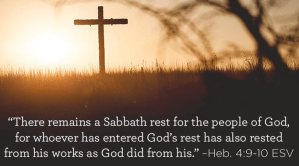
Since therefore it remains for some to enter it, and those who formerly received the good news failed to enter because of disobedience, again he appoints a certain day, “Today,” saying through David so long afterward, in the words already quoted, “Today, if you hear his voice, do not harden your hearts.” For if Joshua had given them rest, God would not have spoken of another day later on. So then, there remains a Sabbath rest for the people of God, for whoever has entered God’s rest has also rested from his works as God did from his. Let us therefore strive to enter that rest, so that no one may fall by the same sort of disobedience.
Notice that the author speaks of “the rest” as something the people of God are to enter into, and former believers did not enter into it because of disobedience. Now if the disobedience spoken of is that which the first generation in the wilderness commited, (and it was) they certainly entered the state of death, some quite speedily. So the disobedient entered death, without experiencing rest, and therefore we cannot equate this death with the rest we think of in some of the other passages we know in the Word.
So what in tarnation is going on?
The rest is restricted from those who have a hardened heart, as the author appeals to Psalm 95, speaking of those who were disobedient, and encouraging those in the present generation to “not harden thier hearts” as those in the past had. The heart is beating blood, producing an existence on this earth, yet it is the very spiritual hardeneing of the heart that restricts the people of God from the rest that they are called to.
Ps 95 speaks of the rebellious generation, with a scathing description of thier heart condition and God’s response.
Psalm 95:7c-11
… Today, if you hear his voice, do not harden your hearts, as at Meribah, as on the day at Massah in the wilderness, when your fathers put me to the test and put me to the proof, though they had seen my work. For forty years I loathed that generation and said, “They are a people who go astray in their heart, and they have not known my ways.” Therefore I swore in my wrath, “They shall not enter my rest.”
Notice the heart condition as it relates to the rest provided. They had seen God’s deliverance and continued to test Him. God will not provide the rest to those who constantly test Him, rebel against him, and harden thier hearts against Him. And why should He? He is the One who is experiencing the Sabbath rest of a complete salvation provided to His people. It is open to the people of God to also partake of this rest, but it is contingent on a soft heart, a teachable heart, a pliable heart.
The catch is that a soft heart requires diligent guarding and instruction. Diligent care and feeding. Diligent reception of the Word of God, for the author immediately enters into the importance of the Word in the next few verses in Hebrews.
Hebrews 4:12-13
For the word of God is living and active, sharper than any two-edged sword, piercing to the division of soul and of spirit, of joints and of marrow, and discerning the thoughts and intentions of the heart. And no creature is hidden from his sight, but all are naked and exposed to the eyes of him to whom we must give account.
Notice the power of the Word of God available to those who diligently interact with it. The Word will reveal the thoughts and intentions of the heart, and will remind us of our exposure in His sight. We are all exposed to His eyes, and we must all give account.
Would it not be the wisest of all instruction for the author to exhort us to strive to enter into the rest that is avaialable for the believer, the Sabbath “rest” of the salvation they already possess? To understand His grace requires our minds, hearts and wills to be transformed by the Spirit and the Word. But this does not happen passively, as if we are simply sponges that water is poured upon. No, it is more like a miner digging for truth, seeking to know the One True God who is truly mysterious and glorious.
There really isnt any paradox with this verse any more. The truth is obvious. Seek the rest that is available in this earthly pilgrimage by diligently seeking out the heavenly One who provides this rest. A rest that supplies a confidence in the Living God, that His provision for us through His Son is more than sufficient for not only our eternal salvation, but for the day to day experience of knowing our God.
Could we admit that the greater our efforts, our striving, the deeper the rest we may experience? Has any of my readers experienced this blessing? Let me know in the comments. I would love to hear from you.
In conclusion, as believers, we are simply reacting to His tremendous grace by keeping, guarding and opening our heart for Him, as an expression of a thankful and revived life.
He is good, and He is good all the time.
Thanks again for coming to visit. I hope you found something of interest in this post and would appreciate a comment, to begin a discussion. If you know someone this blog may bless (or challenge), send them a link, so they may join us in our discussion
Jesus in the Old Testament is a series of posts that will offer my readers a chance to consider pictures or shadows of Jesus in the Old Testament. As mentioned in the introduction to this series, some may be obvious, some may be not so obvious, and some may simply be a facet of the Lord those reading may not have considered previously.
I hope as we venture through this series, we will see the Lord in many wonderful pictures throughout the Old Testament.
SEEING JESUS IN
ADAM
HIS IMPACT
Genesis 3 17 And to Adam he said, “Because you have listened to the voice of your wife and have eaten of the tree of which I commanded you, ‘You shall not eat of it,’ cursed is the ground because of you; in pain you shall eat of it all the days of your life; 18 thorns and thistles it shall bring forth for you; and you shall eat the plants of the field. 19 By the sweat of your face you shall eat bread, till you return to the ground, for out of it you were taken; for you are dust, and to dust you shall return.”
Romans 5 12 Therefore, just as sin came into the world through one man, and death through sin, and so death spread to all men because all sinned–
Adam’s decision to eat of the fruit brought about an escalating impact upon every descendant of his. The impact of his decision to eat of the fruit is still with us, evident in every child born, every death in nature, every argument and fight we witness or take part in! Jesus’ impact is also with us every day, evident in the new life He provides to those who seek Him, the peacemakers and humble servants He has raised up, those believers who are walking with Him. His impact will be of greater impact than Adam’s for He is the Lord of All.
Thanks again for coming to visit. I hope you found something of interest in this post and would appreciate a comment, to begin a discussion. If you know someone this blog may bless (or challenge), send them a link, so they may join us in our discussion.
As we come to a close of “Old Testament Messianic Prophecies”, I would like to offer my readers a series of posts focused on how the Bible describes the True and Living God. My hope is that this series will offer my readers a chance to consider the names, characteristics and descriptions of our God in the Word.
I do not claim to have found every possible name, combination of names, description, or characteristic of the Lord in this series. Having said this, I have found many more than I initially thought possible. The Word is truly rich with descriptions of the Living God, and this effort of searching in the Word was quite illuminating. He truly is the ultimate subject of the Word, and His revelation of self-descriptions, or the accolades offered Him by His priests, prophets, kings apostles and faithful truly was a blessing.
I will present the names in a very similar fashion as the Old Testament Prophecies series, one name/description/characteristic per post, for an opportunity for my readers to meditate on during the day.
Of course I would love to hear of your favorite name, characteristic or description of the Living God. Please leave me a comment, and I will include it in the list!
#
Name/Description/Characteristic
Bible Verse(s)
Commentary
Thanks again for coming to visit. I hope you found something of interest in this post and would appreciate a comment, to begin a discussion. If you know someone this blog may bless (or challenge), send them a link, so they may join us in our discussion.
Jesus in the Old Testament is a series of posts that will offer my readers a chance to consider pictures or shadows of Jesus in the Old Testament. As mentioned in the introduction to this series, some may be obvious, some may be not so obvious, and some may simply be a facet of the Lord those reading may not have considered previously.
I hope as we venture through this series, we will see the Lord in many wonderful pictures throughout the Old Testament.
SEEING JESUS IN
ADAM
TOOK HIS WIFE’S SIN UPON HIMSELF
Genesis 3 6 So when the woman saw that the tree was good for food, and that it was a delight to the eyes, and that the tree was to be desired to make one wise, she took of its fruit and ate, and she also gave some to her husband who was with her, and he ate.
1 Peter 2 24 He himself bore our sins in his body on the tree, that we might die to sin and live to righteousness. By his wounds you have been healed.
Adam took the fruit from his wife, from his wife who had already fallen into death. I often wonder if Adam recognized death in Eve as he took the fruit, and joined her in her sin. We know that the Messiah recognized sin in His bride, and not only joined us in death, but was delivered, resurrected out of death and is bringing His wife out of the death we wallow in!
Thanks again for coming to visit. I hope you found something of interest in this post and would appreciate a comment, to begin a discussion. If you know someone this blog may bless (or challenge), send them a link, so they may join us in our discussion.
Hebrews 13:15 Through him then let us continually offer up a sacrifice of praise to God, that is, the fruit of lips that acknowledge his name.
It was a Friday, early in the morning when the Lord reminded me of a phrase in the Word. Even as I rehearsed it out loud, having my walk about, it seemed to be as if I had never considered it before, almost as if I had never read it. (I can assure my readers that I have read it many times in the past.)
Nevertheless, I couldn’t reconcile the idea of sacrifice with praise, for in my mind, my primary association with sacrifice is that of giving something up that has personal value, yet not from any internal desire, but from an external influence. For example, I don’t sacrifice a meal unless I have to (Doctors orders) , or at the very least, believe some resultant benefit will come from it (a personal fast for concentrating on God’s will, or a period of prayer).
Another tripping thought for me was the idea that sacrifice involves a death, as in the Old Testament Levitical system with the slaughter of bulls, goats and sheep. In our modern world, this does not literally occur in the Christian life, and I had another disconnect in my thinking regarding this verse.
It just didn’t make sense for me, and, as a paradox is wont to do, it took me outside of my usual way of thinking.
So for the remainder of the day and into the weekend, this nagging disconnect kept floating around in my mind. Until I mixed in the human experience, (and not just a logical analysis of the verse) did it become apparent as to what the author was describing.
Consider the background of the epistle. Groups of Hebrew’s were being ostracized, persecuted and rejected by their religious culture, and the apostle was addressing their condition. They seemed to be at the edge of apostacy, willing to jump for it was simply too hard for some.
So what does the apostle challenge this group with. Sacrifice. A very familiar concept for these believers, for they grew up in a culture of sacrifice, or giving up something to the God of their fathers. Only, sly apostle as he was. this sacrifice was something that would not only honor the Lord Jesus, but also give them strength to endure.
For you see, as the believer decides to praise the Father and Son, specifically in the midst of trials and tribulations, when the situation is difficult, disappointing and even discouraging, an active decision to praise when he or she doesn’t feel like it, that is the sacrifice the apostle is admonishing these believers to enter into.
Many believers who may be reading this may consider this to be Christianity 101. This is true, for we are to praise Him for His glorious working in our lives when we see it and don’t see it, when we feel it and when we don’t feel it. So true, but this verse and the message it had for me that weekend produced a memory that I can tuck away in a corner of my mind for future times of difficulty.
The Lord is faithful, and I trust that He will remind me of this “paradox” the next time a period of difficulty arrives at my doorstep.
For that I praise Him!
Thanks again for coming to visit. I hope you found something of interest in this post and would appreciate a comment, to begin a discussion. If you know someone this blog may bless (or challenge), send them a link, so they may join us in our discussion
Jesus in the Old Testament is a series of posts that will offer my readers a chance to consider pictures or shadows of Jesus in the Old Testament. As mentioned in the introduction to this series, some may be obvious, some may be not so obvious, and some may simply be a facet of the Lord those reading may not have considered previously.
I hope as we venture through this series, we will see the Lord in many wonderful pictures throughout the Old Testament.
SEEING JESUS IN
ADAM
STOOPED TO EVE’S CONDITION
Genesis 3 6 So when the woman saw that the tree was good for food, and that it was a delight to the eyes, and that the tree was to be desired to make one wise, she took of its fruit and ate, and she also gave some to her husband who was with her, and he ate.
Philippians 2 6 who, though he was in the form of God, did not count equality with God a thing to be grasped, 7 but emptied himself, by taking the form of a servant, being born in the likeness of men. 8 And being found in human form, he humbled himself by becoming obedient to the point of death, even death on a cross.
Adam, in joining Eve in her decision to eat of the forbidden fruit, and knowing the word of God in relation to this tree, joined Eve in her condition of death. Jesus also stooped to our condition of death, yet His stooping to our condition was temporary and for the lifting of our lives out of the pit of death. Praise His name!
Thanks again for coming to visit. I hope you found something of interest in this post and would appreciate a comment, to begin a discussion. If you know someone this blog may bless (or challenge), send them a link, so they may join us in our discussion.
Jesus in the Old Testament is a series of posts that will offer my readers a chance to consider pictures or shadows of Jesus in the Old Testament. As mentioned in the introduction to this series, some may be obvious, some may be not so obvious, and some may simply be a facet of the Lord those reading may not have considered previously.
I hope as we venture through this series, we will see the Lord in many wonderful pictures throughout the Old Testament.
SEEING JESUS IN
ADAM
GENTILE BRIDE
Genesis 3 20 The man called his wife’s name Eve, because she was the mother of all living.
Ephesians 5 25 Husbands, love your wives, as Christ loved the church and gave himself up for her, 32 This mystery is profound, and I am saying that it refers to Christ and the church.
Both Adam and Eve were technically non-Jews, and therefore “of the nations” in the mind of the first century believer. With this point of view, Eve may be considered a gentile bride for Adam. The church is made up of Jews and Gentiles, and may be thought of as one entity, one person that has no ethnic distinction, much like Eve.
Thanks again for coming to visit. I hope you found something of interest in this post and would appreciate a comment, to begin a discussion. If you know someone this blog may bless (or challenge), send them a link, so they may join us in our discussion.
Although he was a son, he learned obedience through what he suffered. And being made perfect, he became the source of eternal salvation to all who obey him,
In addressing this couplet of verses, in relation to conditional security, we need to address the New Testament understanding of what it means to believe in Jesus the Messiah. You see, the verse speaks of obeying Him, and some may consider this obedience the initial act of faith, and there is truth in that statement. The initial act of faith was an obedient act of the will of the sinner to a call of grace, to a call from the Crucified One.
Yet if we look at the tense of the verb, we find the following. If you notice on the right, BlueLetterBible.org provides a bubble which includes the parsing of the verb. (The link will take you directly to the page being referred to.)
On the left is a listing defining what these letters in the bubble refer to.
For example, the first letter, “V” teaches us that the word “obey” is a verb. The second letter speaks of the tense of the verb. In English, we think of past present and future tense. The Greek word translated as obey is in the present tense.
For the most part, as the clip on the right teaches, this is directly equivalent to our present tense, and is translated as such in this verse.
So in review, let’s consider what we have learned.
The verse does not say
…he became the source of eternal salvation to all who obeyed him. (As in referring to the initial obedience of faith)
Nor does it say
…he became the source of eternal salvation to all who believe him. (Though if we understand to believe is to obey, we could without conflict understand it as such.)
The issue is current obedience.
Where are you at in hearing the voice of God in your life. Is He speaking about something specific, that needs to obeyed? Is He allowing a period of quiet in you life, simply to provide you time to put into practice the teachings you know to be true and faithful.
The Christian life is a life of obedience, discipleship and death to self on a daily basis. Obedience is synonymous with faith, and is simply the path to life.
Do you believe?
Thanks again for coming to visit. I hope you found something of interest in this post and would appreciate a comment, to begin a discussion. If you would like to receive daily posts from Considering the Bible, click on the “Follow” link below
Jesus in the Old Testament is a series of posts that will offer my readers a chance to consider pictures or shadows of Jesus in the Old Testament. As mentioned in the introduction to this series, some may be obvious, some may be not so obvious, and some may simply be a facet of the Lord those reading may not have considered previously.
I hope as we venture through this series, we will see the Lord in many wonderful pictures throughout the Old Testament.
SEEING JESUS IN
ADAM
BEGOTTEN OF GOD
Luke 3 38 the son of Enos, the son of Seth, the son of Adam, the son of God.
Acts 13 33 this he has fulfilled to us their children by raising Jesus, as also it is written in the second Psalm, “‘You are my Son, today I have begotten you.’
To be considered the son of God was Adam’s distinct privilege, until Jesus arrived on the scene, and through His death and resurrection, confirmed for all of humanity that He is the Son!
Thanks again for coming to visit. I hope you found something of interest in this post and would appreciate a comment, to begin a discussion. If you know someone this blog may bless (or challenge), send them a link, so they may join us in our discussion.
Jesus in the Old Testament is a series of posts that will offer my readers a chance to consider pictures or shadows of Jesus in the Old Testament. As mentioned in the introduction to this series, some may be obvious, some may be not so obvious, and some may simply be a facet of the Lord those reading may not have considered previously.
I hope as we venture through this series, we will see the Lord in many wonderful pictures throughout the Old Testament.
SEEING JESUS IN
ADAM
ENTERED WORLD IN SINLESS STATE
Genesis 1 31 And God saw everything that he had made, and behold, it was very good. And there was evening and there was morning, the sixth day.
2 Corinthians 5 21 For our sake he made him to be sin who knew no sin, so that in him we might become the righteousness of God.
For Adam, He came into existence in a state of innocence, brought into a life ignorant to evil, sin and wrong doing. For the Lord, He entered the world in a sinless state, and maintained this state throughout His life of sacrifice and offering.
Thanks again for coming to visit. I hope you found something of interest in this post and would appreciate a comment, to begin a discussion. If you know someone this blog may bless (or challenge), send them a link, so they may join us in our discussion.
What is a paradox and why would we find paradox in the Word? Let’s answer the first question first. I found a great explanation of the history of the word “paradox” on the Merriam Webster website.
The ancient Greeks were well aware that a paradox can take us outside our usual way of thinking. They combined the prefix para- (“beyond” or “outside of”) with the verb dokein (“to think”), forming paradoxos, an adjective meaning “contrary to expectation.” Latin speakers used that word as the basis for a noun paradoxum, which English speakers borrowed during the 1500s to create paradox.
So, based on this description of a paradox, when we venture into understanding the Word, we sometimes come up against concepts or ideas the Biblical authors challenge us with that are “contrary to expectation”. They may seem to be contradictory, or even include an incongruity, yet if we are careful in our reading, I believe the Word provides resolutions, or at the very least dimensions of reality that is beyond our natural understanding.
A recent occurrence began my thinking of this series of posts on paradoxes.
I was enjoying a Bible study with a new group of friends when I challenged a sweet Christian lady to study a difficult topic in the Word, and claimed that the results of the study may “twist her mind” a bit. (Granted the phraseology of “twisting her mind” may have been a poor choice!) She questioned me why she should study something that would cause her problems in her thinking. I replied with silence and the study continued, but I would challenge my readers to accept difficult passages, for my readers to wrestle with the Scripture.
If, as believers claim that the Word is true, we ought to seek to come into conformance with the Authors intent and message and not to conform the Word into our doctrinal corner of theology. Granted this is difficult to enter into and it shall upset the proverbial applecart in many believers minds and faith, yet is this not what we are called into, a life of repentance (changing of the mind) in order to grow into a mature believer?
As I read the gospels, I see twelve men that were constantly challenged in their worldview. If we could chat with Peter or James, I am sure they would admit to much confusion as they were listening to the Lord. Through their desire to “get it”, they continued with Him, in the midst of many misunderstandings and questions.
As I am reading through the word, or as the Lord brings passages to mind, I will offer some paradoxes for your consideration. Hope this series is of interest, and that out of this series, believers would be dig deeper into the Word He has provided us.
Thanks again for coming to visit. I hope you found something of interest in this post and would appreciate a comment, to begin a discussion. If you know someone this blog may bless (or challenge), send them a link, so they may join us in our discussion
Jesus in the Old Testament is a series of posts that will offer my readers a chance to consider pictures or shadows of Jesus in the Old Testament. As mentioned in the introduction to this series, some may be obvious, some may be not so obvious, and some may simply be a facet of the Lord those reading may not have considered previously.
I hope as we venture through this series, we will see the Lord in many wonderful pictures throughout the Old Testament.
SEEING JESUS IN
ADAM
MIRACULOUS BIRTH
Genesis 2 7 then the LORD God formed the man of dust from the ground and breathed into his nostrils the breath of life, and the man became a living creature.
Luke 1 27 to a virgin betrothed to a man whose name was Joseph, of the house of David. And the virgin’s name was Mary. 31 And behold, you will conceive in your womb and bear a son, and you shall call his name Jesus.
Both Adam and Jesus were “born” miraculously.
Granted, Adam was created out of the dust of the ground, but even Eve was not created in such a mysterious way. Likewise Jesus, in His humanity was created in the womb of a virgin, miraculously as no other man has been created
Thanks again for coming to visit. I hope you found something of interest in this post and would appreciate a comment, to begin a discussion. If you know someone this blog may bless (or challenge), send them a link, so they may join us in our discussion.







 Considering the Bible