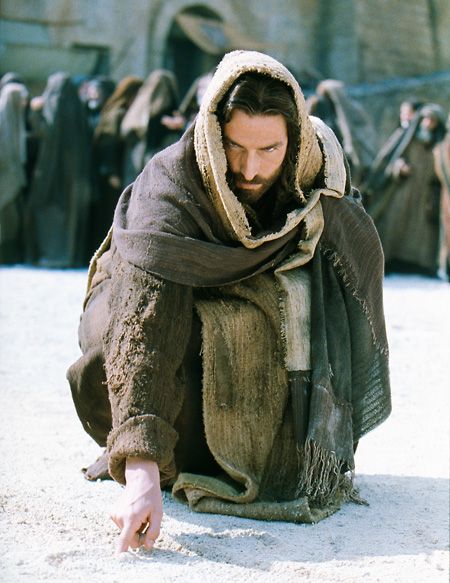

Brother
Thanks for taking the time to respond to my blog, “Did Jesus go to HELL?” I had been looking forward to your comments since Monday. Many of your points were well stated and caused me to look at some of the post again.
I would like to clarify a few items. I may have said or written something that was not clear and I would like to correct that. With that said, I have taken your comments (in blue) and inserted my thoughts for your consideration.
With all due respect. It is written… you have a copy of scripture. I read some of it to you when we talked. I believe in a plain normal grammatical historical plenary interpretation
- Plain
- When you mention plain interpretation of scripture, I assume that you are referring to a literal reading of scripture. In many portions of the Word, I would agree with you. Some passages give me pause though.
- When Acts 2 speaks of tongues of fire, would you understand it to be literal fire?
- I am sure you do not consider the Messiah to be a door, or a sheep, or a light
- I think the apostles and prophets spoke to their audience in a manner that would communicate clearly to them, in their culture, language, social structure and religion. It is our labor to try to decipher their message from that environment, and not to read the Word as if it has been written for 21st century American believers. That just seems a bit provincial.
- Normal
- I looked up normal for a definition and found
- conforming to the standard or the common type; usual; not abnormal; regular; natural
- I would appreciate a little clarification on what you mean when you say normal. It’s almost as if the other terms in this description is defining your “normal” reading of Scripture
- I looked up normal for a definition and found
- Grammatical
- Definition for grammatical
- Of or relating to grammar, Conforming to the rules of grammar:
- I assume you are describing your method of Bible interpretation/understanding as being different than my efforts. I tend to analyze a passage through word studies, the flow of the sentence structure and the context of the sentence/verse/paragraph I am studying. I think I am on the same page as you on this.
- Definition for grammatical
- Historical
- I believe the historical context of the passage when spoken/written is critical to understanding the message. As an example, when Jesus spoke of thine eye being evil, I used to think He was referring to a wickedness of some sort.
- When you mention plain interpretation of scripture, I assume that you are referring to a literal reading of scripture. In many portions of the Word, I would agree with you. Some passages give me pause though.
Matt 6:23
but if your eye is bad, your whole body will be full of darkness. If then the light in you is darkness, how great is the darkness!
What does it mean “if your eye is bad”? Could it refer to a murderous intent, wicked thoughts or evil schemes? I never really understood this verse until I checked the historical background in Deuteronomy 15:9
Deuteronomy 15:9
Take care lest there be an unworthy thought in your heart and you say, ‘The seventh year, the year of release is near,’ and your eye look grudgingly on your poor brother, and you give him nothing, and he cry to the LORD against you, and you be guilty of sin.
Deuteronomy refers to “…your eye look grudgingly”. The most common translation of this hebrew word is “evil”.
When I read Matthew 6:23, I assumed I understood the phrase “if your eye is bad”. But when I studied the historical background of the phrase, and how it relates to the audience Jesus was immediately addressing, the application for my life becomes so much clearer. So I would heartily agree that the historical interpretation of any passage is critical
- Plenary
- If by plenary, you mean that the canon of Scripture is complete (plenary = full), I would also agree.
If we don’t believe the scripture itself when read, how can we expound upon deeper truth?
I think we need to understand the Scripture (as much as possible) in order to believe it. I consider belief/faith an action word Gal 5:6 – For in Christ Jesus neither circumcision nor uncircumcision counts for anything, but only faith working through love.
and not mental consent, and therefore the day to day decisions I make, exercising my faith/belief has to come from an understanding of the message God has provided.
If Christ went to the grave and that’s it. We are still dead in trespasses and sins.
I do not recall saying that Christ went simply to the grave. If I did, I spoke wrongly. What I was considering in the blog post was whether the Messiah went to hell, ie the place of torment. The few NT passages that seem to speak of the Messiah going to hell are not convincing to me in my study.
What is the point as Paul said in 1 Cor 15? The early church got it right historically as I told you Saturday. I stand with them even though the “Soli Scripta” Scripture alone speaks for itself.
Sola Scriptura is what I am trying to do as I study. I seek to find how the Scripture interprets itself, and in the blog, I made mention of a few Old Testament passages that may supply hints as to what the apostles were pointing to.
An example was the “lowest parts of the earth” phrase that Paul used in Ephesians. The OT supplied three possibilities for understanding what Paul meant when he wrote “the lower parts of the earth”
Regarding the resurrection (1 Corinthians 15) I feel you still consider my thoughts to be of denial of the resurrection. I am not sure where you get that from, but let me assure you that I believe in the bodily resurrection more now than when I first believed.
What is the point of judgment if you are going to be forgiven anyways?
Judgement (krino and its compunds – anakrino, diakrino ) have many shades of meaning, from simply to “discern” all the way to “condemn.” To judge (krites and its compounds – dikastēs, kritērion) defines the one judging.
You surely will agree that at the believer’s judgement, condemnation is not considered. Also, we who have been forgiven, will be judged.
| New Testament (Greek) for “judge” | |||
| G350 | ἀνακρίνω | anakrinō | examine, judge, ask question, search, discern |
| G1252 | διακρίνω | diakrinō | doubt, judge, discern, contend, waver, misc |
| G1348 | δικαστής | dikastēs | judge |
| G2919 | κρίνω | krinō | judge, determine, condemn, go to law, call in question, esteem, misc |
| G2922 | κριτήριον | kritērion | to judge, judgment, judgment seat |
| G2923 | κριτής | kritēs | judge, Judge |
New Testament (Greek) for “condemn” | |||
ἀκατάγνωστος | akatagnōstos | cannot be condemned | |
ἀκατάκριτος | akatakritos | uncondemned | |
αὐτοκατάκριτος | autokatakritos | condemned | |
καταγινώσκω | kataginōskō | condemn, blame | |
καταδικάζω | katadikazō | condemn | |
κατάκριμα | katakrima | condemnation | |
κατακρίνω | katakrinō | condemn, damn | |
κατάκρισις | katakrisis | condemnation, condemn | |
κρίμα | krima | judgment, damnation, condemnation, be condemned, go to law, avenge | |
κρίνω | krinō | judge, determine, condemn, go to law, call in question, esteem, misc | |
κρίσις | krisis | judgment, damnation, accusation, condemnation | |
ὑπόκρισις | hypokrisis | hypocrisy, dissimulation, condemnation | |
καταδίκη | katadikē | sentence of condemnation | |
Judgement has an implication of separation, or even of making a determination between right and wrong. Katakrino is the term that strictly refers to condemnation, and at that, I am not sure if there is a time element associated with it. By that I mean, the word itself simply means condemn, not necessarily condemn forever. The context may supply that information, but I do not see where the word itself carried a time element.
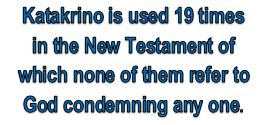 As a matter of fact, it looks like men do a lot of the condemning (ie the men of Ninevah, the Queen of the South, even ourselves (Rom 2:1, 14:23)). Other occurrences in the New Testament speak of the Messiah receiving condemnation. One time the Messiah spoke on condemning, but that He would not condemn the sinner. He is something else, eh? (John 8:10-11)
The list may be found at the end of this post (if of interest).
(As I am studying this concept of judgment, I have found a much larger body of data in the New Testament than first reviewed. In the interest of brevity, I will leave the above mini-study as is, know that it is incomplete, and I will return to it.)
So When Jesus said it was better for Judas not to have been born, (Matthew 26:24, Mark 14:21) woe doesn’t have any significance if there is no consequences for betraying the Son of the living God.?
I am going to assume the consequence you are referring to above is Eternal Conscious Torment (ECT)
Matthew 26:24
The Son of Man goes as it is written of him, but woe to that man by whom the Son of Man is betrayed! It would have been better for that man if he had not been born.”
Mark 14:21
For the Son of Man goes as it is written of him, but woe to that man by whom the Son of Man is betrayed! It would have been better for that man if he had not been born.”
I understand your point, but note that the Messiah said “it would have been better” for Judas to not exist than to be born, not “Judas will burn in hell forever”
“Better” is a comparative term. If I said “I am better than Joe” this doesn’t mean I am equal to the great apostle Paul. Better simply compares to conditions, but it does not supply the extent of the difference between the two things being compared. In other words, Judas destiny was defined as being less than the condition of existing (ie being born). A negative condition.
So, if the Scriptures teaches ECT, Jesus may have been hinting at Judas’ destiny. (A negative condition!)
If He meant something else, (like living and dying under the guilt of condemning a just man), that is also possible. (Also a negative condition!)
Both of these destinies (I am sure there are additional destinies that may be possible for Judas) for Judas would surely fit the description Jesus provides of “not existing”
At this point in my studies, to demand ECT is taught in this passage would be considered eisegesis. The verse does not clearly inform us of Judas destiny, other than being a negative condition.
Or blasphemy against the Holy Spirit?
One verse in the New Testament speaks of blasphemy against the Spirit
Matthew 12:31
Therefore I tell you, every sin and blasphemy will be forgiven people, but the blasphemy against the Spirit will not be forgiven.
There are multiple ways to understand this passage. I will address this passage in a future post as a separate topic.
Or the woes of Matthew 23.
Greater condemnation, v.33-how will they escape the condemnation of Hell?
I guess you don’t believe what Jesus said in v.35 either?
No purgatory in Scripture.
No escaping the judgment of God having received the knowledge of the truth( Hebrews 10:26-31).
If you believe otherwise with all due respect I pity you.
I appreciated this brothers challenge to my thinking, and wish him the best. Since our discussion, he has found something in me that is unacceptable to associate with. I have reached out to him a number of times, but he is a busy family man and was not available. I hope that in the near future, I will have the opportunity to find peace in our relationship.
If you have comments or I have missed an imprtant concept, ignored a Bible passage or represented a teaching incorrectly, let me know. Look down a few inches and you will find a convenient contact form for you to use!


Passages containing the greek word “Katakrino”
| Matt 12:41 | The men of Nineveh shall rise in judgment with this generation, and shall condemn G2632 it: because they repented at the preaching of Jonas; and, behold, a greater than Jonas is here. |
| Matt 12:42 | The queen of the south shall rise up in the judgment with this generation, and shall condemn G2632 it: for she came from the uttermost parts of the earth to hear the wisdom of Solomon; and, behold, a greater than Solomon is here. |
| Matt 20:18 | Behold, we go up to Jerusalem; and the Son of man shall be betrayed unto the chief priests and unto the scribes, and they shall condemn G2632 him to death, |
| Matt 27:3 | Then Judas, which had betrayed him, when he saw that he was condemned, G2632 repented himself, and brought again the thirty pieces of silver to the chief priests and elders, |
| Mark 10:33 | Saying, Behold, we go up to Jerusalem; and the Son of man shall be delivered unto the chief priests, and unto the scribes; and they shall condemn G2632 him to death, and shall deliver him to the Gentiles: |
| Mark 14:64 | Ye have heard the blasphemy: what think ye? And they all condemned G2632 him to be guilty of death. |
| Mark 16:16 | He that believeth and is baptized shall be saved; but he that believeth not shall be damned. G2632 |
| Luke 11:31 | The queen of the south shall rise up in the judgment with the men of this generation, and condemn G2632 them: for she came from the utmost parts of the earth to hear the wisdom of Solomon; and, behold, a greater than Solomon is here. |
| Luke 11:32 | The men of Nineve shall rise up in the judgment with this generation, and shall condemn G2632 it: for they repented at the preaching of Jonas; and, behold, a greater than Jonas is here. |
| John 8:10 | When Jesus had lifted up himself, and saw none but the woman, he said unto her, Woman, where are those thine accusers? hath G2632 no man condemned G2632 thee? |
| John 8:11 | She said, No man, Lord. And Jesus said unto her, Neither do G2632I condemn G2632 thee: go, and sin no more. |
| Rom 2:1 | Therefore thou art inexcusable, O man, whosoever thou art that judgest: for wherein thou judgest another, thou condemnest G2632 thyself; for thou that judgest doest the same things. |
| Rom 8:3 | For what the law could not do, in that it was weak through the flesh, God sending his own Son in the likeness of sinful flesh, and for sin, condemned G2632 sin in the flesh: |
| Rom 8:34 | Who is he that condemneth? G2632 It is Christ that died, yea rather, that is risen again, who is even at the right hand of God, who also maketh intercession for us. |
| Rom 14:23 | And he that doubteth is damned G2632 if he eat, because he eateth not of faith: for whatsoever is not of faith is sin. |
| 1Cor 11:32 | But when we are judged, we are chastened of the Lord, that we should G2632 not be condemned G2632 with the world. |
| Heb 11:7 | By faith Noah, being warned of God of things not seen as yet, moved with fear, prepared an ark to the saving of his house; by the which he condemned G2632 the world, and became heir of the righteousness which is by faith. |
| James 5:9 | Grudge not one against another, brethren, lest ye be condemned: G2632 behold, the judge standeth before the door. |
| 2Peter 2:6 | And turning the cities of Sodom and Gomorrha into ashes condemned G2632 them with an overthrow, making them an ensample unto those that after should live ungodly; |
 When the Master arrived on earth, He twisted everyone’s concept of God.
 Well, I told him what I thought and he seemed to consider my answer with some suspicion, almost as if I had my head on backwards. Don’t get me wrong – I appreciate the challenge, if only for my own learning and research. So off we go to the Word to consider passages that use the same terminology. Scripture interprets Scripture and we have to remember that the Master came to earth to fill the three offices of Prophet, Priest and King. As the preeminent Prophet, He was anchored in Old Testament thought and speech, communicating to an audience steeped in the Sacred Writings.
 First off, as a younger believer, (hey – I’m still young Jerry!) when I saw these type of Old Testament verses, I would consider them to all be referring to one event, and that event was the same event that Jesus prophesied of – the end of the world. I really didn’t consider the context of the passages because it just seemed so obvious. Maybe I was wrong. (Hint – Yup, I was wrong!)
 Did Jesus go to Hell?
 When Paul mentions that He descended into the lower parts of the earth, is it a safe assumption that he meant hell? I taught that for decades and assumed it was without fault. After all, what else could he mean?
 Based on the passage in Psalm 139:15, the lowest parts of the earth, are referring to the womb. This is an incredible passage in light of Ephesians.
 Accountable to Church Leadership?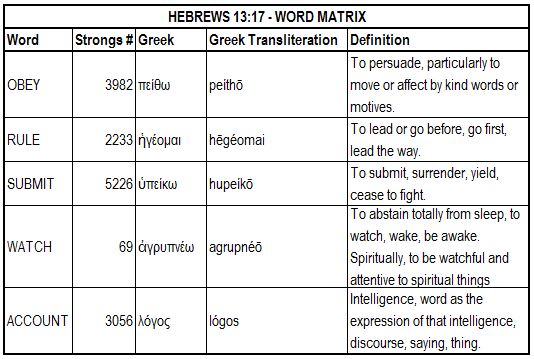
 The Christian life is a life of submission and obedience to the Lord Jesus. It was a while back, when my wife and I were in a Bible study, discussing various topics, when the subject of accountability came up. Now, as a Christian, I have always been taught that the Christian life is a life of submission and obedience to the Lord Jesus, and by association, one of submission to authority found in church officials/employees/ministers. Many passages speak of mutual submission (Eph. 5:21 comes to mind) and of obedience to men placed into church offices.
 help us to know the heart of God better?
 To give all y’all some background on this, I am presently attending a great Sunday School Class where the majority of attendees subscribe to a dispensational framework of understanding future events. I have let all know that I have left that teaching, and they have been gracious to allow me to remain in the class.
 The Strongs concordance states “vanish away” = ἀφανισμός aphanismós, af-an-is-mos’; from
 timid pup, hiding in the back of the cage, a bit fearful and very quiet, but she caught my wife’s eye, and we brought her home. That was about three years ago.
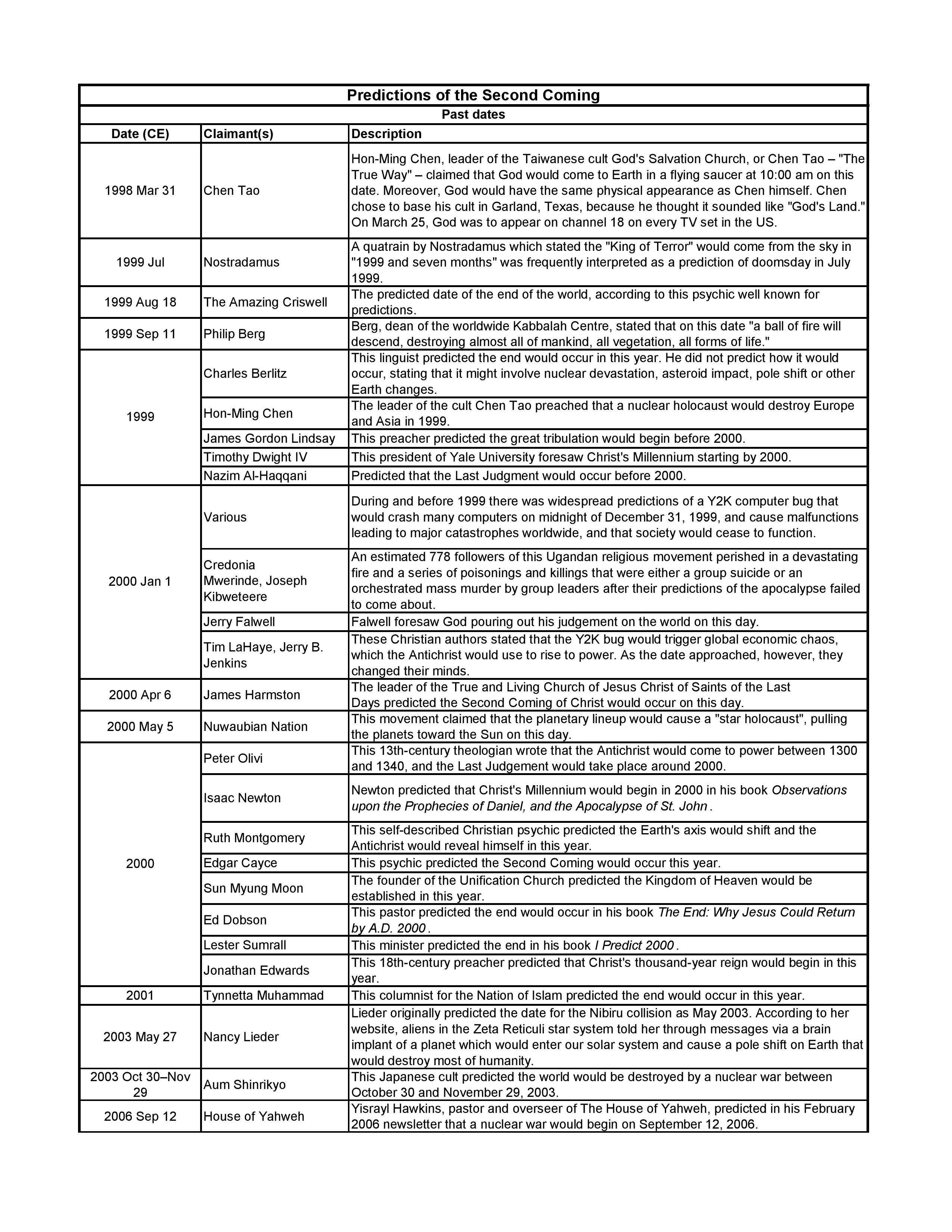
 A few days back I was browsing the internet, that great stealer of time and thought, and came across a list of known “End of the World” prophecies that have hounded the church since the very earliest days of the church.
 The end of the world may be centuries away. I can guaran-dog-tee you are gonna meet God in the next few decades (or less!) Don’t let the sensational fear mongers grab your attention. Daily be in touch with Jesus, seek to obey His will, walk humbly with Him and grow in the knowledge of His ways. Note that if you are not growing in the knowledge of His ways, you can be certain you are regressing and falling away.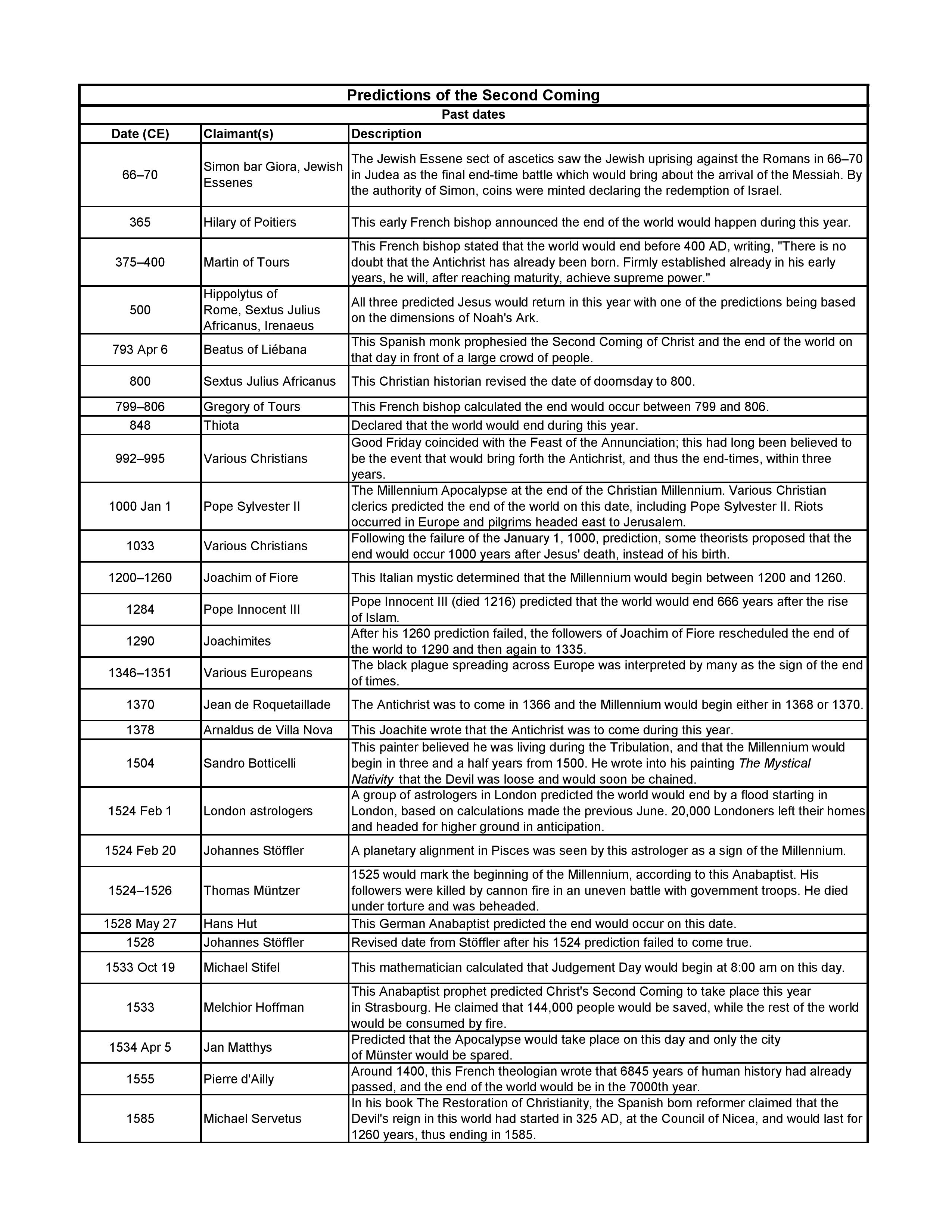









 When I was younger my brother and I were playing softball with an older teenager (Scott and I were 8 and 12 at the time.) The batter was a 19 yr old fella that stayed with us. Lets call him Hank.
 This exception occurs when he/she lives a life of pornography, impurity or greed and professes of being a believer.
 How doth thee teach?



 Imagine the first time Jesus read this package of verses, and realized it was written specifically to Him. The entire Old Testament was a direct message to the Son and contained depths we will never understand, since the Word is a relational, personal and intimate message between the Father and Son.
 Considering the Bible