Recently I have been in discussions with some friends that read my blog fairly consistently and they have, in an effort to understand my beliefs, have baited me by calling me a universalist.
That is fair, since I may not have defined every specific teaching as they may want, most likely due to the fact I honestly haven’t come to a settled persuasion on some of the teaching they may ask about me.
Initially, as I have stated in previous posts, I was surprised with the number of passages that support an evangelical universal reconciliation teaching. Please do not think that this teaching is the same as the “all roads lead to heaven” teaching, which I consider to be blasphemous. There is only one way to the Father, and that is through the Lord Jesus Christ.
With this, I would like to begin delving into some of the New Testament passages Mr. Giles brought to my attention, for your consideration, edification and civil discussion.
Regarding the book itself, I read it in one sitting, not simply because it was under 200 pages, but that it was challenging my thought process and I found it enjoyable reading. If this topic interests you, please pick up a copy. It is well worth your time.
Our sixth blog post will begin with passage 6, Philippians 2:10-11
Passage 6
Philippians 2:10-11
so that at the name of Jesus every knee should bow, in heaven and on earth and under the earth,
and every tongue confess that Jesus Christ is Lord, to the glory of God the Father.
This passage surprised me. Not that every knee should bow and every tongue confess.
No, I have always understood this passage to describe every soul that has ever existed to come to the realization of the Lordship and Deity of Jesus Christ, either joyfully as believers confessing the Lord or grudgingly under compulsion, by those who rejected the Messiah in their lives on earth.
It makes sense and caused no challenge to my general thinking of the afterlife. After all, I was on the “right side” and it wasn’t an issue for me at the time. No cause to research the passage any further, until I picked up Mr. Giles book.
This passage, when considering the translation of the greek word exomologeō within the passage shook my thinking. You see, this greek work is translated as “confess” in our passage, as in
…every knee should bow, in heaven and on earth and under the earth, and every tongueexomologeō that Jesus Christ is Lord.
This word is not the simple word for confess, as in agreeing, or saying the same thing as another. That would be the Greek word homologeō, and I think it is obvious that the last few letters are similar to the word mentioned above. The difference is the beginning of the word, and Paul used our special word here in Philippians instead of the simple word for confess.
So, what’s the big deal Carl?
This word, exomologeō that we find in our passage in Phillippians has the following definition found in Thayers Greek Lexicon. (underline by author)
…..Philippians 2:11 R G L text Tr text WH]; (ἐξ either forth from the heart, freely, or publicly, openly [cf. Winers Grammar, 102 (97)]); active and deponent middle to confess, to profess;
Notice the difference? It isn’t simply confessing. It’s more than that!
Ok – let’s try The NAS New Testament Greek Lexicon
to profess that one will do something, to promise, agree, engage
There is a difference in the reason for the confessing. Notice the first sub – bullet above. To acknowledge openly and joyfully.
Joyfully? What?
I have always understood that those who rejected the Messiah would confess Him as Lord, but under compulsion, and grudgingly. If every tongue confesses joyfully of the Lord Jesus Christ, that messes up my nice tidy eschatology.
Why would someone who hated Jesus his whole life, and at the end, when there is no hope of redemption, no hope of love or mercy, but only eternal fire and conscience eternal torment, why would that person joyfully confess Jesus as Lord?
Paul states that every knees will bow and every tongue joyfully confess (exomologeo) that Jesus Christ is Lord to the glory of God.
What are we to make of this finding?
How good is this good news???
Additional study for those interested!
Consider the use of this Greek word in the New Testament, and see if this definition of “joyfully confess”, fits your previous understanding. Let me know if one or more of these verses “pop” for you. I’ll tell you now – Philippians was a surprise, but a couple more below brought some additional light to the message.
Matthew 3:6: “him in Jordan, confessing their sins.” Matthew 11:25: “Jesus answered and said, I thank thee, O Father, Lord of heaven” Mark 1:5: “the river of Jordan, confessing their sins.” Luke 10:21: “in spirit, and said, I thank thee, O Father, Lord of heaven” Luke 22:6: “And he promised, and sought opportunity to betray him unto them” Acts 19:18: “many that believed came, and confessed, and showed their deeds.” Romans 14:11: “to me, and every tongue shall confess to God.” Romans 15:9: “as it is written, For this cause I will confess to thee among the Gentiles,” Philippians 2:11: “And that every tongue should confess that Jesus Christ is Lord,” James 5:16: ” Confessyour faults one to another, and pray one for another, that” Revelation 3:5: “book of life, but I will confess his name before my”
Thanks for joining and considering the Bible with me. Your thoughts are always welcome, and I look forward to discussing the Word with you.
Recently I have been in discussions with some friends that read my blog fairly consistently and they have, in an effort to understand my beliefs, have baited me by calling me a universalist.
That is fair, since I may not have defined every specific teaching as they may want, most likely due to the fact I honestly haven’t come to a settled persuasion on some of the teaching they may ask about me.
Initially, as I have stated in previous posts, I was surprised with the number of passages that support an evangelical universal reconciliation teaching. Please do not think that this teaching is the same as the “all roads lead to heaven” teaching, which I consider to be blasphemous. There is only one way to the Father, and that is through the Lord Jesus Christ.
With this, I would like to begin delving into some of the New Testament passages Mr. Giles brought to my attention, for your consideration, edification and civil discussion.
Regarding the book itself, I read it in one sitting, not simply because it was under 200 pages, but that it was challenging my though process and I found it enjoyable reading. If this topic interests you, please pick up a copy. It is well worth your time.
Our fifth blog post will begin with passage 5, Colossians 1:14, 19-20. Mr Giles provides a very good introduction to the passage and supplies points that I had never considered before. I do hope you will take a few minutes to consider this passage with me.
Passage 5
Colossians 1:14, 19-20
in whom we have redemption, the forgiveness of sins.
For in him all the fullness of God was pleased to dwell,
and through him to reconcile to himself all things, whether on earth or in heaven, making peace by the blood of his cross.
With this difference, Paul makes a slightly astounding comparison. But before we get to the comparison, consider the following two key verses in this book that defend the complete and utter unapologetic claim that Jesus is God Almighty.
Colossians 1:19 ESV – For in him all the fullness of God was pleased to dwell,
Colossians 2:9 ESV – For in him the whole fullness of deity dwells bodily,
Notice that both of these verses state that the fullness of God, all the fullness of God, not a portion of the fullness of God, not a certain percentage of the fullness of God, but all the fullness of God dwells in Him. He is the Messiah – God with us! The term “all” in these verses are the basis of this claim, in that Paul did not state –
For in Him deity dwells
Dang, we can say that about believers and we are simply beggars at the throne of God, granted tremendous privilege’s based on the righteousness of our Savior! He is the One in whom ALL the fullness of Deity dwells
OK Carl – as a believer, I understand and believe that Jesus is God. What is the point?
Let’s go back to the context of the original verses
Colossians 1:19-20
For in him all the fullness of God was pleased to dwell, and through him to reconcile to himself all things, whether on earth or in heaven, making peace by the blood of his cross.
Paul introduces the same phraseology as in Ephesians, but this time the “all things” is compared with the deity of the Lord Jesus.
This causes me to stop and consider how to understand Paul’s message. In Ephesians, the “all things” of verse 10 was related to the mystery of God’s will, set forth in Christ. The Ephesian passage speaks to uniting “all things” in Him. This passage speaks of reconciling all things to Himself.
Reconciling, dear reader!
The Greek term used in this passage is ἀποκαταλλάσσω apokatallássō, and is used to define three different actions by God toward sinners.
to reconcile completely,
to reconcile back again,
bring back a former state of harmony
You see, an argument in the Ephesian passage could be that the unity referred to is a forced unity, a uniting of all things based on the authority of the Messiah. Jesus is the Lord and has all authority and this may be Paul’s intent in Ephesians.
The argument of authority only doesn’t hold water for me in this passage, unless my readers can provide a cogent reason for reconsidering. Paul is speaking of reconciliation, that is a bringing back, a relationship being returned to between God and “all things”. Reconciliation is an action that screams of relationship, of two “people” looking at each other, relating to one another, at peace with one another!
Returning to consider the “all things” of verse 20, we read in Romans 8:22 that all of creation groans until the redemption of our bodies, yet when I read that passage I default to excluding most of humanity in the “all of creation” description.
Should the “all things” of Colossians 1:20 condition our thinking when we read a passage such as Romans 8:22?
Yet the “all things” of Colossians 1:20 must refer to a portion of humanity, since we know that some have not been reconciled. Therefore the “all things” must be understood to refer to “some things”. And if that is true, should we understand verse 19 to teach us that some of the fullness of the Godhead dwells in the Messiah?
If not, why not? Why would Paul change the intent of the term “all” from one verse to the next. It seems a difficult verse to argue against from the Universalist Reconciliation stance.
Recently I have been in discussions with some friends that read my blog fairly consistently and they have, in an effort to understand my beliefs, have baited me by calling me a universalist.
That is fair, since I may not have defined every specific teaching as they may want, most likely due to the fact I honestly haven’t come to a settled persuasion on some of the teaching they may ask about me.
Initially, as I have stated in previous posts, I was surprised with the number of passages that support an evangelical universal reconciliation teaching. Please do not think that this teaching is the same as the “all roads lead to heaven” teaching, which I consider to be blasphemous. There is only one way to the Father, and that is through the Lord Jesus Christ.
With this, I would like to begin delving into some of the New Testament passages Mr. Giles brought to my attention, for your consideration, edification and civil discussion.
Regarding the book itself, I read it in one sitting, not simply because it was under 200 pages, but that it was challenging my though process and I found it enjoyable reading. If this topic interests you, please pick up a copy. It is well worth your time.
Our fourth blog post will begin with passage 4, Ephesians 1:7-10
Passage 4
Ephesians 1:7-10
In him we have redemption through his blood, the forgiveness of our trespasses, according to the riches of his grace,
which he lavished upon us, in all wisdom and insight
making known to us the mystery of his will, according to his purpose, which he set forth in Christ
as a plan for the fullness of time, to unite all things in him, things in heaven and things on earth.
Mr. Giles continues with his list of Bible passages, providing Ephesians 1:7-10 for our consideration this morning. Sometimes I like to read the passage identifying the pronoun as I read through the passage. Lets try that with this passage.
Ephesians 1:7-10 In him (Christ) we (believers) have redemption through his (Christ’s) blood, the forgiveness of our (believers) trespasses, according to the riches of his (Christ’s) grace, which he (Christ) lavished upon us (believers), in all wisdom and insight making known to us (believers) the mystery of his (God’s) will, according to his (God’s) purpose, which he (God) set forth in Christ as a plan for the fullness of time, to unite all things in him, things in heaven and things on earth.
God has lavished grace on believers. This grace includes the redemption we cherish, and the forgiveness of our trespasses. Although I previously thought of these two aspects of our relationship to God as being the same thing described in two different ways, I believe these are two separate acts of grace provided to the saint. See Simple Thoughts – Colossians 1:14.
Paul is speaking of the multiple benefits of the grace of God to the believer.
God has allowed believers to know the mystery of His will. Within the will of God, His purpose is in the Messiah, as all things of God are centered in the Messiah. In the Messiah, God has invested all of His will, all of His plan and all of His love.
If my thinking is correct, Paul has elevated the Christ to preeminence and only rightly so. He is the Lord of all. So why does Paul continue with the phrase “to unite all things in Him, things in heaven and things on earth”
Unity is a grand theme in the Scriptures. This is not revelatory as the Word often describes God’s pleasure in the unity of the brethren. This is referring to the life of the brethren, yet is this the intent of the apostles message?
The term “unite” in this verse is the Greek word anakephalaioō, and I am not going to ask anyone to pronounce it!
Thayers Greek Lexicon is somewhat helpful.
In Ephesians 1:10 God is said ἀνακεφαλαιώσασθαι τὰ πάντα ἐν τῷ Χριστῷ, to bring together again for himself (note the middle) all things and beings (hitherto disunited by sin) into one combined state of fellowship in Christ, the universal bond
Vines also is referred to below
Eph 1:10, RV, “sum up” (AV, “gather together”), of God’s purpose to “sum up” all things in the heavens and on the earth in Christ, a consummation extending beyond the limits of the church, though the latter is to be a factor in its realization.
Ok, the plan of God is to sum up, or “combine” all things in heaven and on earth. Our God is a rebuilder, One who brings together. It is a teaching that Paul identifies later in this book when he teaches of the Christ knocking down the wall of separation between the Jew and the Gentile. Could Paul be breaching this topic in our verse here? It is a common method of his to introduce a topic somewhat generally, prior to the main teaching being fleshed out.
Maybe.
But what are we to make of the term “all things”. So generic. So “fuzzy”.
Could Paul mean all souls that are in heaven and on earth? All things certainly sound inclusive, and may actually mean all things, without exception. It is a possibility!
Could we be dogmatic on this verse? Certainly not, since it is so generic, so “fuzzy”, and yet there are “fuzzy” passages in the Old Testament, that in thier fulfillment, was much more expansive than many (all?) could have hope for or believed.
With this passage that Mr. Giles provided, a possibility of Universal Reconciliation is allowable in my thinking at this time.
A few weeks back, I published the first of a series of posts offering 60 second short discussions on alternatives to the popular Calvinistic teaching in our churches these days.
The videos were provided by Dr. Leighton Flowers, and addressed a number of topics that related to Calvinism and it’s resultant effects on the believer.
Since then I have provided a few additional videos describing different aspects of a provisionalist perspective on the Scriptures.
Recently I have been in discussions with some friends that read my blog fairly consistently and they have, in an effort to understand my beliefs, have baited me by calling me a universalist.
That is fair, since I may not have defined every specific teaching as they may want, most likely due to the fact I honestly haven’t come to a settled persuasion on some of the teaching they may ask about me.
Initially, as I have stated in previous posts, I was surprised with the number of passages that support an evangelical universal reconciliation teaching. Please do not think that this teaching is the same as the “all roads lead to heaven” teaching, which I consider to be blasphemous. There is only one way to the Father, and that is through the Lord Jesus Christ.
With this, I would like to begin delving into some of the New Testament passages Mr. Giles brought to my attention, for your consideration, edification and civil discussion.
Regarding the book itself, I read it in one sitting, not simply because it was under 200 pages, but that it was challenging my thought process and I found it enjoyable reading. If this topic interests you, please pick up a copy. It is well worth your time.
Our third blog post will begin with passage 3, Romans 5:18-19
Passage 3
Romans 5:18-19
Therefore, as one trespass led to condemnation for all men, so one act of righteousness leads to justification and life for all men.
For as by the one man’s disobedience the many were made sinners, so by the one man’s obedience the many will be made righteous.
It is interesting, as I look for solid teaching on the rebuttal of this verse, that many teachers go out of the way to explain what Paul is not teaching. In one commentary, by James Montgomery Boice, he makes the following statement regarding verse 18. (italics mine)
All men… all men – Paul is using all men with two different meanings for the sake of parallelism, a common practice in the Hebrew Old Testament, which is similar Paul’s repetition of the phrase the many in Romans 5:15 (note). The first all covers all humanity who are born into Adam. The second all refers to that part of the first all who by grace through faith are reborn into the Last Adam, Christ (Paul repeatedly emphasizes righteousness and faith – see notes Romans 1:16; 17; 3:22; 3:28; 4:5; 4:13. To reiterate – Paul is not teaching universal salvation.)
How is it that in using the same phrase, we can negate Paul’s possible intent simply by referring to parallelism? (I understood parralelism to be a method of teaching that reiterated a particular truth in a parallel phrase – Is that incorrect?)
It is telling that this master teacher has to repeat – “Paul is not teaching universal salvation” This reiteration seems to be provided since without it, the text, when simply read, speaks of “One act of righteousness leading to justification and life for all men”. Paul does not explain how this works out in the plan of God, but does give us a summary of his argument in verses 18-19.
Mr Giles quote is helpful from his book.
“Paul leaves us very little wiggle room to read this any other way than what it plainly appears to say: That in the same way everyone was made a sinner due to Adam’s sin, everyone will be made righteous because of Christs obedience.”
I agree with Mr. Giles logic, and yet I refuse to be a “one verse” Christian. I am sure you may have met the believer who rests his entire trust in a specific teaching on a few favorite proof texts, not considering passages that may provide balance, that may provide the whole counsel of God. I grant that focusing on a few verse to maintain a position is appealing, yet it may not produce the well rounded, mature believer that we are to grow up into.
As I have mentioned many times in this blog, the Bible is not equal to a comic strip such as Garfield. A sideways glance at a verse will not produce a deep faith. An overemphasis on a few verses will not result in a balanced faith.
Is the Universal Reconciliation teaching too good to be true? I would ask my reader why we restrict the good news of the life and death of our Messiah?
Why do we take the elder brothers stance when we consider that the love of God may extend much farther that we understand or comprehend.
How do you understand this challenging verse. Can you find a way to avoid the conclusion Mr. Giles offers above, without referring to other passages, but simply from the immediate context?
As mentioned in the introduction, I have been been discussing the differences between Calvinism and Provisionalism with a fellow blogger. One particular response grabbed my attention and I am trying to understand his position, by referring to his proof texts and logic.
This is the fifth portion of his response (in red), along with the corresponding verse he referred to. I shall seek to comment on the verses and find his argument within the verses he has provided.
Natural man can’t tell the difference between good and evil and Jesus said none are good except for God. They are responsible because God is Sovereign. He has the right to do with His creation as he sees fit His righteousness isn’t to be judged by fallen man’s sense of righteousness imputed from the Garden of Eden. Belief is the work of God John 6:29
John 6:29 – Jesus answered them, “This is the work of God, that you believe in him whom he has sent.”
It has been a while since I have published any responses to the “Calvin’s Concern” series, and coincidentally “tripped” over the video below.
The video walks us through a word for word teaching of the passage, highlighting the intent of the verse, that is, the emphasis on the person of Christ. Jesus third person reference to himself when speaking to this particular audience (Pharisees) shouts out the Deity of His Messiahship. The Scripture speaks of Him, and it serves us well to consider the pre-eminence of His person when approaching the Word.
Beyond the refreshing refocus on the person of Christ in the discussion on this passage, to say that “belief is the work of God” seems to be missing the mark when considering this verse. Does not the passage inform us of the work of God, that is that “you believe”. The directive of action is associated with the audience, and the only work directly associated with God is that He sent His Messiah.
Now that God has sent His Messiah, you need to believe in Him.
The context speaks of Jesus answering the Pharisees in their (sarcastic) request “What must we do, to be doing the works of God? The Pharisees, at this point in the ministry of the Savior, were not humbly coming to the Master for guidance, but mocking Him and seeking ways to entrap Him. Jesus refocused them with this verse, by referring Himself in the same manner that God refers to Himself in the Old Testament, and laying on the Pharisees the responsibility to believe in Him.
As you watch this 2 minute clip, humor me as he speaks the greek, but notice the skill this teacher has is walking us through this famous verse. After his explanation, consider the message that Jesus spoke 2,000 yrs ago. Believe in Him.
Let me know your thoughts. I look forward to a cogent and precise discussion.
I do hope you will continue with me as I seek to understand the verses he supplies and if the verses he supplied support his argument of fatalism/determinism which he speaks of.
As mentioned in the introduction, I have been been discussing the differences between Calvinism and Provisionalism with a fellow blogger. One particular response grabbed my attention and I am trying to understand his position, by referring to his proof texts and logic.
This is the sixth (and final) portion of his response (in red), along with the corresponding verses he referred to. I shall seek to comment on the verses and find his argument within the verses he has provided.
Original Comment
God is saving a people unconditionally Romans 9:11 according to election God promises to save a people and He can’t wait around for someone who has no desire or the ability to come. I will rely on scripture that he shows mercy unconditionally to whom he chooses.
Romans 9:11 – though they were not yet born and had done nothing either good or bad–in order that God’s purpose of election might continue, not because of works but because of him who calls–
I do hope you will continue with me as I seek to understand the verses he supplies and if the verses he supplied support his argument of fatalism/determinism which he speaks of.
As I have stated in previous posts, I was surprised with the number of passages that seem to support an evangelical universal reconciliation teaching. Of course many may think, as I initially thought, that this teaching didn’t include a form of hell, or that the cross was not necessary. This is not so.
Also, please do not think that this teaching is the same as the “all roads lead to heaven” teaching, which I consider to be blasphemous. There is only one way to the Father, and that is through the Lord Jesus Christ.
With this, I would like to begin delving into some of the New Testament passages Mr. Giles brought to my attention, for your consideration, edification and civil discussion.
Our next post will consider 1 Corinthians 15:21-22
1 Corinthians 15:21-22
For as by a man came death, by a man has come also the resurrection of the dead.
For as in Adam all die, so also in Christ shall all be made alive.
Okay lets consider the two verses above, and consider some thoughts on possible interpretations.
One author I read concerning this set of verses taught that Paul is using this passage to teach that without transgression, no death would have come into the world. A man (Adam) sinned and brought death into the world. A man (Jesus) obeyed and brought resurrection into the world. This is true, but is that Paul’s point here, to speak of theoretical truths?
Maybe, but the issue to address from the topic under consideration is the second “all” in verse 22. Yes Jesus brought life and immortality to light for all of creation. Romans 8 teaches that all of creation groans until the redemption is realized. Could “the creature” in Romans 8 passage be considered support for UR? We may need to consider that at a later time!
It seems blunt to say it, but if the first all in verse 22 means all humanity (and it does since all have died, with few exceptions – Enoch, Elijah, maybe Moses), then all shall be made alive. Of course my determinist friends will want to insert “kinds of men” in the second phrase, so that it may read as such…
For as in Adam all die, so also in Christ shall all kinds of men be made alive.
Other than adherence to a systematic theology that has a number of Biblical concerns and philosophical problems, inserting text into a verse causes me a wee bit of consternation. Not a fan!
Is there an interpretive solution to this verse that negates what it seems to be saying, and that is that … all die…all shall be made alive”?
Come on Carl – Read the verse!
Paul qualifies each group (those who die, and those who live) by the representative man who brought in the “condition” of death or life. I kind of understand it as..
Since you are in Adam, you will die (all humans are in Adam!)
Since you are in Christ, you will live (all those who have faith in the Messiah are in Christ!)
Although Mr. Giles offered this text as a proof for universal reconciliation, he had to justify the “all in Christ” as being every person ever created. Although he made a valiant effort at proving this particular text, I didn’t find it convincing.
As I have stated in previous posts, I was surprised with the number of passages that seem to support an evangelical universal reconciliation teaching. Of course many may think, as I initially thought, that this teaching didn’t include a form of hell, or that the cross was not necessary.
Pleasedo not think that this teaching is the same as the “all roads lead to heaven” teaching, which I consider to be blasphemous. There is only one way to the Father, and that is through the Lord Jesus Christ.
With this, I would like to begin delving into some of the New Testament passages Mr. Giles brought to my attention, for your consideration, edification and civil discussion.
Our next post will consider 1 Timothy 4:10
Passage 1
1 Timothy 4:10
For to this end we toil and strive, because we have our hope set on the living God, who is the Savior of all people, especially of those who believe.
This verse always confused me as a Calvinist. I remember actually skipping this verse (mentally) as I read through the 1 Timothy. It turns out I tend to avoid passages that conflict with my current understanding of the Word. A difficult position to be in, but then again, we aren’t called to be readers of cartoon comics.
It is important to consider the entire Word of God in formulating a belief, and as I continue to study and ask for direction in understanding, I find I am accumulating more questions than answers. One of these questions is in relation to the teaching on hell. And one of the passages that provides some of God’s thoughts on the topic of hell is the one we are looking at today.
So what does this verse say? Does it teach the damnation of a portion of God’s creation? Or that only some reach the golden shores of heaven?
Of course, if the apostle Paul meant to insert the words “kinds of” so as the verse would read ….the living God, who is the Savior of all kinds of people..
If that is what Paul meant, we might have to begin inserting words elsewhere to make the Word more comfortable for us. But again, I think that is too easy a way out of this possible dilemma, for this verse definitely throws a monkey wrench in our standard “orthodox” way of thinking.
First off, he states that God is the Savior of all people, which seems clear. If he intended to insert “kinds of” into the verse, it would still not resolve the dilemma. (By the way, I am not advocating the insertion of words into any text!) The kicker is the next phrase, “especially of those who believe”. What does that mean?
Paul preached to the nations the necessity of faith in the crucified Savior. He is the great apostle of the gospel of grace, the “faith plus nothing” gospel that began the expansion of the church in the first century, with the growth continuing even today. Who would have thunk it?
So, could Paul be hinting at the salvation of all people, (he seems to state that clearly) but that some “particular” people, those “particular” people that have believed, have already entered into salvation?
No no no.
That can’t be true, since there has to be a hell for those who refuse to accept the Messiah before death. This is utterly impossible. Beyond the scope of the written Word!
And yet…
When the Lord came to earth, He scandalized the religious community with His acceptance of sinners and tax collectors. His love for sinners, (and even Samaritans!) was beyond all the expectations of those who looked for the Messiah.
When the Lord was crucified and rose again, the infant church stayed in Israel. For whatever their strategy was in performing Acts 1:8, it took special revelation to both Peter and that newby Paul for the church to accept those dirty gentiles into it’s fold. His grace and love again expanded beyond the accepted bounds of religious understanding. The Old Testament made reference to the expansion of the Kingdom in many places, and yet the infant church stayed in Israel for years. Why?
I will not be dogmatic in the restriction of God’s grace and love for His creation, that He loves only some and hates the rest. This is not the nature of God, for the nature of our God is that “God is love”. Universal reconciliation may be offensive to some in the church, and may cause claims of heresy. That is fair, since we are to protect the truth of God. But let us consider all the truth of God, and not exclude the verses that may interrupt of systematic theology. God tends to upset the apple cart sometimes and His glory and grace, in reaching ALL would only be magnified if this is His will.
Granted, there are many questions universal reconciliation needs to address, and I am seeking to find answers with passages in the Word that argue against this teaching. Questions involving New Testament descriptions of perishing, of everlasting punishment, of judgement to come and of “post death conversion”.
It is a wild teaching, too good to be true?!
Surely there must be a hell to avoid. The judgement of our saving God must be a prime motivator in our day to day life, for the fear of the Lord is the beginning of wisdom.
What think you? This is the beginning of at least 10 posts that will provide passages that suggest (some quite clearly) of a universal reconciliation. I need your feedback, so as not to be simply hearing myself think.
As mentioned in the introduction, I have been been discussing the differences between Calvinism and Provisionalism with a fellow blogger. One particular response grabbed my attention and I am trying to understand his position, by referring to his proof texts and logic.
This is the fourth portion of his response (in red), along with the corresponding verses he referred to. I shall seek to comment on the verses and find his argument within the verses he has provided.
Original Comment
He told the Pharisees you don’t believe because you aren’t my sheep John 10:26 He didn’t say you aren’t my sheep because you don’t believe That should kill the idea of free will on the spot. If you analyze the Garden of Eden account with Eve you will see the serpent was baiting Eve with free Will through the delusion of gaining the knowledge of good and evil which was a stone cold lie.
Let’s read the verse my friend offers for his argument.
John 10:26 – but you do not believe because you are not among my sheep.
My friend offers a verse that makes his point, as he so humbly states. But in the middle of the argument, we always need to consider the context, audience and intent of the speaker.
The Jews were demanding Jesus reveal His identity!
John 10:24 So the Jews gathered around him and said to him, “How long will you keep us in suspense? If you are the Christ, tell us plainly.” John 10:25 Jesus answered them, “I told you, and you do not believe. The works that I do in my Father’s name bear witness about me,
It is interesting, that throughout Johns gospel, when he uses the concept of faith or belief, he occasionally uses the Present Active Indicative. I am not a grammar monkey, so I am fully open to correction on this stuff, but let’s see if we can find some insight from “da Greek”.
Below is a list from the Blue Letter Bible (BLB) website of the times John uses this particular verb. I find it interesting, challenging, (and above my pay grade) to understand all the implications, but alas, let us take a stab at it!
Present Tense
When the author uses present tense, I understand it to be continuous (check out BLB resource). It is not defining a past point in time when the action began, but the fact that the action is (or isn’t) “present” (sorry – bad pun!)
Active Voice
BLB describes the active voice as occurring “when the action of the verb is being performed by the subject.” As an example, “An ol’ man types on a keyboard”. This sentence tells you that I’m the one performing the action of typing on a keyboard.
The Indicative Mood:
Again, BLB describes this mood as “assertion or presentation of certainty.” I understand it to be a simple statement of fact.
So Carl, what is your point? I’m glad you asked.
It looks like Jesus isn’t telling us of the beginning of the faith of the Jews or of the sheep, just the existence of faith. The present tense is simply saying that the sheep got faith and that the Jew’s ain’t got faith (at that time) in the Messiah.
Could the verse be understood as saying, You do not presently have faith in Me, as evidenced by the fact you aren’t among My sheep, that is one that is acting as a believer. (Or – My sheep have a present visible faith!)
My apologies the the Apostle John for this ragged translation!
It seems to me that Jesus is telling the Jews that faith has a fruit, or is evidenced by a visible attitude towards the Master. An argumentative / demanding position (“Tell us plainly!”) does not reflect the nature of faith, at least not in the identification of the Messiah, which is the point in this passage.
One other issue that I will not labor, but would like the reader to consider, is that this believing in Jesus is in the active voice. Remember, the action of the verb “believing” is being performed by the subject, that is, the sheep. This particular passage describes the activity of faith as that of the sheep, not the Shepherd.
Given this foray into some grammar, it seems the grammar, if correctly understood, leans away from the proof text my friend has provided to support the claim that a particular point in time a sheep (one who is elect) will be given faith. This passage contains Jesus describing the continuous nature/attitude of His sheep at that time towards His claim of Messiahship.
I do hope you will continue with me as I seek to understand the verses he supplies and if the verses he supplied support his argument of fatalism/determinism which he speaks of.
Recently I have been in discussions with some friends that read my blog fairly consistently and they have, in an effort to understand my beliefs, have baited me by calling me a universalist.
That is fair, since I may not have defined every specific teaching as they may want, most likely due to the fact I honestly haven’t come to a settled persuasion on some of the teaching they may ask about me.
After all, I am not quite sure how many angels can sit on the head of a pin!
I want to focus on the bigger picture, the fact that He is the One to look to, to love and listen for, and not necessarily “pure doctrine” that is sometimes advertised as being required to be right with God.
Don’t get me wrong, we need to look to the Word of truth for truth, and yet we need to go beyond simply truth seeking and mature into loving others that may believe the Word from a different perspective!
If you have a different doctrine of where the New Jerusalem will be (Peoria Illinois?) or if you feel that there will be no dogs in heaven (don’t tell my wife!), I believe it is acceptable to love y’all who have a different view. Golly, it is commanded to love all y’all, believers or non-believers, enemies or friends!
You know that whole “love your enemy” thing applies to those who think differently about God also.
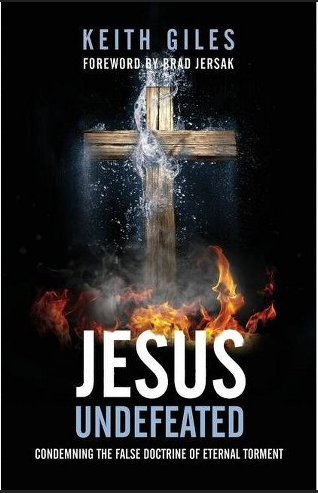
Enough of the general rant, I wanted to introduce the book “Jesus Undefeated”, by Keith Giles in this blog. His topic is Universalism, and the debunking of the Eternal Torment teaching. I picked up this book due to some who claim I am a Universalist. Thought I would find out what I believe, or at least get a bit more familiar with my assumed faith.
With this series, I would like to begin delving into some of the New Testament passages Mr. Giles brought to my attention, for your consideration, edification and civil discussion.
Initially, as I have stated in previous posts, I was surprised with the number of verses that support an evangelical universal teaching. Please do not think that this teaching I am trying to describe is the same as the “all roads lead to heaven” teaching, which I consider to be blasphemous. There is only one way to the Father, and that is through the Lord Jesus Christ.
In the following blog posts in this series, I would like to provide a number of New Testament passages which teach the universal salvation of all through the redemption that is found in Christ Jesus.
Regarding the book itself, I read it in one sitting, not simply because it was under 200 pages, but that it challenged my though process and I found it enjoyable reading. If this topic interests you, please pick up a copy. It is well worth your time.
Our next blog post will begin with passage 1, First Timothy 4:10.
As mentioned in the introduction, I have been been discussing the differences between Calvinism and Provisionalism with a fellow blogger. One particular response grabbed my attention and I am trying to understand his position, by referring to his proof texts and logic.
This is the third portion of his response (in red), along with the corresponding verses he referred to. I shall seek to comment on the verses and find his argument within the verses he has provided.
Original Comment
God gave to the man Jesus the spirit without limit. God doesn’t give faith to everyone because He doesn’t want to according to Romans 9:16 John 1:12-13.
My friend is telling me that God doesn’t want to give faith to everyone, according to Romans 9:16 (dealt with last post) and the current set of verses being considered.
So lets take a look to see if this set of verses gives support to the claim that God doesn’t give faith to everyone, because He doesn’t want to.
First, let’s read the passage.
John 1:12-13 – But to all who did receive him, who believed in his name, he gave the right to become children of God, who were born, not of blood nor of the will of the flesh nor of the will of man, but of God.
It seems the ability to believe is not addressed in this passage, but simply stated as a condition. The result of the belief is that the one believing receives the right to become a child of God. I suppose I could state that the order of salvation is addressed in this verse, in that belief comes before the right to become children of God, but this isn’t my friends intent with this verse, so I will move on.
I think he is referring to the last three clauses in the verse, to speak of where the belief comes from, but that doesn’t seem all that clear in my opinion.
It seems the “being born” is the action being defined in this passage, in that the “being born” is an act of God. It seems to be a stretch to consider the “believing in His name” as being the object of the action.
So if one believes in His name, the believing one acquires the right to become a child of God. It is the result of the faith exercised in the name of the Messiah, that God provides the life, or in other words, “the birth” of a child of God.
Does the faith of the believing one perform the action of becoming a child of God, of being born? No. The action of being born is sourced, or found, in the will of God, not in any other agency.
One more time for a bit of clarity – The faith allows the believing one to acquire the right to become a child of God. God provides the birth upon the faith that is directed to the Messiah.
This passage doesn’t seem to address the topic my friend is seeking to prove, that God doesn’t give faith to everyone, because He doesn’t want to. As a matter of fact, it seems to be an open invitation to any who would trust in His name.
I do hope you will continue with me as I seek to understand the verses he supplies and if the verses he supplied support his argument of fatalism/determinism which he speaks of.
As mentioned in the introduction, I have been been discussing the differences between Calvinism and Provisionalism with a fellow blogger. One particular response grabbed my attention and I am trying to understand his position, by referring to his proof texts and logic.
This is the third portion of his response (in red), along with the corresponding verses he referred to. I shall seek to comment on the verses and find his argument within the verses he has provided.
Original Comment
God gave to the man Jesus the spirit without limit. God doesn’t give faith to everyone because He doesn’t want to according to Romans 9:16 John 1:12-13.
My friend is trying to teach me that God doesn’t give faith to everyone because He doesn’t want to, and he refers to Romans 9:16 to support this claim.
So let’s read the passage and try to understand his point.
Romans 9:16 – So then it depends not on human will or exertion, but on God, who has mercy.
Ok. I may be a bit daft, but I am not sure where faith is referred to in this verse, unless faith is the “it” at the start of the verse.
So what is “it”?
Let’s consider the immediate context.
Romans 9:14 What shall we say then? Is there injustice on God’s part? By no means! Romans 9:15 For he says to Moses, “I will have mercy on whom I have mercy, and I will have compassion on whom I have compassion.” Romans 9:16 So then it depends not on human will or exertion, but on God, who has mercy.
So the “it” in Romans 9:16 reaches back to the question posed in verse 14 – that is “Is there injustice on God’s part?” Faith doesn’t seem to be referred to here. As a matter of fact, this chapter does not address faith until verse 30, (14 verses later!) where it appears that the gentiles received a righteousness by faith. Verse 32 speaks of the Jews not attaining righteousness by faith, but by seeking to attain it by works. This is the only two references to faith in the chapter, and it doesn’t appear to address God’s willingness or reluctance to provide faith to anyone.
Oh, and the subject of faith (or belief) was last referred to in Romans 6:8, speaking of the resurrection, but not of God restricting faith or belief from anyone.
I am not sure why he referred to this verse to teach me that God doesn’t give faith to everyone because He doesn’t want to. Let’s see if the next set of verses in John 1 help us understand his thoughts.
I do hope you will continue with me as I seek to understand the verses he supplies and if the verses he supplied support his argument of fatalism/determinism which he speaks of.
Calvin’s followers seek to justify their teaching with verses that, with just a little bit of explanation, seem to reinforce their philosophy.
You know – the Romans 9 passage, or maybe 1 Corinthians 2:14.
Some of these passages, without considering alternate views (i.e. listening to only Calvinist teachers!) tend to reinforce the Calvinistic thought pattern.
This series of video podcasts will provide a discussion that many Calvinists may have never heard, or considered.
As mentioned in the introduction, I have been been discussing the differences between Calvinism and Provisionalism with a fellow blogger. One particular response grabbed my attention and I am trying to understand his position, by referring to his proof texts and logic.
This is the second portion of his response (in red), along with the corresponding verses he referred to. I shall seek to comment on the verses and find his argument within the verses he has provided.
Original Comment
Scripture says God is sovereign in his decision to whom he will have mercy which is in accordance with Romans 9:16 and other scripture Romans 9:15,18 The natural man doesn’t come and can’t come 1 Corinthians 2:14 John 6:44 John 6:65 He doesn’t have the ability because he lacks spiritual discernment because he doesn’t have the spirit.
This is another favorite verse of the theologically deterministic thinking folks, Calvin’s disciples that is.
John 6:65 – And he said, “This is why I told you that no one can come to me unless it is granted him by the Father.”
Why? Why did Jesus tell them that no man can come to Him unless it is granted him by the Father? Let’s take a few moments to check the context.
John 6:60 When many of his disciples heard it, they said, “This is a hard saying; who can listen to it?” John 6:61 But Jesus, knowing in himself that his disciples were grumbling about this, said to them, “Do you take offense at this? John 6:62 Then what if you were to see the Son of Man ascending to where he was before? John 6:63 It is the Spirit who gives life; the flesh is no help at all. The words that I have spoken to you are spirit and life. John 6:64 But there are some of you who do not believe.” (For Jesus knew from the beginning who those were who did not believe, and who it was who would betray him.) John 6:65 And he said, “This is why I told you that no one can come to me unless it is granted him by the Father.”
Jesus had just finished teaching a hard saying, that is that He was the bread of Life. In verse 51, Jesus equates Himself with the true manna, and instructs those who would live forever to eat of this bread. This is a very very hard saying for a good Jew to understand, since it may imply cannibalism.
Of course the Lord meant it spiritually, and this was a genius move on the Lords method of winnowing out the ones who were simply following for the wrong reasons.
Are you following for the sake of the food (and miracles)? Or are you following because I am the true Deliverer, even if my message seems hard or difficult?
There are two audiences in this passage – the literalists – those who question the ability to eat of the Messiah’s actual flesh (WOW) and those who understand the message as a symbolic or spiritual message. Note that verse 60 opens the immediate context, where the disciples speak of the “hard saying” The message is the topic!
Jesus responds, asking if they are going to take offence at the message. After the bread message, Jesus actually warns them of more difficult saying that will be coming, such as in verse 62, speaking of His ascension. Things weren’t going to get easier for those who sought to follow Him!
Verse 63 is a defining verse. My very first preaching in a church was based on this passage, and looking back, I had it all messed up. Nevertheless, my understanding now is as follows.
The Spirit gives life. (The Spirit doesn’t force life)
The flesh is no help (Eating the body of the Messiah is not the message!)
The words that Jesus spoke are spirit and life. Jesus, in giving the message, was providing the spirit of the message and was the method the Father was using to bring men to the Messiah and life.
Now to our supposed proof passage.
.. “This is why I told you that no one can come to me unless it is granted him by the Father.”
Jesus is speaking of the reception of the words He provides to the masses, not of some secret mysterious will that is conjured up in the minds of some theologians.
Lets consider the action of the Father in this verse. The one coming is granted by the Father. It seemed a funny word to use in this translation, but after reviewing some study books, found it is synonymous with “enabled”. The same idea of the Father enabling the one coming is similar in our previous post on John 6:44.
Enable / Compel
There is a difference.
To be enabled does not equate with to be compelled. I can enable my children to attend a function by inviting them, providing times and addresses and durations for the event. Many may come, but one may not come. Enabling my child to attend does not compel them, or force them to come to the function.
So lets wrap up some of our thoughts. The words of Jesus are the focus, and the words of Jesus include the enabling of those coming. Peter admitted to understanding this when challenged if they will leave the Messiah. He answered – “To whom shall we go? You have the words of eternal life.”
The gospel is the invitation. The words of Jesus is the life giving message. The message was believed, and Peter (along with most of the remaining disciples) knew that Jesus was the Holy One of God. This belief was a result of hearing the message Jesus preached and taught.
As an aside, for my friends who are leaning in the deterministic camp, consider that Jesus chose Judas (vs 6:70), yet was the very one that betrayed the Lord, that fell from grace. That is if he ever walked in grace at all! How is it that the one chosen should be the one who betrays? This is confusing if the choices were made before the foundation of the world!
I do hope you will continue with me as I seek to understand the verses he supplies and if the verses he supplied support his argument of fatalism/determinism which he speaks of.
As mentioned in the introduction, I have been been discussing the differences between Calvinism and Provisionalism with a fellow blogger. One particular response grabbed my attention and I am trying to understand his position, by referring to his proof texts and logic.
This is the second portion of his response (in red), along with the corresponding verses he referred to. I shall seek to comment on the verses and find his argument within the verses he has provided.
Original Comment
Scripture says God is sovereign in his decision to whom he will have mercy which is in accordance with Romans 9:16 and other scripture Romans 9:15,18 The natural man doesn’t come and can’t come 1 Corinthians 2:14 John 6:44 John 6:65 He doesn’t have the ability because he lacks spiritual discernment because he doesn’t have the spirit.
This post will consider what many Calvinist’s may consider their most powerful proof text. I know when I was deep into this philosophy, this was my go-to text to prove that natural, fallen man would not come to the Father, unless the Father quickened him first.
John 6:44 – No one can come to me unless the Father who sent me draws him. And I will raise him up on the last day.
One of the stronger arguments for this passage, from a Calvinist standpoint is the use of the term draw in the passage. Many would suggest that the term actually is synonymous with dragging, or compelling. If this is accurate, then this needs to be admitted to and we may need to reconsider our outlook on this topic.
There are a few verses that include this word that may support the drag/compel idea
Acts 16:19 But when her owners saw that their hope of gain was gone, they seized Paul and Silas and dragged them into the marketplace before the rulers. Acts 21:30 Then all the city was stirred up, and the people ran together. They seized Paul and dragged him out of the temple, and at once the gates were shut. James 2:6 But you have dishonored the poor man. Are not the rich the ones who oppress you, and the ones who drag you into court?
Each of the above verses translates our term as “drag”. Let’s continue with Strong’s definition.
ἑλκύωhelkýō, hel-koo’-o; probably akin to G138; to drag (literally or figuratively):—draw. Compare G1667.
Strongs provides some support for the term to by synonymous with “drag”.
One more resource – let’s consider Vines Expository Dictionary of New Testament Words for a bit of enlightenment on this term “Draw”
“to draw,” differs from suro, as “drawing” does from violent “dragging.” It is used of “drawing” a net, Jhn 21:6, 11 (cp. No. 1, in ver. 8); Trench remarks, “At vv. 6 and 11helko (or helkuo) is used; for there a drawing of the net to a certain point is intended; by the disciples to themselves in the ship, by Peter to himself upon the shore. But at ver. 8 helko gives place to suro: for nothing is there intended but the dragging of the net, which had been fastened to the ship, after it through the water” (Syn., xxi).
This less violent significance, usually present in helko, but always absent from suro, is seen in the metaphorical use of helko, to signify “drawing” by inward power, by Divine impulse, Jhn 6:44; 12:32. So in the Sept., e.g., Sgs 1:4; Jer 31:3, “with lovingkindness have I drawn thee.” It is used of a more vigorous action, in Jhn 18:10, of “drawing” a sword; in Act 16:19; 21:30, of forcibly “drawing” men to or from a place; so in Jam 2:6, AV, “draw,” RV, “drag.”
Notice that Vines describes this drawing as “drawing by inward power, by divine impulse”, and links two verses using this word in the gospel of John. This is important since it is the same author, the same book and the same speaker. But let’s move on with our consideration of John 6:44 before we consider the implications John 12:32.
Consider that the verse doesn’t state “No man comes” but that “no man CAN come”. The drawing of God the Father gives ability to the one coming. It does not state “No man will come…” In short, it is similar to a my sending out invitations to 100 folks in my neighborhood to a party on Saturday. All 100 people have been invited and they can come. Will all 100 people come? Maybe. Maybe not. The invite simply gives them the ability, it does not produce the outcome, it does not necessarily impact the will of the invited. When we place the emphasis on the term “draws”, without considering the intent of the drawing, we can come up with a deterministic slant to the verse.
Is this the message Jesus is giving to the crowds?
Lets check out the context of this passage to get a bit bigger view of the teaching the Lord gave to the crowd on that day.
John 6:44 No one can come to me unless the Father who sent me draws him. And I will raise him up on the last day. John 6:45 It is written in the Prophets, ‘And they will all be taught by God.’ Everyone who has heard and learned from the Father comes to me–
Jesus repeats the condition of the one who comes to the Father, speaking of all being taught of God, and that those who have heard and learned, are the ones who actually come to the Father. Those that actually have come to the Father have exercised their will by listening and learning (note past tense!) from the Father.
So, the Father draws those to give them ability to come, and yet there is the decision to hear and learn that is required in the ones who come. (They actually read the invite and decide to come to the party!)
But wait – there is more!
Remember when Vines connected the term draw from John 6:44 with John 12:32? This becomes a bit of a problem for those who would demand that it should be understood as a dragging that is irresistible, that cannot be refused.
Remember that those who teach of a deterministic salvation would demand that God determines who is saved and who is eternally lost. That God chooses who is “dragged” into the Kingdom, using John 6:44 as a proof text.
Fair enough, for if that is true, that is that the term is to be understood as a literal “dragging”, we have great news, for the Lord used the same term in John 12:32.
Let’s read it the way our Calvinist friends understand the term “draw”.
John 12:32 And I, when I am lifted up from the earth, will “irresistibly drag” all people to myself.”
Does this not tells us that all people will be irresistibly dragged into the Kingdom, that all people have been chosen to be included in the salvation provided by Jesus death on the cross.
Simple deductive reasoning of these two verses, using the Calvinistic supplied definition of “draw” as “drag”, produces the result that God chooses everyone that has ever had a heartbeat.
My point is – using one or two verses to support a teaching may be a very unwise approach for the believer. There are many teachings in the church nowadays due to the emphasis on a few well chosen verses.
Regarding John 6:44, my personal thoughts are that we have a living God that is active in our lives before we decide to follow Him. He sends “the invite” allowing us to decide for Him. He has provided the Savior for our forgiveness and justification, the Spirit of God to comfort and direct us, and the love of the Father to woo us to His side. His patience and mercy are everlasting, and His grace is abounding towards us.
To consider the drawing as dragging cheapens the invite.
I have never “dragged” folks to my party and found that they ever had a good time. I imagine they would just look at me and wander off, shaking their head.
No, the very act of love that the Lord displayed for all is the greatest of reasons to accept the invite. Forcing an acceptance implies that the singular greatest act of love was not quite enough.
Thanks for taking the time to read and consider. I would appreciate a chance to honestly discuss this verse and topic, and look forward to an edifying discussion.
So many straw men are set up, giving both sides enemies to argue with, yet to no resolve.
The following clip may give you something to consider in relation to the debate.
The following 10 minute clip addresses some claims of a Calvinist and the response was helpful. I hope you find it informative, or challenging, depending on your position. Take a few moments to consider the question with Dr. Flowers.
Thanks for joining me in this series on Calvinism.
Years back I came out of this system of thought. I am grateful for the blessings of a loving God that has expressed His love lavishly, beyond human comprehension.
Sometimes I get confused with all the details, and need to pull back and look at the forest instead of the trees.
Such is the case in this post. As some of you may recognize if you follow my blog, I have dipped into the theistic determinist discussion of soteriology. Wow Carl – bring it down a bit eh? What did you just say?
Calvinism. Did God choose certain people to be saved and damn all the rest?
It is a logic that seems to be flawless, and I spent close to a decade in it until I snapped. It was becoming more and more confirmed in my mind until it wasn’t. I should not have considered what some other passages in the Word might be saying.
But back to the forest idea.
Recently I picked up a book titled “The Inescapable Love of God”, by Thomas Talbott, and within the first 1/4 of the book, found three general propositions that are contradictory.
Let me share them with you. This information is found in pages 43 – 45 of the aforementioned book, along with a few verses that are used to support the statement.
It is God’s redemptive purpose for the world (and therefore His will) to reconcile all sinners to Himself.
Some sinners will never be reconciled to God, and God will therefore either consign them to a place of eternal punishment, from which there will be no hope of escape, or put them out of existence.
Matthew 25:46, 2 Thessalonians 1:9, & Ephesians 5:5
These three propositions cannot seemingly exist together. With three propositions together creating a contradiction, it became necessary to strike out one proposition to provide the basis of one of three historically accepted Christian theologies. This is the intent of the following three sections.
Calvinism
It is God’s redemptive purpose for the world (and therefore His will) to reconcile all sinners to Himself
It is within God’s power to achieve his redemptive purpose for the world.
Some sinners will never be reconciled to God, and God will therefore either consign them to a place of eternal punishment, from which there will be no hope of escape, or put them out of existence.
Let’s strike out the first proposition.
The remaining two propositions provide the basis for the logical framework of Calvinism. This particular thinking arose with St Augustine, (354 430 AD). My understanding is that this teaching existed previous to the Augustine’s promotion of it within the church, but was within a Persian religion called Manichaeism. Christianity had not previously taught the deterministic philosophy associated with this religion. That is, until St Augustine popularized it.
God has the power to save all, but has decided to choose a limited number of souls to save in order to bring greater glory to Himself.
In this philosophy, God’s power and justice are emphasized but it is not within His redemptive love to reconcile all sinners to Himself.
Summary statement – God’s love is questioned
Arminianism
It is God’s redemptive purpose for the world (and therefore His will) to reconcile all sinners to Himself
It is within God’s power to achieve his redemptive purpose for the world
Some sinners will never be reconciled to God, and God will therefore either consign them to a place of eternal punishment, from which there will be no hope of escape, or put them out of existence.
This time, let us strike out the second proposition
This has been my default position, except for a decade of Calvinism beginning in the late 90’s. I simply ignored the aspect that Arminianism implies a restriction of God’s power in the plan of salvation. Of course my teachers would not emphasize (or mention) this weakness, so my ignorance was well founded, but still without excuse.
Arminianism is a teaching that was somewhat codified by Jacobus Arminius followers. Jacobus was a student of Calvin’s successor Theodore Beza, and in his study, rejected Calvin’s theology. Arminius and his followers taught that God loves all, but has granted free will to His creation, giving His created beings choice. This choice impacts God’s ability to save, (and therefore reflects on His power).
In this philosophy, God’s love and justice are emphasized but it is not within His redemptive power to reconcile all sinners to Himself.
Summary statement – God’s power is questioned
Universal Reconciliation (UR)
It is God’s redemptive purpose for the world (and therefore His will) to reconcile all sinners to Himself
It is within God’s power to achieve his redemptive purpose for the world
Some sinners will never be reconciled to God, and God will therefore either consign them to a place of eternal punishment, from which there will be no hope of escape, or put them out of existence.
This time, let us strike out the third proposition
UR is a teaching I had always rejected assuming there was no justification from the Word to consider it. I was surprised to hear a claim from a teacher I respect, that in the first four centuries of the New Testament church, a majority of theological schools leaned to this doctrine. Origen, as far as I can tell, was a major proponent of this teaching in the first century.
UR implies that God’s holiness is limited, a holiness that demands eternal suffering in hell for sinful acts performed against Him. UR teaching does not reject the concept of punishment after death, but the eternality of it. UR teaches of judgement after death, but that hell has an exit door to it.
I know, I know – Scripture doesn’t teach that Hitler could leave hell after a period of time! That is and has been my response my entire Christian life. This is because I only listened to the one who stated their case first!
Proverbs 18:17
The one who states his case first seems right, until the other comes and examines him.
But as I have mentioned in my purpose for this blog, it is important to at least consider other Christian teachings, to test them and understand their scriptural basis, if any. Not testing a teaching is a blindness we should not allow.
In this philosophy, God’s will and power are emphasized but it is not His redemptive purpose to punish sinners eternally in hell.
Summary statement – God’s holiness is questioned
Conclusion
The three philosophies are supplied here as a 30,000 foot overview, immensely simplified. As stated in the introduction, the intent is to pull away from the details and try to get a general overview of three positions. I am currently looking into UR since I have not spent any time in studying it, and have considered the other two positions earlier in my faith.
I hope this post will generate edifying discussion and I look forward to others providing assistance in my research of all three philosophies.
As mentioned in the introduction, I have been been discussing the differences between Calvinism and Provisionalism with a fellow blogger. One particular response grabbed my attention and I am trying to understand his position, by referring to his proof texts and logic.
This is the second portion of his response (in red), along with the corresponding verses he referred to. I shall seek to comment on the verses and find his argument within the verses he has provided.
Original Comment
Scripture says God is sovereign in his decision to whom he will have mercy which is in accordance with Romans 9:16 and other scripture Romans 9:15,18 The natural man doesn’t come and can’t come 1 Corinthians 2:14 John 6:44 John 6:65 He doesn’t have the ability because he lacks spiritual discernment because he doesn’t have the spirit.
My friend continues with his verse list, intending (I believe) to supply a volume of verses with seemingly obvious messages that support his teaching of Calvinism.
The next verse we are to consider is a verse that Paul wrote to the Corinthian church, and when considered in the larger context, may not have the intended effect my friend assumes. But lets read the verse before we go any further.
1 Corinthians 2:14 – The natural person does not accept the things of the Spirit of God, for they are folly to him, and he is not able to understand them because they are spiritually discerned.
Lets consider the larger context. Paul speaks of wisdom in the beginning of this chapter to the most carnal and foolish saints of all his church plants.
1 Corinthians 2:6
Yet among the mature we do impart wisdom, although it is not a wisdom of this age or of the rulers of this age, who are doomed to pass away.
Who would consider the church Paul is addressing to be mature? Is that something anyone reading may argue, that the Corinthian church, or even the bulk of individuals in the church were mature? Could Paul be implying the following message to his childish church?
Yet among the mature (but not you guys!) we do impart wisdom.
1 Corinthians 2:7
But we impart a secret and hidden wisdom of God, which God decreed before the ages for our glory.
When did you impart this secret and hidden wisdom Paul? Did you preach this secret and hidden wisdom as part of the gospel message to those lost Corinthians? It seems in the beginning of chapter 2, Paul writes he proclaimed the testimony of God without lofty speech or wisdom, but with only one message – Jesus Christ crucified.
In other words, he preached the gospel to these Corinthians at the start. He did not disciple them. He preached to them! Discipling was to come later!
1 Corinthians 2:10
these things God has revealed to us through the Spirit. For the Spirit searches everything, even the depths of God.
God reveals the deeper wisdom through the Spirit, and as believers in the Messiah, the Corinthians had no excuse to ignore the deeper things as they sought to follow after God as dear children. God’s spirit, who lives in the believer, is willing (and able) to communicate this wisdom if the believer is open and willing. Alas, it appears the Corinthians may not have been willing. Alas, they may be acting like a natural man – Yes, it appears a believer may act as a natural/carnal man.
1 Corinthians 3:1
But I, brothers,could not address you as spiritual people, but as people of the flesh, as infants in Christ.
Brothers are addressed as babes in Christ. Not mature. Not ready for the deep things of God.
So where does this lead us to.
Paul is saying that the things of God in verse 14 is a discipleship issue, not a salvation issue. The Corinthians were believers, and yet not mature. The context of chapter 2 is of wisdom for the mature. The natural man, whom the Corinthians are acting like, cannot understand the deep mysteries of God This is the Corinthians responsibility – that is to receive the wisdom of God in their following Christ.
For the natural unregenerate man, the responsibility is not understanding the deep things of God, or the hidden wisdom of God. It is to repent and believe the gospel. In so doing, the the lost man finds life in the Son.
Let’s get things ordered in a chronological manner, for our God is a God of order.
This I believe is the context of the passage.
But even with this overview, my friend may argue that I am being too general, missing the point or provide some other reason to argue. Fair enough. But what of it? Does the verse, on it’s own teach of the inability of the lost to decide for Christ? Let’s see.
My friend speaks often of the natural man not accepting the things of God because he is dead in sins. Ooops I mixed two verses there – I’m sorry. Let’s try this again
The natural man doesn’t accept the things of God because they are foolishness. The natural man hears the message, makes a judgement on the message and does not accept it. Does the verse say that he cannot accept it? Not yet at least. It seems the natural man’s inability isn’t described so much as his poor decision making skills.
But Carl, the very next clause in the verse states that he is not able to understand the things of the spirit. Is that because he is dead in sins (Oops – did it again!) I mean because he is not spiritual. Yes. of course!
So where does this passage teach that the natural man always refuses to believe the gospel? Yes, he decides (intellectually) against the message, and yes, he cannot understand the spiritual things of God. This seems clear. What is still unclear is where this verse states that the lost can not repent and believe the gospel.
If only Paul had added, “and he can not believe the gospel from the heart and he can not voice his confession unless God first regenerates him”
Let’s try the passage the way I think my friend understands it, (with the italicized portions added to hopefully supply clarity on my friends behalf).
The natural person does not accept the gospelthe things of the Spirit of God, for they are folly to him, and he is not able to understand the gospelthem because they are spiritually discerned, and he cannot believe the gospel from the heart and he can not voice his confession unless God first regenerates him.
OK so where does this lead us now.
Paul is speaking to a carnal immature church, believers that had not progressed, true saints according to the opening verses of the letter. Yet he delves into speaking of a wisdom that is for the mature, and that the natural man doesn’t accept or understand.
But that simply makes sense. The sinner needs to believe in order to have the spirit of God in their life, in order to seek out and accept the deep things, the wisdom of God intended for the mature.
When I became a believer at approx. 9:30 pm on Feb 19 1981, I repented of my sins and trusted the Lord Jesus for my salvation.
Did I (as a natural man) accept the things of the Spirit of God, that wisdom that is imparted to the mature (vs 6), the secret and hidden wisdom of God (vs 7)?
Of course not. I needed the gospel of Jesus, the milk of the word that gives life to those who believe. The wisdom that is imparted to the mature is for the mature. I was a baby! (Kinda like them darn Corinthians!)
Was I (as a natural man) able to understand the wisdom that is imparted to the mature (vs 6), the secret and hidden wisdom of God (vs 7)?
Obviously not, but I was alive once I believed! For the next four decades I sought to understand the wisdom for the mature, the secret and hidden wisdom of God, through study of the scriptures, hearing God’s direction and learning from other believers!
I just don’t see the sinners passage into life to be dependent on knowing the secret and hidden wisdom God intends for the mature.
So, I am not convinced this passage supplies a solid argument for the inability of the sinner to decide to believe. But, my friend supplies a plentitude of verses that I will continue to look through. We will see!
I do hope you will continue with me as I seek to understand the verses he supplies and if the verses he supplied support his argument of fatalism/determinism which he speaks of.
As mentioned in the introduction, I have been been discussing the differences between Calvinism and Provisionalism with a fellow blogger. One particular response grabbed my attention and I am trying to understand his position, by referring to his proof texts and logic.
This is the second portion of his response (in red), along with the corresponding verses he referred to. I shall seek to comment on the verses and find his argument within the verses he has provided.
Original Comment
Scripture says God is sovereign in his decision to whom he will have mercy which is in accordance with Romans 9:16 and other scripture Romans 9:15,18 The natural man doesn’t come and can’t come 1 Corinthians 2:14 John 6:44 John 6:65 He doesn’t have the ability because he lacks spiritual discernment because he doesn’t have the spirit.
Romans 9:15 – For he says to Moses, “I will have mercy on whom I have mercy, and I will have compassion on whom I have compassion.”
Romans 9:18 – So then he has mercy on whomever he wills, and he hardens whomever he wills.
This set of two texts, as proof texts for individual election are very powerful if provided without the general context. All those of the reformed inclination focus on these verses and seem to give more weight than any other verse or set of verses that might temper or provide guidance in the overall teaching of the New Testament.
As reading this set of verses in Romans 9, I have suggested a corporate reading of the text. One way to consider this viewpoint is in the following “picture”
A king wished to be entertained by a singing group, and called upon a nearby town to provide a singing group. All the townspeople had an opportunity to join the singing group, and eventually, one month before the appearance before the king, a group was established.
Of course, as the day of appearing before the king grew near, an occasional singer may fall sick, choose to drop out or simply give up. Also during this time, those within the town have changed their mind and requested to join the group. In the kings invitation, the stipulated requirement was to provide the choir, not specific people to make up the singing group.
In front of the king, on that fateful day, the choir sang before him and the invitation to perform in front of the king was a success. Specific townsfolk decided (willfully or otherwise) to either join or ignore the opportunity. But the calling (invite) was for a singing group. Specific people in the group still retained the freedom the join or abandon the opportunity, yet the calling of the singing group was complete.
As you read through that feeble attempt to explain my understanding, there will be those who find fault in the picture. That is to be expected, since I (as all others) are looking through a glass darkly. I do not want to imply this is the only way to understand Romans 9, as a text on its own.
Yet, in the larger context of Romans 9-11, I find passages that have a very inclusionary feel about the gospel.
Rom 3 has clearly stated that
All have sinned and come short of the glory of God
Pauls theological teaching on the gospel of God comes t a close with Romans 22 and immediately prior to the praise Paul beaks into of the inestimable riches, wisdom and knowledge of God, he makes the following summary statement.
The supposed calling of a specific individual election to salvation, prior to the foundation of the world seems to be left behind in this summary statement.
How could Paul, in giving so strong of an argument convining his readers of the sinfulness of all in Romans 3, and continuing with the all inclusive language of God consigning all to disobedience in verse 32, then immediately restrict His ability to have mercy on only a subset of the all?
Romans 11:32 tells us of the intent of God consigning all to disobedience. He desires to have mercy on all.
Following are a number of translations for the reader to consider of Romans 11:32, in order to quell any doubt as to the intent of the apostle
KJV For God hath concluded them all in unbelief, that he might have mercy upon all.
NKJV
For God has committed them all to disobedience, that He might have mercy on all.
ESV
For God has consigned all to disobedience, that he may have mercy on all.
RSV
For God has consigned all men to disobedience, that he may have mercy upon all.
NIV
For God has bound everyone over to disobedience so that he may have mercy on them all.
Thanks for dropping by.
As many who read this bIog may know I have spent many of the days of my pilgrimage in dwelling on specific passages that seem to support my thinking. I spent many years rejecting any teaching (or passage) that seemed to challenge a specific belief. I found I wanted to indoctrinate others to find support for my own faith, as opposed to simply seeking a balanced view of the Scripture, not emphasizing one portion of the Word over another. This is far more difficult than it may seem, and although I believe my intentions are good, my skill level at navigating through this effort is far inferior to many who may read this blog.
As always, your comments are appreciated and will be considered as they are delivered. Thanks again, and may your day be blessed
As mentioned in the introduction, I have been been discussing the differences between Calvinism and Provisionalism with a fellow blogger. One particular response grabbed my attention and I am trying to understand his position, by referring to his proof texts and logic.
This is the second portion of his response (in red), along with the corresponding verses he referred to. I shall seek to comment on the verses and find his argument within the verses he has provided.
Original Comment
Scripture says God is sovereign in his decision to whom he will have mercy which is in accordance with Romans 9:16 and other scripture Romans 9:15,18 The natural man doesn’t come and can’t come 1 Corinthians 2:14 John 6:44 John 6:65 He doesn’t have the ability because he lacks spiritual discernment because he doesn’t have the spirit.
Romans 9:16 – So then it depends not on human will or exertion, but on God, who has mercy
This is the big one! The verse that seems to answer all questions when it comes to determinism, a lynchpin in the Calvinistic understanding of the sovereignty of God. When the topic of free will comes up in relation to soteriology, Romans 9 seems to be the passage used to defeat all arguments. I am not convinced this is so.
First A Plea
I realize that some may read this and will immediately discount my thoughts. That is expected. When I taught the “doctrines of grace” I too discounted all who challenged me. Romans 9-11 is considered the hotbed of Calvinism. I make absolutely no claim to resolve the debate of it’s interpretation, but only to supply an alternate perspective to the deterministic approach.
For those who refuse to consider any alternate teaching, they themselves have set themselves up to be the arbiters of truth, judging others as opposed to understanding another position and showing grace to others.
They may be completely convinced of their position, and of that, I salute their arrival. For myself, I previously lived a life of “superior” knowledge, looking down on others and their thoughts. (Romans 1:22) Out of that life attitude, I offended, judged, tore down, and condemned many that were walking a better Christian life than myself. (Galations 5:15)
I readily admit that it is difficult to consider a differing opinion, since it opens the reader up to admitting an error. Admitting error is often called repentance in the Body of Christ, and is to be celebrated.
It is important to remember that the Christian life is Christ, that Christianity is not principally a teaching (John 5:39) but a Person, a Person that has been raised from the dead. My second birth occurred due to my repentance of sin and faith in the One who had the right to be my Judge, and yet He sacrificed Himself for a lost sinner. This simple truth has set me free. He is full of grace to the ones who reject Him, revile Him and run from Him.
Back to Verse 16
Who is receiving the mercy? This, in my opinion, is the crux of the matter. Does this passage refer to individuals or nations, that is corporate entities?
This passage is dependent on the context and hinges on a phrase found in Exodus 33:19. Let me try to recount the context.
Exodus 32, Moses is on Mount Sinai, with the children of Israel below, beginning to grumble. During the time on the mount, the Lord informs Moses of the sin of Israel in worshipping the golden calf. The Lord tells Moses to leave Him alone in order that the children of Israel may be consumed.
Moses goes into intermediary mode, (forgoing the potential honor of his own nation from his loins), and reminds the Lord of His promises to the fathers. The Lord relents of His consuming judgement upon His nation, His very own people. Yet judgement came upon certain individuals – 3,000 died at the hand of the Levites.
Exodus 33 Moses receives a command to leave Sinai and head to the promised land. Moses needs assistance in this huge effort of leading the nation of Israel, His people to the promised land. He needs God’s presence with him on this assignment.
Moses was given the promise of God’s presence to go with him and to give him rest. Moses pushes, and makes his demand – If you do not go up with US, do not lead US up from here. He had been given the promise of God’s presence, but Moses sought the presence of God for the nation, the people of God.
God promises His presence for the nation, and then Moses asked to see His glory.
The Lord states
Exodus 33:19
And he said, “I will make all my goodness pass before you and will proclaim before you my name ‘The LORD.’ And I will be gracious to whom I will be gracious, and will show mercy on whom I will show mercy.
Let’s think about the context. Moses had found favor in the sight of the Lord. (Ex 33:17) The nation of Israel had definitely not found favor, but had rebelled and sinned against the One who delivered them.
It seems this phrase
“And I will be gracious to whom I will be gracious, and will show mercy on whom I will show mercy.”
is referring to the nation of Israel, and not an individual, since God’s relationship with Moses had been defined earlier in the passage.
Whoa Carl – that is such a tenuous statement. My Calvinistic teaching demands that the mercy shown in this context is on individuals, and not a corporate mercy. This cannot be the correct interpretation, since it conflicts with my theology!
No comment. Lets continue.
Malachi 1:2-3
“I have loved you,” says the LORD. But you say, “How have you loved us?” “Is not Esau Jacob’s brother?” declares the LORD. “Yet I have loved Jacob
but Esau I have hated. I have laid waste his hill country and left his heritage to jackals of the desert.”
I see the verses above defining the one who is loved as being the corporate entity of the nation of Israel, as opposed to a singular person. Although the passage states that “Esau” was hated, it is the nation of Edom that is referred to in the expression of the hatred. Esau was long gone and his fate had been sealed by this time. But the prophet speaks of a national disaster that befell the nation of Edom, when he defines the “hatred” the Lord has for Esau. Jacob, meanwhile was back in the land and still in existence by the time of Malachi. Surely the nation of Israel was loved by God.
Back to Romans 9:16. With this background and understanding, the mercy spoken of in Exodus 33 was being shown to a nation that had sinned greatly in front of the Lord. His people had rejected Him as He sought to offer His covenant to them.
Is there not a parallel with the condition Paul was in the midst of? The physical nation of Israel was predominantly rejecting the new covenant, just like they rejected the covenant at Sinai.
The very promises of God were being questioned, in the midst of the nation rejecting the opportunity. And Paul was answering these challenges by using verses specifically chosen that define the mercy of God on a corporate entity. The nation of Israel had many blessings as defined in 9:2- 3.
As I mentioned earlier, I am supplying an alternate framework to consider the Romans 9-11 passage, which makes sense to me. Since the name of this blog is “Considering the Bible” and not “I have all truth”, this is offered for your consideration, and not blind obedience!
I do hope you will continue with me as I seek to understand the verses he supplies and if the verses he supplied support his argument of fatalism/determinism which he speaks of.
As mentioned in the introduction, I have been been discussing the differences between Calvinism and Provisionalism with a fellow blogger. One particular response grabbed my attention and I am trying to understand his position, by referring to his proof texts and logic.
This is the first portion of his response (in red), along with the corresponding verses he referred to. I shall seek to comment on the verses and find his argument within the verses he has provided.
Original Comment
You are always using Human reasoning instead of scripture. God can change and has to change a person’s will to be saved. Ezekiel 36:26 John 3:3-8 Romans 3:10-12 Psalms 14:1-3 even though you think he can’t interfere with natural man’s will and someone will have to tell me how one person believes the Gospel the true gospel that is and another doesn’t. No freewill advocate can give me an answer. They ignore that question.
Psalm 14:1-3
Psalm 14:1 – To the choirmaster. Of David. The fool says in his heart, “There is no God.” They are corrupt, they do abominable deeds; there is none who does good. Psalm 14:2 – The LORD looks down from heaven on the children of man, to see if there are any who understand, who seek after God. Psalm 14:3 – They have all turned aside; together they have become corrupt; there is none who does good, not even one.
This passage is attributed to David, very likely during the persecution of King Saul, or the rebellion of his son Absalom. It is a dark day for David, no matter what, and the psalm expresses his utter despair, and his expectation of the Lord’s deliverance.
It is interesting that David does not say “everyone born says in his heart, “There is no God….” Nope – David has a specific type of person in mind, a fool. This passage my friend has supplied, describes a portion of humanity from David’s perspective. As we considered in our previous post, the Apostle Paul applies this passage to all, (calling us all fools!) yet even the universality of sin does not support my friends contention that a man cannot respond to the grace of God.
Verse 2 speaks of “the children of men”. This moves the reader from considering the category of fools, to that of all humanity.
And yet we have a number of instances in the Word of those who are “devout”.
A good example of the ability of a lost person to respond to God is found in Acts 10, where Peter is told to visit with a dirty Roman centurion. But wait a minute Carl. This fella Cornelius, in verse 2, is called “a devout man who feared God with all his household, gave alms generously to the people and prayed continually to God.” He was obedient to the vision, (whereas Peter had to be shown his vision 3 times!)
What a terrific story, and upon reading it, it seems that Cornelius was seeking to hear and understand, and it was Peter that was a bit reluctant to obey. So backwards to what we should be like.
Nevertheless, Psalms 14 speaks of a person that is corrupt, does bad things, does not do good things, who turns aside, and has become corrupt. (By the way, if this fool has always been against God, what does it mean when he say he turned aside? That he has become corrupt? Could the one described have been seeking God, in some way previously, and has since “turned aside”, has “become corrupt”?)
This passage describes fools, (and the rest of us). It might not be comfortable to hear it, but hear it we must.
I do hope you will continue with me as I seek to understand the verses my friend supplies and if the verses he supplied support his argument of fatalism/determinism which he speaks of.
As mentioned in the introduction, I have been been discussing the differences between Calvinism and Provisionalism with a fellow blogger. One particular response grabbed my attention and I am trying to understand his position, by referring to his proof texts and logic.
This is the first portion of his response (in red), along with the corresponding verses he referred to. I shall seek to comment on the verses and find his argument within the verses he has provided.
Original Comment
You are always using Human reasoning instead of scripture. God can change and has to change a person’s will to be saved. Ezekiel 36:26 John 3:3-8 Romans 3:10-12 Psalms 14:1-3 even though you think he can’t interfere with natural man’s will and someone will have to tell me how one person believes the Gospel the true gospel that is and another doesn’t. No freewill advocate can give me an answer. They ignore that question.
Romans 3:10-12
The next passage my friend brings to the table to support his theology is Romans 3:10-12. Such a famous set of verses describing the fallen state of man, and the universality of sin in the human race.
Romans 3:10-12
as it is written: “None is righteous, no, not one; no one understands; no one seeks for God. All have turned aside; together they have become worthless; no one does good, not even one.”
In Romans 1 Paul is describing the Gentile world and their wretchedness in front of God, and in chapter 2, he continues with descriptions of sinfulness. By the time he gets to Romans 3:23, he has made his point. All have sinned, both Gentile and Jew.
Remember the problem that Paul was addressing in the letter to the Romans was the division between Jews and Gentiles within the body, how the Jews were acting self righteous and the Gentiles seemingly took too many liberalities. Division was rampant, and we all know how Paul felt about division!
Could the passage be chosen by Paul in order to level the playing field of the different parties reading it? As we say in Texas, all y’all are sinners. All y’all are in the same bucket!
It doesn’t seem to address the sinners abilities to repent, only that they are sinners through and through, and that they have no power to redeem themselves.
Let me try to explain my understanding this way.
If I am drowning and not able to swim, and going down for the third time, I am as good as dead. (Ephesians 2:5) Yet if a boat comes along and rescues me, I only need to stop my struggle and accept the rescue. In words that sound biblical, I need to repent of my own works and receive the grace of God through the Lord Jesus Christ.
Is there any glory in the rescue for the drowning person? I think not. Next time you see a rescue being reported of on the TV, notice who gets the glory.
My friend, we are all sinners, drowning in the cess pool of our own filth, our disobedience only growing with each day of rejection. There is a Savior that is seeking the lost and desiring to commune with the believer. He is the One who desires to live with us, or better put, for us to live with Him, for there is a difference!
I think I may have wandered from the topic, and would like to remind the reader that the emphasis of this passage is the universality of sin on a fallen world, and that it does not describe one who cannot react to the offer of a good gift given to them.
The next passage my friend refers to for consideration is Psalm 14:1. This is the very passage Paul quoted from in the previous portion. David’s context is different and it may be wise to consider the background upon which this passage was written.
I do hope you will continue with me as I seek to understand the verses he supplies and if the verses he supplied support his argument of fatalism/determinism which he speaks of.
As mentioned in the introduction, I have been been discussing the differences between Calvinism and Provisionalism with a fellow blogger. One particular response grabbed my attention and I am trying to understand his position, by referring to his proof texts and logic.
This is the first portion of his response (in red), along with the corresponding verses he referred to. I shall seek to comment on the verses and find his argument within the verses he has provided.
Original Comment
You are always using Human reasoning instead of scripture. God can change and has to change a person’s will to be saved. Ezekiel 36:26 John 3:3-8 Romans 3:10-12 Psalms 14:1-3 even though you think he can’t interfere with natural man’s will and someone will have to tell me how one person believes the Gospel the true gospel that is and another doesn’t. No freewill advocate can give me an answer. They ignore that question.
The next passage my friend provides for consideration is John 3:3-8
John 3:3-8
3 – Jesus answered him, “Truly, truly, I say to you, unless one is born again he cannot see the kingdom of God.” 4 – Nicodemus said to him, “How can a man be born when he is old? Can he enter a second time into his mother’s womb and be born?” 5 – Jesus answered, “Truly, truly, I say to you, unless one is born of water and the Spirit, he cannot enter the kingdom of God. 6 – That which is born of the flesh is flesh, and that which is born of the Spirit is spirit. 7 – Do not marvel that I said to you, ‘You must be born again.’ 8 – The wind blows where it wishes, and you hear its sound, but you do not know where it comes from or where it goes. So it is with everyone who is born of the Spirit.”
Awesome passage of the Lord speaking to one of His people, an Israelite – one who is a religious leader in Israel. One who is interested in this new Prophet. Yes he comes under cover of darkness, but Nicodemus comes to the Messiah, and queries Him.
He is joining into a discussion with Jesus, and this shows his desire to understand. Nowhere does the passage state that it is God’s moving in his life that is making him ask questions, and nowhere does it deny God’s actions in Nicodemus life. That is a moot point in this passage.
Note that Jesus states a prerequisite for entering the Kingdom of God, but doesn’t assign any responsibility (either to God or man) to perform the action (of being born again)
Verse 7 may give us a bit of a hint. You Nicodemus, you must be born again. Jesus didn’t state a fact that some would be born again. This statement is in the command mode. You MUST be born again.
It seems the responsibility is squarely laid upon Nicodemus. Again I want to be clear that the specific actions Nicodemus is to perform to become born again are not expressed in the passage my friend supplied. But alas, Jesus begins to give a hint regarding the prerequisite for being born again a few verses later.
John 3:12 If I have told you earthly things, and ye believe not, how shall ye believe, if I tell you of heavenly things?
Ok Nicodemus – you aren’t even believing earthly things.
Why bring up the topic of belief?
Why is Jesus addressing Nicodemus’ attitude toward His teachings?
A bit later in the passage, the following verse pops up
John 3:15 That whosoever believeth in him should not perish, but have eternal life.
Nicodemus has been told of the requirement of being born again. Then Jesus speaks of the responsibility of the one who must be born again.
If it is only “of God” that this requirement (of being born again) is being taught, then it follows that God is responsibile to give Nicodemus life in order for him to believe. Yet Jesus speaks of the necessity of faith.
Surely, if it is God that Nicodemus must wait on to receive life before he can believe, this conversation with Nicodemus seems a bit confusing.
I suppose the conversation should have ended with the following terse statement from the Lord.
Just go home Nicodemus – Sure you got questions, but you can’t understand the answers until My Father regenerates you. Then you will have faith, and be born again. That’s that!
Huh. That conversation doesn’t seem to occur in this passage. After reading this passage, I am not convinced my friends position is strengthened, (or even supported) by the passage.
I do hope you will continue with me as I seek to understand the verses he supplies and if the verses he supplied support his argument of fatalism/determinism which he speaks of.
Thanks again for coming to visit. I hope you found something of interest in this post and would appreciate a comment, to begin a discussion.
Romans 3:10-12
The next passage my friend brings to the table to support his theology is Romans 3:10-12. Such a famous set of verses describing the fallen state of man, and the universality of sin in the human race.
Romans 3:10-12
as it is written: “None is righteous, no, not one; no one understands; no one seeks for God. All have turned aside; together they have become worthless; no one does good, not even one.”
In Romans 1 Paul is describing the Gentile world and their wretchedness in front of God, and in chapter 2, he continues with descriptions of sinfulness. By the time he gets to Romans 3:23, he has made his point. All have sinned, both Gentile and Jew.
Remember the problem that Paul was addressing in the letter to the Romans was the division between Jews and Gentiles within the body, how the Jews were acting self righteous and the Gentiles seemingly took too many liberalities. Division was rampant, and we all know how Paul felt about division!
Could the passage be chosen by Paul in order to level the playing field of the different parties reading it? As we say in Texas, all y’all are sinners. All y’all are in the same bucket!
It doesn’t seem to address the sinners abilities to repent, only that they are sinners through and through, and that they have no power to redeem themselves or even a desire to do so.
Let me try to explain it this way. If I am drowning and not able to swim, and going down for the third time, I am as good as dead. (Ephesians 2:8) Yet if a boat comes along and rescues me, I only need to stop my struggle and accept the rescue. In words that sound biblical, I need to repent of my own works and receive the grace of God through the Lord Jesus Christ.
Is there any glory in the rescue for the drowning person? I think not. Next time you see a rescue being reported of on the TV, notice who gets the glory.
My friend, we are all sinners, drowning in the cess pool of our own filth, our disobedience only growing with each day of rejection. There is a Savior that is seeking the lost and desiring to commune with the believer. He is the One who desires to live with us, or better put, for us to live with Him, for there is a difference!
I think I may have wandered from the topic, and would like to remind the reader that the emphasis of this passage is the universality of sin on a fallen world, and that it does not describe one who cannot react to the offer of a good gift given to them.
The next passage my friend refers to for consideration is Psalm 14:1. This is the very passage Paul quoted from in the previous portion. David’s context is different and it may be wise to consider the background upon which this passage was written
I do hope you will continue with me as I seek to understand the verses he supplies and if the verses he supplied support his argument of fatalism/determinism which he speaks of.
Thanks again for coming to visit. I hope you found something of interest in this post and would appreciate a comment, to begin a discussion.
Psalm 14:1-3
Psalm 14:1 – To the choirmaster. Of David. The fool says in his heart, “There is no God.” They are corrupt, they do abominable deeds; there is none who does good. Psalm 14:2 – The LORD looks down from heaven on the children of man, to see if there are any who understand, who seek after God. Psalm 14:3 – They have all turned aside; together they have become corrupt; there is none who does good, not even one.
This passage is attributed to David, very likely during the persecution of King Saul, or the rebellion of his son Absolom. It is a dark day for David, no matter what and the psalm expresses his utter despair, and his expectation of the Lord’s deliverance.
It is interesting that David doen not say “everyone born says in his heart, “There is no God….” Nope – David has a specific type of person in mind, a fool. This passage my friend has supplied, describes a portion of humanity from Davids perspective. As we considered above, the Apostle Paul applies to all, yet even the universality of sin does not support my friends contention that a man cannot respond to the grace of God.
A good example of the ability of a lost person to respond to God is found in Acts 10, where Peter is told to visit with a dirty Roman centurion. But wait a minute Carl. This fella, in verse 2, is called “a devout man who feared God with all his household, gave alms generously to the people and prayed continually to God.” He was obedient to the vision, (whereas Peter had to be shown his vision 3 times!)
What a terrific story, and upon reading it, it seems that Cornelius was seeking to hear and understand, and it was Peter that was a bit reluctant to obey. So backwards to what we should be like.
Nevertheless, Psalms 14 speaks of a type of person that is corrupt, does bad things, does not do good things, who turns aside, and has become corrupt.
This passage describes a group of fools. Paul, in the passage above applies these very verses to his audience in order to place us all in the category of fools.
It might not be comfortable to hear it, but hear it we must.
I do hope you will continue with me as I seek to understand the verses he supplies and if the verses he supplied support his argument of fatalism/determinism which he speaks of.
Thanks again for coming to visit. I hope you found something of interest in this post and would appreciate a comment, to begin a discussion.
As mentioned in the introduction, I have been been discussing the differences between Calvinism and Provisionalism with a fellow blogger. One particular response grabbed my attention and I am trying to understand his position, by referring to his proof texts and logic.
This is the second portion of his response (in red), along with the corresponding verses he referred to. I shall seek to comment on the verses and find his argument within the verses he has provided.
Original Comment
Scripture says God is sovereign in his decision to whom he will have mercy which is in accordance with Romans 9:16 and other scripture Romans 9:15,18 The natural man doesn’t come and can’t come 1 Corinthians 2:14 John 6:44 John 6:65 He doesn’t have the ability because he lacks spiritual discernment because he doesn’t have the spirit.
Romans 9:16 – So then it depends not on human will or exertion, but on God, who has mercy
Romans 9:15 – For he says to Moses, “I will have mercy on whom I have mercy, and I will have compassion on whom I have compassion.”
Romans 9:18 – So then he has mercy on whomever he wills, and he hardens whomever he wills.
I do hope you will continue with me as I seek to understand the verses he supplies and if the verses he supplied support his argument of fatalism/determinism which he speaks of.
Thanks again for coming to visit. I hope you found something of interest in this post and would appreciate a comment, to begin a discussion.
1 Corinthians 2:14 – The natural person does not accept the things of the Spirit of God, for they are folly to him, and he is not able to understand them because they are spiritually discerned.
I do hope you will continue with me as I seek to understand the verses he supplies and if the verses he supplied support his argument of fatalism/determinism which he speaks of.
As mentioned in the introduction, I have been been discussing the differences between Calvinism and Provisionalism with a fellow blogger. One particular response grabbed my attention and I am trying to understand his position, by referring to his proof texts and logic.
This is the third portion of his response (in red), along with the corresponding verses he referred to. I shall seek to comment on the verses and find his argument within the verses he has provided.
Original Comment
God gave to the man Jesus the spirit without limit. God doesn’t give faith to everyone because He doesn’t want to according to Romans 9:16 John 1:12-13.
Romans 9:16 – So then it depends not on human will or exertion, but on God, who has mercy.
I do hope you will continue with me as I seek to understand the verses he supplies and if the verses he supplied support his argument of fatalism/determinism which he speaks of.
Thanks again for coming to visit. I hope you found something of interest in this post and would appreciate a comment, to begin a discussion.
John 1:12-13 – But to all who did receive him, who believed in his name, he gave the right to become children of God, who were born, not of blood nor of the will of the flesh nor of the will of man, but of God.
As mentioned in the introduction, I have been been discussing the differences between Calvinism and Provisionalism with a fellow blogger. One particular response grabbed my attention and I am trying to understand his position, by referring to his proof texts and logic.
This is the fourth portion of his response (in red), along with the corresponding verses he referred to. I shall seek to comment on the verses and find his argument within the verses he has provided.
Original Comment
He told the Pharisees you don’t believe because you aren’t my sheep John 10:26 He didn’t say you aren’t my sheep because you don’t believe That should kill the idea of free will on the spot. If you analyze the Garden of Eden account with Eve you will see the serpent was baiting Eve with free Will through the delusion of gaining the knowledge of good and evil which was a stone cold lie.
John 10:26 – but you do not believe because you are not among my sheep.
I do hope you will continue with me as I seek to understand the verses he supplies and if the verses he supplied support his argument of fatalism/determinism which he speaks of.
As mentioned in the introduction, I have been been discussing the differences between Calvinism and Provisionalism with a fellow blogger. One particular response grabbed my attention and I am trying to understand his position, by referring to his proof texts and logic.
This is the fifth portion of his response (in red), along with the corresponding verses he referred to. I shall seek to comment on the verses and find his argument within the verses he has provided.
Original Comment
Natural man can’t tell the difference between good and evil and Jesus said none are good except for God. They are responsible because God is Sovereign. He has the right to do with His creation as he sees fit His righteousness isn’t to be judged by fallen man’s sense of righteousness imputed from the Garden of Eden. Belief is the work of God John 6:29
John 6:29 – Jesus answered them, “This is the work of God, that you believe in him whom he has sent.”
I do hope you will continue with me as I seek to understand the verses he supplies and if the verses he supplied support his argument of fatalism/determinism which he speaks of.
As mentioned in the introduction, I have been been discussing the differences between Calvinism and Provisionalism with a fellow blogger. One particular response grabbed my attention and I am trying to understand his position, by referring to his proof texts and logic.
This is the sixth (and final) portion of his response (in red), along with the corresponding verses he referred to. I shall seek to comment on the verses and find his argument within the verses he has provided.
Original Comment
God is saving a people unconditionally Romans 9:11 according to election God promises to save a people and He can’t wait around for someone who has no desire or the ability to come. I will rely on scripture that he shows mercy unconditionally to whom he chooses.
Romans 9:11 – though they were not yet born and had done nothing either good or bad–in order that God’s purpose of election might continue, not because of works but because of him who calls–
I do hope you will continue with me as I seek to understand the verses he supplies and if the verses he supplied support his argument of fatalism/determinism which he speaks of.
I was driving home from helping my son install some ceiling fans, and as I was listening to Free Bird, it occurred to me that some within the Christian faith claim the Bible teaches “perseverance of the saints”. I know – an errant thought, but stick with me for a minute.
But first, let’s look at the verse that stirred my thinking during the middle of Free Bird, and then we can delve into the dark crevices of my thoughts.
1 John 2:19
They went out from us, but they were not of us; for if they had been of us, they would have continued with us. But they went out, that it might become plain that they all are not of us.
Perseverance of the saints is not a troubling teaching in my mind, but to be practical, we have to admit that it is a time dependent truth for each of us. Some believers will use this verse to claim that only true Christians remain faithful, and with that I have no argument. True believers continue to believe.
The time component is what sticks in my craw, when I hear that some believers that are living today, claim that they are in a contract with the God of the universe that is iron clad, and without conditions. That initial faith is their ticket to heaven. They will end up in heaven no matter what happens, no matter what they do, or no matter what occurs in their faith.
Let me try to explain it as I heard it in my head as I was conversing with myself on the way home – Don’t worry – I turned Free Bird off during my self conversation!! Carl – admit it – You were talking to yourself!
Carl – 1 John 2:19 teaches that true believers continue in the faith
Anti-Carl – Yes that is true, and those that left the faith were either never a believer, or that they abandoned the faith.
Carl – Oh I am sure the author intends the reader to see those who did not continue in the faith to have never been a believer
Anti-Carl – So you say, but lets get practical. Are you a believer?
Carl – Of course.
Anti-Carl – How do you know you will continue? Can you foresee the future?
Carl – Of course I cannot see into the future, but God will keep me. He has promised.
Anti-Carl – Many folks have claimed a promise from God and yet have walked away. What makes you better than them?
Carl – They were liars, even self deceived.
Anti-Carl – Again, the only assurance you have of eternal life is that you have faith at the point of death. Until that time, you cannot guarantee anyone of your continuance, since it is expressed in action (continuing with believers) as opposed to simply a feeling or a belief. It seems the security you boast in is highly time dependent and somewhat fragile until the end.
Carl – I refuse to hear you anymore!
Remember, dear reader, that the Lord’s promises are many times conditional on our heart response, our obedience, our listening and doing. Our faith is not to be based on head knowledge alone, but on a willing heart that seeks to follow Him.
Your thoughts?
Thanks again for coming to visit. I hope you found something of interest in this post and would appreciate a comment, to begin a discussion. If you know someone this blog may bless (or challenge), send them a link, so they may join us in our discussion