Skip to content

Considering the Bible

  • Testimony
  • Purpose
  • Contact Me
  • Home
  • About
  • Parable Surprises – Why?

    2021-03-06

    One sunny day, as Jesus was in the middle of teaching by way of parables, (in the 13th chapter of Matthew) Matthew makes a brief comment that may help us in understanding why Jesus taught in parables.

    Matthews first comment is on the regularity of Jesus teaching in parables. His second comment is on the the fulfillment of prophecy in doing so.

    I’m sorry – What was that? Teaching in parables was a fullfillment of prophecy?

    Hang on – we will get to it, but first lets look at the passage from the gospel of Matthew.

    Matthew 13:34-35

    34 All these things Jesus said to the crowds in parables; indeed, he said nothing to them without a parable.

    35 This was to fulfill what was spoken by the prophet: “I will open my mouth in parables; I will utter what has been hidden since the foundation of the world.”

    Verse 34 seems to be telling us that Jesus limited Himself to teaching only in parables, yet we know that He taught in many ways, sometimes with object lessons, or with a simple direct narrative. He is the Great Teacher, and exercised many methods of teaching.

    So what is Matthew saying? At this time in Jesus ministry, and with the current audience, He taught them with parables. That, in my opinion was a simple observation. Verse 35 is where I am struggling.

    A Difficulty – Apostolic Interpretation

    My first difficulty is the fact that this method of teaching is a fulfillment of prophecy. Let’s consider the Old Testament verse we find the prophecy in.

    Psalm 78:2

    I will open my mouth in a parable; I will utter dark sayings from of old

    It appears that the psalmist is stating the current condition for his writing, that is, he will open his mouth in a parable. It is his chosen method of teaching in his current historical context. As a young believer, reading through the Old Testament, there were prophecies that were obvious, such as Isaiah 53 or Psalm 22, concerning the Messiah. Psalm 78, without the apostles direction, would not have occured to me as prophetic.

    This is critical, for the apostles are the teachers of truth, based on the Lords method of reading the Old Testament.

    Which makes this next passage so amazing.

    A Difficulty – Parabolic Reasons

    The Lord supplied the reason for speaking in parables in the following verses.

    Matthew 13:13-15

    13 This is why I speak to them in parables, because seeing they do not see, and hearing they do not hear, nor do they understand.

    14 Indeed, in their case the prophecy of Isaiah is fulfilled that says: “‘”You will indeed hear but never understand, and you will indeed see but never perceive.”

    15 For this people’s heart has grown dull, and with their ears they can barely hear, and their eyes they have closed, lest they should see with their eyes and hear with their ears and understand with their heart and turn, and I would heal them.’

    Again, let’s consider the passage Jesus is referring to in verse 14.

    Isaiah 6:9

    And he said, “Go, and say to this people: “‘Keep on hearing, but do not understand; keep on seeing, but do not perceive.’

    God is speaking to Isaiah, telling him that the people of his day will hear the words, but not understand the message. When I read this passage, it seems to be directed to the people Isaiah was ministering to over 700 yrs before the Messiah. I wouldn’t have seen this as prophetic, and that is why the apostolic interpretation of the Old Testament is such an important concept to grasp as we read through the New Testament.

    As amazing as the apostolic interpretation of the Old Testament is (which is such a gift!), the reason why the parables are Jesus’ preferred teaching method is even more amazing.

    Jesus tells His apostles that the reason He teaches in parables is to teach only to the teachable. (And yet some of his disciples didn’t understand the parables!) He tells stories that only those who are willing and able to hear can understand. The people He is teaching at this time, that do not “hear” Him, only become deafer and blinder.

    Another Feature of Grace

    Truly amazing when you think of the loneliness of the Master as He taught. No-one was getting it! How frustrating. The Master Teacher came to earth, spent His days speaking out truth, and yet His best students/disciples were struggling with understanding the message.

    What hope do we have? The Spirit of God and prayer are critical for this effort. As I have quickly reviewed the parables in accumulating them for the study, I am concerned I may be biting off more than I can chew.

    No – that is wrong. I am definetly biting off more than I can chew. I need guidance and strength to understand, see and hear His message.

    I do hope you will venture along with me on this trek. It promises to be a whopper!


    ← Back

    Thank you for your response. ✨

    Follow Considering the Bible on WordPress.com

    Thanks again for coming to visit. I hope you found something of interest in this post and would appreciate a comment, to begin a discussion.

    Share this:

    • Email a link to a friend (Opens in new window) Email
    • Print (Opens in new window) Print
    • Share on Telegram (Opens in new window) Telegram
    Like Loading…
  • Song Squawk – All Over Me

    2021-03-05

    In the mid nineties, I had a little red Buick and a big ol’ bass box in the trunk, and would listen to “Christian Rock”, cranked to 11.

    (What did you say?  Huh?  Can  you say that again, I didn’t hear you….)

    I have gotten away from that genre for many reasons, the least of which may be a loss of hearing, but some songs have stuck with me over the decades.

    The artist’s I listened to sought to reflect Scriptural teaching for the most part. They ranged from “preaching” pop culture religion to significant theological teaching. As I listened to the lyrics, I found some to be quite challenging.

    To be honest, I listened because I could justify the rock beat with “sanctified lyrics”.

    Occassionaly I will post a song, supply the lyrics and make a comment or two. If you decide to listen to the tune, turn the speaker down unless you are already deaf. Some of the songs tend to have a certain “volume” about them!


    This post will consider the song

    All over Me – by The Benjamin Gate

    This group was from South Africa and had a lady front woman (Adrienne “Adie” Camp), with a great voice. It was a fun group, but like I mentioned with X-Sinner, these guys were having fun with thier music. There seemed to be a generality about this song, but nevertheless, it was catchy and I tended to find I came back to it occasionally.

    Wave come, wave fall
    Cast me on your broken shore
    Sun come, sun fall
    Cast me on your love so warm

    Take a listen!

    All over Me – by The Benjamin Gate

    All over Me – by The Benjamin Gate

    Wave come, wave fall
    Cast me on your broken shore
    Sun come, sun fall
    Cast me on your love so warm

    Jesus’ love is
    Jesus’ love is

    All over me, all over me
    Your love is all over me
    All over me, all over me
    Your love is . . .Christ come, Christ crawl
    Nailed to a cross so tall
    All come, all fall
    All walk with hearts so torn

    Jesus’ love is
    Jesus’ love is

    All over me, all over me
    Your love is all over me
    All over me, all over me
    Your love is . . .

    Let me know what you think of the lyrics, and of the tunes!


    ← Back

    Thank you for your response. ✨

    Follow Considering the Bible on WordPress.com

    Thanks again for coming to visit. I hope you found something of interest in this post and would appreciate a comment, to begin a discussion.

    Follow Considering the Bible on WordPress.com

    Thanks again for coming to visit. I hope you found something of interest in this post and would appreciate a comment, to begin a discussion.

    Share this:

    • Email a link to a friend (Opens in new window) Email
    • Print (Opens in new window) Print
    • Share on Telegram (Opens in new window) Telegram
    Like Loading…
  • Love Like Jesus – Kindness

    2021-03-04

    lovelikejesus_157x157

    Lately, I have been exclusively in the Apostle John’s writings, in my personal readings, my blog writing, and my time with my wife.

    John reiterates one theme, over and over again in my opinion, and that is that we are to love one another, to love like Jesus, to love.

    It is refreshing to be reminded of the core mission of believers.

    Love like Jesus.

    Kindness

    Love is the goal of all of Christian life.  Love that is displayed in the life of Jesus.  The life and death of Jesus.  This love is described in 1 Corinthians 13.  Let’s consider

    Love is kind

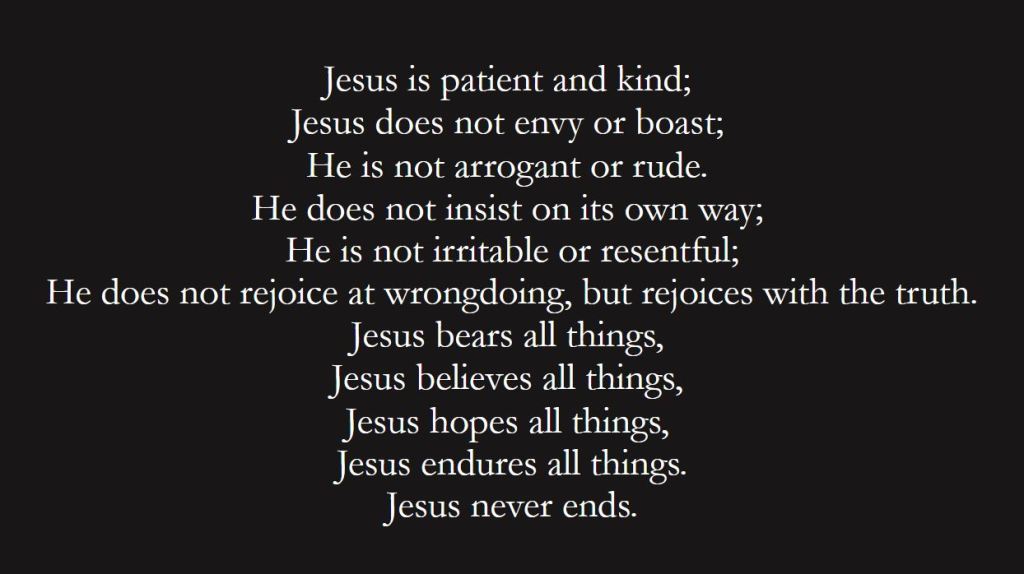
    It has been years since a brother once instructed me to replace the term “love” with “Jesus” to get a better understanding of who He is.  

    Jesus is kind


    1 Cor 13 - kind

    Kindness, in my mind, is the same as being “nice”.

    But does the Bible teach believers to be nice?

    Let’s consider a comparison of these two concepts. I owe this information to Crumps Corner.

    KindNice
    Speaks upStays quiet
    HealingToxic
    Tells the truthLies to keep the peace
    Moves forward with careHolds back
    Takes courageLacks courage
    Is more concerned for others than selfIs more concerned for self than for others
    Desires to be helpfulDesires to be liked
    Leads to successPrevents success

    Nice

    I read a book a few years ago, simply because the title was so outrageous. “Don’t Be a Nice Christian”, or something like that. I had always assumed that Christianity was typified by niceness. You are so nice Carl, what a nice Christian. You do nice things Carl… The book started to bug me. Alot.

    Let’s consider the concept of niceness per Bible teaching.

    Okay I found three words in the Bible that refer to “nice”

    Bernice, Eunice, Phenice – Definitely not the results I was hoping for! Nothing of any command for believers to “be nice”

    Nothing to see here folks. Let’s move along…

    Kind

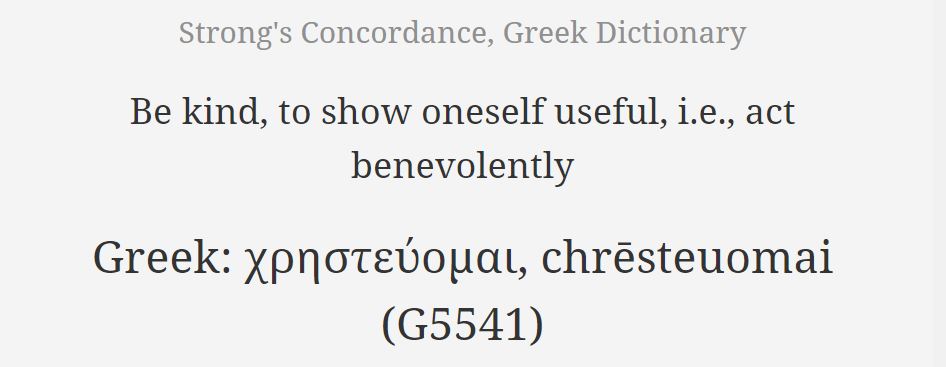
    Not so with the kindness Paul uses to describe Christian love. The passage we are reading today defines love as kind (chresteoumai). This word is used ten times in the New Testament, mostly describing the kindness (or sometimes translated as goodness, gentleness) of God. Nevertheless, love as expressed as kind is a goal for the believer to strive to.

    What does that look like? This table above, I suggest gives us much to consider. If you are “nice” like I am “nice”, you will want to consider the differences.

    2 Corinthians 6:6

    by purity, knowledge, patience, kindness, the Holy Spirit, genuine love;

    Paul is describing the methods of service to God by which they commend themselves to others. It is interesting that two verses earlier, patience rears its head again in the description of the Christian life! I wonder which patience he refers to? The “makro” or the “hupo”? I gave you a hint in the last post if you remember!

    Back to kindness. Paul’s method of serving God included kindness. Vines Expository Dictionary of the New Testament states

    It signifies “not merely goodness as a quality, rather it is goodness in action, goodness expressing itself in deeds,

    Kindness is not simply a feeling within your heart, or only a good attitude toward others, which of course is required, but it is expressed in acts of usefulness to others. By implication, to those who do not deserve it – those who may be neutral to us, or – dare I say it – our enemies!

    Galatians 5:22

    But the fruit of the Spirit is love, joy, peace, patience, kindness, goodness, faithfulness,

    Kindness is a fruit of the Spirit, not a work of the flesh. Focus on the source and not the fruit and the fruit will fruit out. (does that make sense to you?)

    Colossians 3:12

    Put on then, as God’s chosen ones, holy and beloved, compassionate hearts, kindness, humility, meekness, and patience,

    A simple command for believers to obey. Be kind, by putting on the new man, the Christ.

    In conclusion I have a question for my gentle reader.

    Was the Christ kind when he cleaned the temple? I certainly do not think He was nice, but again, let us refuse that connection with Christianity.

    Jesus replacing Love

    So is my brother’s suggestion of replacing the term love with Jesus accurate and helpful?

    The gospels do not describe Jesus with the exact Greek term Paul uses in this passage, the root word chrēstos, is definitely used in relation to the Master. Many of you are zeroing in on one of the more famous descriptions of our Lord when He described Himself thusly.

    Matthew 11:28-30

    Come to me, all who labor and are heavy laden, and I will give you rest.

    Take my yoke upon you, and learn from me, for I am gentle and lowly in heart, and you will find rest for your souls.

    For my yoke is easy, and my burden is light.”

    He is gentle and lowly in heart, and yet the term we are looking at is describing the yoke He is providing to those who will follow. The yoke is “kind”. He is gentle and His yoke in easy, or kind. I have heard it described as a yoke that doesn’t chafe the neck of the one wearing it.

    As we look to the Master, as we recognize His character, and the tremendous love He has for us, the yoke, no matter what it may entail in our lives at the time, is tailored to our need and condition. To realize this, we must understand His character, His meekness and lowliness of heart.

    He directs us to learn of Him, and yet describes Himself as meek. If He were not the Son of God, this claim to learn of Him would be an act of extreme arrogance. If the Son of God, this direction to learn of Him is wisdom personified.

    Learn of Him. He is the truth.

    Please join me as we continue our travels through 1 Cor 13, looking at the first description of love as a negative. (Say it isn’t so Carl)

    I look forward to comments and discussion.  May the Lord give you an understanding heart and a willing spirit to consider the Bible and all it’s wealth.


    ← Back

    Thank you for your response. ✨

    Follow Considering the Bible on WordPress.com

    Thanks again for coming to visit. I hope you found something of interest in this post and would appreciate a comment, to begin a discussion.

    Share this:

    • Email a link to a friend (Opens in new window) Email
    • Print (Opens in new window) Print
    • Share on Telegram (Opens in new window) Telegram
    Like Loading…
  • Calvin’s Concerns

    2021-03-03

    It’s funny how things go round in life. Over twenty years ago I providentially tripped over the teaching’s of “grace”, and found that my head had additional capacity for puffing up (see 1 Corinthians 8:1).

    At the time, I was teaching a Sunday School Class for adults, studying a minimum of 10 hours for every hour in front of the class. (Can you hear the me me monster coming out?)

    Nevertheless, did I mention that I was in a church that was NOT Calvinistic, that did not adhere to the teachings of grace.

    It wasn’t easy!

    Since moving away and not attending that church, I have had the opportunity to consider the teachings of Calvinism. I have found that I just couldn’t retain the obvious conclusions this teaching provided. I initially ignored this particular theory, and then serendipitously found Bible passages that refuted it. Eventually, I came to the conclusion that Calvinism had too many concerns and not enough foundation in the truth.

    Years pass, and I venture into other areas of Bible research. Ecclesiology, a bit or Eschatology. Maybe even some hamartiology –

    Say it isn’t so Carl! Yes but not for long.

    Covid 19 struck America and we spent some time not attending a fellowship. Eventually I had had enough and sought out a church that was welcoming people in their buildings for face to face worship.

    What a wonderful idea!

    The preaching was good and the folks seemed real friendly. Eventually, it became apparent that this body of believers were of the Calvinistic stripe.

    Golly, I become a Calvinist in a non Calvinist church, leave that church and abandon Calvinism, and now begin attending a fine church, with teaching that focuses on the Calvinistic thought process a bit much.

    No matter. Fellowship depends on our relationship with the Son, not on our perspective regarding “mysterious” decress in eternity past.

    With that said, I would like to offer an alternative consideration of soteriology (Doctrine of Salvation, or the study of Biblical Salvation).

    I have found a teacher on You Tube that presents an irenic message, well thought out and, in my humble opinion, a perspective that has far greater support based on the Word of God.

    Watch for the first installment in our next “Calvin’s Concerns” post.


    ← Back

    Thank you for your response. ✨

    Follow Considering the Bible on WordPress.com

    Thanks again for coming to visit. I hope you found something of interest in this post and would appreciate a comment, to begin a discussion.
    Share this:

    • Email a link to a friend (Opens in new window) Email
    • Print (Opens in new window) Print
    • Share on Telegram (Opens in new window) Telegram
    Like Loading…
  • Book Look – 12 Steps for the Recovering Pharisee.

    2021-03-02

    12 steps recovering phariseeI found a book called “12 Steps for the Recovering Pharisee” by John Fischer, and found the following chapters somewhat convicting.  Since reading it, I have come to recognize a glaring problem in my life, and you guessed it – I love to “do the Pharisee!”

    To do the pharisee is to live a dry, empty and lonely existence.  This book will supply specific attitudes that need to be addressed in each of our lives as we seek to live grace-filled lives.

    The following heading for the “12 Steps” supply a general outline of the book.

    1. We admit that our single most unmitigated pleasure is to judge other people.
    2. We have come to believe that our means of obtaining greatness is to make everyone lower than ourselves in our own mind.
    3. We realize that we detest mercy being given to those who, unlike us, haven’t worked for it and don’t deserve it.
    4. We have decided that we don’t want to get what we deserve after all, and we don’t want anyone else to either.
    5. We will cease all attempts to apply teaching and rebuke to anyone but ourselves.
    6. We are ready to have God remove all these defects of attitude and character.
    7. We embrace the belief that we are, and will always be, experts at sinning.
    8. We are looking closely at the lives of famous men and women of the Bible who turned out to be ordinary sinners like us.
    9. We are seeking through prayer and meditation to make a conscious effort to consider others better than ourselves.
    10. We embrace the state of astonishment as a permanent and glorious reality.
    11. We choose to rid ourselves of any attitude that is not bathed in gratitude.
    12. Having had a spiritual awakening as the result of these steps, we will try to carry this message to others who think that Christians are better than everyone else.

    One passage that rung so true for me is as follows…

    “The only way to save a Pharisee is to break a Pharisees back with the burden of the law.  There was, and is, hope for the Pharisee, and that hope comes in the form of failure.  Failure is the doorway to freedom, but of course this presents a huge dilema, since failure is the one thing a good Pharisee can never accept.

    Pick it up if you have ever judged (condemned) anyone in your Christian life.

    If any who are reading this and have found what I am describing, please let me know.  Comment as you see fit. I always love hearing from you.


    ← Back

    Thank you for your response. ✨

    Follow Considering the Bible on WordPress.com

    Thanks again for coming to visit. I hope you found something of interest in this post and would appreciate a comment, to begin a discussion.

    Share this:

    • Email a link to a friend (Opens in new window) Email
    • Print (Opens in new window) Print
    • Share on Telegram (Opens in new window) Telegram
    Like Loading…
  • Jesus & Paul – Different Messages? Part 20

    2021-03-01

    PaulIn the past few months I have noticed that there are rumblings – at least in my world – of some internet folks trying to make out the message of Paul to be different that that of Jesus.

    Never mind the fact that Jesus was dealing with a nation in the last gasps of it’s life and His pleading for their repentance, and Paul’s focus on “making that tent bigger for them dirty Gentiles” (See Isaiah 54:2-3)

    Why?  I don’t know, and at this point I am not concerned with their motivation, since I will assume the worst, which may not be fair.

    Nevertheless, as I was browsing my computer bible study files, I providentially tripped over the following information.  I must have found this info years back, and will not take credit for the compiling of the verses, but for the life of me, I am not sure where I found this.

    This is the twentieth post addressing different topics from the New Testament that both Jesus and Paul taught on showing similarity in their teachings.  My comments will be sparse, (unless they are not)

    20. Both had the same attitude toward women’s roles – Did not choose them as church leaders

    Jesus

    Mark 3:13-19 — And He went up on the mountain and called to Him those He Himself wanted. And they came to Him. Then He appointed twelve, that they might be with Him and that He might send them out to preach, and to have power to heal sicknesses and to cast out demons: Simon, to whom He gave the name Peter; James the son of Zebedee and John the brother of James, to whom He gave the name Boanerges, that is, “Sons of Thunder”; Andrew, Philip, Bartholomew, Matthew, Thomas, James the son of Alphaeus, Thaddaeus, Simon the Cananite; and Judas Iscariot…

    Luke 6:12-14 — Now it came to pass in those days that He went out to the mountain to pray, and continued all night in prayer to God. And when it was day, He called His disciples to Himself; and from them He chose twelve whom He also named apostles: Simon, whom He also named Peter… [etc.]

    Paul

    1 Timothy 2:12 — And I do not permit a woman to teach or to have authority over a man…

    1 Timothy 3:2-5 — A bishop [Gr. “overseer”]then must be blameless, the husband of one wife, temperate, soberminded, of good behavior, hospitable, able to teach; not given to wine, not violent, not greedy for money, but gentle, not quarrelsome, not covetous; one who rules his own house well, having his children in submission with all reverence (for if a man does not know how to rule his own house, how will he take care of the church of God?).

    Titus 1:5-6 — For this reason I left you in Crete, that you should set in order the things that are lacking, and appoint elders in every city as I commanded you—if a man is blameless, the husband of one wife, having faithful children…

    A short post to encourage you with the consistency of the Word.  May the Lord strengthen you and bless you as you seek His Kingdom.

    Leave a comment as you may desire.


    ← Back

    Thank you for your response. ✨

    Follow Considering the Bible on WordPress.com

    Thanks again for coming to visit. I hope you found something of interest in this post and would appreciate a comment, to begin a discussion.

    Share this:

    • Email a link to a friend (Opens in new window) Email
    • Print (Opens in new window) Print
    • Share on Telegram (Opens in new window) Telegram
    Like Loading…
  • 1 John – Testing to Know – Test 11

    2021-02-28

    that-you-may-know.jpg

    Test # 11 Relationship with Spirits

    1 John 4:1 – 7

    Beloved, do not believe every spirit, but test the spirits to see whether they are from God, for many false prophets have gone out into the world.

    By this you know the Spirit of God: every spirit that confesses that Jesus Christ has come in the flesh is from God,

    and every spirit that does not confess Jesus is not from God. This is the spirit of the antichrist, which you heard was coming and now is in the world already.

    Little children, you are from God and have overcome them, for he who is in you is greater than he who is in the world.

    They are from the world; therefore they speak from the world, and the world listens to them.

    We are from God. Whoever knows God listens to us; whoever is not from God does not listen to us. By this we know the Spirit of truth and the spirit of error.

    Beloved, let us love one another, for love is from God, and whoever loves has been born of God and knows God.

    Our last test dealt with loving our brother.  This test also finds its result in loving our brother, but the source of this love is defined by the spirit we know according to John.  Our last test dealt with giving to our brother in need.

    This test is defining the spirit we listen to.

    Let’s consider John’s claim in verse 6.  He is from God.  The apostles are from God, but of course not in the same manner that Jesus claims He is from God.  Jesus taught that He came from God.

    John 8:42

    Jesus said to them, “If God were your Father, you would love me, for I came from God and I am here. I came not of my own accord, but he sent me.

    Note that John is also describing believers as being from God, in verse 4.  The family of God has their beginning and ending in the Triune God.

    John is setting a stage, defining that he and the apostles are true prophets and teachers as opposed to those who are described as false prophets in verse 1.

    John is also defining two spirits that are preaching and teaching in his day.  The apostles of Jesus have a message to be trusted and the false prophets that are in the world have a message, even during John’s time.  How much more today!

    John has confidence in his message, and the message of the apostles.  John is telling believers to test all messages that you lend an ear to.  He includes all messages, even his own.  He has no fear of failing the test.  (Only those who know they are preaching a false message fear the test!)

    Test the Spirits.

    Check out the source of the message.  The spirit that confesses Jesus Christ as having come in the flesh is from God.  This is a test for believers to continually perform on those they hear.

    Let me tell you a story that comes to mind.

    I love attending home Bible studies and during series of studies, that I was a new comer to, the believers exhibited denominational differences that I thought I might learn something from.  Was I uncomfortable?  Yes.

    In my previous teaching, I had taught against the very thing I was witnessing, but I sought to learn and give these folk an opportunity to provide answers to my questions.

    I still remember the room we were in when the key message, in my opinion, became crystal clear.

    The teacher was addressing the crucifixion and claimed that the “Christ spirit” left Jesus when He hung on the cross.

    Pardon me?

    god-in-the-flesh.jpgI sought clarification, and eventually found out they considered Jesus to have the “Christ spirit” during His ministry years only, that is from the baptism up to but not including the crucifixion.

    I closed my Bible, stood up, and declared that I cannot accept that teaching.  I turned around and left the meeting.

    There are multitudinous teachers out there.  John is supplying a test for the message we are to adhere to.  If you are listening to a message that is not openly teaching the humanity of Christ, run.

    Run far away from that spirit and return to the spirit that is from God.

    I hope you found a truth that was helpful in your life within this post.  Drop me a line, or send this post to a friend that you thought of recently.


    ← Back

    Thank you for your response. ✨

    Follow Considering the Bible on WordPress.com

    Share this:

    • Email a link to a friend (Opens in new window) Email
    • Print (Opens in new window) Print
    • Share on Telegram (Opens in new window) Telegram
    Like Loading…
  • Parable Surprises – Introduction

    2021-02-27

    The parables have often caught my attention and, if dwelt on, usually cause me surprise. I often enter a parable with a presupposition, and leave with a different conclusion.

    Welcome to Considering the Bible, and our newest series, looking at the Parables of the Lord. The following posts will consider the stories Jesus “laid down beside” our earthly experiences to explain a heavenly, spiritual existence He was re-introducing to the nation of Israel, and eventually the entire earth.

    What is a “Parable”

    I suppose it is incumbent upon me to explain the concept of a parable. The word “parable” comes from the root greek word παραβάλλω, paraballō.

    This word is made up of two greek root words.

    • παρά (G3844)
      • to be with, to be beside..
    • βάλλω (G906)
      • cast, put, thrust, lie

    Simply by putting these two terms together, we see that a parable is a story that is “cast down beside” something. Jesus provided short stories of general earthly truths that would illuminate His hearers (if they wanted to hear the message) of a heavenly or spiritual truth.

    Why a Series on the Parables

    I have never sought to methodically go through the parables in an intentional way, and this blog will give me the structure to attempt this study.

    Each post will seek to address the following items

    • Who were the audience when Jesus spoke these words?
      • Was it a private teaching to only his inner circle, or to the population at large? This may have significant bearing on the intent of the message!
    • When did the Lord give this parable?
      • I suspect we may find some enlightenment with understanding when a parable was given by the Lord.
    • Where did the Lord teach the parable?
      • The location of the message may also give us insight as to the purpose of the parable.
    • Why did the Lord give this message?
      • Although we will seek to address this question specifically for each parable, our next post will look at this question in a general manner.
    • What was the message for the original audience?
      • If we get this, it may help with the next question!
    • What is the message for us today?
      • This is the crux of the matter, and only after understanding the intent of the message for the original hearers may we come to an accurate application for our lives. This is the goal!

    A spreadsheet of the parables in chronological order is supplied at the beginning of this series. As the series progresses, updates may be required.

    CTB – PARABLES SPREADSHEET

    The parables, chronologically ordered, matching the spreadsheet noted above may also be downloaded for your information and study.

    CTB – PARABLES

    I am currently using the ESV for the text.

    I do hope you will follow along as we Consider the Bible and the message we may find in the parables of the Lord


    ← Back

    Thank you for your response. ✨

    Follow Considering the Bible on WordPress.com

    Thanks again for coming to visit. I hope you found something of interest in this post and would appreciate a comment, to begin a discussion.

    Share this:

    • Email a link to a friend (Opens in new window) Email
    • Print (Opens in new window) Print
    • Share on Telegram (Opens in new window) Telegram
    Like Loading…
  • Song Squawk – Brutal Planet

    2021-02-26

    In the mid nineties, I had a little red Buick and a big ol’ bass box in the trunk, and would listen to “Christian Rock”, cranked to 11.

    (What did you say?  Huh?  Can  you say that again, I didn’t hear you….)

    I have gotten away from that genre for many reasons, the least of which may be a loss of hearing, but some songs have stuck with me over the decades.

    The artist’s I listened to sought to reflect Scriptural teaching for the most part. They ranged from “preaching” pop culture religion to significant theological teaching. As I listened to the lyrics, I found some to be quite challenging.

    To be honest, I listened because I could justify the rock beat with “sanctified lyrics”.

    Occassionaly I will post a song, supply the lyrics and make a comment or two. If you decide to listen to the tune, turn the speaker down unless you are already deaf. Some of the songs tend to have a certain “volume” about them!


    This post will consider the song

    Brutal Planet – Alice Cooper

    I could not believe it when I first heard that Alice Cooper had become a devout Christian. It was such a surprise, and then to hear that he put out some albums with explicit Christian message was too much for me.

    The first album I listened to was Brutal Planet, and the title song is included for your consideration.

    It is classic Alice with a great message.

    Here’s where we keep the armies
    Here’s where we write their names
    Here’s where the money got us
    Here’s our famous hall of shame
    Here’s where we starve the hungry
    Here’s where we cheat the poor
    Here’s where we beat the children
    Here is where we pay the whores

    Why don’t you, come down to
    It’s such a brutal planet
    It’s such an ugly world
    Why won’t you, come down to….

    Take a listen!

    Brutal Planet – Alice Cooper

    “Brutal Planet”

    We’re spinning round on this ball of hate
    There’s no parole, there’s no great escape
    We’re sentenced here until the end of days
    And then my brother there’s a price to pay

    We’re only human, we were born to die
    Without the benefit of reason why
    We live for pleasure to be satisfied
    And now it’s over there’s no place to hide

    Why don’t you, come down to
    It’s such a brutal planet
    It’s such an ugly world
    Why won’t you, come down to

    “This world is such perfection” (What a sight)
    “It’s just like paradise” (For my eyes)
    “A truly grand creation” (What a sight)
    “From up here it looks so nice” (For my eyes)

    It’s such a brutal planet
    It’s such a living hell
    It was a holy garden
    That’s right where Adam fell
    It’s where the bite was taken
    It’s where we chose to sin
    It’s where we first were naked
    This is where our death begins

    We took advice from that deceiving snake
    He said don’t worry it’s a piece of cake
    And sent us swimming in a burning lake
    Now we’re abandoned here for heaven’s sake

    Why don’t you, come down to
    It’s such a brutal planet
    It’s such an ugly world
    Why won’t you, come down to

    “This world is such perfection” (What a sight)
    “It’s just like paradise” (For my eyes)
    “A truly grand creation” (What a sight)
    “From up here it looks so nice” (For my eyes)

    Here’s where we keep the armies
    Here’s where we write their names
    Here’s where the money got us
    Here’s our famous hall of shame
    Here’s where we starve the hungry
    Here’s where we cheat the poor
    Here’s where we beat the children
    Here is where we pay the whores

    Why don’t you, come down to
    It’s such a brutal planet
    It’s such an ugly world
    Why won’t you, come down to

    “This world is such perfection” (What a sight)
    “It’s just like paradise” (For my eyes)
    “A truly grand creation” (What a sight)
    “From up here it looks so nice” (For my eyes)

    Right here we stoned the prophets
    Built idols out of mud
    Right here we fed the lions
    Christian flesh and Christian blood
    Down here is where we hung him
    Upon an ugly cross
    Over there we filled the ovens
    Right here the holocaust


    Let me know what you think of the lyrics, and of the tunes!


    ← Back

    Thank you for your response. ✨

    Follow Considering the Bible on WordPress.com

    Thanks again for coming to visit. I hope you found something of interest in this post and would appreciate a comment, to begin a discussion.

    Share this:

    • Email a link to a friend (Opens in new window) Email
    • Print (Opens in new window) Print
    • Share on Telegram (Opens in new window) Telegram
    Like Loading…
  • Love Like Jesus – Two Much Patience?

    2021-02-25

    lovelikejesus_157x157

    Lately, I have been exclusively in the Apostle John’s writings, in my personal readings, my blog writing, and my time with my wife.

    John reiterates one theme, over and over again in my opinion, and that is that we are to love one another, to love like Jesus, to love.

    It is refreshing to be reminded of the core mission of believers.

    Love like Jesus.

    Patience in the New Testament – A Comparison

    In our last post, we considered patience that Christian love exhibits. Patience that is exercised by an anger that is far away, that is distant, that is put off. That patience is Makrothumia

    Our current study is to concern ourselves with two Greek words that are commonly translated as patience, or long suffering.

    Of course you recognize makrothumia, since we spent some time in our last post thinking on it. The idea of stretched out anger, anger that is put off.

    The second word for patience in the New Testament is hupomeno. We will consider this type of patience in a later post on the 7th verse in this passage , but I wanted to consider these two words in comparison.

    Hupomeno is also a compound Greek word, made up of the prefix hupo, with the meaning of “under”, typically when associated with patience. The root meno is also a very interesting word, which typically means to “abide”, “remain” or “dwell”. Taking these two word meanings, we can build a sort of synonym when we see hupomeno.

    To abide under.

    By application, abiding under a situation or condition that is not favorable, that is difficult, that might be crushing your soul. Exercise patience by not escaping from a difficult situation. If an opportunity to escape a difficult situation comes along, patience would require you to remain under the difficult situation. The opportunity to escape may be a temptation to do wrong!

    One patience speaks of long drawn out anger, while the other speaks of abiding under. Two completely different terms, describing two different attributes of the patience in a believer.

    Another interesting feature of these two Greek terms is what they relate to in the subjects they are active upon.

    Makrothumia is patience related to people, whereas hupomeno is patience related to situations.

    Makrothumia

    A few examples

    Rom 9:22

    What if God, desiring to show his wrath and to make known his power, has endured with much patience vessels of wrath prepared for destruction,

    These vessels of wrath are the people who have rejected God and His Messiah. The verse speaks of God enduring with much patience. Much “drawn out anger”. The Lord cast His anger far away when relating to these people, and yet this verse speaks of destruction. Patience has her limits!

    Eph 4:2

    with all humility and gentleness, with patience, bearing with one another in love,

    This particular verse speaks of loving one another, with the expression of humility, gentleness and “drawn out anger”. (Not your typical description of love we might find from the modern media message!)

    When I consider patience as “drawn out anger”, it changes my perspective, since I have recently experienced anger towards people. This history of non – “drawn out anger” is sending off alarms in my head. This is not the Christian life I am to live.

    We need to realize that anger is a real emotion that can be controlled under the leading of the Spirit of God. I need to possess my soul and control my thoughts under the Lordship of Christ.

    Hupomeno

    Romans 12:12

    Rejoice in hope, be patient in tribulation, be constant in prayer.

    Paul speaks of patience in tribulation. We may look at the term of tribulation later on in our study, but suffice it for now, the term speaks of a squeezing, of pressure applied. Paul speaks of being patient with his circumstances, with things that are not proceeding as he wishes, of trials that are fighting him.

    Paul is telling us he remained under the tribulation. As a believer, I know I seek relief from trials and tribulations. Not so with Paul. Granted, there were times when Paul, in the wisdom of God sought relief when justice was being twisted, as in the time he was beaten in Philippi.

    Nope, can’t use that as an example! He took the beating though unjustly. You see, the magistrate did not have the right to beat a Roman citizen, and yet Paul took the beating.

    Something is going on here. Paul stayed under the tribulation. His faith was different than mine.

    I have a theory about that particular incident in Paul’s life, and how the beating he took supplied a practical blessing to the ones he was ministering to. But that will be for a another post.

    2 Timothy 2:10

    Therefore I endure everything for the sake of the elect, that they also may obtain the salvation that is in Christ Jesus with eternal glory.

    Notice that Paul speaks of a patience in everything, for the sake of believers. He saw the faith as a all encompassing life, that had a Father in heaven that worked out all things for his good and the glory of God. Even tribulation or trial that he may have rightfully escaped

    Jas 1:12

    Blessed is the man that endureth temptation: for when he is tried, he shall receive the crown of life, which the Lord hath promised to them that love him.

    Temptation. The very word brings a sense of weakness to my heart. My temptations are so justifiable, so reasoned, so allowable. To the point that I do not recognise them as temptations. And there I go.

    The believer is the abide under the temptation, carry the temptation instead of simply succumbing to it.

    Easier said than done. Help me Lord to abide.

    Lets get back to the topic of this series. Our next study will consider how love is kind. (Kinda obvious Carl!)

    Let’s wait and see. You may be surprised.

    I look forward to comments and discussion.  May the Lord give you an understanding heart and a willing spirit to consider the Bible and all it’s wealth.


    ← Back

    Thank you for your response. ✨

    Follow Considering the Bible on WordPress.com

    Thanks again for coming to visit. I hope you found something of interest in this post and would appreciate a comment, to begin a discussion.

    Share this:

    • Email a link to a friend (Opens in new window) Email
    • Print (Opens in new window) Print
    • Share on Telegram (Opens in new window) Telegram
    Like Loading…
  • Book Look – World Christian Trends – Geotargeting

    2021-02-24
    World Christian Trends

    As many of those who read this blog realize by now, I struggle with the modern American church, and have found that I have fallen into the basic message it propagates.  

    A few years ago, as I mentioned in the introduction to this post series, I stumbled over the graphic below.  

    I was greatly saddened by the self love of the modern church, but mostly of how I had accepted the “normality” of the situation.

    By way of explanation, the graphic below defines three “worlds” in relation to their opportunity to hear the gospel. 

    World AUnevangelized People2.2 Billion
    World BEvangelized non-Christians1.9 Billion
    World CChristians1.9 Billion

    What I find so sad is the focus on evangelizing the saved, the believer. I draw your attention to the third column, which gives an “e” factor. This “e” factor equals the evangelism hours (offers) received per year per capita. In other words, in World C, each person receives a average of 400 hours of evangelism per person every year. In World A, each person is “lucky” to get one offer each year.

    When my wife and I were first married, we had a little poster on a wall in our home that spoke of the dead sea. I think the graphic said something like .. “The dead sea is dead because it has no outlet – It only receives.”

    As believers in World C, our deadness I fear is a result of not reaching out to those who are in such desperate need, but only servicing our own supposed needs.

    Brother & Sister – Consider how you may target the unreached, uncontacted and un targeted. There are numerous mission organizations that are hurting at this time that has World A as their focus.

    I hope this post will motivate you to find focus in your giving and prayers.

    Comment as you see fit. I always love hearing from you.


    ← Back

    Thank you for your response. ✨

    Follow Considering the Bible on WordPress.com

    Thanks again for coming to visit. I hope you found something of interest in this post and would appreciate a comment, to begin a discussion.

    Share this:

    • Email a link to a friend (Opens in new window) Email
    • Print (Opens in new window) Print
    • Share on Telegram (Opens in new window) Telegram
    Like Loading…
  • Discussions with an Atheist – Part 19

    2021-02-23

    atheist

    A long time ago, I was browsing my Facebook page when I came across a post that ridiculed Kirk Cameron’s efforts to sell an “Atheist” Bible.
    A friend (who it turns out to be an atheist) seemed to think that Kirk was “uninformed”
    Well I thought, lets discuss this issue, and what follows is a record of our discussion.
    I really looked forward to his responses and enjoyed considering and responding to his concerns.
    Some of my friends comments are a bit lengthy, and as I read them I found echoes of myself, seeking to defend a position simply by supplying a massive quantity of words, knowing inside that he quality of the argument was weak.
    If you are a believer in the Lord Jesus, you may find encouragement, and some understanding of an atheist’s worldview.
    If you are an atheist, I would encourage you to read and consider my responses.  I seek to understand your position, and if you see a fallacy in my thinking, please comment.  I only ask that you focus your position to one point at a time, in order that I may respond (if I can) without unnecessary confusion.
    My comments and responses are in red.

    ” to think a being created this one earth in the billions of other galaxies and made everything for the purpose of a couple billion Christians or 6.8 (and rising) humans is again arrogant …but to say something is not disproven does not make it any more valid than a faith based claim.”

    “Arrogance” if proven untrue. You seem to assume your position is not “a faith based claim”. It is!

    “Religion (sic) noun. Belief that is not proven that there is an imaginary being that created everything from nothing and only speaks to “special” people.”

    Is this an actual definition or did you make this up? BTW, I am not defending religion. Get that out of your head! Institutional religion, in it’s varied forms, has committed more atrocities than any other institution I can think of! Jesus did not create a religion. As a matter of fact, His death doomed the very religion of the Jews.

    ”and lets face it stats are a great indicator whether something is possible or not,”

    Whether something is possible is not a good indicator if something is true. Many things are “impossible”, and yet happen. Try to focus friend! You seem to ramble and use a “shotgun” approach. It is difficult to follow your train of thought sometimes.

    Many of the issues you bring up are repeats of previous comments. It seems you are struggling, not with information/data/knowledge, but with your will. You WILL NOT allow anything to disturb your world. You understand that if there is a God, (and His name is Jesus) He has a claim on your life and this is unacceptable to you. But if there is a God, He will not go away!

    As a matter of fact, He may just die for you! If that is true…


    With this last discussion, we dropped communicating.

    I can’t remember exactly why, but I hope my friend considers who the Lord is, and that He is a rewarder of those who diligently seek Him.  Hey thanks for dropping by and reading my post, especially if you are an atheist friend.  I hope to hear from you and would appreciate a comment to begin a discussion.

    Have a great day.


    ← Back

    Thank you for your response. ✨

    Follow Considering the Bible on WordPress.com

    Thanks again for coming to visit. I hope you found something of interest in this post and would appreciate a comment, to begin a discussion.

    Share this:

    • Email a link to a friend (Opens in new window) Email
    • Print (Opens in new window) Print
    • Share on Telegram (Opens in new window) Telegram
    Like Loading…
  • Jesus & Paul – Different Messages? Part 19

    2021-02-22

    PaulIn the past few months I have noticed that there are rumblings – at least in my world – of some internet folks trying to make out the message of Paul to be different that that of Jesus.

    Never mind the fact that Jesus was dealing with a nation in the last gasps of it’s life and His pleading for their repentance, and Paul’s focus on “making that tent bigger for them dirty Gentiles” (See Isaiah 54:2-3)

    Why?  I don’t know, and at this point I am not concerned with their motivation, since I will assume the worst, which may not be fair.

    Nevertheless, as I was browsing my computer bible study files, I providentially tripped over the following information.  I must have found this info years back, and will not take credit for the compiling of the verses, but for the life of me, I am not sure where I found this.

    This is the nineteenth post addressing different topics from the New Testament that both Jesus and Paul taught on showing similarity in their teachings.  My comments will be sparse, (unless they are not)

    19. Both had the same attitude toward women’s roles – Respected and trusted them with ministry responsibilities

    Jesus

    John 4:28-29, 39 — The woman then left her water pot, went her way into the city, and said to the men, “Come, see a Man who told me all things that I ever did. Could this be the Christ?”… And many of the Samaritans of that city believed in Him because of the word of the woman who testified…

    Mark 14:6, 8-9 — [Mary of Bethany] has done a good work for Me. …She has done what she could…Assuredly, I say to you, wherever this gospel is preached in the whole world, what this woman has done will also be told as a memorial to her.”

    Matthew 28:5, 7 — But the angel answered and said to the women…“go quickly and tell His disciples that He is risen from the dead, and indeed He is going before you into Galilee; there you will see Him. Behold, I have told you.”

    Paul

    Galatians 3:28 — There is neither Jew nor Greek, there is neither slave nor free, there is neither male nor female; for you are all one in Christ Jesus.

    Romans 16:1-2 — I commend to you Phoebe our sister, who is a servant of the church in Cenchrea, that you may receive her in the Lord in a manner worthy of the saints, and assist her in whatever business she has need of you; for indeed she has been a helper of many and of myself also.

    Romans 16:3 — Greet Priscilla and Aquila, my fellow workers in Christ Jesus…

    Philippians 2:2-3 — I implore Euodia and I implore Syntyche to be of the same mind in the Lord. And I urge you also, true companion, help these women who labored with me in the gospel…

    Titus 2:3-4 — the older women likewise, [admonish] that they be…teachers of good things—that they admonish the young women…

    A short post to encourage you with the consistency of the Word.  May the Lord strengthen you and bless you as you seek His Kingdom.

    Leave a comment as you may desire.


    ← Back

    Thank you for your response. ✨

    Follow Considering the Bible on WordPress.com

    Thanks again for coming to visit. I hope you found something of interest in this post and would appreciate a comment, to begin a discussion.

    Share this:

    • Email a link to a friend (Opens in new window) Email
    • Print (Opens in new window) Print
    • Share on Telegram (Opens in new window) Telegram
    Like Loading…
  • 1 John – Testing to Know – Test 10

    2021-02-21

    that-you-may-know.jpg

    Test # 10 Love of the Brethren

    1 John 3:14 – 18
    We know that we have passed out of death into life, because we love the brothers. Whoever does not love abides in death.

    Everyone who hates his brother is a murderer, and you know that no murderer has eternal life abiding in him.

    By this we know love, that he laid down his life for us, and we ought to lay down our lives for the brothers.

    But if anyone has the world’s goods and sees his brother in need, yet closes his heart against him, how does God’s love abide in him?

    Little children, let us not love in word or talk but in deed and in truth.

    Sometimes I think if I study the Word more and more, it is proof of my passing from death into life.  Or if I seek out the lost, or pursue a holy life or provide for my family, or….  All these things God calls us to, and more, but this particular test John gives is simple.

    Love for the brethren, our brothers and sisters in the Lord.

    It is so easy, at least for me, to cry and whine about the believers I know, but that is such a sinful attitude.  I need to serve them, love them, seek their good above my own.

    And there is the rub.

    If I were to give all my money or time to a brother, in need, would that be loving him?

    I have come to realize that giving can be a complex problem, where supplying funds, or efforts, or counsel can just as likely backfire as do well.  How can we know when a gift initially considered, will not simply enable a sinful decision.

    Is this our place to discern?  We are called to love the brethren, and love does not rejoice at wrongdoing, but rejoices with the truth.

    nice

    To truly love the brethren is not to simply be polite, or nice.  Note that the Word defines love as kind. (see 1 Corinthians 13:4)  Nice is not in the definition!  It is in France.  (Sorry bout that – couldn’t resit a dad joke!)

    To be kind in a difficult situation is to speak truth gently, to find the best method to address a wrong attitude or action in a brother.  To be nice is to pat him on the back, give him a hug and tell him everything will be alright.  We are not called to be nice.  That is a false caricature of the true believer.

    To love a brother is to “not insist on your own way”.  (again check out 1 Corinthians 13:5) Oh no…. how can I know I helped a brother if I am to allow for alternate ways for a brother.

    This is too much for me.

    OK, so to help a brother must result in my brother accepting my counsel. Not so fast Carl!

    Humility 1I need humility to truly love a brother, and this humility comes from Him.  If I am to love a brother, I need to exercise humility in our discussion, or in my gifting, directing the brother to Him.  If my brother finds assistance in knowing Him, I am truly loving my brother.  If I am seeking only to make another Carl – golly – that is just a waste of time!

    Like I said at the beginning – this test is simple.  I did not say it was easy.

    To love a brother is to get out of the way, but I just don’t want to sometimes.  But alas – that is what is needed!

    And that is the test John is speaking of here.

    I hope you found a truth that was helpful in your life within this post.  Drop me a line, or send this post to a friend that you thought of recently.


    ← Back

    Thank you for your response. ✨

    Follow Considering the Bible on WordPress.com

    Share this:

    • Email a link to a friend (Opens in new window) Email
    • Print (Opens in new window) Print
    • Share on Telegram (Opens in new window) Telegram
    Like Loading…
  • Book Look – The Gospel According to Moses

    2021-02-20

    Gospel according to Moses

    I  picked up this book to find fault.  I admit it.  I tend to be critical of anything I am not comfortable with.

    I started to read it years ago, and put it down, without getting too far into the first chapter.

    Recently, it beckoned me again, and I have found a book that is irenic in its approach to the Jewish way of thinking.  The way of thinking, and somethings what they think.  The author describes his many times of visiting a Jewish Chever Torah, a meeting for Jewish folk to discuss their faith.

    During these meetings, the author found their manner of discussion to be unlike those in the Christian Church.

    Let me explain by use of the authors words.

    “…Rabbi Stern fires off another question. No one answers. He offers a provocative observation – something controversial to stir the pot.   Still, we are silent.  Finally in frustration, he exclaims, “Come on people! Somebody disagree with me! How can we learn anything if no one will disagree?”

    Wow – That is a radical thought.  Disagreement for the sake of thinking!

    The author comments a bit further on.

    “Unfortunately, most theological conversations I have had in church have been the self-reinforcing kind: a group of people sitting around telling each other what everyone already believes.  If some brave soul interjects a radical new idea or questions one of the group’s firmly held views, it is usually an unpleasant experience We shift in our seats uncomfortably until someone rises to the bait. The discussion remains civil, but it seems that any challenge to the groups theology must be corrected, so all comments are solidly aimed at that one goal: arriving at a preconceived answer”

    I don’t know about your experience, but I have often asked a question within a Sunday School class or Bible Study setting only to be ignored, told that we will address that later, mocked, or worse yet, asked to not return.

    Why?

    If we have the truth in the pages of the Word, why can we not ask tough questions?  Sure, some questions have no answers and we need to accept that.  Some questions have answers that cause theological tension. We need to accept that tension, struggle with it, and understand when another believer hasn’t considered an opposing view.  This is where the Chever Torah process would build the immature believer into a thinking, and more mature believer.

    I suppose I come off as a bit of a problem in some get togethers, and I readily admit that I enjoy a good discussion – some might call it a debate.  In recent years, I have found theological stances that have challenged my faith, struggled with them and accepted some as valid, turning my Christianity on it’s head somewhat.

    Has it been uncomfortable?  You bet.

    Have I lost friends.  In some ways my fellowship has been strained with some brothers, and it hurt at first, but when I consider my brothers perspective, I understand.

    Have I regretted the pursuit of growing in my understanding? Not at all.

    Considering “The Gospel according to Moses” I would recommend the book for the challenges it presents.  It will supply comparisons with the Jewish faith that are very interesting.


    Comment as you see fit. I always love hearing from you.


    ← Back

    Thank you for your response. ✨

    Follow Considering the Bible on WordPress.com

    Thanks again for coming to visit. I hope you found something of interest in this post and would appreciate a comment, to begin a discussion.

    Share this:

    • Email a link to a friend (Opens in new window) Email
    • Print (Opens in new window) Print
    • Share on Telegram (Opens in new window) Telegram
    Like Loading…
  • Let Me Tell You a Story – Pleasing God

    2021-02-19

    let-me-tell-you-a-story.jpg

    Jim attended a church we visited years back, and his infectious hospitality drew us in. We stayed in the church for years and developed a great friendship with Jim and his family.

    Eventually, our family moved to the US, and he continued in Canada. We lost contact for years, and recently another brother from Canada let me know that Jim had passed away.

    The memory of Jim, along with his happy demeanor and engaging smile, brought back a number of times we spent together.

    Jim loved to golf. I had recently purchased a computer game called “Links 360”, and being in Canada, the golfing season was severely restricted (unless you used orange golf balls!) We invited Jim and his family over for supper one Sunday night, and I showed him the game. He was captivated. We spent hours playing the game, and Jim eventually bought the computer the game was on. I tell you he loved to play computer golf!

    Another time we got together was to study the Bible. A number of times, we would be reading and the Lord seemed to impress on our minds and hearts certain truths that one of us needed to hear. One specific time, we were reading through the book of 1 Thessalonians, beginning in the 4th chapter.

    1 Thessalonians 4:1

    Furthermore then we beseech you, brethren, and exhort you by the Lord Jesus, that as ye have received of us how ye ought to walk and to please God, so ye would abound more and more.

    I can’t remember which one of us hung on the phrase “to please God”, but as we considered the phrase, we experienced a renewed hope that we weren’t simply trying to appease an angry God, but that God was willing (and able) to be pleased.

    To please God.

    Who would have thought that the gospel would provide a possibility of such magnitude to the saint. Of course, we understood the Son was fully pleasing to the Father at all times until the crucifixion, where the Father turned away from His Son.

    This is an unfathomable truth for me.

    As a matter of fact, the truth of the Father turning away from the Son is far and away a greater truth than the resultant hope of the saint being pleasing unto God. Yes – that is true – the hope of the saint being pleasing to the Father is based on the Only Begotten being abandoned, left to die alone and under the weight of our sin.

    He is worthy of all honor and glory, for Who is like unto Thee O Lord?

    I am looking forward to visiting with you Jim. It has been decades since we had that study, and I remember the table we were at, the room we were in, and the fellowship we experienced together.

    Thanks for being a friend.

    ← Back

    Thank you for your response. ✨

    Follow Considering the Bible on WordPress.com

    Share this:

    • Email a link to a friend (Opens in new window) Email
    • Print (Opens in new window) Print
    • Share on Telegram (Opens in new window) Telegram
    Like Loading…
  • Love Like Jesus – Patience

    2021-02-18

    lovelikejesus_157x157

    Lately, I have been exclusively in the Apostle John’s writings, in my personal readings, my blog writing, and my time with my wife.

    John reiterates one theme, over and over again in my opinion, and that is that we are to love one another, to love like Jesus, to love.

    It is refreshing to be reminded of the core mission of believers.

    Love like Jesus.

    Patience

    Love is the goal of all of Christian life.  Love that is displayed in the life of Jesus.  The life and death of Jesus.  This love is described in 1 Corinthians 13.  Let’s consider.

    Love is patient

    It has been years since a brother once instructed me to replace the term “love” with “Jesus” to get a better understanding of who He is.  

    Jesus is patient

    1 Cor 13 - patient

    Patience is a major theme in the word of God. Almost exclusively of the patience of God.

    Believers are to be patient. That is, if we are to express the love of God through Jesus Christ. The love of God through Jesus Christ does not look like the love that is popularized in the media, the emotional gushy teary eyed feeling that makes you go awwwww.

    To love as Jesus loved is impossible for us humans. That is why we need to depend on Him for the strength to do that which is not natural.

    This is where patience comes in. To be patient means to wait. To possibly loose opportunity. To sacrifice instead of to consume. I don’t know about you, but this is not natural for me.

    And yet, this Greek word Paul uses is trying to teach us much more. You see, the Bible uses two Greek words for patience. The first one we come across in this passage is makrothumos, This is a compound Greek word from makro, which we use in English with words like macroeconomics, or largeness of economics. It defines largeness or farness, distant. Thumos, surprisingly speaks of passion, anger, wrath.

    Putting these two together we get the concept of anger being far away, long enduring temper. It is the practice of putting off anger, even rightly deserved anger. This is a blessing in the nature of God. This is sorely absent in the nature of man.

    We come across the idea of patience once more in the passage we are considering. 1 Corinthians 13:7 speaks of

    Love bears all things, believes all things, hopes all things, endures all things.

    The concept of patience is in the word “endure” and yet it is not the term we are looking at. This Greek word in this second passage is hupomeno. There are two terms for the concept of patience in this text. Interesting!

    Jesus replacing Love

    So is my brother’s suggestion of replacing the term love with Jesus accurate and helpful?

    Based on common knowledge of the Word of God, patience is surely a typical characteristic of God, and by extension Jesus the Messiah. Many examples in the gospels show His seemingly unending patience with His disciples, and towards those who were planning His death.

    Yet, in my research, I found only one passage in the gospels that uses this term in relation to God’s patience. This is surprising since the Word speaks of the patience of God in numerous passages, from the Psalms to the book of Revelation.

    Luke 18:6-8

    And the Lord said, “Hear what the unrighteous judge says.

    And will not God give justice to his elect, who cry to him day and night? Will he delay long over them?

    I tell you, he will give justice to them speedily. Nevertheless, when the Son of Man comes, will he find faith on earth?”

    Our Lord speaks of God’s reaction to His saints as they seek relief from Him. As we wait on the Lord, and sometimes feel like He is delaying long, Jesus gives us a different perspective. The Father will give justice speedily. Delays from our perspective are what works in us a greater glory, an exercise of patience required to build character. When the exercise of our patience has come to full fruition, the Father will quickly, at that time, supply justice.

    The exercise of our patience is typically related to our suffering, and the relief is the justice we seek. His patience over our situation is for our good.

    In closing, I would ask for help with understanding Jesus’ last phrase. You know, “when the Son of Man comes, will He find faith on earth?” How does that relate to the patience of God in providing justice speedily? This parable has always given me more questions than answers, and your input would be appreciated

    Our next study will take a bit of a rabbit trail, since the idea of two greek words speaking of patience for the believer kinda intrigues me

    Hope you will join me as I look into the difference, and understand the love of Jesus more.

    I look forward to comments and discussion.  May the Lord give you an understanding heart and a willing spirit to consider the Bible and all it’s wealth.


    ← Back

    Thank you for your response. ✨

    Follow Considering the Bible on WordPress.com

    Thanks again for coming to visit. I hope you found something of interest in this post and would appreciate a comment, to begin a discussion.

    Share this:

    • Email a link to a friend (Opens in new window) Email
    • Print (Opens in new window) Print
    • Share on Telegram (Opens in new window) Telegram
    Like Loading…
  • Book Look – World Christian Trends – Introduction

    2021-02-17

    World Christian TrendsI told my wife about a book I had considered buying a few years ago (closer to a decade ago!) because I saw some very interesting statistics relating to the modern church. She asked me the name of the book and after a few minutes, was able to supply it to her.  Lo and behold, she had it delivered to our doorstep a few days later.  (What a wifey!!)

    This book is massive!  It is a global review of world Christianity, with analysis and interpretation of the trends within the global church, and the church found within each nation.

    Like I said, it is massive.

    I am not going to review the book (heck I guess I did when I told you it is massive!!!) but mainly pull graphics to discuss with the reader.

    My next post on this book will consider strategic mission efforts for the modern church to target.

    I hope you can visit, and find focus in your giving and prayers

    Comment as you see fit. I always love hearing from you.


    ← Back

    Thank you for your response. ✨

    Follow Considering the Bible on WordPress.com

    Thanks again for coming to visit. I hope you found something of interest in this post and would appreciate a comment, to begin a discussion.

    Share this:

    • Email a link to a friend (Opens in new window) Email
    • Print (Opens in new window) Print
    • Share on Telegram (Opens in new window) Telegram
    Like Loading…
  • Discussions with an Atheist – Part 18

    2021-02-16

    atheist

    A long time ago, I was browsing my Facebook page when I came across a post that ridiculed Kirk Cameron’s efforts to sell an “Atheist” Bible.
    A friend (who it turns out to be an atheist) seemed to think that Kirk was “uninformed”
    Well I thought, lets discuss this issue, and what follows is a record of our discussion.
    I really looked forward to his responses and enjoyed considering and responding to his concerns.
    Some of my friends comments are a bit lengthy, and as I read them I found echoes of myself, seeking to defend a position simply by supplying a massive quantity of words, knowing inside that he quality of the argument was weak.
    If you are a believer in the Lord Jesus, you may find encouragement, and some understanding of an atheist’s worldview.
    If you are an atheist, I would encourage you to read and consider my responses.  I seek to understand your position, and if you see a fallacy in my thinking, please comment.  I only ask that you focus your position to one point at a time, in order that I may respond (if I can) without unnecessary confusion.
    My comments and responses are in red.

    “you do not understand this whole god thing right?“

    No, I do not understand this whole God thing – that is true! He is God and I am not!

    “do you know how it does things?”

    No, I do not know how He does everything!

    “how things are created? “

    No, I do not know how things are created!

    “no mind can systematically remember every detail without rethinking about a certain aspect of it and revamping or downgrading it.”

    This is relatively true, but the issue with the gospels, as I mentioned previously, is the promise of Jesus to bring “all things to remembrance” for the apostles when they would need it.

    With your rejection of Jesus as God Almighty, you simply live on a naturalistic plane.

    You have great faith!

    ”What is hypothetical about being born in Norway or India?”

    Being born in Norway or India is hypothetical to me, since I was born in Canada, and I can not speak for those born in India or Norway.

    But I can speak about being born in a non-Christian country, in a non-Christian home, and the similarities are enough to answer your complaint, (IF you want it answered, but alas, I think you do not want answers!)


    Hey thanks for dropping by and reading my post, especially if you are an atheist friend.  I hope to hear from you and would appreciate a comment to begin a discussion.

    Have a great day.


    ← Back

    Thank you for your response. ✨

    Follow Considering the Bible on WordPress.com

    Thanks again for coming to visit. I hope you found something of interest in this post and would appreciate a comment, to begin a discussion.

    Share this:

    • Email a link to a friend (Opens in new window) Email
    • Print (Opens in new window) Print
    • Share on Telegram (Opens in new window) Telegram
    Like Loading…
  • Jesus & Paul – Different Messages? Part 18

    2021-02-15

    PaulIn the past few months I have noticed that there are rumblings – at least in my world – of some internet folks trying to make out the message of Paul to be different that that of Jesus.

    Never mind the fact that Jesus was dealing with a nation in the last gasps of it’s life and His pleading for their repentance, and Paul’s focus on “making that tent bigger for them dirty Gentiles” (See Isaiah 54:2-3)

    Why?  I don’t know, and at this point I am not concerned with their motivation, since I will assume the worst, which may not be fair.

    Nevertheless, as I was browsing my computer bible study files, I providentially tripped over the following information.  I must have found this info years back, and will not take credit for the compiling of the verses, but for the life of me, I am not sure where I found this.

    This is the eighteenth post addressing different topics from the New Testament that both Jesus and Paul taught on showing similarity in their teachings.  My comments will be sparse, (unless they are not)

    18. Both taught that there will be a general resurrection at Christ’s second coming.

    Jesus

    John 5:28-29 — Do not marvel at this, for an hour is coming when all who are in the tombs will hear his voice and come out, those who have done good to the resurrection of life, and those who have done evil to the resurrection of judgment.

    John 6:40 — For this is the will of my Father, that everyone who looks on the Son and believes in him should have eternal life, and I will raise him up on the last day.”

    Paul

    Acts 24:15 — “[I have] a hope in God, which these men themselves accept, that there will be a resurrection of both the just and the unjust.”

    1 Thessalonians 4:16-17 — For the Lord himself will descend from heaven with a cry of command, with the voice of an archangel, and with the sound of the trumpet of God. And the dead in Christ will rise first. Then we who are alive, who are left, will be caught up together with them in the clouds to meet the Lord in the air, and so we will always be with the Lord.

    A short post to encourage you with the consistency of the Word.  May the Lord strengthen you and bless you as you seek His Kingdom.

    Leave a comment as you may desire.


    ← Back

    Thank you for your response. ✨

    Follow Considering the Bible on WordPress.com

    Thanks again for coming to visit. I hope you found something of interest in this post and would appreciate a comment, to begin a discussion.

    Share this:

    • Email a link to a friend (Opens in new window) Email
    • Print (Opens in new window) Print
    • Share on Telegram (Opens in new window) Telegram
    Like Loading…
  • 1 John – Testing to Know – Test 9

    2021-02-14

    that-you-may-know.jpg

    Test #9 Continuation of Sinning

    1 John 3:4 – 7
    Everyone who makes a practice of sinning also practices lawlessness; sin is lawlessness.

    You know that he appeared in order to take away sins, and in him there is no sin.

    No one who abides in him keeps on sinning; no one who keeps on sinning has either seen him or known him.

    Little children, let no one deceive you. Whoever practices righteousness is righteous, as he is righteous.

    Why did Jesus come to earth?

    To save us from hell?

    Umm – not to sure John is discussing that here.  Don’t get me wrong – that is definitely a huge benefit for us, but this passage doesn’t seem to teach us that

    Why did He come to earth?  John tells us that He appeared in order to “take away sins”.

    Now did John mean the guilt of sin?  Or maybe the penalty of a sinful life.  Both of those teachings are available in the Word, but  I am not understanding this particular passage that way.

    John 1 29He came to take away sin, and if we abide in Him, we will not continue in sin.

    Will we find sinless perfection in this life?

    Dare I say that there may be fleeting moments in this life where the only thing I think of is how to please the Father.  In those rare moments, I am free of sin.

    Oh, but the weakness of my flesh, where distractions, desires and deceptions are the hook I choose to bite, taking me away from this peace.

    But enough of my failings.  His purpose is to take away sin from our lives, and that we are to live (practice) righteousness in our lives.

    1-john-2 29.jpg

    May I be so bold as to say that if you do not struggle to practice righteousness, fight to gain the wisdom of God, seek the strength only He can provide, you may not be experiencing the reason He came.

    Only when I resist the sin in me, do I realize the enormity of the foe.  I need Him to save me from this body of death, and He can supply peace and joy in the midst of the battle.

    But the battle is real – Practice righteousness consistently, and seek His strength.

    I hope you found a truth that was helpful in your life within this post.  Drop me a line, or send this post to a friend that you thought of recently.


    ← Back

    Thank you for your response. ✨

    Follow Considering the Bible on WordPress.com

    Share this:

    • Email a link to a friend (Opens in new window) Email
    • Print (Opens in new window) Print
    • Share on Telegram (Opens in new window) Telegram
    Like Loading…
  • Judge Judge Judge – δίκη – Verse List for Study 10

    2021-02-13

    Because of the Cross

    This word is found 3 times in 3 verses within the New Testament. 

    The previous study dealt with each occurrence of this word in the New Testament.


    I look forward to comments and discussion.

    May the Lord give you an understanding heart and a willing spirit to consider the Bible and all it’s wealth.


    ← Back

    Thank you for your response. ✨

    Follow Considering the Bible on WordPress.com

    Thanks again for coming to visit. I hope you found something of interest in this post and would appreciate a comment, to begin a discussion.

    Share this:

    • Email a link to a friend (Opens in new window) Email
    • Print (Opens in new window) Print
    • Share on Telegram (Opens in new window) Telegram
    Like Loading…
  • Judge Judge Judge – δίκη – Study 10

    2021-02-13

    Because of the Cross

    Thanks for returning to this series on “Judge Judge Judge” and my feeble attempt to understand a believers responsibility and right to make judgments.

    Another purpose of this series hopefully is to understand the believers restriction on judgement. 

    What can a Christian judge?  How is he to judge?  What is prohibited in the Christian life to judge.  So many questions and concerns. 

    Our tenth greek word related to judging is…

    dikē

    δίκη – dikē – vengeance, judgment, punish

    This word is found 3 times in 3 verses within the New Testament.  A full listing of all verses will be included in this study.  

    This word (along with some of our following studies) carries the meaning that most in our society associate with the term judge.  Synonyms for this word include vengeance, judgment and punish.

    Acts 28:4

    When the native people saw the creature hanging from his hand, they said to one another, “No doubt this man is a murderer. Though he has escaped from the sea, Justice has not allowed him to live.”

    This verse is a recounting of the natives of Malta, as Paul and Barnabas were seeking to minister to the people.  The Maltan’s were a kind people, having begun a fire for Paul and Barnabas.  As Paul helped with the fire, a venomous snake bit him.

    First he was a murderer, deserving the justice of death at the teeth of a venomous snake.  Moments later, he was considered a god, escaping the death of the snake bite!

    Each of these responses showed the Maltans understanding of the rightful demands of justice.  These folk, like us, had an innate sense of justice, that this is a world that cries out for justice.  Yet how often are injustices and wrongs allowed to exist in this world, causing us a yearning for a world of righteousness and truth.  And yet…

    James 2:13

    For judgment is without mercy to one who has shown no mercy. Mercy triumphs over judgment.

    Since God has judged us with mercy, we also, following the character of the Master, should also express mercy to those we meet and associate with.  Let us display the mercy of God in our relationships, walking humbly, seeking to be a blessing and not a curse.

    2 Thessalonians 1:9

    They will suffer the punishment of eternal destruction, away from the presence of the Lord and from the glory of his might,

    Who will suffer? Who is Paul referring to in this passage, that will suffer the punishment of eternal destruction?

    I am going to leave this as a self study for the reader, but will assist by directing you to Acts 17:1-9, and 1 Thessalonians 2:13-16.  Let me know what you find out, or if there are additional passages that bring light to this particular topic.

    The punishment of eternal destruction.  Justice that results in eternal destruction.  It is interesting that my initial assumption of this judgement is the lake of fire, the burning of hell.  I am not arguing for or against the teaching of eternal torment in this study, but regarding this verse, the passage does not say

    “They will suffer the punishment of eternal suffering“

    So what is this verse trying to say?  In regards to the term we are studying, the justice declared results in an eternal condition.  I have supplied a post on the Greek term Apollumi, sometimes translated as “perish” in the New Testament, and may assist you in considering the intent of the Apostle Paul’s message in 1 Thessalonians.

    Jude 1:7

    just as Sodom and Gomorrah and the surrounding cities, which likewise indulged in sexual immorality and pursued unnatural desire, serve as an example by undergoing a punishment of eternal fire.

    This verse also defines an eternal state of judgment / punishment.

    When Jude wrote this passage, I assume the actual physical(?) fires of Sodom and Gomorrah, along with the surrounding cities had been extinguished.  The question I have is with the term “eternal” fire.

    Since the punishment is eternal, does that imply eternal suffering? Or might the effects of this judgement be eternal.  Notice that the phrase is “punishment of eternal fire”, not “eternal punishing/suffering in fire”.

    As may be obvious by now for those paying attention, I am unsure how to understand the New Testament teaching on hell.  One thing is for sure – Judgment and a day of reckoning is coming, and we all need to prepare.

    Flee to the Savior for He is the only place of refuge available.

    Thanks for joining me in this study.  Hope to visit with you in our next post as we look at the Greek term κρίμα which is commonly translated judgment, damnation, condemnation, be condemned, go to law, avenge in the New Testament.

    Be Blessed.

    I look forward to comments and discussion.  May the Lord give you an understanding heart and a willing spirit to consider the Bible and all it’s wealth.


    ← Back

    Thank you for your response. ✨

    Follow Considering the Bible on WordPress.com

    Thanks again for coming to visit. I hope you found something of interest in this post and would appreciate a comment, to begin a discussion.

    Share this:

    • Email a link to a friend (Opens in new window) Email
    • Print (Opens in new window) Print
    • Share on Telegram (Opens in new window) Telegram
    Like Loading…
  • Song Squawk – Execution

    2021-02-12

    In the mid nineties, I had a little red Buick and a big ol’ bass box in the trunk, and would listen to “Christian Rock”, cranked to 11.

    (What did you say?  Huh?  Can  you say that again, I didn’t hear you….)

    I have gotten away from that genre for many reasons, the least of which may be a loss of hearing, but some songs have stuck with me over the decades.

    The artist’s I listened to sought to reflect Scriptural teaching for the most part. They ranged from “preaching” pop culture religion to significant theological teaching. As I listened to the lyrics, I found some to be quite challenging.

    To be honest, I listened because I could justify the rock beat with “sanctified lyrics”.

    Occassionaly I will post a song, supply the lyrics and make a comment or two. If you decide to listen to the tune, turn the speaker down unless you are already deaf. Some of the songs tend to have a certain “volume” about them!


    This post will consider the song

    Execution – by Grammatrain

    No verse in this song is one “that I sung along with” It is a graphic song of the process of abortion. If you have a squeamy stomach, stop reading.

    These guys became a staple for me – but this particular song haunted me with the descriptions of the abortion described as an execution.

    Take a listen!

    Execution – by Grammatrain

    Execution – by Grammatrain

    Watch while I’m burned in salt
    Tell me now where’s my fault
    I’m torn in two, you pull me through
    Oh ignore my shout now scrape me out

    Oh nation murders me, me, me

    Suck me down your hose
    Pieces of my fingers and toes
    Use me to rew your lab rat stew
    Oh dissolve my voice for your woman’s choice

    My execution, it’s your revolution

    Spill my blood on “civil” hands
    And I pay to make you free
    Oh, nation murders me
    Yeah, with politicians dreams
    Now silencing my screams, screams, screams

    Let me know what you think of the lyrics, and of the tunes!


    ← Back

    Thank you for your response. ✨

    Follow Considering the Bible on WordPress.com

    Thanks again for coming to visit. I hope you found something of interest in this post and would appreciate a comment, to begin a discussion.

    Follow Considering the Bible on WordPress.com

    Thanks again for coming to visit. I hope you found something of interest in this post and would appreciate a comment, to begin a discussion.

    Share this:

    • Email a link to a friend (Opens in new window) Email
    • Print (Opens in new window) Print
    • Share on Telegram (Opens in new window) Telegram
    Like Loading…
←Previous Page
1 … 83 84 85 86 87 … 102
Next Page→

Create a website or blog at WordPress.com

Loading Comments...
  • Subscribe Subscribed
    • Considering the Bible
    • Join 675 other subscribers
    • Already have a WordPress.com account? Log in now.
    • Considering the Bible
    • Subscribe Subscribed
    • Sign up
    • Log in
    • Report this content
    • View site in Reader
    • Manage subscriptions
    • Collapse this bar
%d