My hope is that this series will offer my readers a chance to consider the names, characteristics and descriptions of our God in the Word.
The remaining Names of God in this series might be considered descriptors, or characteristics of the Lord. We have reviewed the three primary Names of God, along with nineteen compound Names of God in our previous posts. As we venture through these descriptors of our God, I hope we will recognize all the many characteristics of our God that we tend to take for granted.
The Word is truly rich with descriptions of the Living God, and this effort of searching in the Word was quite illuminating. He truly is the ultimate subject of the Word, and His revelation of self-descriptions, or the accolades offered Him by His priests, prophets, kings apostles and faithful truly is a blessing.
May the Name of the Lord be praised, and by thinking on His name, may you have a blessed day.
26
ALPHA AND OMEGA
Revelation 1:8 “I am the Alpha and the Omega,” says the Lord God, “who is and who was and who is to come, the Almighty.”
Recently we were considering this verse regarding the description of Jesus as the “Almighty, the One who has authority over heaven and earth.
In this description of God, John is speaking of the Lord God’s message, for both of alpha and omega are letters of the Greek alphabet, the beginning and end letters of the Greek alphabet.
When we think of the alphabet, we are considering the very building blocks of all written communication. To reveal that He is the Alpha and Omega is to speak of Him as the foundation of God’s written communication for us.
John speaks of Jesus as the Logos in an earlier writing. Jesus is the Word, the message that we need to hear, the full communication of God to man.
God’s full message in living form!
Matthew 17:4,5 And Peter said to Jesus, “Lord, it is good that we are here. If you wish, I will make three tents here, one for you and one for Moses and one for Elijah.” He was still speaking when, behold, a bright cloud overshadowed them, and a voice from the cloud said, “This is my beloved Son, with whom I am well pleased; listen to him.” (emphasis mine)
Jesus. Listen to Him.
I would love to hear of your favorite name, characteristic or description of the Living God. Please leave me a comment, and I will include it in the list!
Thanks again for coming to visit. I hope you found something of interest in this post and would appreciate a comment, to begin a discussion. If you know someone this blog may bless (or challenge), send them a link, so they may join us in our discussion.
My hope is that this series will offer my readers a chance to consider the names, characteristics and descriptions of our God in the Word.
The remaining Names of God in this series might be considered descriptors, or characteristics of the Lord. We have reviewed the three primary Names of God, along with nineteen compound Names of God in our previous posts. As we venture through these descriptors of our God, I hope we will recognize all the many characteristics of our God that we tend to take for granted.
The Word is truly rich with descriptions of the Living God, and this effort of searching in the Word was quite illuminating. He truly is the ultimate subject of the Word, and His revelation of self-descriptions, or the accolades offered Him by His priests, prophets, kings apostles and faithful truly is a blessing.
May the Name of the Lord be praised, and by thinking on His name, may you have a blessed day.
25
ALMIGHTY
Revelation 1:8 “I am the Alpha and the Omega,” says the Lord God, “who is and who was and who is to come, the Almighty.”
We have earlier considered the Old Testament reference to “Almighty” in our fifth post in this series, as in Names of God – EL SHADDAI (ALMIGHTY GOD) – 5. The passage we considered was in the early narrative found in Genesis 17, when God spoke to Abraham at 99 years old!
This Greek name bears much of the same message, yet I sense an expansion of the thought.
Let me try to explain.
The term for almighty in the Greek is παντοκράτωρ pantokrátōr, made up of πᾶς pâs, referring to each, all, any or everything and κράτος krátos, referring to dominion, power and strength. Now at first glance, you may ask what is the difference in this description beyond that in the earlier post, when Abraham was spoken to. And granted there may not be much, for I do not want to go beyond what the Word is trying to communicate to us.
Yet when Abraham was spoken to, it was in relation to his own life, his progeny, his offspring. It was in relation to a single individual, a man of faith, following God to the best of His knowledge.
In our current study, this message is given to multitudes of believers, and speaks of national, even global dominion as the One who was crucified has been granted all authority on earth and heaven.
Matthew 28:18 And Jesus came and said to them, “All authority in heaven and on earth has been given to me.
Although I cannot speak for how Abraham understood the self revelation of God in relation to being almighty, we New Covenant believers have no reason to limit the extent of His control of the universe. As John records, multitudes are now expressing the truth of His reign over all!
Revelation 19:6 Then I heard what seemed to be the voice of a great multitude, like the roar of many waters and like the sound of mighty peals of thunder, crying out, “Hallelujah! For the Lord our God the Almighty reigns.
All things are within His sight and as the King, He has control over all things. He decides to allow or to redirect, to permit or to restrict, to let happen or to force change.
He is the Sovereign King and as the King, He is the Almighty. Can we rest in that truth?
I would love to hear of your favorite name, characteristic or description of the Living God. Please leave me a comment, and I will include it in the list!
Thanks again for coming to visit. I hope you found something of interest in this post and would appreciate a comment, to begin a discussion. If you know someone this blog may bless (or challenge), send them a link, so they may join us in our discussion.
1 For freedom Christ has set us free; stand firm therefore, and do not submit again to a yoke of slavery. 2 Look: I, Paul, say to you that if you accept circumcision, Christ will be of no advantage to you. 3 I testify again to every man who accepts circumcision that he is obligated to keep the whole law. 4 You are severed from Christ, you who would be justified by the law; you have fallen away from grace. –
In Paul’s writing, I do not recall a time when he is harsher, more blunt or shocking than in this passage. There may be a passage in Romans or 1 Corinthians, but I gotta remind myself – this isn’t a competition. This passage is simply a tough one to take in no matter how you approach it.
Tough Issue 1
Paul is in the midst of reprimanding the church in Galatia for their desire to use the law for a basis of sanctification, for living correctly in front of God, for maintaining a relationship with the Lord. The first issue that is tough for me to understand is the fact that Paul does not speak of sanctification in this passage, but justification. The same justification the same author speaks of in Romans 3:24
…justified by his grace through the redemption that is in Christ Jesus
or how about Romans 5:1
…since we have been justified by faith, we have peace with God through our Lord Jesus Christ
My point is bringing these two (out of many possible verses) to our discussion is that Paul refers to justification as a past act, not a continual act. That is, when I repented, and placed my faith in the Lord Jesus and His sacrifice for me, I was (past tense) justified. At that point, as I understand the Word, the process of sanctification began, a continual process of becoming like Him, of following His and His will for me, frail and incomplete as that is.
So why does Paul bring up justification, as opposed to sanctification? He is addressing his message to believers, and he is going back to the very foundation of their Christian life, the point of rebirth! Are we to see this dependence on the law, circumcision in this particular instance, to be so serious that justification is nullified?
Ok, might Paul be referring to those who simply think they are Christians in the Body, and trying to reveal to them their utter error in never trusting Christ? Why would Paul address them as believers if they are not? Does that not introduce confusion into the passage, especially for those who truly are believers? I don’t understand Paul shifting gears in relation to who he is talking to in this passage.
Tough Issue 2
To be severed!
Tough issue number two. When Paul speaks of “severed” from Christ, he is referring to one who had not been severed earlier. Let me try to explain my thought.
When my son is cooking chicken for his ol’ dad to enjoy a good supper, I see him with his cleaver “severing” the leg from the body. The leg was attached, but upon the act of severing, it is no longer attached. For something to be severed speaks of it being attached previously. For Paul to use such a term speaks of separation from Christ (by their choice – for it surely is not the Lord’s choice), that by choosing to trust in some religious act instead of in Him, they are in reality choosing that religious act over finding life in Christ. It is an either/or situation, not a “let’s improve the Christian life with the law” type of situation!
Tough issue 3
Fallen away from grace.
Either the reader of this letter trusts in Christ or trusts in an outward act of religious show, but out of this decision flows the issues of life and death. To be fallen from grace, by attaching oneself to the Law, is an act that for Paul has dire consequences.
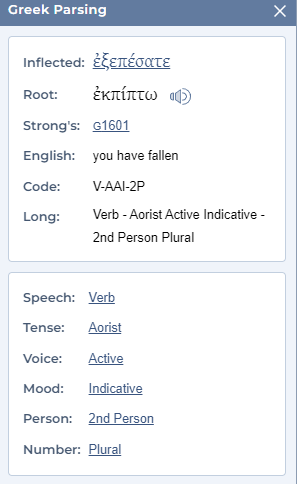
The term used for fallen away is ἐκπίπτω ekpíptō, and it is in the aorist tense. Since I am no Greek guru, I understand from my research this is typically considered to be an act in the past, a completed act, as the English translation communicates. It isn’t a process of falling, but of having fallen. Although it may seem I am laboring with tenses in many of the points I bring up, it is my desire to be clear with the text, to try to take the text and understand his original message.
And that message is a tough one!
If I were to summarize Paul’s message, I would have to say. Trust Christ and do not trust religion! Religion will kill you!
And if you teach that religion is the way of life, take a gander at Galatians 5:12. Surely there was no love lost between Paul and those who would unsettle believers from their trust in the Savior
Thanks again for coming to visit. I hope you found something of interest in this post and would appreciate a comment, to begin a discussion. If you would like to receive daily posts from Considering the Bible, click on the “Follow” link below
Jesus in the Old Testament is a series of posts that will offer my readers a chance to consider pictures or shadows of Jesus in the Old Testament. As mentioned in the introduction to this series, some may be obvious, some may be not so obvious, and some may simply be a facet of the Lord those reading may not have considered previously.
I hope as we venture through this series, we will see the Lord in many wonderful pictures throughout the Old Testament.
SEEING JESUS IN
ADAM
DEATH IN A GARDEN
Genesis 3:23 therefore the LORD God sent him out from the garden of Eden to work the ground from which he was taken.
John 19 41 Now in the place where he was crucified there was a garden, and in the garden a new tomb in which no one had yet been laid.
When I speak of death in the garden, I am not referring to the act of dying in a garden, for we know that Jesus did not die in a garden, but on a rugged hill named Calvary, the place of the skull. Not a picture of life and abundance, but of death and suffering.
Yes, John says there was a garden “in the place where He was crucified”. My understanding is that the garden was close by and could be generally considered to be “in the place” where He was crucified. The garden would be His final resting place, until He ruined the plans some had.
For Adam, his rebellion was in a garden, and the judgement of God came down upon Adam in the garden, for the Lord sent him out of the garden to work in a broken world. Jesus entered the broken world, being judged and condemned by sinners, only to enter death willingly through His obedience in a garden. His prayer to the Father in the garden set Him on a path of suffering and death that Adam had once experienced in kind. You see, Adam lost his unending fellowship with God, which is all he had known, and his fall into sin must surely have been horrific!
Jesus in all of eternity past, had never experienced any loss of fellowship with the Father ever. After the garden, Jesus entered into a death march.
Adam in a garden due to rebellion resulted in rejection from a garden into judgement and death.
Jesus in a garden, due to obedience, resulted in a judgement and death on a cross and into a tomb, representing death, in a garden.
The message of this word picture is that a garden was originally a place of life for Adam. Though he lost that life, a new (and better) life has been restored to us by Jesus, for in the garden, Jesus brought life and immortality to all of creation.
Thanks again for coming to visit. I hope you found something of interest in this post and would appreciate a comment, to begin a discussion. If you know someone this blog may bless (or challenge), send them a link, so they may join us in our discussion.
My hope is that this series will offer my readers a chance to consider the names, characteristics and descriptions of our God in the Word.
The remaining Names of God in this series might be considered descriptors, or characteristics of the Lord. We have reviewed the three primary Names of God, along with nineteen compound Names of God in our previous posts. As we venture through these descriptors of our God, I hope we will recognize all the many characteristics of our God that we tend to take for granted.
The Word is truly rich with descriptions of the Living God, and this effort of searching in the Word was quite illuminating. He truly is the ultimate subject of the Word, and His revelation of self-descriptions, or the accolades offered Him by His priests, prophets, kings apostles and faithful truly is a blessing.
May the Name of the Lord be praised, and by thinking on His name, may you have a blessed day.
24
ADVOCATE
1 John 2:1 My little children, I am writing these things to you so that you may not sin. But if anyone does sin, we have an advocate with the Father, Jesus Christ the righteous.
An advocate is an old term we don’t use often in our society, as we commonly think of one who argues in our favor as a defense attorney, a lawyer that we pay to defend us in front of a judge. The lawyer performs his duties being motivated by a paycheck at the end of the week, as one who stands before a condemning judge, physically apart from us, pleading before the judge, seeking to the judge of our innocence, sometimes by revealing a partial truth, or by exposing only some of the facts. Of course, I may be a bit jaded towards lawyers, for I am sure there are some who seek to do right, speak the truth and desire justice to be performed.
Our Advocate in heaven is quite different.
He is the truth, and will not shy away from expressing the “guilt” of our actions, for John notes that “if anyone sins”. Jesus is our advocate, and John reminds us that He is righteous, not us!
He is in relation with us, and not simply seeking a paycheck. He is not motivated by “filthy lucre”, as the old KJV sometimes refers to money.
He is beside us, associating with one of God’s children that has sinned, standing beside me, representing me as the Righteous One before the Father.
No – let’s reread that passage once more – the passage says we have an advocate with the Father. Our advocate in not merely standing in front of the judge, representing his client, but is an advocate with the Father. Am I pressing this too much to think that the personnel relationship Jesus has with the Father, that this relationship also bears weight in our representation before the Father?
Not only has He died for our sins, and out of that tremendous gift of grace towards us, have the right to defend us before a judge, but on top of that advantage, Our Advocate is with the Father.
One final thought to consider in this passage is that John does not refer to our Father as a judge in this passage. Our advocate is with His Father.
Truly, I am sure that as we consider the descriptions of the Lord, we will find more than we expect, as we slow down and consider the ramifications of the passages we sometimes gloss over.
Our Advocate is much more that a legal representative before a judge due to our sin.
So much more!
I would love to hear of your favorite name, characteristic or description of the Living God. Please leave me a comment, and I will include it in the list!
Thanks again for coming to visit. I hope you found something of interest in this post and would appreciate a comment, to begin a discussion. If you know someone this blog may bless (or challenge), send them a link, so they may join us in our discussion.
My hope is that this series will offer my readers a chance to consider the names, characteristics and descriptions of our God in the Word.
The remaining Names of God in this series might be considered descriptors, or characteristics of the Lord. We have reviewed the three primary Names of God, along with nineteen compound Names of God in our previous posts. At this point in our study, we will begin with “A God Merciful and Gracious”, the twenty-third Name of God on my list. As we venture through these descriptors of our God, I hope we will recognize all the many characteristics of our God that we tend to take for granted.
The Word is truly rich with descriptions of the Living God, and this effort of searching in the Word was quite illuminating. He truly is the ultimate subject of the Word, and His revelation of self-descriptions, or the accolades offered Him by His priests, prophets, kings apostles and faithful truly is a blessing.
May the Name of the Lord be praised, and by thinking on His name, may you have a blessed day.
23
A GOD MERCIFUL AND GRACIOUS
Psalm 86:15 But you, O Lord, are a God merciful and gracious, slow to anger and abounding in steadfast love and faithfulness.
What a good way to start out with on our third phase in the Names of God series. Merciful and Gracious. As I new believer in the church, I was told that grace is getting what you don’t deserve, and mercy is not getting what I deserve.
Does that make sense?
Yet, this merciful term has a bit more to it that just not getting what we deserve, as if that didn’t provide enough to be blessed by. This word “merciful” also includes the concept of compassion and somewhat surprised me when I think of merciful. Remember, merciful, in my mind, speaks of the refrain of some action or judgement upon a person that deserves it. To add the idea of compassion brings to mind the motivation behind the my concept of mercy.
When I consider the mercy of God, I commonly think only of the actions of the Lord (or better said, the refraining of rightful actions) and not His motivation in refraining from a judgement. Yet our God is a compassionate God, a God whose heart is that of a Father, seeking the best for His children, teaching, guiding, warning and loving His children.
The second term only strengthens this thought, for the psalmist reminds us of the graciousness of our God, a descriptor that blows up for us in the New Covenant. But for God to be understood as gracious is definitely not only a New Testament descriptor, for there are multitudinous passages referring to our God as gracious in the Old Covenant.
Moses, the law giver, did not understand God to be a harsh, dictatorial God, but when Moses met God, after he destroyed the first two tablets of the law, God began His self revelation to Moses, with the very same description we are considering today
Exodus 34:6 The LORD passed before him and proclaimed, “The LORD, the LORD, a God merciful and gracious, slow to anger, and abounding in steadfast love and faithfulness,
Moses, out of anger in seeing the Israelites sinning, through down the tablets of the law, a picture of us all “breaking the law”. And God reveals Himself as a God merciful and gracious.
Our God is a most surprising God and His name is to be praised
I would love to hear of your favorite name, characteristic or description of the Living God. Please leave me a comment, and I will include it in the list!
Thanks again for coming to visit. I hope you found something of interest in this post and would appreciate a comment, to begin a discussion. If you know someone this blog may bless (or challenge), send them a link, so they may join us in our discussion.
Hebrews 2:1 Therefore we must pay much closer attention to what we have heard, lest we drift away from it. Hebrews 2:2 For since the message declared by angels proved to be reliable, and every transgression or disobedience received a just retribution, Hebrews 2:3 how shall we escape if we neglect such a great salvation? It was declared at first by the Lord, and it was attested to us by those who heard,
We have been working through multiple passage under this series and it is somewhat surprising that this passage has been neglected till now. It is such a powerful passage warning us of our tendency to drift away from the message of the grace of God, and the great salvation He has provided!
When I embraced the OSAS (Once Saved Always Saved) teaching, I looked at this verse as a passage that was delivered to the lost, and the danger of their rejecting the great salvation the Lord provided for the world. This was the result of reading the third verse only, with a set of OSAS goggles on, interpreting the verse the way I was told to interpret it.
Lets consider the immediate context, and the specific message of the third verse.
Context
The author is speaking to Christians, including himself! Notice how he refers to “we” a couple of times in the first verse. Yes I have heard that the we could be referring to Hebrews, and not Christians since the author may have been Jewish, but honestly, this seems to be such a stretch to avoid the obvious. Consider the author’s fear of drifting away in the first verse. The direction of movement is away from the gospel, which implies there may have been a time when the audience (and the author) were closer to the message.
The entire book of Hebrews is speaking to believers who are on the edge of abandoning their faith, and for the author to change the audience in this small passage makes no sense for me. There will be a number of these passages in Hebrews, where the author addresses the audiences dangerous position. His audience contains Christians, those who believed in the Jewish Messiah, leaving behind a dead religion, a religion whose purpose was to bring them to faith, not to be a competition to the truth!
Specific Message
Again, as an OSAS adherent, I read the third verse thusly.
Hebrews 3:3 how shall we escape if we neglectreject such a great salvation?
How often have you heard a preacher or teacher read this verse, and then go on as if he is teaching it to an audience of lost souls, that they are rejecting the gospel? As if the church is full of lost souls, and that if any believers are in attendance, they are allowed to listen, but it doesn’t really apply to them.
The term the apostle uses is neglect, and refers to an attitude of negligence, carelessness of disregarding the truth we have been given. A few chapters later, the apostle uses this same Greek word in a bit different way, for he speaks of God showing no concern.
Hebrews 8:9 not like the covenant that I made with their fathers on the day when I took them by the hand to bring them out of the land of Egypt. For they did not continue in my covenant, and so I showed no concern for them, declares the Lord.
The same Greek word (ἀμελέω ameléō, G 272), but the one “neglecting” is God, and the ones being neglected are the very ones who considered the truth they had been provided as unimportant. Note that the author reminds the Hebrew believers that the Hebrews of history did not continue in the covenant they had been provided! Might it be that the Hebrews of old neglected the covenant, made light of the covenant? Surely this is the authors intended message!
Don’t make light of the gospel. We are in a life and death battle, a battle that will have consequences.
Thanks again for coming to visit. I hope you found something of interest in this post and would appreciate a comment, to begin a discussion. If you would like to receive daily posts from Considering the Bible, click on the “Follow” link below
Jesus in the Old Testament is a series of posts that will offer my readers a chance to consider pictures or shadows of Jesus in the Old Testament. As mentioned in the introduction to this series, some may be obvious, some may be not so obvious, and some may simply be a facet of the Lord those reading may not have considered previously.
I hope as we venture through this series, we will see the Lord in many wonderful pictures throughout the Old Testament.
SEEING JESUS IN
ADAM
HIS DOMINION
Genesis 1 26 Then God said, “Let us make man in our image, after our likeness. And let them have dominion over the fish of the sea and over the birds of the heavens and over the livestock and over all the earth and over every creeping thing that creeps on the earth.”
Matthew 28: 18 And Jesus came and said to them, “All authority in heaven and on earth has been given to me.
In Adam’s creation, God granted him dominion over all created beings, even over “all the earth”. Did Adam do anything to deserve this tremendous act of benevolence? Dang, the only thing he did was to “become”, if you know what I mean. He was completely passive in his own creation, and all of creation previous to his own. He came into this creation with nothing but the love of God shining down on him, and the beauty of creation encircling him.
Within this condition, God provided Adam the kingdom of the earth, for that is what dominion is speaking of, that is Adam was granted the right to rule over the entire creation. This appointment of ruling was granted out of absolutely nothing Adam did. Please understand my point for it may seem I am laboring to make it.
I assume by now you understand though Adam and Jesus were both granted dominion, Jesus far excels the example of Adam, for He did not have a perfect creation to rule over as Adam, but took a broken world, and suffered to redeem it, and out of a sinless life and vicarious death for our sake, was granted all dominion (authority) in heaven and earth.
A picture they say is worth a thousand words, but the picture of the “dominion of Adam” over earth barely scratches the extent of Jesus’ kingdom. And to return to the thought of deserving the kingdom, as we said with Adam, he did nothing to deserve the dominion over God’s creation. Jesus did everything to deserve the dominion He has been granted. And why? Because He is worthy!
Thanks again for coming to visit. I hope you found something of interest in this post and would appreciate a comment, to begin a discussion. If you know someone this blog may bless (or challenge), send them a link, so they may join us in our discussion.
My hope is that this series will offer my readers a chance to consider the names, characteristics and descriptions of our God in the Word.
Our next set of names (#4 through #22) are considered His compound names, which typically uses His primary name and attaches a specific descriptor to it. These are the names that originally got me chasing this topic, and now it has developed into a much bigger study than the original intent, but I digress, for I have already mentioned this!
The Word is truly rich with descriptions of the Living God, and this effort of searching in the Word was quite illuminating. He truly is the ultimate subject of the Word, and His revelation of self-descriptions, or the accolades offered Him by His priests, prophets, kings apostles and faithful truly was a blessing.
May the Name of the Lord be praised, and by thinking on His name, may you have a blessed day.
22
EL QANNA (JEALOUS GOD)
Exodus 20:5 You shall not bow down to them or serve them, for I the LORD your God am a jealous God, visiting the iniquity of the fathers on the children to the third and the fourth generation of those who hate me,
Whenever the concept of jealousy comes up in relation to the LORD, I fear we bring to mind the image of a drunken, insecure man wearing a “wife beater” shirt, ready to blow up at the hint of any disappointment or challenge in a relationship. Granted, this is how much of our experiential jealousy works itself out in our world (minus the shirt thing!) but as I found out in a previous study series (A Jealous God), for our God to be jealous is everything we should ever want.
He is jealous for our sake, not out of an insecurity of his worth, for He is certainly worthy, He is jealous for our sake, not out an emotional dependency He has, for prior to our creation, He was in full harmony within the Godhead. No, this jealousy, if I understand the Word properly, is a burden the Lord has taken upon Himself for our sakes, and not some knee jerk emotional reaction to the actions of others.
In our verse above, the context is the giving of the Ten Commandments, and the name He provides us is in relation the His people worshipping idols. Throughout the history of the Old Testament, for a father to allow idols usually plays out in the son worshipping the idol.
An example may help.
The patience of the Lord in the Old Testament regarding His people’s continual attraction to idols seems outrageous, for even King Manasseh – the king who typifies the idol worshipping king of Israel in my mind, was granted forgiveness, and restoration.
2 Chronicles 33:10-13 The LORD spoke to Manasseh and to his people, but they paid no attention. Therefore the LORD brought upon them the commanders of the army of the king of Assyria, who captured Manasseh with hooks and bound him with chains of bronze and brought him to Babylon. And when he was in distress, he entreated the favor of the LORD his God and humbled himself greatly before the God of his fathers. He prayed to him, and God was moved by his entreaty and heard his plea and brought him again to Jerusalem into his kingdom. Then Manasseh knew that the LORD was God.
This amazing repentance of Manasseh and personal restoration from idolatry by God for the king did not stop the degradation of the nation into captivity, for the children of the nation were on a course of self destruction, with each generation hardening against our Jealous God. Eventually, the beneficial aspect of God’s jealousy (that is, the actions of the Lord, intended for the for the people’s sake) became extremely harsh, for the nation who was granted this love continually spurned it.
Even in the Babylonian captivity, our jealous God continued to show His commitment to His people, using the captivity, not as a final judgement on the nation, but as a learning period for His people as a nation. He exercised the discipline the sons required in order for the restoration of the nation, knowing that the very nation would include those who would condemn the Messiah.
Yet out of this horrific exercise of hardened sinners, the jealousy of God was fully manifested, in that even in the rebellion of men, the grace of God provided for our benefit the gift of eternal life, the privilege of the Spirit of God, and the comfort of the Father’s love for the church.
He is good, and out of His jealousy for us, He has provided all good things!
I would love to hear of your favorite name, characteristic or description of the Living God. Please leave me a comment, and I will include it in the list!
Thanks again for coming to visit. I hope you found something of interest in this post and would appreciate a comment, to begin a discussion. If you know someone this blog may bless (or challenge), send them a link, so they may join us in our discussion.
My hope is that this series will offer my readers a chance to consider the names, characteristics and descriptions of our God in the Word.
Our next set of names (#4 through #22) are considered His compound names, which typically uses His primary name and attaches a specific descriptor to it. These are the names that originally got me chasing this topic, and now it has developed into a much bigger study than the original intent, but I digress, for I have already mentioned this!
The Word is truly rich with descriptions of the Living God, and this effort of searching in the Word was quite illuminating. He truly is the ultimate subject of the Word, and His revelation of self-descriptions, or the accolades offered Him by His priests, prophets, kings apostles and faithful truly was a blessing.
May the Name of the Lord be praised, and by thinking on His name, may you have a blessed day.
21
JEHOVAH-RAAH (THE LORD MY SHEPHERD)
Psalm 23:1 A Psalm of David. The LORD is my shepherd; I shall not want.
Out of all the Bible, this has to be one of the most recognizable names of our God. The LORD my Shepherd. We know it was revealed to us through David the shepherd king, yet He has always been a shepherd to His people. The idea of a shepherd began with the tending of sheep, of providing for these beasts of the fields. The first martyr was a shepherd, providing a glimpse in the Great Shepherd’s fate.
Genesis 4:2 And again, she bore his brother Abel. Now Abel was a keeper of sheep, and Cain a worker of the ground.
The term is sometimes translated as pasturing a flock, that is to take the flock to a place of sustenance, refreshment or safety. Many other men were famous shepherds. Abraham, Isaac and Israel, along with Moses, Amos and the shepherds near Bethlehem.
To be a shepherd meant to be alone, in the fields, amongst the wild beasts, in the cold of night, or under a blistering sun at high noon. To be a shepherd meant to forsake your will for the sake of some “dumb” animals, animals that were in constant danger, unknowing of any threat and requiring constant care. To be a shepherd meant to have animals as your closest friends, to identify with them, to plan for their survival, to seek their good, to search for the lost one, and to teach the wandering one difficult lessons.
Yes – The LORD is my shepherd, for He has acted like a true Shepherd, in that he has been all alone on the cross, fighting the wild beasts that want my soul, forsaking His will for the Father’s will, in order to seek and save a poor dolt like me. He is a constantly caring God, who seeks to be a friend, has identified with us, seeks our good, and teaches us difficult lessons.
I am thankful for the LORD my Shepherd.
I would love to hear of your favorite name, characteristic or description of the Living God. Please leave me a comment, and I will include it in the list!
Thanks again for coming to visit. I hope you found something of interest in this post and would appreciate a comment, to begin a discussion. If you know someone this blog may bless (or challenge), send them a link, so they may join us in our discussion.
18 This charge I entrust to you, Timothy, my child, in accordance with the prophecies previously made about you, that by them you may wage the good warfare,
19 holding faith and a good conscience. By rejecting this, some have made shipwreck of their faith,
20 among whom are Hymenaeus and Alexander, whom I have handed over to Satan that they may learn not to blaspheme.
Rejection. Paul is warning Timothy of the results of ignoring a good conscience. No – that is not right! It is not a matter specifically of ignoring to maintain a good conscience, which by the way is dangerous, but Paul speaks of some, who we will meet soon, as rejecting faith and a good conscience.
Two actions are being described in this verse.
Holding
G2192 – ἔχω échō To have, to hold, to own or possess.
This is a typical term to define ownership or to keep within close proximity, to cling to or to be closely joined to. The thought communicated is typical of Paul’s writings, and that is to maintain a close relationship with the Lord, and the two vehicles to maintain this relationship is faith and a good conscience. Paul is highlighting Timothy’s continued efforts for his ministry.
Rejecting
G683 – ἀπωθέομαι apōthéomai. To push off, cast away or to thrust away from. This seems to be a deliberate action on the part of the subject. This isn’t a matter of human frailty, in that we all fall down occasionally. Paul is using a word here that speaks of a decision to reject faith and a good conscience. To be able to reject something implies the possession of the thing being rejected – how can you reject something you do not have!. May we safely assume that the two men mentioned in this passage were believers at one time?
Two men are given as examples, who have rejected faith and a good conscience.
Hymenaeus
Hymenaeus shows up in one other passage in the New Testament. Paul is speaking of him as swerving from the truth, and upsetting the faith of some. Pray tell, Paul – what is Hymanaeus teaching that is so bad that you are calling him out for it?
2 Timothy 2:16-18
But avoid irreverent babble, for it will lead people into more and more ungodliness, and their talk will spread like gangrene. Among them are Hymenaeus and Philetus, who have swerved from the truth, saying that the resurrection has already happened. They are upsetting the faith of some.
Only that the general resurrection has occurred in the past! Consider if you were a believer during this time, and heard that you missed the resurrection. Talk about gutting the gospel! The fellow was causing tremendous damage in the church, and is to be considered an enemy of the gospel in my opinion. And in Paul’s opinion too, if I’m reading him right.
Alexander
There are a number of Alexanders in the New Testament, or at least there could be. We just don’t know. I tend to lean to the thinking Paul is referring to Alexander the coppersmith in our passage to Timothy, since Timothy is in Ephesus and the riot in Ephesus was lead by Alexander
Acts 19:33 Some of the crowd prompted Alexander, whom the Jews had put forward. And Alexander, motioning with his hand, wanted to make a defense to the crowd.
Another reference to Alexander , that Timothy would recognize and may be the one Paul is referring to in our passage in 1 Timothy, is Alexander the Coppersmith. Personally I would find it difficult to think this is a different man Paul refers to but I will leave that up to my reader
2 Timothy 4:14 Alexander the coppersmith did me great harm; the Lord will repay him according to his deeds.
Both Hymenaeus and Alexander have rejected a good conscience and faith. The results do not appear to be characteristic of good Christian living, so I ask you my friend.
What is the result of their rejecting a good conscience and faith?
Thanks again for coming to visit. I hope you found something of interest in this post and would appreciate a comment, to begin a discussion. If you would like to receive daily posts from Considering the Bible, click on the “Follow” link below
Jesus in the Old Testament is a series of posts that will offer my readers a chance to consider pictures or shadows of Jesus in the Old Testament. As mentioned in the introduction to this series, some may be obvious, some may be not so obvious, and some may simply be a facet of the Lord those reading may not have considered previously.
I hope as we venture through this series, we will see the Lord in many wonderful pictures throughout the Old Testament.
SEEING JESUS IN
ADAM
IN HIS IMAGE
Genesis 1:27 So God created man in his own image, in the image of God he created him; male and female he created them.
Luke 3:38 the son of Enos, the son of Seth, the son of Adam, the son of God.
Both Jesus and Adam were in His image.
Of course Adam’s creation was all encompassing. Everything about Adam at his creation was in the image of God.
At the visit with Mary by the Spirit, Jesus earthly body was also created, and with that creation, the image of God had taken a physical form. Adam kept the image untarnished for a matter of hours, maybe a day. Jesus is the image of God, in all His glory, and has retained that image spotlessly from the very beginning.
Definitely Adam was a refection of the Lord, though the duration was fleeting. But He is the eternal image of God, and knowing that makes all the difference!
Thanks again for coming to visit. I hope you found something of interest in this post and would appreciate a comment, to begin a discussion. If you know someone this blog may bless (or challenge), send them a link, so they may join us in our discussion.
My hope is that this series will offer my readers a chance to consider the names, characteristics and descriptions of our God in the Word.
Our next set of names (#4 through #22) are considered His compound names, which typically uses His primary name and attaches a specific descriptor to it. These are the names that originally got me chasing this topic, and now it has developed into a much bigger study than the original intent, but I digress, for I have already mentioned this!
The Word is truly rich with descriptions of the Living God, and this effort of searching in the Word was quite illuminating. He truly is the ultimate subject of the Word, and His revelation of self-descriptions, or the accolades offered Him by His priests, prophets, kings apostles and faithful truly was a blessing.
May the Name of the Lord be praised, and by thinking on His name, may you have a blessed day.
20
JEHOVAH TSIDKENU (THE LORD OUR RIGHTEOUSNESS)
Jeremiah 23:6 In his days Judah will be saved, and Israel will dwell securely. And this is the name by which he will be called: ‘The LORD is our righteousness.’
How New Testamental can a prophet get?
Notice that Jeremiah is not defining the LORD as righteous, though God is. No no no. The name we are looking at today is The Lord our Righteousness. God Himself is our righteousness, and none other. So what is Jeremiah telling us in this name.
When I think of righteousness, I sometimes fall into the thinking of sinlessness. Is that a correct understanding? Possibly. Could there be more to righteousness than just sinlessness? I am not sure but would like to offer my understanding, that hopefully will honor the LORD, in that He is our Righteousness.
In the English language, to be righteous is to act in accord with divine or moral law. It has implications of being virtuous, true, good and decent. All of these characteristics are gained by “keeping the rules”. And that is the rub! What rules? You see, the rules define righteousness acts. If the rules stated I need to skip instead of walk, walking would be considered sinful. (And girls would naturally be more righteous than boys – lol)
Therefore, if there are two sets of “rules” existing in a culture or society, there will be two sets of righteousness, both in conflict with one another. Does that make sense?
Let’s consider this concept another way. Some examples of two righteous ways of life are exhibited in the times of the Messiah. One righteousness was performed via the law of God, or at least the law of God as interpreted by centuries of men analyzing, arguing and reinterpreting someone’s interpretation. The folks that had mastered this righteousness were called the Pharisees.
The other righteousness was exhibited perfectly by a lone preacher that was connected with His Father, with eyes that read the Word with light, understood the heart of God, saw that up was down, light was dark and right was wrong. He persistently understood the Old Testament in ways that shocked the experts, and from that understanding lived a life of sacrifice, not of religion, of denial, not of reputation, of service, not of self.
And these two righteousness clashed. One took the path of violence and envy, the other the path of peace of love.
The LORD our Righteousness speaks of our rejecting one righteousness, and a daily clinging to another righteousness, that is the LORD (a person, not a set of rules) as our righteousness. He is the One who is “the rule”, and by His very character defines what righteousness is, and then came to earth to exhibit that righteousness in front of our eyes.
What does this righteousness look like?
Watch a humble preacher teaching life altering words in simple stories, washing his friends feet, teaching the worst of sinners of the love of God, and then bleeding for His enemies.
His name is Jesus and He is the Lord our Righteousness.
I would love to hear of your favorite name, characteristic or description of the Living God. Please leave me a comment, and I will include it in the list!
Thanks again for coming to visit. I hope you found something of interest in this post and would appreciate a comment, to begin a discussion. If you know someone this blog may bless (or challenge), send them a link, so they may join us in our discussion.
My hope is that this series will offer my readers a chance to consider the names, characteristics and descriptions of our God in the Word.
Our next set of names (#4 through #22) are considered His compound names, which typically uses His primary name and attaches a specific descriptor to it. These are the names that originally got me chasing this topic, and now it has developed into a much bigger study than the original intent, but I digress, for I have already mentioned this!
The Word is truly rich with descriptions of the Living God, and this effort of searching in the Word was quite illuminating. He truly is the ultimate subject of the Word, and His revelation of self-descriptions, or the accolades offered Him by His priests, prophets, kings apostles and faithful truly was a blessing.
May the Name of the Lord be praised, and by thinking on His name, may you have a blessed day.
19
JEHOVAH SHAMMAH (THE LORD IS THERE)
Ezekiel 48:35 The circumference of the city shall be 18,000 cubits. And the name of the city from that time on shall be, The LORD Is There.”
Let us remember the circumstances Ezekiel is writing under. The nation has been decimated by the Babylonians, Jerusalem sacked and the temple, the magnificent temple of Solomon has been cut down, destroyed. The people of God have been either killed in battle, underwent starvation and subsequent death, or carried off to a strange land to the north, amongst those who speak with a different tongue and worship a different god.
According to my research, Ezekiel receives this revelation of God’s name 25 after the deportation of the Jews into the strange land of Babylon. Two and a half decades of living in shock and confusion, for being away from the temple meant there was no ability to provide sacrifices to God, no priests performing the required rituals for the people.
And recently the people had been alerted that any hope of returning quickly to Jerusalem to be near the temple, well – that wasn’t going to happen! The Babylonians destroyed the Temple, and even the prophets were speaking of a long captivity, of 70 years away from the land!
Many of the Jews understandably may have lost heart, seeing that they would never survive the captivity, and then finding out that the temple was destroyed, accepted their destiny was to grow old in this strange land. With all the established physical connections with God broken, and experiencing the disciplinary hand of God, the Jewish people’s faith must have been crushed. A people without a home, a land, and seemingly without a God.
So when Ezekiel starts to describe a future city, the people’s ears must have perked up. Ezekiel has already spent considerable time in earlier chapters describing a temple to be constructed after the captivity, but in our passage today, Ezekiel is describing a city, not a temple. And the name we are considering this fine day is “The LORD is There”. This is curious, for the careful reader will recognize that the name is not associated with a temple, as most would expect, but with a City, where day to day life happens.
My understanding is that Ezekiel is not only trying to encourage the remnant, but to expand their understanding of relating to God. No longer is a faithful one to meet with God in the temple on holy days, but that the faithful one would be living life, minute by minute, in the presence of God. Such a tremendous promise. The promise of permanence of God’s presence is provided to the faithful here, for the verse speaks of a city having this name “from that time on.” The city where the LORD is!
This series is not on eschatology, on when this blessing will occur, but is seeking to provide a vehicle for those reading to consider who our God is, through his names and descriptions. Personally, the understanding I have tried to explain above fits with our current church age, in that He is the ever-present One, the LORD who is There in the City of God. He is building this city, stone by stone, and He is There.
Hebrews 11:10 For he was looking forward to the city that has foundations, whose designer and builder is God. Hebrews 11:16 …. Therefore God is not ashamed to be called their God, for he has prepared for them a city.
What city do you dwell in?
I would love to hear of your favorite name, characteristic or description of the Living God. Please leave me a comment, and I will include it in the list!
Thanks again for coming to visit. I hope you found something of interest in this post and would appreciate a comment, to begin a discussion. If you know someone this blog may bless (or challenge), send them a link, so they may join us in our discussion.
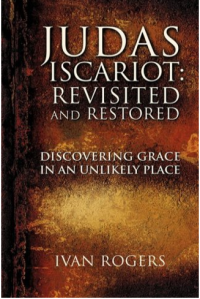
I found a book called “Judas Iscariot: Revisited and Restored” by Ivan Roger, and though I have read it once before, this time the authors points seem to be sinking in a bit more.
The general theme of the book is that much of the popular understanding of Judas, and his relationship within Christianity, is colored by theological presuppositions and general bias against Judas.
In our previous discussion, we considered the Greek word translated as “woe” within the gospel of Matthew, along with a grammar lesson on pronouns, and who they belonged to.
In this post we will consider John 13:27, where the Lord commands Judas to quickly do what he needs to do. Let’s take a moment to read the verse.
John 13:27 ESV – Then after he had taken the morsel, Satan entered into him. Jesus said to him, “What you are going to do, do quickly.”
Our author makes the point of Jesus statement as being a command to Judas, to go do it quickly. The word “do” is a Greek word that means “to ordain, to appoint or to deal”. It does not have any implication of rejection, as if Jesus was “kicking him out of the upper room”, as it sometimes is communicated to me by well meaning friends. No, per the language, it appears Jesus is actually commissioning Judas to perform his task. A task of “delivering the sacrificial lamb” to the priest. The author’s detailing of this deliverance is worth the purchase of the book and I shall not expand on it here.
Note also two additional items to consider.
Warning?
Jesus gave Peter advance notice of his impending failure and denial. When other disciples were in the midst of failing a particular task, the Lord corrected them. In this instance, Jesus commissioned or encouraged(?) Judas to perform his assignment. No discouragement, no warning, no statement from Jesus that would restrict Judas from his endeavor. Judas was told to do it quickly!
Woe?
As soon as Judas left the room, Jesus spoke the following.
John 13:31 When he had gone out, Jesus said, “Now is the Son of Man glorified, and God is glorified in him.
Jesus understood Judas’ mission. If I was in the room, knowing the same, I would expect “Woe is me” from the Master. But after Judas left the room, setting in motion the deliverance of the lamb to the high priest, Jesus spoke of glorification, both of Himself and of God. Glorification, in this context is speaking of the crucifixion, and the wheels had begun to turn. Judas set the stage for the priests to begin the process.
And God is glorified!
So help me in understanding from this passage where Judas is standing in relation to Jesus. Is he the enemy? Is he Satan? What think ye? Leave me a comment below.
I look forward to your return for our next posting on this book at Considering the Bible, and if you have found my ruminations to be a blessing (or a challenge), invite your friends to join us.
I found a book called “Judas Iscariot: Revisited and Restored” by Ivan Roger, and though I have read it once before, this time the authors points seem to be sinking in a bit more.
The general theme of the book is that much of the popular understanding of Judas, and his relationship within Christianity, is colored by theological presuppositions and general bias against Judas.
In our previous discussion, we considered the Greek word translated as “betray” within the gospel of Matthew, and offered the possibility that it could be translated as deliver, as opposed to betray.
In this post we will consider Matthew 26:24, where the Lord speaks of “woe” on the one who will deliver Him to the high priest. Let’s take a moment to read the verse.
Mat 26:24 ESV – The Son of Man goes as it is written of him, but woe to that man by whom the Son of Man is betrayed! It would have been better for that man if he had not been born.”
The author of the book provides two questions to consider. Does the term woe carry with it a sense of responsibility? And secondly, what is the message “…would have been better for that man if he had not been born.”?
Woe
As Jesus comes to the end of His ministry, He begins to pronounce His woes on those who will enter into judgement. The Pharisees, the Scribes, Judas, pregnant women and young mothers. What? Pregnant women and young mothers? Entering into judgement? Am I assuming something I shouldn’t?
Mat 24:19 ESV – And alas for women who are pregnant and for those who are nursing infants in those days!
The word “woe” (or “alas” as translated in this verse) is a translation of οὐαί ouaí and is a primary exclamation of grief. I have always introduced the idea of judgement with this word, but that is an additional concept Carl brings into the verse, especially when I hear it about those dang Pharisees! (Don’t forget your pharisaical tendencies Carl!)
The term strictly carries with it the idea of grief, and not necessarily that of responsibility. The Lord expresses His grief, even when it comes to those opposing Him. Jesus, in pronouncing woe on those who would be instrumental in His crucifixion, was expressing grief over their future. And He was pronouncing grief over the future of Judas, but is He pronouncing an eternal judgement of hellfire and condemnation on Judas? I have to admit that I find it difficult to see this interpretation as a clear teaching from this verse. His heart is breaking over the suffering His disciple was going to experience in the future. Like those pregnant women and young mothers. But Carl, the next phrase is where we get the judgement and condemnation poured out on Judas! So let us consider the phrase “better for that man if he had not been born”.
Better for that man if he had not been born.”
The author associates “that man” with Judas, which I also have as I read through this passage. He refers to Judas as a representative man, a man that stands in the place of all humanity in being a traitor to the Messiah, and that each of us deserves judgement. I get this, yet it didn’t seem to make a difference for me in my understanding of Jesus statement.
A few years ago, I was looking at this verse and stumbled over an alternate translation that associates “that man” with Jesus. Hold up now before you think I have flipped my lid. Consider a literal translation, such as Youngs Literal Translation.
Matthew 26:24 YLT – the Son of Man doth indeed go, as it hath been written concerning him, but wo to that man through whom the Son of Man is delivered up! good it were for him if that man had not been born.’
Did you catch the difference in who “that man” is?
…good it were for him (Judas) if that man (Jesus) had not been born. That is a completely different message!
Consider all that is going on in this portion of the verse.
First off, it speaks of life, and not simply existence. There is a difference. It is not that “that man” was never conceived, but that he had not been born. A still born baby existed, but never lived outside of the womb. I am not sure if this fine point makes a difference, or if this is simply a Hebrew prophets way of describing no existence better than having existed, even for a short duration. Yet even with that, to assign the hell fires of eternal condemnation to Judas based on this turn of phrase, seems like we just can’t wait to get Judas into hell. We sure like to hate him!
Secondly, the turn of phrase, that of “better to not have been born”, may not be referring to Judas if I am understanding the literal translations. No matter, based on both my preconceived ideas of “woe” and identifying who should have not been born, this verse is not so clear as I thought regarding Judas’ destiny of eternal torment.
What think ye? Leave me a comment below
In my next posting, we will consider the command Jesus gave to Judas at the last supper. Somewhat of a challenge to our (my) thinking, to say the least.
I look forward to your return for our next posting on this book at Considering the Bible, and if you have found my ruminations to be a blessing (or a challenge), invite your friends to join us.
My hope is that this series will offer my readers a chance to consider the names, characteristics and descriptions of our God in the Word.
Our next set of names (#4 through #22) are considered His compound names, which typically uses His primary name and attaches a specific descriptor to it. These are the names that originally got me chasing this topic, and now it has developed into a much bigger study than the original intent, but I digress, for I have already mentioned this!
The Word is truly rich with descriptions of the Living God, and this effort of searching in the Word was quite illuminating. He truly is the ultimate subject of the Word, and His revelation of self-descriptions, or the accolades offered Him by His priests, prophets, kings apostles and faithful truly was a blessing.
May the Name of the Lord be praised, and by thinking on His name, may you have a blessed day.
18
JEHOVAH SHALOM (THE LORD IS PEACE)
Judges 6:24 Then Gideon built an altar there to the LORD and called it, The LORD Is Peace. To this day it still stands at Ophrah, which belongs to the Abiezrites.
Peace.
I often think of peace as merely the absence of war, and to a point that is accurate, depending on the war we are considering. International war is the predominant topic when the topic of peace is tossed about in discussions.
Why can’t we have peace? As Gideon has described our God in this verse, the LORD is peace!
So how do we make sense of this? Even the Lord in one of His final discourses warned us of wars in the future.
Matthew 24:6 And you will hear of wars and rumors of wars. See that you are not alarmed, for this must take place, but the end is not yet.
So it seems evident that He didn’t come to immediately put an end to physical wars between nations. And yet He is peace. This is the nature of our God, and by providence, our last study in the Names of God was the LORD of Hosts, or the Lord of the armies! This is a conflict surely!
As mentioned in the introductory, we need to remember the context of the conversation. What war is being referred to, and does the peace spoken of merely refer to the absence of war?
I believe that God is One who works in the nations through changing the people within the nation. Of course He can change the “heart of the king” when His plans demand it, or in response to His peoples prayers, but at this point in my pilgrimage, I understand His ways are primarily with individual hearts and minds.
If this is true, we can see the LORD of peace fully displayed in the Lord Jesus. And per His teaching, His intent was not to rule over the kingdom of this world. No – this world, or world system must be destroyed
John 18:36 Jesus answered, “My kingdom is not of this world. If my kingdom were of this world, my servants would have been fighting, that I might not be delivered over to the Jews. But my kingdom is not from the world.”
So when we read of peace in the Word, we should be careful to understand the Word is not primarily speaking of international peace amongst nations. When we read of peace in the Word, we should hear a fuller picture, a mental image including completeness or wholeness, safety, soundness, welfare, health, prosperity, tranquility, contentment.
Much more than simply the absence of war! As a matter of fact, one of the many blessings of being a believer is the fact that we can have this peace in the midst of outer turmoil, of international wars, of upheaval in our own nation.
Peace in the midst of war. Only the LORD of peace can provide this!
I would love to hear of your favorite name, characteristic or description of the Living God. Please leave me a comment, and I will include it in the list!
Thanks again for coming to visit. I hope you found something of interest in this post and would appreciate a comment, to begin a discussion. If you know someone this blog may bless (or challenge), send them a link, so they may join us in our discussion.
My hope is that this series will offer my readers a chance to consider the names, characteristics and descriptions of our God in the Word.
Our next set of names (#4 through #22) are considered His compound names, which typically uses His primary name and attaches a specific descriptor to it. These are the names that originally got me chasing this topic, and now it has developed into a much bigger study than the original intent, but I digress, for I have already mentioned this!
The Word is truly rich with descriptions of the Living God, and this effort of searching in the Word was quite illuminating. He truly is the ultimate subject of the Word, and His revelation of self-descriptions, or the accolades offered Him by His priests, prophets, kings apostles and faithful truly was a blessing.
May the Name of the Lord be praised, and by thinking on His name, may you have a blessed day.
17
JEHOVAH SABAOTH (THE LORD OF HOSTS)
1 Samuel 1:3 Now this man used to go up year by year from his city to worship and to sacrifice to the LORD of hosts at Shiloh, where the two sons of Eli, Hophni and Phinehas, were priests of the LORD.
The LORD of Hosts. Jehovah Sabaoth.
At first glance, I associated this name with the sabbath, but this is not correct. This name has nothing to do with rest, for the term sabaoth refers to armies!
No, this description, this name of God defines Him as One who commands the armies of heaven and earth. The verse above includes the first occurrence of this name of God in the Word. But not the last. The prophets refer to God as the LORD of Hosts over 200 times in the Old Testament.
Prior to Samuel’s arrival on the scene for the Israeli people, the nation was likely experiencing a sense of inadequacy, where all the neighboring nations had armies that were stronger than the little fledgling nation of Israel. In writing this as a history for the nation, Samuel may have recorded this name in order to bolster the faith of those in the nation.
Of course the Lord has always been a warrior God, and for the men of Israel, this translated into dominance over other men, peoples and nations. This requirement of dominance over others was for two purposes.
The primary purpose I suppose many would guess at, but let us first consider the secondary purpose of the nation of Israel to exist, which required physical battles. The nation, per God’s intent, was to be a blessing to the nations. Remember Gods promise to Abraham?
This intent was not fully realized in the nation itself, for the nation fell into idolatry and sin. Sadly, the goal of blessing the nations by the nation of Israel was not fully realized.
So let us consider the primary purpose of the establishment of the nation. To establish the nation of Israel would provide a focused environment for prophecy to be displayed. And the focus of this prophecy? The Messiah of all of creation of course!
Yes – the purpose of the nation was to produce the Messiah, the Savior for all. And for that nation to be used of God in protecting the physical lineage of the Messiah.
But once the Messiah arrived, the motivation of the LORD of hosts became clear, in that our warrior God’s actions were not to accomplish physical dominance, but to shed grace and mercy fueled by His never ending love to all who would look to Him.
When we speak of the Lord of Hosts today, we should not imagine a god who revels in bloodshed, death and destruction. This was never His overarching intent, and as we see in the Messiah, not of His character. His armies have fought to preserve the lineage of the Messiah, so that the Messiah could come and display the greater power, the power of love for His enemies.
The LORD of hosts is the warrior God who is fighting for our souls, as opposed to against our physical “enemies”.
He is our LORD of Hosts, and we are blessed to be led by Him in a triumph of victory through sacrifice, humility, peace and love. Praise His name
I would love to hear of your favorite name, characteristic or description of the Living God. Please leave me a comment, and I will include it in the list!
Thanks again for coming to visit. I hope you found something of interest in this post and would appreciate a comment, to begin a discussion. If you know someone this blog may bless (or challenge), send them a link, so they may join us in our discussion.
I found a book called “Judas Iscariot: Revisited and Restored” by Ivan Roger, and thought I have read it once before, this time the authors points seem to be sinking in a bit more.
The general theme of the book is that much of the popular understanding of Judas, and his relationship within Christianity, is colored by theological presuppositions and general bias against Judas.
In our introductory post on this book, I mentioned some presuppositions that color our understanding of Judas. With this post, I would like to consider the description of Judas as the betrayer.
In each of the listings of the apostles, Judas is always the last named, and is usually described as the one who betrayed Jesus.
Betrayal. Such a loaded term! But is this a required translation of the Greek? The word translated as betrayal, in the gospel of Matthew is from the Greek word παραδίδωμι paradídōmi (Strong’s G3860).
A number of the verses that have G3860 in them follows, with the translation of the term underlined for the readers convenience
Mat 26:15 and said, “What will you give me if I deliver him over to you?” And they paid him thirty pieces of silver. Mat 26:16 And from that moment he sought an opportunity to betray him. Mat 26:21 And as they were eating, he said, “Truly, I say to you, one of you will betray me.” Mat 26:23 He answered, “He who has dipped his hand in the dish with me will betray me. Mat 26:24 The Son of Man goes as it is written of him, but woe to that man by whom the Son of Man is betrayed! It would have been better for that man if he had not been born.” Mat 26:25 Judas, who would betray him, answered, “Is it I, Rabbi?” He said to him, “You have said so.” Mat 26:45 Then he came to the disciples and said to them, “Sleep and take your rest later on. See, the hour is at hand, and the Son of Man is betrayed into the hands of sinners. Mat 26:46 Rise, let us be going; see, my betrayer is at hand.” Mat 26:48 Now the betrayer had given them a sign, saying, “The one I will kiss is the man; seize him.” Mat 27:2 And they bound him and led him away and delivered him over to Pilate the governor. Mat 27:3 Then when Judas, his betrayer, saw that Jesus was condemned, he changed his mind and brought back the thirty pieces of silver to the chief priests and the elders, Mat 27:4 ESV – saying, “I have sinned by betraying innocent blood.” They said, “What is that to us? See to it yourself.” Mat 27:18 ESV – For he knew that it was out of envy that they had delivered him up. Mat 27:26 ESV – Then he released for them Barabbas, and having scourged Jesus, delivered him to be crucified.
Notice that throughout the previous verses the Greek word paradídōmi has been translated as betray or deliver. Are these the same concepts in the original intent of the author?
Let’s take for example Matthew 27:26 and replace deliver with betray.
Matthew 27:26 Then he released for them Barabbas, and having scourged Jesus, betrayed him to be crucified.
Does that make sense? Might the translators be taking a liberty that is not necessarily justified? The same might be said of Matthew 27:2.
Mat 27:2 And they bound him and led him away and betrayed him over to Pilate the governor.
Yet, if the term paradídōmi is consistently translated as “delivered”, the verses above continue to make sense, and open up an allowable scenario for Judas to perform a task that is not so emotionally charged as with the word betray, and in my opinion reinforces the Kingship of Jesus. For you see, this understanding may elevate His complete control over a situation that was at all appearance completely out of His control. Even at the time of seeming defeat, God was orchestrating a deliverance of mankind that no one saw coming, and had a depth of old covenant teaching in it I had never realized.
For Judas to be a “deliverer” has old covenant implications that I found quite astounding, and is expanded in the book. For those who have an open mind, I would suggest picking up a copy. I am confident you may read it more than once.
In my next installment, we will consider another of the presuppositions the author brings to the table, (the woe of Matthew 26:24). I hope you get a chance to visit and let me know your thoughts.
I found a book called “Judas Iscariot: Revisited and Restored” by Ivan Roger, and though I have read it once before, this time the authors points seem to be sinking in a bit more.
The general theme of the book is that much of the popular understanding of Judas, and his relationship within Christianity, is colored by theological presuppositions and general bias against him.
It is a difficult book to take seriously at first, for my opinion of Judas has been established via cultural and religious teaching from the very first time I heard of this wicked evil betrayer. As the author notes, within the western world, no-one names his child Judas due to the association of evil the name carries with it. He is the ultimate betrayer, a toxic man of shear evil.
Somewhere in Dante’s Inferno, the writer describes Judas’ place in the lowest bowels of hell, being feasted on by Satan himself for all eternity! Surely there is no place for Judas amongst the redeemed! Such is my opinion, and to be honest, I do not know why I purchased this book. But I did, and I am thankful for the challenge it has put in front of me
As I venture through this book, I will occasionally bring to the reader some interesting points to consider. For those who have an open mind to consider alternate Christian views on this most hated of the apostles, I would suggest picking up a copy. I am confident you may read it more than once.
In my next installment, we will consider one of the presuppositions the author brings to the table, and helped me begin to consider an alternate view of and for Judas.
My hope is that this series will offer my readers a chance to consider the names, characteristics and descriptions of our God in the Word.
Our next set of names (#4 through #22) are considered His compound names, which typically uses His primary name and attaches a specific descriptor to it. These are the names that originally got me chasing this topic, and now it has developed into a much bigger study than the original intent, but I digress, for I have already mentioned this!
The Word is truly rich with descriptions of the Living God, and this effort of searching in the Word was quite illuminating. He truly is the ultimate subject of the Word, and His revelation of self-descriptions, or the accolades offered Him by His priests, prophets, kings apostles and faithful truly was a blessing.
May the Name of the Lord be praised, and by thinking on His name, may you have a blessed day.
16
JEHOVAH RAPHA (THE LORD YOUR HEALER)
Exodus 15:26 saying, “If you will diligently listen to the voice of the LORD your God, and do that which is right in his eyes, and give ear to his commandments and keep all his statutes, I will put none of the diseases on you that I put on the Egyptians, for I am the LORD, your healer.”
This name of our God speaks of the Lord’s ability to control disease over His creation. After having just reviewed His name as Jehovah Naheh, The Lord that strikes, this name also is somewhat related to disease and His people.
Moses speaks of the Lord not placing any of the diseases on His people that He placed on the Egyptians. It seems Moses is placing the responsibility of the Egyptians being diseased on the Lord and that God controls who receives disease. I do not often think of the Lord as the One placing disease on anyone, and yet the passage here speaks of Him doing that very thing!
Let’s remember the context of the passage that gives us this wonderful name. It is immediately after the Israelites are delivered from the Egyptians, when they saw the Red Sea collapse on their enemies, drowning Pharoah and his armies. The people of God, not yet in covenant relation with the Creator of the Universe, have experienced a rollercoaster ride of experiences, from being kept safe from ten plagues, to escaping from the most powerful nation on earth and being delivered (again) by the hand of God from certain capture at the shores of the Red Sea. This was incredible! The hand of the Lord had been exposed over and over again in miraculous ways, favoring this family of a wandering shepherd named Abraham.
After all the action and tense rescues, the people of God venture into a journey to the promised land. Three days into the journey, the people of God again come to a “fork in the road”. They have not had any water for three days, and when they did find water, it was bitter.
At this point the Lord allowed a circumstance to occur that would reinforce a needed revelation. Not so much a revelation of the nature of God as the great Healer, though precious as it is, but a revelation of the people themselves in relation the the One who has rescued them. The people easily forgot God. The people of God easily, or shall we say naturally, turned bitter against God.
This reaction of the people is a revelation of their hearts, if they were so inclined to receive it, of their relation with the One who rescued them. Upon coming to an oasis that provided a false hope of relief from thirst, the people did not go to the Lord, as Moses did, for direction or deliverance. They went to Moses to complain.
I believe this occurrence was provided to the people of God as a way of exposing to them their own bitterness. And they were a bitter, grumbling people, complaining of the immediate circumstance, looking short term and not to Who was guiding them. Let’s admit this of ourselves, for we often complain to someone of God’s dealing in our lives, as those in our passage did, when we should go directly to Him with our concerns.
The passage continues, emphasizing obedience to the will of God, but note that it is after the miracle was performed, after the bitter water was made sweet. God, in His ever patient manner provides a solution after the people’s leader cries out to Him. After the solution is provided, obedience is spoken of.
For obedience would become the central theme of discussion in a short time. The fledgling community would come to a mountain called Sinai soon, and enter into a covenant with God based on obedience. Out of obedience will come success, for Moses is teaching the people here of a general truth of the blessing resulting from hearing God’s Word and doing it.
In closing, and in relation the the name of God we are looking at, please note that the log that Moses was shown, and that he threw into the bitter waters, could be translated as a tree. This reference to a log/tree being used to heal the water, leads me to think of the crucifixion, of Jesus hanging on a tree, and that the bitterness of our lives has been healed if we look to Him. The tree/cross of Christ is the instrument God has used to provide us with sweet water, the solution to our bitter lives. We may be a complaining lot, but God has acted, He has provided the solution, He has given us the sweet water of salvation in it’s greatest sense. 1Peter 2:24 He himself bore our sins in his body on the tree, that we might die to sin and live to righteousness. By his wounds you have been healed.
Yes our God is JEHOVAH RAPHA (THE LORD OUR HEALER) When Moses spoke of this name, it was in the immediate context of water for physical existence. We now know that as the healer, He had a much greater salvation than simply provided drinkable water for a thirsty nation. He is good!
I would love to hear of your favorite name, characteristic or description of the Living God. Please leave me a comment, and I will include it in the list!
Thanks again for coming to visit. I hope you found something of interest in this post and would appreciate a comment, to begin a discussion. If you know someone this blog may bless (or challenge), send them a link, so they may join us in our discussion.
My hope is that this series will offer my readers a chance to consider the names, characteristics and descriptions of our God in the Word.
Our next set of names (#4 through #22) are considered His compound names, which typically uses His primary name and attaches a specific descriptor to it. These are the names that originally got me chasing this topic, and now it has developed into a much bigger study than the original intent, but I digress, for I have already mentioned this!
The Word is truly rich with descriptions of the Living God, and this effort of searching in the Word was quite illuminating. He truly is the ultimate subject of the Word, and His revelation of self-descriptions, or the accolades offered Him by His priests, prophets, kings apostles and faithful truly was a blessing.
May the Name of the Lord be praised, and by thinking on His name, may you have a blessed day.
15
JEHOVAH NAHEH (THE LORD THAT STRIKES)
Deuteronomy 28:22 The LORD will strike you with wasting disease and with fever, inflammation and fiery heat, and with drought and with blight and with mildew. They shall pursue you until you perish.
This one is heavy!
Moses is speaking to the nation of Israel, recounting their failures as they journey to the promised land, and speaking his last formal message to the people of God. This name of God is found in the middle of a discourse that defines the curses that will be laid on the people of God due to their disobedience.
Starting in verse 15 of the 28th chapter of Deuteronomy, Moses starts with the results of not obeying the voice of God, speaking of how these curses will overtake them, as if they could run from judgement. It is a sobering passage that does not make for light reading!
Nevertheless, the character of the Lord is further defined in this passage, and it is in relation to His covenant people. To strike, or as some Bibles translate it, to smite, in relation to God and His people, is usually referring to physical ailments, plagues and such.
Wasting disease refers to consumption, or in our terminology, a lung disease. It has the image of emaciation associated with it, and brings to my mind the picture of a starving man on the side of the road.
The next three descriptors of the “striking” the Lord lays on His people, and are all associated with a fever, each becoming a greater threat to life. A fiery heat may imply a violent heat. Violent, as the fever makes the body react in a violent manner!
The term translated as drought may also be translated as sword. Here we start to see that it is not merely a striking of the body, but also of the land, in not producing crops for the sustenance of the people. If sword is the correct translation, the effect is the same, for when war comes, so comes severe lack of resources, primarily food.
Blight is a disease that is readily associated with grain, and speaks of a sudden wilting and dying of part of all of the plant. Mildew is associated with plants, usually due to drought. Both of these terms speak of the loss of sustaining food for the population.
No matter how you look at some of these descriptors, the “striking” is serious. So serious, that in our verse above, Moses tells the people of God that there will be no escape. Once the condition of rebellion is established, once the choice is made to not obey the voice of the Lord, the curses will pursue you.
The curses will not simply pursue you at arms length, giving you the opportunity to escape, but for these people hearing the voice of God through the prophet Moses, they are told they will not be able to escape.
No escape! The curses will pursue them until they perish. Perish!
This is a heavy, serious and dangerous name to consider in our thinking. He is the All-Powerful, and He deserves our obedience, yet in the midst of it all, in seeing our desperate condition, He provided an opportunity.
A man hanging on a tree, accepting the curses in our place. The curses are real, and the curses will consume us, unless we flee to the One who tasted death for us, the One who became a curse for us.
Galatians 3:13 Christ redeemed us from the curse of the law by becoming a curse for us–for it is written, “Cursed is everyone who is hanged on a tree”
He did not simply accept the curses we deserve, but He became a curse for us. He is the One who only and always is a blessing to the Father, a blessing to His creation and the bearer of all good gifts to the one who follows.
Praise His name, for He is good. He provides to the rebel and the sinner, the hater and the liar, an opportunity to know the only true God and Jesus Christ, whom He sent.
I would love to hear of your favorite name, characteristic or description of the Living God. Please leave me a comment, and I will include it in the list!
Thanks again for coming to visit. I hope you found something of interest in this post and would appreciate a comment, to begin a discussion. If you know someone this blog may bless (or challenge), send them a link, so they may join us in our discussion.
5 The aim of our charge is love that issues from a pure heart and a good conscience and a sincere faith. 6 Certain persons, by swerving from these, have wandered away into vain discussion, 7 desiring to be teachers of the law, without understanding either what they are saying or the things about which they make confident assertions. 8 Now we know that the law is good, if one uses it lawfully, 9 understanding this, that the law is not laid down for the just but for the lawless and disobedient, for the ungodly and sinners, for the unholy and profane, for those who strike their fathers and mothers, for murderers, 10 the sexually immoral, men who practice homosexuality, enslavers, liars, perjurers, and whatever else is contrary to sound doctrine, 11 in accordance with the gospel of the glory of the blessed God with which I have been entrusted.
What a fantastic passage on the purpose of the law. When I first came to know the Lord, this basic truth, that the law was provided for sinners, law breakers, rebels and such, stunned me. I thought it was to provide guidance for the morally upright, and to a point this may be true, but external standards are provided to show we cannot maintain the standard without help, without inner strength, without the desire to please someone.
Yes, the law is good and holy, but as Paul mentions, we have to use it lawfully, or for the purpose for which it was given. It provides condemnation! But before I delve into that topic, let us consider how the passage above applies to the topic of this series.
How does 1 Timothy 1:5-11 read in relation to conditional security? I have read this passage many times, and confessedly, always dwell on the law topic within the verses, but let me refer you to verse 5 & 6.
First off, Paul speaks of the goal of his teaching or instruction. He aims to direct believers into love. This love comes from a pure heart. This love comes from a good conscience. This love comes from a sincere faith. Love is the aim of the apostles teaching. Not a spurious, feely touchy love that ebbs and flows with emotional highs and lows. This love is to be a consistent, nature based loved, a love based on character, a character developed by knowing the Lord, as opposed to knowing a law.
I hope this isn’t shocking to any of my readers, for love is the core of Christianity. Love that is found in and sourced out of the Lord Jesus, and His self sacrificial life. Paul saw the destination (or was aiming at) this condition for the believers as he taught them.
But what if believers decide this isn’t to be the focus of their faith, the target to shoot for as they live amongst others? Paul speaks of these that have swerved from this target, wandering into vain discussion. They have swerved! I understand this to mean they were on course at one time, they had caught sight of the target and was well on the way. Until. Until something pulled them away. Something distracting, tantalizing, shiny and bright!
The law.
Oh how the law feeds to the pride we live in. If (when) I focus on the law, I become a judge. A judge that has to condemn, and that conveniently turns a blind eye to my own rebellion. Love has to be jettisoned from our focus in life, for the law has no room for mercy, love or patience.
These believers that Paul refers to as swerving are not understanding what they are dabbling in, becoming those who teach (instead of learning?) and disassociate from the just, turning to the lawless to provide guidance for life. Yet the law was intended to condemn. My friend, the law either condemns, or feeds a self righteous heart.
I don’t know about you, but I want to know of the grace of God, the love of Jesus, the consolation of the Spirit, the encouragement of the saints.
Decades ago, I heard a preacher quote this diddy
The law commands but gives me neither feet nor hands, A better thing the gospel brings, it bids me fly and gives me wings!
Trust in the Living God, and out of this trust, from following the Messiah, the law will be worked out in your life, without focusing on it.
Focusing on the law will not provide the growth, encouragement or joy the gospel provides. It will not! This passage reminds me of many passages in the New Testament that speak to this topic, but to close, I offer Galatians 5:7-10.
Note Paul’s warning of the teacher in verse 10
Galatians 5:7-10
7 You were running well. Who hindered you from obeying the truth? 8 This persuasion is not from him who calls you. 9 A little leaven leavens the whole lump. 10 I have confidence in the Lord that you will take no other view, and the one who is troubling you will bear the penalty, whoever he is.
Thanks for reading, and I pray that the Spirit will give illumination to each of us as we seek to follow.
Thanks again for coming to visit. I hope you found something of interest in this post and would appreciate a comment, to begin a discussion. If you would like to receive daily posts from Considering the Bible, click on the “Follow” link below
Jesus in the Old Testament is a series of posts that will offer my readers a chance to consider pictures or shadows of Jesus in the Old Testament. As mentioned in the introduction to this series, some may be obvious, some may be not so obvious, and some may simply be a facet of the Lord those reading may not have considered previously.
I hope as we venture through this series, we will see the Lord in many wonderful pictures throughout the Old Testament.
SEEING JESUS IN
ADAM
HIS DESTINY
Genesis 3 24 He drove out the man…
John 12 32 And I, when I am lifted up from the earth, will draw all people to myself.”
Consider.
One was driven from his place of honor and dignity, restricted from being able to return. The second Adam, instead of being driven from the presence of God, came to draw all men to the Father.
One was acted upon, in that he had no choice but to leave. The second Adam acted to provide access to the presence of God. He had choice and used it to our benefit.
Thanks again for coming to visit. I hope you found something of interest in this post and would appreciate a comment, to begin a discussion. If you know someone this blog may bless (or challenge), send them a link, so they may join us in our discussion.