Category: Christian Security
-

But what else was Paul trying to infer/imply? It is interesting that the term “moved” in the Greek, generally refers to a dog waggin his tail.
Strongs Concordance
Moved – σαίνω saínō, sah’-ee-no; akin to G4579; to wag (as a dog its tail fawningly), i.e. (generally) to shake (figuratively, disturb):—move.
Follow Considering the Bible on WordPress.com
Thanks again for coming to visit. I hope you found something of interest in this post and would appreciate a comment, to begin a discussion.
-

Jude 1:5
5 Now I want to remind you, although you once fully knew it, that Jesus, who saved a people out of the land of Egypt, afterward destroyed those who did not believe.
Can Jude be any less blunt?
Wow – these Israelites, whom Jesus saved out of Israel, were destroyed by Jesus later, due to absence of faith.Did I read that right?OK, so Jude may be talking of the people, the family of Israel, the tribes, the entire gaggle of people that were delivered from Egypt. I get that.But those that Jesus destroyed? No that is not what I think it means!Jesus destroyed those who did not believe.Those without individual faith are destroyed by Jesus.Let that sink in. Can it get any more disturbing to the modern Christian to hear a statement such as this!OK, lets get back to the point. Could the first deliverance refer to simply being delivered from the tyrants of Israel? I’m thinking the first deliverance was a type, a foreshadowing of a greater deliverance, of a greater salvation, of a greater redemption intended for all who saw the acts of God, heard the words from Moses and internally exercised faith in the God of Israel.What was the difference between one who was destroyed and one who wasn’t, even though both had been delivered? The duration of their faith separated these two groups of folk – all believed once, some believed continuously.Only one condition, and that condition is the individuals duration of faith in the Savior, and Jude is preaching this story to believers.
Seems kinda obvious as to the intent of the author. One condition to avoid destruction in the Christian experience.And that condition is continuous faith. Dang the people above made the one decision to join the deliverance from Egypt. And were destroyed. By none other that the One who initially delivered them.Remember Jesus did not say “You must become born again” (referring to a point in time!)Nope – He didn’t say it that way, and that wasn’t His message.You must
born again (a state of being!)
Consider!
Follow Considering the Bible on WordPress.com
Thanks again for coming to visit. I hope you found something of interest in this post and would appreciate a comment, to begin a discussion.
-
Because these saints did not think of their previous land, (because if they did they would have returned), God is not ashamed to be called their God.What?Something is missing here. The Old Testament saints decided to think and speak of a better country, a better place to be, a better homeland. This decision to think and speak this certain way impacted God’s attitude towards them.God’s attitude was determined by these Old Testament saints decision to think correctly. And the result of God not being ashamed? He has prepared for them a CityOh, to have right thoughts, to be aligned with His thoughts in the midst of a busy day, full of distractions, concerns and problems. Desire a better country, brother and sister! Desire the heavenly one, where the Heavenly One is. May He not be ashamed to be called our God.
Follow Considering the Bible on WordPress.com
Thanks again for coming to visit. I hope you found something of interest in this post and would appreciate a comment, to begin a discussion.
-

1 Corinthians 1:4-9
4 I give thanks to my God always for you because of the grace of God that was given you in Christ Jesus,
5 that in every way you were enriched in him in all speech and all knowledge–
6 even as the testimony about Christ was confirmed among you–
7 so that you are not lacking in any gift, as you wait for the revealing of our Lord Jesus Christ,
8 who will sustain you to the end, guiltless in the day of our Lord Jesus Christ.
9 God is faithful, by whom you were called into the fellowship of his Son, Jesus Christ our Lord.
In an earlier post, I mentioned that I would look at verses that seem to support the eternal security teaching and discuss the strengths and weaknesses of these passages.
Today’s passage is found in 1 Corinthians 1:8, but I would like to consider the passage from verses 4 through 9.
Is Paul seeking to instruct the believers in Corinth about eternal security? Or is he breaching upon their lack of stability?
Security and Confirmation
Verse 8 clearly states that Jesus Christ shall confirm them unto the end, which must surely mean that once a person becomes a true believer, Jesus Christ is responsible to independently supply the believers security and deliver that person to God at their death. At least that is how I read it in the past and suppose it is the common understanding among those who lean toward the eternal security teaching.
But I do have a few concerns.
I would like to start with Paul’s description of the Corinthians confirmation in verse 6. The passage is telling me that the testimony of Christ was confirmed in the Corinthians. This is the very same word that Paul uses two verses later in verse 8.
So lets consider what is going on in these verses.

In verse 7, Paul states the purpose of the confirmation described in verse 6. The testimony of Christ – that is the witness/proof of Christ, was confirmed in the Corinthians via the gifts they received, the knowledge and utterance they experienced. The confirmation had a purpose. The confirmation had two participants, that is, God supplied the gifts, but the Corinthians exercised these gifts of knowledge and utterance. This is important to consider.
In verse 8, Jesus Christ is confirming the believers for the purpose of presenting them as blameless in the day of Christ.
Lets think about this.
Security Synonym?

Is confirmation a synonym (a word that means the same) for security?
As I read this passage in my earlier belief of eternal security, I would have to say yes! But the question begs to be answered honestly. Please remember that security has synonyms such as safety, defended, protected, sheltered, unharmed and shielded. Confirmation does not relate to these concepts.
But I am getting ahead of myself.
Additional Questions

Is this confirmation something that is performed only in heaven? Or is this confirmation something that is being accomplished within the believer’s life?
Of course, if it is some type of mystical confirmation in heaven that is a completely independent activity of Jesus Christ alone without the participation of the believer, then adherents to the eternal security may have a valid argument with this verse.
But if the believer participates in this confirmation by obeying the direction (however imperfectly ) of the Master, following His teaching and seeking His direction, then somehow verse 8 includes a human component, a willingness and desire to conform to a blameless life, under the power and enabling of the Lord.
The greek word used in both verse six and eight has the the root meaning of “to be firm”.
When used of persons, it signifies someone who is trustworthy, someone who inspires confidence. In verse eight, the verb is in the future tense and active voice. The active voice represents Jesus Christ (the subject) as the doer or performer of the action.
Let me ask this simple question. As Jesus is confirming these believers to be blameless, would it not be obvious to all? Remember that to confirm someone is to produce someone who is firm, trustworthy, and one in whom you can trust and depend on.
Would not this fruit be evident in the believer’s life? A life that is becoming more like Jesus. He is certainly firm, trustworthy and One in whom we can place our confidence!
This is most interesting since many in the eternal security camp may speak of those who have no outward witness of Christ living in them as still being believers that are eternally secure and guaranteed entry into heaven, simply due to some statement of belief in the past.

Of course this is a difficult statement to say in these days of sensitivity, where we must not offend any. But I wonder what engenders God’s trust in a believer who breaks covenant without concern and who claims a vital relationship with Him in the midst of obvious sin and rebellion.
Consider.
Follow Considering the Bible on WordPress.com
Thanks again for coming to visit. I hope you found something of interest in this post and would appreciate a comment, to begin a discussion.
-

Follow Considering the Bible on WordPress.com
Thanks again for coming to visit. I hope you found something of interest in this post and would appreciate a comment, to begin a discussion.
-

Follow Considering the Bible on WordPress.com
Thanks again for coming to visit. I hope you found something of interest in this post and would appreciate a comment, to begin a discussion.
-

Follow Considering the Bible on WordPress.com
Thanks again for coming to visit. I hope you found something of interest in this post and would appreciate a comment, to begin a discussion.
-
Continue in the FaithFollow Considering the Bible on WordPress.com
Thanks again for coming to visit. I hope you found something of interest in this post and would appreciate a comment, to begin a discussion.
-

A brother recently commented on an earlier post regarding this very passage, and I thought it would be wise to look into it. It is one of the passages that made me consider conditional security many many years ago.
Let’s remember that the conditional clause could be translated as If, as is the case we are faithless, he remains faithful
This portion of the passage, for both the OSAS follower and those of the other persuasion, may be used to justify thier position in the following way
An OSAS follower might argue…
If you are truly saved years back, but have slipped on slid away somewhat, God remains faithful. He cannot deny Himself and will keep the promise of takiing you home based on your initial faith.
Those other believers might argue…
This phrase is a description of the faithfulness of the Master to His own nature. If the servant abandons the Master, the Master will not change His nature to allow a denier to be in fellowship with Him.
No matter the perspective you take in looking at this final clause, it is comforting to know that He remains faithful, or true to His own nature.
Our faithlessness cannot affect His faithfulness. He is God and we are not. He is true to His own nature in the present, has been true to His own nature prior to creation, and will continue to be true to His own nature after the consummation of all things.
He is faithful.How ’bout us?
Let us be faithful to the Only One who deserves our trust.
Follow Considering the Bible on WordPress.com
Thanks again for coming to visit. I hope you found something of interest in this post and would appreciate a comment, to begin a discussion.
-

A brother recently commented on an earlier post regarding this very passage, and I thought it would be wise to look into it. It is one of the passages that made me consider conditional security many many years ago.
Until then, be blessed and practice good discernment regarding those to avoid. Don’t fall into the trap of applying this restriction to those that it is not to be applied to! That just be a cop out.Follow Considering the Bible on WordPress.com
Thanks again for coming to visit. I hope you found something of interest in this post and would appreciate a comment, to begin a discussion.
-
A brother recently commented on an earlier post regarding this very passage, and I thought it would be wise to look into it. It is one of the passages that made me consider conditional security many many years ago. Follow Considering the Bible on WordPress.com
Thanks again for coming to visit. I hope you found something of interest in this post and would appreciate a comment, to begin a discussion.
-

A brother recently commented on an earlier post regarding this very passage, and I thought it would be wise to look into it. It is one of the passages that made me consider conditional security many many years ago.
Romans 6:3-5
3 Do you not know that all of us who have been baptized into Christ Jesus were baptized into his death?
4 We were buried therefore with him by baptism into death, in order that, just as Christ was raised from the dead by the glory of the Father, we too might walk in newness of life.
5 For if we have been united with him in a death like his, we shall certainly be united with him in a resurrection like his.
2 Timothy 2:11 seems straightforward, but as I dwell on this phrase, I’m reminded that I have considered our death in the Messiah to be an academic truth. Something that I “believe” but not understand how to practice in my daily life. I have not considered it to be a truth that is “practical”.
I am not so sure about this way of thinking!
Follow Considering the Bible on WordPress.com
Thanks again for coming to visit. I hope you found something of interest in this post and would appreciate a comment, to begin a discussion.
-

It’s been a while since I have blogged on the topic of “Conditional Security”. Probably too long.
I admit, I struggle with the topic, and yearn for the days when I was convinced of the “Once Saved Always Saved” (OSAS) belief.
But I have considered what “those other believers” teach (as if there is such a group as “those other believers”!), and have found their argument to have some strength.
How do you handle other opinions and teachings within the church? Are they a threat? Do you automatically consider the source heretical?
Generally, when a believer teaches something your denomination avoids or condemns, do you assume your group is right, or do you test the teaching by studying the Word? Simply refusing it since you may not have been taught it seems shortsighted, and kinda arrogant.
I fell into that religious swamp for far too many years, and I thank God that He gave me the willingness to consider opposing teachings. I was in a religious ghetto, an echo chamber that was creating a spirit of deadness in me.
Don’t live in da ghetto brudder!
Consider some opposing view that good Christian men and women believe. Be challenged by it and do not avoid it. Search the Scripture to see if it be so.
Okay, enough of my rant. Back to conditional security.
This particular set of verses may seem to argue against conditional security, and if that be, that be good. We all need to be corrected by the Word, to be humble enough to admit that our knowledge base is tiny, somewhat full of hot air, and shot through with bias’s and wrong motivations.
If the Bible teaches something that we are to rely on, it needs to be clearly taught and without contradictions. The rest is potential fodder for destructive argument and distractive red herrings. But I digress (again).
Let’s consider the passage.
Follow Considering the Bible on WordPress.com
Thanks again for coming to visit. I hope you found something of interest in this post and would appreciate a comment, to begin a discussion.
-
Don’t be the Lord’s Enemy

Exodus 23:20-22
20 “Behold, I send an angel before you to guard you on the way and to bring you to the place that I have prepared.21 Pay careful attention to him and obey his voice; do not rebel against him, for he will not pardon your transgression, for my name is in him22 “But if you carefully obey his voice and do all that I say, then I will be an enemy to your enemies and an adversary to your adversaries.
As I was reading Exodus this morning I came across the verse above and it stopped me in my reading for a couple of reasons. God will be an enemy?An Enemy Does Not Obey
Many times I have heard or thought to myself of how the Lord is on the side of a certain people group. Take for instance in the Old Testament. It was commonly thought (correctly at times) that the people of Israel had God on their side. I suppose that is how it appears, (I hope I am not splitting hairs here) but it seems that is not exactly what is going on here.
The initial condition that has to be met is that the people “obey his voice”, “indeed obey his voice” and “do all that I speak”.
THEN
Then God will be an enemy to thine enemies, an adversary to thine adversaries. Note that obedience to the voice of the Lord brings the people into the will and desire of the LORD Himself. The “enemy” here does not gain an adversary in God if the people obey Him. God’s enemy does not change unless of course they change into His friends. (The enemy of God is such, not because of God’s desire, but the enemies desire – God wants no enemies) The people simply join God in having the same enemy. Is our motivation in obeying God simply to earn a big brother to beat up an enemy who may have hurt our feelings or made us cry?An Enemy is not Pardoned
What is tarnation is going on with verse 21? “he will not pardon your transgressions: for my name is in him” I don’t know about you but whenever I hear “my name is in him” I automatically think of a theophany. Also the fact that the one referred to is “an angel”, I want to think it is a preincarnate appearance of the Lord Himself, especially when the angel’s prerogative to forgive sins comes up. Usually the Old Testament mentions “the Angel of the Lord” as what is commonly accepted as a theophany – I don’t know. If it is the Lord Himself or a representative (angel), the message is the same.
I fear that sometimes modern nations fall into a wrong-headed thinking. They give lip service to God and call on Him to fight for their nation. This gives me pause. Why would God do this when His Nation (the body of Christ), is a holy nation of saints that is pulled from each nation on earth.
I suppose judgement must fall on nations who do evil, (and maybe that is the idea of verse 21?), but to think that God is pleased when innocents die in war, or enlisted men are killed simply due to an imaginary line in the sand, this is beyond my understanding. I admit my past desire to see justice after 9/11, but looking back on those days, I feel my concept of God’s will for this planet was incorrect.
My Confusion
If someone can explain verse 21 to me, I sho nuff would appreciate it. How could it be said that he (God or God’s messenger) would not pardon their transgressions, when many times the Old Testament clearly states that the Lord Himself is plenteous in mercy
Psalm 86:5
For you, O Lord, are good and forgiving,
abounding in steadfast love to all who call upon you.Ps 86:15
But you, O Lord, are a God merciful and gracious,
slow to anger and abounding in steadfast love and faithfulness.Psalm 103:8
The LORD is merciful and gracious,
slow to anger and abounding in steadfast love.Difficulties with the WORD
Like I said, this is difficult for me to understand.
But that is ok – as a matter of fact, that is great! If I understood everything, if the mystery completely evaporated, how poor we would be as Christians?
So, if I may be so bold to exhort you, revel in the mysteries, do not be satisfied with some pablum that another man spoon feeds you. Ask the Word questions, converse with the Living One and struggle with the text.
A Conclusion
So what is the conclusion?
- Obey what you know.
- Struggle to understand more.
- Be happy!
He is the LORD!
Thanks again for coming to visit. I hope you found something of interest in this post and would appreciate a comment, to begin a discussion.
-
-
-
Years ago, when I was merely beginning to consider verses that may hint at the possibility of a chance that conditional security could have a tiny opportunity of gaining credibility in my understanding, this particular verse may have been the culprit that started my “descent into heresy”.The circumstances, combined with my studying this verse in Colossians, seemed to be completely unrelated. It came about because I was meeting with a bunch of word of faith “believers”. I had been visiting with them, trying to understand their thinking, (instead of just taking someones word on their thinking.)
Anyhow, they were looking at the temptation of the Lord, and specifically the “if” statements the devil was throwing out at Him. I can’t recall the specific clause they landed on, but their conclusion followed the Arian heresy*. Two minutes after I asked some pertinent questions, and understood their settled stand on this matter, I spoke of my conviction, thanked them for their hospitality and quietly excused myself from thier home.
But the talk haunted me and set me on a bit of a study on the word “IF”. (Carl – you need to git a life!)
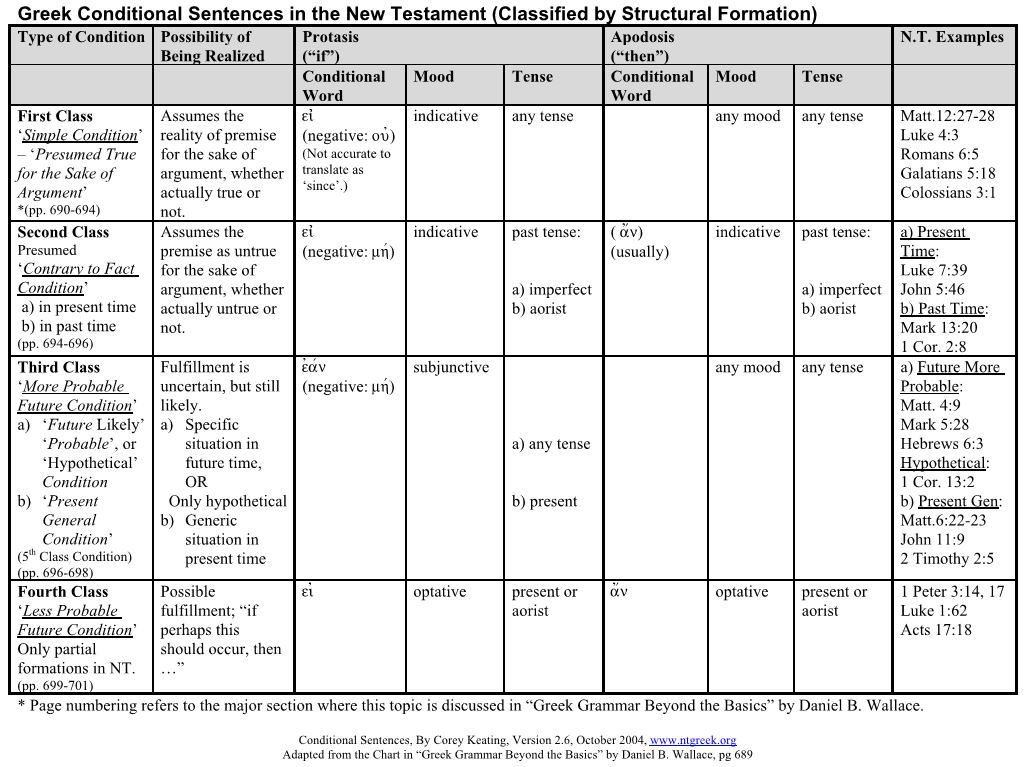
Anyway, I found a table (see end of post) that seemed helpful in explaining the different conditions in the Greek manuscripts that the English word “IF” was trying to communicate to us.
Colossians 1:23 uses the first class condition. But I am getting way ahead of myself.
Lets consider the passage first.
Colossians 1:21-23
And you, who once were alienated and hostile in mind, doing evil deeds, he has now reconciled in his body of flesh by his death, in order to present you holy and blameless and above reproach before him, if indeed you continue in the faith, stable and steadfast, not shifting from the hope of the gospel that you heard, which has been proclaimed in all creation under heaven, and of which I, Paul, became a minister.
Like I said, Colossians 1:23 uses a first class conditional “IF”, and some teachers state that this term can be translated as “since”. This would definitely take any “conditionality” out of this passage, since Paul would be stating a settled fact, as in …. Since you will continue in the faith….Boy, that would be devastating for the conditional position.
But wait! Lets try that same translation for other instances where the first class conditional “IF” is used in the New Testament.
How bout this one.
Matthew 5:29
Since your right eye causes you to sin, tear it out and throw it away. For it is better that you lose one of your members than that your whole body be thrown into hell
This verse actually instructs believers to pluck their eye out, since their eye offends them!
OK – Lets try this verse
Ephesians 4:21
assuming that you have heard about him and were taught in him, as the truth is in Jesus,
Ephesians 4:21 seems to allow using “assuming” instead of “if”, but this seeming exception should not make the rule. Paul may be questioning these believers if they really heard “Him” to make a point.
OK Carl, how can you say it is the exception to the rule. Check out these verses to consider if translating this word as “since” makes sense.
Matthew 12:27
Since I cast out demons by Beelzebul, by whom do your sons cast them out? Therefore they will be your judges.
Matthew 17:4
And Peter said to Jesus, “Lord, it is good that we are here. Since you wish, I will make three tents here, one for you and one for Moses and one for Elijah.”
Luke 11:18
SINCE Satan is also divided against himself, how will his kingdom stand?
Luke 22:42
Father, SINCE you are willing, remove this cup from me . . .
John 10:37
SINCE I am not doing the works of my Father, do not believe me . . .
Acts 25:11
Now SINCE I am wrong and have committed a deed worthy of death, I am not refusing to die . . .
Romans 4:2
For SINCE Abraham was justified by works, he has a basis for boasting . . .
Romans 4:14
For SINCE those who follow the law are heirs, faith is canceled out and the promise is voided
1 Corinthians 7:9
But SINCE they are not exercising self-control, they should get married.
1 Corinthians 8:13
SINCE food causes my brother to stumble, I will never eat meat . . .
1 Corinthians 9:17
For SINCE I do this willingly, I have a reward; but since I do it unwillingly, I have been entrusted with a stewardship
1 Corinthians 11:6
For SINCE a woman will not veil herself, she should cut off her hair . . .
1 Corinthians 15:13
Now SINCE there is no resurrection from the dead, neither has Christ been raised
1 Corinthians 15:19
SINCE in this life we have hoped in Christ, we are of all people most miserable
1 Corinthians 15:32
SINCE the dead are not raised, “let us eat and drink for tomorrow we die.”
Galations 2:21
For SINCE justification comes through the law, then Christ died for nothing.
Galations 3:18
For SINCE the inheritance is from the law, it is no longer from the promise.
Galations 5:11
Now brothers, SINCE I am still preaching circumcision, why am still being persecuted?
Hebrews 9:13
For SINCE the blood of goats and bulls . . . sanctifies those who have been defiled
Hebrews 12:8
SINCE you are without the discipline which all children share, then you are illegitimate and not sons
James 2:11
Now SINCE you do not commit adultery, but SINCE you murder, you have become a transgressor of the law.
OK – I think I made my point. A simple reading of the passage communicates the conditionality intended by the author. So it seems Paul is informing the Colossians of their conditional status before their Master.
Story Time
As an aside, a few months after my study on this passage was complete, I was attending a newly formed Bible study and coincidentally looking at the first chapter of Colossians. The spirit of the meeting was very cordial and I sensed an openness to ask questions. Since I had just learned of this passage, I thought I would bring it up.
NO DISCUSSION ALLOWED.
The leader actually stood up from his chair, and approached me in front of the rest of the group. “The preacher said those verses should be read differently.” Therefore that was all the discussion that was needed. I am sure he was seeking to maintain the purity of the faith, protect the weak, or enforce his leadership, but that night sticks with me.
A couple of practical applications come to my mind from this experience
If I feel threatened by a believer’s differing views, ask yourself…
-
Are you depending/trusting in a man’s interpretation of a verse, passage or theology? Professional Christians may have oodles of learning, but NOTHING replaces self study and prayer in seeking to understand the Word.
-
Have I “finished” searching out the Scriptures? They – the Scriptures – tend to speak of Him, and with that hope, the Word is worthy of trying to understand.
-
Do I discuss opposing views with respect and an honest effort to understand the position? The Word of Faith folks, in my opinion, were wringing the Scriptures of truth, but any mockery, dismissal, anger or intimidation would accomplish absolutely nothing positive. Trust me – I have personal experience of this!
Let your speech always be gracious, seasoned with salt, so that you may know how you ought to answer each person.

Follow Considering the Bible on WordPress.com
- According to Wikipeadia – The Arian controversy was a series of Christian theological disputes that arose between Arius and Athanasius of Alexandria, two Christian theologians from Alexandria, Egypt. The most important of these controversies concerned the substantial relationship between God the Father and God the Son.
-
-
Let me supply a listing of conditional security passages I am attempting to study as I blog. Note that this post is simply a list of Bible passages teaching of the conditional security of the believer (I think).When I first considered all the potential verses (potential, since I haven’t come to any settled conclusions on many of them!), I was a bit dumbfounded. I thought a couple passages in Hebrews would be the extent of my study.

Of course, as you review and consider some of these passages, you may want to add, or question one of the passages. Let me know via the contact form at the bottom.
Now, without further ado, I present to you a working list of New Testament conditional security passages. As I study each passage I will link the post to the verse references below.
Hopefully I can keep it updated!
Topical
Old Testament
- Exodus 23:20-22
- Exodus 32:31-33
- Leviticus 26:14-45
- Joshua 1:9
- 1 Kings 15:5
- 2 Chronicles 15:1-2
- Psalm 26:9-12
- Psalm 51:11
- Psalm 69:17-28
- Proverbs 21:16
- Isaiah 1:18-28
- Ezekiel 18:24
- Ezekiel 33:12-15
Gospel of Matthew
- Matthew 3:8-10
- Matthew 5:13
- Matthew 5:22
- Matthew 5:29-30
- Matthew 6:23
- Matthew 7:13-23
- Matthew 7:16-19
- Matthew 10:21-22
- Matthew 10:24-28
- Matthew 10:32-33
- Matthew 10:42
- Matthew 12:31-37
- Matthew 13:20-21
- Matthew 13:24-30
- Matthew 13:38-43
- Matthew 18:21-35
- Matthew 22:1-14
- Matthew 24:9-10
- Matthew 24:11-13
- Matthew 24:23-26
- Matthew 24:44-51
- Matthew 25:1-30
- Matthew 25:41-46
Gospel of Mark
- Mark 4:3-19
- Mark 13:13
- Mark 13:35-37
Gospel of Luke
- Luke 3:8-9
- Luke 8:4-15
- Luke 8:11-15
- Luke 9:57-62
- Luke 11:24-26
- Luke 12:8-12
- Luke 12:35-46
- Luke 12:41-48
- Luke 13:1-9
- Luke 14:25-35
- Luke 15:24
Gospel of John
- John 3:16
- John 5:28-29
- John 6:66-71
- John 8:31,32, 51
- John 10:28-29
- John 13:8-11
- John 15:1-6 – A
- John 15:1-6 – B
- John 15:11-17
Acts of the Apostles
- Acts 5:32
- Acts 8:9-24
- Acts 11:23
- Acts 13:43
- Acts 14:21-23
Romans
- Romans 2:1-11
- Romans 2:7
- Romans 6:15-16
- Romans 6:11-23
- Romans 8:1-17
- Romans 8:12-14
- Romans 8:17
- Romans 11:17-24
- Romans 11:20-22
- Romans 11:29
- Romans 14:15-23
1 Corinthians
- 1 Corinthians 1:4-9 – A
- 1 Corinthians 1:4-9 – B
- 1 Corinthians 6
- 1 Corinthians 9:23-10:22 – A
- 1 Corinthians 9:23-10:22 – B
- 1 Corinthians 9:23-10:22 – C
- 1 Corinthians 9:23-10:22 – D
- 1 Corinthians 11:29-32
- 1 Corinthians 15:1-2
2 Corinthians
- 2 Corinthians 1:24
- 2 Corinthians 6:14-18
- 2 Corinthians 11:2-4
- 2 Corinthians 12:21 – 13:5
- 2 Corinthians 13:5-9
Galations
- Galatians 1:6-10
- Galatians 1:6-7
- Galatians 4:1-11
- Galatians 5:1-4
- Galatians 6:7-9
Ephesians
- Ephesians 3:17
- Ephesians 5:3-6
Philippians
- Philippians 1:3-11
- Philippians 2:12-16
- Philippians 3:7-20 – A
- Philippians 3:7-20 – B
- Philippians 3:7-20 – C
Colossians
- Colossians 1:21-23
- Colossians 2:4-8
- Colossians 2:18-19
- Colossians 3:4-10
1 Thessalonians
1 Timothy
- 1 Timothy 1:3-7
- 1 Timothy 1:5-11
- 1 Timothy 1:18-20
- 1 Timothy 2:11-15 – A
- 1 Timothy 2:11-15 – B
- 1 Timothy 4:1-3 – A
- 1 Timothy 4:1-3 – B
- 1 Timothy 4:16
- 1 Timothy 5:5-8
- 1 Timothy 5:11-15 – A
- 1 Timothy 5:11-15 – B
- 1 Timothy 6:3-8
- 1 Timothy 6:9-11
- 1 Timothy 6:12
- 1 Timothy 6:17-19
2 Timothy
- 2 Timothy 2:11-14 – A
- 2 Timothy 2:11-14 – B
- 2 Timothy 2:11-14 – C
- 2 Timothy 2:11-14 – D
- 2 Timothy 2:8-13
- 2 Timothy 2:24-26 – A
- 2 Timothy 2:24-26 – B
- 2 Timothy 3:13-15
Titus
Hebrews
- Hebrews 2:1-3
- Hebrews 3:6-19
- Hebrews 4:1-11
- Hebrews 4:11
- Hebrews 4:13
- Hebrews 4:14
- Hebrews 5:8-9
- Hebrews 6:1-12
- Hebrews 6:4-20
- Hebrews 7:25
- Hebrews 10:19-25
- Hebrews 10:26-31
- Hebrews 10:35-39
- Hebrews 11:13-16
- Hebrews 12:6-9
- Hebrews 12:10-13
- Hebrews 12:14-17
- Hebrews 12:18-25
- Hebrews 13:7
- Hebrews 13:9-14
James
- James 1:12
- James 1:13-16
- James 1:21-22
- James 2:14-26
- James 4:4-10
- James 5:7-9
- James 5:19-20
1 Peter
- 1 Peter 1:5-11
- 1 Peter 1:13
- 1 Peter 4:17-18
2 Peter
- 2 Peter 1:5-11
- 2 Peter 2:4-22
- 2 Peter 3:11-15
- 2 Peter 3:16-17
1 John
- 1 John 1:5-10
- 1 John 2:1-11
- 1 John 2:19
- 1 John 2:23-29
- 1 John 3:1-10
- 1 John 3:15
- 1 John 5:4-5
- 1 John 5:16-17 – A
- 1 John 5:16-17 – B
2 John
3 John
Jude
Revelation
- Revelation 2:4-5
- Revelation 2:7
- Revelation 2:10-11
- Revelation 2:12-17
- Revelation 2:18-26
- Revelation 3:4-5
- Revelation 3:8-12
- Revelation 3:14-22
- Revelation 12:11
- Revelation 14:9-13
- Revelation 17:14
- Revelation 21:7-8
- Revelation 21:27
- Revelation 22:14-15
- Revelation 22:18-19
Thanks again for coming to visit. I hope you found something of interest in this post and would appreciate a comment, to begin a discussion.
-
Conditional Security of Christian Believers

SECURITY: the quality or state of being secure: freedom from danger, fear or anxiety
I have been a believer for over 35 years, having been saved at the ripe ol’ age of 21. One of the first teachings I received was the eternal security, “once saved always saved” (OSAS) doctrine. This doctrine teaches that once a person has placed faith in Christ (asked Jesus into his/her heart?), that person is eternally and irrevocably destined to heaven. It was, in my thinking, a contract I signed with God, a business transaction. Please understand, I am in no way reducing the covenantal promise He has provided to all who will trust in Him, but I suppose I question the duration of trust required.
Although I was never explicitly taught that sin could not break the contract I “signed” with God through faith, there was no fear to indulge in some peripheral sin. I was secure – I was going to be just fine! For close to 25 years I belonged to an eternal security denomination. I would only read eternal security books, eternal security pamphlets, and listen to teachers who taught eternal security. Every few sermons seemed to emphasize the eternal security of the believer, sometimes even using certain Scriptures to support the teaching. I vowed to never entertain that heresy of the “dark side”.
I just couldn’t risk the conflict in my mind.
I thought the OSAS logic was air tight. Certain Scriptures seemed to only teach the eternal security position. I would simply avoid the odd “bothersome” passages, (which began to pile up after a while), or find some way to explain the passage away.
It was a very comfortable place to be.
A Loss of Security
Then the church I was (heavily) involved in found sin in us and told us to leave. We were shocked and disoriented.
Just a few days previously, I had lost my job. We were living in a small Texas town with no possibility for work.
The security we found in our local church and our cushy job fell down around us.
I eventually found a position approx. 3 hours away. During my 3 hour commutes Monday morning and Friday afternoon, I began to listen to a Bible teacher who held different views than I. Initially I was drawn to this teacher’s eschatology, since my faith in dispensational teachings was slipping. He is a methodical and thorough Bible teacher who is not afraid to consider alternate viable interpretations of the Scriptural text.
I found him to be very challenging. Only one weakness – he had a “dark” side – he didn’t teach OSAS!
Another Security
As I listened to his teaching on Israel, the church and the end times, I would occasionally catch a reference to his “dark” side teaching and at first easily rebuffed his argument in my mind. That is until the passages became too numerous. It seemed that all I was doing was excusing, avoiding or rearranging Bible passages.
I started to study the passages and other authors from the dark side, until I found a book by Robert Shank, called “Life in the Son”. If you desire to continue in the OSAS camp, do not read this book. The exposition of numerous passages became too much for me.
So what is true security?
So far, I think true security is found in a consistent, direct relationship with the Savior. A desire to please Him and to do as He directs.
Although I have learned much since I began to consider conditional security, two thoughts come to mind.
- The new covenant is an agreement between two parties.
- He is faithful in all His activities and promises.
- I am asking for help to become like Him.
- If the nation of Israel, God’s covenant nation, was cut off and destroyed, how could I be so proud to think my relationship with the Living God could be ignored and not suffer?
No matter which camp you may fall into, we need to be motivated to please Him in all our ways.
As I publish on this blog, I will occasionally write on this topic, based on a Bible passage or topic. I look forward to all comments and remarks.I hope you will join me in “Considering the Bible”
2 Timothy 2:19
But God’s firm foundation stands, bearing this seal: “The Lord knows those who are his,” and, “Let everyone who names the name of the Lord depart from iniquity.”
Thanks again for coming to visit. I hope you found something of interest in this post and would appreciate a comment, to begin a discussion. If you know someone this blog may bless (or challenge), send them a link, so they may join us in our discussion
Come join us at Considering the Bible
- The new covenant is an agreement between two parties.


As a recap, let’s remember that Asa, as a good king, had called out to the Lord at a time of need, had experienced God’s security (a great deliverance), and, as the following passages teaches, was following God’s leading.
2 Timothy 2:13
2 Timothy 2:12 b
2 Timothy 2:12 a

In the previous post, we reviewed each Old Testament passage describing the concept of sealing. Now that we will venture into the New Testament to discover how the Lord Himself, and His apostles understood the concept of sealing, I feel it is only correct to compare similar concepts of sealing.
This first part of the study, we will review all the Old Testament verses that include the hebrew word translated as “sealed” חָתַםchatham (khaw-tham’)