11 Let a woman learn quietly with all submissiveness. 12 I do not permit a woman to teach or to exercise authority over a man; rather, she is to remain quiet. 13 For Adam was formed first, then Eve; 14 and Adam was not deceived, but the woman was deceived and became a transgressor. 15 Yet she will be saved through childbearing–if they continue in faith and love and holiness, with self-control.
Is this a tough passage? Everyone says YES!
This is a difficult passage that creates more questions than answers. My intent isn’t to solve the mystery of what it means to be “saved through childbearing”, but to bring the last clause into focus.
This is an example of the topic of salvation being contingent upon continuance, by our perseverance, persistence and determination to practice our faith, love and holiness, with self control. This begs the question of our source of strength for only through our connection with the Savior, can we continue through His strength. Yet we are to follow, look to Him, seek His help, pray for His strength, ask for His wisdom and in every way we know, lean on Him for our every need.
Yet as I walk through these passages that speak of conditional security, I can see where this topic may foster an attitude of superiority, of a pride in persevering, of thinking haughty inner thoughts due to continuing in a religious life, of comparing your “living” faith with others who may be struggling.
My brothers and sisters, this is antithetical to true Christian life and exhibits a self reliance, a leaning on the strength of your own will. This pride of perseverance is the very sour air that turns so many away from the faith, and rightly so.
We desperately need to admit our weakness, our poverty, our neediness, our inabilities. Not only to ourselves, which is the first (and hardest?) step, but also to our family, our friends, our fellow workers, and dare I say it – even our enemies.
But alas, this requires great wisdom, and a true humility, where we don’t necessarily think lowly of ourselves, but that we don’t think of our selves at all. – What a blessing to be in that state!
Truly, to walk with the Lord is impossible without Him. It is just too deep, too broad, too high and too wide, for our feeble minds and weak hearts to fathom.
May we seek Him, and in the seeking find the strength He provides to humbly admit our weaknesses.
Thanks again for coming to visit. I hope you found something of interest in this post and would appreciate a comment, to begin a discussion. If you would like to receive daily posts from Considering the Bible, click on the “Follow” link below
7 The one who conquers will have this heritage, and I will be his God and he will be my son.
8 But as for the cowardly, the faithless, the detestable, as for murderers, the sexually immoral, sorcerers, idolaters, and all liars, their portion will be in the lake that burns with fire and sulfur, which is the second death.”
John is coming to a close in the book of Revelation and enters into his description of the new heaven and the new earth. As he describes this new creation, and especially the provision of the water of life to those who conquer, he veers off and starts talking of some who do not conquer. The ones who are cowards, faithless, detestable, murderers, sexually immoral, sorcerers, idolaters and all liars will enter the second death.
But John – you are sending this book to the seven churches. Are you not concerned that some of the believers might see themselves in these descriptions. These are believers that will read this message and they may not realize you intend this for unbelievers.
That is the rub in this passage. Those in the church who may read this, if they are not hardened beyond repentance, will see this as a warning and return to the truth. John is actually evangelizing the saved, and is not providing a warning for those in the church to use when they are talking to the lost.
As a matter of fact, it occurs to me that many times when the apostles spoke to the lost, their emphasis was the risen Lord, and not the destination of those who may believe. In other words, it is rare when an apostle uses hell to “scare them into heaven”. If my reader has a portion of Scripture that I have missed, please provide, but the apostles emphasis was His resurrection and not our destination.
Nevertheless, this passage speaks of the believer who has apostatized, who has decided to walk away from the Savior, who has hardened their heart and stopped their ears, rejecting the leading of the Father.
The new heaven and the new earth is for those believers who have continued with the Savior through thick and thin, who have followed and kept the faith, not merely as a doctrine, but as a practice in their lives.
My friend – our lives are to be lives of repentance and faith, of realizing we are weak and that we need His strength, of understanding that we naturally fall, tend to wander and close our eyes to the light.
He is good. May we seek to follow, and by His strength and mercy, conquer.
Thanks again for coming to visit. I hope you found something of interest in this post and would appreciate a comment, to begin a discussion. If you would like to receive daily posts from Considering the Bible, click on the “Follow” link below
Revelation 2:18-26 18 “And to the angel of the church in Thyatira write: ‘The words of the Son of God, who has eyes like a flame of fire, and whose feet are like burnished bronze. 19 “‘I know your works, your love and faith and service and patient endurance, and that your latter works exceed the first. 20 But I have this against you, that you tolerate that woman Jezebel, who calls herself a prophetess and is teaching and seducing my servants to practice sexual immorality and to eat food sacrificed to idols. 21 I gave her time to repent, but she refuses to repent of her sexual immorality. 22 Behold, I will throw her onto a sickbed, and those who commit adultery with her I will throw into great tribulation, unless they repent of her works, 23 and I will strike her children dead. And all the churches will know that I am he who searches mind and heart, and I will give to each of you according to your works. 24 But to the rest of you in Thyatira, who do not hold this teaching, who have not learned what some call the deep things of Satan, to you I say, I do not lay on you any other burden. 25 Only hold fast what you have until I come. 26 The one who conquers and who keeps my works until the end, to him I will give authority over the nations,
This is a difficult passage! My first question is …
Who is the subject of this rebuke?
I am going to add my understanding to the verses on this passage below, to try to make sense of the intended audience, and then from that exercise, make some conclusions. Hopefully it brings some clarity and not confusion!
20 But I have this against you (Thyatirian Church Body), that you (Thyatirian Church Body) tolerate that woman Jezebel, who calls herself a prophetess and is teaching and seducing my servants (Thyatirian Church Individuals) to practice sexual immorality and to eat food sacrificed to idols. 21 I gave her (Jezebel) time to repent, but she (Jezebel) refuses to repent of her sexual immorality. 22 Behold, I will throw her (Jezebel) onto a sickbed, and those (Thyratirian Church Individuals) who commit adultery with her I will throw into great tribulation, unless they (Thyatirian Church Indiviuals) repent of her works, 23 and I will strike her children (Jezebel’s followers) dead. And all the churches will know that I am he who searches mind and heart, and I will give to each of you (Thyatirian Church Individuals) according to your works. 24 But to the rest of you in Thyatira (Thyatirian Church Individuals), who do not hold this teaching, who have not learned what some call the deep things of Satan, to you I say, I do not lay on you any other burden. 25 Only hold fast what you have until I come.
As I have went through this passage trying to identify who Jesus is specifically calling out to, my issue becomes two fold. Is he speaking to the body of believers, or to individuals within the body?
Body
Is he talking to the church as a body alone, and as the church body, speaking of their survival as a witness in the city of Thyatira?
This approach is the way I approached the passage in my days when I clung to the OSAS (Once Saved Always Saved) teaching. I referred to verse 22 as a passage that spoke of a Great Tribulation coming upon the church in the end days, and was able to save my OSAS thinking, delegating those who follow this Jezebel to a small group within a church – not believers – in the last few years prior to eternity.
As you may know, this is not my thinking now, for why would the Lord speak to the first century church in Thyatira of a small group of people 2,000 years in the future?
Individuals
Or is he talking to the church, addressing individuals within the church, informing them that as they follow Jezebel, they are not following Him?
This makes more sense, though it is scarier for the individual if you are following the prophetess Jezebel. Those in verse 22 are responsible to repent of Jezebels works, responsible to change their thinking, their faith and their allegiance to this prophetess.
Note that verse 23 speaks of Jezebel’s children. May I suggest that those, in the church, who have fully given over to her teaching, are now classified as Jezebel’s children.
The very next verse, Jesus continues with .. But to the rest of you in Thyatira, (helping me understand that the audience is still the church in Thyatira) … this verse connects these children of Jezebel as a some part of the church of Thyatira. And the judgement upon these children is final!
Jesus will strike these children dead.
I find it interesting to say the least that a few translations refer to this death as a plague or pestilence.
‘And I will kill her children with plague, NASB
‘And I will kill her children with pestilence, LSB
‘I will strike her followers with a deadly disease, NET
‘And I will kill her children (followers) with pestilence [thoroughly annihilating them], AMP
No matter how you understand this last phrase, it surely is not associated with those who are actively seeking and following after the Savior.
If you are listening to any teacher that advocates any other god than the True God, a teacher that is alluring you away from Jesus and towards a spiritually adulterous faith, advocating sexual immorality in the believers life, and providing “grace” to eat foods sacrificed to idols – telling me of Jezebel’s advocating participation in idol worship, this is dangerous.
No matter how you understand this passage, whether you are simply loosing out on rewards (OSAS thinking) or walking towards death, take the Lord’s warning seriously, test your teacher’s doctrine and way of life, compare those you follow with the Word of God.
If those you follow are not of the Word, immediately run as far as you can from them. Cling to the Word and trust in the Savior only.
Thanks again for coming to visit. I hope you found something of interest in this post and would appreciate a comment, to begin a discussion. If you would like to receive daily posts from Considering the Bible, click on the “Follow” link below

11 Now the parable is this: The seed is the word of God.
12 The ones along the path are those who have heard; then the devil comes and takes away the word from their hearts, so that they may not believe and be saved.
13 And the ones on the rock are those who, when they hear the word, receive it with joy. But these have no root; they believe for a while, and in time of testing fall away.
14 And as for what fell among the thorns, they are those who hear, but as they go on their way they are choked by the cares and riches and pleasures of life, and their fruit does not mature.
15 As for that in the good soil, they are those who, hearing the word, hold it fast in an honest and good heart, and bear fruit with patience.
We all know this parable, or at least I think we do. I know that when I come to this passage, I tend to feel a bit sheepish toward it in that I am not a world evangelist, or the leader of a million person church.
But let us be sure that we all have levels of faith, and this passage speaks of life, (not faith) and the fruit that is the evidence of life.
It seems obvious that verse twelve speaks of the one who hears but is not impacted by the Word, one who is the victim of the devil’s thievery. No salvation for this one.
This situation seems obvious.
It also seems obvious that verse fifteen speaks of the fully mature believer, holding fast to the message, and refusing to let go, exercising a good and honest heart, which over an extended period of time develops mature fruit, which is the evidence of new life.
That seems obvious.
When we get to verses 13 and 14, the obviousness of the condition of the one being described becomes a little less obvious.
Let’s consider verse 14, for Jesus speaks of a life being choked, and that any fruit from this life does not come to maturity. He mentions fruit with this group and I understand that to indicate there is life resident in this group. A stunted life to be sure, a life that is less than hoped for, that may be a disappointment to the gardener, but a life none the less.
I know I have approached this passage with the verses out of order but it is verse 13 that is of interest to me and serves my purposes with this topic. Verse 13 actually speaks of one receiving the message with joy. Of course the debate over what it means to receive has caused much discussion, as to whether life had been received or simply a message, but this isn’t the main point I would draw your attention to in this passage.
The main point is the reference to a falling away that Jesus speaks of. I naturally assumed the Greek word would be related to, or would be the basis of our term “apostacy”, but I was wrong.
The Greek word used here when Jesus says “falling away” is ἀφίστημι aphístēmi, and it has multiple descriptions associated with it. Luke seemed to like this term, for he used it more than any other writer in the New Testament.
It speaks of deserting, withdrawing, leaving, shunning, fleeing, removing…. One shade of meaning coming out of this term is to “actively instigate to revolt”.
This is so interesting to me, for it helps me understand that conditional security isn’t a teaching that should be applied to one who has had a lapse in faith, or is struggling with faith – (which in my opinion is the essence of faith), but it speaks of a settled, active refusal to follow after, to reject that which was once precious as being refuse, that which is to be abandoned.
Note that this condition is not related to the victim of the devil (vs 12), or those who are distracted by cares and pleasures (vs 14) and it goes without saying that it does not apply to the victorious believer in vs 15.
This decision is made by those that “believe for a while” and then refuse, reject and run away.
My friends, stay active in your faith, for times of testing will come and may provide you opportunity to reject the Savior. Cling to Him at your every opportunity, so that when hard times come, it will only be “natural” to seek His aid.
Does this message not seem to be the obvious intent of the Word? Is that not an obvious benefit to us and an obvious blessing to others?
Obviously!
Thanks again for coming to visit. I hope you found something of interest in this post and would appreciate a comment, to begin a discussion. If you would like to receive daily posts from Considering the Bible, click on the “Follow” link below
12 “And to the angel of the church in Pergamum write: ‘The words of him who has the sharp two-edged sword. 13 “‘I know where you dwell, where Satan’s throne is. Yet you hold fast my name, and you did not deny my faith even in the days of Antipas my faithful witness, who was killed among you, where Satan dwells. 14 But I have a few things against you: you have some there who hold the teaching of Balaam, who taught Balak to put a stumbling block before the sons of Israel, so that they might eat food sacrificed to idols and practice sexual immorality. 15 So also you have some who hold the teaching of the Nicolaitans. 16 Therefore repent. If not, I will come to you soon and war against them with the sword of my mouth. 17 He who has an ear, let him hear what the Spirit says to the churches. To the one who conquers I will give some of the hidden manna, and I will give him a white stone, with a new name written on the stone that no one knows except the one who receives it.’
It all depends on “them”. Who are the “them” in verse 16.
I will come to you soon and war against them with the sword of my mouth.
I can see that this passage may refer to them as being teachers not in the Body of Christ, but allowed by the Body of Christ to hear their teaching. Teaching that provided justification for sin, and of the Nicolaitans. The Nicolaitans teaching is unclear in my mind, and at this time, I do not think I should explore this specific topic. Sufficient for the topic at hand is that the church of Pergamum was allowing heretical teachers into their fellowship.
Who is the “them”?
So when the Lord speaks in verse 16, stating that He will “war against them”, a couple of questions rise up.
Believers?
Are these teachers believers? Have they wandered from the truth, and need to be retaught with the Sword of the Lord, which often speaks of the truth of the Scriptures. After all, in the introductory verse to this church, Jesus describes Himself as the One who has the sharp two edged sword.
Revelation 2:12 ESV – “And to the angel of the church in Pergamum write: ‘The words of him who has the sharp two-edged sword.
Previously, in the book of Revelation, Jesus is described as the One from whom a sharp two-edged sword came out of His mouth, representing His words.
Revelation 1:16 ESV – In his right hand he held seven stars, from his mouth came a sharp two-edged sword, and his face was like the sun shining in full strength.
Finally, we all recognize the passage in Hebrews where the Scriptures are associated with a two edged sword.
Hebrews 4:12 ESV – For the word of God is living and active, sharper than any two-edged sword, piercing to the division of soul and of spirit, of joints and of marrow, and discerning the thoughts and intentions of the heart.
If they are believers, they stand in a precarious position, and hopefully the truth of the Scriptures will bring them back into the narrow way. We know the Scriptures have that power and with the help of the Spirit, we know that those who have taught error can repent and return to the faith.
Unbelievers?
If these “them” are unbelievers, it is uncommon to use the “sword” image as a weapon against unbelievers.
If these teachers entered into the fellowship without bending the knee to the Lord, the fault may lie at the doorstep of the church itself, for accepting those who know not the Lord. This is pure conjecture on my part, without any judgement from myself as I have often been deceived by those who say they are believers but have taught error!
Nevertheless, if these “them”, upon whom the Sword of Jesus mouth will be weilded, are unbelievers, will come upon them if the church does not repent.
The command is for the church to repent.
If the church does not perform corrective action upon these false teachers, thereby instructing the false teachers of their error, Jesus will come to the church.
To the church of Pergamum, which harbors false teachers, accepting them in a spirit of inclusion and diversity(?).
As you can tell, this passage is not clear in my mind as to the recipients of the judgement, and it’s intended result. No matter though, for the picture presented is not a desirable situation and as the church, we need to be vigilant in who we accept as teachers for our sometimes “itchy” ears.
If, as you read this post, you have suggestions to assist in understanding the message, I would appreciate your thoughts in the comments below.
Thanks again for joining me in this series.
Thanks again for coming to visit. I hope you found something of interest in this post and would appreciate a comment, to begin a discussion. If you would like to receive daily posts from Considering the Bible, click on the “Follow” link below
1 “I am the true vine, and my Father is the vinedresser.
2 Every branch in me that does not bear fruit he takes away, and every branch that does bear fruit he prunes, that it may bear more fruit.
3 Already you are clean because of the word that I have spoken to you.
4 Abide in me, and I in you. As the branch cannot bear fruit by itself, unless it abides in the vine, neither can you, unless you abide in me.
5 I am the vine; you are the branches. Whoever abides in me and I in him, he it is that bears much fruit, for apart from me you can do nothing.
6 If anyone does not abide in me he is thrown away like a branch and withers; and the branches are gathered, thrown into the fire, and burned.
When we last got together on John 15, we were discussing verse 2 and 3, and the relationship of pruning and cleansing. We saw the two types of branches, and the actions taking on them based on their fruitfulness. Of course we considered what Jesus meant for the non-fruit bearing believer when He used the term “take away”, and couldn’t come to a conclusion as to His meaning given the verse we were looking at. Did it mean to raise up, as in raising the branch our of the dirt , or did it mean removal of the branch form the vine?
Hopefully the next few verses will assist in our understanding.
Verse 4 is a defining verse in this passage, for Jesus identifies who the branches are. It may have been assumed previously, but now there is no doubt. The branches are disciples.
Their responsibility? Abide in Jesus. This is a command that is to be obeyed, and out of this obedience, a fruitfulness occurs. Don’t get this backward though. Working at being fruitful is not the intent of this passage. Jesus isn’t saying that we should force fruitfulness out of our lives, as if that were possible. No. He says to abide in Him.
To Abide
The Greek term is menō. Synonyms for this word include remain, dwell, continue, tarry and endure.
For the disciple to continue having the life of God course through his (spiritual) veins, he has to remain in Christ. His responsibility is to stay put, to continue with Christ and not to “not abide”.
Yet in this passage Jesus brings to the disciples thoughts what are the consequences if anyone does not abide in Jesus….
This is the picture of the one who started as a branch, but decided to move on to something “better”. This disciple did not abide, he did not stay in Christ.
What is the reaction of the Father? As a Master Vinedresser, He tends the vineyard, finding unconnected branches, possibly with green leaves and fruit hanging from it, and throws the unconnected branch away. The unconnected branch may have the appearance of life, but since it is not connected to the life giving source of the True Vine, it is only a matter of time before the leaves turn brown, and the branch dries out.
The one who chooses not to abide in the True Vine is thrown away, eventually to be gathered together with other unconnected branches, to be thrown in fire.
Now that is some harsh teaching!
When Jesus brings the picture of burning and fire into the monologue, might Jesus be referring to hell as we modern believers understand it? A fire of eternal torment? This particular passage does not address this topic fully of course, and other Bible passages may provide alternate understandings of fire in a believers existence.
Might the fire refer to a fire of consumption? That is a fire that consumes whatever is thrown into it?
Another possible understanding is that the fire is a fire of purification, intending to burn off waste in order to cleanse.
Whatever the fire means in this passage cannot be something to look forward to. And it surely is not the intended end of a believer.
John 15 is very comforting to believers of all stripes, and I used to love reading it, skipping over the “difficult” parts, but it may be wise to tackle those very parts, in order to truly enjoy the comforting parts.
What are your thoughts on this passage? Have you a comment to offer on this passage and the provided teaching? I would love to hear anything you may say, especially from those who may disagree.
Nevertheless, may the Lord give you peace and strength to stay put in Christ, to abide in Him. He is the True Vine!
Thanks again for coming to visit. I hope you found something of interest in this post and would appreciate a comment, to begin a discussion. If you would like to receive daily posts from Considering the Bible, click on the “Follow” link below
1 “I am the true vine, and my Father is the vinedresser.
2 Every branch in me that does not bear fruit he takes away, and every branch that does bear fruit he prunes, that it may bear more fruit.
3 Already you are clean because of the word that I have spoken to you.
4 Abide in me, and I in you. As the branch cannot bear fruit by itself, unless it abides in the vine, neither can you, unless you abide in me.
5 I am the vine; you are the branches. Whoever abides in me and I in him, he it is that bears much fruit, for apart from me you can do nothing.
6 If anyone does not abide in me he is thrown away like a branch and withers; and the branches are gathered, thrown into the fire, and burned.
Looking over my list of future Bible passages that speak to our topic of conditional security, I have come across the very passage that was one of the big ones that made me reconsider OSAS (Once Saved Always Saved) may not be without debate.
John 15, along with a passage in Colossians and a smattering of verses in Hebrews and Revelation all were instrumental in turning my eyes to this topic. After having worked through over 100 passages or verses in the Word in relation to conditional security, I was amazed that I had never addressed this particular passage.
Let’s consider the audience. Jesus is speaking to 12 men, men who have been following him for close to 3 years. Men who have committed to Him their lives, as much as they knew how to. Little did they understand the future revelations that would come to them, but at this time, these men showed every evidence of being true and faithful to Jesus.
Well – maybe one may show some lack of faithfulness in the near future, but that is an unknown to the group as we find them in this passage.
This passage centers around the picture of a vine, and the upkeep of the vine by the Father. Jesus begins by likening Himself to the vine, yet He qualifies the type of vine He speaks of. He describes Himself as the True Vine. This must surely have raised the eyebrows of the disciples, for they knew from their childhood teachings, that Israel was the vine of God. For Jesus to describe Himself as the true vine had some serious implications.
Israel the nation was not the true vine. This truth may have been predominant in the apostles minds. The second implication may have been that Israel the nation was simply a symbol of a reality. Now, this symbiology of Jesus being the reality of a shadow in the Old Testament would be fleshed out in future experiences with the disciples, but this is a typical teaching from the Lord while He walked with us on earth. Jesus is the True Vine, the True Shepherd, the True Temple, the True Israel. He is the fulfillment of all of the Old Testament pictures provided.
Let’s take a moment to gain some knowledge of how Israel was described as a vine in the Old Testament. God had brought the people of Abraham, Jacob and Joseph out of Egypt and planted them in the land as a vine in a vineyard. He prepared the land for the vine to grow and eventually it filled the land.
Psalm 80:8-9
8 You brought a vine out of Egypt; you drove out the nations and planted it. 9 You cleared the ground for it; it took deep root and filled the land.
Sadly, even under the care of the Master Vinedresser, after hundreds of years of testing and failure, Israel had proven that they, the vine, had turned wild, producing wild grapes instead of cultivated, fruit.
Isaiah 5:1-2
1 Let me sing for my beloved my love song concerning his vineyard: My beloved had a vineyard on a very fertile hill.
2 He dug it and cleared it of stones, and planted it with choice vines; he built a watchtower in the midst of it, and hewed out a wine vat in it; and he looked for it to yield grapes, but it yielded wild grapes.
Further into Israel’s history, God spoke of Israel as a choice vine, a vine of good stock, yet it had become degenerate.
Jeremiah 2:21
21 Yet I planted you a choice vine, wholly of pure seed. How then have you turned degenerate and become a wild vine?
Surely there was a Vine that would not fail, that was of pure seed and that would be fruitful. Jesus is claiming this calling, and by that claim, knocked the nation of Israel out of contention for this title. But let us not forget the history of the image of the vine in the Old Testament, for Jesus is using this knowledge base when teaching His men at this time.
With Jesus establishing Himself as the True Vine, He continues with this image, describing the Father as the vinedresser. This should not be shocking to the disciples, for the Old Testament speaks of God as the One who planted the vine, cultivated it and watched over it.
Jesus then takes the picture of the vine and extrapolates the image to include branches, and begins to speak of two types of fruit. This is where is gets very interesting.
Fruit Bearing
Let’s consider the fruit bearing branch first. With this type of branch, He prunes it. To prune the branch is to kathairō. It speaks of cleansing, and when used in relation to vines, speaks of clipping useless shoots off the branch.
What I find interesting is that Jesus speaks of the disciples as already pruned, for the term for “clean” in our very next verse is katharos. Can you see a similarity of this word to the Greek word used previously?
The disciples had been pruned (cleaned) because of His teaching that He provided earlier. A pruning action had been performed on the disciples, through His teaching, that had born fruit in the disciples lives.
A question for my reader. How would you describe the fruit that was produced? What is it in the disciples lives that exhibited a fruitfulness?
Non Fruit Bearing
For those branches that are non fruit bearing, the Father will “take away”. Now it would be easy to associate this “taking away” with judgement, loss of life and condemnation, but after a bit of review, I found that this term can refer to two actions.
The first action would refer to moving something from it’s place, to take away, to remove, or to carry off. The translators use of “take away” fits this description.
A secondary interpretation of this Greek term is to lift up, to elevate or to raise upwards. As the vinedresser, the picture is that of God lifting up branches from the dirt of the field, in order to give them opportunity to thrive. This is appealing to consider yet for the sake of our discussion, it would be wise to consider both meanings as we venture through Jesus’ teaching.
With that, I will let my reader ruminate on the two different meaning of “take away” in this passage and we shall close, for this post has become a bit longer than I expected. Let’s get together again to finish up this passage. Until then, may the Lord bless you and make you a fruitful believer.
Thanks again for coming to visit. I hope you found something of interest in this post and would appreciate a comment, to begin a discussion. If you would like to receive daily posts from Considering the Bible, click on the “Follow” link below
5 Examine yourselves, to see whether you are in the faith. Test yourselves. Or do you not realize this about yourselves, that Jesus Christ is in you?–unless indeed you fail to meet the test! 6 I hope you will find out that we have not failed the test. 7 But we pray to God that you may not do wrong–not that we may appear to have met the test, but that you may do what is right, though we may seem to have failed. 8 For we cannot do anything against the truth, but only for the truth. 9 For we are glad when we are weak and you are strong. Your restoration is what we pray for.
Who is Paul writing to? Believers or professors? If professors, he is certainly giving them much encouragement in thier status with God by calling them out as saints (1:1), brothers (1:8), having the seal (1:22) and the Spirit (1:22). Yes, for Paul to consider those he addresses as brothers in chapter 1 as professors in chapter 13 causes me a discontinuity that I cannot find justification for.
Given that Paul is addressing his brothers in chapter 13, let us consider what Paul is about to say. Ok, so let us ead it one more time.
Examine yourselves, to see if you go to church enough, tithe enough, read the bible enough, or pray enough.
That is not the message at all. The question is – Are you “in” the faith or “out” of the faith. That is the challenge!
This is one of the rare instances where two words for testing used by the Greeks is used in the same verse. Kinda interesting!
The first word (Examine) is peirazō, πειράζω to test (objectively). As we say at the office – It is what it is! No intentions, emotions or subjective rational during this testing. A fact is a fact!
The second word (Test) is dokimazō, δοκιμάζω, to test if genuine, also to approve, or deem worthy after testing. This word, when I come across it in the New Testament, always brings to mind the intent that the testing is for the sake of approval, the test is given hoping that the test is passed.
For both of these words to be used, I imagine, is Paul’s way of saying the truth is harsh, relentless, unforgiving (as to the conclusions arrived by seeking it) and possibly shocking. Yet in the midst of exhorting the Corinthians to face the facts, he also has the heart of a pastor, seeking for good results, for success after the time of self testing for the believers.
Yet the topic of this blog is the possibility of these believers having fallen away, left their Savior, walked away. Unless this is a very real possibility, the test seems to be an exercise of futility, and possibly may cause more damage than intended.
Let’s say that after some self examination, I find I am out of the faith, but are still being encouraged by outside forces that “things will be alright”, “there is nothing to worry about”, and reminded that “50 yrs ago you said a prayer”. The test becomes fruitless. There is no reason to repent from your current situation.
Let’s say instead I understand that the security I have is conditional, and that I may have slipped away. This testing could save my life, bringing me back under the Lord and in the church.
These are not light teachings, and we cannot judge Paul’s intent of message based on my simple logic, but let us be careful with blanket encouragement of those who may be undergoing a self examination with bad results.
Encourage them “in the Lord”, and not with empty platitudes or distant prayers. The focus is always the Lord, our relationship with Him.
Do you know Him? As a “Christian”, do you know Him?
Paul would pray for the believers restoration. Is there a restoration for you?
Thanks again for coming to visit. I hope you found something of interest in this post and would appreciate a comment, to begin a discussion. If you would like to receive daily posts from Considering the Bible, click on the “Follow” link below
12 Fight the good fight of the faith. Take hold of the eternal life to which you were called and about which you made the good confession in the presence of many witnesses.
Paul speaks of the faith as including a good fight. He commands Timothy to fight the good fight. As we may extrapolate from Paul’s use of this description of the Christian life, to be in a fight implies two outcomes. A winner and a non-winner, what was called a loser in years past! Is this a message that Paul crouches in this metaphor? I will leave that to my gentle reader to consider.
Moving on, Paul speaks of taking hold of eternal life. At the risk of sounding sarcastic, why would any believer need to take hold of something he already possesses, and that he has contractual agreements signed and sealed at his disposal? You see, while I was in the OSAS camp, I was under the impression that when I repented, and trusted in Christ, I entered into a binding covenant with God that could not be nullified. Now before someone blows up and starts claiming I am a heretic, God’s faithfulness in never-ending, keeping His covenant with a believer perfectly, protecting, guiding and providing for His child as the perfect Father. He is beyond our frail attempt to describe in terms of faithfulness to His child.
Paul’s topic is not God in this verse but the believer, and the believer’s faithfulness to God. Paul is telling the believer to take hold, to firmly grip, to grasp tightly or to seize upon eternal life.
Timothy had been called by God. Timothy had openly confessed a faith in front of witnesses. Now Timothy – wrestle with it, fight to understand and obey the message. Grab on and don’t let go for anything. Seize the message, hang on to the feet of Jesus and when the going get’s tough, is unbearable and you loose heart, remember two things.
We are a faithless bunch, weak and willing to walk. We cannot consider ourselves to be up for the challenge, outside of the grace of God.
He is faithful, and willing to strengthen, direct, teach, encourage and discipline us, for our good, in order that we may mature and become the people of God.
Look to Him. Fight to focus on the goodness of God and not the evil of man. Struggle with the truths of the Scripture, to understand the message He has provided and to not simply accept a teaching. Prove yourself to be a believer in your thoughts, attitudes and actions.
Thanks again for coming to visit. I hope you found something of interest in this post and would appreciate a comment, to begin a discussion. If you would like to receive daily posts from Considering the Bible, click on the “Follow” link below
9 But those who desire to be rich fall into temptation, into a snare, into many senseless and harmful desires that plunge people into ruin and destruction. 10 For the love of money is a root of all kinds of evils. It is through this craving that some have wandered away from the faith and pierced themselves with many pangs. 11 But as for you, O man of God, flee these things. Pursue righteousness, godliness, faith, love, steadfastness, gentleness.
This passage contains one of the most wrongly quoted verses in the Word of God. How often have you heard someone tell you that money is the root of all evil?
This is ludicrous. Money is an inanimate object, a tool for an exchange of services, a method of allowing equitable exchange of talents for goods. Money, as a subject of discussion is not a moral agent. It does not make choices of good or evil, but is simply a tool for moral agents to use in pursuing good or evil. So many in our culture want to assign personal responsibility to inanimate objects. How far have we drifted from common sense!
No, Paul is teaching us that the problem is the constant craving. Even the craving, this desire within us is not necessarily evil, for the term is used elsewhere in the New Testament to describe a craving for a noble office
1 Timothy 3:1 The saying is trustworthy: If anyone aspires to the office of overseer, he desires a noble task.
Elsewhere, an apostle speaks of pilgrims leaving behind the temporal cities of this earth, craving a better country.
Hebrews 11:16 But as it is, they desire a better country, that is, a heavenly one. Therefore God is not ashamed to be called their God, for he has prepared for them a city.
So money doesn’t contain a bucket of evil within it, staining every person who touches it. Even the craving for something doesn’t necessarily carry with it a sense of wickedness.
It is the marrying of these two topics that causes concern. And before I forget, this isn’t a rich man’s disease, for the poor man is as susceptible to this trap as the rich man. Paul does not say that the love of lots of money is the root of all evil. No no no.
Love a dime? You got a potential problem! What will you allow in your life in order to gain a nickel? What type of evil will accompany your that craving you succumb to for that nickel?
But back to our topic at hand for the believer. Paul is writing to a young pastor, seeking to guide him into fruitful service for the Master, providing him examples of believers who have caused damage to their faith. For Paul, he describes the outcome of a believer’s love of money as two fold.
Wandered away from the faith.
Notice the definite article, directing Timothy to the truth provided by the Scriptures. The believer who wanders off based on a craving for money, leaves behind the truth of the Scriptures. May I ask my reader if a believer is a believer if he doesn’t believe the message of his belief?
Leaving behind the message of the Scriptures in an effort to satisfy a craving, in this case Paul speaks of money, puts the believer in a dangerous situation!
Pierced themselves with many pangs
When Paul speaks of piercing, he uses a word that means to pierced thoroughly, completely. To fully pierce. The term is only used once in the NT and it is describing the result of following after the craving of loving money, loving an inanimate article that is a tool for good or bad. (Are we not to love the good, not the tool?)
Suffice it to say, the piercing is thorough, and the result is to experience pangs, or as other translators understand, griefs. This term does not necessarily refer to suffering physical torments, but of distress, and I can imagine this may be the result of one who uses people to make money, as opposed to one who uses money to make people. We so often get it all backwards!
It is interesting that Paul prescribes a number of Christian characteristics after this death trap of loving money. One of these characteristics is tithing, giving money away, placing offerings in a plate.
Did you read the passage? It said nothing of the sort. Paul speaks to Timothy, telling him to pursue righteousness, godliness, faith, love, steadfastness, gentleness.
Why does he not tell him to give all his money away? Again, let us remember it is a heart issue. A destitute man can still have an insatiable craving for cash, a longing that will allow for many “allowances” in his Christian life.
Whatever funds, possessions, stocks, bonds, real estate, coins, investments, vehicles, or such that you own, it is your decision to be ready to loose it all for Him. Holding onto the penny, or chasing the nickel will produce pangs of grief eventually, and in the end, it will prove to be temporal. A temporary tool.
Use the possessions you have to make people, to minister to those who need encouragement, to feed those who are in need (in deed) and to provide assistance for those less fortunate. As Paul mentions above, pursue righteousness, godliness, faith, love, steadfastness, gentleness. Seek after these qualities, and when the topic of money comes up, let these qualities direct your goals!
Thanks again for coming to visit. I hope you found something of interest in this post and would appreciate a comment, to begin a discussion. If you would like to receive daily posts from Considering the Bible, click on the “Follow” link below
9 Do not be led away by diverse and strange teachings, for it is good for the heart to be strengthened by grace, not by foods, which have not benefited those devoted to them.
10 We have an altar from which those who serve the tent have no right to eat.
11 For the bodies of those animals whose blood is brought into the holy places by the high priest as a sacrifice for sin are burned outside the camp.
12 So Jesus also suffered outside the gate in order to sanctify the people through his own blood.
13 Therefore let us go to him outside the camp and bear the reproach he endured.
14 For here we have no lasting city, but we seek the city that is to come.
To be led away.
What is the apostle speaking of when he makes this remark
Well let’s consider the context of this passage.
First off, I do not want to appear to ignore a passage that would speak against conditional security! You see, the once saved always saved (OSAS) adherent would appeal to verse 5 in their defense, and I will be the first to agree with them in the faithfulness of the Lord. He will never leave us nor forsake us.
Yet this is not spoken out of a vacuum, for the reason the apostle speaks thus is to challenge the Master’s followers to be likewise, to not forsake the Master, to never leave the ways of the Master. The verse speaks of the great faithfulness of the Lord as an encouragement to His followers to be likewise faithful.
This thought continues through verse 7, speaking of the Lord’s faithfulness, and now includes our previous faithful leaders.
Hebrews 13:7 Remember your leaders, those who spoke to you the word of God. Consider the outcome of their way of life, and imitate their faith.
The Great Example of faithfulness is the Lord Jesus Christ, and the apostle summarizes his though in verse 8.
Jesus Christ is the same yesterday and today and forever!
Out of this context, the apostle begins a warning for his readers. Granted this is not one of the major warning sections most scholars consider to be hubs in the argument of the book (see below for list of 5 warning passages), yet we know the tenor of the book – that is the Lord is better than any religious competition – and the repercussions for the believer to this truth is to remain faithful. And why would the believer not remain faithful to Him? His is the best!
So let us consider the passage we are looking at today.
The apostle speaks of diverse and strange teachings the Hebrew believers may be tempted to go after. But the apostle speaks somewhat stronger than the believers simply going after them.
The believers, it seems to me, have the potential of being carried away by these teachings. To be diverted from the good path we have been granted, that is of being strengthened by grace. It is of interest that the apostle speaks of the “foods” not benefitting those devoted to them. For the Hebrew believer this must have brought to mind those who were committed to the diet of the religious Jew.
Now I am of the opinion that this book was written just prior to 70 AD, just prior to the time when the Romans would come in and completely destroy the nation of Israel, the city of Jerusalem and the Temple of God.
Yes – those devoted to these strange and diverse teachings surely did not benefit from them. Destruction awaited them as the course of history has testified.
My friends, this passage speaks of our need to separate from teachings that will drag us off in the wrong direction, to a path that misses the altar we have been provided. To follow after strange and diverse teachings allows us to stay in the camp, “safe” amongst those who also adhere to them.
But that is not our call, for we are to go outside the camp, escaping this city of destruction, and head to the city that is to come (verse 14).
My friends, to follow after strange and diverse teachings, teachings that are not founded on the rock of the Lord Jesus Christ, and through the teachings of His apostles, is to abandon the way. To seek other teachings is to allow yourself to be carried away from the truth of Jesus and His Word. And strange and diverse teachings will surely carry us away from Him!
Seek the Lord Jesus, and discover Him in the Word. The Word is truly abundant in teachings of grace for the believer and contains a wealth of blessing we abandon at our own risk.
As mentioned above, find the five warnings of Hebrews below.
Five Warning Passages of Hebrews
Hebrews 2:1-4
Hebrews 4:12-13
Hebrews 6:4-8
Hebrews 10:26-31
Hebrews 12:25-29
Thanks again for coming to visit. I hope you found something of interest in this post and would appreciate a comment, to begin a discussion. If you would like to receive daily posts from Considering the Bible, click on the “Follow” link below
16 as he does in all his letters when he speaks in them of these matters. There are some things in them that are hard to understand, which the ignorant and unstable twist to their own destruction, as they do the other Scriptures.
17 You therefore, beloved, knowing this beforehand, take care that you are not carried away with the error of lawless people and lose your own stability.
Stability. Quite the concept for the Apostle Peter to bring up, and yet it is fitting, for he is writing as one who had obtained a faith of equal standing with those to whom he wrote. He was intimately knowledgeable of instability, of how the Lord had brought him back from having denied his Master.
As Peter is closing his last epistle to his brethren, he describes the patience of the Lord, and commends Paul’s writings, that were hard to understand. Even for Peter?
Nevertheless, Peter describes Paul’s writings as Scripture, and that there are some ignorant and unstable readers twist the scripture to their destruction.
Twist or distort. The term “twist” has the connotation of to be tortured, to twist or pervert. In my thoughts (which are worth less than the wind), I imagine these ignorant and unstable readers taking a truth from Paul’s writings and forcing it to say something it never was meant to convey. Can you imagine the picture Peter is trying to form in his readers mind. A truth provided by an apostle being tortured until a different message is understood!
This speaks of the willingness of our hearts to accept what the text says, after comparing with other texts within the Word. Is there something in the Word that you have to explain away in order to feel comfortable? Can you hear the text being tortured?
It is good to remember that the text is sometimes offensive, difficult to understand, upsetting to our sensibilities, even disturbing at times.
Peter is careful to describe those ignorant and unstable as twisting the text to their own destruction. Now I can hear many say that these ignorant and unstable are not believers, for their end is destruction, and I would have nothing to argue with you on this point.
The issue is that Peter is warning his people, believers who had obtained a faith of equal standing with Peter (verse 1) of the message the ignorant and unstable were providing, the error of the lawless people. The message they tortured out of the text was bringing about their destruction. Is Peter warning his people of their own destruction? He certainly is warning them of staying away from the wrong message and thereby avoiding the same end the ignorant and unstable will experience.
And what is the cure, what is Peter’s last message for the church?
2 Peter 3:18 But grow in the grace and knowledge of our Lord and Savior Jesus Christ. To him be the glory both now and to the day of eternity. Amen.
Instead of listening to those who torture the text, or to your thoughts when they are wanting to hear something instead of the truth, seek after the Lord and Savior Jesus Christ, to increase in His knowledge and grace, to come to understand who He is and what He has done.
Focus on Him and the truth provided through the Word. Stay away from the ignorant and unstable, for they produce a destroying message! (Note that the ignorant and unstable will often make glorious claims of deep or new understandings in order to “justify” their tortured message!)
Just let the Word speak without torture!
Thanks again for coming to visit. I hope you found something of interest in this post and would appreciate a comment, to begin a discussion. If you would like to receive daily posts from Considering the Bible, click on the “Follow” link below
41 Peter said, “Lord, are you telling this parable for us or for all?” 42 And the Lord said, “Who then is the faithful and wise manager, whom his master will set over his household, to give them their portion of food at the proper time? 43 Blessed is that servant whom his master will find so doing when he comes. 44 Truly, I say to you, he will set him over all his possessions. 45 But if that servant says to himself, ‘My master is delayed in coming, and begins to beat the male and female servants, and to eat and drink and get drunk, 46 the master of that servant will come on a day when he does not expect him and at an hour he does not know, and will cut him in pieces and put him with the unfaithful. 47 And that servant who knew his master’s will but did not get ready or act according to his will, will receive a severe beating. 48 But the one who did not know, and did what deserved a beating, will receive a light beating. Everyone to whom much was given, of him much will be required, and from him to whom they entrusted much, they will demand the more.
Who is this story for? Peter askes for clarification on a previous parable about readiness, with Jesus providing this portion of Scripture in response. Is He speaking to believers, servants of the Lord, or everyone? Personally, I don’t see it as everyone, for there would be no degradation of an unbelievers actions, for they are by nature without a manager, they do not submit to a Master.
It doesn’t seem to apply to the unregenerate.
Yet if this parable is meant for believers, this poses another problem. What is it to be cut in pieces?
To be cut in pieces refers to a cruel punishment of the Hebrews, very similar to what our Lord suffered prior to the crucifixion. To be cut in pieces is actually what the original punishment meant, to be cut in half – a form of execution, but in our passage, it likely refers to a scourging, or severe whipping.
If it is a believer/servant Jesus is referring to, and the believer/servant considers he has opportunity (since in his estimation the master will not return very soon), he transitions from servant to tyrant, abusing his fellow servants, and indulging in his fleshly desires. This servant ignores his responsibility of feeding the Masters servants and instead indulges himself instead.
So was he never a servant? Notice that after the scourging, the Master places this servant/believer with the hypocrites. It is interesting that the term hypocrites in Luke is the term ἄπιστος ápistos. With the “a” before the common term pistos, (meaning faith or faithful), this word refers to a unbeliever.
So this servant/believer who was not ready, He is severely punished and then associated with those who do not believe.
Is this “servant” still a believer? If not, when did this transition from believer to non believer happen? In his actions or his thoughts?
Or was he a hypocrite/unbeliever throughout the parable, with the opportunity to indulge merely showing off his inner desires?
Who then is the faithful and wise manager?
Thanks again for coming to visit. I hope you found something of interest in this post and would appreciate a comment, to begin a discussion. If you would like to receive daily posts from Considering the Bible, click on the “Follow” link below
Colossians 2:18-19 Let no one disqualify you, insisting on asceticism and worship of angels, going on in detail about visions, puffed up without reason by his sensuous mind, and not holding fast to the Head, from whom the whole body, nourished and knit together through its joints and ligaments, grows with a growth that is from God.
Disqualify Christians?
Who is Paul talking to here? Is he speaking to those on the fringe of the church, those who may not be totally committed to the Savior. Maybe this passage is intended for those on the outside looking in, those who have not made a commitment, that are not believers yet. No – that can’t be since Paul has addressed this letter to the saints and faithful.
Colossians 1:2
To the saints and faithful brothers in Christ at Colossae: Grace to you and peace from God our Father.
No this warning can’t be for those on the fringe of the church. Since we have established this warning to true believers, then we must understand what it means to be disqualified for a believer?
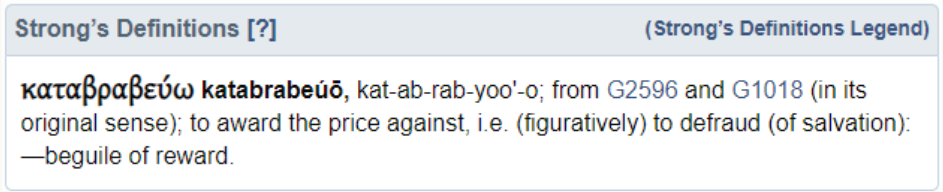
First, what is it to be “disqualified”? What does the Greek word actually mean? Let us refer to Strong’s definition to begin.
It is a compound word in the Greek, made up of kata – “against” and brabeus – “an umpire”, and refers to those false teachers in the church who are acting as judges or umpires regarding the truth, fighting against the teaching Paul has provided.
Disqualified from Christian leadership?
Some may approach this verse in conjunction with Paul’s teaching in other passages where the apostle (or any other Christian leader) would be disqualified from further service due to sin or lapse in faithfulness. This certainly is a truth in the Word, but I struggle finding this theme in this passage. It appears Paul is talking to all the saints and faithful in Colossae
Disqualified from Christian rewards?
To be disqualified in this verse is to loose the opportunity for some (or all) the rewards possible for a believer when he passes from this earth. This is the common fall back position I took when I was invested in OSAS (Once Saved Always Saved). This may have some connection to the previous topic of service, and may be the correct interpretation, if the theme of rewards may be found in the earlier verses. Can you find the theme of rewards in this passage?
Disqualified from Christian life?
Although the grimmest of end results, that is the apostacy of the believer being referred to here in verse 18 , the very next verse may direct me to this conclusion. Paul speaks of being disqualified, and then speaks of the believer “not holding fast to the Head”
Colossians 2:19
and not holding fast to the Head, from whom the whole body, nourished and knit together through its joints and ligaments, grows with a growth that is from God.
When might we think that not holding fast to the Head would be an acceptable condition for salvation?
Although I typically use the ESV throughout my posts on this blog, I do refer to other translations occasionally, and in this instance found two translations that speak of an apostacy.
Colossians 2:19 NIV
They have lost connection with the head, from whom the whole body, supported and held together by its ligaments and sinews, grows as God causes it to grow.
Colossians 2:19 NLT
and they are not connected to Christ, the head of the body. For he holds the whole body together with its joints and ligaments, and it grows as God nourishes it.
Also, though my understanding of the English word disqualified may not be worth much, when I see the term “disqualified” I understand the word to mean that the participant is ejected from the competition, that he or she is no longer allowed to be involved, that upon some decision or act of the participant, a rule was broken (or in my understanding a relationship was rejected).
Rejecting the Head for an alternate method of reaching God. Foolishness yet a very real threat in this age, as we have multitudinous false teachers seeking to pull us away from the truth of the gospel.
Jesus is the only way, and any teacher that distracts you from the simple truth of Jesus the Messiah, crucified for you is a deadly distraction.
Thanks again for coming to visit. I hope you found something of interest in this post and would appreciate a comment, to begin a discussion. If you would like to receive daily posts from Considering the Bible, click on the “Follow” link below
17 As for the rich in this present age, charge them not to be haughty, nor to set their hopes on the uncertainty of riches, but on God, who richly provides us with everything to enjoy. 18 They are to do good, to be rich in good works, to be generous and ready to share, 19 thus storing up treasure for themselves as a good foundation for the future, so that they may take hold of that which is truly life.
Paul is amazing in his instruction, for as some of my dear brothers may suggest, to follow after the Christ is to give up all possessions, to sell your stuff and leave it all behind. For some this is the appropriate call on their lives, and to those so called, it is a high calling.
Yet Paul does not leave the rest of us without a responsibility in relation to the riches in this present age. To be rich in this present age – a phrase that speaks of the source or foundation of the riches, as opposed to the time we experience the riches. He is instructing Timothy to admonish those who have accumulated “things of this world”, material wealth, goods and investments with the following instruction . As we consider this passage, we can see that Paul is speaking of two worlds that the believer lives in, the material and the spiritual.
If a believer is not called upon to physically leave behind his goods to follow the Master (which also has a trap of producing a prideful attitude), the saint is then challenged with the requirement to prioritize his goods to a much lower level in the believers life.
Note what it is that Paul focuses on. Two “don’ts” and three “do’s”.
Don’t be haughty
A large (or medium, even a small bank account) is no reason to consider yourself better than a brother in the Lord. As I speak to my brothers in my blog, we tend to measure our success in life with the toys we have.
This is a mindset that needs to be rejected.
Paul is speaking of our current attitude toward others in this verse, based on the riches of this present age.
Don’t hope in material goods
Paul then breaches our faith, or our hope for the future, based on the riches we have accumulated. This is tantamount to opposing our faith in God. Each of us who have material goods needs to wash our minds and hearts of any detrimental hope we may have in our savings.
Wisdom dictates we store up for the future, that we do what we can to prepare for the future, yet our hope is not on the material goods we accumulate, but on the God who gives us the strength each day to work, love and care for others.
Do good
Paul speaks of our actions to enter into as one who may have trusted in his goods. Do good. Simple. He simply speaks of doing good, and leaves it up to the believer to find opportunities to “do” good.
Be generous
The next two “do’s” are better described as who we are to become, and not exactly specific (or even general) actions or works we are to enter into.
It is a state of being, to “be” generous. When an opportunity arises that can be taken care of, a generous man will do what he can to relieve it. It will be an automatic response, not necessarily a calculated response.
Be ready
Not only are we to be generous, but we are to be ready. This speaks of continuing in the attitude of generosity.
In all of this charge to the rich of this world, Paul instructs Timothy to inform the rich that this life will produce a “good foundation” for the future” in order that the rich maytake hold of life.
May take hold of life?
Isn’t he speaking to believers? Do they not have in their possession the life of God by faith in the Messiah? What is all this talk of a foundation for the future, of them leading lives that produce conditions to take hold of life?
Am I suggesting that providing generous gifts to charities and churches will get you to heaven? Not so! There is only one way and we all know it isn’t by our actions.
And yet, it is our actions that prove we have the life.
How are your actions and attitudes lately? Have you considered the life you are living in relation to Paul’s exhortation to Timothy?
Do good – Paul did not put any limits on this command, and be generous as the Lord directs.
Grab the life in this life. Paul gives us the instructions on how to do it!!!
Thanks again for coming to visit. I hope you found something of interest in this post and would appreciate a comment, to begin a discussion. If you would like to receive daily posts from Considering the Bible, click on the “Follow” link below
4 For everyone who has been born of God overcomes the world. And this is the victory that has overcome the world–our faith. 5 Who is it that overcomes the world except the one who believes that Jesus is the Son of God?
The faith we live is the victory we are granted to walk in and I understand the victory to be a daily occurrence, a battle with the influences of this old world.
A personal story may help me explain my thoughts.
My wife and I were recently out for a meal with some folks and a lady requested if I had seed a recent movie. I understood this movie had an agenda, and I mentioned this to her. Now before we go any further, let me confess this lady is a believer, she attends a conservative church, does many charitable works and confesses the Lord. Yet she found my understanding of the movie to be offensive.
I made a comment to the effect that the movie appealed to her since it fit her worldview. It did not “fit” my worldview as it was peddling what I considered a radically progressive worldview, seeking to normalize an offensive lifestyle unto the populace.
We are both believers, but I would suggest that if my estimation of “the world” is correct, she may not be overcoming “the world” in this area. Now before someone think I am judging harshly, I readily admit my own worldview, or how I perceive truth, is not any better, for I have blind spots and opinions that are in opposition to the faith I confess.
With this being said, I would suggest the faith we have is to be in opposition to the world, that as believers we are to be a counterculture, a people that tests the thoughts being offered to us, filter those thoughts through the Word, and reject all that do not line up with the general teaching of the Word.
But let us not reject out of a position of pride, but handle the position we take out of humble spirit, always seeking to provide a loving answer, a solid response and to act in grace with mercy to those who oppose.
In my study of this verse, I tripped over a Matthew Henry quote that seems to capture many of my suspected thoughts on this verse.
Self-denial is required, but true Christians have a principle which carries them above all hindrances. Though the conflict often is sharp, and the regenerate may be cast down, yet he will rise up and renew his combat with resolution. But all, except believers in Christ, are enslaved in some respect or other, to the customs, opinions, or interests of the world. Faith is the cause of victory, the means, the instrument, the spiritual armor by which we overcome. In and by faith we cleave to Christ, in contempt of, and in opposition to the world. Faith sanctifies the heart, and purifies it from those sensual lusts by which the world obtains sway and dominion over souls. It has the indwelling Spirit of grace, which is greater than he who dwells in the world. The real Christian overcomes the world by faith; he sees, in and by the life and conduct of the Lord Jesus on earth, that this world is to be renounced and overcome. He cannot be satisfied with this world, but looks beyond it, and is still tending, striving, and pressing toward heaven. We must all, after Christ’s example, overcome the world, or it will overcome us to our ruin.
Are you overcoming the world, or is it overcoming you?
Thanks again for coming to visit. I hope you found something of interest in this post and would appreciate a comment, to begin a discussion. If you would like to receive daily posts from Considering the Bible, click on the “Follow” link below
Hebrews 12:18-25 18 For you have not come to what may be touched, a blazing fire and darkness and gloom and a tempest 19 and the sound of a trumpet and a voice whose words made the hearers beg that no further messages be spoken to them. 20 For they could not endure the order that was given, “If even a beast touches the mountain, it shall be stoned.” 21 Indeed, so terrifying was the sight that Moses said, “I tremble with fear.” 22 But you have come to Mount Zion and to the city of the living God, the heavenly Jerusalem, and to innumerable angels in festal gathering, 23 and to the assembly of the firstborn who are enrolled in heaven, and to God, the judge of all, and to the spirits of the righteous made perfect, 24 and to Jesus, the mediator of a new covenant, and to the sprinkled blood that speaks a better word than the blood of Abel. 25 See that you do not refuse him who is speaking. For if they did not escape when they refused him who warned them on earth, much less will we escape if we reject him who warns from heaven.
The Old Covenant and the New Covenant compared, with the responses associated with the covenants included. At least with the experiences of the Old Covenant. Terror. Even the mediator of the Old Covenant spoke of trembling with fear. The sight of the mountain, that physical place where the covenant was ratified with the children of Israel, that mountain was a place of terror, of blazing fire, of darkness, of gloom and a tempest. It must have been a horrible, frightening experience, a physical experience that set the tone of the relationship between God and His new nation.
The author provides a stark contrast for New Covenant participants, in that we have come to persons (angels, assembly of the firstborn, God spirits made righteous, Jesus) and not a physical mountain that could not be touched.
The Old covenant was based on rules, a fear inducing agreement between God and a nation and destined for failure, due to our inherent weakness and rebellious nature! So impersonal, so distant, such a separation between participants in the covenant!
Not so with the New Covenant! The New Covenant is personal, individual (to a point) and has the full revelation of the Lord’s loving sacrificial nature at the center of it!
Now, after understanding the difference in the covenants, is it wise to refuse him who is speaking? Judgement was a natural consequence of the law, but when I break a law – say by speeding, I pay a fine and move on. If I were to break my relationship with my wife or child, there is no coming back from it. Some healing may occur, but damage is done to one I love. Much deeper cut. Much harsher pain.
Both covenants had consequences, but I would argue that the New Covenant, based on the sacrifice of the Master, and not simply on an agreement over some rules (I am being somewhat glib at this point) provides deeper consequences.
The apostle even compares the sourcing of the warnings as a comparison of the covenants, and therefore the differences in the consequences. Under the law the warnings were from earth, but our warnings are from heaven.
Note that this is the second time the apostle brings up the topic of believers “not escaping”. A good self study for those interested would be to compare what the Old Testament saint would escape from in the Old Covenant, and consider the corollary for the New Testament saint.
Hebrews 2:3 how shall we escape if we neglect such a great salvation? It was declared at first by the Lord, and it was attested to us by those who heard,
Thanks again for coming to visit. I hope you found something of interest in this post and would appreciate a comment, to begin a discussion. If you would like to receive daily posts from Considering the Bible, click on the “Follow” link below
14 Strive for peace with everyone, and for the holiness without which no one will see the Lord. 12:15 See to it that no one fails to obtain the grace of God; that no “root of bitterness” springs up and causes trouble, and by it many become defiled; 12:16 that no one is sexually immoral or unholy like Esau, who sold his birthright for a single meal. 12:17 For you know that afterward, when he desired to inherit the blessing, he was rejected, for he found no chance to repent, though he sought it with tears.
Hold up!
It is by faith that we will see the Lord, by faith that we will approach our Maker and our Redeemer. Why would the apostle bring the concept of holiness into the equation? As a matter of fact, he also includes our striving to be at peace with EVERYONE! As a side bar to this topic, the striving for peace with everyone does not mean that we are at peace with everyone. Peace is dependent on two parties, and the apostle is simply placing our responsibility for peace making on us. We are to strive for peace with everyone.
This is a forgotten discipline in the Christian faith, for we think we have rights, and can be easily offended by others, harboring resentment and anger, and thinking we are in good standing with the Lord. Striving for peace does not provide any shelter for the believer to harbor ill feelings towards any.
Now to the actual attainment of peace with everyone, some may reject any effort to bring peace into a relationship. We are not responsible for their actions, but we are to seek peace with all continually. This means the rejection of an offer of peace does not provide us the freedom of harboring ill feeling to the one who rejects us. We are to strive!
Back to our topic!
We are to strive for peace and the holiness (or the sanctification) believers are to grow in. As the alternate option to seeking peace and sanctification, the apostle brings to the audience a reminder of an Old Testament character who eventually sold his birthright for a single meal. A single meal! How could anyone do that? (Does anyone hear the Lord’s reproach to the disciples when he spoke of the “flesh being weak”?)
Let’s take a moment to consider the example the author brings to our attention.
The apostle speaks of failing to obtain the grace of God, which is the equivalent of a root of bitterness springing up and causing trouble. In Esau’s case, this root of bitterness may very well have been the result of his own decisions, for he did decide to sell his birthright to Jacob. A major regret! Out of that decision, Jacob, through deception, attained Esau’s blessing. Birthright and blessing lost, for without the birthright, the blessing would be hobbled. Jacob needed the birthright to get the upper hand and continue with his dominance over Esau.
If someone stole that which was rightfully yours, or at least traded you stew for riches, would you not experience a root of bitterness erupting in your heart? Out of this bitterness, Esau’s immediate and extended family were impacted, with an extended separation from each other. The bitterness continues to fester, and as we know, what is in the heart comes out. This bitterness most certainly controlled Esau in many ways, and affected many he came into contact with.
He did seek to find restoration, to find his place in the family, through seeking the blessing from Isaac. But he was rejected. He found no chance to repent. Now wait a minute. It looks like he sought it with tears, and he desired to inherit the blessing. Why was he rejected?
The cast had been set. The birthright had been sold, and the blessing had been granted. His chance to repent had passed. He may have been sincere, truly seeking restoration, and yet the conditions of the situation did not allow the blessing to be taken from Jacob and granted to Esau.
As we go about our daily lives today, consider Esau and his decision making process. He prioritized a breakfast over a birthright. Out of that thought process, he also lost the blessing.
Now it turns out that Esau came to grips within himself later in life as we can see in a future meeting with Jacob. As we see in Genesis 33, Esau sought reconciliation with Jacob, Esau exhibited the desire to find peace with the one who abused his weakness and stole his blessing.
Genesis 33:4 But Esau ran to meet him and embraced him and fell on his neck and kissed him, and they wept.
Yes Esau, due to his foolishness in his youth, lost out on his rightful potential as the patriarch of the nation of Israel. The nation that sprang from his seed was known as Edom, and became a thorn in Israel’s side. But Esau, it appears found peace in himself and from that peace actually sought peace with Jacob, the one who abused and cheated him of his rightful place in the family. Let’s remember that Jacob was the very focus of Esau’s bitterness, the reason Esau allowed bitterness to fester in his life. Yet he sought peace later in life, with the very one who could be blamed for the bitterness.
If someone has hurt you badly, taken advantage of you, emotionally scarred you, seek peace with that person. This is the call of God on your life.
We are to be peacemakers.
Matthew 5:9 “Blessed are the peacemakers, for they shall be called sons of God.
Thanks again for coming to visit. I hope you found something of interest in this post and would appreciate a comment, to begin a discussion. If you would like to receive daily posts from Considering the Bible, click on the “Follow” link below
Hebrews 12:10-13 10 For they disciplined us for a short time as it seemed best to them, but he disciplines us for our good, that we may share his holiness. 11 For the moment all discipline seems painful rather than pleasant, but later it yields the peaceful fruit of righteousness to those who have been trained by it. 12 Therefore lift your drooping hands and strengthen your weak knees, 13 and make straight paths for your feet, so that what is lame may not be put out of joint but rather be healed.
The apostle continues in this passage with an exhortation to endure, and not only endure but to be strengthened by the very outcome of the discipline being experienced. Truly this is a challenge, and yet knowing the intent of the Father’s discipline should spur us on. It is not that the Father is disciplining us out of anger or frustration, or that He is simply considering His own reputation. His intent is to bring about peaceable fruit of righteousness in His children. But is that what the apostle wrote? Let us read it again. His intent is to bring about “peaceful fruit of righteousness to those who have been trained by it”. That qualifier is what grabs my attention.
You see, all who claim Christ go through trials, and as I glibly read this passage, it appears that all believers gain from these trials. At least that is what I used to think, for I did not consider those who may not be trained by the trials they are going through. Consider one who may be experiencing a difficult trial, even a discipline from the Lord, and though may struggle and doubt for a period of time, at one point they simply say – that is enough. They make the internal decision to “not be trained.” To reject the discipline. What might the apostle be referring to in this instance, and yes I do understand this is inference to our topic! Yet the statement is qualified by our active participation in the discipline.
Where does that leave the one who refuses to enter and remain under the discipline of the Lord?
Verse 12 and 13 speak of the apostles hope for the believer who is struggling with understanding the discipline of God in their lives. We all need to understand the motivation of God (love) , and the outcome of the endurance (peaceful fruit of righteousness), and from these two truths, be encouraged, strengthened and renewed to continue in our faith, to endure doubts and struggles, even to the point of shedding blood as he refers to in verse 4.
Be trained by the discipline my brothers and sisters. There is great love bringing this time of testing to you and a great outcome will be realized after the trial has passed and you have endured. Therefore, endure for the current time, and during this time of trial, look to Jesus, who set the example, who …
endured the cross, despising the shame, and is seated at the right hand of the throne of God.
He is good and He is good all the time.
Thanks again for coming to visit. I hope you found something of interest in this post and would appreciate a comment, to begin a discussion. If you would like to receive daily posts from Considering the Bible, click on the “Follow” link below
Hebrews 12:6-9 6 For the Lord disciplines the one he loves, and chastises every son whom he receives.” 7 It is for discipline that you have to endure. God is treating you as sons. For what son is there whom his father does not discipline? 8 If you are left without discipline, in which all have participated, then you are illegitimate children and not sons. 9 Besides this, we have had earthly fathers who disciplined us and we respected them. Shall we not much more be subject to the Father of spirits and live?
In the book of Hebrews, the author gives us 5 warnings as believers throughout the book. We are entering the fifth warning here and the author is developing the Father/son relationship, emphasizing the corrective posture of both our earthly father and our heavenly Father.
Within this particular passage, it is possible to understand the authors intent to simply spur on believers in the midst of trials. Many of the exhortations may focus on spurring on believers, and not enter into any conditional security topic. And yet, some of them may breach our topic of consideration in this series. With that said, for the next few posts, we are going to sit in this chapter and consider a few of the author’s messages in Hebrews 12 to the first century Hebrew believer.
In our first entry into this amazing chapter, we come to verse 6, where the author lays down the topic of discipline for the believer, and the reason believers experience this painful turn of events in their lives. He is quick to define the Lord’s motives, and that is not out of anger or frustration, which many earthly father’s experience, but out of pure love for His children. Don’t get me wrong – a good father, though angry and frustrated, will attempt to correct his son out of a foundation of love for the child. A non child, a neighbors child, or a young one he comes across in the grocery store does not affect the father as his own son’s bad behavior. No – it is the relationship that is emphasized in this passage as the motivating factor of discipline, and out of that, the proper response we are to exhibit towards our heavenly Father.
The exhortation to endure is a key element in this passage from the author. To endure takes on many descriptions throughout the book of Hebrews, but for brevity of this post, note the varied ways the author speaks of enduring just in chapter 12.
12:5 do not regard lightly the discipline of the Lord, nor be weary when reproved by him
12:9 shall we not much more be subject to the Father of spirits and live
12:13 so that what is lame may not be put out of joint but rather be healed
12:15 See to it that no one fails to obtain the grace of God
12:15 See to it ….that no “root of bitterness” springs up and causes trouble, and by it many become defiled;
12:16 See to it …. no one is sexually immoral or unholy like Esau, who sold his birthright for a single meal
12:25 See that you do not refuse him who is speaking
Some of these phrases we will deal with in later posts, but for our current passage, note verse 8 & 9, where I believe the author speaks of living in relation to discipline. Our mental and spiritual repose before the Father, that of respect and subjection to His authority over our lives, provides assurance of our continuing in the life He has provided us out of grace and mercy.
Be subject to the Father and live.
Does this ring of an ongoing relationship with the One who saved us? Of a continual ongoing respect to the Father that is required in order to live?
Of course, if my thinking is correct, I have to consider the apostles reference to “live”” as being alive in Christ, to be of a resurrected reborn man or woman of God, one who has claimed and practiced the Christian life. This seems obvious to me at this time, for why would the apostle simply speak of physical life. If only physical life, the very discipline of the Father, which may end in martyrdom, would be contradictory.
For example, might the apostle be trying to say – Endure discipline, to the point of physical death so that you may live (physically?) It doesn’t make sense to me, but I am open to your comments, and hope to hear your thoughts on this passage.
Thanks again for coming to visit. I hope you found something of interest in this post and would appreciate a comment, to begin a discussion. If you would like to receive daily posts from Considering the Bible, click on the “Follow” link below
1 For freedom Christ has set us free; stand firm therefore, and do not submit again to a yoke of slavery. 2 Look: I, Paul, say to you that if you accept circumcision, Christ will be of no advantage to you. 3 I testify again to every man who accepts circumcision that he is obligated to keep the whole law. 4 You are severed from Christ, you who would be justified by the law; you have fallen away from grace. –
In Paul’s writing, I do not recall a time when he is harsher, more blunt or shocking than in this passage. There may be a passage in Romans or 1 Corinthians, but I gotta remind myself – this isn’t a competition. This passage is simply a tough one to take in no matter how you approach it.
Tough Issue 1
Paul is in the midst of reprimanding the church in Galatia for their desire to use the law for a basis of sanctification, for living correctly in front of God, for maintaining a relationship with the Lord. The first issue that is tough for me to understand is the fact that Paul does not speak of sanctification in this passage, but justification. The same justification the same author speaks of in Romans 3:24
…justified by his grace through the redemption that is in Christ Jesus
or how about Romans 5:1
…since we have been justified by faith, we have peace with God through our Lord Jesus Christ
My point is bringing these two (out of many possible verses) to our discussion is that Paul refers to justification as a past act, not a continual act. That is, when I repented, and placed my faith in the Lord Jesus and His sacrifice for me, I was (past tense) justified. At that point, as I understand the Word, the process of sanctification began, a continual process of becoming like Him, of following His and His will for me, frail and incomplete as that is.
So why does Paul bring up justification, as opposed to sanctification? He is addressing his message to believers, and he is going back to the very foundation of their Christian life, the point of rebirth! Are we to see this dependence on the law, circumcision in this particular instance, to be so serious that justification is nullified?
Ok, might Paul be referring to those who simply think they are Christians in the Body, and trying to reveal to them their utter error in never trusting Christ? Why would Paul address them as believers if they are not? Does that not introduce confusion into the passage, especially for those who truly are believers? I don’t understand Paul shifting gears in relation to who he is talking to in this passage.
Tough Issue 2
To be severed!
Tough issue number two. When Paul speaks of “severed” from Christ, he is referring to one who had not been severed earlier. Let me try to explain my thought.
When my son is cooking chicken for his ol’ dad to enjoy a good supper, I see him with his cleaver “severing” the leg from the body. The leg was attached, but upon the act of severing, it is no longer attached. For something to be severed speaks of it being attached previously. For Paul to use such a term speaks of separation from Christ (by their choice – for it surely is not the Lord’s choice), that by choosing to trust in some religious act instead of in Him, they are in reality choosing that religious act over finding life in Christ. It is an either/or situation, not a “let’s improve the Christian life with the law” type of situation!
Tough issue 3
Fallen away from grace.
Either the reader of this letter trusts in Christ or trusts in an outward act of religious show, but out of this decision flows the issues of life and death. To be fallen from grace, by attaching oneself to the Law, is an act that for Paul has dire consequences.
The term used for fallen away is ἐκπίπτω ekpíptō, and it is in the aorist tense. Since I am no Greek guru, I understand from my research this is typically considered to be an act in the past, a completed act, as the English translation communicates. It isn’t a process of falling, but of having fallen. Although it may seem I am laboring with tenses in many of the points I bring up, it is my desire to be clear with the text, to try to take the text and understand his original message.
And that message is a tough one!
If I were to summarize Paul’s message, I would have to say. Trust Christ and do not trust religion! Religion will kill you!
And if you teach that religion is the way of life, take a gander at Galatians 5:12. Surely there was no love lost between Paul and those who would unsettle believers from their trust in the Savior
Thanks again for coming to visit. I hope you found something of interest in this post and would appreciate a comment, to begin a discussion. If you would like to receive daily posts from Considering the Bible, click on the “Follow” link below
Hebrews 2:1 Therefore we must pay much closer attention to what we have heard, lest we drift away from it. Hebrews 2:2 For since the message declared by angels proved to be reliable, and every transgression or disobedience received a just retribution, Hebrews 2:3 how shall we escape if we neglect such a great salvation? It was declared at first by the Lord, and it was attested to us by those who heard,
We have been working through multiple passage under this series and it is somewhat surprising that this passage has been neglected till now. It is such a powerful passage warning us of our tendency to drift away from the message of the grace of God, and the great salvation He has provided!
When I embraced the OSAS (Once Saved Always Saved) teaching, I looked at this verse as a passage that was delivered to the lost, and the danger of their rejecting the great salvation the Lord provided for the world. This was the result of reading the third verse only, with a set of OSAS goggles on, interpreting the verse the way I was told to interpret it.
Lets consider the immediate context, and the specific message of the third verse.
Context
The author is speaking to Christians, including himself! Notice how he refers to “we” a couple of times in the first verse. Yes I have heard that the we could be referring to Hebrews, and not Christians since the author may have been Jewish, but honestly, this seems to be such a stretch to avoid the obvious. Consider the author’s fear of drifting away in the first verse. The direction of movement is away from the gospel, which implies there may have been a time when the audience (and the author) were closer to the message.
The entire book of Hebrews is speaking to believers who are on the edge of abandoning their faith, and for the author to change the audience in this small passage makes no sense for me. There will be a number of these passages in Hebrews, where the author addresses the audiences dangerous position. His audience contains Christians, those who believed in the Jewish Messiah, leaving behind a dead religion, a religion whose purpose was to bring them to faith, not to be a competition to the truth!
Specific Message
Again, as an OSAS adherent, I read the third verse thusly.
Hebrews 3:3 how shall we escape if we neglectreject such a great salvation?
How often have you heard a preacher or teacher read this verse, and then go on as if he is teaching it to an audience of lost souls, that they are rejecting the gospel? As if the church is full of lost souls, and that if any believers are in attendance, they are allowed to listen, but it doesn’t really apply to them.
The term the apostle uses is neglect, and refers to an attitude of negligence, carelessness of disregarding the truth we have been given. A few chapters later, the apostle uses this same Greek word in a bit different way, for he speaks of God showing no concern.
Hebrews 8:9 not like the covenant that I made with their fathers on the day when I took them by the hand to bring them out of the land of Egypt. For they did not continue in my covenant, and so I showed no concern for them, declares the Lord.
The same Greek word (ἀμελέω ameléō, G 272), but the one “neglecting” is God, and the ones being neglected are the very ones who considered the truth they had been provided as unimportant. Note that the author reminds the Hebrew believers that the Hebrews of history did not continue in the covenant they had been provided! Might it be that the Hebrews of old neglected the covenant, made light of the covenant? Surely this is the authors intended message!
Don’t make light of the gospel. We are in a life and death battle, a battle that will have consequences.
Thanks again for coming to visit. I hope you found something of interest in this post and would appreciate a comment, to begin a discussion. If you would like to receive daily posts from Considering the Bible, click on the “Follow” link below
18 This charge I entrust to you, Timothy, my child, in accordance with the prophecies previously made about you, that by them you may wage the good warfare,
19 holding faith and a good conscience. By rejecting this, some have made shipwreck of their faith,
20 among whom are Hymenaeus and Alexander, whom I have handed over to Satan that they may learn not to blaspheme.
Rejection. Paul is warning Timothy of the results of ignoring a good conscience. No – that is not right! It is not a matter specifically of ignoring to maintain a good conscience, which by the way is dangerous, but Paul speaks of some, who we will meet soon, as rejecting faith and a good conscience.
Two actions are being described in this verse.
Holding
G2192 – ἔχω échō To have, to hold, to own or possess.
This is a typical term to define ownership or to keep within close proximity, to cling to or to be closely joined to. The thought communicated is typical of Paul’s writings, and that is to maintain a close relationship with the Lord, and the two vehicles to maintain this relationship is faith and a good conscience. Paul is highlighting Timothy’s continued efforts for his ministry.
Rejecting
G683 – ἀπωθέομαι apōthéomai. To push off, cast away or to thrust away from. This seems to be a deliberate action on the part of the subject. This isn’t a matter of human frailty, in that we all fall down occasionally. Paul is using a word here that speaks of a decision to reject faith and a good conscience. To be able to reject something implies the possession of the thing being rejected – how can you reject something you do not have!. May we safely assume that the two men mentioned in this passage were believers at one time?
Two men are given as examples, who have rejected faith and a good conscience.
Hymenaeus
Hymenaeus shows up in one other passage in the New Testament. Paul is speaking of him as swerving from the truth, and upsetting the faith of some. Pray tell, Paul – what is Hymanaeus teaching that is so bad that you are calling him out for it?
2 Timothy 2:16-18
But avoid irreverent babble, for it will lead people into more and more ungodliness, and their talk will spread like gangrene. Among them are Hymenaeus and Philetus, who have swerved from the truth, saying that the resurrection has already happened. They are upsetting the faith of some.
Only that the general resurrection has occurred in the past! Consider if you were a believer during this time, and heard that you missed the resurrection. Talk about gutting the gospel! The fellow was causing tremendous damage in the church, and is to be considered an enemy of the gospel in my opinion. And in Paul’s opinion too, if I’m reading him right.
Alexander
There are a number of Alexanders in the New Testament, or at least there could be. We just don’t know. I tend to lean to the thinking Paul is referring to Alexander the coppersmith in our passage to Timothy, since Timothy is in Ephesus and the riot in Ephesus was lead by Alexander
Acts 19:33 Some of the crowd prompted Alexander, whom the Jews had put forward. And Alexander, motioning with his hand, wanted to make a defense to the crowd.
Another reference to Alexander , that Timothy would recognize and may be the one Paul is referring to in our passage in 1 Timothy, is Alexander the Coppersmith. Personally I would find it difficult to think this is a different man Paul refers to but I will leave that up to my reader
2 Timothy 4:14 Alexander the coppersmith did me great harm; the Lord will repay him according to his deeds.
Both Hymenaeus and Alexander have rejected a good conscience and faith. The results do not appear to be characteristic of good Christian living, so I ask you my friend.
What is the result of their rejecting a good conscience and faith?
Thanks again for coming to visit. I hope you found something of interest in this post and would appreciate a comment, to begin a discussion. If you would like to receive daily posts from Considering the Bible, click on the “Follow” link below
5 The aim of our charge is love that issues from a pure heart and a good conscience and a sincere faith. 6 Certain persons, by swerving from these, have wandered away into vain discussion, 7 desiring to be teachers of the law, without understanding either what they are saying or the things about which they make confident assertions. 8 Now we know that the law is good, if one uses it lawfully, 9 understanding this, that the law is not laid down for the just but for the lawless and disobedient, for the ungodly and sinners, for the unholy and profane, for those who strike their fathers and mothers, for murderers, 10 the sexually immoral, men who practice homosexuality, enslavers, liars, perjurers, and whatever else is contrary to sound doctrine, 11 in accordance with the gospel of the glory of the blessed God with which I have been entrusted.
What a fantastic passage on the purpose of the law. When I first came to know the Lord, this basic truth, that the law was provided for sinners, law breakers, rebels and such, stunned me. I thought it was to provide guidance for the morally upright, and to a point this may be true, but external standards are provided to show we cannot maintain the standard without help, without inner strength, without the desire to please someone.
Yes, the law is good and holy, but as Paul mentions, we have to use it lawfully, or for the purpose for which it was given. It provides condemnation! But before I delve into that topic, let us consider how the passage above applies to the topic of this series.
How does 1 Timothy 1:5-11 read in relation to conditional security? I have read this passage many times, and confessedly, always dwell on the law topic within the verses, but let me refer you to verse 5 & 6.
First off, Paul speaks of the goal of his teaching or instruction. He aims to direct believers into love. This love comes from a pure heart. This love comes from a good conscience. This love comes from a sincere faith. Love is the aim of the apostles teaching. Not a spurious, feely touchy love that ebbs and flows with emotional highs and lows. This love is to be a consistent, nature based loved, a love based on character, a character developed by knowing the Lord, as opposed to knowing a law.
I hope this isn’t shocking to any of my readers, for love is the core of Christianity. Love that is found in and sourced out of the Lord Jesus, and His self sacrificial life. Paul saw the destination (or was aiming at) this condition for the believers as he taught them.
But what if believers decide this isn’t to be the focus of their faith, the target to shoot for as they live amongst others? Paul speaks of these that have swerved from this target, wandering into vain discussion. They have swerved! I understand this to mean they were on course at one time, they had caught sight of the target and was well on the way. Until. Until something pulled them away. Something distracting, tantalizing, shiny and bright!
The law.
Oh how the law feeds to the pride we live in. If (when) I focus on the law, I become a judge. A judge that has to condemn, and that conveniently turns a blind eye to my own rebellion. Love has to be jettisoned from our focus in life, for the law has no room for mercy, love or patience.
These believers that Paul refers to as swerving are not understanding what they are dabbling in, becoming those who teach (instead of learning?) and disassociate from the just, turning to the lawless to provide guidance for life. Yet the law was intended to condemn. My friend, the law either condemns, or feeds a self righteous heart.
I don’t know about you, but I want to know of the grace of God, the love of Jesus, the consolation of the Spirit, the encouragement of the saints.
Decades ago, I heard a preacher quote this diddy
The law commands but gives me neither feet nor hands, A better thing the gospel brings, it bids me fly and gives me wings!
Trust in the Living God, and out of this trust, from following the Messiah, the law will be worked out in your life, without focusing on it.
Focusing on the law will not provide the growth, encouragement or joy the gospel provides. It will not! This passage reminds me of many passages in the New Testament that speak to this topic, but to close, I offer Galatians 5:7-10.
Note Paul’s warning of the teacher in verse 10
Galatians 5:7-10
7 You were running well. Who hindered you from obeying the truth? 8 This persuasion is not from him who calls you. 9 A little leaven leavens the whole lump. 10 I have confidence in the Lord that you will take no other view, and the one who is troubling you will bear the penalty, whoever he is.
Thanks for reading, and I pray that the Spirit will give illumination to each of us as we seek to follow.
Thanks again for coming to visit. I hope you found something of interest in this post and would appreciate a comment, to begin a discussion. If you would like to receive daily posts from Considering the Bible, click on the “Follow” link below