A Song of Ascents. Those who trust in the Lord are like Mount Zion, which cannot be moved, but abides forever.
As I consider passages throughout the Word, and stumble (or am guided) to particular passages, I find various degrees of clarity in the passages on out topic.
Some clearly define the truth of a conditional relationship with the Living God, and the danger of letting that relationship sour, becoming such that eventually the soul determines to walk away, and thereby enters into the realm of death.
This is a difficult truth, and though it is a difficult truth, it seems I am consistently looking at the negative aspacts of the cold heart, of the soul that may die. I suppose that is the nature of the topic, and may be unavoidable.
But there is the positive aspect for the heart that endures, for the soul that clings, for the mind that seeks to remain faithful.
Psalm 125:1 caught my sight this evening, and the description of “those who trust”, stuck in my craw. The psalmist does not refer to those who trusted, or those who may trust, but of the present trusting soul seeking God. It is a simple truth, speaking of the trusting one’s stability in life, how the saint who is currently (and by implication, constantly) trusting in the Lord cannot be moved.
Of course, the passage lends itself to imply that those who do not trust do not have this stability, this immovableness, but for our time together today, let’s think of the positive truth provided by this psalmist. Let’s dwell on the blessing of stability God provides to the one who in trusting in the saving work of the Savior, the love of God the Father, and the faithful ministry of the Spirit of God.
He is good, and worthy of our trust.
Hebrews 12:28 Therefore let us be grateful for receiving a kingdom that cannot be shaken, and thus let us offer to God acceptable worship, with reverence and awe,
Thanks again for coming to visit. I hope you found something of interest in this post and would appreciate a comment, to begin a discussion. If you would like to receive daily posts from Considering the Bible, click on the “Follow” link below
18 Beware lest there be among you a man or woman or clan or tribe whose heart is turning away today from the LORD our God to go and serve the gods of those nations. Beware lest there be among you a root bearing poisonous and bitter fruit, 19 one who, when he hears the words of this sworn covenant, blesses himself in his heart, saying, ‘I shall be safe, though I walk in the stubbornness of my heart.’ This will lead to the sweeping away of moist and dry alike. 20 The LORD will not be willing to forgive him, but rather the anger of the LORD and his jealousy will smoke against that man, and the curses written in this book will settle upon him, and the LORD will blot out his name from under heaven.
Moses, in declaring God’s message for the nation warns them of those whose hearts are turning away from the Lord. Be it man or woman, clan or tribe, the warning is given in order to preserve the nation from apostacy.
He warns the nation of this one who is turning away from the covenant, even as this soul convinces himself of his security. Note in particular verse 19, where the soul who is becoming a “root bearing poisonous and bitter fruit” is convincing himself of his own security.
What is even more difficult to stomach is that this one who is becoming a “root bearing poisonous and bitter fruit” is convincing himself, blessing himself, as he hears the words of this sworn covenant, the very covenant that God graciously provided to the nation through the prophet Moses. He isn’t merely convincing himself out of a vacuum, or when he is with his friends at a bar or bowling alley, but as he hears the very words of the covenant that he refuses to submit to.
Excuse me for this leap of logic, but I can’t help but find a parallel with our current conditions, where believers may be in church, hearing the Word, and yet possibly be on the edge of turning from Him.
Even worse, to think that some teachers of the Word provide no warnings of “heart turning”, or deny this possibility of becoming a “root bearing poisonous and bitter fruit”. Or worse yet, some may teach that it is impossible to turn from the Lord, saying that a prayer at an altar will forever seal your fate.
Thankfully we may identify those who have turned from the Lord, in that they are a source (root) of poison and bitterness. Let’s consider both those terms.
Poisonous
רֹאשׁ rôʼsh is found in the Old Testament and refers to a poisonous plant or the poison of a serpent. Obviously associated with death!
Bitterness
The Hebrew word translated as bitterness in this verse is לַעֲנָה laʻănâh. We find it translated as wormwood also, and it speaks of a noxious and poisonous root. It has the connotation of cursing, and is also associated with death.
Now what?
Moses provides a warning at the start of this passage for the nation in his day, and the church in our day, to identify those who may become a “root bearing poisonous and bitter fruit” To identify those the Lord warns us of in the passage above, we require discernment to see the fruits of their lives. Moses warns us of the one who is confident in his profession of faith, and yet, from the root of his life, in his very heart, death ensues.
For death is this soul’s denial of the Lord Jesus, whether it be active denial or passive denial. Of course it is easy to identify the actively denying soul, the one who rants and raves against the person of Jesus, and it is wise to understand our relationship to that soul.
The soul that is difficult to discern is the one who is still in the passive denial of truth, that is the soul convincing himself of his security, yet seemingly proceeding down a path of death. As believers, we would be wise to heed the apostles advise when addressing those who may be slipping away, for we are also a weak and fragile people.
Galatians 6:1 Brothers, if anyone is caught in any transgression, you who are spiritual should restore him in a spirit of gentleness. Keep watch on yourself, lest you too be tempted.
May we have roots found in the Lord Jesus, full of life and the sweetness of His character!
Thanks again for coming to visit. I hope you found something of interest in this post and would appreciate a comment, to begin a discussion. If you would like to receive daily posts from Considering the Bible, click on the “Follow” link below
31 So Moses returned to the LORD and said, “Alas, this people has sinned a great sin. They have made for themselves gods of gold. 32 But now, if you will forgive their sin–but if not, please blot me out of your book that you have written.” 33 But the LORD said to Moses, “Whoever has sinned against me, I will blot out of my book. 34 But now go, lead the people to the place about which I have spoken to you; behold, my angel shall go before you. Nevertheless, in the day when I visit, I will visit their sin upon them.” 35 Then the LORD sent a plague on the people, because they made the calf, the one that Aaron made.
Chapter 32 starts off real bad.
The children of Israel directed Aaron to take over, to cast a golden calf to worship.
As an aside, for them to build a calf is such a sad commentary on their commitment to religion, for as they had left the country of Egypt, they left behind the worship of Apsis, a sacred bull worshipped by the Egyptians. They built a calf!
The Israel people sinned a great sin in constructing this calf, and then committed even greater sin in the worship of the calf. But in all their efforts to sin against God in the casting of the calf, its apparent their idol was simply a reduced version of the idol of the people they were escaping from. Even in their sin here, they showed their hearts were held by their abusers! Amazing.
The Israeli people sought Aaron to lead them in the idolatrous worship of this calf, in direct disobedience to the very first of the commandments given to the nation by God.
Exodus 20
3 You shall have no other gods before me. 4 You shall not make for yourself a carved image, or any likeness of anything that is in heaven above, or that is in the earth beneath, or that is in the water under the earth. 5 You shall not bow down to them or serve them, for I the LORD your God am a jealous God…
The very day of the giving of the commandments, in the midst of the thunder and peals of lightning, with the mountain smoking, the people admittedly confessed their fear. And rightly so, since the mountain was smoking!
Moses informed the people that this display was to instill fear in their hearts, that they may not sin!
20 Moses said to the people, “Do not fear, for God has come to test you, that the fear of him may be before you, that you may not sin.”
Then to ensure the people understood the importance of this first commandment, God repeats Himself.
23 You shall not make gods of silver to be with me, nor shall you make for yourselves gods of gold.
So what do the Israeli people do? They go right ahead and make for themselves gods of gold.
Ok – after that background information, we have some context for our Exodus 32 passage. Verse 33 is the focus of our text for the purpose of our topic today.
32:33 But the LORD said to Moses, “Whoever has sinned against me, I will blot out of my book.
Now there are a number of ways to understand “my book”, and I keep promising myself that I am going to do a series on this topic. But for now, my understanding is that individual Israelites are being addressed, they currently are in the book of God, and due to sin, God will blot them out.
Is this referring to eternal salvation? National citizenship? Physical life? Too many questions to address in this post, but the principal is put before us.
How may I describe my understanding? Each person in a relationship with God has the opportunity (freedom) to loose this relationship.
One thought that I hope I have developed is that the sin that causing this loss is not some errant thought, or accidental falling into sin, but a deliberate (and constant?) refusal to follow the clear and obvious will of God.
That will of God in this day and time, is to follow after the One who has delivered us from the curse, that has provided us strength to obey, who is patient and loving towards us, and that has become our sacrifice. No longer are we to bow to the idols of this world’s culture, or the idols of the religious devotees surrounding us, but only to follow after the Crucified One.
Will you follow?
Thanks again for coming to visit. I hope you found something of interest in this post and would appreciate a comment, to begin a discussion. If you would like to receive daily posts from Considering the Bible, click on the “Follow” link below
let the wicked forsake his way, and the unrighteous man his thoughts; let him return to the LORD, that he may have compassion on him, and to our God, for he will abundantly pardon.
Isaiah 55 is a great chapter, promising the blessing of God on the people of God. It might be argued that this chapter begins with an invitation to all, to every soul on earth, beyond the boundaries of Israel. Take note of the introductory verse of this chapter, and the general invitation provided to everyone.
Isaiah 55:1 “Come, everyone who thirsts, come to the waters; and he who has no money, come, buy and eat! Come, buy wine and milk without money and without price.
Isaiah continues with the plea, supposedly to all, in verse 3.
Isaiah 55:3 Incline your ear, and come to me; hear, that your soul may live; and I will make with you an everlasting covenant, my steadfast, sure love for David.
Notice the promise of God, how Isaiah records God’s message as in the future with “I will make” an everlasting covenant with those who come to Him.
Of course, in our present time, it seems obvious that this everlasting covenant refers to the New Covenant Jesus initiated at the last supper, and fulfilled upon His death burial and resurrection.
So a quick question for my reader. In verse 5, Isaiah speaks of “you” shall call a nation…
Isaiah 55:5 Behold, you shall call a nation that you do not know, and a nation that did not know you shall run to you, because of the LORD your God, and of the Holy One of Israel, for he has glorified you.
Who is “you” in this verse?
Well let’s try to break this verse down. First off, Isaiah uses the word “you” five times in this verse. I will attempt with the easiest identification of “you” in the passage, that being the last, for if this passage speaks of the gospel message and the salvation provided by the Messiah, the only One rightfully described of as glorified is Jesus Himself.
Now for my reader’s consideration, let’s think on the remaining 4 times “you” is recorded in this verse. Might I suggest it be the remnant of Israel, those Israelites who were faithful to the God of Israel? And might the term “nation” refer to gentiles?
Let’s try this substitution. (substitution in italics)
Behold, faithful Israel shall call gentiles that faithful Israel do not know, and gentiles that did not know faithful Israel shall run to faithful Israel, because of the LORD your God, and of the Holy One of Israel, for he has glorified the Messiah.
Is this a solution to my quandary as to who Isaiah refers to in this passage? Possibly, and I personally tend to think so, but I will leave it to my readers to consider. Given the previous though, let us move on.
As we enter verse 6 and 7, we find that the Lord is providing a opportunity to be forgiven, to find mercy and pardon. An invitation to all, if Isaiah’s audience remains the same as in verse 1, or Isaiah may be focusing in on the nation of Israel, for he refers to God’s thought’s and way’s (vs 8) and only the nation of Israel has had this privilege granted them. Isaiah may be speaking directly to the nation of the Old Covenant.
Either way, there are some in Isaiah’s audience who are being addressed in verse 6 & 7 that have the option to forsake their ways and thoughts for a better way, by returning to the Lord. By stating that they are to return to the Lord makes me think Isaiah is specifically speaking to Israel, for by using the term “returning”, it implies they had previously left an agreement, abandoned a covenant with God.
And yet, the Lord is seeking them, offering them the gospel message, the opportunity to return to the truth of the Living God. Truly amazing is the mercy and longsuffering of the Lord.
A bit of a long post this morning, and with some caveat’s along the way, but consider the mercy of God to a straying nation, interspersed with a gospel call to all. God is seeking those who know not the truth, and those who have turned from the truth.
No matter which you might be, God is seeking you, even this very moment. He is seeking you through the crucifixion of His Messiah, and the message of the Lord Jesus.
One last exhortation – Do not fall for a generic gospel that does not identify the Lord Jesus as the One and Only Messiah, the One who has been glorified and is glorified, being glorified forever!
He is the Only hope we have, for if God could have provided us salvation without the cruel sacrifice of His Son, He would have done so. But His Son lives, and because of that, we also have that promise!
Praise Him.
Thanks again for coming to visit. I hope you found something of interest in this post and would appreciate a comment, to begin a discussion. If you would like to receive daily posts from Considering the Bible, click on the “Follow” link below
For the purpose of this post, I am going to replace an Old Testament character’s name with Frank. FRANK was a simple fella, belonging to a well to do family, but ol’ FRANK had some dramatic situations in his life. As we read though a couple of his stories, try to exercise balanced discernment in the quesitons I offer.
Now let’s consider the life of FRANK.
Then the Spirit of the LORD will rush upon FRANK, and FRANK will prophesy with some Bible thumpers and be turned into another man. When FRANK turned his back to leave his friend, God gave FRANK another heart. A group of Bible thumpers met him, and the Spirit of God rushed upon FRANK, and FRANK prophesied among them.
Young FRANK
Now if this story was told in your congregation by a credible, reliable witness, would your judgement be that FRANK had an honest experience with God, even that Frank had come to know the Lord, and was delivered from his life of sin? Is that a conclusion you might come to?
Go ahead and say it – I couldn’t hear you!
I understand the argument that this description may be appropriate in describing a man being called into service and not necessarily salvation. That is possible, but is it an absolute?
By that I mean, this experience of FRANK, if it had happened in the Old Testament, say in the days before King David, might it be construed as being simply a call to service. If that is a correct understanding, the principle of conditionality is still demonstrated. Continued service that is conditional upon some decisions or acts of the believer or servant is possibly the intent of this story.
Possibly.
On the other hand, if this was a true to life salvation experience, FRANK has become a vessel of the Spirit of the Lord, and has shown proof of his new life in the prophecies he has uttered.
Your decision on how to understand FRANKS situation is left to your judgement. You can leave me a comment if you please.
Older FRANK
Time passes, and life happens. Difficult decisions are made and complications arise. It comes about that FRANK experiences the loss of the Spirit of God in his life.
Now the Spirit of the LORD departed from FRANK, and a harmful spirit from the LORD tormented him.
At this point, how would you describe FRANK’s condition? Backslidden? Possibly. Temporary situation? Possibly.
No matter how we slice it, FRANK’s condition is troubling, yes a very troubling situation!
Elderly Frank
OK, so for years now, FRANK has been without the Spirit, no longer experiencing the comforting presence of God, but increasing being controlled by anger, depression, rage, jealousy and fear.
Is there any hope for FRANK? This is another time you can chime in with your thoughts!
It turns out that an old friend comes by to talk with FRANK, and is known as a reliable witness for FRANK. This friend informs him that FRANK has not merely lost the Spirit of God as a comforter and guide, but that the Lord God has become his enemy!
And a Bible thumper said, “Why then do you ask me, since the LORD has turned from you FRANK and become your enemy?
This transformation from a young FRANK to our elderly FRANK is shocking, and of course by now, it is impossible to not recognize FRANK as King Saul. It was a fairly obvious dupe on my part, for I am sure that many recognized the story. Hopefully it helped to remove a bit of prejudice we may have against poor ol’ Saul in our general opinion of his life.
Nevertheless, how do you understand the life of Saul? Did he merely loose the opportunity to serve the Lord, or was he a believer that apostatized, willfully walking away from the mercy of God?
I look forward to your thoughts. And try to be earnest with me. (But don’t be FRANK!)
For those who would like to refer to the Bible passages not butchered by my edits, the following verses were referred to.
Young FRANK
1 Samuel 10:6, 9-10
Older FRANK
1 Samuel 16:14
Elderly FRANK
1 Samuel 28:16
Thanks again for coming to visit. I hope you found something of interest in this post and would appreciate a comment, to begin a discussion. If you would like to receive daily posts from Considering the Bible, click on the “Follow” link below
I will heal their apostasy; I will love them freely, for my anger has turned from them.
Hosea has lived out the drama of a faithless wife in front of the nation, a drama that Israel and God had experienced in their covenant relationship, a relationship that needs to be based on obedience and trust, but fell into drama and pain, due to the treachery of a unfaithful wife, a woman who would not submit to her man.
She was a loose woman before Hosea married her, as was Israel.
She was a faithless wife after Hosea married her, as was Israel.
She suffered due to her decisions, as will Israel.
And yet God says He will heal her.
Honestly, I expected that God would speak of forgiveness toward Israel, especially as the first few verses of Hosea speaks of their need of repentance and return to Him. But He speaks of healing.
If forgiveness was referred to, in my minds eye, I see a Judge who has found a way to righteously release the criminal – as in the gospel message and the crime being paid for by the Guiltless One.
But Hosea doesn’t speak of forgiveness, at least not in this passage referring to apostacy. He speaks of healing. Now when healing is brought into the conversation, it implies a relationship of doctor / patient, and of a diseased condition. That is somewhat shocking, for that implies a condition in which Israel may not be culpable.
No one “blames” me if I have Covid 19. I don’t link a disease with my will or actions stemming from it. Granted some disease may be associated with bad decisions, but the point is that God is in the healing business in this passage.
And to be clear, this disease is not some simple Covid 19, a relatively minor infection that is essentially harmless. This disease is the disease of sin in and through the heart of the victim, a spiritual sickness that leads to death, that is carried by each and every one of us, that pulls us down, that pulls us away, that draws us to the worst and not the best, that harms us and eventually kills us.
God will heal this disease, this apostacy, this sickness rampant through the nation. It will take time, and the death of the Only One, but the healing will and has come. But for those individuals who rejected Hosea’s plea to return to the Lord, it seems that the disease would continue in it’s natural course of destruction.
This passage speaks to me of the many faceted mercies of God, that in His sacrifice for us, He dealt with the willful sin of the rebel, and healed the helpless victim of a killing disease.
Apostacy existed in the Old Testament. The rot of sin had gotten hold of the nation and both Jeremiah and Hosea spoke of this condition as the nation teetered into the chasm of captivity. The reality of apostacy became evident as the pleas for repentance were at first ignored, then rejected, and finally deaf to any message from the Lord.
Don’t reject the call of God on your life, even in those day to day circumstances when God’s Word speaks loudly in the mundane, the ordinary, the “boring” acts of obedience we as the Bride of Christ can do to show our love to Him.
As I have heard often, the closer the walk, the better the life!
Thanks again for coming to visit. I hope you found something of interest in this post and would appreciate a comment, to begin a discussion. If you would like to receive daily posts from Considering the Bible, click on the “Follow” link below
And the LORD will bring you back in ships to Egypt, a journey that I promised that you should never make again; and there you shall offer yourselves for sale to your enemies as male and female slaves, but there will be no buyer.”
As a Once Saved Always Saved (OSAS) believer, for most of my life of faith, I would appeal to the teaching that if God promised eternal life, and if it turned out to not be eternal, then God is a LIAR! Therefore OSAS must be true, and don’t even consider any other teaching – it will only confuse you.
That is so logical, it kept me at bay for decades.
This passage somewhat addresses this approach of locking in a promise, without the possibility of provided.
Note that God “.. promised that you should never make again” a trip back to Egypt in ships, even as He speaks of bringing the people of Israel back to Egypt.
What type of double speak is going on here? Might it be that due to continual and obstinate sin against the Lord, other factors need to be considered?
Although I started this post trying to explain in heavenly thoughts, it is a situation that may have a parrallel experience my wife and I are going through even this week.
Story time
My wife and I are building an addition to our home and my wife loves a patio. So we hired a contractor a friend sugessted to put a steel roof on the patio. We came up with a scope of work for him to complete, and negotiated an agreed upon price, and let him know we are looking for completion in the next couple weeks.
That was eight weeks ago, and after multiple excuses, (family troubles, brother getting out of jail, too wet out, too hot, sick, doctors appointments, more family troubles), construction errors (he is not that great of a builder it seems), and his faithful avoidance to pick up the phone or communicate, it seems that though I promised him a sum of money, I have the right to refrain from a final payment.
It seems reasonable to consider the option to cut our losses and move on to another contractor. We have provided him funds for materials that have not shown up on site, and by his actions understand that he is not serious about fulfilling his promise to complete my wife’s roof.
Yes, I promised him a certain amount, but in that promise, there were certain conditions. Build my wife a roof for her patio.
So my question, or at least my resolution to our passage’s assumed double speak when it comes to the promise of God is to check if there are conditions both parties are required to keep.
For the people of Israel, it is obvious in Deuteronomy that if they did not keep the covenant they entered into at Sinai, judgement would fall, and they would “be sent back to Egypt”.
But consider the patience and loving mercy of the Lord, in that at the very moment when the law was given, the new nation immediately broke it, and though at times Israel made a valiant effort to keep the law, it was, at the best of times tainted with sin and set up for failure. After all, we but dust, prone to wander and willing to depart.
Yet the Lord is patient and shows each of us tremendous mercy. But the option to cut His losses seems to be a right He has.
I think I’m going try to work with this contractor a bit more!
Thanks again for coming to visit. I hope you found something of interest in this post and would appreciate a comment, to begin a discussion. If you would like to receive daily posts from Considering the Bible, click on the “Follow” link below
James 5:7 Be patient, therefore, brothers, until the coming of the Lord. See how the farmer waits for the precious fruit of the earth, being patient about it, until it receives the early and the late rains. James 5:8 You also, be patient. Establish your hearts, for the coming of the Lord is at hand. James 5:9 Do not grumble against one another, brothers, so that you may not be judged; behold, the Judge is standing at the door.
Patience. It is a primary characteristic of the believer.
There are two primary words used in the New Testament to describe patience. Considering the Bible has provided a number of short studies on the topic of patience for those who may be interested. Find listing of studies below.
For our passage this morning, in the fifth chapter of James, the author resorts to using the Greek term μακροθυμέω, transliterated as makrothyméō. The term speaks of a long temper, (makros = long, and thumos = temper), and speaks of patient endurance.
James is exhorting the borthers to be patient, to wait with expectation. As a matter of fact, James introduces a related concept when he speaks of the farmer “waits” for the precious fruit. This waiting is not the simple idea of letting time pass without any internal desires being associated with it. It is not the type of waiting I do as grass grows, or as paint dries. That type of waiting is far removed from James intent here. The waiting of the farmer has expectation associated with it, a certain internal connection with the outcome. The farmer, due to his previous experience as a farmer is waiting, but with an expectation of a good harvest, a harvest of precious fruit.
The simile for believers, in James message is the coming of the Lord. It is likened to precious fruit. A good expectation. A wonderful expectation.
Then he drops the bomb – Don’t grumble. Don’t grumble against your brothers!
Now the expectation is of judgement. Behold the Judge is standing at the door!
Wow.
Talk about a sudden shift in images. Precious Fruit – anticipation, expectation, a sense of longing for. The very next verse James brings the picture of a Judge at the door.
Now earlier on, we have looked at the topic of judgement in this blog and considered the various meanings of the English term “judge”, which ranges from the discernment of right from wrong all the way to the idea of condemnation.
Our word here, both the action of being judged and the person who is the Judge, is related to the Greek word κρίνω krínō. It alone has a range of meanings, but according to those much (much) more able in understanding the languages, this verse carries with it the intent of condemning, and decreeing or inflicting a penalty. It is not merely the discernment of good from bad, or truth from a lie, and therefore to move on. There is action to be performed on that which is judged!
It is the same term translated as condemned in John 3:18
John 3:18 Whoever believes in him is not condemned, but whoever does not believe is condemned already, because he has not believed in the name of the only Son of God.
So let’s review. Two ways for a Christian to live.
Patience – Anticipation – Precious Fruit
Grumbling – Judge at the door – Judged
I could take a few minutes and venture into a short study on grumbling and complaining, of having a grudging attitude, full of periods of groaning, but if my readers are anything like myself, I think that is unnecessary. I understand grumbling, for it is my nature!
Two ways to live the Christian life. A joyful anticipating patience. Or a grumbling, complaining wait for judgement.
What is your choice today?
Eight short studies on patience. Take your time considering.
Thanks again for coming to visit. I hope you found something of interest in this post and would appreciate a comment, to begin a discussion. If you would like to receive daily posts from Considering the Bible, click on the “Follow” link below
John 5:28 Do not marvel at this, for an hour is coming when all who are in the tombs will hear his voice John 5:29 and come out, those who have done good to the resurrection of life, and those who have done evil to the resurrection of judgment.
It has been a while, but years back I sought to study the term judgement in the New Testament. The series was called Judge Judge Judge, and for the most part I remember finding that judging was a necessary part of the believers life, that to judge was imperative for the believer.
Now before you blow a gasket and start condemning me for propagating a lifestyle of hating on people, the Greek words I found that were occasionally translated as judge had the intent of discernment, not condemnation, and it turns out that when we see “judge” in the New Testament, we need to be careful as to our understanding of it.
I need to pick up that thread of study, for I got diverted in completing it.
Nevertheless, one of the Greek words I was slated to study is found in this passage. The term is κρίσις krísis, translated as judgement in verse 29.
When we see this word, we can default to the base meaning of condemnation, of a judgement to punishment, not merely an act of making a decision, but that consequences of punishment are the result of this judgement.
Harsh. Yes. There will be some that are resurrected to this judgement. A judgement of condemnation, of punishment, of damnation.
Thankfully we can rest on the fact that salvation is by faith alone, and that if we believe, we will escape this judgement. One act of belief, one night of decision, one point in time when a person invites Jesus into their heart, and all is well.
Woah. Hold on a minute! Let’s read this passage again.
John 5:29 and come out, those who have done good to the resurrection of life, and those who have done evil to the resurrection of judgment.
I do not explicitly see any reference to faith or belief in this verse! Let’s look a few verses earlier for Jesus does bring up the concept of faith, of believing, of hearing.
John 5:24 Truly, truly, I say to you, whoever hears my word and believes him who sent me has eternal life. He does not come into judgment, but has passed from death to life.
Jesus speaks of the one who hears and believes. The one who currently hears Jesus word, and currently believes God that sent the Messiah. Both of these verbs in verse 24 are in the present tense, indicating a current condition of the one who is being granted eternal life.
Yet Jesus does not speak of faith in the verse we are considering, but speaks of “doing”, of those who have done good, and of those who have done evil.
Why has he changed up the criteria? What is it that we are to understand? Does faith save us? Yes, of course, but we sometimes think of faith as “mental assent” or “inner agreement”, where Jesus is teaching us that faith is equal to, or results in “doing good”.
Let me be frank. Good works are necessary for the believer, for to believe in such a great God will produce good works in our lives. As we constantly listen for and believe the words of Jesus, we will reproduce the life of service that Jesus exhibited, not perfectly by a long shot, but “doing good” will be evident.
So how should we consider the term “doing evil”? Is this synonymous with disobeying, not listening, not believing Jesus and His message? Might Jesus be defining the nature of “doing evil” by being equal to rejecting God’s message of Jesus as the Messiah, and that not believing will result in a life dominated with doing evil?
The twist in my mind is that there are some, from a worldly point of view, that “do good” all the time, and yet have nothing to do with Jesus. Is Jesus implying that by merely doing good there is the hope of resurrection to life?
I would suggest that as we read this passage, the definition of doing good is to be understood in the context of belief in Jesus, that our understanding of doing good needs to be refined.
To truly do good not only is an action seen by men, but that the motivation also is critical. Did not Paul speak of this in 1 Timothy 1:5?
The aim of our charge is love that issues from a pure heart and a good conscience and a sincere faith.
Consider that the resurrection of life is dependent on our belief in Jesus, a continuing, current belief, and that out of this continuous, current faith in the Messiah and His message, our hearts will lead us to perform good works. We will do good, according to Jesus definition, and not merely for show
Thanks again for coming to visit. I hope you found something of interest in this post and would appreciate a comment, to begin a discussion. If you would like to receive daily posts from Considering the Bible, click on the “Follow” link below
Matthew 13:5 Other seeds fell on rocky ground, where they did not have much soil, and immediately they sprang up, since they had no depth of soil, Matthew 13:6 but when the sun rose they were scorched. And since they had no root, they withered away.
The Explanation
Matthew 13:20 ESV – As for what was sown on rocky ground, this is the one who hears the word and immediately receives it with joy, Matthew 13:21 ESV – yet he has no root in himself, but endures for a while, and when tribulation or persecution arises on account of the word, immediately he falls away.
If this passage supports the conditional security teaching, it is in seeing that, though the seed had no root, “they” (vs 6) sprang up. The debate in my mind is that “they” who sprung up, may have sprung up merely emotionally, and not due to conviction of sin and the birth of the new heart.
Yet as the Lord explains the passage to His disciples, He speaks of …
the one who hears the word and immediately receives it with joy,
“Hearing and receiving” certainly falls into the description of life, and at least for a short time, to be evidence of life in this one. To “receive” is used of true conversion, or at least the process of conversion taking place.
Acts 19:2 And he said to them, “Did you receive the Holy Spirit when you believed?” And they said, “No, we have not even heard that there is a Holy Spirit.”
Acts 26:18 to open their eyes, so that they may turn from darkness to light and from the power of Satan to God, that they may receive forgiveness of sins and a place among those who are sanctified by faith in me.’
One additional phrase that may argue for this one to have been truly saved, and yet to have fallen away or apostatized, is that
…he endures for a while
This one walks the walk for a period of time, providing evidence of life, even in the midst of trials. This is typically the very thing I watch for in any that claim they follow, that is if hard times come, do they turn their back on the Master. This one did not for a while….
One last phrase that this passage provides may help us understand the teaching of conditional security. The Lord declares..
…he falls away
This is not the Greek word that is transliterated as apostacy, which prior to looking, I assumed I would find. The term found in the gospel is σκανδαλίζω skandalízō, and typically is translated as offend, to be offended, or to trip up. So the first thing I need to understand is what might be the stumbling rock upon which this one trips up over. He has endured for a while, it is looking promising, so what is it that trips him up?
It is…
when tribulation or persecution arises on account of the Word.
This is enlightening, but not for my purposes in relation to conditional security. It may support the teaching, it may not, I will let my reader consider.
For this one who we are considering, he endured for a while, assuming the endurance was due to troubles he suffered, but when persecution was due to the Word, this caused the one to stumble.
Could the Word become a stumbling block for a believer?
Might a truly born again person get to the point that the Word offends them, causes them confusion or inner conflict?
Might a truly repentant, blood bought believer apostatize, due to the Word?
As we are on our pilgrimage, it is critical to have a humble and sensitive spirit towards the Word, to approach it with respect and to acknowledge it is the truth, the witness of the Son of God, the Savior. Some things in the Word are very difficult to understand, and some seem to be in conflict with what we think is true. It is at this point we need to confess our ignorance of all things, of our near complete ignorance of the universe, of history, of our own current affairs in this world and even our own lives.
We are simply too limited in our understanding! How then could we take the position of judge over the Word of God? It is the message God has provided to His people, that has survived for millennium the attacks of the faithless, and given us the witness of His Son, the Sacrificial Lamb who died for our sins. As we become a judge over the Word, finding problems or supposed conflicts, statements that are uncomfortable, or things we just don’t want to accept, we should realize this may be dangerous territory to enter into.
No matter what the specific message you may be struggling with this very day, a willing heart, an inquisitive mind, and a humble spirit is needed to provide opportunity for solutions to be found, or the patience to endure until the Lord provides direction for our souls.
He is good, but sometimes He lets us struggle for our own good. Do not give up the fight of living a life of humility before the One who died for us.
Thanks again for coming to visit. I hope you found something of interest in this post and would appreciate a comment, to begin a discussion. If you would like to receive daily posts from Considering the Bible, click on the “Follow” link below
Psalm 51:11 Cast me not away from your presence, and take not your Holy Spirit from me.
Talk about a verse to discuss for this topic! How have I went for over 5 years of blogs considering this topic, and yet not addressed this seemingly obvious verse.
Some general background may be beneficial. David is the author, and he has fallen hard. Fallen into sin that includes, adultery and murder. Confession didn’t come immediately, but when it did, amazingly forgiveness was granted.
2 Samuel 12:13 David said to Nathan, “I have sinned against the LORD.” And Nathan said to David, “The LORD also has put away your sin; you shall not die.
Capital offences according the the covenant of God! When Nathan speaks of David and death, he is speaking of the Law of God demanding the offender to die.
Adultery demands death.
Leviticus 20:10 If a man commits adultery with the wife of his neighbor, both the adulterer and the adulteress shall surely be put to death.
Murder demands death.
Exodus 21:14 But if a man willfully attacks another to kill him by cunning, you shall take him from my altar, that he may die.
David should die. He should die for either one of these offenses! The Law demanded death! Nathan delivered to David God’s reprieve of physical death, of the Lord putting away his sin. David would experience trouble in his family, but he would not be put to death. David would live.
David realized this physical judgement mirrored his spiritual life. Though the judgement of physical death had been taken from him, he understood the spiritual death he was wallowing in presented a much greater danger.
Over and over again, in different ways and with different phrases, David looked to God for forgiveness beyond the physical in this psalm.
Blot out my transgressions, wash me thoroughly from my iniquity, cleanse me from my sin, purge me with hyssop, wash me, hide Your face from my sins, blot out all my iniquities.
He openly confessed his sin and sought from God the forgiveness he needed to experience and posses his spiritual life. He had been released from physical death. He would live, but he was desperate to live!
Eventually he begged God to not take away the Holy Spirit from him. He needed a new heart! A clean heart.
What a man of God!
He realized his complete poverty before God and openly confessed his total lack of ability to make things right, to be right with God. He knew the Spirit of God had been taken from Saul, and now it looked like he was heading down the same path of self destruction, being abandoned by God due to sin.
Of course, as an OSAS (Once Saved Always Saved) adherent, I would reject any connection to David or Saul, or any Old Testament saint who spoke of the Holy Spirit being taken from them, as being applicable for the New Testament saint.
We have many verses in the New Testament speaking of the faithfulness of God to the believer, of His never leaving us, of His constant ministry in our lives. The New Testament is replete with describing God’s commitment to the believer.
Hebrews 13:5 … he has said, “I will never leave you nor forsake you.”
Matthew 28:20 …I am with you always, to the end of the age.”
John 10:28 …no one will snatch them out of my hand.
Ephesians 4:30 ….you were sealed for the day of redemption
Romans 11:29 …the gifts and the calling of God are irrevocable.
The faithfulness of God is described in the New Testament to the believer, and for that we are to be ever so thankful.
But consider.
Does the faithfulness of God somehow guarantee our faithfulness to Him? Are they one and the same? For God to be faithful, as He is, describes God’s faithfulness. Should we be of such boldness to assume we are as faithful as He? We are a weak, crippled people, and though we have been given a new heart, and the Spirit of God has come to abide with us, we are but jars of clay. He is the light and we are but dust. Though He is able to provide strength, we must not assume we are without responsibility in our relationship with the Almighty God. Our lives are to exhibit a humility and godly fear before Him, not assuming on the promises of God, and ignoring our part in the relationship with the Master!
David and us
Does the New Testament believer and David have the same God?
Of course! He is faithful!
Does the New Testament believer and David possess the same covenant?
Of course not. We have such a deeper and greater covenant with Him, by the blood of the Lamb.
Does the New Testament believer and David share in the sinfulness of a darkened, deceitful heart?
Of course! We are not faithful to God by our very nature!
Does the New Testament believer and David struggle with sin, causing pain and grief to the Lord?
Of course! Let us not deceive ourselves, thinking we are of any better stock than the man after God’s own heart! We have a much greater understanding and covenant with God, but we are on our own, weak, poor and blind.
Let us learn from this passage, not some implied connection between David’s experience and a possible experience of the New Testament believer. That will be debated by believers until He comes back.
No, the lesson is that as David reacted to his sin before God in this psalm, we should also react to our sin before Him, from a heart of sorrow, out of a need for His grace, sensing a desperation for God, desperate to be created anew!
Thanks again for coming to visit. I hope you found something of interest in this post and would appreciate a comment, to begin a discussion. If you would like to receive daily posts from Considering the Bible, click on the “Follow” link below
Matthew 10:32 So everyone who acknowledges me before men, I also will acknowledge before my Father who is in heaven, Matthew 10:33 but whoever denies me before men, I also will deny before my Father who is in heaven.
Two words pop up in this short passage. Acknowledge and deny. I behoves me to look into each and try to find out what is going in in the two verses above. A parallel passage may be found in Luke 12:8-9.
Acknowledge
To acknowledge something or someone is to confess or agree with that person or topic. The Greek word is ὁμολογέω homologéō. (Strong’s number G3670). It is a compound word made up of two base Greek words.
ὁμοῦ homoû, (Strongs G3674) meaning the same, or as an adverb, at the same place or time, together
λόγος lógos, (Strongs G3056). Strongs definition includes the following
…something said (including the thought); by implication, a topic (subject of discourse), also reasoning (the mental faculty) or motive.
To acknowledge is to agree with a person on his teaching, to admit (before men, as the passage clearly teaches) that you agree, confess and openly declare agreement (before men) with the teaching of the Rabbi.
The term is somewhat defined by the negative at times. To acknowledge is to concede, or not to deny, not to refuse. There may be an element of grudgingly admitting defeat to the truth of the message in this term.
Alternatively, the term allows the meaning of declaring openly, speaking out freely and to profess one’s self the worshipper of the Rabbi, to praise and celebrate the Rabbi in His teaching and life.
As you can see, it has a broad base of meaning to the hearer, and allows for some variation within those confessing as to the inner motivation.
Have you always, and without exception been joyous and exuberant in your confession of the Lord before men? I imagine it is the desired method of confession, that is to openly and with great joy agree with the Savior in His teaching. Yet I know from personal experience, I have at times (and in fear) provided a confession that appeared reluctant, almost grudgingly. I admit, from my point of view, this is the worst type of confession before men, but according to my little study, I find it is an acceptable confession before men.
Does my reader have a similar experience? Let me ask you a question.
In your imagination, which type of confession communicates dedication to God better?
When things are great in our lives, with no outward resistance being experienced, confession is relatively easy. On the other hand, when the enemy is attacking, difficulties pile up, situations are dark and we may have lost that inner confidence, but we confess anyway, simply because we know the truth, is this a confession that will be rejected?
Something to consider!
DEny
To deny is to reject. May I suggest that to deny is to understand a position or a persons message and after having understood it, to reject the person or the message. Jesus is not speaking of those who have never heard His message. That group of people are not being dealt with in this passage.
The Greek word is ἀρνέομαι arnéomai, Strongs G720, and includes the idea on contradiction, of refusing or rejecting a teaching, of disowning a person. To deny is to reject or renounce a person or teaching.
To deny is interestingly enough used in relation to the teachings of Christ and of our own desires.
The passage above speaks of denying the Christ and His teachings. Jesus also speaks of denial in relation to our own desires in Luke 9, and to take up a life of suffering in order to follow Him.
Luke 9:23 And he said to all, “If anyone would come after me, let him deny himself and take up his cross daily and follow me.
In summary, Jesus is providing us the opportunity to know how He represents us before the Father. He is providing us the knowledge of His communication to the Father of our reaction to His teaching and person.
Jesus is providing us the opportunity to know how He represents us before the Father.
Note one additional difference between Acknowledge and deny in this set of verses.
The Greek word for “acknowledge” in verse 32 is a future active indicative* verb. Jesus is stating that anyone who actively (of his own power and volition) acknowledges Him before men (after He makes this statement) will be acknowledged by Jesus before God.
The Greek word of “deny” in verse 33 is an aorist middle subjunctive* Understanding each of these descriptions of the verb is beyond my depth. I will only refer my reader to the difference, and imply that since it is aorist, there is no time defined, that the verb being in middle voice, speaks of the one denying as being involved (possibly with other’s influencing the denial), and as subjunctive, it speaks of possibility or potentiality, depending on circumstances.
Was Jesus speaking to those who, at the time of His message were actively confessing, acknowledging and agreeing with Him? Chapter 10 of the Gospel of Matthew is describing and preparing the apostles for their mission to the lost sheep of Israel. Those hearing this message were, to all appearances, the most committed of His followers.
Jesus warns these followers of the potential of denial.
Paul speak the same later on in his message to Timothy.
2 Timothy 2:12 if we endure, we will also reign with him; if we deny him, he also will deny us;
To deny is an option for the believer.
What a far better choice we have, as we agree with the Master, willingly comply with what we know of His message, fully agree with Him and openly confess Him before men. If we do this, Jesus has told us of how He will communicate with the Father.
Perty good news if you tell me!
*I am not, and will never claim to be any level of Greek scholar, but simply depend solely on the work of learned men and women of the past who have provided such great tools as the Strong’s Concordance, in combination with the interlinear provided by Blue Letter Bible website. Any corrections or assistance in understanding the above from a formally taught linguist will be happily received.
Thanks again for coming to visit. I hope you found something of interest in this post and would appreciate a comment, to begin a discussion. If you would like to receive daily posts from Considering the Bible, click on the “Follow” link below
But I say to you that everyone who is angry with his brother will be liable to judgment; whoever insults his brother will be liable to the council; and whoever says, ‘You fool!’ will be liable to the hell of fire.
The beatitudes. The longest sermon the Lord provided for His people. Yes, it may be a compilation of Jesus teachings, given over a period of days, but that does not detract the sheer power of the message delivered.
Our verse, Matthew 5:22 is found in a portion of the sermon addressing anger. The question being addressed is – How is a believer to understand anger in his life?
There are some well meaning believers that consider this passage to be applicable to the future, to the saints who will exist in some future kingdom. As such, this passage supposedly does not apply to the church age believer. I know of these teachings because I was drawn to them, believed this slant and taught others of it. It is an outgrowth of a dispensational thought process and it was a comfortable way of thinking.
A comfortable way of thinking since this passage is a very challenging portion of Scripture if we allow it to be applicable to the current age. After many years of hanging on to a teaching that I currently reject, that strips the Word of much instruction for the modern believer, and causes much confusion, I began to consider that this passage Jesus gave His followers while He was on earth were for His followers while He was on earth.
Nevertheless, Jesus is instructing those who want to know of His teaching, what He expects of those who follow Him, and occasionally provides the results of not obeying His Word.
Such is the case in this passage. He builds in intensity of judgement, based on three acts escalating acts of anger.
Angry with his brother = liable to judgement
Insults his brother = liable to the council
Calls his brother fool = liable to the hell of fire (Gehenna)
His teaching is a correction of the Pharisees, in that they allowed anger to be resident in the faithful adherent, teaching that physical murder is where sin is found. Anger seemed to be allowed, but not under the Lordship of Christ.
A bit of a sidebar. Note that the Lord speaks of anger in relation to a brother. This is critical, for we know that the overarching message to the follower of Christ is to love the brethren, to care for them, to carry their burdens if called upon.
Yet there is a place for anger in the believers life. I fear I may be going down a bit of a rabbit trail mentioning this, but I do want to make clear that Jesus is addressing interpersonal relationships within the body of people we eventually call the church. There are situations where anger is called for, but this post is not addressing that topic. Maybe another day!
Let us move on to the reason for considering this passage. What is the outcome of anger being resident in the believers life, the one who is following the Savior?
It is not good!
According to Jesus, being angry with a brother is equal in judgement to that of physical murder! The first mention of anger Jesus addresses is equal to the sin of murder, and the worst judgement the Pharisees spoke of. Both murder and anger with a brother are described as being “liable to judgement”.
Jesus continues His teaching that a believers act of insulting a brother would result in being liable to the council. I don’t understand this to be yanked in front of the Sanhedrin, other than Jesus saying it to provide context. This judgement may be before a council that had not been convened as yet, or that was convened, but without physical location. It may be the very council of God, setting judgement for the believer in his life.
Matthew 12:36 I tell you, on the day of judgment people will give account for every careless word they speak,
A careless word certainly would include insulting a brother! To give account speaks of our defense, but we know we have no real defense before the holy and righteous God, sitting on the throne. Our only defense is the Lamb of God, slain for our sins. Yet we must remember that our actions have consequences, even as we live in the abundant forgiveness of the Lord.
For the last phrase, Jesus mentions Gehenna fire. As you know if you have been following Considering the Bible, I am not convinced this reference is to what is commonly thought of as hell, or the lake of fire. For those who may be interested in my current thoughts, I would direct you to Perishing in Eternal Torment. I readily admit that I am unsure of the exact fate of the lost, other than it will not (at least immediately) be with the Living Savior.
No matter, for as the Lord speaks of Gehenna, He communicates clearly that any believer who degrades a brother, calling him a fool, is liable for the fires of gehenna.
Ok, we should make every effort to understand what the people Jesus was teaching would associate with when He uses this word. Did they have, as a general teaching in their culture and religion, a concept of Dante’s inferno, with pitchforks, darkness, fire, demons, eternal suffering and torture already in their consciences? Was that a common thought in the first century?
I would suggest that Jesus’ audience more likely associated the term Gehenna with a garbage dump on the east side of the City of Jerusalem. A waste pit, the repository of the garbage generated by the city, constantly being consumed by the fires that were continually burning.
A very vivid picture for Jesus to refer to.
As a believer, if we are angry with our brother, we are liable (destined?) for the waste pit. A stark message from the Savior, that anger has no place in the believer’s life, and that if anger is resident in the believers life, it escalates and consumes the believer until he has wasted his life, destined for a waste pit.
Would Jesus’ audience have understood the Savior as such? Should we?
Thanks again for coming to visit. I hope you found something of interest in this post and would appreciate a comment, to begin a discussion. If you would like to receive daily posts from Considering the Bible, click on the “Follow” link below
Proverbs 21:16 One who wanders from the way of good sense will rest in the assembly of the dead.
As we read the proverbs, we have to remember that they describe general truths of life. A good example may be found in Proverbs 22:6
Train up a child in the way he should go; even when he is old he will not depart from it.
Many parents, when their child seems to wander from the faith, run to this verse and find some comfort. Two thoughts give me pause though.
Proverbs 22:6 does not speak of faith but of lifestyle. Yes I know those two things can be synonymous, but not necessarily so. The second thing to notice is that Solomon does not instruct us with what we want him to say, such as my mashed up verse 6.
Train up a child in the way he should go; and though he departs from the faith for a season, never going to church, or even praying, I promise he will return to the very denomination he left when he gets older.
See the difference? Solomon speaks of the child never departing. We think he is telling us the child will return.
My point is that the proverbs should be read carefully, and we should not try to extract an absolute truth from a proverb. They are general truths. Solomon speaks of the child not departing if he/she has been trained properly, but we all know godly families who have a son or daughter who has rebelled and walked away.
The proverbs provide general truths.
Now, back to our topic verse, and to consider what Solomon is trying to generally tell us. I think there are two items worthy to consider in this verse.
1. – TO WANDER
First off, consider that the one spoken of here is “wandering from the way of good sense”, or “strays from common sense” (NLT).
The Hebrew verb תָּעָה tâʻâh, is typically translated “wander” in this verse. The one passage I found above, translating it as “stray” is rare. To wander or to stray, speaks of an undisciplined life, a life that may not have a goal in sight, or that the life goal has been lost, ignored, or even forgotten.
When the topic of wandering comes to mind, I always think of my days trapping beaver and muskrat with Reynald in northern Canada. He definitely had a goal as we trudged through that field to the beaver dam, but I seemed to wander! If interested, check out Let Me Tell You a Story – Plowing
To wander implies no goal, or a forgotten goal. Might Peter be speaking to the same topic?
2 Peter 1:9 For whoever lacks these qualities is so nearsighted that he is blind, having forgotten that he was cleansed from his former sins.
2 – TO WANDER FROM
Yes I know my first point included wandering, but let me explain.
This soul who is wandering in Solomon’s mind is wandering from something. Solomon is not stating that this soul is one who is currently in the assembly of the dead, but that he has his origin in the “way of good sense”. He wanders, not from a neutral position, or even from within an immoral, sinful position, but from the way of good sense.
Does this verse speak directly of the absolute truth of the conditional security for the Christian believer? No. I don’t think so. It is a general truth. A truth that may apply to one who wanders.
As we have looked at passages in the Conditional Security series, it has become evident (at least to me) that walking away from God is a common thread in the Word, that there is danger in sliding away, and that we need to pay attention, not wander, from the Savior and His will for our lives.
Paul warns the early church of an apostacy from sound teaching, and this counsel is appropriate for us in the modern church.
2 Timothy 4:3 For the time is coming when people will not endure sound teaching, but having itching ears they will accumulate for themselves teachers to suit their own passions, 2 Timothy 4:4 and will turn away from listening to the truth and wander off into myths.
Teachers in the church are not immune to this wandering, sometimes swerving from the truth and into vanities.
1 Timothy 1:6 Certain persons, by swerving from these, have wandered away into vain discussion, 1 Timothy 1:7 desiring to be teachers of the law, without understanding either what they are saying or the things about which they make confident assertions.
Finally, though speaking specifically of widows, the truth is still presented, that after some wandering from, there is the next step of straying after.
1 Timothy 5:15 For some have already strayed after Satan.
My friend, there is only One Savior and He is the way, the good path. Let us not be the one who “wanders from the way of good sense”.
Thanks again for coming to visit. I hope you found something of interest in this post and would appreciate a comment, to begin a discussion. If you would like to receive daily posts from Considering the Bible, click on the “Follow” link below
Ezekiel 33:12 “And you, son of man, say to your people, The righteousness of the righteous shall not deliver him when he transgresses, and as for the wickedness of the wicked, he shall not fall by it when he turns from his wickedness, and the righteous shall not be able to live by his righteousness when he sins. Ezekiel 33:13 Though I say to the righteous that he shall surely live, yet if he trusts in his righteousness and does injustice, none of his righteous deeds shall be remembered, but in his injustice that he has done he shall die. Ezekiel 33:14 Again, though I say to the wicked, ‘You shall surely die,’ yet if he turns from his sin and does what is just and right, Ezekiel 33:15 if the wicked restores the pledge, gives back what he has taken by robbery, and walks in the statutes of life, not doing injustice, he shall surely live; he shall not die.
Last week we spent a short time in Ezekiel 18:24, where Ezekiel is addressing the people of God during the captivity regarding personal responsibility. A difficult teaching for ever since the fall, us humans have been very apt to shift the blame of our own decisions onto someone else.
Consider our original parents.
Adam blames God for the actions he took in eating the fruit of the tree.
Genesis 3:12 The man said, “The woman whom you gave to be with me, she gave me fruit of the tree, and I ate.”
Eve blamed the serpent for her decision.
Genesis 3:13 Then the LORD God said to the woman, “What is this that you have done?” The woman said, “The serpent deceived me, and I ate.”
It is a favored method of avoiding our responsibility, and as I have recognized in my own life, an automatic response, a response that I need no training in, nor any guidance in. It is a natural response, a common response, a routine response, yet it draws us away from a faithful life before God.
For the people of Ezekiel’s day, in this passage, it may seem to have a similar truth as in chapter 18. A good man slips into sin. A sinner repents and turns to God.
I am not so sure that it is as simple as that.
Consider a verse immediately prior to our passage.
Ezekiel 33:10 “And you, son of man, say to the house of Israel, Thus have you said: ‘Surely our transgressions and our sins are upon us, and we rot away because of them. How then can we live?’
Can you hear the fatalism, the determinism that the children of Israel is expressing to the Lord? There is no hope to do right Lord because of the sin laid on us. It is hopeless, and our condition will not allow us to live a righteous life.
God turns back and tells them He has no pleasure in the death of the wicked. Think about that. If He could provide an out for the wicked, would He not do that. He has no pleasure in the death of the wicked! But the problem lies in the attitude of the people in saying they are helpless, that their condition is their fate. Is there a hint that they may be blaming God for the state they are in? In my mind, this sounds very similar to those who claim that they were not chosen by God, and therefore are not able to trust in God.
Nevertheless, Ezekiel provides two situations.
Sinner turns
One known as a sinner, who is characterized by his sin, that has history of rebellion, and a past of disobedience, one who is under the judgement of God and has no hope, if he turns from his sin, restores that which he unjustly took, and walks properly before the Lord – He shall live.
His active obedience to the known will of God will provide life to him. He shall not die. He shall live
For a sinner in Ezekiel’s day to turn toward from God was to have the debt of his many years of wrong living thrown away.
Saint Turns
One known as a saint, who is characterized by his obedience, that has a history of doing right, and a past of righteousness, one who is under the blessing of God and has great hope, if he turns from his God, trusts in his righteousness and walks away from the Lord – He shall die.
His active disobedience to the known will of God will provide death to him. He shall not live. He shall die.
For a saint in Ezekiel’s day to turn away from God was to throw the benefit of his many years of right living away.
Past performance does not dictate current conditions!
Notice that Ezekiel is very strong in defining the responsible party in each of these situations. God reacts to the life decisions of each of Ezekiel’s audience.
If they hate God – that is they turn from Him – forget about their history – God lets them and they die. (Sounds somewhat like the truth of Romans 1!)
If they love God – that is they turn to Him – forget about their history – God accepts them and they live. (Sounds somewhat like the truth of Romans 3!)
In his message to saint or sinner, Ezekiel is trying to wake up the nation to a fatalistic belief, slapping them in the face with personal responsibility, and not allowing them to blame shift their condition onto anyone else, especially on to God.
You know, when I read a passage like this, I can hear my pretty wife talking, saying that what is past is past, and all we can do is look to the future. look to do the right thing today, and to throw the past in the back seat of life.
I like that girl. She speaks a good life lesson, for our past is sometimes an anchor we simply cannot bear! We have been given the blessing of one more day, and we have opportunity to do right and to love God.
Simple!
Thanks again for coming to visit. I hope you found something of interest in this post and would appreciate a comment, to begin a discussion. If you would like to receive daily posts from Considering the Bible, click on the “Follow” link below
Ezekiel 18:24 But when a righteous person turns away from his righteousness and does injustice and does the same abominations that the wicked person does, shall he live? None of the righteous deeds that he has done shall be remembered; for the treachery of which he is guilty and the sin he has committed, for them he shall die.
When reading Ezekiel in my former thoughts, I would conveniently skip over chapter 18, and 33.
For this post, let’s not skip the message Ezekiel delivered to the nation of Israel in chapter 18. It is a difficult passage, and will sting as it did I when I eventually allowed it to get through to my contractual heart!
I say contractual heart, for as I have mentioned of my previous thoughts on this topic of eternal security, I considered my initial faith to be the signing of a contract with the Lord that was unassailable, that the contract could not be deemed null and void, that all decisions and heart thoughts I entered into and acted upon had no bearing on my relationship with the Living God.
I had a contract!
Since those days of old, I have come to a considered opinion, an opinion some near and dear friends consider a wrong position, but that as I read the Word, seems to be the consistent witness of the Word.
One of the many passages that cracked open the possibility of my error in thinking was the passage we are looking at today.
Ezekiel is in the middle of a generation of Israeli’s that are under the judgment of God, with deportation and captivity from the land being experienced by the nation. Of course, as we know of human nature, we should expect complaints and blame-shifting by those who are in trials. This generation does not disapoint.
Those with Ezekiel in Babylon are speaking a proverb about sour grapes, and that their circumstances aren’t fair, that their fathers sinned and they are being punished for their father’s sin.
Ezekiel provides the nation a lesson on personal responsibility.
Ezekiel 18:4 Behold, all souls are mine; the soul of the father as well as the soul of the son is mine: the soul who sins shall die.
He goes through a recounting of a man and his son’s life choices.
Ezekiel 18:5-9 Speaks of a faithful man and that he shall live.
Ezekiel 18:9 walks in my statutes, and keeps my rules by acting faithfully–he is righteous; he shall surely live, declares the Lord GOD.
This faithful man’s son decides to sin. Ezekiel 18:10 – 13
Ezekiel 18:13 ….shall he then live? He shall not live. He has done all these abominations; he shall surely die; his blood shall be upon himself.
This violent man fathers a son, and walks the faithful life.
Ezekiel 18:17 withholds his hand from iniquity, takes no interest or profit, obeys my rules, and walks in my statutes; he shall not die for his father’s iniquity; he shall surely live.
So Ezekiel lays it out before the people of Israel, that each generation has a choice to walk properly, and will be judged on their own lives. Life and death is dependent on their life time decisions.
Faithful = life
Sinful = death
The summary of the story – the soul who sins shall die
Ezekiel 18:20 The soul who sins shall die. The son shall not suffer for the iniquity of the father, nor the father suffer for the iniquity of the son. The righteousness of the righteous shall be upon himself, and the wickedness of the wicked shall be upon himself.
Verse 24 fleshes this truth out, for Ezekiel speaks of the righteous man who turns away from righteousness, in his treachery he shall die. His past righteousness shall not be remembered!
Ezekiel 18:24 But when a righteous person turns away from his righteousness and does injustice and does the same abominations that the wicked person does, shall he live? None of the righteous deeds that he has done shall be remembered; for the treachery of which he is guilty and the sin he has committed, for them he shall die.
In explaining this truth to the people of God, Ezekiel asks a rhetorical question.
If a righteous person turns away, shall he live?
Of course the people of God argued against this teaching, even saying that the Lord is not just in His ways.
Incredible how history repeats itself, and that those who struggle with this general teaching will claim that God is unjust.
No matter your opinion on this topic, Ezekiel’s words are as pertinent to us as to the men and women during the captivity. The people who know God are to have a new spirit and a new heart. Our ways are to reflect the faith we espouse – continuously.
Ezekiel 18:30-32 “Therefore I will judge you, O house of Israel, every one according to his ways, declares the Lord GOD. Repent and turn from all your transgressions, lest iniquity be your ruin. Cast away from you all the transgressions that you have committed, and make yourselves a new heart and a new spirit! Why will you die, O house of Israel? For I have no pleasure in the death of anyone, declares the Lord GOD; so turn, and live.”
My friend, seek God and do as He directs. Be faithful unto God in all that you know, and His Spirit will be with you.
Thanks again for coming to visit. I hope you found something of interest in this post and would appreciate a comment, to begin a discussion. If you would like to receive daily posts from Considering the Bible, click on the “Follow” link below
Revelation 22:14 Blessed are those who wash their robes, so that they may have the right to the tree of life and that they may enter the city by the gates. Revelation 22:15 Outside are the dogs and sorcerers and the sexually immoral and murderers and idolaters, and everyone who loves and practices falsehood.
Consider the first verse. Why are the subjects of the verse blessed? What is the result of this blessing?
When I first read this passage, I automatically though John was simply stating a past fact – that those who had washed their robes – they would have the right to the tree of life. I washed my robes in 1981 – I’m good. Let’s move on!
Yet as I started looking at the passage, I started to consider that the verb was in the present tense. That is to say, it is a continual action. Now I am not a greek scholar, nor even a student of the language. I rely heavily on those who went before, and I am fully open to any for correction. With that said, I will provide what I have found regarding this verb.
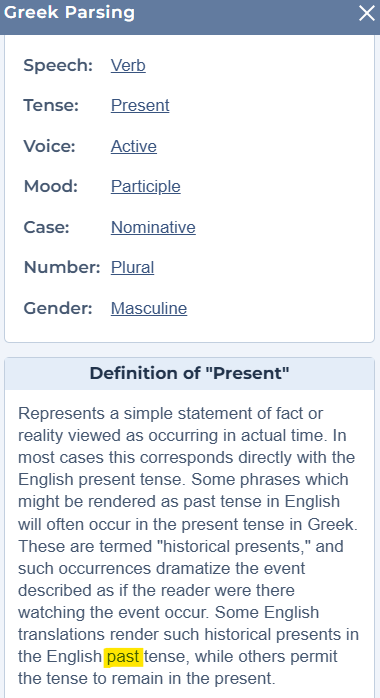
As I have found, the verb πλύνω plýnō, – wash in our verse – describes a plunging, or of a flow, a laundering of sorts. The parsing, as shown in the graphic speaks of the possibilty of the verb to be a past action. If this is the correct understanding of this passage, it would definitely support my previous thought.
But in reviewing numerous english translations, non of the translations available translate it as “Blessed are those who have washed…”
Some are so bold to interpret this first phase as
Blessed are those who do His commandments… NKJV
Happy are those doing His commands… YLT
Blessed are they that do his commandments… WEB
I fear that my original understanding, though somewhat comforting, did not provide me the surety of my condition. Surety of my right to the tree of Life, our Savior, is to be found in following Him, washing our robes as they get soiled from our living on this earth.
Got clean robes?
Thanks again for coming to visit. I hope you found something of interest in this post and would appreciate a comment, to begin a discussion. If you would like to receive daily posts from Considering the Bible, click on the “Follow” link below
Exodus 32:31 So Moses returned to the LORD and said, “Alas, this people has sinned a great sin. They have made for themselves gods of gold. Exodus 32:32 But now, if you will forgive their sin–but if not, please blot me out of your book that you have written.” Exodus 32:33 But the LORD said to Moses, “Whoever has sinned against me, I will blot out of my book.
Moses has a problem. The newly formed nation, whom God has delivered out of Egypt by His mighty hand has a problem. After receiving the covenant and confirming the covenant, obligating themselves to obey the covenant delivered to them by Moses, decided to fall back to the old ways of idolatry.
Exodus 32 is the story of the golden calf and of Israel’s deliverer interacting with God Almighty on the mount, while the people, are running roughshod over the very agreement they made with God.
Consider
Exodus 32:7 And the LORD said to Moses, “Go down, for your people, whom you brought up out of the land of Egypt, have corrupted themselves. Exodus 32:8 They have turned aside quickly out of the way that I commanded them. They have made for themselves a golden calf and have worshiped it and sacrificed to it and said, ‘These are your gods, O Israel, who brought you up out of the land of Egypt!’”
God is about to wipe the nation off the face of the earth, and speaking of replacing the nation!
Exodus 32:10 Now therefore let me alone, that my wrath may burn hot against them and I may consume them, in order that I may make a great nation of you.”
Moses went down the mountain, saw what God was referring to and was furious.
Exodus 32:19 And as soon as he came near the camp and saw the calf and the dancing, Moses’ anger burned hot, and he threw the tablets out of his hands and broke them at the foot of the mountain.
Moses laid it out on the line for the nation. They had sinned a sin, a great sin.
Exodus 32:30 ESV – The next day Moses said to the people, “You have sinned a great sin. And now I will go up to the LORD; perhaps I can make atonement for your sin.”
Even after undertaking such a great sin, Moses offered the hope of atonement. The hope of continuing with the Lord as a nation. Moses provided an option for the Lord, a chance for the Lord to simply take Moses and punish him instead of the entire nation. This is Moses acting like Jesus, a tremendous exercise of the love of God being offered for the rebellious people of God by Moses the mediator.
This passage speaks the truth – the one who sins will bear responsibility – he will be blotted out of God’s book. Now it bears to reason that to be blotted out of God’s book means the person was in God’s book in the first place.
It is easy, coming from my position to assume that to be in God’s book is equal to being saved, and to be removed from the book is to loose salvation. It would be easy to make the equivalent, but I think it wise to be careful, since we are speaking of a national existence and individual sinners within the nation that will have judgement fall on them.
The very next verse helps us understand the extent of the judgement, and our topic verses are directly linked to the reason for the death entering the camp.
Exodus 32:25 Then the LORD sent a plague on the people, because they made the calf, the one that Aaron made.
People died because of sin. This is the point, even for the rescued people of God. It is obvious the people of God fell under judgement, and death resulted. How we as New Testament believers are to understand this passage is worthy of pause and consideration.
Are we to consider it only a physical death that may result as in 1 Corinthians,
1 Corinthians 11:30, 32 That is why many of you are weak and ill, and some have died. But when we are judged by the Lord, we are disciplined so that we may not be condemned along with the world.
Or are we to understand that, just as the people who fell in Exodus, the New Testament people of God can also loose spiritual privileges, even life with God by wanton, great sin?
Thanks again for coming to visit. I hope you found something of interest in this post and would appreciate a comment, to begin a discussion. If you would like to receive daily posts from Considering the Bible, click on the “Follow” link below
Revelation 21:27 But nothing unclean will ever enter it, nor anyone who does what is detestable or false, but only those who are written in the Lamb’s book of life.
Revelation. What a book. If you understand it, you don’t. Every time I try to enter it’s mysteries, I come out of it with more questions. Yet every time I enter it, I also come out of it knowing one single truth.
Jesus wins in the end.
How we get there is up to Him, and by His grace I’m gonna hang on, but He wins in the end, and that is a great comfort to us.
For the passage above, let’s consider the context of the verse. The portion of Revelation this verse is found in has John describing the new Jerusalem, after experiencing the New Heaven and the New Earth (Revelation 21:1-8).
Verse 8 end the first passage on a very sour note.
Revelation 21:8 But as for the cowardly, the faithless, the detestable, as for murderers, the sexually immoral, sorcerers, idolaters, and all liars, their portion will be in the lake that burns with fire and sulfur, which is the second death.”
A disturbing verse for what it says and what it does not say. Nowhere in that passage does John speak of those in the lake of death as being faithless. Not once are those who are suffering related to how they believed or did not believe in Jesus. It is an assumption I always made, and other passages surely connect our faith with our destiny, but for this verse, that connection is absent. Interesting – disturbing but also intriguing!
On to our passage in Revelation 21:9-27. A bulk of the passage describes the “physical” appearance of the holy city of Jerusalem. Verses 11 through 21 speak of the walls and the gates, which is worthy of comment, but we need to focus on the topic Carl!
Verse 22- 26 speaks of no temple, as expected, but that
22 ….its temple is the Lord God the Almighty and the Lamb.
He is all in all!
Verse 23 – 26 speaks of the needs of the city – there is none, and
25 …its gates will never be shut by day—and there will be no night there.
Amazing – No restriction to the city. It’s gates will never be shut by day, yet there is no night. The gates will always be open!
What is entering the City? The glory and honor of the nations. Now that alone bears to ask a multitude of questions, but I digress again! I gotta get to the point.
How about we read verse 27 in full once more.
Revelation 21:27 But nothing unclean will ever enter it (the City), nor anyone who does what is detestable or false, but only those who have asked Jesus into their heart, trusting Him at some point in the past to secure an unalterable contract between God and them, without concern for life decisions since.
Ok I stretched the point out only to ensure you didn’t go from this blog thinking something wrong.
The verse speaks of equating those written in the Lambs book of Life as those who are not unclean, nor doing what is detestable or false.
These descriptions have nothing to do with our very real heart feelings, but as to actual actions in our lives. If we are to be truthful with ourselves, we should not feel saved if we are living unsaved.
As men and women on this earth, we have a tremendous capacity to deceive ourselves. Check your life. Be honest with yourself.
Thanks again for coming to visit. I hope you found something of interest in this post and would appreciate a comment, to begin a discussion. If you would like to receive daily posts from Considering the Bible, click on the “Follow” link below
Hebrews 4:11 ESV – Let us therefore strive to enter that rest, so that no one may fall by the same sort of disobedience.
I was chatting with a friend recently, a brother I have know for over a decade, a brother that used to enter into some Bible discussions with me at a previous employer.
Nothing to extended, for we were not being paid to discuss the location of the New Jerusalem, or to relieve the tension between Calvinism and Arminianism, but when my brother would come in my office with a question, we would consider what the Word says, discuss a few moments and let it ruminate. It was a good environment to work in, I learned bunches, and the people were great.
But that was over a decade ago, and my brother and I parted ways due to different choices for our careers. But lately he has taken the opportunity to reach out, and we had broke bread together just a few days ago. In the midst of the lunch, I let slip that I have a blog, and he has been reading.
Out of that reading, our recent chat revolved around the topic of conditional security and the once saved always saved teachings. During the discussion, I referred to a passage in Hebrews on this topic, (of which there are numerous passages addressing this topic), and the topic of striving came up.
What is it to strive? The apostle exhorts us to strive to enter rest, which is a paradox in my mind, but let us not get too distracted. (Besides the verse has been considered in Paradoxical Passages – Hebrews 4:11)
So – to strive, to persevere, to be diligent or to endeavor to do. The Greek word is σπουδάζω spoudázō, and it simply means to exert yourself, to give diligence, even to hasten or to make haste. Note that there is the idea of effort (exerting, laboring) and the component of time (hasten, make haste) in this word.
Do not both these ideas of exerting and hastening rest within the very same character of one “striving” I have yet to meet someone striving that is not giving it all he or she has. Not a partial effort, but with the strength provided, pushing forward. I have also never met someone who striving that is not striving now. He or she isn’t planning on striving in 2 years. How foolish of an idea that is. To strive is to be active now.
Strive to enter that rest, the sabbath rest. Yes this rest the apostle speaks of is a sabbath rest provided for the believer
Hebrews 4:9 So then, there remains a Sabbath rest for the people of God,
So if we don’t strive to enter that sabbath rest, what might the outcome be? Let’s read Hebrews 4:11 one more time.
Let us therefore strive to enter that rest, so that no one may fall by the same sort of disobedience.
So let me get this straight. The apostle is writing to believers, and providing instruction – that is to strive to enter a rest – so that no one, no believer, may fall. Does that not imply that believers may fall?
Are you still depending on your own works in some way to add to your salvation? Do you consider your efforts to add (or subtract) from the finished work of Christ on the cross, His complete salvation?
Enter the rest He has provided, not only in your initial decision to lay it before Him and follow, but in your daily walk with Him. There is a rest for the people of God.
Are you walking in it, even today? He is good, and His rest is beyond our own doing!
Thanks again for coming to visit. I hope you found something of interest in this post and would appreciate a comment, to begin a discussion. If you would like to receive daily posts from Considering the Bible, click on the “Follow” link below
1 Timothy 4:16 Keep a close watch on yourself and on the teaching. Persist in this, for by so doing you will save both yourself and your hearers.
In Paul’s closing days, he wrote to Timothy, his child in the faith, reminding him that he needed to persist.
Persist. Other translations use “persevere”, or “continue”. As you may know, I use the Blue Letter Bible web site for much of my research and they provide a parsing option of the Greek words used in the Word. Notice that to persevere is in the present tense – an action Paul expected to be occurring in the present, and was second person, to be applied to the reader. Paul isn’t speaking of Timothy persevering in the faith in order for others to become Christians. He was giving this command to Timothy for his own salvation
Now I provide this information as overkill, for the English also provides the same message. Timothy was to persevere in the faith for his own life, and for the teaching he provided.
Both arenas of effort were included. How often have you seen a Bible teacher dig into the Word, bring out doctrinal truth, and yet the witness is sullied due to his own life being shipwrecked with unfaithfulness and sin.
But Carl, is not Paul referring to sanctification before God in this passage? Does Paul not go on to say that this lack of perseverance will damage his sanctification before God.
Is that what he says? Let’s read that portion of verse 16 once more.
…by so doing you will save both yourself and your hearers.
Heck, let’s go back to the BLB and it’s parsing chart.
The word Paul uses is σώζω sṓzō, and I cannot find it translated as sanctification in my studies. It refers to preserving from danger, or to deliver from destruction, to rescue, or to keep safe and sound. The New Testament concept of sanctification comes from the Greek word ἅγιος hágios, and speaks of holiness, consecration or separateness from evil. Two different concepts, though linked, in the eternal life we are blessed to experience.
Notice that with this verb, it is future tense. Paul is speaking of salvation in the future for both his own life and those of the congregation. He and his current congregation will ensure their salvation by persevering in previous activities Paul lined out for Timothy.
…save both yourself and your hearers.
Paul taught this to a believer, a leader in the church!
If OSAS (Once Saved Always Saved) is correct, this makes no sense!
Thanks again for coming to visit. I hope you found something of interest in this post and would appreciate a comment, to begin a discussion. If you would like to receive daily posts from Considering the Bible, click on the “Follow” link below
Matthew 10:21-22 Brother will deliver brother over to death, and the father his child, and children will rise against parents and have them put to death, and you will be hated by all for my name’s sake. But the one who endures to the end will be saved.
The previous post spoke of how Jesus was warning His apostles of the dangers of being a believer, and of how they would recognize true believers as they went about the tribes of Israel, preaching of the Messiah.
The passage above was referred to in order to make the point that families may be split down the middle in relation to who Jesus is, and that rightness with God is not simply due to some physical bloodline, but association and relationship with Jesus and His men.
The purpose of this post is to focus on the last phrase of the provided verses.
But the one who endures to the end will be saved.
Endurance. The verb speaks of “staying under”, or “remaining behind” To endure is the English translation of the Hebrew ὑπομένω hupŏmĕnō. In our journeys through the Bible, we have broached this word a number of times. If interested, check out the following posts.
Suffice it to say, this concept pops up in the Scripture many times. In the context of our passage this morning, Jesus is telling us that to be saved we need to “stay under”, or “remain behind”, to not cut and run when the times are difficult.
But there is a finer point on His message I believe, for in the very next verse He instructs His disciples to flee, to cut and run, to not remain in the town if persecution comes.
Matthew 10:23 When they persecute you in one town, flee to the next, for truly, I say to you, you will not have gone through all the towns of Israel before the Son of Man comes.
So what is this endurance thing all about? Surely the Lord is not speaking of staying in a local area simply to be stubborn. He wants His people to be mobile, agile and able to move, able to escape persecution.
So if it isn’t the willingness to remain in a specific location no matter what happens, no matter what the local population wants to do to you, what might He be instructing He people to endure?
Consider verse 21. I think it gives some guidance.
Brother will deliver brother over to death
Father deliver his his child over to death
Children will rise against parents and have them put to death
This is the dissolution of society, at least in the disciples world. The very building blocks of social order are the family unit. Jesus isn’t speaking of some stranger in some far off town persecuting the believer, and staying around to take it. No – it is the closest of family that is out to get them.
This endurance is relational, an endurance to stay committed to the ways of Christ, even amongst the closest of family. In the midst of resistance within your family, when those closest to you may betray you, may deny you, may bring authorities to your doorstep, will you endure, will you stay under for the sake of the name of the Lord?
To endure to the end will result in salvation.
Jesus is the great example, for His own family rejected Him, His closest friends denied Him, one who He broke bread with betrayed Him.
Look to Him to consider how He endured. No lashing out, no condemning or vengence spoken of. When an “enemy” lost an ear, He healed it. When they spit and mocked Him, He endured.
Hebrews 12:1 Therefore, since we are surrounded by so great a cloud of witnesses, let us also lay aside every weight, and sin which clings so closely, and let us run with endurance (hupŏmĕnō) the race that is set before us,
Truly amazing. He is truly amazing. And we have been called to the same endurance. The same endurance, but note – without Him, we will not succeed.
Thanks again for coming to visit. I hope you found something of interest in this post and would appreciate a comment, to begin a discussion. If you would like to receive daily posts from Considering the Bible, click on the “Follow” link below
And whoever gives one of these little ones even a cup of cold water because he is a disciple, truly, I say to you, he will by no means lose his reward.”
Jesus is sending out his disciples into the nation to preach the gospel, to proclaim that the kingdom of heaven is at hand. The disciples were given clear instructions, especially how to treat those who received them or rejected them
Matthew 10:13 -14 And if the house is worthy, let your peace come upon it, but if it is not worthy, let your peace return to you. And if anyone will not receive you or listen to your words, shake off the dust from your feet when you leave that house or town.
In discussing those who would not receive the disciples, Jesus spoke of Sodom and Gomorrah as a preferred place to be.
Matthew 10:15 Truly, I say to you, it will be more bearable on the day of judgment for the land of Sodom and Gomorrah than for that town.
Jesus continues the discourse, referring to the persecution of disciples that would occur, even within the household of their family.
Matthew 10:21 Brother will deliver brother over to death, and the father his child, and children will rise against parents and have them put to death,
He encourages his men to reject fear, speaking of not only physical death, but spiritual death.
Matthew 10:28 And do not fear those who kill the body but cannot kill the soul. Rather fear him who can destroy both soul and body in hell.
Just prior to our topic verse, Jesus speaks of bringing a sword of division, for households will be split apart due to the good news, and how people receive or reject the person of Christ.
Matthew 10:36-37 And a person’s enemies will be those of his own household. Whoever loves father or mother more than me is not worthy of me, and whoever loves son or daughter more than me is not worthy of me.
As we have ventured through the 10th chapter of Matthew, it seems the message was centered on the reception of the apostles, and the results of either receiving or rejecting them, of how households would respond to the message of Jesus being the Messiah.
If this is true, then for one in a household to provide cold water to a “little one”, that disciple will by no means loose his reward.
But what may I ask is the reward?
This passage is often spoken in reference to assisting other brothers and sisters in ministry, or even of simple charitable acts given to others as having an some added benefit to the giver, when they enter heaven. This may be a great application, and may be supported by many other verses in the Word, but is not the context of the entire 10th chapter of Matthew that of life and death?
By giving cold water to a disciple, especially in the midst of a household that is split down the middle concerning who Jesus is, would mark that person out as a disciple. This act would identify the person as one who believes in Jesus.
By giving cold water to one of the apostles, (little ones, as in spiritual stature, humble men) they would be associating or joining with those entering into the kingdom that was at hand.
So i ask my reader – might the reward be spiritual life itself?
Another way of considering this passage is to ask – Is Jesus speaking of folks having an option to “loose a reward” and yet maintain spiritual life?
Or is He speaking of how the disciples would recognize those who are entering the kingdom of God?
I think there are two different ways to consider this passage.
First, life in the kingdom is proven by acts of service to others in the kingdom. The apostles would know when to “shake the dust off” or to let their peace remain.
The second was of considering this passage would be that acts of service to those in the kingdom are independent of the offeror being a kingdom citizen. In my feeble mind that equates to life decisions being independent of a salvation reality. If acts of service are independent of salvation, then we might identify these acts of service as rewards instead of proof of life. If this scenario is true, a possible outcome may be seen in the soul who “got saved” 40 years ago but has not followed/obeyed Christ. He has been taught he is eternally secure, yet may have no proof of life.
Does that make sense?
My friend, I propose this passage in Matthew 10 speaks of the identification of a true believer, one who serves at the risk of being ostracized by his own household and family. At the time of giving cold water, the disciples could know they were in the midst of a fellow disciple.
No dust to be shook off, and peace to be shared with all.
It is good to be in the family of God.
Thanks again for coming to visit. I hope you found something of interest in this post and would appreciate a comment, to begin a discussion. If you would like to receive daily posts from Considering the Bible, click on the “Follow” link below
Galatians 1:6 I am astonished that you are so quickly deserting him who called you in the grace of Christ and are turning to a different gospel– Galatians 1:7 not that there is another one, but there are some who trouble you and want to distort the gospel of Christ.
Paul is shocked. He is awestruck. The saints who cared for him, and had accepted him in their homes, willingly giving their time and talent due to the good news of Jesus that he brought them, were walking away from Jesus.
Walking away from the One who had called them into the grace of Christ.
Now it goes without saying that the passage speaks of God doing the calling, and not Paul himself, for their desertion may be from Paul’s gospel, but that meant the desertion was from the subject of Paul’s gospel, the Lord Jesus Christ also.
This desertion, or walking away may be defined as a removal, or a translation from one spot to another, a change. Paul is claiming these believers were in the process of being removed from the grace of Christ. But note that this isn’t due to persecution or to apathy, but by some person in the church who sought to trouble them (vs 7). It is by the teaching of these troublemakers that the believers are choosing to desert the One who called them to His side.
This is a decision these believers were making, a decision to reject the message provided by the gospel preacher and apostle, choosing to listen to those who speak contrary to the truth. True, they were being tempted with “new” teachings, but to start to succumb to the enticement of the message so quickly? How could this be?
In all of this, do they not hear the truth Paul spoke to them? Is their memory that faulty? Do they not have the privilege of remembering Paul’s passion, his love, his message of a crucified Savior, of a life of faith and not of works, providing them approach freely before a holy God?
For us today, we have multitudinous teachers in the “church”, troubling us with destructive doctrines, tempting us with worldly teaching, depending on personal experiences that cannot be verified, or teachings of religions that depend on the wisdom of man. My brother or sister, cling to the Word of God and it’s message, cling to the guiding Spirit of God and cling to the quiet Voice that guides true believers.
Having heard the truth does not allow us to venture off looking for different truths. Danger! Danger! The truth is a Person, the Lord Jesus. Religions will use Him for their purpose, but beware of those who do not walk as He did.
Remember that He stepped down in order to lift you up. He died in order that we may live. His people are to mimic this life of self denial for the sake of others. Any teacher that elevates himself over you, demands something from you, or departs from the Word of God is to be avoided like a plague.
Why allow yourself to be tempted to desert the One who loves you? Don’t walk away from Him!
It makes no sense! It is quite simply “Shocking”.
Thanks again for coming to visit. I hope you found something of interest in this post and would appreciate a comment, to begin a discussion. If you would like to receive daily posts from Considering the Bible, click on the “Follow” link below