Lately, I have been exclusively in the Apostle John’s writings, in my personal readings, my blog writing, and my time with my wife.
John reiterates one theme, over and over again in my opinion, and that is that we are to love one another, to love like Jesus, to love.
It is refreshing to be reminded of the core mission of believers.
Love like Jesus.
Patience in the New Testament – A Comparison
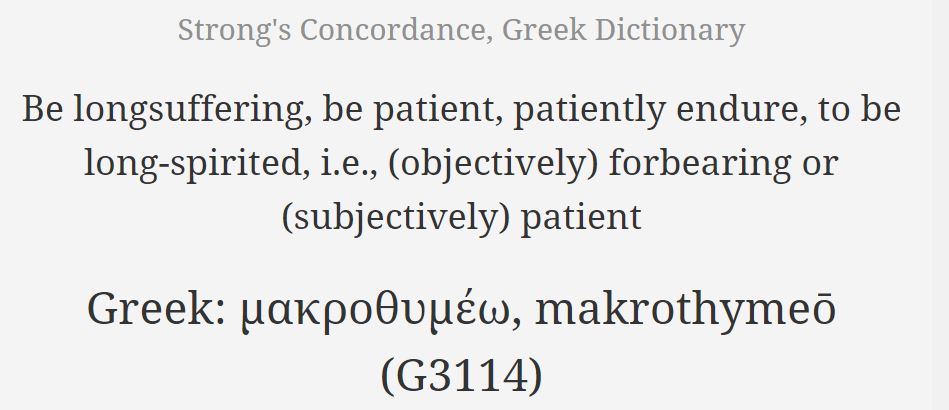
In our last post, we considered patience that Christian love exhibits. Patience that is exercised by an anger that is far away, that is distant, that is put off. That patience is Makrothumia
Our current study is to concern ourselves with two Greek words that are commonly translated as patience, or long suffering.
Of course you recognize makrothumia, since we spent some time in our last post thinking on it. The idea of stretched out anger, anger that is put off.
The second word for patience in the New Testament is hupomeno. We will consider this type of patience in a later post on the 7th verse in this passage , but I wanted to consider these two words in comparison.
Hupomeno is also a compound Greek word, made up of the prefix hupo, with the meaning of “under”, typically when associated with patience. The root meno is also a very interesting word, which typically means to “abide”, “remain” or “dwell”. Taking these two word meanings, we can build a sort of synonym when we see hupomeno.
To abide under.
By application, abiding under a situation or condition that is not favorable, that is difficult, that might be crushing your soul. Exercise patience by not escaping from a difficult situation. If an opportunity to escape a difficult situation comes along, patience would require you to remain under the difficult situation. The opportunity to escape may be a temptation to do wrong!
One patience speaks of long drawn out anger, while the other speaks of abiding under. Two completely different terms, describing two different attributes of the patience in a believer.
Another interesting feature of these two Greek terms is what they relate to in the subjects they are active upon.
Makrothumia is patience related to people, whereas hupomeno is patience related to situations.
Makrothumia
A few examples
Rom 9:22
What if God, desiring to show his wrath and to make known his power, has endured with much patience vessels of wrath prepared for destruction,
These vessels of wrath are the people who have rejected God and His Messiah. The verse speaks of God enduring with much patience. Much “drawn out anger”. The Lord cast His anger far away when relating to these people, and yet this verse speaks of destruction. Patience has her limits!
Eph 4:2
with all humility and gentleness, with patience, bearing with one another in love,
This particular verse speaks of loving one another, with the expression of humility, gentleness and “drawn out anger”. (Not your typical description of love we might find from the modern media message!)
When I consider patience as “drawn out anger”, it changes my perspective, since I have recently experienced anger towards people. This history of non – “drawn out anger” is sending off alarms in my head. This is not the Christian life I am to live.
We need to realize that anger is a real emotion that can be controlled under the leading of the Spirit of God. I need to possess my soul and control my thoughts under the Lordship of Christ.
Hupomeno
Romans 12:12
Rejoice in hope, be patient in tribulation, be constant in prayer.
Paul speaks of patience in tribulation. We may look at the term of tribulation later on in our study, but suffice it for now, the term speaks of a squeezing, of pressure applied. Paul speaks of being patient with his circumstances, with things that are not proceeding as he wishes, of trials that are fighting him.
Paul is telling us he remained under the tribulation. As a believer, I know I seek relief from trials and tribulations. Not so with Paul. Granted, there were times when Paul, in the wisdom of God sought relief when justice was being twisted, as in the time he was beaten in Philippi.
Nope, can’t use that as an example! He took the beating though unjustly. You see, the magistrate did not have the right to beat a Roman citizen, and yet Paul took the beating.
Something is going on here. Paul stayed under the tribulation. His faith was different than mine.
I have a theory about that particular incident in Paul’s life, and how the beating he took supplied a practical blessing to the ones he was ministering to. But that will be for a another post.
2 Timothy 2:10
Therefore I endure everything for the sake of the elect, that they also may obtain the salvation that is in Christ Jesus with eternal glory.
Notice that Paul speaks of a patience in everything, for the sake of believers. He saw the faith as a all encompassing life, that had a Father in heaven that worked out all things for his good and the glory of God. Even tribulation or trial that he may have rightfully escaped
Jas 1:12
Blessed is the man that endureth temptation: for when he is tried, he shall receive the crown of life, which the Lord hath promised to them that love him.
Temptation. The very word brings a sense of weakness to my heart. My temptations are so justifiable, so reasoned, so allowable. To the point that I do not recognise them as temptations. And there I go.
The believer is the abide under the temptation, carry the temptation instead of simply succumbing to it.
Easier said than done. Help me Lord to abide.
Lets get back to the topic of this series. Our next study will consider how love is kind. (Kinda obvious Carl!)
Let’s wait and see. You may be surprised.
I look forward to comments and discussion. May the Lord give you an understanding heart and a willing spirit to consider the Bible and all it’s wealth.
Follow Considering the Bible on WordPress.com
Thanks again for coming to visit. I hope you found something of interest in this post and would appreciate a comment, to begin a discussion.





 In the past few months I have noticed that there are rumblings – at least in my world – of some internet folks trying to make out the message of Paul to be different that that of Jesus.

 I need humility to truly love a brother, and this humility comes from Him. If I am to love a brother, I need to exercise humility in our discussion, or in my gifting, directing the brother to Him. If my brother finds assistance in knowing Him, I am truly loving my brother. If I am seeking only to make another Carl – golly – that is just a waste of time!


 He came to take away sin, and if we abide in Him, we will not continue in sin.




 No matter.
 A broader understanding of the Word of God will allow for the mystery of the Word to become apart of your life. If you feel you fully understand the Word, repent of this arrogance. Remember that this ancient book is not a cartoon comic that we can pick up for 2 mins and understand. That is way too shallow!
 Discussion with believers of other denominations and understanding of their faith systems within the Christian church may possibly break down some of the “us verses them” attitude in the Body of Christ. I am pretty sure Paul would applaud this. I need to add that this discussion, if it is to be fruitful, has to be based on the shared understanding that the Word is the authority, and not tradition, logic or emotional bias.
 Considering the Bible