1 Corinthians 7:22 ESV — For he who was called in the Lord as a bondservant is a freedman of the Lord. Likewise he who was free when called is a bondservant of Christ.
Ok – this passage is confusing at first glance. What is Paul trying to communicate here. Each person described has a freedom associated with him and a slavery associated with him. What is going on?
It just didn’t make sense for me, and, as a paradox is wont to do, it took me outside of my usual way of thinking.
I suppose the best thing to start with is to understand the terms we are dealing with.
Freedom
What is freedom? When we say we are free, the question needs to be asked – free from what? There is no freedom in a vacuum, for if we claim to be free from all restrictions, laws and common sense, we become more and more the slaves to our base nature.
Bob Dylan was right when he said “we gotta serve somebody”.
Paul is making the previous statement with this understanding, that freedom and bondage are two sides of the same coin. There is no third side, as it is an either or situation.
Physical Freedom
If we are free from the bondage of physical slavery, we can find freedom in the Lord. This freedom is found in our release from the bondage of sin, not man. Though we may be physically free, we are all slaves of sin. To become a believer and a slave to God, we are released from the condition of being slaves to sin. At this point we can experience freedom in the Lord.
Romans 6:22 But now that you have been set free from sin and have become slaves of God, the fruit you get leads to sanctification and its end, eternal life.
Being set free from sin is the result of becoming a slave to God.
Generally, for Paul to describe the believer as free yet a bondman to God, describes the non-slave in Roman times as a slave in his spirit to God. As a slave to God, we have been set free from sin, that taskmaster that leads us to the grave.
Paul is speaking of the freedom of the slave of God! Tremendous paradox, in and of itself, speaking to the grace and goodness of God in His desires for His people!
Spiritual Freedom
On the other hand, if we are not free from the bondage of physical slavery, which is still a very tragic reality in our world even today, we, like the man discussed above, can experience the freedom of release from sin.
He may still be a physical slave slave, (a very common condition in Roman times), but he is free in Christ, free to obey the Messiah, free in the inner man. He is still owned by a human, and is responsible to the human master for his orders, yet he knows the Lord is over all, and the physical slave can find an inner freedom making his deplorable condition not only bearable, but full of purpose, direction and receive inner joy that comes from the Spirit. The physical slave, in becoming a slave to God also, actually finds freedom while owned by a man.
Incredible
But this pair of seeming paradoxes got me to thinking of an additional topic. A bit dangerous when my mind wanders, so I would appreciate a comment or correction in the following thoughts.
Freedom of God
Consider the freedom of God. He always and without exception performs all his works according to His nature, according to His attributes. In a very heretical manner of speaking, He does not have the “freedom” to act outside of His nature. Why would He?
Is God free?
In the most absolute sense, He is the freest of all, since He is not even tempted to follow after alternate (sinful) acts. He is the most free, since He has never been in bondage to anything, other than His over the top love for a sinful people.
What think ye of this concept?
Thanks again for coming to visit. I hope you found something of interest in this post and would appreciate a comment, to begin a discussion. If you know someone this blog may bless (or challenge), send them a link, so they may join us in our discussion
As many who have followed me for a bit, I have fallen into the Psalms, and I can’t get up! (As if I would want to.) The Psalms are a majestic collection of poetry, of heart felt human experiences that constantly challenge me in my own frail attempt to follow the true King. As many of the Psalms are written by David, my study on the Psalms has spurred me on to looking at the life of David, is the main contributor to this book, and to follow the victories and tragedies of the shepherd King of Israel.
Many times in the narrative, we will see the Lord Jesus, imperfectly, yet a reflection of His spirit in a man with weaknesses.
David has executed the Amalekite who he understands killed his king and best friend. Now, after completing judgement on the Amalekite. David now turns to mourning, to writing a lament regarding Saul his king, and Jonathon his friend. For this passage I would like to consider the two subjects in separate posts.
For this post, lets consider David and his expression of mourning for his best friend Jonathon. I wanted to discuss Jonathon, for his feeling toward Jonathon definitely seem less complicated.
2 Samuel 1:17-18 17 And David lamented with this lamentation over Saul and Jonathan his son, 18 and he said it should be taught to the people of Judah; behold, it is written in the Book of Jashar. He said:
David wrote out his heart, and intended the entire nation to be taught of his feelings of the downfall of the ruling family of Israel. He was not seeking to sling mud, create division or push some agenda on the nation. He spoke of them as mighty ones, Israel’s glory, beloved and lovely, united in death. But I am getting ahead of myself. Let’s read the passage.
2 Samuel 1:19-27 19 “Your glory, O Israel, is slain on your high places! How the mighty have fallen! 20 Tell it not in Gath, publish it not in the streets of Ashkelon, lest the daughters of the Philistines rejoice, lest the daughters of the uncircumcised exult. 21 “You mountains of Gilboa, let there be no dew or rain upon you, nor fields of offerings! For there the shield of the mighty was defiled, the shield of Saul, not anointed with oil. 22 “From the blood of the slain, from the fat of the mighty, the bow of Jonathan turned not back, and the sword of Saul returned not empty. 23 “Saul and Jonathan, beloved and lovely! In life and in death they were not divided; they were swifter than eagles; they were stronger than lions. 24 “You daughters of Israel, weep over Saul, who clothed you luxuriously in scarlet, who put ornaments of gold on your apparel. 25 “How the mighty have fallen in the midst of the battle! “Jonathan lies slain on your high places. 26 I am distressed for you, my brother Jonathan; very pleasant have you been to me; your love to me was extraordinary, surpassing the love of women. 27 “How the mighty have fallen, and the weapons of war perished!”
David refers to Jonathon specifically in verse 22, 23 and 26. Now of course, as David speaks of the mighty ones having fallen, he is including Jonathon, but for the sake of this post, let us consider David’s specific references to Jonathon
bow turned not back
David starts out with the bravery of Jonathon. Any reader of the Old Testament, and of the exploits of Jonathon can readily recall when he took on a battalion of Philistines with his sheild bearer. And he attacked based on outside circumstances, believing God could direct. Amazing courage.
Also, to be in the kings house and yet to be faithful to David, the rightful king, must have strained at Jonathon’s senses of right and wrong, but we must consider the courage it took to be faithful to one in the house of his very enemy.
This condition should be easily recognized by the believer in Jesus, for as we believers walk this earth, we are essentially in the house of the enemy of our King. As Jonathon, we also are to realize our allegiance is with the King not in the land, and that a rebel king is seeking our obedience.
May we be faithful in walking with the only True King!
beloved and lovely
Beloved – simply expressing love for family, a neighbor or for God. David knew his friend and that he was of the right spirit, not vengeful, but with the right spirit.
This word is used of Saul in the same passage, and it will be mush harder to understand when we discuss David speaking thus of him!
Lovely – to be pleasant, agreeable. Sometimes this term refers to singing. This is the spirit of seeking unity, to be at peace. This should not be confused with the spirit of giving up, or of appeasement, for they are two different spirits. To be agreeable is to seek a way for finding similar ground to stand on with those you differ.
Truly, to be agreeable is as much an attitude as an action, and in the attitude of being agreeable, much can be accomplished. To be flexible in finding righteousness is a skill that comes from the Lord, and exhibits a gracious character, a character that draws people to us.
lies slain on your high places
David did not shy away from hard truths. Jonathon had been massacred on the hills, even on the high places.
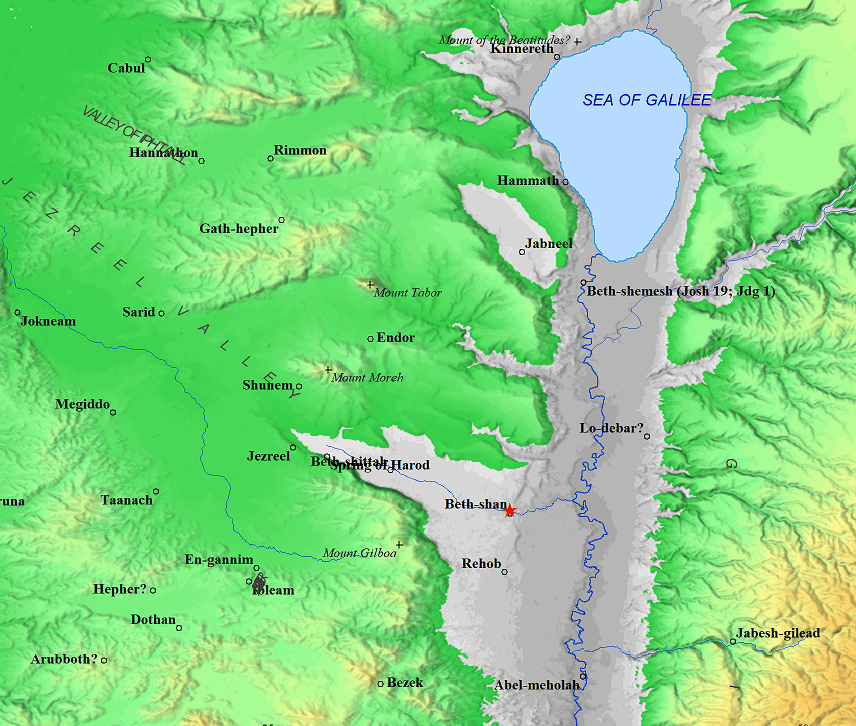
High places sometimes refers to areas of cultic worship. For our passage this morning, it is likely David is referring to the battlefield of Mount Gilboa. Even as Israel had the advantage in location, for the word speaks of the Philistines chasing the Israelites on Mount Gilboa, Jonathon was slain.
love was extraordinary, surpassing the love of women
This is a magnet verse for a certain group within the church that carry an agenda. It is as if the term “love” (אַהֲבָה ʼahăbâh) describes love in a restricted physical sense only.
When coupled with the following verse, this group within the established church claim David and Jonathon were lovers sexually.
1 Samuel 20:17 And Jonathan made David swear again by his love for him, for he loved him as he loved his own soul.
Regarding the term “love”, it is true that the term is used once in reference to sexual desire.
2 Samuel 13:15 Then Amnon hated her with very great hatred, so that the hatred with which he hated her was greater than the love with which he had loved her. And Amnon said to her, “Get up! Go!”
And it may be understood to speak of the sexual act between a man and woman, but many times, even in the most sexually active book of the Bible (the book of Songs), the term may also speak of the emotional spiritual desire and not only that which is of the physical act. I have added a few verses to consider for my reader.
Song 2:4 He brought me to the banqueting house, and his banner over me was love.
Song 2:5 Sustain me with raisins; refresh me with apples, for I am sick with love.
Song 5:8 I adjure you, O daughters of Jerusalem, if you find my beloved, that you tell him I am sick with love.
Song 8:6 Set me as a seal upon your heart, as a seal upon your arm, for love is strong as death, jealousy is fierce as the grave. Its flashes are flashes of fire, the very flame of the LORD. refresh me with apples, for I am sick with love.
Song 8:7 Many waters cannot quench love, neither can floods drown it. If a man offered for love all the wealth of his house,
Proverbs has a reference that leans towards the sexual act between a man and a woman
Proverbs 5:19 a lovely deer, a graceful doe. Let her breasts fill you at all times with delight; be intoxicated always in her love. he would be utterly despised.
The point is that the term does not have to identify sexual activity, and may refer to love generically, that is in the sense of care, bonding and commitment.
My goodness, this term is also used in God’s care towards His people.
Hosea 11:4 I led them with cords of kindness,with the bands of love, and I became to them as one who eases the yoke on their jaws, and I bent down to them and fed them.
Jeremiah 31:3 the LORD appeared to him from far away. I have loved you with an everlasting love; therefore I have continued my faithfulness to you
So what is David speaking of in this verse then?
I would suggest we remember David’s experience with women, even at the time these passages were written.
David entered into multiple marriages, and at times, his wives tried to shame him, or were used to provide advantage for king Saul.
As he was not faithful to one woman, it can be understood that this reflected into his own opinion of women and their importance in a man’s life.
David had found a soul he could trust, that his soul had bonded with and that he related to deep in his heart. His attachment to Jonathon was soulish, of the inner man and related to the higher ideals of friendship, trust and honor between men.
For those men in my audience, think back to your closest male friend, and honestly consider your feelings toward him. A close friend, a trusting relationship, a bonding of experiences between men, does not require the introduction of any sexual act between them. But there are some in the established church with an agenda.
For the believer, the man or woman who has a living experience with the Risen Savior, it is wise to consider those introducing this heinous picture of David and Jonathon as worthy of rejection. David had enough sin on his plate. We need not consider his relation with Jonathon to also be sinful!
Leave a comment to discuss!
Thanks again for coming to visit. I hope you found something of interest in this post and would appreciate a comment, to begin a discussion. If you know someone this blog may bless (or challenge), send them a link, so they may join us in our discussion.
Jesus in the Old Testament is a series of posts that will offer my readers a chance to consider pictures or shadows of Jesus in the Old Testament. As mentioned in the introduction to this series, some may be obvious, some may be not so obvious, and some may simply be a facet of the Lord those reading may not have considered previously.
I hope as we venture through this series, we will see the Lord in many wonderful pictures throughout the Old Testament.
SEEING JESUS IN
Caleb
Overcome Doubt of Others (Negativity)
Joshua 14:8 But my brothers who went up with me made the heart of the people melt; yet I wholly followed the LORD my God.
Matthew 14:31 Jesus immediately reached out his hand and took hold of him, saying to him, “O you of little faith, why did you doubt?”
For Caleb, he fought through the doubters, and without a doubt, sought to convince those he travelled with as they carried back such a damming report. Joshua records Caleb’s claim of how his own peers, as they reported on what they had seen in Canaan land, was a message of doubt, a message of defeat and that had caused the melting of the young nations heart.
This passage doesn’t address how Caleb sought to convince those bringing back such a deadly doubt-filled message, but surely a man who was committed to the work of God, he sought to convince them before they delivered the poisonous message. This is my assumption. Joshua simply states the fact that Caleb wholly followed the Lord in the midst of doubters. Now I am not knocking Caleb in this instance. No not at all, for it is no small task to believe the Word of God when the world is yelling that you are wrong, but Caleb held tight. He held tight!
While on earth. the Messiah also had close associates that were infected with the doubt disease, a disease that we all suffer from. Numerous times, He spoke to those of little faith, asking them of their doubt.
Now I used to think this was Jesus way to get a dig in, to mentally slap his apostles around, but as I understand the person of Christ more, I don’t see Him like that anymore. What I was actually doing was mirroring my heart onto the Messiah in these interactions with the apostles, for I tend to cut those who need encouragement. I want to assume failure instead of success. I naturally think the worst rather than the best.
Jesus’ heart is wholly different from my heart, and I safely will assume different from your heart, unless of course you have deceived yourself.
Jesus was (and is) in the midst of doubtful friends, surrounded by saints that struggle with faith, and working on believers who just don’t understand. This is the fact of the church and is in my mind a huge mystery of how He gets anything done working with men and women who sometimes just don’t get it. But then I forget who I am dealing with!
He remains faithful to the will of God, as Caleb did, and yet He also successfully pulls us out of the depths of doubt to prove His care and guidance.
We need to look to Him for our strength, for I doubt we have any!
My hope is that this series will offer my readers a chance to consider the names, characteristics and descriptions of our God in the Word.
The remaining Names of God in this series might be considered descriptors, or characteristics of the Lord. We have reviewed the three primary Names of God, along with nineteen compound Names of God in our previous posts. As we venture through these descriptors of our God, I hope we will recognize all the many characteristics of our God that we tend to take for granted.
The Word is truly rich with descriptions of the Living God, and this effort of searching in the Word was quite illuminating. He truly is the ultimate subject of the Word, and His revelation of self-descriptions, or the accolades offered Him by His priests, prophets, kings apostles and faithful truly is a blessing.
May the Name of the Lord be praised, and by thinking on His name, may you have a blessed day.
215
FATHER OF MERCIES
2 Corinthians 1:3 Blessed be the God and Father of our Lord Jesus Christ, the Father of mercies and God of all comfort,
We recently considered this verse, speaking of the name God of all comfort, and found this passage to be couched in the middle of an extended discussion on affliction.
I will not repeat the discussion on that funny sounded word used in the Greek, describing the affliction, for many who read this blog certainly have a remembrance. For those who have tripped over this post without this background, consider Names of God – GOD OF ALL COMFORT – 214
For the sake of this post, I want to share a realization of a difficult time experienced in our family. For the sake of those still reeling from this event, I will not describe it other than to say it was a life and death event. Nothing more serious could have been experienced by all.
As my wife and I were travelling to be with family, to be of help of some sort, any sort, I began to realize that every soul touched by this tragedy was hurting. Now that may seem obvious to many, but it became crystal clear that night.
The hurt was multi-layered, with each soul affected deeply and differently. I was convinced that each soul would be ministered to by the Father of Mercies, in very different manners and methods. It was good to remember that though I was hurting, God calls believers to heal the hurt, to provide a balm for the pain and to acknowledge the various types of suffering each soul was going through.
And in all of this, a story came to me of Steven Curtis Chapman, and the accidental death of his 5 year old daughter. She passed away because Steven’s teenage son did not see her as he backed the family SUV over her. A tragic event!
As I heard Steven tell the story, he made a point of yelling out of the window as he took his daughter to the hospital, of yelling out the window to the son who struck the little girl, of yelling out that he loved his son. Steven openly ministered to the pain of the son, in the midst of his own heartbreak.
This is the heart of the Father of Mercies, where the Father of Mercies calls out to his children as they accidentally (or intentionally) inflict pain on each other.
In the midst of suffering affliction, let us be more like the Father of Mercies, seeking to minister to those we are in pain with.
Active love is like that. Remember, it isn’t all about us, for every soul in hurting, and if we know the Lord, we have His Spirit to guide us, His Spirit to provide the strength and His Spirit to direct us in the way to minister to the hurting.
Let us think of others instead of ourselves.
I would love to hear of your favorite name, characteristic or description of the Living God. Please leave me a comment, and I will include it in the list!
Thanks again for coming to visit. I hope you found something of interest in this post and would appreciate a comment, to begin a discussion. If you know someone this blog may bless (or challenge), send them a link, so they may join us in our discussion.
A little while ago, I produced a verse by verse series in Philippians. I really enjoyed that exercise and have been wondering if I should take on another book. Well it turns out that 1 Thessalonians is the victim of my machinations, and hopefully, the thoughts produced by this fantastic book will edify and encourage the reader.
As with Philippians I am going to limit each post to one verse, and hopefully produce a short, succinct read for my friends who follow.
1 Thessalonians 2:5 For we never came with words of flattery, as you know, nor with a pretext for greed–God is witness.
Can you hear those in the church trying to degrade Paul? Their “ministry” of destruction describes his inner motives, his desire for things and his manipulation of those he seeks to gain from.
Flattery
This term is only used once in the New Testament and is associated with greed. It is a tool of the speaker to get on the good side of the hearer, to gain something from them. It is always associated with a message that favors the hearer, or the hearer’s condition. It includes excessive compliments, praising them beyond what the situation deems necessary.
Yes, the apostle who had been whipped and tortured, imprisoned and beaten was a man pleaser. Sometimes the defamation of a man’s character is blatantly flimsy, and so it is in this claim, yet it must have been accepted by some in the church to afford a response from the apostle.
This speaks of our responsibility to reject gullibility, to be willing to listen to others yet not to be swayed by arguments that are baseless, that we as believers are to be grounded in the truth, ready for those who may seek to convince us of their opinion, to our own hurt.
Paul a flatterer? This was a weak attack and speaks of the hearer’s willingness to let go of Paul’s message of self sacrifice and giving to others. Those not committed to the Savior and His apostle may seek an alternate opinion, that would allow their faith to settle elsewhere. A dangerous situation!
Greed
We have considered flattery, and the impact this claim may have on those in the church, but when we get to greed, this touches a nerve for myself. Not that I consider even a hint of this avarice expressed in the apostle Paul’s life, for he spent much of his ministry working for his own support, and rejected the common teaching of a salaried position. He lived by faith, went without, suffer hunger and deprivation and found God to be enough.
This claim of greed that is attached to the apostle Paul is as weak as the flattery claim in my opinion, and as such should be rejected.
When I suggested above that this topic touches a nerve for myself, I am referring to a modern church that is mad with greed. A modern church that accepts millionaire pastors, that feed the shepherds even as they consume the flock. A modern church that pushes a physical wealth as promised by the poverty stricken Messiah (He had no place to rest His head) and His apostles, who spoke of having no silver or gold. A modern church that is distracted from the kingdom in order to enjoy the world. A modern church, that sadly infects us all.
Flattery and greed. Paul was accused of this approach and motivation to the Thessalonian church, even though they experienced his life practice for a period.
Sadly, though the claim is baseless against the apostle Paul, it is not baseless against many in the modern church, and yet no one seems to care. No one sound the alarm that this is the very death of true Christianity, leaving behind an empty shell of what was. A hollowed out, weak church with nothing but self love.
I must quit. This topic is heavy on my heart, and I fear the worst for the modern church.
May the Lord Himself speak to the church, (may He speak to me!). May He drive into our thoughts and hearts the depth of this infection, and guide us out of the mire of greedy motivations and coveting of lowly things!
May we be like the apostle, slurred with the claim of flattery and greed, but clearly without a basis of the claim sticking.
My hope is that this series will offer my readers a chance to consider the names, characteristics and descriptions of our God in the Word.
The remaining Names of God in this series might be considered descriptors, or characteristics of the Lord. We have reviewed the three primary Names of God, along with nineteen compound Names of God in our previous posts. As we venture through these descriptors of our God, I hope we will recognize all the many characteristics of our God that we tend to take for granted.
The Word is truly rich with descriptions of the Living God, and this effort of searching in the Word was quite illuminating. He truly is the ultimate subject of the Word, and His revelation of self-descriptions, or the accolades offered Him by His priests, prophets, kings apostles and faithful truly is a blessing.
May the Name of the Lord be praised, and by thinking on His name, may you have a blessed day.
213
GOD OF ALL THE CLANS OF ISRAEL
Jeremiah 31:1 “At that time, declares the LORD, I will be the God of all the clans of Israel, and they shall be my people.”
Jeremiah is speaking of an astounding prophecy here, but we need to get into Jeremiah’s head for a tiny bit.
He is experiencing the coming decimation of Israel, of the Israel he lived in, but the Assyrians had come down and taken care of the ten northern tribes years back.
The ten northern tribes, had fallen back in 722 BC to the Assyrians. The Word speaks of the Assyrians attacking Jerusalem, but our King Hezekiah, with a starving city were rescued by the angle of the Lord. An amazing rescue of the southern kingdom, including the death of 185,000 Assyrians. The Assyria leader whimpered back to Ninevah.
Israel seemed to be invincible!
But Israel only seemed to be invincible, for Jeremiah, close to 125 years later, saw the Babylonian conquest of the remaining nation of Israel on the horizon. In reality, by the year 597 BC, the Babylonians had overtaken the City of Jerusalem, with the occupants either starved to death, taken down by pestilence and disease, killed in military skirmishes or defensive efforts, or finally taken away to a strange land and a strange people, away from their sacred temple which the Lord had abandoned until many centuries later.
The northern tribes were gone. Who ever may have survived has entered into the general populace, loosing the identifying character of God’s chosen people.
The southern tribes were conquered, with a majority having died in the conquest, and the few left carried off to a strange land for 70 years. Even after the 70 years, only a portion of those who had settled in Babylon returned to Israel.
And Jeremiah has the gall to claim that the God who is bringing this destruction on His people will become the God of all the clams of Israel.
“I will be the God of all the clans of Israel, and they shall be my people”
Those who belonged to the northern clans have no available lineage to trace from, and since the destruction of the Temple in 70 AD, no other Jew may claim direct lineage to the national population. No records. None.
So why is God so specific here, defining that He will be the God of all the clans, or all the families of Israel?
Jeremiah, in verse 5 & 6, goes so far as to speak of Samaria (northern kingdom) as the place to plant vineyards, and defines Ephraim (northern kingdom) as being invited to Zion, to worship.
Jeremiah 31:5 Again you shall plant vineyards on the mountains of Samaria; the planters shall plant and shall enjoy the fruit. Jeremiah 31:6 For there shall be a day when watchmen will call in the hill country of Ephraim: ‘Arise, and let us go up to Zion, to the LORD our God.’”
But that is not all.
This recall of the northern tribes, of the remnant of Israel from the north country, will return, for God is the father to Israel, and Ephraim is His first born.
Jeremiah 31:9 ESV – With weeping they shall come, and with pleas for mercy I will lead them back, I will make them walk by brooks of water, in a straight path in which they shall not stumble, for I am a father to Israel, and Ephraim is my firstborn.
In all of this, the intent of all of this rescuing of a sinful nation, of calling all the tribes back is two fold.
First, to show the grace of God towards those who have walked away, to be a God who is the God of the wayward as well as the faithful.
He is the God of ALL the clans of Israel.
Secondly, (and I am partial to this truth), verse 10 – 11 speaks of the return of Israel to cast out the word of God to the nations, even to far off lands covered in snow.
Jeremiah 31:10 “Hear the word of the LORD, O nations, and declare it in the coastlands far away; say, ‘He who scattered Israel will gather him, and will keep him as a shepherd keeps his flock.’ Jeremiah 31:11 For the LORD has ransomed Jacob and has redeemed him from hands too strong for him.
God’s ways with Israel have a purpose for those who came after. Those in the nations, such as I was born into, a nation covered in snow, heard the Word of the Lord and saw the faithfulness of God’s patience with a wayward nation.
God brought the remnant back to the land, for a Special Man was to be born there, with a lineage and a purpose that was beyond our imagination. He was born there, established in His lineage, and was crucified for our sins.
He is now not only the God of all the Clans of Israel, but the King of all kings, and the God of ALL the nations.
Matthew 28:18 And Jesus came and said to them, “All authority in heaven and on earth has been given to me.
Thankyou Jesus for your saving life. May we represent you properly, with patience, kindness and love to our neighbor.
I would love to hear of your favorite name, characteristic or description of the Living God. Please leave me a comment, and I will include it in the list!
Thanks again for coming to visit. I hope you found something of interest in this post and would appreciate a comment, to begin a discussion. If you know someone this blog may bless (or challenge), send them a link, so they may join us in our discussion.
My hope is that this series will offer my readers a chance to consider the names, characteristics and descriptions of our God in the Word.
The remaining Names of God in this series might be considered descriptors, or characteristics of the Lord. We have reviewed the three primary Names of God, along with nineteen compound Names of God in our previous posts. As we venture through these descriptors of our God, I hope we will recognize all the many characteristics of our God that we tend to take for granted.
The Word is truly rich with descriptions of the Living God, and this effort of searching in the Word was quite illuminating. He truly is the ultimate subject of the Word, and His revelation of self-descriptions, or the accolades offered Him by His priests, prophets, kings apostles and faithful truly is a blessing.
May the Name of the Lord be praised, and by thinking on His name, may you have a blessed day.
214
GOD OF ALL COMFORT
2 Corinthians 1:3 Blessed be the God and Father of our Lord Jesus Christ, the Father of mercies and God of all comfort,
We will discuss the Father of Mercies in our next blog but for this post, lets take a minute to consider the God of all Comfort. It is instructive to understand that Paul calls our God the God of all Comfort in the midst of a passage that speaks of affliction.
Affliction.
When I think of affliction, (the Greek term is thlipsis – refer to Patience – Associated with Suffering, and a second post Love Like Jesus – Enduring all Things) – I think of crushing, of squeezing, of unrelenting pressure. It is in the context of pain and stress, pressure and trial, that Paul describes our God as the God of all Comfort.
For us in the modern world, we also experience stress and pressure. Do we experience it differently than Paul and his team? I think it may depend on the reason we are experiencing the pressure.
Is it a pressure that is gained because of a burden God has placed on your life? Is it a resistance to be faced from those who are against God, and because your are His child, against you? Paul faced this pressure, even to the point of death as he mentions in v10.
2 Corinthians 1:10 He delivered us from such a deadly peril, and he will deliver us. On him we have set our hope that he will deliver us again.
Or is it a pressure that is caused because a need isn’t being met? Or even worse, is it pressure created out of a desire to get ahead, to make a deal work, to orchestrate an outcome?
May I suggest this is a different animal altogether.
Yet Paul says God is the the God of all Comfort. I don’t think there is a qualifier embedded in the “all” in this instance. Now of course, the comfort in this instance of self afflicted stress comes from the hand of God in the midst of failure, regret and disappointment, but He is the God of all Comfort.
It is His nature to care, to comfort those who are in trials.
2 Corinthians 1:6 If we are afflicted, it is for your comfort and salvation; and if we are comforted, it is for your comfort, which you experience when you patiently endure the same sufferings that we suffer.
There is one additional caveat, in that the comfort comes through patiently enduring. This tells me the comfort is not immediate, but that the trial may be an extended suffering, an extended trial with God seemingly absent in the trial.
This is the patience of the saints.
For Paul, in all his trials for the gospel, he found comfort from the hand of God, even from the God of all Comfort.
We can rest in the loving hand of God, knowing that His heart is to comfort the afflicted, that though it may seemingly delay, we can rest assured His gentle care and comforting guidance will be provided at the right time and in the right way.
For our God is the God of all Comfort.
I would love to hear of your favorite name, characteristic or description of the Living God. Please leave me a comment, and I will include it in the list!
Thanks again for coming to visit. I hope you found something of interest in this post and would appreciate a comment, to begin a discussion. If you know someone this blog may bless (or challenge), send them a link, so they may join us in our discussion.
Mark 9:39 But Jesus said, “Do not stop him, for no one who does a mighty work in my name will be able soon afterward to speak evil of me
John was a zealous follower of Jesus, and as one of His inner circle, may have acquired a bit of the “I’m special” disease, thinking if your not with his group, following Jesus physically with the group, you were not following Jesus.
This disease is common among believers, for we often reject those who are in the family of God because they may understand Jesus differently than us, go to a different denomination, observe rituals we may not, yet they are manifesting the Spirit of Christ.
The “I’m special” disease is alive and well, but for this post I want to consider the impact of a small phrase Jesus mentioned when John came to Him, trying to control the movement of the Spirit amongst others.
Jesus stated that “no one who does a mighty work in my name will be able soon afterward to speak evil of me”
Soon afterward?
First off, let’s establish that if the man is expelling demons, He is doing that by the Spirit of God. Consider Jesus arguement when the Pharisees argued of His source of authority /power as He expelled demons.
Mark 3:22-27
22 And the scribes who came down from Jerusalem were saying, “He is possessed by Beelzebul,” and “by the prince of demons he casts out the demons.” 23And he called them to him and said to them in parables, “How can Satan cast out Satan? 24 If a kingdom is divided against itself, that kingdom cannot stand. 25 And if a house is divided against itself, that house will not be able to stand. 26 And if Satan has risen up against himself and is divided, he cannot stand, but is coming to an end. 27 But no one can enter a strong man’s house and plunder his goods, unless he first binds the strong man. Then indeed he may plunder his house.
Although Jesus is arguing that the Pharisee’s complaint is fallacious, it may also be applied to this situation in order to establish this follower as being in the faith.
Yet Jesus says that “soon after” phrase and it got me thinking. Yes He speaks of reward in the passage, and as a believer who was once a committed OSAS adherent, I would have claimed this demon casting man would have lost a reward but not his salvation.
But consider
1 Corinthians 12:3 Therefore I want you to understand that no one speaking in the Spirit of God ever says “Jesus is accursed!” and no one can say “Jesus is Lord” except in the Holy Spirit.
Speak evil of Jesus. Jesus is accursed. Personally, I don’t see a difference, and it appears Paul is setting a standard that argues against my previous “loss of reward” understanding.
In summary, I might suggest that as Jesus speaks of “not soon after” in our topic verse, He is referring to the repudiation of Life in the Son, and not just rewards.
But on second thought, let us consider who Jesus is referring to in this verse. Let’s review the context for a moment.
Mark 9:39 But Jesus said, “Do not stop him, for no one who does a mighty work in my name will be able soon afterward to speak evil of me. Mark 9:40 For the one who is not against us is for us. Mark 9:41 For truly, I say to you, whoever gives you a cup of water to drink because you belong to Christ will by no means lose his reward.
The term “reward” speaks of payment or of wages. μισθός misthós
Is Jesus speaking of rewards in relation to the one who was casting out demons (verse 39), and then speaking evil, showing that he has walked away from Life in the Son. Or might He be speaking of those who are in the Body, faithfully serving, even a glass of water. Note that there is a verse in between where Jesus speaks of the unity of the family of God.
Jesus mentions a glass of water being given to those who belong to Christ. This glass of water represents any good that is offered to those in the Body of Christ, and that the one who does good in serving will receive a reward. Note that there is no mention of loosing the reward. The one speaking evil has walked away. Casting out demons is definitely a sign of a good work being performed. But this follower seems to have departed, speaking evil of Jesus as he departs.
I might suggest that the one who provides blessing will not loose his reward. Does this apply to the one who speaks evil of the Savior?
Consider how this small phrase actually speaks of the importance of faithfulness in the believers life, of seeking to maintain a love for the Savior, and not slipping into the Spirit of the age, where it is common to speak evil of the One who rescued us from the evil one.
Let us be thankful for the opportunity to be believers, that we may , in the name of Jesus, do good and speak blessing on those we meet.
As the Master has said, the reward is for servants serving the Body of Christ, even in the smallest of ways.
Thanks again for coming to visit. I hope you found something of interest in this post and would appreciate a comment, to begin a discussion. If you would like to receive daily posts from Considering the Bible, click on the “Follow” link below
As many who have followed me for a bit, I have fallen into the Psalms, and I can’t get up! (As if I would want to.) The Psalms are a majestic collection of poetry, of heart felt human experiences that constantly challenge me in my own frail attempt to follow the true King. As many of the Psalms are written by David, my study on the Psalms has spurred me on to looking at the life of David, is the main contributor to this book, and to follow the victories and tragedies of the shepherd King of Israel.
Many times in the narrative, we will see the Lord Jesus, imperfectly, yet a reflection of His spirit in a man with weaknesses.
2 Samuel 1:11-16
11 Then David took hold of his clothes and tore them, and so did all the men who were with him. 12 And they mourned and wept and fasted until evening for Saul and for Jonathan his son and for the people of the LORD and for the house of Israel, because they had fallen by the sword. 13 And David said to the young man who told him, “Where do you come from?” And he answered, “I am the son of a sojourner, an Amalekite.” 14 David said to him, “How is it you were not afraid to put out your hand to destroy the LORD’s anointed?” 15 Then David called one of the young men and said, “Go, execute him.” And he struck him down so that he died. 16 And David said to him, “Your blood be on your head, for your own mouth has testified against you, saying, ‘I have killed the LORD’s anointed.’”
First off, let’s consider the extent of impact the news this Amalekite provided had on David. But not only did it affect David, but all that were with him. At first I assumed it would be all his soldiers, but that is not stated, simply that all who were with him took hold of their clothes and ripped them.
When I read “all who were with him”, I thought of the army, then considered those men who were within earshot of the Amalekite as he spoke the news that brought him his death. After a second read though, I am inclined to think the text may not only be speaking of geographical nearness to David, but of the spirit of the men that heard the news. They had the same spirit of allegiance to King Saul, and to the nation that rejected them that David had.
The power of influence on our friends and acquaintances is inferred in this passage, for the spirit of David, his heart for God and his desire for the best for Saul lasted to the end, and when all hope was extinguished, sorrow came. Such was the spirit of David and of those who were with him.
No celebration, no rejoicing, no seeking an opportunity for the future king, no planning meetings or strategy sessions. Mourning and sorrow was the natural (spiritual?) reaction to the death of Israel’s first monarch.
As for the Amelakite, that was a different story. Thinking he would acquire rewards in removing David’s (assumed) enemy, he stepped into an environment that brought his own demise. How often have we sought to gain advantage, only to recieve defeat, to not only be disappointed, but to take a serious hit in life, a correction.
Thankfully, as believers, even as we slip into the attitude of gaining advantage over another, (and let’s be honest – we to often do), we have a loving Father that will teach us and instruct us (if we are open to Him) even during the discipline that needs to be experienced.
For the Amalekite, he fell by the sword. He killed by the sword (per David’s perception) and he died by the sword.
A fatal judgement, quickly executed fell on this Amalekite due to his act of lying. He killed no man, yet suffered the death penalty.
In this instance, the passage in James speaks loudly to me.
James 2:10-11
10 For whoever keeps the whole law but fails in one point has become guilty of all of it. 11 For he who said, “Do not commit adultery,” also said, “Do not murder.” If you do not commit adultery but do murder, you have become a transgressor of the law.
Don’t get me wrong in thinking this Amalekite was a believer, and that as James spoke to believers in this passage, I am assuming this man as a believer. No no no. The passage is offered to remind us that sin is sin, and the category of sin we fall into does not provide us any safety.
That is, I may be a liar, and think I don’t deserve death, much like this Amalekite, but the Word says I am mistaken. It is in our rebellion against the person of God, against the character of God found in the law of God, whether by “white” lie or murderous actions that we fall. The law perfectly reflects the character of God, and any deviation from the law proves us the rebel.
There is One who perfectly represented God, fulfilled the righteousness of God and suffered a rebels death for those He loved.
Even for that Amalekite, He died.
And for me.
Thanks again for coming to visit. I hope you found something of interest in this post and would appreciate a comment, to begin a discussion. If you know someone this blog may bless (or challenge), send them a link, so they may join us in our discussion.
Jesus in the Old Testament is a series of posts that will offer my readers a chance to consider pictures or shadows of Jesus in the Old Testament. As mentioned in the introduction to this series, some may be obvious, some may be not so obvious, and some may simply be a facet of the Lord those reading may not have considered previously.
I hope as we venture through this series, we will see the Lord in many wonderful pictures throughout the Old Testament.
SEEING JESUS IN
Caleb
Man of Conviction
Joshua 14:7 I was forty years old when Moses the servant of the LORD sent me from Kadesh-barnea to spy out the land, and I brought him word again as it was in my heart.
Hebrews 11:1 Now faith is the assurance of things hoped for, the conviction of things not seen.
Caleb and Moses each had life changing events in their fortieth year. Both men went through extended times of waiting, of being drawn out and tested, of seemingly not being used by God.
For Moses, it was 40 years before he was in front of the Pharaoh, demanding the release of his people.
For Caleb, it was 45 years before he found the opportunity to realize the promise given him by Moses. He may have been greatly encouraged by the life of Moses, the fact that the man of God was “put aside” for 40 years, but was then used by God like no other!
Caleb was a man of conviction, a man that delivered to Moses the message “as it was in his heart”.
The term referred to here in relation to Caleb’s heart is לֵבָב lêbâb, and speaks of the inner man, the will, his heart. It does not refer to fluffy feelings, nebulous ideas or soft thinking, but represents the conviction he had after considering the land he visited, in light of the command of God to conquer.
He was a man of faith, and was convinced (convicted) of the truth of the promise God had provided, and saw the resistance in Canaan for what it was, and not an insurmountable obstacle that was not to be attempted. He was convinced God was bigger, that the land was obtainable, and that he wanted it.
As a matter of fact, in time it came about that he wanted a specific piece of that land, and was given the opportunity to continue in his convictions in routing those in the land out! It was his land, and he was going to take it!
There was Another Man that was determined to complete the will of God for His life, and as the day came closer, we read that Jesus set his face to go to Jerusalem.
Luke 9:51 When the days drew near for him to be taken up, he set his face to go to Jerusalem.
To “set” his face is the term στηρίζω stērízō. To set his face was to be confirmed, to strengthen, to render constant (in an effort), to make firm.
May I ask you my friend, How many times have you made a decision to perform a task, only to be distracted, deterred from the goal, and wandered off into some other task? My hand is up, I can tell you! This is to be without conviction in a task!
In the Gospel of Luke, this word speaks of Jesus conviction to get to Jerusalem, to get to the goal of the Passion Week, the pain, the suffering, the crucifixion and finally to His final breath. His conviction took Him to the last day, and distractions were helpless against Him.
Both Caleb and Jesus were men of conviction, but in light of the goals each man sought to reach, we see the conviction of Jesus as so much greater, deeper, stronger and wholly different, for this conviction carried him to His death!
My hope is that this series will offer my readers a chance to consider the names, characteristics and descriptions of our God in the Word.
The remaining Names of God in this series might be considered descriptors, or characteristics of the Lord. We have reviewed the three primary Names of God, along with nineteen compound Names of God in our previous posts. As we venture through these descriptors of our God, I hope we will recognize all the many characteristics of our God that we tend to take for granted.
The Word is truly rich with descriptions of the Living God, and this effort of searching in the Word was quite illuminating. He truly is the ultimate subject of the Word, and His revelation of self-descriptions, or the accolades offered Him by His priests, prophets, kings apostles and faithful truly is a blessing.
May the Name of the Lord be praised, and by thinking on His name, may you have a blessed day.
212
GOD MY MAKER
Job 35:10 But none says, ‘Where is God my Maker, who gives songs in the night,
In the book of Job we have three comforters counselling Job in his suffering. By the time we get to chapter 35, they have all had a chance to correct poor Job, and in this verse we hear Elihu giving his wisdom to Job.
Elihu is seeking to counsel Job that the proud are insincere in their searching for God, even in the midst of suffering. Elihu claims that the proud, (in this instance Job) though in times of suffering, do not seek God in sincerity, confessing God as their Maker!
Just a few verses later, Elihu reveals his thinking, even as he sees his friend suffering in a pile of ash, covered in boils.
Job 35:13 Surely God does not hear an empty cry, nor does the Almighty regard it.
Job 35:16 Job opens his mouth in empty talk; he multiplies words without knowledge.”
As an aside, it is interesting that the term “Maker” is in the plural, possibly revealing even the most ancient of men to consider the Godhead as a trinity. But that is a side issue, for we are looking at the name “God my Maker”, and considering the source of this name, as he seeks to counsel his friend.
This is instructive for my heart and mind, as I sometimes have the opportunity to be with a believer who is in the midst of a trial, and my first response is usually to speak a harshness, a truth that needs to be considered, that needs to be addressed by the one suffering. I am pretty good at this style of “comforting” the suffering.
After all, they need to get right, whatever that might mean in my mind, and I see myself as the avenging angel delivering the message that will magically turn the tides and produce righteousness in the suffering soul’s heart and mind.
But as I have performed this “ministry” – can you hear my sarcasm – I have to admit two things.
1. I fear the very same “counsel” if I was in a trial. 2. I would most likely rebuff “counsel” given in this spirit of haughtiness if I was in a trial.
My mind thinks of the passage where the Lord Himself spoke of not breaking a bruised reed, as He described His own ministry amongst those who are bruised.
Matthew 12:20 a bruised reed he will not break, and a smoldering wick he will not quench, until he brings justice to victory;
I may have wandered a bit in this little post, as I am wont to do occasionally, but as I think of Elihu, speaking to the suffering Job, I find I easily identify with him. I understand the desire to simply say something, even a true thing, in order not to be involved in the suffering.
I simply don’t want to touch, see, hear or feel the suffering of the saint, so I would rather rebuke and exhort, and walk away, thinking I have done the Lord’s work.
But “God my Maker” does not break a bruised reed, nor will He quench a smoldering wick. Both of these represent items of the weakest sort, and yet He seeks to bring justice, implying the healing of those downtrodden, suffering and in trial.
God my Maker is so different!
May we enter into the other’s pain, instead of simply judging and speaking down to them in their pain.
May we also be different, in the way that please God our Maker.
I would love to hear of your favorite name, characteristic or description of the Living God. Please leave me a comment, and I will include it in the list!
Thanks again for coming to visit. I hope you found something of interest in this post and would appreciate a comment, to begin a discussion. If you know someone this blog may bless (or challenge), send them a link, so they may join us in our discussion.
Thoughts on the topic of money from the book of wisdom.
In our first post on the topic of money, I had an extended introduction on the intangible assets such as instruction, knowledge, understanding and wisdom that is compared with money in the proverbs, along with a short discussion on each of these intangible assets. I also tried to define the difference between worth and value in the first post. If there is interest in this topic, please see Proverbial Thoughts on Money / Instruction.
Otherwise, our topic in this post is money in relation to relationships.
Worth Less than Relationships
Proverbs 15:17 Better is a dinner of herbs where love is than a fattened ox and hatred with it.
Proverbs 17:1 Better is a dry morsel with quiet than a house full of feasting with strife.
Hatred and strife in the home. How terrible it is when the very place to be reserved for acceptance and love is turned into a arena of strife and hatred.
Now I need to confess that in this study, there is not a direct connection with money in these verses, other than the implication that a fattened calf and feasting implies wealth. To be sure, there may be times of celebration for the poor that bring the elements of the fattened calf / feasting into their lives, but my assumption for the purpose of this study is that these verses speak of the wealthy.
Nevertheless, when wealth comes into a home, division, hatred, conflict and strife may also come with the wealth. That is the inevitable result when the desire of things becomes a priority over those we are to love.
As wealth enters a family, as believers, we need to remember the priorities we are called to. We are not called to love gold with all our hearts, minds and souls. (If your Bible says that, throw it out – a definite misprint!)
We are called to love God, and by extension, the people he has brought into our lives. If you find strife in your home, one of the possible (probable) causes may be the priority of gold over God in the home.
Proverbs 15:27 Whoever is greedy for unjust gain troubles his own household, but he who hates bribes will live.
Although this passage speaks of unjust gain, a similar truth may be extrapolated from it in that greed and a healthy house are apposed to one another. I have heard of men who have worked day and night for decades, seeking more and more funds (security) for his family, all in an honest manner, and at the end, the family breaks apart.
Greed and people don’t mix! Kinda like oil and water!
Story time
Years ago I met a family that seemed to consider people more important that possessions, and the more I hung around with these folks, the more I realized they had picked the better path. Now I want to be honest in this story, for the family I met was my future wife’s parents, and I was going to be connected to them for the rest of my life, for that girl had me!
But the practice this family had of an open door and the coffee always on, a kitchen table with “strangers” around it, and my future mother in laws refried rigatonies – don’t get me started – was an experience I shall not soon forget. They were a relatively poor family financially, and I will admit there were some struggles, but I never headed to that home to visit with any hesitation.
Pop would put his wrench down to chat with me, and sometimes allow me to go on a work visit with him to fix a furnace. I tried to help with insulating a small addition once, and out of that exercise, acquired the name “dummy” from him. Loved it when he called me that, for he never meant it in a pejorative manner. The very odd time he would call me by my given name, I knew I was sideways with the man, but he would talk it out with me, and I knew where I stood with him. And he would call me “dummy” again!
I miss him.
Eventually, my mom started baking me blueberry pie every time I came, and sent me off to the store to get some vanilla ice cream. She always had a few pennies put aside to buy some ice cream for my pie.
Sure loved that lady.
So, as a summary of the topics in relation to money that we have considered in the book of Proverbs, we have found that….
My wife and I are reading through the Psalms in our evening reading and occasionally a nugget of the Psalms jumps out of the page. Don’t you love it when, after years of reading the “Old Book” passages become alive, reinforcing old teachings or simply warming your heart.
This is the book of Psalms, and it is rich.
I pray I can communicate a portion of the blessing we receive from this wonderful book.
Before we begin this psalm that refers of the true king, pictures the Messiah, and describes the ultimate kingdom, it may be good to mention there is some discussion on the author. Per the ESV, verse 1 seems to speak of this psalm as originating (humanly) from Solomon, David’s son. There is an argument that the psalm was written by David himself (see the last verse) and he wrote it “of Solomon” in his reign, as David looked into the future potential of his son.
Although I am of the opinion David wrote this psalm, no matter how you see this topic, let us delve into this psalm that speaks over and over again of the greater Son of David, the true King of all.
Psalm 72:1 Of Solomon. Give the king your justice, O God, and your righteousness to the royal son! Psalm 72:2 May he judge your people with righteousness, and your poor with justice! Psalm 72:3 Let the mountains bear prosperity for the people, and the hills, in righteousness! Psalm 72:4 May he defend the cause of the poor of the people, give deliverance to the children of the needy, and crush the oppressor!
David opens this psalm with one overarching topic, a topic that is of top priority in any government. This topic, if found in the government will provide the foundation for a lasting kingdom, providing security and prosperity to the people.
The topic is righteousness, and David uses multiple terms to describe this characteristic of the kingdom he foresees
72:1 – 0 Give the king your justice
justice (מִשְׁפָּט mishpâṭ, H4941) This term speaks of the act of judging, an action that rightly belongs to God Himself, who can judge properly and correctly at all times, for He alone is able to know all things affecting the decision, and to weigh the intangible aspects of the act (motivations and intent) being judged. David knows of the challenge this is for the King, and understands the critical need for God to provide!
72:1 – righteousness to the royal son
righteousness (צְדָקָה tsᵉdâqâh, H6666) Can you see the root of one of God’s name in this Hebrew word? JEHOVAH TSIDKENU In that earlier post we spoke of how there may be two righteousness’s in a culture or kingdom, one based on lies and violence and one based on peace and love. Of course, we live in a world where the claim of righteousness is based on lies and violence, but for David, he sought that righteousness that was not logical, not common, not familiar, but of God.
David is asking that the royal son be different than those kingdoms that surround him, that the son would listen to God for instruction in righteousness and not the neighbor kingdoms. And that God would grant him this righteousness!
72:2 – May he judge your people
judge (דִּין dîyn, H1777). This Hebrew word speaks of contending, or of pleading a cause. Might David be hinting to the act of directing the people, or a singular person, prior a decision to be made? Of course as a human king, David must be considering this for Solomon in relation to his inner court, for how could he anticipate all the judgements of his people.
And yet, this may be observed in Solomons judgement to cut the baby in half to bring to the truth the identity of the living child. In his “harsh” judgement, he plead the emotions of the true mother, and found the truth!
72:2 – he judge your people with righteousness,
righteousness (צֶדֶק tsedeq, H6664) This term is of the same root word as in verse 1, and as is obvious, connected with the description of God as righteousness.
72:2 – poor with justice!
righteousness (מִשְׁפָּט mishpâṭ). David speaks the same term here as in verse 1. He reiterates the need of the King to have God provide the correct understanding of each act needing a decision from the king, and produce the desired effect on the kingdom.
Note that he associates the poor (or afflicted) with the kings declaration of justice. It is too often the poor’s only defense against the powerful that the judgement of the government can be called upon. Thus the emphasis on the poor, for the powerful take whatever they want!
72:3 mountains bear prosperity … in righteousness!
Any government worth it’s salt is to provide a condition within the kingdom that provides the ability of it’s subjects to prosper. The environment needed for any within the kingdom to prosper is
72:4 May he defend the cause of the poor
Defend (שָׁפַט shâphaṭ, H8199). David continues his cry for the king to exercise righteousness, in the act of defending the afflicted. He has referred to the connection between righteousness and the poor in verse 2, and speaks again of the responsibility to judge rightly, or to govern in righteousness for the sake of the powerless, the poor and afflicted.
Some passages translate this term as “vindicate”. Is David speaking of not only a defensive position, but a proactive attitude, of not merely rescuing the afflicted, but fighting for them in righteousness? That seems obvious in theory, but David seeks it to be in practice for his royal son.
Consider
In all of this discussion on righteousness, David is setting the stage for the establishment of a kingdom that will endure.
Although we are directed to think of this psalm as being “of Solomon”, or describing the hopes David has for his direct son, in reality, this psalm speaks to the Son of David, the Messiah. Throughout this psalm David speaks of this king’s reign “to the ends of the earth”, that his name “enduring forever”, that “all kings fall down before him”, that his fame “continue as long as the sun” and that “all nations serve him”.
As we venture through this psalm, we will continually bump into statements that bring the Lord Jesus to mind, of the kingdom Jesus will (has) established.
For our passage this morning, note the basis upon Jesus’ governance will be established. He is the Righteous King, and has been granted this right not only through the fact He is God, but that He has suffered and bled for us, leading His kingdom through love, peace and self sacrifice.
My hope is that this series will offer my readers a chance to consider the names, characteristics and descriptions of our God in the Word.
The remaining Names of God in this series might be considered descriptors, or characteristics of the Lord. We have reviewed the three primary Names of God, along with nineteen compound Names of God in our previous posts. As we venture through these descriptors of our God, I hope we will recognize all the many characteristics of our God that we tend to take for granted.
The Word is truly rich with descriptions of the Living God, and this effort of searching in the Word was quite illuminating. He truly is the ultimate subject of the Word, and His revelation of self-descriptions, or the accolades offered Him by His priests, prophets, kings apostles and faithful truly is a blessing.
May the Name of the Lord be praised, and by thinking on His name, may you have a blessed day.
211
GOD AND FATHER OF OUR LORD JESUS CHRIST
2 Corinthians 11:31 The God and Father of the Lord Jesus, he who is blessed forever, knows that I am not lying.
Paul has spent much time in this letter to the Corinthians speaking of his apostolic authority, defending against those who would defame him, who would vilify him, and seek to negate his impact on this church.
The Corinthian church was a difficult church that Paul spent much time with. Not only the 18 months when he originally evangelized, but then again on his second missionary journey. This painful visit he spoke of in 2 Corinthians 2:1 was followed by his second letter, of which we read today. Even after this second epistle, he visited again. Three trips by the apostle, with extended stays associated with the visits.
Even in his writing, 1 & 2 Corinthians are two of the longest letters written by Paul to his churches.
All of this history is to give context to the name we have for today. During all of his stay with the Corinthians, and for the majority of the second epistle, Paul has been defending himself, generally to the claim that he is a liar. That there are those who claim he is not an apostle, yet he says that he is.
After a period of time, of defending his position and reputation, of teaching and preaching, of writing to these believers, Paul resorts to the bedrock of his own stability.
God knows he is not lying!
As I sit here and consider the strength of that claim, the inner peace that claim provided, of the defense made against his detractors in the realm of reality! Awesome.
To possess the truth and then to state that God also knows this truth is unassailable. Paul appeals to the very God and Father of the Lord Jesus. Now whether you consider this phrase a description of the trinity, (with God representing the Holy Spirit), or that God the Father is described with two different names is for others to debate.
Paul is hauling God Himself into the courtroom of church opinion, before these Corinthians who are judging Paul to be a liar. What a witness for Paul to call, for the Corinthians claim to know God, His ways and thoughts!
I find it amazing that Paul calls on the God and Father of the Lord Jesus, especially after he speaks of his own weakness, and the shame associated with the escape from Damascus.
The Corinthians seem to not have solidly grasped the self sacrificial life of the believer, and would rather listen to those who may glamourize Christianity into something it is not.
But Paul knew. And the God and Father of our Lord Jesus knew Paul, and the truth of his claims.
As moderns, we also need to be reminded of the truth of Paul’s claims, and reject those who whisper in our ears that he is a liar. He represented the God and Father of the Lord Jesus with his words and life, of which we have the privilege to share.
May the name of the God and Father of our Lord Jesus be praised today in our lives
I would love to hear of your favorite name, characteristic or description of the Living God. Please leave me a comment, and I will include it in the list!
Thanks again for coming to visit. I hope you found something of interest in this post and would appreciate a comment, to begin a discussion. If you know someone this blog may bless (or challenge), send them a link, so they may join us in our discussion.
Therefore thus says the Lord: “If you return, I will restore you, and you shall stand before me. If you utter what is precious, and not what is worthless, you shall be as my mouth. They shall turn to you, but you shall not turn to them.
In our last few posts on this topic, we have considered the message of Zechariah (a post exilic prophet, a man that prophesied after the Jew returned from captivity in Babylon), the message of Moses as he provided a warning in Deuteronomy 29 to the newly formed nation and Ezra (who many think wrote 1 Chronicles) as he documented King David’s warning to his son.
There is a certain theme that may be observed in many of these Old Testament texts. Although King David’s message to his son doesn’t apply, the theme I speak of is that these Old Testament passages may be aimed at sending out a plea for a national response, addressing the national backsliding of Israel, and calling for a national repentance.
Some may think the application of a conditional security may not be found in these calls to the nation of Israel to repent. Yet, nations are made up of individuals, and the application of this truth of a conditional security seems to be readily transferred to the individuals who hear this message.
Our passage today is not addressed to the nation, but to the very prophet of God, the weeping prophet who had been calling the nation to repentance for many years. He had stood firm as God’s spokesman in front of the people, but at this point in his ministry, he was in deep sorrow, confused with the bitter response he had been receiving, and the seemingly obvious failure he was becoming in bringing the nation to it’s knees.
A bit of context may help.
Jeremiah is in prayer to God, speaking of his experience of the Word of God being a joy and delight, and of Jeremiah’s willingness to separate himself from the “revellers”, much like the Psalmist spoke of in Psalm 1:1.
Jeremiah 15:16 Your words were found, and I ate them, and your words became to me a joy and the delight of my heart, for I am called by your name, O LORD, God of hosts. Jeremiah 15:17 I did not sit in the company of revelers, nor did I rejoice; I sat alone, because your hand was upon me, for you had filled me with indignation. Jeremiah 15:18 Why is my pain unceasing, my wound incurable, refusing to be healed? Will you be to me like a deceitful brook, like waters that fail?
But Jeremiah reveals his condition in verse 18. He has stood with God, but has unceasing pain, as if a wound unhealable. He has stood with God, but has received trials.
What is worse, is that Jeremiah speaks of God as a deceitful brook. The quiet part came out and Jeremiah is on the edge of loosing his trust in God, speaking of Him as waters that fail.
Did not Jeremiah speak of waters earlier on in his ministry, as he sought to describe the people he had been sent to minister to?
Jeremiah 2:13 for my people have committed two evils: they have forsaken me, the fountain of living waters, and hewed out cisterns for themselves, broken cisterns that can hold no water.
It seems obvious that Jeremiah is tasting of his own rebellious heart, and may I ask, how many of my readers can relate to this pain as Jeremiah describes it? Such a low point, so low that he is actually mimicking those who he declared judgement on rather than being the prophet he has been called to be.
In a word, Jeremiah is in deep trouble in his soul, for as he is coming clean to God, he speaks of how he struggles with the situation he finds himself in, and confesses his doubts to the God who called him into this life of hardness.
Does this not speak of Jeremiah’s honesty before the Lord, and how the communication between God and his prophet was open and available. Jeremiah must have known that God was willing to hear of the truth in his soul. Jeremiah was not looking to simply cover it up with regulatory actions, with religious observance. Jeremiah was utterly raw with the Lord, and as we may have expected, God judged him, condemned him and removed him from the office of prophet.
My friend, this is not the God we know of, for though Jeremiah was on the precipice of loosing his faith, God sought his prophet to return , (meaning Jeremiah had left God in some manner), and He promised to restore his prophet.
Jeremiah would stand before the Lord again, if he returned.
One evidence of this return would be that which Jeremiah would utter. If Jeremiah returned, he would stand before the Lord, and if He uttered what was precious, Jeremiah would be His prophet.
Jeremiah’s open and frank admission before the Lord must have been very difficult for this prophet, for he knew of the judgement of God on those who walked away, yet he spoke truthfully to God, and God replied with a hopeful, yet specific message for Jeremiah.
It is a blessing to see that the God we serve, or at times the God we struggle with, is the God who listens to our complaints, our concerns, our lack of understanding and understands our lack of strength. After all, He is the Almighty, the All Knowing and the Ever Living God who is never surprised with the pain, struggles and doubts we experience.
He is the God who seeks us even as we are in the midst of falling from Him. He is good, and He is good all the time!
Thanks again for coming to visit. I hope you found something of interest in this post and would appreciate a comment, to begin a discussion. If you would like to receive daily posts from Considering the Bible, click on the “Follow” link below
As many who have followed me for a bit, I have fallen into the Psalms, and I can’t get up! (As if I would want to.) The Psalms are a majestic collection of poetry, of heart felt human experiences that constantly challenge me in my own frail attempt to follow the true King. As many of the Psalms are written by David, my study on the Psalms has spurred me on to looking at the life of David, is the main contributor to this book, and to follow the victories and tragedies of the shepherd King of Israel.
Many times in the narrative, we will see the Lord Jesus, imperfectly, yet a reflection of His spirit in a man with weaknesses.
2 Samuel 1:1-10 1 After the death of Saul, when David had returned from striking down the Amalekites, David remained two days in Ziklag. 2 And on the third day, behold, a man came from Saul’s camp, with his clothes torn and dirt on his head. And when he came to David, he fell to the ground and paid homage. 3 David said to him, “Where do you come from?” And he said to him, “I have escaped from the camp of Israel.” 4 And David said to him, “How did it go? Tell me.” And he answered, “The people fled from the battle, and also many of the people have fallen and are dead, and Saul and his son Jonathan are also dead.” 5 Then David said to the young man who told him, “How do you know that Saul and his son Jonathan are dead?” 6 And the young man who told him said, “By chance I happened to be on Mount Gilboa, and there was Saul leaning on his spear, and behold, the chariots and the horsemen were close upon him. 7 And when he looked behind him, he saw me, and called to me. And I answered, ‘Here I am.’ 8 And he said to me, ‘Who are you?’ I answered him, ‘I am an Amalekite.’ 9 And he said to me, ‘Stand beside me and kill me, for anguish has seized me, and yet my life still lingers.’ 10 So I stood beside him and killed him, because I was sure that he could not live after he had fallen. And I took the crown that was on his head and the armlet that was on his arm, and I have brought them here to my lord.”
In this passage, we have a story of an Amalekite telling a story. A fabrication to ingratiate himself to the future king of Israel.
So many questions.
Was this one of the Amalekites that escaped from David’s attack, when David came to rescue those taken from Ziklag?
If so, this poor Amalekite escaped from David to simply fall into the hands of Saul, just as he was being defeated. What luck!
Much more likely, this Amalekite was not of the armies that David decimated, but simply a prisoner of war that was being held by the camp of Israel.
Earlier on in 1 Samuel, the text tells us that Saul died before the armor bearer committed suicide.
How did this Amalekite kill Saul without mentioning the killing of the armor bearer, who was sworn to defend the king against all threats?
It is interesting that this Amalekite mentions Saul and his son Jonathon, but not the other sons.
Might he have known of the bond David had with Jonathon?
Why would Saul call to his arch enemy, an Amalekite, to kill him? He had plenty of Philistines surrounding him if Saul sought death.
I could go on, but suffice to say, this Amalekite, in the aftermath of the battle, may have tripped over the body of king Saul, and simply took the crown and armlet of the king. Simply taking advantage of the death of soldiers in the battle field. Kind of a sad picture in my mind, that a foreigner was just waiting to pick from the dead, but somehow it may fit with this fellow. Not of the highest moral fiber, as he is obviously a liar. A liar and a story-teller!
As for David, let’s remember he just got back from a battle, rescuing his family from the Amalekites, and on the third day, was told information that would propel him into the position of king! Saul was the only man who stood in his way, and God had promised him this position. It was David’s time to rise to the throne!
But unlike this Amalekite, he refrained from looking first to his advantage, but sought news of his nation’s state of affairs, and of King Saul.
Here was a man who had nearly entered into battle against his own people, allying himself with the Philistines. David had a busy time this last few days, seeing God consistently working in his life. He had seen the hand of God rescue him from a very sticky situation with the Philistines. He had seen the hand of God deliver him from his own army moving to mutiny him as they entered the plundered Ziklag. He had seen the hand of God provide guidance to the Amalekites camp. He had seen the hand of God provide victory over the Amalekites. He had seen the hand of God in protecting his loved ones, recovering every kidnapped victim of Ziklag.
Now the hand of God was providing news of David’s opportunity to claim the kingdom as promised, and he asked about Saul and Jonathon. The kingdom could wait, for David was of a different spirit than this Amalekite.
Whereas the Amalekite would weave a story to get something, David would put off advantage for the sake of information. He knew the importance of data over dollars!
Much can be gleaned from this passage, but for this writer, these two men reveal a difference that is stark, that is important and for the believer, should be heeded. We, as believers should prioritize facts, data, information, knowledge and the wisdom of God as He works amongst us.
And He is working! Even when a liar comes to tell you a story! God is at work, if you have eyes to see!
Thanks again for coming to visit. I hope you found something of interest in this post and would appreciate a comment, to begin a discussion. If you know someone this blog may bless (or challenge), send them a link, so they may join us in our discussion.
Jesus in the Old Testament is a series of posts that will offer my readers a chance to consider pictures or shadows of Jesus in the Old Testament. As mentioned in the introduction to this series, some may be obvious, some may be not so obvious, and some may simply be a facet of the Lord those reading may not have considered previously.
I hope as we venture through this series, we will see the Lord in many wonderful pictures throughout the Old Testament.
SEEING JESUS IN
Caleb
Depended on God’s Promises
Joshua 14 7 I was forty years old when Moses the servant of the LORD sent me … to spy out the land. 9 And Moses swore on that day, saying, ‘Surely the land on which your foot has trodden shall be an inheritance for you … 10 And now, behold, the LORD has kept me alive, just as he said, these forty-five years since the time that the LORD spoke this word to Moses…
Hebrews 4:1 Therefore, while the promise of entering his rest still stands, let us fear lest any of you should seem to have failed to reach it.
We all know the story of Joshua and Caleb, along with the other ten spies, (who have remained nameless) being sent into the wilderness, finding enough resistance (or intimidation) in the land for ten of the spies to come back an cower before Moses. But Joshua and Caleb gave good reports, reports that took into account the promise of God in providing this nation a land to call home.
Flash forward 45 years, a period of time that if it had been my experience, I would feel cheated and angry! If I saw an opportunity and my neighbors and countrymen fouled it up, furious would I be! The best years of my life up in smoke, and all due to a faithless generation.
Of course we have little to go on for those 45 years in reference to Caleb’s life. Did he simply wander around the desert with his nation, suffering the judgement of unbelief, continually facing disappointment due to his neighbors denial of God’s ability and goodness?
No matter, for when push came to shove and the occupation of the land was completed, Caleb continued. He was no longer shackled with the unbelieving generation, having outlived them through the judgement years, and now he was ready to take the land Moses promised him 45 years ago.
He depended on God’s promise through His prophet, and had kept his eye on the goal.
You know, I mentioned we have little to go on regarding Caleb’s life in those intervening years, and as I mentioned, if it had been me, I would have ended us a miserly old sod, angry at the nation, but really just angry at God. But Caleb didn’t come out of those years angry and sullen, but was still depending on the promise of God, specifically that promise Moses gave him over 4 decades earlier.
Caleb depended on the promise of God in the midst of much discouragement.
Jesus also faced much discouragement, even from His own 12 disciples. How often do we hear him speak of them having so little faith, or of having no faith, or of how they just don’t understand.
In the big picture, Jesus had the promise of life after death provided to Him from God, but specifically in relation to Caleb and his disappointing neighbors, Jesus had 12 disciples that looked doomed to failure, giving little evidence of ever comprehending the fantastic truth of who Jesus was.
Caleb depended on God’s promises amongst those who were disappointments.
Jesus depended on God’s promises amongst those who were disappointments.
Each of us have those who we consider “disappointments”. First off, this is an attitude of judgement and it be wise if we express love towards them instead of judgement. That may be the wisest thing to do.
But nevertheless, if we live amongst some that do not share the faith, it is not a reason to give up on the promise of God for our lives. His promise is based on His character and not our neighbors acceptance of it.
My hope is that this series will offer my readers a chance to consider the names, characteristics and descriptions of our God in the Word.
The remaining Names of God in this series might be considered descriptors, or characteristics of the Lord. We have reviewed the three primary Names of God, along with nineteen compound Names of God in our previous posts. As we venture through these descriptors of our God, I hope we will recognize all the many characteristics of our God that we tend to take for granted.
The Word is truly rich with descriptions of the Living God, and this effort of searching in the Word was quite illuminating. He truly is the ultimate subject of the Word, and His revelation of self-descriptions, or the accolades offered Him by His priests, prophets, kings apostles and faithful truly is a blessing.
May the Name of the Lord be praised, and by thinking on His name, may you have a blessed day.
210
GOD AND FATHER OF ALL
Ephesians 4:6 one God and Father of all, who is over all and through all and in all.
Though our name in this post is found in Ephesians 4:6, it is important to include the context of the passage at this time.
Ephesians 4:3-6 3 eager to maintain the unity of the Spirit in the bond of peace. 4There is one body and one Spirit–just as you were called to the one hope that belongs to your call– 5 one Lord, one faith, one baptism, 6 one God and Father of all, who is over all and through all and in all.
Paul is eager to maintain the unity of the Spirit. Much could be said about the fact that Paul stated for the church to “maintain unity” as opposed exhorting the church to “work towards unity”
This unity within the church is a gift given the church by God. Paul provides the basis of this truth of unity by describing the oneness of, not only the unity within the Godhead, but also of the unity extending into the church due to the nature of those in union with the Savior.
There are some who may see our name we are considering in this post and claim that God is the Father of all of creation, of every living soul on earth. That is a true statement, if we understand a Father as one who is the source of life, the one who provides, guides and sustains those who He has created. This understanding of fatherhood in relation to every living soul on earth has to include the fact that those who He has given life to, that He provides for, that He guides and sustains, are those who have turned their back to Him.
Those who have turned their back, or better said, are maintaining a heart of rebellion against Him, He cares for, He loves and seeks.
Is that the Father Paul is describing? Maybe.
I suspect Paul is speaking of a Father that is relating to His children because they have turned to Him, repented of their rebellion, and entered into a communion with the Father.
Two different Fathers, and yet our God finds Himself in both positions, with two different peoples, one in rebellion and one in faith, and obedience.
He seeks one people. He seeks that all people would be in the second group, the relating group, the faithful group.
As we walk about our day today, let us consider those who may be of the first group, in rebellion and not knowing the Living God, the relating God, the sacrificing God.
Inviting them to know the Father would be Christlike.
Inviting them to know the Father would not only show us to be in union with the Spirit, for that is the Father’s heart, but also provide that soul to become one with us.
God is the GOD AND FATHER OF ALL.
Do all know of the Father as we know of the Father?
I would love to hear of your favorite name, characteristic or description of the Living God. Please leave me a comment, and I will include it in the list!
Thanks again for coming to visit. I hope you found something of interest in this post and would appreciate a comment, to begin a discussion. If you know someone this blog may bless (or challenge), send them a link, so they may join us in our discussion.
My wife and I are reading through the Psalms in our evening reading and occasionally a nugget of the Psalms jumps out of the page. Don’t you love it when, after years of reading the “Old Book” passages become alive, reinforcing old teachings or simply warming your heart.
This is the book of Psalms, and it is rich.
I pray I can communicate a portion of the blessing we receive from this wonderful book.
Before we begin this psalm that refers of the true king, pictures the Messiah, and describes the ultimate kingdom, it may be good to mention there is some discussion on the author. Per the ESV, verse 1 seems to speak of this psalm as originating (humanly) from Solomon, David’s son. There is an argument that the psalm was written by David himself (see the last verse) and he wrote it “of Solomon” in his reign, as David looked into the future potential of his son.
Although I am of the opinion David wrote this psalm, no matter how you see this topic, let us delve into this psalm that speaks over and over again of the greater Son of David, the true King of all.
Psalm 72:1 Of Solomon. Give the king your justice, O God, and your righteousness to the royal son! Psalm 72:2 May he judge your people with righteousness, and your poor with justice! Psalm 72:3 Let the mountains bear prosperity for the people, and the hills, in righteousness! Psalm 72:4 May he defend the cause of the poor of the people, give deliverance to the children of the needy, and crush the oppressor!
David opens this psalm with one overarching topic, a topic that is of top priority in any government. This topic, if found in the government will provide the foundation for a lasting kingdom, providing security and prosperity to the people.
That topic is righteousness, and David uses multiple terms to describe this characteristic of the kingdom he foresees.
72:1 – 0 Give the king your justice
justice (מִשְׁפָּט mishpâṭ, H4941) This term speaks of the act of judging, an action that rightly belongs to God Himself, who can judge properly and correctly at all times, for He alone is able to know all things affecting the decision, and to weigh the intangible aspects of the act (motivations and intent) being judged. David knows of the challenge this is for the King, and understands the critical need for God to provide!
72:1 – righteousness to the royal son
righteousness (צְדָקָה tsᵉdâqâh, H6666) Can you see the root of one of God’s name in this Hebrew word? JEHOVAH TSIDKENU In that earlier post we spoke of how there may be two righteousness’s in a culture or kingdom, one based on lies and violence and one based on peace and love. Of course, we live in a world where the claim of righteousness is based on lies and violence, but for David, he sought that righteousness that was not logical, not common, not familiar, but of God.
David is asking that the royal son be different than those kingdoms that surround him, that the son would listen to God for instruction in righteousness and not the neighbor kingdoms. And that God would grant him this righteousness!
72:2 – May he judge your people
judge (דִּין dîyn, H1777). This Hebrew word speaks of contending, or of pleading a cause. Might David be hinting to the act of directing the people, or a singular person, prior a decision to be made? Of course as a human king, David must be considering this for Solomon in relation to his inner court, for how could he anticipate all the judgements of his people.
And yet, this may be observed in Solomons judgement to cut the baby in half to bring to the truth the identity of the living child. In his “harsh” judgement, he plead the emotions of the true mother, and found the truth!
72:2 – he judge your people with righteousness,
righteousness (צֶדֶק tsedeq, H6664) This term is of the same root word as in verse 1, and as is obvious, connected with the description of God as righteousness.
72:2 – poor with justice!
righteousness (מִשְׁפָּט mishpâṭ). David speaks the same term here as in verse 1. He reiterates the need of the King to have God provide the correct understanding of each act needing a decision from the king, and produce the desired effect on the kingdom.
Note that he associates the poor (or afflicted) with the kings declaration of justice. It is too often the poor’s only defense against the powerful that the judgement of the government can be called upon. Thus the emphasis on the poor, for the powerful take whatever they want!
72:3 mountains bear prosperity … in righteousness!
Any government worth it’s salt is to provide a condition within the kingdom that provides the ability of it’s subjects to prosper. The environment needed for any within the kingdom to prosper is
72:4 May he defend the cause of the poor
Defend (שָׁפַט shâphaṭ, H8199). David continues his cry for the king to exercise righteousness, in the act of defending the afflicted. He has referred to the connection between righteousness and the poor in verse 2, and speaks again of the responsibility to judge rightly, or to govern in righteousness for the sake of the powerless, the poor and afflicted.
Some passages translate this term as “vindicate”. Is David speaking of not only a defensive position, but a proactive attitude, of not merely rescuing the afflicted, but fighting for them in righteousness? That seems obvious in theory, but David seeks it to be in practice for his royal son.
Consider
In all of this discussion on righteousness, David is setting the stage for the establishment of a kingdom that will endure.
Although we are directed to think of this psalm as being “of Solomon”, or describing the hopes David has for his direct son, in reality, this psalm speaks to the Son of David, the Messiah. Throughout this psalm David speaks of this king’s reign “to the ends of the earth”, that his name “enduring forever”, that “all kings fall down before him”, that his fame “continue as long as the sun” and that “all nations serve him”.
As we venture through this psalm, we will continually bump into statements that bring the Lord Jesus to mind, of the kingdom Jesus will (has) established.
For our passage this morning, note the basis upon Jesus governance will be established. He is the Righteous King, and has been granted this right not only through the fact He is God, but that He has suffered and bled for us, leading His kingdom through love, peace and self sacrifice.
A little while ago, I produced a verse by verse series in Philippians. I really enjoyed that exercise and have been wondering if I should take on another book. Well it turns out that 1 Thessalonians is the victim of my machinations, and hopefully, the thoughts produced by this fantastic book will edify and encourage the reader.
As with Philippians I am going to limit each post to one verse, and hopefully produce a short, succinct read for my friends who follow.
1 Thessalonians 2:4 but just as we have been approved by God to be entrusted with the gospel, so we speak, not to please man, but to please God who tests our hearts.
Paul has just defended himself from the claims his detractors spread of his impure motives, errors and any attempt to deceive. As mentioned earlier, he fully understood the reason those in the church may spread this slander about him, for if the messenger was defamed, the message became null and void, even harmful. A little slander goes a long way and though it may not be trusted by all in the church, it can be a very effective tool to split a church, to cause disunity and distract from the goal of the church!
Paul saw the writing on the wall, and he fights back, beginning with his commitment to God, and God’s commitment to him
Approved by God
Paul goes to the core of the issue, by speaking of the One who sent his troupe with the message of the gospel, and in the sending has approved of these men and their preaching.
In the trials and sufferings of this group, God has “dokimzoed” these servants
To be “dokimzoed” (δοκιμάζω dokimázō) is to be tested and to be found genuine. The object, or person in this instance, was examined and after a period of time, was found genuine. Once the testing is complete, the person has the approval of the testing authority.
God had placed on the apostle Paul and his team testing that is not described in this verse, but since he has recently spoken of his time in Philippi (vs 2), we may surmise he is speaking of the beatings, jailing and rescue from the prison. But let us remember he is defending the message here, the gospel he is preaching by describing God’s actions in rescuing him.
If God did not approve of this message he was spreading, this miraculous rescue from a prison must be explained by his detractors.
No, Paul and his team had been tested, at the very least in Philippi, but I suspect Paul could speak of more, and they were approved, found to be the real deal, and due to this, could be trusted to provide a truthful, God approved message.
Entrusted with the gospel
This is exactly what has happened, for as these men were tested and approved by God, God entrusted them with the message that cost His Son His life.
Earlier I had mentioned that the apostles testing may have been more than just in Philippi. To be entrusted with the spreading of the gospel, from what I understand Paul is saying, is to be tested by God first, and then to be sent out. Or at the very least, in the sending, testing would occur. Note that Paul mentioned “as we have been approved”, speaking of a past testing. The faithfulness of the servants had been tested and found genuine, and due to this, the gospel was committed to Paul and his team in their missionary travels.
Consider the importance of this message to God. The truine God had been establishing and orchestrating a condition for His Son to enter a sin sick world, provide a message of life to the world, and as the love of God was spread out to those who claimed to know God, those who claimed to know God crucified the very God they claimed to follow. Our messenger, God’s Son was crucified. Rejected. Murdered. And yet, in all this, the Son was resurrected from the grave, with one message – He is King, Savior of the World and Lord of all.
This message was and is the heartbeat of the Living God, and to be entrusted with this message is of the highest honor. God actually trusted Paul with His message, in the diffusion of His gospel throughout the known world.
Please God
Because of this successful testing, and because of this entrustment between God and His servant, Paul speaks. He is providing the source, even the motivation of speaking and spreading this message. Out of this mutual trust between God and him, Paul speaks.
And his goal as he speaks is two fold.
Not Please Man
To please someone is to seek their approval, to work to gain the approval of their audience, to adjust their lives in order to satisfy someone else’s opinions or desires!
Although I cannot prove this, I suspect he is separating himself from those in the church who seek the approval of men, those religious men (and women?) who spread errors, impure teaching and attempt to deceive, as they claim he does.
In general, Paul cares little for the approval of man. But is he seeking man’s disapproval? Is he speaking in order to offend, or is he simply seeking to provide a faithful witness.
There are those in the church who seek position, or office in the church by comforting those in the church in order to gain authority. This is not Paul’s goal. There are also those in the church who unnecessarily offend their listeners, thinking they do service to God by their harsh message.
Neither of these positions is taken by Paul. He has a goal in mind, and pleasing men is not a part of that goal!
Please God
This is central to Paul’s motivation. Since a wee boy, he has sought to please God. Through the trials and through the preaching, he is adjusting his life and thoughts to find approval before God.
Paul adds a critical phrase after this statement of his goal to please God. He speaks of God as the One who tests our hearts. This testing is the very same testing we spoke of in the earlier portion of our thoughts on this verse.
God “dokimzoes” our hearts. He is testing our hearts, through trials and circumstances to determine our genuineness as believers. I suspect God does this for a number of reasons, but the one reason I would like to end this post on is that He tests us for our own instruction!
We are a self deceiving people and in the daily back and forth of living, we make decisions and act out our desires. Our “heart” actually is the source of our actions, and in the testing of our hearts God provides proof of our desires in concrete, historical actions we do.
I am of the opinion that His heart wants us to succeed, to be faithful, to pass the tests we face as we walk with Him.
God tests our hearts, and we should be thankful for the nudging, conviction and call to repentance we experience as we seek to walk with Him.
He is faithful to us. May we seek to be faithful to Him!
My wife and I are reading through the Psalms in our evening reading and occasionally a nugget of the Psalms jumps out of the page. Don’t you love it when, after years of reading the “Old Book” passages become alive, reinforcing old teachings or simply warming your heart.
This is the book of Psalms, and it is rich.
I pray I can communicate a portion of the blessing we receive from this wonderful book.
Psalm 71 is a psalm written by an aged saint, a man who had walked with the Lord through many trials and triumphs. Some think this psalm represents David’s thoughts as he approaches the grave, as he ages and finds his life coming to a close.
One thing that is obvious in this psalm, that whoever wrote this psalm had an intimate experience with the Word of God. I have heard the claim that in the 24 verses of this psalm, there are up to 25 references, allusions and hints of other psalms within this reflection of an old saint. He has saturated his life with the Word, to the point that even phrasing of the old book comes through this old man’s message.
It is truly a witness of the wise to engage in an early and consistent immersion into the Word of God for every saint.
Let’s take a moment to consider
Psalm 71:22 I will also praise you with the harp for your faithfulness, O my God; I will sing praises to you with the lyre, O Holy One of Israel. Psalm 71:23 My lips will shout for joy, when I sing praises to you; my soul also, which you have redeemed. Psalm 71:24 And my tongue will talk of your righteous help all the day long, for they have been put to shame and disappointed who sought to do me hurt.
In our last post, we reviewed the hope of this ol’ saint, the hope of resurrection, of being raised from the depths of the earth. In verse 23, he continues describing the works of God in his soul’s redemption.
God is elevated in His many works by this ol’ saint and not in the simple ways, but in resurrection and redemption. He speaks of God’s “righteous help all the day long”, and in that, it show’s the ol’ saint is watching for the work of God, that he expects and looks for the work of God in his life. He seeks the help, anticipates the help, observes the help and is thankful for the help.
As a matter of fact, the emphasis in this verse is on the righteousness of the help, specifically in this case of the shame and disappointment falling on his adversaries, who wanted to hurt the ol’ saint.
It is good to recognize the help of God as He works righteous acts in and through our lives.
But there is a concern I sometimes trip over as I seek to thank Him for all things. There have been too many times I have praised the Lord for something that favors my lot, yet may not exactly be righteous. Yes we are to give thanks in all circumstances, as 1 Thessalonians directs us.
1 Thessalonians 5:18 give thanks in all circumstances; for this is the will of God in Christ Jesus for you.
You see there is a difference between thanking Him for all things, and thanking Him in all circumstances.
Some things that occur in the believers life may be terrible, and may cause much heartache, disappointment and even despair. These things may even be the righteous acts of our loving Father, and in the pain, the believer may have to submit, but to be thankful for the pain is a difficult concept for me to understand. Yet as 1 Thessalonians speaks, it doesn’t address the believer to be thankful for the pain, but that in the circumstances, God is in the middle of it, and that is the focus of the thanks. It is looking to the source of the circumstance, the hand of God, and not the result of the righteous act, which may be causing great pain.
It is to look to the Savior, to be thankful He is with us, that though we may find pain and trial, to know that the hand of God is with us, that He has led the way and been faithful, that is what we can give thanks for.
This ol’ saint was thankful for the righteous acts of God in his life, and the way God rescued him from his very enemies. He is a saving God, a God who may bring struggles, but as we come to know Him as the loving God He has proven Himself to be, we can go through the trial with a thankful heart.
My hope is that this series will offer my readers a chance to consider the names, characteristics and descriptions of our God in the Word.
The remaining Names of God in this series might be considered descriptors, or characteristics of the Lord. We have reviewed the three primary Names of God, along with nineteen compound Names of God in our previous posts. As we venture through these descriptors of our God, I hope we will recognize all the many characteristics of our God that we tend to take for granted.
The Word is truly rich with descriptions of the Living God, and this effort of searching in the Word was quite illuminating. He truly is the ultimate subject of the Word, and His revelation of self-descriptions, or the accolades offered Him by His priests, prophets, kings apostles and faithful truly is a blessing.
May the Name of the Lord be praised, and by thinking on His name, may you have a blessed day.
209
GOD WHO WORKS WONDERS
Psalm 77:14 You are the God who works wonders; you have made known your might among the peoples.
The psalmist in this passage is in the middle of speaking of the greatness of God, and one of his statements to describe God as being great is that He works wonders!
He is not simply a God who sits on His throne and give orders, demanding compliance and expecting submission. The God this psalmist knows is a God who works, performs, does and accomplishes wonders. He is not an idle King that waits for those to serve Him, that is dependent on His servants for His needs. No, this psalmist’s God is active and involved in His Kingdom, working wonders.
It is interesting, at least in my mind, that according to my research, the term “wonders”, is associated with things that are hard to understand, things that are extraordinary!
I can’t help but consider the time Moses described God as a God who does wonders. Moses specifically is referring to the redemption of the nation, the plagues, the Passover seder, the leading of the nation by fire and smoke. and the splitting of the Red Sea, along with the collapse of of the Sea upon their enemies!
Exodus 15:11“Who is like you, O LORD, among the gods? Who is like you, majestic in holiness, awesome in glorious deeds, doing wonders?
Was God active? Yes He was “over the top” active in the birthing of His people out of Egypt. He had a “job” to do, and He accomplished it!
But consider – the Psalmist, in our passage, does not use the past tense for the activity of God he is describing. The Psalmist speaks of God as an active God in our midst, working out His will in many diverse and mysterious ways.
At least for me, I tend to be blind to His many orchestrations of people/leaders/nations to further His will, but with a verse such as this, I am reminded that God is at work, even today.
Consider how God is at work in your life, even today, for He is a God who works wonders!
I would love to hear of your favorite name, characteristic or description of the Living God. Please leave me a comment, and I will include it in the list!
Thanks again for coming to visit. I hope you found something of interest in this post and would appreciate a comment, to begin a discussion. If you know someone this blog may bless (or challenge), send them a link, so they may join us in our discussion.
Therefore say to them, Thus declares the Lord of hosts: Return to me, says the Lord of hosts, and I will return to you, says the Lord of hosts.
Zechariah is a difficult book, one that I haven’t visited for years and years, to my detriment, for the book is rich with encouraging visions, complex prophecies and providing messages that still haunt us to this day.
But for our time in this book today, I would like to consider the initial plea Zechariah started the book with, his desire to see the nation return to God.
But Zechariah, the nation has returned to God, by leaving behind Babylon and venturing back to the promised land. The portion of Israelites that did not stay in Babylon would be considered the faithful, the remnant, the ones who sought the Temple and the promises!
So what gives Zechariah? Why can’t you be happy with what is going on?
Yes this remnant was in the land, as were their fathers before them. But that is a very low bar to judge themselves by. For their fathers were in the land, but had refused to return to God, and were vomited our of the land. It seems this remnant were their fathers children, in that they too had walked away from the covenant. The covenant each Jew entered into under God, in the keeping of the law and following God’s ways.
It seems that though they were in the land, and that they had returned from Babylon, God expected more. He seemed to want this remnant to return from their evil ways and evil deeds!
Zechariah 1:4 Do not be like your fathers, to whom the former prophets cried out, ‘Thus says the LORD of hosts, Return from your evil ways and from your evil deeds.’ But they did not hear or pay attention to me, declares the LORD.
Some may see this passage as an initial call to salvation, and not necessarily a call back from a backsliden condition. Well and enough it may be, yet the passage speaks of “returning to God”, not coming to God in the first place. To return is to come back to the source or place one originally existing in.
Some may say that the returning was directed to the nation and not individuals. Well and enough it may also be, but this call to return, speaks of the condition of back sliddenness, whether it be for a nation, or as I suspect for an individual.
My friends, it was decades ago when I searched out the Scriptures concerning the teaching of repentance, and found that a majority of time repentance is called for in the New Testament, it is for the saved, the covenant people of God. There are a number of times that it is clearly intended for those who have never known the Lord, but that is in the minority. A little study that may be of interest to the wondering soul may be found in an old blog post I wrote in 2020 – Repent of Your Sins – Introduction
Nevertheless, however you understand Zechariah’s call to return, there is within that call to return, a plea for God’s people to stop their evil ways and doings. We are to be a people that want to do righteous acts (per God’s righteousness) think properly (according to God’s will), and live a life of deep love for those who know and don’t know the Living God!
Thanks again for coming to visit. I hope you found something of interest in this post and would appreciate a comment, to begin a discussion. If you would like to receive daily posts from Considering the Bible, click on the “Follow” link below
As many who have followed me for a bit, I have fallen into the Psalms, and I can’t get up! (As if I would want to.) The Psalms are a majestic collection of poetry, of heart felt human experiences that constantly challenge me in my own frail attempt to follow the true King. As many of the Psalms are written by David, my study on the Psalms has spurred me on to looking at the life of David, is the main contributor to this book, and to follow the victories and tragedies of the shepherd King of Israel.
Many times in the narrative, we will see the Lord Jesus, imperfectly, yet a reflection of His spirit in a man with weaknesses.
For this post, we will not see David, but it will focus of his father-in-law, his king, and his arch enemy describes a turning point in David’s life, and his future as the king.
Lets consider the outfall of Saul’s death.
1 Samuel 31:8 The next day, when the Philistines came to strip the slain, they found Saul and his three sons fallen on Mount Gilboa. 1 Samuel 31:9 So they cut off his head and stripped off his armor and sent messengers throughout the land of the Philistines, to carry the good news to the house of their idols and to the people. 1 Samuel 31:10 They put his armor in the temple of Ashtaroth, and they fastened his body to the wall of Beth-shan. 1 Samuel 31:11 But when the inhabitants of Jabesh-gilead heard what the Philistines had done to Saul, 1 Samuel 31:12 all the valiant men arose and went all night and took the body of Saul and the bodies of his sons from the wall of Beth-shan, and they came to Jabesh and burned them there. 1 Samuel 31:13 And they took their bones and buried them under the tamarisk tree in Jabesh and fasted seven days.
The Philistines won the battle, and on the very next day, they came back to the battle ground, after all the Israelites had run away, to strip off the fallen. Spoils of war!
This is a common act of the victorious, for the winning soldiers would often come back to pick the dead clean. Now of course, this act of recovering goods from dead soldiers sometimes brought our the worst in the soldiers. There were some who could not resist humiliating King Saul, along with the entire nation of Israel, in the decapitation of the defeated king, and the exhibition of his headless corpse on the wall at Beth-shan. Why at Beth Shan? It was deep in the defeated regions of Israel, where the Philistines could shame the king and his people. Perfect psychological warfare, even after the killing was over!
For a body to be hung on the city walls was a great shame, an insult to those of his family. This act of defilement was more than a show of victory over the nation, it was an exhibition of gloating by the Philistines, and heaped disgrace on the royal family, and nation of Israel.
Early on in King Saul’s reign, the town of Jabesh Gilead was the sighting of Saul’s first challenge in defending his people. An Ammonite army descended on Jabesh, placed the town under siege, and then forced the citizen’s of Jabesh into an agreement prior to attacking. The Ammonites would kill them by sword, or have their right eyes gouged out. What a choice!
But for some reason, the Ammonites allowed them to reach out for help, giving them seven days to bring reinforcements. Were they hoping to find more success by defeating greater numbers of Israelites? Or simply heaping additional shame on this town when no-one came?
But the newly crowned King Saul did come, and he was large and in charge. He rallied an army, though through threatening, and marched onto Jabesh. With his army, he defeated the Ammonites fully, and it became a fantastic victory for this newly ascended king.
The people of Jabesh did not forget, and they made efforts to retrieve the kings body. For reasons unknown, the people of Jabesh burned the body of King Saul. This was not common practice in the days of Israel. Possibly they burned the bodies due to the extent of dismemberment, or the deterioration from the daily heat. Personally, I think the Jabesh people sought to give Saul peace from being dug up again and put on display, continuing the shameful treatment of their first king.
Either way, the people of Jabesh, those valiant men, provided King Saul relief from the shame of defeat, the shame of exposure and the shame of defilement. They honored their king, their rescuing hero in a way only they could.
This was a very sad day for the nation, for their first king had been conquered. Depending on your point of view, he had been conquered much earlier than his physical death, but nevertheless, he had been conquered, and the valiant men of Jabesh Gilead went into enemy territory to retrieve what was left of their king.
Thanks again for coming to visit. I hope you found something of interest in this post and would appreciate a comment, to begin a discussion. If you know someone this blog may bless (or challenge), send them a link, so they may join us in our discussion.