Revelation 22:14 Blessed are those who wash their robes, so that they may have the right to the tree of life and that they may enter the city by the gates. Revelation 22:15 Outside are the dogs and sorcerers and the sexually immoral and murderers and idolaters, and everyone who loves and practices falsehood.
Consider the first verse. Why are the subjects of the verse blessed? What is the result of this blessing?
When I first read this passage, I automatically though John was simply stating a past fact – that those who had washed their robes – they would have the right to the tree of life. I washed my robes in 1981 – I’m good. Let’s move on!
Yet as I started looking at the passage, I started to consider that the verb was in the present tense. That is to say, it is a continual action. Now I am not a greek scholar, nor even a student of the language. I rely heavily on those who went before, and I am fully open to any for correction. With that said, I will provide what I have found regarding this verb.
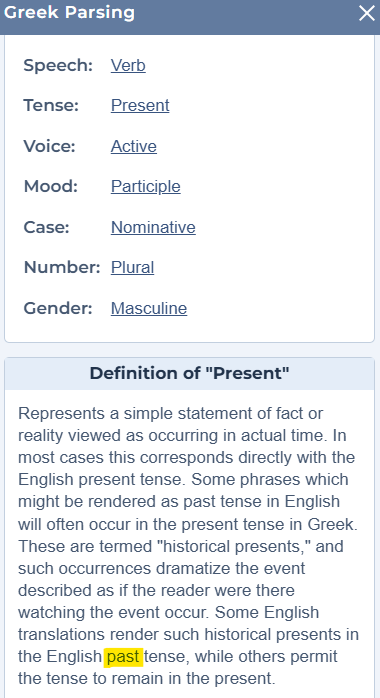
As I have found, the verb πλύνω plýnō, – wash in our verse – describes a plunging, or of a flow, a laundering of sorts. The parsing, as shown in the graphic speaks of the possibilty of the verb to be a past action. If this is the correct understanding of this passage, it would definitely support my previous thought.
But in reviewing numerous english translations, non of the translations available translate it as “Blessed are those who have washed…”
Some are so bold to interpret this first phase as
Blessed are those who do His commandments… NKJV
Happy are those doing His commands… YLT
Blessed are they that do his commandments… WEB
I fear that my original understanding, though somewhat comforting, did not provide me the surety of my condition. Surety of my right to the tree of Life, our Savior, is to be found in following Him, washing our robes as they get soiled from our living on this earth.
Got clean robes?
Thanks again for coming to visit. I hope you found something of interest in this post and would appreciate a comment, to begin a discussion. If you would like to receive daily posts from Considering the Bible, click on the “Follow” link below
Exodus 32:31 So Moses returned to the LORD and said, “Alas, this people has sinned a great sin. They have made for themselves gods of gold. Exodus 32:32 But now, if you will forgive their sin–but if not, please blot me out of your book that you have written.” Exodus 32:33 But the LORD said to Moses, “Whoever has sinned against me, I will blot out of my book.
Moses has a problem. The newly formed nation, whom God has delivered out of Egypt by His mighty hand has a problem. After receiving the covenant and confirming the covenant, obligating themselves to obey the covenant delivered to them by Moses, decided to fall back to the old ways of idolatry.
Exodus 32 is the story of the golden calf and of Israel’s deliverer interacting with God Almighty on the mount, while the people, are running roughshod over the very agreement they made with God.
Consider
Exodus 32:7 And the LORD said to Moses, “Go down, for your people, whom you brought up out of the land of Egypt, have corrupted themselves. Exodus 32:8 They have turned aside quickly out of the way that I commanded them. They have made for themselves a golden calf and have worshiped it and sacrificed to it and said, ‘These are your gods, O Israel, who brought you up out of the land of Egypt!’”
God is about to wipe the nation off the face of the earth, and speaking of replacing the nation!
Exodus 32:10 Now therefore let me alone, that my wrath may burn hot against them and I may consume them, in order that I may make a great nation of you.”
Moses went down the mountain, saw what God was referring to and was furious.
Exodus 32:19 And as soon as he came near the camp and saw the calf and the dancing, Moses’ anger burned hot, and he threw the tablets out of his hands and broke them at the foot of the mountain.
Moses laid it out on the line for the nation. They had sinned a sin, a great sin.
Exodus 32:30 ESV – The next day Moses said to the people, “You have sinned a great sin. And now I will go up to the LORD; perhaps I can make atonement for your sin.”
Even after undertaking such a great sin, Moses offered the hope of atonement. The hope of continuing with the Lord as a nation. Moses provided an option for the Lord, a chance for the Lord to simply take Moses and punish him instead of the entire nation. This is Moses acting like Jesus, a tremendous exercise of the love of God being offered for the rebellious people of God by Moses the mediator.
This passage speaks the truth – the one who sins will bear responsibility – he will be blotted out of God’s book. Now it bears to reason that to be blotted out of God’s book means the person was in God’s book in the first place.
It is easy, coming from my position to assume that to be in God’s book is equal to being saved, and to be removed from the book is to loose salvation. It would be easy to make the equivalent, but I think it wise to be careful, since we are speaking of a national existence and individual sinners within the nation that will have judgement fall on them.
The very next verse helps us understand the extent of the judgement, and our topic verses are directly linked to the reason for the death entering the camp.
Exodus 32:25 Then the LORD sent a plague on the people, because they made the calf, the one that Aaron made.
People died because of sin. This is the point, even for the rescued people of God. It is obvious the people of God fell under judgement, and death resulted. How we as New Testament believers are to understand this passage is worthy of pause and consideration.
Are we to consider it only a physical death that may result as in 1 Corinthians,
1 Corinthians 11:30, 32 That is why many of you are weak and ill, and some have died. But when we are judged by the Lord, we are disciplined so that we may not be condemned along with the world.
Or are we to understand that, just as the people who fell in Exodus, the New Testament people of God can also loose spiritual privileges, even life with God by wanton, great sin?
Thanks again for coming to visit. I hope you found something of interest in this post and would appreciate a comment, to begin a discussion. If you would like to receive daily posts from Considering the Bible, click on the “Follow” link below
Revelation 21:27 But nothing unclean will ever enter it, nor anyone who does what is detestable or false, but only those who are written in the Lamb’s book of life.
Revelation. What a book. If you understand it, you don’t. Every time I try to enter it’s mysteries, I come out of it with more questions. Yet every time I enter it, I also come out of it knowing one single truth.
Jesus wins in the end.
How we get there is up to Him, and by His grace I’m gonna hang on, but He wins in the end, and that is a great comfort to us.
For the passage above, let’s consider the context of the verse. The portion of Revelation this verse is found in has John describing the new Jerusalem, after experiencing the New Heaven and the New Earth (Revelation 21:1-8).
Verse 8 end the first passage on a very sour note.
Revelation 21:8 But as for the cowardly, the faithless, the detestable, as for murderers, the sexually immoral, sorcerers, idolaters, and all liars, their portion will be in the lake that burns with fire and sulfur, which is the second death.”
A disturbing verse for what it says and what it does not say. Nowhere in that passage does John speak of those in the lake of death as being faithless. Not once are those who are suffering related to how they believed or did not believe in Jesus. It is an assumption I always made, and other passages surely connect our faith with our destiny, but for this verse, that connection is absent. Interesting – disturbing but also intriguing!
On to our passage in Revelation 21:9-27. A bulk of the passage describes the “physical” appearance of the holy city of Jerusalem. Verses 11 through 21 speak of the walls and the gates, which is worthy of comment, but we need to focus on the topic Carl!
Verse 22- 26 speaks of no temple, as expected, but that
22 ….its temple is the Lord God the Almighty and the Lamb.
He is all in all!
Verse 23 – 26 speaks of the needs of the city – there is none, and
25 …its gates will never be shut by day—and there will be no night there.
Amazing – No restriction to the city. It’s gates will never be shut by day, yet there is no night. The gates will always be open!
What is entering the City? The glory and honor of the nations. Now that alone bears to ask a multitude of questions, but I digress again! I gotta get to the point.
How about we read verse 27 in full once more.
Revelation 21:27 But nothing unclean will ever enter it (the City), nor anyone who does what is detestable or false, but only those who have asked Jesus into their heart, trusting Him at some point in the past to secure an unalterable contract between God and them, without concern for life decisions since.
Ok I stretched the point out only to ensure you didn’t go from this blog thinking something wrong.
The verse speaks of equating those written in the Lambs book of Life as those who are not unclean, nor doing what is detestable or false.
These descriptions have nothing to do with our very real heart feelings, but as to actual actions in our lives. If we are to be truthful with ourselves, we should not feel saved if we are living unsaved.
As men and women on this earth, we have a tremendous capacity to deceive ourselves. Check your life. Be honest with yourself.
Thanks again for coming to visit. I hope you found something of interest in this post and would appreciate a comment, to begin a discussion. If you would like to receive daily posts from Considering the Bible, click on the “Follow” link below
Hebrews 4:11 ESV – Let us therefore strive to enter that rest, so that no one may fall by the same sort of disobedience.
I was chatting with a friend recently, a brother I have know for over a decade, a brother that used to enter into some Bible discussions with me at a previous employer.
Nothing to extended, for we were not being paid to discuss the location of the New Jerusalem, or to relieve the tension between Calvinism and Arminianism, but when my brother would come in my office with a question, we would consider what the Word says, discuss a few moments and let it ruminate. It was a good environment to work in, I learned bunches, and the people were great.
But that was over a decade ago, and my brother and I parted ways due to different choices for our careers. But lately he has taken the opportunity to reach out, and we had broke bread together just a few days ago. In the midst of the lunch, I let slip that I have a blog, and he has been reading.
Out of that reading, our recent chat revolved around the topic of conditional security and the once saved always saved teachings. During the discussion, I referred to a passage in Hebrews on this topic, (of which there are numerous passages addressing this topic), and the topic of striving came up.
What is it to strive? The apostle exhorts us to strive to enter rest, which is a paradox in my mind, but let us not get too distracted. (Besides the verse has been considered in Paradoxical Passages – Hebrews 4:11)
So – to strive, to persevere, to be diligent or to endeavor to do. The Greek word is σπουδάζω spoudázō, and it simply means to exert yourself, to give diligence, even to hasten or to make haste. Note that there is the idea of effort (exerting, laboring) and the component of time (hasten, make haste) in this word.
Do not both these ideas of exerting and hastening rest within the very same character of one “striving” I have yet to meet someone striving that is not giving it all he or she has. Not a partial effort, but with the strength provided, pushing forward. I have also never met someone who striving that is not striving now. He or she isn’t planning on striving in 2 years. How foolish of an idea that is. To strive is to be active now.
Strive to enter that rest, the sabbath rest. Yes this rest the apostle speaks of is a sabbath rest provided for the believer
Hebrews 4:9 So then, there remains a Sabbath rest for the people of God,
So if we don’t strive to enter that sabbath rest, what might the outcome be? Let’s read Hebrews 4:11 one more time.
Let us therefore strive to enter that rest, so that no one may fall by the same sort of disobedience.
So let me get this straight. The apostle is writing to believers, and providing instruction – that is to strive to enter a rest – so that no one, no believer, may fall. Does that not imply that believers may fall?
Are you still depending on your own works in some way to add to your salvation? Do you consider your efforts to add (or subtract) from the finished work of Christ on the cross, His complete salvation?
Enter the rest He has provided, not only in your initial decision to lay it before Him and follow, but in your daily walk with Him. There is a rest for the people of God.
Are you walking in it, even today? He is good, and His rest is beyond our own doing!
Thanks again for coming to visit. I hope you found something of interest in this post and would appreciate a comment, to begin a discussion. If you would like to receive daily posts from Considering the Bible, click on the “Follow” link below
1 Timothy 4:16 Keep a close watch on yourself and on the teaching. Persist in this, for by so doing you will save both yourself and your hearers.
In Paul’s closing days, he wrote to Timothy, his child in the faith, reminding him that he needed to persist.
Persist. Other translations use “persevere”, or “continue”. As you may know, I use the Blue Letter Bible web site for much of my research and they provide a parsing option of the Greek words used in the Word. Notice that to persevere is in the present tense – an action Paul expected to be occurring in the present, and was second person, to be applied to the reader. Paul isn’t speaking of Timothy persevering in the faith in order for others to become Christians. He was giving this command to Timothy for his own salvation
Now I provide this information as overkill, for the English also provides the same message. Timothy was to persevere in the faith for his own life, and for the teaching he provided.
Both arenas of effort were included. How often have you seen a Bible teacher dig into the Word, bring out doctrinal truth, and yet the witness is sullied due to his own life being shipwrecked with unfaithfulness and sin.
But Carl, is not Paul referring to sanctification before God in this passage? Does Paul not go on to say that this lack of perseverance will damage his sanctification before God.
Is that what he says? Let’s read that portion of verse 16 once more.
…by so doing you will save both yourself and your hearers.
Heck, let’s go back to the BLB and it’s parsing chart.
The word Paul uses is σώζω sṓzō, and I cannot find it translated as sanctification in my studies. It refers to preserving from danger, or to deliver from destruction, to rescue, or to keep safe and sound. The New Testament concept of sanctification comes from the Greek word ἅγιος hágios, and speaks of holiness, consecration or separateness from evil. Two different concepts, though linked, in the eternal life we are blessed to experience.
Notice that with this verb, it is future tense. Paul is speaking of salvation in the future for both his own life and those of the congregation. He and his current congregation will ensure their salvation by persevering in previous activities Paul lined out for Timothy.
…save both yourself and your hearers.
Paul taught this to a believer, a leader in the church!
If OSAS (Once Saved Always Saved) is correct, this makes no sense!
Thanks again for coming to visit. I hope you found something of interest in this post and would appreciate a comment, to begin a discussion. If you would like to receive daily posts from Considering the Bible, click on the “Follow” link below
Matthew 10:21-22 Brother will deliver brother over to death, and the father his child, and children will rise against parents and have them put to death, and you will be hated by all for my name’s sake. But the one who endures to the end will be saved.
The previous post spoke of how Jesus was warning His apostles of the dangers of being a believer, and of how they would recognize true believers as they went about the tribes of Israel, preaching of the Messiah.
The passage above was referred to in order to make the point that families may be split down the middle in relation to who Jesus is, and that rightness with God is not simply due to some physical bloodline, but association and relationship with Jesus and His men.
The purpose of this post is to focus on the last phrase of the provided verses.
But the one who endures to the end will be saved.
Endurance. The verb speaks of “staying under”, or “remaining behind” To endure is the English translation of the Hebrew ὑπομένω hupŏmĕnō. In our journeys through the Bible, we have broached this word a number of times. If interested, check out the following posts.
Suffice it to say, this concept pops up in the Scripture many times. In the context of our passage this morning, Jesus is telling us that to be saved we need to “stay under”, or “remain behind”, to not cut and run when the times are difficult.
But there is a finer point on His message I believe, for in the very next verse He instructs His disciples to flee, to cut and run, to not remain in the town if persecution comes.
Matthew 10:23 When they persecute you in one town, flee to the next, for truly, I say to you, you will not have gone through all the towns of Israel before the Son of Man comes.
So what is this endurance thing all about? Surely the Lord is not speaking of staying in a local area simply to be stubborn. He wants His people to be mobile, agile and able to move, able to escape persecution.
So if it isn’t the willingness to remain in a specific location no matter what happens, no matter what the local population wants to do to you, what might He be instructing He people to endure?
Consider verse 21. I think it gives some guidance.
Brother will deliver brother over to death
Father deliver his his child over to death
Children will rise against parents and have them put to death
This is the dissolution of society, at least in the disciples world. The very building blocks of social order are the family unit. Jesus isn’t speaking of some stranger in some far off town persecuting the believer, and staying around to take it. No – it is the closest of family that is out to get them.
This endurance is relational, an endurance to stay committed to the ways of Christ, even amongst the closest of family. In the midst of resistance within your family, when those closest to you may betray you, may deny you, may bring authorities to your doorstep, will you endure, will you stay under for the sake of the name of the Lord?
To endure to the end will result in salvation.
Jesus is the great example, for His own family rejected Him, His closest friends denied Him, one who He broke bread with betrayed Him.
Look to Him to consider how He endured. No lashing out, no condemning or vengence spoken of. When an “enemy” lost an ear, He healed it. When they spit and mocked Him, He endured.
Hebrews 12:1 Therefore, since we are surrounded by so great a cloud of witnesses, let us also lay aside every weight, and sin which clings so closely, and let us run with endurance (hupŏmĕnō) the race that is set before us,
Truly amazing. He is truly amazing. And we have been called to the same endurance. The same endurance, but note – without Him, we will not succeed.
Thanks again for coming to visit. I hope you found something of interest in this post and would appreciate a comment, to begin a discussion. If you would like to receive daily posts from Considering the Bible, click on the “Follow” link below
And whoever gives one of these little ones even a cup of cold water because he is a disciple, truly, I say to you, he will by no means lose his reward.”
Jesus is sending out his disciples into the nation to preach the gospel, to proclaim that the kingdom of heaven is at hand. The disciples were given clear instructions, especially how to treat those who received them or rejected them
Matthew 10:13 -14 And if the house is worthy, let your peace come upon it, but if it is not worthy, let your peace return to you. And if anyone will not receive you or listen to your words, shake off the dust from your feet when you leave that house or town.
In discussing those who would not receive the disciples, Jesus spoke of Sodom and Gomorrah as a preferred place to be.
Matthew 10:15 Truly, I say to you, it will be more bearable on the day of judgment for the land of Sodom and Gomorrah than for that town.
Jesus continues the discourse, referring to the persecution of disciples that would occur, even within the household of their family.
Matthew 10:21 Brother will deliver brother over to death, and the father his child, and children will rise against parents and have them put to death,
He encourages his men to reject fear, speaking of not only physical death, but spiritual death.
Matthew 10:28 And do not fear those who kill the body but cannot kill the soul. Rather fear him who can destroy both soul and body in hell.
Just prior to our topic verse, Jesus speaks of bringing a sword of division, for households will be split apart due to the good news, and how people receive or reject the person of Christ.
Matthew 10:36-37 And a person’s enemies will be those of his own household. Whoever loves father or mother more than me is not worthy of me, and whoever loves son or daughter more than me is not worthy of me.
As we have ventured through the 10th chapter of Matthew, it seems the message was centered on the reception of the apostles, and the results of either receiving or rejecting them, of how households would respond to the message of Jesus being the Messiah.
If this is true, then for one in a household to provide cold water to a “little one”, that disciple will by no means loose his reward.
But what may I ask is the reward?
This passage is often spoken in reference to assisting other brothers and sisters in ministry, or even of simple charitable acts given to others as having an some added benefit to the giver, when they enter heaven. This may be a great application, and may be supported by many other verses in the Word, but is not the context of the entire 10th chapter of Matthew that of life and death?
By giving cold water to a disciple, especially in the midst of a household that is split down the middle concerning who Jesus is, would mark that person out as a disciple. This act would identify the person as one who believes in Jesus.
By giving cold water to one of the apostles, (little ones, as in spiritual stature, humble men) they would be associating or joining with those entering into the kingdom that was at hand.
So i ask my reader – might the reward be spiritual life itself?
Another way of considering this passage is to ask – Is Jesus speaking of folks having an option to “loose a reward” and yet maintain spiritual life?
Or is He speaking of how the disciples would recognize those who are entering the kingdom of God?
I think there are two different ways to consider this passage.
First, life in the kingdom is proven by acts of service to others in the kingdom. The apostles would know when to “shake the dust off” or to let their peace remain.
The second was of considering this passage would be that acts of service to those in the kingdom are independent of the offeror being a kingdom citizen. In my feeble mind that equates to life decisions being independent of a salvation reality. If acts of service are independent of salvation, then we might identify these acts of service as rewards instead of proof of life. If this scenario is true, a possible outcome may be seen in the soul who “got saved” 40 years ago but has not followed/obeyed Christ. He has been taught he is eternally secure, yet may have no proof of life.
Does that make sense?
My friend, I propose this passage in Matthew 10 speaks of the identification of a true believer, one who serves at the risk of being ostracized by his own household and family. At the time of giving cold water, the disciples could know they were in the midst of a fellow disciple.
No dust to be shook off, and peace to be shared with all.
It is good to be in the family of God.
Thanks again for coming to visit. I hope you found something of interest in this post and would appreciate a comment, to begin a discussion. If you would like to receive daily posts from Considering the Bible, click on the “Follow” link below
Galatians 1:6 I am astonished that you are so quickly deserting him who called you in the grace of Christ and are turning to a different gospel– Galatians 1:7 not that there is another one, but there are some who trouble you and want to distort the gospel of Christ.
Paul is shocked. He is awestruck. The saints who cared for him, and had accepted him in their homes, willingly giving their time and talent due to the good news of Jesus that he brought them, were walking away from Jesus.
Walking away from the One who had called them into the grace of Christ.
Now it goes without saying that the passage speaks of God doing the calling, and not Paul himself, for their desertion may be from Paul’s gospel, but that meant the desertion was from the subject of Paul’s gospel, the Lord Jesus Christ also.
This desertion, or walking away may be defined as a removal, or a translation from one spot to another, a change. Paul is claiming these believers were in the process of being removed from the grace of Christ. But note that this isn’t due to persecution or to apathy, but by some person in the church who sought to trouble them (vs 7). It is by the teaching of these troublemakers that the believers are choosing to desert the One who called them to His side.
This is a decision these believers were making, a decision to reject the message provided by the gospel preacher and apostle, choosing to listen to those who speak contrary to the truth. True, they were being tempted with “new” teachings, but to start to succumb to the enticement of the message so quickly? How could this be?
In all of this, do they not hear the truth Paul spoke to them? Is their memory that faulty? Do they not have the privilege of remembering Paul’s passion, his love, his message of a crucified Savior, of a life of faith and not of works, providing them approach freely before a holy God?
For us today, we have multitudinous teachers in the “church”, troubling us with destructive doctrines, tempting us with worldly teaching, depending on personal experiences that cannot be verified, or teachings of religions that depend on the wisdom of man. My brother or sister, cling to the Word of God and it’s message, cling to the guiding Spirit of God and cling to the quiet Voice that guides true believers.
Having heard the truth does not allow us to venture off looking for different truths. Danger! Danger! The truth is a Person, the Lord Jesus. Religions will use Him for their purpose, but beware of those who do not walk as He did.
Remember that He stepped down in order to lift you up. He died in order that we may live. His people are to mimic this life of self denial for the sake of others. Any teacher that elevates himself over you, demands something from you, or departs from the Word of God is to be avoided like a plague.
Why allow yourself to be tempted to desert the One who loves you? Don’t walk away from Him!
It makes no sense! It is quite simply “Shocking”.
Thanks again for coming to visit. I hope you found something of interest in this post and would appreciate a comment, to begin a discussion. If you would like to receive daily posts from Considering the Bible, click on the “Follow” link below
Ephesians 5:3 But sexual immorality and all impurity or covetousness must not even be named among you, as is proper among saints. Ephesians 5:4 Let there be no filthiness nor foolish talk nor crude joking, which are out of place, but instead let there be thanksgiving. Ephesians 5:5 For you may be sure of this, that everyone who is sexually immoral or impure, or who is covetous (that is, an idolater), has no inheritance in the kingdom of Christ and God. Ephesians 5:6 Let no one deceive you with empty words, for because of these things the wrath of God comes upon the sons of disobedience.
Paul provides us a tough passage here, and his motivation appears to be the correction of a slackness in the people of God, for he comes out of the gate speaking of certain sins as not even to be named among the them. Those who are in the body should never hear whispers of this type of activity. Heaven forbid that the lost hear!
But alas, in todays church, it seems to be commonplace that the world hears of every dirty little secret the church has, and it seems the church, like the Corinthian church of old, revells in their “freedoms” But enough of my whining, and back to the passage.
So when Paul speaks of something not even being named amongst them, is Paul simply lamenting the churches ability to keep things under wraps amongst themselves, that secret sins should be not spoken of? Hardly think so. He is providing a warning to those who claim to follow the Savior.
The key verse within the passage for the sake of our topic is Paul’s reference to the inheritance in the kingdom of God. Two things needed to be considered.
1. Who is Paul talking to?
Is it fair to consider Paul’s warning to be applied to the believer’s in this church. Should we understand his warning to be towards those outside of the church? (Does that even make sense?)
2. What is the intended message of inheritance.
Lets read the verse once more
Ephesians 5:5 For you may be sure of this, that everyone who is sexually immoral or impure, or who is covetous (that is, an idolater), has no inheritance in the kingdom of Christ and God.
If he is talking to believers, (and I think that is obvious) when he speaks of having no inheritance, is he implying that they belong to the kingdom, but receive no benefits? A sort of still saved but no rewards scenario? Could that be his message?
Or might it be that having no inheritance in the kingdom, means there is no family connection, no legal standing with the kingdom, the citizenship is not existent?
This is deadly serious council from the apostle, for the specific sins Paul speaks of seems to be considered flippant in todays society, and in the church, many consider it to be a norm for many within the body.
No inheritance! This should make the heart of the believer shudder.
May we find peace in the Lord and strength to maintain purity in our lives, that judgement does not fall on the church
Thanks again for coming to visit. I hope you found something of interest in this post and would appreciate a comment, to begin a discussion. If you would like to receive daily posts from Considering the Bible, click on the “Follow” link below
Hebrews 4:14 Since then we have a great high priest who has passed through the heavens, Jesus, the Son of God, let us hold fast our confession.
Let us “hold fast our confession”.
It is a common refrain within the book of Hebrews, for the author uses the phrase “holding fast” and “confession” in two other passages within the book.
Hebrews 4:14 Since then we have a great high priest who has passed through the heavens, Jesus, the Son of God, let us hold fast our confession.
Hebrews 10:23 Let us hold fast the confession of our hope without wavering, for he who promised is faithful.
That terminology may seem a bit archaic for us moderns, so I would like to break the phrase down for our consideration.
To “hold fast” is synonymous to retaining, or to keeping carefully. The transliteration of the Greek word is kratéō (G2904 in the Strong’s Dictionary).
Thayer’s dictionary adds the idea of it referring to becoming masterful of or to be powerful. The idea in using this term is to communicate that there is a battle, a resistance to maintaining this confession. It is not a neutral condition, for if it was, we would not be exhorted so often to persist, maintain, and persevere.
Is it not understood that our confession will be resisted against, our confession will find opposition, even a deadening. A “force” will seek to pull it from us, whether it be the world, the devil or our very own selves.
Ourselves? Why would we fight against our our confession? Is there not an assumption commonly taught that our confession, once publicly spoken, is a continual and everlasting, never changing truth?
But I am getting ahead of myself.
Let’s consider what the author is speaking of when he refers to a confession. The Greek term is homologia, and means “to say together” or to agree to the same thing with someone. It had legal connotations in the ancient world, and the context of this passages speaks of believers agreeing with God about who the Messiah is. Throughout the book of Hebrews, the author elevates Jesus above all. He is the Christ, the Messiah, God Almighty in human form.
The statement “Jesus is the Christ” is eternal. There is no challenge to this truth for there is no force capable of changing the declaration of God in the resurrection of Jesus from the grave. He is the living One. Yet that is not a confession. A confession takes two parties to agree to. God has made the statement “Jesus is the Christ” by raising Him from the grave.
But as the apostle writes to the Hebrews, he is writing to a group of believers who are under the gun, struggling with the world’s influence on them, with the devil’s temptation to return to mere religion, reducing the Lord Jesus to simply a good teacher, or a moral man that loved His enemies. He is writing to a people, not about an absolute truth statement, that is that Jesus is the Christ, but their confession of that truth in their own lives.
We know – or should I say, I know – that when an easier route to take is offered, when resistance may be reduced in the fight, the temptation is very real. If I do not keep my eyes on the crucified One, my confession will become historical. Something I entered into in the past. A confession that may not be current.
A historical confession, great as it may be, is no match for a living and vibrant confession on a day by day basis.
That is the message of this text. Yesterday’s confession was good yesterday. How is your confession today?
Thanks again for coming to visit. I hope you found something of interest in this post and would appreciate a comment, to begin a discussion. If you would like to receive daily posts from Considering the Bible, click on the “Follow” link below
Luke 3:8 ESV – Bear fruits in keeping with repentance. And do not begin to say to yourselves, ‘We have Abraham as our father.’ For I tell you, God is able from these stones to raise up children for Abraham. Luke 3:9 ESV – Even now the axe is laid to the root of the trees. Every tree therefore that does not bear good fruit is cut down and thrown into the fire.”
First off, let’s all agree that Abraham was a great man of faith. A pillar of the Old Testament, and a hero to those who came after him. He is referred to in the Gospels 33 times, and in the remaining portions of the New Testament 40 times. He is a lynch pin in the Covenant of Promise and was the chosen man to provide seed for the nation of Israel, and the Messiah. His faith shone through the ages and he is called a friend of God. What a hero, an example and a saint!
How shocking for John to tell the crowd “Don’t follow Abraham!”
John is telling those who look to Abraham as their father to quit. To stop depending on the physical lineage they claimed to have. Yes, Abraham may have some physical link with those John was speaking to, but that is of no import. Absolutely none, and this bloodline issue may actually become a snare, a point of diversion that entraps those who claim Abraham as father.
Of course having the blood of Abraham flowing through your veins is not necessarily a detriment to knowing God. Thankfully this connection can no longer be claimed. But this distraction of focus is typical of those who claim religion.
Abraham was a believer. Those who followed after him, some had faith, many did not. As a matter of fact, as we read through the Old Testament, it seems there were masses of people claiming rightness with God simply because of association with Abraham.
So Carl, your point is understood, but this passage is evangelistic, of John speaking a rebuke to the crowds who were being baptized. He spoke of them as vipers in the previous verse, and now he is demanding fruits (actions) in keeping with their repentance (changed mind).
Agreed. But His emphasis in verse 8 is on the (continuing) production of fruits based on their decision to repent and receive baptism. They have “repented” and they have been “baptized”, but now they have a life of fruits to produce.
So as I read this passage, I see personal application to those who are present at this time, to those who have entered into some covenant with the Master, though they may not understand all the ramifications.
Well, I think John makes one of the ramifications fairly clear. Make sure you don’t convince yourself of another Master. Note His clear statement.
And do not begin to say to yourselves, ‘We have Abraham as our father.’
This group facing Jesus were told to not to start to depend on Abraham. By application, we can extend this warning to all that may be tempted to see as their master the Lord’s apostles, Augustine, any pope, Buddha, Muhammad, Joseph Smith, Charles Taze Russell, or any other religious figure that appears.
As believers, they (and us) had entered into another relationship that was far greater, much stronger and so much better than what Abraham (or these teachers) could provide. Yet John knew His audience, and seemingly He knows our hearts. So He makes it clear.
Bear fruit my friends. Bear fruit or die!
Is that too blunt? Should I have said that? Is that a bit much?Am I exaggerating His message simply to make a point for my topic?
My friends, He goes on to continue the picture of fruit bearing with an illustration of an axe at the base of trees. No fruit – no life. No fruit – into the fire. How did the audience understand that. Did they explain it away thinking this was some eschatological or theological teaching those two thousand years later would understand? Did they walk away thinking the message was for someone else?
We must remember He is speaking to a religious community, a religious community that had God’s written message, and claimed they personally had a physical link to a major player in the Word. He is shaking them up with some harsh truth.
Do we also need harsh truth to understand the grace of God?
My friends, seek to produce fruit in your lives.
Love your neighbor, love your enemy, love those who can’t love you back. Exercise patience while we wait, show humility to those who are proud, have a peaceful presence in the midst of turmoil, live a joyful life while others worry, sacrifice willingly for those who may be greedy. Show self control while everyone’s hair is on fire.
In other words, keep your eyes on Jesus. Don’t look away from Jesus by looking to somewhere else, such as Abraham (or any other) as your father.
The fruit will dry up. And John is telling us that ain’t good. Not at all!
Thanks again for coming to visit. I hope you found something of interest in this post and would appreciate a comment, to begin a discussion. If you would like to receive daily posts from Considering the Bible, click on the “Follow” link below
1 John 3:15 Everyone who hates his brother is a murderer, and you know that no murderer has eternal life abiding in him.
I have spent much of my life trying to grasp the intent of John in his first letter. Much of my early time in my faith walk centered on 1 John 5:13 as the purpose of the book.
1 John 5:13 I write these things to you who believe in the name of the Son of God, that you may know that you have eternal life.
It seemed to my understanding John wrote it as a treatise for believers, to provide assurance of salvation based on an initial belief. He says it right in the verse! How could I deny John’s message?
Of course I read this passage over and over again with my Once Saved Always Saved (OSAS) glasses on, reinforcing my understanding of salvation being no more than a binding contract with God upon my initial faith. My eternal salvation hung on that night of Feb 19, 1981, when I bent the knee and confessed my sin, repented of my ways, and trusted in the Lord. After that night, my salvation was eternally secured, and praise God, He is faithful in every instance of my walk. He has been so good to me and my family, and provided all that we need and much of what we wish for. But I digress.
As I read this book of 1 John, I settled on a few of the favorite verses, such as 5:13, and of course 1:9, the great escape clause in the start of the book – you know, where we can get forgiveness by confession. I really liked that verse!
That was then and this is now.
As you may know, my opinion on the book has been tweaked, as I sought to understand the book through a series of posts a year or so back. For some background to my travels through this book I would refer my reader to 1 John – Testing to Know – Introduction.
Suffice to say, my general sense of the book is that John provides self tests for believers to check themselves out on as they walk with Jesus. John provides a number of tests – I think I found 12 within the book – to help believers understand that the Christian life is a provable, testable reality we can and should test and recognize within our lives.
Our verse above is the heart of such a test. I will refer to this short passage supplied, since it hits the point hard. Hate your brother – You ain’t got life. Now of course we all fall into sin, loosing our love for others as we seek our own ways, but this verse speaks of hatred as a verb, indicating an action performed by the subject, with the verb in its present tense, meaning it is a continuous action.
The verse prior speaks of those who do not love the brothers (believers) abiding in death. To abide, or remain in death. To choose to stay in the realm of death.
Love and hate are action words (verbs) that are being contrasted in this passage, and John is telling us the source of these decisions. If I hate, I am like a murderer, and abide in the realm of death. If I love, I have passed out of death, and abide in Him, having eternal life.
A believer who constantly, consistently and continually hates on a brother is living in a self deception that may one day be irrevocable. The hatred will be set in a stony heart, reigning over the life of the hater, a slave to the decision to hate. When this occurs is between God and the believer, and I am confident God provides abundant warnings (as John provides one here) to pull the believer back to life. It is the love of God continually inviting us back!
Is it not only right to love our brother and sister, to forgive those who may have hurt us, to mimic the Savior who forgave us our own sin?
Hatred is a choice my brother, and as we harbor this hatred, we may find it overpowers us, deadening our souls and forcing an abandonment of a faith that produces good things in our life. Good things such as….
love
joy
peace
patience
kindness
goodness
faithfulness
gentleness
self-control
I have recently been in the book of Galatians, and as I was listening to the Message translation, I came across the same passage, yet with a non-standard list, it provoked me to reconsider the list of fruit for my own life. Consider.
affection for others
exuberance about life
serenity
a willingness to stick with things
a sense of compassion in the heart
a conviction that a basic holiness permeates things and people
involved in loyal commitments
not needing to force our way in life
able to marshal and direct our energies wisely
We have a choice in our walk with God. To hate is to depart from God, for God is love. and to hate is to be of the devil. May we seek to love those we come in contact with, those who are a blessing, and to those who are not.
It is for us to enjoy the life of love, abandoning the act of hatred, along with the death associated with it.
May God teach us of His ways.
Thanks again for coming to visit. I hope you found something of interest in this post and would appreciate a comment, to begin a discussion. If you would like to receive daily posts from Considering the Bible, click on the “Follow” link below
Revelation 2:4 But I have this against you, that you have abandoned the love you had at first. Revelation 2:5 Remember therefore from where you have fallen; repent, and do the works you did at first. If not, I will come to you and remove your lampstand from its place, unless you repent.
Two topics arise in this short passage regarding conditional security. The messages in verse 4 of abandoning the love, and in verse 5 of removing your lampstand need to be considered.
Left
To leave is not to apostatize, as I expected, but is the Greek term aphiemi, which has the meaning of to leave, leave alone, forsake or neglect.
The Ephesian church had left their first love behind, they had departed from that first love and yet continued to exhibit all the ear marks of a very orthodox, “healthy” church.
We don’t read of this church actively leaving that first love, or in the process of leaving that first love. They have left it (past tense), departed from their first love and seemed to be existing quite fine in all appearance. As a matter of fact, some semblance of a church existed for centuries in Ephesus, for by the year 431 AD, The Fourth Ecumenical Council was convened in Ephesus. It was at this council Mary was declared as the Mother of God Theotokos.
So in review, we have a church that was the center of great teaching through Paul, a sending church, a center for early theological debate and a very orthodox church, but by the time of this letter, around 69 AD, the church began living for truth and not for Christ. By the time of Constantine and the Roman nation accepting Christianity as the state approved religion, the church had continued to exist, yet it’s decay had become evident to all true believers and the lamp had been pulled.
Removing
Though the church had left their first love, the Lord did not immediately remove their lampstand. He petitioned the church body to repent, to change her mind about her priorities, to do the works she had first performed to exhibit their love.
But what is it for a church to have it’s lampstand removed? As mentioned above, the church had continued to physically exist up to the 5th century as a body representing God, recognized at least by the state. It was as influential as any church at the time, for the state convened a very important convention to determine a theological teaching.
So what is going on? Two options are allowable for the reader to consider.
The church had repented and was a vibrant living branch of the vine, a body fully alive to it’s Redeemer and Lord. No removal of the lampstand had been necessary and the church continued in a loving relationship with her Lord and the faithful.
The other option was that the church continued in its cold orthodox “letter of the law” only existence, and the removal of a lampstand was executed.
This last option, though difficult to accept, may be the correct outcome of the message. Let me explain.
The Lord has described the churches as lampstands.
Revelation 1:20 As for the mystery of the seven stars that you saw in my right hand, and the seven golden lampstands, the seven stars are the angels of the seven churches, and the seven lampstands are the seven churches.
To be described as lampstands forces us to remember the purpose of a lampstand. Is it too much to consider the lampstands purpose was to shine a type of light, the gospel of Jesus. The light of the gospel in the cities referred to here emanated from the church body. No other source is provided. The life of Christ was to be flowing though these church bodies to the cities, just as oil was used to create light for it’s surroundings.
But let us not make the mistake that thinking a group of people congregating together and calling themselves Christians creates a lampstand. The lampstand is simply a vehicle for the oil to produce light. For a group of people to be a true lampstand, the correct oil is critical. For any “oil” other than the Spirit of God, to be the “fuel” for their light, would be a misuse of the lampstand, and represent the Lord incorrectly. For a church to depend on anyone or anything, other than God is to be condemned to having it’s life giving authority from God to be removed.
A very similar truth of the kingdom of God being removed, or taken away from a group of people may be found in Matthew 21:43.
Matthew 21:43 ESV – Therefore I tell you, the kingdom of God will be taken away from you and given to a people producing its fruits.
As we know, the nation of Israel existed for 40 years after she crucified her Lord. In this instance the Lord gave the nation, and it’s inhabitants a full generation to repent prior to her destruction. Many individual Israelites followed the Master, yet as a nation, she rejected the truth and continued to persecute those who followed her Messiah. It did not end well for the nation.
Does this passage directly address a conditional security teaching as this series seeks to find out? In my opinion, the passage speaks of the death of a lampstand, of a body of believers, transitioning from a loving relationship with God, to a dead relationship with their truth.
Might some within the church have apostatized? Possibly, but this isn’t the intent of the passage. The judgement of removal is directed to the church body within the city, and not directly to an individual.
Let me know your thoughts.
Be blessed my friends and may the Lord continue to work in you to produce His good pleasure.
Thanks again for coming to visit. I hope you found something of interest in this post and would appreciate a comment, to begin a discussion. If you would like to receive daily posts from Considering the Bible, click on the “Follow” link below
17 For it is time for judgment to begin at the household of God; and if it begins with us, what will be the outcome for those who do not obey the gospel of God? 18 And “If the righteous is scarcely saved, what will become of the ungodly and the sinner?”
In our last posting on this passage in 1 Peter, we considered the context, the audience Peter is speaking to and some timing considerations. In this post, I would like to suggest an Old Testament passage that Peter may have in mind as he writes to us.
A Background for Peter?
During the Babylonian invasion, a prophet named Ezekiel gave us the following passage, and may provide some background to Peters thoughts in his warnings. We will pick up where God directs the commencement of judgement upon the city of Jerusalem, including the sanctuary.
Ezekiel 9:5-6 5 And to the others he said in my hearing, “Pass through the city after him, and strike. Your eye shall not spare, and you shall show no pity. 6 Kill old men outright, young men and maidens, little children and women, but touch no one on whom is the mark. And begin at my sanctuary.” So they began with the elders who were before the house.
According to Ezekiel, judgement was to begin at the sanctuary, similar to Peter’s warning at his time of writing. The judgement was to be without pity, upon young and old, women and children. All the inhabitants of the city were considered worthy of judgement, even those in the sanctuary. Those who attended the sanctuary may suffer! Yet there is an exception. Those with a mark.
Ezekiel 9:3-4
3 Now the glory of the God of Israel had gone up from the cherub on which it rested to the threshold of the house. And he called to the man clothed in linen, who had the writing case at his waist. 4 And the LORD said to him, “Pass through the city, through Jerusalem, and put a mark on the foreheads of the men who sigh and groan over all the abominations that are committed in it.”
Prior to judgement falling on Jerusalem and the sanctuary, God ordered “the man clothed in linen” to put a mark on the foreheads of those who mourned over the sin of the nation. Those who mourned over the sin of the nation could easily be described as people who sought God, and eschewed sin. Those who were marked were deep in a culture that was full of “the ungodly and sinner”, and they were marked by their heart response to the culture they were in. Due to their faith, their heart of pain, they were saved from the judgement. The city would be ravaged, burned and tore down. Death was everywhere, blood flowing, bodies strewn, even in the sanctuary. A horrible tragedy, second only to the Roman invasion of Jerusalem.
Surely those who were marked must have felt they were scarcely saved from this total destruction of Jerusalem.
The marked were saved. The ungodly and the sinner were put to death.
Might Peter be considering this Old Testament passage to provide warning for the church prior to the Roman invasion coming in the late 60’s? Many parrallels suggest that in my mind.
I would suggest it is also a warning for our own lives? Are we not in the midst of a decadent, sinful culture, within a population committing abominations, in a land that is covered with the blood of the unborn, full of injustice and crime?
What may seem even worse, is that whatever is left of the church is following after a vile culture. The church needs a cleansing, a time of mourning over all the abominations committed in it.
Please look to the Lord for mercy in our days, that we would mourn over the evil committed, even in the church.
Thanks again for coming to visit. I hope you found something of interest in this post and would appreciate a comment, to begin a discussion. If you would like to receive daily posts from Considering the Bible, click on the “Follow” link below
17 For it is time for judgment to begin at the household of God; and if it begins with us, what will be the outcome for those who do not obey the gospel of God? 18 And “If the righteous is scarcely saved, what will become of the ungodly and the sinner?”
The question that has to be grappled with is who is Peter talking of?
As a former adherent of OSAS (Once Saved Always Saved), I automatically considered those who do not obey the gospel of God as those who have never obeyed the gospel of God. That is, Peter is speaking of both those in the church (believers) and those outside of the church (unbelievers).
Context
Starting at verse 12, Peter begins his challenge to believers to not be surprised at the fiery trial that was to come upon them. He continues to speak to believers as they share in Christ’s sufferings (vs 13) and are insulted for the name of Christ (vs 14).
He connects suffering and insults with believers. A trial is coming and includes suffering and insults.
He proceeds to warn believers not to suffer as a murderer, a thief, an evildoer or a meddler (vs 15). How can Peter assume this is a possibility? Was not the church of purer stock than to have evil doers in it’s ranks? Were there meddlers in the group? Murderers? Is it not obvious that Christians are to mimic the Lord Jesus, and these actions are definitely not of the character of God.
Peter sums up the discussion on the general attitude of the believer who suffers as a believer, standing up for Christ. No shame. Glorify God.
Audience
Next comes our verses, where Peter does not indicate that he is going to talk of both believers and unbelievers. Remember, just a verse or two earlier, Peter described some of his audience as suffering as a murderer.
If Peter does not change the focus of his audience, when he speaks in verse 17, might he be referring to rebellious Christians when he speaks of “those who do not obey the gospel of God”? Might Peter be speaking of those who may have started out on the journey with the Lord, and for some reason decided no longer to believe?
Timing
There is also a consideration of timing implied in verse 17 of this passage. I have inserted my assumptions (italicized) in the passage to help explain how I often read this passage.
For it is time for judgment to begin at the household of God; and if it begins with us (household of God), what will be the outcome (after the household of God has suffered) for those who (outside of the household of God) do not obey the gospel of God.
I sometimes compartmentalize this verse into two time periods, one period for believers suffering during their lives on earth for the Messiah, and the second time period referring to the lost souls suffering after death in eternal fires.
Is this the intent of Peter? What might Peter be thinking when he provides us this passage. Join me in my next blog to consider a possible source of some of Peter’s thoughts
Until then, as the household of God, let us give thanks for His mercies, and seek to live unto His glory!
Thanks again for coming to visit. I hope you found something of interest in this post and would appreciate a comment, to begin a discussion. If you would like to receive daily posts from Considering the Bible, click on the “Follow” link below
Titus 1:15 To the pure, all things are pure, but to the defiled and unbelieving, nothing is pure; but both their minds and their consciences are defiled. Titus 1:16 They profess to know God, but they deny him by their works. They are detestable, disobedient, unfit for any good work.
I have recently published a number of passages in the Conditional Security series (including here, here and here) that included the Greek term ἀδόκιμος adókimos. This term is often translated as disqualified, failed, failed to meet a test or, in our verse above “unfit”. Other translations use terms such as reprobate, worthless, and disapproved.
As I read this passage previously, I did not make such a connection. I had not associated these folk that Paul is warning Titus about as being believers, but of those who are of the circumcision, as verse 10 refers to.
Titus 1:10 For there are many who are insubordinate, empty talkers and deceivers, especially those of the circumcision party.
But then I noticed note that Paul does not state only those of the circumcision, but especially those of the circumcision. And lets consider the wider context.
Paul’s discussion prior to referring to the circumcision is a description of elders, believers who supposedly had been previously tested to fill the position of an elder. Elders who may have taught the believers, or oversaw believers who taught in the church.
Whoever the folk are that are insubordinate, empty talkers and deceivers, they are upsetting whole families (verse 11) with their teaching. Are these teachers unsaved folk, for they are described as subordinate, empty talkers and deceivers? Does not Paul command Titus to “rebuke them sharply”, in order to bring them into the faith?
Lets read that verse together
Titus 1:13 This testimony is true. Therefore rebuke them sharply, that they may be sound in the faith,
Ooops – that may be a slip on my part. Did Paul command Titus to bring them into the faith through rebuke?. No, it appears Paul is telling Titus to straighten them up, to bring them to a soundness in the faith! These folk seem to have a faith that exists, but not in a healthy manner.
Is the previous context of elders, those who watch over the church, teaching us that the subordinate, empty talking deceivers (verse 10) as those in the church? Believers who have enough experience to be teachers within the home churches of the area?
It seems Paul is wanting Titus (and the elders) to rebuke believers, those who are insubordinate, empty talking deceivers, who have slipped from the truth of the gospel. The rebuke is for believers who have turned away from the truth. Consider verse 14, and the influence of people who have turned away on these teachers.
Titus 1:14 not devoting themselves to Jewish myths and the commands of people who turn away from the truth.
These teachers, may be pursuing and propagating a teaching of the circumcision (some food laws possibly) are professing to know God, and yet their mind and conscience are defiled, they deny God, and are disqualified.
The more I read this passage and try to understand the intent of the apostle, I am coming away thinking this passage is speaking of believers who have been lured away from the simple gospel by false teachers, and are, or beginning to, walk away from the Messiah.
Most of this post has dwelt with Paul’s description of these teachers being disqualified. He also brings to the discussion the idea of denial. Let me remind my reader that to deny is to disavow, reject and refuse. It is commonly synonymous with renouncing something or someone, typically that had been accepted previously.
When Paul uses a term such as deny, I can’t help but think he is speaking of those who at one time did not deny the Messiah, but had accepted, believed and followed.
When Paul uses a term such as disqualified I can’t help but think he is speaking of those who at one time were not disqualified, but had entered the contest, joined the fight and found success, even victory.
Let me know your thoughts. Is Paul speaking of believers in this passage and directing Titus do bring them back to a soundness of faith?
I would appreciate your thoughts.
Thanks again for coming to visit. I hope you found something of interest in this post and would appreciate a comment, to begin a discussion. If you would like to receive daily posts from Considering the Bible, click on the “Follow” link below
4 You adulterous people! Do you not know that friendship with the world is enmity with God? Therefore whoever wishes to be a friend of the world makes himself an enemy of God. 5 Or do you suppose it is to no purpose that the Scripture says, “He yearns jealously over the spirit that he has made to dwell in us”? 6 But he gives more grace. Therefore it says, “God opposes the proud but gives grace to the humble.” 7 Submit yourselves therefore to God. Resist the devil, and he will flee from you. 8 Draw near to God, and he will draw near to you. Cleanse your hands, you sinners, and purify your hearts, you double-minded. 9 Be wretched and mourn and weep. Let your laughter be turned to mourning and your joy to gloom. 10 Humble yourselves before the Lord, and he will exalt you.
Our initial verse comes out swinging! James is not gentle with his audience, for he has a stern warning for them and us.
First – A truth statement. Friendship with the world is hostility (or hatred) toward God. I realize the translation says enmity with God, but the Greek term ἔχθρα échthra can be translated as either enmity or hostility/hatred. For me, enmity is not as defined as hatred or hostility.
So the truth is there are two camps each one of us will belong to. The world, or God. Joining one camp produces a war like attitude regarding the other camp. Love God – Hate the world (but not the people!). Love the world – Hate God.
Now that is some harshness coming of the apostle James! But remember this is simply a statement of fact. It is the next phrase is should shake us, for he takes a truth statement, and applies it to believers. Believers!
If you wish to be a friend of the world, you are making yourself an enemy of God. Did you get the jab? If you wish to be a friend of the world. It is a matter of desire, or better yet, an act of the will to be a friend of the world, a decision to pursue their acceptance, friendship, community or “gang”.
You see, when James speaks of “wishes”, he uses the Greek term βούλομαι boúlomai. Per Thayer’s Lexicon, this word has a range of meaning, from “to will deliberately, have a purpose, be minded”, to the idea of “an affection, to desire”
With this understanding, could James be telling us the mere desire to be friends with the world is casting us into the camp of the enemy? It certainly appears so. In the following verses, James submits pleas for those who desire/want/seek friendship with the world. Remember our context, for in our first verse, James comes out swinging, calling the audience adulterous. He has set the stage, and provided a truth fact, made application and is now making a plea to return to God. In the next few verses, James is pleading these believers to:
Submit yourselves therefore to God.
Resist the devil
Draw near to God
Cleanse your hands
Purify your hearts
Be wretched
Mourn
Weep.
Let your laughter be turned to mourning
Let your your joy be turned to gloom.
Humble yourselves before the Lord, and he will exalt you.
All of these previous actions are to come from our desire to be friends with God, our will to be right with the Father. This list of actions of our will should not be surprising to the believer who has walked with the Lord for any time, for as we walk with Him, we do get pulled away, we tend to wander, we get distracted and lured into alternate allegiances.
In the midst of this list exhibiting our brokenness towards God, God is ever there to provide motivation for us to turn back, to repent, to change our mind. This motivation is that He is jealous for our devotion, willing to provide more grace, a promise that the grace of God is not limited, it is not of short supply.
Regarding the jealousy of God, check out my eight post series on “A Jealous God”. I think some of my findings will surprise you. But back to James.
He provides motivation and grace.
He yearns jealously over the spirit that he has made to dwell in us
He gives more grace.
James also is not merely loading us up with requirements, and providing energy to perform, but defining the response we may expect from God as we turn back.
The devil will flee from you.
God will draw near to you.
The Lord will exalt you.
If we have walked away, for a day or for a decade, to return to God will be a joyous event, with the enemy running, the Lord being close, and our being exalted. This is incredible, for as I have read this passage in the past, I had never took into account this exaltation.
Let me ask my readers. To come back to God will result in our exaltation. What does that mean for you?
Thanks again for coming to visit. I hope you found something of interest in this post and would appreciate a comment, to begin a discussion. If you would like to receive daily posts from Considering the Bible, click on the “Follow” link below
12 “This is my commandment, that you love one another as I have loved you. 13 Greater love has no one than this, that someone lay down his life for his friends. 14 You are my friends if you do what I command you.
What a wonderful passage. At times, I feel any comments made are actually hurting the message the Lord intended, and it would be wise to let the message speak for itself. Take a few moments and simply read the Word of God provided above. Dwell on the words He has given us. Consider what He is blessing us with!
To think we could be servants, simple men and women is a high calling, a privilege that is undeserved, surprising and somewhat daunting in itself. But Jesus takes the relationship much further. He calls us friends. The One who would take our sins, our rebellion, our disdain, our hatred, our pain and frustration upon His own, calls us friends.
How can that be?
A bit of a story to help you understand my head space.
I have a friend who has moved to a different country to pursue a career. Super busy, and always unavailable. For many many months, I reached out to him to chat, to find time to even text together. Either he ignored my efforts, or responded with a trite response. A “let’s do lunch sometime” type of response. At this point in the relationship, it has been years since we have interacted.
I still consider him a friend. But are we in a relationship that is exhibiting the nature of friendship? Remember, this short story is provided to define what a friendship is to be between mere humans. An equality of participants in our nature.
Jesus, for Him to call us a friend, and to not communicate with Him seems to mimic the situation above, but with far greater impact. Jesus, though fully human, is no mere human. To be friends with Him, may I say, is not to be trifled with.
All of this to say, let us consider the fourteenth verse for a moment, to understand what conditions Jesus may be placing on the offer of friendship.
14 You are my friends if you do what I command you.
The smallest of words with the greatest of impact. IF. In the Strong’s numbering system, it is G1437, ἐάνeán. Strong’s dictionary includes, in the definition, the following phrase.
“a conditional particle; in case that, provided, etc.; often used in connection with other particles to denote indefiniteness or uncertainty”
Thayers Greek Lexicon defines this particular word as..
“It is a conditional particle, which makes reference to time and to experience, introducing something future, but not determining, before the event”
I surely do not wish to get bogged down in definitions, but suffice it to say that when used, “if” does not suggest a statement of fact, or a finished accomplishment.
So what are the conditions of being a friend of Jesus? Unlike my friend above, between us there is no commanding of actions or demanding of attitudes between us. We are in a mutually agreed state of friendship, to the extent that it is.
With the Lord, the condition is obedience. This statement, when considered in the context of friendship, seems to be offensive, since to be friends is to have a mutual give and take. At least with those our equals. But you see, He is not our equal. He is the One above all else and greater than any other!
Also, as with my foreign friend, our friendship is only as close as each of us allow it to be. Not so with Jesus, for He has went to the gallows for us to prove Hs friendship, suffering, facing death, the great enemy of the author of Life, experienced rejection and ridicule, persecution and loneliness. His faithfulness in friendship cannot be improved, upgraded, improved or exaggerated. He upholds His end of the relationship with a faithfulness that is everlasting.
But that is not so with us, as weak, feeble people, that tend to abandon our friends, walk away from our loved ones and forget those we love, all for the sake of self self self. Jesus is telling us of the condition for our sake, so we might see it as the challenge we need to recognize, and not to simply assume we are in good shape, from our faithfulness.
He is faithful. Let us mimic Him in our seeking to obey His commands, especially that which He brings to our attention in this passage. And what is that command?
12 “This is my commandment, that you love one another as I have loved you. 13 Greater love has no one than this, that someone lay down his life for his friends.
Can we obey to maintain that friendship?
Thanks again for coming to visit. I hope you found something of interest in this post and would appreciate a comment, to begin a discussion. If you would like to receive daily posts from Considering the Bible, click on the “Follow” link below
14 Therefore, my beloved, flee from idolatry. 15 I speak as to sensible people; judge for yourselves what I say. 16 The cup of blessing that we bless, is it not a participation in the blood of Christ? The bread that we break, is it not a participation in the body of Christ? 17 Because there is one bread, we who are many are one body, for we all partake of the one bread. 18 Consider the people of Israel: are not those who eat the sacrifices participants in the altar? 19 What do I imply then? That food offered to idols is anything, or that an idol is anything? 20 No, I imply that what pagans sacrifice they offer to demons and not to God. I do not want you to be participants with demons. 21 You cannot drink the cup of the Lord and the cup of demons. You cannot partake of the table of the Lord and the table of demons. 22 Shall we provoke the Lord to jealousy? Are we stronger than he?
This will be the last post in this passage as we are looking at Paul’s warning for the Corinthians. this passage usually carries with the the present day experience of communion for the modern church in my mind, and that may be directing my thoughts incorrectly. You see, the communion of the Lord in the first century was a meal, a full fledged meal, somewhat like a pot luck in my mind. Food items and wine were brought together to a central home where believers gathered to partake in a meal. The Lord’s supper was not a ceremony as I experience in a modern church, where all are solemn, and the congregation waits for a chip or wafer, and a little cup of grape juice or wine. This is foreign to the record I read in the New Testament.
Against this backdrop, let’s consider Paul’s concern in this passage.
First, Paul identifies believers with Christ through the supper, the intake of a meal. Secondly, Paul identifies Israel with demons through the intake of a meal.
Then Paul seeks to provide a correction to the audiences possible thought that food or demons are the issue of discussion. The food isn’t the issue. The demons aren’t even the issue.
Verse 20, Paul seeks to correct any misunderstandings and focuses into the issue he is warning them about. It is the believers actions that are the topic of concern. Paul speaks of pagans offering up to a demon, and joining in this action is the problem. Paul isn’t concerned about what demon, or how many demons, or the circumstances behind the food that is being up, but that believers are joining these practices. That believers are influenced by the pagan way of worship, by pagan beliefs during worship.
A believers devotion to God is being tested here, and if a Christian chooses to worship as the pagans do, the believers worship does not necessarily change the object of the pagans worship into the true God. It simply shows the believer as having left behind the true God to join in with those who do not know God.
We leave Him for a shared experience with pagans, and this is the action that provokes God to jealousy. How audacious and chilling some of our actions may appear from God’s point of view!
May we conform to the true worship and pull away from the worship that is “popular”, that is accepted by all, that is common and repetitive.
May the Lord continue to teach us.
Thanks again for coming to visit. I hope you found something of interest in this post and would appreciate a comment, to begin a discussion. If you would like to receive daily posts from Considering the Bible, click on the “Follow” link below
6 Now these things took place as examples for us, that we might not desire evil as they did. 7 Do not be idolaters as some of them were; as it is written, “The people sat down to eat and drink and rose up to play.” 8 We must not indulge in sexual immorality as some of them did, and twenty-three thousand fell in a single day. 9 We must not put Christ to the test, as some of them did and were destroyed by serpents, 10 nor grumble, as some of them did and were destroyed by the Destroyer. 11 Now these things happened to them as an example, but they were written down for our instruction, on whom the end of the ages has come. 12 Therefore let anyone who thinks that he stands take heed lest he fall. 13 No temptation has overtaken you that is not common to man. God is faithful, and he will not let you be tempted beyond your ability, but with the temptation he will also provide the way of escape, that you may be able to endure it.
In our last passage we noted that all that were of the nation of Israel had experienced the salvation of God through the escape out of Egypt, and travels through the wilderness, yet most failed to please God, and were overthrown in the wilderness. Two men of the original people who left Egypt actually made it to the promised land, along with the children born in the wilderness.
In this passage Paul continues to describe the failings of the nation of Israel, specifically idolatry, sexual immorality and grumbling.
Those three actions are brought forward to the first century church as failings of the nascent church in the wilderness. They were overthrown, scattered in the wilderness, as Paul describes in the previous passage, and in this set of verses, he continues to teach of the end result of these three sins. Notice that Paul shifts to describing the end result of these three specific sins as destruction.
Idolatry
Paul refers to Exodus 32 when he writes.
Exodus 32:6 And they rose up early the next day and offered burnt offerings and brought peace offerings. And the people sat down to eat and drink and rose up to play.
Check out the context. Moses was on the mountain, receiving the law of God, while Aaron was at the base camp, being manipulated by the people. They demanded gods to worship, and Aaron provided. The result was the old worship of Egypt with the name of God tacked on.
Get the import of this. The people assigned the idol to the god who rescued them out of Israel, and Aaron made a formal announcement – “Tomorrow shall be a feast to the Lord”.
The people wanted it. The leader wanted it. What could go wrong? Given they had the smell of Egyptian idol worship lingering in the camp, they did what came naturally – they ate and drank, then rose up to play.
The eating and drinking describes a sacrificial offering to the idol, of which the idolaters would consume. This feast also speaks of the complete loss of self control in eating, for many students of the word understand this to be a gluttonous feast in front of this idol.
Was it not just a few verses earlier, in chapter 9, that Paul spoke of the importance of self control in the winning of the reward? The link between self control and victory is again shown to us, though through the failure of the people of Israel.
Sexual Immorality
Out of this idolatrous feasting, what little self control left for the people was jettisoned in favor of sexual immorality. Once the dam broke, the flood waters of licentiousness drowned the people. Destruction came into the camp, with twenty three thousand falling in ONE DAY.
Grumbling
Grumbling. When I first realized this sin was grouped with idolatry and sexual sin, it was a bit of a surprise. After all, grumbling seems like a minor sin, a sort of acceptable sin, something “everybody does”.
Consider. To grumble is to murmur, to say anything against something, or someone, in a low tone. Could this have been the beginning of this entire debacle, this release of self constraint, that allowed a people to seek what they wanted instead of what God wanted. To begin to grumble eats away at a thankful heart, allows a rebellious spirit, opens up a spirit of judgement against an authority. It provides a medium to grow a discontented, argumentative and hateful people. To grumble against an authority allows for a law to be created, another way to live, a create a law unto themselves, for the grumbler surely knows better.
My friends, grumbling is a serious sin, and after considering grumbling in light of the first two sins Paul describes, I have a better understanding why these three sins are grouped together. Paul refers to the destruction of some in relation to grumbling. Grumbling is an acid that will eat you up, and tear you down.
Thankfully, we have the promise that temptations such as grumbling can be overtaken by the believer. The way of escape you ask? The way of escape is a humble spirit of reliance on the God we serve, a willingness to accept His leading and not to challenge His wisdom. The way of escape is to be led, or controlled by the Spirit of God, and to endure hard times by His strength and grace. It is not to “get up and play” but to abide in the self control God has provided through a reliance on Him. After all, the fruit of the Spirit is love, joy, peace, patience, kindness, goodness, faithfulness, gentleness, self-control.
My friends – we are to have a humility of spirit before the Lord, a submissive heart, for we cannot think we have ever arrived, that we know better or that we ever could have thought of a better way.
… let anyone who thinks that he stands take heed lest he fall.
Take heed my friends.
Thanks again for coming to visit. I hope you found something of interest in this post and would appreciate a comment, to begin a discussion. If you would like to receive daily posts from Considering the Bible, click on the “Follow” link below
Let’s continue with our passage in 1 Corinthians, remembering Paul has just written of self control for the believer. In our passage today, Paul brings up the history of Israel in the wilderness for us to consider.
Not a great example of victory!
1 Corinthians 10:1-5
1 For I do not want you to be unaware, brothers, that our fathers were all under the cloud, and all passed through the sea, 2 and all were baptized into Moses in the cloud and in the sea, 3 and all ate the same spiritual food, 4 and all drank the same spiritual drink. For they drank from the spiritual Rock that followed them, and the Rock was Christ. 5 Nevertheless, with most of them God was not pleased, for they were overthrown in the wilderness.
Paul just spoke of his own danger of being disqualified due to a lack of self control. We saw in our last passage, that he also warns the believers that disqualification was a very real danger to the “rank and file” believer. (See Conditional Security – 2 Corinthians 13:5-9).
In the very next passage, in chapter 10, Paul emphasizes this very truth by reaching back into the history of Israel, of their deliverance from Egypt and guidance into the promised land.
In this passage I would like to draw your attention to the qualifiers in the passage. When I speak of qualifiers in this passage, I am thinking of qualifiers of quantity, or a description of the amount of subject being described. The two that are obvious for our study are…
ALL
“All” typically speaks of the totality of the subject matter, a 100% factor, implying in this instance entirely everyone in the group.
I know there is a faction within the Body that considers “all” to not be describing “all” but a subset of “all”, as in “all” the chosen, or “all” the predestined. Don’t you just love quote marks! It is as if those who are not in the all, may never be in the all, and are not to be considered of the all.
Alright – A bit of a rant on my part. Your forgiveness is requested. I will leave that discussion for another time, but in this instance, when Paul speaks of all, he is referring to all the Israelites, the entire nation. It seems obvious.
all under the cloud
all passed through the sea
all were baptized into Moses in the cloud and in the sea
all ate the same spiritual food
all drank the same spiritual drink.
For they (all) drank from the spiritual Rock that followed them, and the Rock was Christ.
(italicized added for completeness of thought)
The entire nation is represented as having went through each of the above actions. To go through these actions was to establish those that would become the nation of Israel. It is also of benefit to note that though some of these actions were experienced, or entered into by the tribes of Israel in one day, some actions, such as eating and drinking of the spiritual food and drink, occurred much later in their experience. Paul may be referring to a continual action in the last two actions.
MOST
Most is our second qualifier of quantity. Unlike “all”, most speaks of a majority, or of the greatest in quantity, but falls short of including all.
As Paul uses this term, it is shocking that he refers to most as having failed to please God.
An instance that comes to mind is the sending out of the twelve spies. Ten of the spies did not please God! That is an 83% rate of failure in pleasing God.
Another instance that occurs to me is the provision of quails due to the grumbling of the people, and the resultant death of many with a very great plague
Numbers 11:33 While the meat was yet between their teeth, before it was consumed, the anger of the LORD was kindled against the people, and the LORD struck down the people with a very great plague.
One more instance will suffice. Consider Israel and the serpents.
Numbers 21:5-6 And the people spoke against God and against Moses, “Why have you brought us up out of Egypt to die in the wilderness? For there is no food and no water, and we loathe this worthless food.” Then the LORD sent fiery serpents among the people, and they bit the people, so that many people of Israel died.
As an aside, the people spoke of God’s manna as “worthless food”. How thankless, how insulting to God, the supplier and sustainer of the people, to reject the bread of life. Yet this is the history Paul brings to mind.
When Paul speaks of most that were in the wilderness, he speaks of all but two. The only two who made it through from Egypt to the promised land was Joshua and Caleb. Two men who left Egypt that did not fail to please God. The remaining fathers who saw the mighty works of God lay strewn in the desert. Paul says they were overthrown in the wilderness. This is the very same term Moses uses in Number 14:13
Numbers 14:16 ‘It is because the LORD was not able to bring this people into the land that he swore to give to them that he haskilled them (overthrown them) in the wilderness.’
How incredible to consider this warning. The Lord was not able, because the people would not submit, and were doomed to the wilderness.
Earlier I mentioned a percentage of 83%. Let us not consider the percentage of those who ultimately failed to please God in the wilderness, for it is truly a sad tale! Yet Paul speaks of it as a reminder of the challenge before us.
If there is something going on in that you are struggling with in the Lord’s will, take heart and understand the Lord is seeking the best for you. But let this warning be understood.
Rebellion against Him and refusal of His will will not go well for any of us! Submit to Him and seek to please Him. Humble yourself and admit your error before Him. Consider the Bread of Life as worthy and not worthless.
After the Lord spoke of the overthrow of the people, He reminded those listening.
Numbers 14:18 ‘The LORD is slow to anger and abounding in steadfast love, forgiving iniquity and transgression, but he will by no means clear the guilty, visiting the iniquity of the fathers on the children, to the third and the fourth generation.’
He is good. Trust Him. Seek to please him is all the ways you know of.
Thanks again for coming to visit. I hope you found something of interest in this post and would appreciate a comment, to begin a discussion. If you would like to receive daily posts from Considering the Bible, click on the “Follow” link below
24 Do you not know that in a race all the runners run, but only one receives the prize? So run that you may obtain it. 25 Every athlete exercises self-control in all things. They do it to receive a perishable wreath, but we an imperishable. 26 So I do not run aimlessly; I do not box as one beating the air. 27 But I discipline my body and keep it under control, lest after preaching to others I myself should be disqualified.
I am somewhat surprised that in our trek through passages that address the conditional security of the believer, we are just now considering 2 Corinthians 9 & 10. It may be that as a lengthy passage I felt overwhelmed in approaching it, or that it hits a few sensitive spots that need to be addressed in my own walk with the Lord. What ever the issue, let us not be fearful of the truth.
Paul begins this passage with a picture of an athlete, a runner whose goal is to run and win a race. The connecting theme between the runner and the believer is the exercise of self control in all things. He is looking to provoke the believers into exercising self control for the sake of obtaining a prize.
Yet this passage has somewhat bothered me, in that it conjures up in my mind a competitive spirit between believers. Is Paul seeking to pit believer against believer in this passage. Only one can win! Run (against your brother) to win.
But I don’t think Paul intends to communicate that believers are running against each other, but that they all need to exercise self control, as those of the world do. The world competes for a leaf that fades, and in the midst of that effort, may employ methods that are less than of the highest morals in order to get an edge.
Not so with Paul’s audience. Paul is comparing their goals with our goals – not of beating our competition – i.e. other believers, but of attaining to a reward, an eternal reward. The act of self control is similar in both competitors fields, but for the believer, the motivation is for an eternal goal, an eternal crown.
As it is with those who seek a leafy crown, some believers fall away, some are taken out of commission (go home seemingly early), and some are disqualified. And in this passage Paul is considering the threat of disqualification for himself!
Disqualified
It is the term that I couldn’t explain away when I was a young believer, so I often skipped over the verse, or connected the passage with rewards – which made some sense since Paul speaks of rewards just a verse earlier. Yet to be disqualified may mean more than simply the loss of rewards.
Disqualified is the translation of the Greek term ἀδόκιμος adókimos, and has the sense of being unapproved, rejected, worthless, a castaway, a reprobate. Harsh words.
I ask my reader to consider that if an athlete is rejected from the games, being considered not worthy of entering future competition (worthless to the judges), any rewards he may think are coming to him will also be lost. His loss is not only the rewards, but also his reputation, his name, his career, his livelihood, his very life focus that he had committed to for years.
Disqualification is a brutal set back, a judgement that one may never recover from. Remember, Paul is speaking of his own disqualification in this passage. Yes the great apostle Paul did no consider himself beyond this possibility.
Later on, he speaks of disqualification regarding those in the Corinthian church, using the very same word. (See Conditional Security – 2 Corinthians 13:5-9) There didn’t seem to be any believer that were immune to this danger! Every believer, from the apostle Paul to the young girl who served the saints a drink of water. All believers were in this potential danger of being disqualified!
However you see this passage, whether it be of service or of salvation, it is a dire warning to us all to heed the word of the Lord in keeping his ways, his commandments, his principles.
Breaking His law of love may bring about disqualification. No believer wants that, and certainly the Lord seeks to avoid this judgement on a believer. May we never give reason for this to be an issue before our Redeemer.
May we all seek Him, and His ways in our lives, for His glory and our benefit!
Thanks again for coming to visit. I hope you found something of interest in this post and would appreciate a comment, to begin a discussion. If you would like to receive daily posts from Considering the Bible, click on the “Follow” link below
21 Then Peter came up and said to him, “Lord, how often will my brother sin against me, and I forgive him? As many as seven times?” 22 Jesus said to him, “I do not say to you seven times, but seventy-seven times. 23 “Therefore the kingdom of heaven may be compared to a king who wished to settle accounts with his servants. 24 When he began to settle, one was brought to him who owed him ten thousand talents. 25 And since he could not pay, his master ordered him to be sold, with his wife and children and all that he had, and payment to be made. 26 So the servant fell on his knees, imploring him, ‘Have patience with me, and I will pay you everything.’ 27 And out of pity for him, the master of that servant released him and forgave him the debt. 28 But when that same servant went out, he found one of his fellow servants who owed him a hundred denarii, and seizing him, he began to choke him, saying, ‘Pay what you owe.’ 29 So his fellow servant fell down and pleaded with him, ‘Have patience with me, and I will pay you.’ 30 He refused and went and put him in prison until he should pay the debt. 31 When his fellow servants saw what had taken place, they were greatly distressed, and they went and reported to their master all that had taken place. 32 Then his master summoned him and said to him, ‘You wicked servant! I forgave you all that debt because you pleaded with me. 33 And should not you have had mercy on your fellow servant, as I had mercy on you?’ 34 And in anger his master delivered him to the jailers, until he should pay all his debt. 35 So also my heavenly Father will do to every one of you, if you do not forgive your brother from your heart.”
It’s all a matter of degree. How often do I have to forgive? Do I really need to do it again? I forgave him three times already and he isn’t learning his lesson. Why keep forgiving him?
Let me submit to my gentle reader that that is the wrong way to look at the Christian life. Or at least the wrong mental stance when it comes to hearing His word for us.
We are not to consider our Christian lives as a grudging obedience of a number of commands. A life of laws pushing us around. The principles God provides us sometimes feel risky in obeying them, can take us out of our comfort zone, can actually be unfair! But we need to realize that His ways are given to us for our own good.
Let’s take a look at this parable and consider it’s implications. I have looked at this parable in a previous post that may be of interest to my reader. Find it at Parable Surprises – Unmerciful Servant
We have three subjects in this parable, with the unmerciful servant being the man to watch. He has a freaking huge debt with the King, and the King, rightly so, requires payment. A payment he can’t provide. He begs for time to pay it all back – which sounds good, but this debt was beyond that cure! Time wasn’t going to solve this problem!
So the King had two options. Sell the servant, his wife, his children and all that he had!
Or forgive him of all debt. Release the servant, and his entire family, of his debt obligation. Free him of his responsibility to the King, and allow him to continue living with his family, and to continue with his possessions.
Grasp this action, this ridiculously gracious and undeserved action this servant received. This was not per the legal code of the day, for the servant was responsible by law for the repayment. This servant was granted his life back, and the lives of his family!
But this act of grace, of forgiveness, of unbounded mercy did not translate into this servants life. There was something wrong with this servant! Something terribly wrong! For as soon as he could, he started calling in debts from those who were his equal, his fellow servants. And for paltry amounts, the sort of amount that is petty in comparison.
The parable also implies the servant was quick to find this debtor, and when confronted him, actually began to choke him, demanding payment. Now of course, he had every right to demand payment by law, but give me a break – what is wrong with this fellow?
The surprise in all of this parable is the King’s reaction. Yes he had freely provided forgiveness to the servant, but upon hearing of the flagrant disregard to responding this this act of grace, called the servant back to his throne.
‘You wicked servant! I forgave you all that debt because you pleaded with me. And should not you have had mercy on your fellow servant, as I had mercy on you?’
Remember this is the king speaking. His grace, mercy and forgiveness is being rescinded based on the servants actions!
And in anger his master delivered him to the jailers, until he should pay all his debt.
This passage shook my core when I first quit ignoring it’s principle message. We, as believers, who know of the unfathomable forgiveness granted to us in the cross of Christ, should want to forgive everyone, should have had a life experience that draws us to forgiving others.
For believers to hold resentment, refuse to forgive, to nurse a grudge or maintain hateful attitudes towards our own brothers and sisters should alarm our souls to the danger we are living in.
At the very least, holding back forgiveness may simply reveal a lack of understanding the grace provided us. An unforgiving heart and it’s resulting actions, based on this passage should warn us that our forgiveness may be rescinded some day.
For those who have never experienced the forgiveness of God, you may not think forgiveness is a blessing to the forgiver. Please understand to forgive another is a blessing that we enter into, finding freedom to live the life God intended for us.
God is good, and He rejoices to forgive.
Luke 15:7 … I tell you, there will be more joy in heaven over one sinner who repents ….
If we are believers, and have the life of God in our lives, we will experience the same joy.
Thanks again for coming to visit. I hope you found something of interest in this post and would appreciate a comment, to begin a discussion. If you would like to receive daily posts from Considering the Bible, click on the “Follow” link below
1 “Then the kingdom of heaven will be like ten virgins who took their lamps and went to meet the bridegroom. 2 Five of them were foolish, and five were wise. 3 For when the foolish took their lamps, they took no oil with them, 4 but the wise took flasks of oil with their lamps. 5 As the bridegroom was delayed, they all became drowsy and slept. 6 But at midnight there was a cry, ‘Here is the bridegroom! Come out to meet him.’ 7 Then all those virgins rose and trimmed their lamps. 8 And the foolish said to the wise, ‘Give us some of your oil, for our lamps are going out.’ 9 But the wise answered, saying, ‘Since there will not be enough for us and for you, go rather to the dealers and buy for yourselves.’ 10 And while they were going to buy, the bridegroom came, and those who were ready went in with him to the marriage feast, and the door was shut. 11 Afterward the other virgins came also, saying, ‘Lord, lord, open to us.’ 12 But he answered, ‘Truly, I say to you, I do not know you.’ 13 Watch therefore, for you know neither the day nor the hour.
First off, let’s assume the kingdom of heaven is the kingdom of God. There is a teaching in the church that would differentiate the two. Since Matthew was teaching to a Jewish audience in his gospel, he respected their sensibilities and referred to the kingdom as “of heaven” and not as “of God”, where a strict Jew may find unnecessary offence. (There would be plenty of necessary offence as the Jew read his gospel!)
Find the following comparison of passages, speaking of the same story, yet using different terms associated with kingdom, that may help illuminate those who struggle with this.
Kingdom of Heaven – Kingdom of God Matthew 11:11-12 – Luke 7:28 Matthew 13:11 – Mark 4:11 Matthew 13:11 – Luke 8:10 Matthew 13:24 – Mark 4:26 Matthew 13:31 – Mark 4:30 Matthew 13:31 – Luke 13:18 Matthew 13:33 – Luke 13:20 Matthew 18:3 – Mark 10:14 Matthew 18:3 – Luke 18:16 Matthew 22:2 – Luke 13:29
Oh, but you say, this message was for those who would experience the physical, re-establishment of Israel as the Messiah’s nation to rule over. Kingdom speech, whether using “of God” or “of the kingdom” referred to the nation of Israel realizing the promises of God in the Old Testament, of becoming the nation that would have as it’s King He who would subdue the world, every nation bring subservient to the King and His nation.
This was a manner of thought I lived in for a period of my Christian life, and thought the body of Christ was a distinctly different group under God, as if God had two families. I shied away from passages when an apostle referred to the Body of Christ as the Kingdom, or simply overlooked the implication. Yet the apostles did not mind referring to the church as the Kingdom.
Starting in Acts, and searching for kingdom references until Revelation, we have 31 passages. Granted there are a couple in Revelation that refers to the kingdom of this world, but suffice to say, the early church had no problem with the church being referred to as a kingdom.
With all my previous arguments for not considering this passage in Matthew for my own standing before God, but as only for an ancient people, let us try to understand the principle message and the application for us today.
In the culture of the day, a wedding took the form of three stages. The first being the engagement, in which two fathers would make an agreement concerning their children. The next stage was a betrothal, where the children, now of marrying age, would make a formal mutual promise to each other. The last stage, the actual marriage ceremony, would occur approx. twelve months after the betrothal. Not necessarily exactly twelve months, as the custom allowed for the bridegroom to come unexpectantly. Jesus picks up this cultural norm to apply to His coming to get His bride, the church.
And as the bridegroom would arrive, as he travelled to the brides home, the virgins of the wedding party would meet him and return to the place of marriage with the bridegroom. It seems in this parable, the ten virgins had been given a possible time of the bridegrooms appearance, and headed to the meeting place to wait. And as we know from the parable, five of these virgins knew the bridegroom was coming that night. Or were they were just lazy? Certainly they were foolish!
At the risk of boring my reader with my past beliefs, the very teaching I followed, that allowed me to disregard a passage as this for my own life, produced this same condition in my heart. I would never say it out load, but I knew Jesus was coming back soon, and I planned accordingly. Short term plans, just getting by, ignoring long term problems that might arise from my short term thinking. Sound familiar?
Jesus is coming back, and He may be coming back before you are done reading this post. But He may be coming back in 10,000 years. My planning, as it was for these virgins, must be for the worst case scenario, where the bridegroom may “be delayed”.
Another application of this passage is that we are not to rely on others for that with which we are responsible. I can’t rely on my wife’s faith to be credited to my life. I can’t assume my child’s faith will somehow bring me into good standing with God. I need my own oil, and I need my own oil now. Assuming I have enough oil to make it may be fatal. And for the foolish virgins, it turned out to be fatal, for the very purpose of their life at the time was to be at the marriage feast.
They were refused! They were refused because they were not ready for an extended period of waiting.
Have you been waiting for years for the Lord’s return? Possibly decades? Personally, I have been granted the privilege of knowing the Lord for 43 years now, and have went through many times of discouragement, disappointment and disillusionment. As I look back, He has always been there for me, showing grace, forgiveness and guidance. In those years, He has provided encouragement as I look to Him, as I seek Him out, as I consider (and sometimes reject) popular teaching if the Bible teaches differently.
He will be coming back on His schedule, whether it be today or in the year 2924. No one knows, but we have the blessing of knowing Him today, preparing for His return as we look to Him, as we ask for His guidance, blessing and strength.
God is good, and we need to be prepared daily for a long term faithful walk with Him. Short term thinking may cause you discouragement, disappointment and disillusionment that will war against your soul.
God is good, and we can trust Him, for He is good, all the time, even until 2925. (And beyond)
Thanks again for coming to visit. I hope you found something of interest in this post and would appreciate a comment, to begin a discussion. If you would like to receive daily posts from Considering the Bible, click on the “Follow” link below