My hope is that this series will offer my readers a chance to consider the names, characteristics and descriptions of our God in the Word.
The remaining Names of God in this series might be considered descriptors, or characteristics of the Lord. We have reviewed the three primary Names of God, along with nineteen compound Names of God in our previous posts. As we venture through these descriptors of our God, I hope we will recognize all the many characteristics of our God that we tend to take for granted.
The Word is truly rich with descriptions of the Living God, and this effort of searching in the Word was quite illuminating. He truly is the ultimate subject of the Word, and His revelation of self-descriptions, or the accolades offered Him by His priests, prophets, kings apostles and faithful truly is a blessing.
May the Name of the Lord be praised, and by thinking on His name, may you have a blessed day.
181
GOD OF JESHURUN
Deuteronomy 33:26 There is none like the God of Jeshurun, Who rides the heavens to your help, And through the skies in His majesty.
Jeshurun. The name means upright one, and it is used exclusively of Israel. As you may know, Israel mean God prevails.
Jeshurun is a name provided by God, speaking of her ideal character, the goal she as a nation was to strain for. It is a poetic name, especially as we see Israel fail and fail.
To be called Jeshurun was a reminder of the loving attitude of God Almighty towards His called people.
It is interesting that even when God referred to His people by this term of endearment, reflecting an ideal image of the nation, of a nation that was “upright”, that God would ride the heaven to her help.
This truth is sometimes forgotten when things are good in our lives, when we are seeking to please God, when we are not under conviction of sin or undergoing a learning lesson, but simply walking with Him to the best of our ability and knowledge. Even then, He rides the heavens to our help.
He is not a God that only rescues those in trouble, though for that I am eternally thankful, but He is a God who helps those who are walking properly. He is a God who is always at our side, riding the heavens to provide aid to the upright.
He is a God who is with us always.
Matthew 28:20 … behold, I am with you always, to the end of the age.
He is the God of Jeshurun.
I would love to hear of your favorite name, characteristic or description of the Living God. Please leave me a comment, and I will include it in the list!
Thanks again for coming to visit. I hope you found something of interest in this post and would appreciate a comment, to begin a discussion. If you know someone this blog may bless (or challenge), send them a link, so they may join us in our discussion.
My wife and I are reading through the Psalms in our evening reading and occasionally a nugget of the Psalms jumps out of the page. Don’t you love it when, after years of reading the “Old Book” passages become alive, reinforcing old teachings or simply warming your heart.
This is the book of Psalms, and it is rich.
I pray I can communicate a portion of the blessing we receive from this wonderful book.
Psalm 69 is a psalm of sorrow, of apparent defeat and deep emotional stress, of a distress in the heart and of being overwhelmed, of a weariness of soul, and of a waiting for an answer from God. It is a psalm that speaks of loneliness, of disappointment and of extended trials.
As we venture through the psalmist’s deep confession, his pain and his sorrow, we will encounter passages that will be referred to in the New Testament, providing a recounting of the sorrow of Jesus.
Psalm 69:30 I will praise the name of God with a song; I will magnify him with thanksgiving. Psalm 69:31 This will please the LORD more than an ox or a bull with horns and hoofs. Psalm 69:32 When the humble see it they will be glad; you who seek God, let your hearts revive. Psalm 69:33 For the LORD hears the needy and does not despise his own people who are prisoners.
Let’s return to the passage I started to discuss last week, but as you may remember, got a bit distracted from the text by realizing I am more like Michal than David. To say the least, my discovery of a certain aspect of praise certainly took me aside last week, but for this time together, let’s consider more than just one of the words David used for this portion of Psalm 69.
As I read this four verse portion of Psalm 69, I am struck with how New Testamental David sounds in expressing his faith. He speaks of how praise and thanksgiving is greater than the prescribed sacrifices of bulls and oxes. This attitude, in an age dominated and ordained with a sacrificial system that was required by the faithful in order to approach God formally – this is a massive spiritual understanding of the priority of God’s desires.
Note that David refers to the humble seeing “it”. What is it that the humble see?
Is he reaching back to verse 29, speaking of God’s salvation in setting the distraught saint on high? Or might he be thinking of the universal opportunity to approach God based on humility, brokenness, poverty and desire?
Of course, the end result is that the salvation of God set’s the undeserved on high, but I think the humble rejoice in “how” this occurs, from the standpoint of the saint.
First, note that verse 30 speaks of praise, songs, magnification and thanksgiving. These attitudes or characteristics are not restricted from the believer due to their financial class, at least no due to their lack of finances. There is something to be said about how abundance can dull the saints proper stance before God, but we speak of the humble here.
Vere 33 gives more justification to think the humble rejoice in the “how” of approaching God and not specifically the end result of being lifted up. The verse speaks of the needy, and of prisoners, those who have no resources other than their hearts and souls before God.
Yes, the humble rejoice in that they are provided no restrictions in approaching God, that they are not “buying” time with God, but simply expressing a deep need for the Lord, and this is what pleases God, even more than sacrifice!
This is such a freeing concept, a freeing understanding of the type of God we have, that he sets no restrictions to our approaching him in humility and brokenness, and yet I fear we sometimes approach Him in our pride and a wholeness that must nauseate the Master.
As you may know, I got me some grandkids and I love those little rugrats, but when they come to me thinking they are equal, or that they want to manipulate me, or that they can boss ol’ gramps around, that turns my nose up. Don’t get me wrong, I still love them, and I wanna hug em all the time, but a period of repositioning the child in the family has to occur for rightness to occur in the relationship.
But I do have a short story if you don’t mind me sharing, for we had a bunch of my favorite people together for a long weekend. My youngin’s and I were a drivin and singing together, playing old Macdonald, going 75 mph on the highway, when all of a sudden, the group got real quiet. That is a rare situation with four grandkids and grampa, but it happened – no joke! During that interlude, I looked back at one of those youngins, and he simply looked me in the eye, and completely out of the blue, said clear as a bell…
“I love you grandpa”
I can’t communicate the inflection in his voice or the softness of his eyes, the gentle smile on his face or the innocence of the moment, but trust me – at that moment in my life, all was well in my world!
Now, imagine God in a similar circumstance. Since He created us in His image, and though we be a broken and weak reflection of Him, if a simple expression like that melts an ol fella like me, might our simple, humble confession, especially out of the blue, capture God’s attention?
That is the type of God we serve. An active God that is alive and relatable. He is a loving God.
My hope is that this series will offer my readers a chance to consider the names, characteristics and descriptions of our God in the Word.
The remaining Names of God in this series might be considered descriptors, or characteristics of the Lord. We have reviewed the three primary Names of God, along with nineteen compound Names of God in our previous posts. As we venture through these descriptors of our God, I hope we will recognize all the many characteristics of our God that we tend to take for granted.
The Word is truly rich with descriptions of the Living God, and this effort of searching in the Word was quite illuminating. He truly is the ultimate subject of the Word, and His revelation of self-descriptions, or the accolades offered Him by His priests, prophets, kings apostles and faithful truly is a blessing.
May the Name of the Lord be praised, and by thinking on His name, may you have a blessed day.
180
GOD OF HEAVEN AND EARTH
Ezra 5:11 And this was their reply to us: ‘We are the servants of the God of heaven and earth, and we are rebuilding the house that was built many years ago, which a great king of Israel built and finished.
Ezra is a teaching scribe, provided by God to the nation after being in Babylon for 70 years. Those brave enough to leave the nation that took them captive, experienced challenges beyond our imagination, but with leaders like Ezra and Nehemiah, were able to surmount those challenges.
The challenge the nation was confronting in this portion of Scripture is the neighboring governors of nearby provinces, impacting the Jews desire to rebuild the temple. These neighboring powers, (Tattenai and Shethar-bozenai) sent a letter to Darius, the king of Persian, the ultimate power of the region, questioning the legality of the Jews efforts.
The situation smacks of sucking up to the powers that be, in order to find some advantage. (A bit like my little grandkids when they go tattle on their brother to mommy).
Nevertheless, this was another challenge to the Jews that may cause a work stoppage. A letter was crafted by the Jews, describing their efforts and their authority to perform the work. In this letter, that Tattenai and Shethar-bozenai sent off to Darius, the Jews declare they are the servants of the God of heaven and earth.
Interestingly, Darius, as king of Persia, and ruling over the largest empire the world had ever known at the time, was very tolerant of other religions. He, himself seemed to be monotheistic, that is, he only spoke of one God, speaking only of the religion of Zoroaster.
For the Jews to refer to the God of heaven and earth, as apposed the the God of Israel, had two intents, if I understand the motivation for speaking to Darius in such a way.
To refer to God as the God of Israel, may introduce an element of superiority of the Jews over the Persian king. This communication may have been chosen in order to maintain good relations with the Persian king while they have his favor.
The second reason the Jews may have referred to God as the God of heaven and earth is that Darius spoke of one god, Ahura Mazda, the supreme god of the Persians. Though the identification of the supreme God differed between the Persians and the Jewish nation, both agreed there was a power over them that was supreme.
The Jews reminded Darius, (along with Tattenai and Shethar-bozenai), of this truth. Even the king of Persia had to answer to someone, and the Jews communicated this truth to find common ground between them. Very diplomatic!
He is the God of Heaven and Earth. He reigns over all inhabitants of this creation, making all responsible to Him, whether you were a recently released people or the reigning King of Persia.
We are all under Him, the God of Heaven and Earth. Thankfully, we can know Him, as He has entered our existence, bled and died, was raised for our salvation and rules over us.
There is no longer any need to speak in general terms to identify the God of Heaven and Earth. The God of Heaven and Earth is Jesus.
I would love to hear of your favorite name, characteristic or description of the Living God. Please leave me a comment, and I will include it in the list!
Thanks again for coming to visit. I hope you found something of interest in this post and would appreciate a comment, to begin a discussion. If you know someone this blog may bless (or challenge), send them a link, so they may join us in our discussion.
Jesus in the Old Testament is a series of posts that will offer my readers a chance to consider pictures or shadows of Jesus in the Old Testament. As mentioned in the introduction to this series, some may be obvious, some may be not so obvious, and some may simply be a facet of the Lord those reading may not have considered previously.
I hope as we venture through this series, we will see the Lord in many wonderful pictures throughout the Old Testament.
SEEING JESUS IN
Balaam
Third Temptation
Numbers 31:16 Behold, these, on Balaam’s advice, caused the people of Israel to act treacherously against the LORD in the incident of Peor
Matthew 4:10 Then Jesus said to him, “Be gone, Satan! For it is written, “‘You shall worship the Lord your God and him only shall you serve.’”
At this point in the narrative, Balak and Balaam are together, with Balak still needing that cursing. He really, really needs that cursing, and yet Balaam is constant in his claim that what the Lord speaks, he will speak.
Balaam gives a number of oracles, or prophecies in chapters 23 & 24 that are worthy of review, and the result is that Balak comes away from this time with Balaam, being cursed himself!
It looks like Balaam, on the surface survived the testing and moved on. Yes, he certainly said the right things!
Except, it appears that Moses brings up a time where Balaam provide some counsel to Balak. He rightly did not and could not curse the people of God as a prophet, but as a counsellor to Balak, Balaam was able to provide Balak’s needs.
Numbers 31:16 Behold, these, on Balaam’s advice, caused the people of Israel to act treacherously against the LORD in the incident of Peor, and so the plague came among the congregation of the LORD.
After all of Balaam’s “faithfulness” in speaking, in the manner of a prophet, it seems Balaam takes the king aside, and counsels him with some “free” advise.
I can hear ol’ Balaam even now.
“You know king Balak, if you draw the Israelites away from worshipping God with some wild Moabite women, God may not take too kindly to that. Just saying…”
Effective advice, for after the proclamation of Balaam’s oracles, that speak of the Lord Jesus as the Messiah in chapters 23 & 24, immediately we see the Israelites whoring with the daughters of Moab, worshipping Baal at Peor. The result? The anger of the Lord lashes out, killing many of the Israelites!
Balaam’s third temptation may not have been a specific temptation, at least that I can find, but simply a response to the original thought of “a house full of gold and silver”. Balak’s blank check just couldn’t be resisted.
So Balaam provided some counsel!
Numbers 25:3 So Israel yoked himself to Baal of Peor. And the anger of the LORD was kindled against Israel. Numbers 25:4 And the LORD said to Moses, “Take all the chiefs of the people and hang them in the sun before the LORD, that the fierce anger of the LORD may turn away from Israel.” Numbers 25:9 Nevertheless, those who died by the plague were twenty-four thousand.
Balak, for all his efforts, and through all the frustrations he had with Balaam, was able to find success in weakening those people he feared. Twenty four thousand dead, and Balak didn’t have to raise a spear!
Balaam is such a mixed bag. He spoke right, seemed to have the ear of God, and yet caused such devastation to the people of God.
Balaam decided to worship things. He found ways to avoid the conditions God set down for him, and when all was said and done, when all the prophecies were spoken, and when Balak was fully frustrated with Balaam, only then would Balaam let the cat out of the bag, and provide Balak counsel. The prophecies certainly were not satisfying Balak, and when any hope of funds transferring hands seemed to be slipping away, Balaam stepped up for Balak. So disappointing!
For the Lord’s last temptation, He was offered all the glory of the kingdoms of the world. The “house full of gold” that Jesus was tempted with far outshone that which Balaam could have imagined.
But the end result was so different. For the Lord, He sought no “out”, no looking for loopholes in the will of God, no adjustments in who (or what) to worship, no distraction from who He would serve. He resisted to the end! He was not simply avoiding sin, He was seeking God with everything He had.
Thanks again for coming to visit. I hope you found something of interest in this post and would appreciate a comment, to begin a discussion. If you know someone this blog may bless (or challenge), send them a link, so they may join us in our discussion.
My hope is that this series will offer my readers a chance to consider the names, characteristics and descriptions of our God in the Word.
The remaining Names of God in this series might be considered descriptors, or characteristics of the Lord. We have reviewed the three primary Names of God, along with nineteen compound Names of God in our previous posts. As we venture through these descriptors of our God, I hope we will recognize all the many characteristics of our God that we tend to take for granted.
The Word is truly rich with descriptions of the Living God, and this effort of searching in the Word was quite illuminating. He truly is the ultimate subject of the Word, and His revelation of self-descriptions, or the accolades offered Him by His priests, prophets, kings apostles and faithful truly is a blessing.
May the Name of the Lord be praised, and by thinking on His name, may you have a blessed day.
179
God my Rock
Psalm 42:9 I say to God, my rock: “Why have you forgotten me? Why do I go mourning because of the oppression of the enemy?”
The psalmist is all alone. At least that is his experience, if not his reality. He is mourning, with an enemy actively attacking him, causing him trials and taking away any semblance of peace in his life.
He is not is a whining attitude, complaining about God, as if folr some reason God is at fault. No no no. During the first few verses of this psalm, he speaks of his desire to know God.
Psalm 42:2 My soul thirsts for God, for the living God. When shall I come and appear before God?
He also speaks of the faithfulness of God.
Psalm 42:8 By day the LORD commands his steadfast love, and at night his song is with me, a prayer to the God of my life.
By the time we arrive at verse 9, we may think he is claiming God has forgotten him. How can he say that when just the verse prior, he speaks of God commanding His steadfast love towards him?
It is a familiar place for the believer to admit, even confess the greatness of God, of His faithfulness and constancy, of His continual care for the saint. Yet there is the admission that some of the trial the believer may be going through is directly from the One who cares.
Consider verse 7, where he speaks of God’s waterfalls, God’s breakers and God’s waves going over him.
Psalm 42:7 Deep calls to deep at the roar of your waterfalls; all your breakers and your waves have gone over me.
This saint is confessing what seems to be conflicting truths! On top of these two truths, that of God’s faithfulness, and the God has provided a trial for the saint, we find he reminds himself of the truth that God is His protection.
God is his rock. Now when he speaks of God as his rock, he is not referring to a stone that could be picked up, a trinket of rock that may be thought of as a souvenir.
When he speaks of God the rock, he is speaking of a massive rocky outcrop, a craggy place providing areas of protection for the saint. The term also describes a lofty, high location, defined by cliffs with deep depressions. One passage speaks of the rock as a place where judgement was unleashed on the enemies of Israel.
2 Chronicles 25:12 The men of Judah captured another 10,000 alive and took them to the top of a rock and threw them down from the top of the rock, and they were all dashed to pieces.
For the majority of passages in the Old Testament, this term “rock” often describes a stronghold, a place of refuge, a place of security and perspective. Perspective, for the rock provides a different viewpoint, a place that is not on the level ground of our existence, but elevated, above our trials and temptations, a place where we may understand God’s perspective on a matter.
Is this not the Psalmist’s witness, even as he corrects his own soul?
Psalm 42:5 Why are you cast down, O my soul, and why are you in turmoil within me? Hope in God; for I shall again praise him, my salvation
Psalm 42:11 Why are you cast down, O my soul, and why are you in turmoil within me? Hope in God; for I shall again praise him, my salvation and my God.
Yes, our saint is in inner turmoil, with external forces buffeting him and internal conflicts raging. But when he resorts to the Rock, he gains a perspective, he gains a security, as a stronghold can afford one in a battle. He resorts to God his Rock, and finds a safe place, providing clarity for his situation.
God is our Rock.
Flee to Him if you are embattled and confused.
I would love to hear of your favorite name, characteristic or description of the Living God. Please leave me a comment, and I will include it in the list!
Thanks again for coming to visit. I hope you found something of interest in this post and would appreciate a comment, to begin a discussion. If you know someone this blog may bless (or challenge), send them a link, so they may join us in our discussion.
My wife and I are reading through the Psalms in our evening reading and occasionally a nugget of the Psalms jumps out of the page. Don’t you love it when, after years of reading the “Old Book” passages become alive, reinforcing old teachings or simply warming your heart.
This is the book of Psalms, and it is rich.
I pray I can communicate a portion of the blessing we receive from this wonderful book.
Psalm 69 is a psalm of sorrow, of apparent defeat and deep emotional stress, of a distress in the heart and of being overwhelmed, of a weariness of soul, and of a waiting for an answer from God. It is a psalm that speaks of loneliness, of disappointment and of extended trials.
As we venture through the psalmist’s deep confession, his pain and his sorrow, we will encounter passages that will be referred to in the New Testament, providing a recounting of the sorrow of Jesus.
Psalm 69:30 I will praise the name of God with a song; I will magnify him with thanksgiving. Psalm 69:31 This will please the LORD more than an ox or a bull with horns and hoofs. Psalm 69:32 When the humble see it they will be glad; you who seek God, let your hearts revive. Psalm 69:33 For the LORD hears the needy and does not despise his own people who are prisoners.
As you know, I love to try to understand the words we read in our English Bible with the original meanings that men and women have researched. They have provided for us a treasure of knowledge in the work of lexicons and dictionaries of the New and Old Testament.
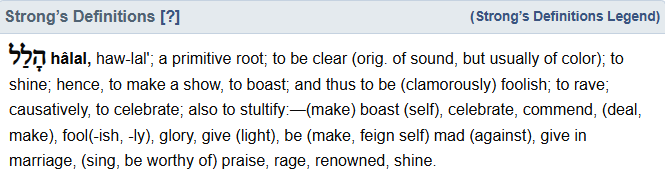
This morning, as I was just beginning to dig into this passage, I reviewed the word “praise” in the first verse, reading through the Strong’s definition.
Let me share with you what I found.
Did you notice what I noticed? See the reference to “foolish”? Strong’s dictionary defines this word to include the meaning of to be clamorously foolish, even to rave! “Clamorously” refers to that which attracts attention. Something is wrong here. To praise is not to make a fool of myself, is it?
I had to check another source. Let’s consider Gesenius Hebrew-Chaldee Lexicon. The fourth paragraph speaks the same.
The idea of praise in the Old Testament has an element of boasting (which I get) but, which surprised me, a boasting to the extent of appearing foolish.
Why is this such a concern Carl?
A short confession may help my reader understand.
I am an introvert. Give me 8 – 12 hours of study, and I will walk away content and happy. Occasional bursts of emotion, though they may erupt in my heart and soul are “handled” until I can explain myself logically, or at least methodically. Does not the Scripture teach me that the Spirit Himself guides us into a life of self control? Am I not justified in “controlling” my praise to God, in bringing honor to Him while retaining my own?
How is a believer to reconcile this apparent tension. A self controlled believer or a boasting, clamorous fool. Is this a necessary conflict in my thinking? Am I making a mountain out of a molehill?
My friends – I think I have described a man above who seeks to protect his reputation to the detriment of the glory of God. I am the embodiment of a crusty old believer (I think of it as “mature”) that appears to have little or no joy. If God shows forth His greatness to a ol’ fool such as I, should I control that? Should I damp down that joy?
I can’t help thinking of a passage that has always somewhat bothered me.
2 Samuel 6:16 ESV – As the ark of the LORD came into the city of David, Michal the daughter of Saul looked out of the window and saw King David leaping and dancing before the LORD, and she despised him in her heart. 2 Samuel 6:20 …Michal the daughter of Saul came out to meet David and said, “How the king of Israel honored himself today, uncovering himself today before the eyes of his servants’ female servants, as one of the vulgar fellows shamelessly uncovers himself!” 2 Samuel 6:21 …David said to Michal, “It was before the LORD, who chose me above your father and above all his house, to appoint me as prince over Israel, the people of the LORD–and I will celebrate before the LORD.
Am I to act as Michal, or as David? Now that is disheartening! I know which of these characters I reflect. I am the controlled, contained, concerned Michal.
2 Samuel 6:22 will make myself yet more contemptible than this, and I will be abased in your eyes. But by the female servants of whom you have spoken, by them I shall be held in honor.”
David expressed his concern over Michal’s complaint by throwing his own honor (in her sight) under the bus for the sake of the Lord’s honor. Remember David was King of Israel, and he had risked it all for this position. Yet his concern over any honor he may loose was nonexistent.
David was led of the Spirit to worship God and openly show his love for God.
Regarding the self control I resort to when this topic of praise comes up, I am seeing that I have controlled the One who is to control me. Yes, He will, as I depend on Him, provide the strength to resist sinful behavior, providing a self control that honors Him. But any of this self control I exercise, that is any controlling of my heart expression when it comes to God’s glory and His goodness is simply a dampening, an extinguishing of Spirit led praise to God.
Paul saw me coming when he repeatedly wrote of this possibility in the believer
Ephesians 4:30 And do not grieve the Holy Spirit of God, by whom you were sealed for the day of redemption.
1 Thessalonians 5:19 Do not quench the Spirit.
For a brief moment this morning, join me is a prayer that as believers, we (I) would allow the goodness, the greatness, and the glory of the Lord to be expressed in our lives, even in a foolish way, a clamorous way, but only in a way that honors Him. That we (I) would show our love and amazement of the One on the throne, who hung on a cruel cross for us, clearly boasting as the Spirit leads, of His goodness and love for us, willing to sacrifice our own ego, self esteem, pride and reputation to the gutter for the sake of His honor being seen, even for a moment.
How this works out in our lives is up to the One who is over us. May we trust Him enough to follow even in this!
May His name be honored, and mine forgotten.
I fear I have departed from the text this morning, but this has been an unexpected illumination on my part. I will come back to Psalm 69:30-33 in our next posting.
My hope is that this series will offer my readers a chance to consider the names, characteristics and descriptions of our God in the Word.
The remaining Names of God in this series might be considered descriptors, or characteristics of the Lord. We have reviewed the three primary Names of God, along with nineteen compound Names of God in our previous posts. As we venture through these descriptors of our God, I hope we will recognize all the many characteristics of our God that we tend to take for granted.
The Word is truly rich with descriptions of the Living God, and this effort of searching in the Word was quite illuminating. He truly is the ultimate subject of the Word, and His revelation of self-descriptions, or the accolades offered Him by His priests, prophets, kings apostles and faithful truly is a blessing.
May the Name of the Lord be praised, and by thinking on His name, may you have a blessed day.
178
GOD MOST HIGH
Genesis 14:19 And he blessed him and said, “Blessed be Abram by God Most High, Possessor of heaven and earth;
This name of God has been addressed once previously, but the passage considered translated the as “the Most High God”, and it was addressed very early in our study, at the 6th posting. The post may be found at Names of God – EL ELYON (THE MOST HIGH GOD) – 6.
Although this is the same name in the Hebrew, the translators have decided to rearrange the terms, and given me an opportunity to consider the name God Most High.
The passage finds us with Abram after his victory over the kings in the Valley of Siddim. After the battle of the nine kings, where Chedorlaomer, and three of his allies crushed five smaller kings, he looted the area, picking up a certain fellow named Lot. This was definitely not an acceptable condition for Abram, so with 318 trained servants, he ran a night mission and rescued his nephew Lot.
Abraham actually didn’t simply sneak into the camp and steal Lot away under cover of darkness, but the passage speaks of Abraham pursuing the 4 kings as far as Dan, defeating them.
Get that? An old shepherd with 318 servants, trained though they be, attacked a coalition force of 4 armies, successful armies that were on their victory march back to their home country. Not only did Abraham have the hutzpah to attack, he found victory over this marauding force, rescuing Lot, recovering Lot’s possessions, along with the women and people of Sodom.
A fantastic story of a man rescuing his nephew, a nephew that took the best area to settle in, that seemed to have a selfish streak, and that is remembered only in relation to his uncle.
A tremendous foreshadowing of Another who left everything behind to save a selfish man!
After this testing and restoration of the family, a mysterious man shows up by the name of Melchizedek. I personally believe this was the Lord Jesus in a pre incarnate visit with His saint.
Upon this meeting, Abraham was in the presence of the Master, with Melchizedek blessing Abraham. Note the blessing carefully.
“Blessed be Abram by God Most High”
Ok, let’s think about this. Who was blessing Abram?
Melchizedek?
Melchizedek spoke the words, and therefore the blessing was by Melchizedek
God Most High?
Yet Melchizedek stated the blessing on Abram was by God Most High.
Seems to be obvious to me that Melchizedek, as God Most High was blessing Abram.
Jesus is God Most High!
I would love to hear of your favorite name, characteristic or description of the Living God. Please leave me a comment, and I will include it in the list!
Thanks again for coming to visit. I hope you found something of interest in this post and would appreciate a comment, to begin a discussion. If you know someone this blog may bless (or challenge), send them a link, so they may join us in our discussion.
Jesus in the Old Testament is a series of posts that will offer my readers a chance to consider pictures or shadows of Jesus in the Old Testament. As mentioned in the introduction to this series, some may be obvious, some may be not so obvious, and some may simply be a facet of the Lord those reading may not have considered previously.
I hope as we venture through this series, we will see the Lord in many wonderful pictures throughout the Old Testament.
SEEING JESUS IN
Balaam
Second Temptation
Numbers 22:18 But Balaam answered and said to the servants of Balak, “Though Balak were to give me his house full of silver and gold, I could not go beyond the command of the LORD my God to do less or more.
Matthew 4:7 Jesus said to him, “Again it is written, ‘You shall not put the Lord your God to the test.’”
In our first consideration of Balaam as a type or picture of the Lord, we find him resisting the initial offering of the king of Moab, fighting off the temptation, and successfully sending the Moabite servants back to Balak.
But Balak, like all tempters, is not to give up easily. He needs Balaam’s “talent” and sends more important folks to discuss with Balaam.
Let’s read the passage and consider how Balaam performs in this second tempation.
Numbers 22:15 Once again Balak sent princes, more in number and more honorable than these. Numbers 22:16 And they came to Balaam and said to him, “Thus says Balak the son of Zippor: ‘Let nothing hinder you from coming to me, Numbers 22:17 for I will surely do you great honor, and whatever you say to me I will do. Come, curse this people for me.’” Numbers 22:18 But Balaam answered and said to the servants of Balak, “Though Balak were to give me his house full of silver and gold, I could not go beyond the command of the LORD my God to do less or more. Numbers 22:19 So you, too, please stay here tonight, that I may know what more the LORD will say to me.” Numbers 22:20 And God came to Balaam at night and said to him, “If the men have come to call you, rise, go with them; but only do what I tell you.” Numbers 22:21 So Balaam rose in the morning and saddled his donkey and went with the princes of Moab.
Now before we get into this passage, lets remember this is the temptation that includes Balaam’s donkey chit chatting with him. Although super interesting, this portion of the passage will not be dealt with in this posting.
second Temptation
In this second temptation, Balak offers Balaam great honor and a blank check. He is not simply providing the diviner’s fees as in the last temptation. No no no. Balak offered him an incredible, though generic, offer.
Numbers 22:17 ….whatever you say to me I will do
Balaam, if anything in this passage, is not subtle. He pontificates on his ability to resist – I would suggest this is a great weakness – even as the offer of a blank check is provided.
Numbers 22:18 …”Though Balak were to give me his house full of silver and gold, I could not go beyond the command of the LORD my God to do less or more”.
Balaam’s response is awesome. Sounds really good, but I wonder. Why mention gold and silver unless it was on his mind? Could he not have simply said no, that Israel was blessed, and that God was in charge, that God was the One who determined Israel’s future?
Balaam begins to show his inner man, his desire for wealth and power in this temptation. The covering is dropping and his nature becomes a bit more evident than in the first temptation.
Yes Balaam rejected the temptation, but he also seemed to introduce an opportunity for the men of Moab to provide greater motivation for Balaam next time.
You know, I am wondering. Did Balaam actually resist the temptation here? As I read a bit further, and see that God becomes angry with Balaam, I have to ask myself – What is going on? Lets review the passage and check out verse 20 through 22 for some clues.
Numbers 22:20 And God came to Balaam at night and said to him, “If the men have come to call you, rise, go with them; but only do what I tell you.” Numbers 22:21 So Balaam rose in the morning and saddled his donkey and went with the princes of Moab. Numbers 22:22 But God’s anger was kindled because he went, …
What is it that Balaam did, per the passage above, that might have kindled the anger of the Lord?
You see, Balaam eventually ventured off to Moab with these fellas, but I don’t see where the men came to call on him. Notice in verse 20, that tiny word “if”. Notice that God placed a condition on Balaam’s release to venture off, but it seems Balaam, in his desire for houses full of gold, may have made an assumption he shouldn’t have. He simply rose and went.
God told Balaam to rise. Balaam rose in the morning.
God told Balaam to go with the princes of Moab. Balaam went with the men.
The only thing Balaam didn’t do was to wait for the men to come get him. The silence of the passage referring to the men coming to Balaam is deafening. Balaam simply wanted to go and he simply went.
If it wasn’t so sad, it would be funny, for Balaam used that “if” word in response to God’s restricting him while travelling
Numbers 22:34 ESV – Then Balaam said to the angel of the LORD, “I have sinned, for I did not know that you stood in the road against me. Now therefore, if it is evil in your sight, I will turn back.”
Again, Balaam did not simply bow to the Lord, admit his sin and turn back. Was there something in the circumstances that allowed Balaam to think his sin in travelling, without fulfilling the condition God set, was acceptable? Maybe he was simply looking for an opportunity to continue on his way, hoping for the allowance of God in his mission.
In summary, he refused the offer of the Moabites in verse 18, but told the men to stick around. Maybe God may change His mind, maybe he could work this situation. After that night, and knowing the condition God set, Balaam simply started travelling with the emissaries. Now he is asking if….
Numbers 22:34 … if it is evil in your sight, I will turn back.”
It turns out God did allow Balaam to venture into the lions den, into Moab and to face the tempter himself, Balak, the king of Moab.
Balaam, by his speech and teaching to the Moabites is looking relatively good. He is speaking of God’s blessing on Israel, and the refusal of cursing upon Israel. Yet he seems to be exhibiting the character traits of a self willed, greedy man.
Jesus, though, did not succumb to His second temptation, nor provide any long winded reasoning or excuse, but simply quoted God’s word. He exhibited the willingness to allow suffering to enter His life, and to not test God, but to be subject to the will of God.
Balaam sought the worlds riches, while Jesus rebuked His tempter. Note that this second temptation of the Messiah speaks of God’s blank check to the Messiah, of His care for the Messiah, of the angels at God’s beck and call for the sake of the Messiah.
Such commitment from the Father to the Son, and to think that that care was relinquished for our sake. Of course, the Father’s eye watched over the Son in every trial and terror, until the last, where the Son willingly suffered for our sakes.
He gave up this promise for us. He gave up all for us. He is so unlike Balaam. He is so unlike us.
Thanks again for coming to visit. I hope you found something of interest in this post and would appreciate a comment, to begin a discussion. If you know someone this blog may bless (or challenge), send them a link, so they may join us in our discussion.
My hope is that this series will offer my readers a chance to consider the names, characteristics and descriptions of our God in the Word.
The remaining Names of God in this series might be considered descriptors, or characteristics of the Lord. We have reviewed the three primary Names of God, along with nineteen compound Names of God in our previous posts. As we venture through these descriptors of our God, I hope we will recognize all the many characteristics of our God that we tend to take for granted.
The Word is truly rich with descriptions of the Living God, and this effort of searching in the Word was quite illuminating. He truly is the ultimate subject of the Word, and His revelation of self-descriptions, or the accolades offered Him by His priests, prophets, kings apostles and faithful truly is a blessing.
May the Name of the Lord be praised, and by thinking on His name, may you have a blessed day.
177
GOD MANIFEST IN THE FLESH
1 Timothy 3:16 Great indeed, we confess, is the mystery of godliness: He was manifested in the flesh, vindicated by the Spirit, seen by angels, proclaimed among the nations, believed on in the world, taken up in glory.
I have a friend down south who stated this passage was his very favorite verse of the entire Bible.
The entire Bible.
That is some claim, and he certainly used it in many contexts, but his favorite context was when we were evangelizing on the streets, in the winter, while the temps were -20 to -30 degrees, on Tuesday nights.
No-one left their warm homes during the winter, especially on a Tuesday night (for some unknown reason), and we were occasionally asked in as a gesture of kindness. Sometimes the invite was due to curiosity, for we clearly represented ourselves immediately as Christian believers sharing the gospel of Christ.
Prior to knocking, we would always decide which of us would speak, and which of us would pray, and as this one night I will speak of progressed, my brother took this verse and shared a mystery with a young family.
He spoke of God being in the flesh. He really labored on this phrase, for he sought to make Jesus understood for who He is, and not some generic, run of the mill Rabbi, or teacher, or prophet. He labored in making the point that Jesus was not simply a good man, but that He was God in the flesh.
Now if you spend just a moment considering this phrase, hopefully you will come to the same conclusion Paul suggested as he began this verse..
This truth, that Jesus was (and is) God in the flesh is a great mystery. How could God be “in the flesh”?
Sometimes in the New Testament, to be “in the flesh” is synonymous with living in the sinful nature, or to be fleshly, earthy and natural. Surely this is not the message Paul is giving out, for he speaks of the Messiah as being vindicated by the Spirit, that He was the worthy Lamb of God.
So what is Paul getting at? What is so mysterious?
The mystery, at least in this verse, is that Paul is speaking of how God saves sinners, that is, God saves sinners through the Christ, that God’s Messiah was not just a very good man, but that He was God in the flesh, in a human body.
That really is a mind blowing truth.
Now, for context, a mystery for those of the first century, referred to something that had been hidden, that had not been understood, or even considered, but that was now a known truth.
So let me try to summarize.
God’s method of saving lost souls is through His taking on of human flesh, with all the limitations, pains, weakness, fears, pressures and trials of the human experience.
God’s method of saving lost souls is through Jesus, accepting the condition of humanity forever, and dying to bring us to God.
Jesus is God manifest in the flesh!
That night, a friendly family who invited us in for some warmth, were given a mystery, a message revealed that is truly magnificent, and after 30 years, still rings in my ears.
He is God manifest in the flesh!
I would love to hear of your favorite name, characteristic or description of the Living God. Please leave me a comment, and I will include it in the list!
Thanks again for coming to visit. I hope you found something of interest in this post and would appreciate a comment, to begin a discussion. If you know someone this blog may bless (or challenge), send them a link, so they may join us in our discussion.
My wife and I are reading through the Psalms in our evening reading and occasionally a nugget of the Psalms jumps out of the page. Don’t you love it when, after years of reading the “Old Book” passages become alive, reinforcing old teachings or simply warming your heart.
This is the book of Psalms, and it is rich.
I pray I can communicate a portion of the blessing we receive from this wonderful book.
Psalm 69 is a psalm of sorrow, of apparent defeat and deep emotional stress, of a distress in the heart and of being overwhelmed, of a weariness of soul, and of a waiting for an answer from God. It is a psalm that speaks of loneliness, of disappointment and of extended trials.
As we venture through the psalmist’s deep confession, his pain and his sorrow, we will encounter passages that will be referred to in the New Testament, providing a recounting of the sorrow of Jesus.
Let’s read a single solitary verse of this revealing psalm.
Psalm 69:29 But I am afflicted and in pain; let your salvation, O God, set me on high!
In our previous passage, we attempted to understand some very difficult portions of this psalm. Condemnation of the enemy, blotting out those men from the book of life, adding punishment upon punishment upon his enemies.
Tough stuff to read, and even tougher to understand. In the midst of those prayers, I still am not convinced of the motivation of the saint writing such difficult verses. Was it that the psalmist wished such harsh judgement to fall on the enemy, or that he expected such harsh judgement to fall on the enemy.
There is a difference! But I will leave that to my reader friend.
Let us consider the psalmist as he turns a corner in his mind, as he speaks clearly of his condition, and of his response to God in the midst of his own condition.
Afflicted
For us modern believers, to be afflicted usually has the meaning of a persecution, of a trial to be endured, or of a persistent suffering. For the Hebrew saint, to be afflicted focuses on poverty, a depression of mind or circumstances, humility and weakness. A state of being that exemplified a lowly state, a state of being needy.
David was at his lowest in this psalm, and yet the surrounding of his enemies may not be the reason he is lamenting this affliction he speaks of. At this point in the psalm, he may have caught sight of his own spiritual poverty. More on this in our next definition.
Personally, I will admit that whenever I venture off into judgy-judge land, where my opinion is the law, and I freely condemn anyone who thinks or does otherwise, I eventually wake up from my stupor to realize how impotent and weak I am, how I have only reflected my own weakness onto others and then judged them to feel better about myself.
It was years ago, I was reading a small book on judgement, and a phrase out of that book has worked itself into my mind. The saint can do two things. Judge others (by that I mean condemn others) or Love others. What the Psalmist went through in the previous verses may have exposed his poverty, weakness and need to himself, and because of this, brought about this realization of his own heart.
As I said above, the previous passage is tough, and my understanding of the psalmist surely needs guidance.
In Pain
Previously, I mentioned that after all the judging the psalmist may have entered into – that is, if the Psalm reflects his wishes as opposed to his expectations – he may have “woke up” and realized he is, at his core, one and the same as those he judged. In this very verse, he may be in the middle of catching sight of his own spiritual poverty (affliction) and pain.
For the Hebrew reader, this word “pain” brought to mind physical and/or mental pain, and is associated with sorrow and grieving. Again, this may be a stretch for some, but I think he may be speaking of his own condition before God, a confession of his own heart.
How deep is the darkness, that when we lash out, we find that after, if we are honest, we must recognize that which we condemned, is that which we take part in, that which we might even love. It is these times when the honest saint will break, when tears are welcomed, when the pain is experienced, and we freely admit to a Holy and Righteous God that we are not worthy to be His subjects, nor could be. It is those times when the darkness of our own desires and experience is revealed, it is at those times that the light of the gospel is utterly, painfully blinding!
He is the Lord who provides light in darkness.
2 Corinthians 4:6 For God, who said, “Let light shine out of darkness,” has shone in our hearts to give the light of the knowledge of the glory of God in the face of Jesus Christ.
For that, we should be ever so thankful. When light shines out of darkness, it is inevitable that hidden things will be revealed. When hidden things are revealed, this will cause, for the honest saint, a self realization of utter poverty, combined with a deep sorrow towards the Lord.
If you are experiencing some self reflection that is difficult to handle, look to the source of light, not your own heart. He is the light. He is our salvation. He will lift us up, though we are lowly, poor and destitute. And when light shines in darkness, affliction and pain can be experienced. It is this repentance we need to agree to in order to maintain and grow in our life in Christ.
My hope is that this series will offer my readers a chance to consider the names, characteristics and descriptions of our God in the Word.
The remaining Names of God in this series might be considered descriptors, or characteristics of the Lord. We have reviewed the three primary Names of God, along with nineteen compound Names of God in our previous posts. As we venture through these descriptors of our God, I hope we will recognize all the many characteristics of our God that we tend to take for granted.
The Word is truly rich with descriptions of the Living God, and this effort of searching in the Word was quite illuminating. He truly is the ultimate subject of the Word, and His revelation of self-descriptions, or the accolades offered Him by His priests, prophets, kings apostles and faithful truly is a blessing.
May the Name of the Lord be praised, and by thinking on His name, may you have a blessed day.
176
GOD AT HAND
Jeremiah 23:23 “Am I a God at hand, declares the LORD, and not a God far away?
I used to go to a church where the general attitude was that the sanctuary was a bit holier than the hallway leading up to it. I bought into that for years, mostly out of well meaning peer pressure.
I can hear myself telling my kids that they need to be quiet, not run around, or chase their friends in the sanctuary. Of course this was appropriate during the church service, but even when I went in that area after church, or before prayer meeting, I naturally spoke softer, tried to sin less, and generally figgered God was watching, even in the room.
My adjusting of my actions due to being in the sanctuary is something similar to what Jeremiah is speaking of with the Jewish folk of his time. Many of the prophets, those lying prophets, who were contemporary to Jeremiah, spoke of God being more influential in the Temple, that the Temple was the center of God’s influence and the farther from the Temple, the farther from God. Convenient for these prophets if they could control where the influence might be found! And maybe set up shop, or a little knickknack stand. But I digress!
Jeremiah needed to fix this thinking!
Jeremiah agrees with the teaching of God being at hand, but he expands the idea to describe a God who is afar off, a God who is not restricted to a temple, or a sanctuary.
As a God at hand, those of us in the New Testament church realize even this description has been expanded, redefined and deepened. For God is not only a God at hand, who is with us in our trials and tribulations, in our joys and victories, but for us modern believers, He is a God who is within us, always ministering to our concerns, our hopes, our needs, and our fears.
He is a God at Hand, and for that we are thankful, and yet He is so much more. Thank you Jesus!
I would love to hear of your favorite name, characteristic or description of the Living God. Please leave me a comment, and I will include it in the list!
Thanks again for coming to visit. I hope you found something of interest in this post and would appreciate a comment, to begin a discussion. If you know someone this blog may bless (or challenge), send them a link, so they may join us in our discussion.
Jesus in the Old Testament is a series of posts that will offer my readers a chance to consider pictures or shadows of Jesus in the Old Testament. As mentioned in the introduction to this series, some may be obvious, some may be not so obvious, and some may simply be a facet of the Lord those reading may not have considered previously.
I hope as we venture through this series, we will see the Lord in many wonderful pictures throughout the Old Testament.
SEEING JESUS IN
Balaam
First Temptation
Numbers 22:13 So Balaam rose in the morning and said to the princes of Balak, “Go to your own land, for the LORD has refused to let me go with you.”
Matthew 4:4 But he answered, “It is written, “‘Man shall not live by bread alone, but by every word that comes from the mouth of God.’”
Balaam was a non Israelite prophet that is reknown as a man with an evil (greedy) eye, of a prophet who forsook the way of righteousness, and that loved the wages of unrighteousness. His greatest failing was that of providing Balak cousel to cripple Israel though committing fornication and to eat things sacrificed to idols. Revelation 2:14.
Peter also has some very harsh things to say about this man.
In all of Balaam’s moral failings and apostacy, he remains a type of Christ in a number of surprising ways.
In Numbers 22 & 23, we find a prophet of God by the name of Balaam being approached by the king of Moab. It seems the people of Israel were causing Balak, the king of Moab some concerns as they camped in the plains of Moab. That Moabite king needed to take care of those Israelites before they became to powerful. The entire nation was in dread of the Israelites! What could be done?
The Israelites had dominated the Amorites, and the Moabites realized they needed an alternative approach. Enter the prophet Balaam, a non Israeli who was known as a prophet of God, and that Balak hoped he could hire for service.
Three times Balak tempted Balaam to curse the nation of Israel. Three temptations, three refusals. In the final temptation, Balak took Balaam to a high place to look down on Israel and curse them. Each time Balaam blessed them. (sort of)
First temptation
Numbers 22:6 Come now, curse this people for me, since they are too mighty for me. Perhaps I shall be able to defeat them and drive them from the land, for I know that he whom you bless is blessed, and he whom you curse is cursed.” Numbers 22:12 God said to Balaam, “You shall not go with them. You shall not curse the people, for they are blessed.” Numbers 22:13 So Balaam rose in the morning and said to the princes of Balak, “Go to your own land, for the LORD has refused to let me go with you.”
The portion of Scripture I want to draw your attention to is the response Balaam has for Balak. Balaam was not allowed to go anywhere with the servants of Balak, for God directed him to stay back. The message Balaam provided the men of Moab was directly from God.
At this point in the story, Balaam is looking better than average, and has rejected the temptation of the king of Moab. The tempters Balak had sent had the fees of divination in their possession to assist Balaam in making a positive decision, yet he stood strong.
Numbers 22:7 So the elders of Moab and the elders of Midian departed with the fees for divination in their hand. And they came to Balaam and gave him Balak’s message.
Jesus, as He was tempted by the Adversary to change a rock into food, also rejected a self serving temptation, but note the difference.
Balaam only referred to himself, of God’s refusal to allow him to go with them. Nothing about the reason for not going, or that Israel was blessed unconditionally. Just that he can’t go. Nothing regarding the reason for this denial of service.
Not so with Jesus. His rejection of temptation provided no “out” for the tempter, no opportunity to find a crack to leverage for the next temptation.
Jesus referred to the written Word of God in rebuking the devil. Balaam, on the other hand, provided a message to Balak, the tempter, couched in terms of refusal, as if Balaam wanted to go, but had to stay back. He also provided a somewhat modified message of God from the message he received.
This difference provides insight for our own victory over temptation. Jesus did not mince words about His rejection of the temptation, but referred to the spoken and written Word of God. Balaam, though victorious over the temptation, seemed to be destined to allow some wiggle room.
Thankfully this was not the attitude of our Savior!
Thanks again for coming to visit. I hope you found something of interest in this post and would appreciate a comment, to begin a discussion. If you know someone this blog may bless (or challenge), send them a link, so they may join us in our discussion.
My hope is that this series will offer my readers a chance to consider the names, characteristics and descriptions of our God in the Word.
The remaining Names of God in this series might be considered descriptors, or characteristics of the Lord. We have reviewed the three primary Names of God, along with nineteen compound Names of God in our previous posts. As we venture through these descriptors of our God, I hope we will recognize all the many characteristics of our God that we tend to take for granted.
The Word is truly rich with descriptions of the Living God, and this effort of searching in the Word was quite illuminating. He truly is the ultimate subject of the Word, and His revelation of self-descriptions, or the accolades offered Him by His priests, prophets, kings apostles and faithful truly is a blessing.
May the Name of the Lord be praised, and by thinking on His name, may you have a blessed day.
175
GOD ALMIGHTY
Genesis 35:11 And God said to him, “I am God Almighty: be fruitful and multiply. A nation and a company of nations shall come from you, and kings shall come from your own body.
Granted this name of God is essentially the same Hebrew word construction, but with the English equivalent name being reordered, I simply couldn’t resist considering it one more time.
In our passage this morning, God appears to Jacob, renaming him Israel, and speaking to this newly named saint that he was to be fruitful, that he was to multiply his seed throughout the land. Not only was Israel to have abundant offspring, this offspring would become a nation, with other nations splitting off from the core. To top it off, kings would be produced through Israel’s family.
Let’s remember that Jacob was a shepherd, a man who worked with his hands, and schemed with his mind. Was he not a man of the fields, using a stone for a pillow, and watching over his sheep?
He was a man who had done some nasty things to those closest to him, and had lost contact with his family due to his selfish decisions. Had he not been on the run from a brother who had committed to killing him?
Now the Lord shows up and tells him he is of royal lineage, that his family will become a nation. Of course, as he grew up under his father Isaac, he must have heard of the promises given to Abraham, and he had been personally visited by God. This word from God should not have surprised him. God is faithful, but Jacob had not been a stellar fella!
Nevertheless, God was present and He identified as God Almighty. Not as the God who had great ability, or that He was stronger than most, but that He was almighty. He had all might, and His resources could not be depleted.
Consider that when you sense you have asked for too much from God, or that you are too much of a burden on God, or that your situation is too difficult to solve for God.
Jacob, by this time had advanced in years, had raised a family, had renewed his relationship with his only brother, and was about to visit his father Isaac for the last time. The command to be fruitful was given to the patriarch Israel as a reminder to continue to grow, to advance, to increase in size and impact upon the world. He would be the father of a nation that would be led, and rescued by God, and that would produce the Savior.
He is God Almighty, and for one elderly man who had stumbled through life with dubious decisions and poor lifestyle choices, God was still on the throne and able to perform great and mighty, dare I say Almighty things.
For He is God Almighty.
I would love to hear of your favorite name, characteristic or description of the Living God. Please leave me a comment, and I will include it in the list!
Thanks again for coming to visit. I hope you found something of interest in this post and would appreciate a comment, to begin a discussion. If you know someone this blog may bless (or challenge), send them a link, so they may join us in our discussion.
My wife and I are reading through the Psalms in our evening reading and occasionally a nugget of the Psalms jumps out of the page. Don’t you love it when, after years of reading the “Old Book” passages become alive, reinforcing old teachings or simply warming your heart.
This is the book of Psalms, and it is rich.
I pray I can communicate a portion of the blessing we receive from this wonderful book.
Psalm 69 is a psalm of sorrow, of apparent defeat and deep emotional stress, of a distress in the heart and of being overwhelmed, of a weariness of soul, and of a waiting for an answer from God. It is a psalm that speaks of loneliness, of disappointment and of extended trials.
As we venture through the psalmist’s deep confession, his pain and his sorrow, we will encounter passages that will be referred to in the New Testament, providing a recounting of the sorrow of Jesus.
Psalm 69:22 Let their own table before them become a snare; and when they are at peace, let it become a trap. Psalm 69:23 Let their eyes be darkened, so that they cannot see, and make their loins tremble continually. Psalm 69:24 Pour out your indignation upon them, and let your burning anger overtake them. Psalm 69:25 May their camp be a desolation; let no one dwell in their tents. Psalm 69:26 For they persecute him whom you have struck down, and they recount the pain of those you have wounded. Psalm 69:27 Add to them punishment upon punishment; may they have no acquittal from you. Psalm 69:28 Let them be blotted out of the book of the living; let them not be enrolled among the righteous.
Difficult. This passage is simply very difficult to understand. How can we understand this passage that appears to be praying for vengeance, pain, judgement and suffering on those who are the psalmist’s foes. This passage just seems to be so human, so judgmental, so full of seeking God to punish others.
Let’s consider verse 26 first, try to understand the reason for this prayer, and then return to this general understanding of the passage as a whole
Psalm 69:26 For they persecute him whom you have struck down, and they recount the pain of those you have wounded.
A long time ago, a Bible teacher I listened to would always remind me to ask the question, “What is the “therefore” there for in a passage? A similar question can be applied for verse 26. What is the “for” there for?
When a sentence starts with “for”, it indicates purpose or reason for the statement to follow. We could replace “for” with “because’, or “since” or “seeing”. The psalmist is giving us the reason for his complaint, for the seeming vicious judgement he wishes would pour down on his adversaries.
Ok, grammar lesson over, and let’s consider why the psalmist is praying for judgement to be unleashed on others.
Two reasons
1. They persecute him whom you have struck down
The first reason for this judgement to be sought after was that the enemies persecuted the author who was already at a low point, one who was under difficult times.
Per Strong’s concordance, this term of persecution may principally communicate a chasing after the victim, hunting the victim down, pursuing him and causing him no rest. The enemy is chasing the psalmist, even while he is at his weakest point, with God having struck him down.
Let’s be clear here. Two actions are being described here.
God has “struck” this saint down. The term speaks of being smitten, beaten, scourged, destroyed punished, even killed. This is no slight inconvenience on the psalmist!
On top of this, the enemy, seeing advantage in the psalmist’s weakened condition, continues chasing him, persecuting, harassing him.
No relief! Constant pressure!
2. They recount the pain of those you have wounded
Beyond this physical suffering of the saint, the second reason for our psalmist to seek judgement on his foes is that they speak of his pain, of the action of God on his life, on those who are under the hand of God.
After understanding our first reason, the persecution of man and smiting of God, this recounting of suffering seems to be somewhat insignificant. It is simply the telling of a condition the saint is under.
But consider. Being under the hand of God, and having everyone know about it due to someone speaking of it, only doubles the pain. There have been times where I have been the topic of gossip, the recounting of a “truth” that was not very positive about my life. The sting, the embarrassment, the hanging of my head, only helps me to identify with this reason for vengeance. In my heart and head, I have to admit I sought damage on those spreading “truth” about me, about God’s displeasure of me.
Consider this condition in a shame based culture like the Old Testament saint lived in. Multiply the sense of dread and embarrassment many fold, and then the effect may approach the truth of this saint’s condition.
Ok, so we have considered why the psalmist is praying this prayer regarding his enemies, and throughout this short study, I have implied that the psalmist wishes (or prays for) judgement to fall on those who persecute him and speak of his troubles. This may very well be true.
Yet a possible approach to this difficult portion of Scripture may be that the psalmist is recounting what he expects to happen as the just recompence of the outworking of the law on his enemies.
Let me explain.
Yes it appears the psalmist has evil intent, that his heart is full of hatred on his enemies, and this may be the correct interpretation. There are many times in the Word where we see the sinful side of man being exposed, recorded for our learning (and warning).
But I do pause on this way of approaching this passage, only due to the way the apostles considered verse 25.
Psalm 69:25 May their camp be a desolation; let no one dwell in their tents.
Luke writes of Peter reaching back into this psalm in referring to Judas end condition.
Acts 1:20 “For it is written in the Book of Psalms, “‘May his camp become desolate, and let there be no one to dwell in it’; and “‘Let another take his office.’
Therefore, let’s recount the end of Judas.
Judas, by all accounts, took his own life, shortened his life, and caused his “camp” to be desolate. He left this world with no descendants, and the prayer of the psalmist found fulfillment in a disciple of Jesus.
This action of Judas was self inflicted, for the last thing Jesus did towards Judas was call him “friend”.
Matthew 26:50 Jesus said to him, “Friend, do what you came to do.” Then they came up and laid hands on Jesus and seized him.
Might the psalmist be speaking of the decisions and lifestyle of the enemy causing the judgement of God to be passively worked out in their lives?
Maybe. Maybe not. Simply a thought experiment for my reader to consider.
Yet this passage does speak of the judgement rightly deserved on those who persecute the Righteous One, the One who was smitten and struck down, wounded for our sakes. Verse 26 speaks of One who suffered, of One who was weakened and gossiped about, Who was taken advantage of, persecuted, smitten and scourged. He suffered, accepting this suffering, taking the pain, the shame and the judgement. He was placed in a tomb, by Himself, under the social stain of the “truth” of his legal conviction by the state.
Judgement should rightly fall on those whose heart and mind would have joined those who condemned Him. Judgement should rightly fall on me.
But He is a Savior like no other, and His substitution on my behalf is a fact I cannot get over, nor wish to. May His name and not mine, be honored today.
His name is Jesus, and He is beyond all explanation and understanding.
My hope is that this series will offer my readers a chance to consider the names, characteristics and descriptions of our God in the Word.
The remaining Names of God in this series might be considered descriptors, or characteristics of the Lord. We have reviewed the three primary Names of God, along with nineteen compound Names of God in our previous posts. As we venture through these descriptors of our God, I hope we will recognize all the many characteristics of our God that we tend to take for granted.
The Word is truly rich with descriptions of the Living God, and this effort of searching in the Word was quite illuminating. He truly is the ultimate subject of the Word, and His revelation of self-descriptions, or the accolades offered Him by His priests, prophets, kings apostles and faithful truly is a blessing.
May the Name of the Lord be praised, and by thinking on His name, may you have a blessed day.
174
GLORY OF THEIR STRENGTH
Psalm 89:17 For you are the glory of their strength; by your favor our horn is exalted.
Let us consider this phrase, this name of God and what it is communicating, at least to this ol’ believer.
The psalmist is speaking of the saints strength, and that this strength they have is due to the might of God in their lives. In all the saint’s life, all is due to God, the very breath we breath and the ability to trust Him. all is due to the Living God.
But this phrase is not speaking primarily of the strength of the people, the sustaining might provided to the saint to walk properly though crippled. That is a truth that is known to the psalmist, for he is drenched in this truth.
No, for the psalmist goes further, speaking of the glory, the beauty and the honor of this strength granted to the saint. The strength provided to the saint is not brute force, nor a violent dangerous, and hurtful strength, not a careless and uncontrolled strength, but a strength that is exhibited in a glorious life, a life that is adorned with a beauty and splendor.
The strength of the Lord in the saint’s life is that which exudes love, joy, peace, patience, kindness, goodness, faithfulness, gentleness and self-control. It is a life that is full, gracious, forgiving and bountiful with thanksgiving.
The glory of the saint’s strength is Jesus.
I would love to hear of your favorite name, characteristic or description of the Living God. Please leave me a comment, and I will include it in the list!
Thanks again for coming to visit. I hope you found something of interest in this post and would appreciate a comment, to begin a discussion. If you know someone this blog may bless (or challenge), send them a link, so they may join us in our discussion.
Jesus in the Old Testament is a series of posts that will offer my readers a chance to consider pictures or shadows of Jesus in the Old Testament. As mentioned in the introduction to this series, some may be obvious, some may be not so obvious, and some may simply be a facet of the Lord those reading may not have considered previously.
I hope as we venture through this series, we will see the Lord in many wonderful pictures throughout the Old Testament.
SEEING JESUS IN
ABIATHAR
REJECTION
1 Kings 2:27 ESV – So Solomon expelled Abiathar from being priest to the LORD, thus fulfilling the word of the LORD that he had spoken concerning the house of Eli in Shiloh.
Matthew 21:42 Jesus said to them, “Have you never read in the Scriptures: “‘The stone that the builders rejected has become the cornerstone; this was the Lord’s doing, and it is marvelous in our eyes’?
I would like to return to Abiathar for one more post, for though he reflected Jesus as a survivor, (Jesus in the Old Testament – Abiathar – 01) he also reflects the Lord’s experience as one rejected.
Remember that Abiathar was a priest that had narrowly escaped the wrath of a crazy king, but in his latter days, he made a decision that was not in his own favor. In the last days of David’s reign, Abiathar decided to break away from his king to follow Adonijah. The rebel son who sought to become King Solomon’s enemy. The son of David who saw his brother Absalom succumb to the hand of God in protecting the reign of David, also tried to wrest the kingdom away.
David’s reign and dynasty was to be extended through Solomon, but Adonijah saw opportunity, and Abiathar got caught up in the possibility of a King Adonijah
All of this history speaks of Abiathar’s mistakes, his ungratefulness, his treachery to the reign of God through David, yet he was rejected by the king, rightfully so, but rejected!
A priest rejected by a king. How shameful!
Jesus, as a priest above and beyond the mere earthly honor of Abiathar, performed no self serving lining up with an earthly political flashpoint, but served God only in His faithful life. He is nothing like Abiathar in this priest’s efforts to gain office through treachery, yet they both suffered rejection, shame and dishonor.
Only how much greater shame the Son of God experienced, for though Abiathar deserved the shame, Jesus only deserves honor, glory and splendor. For His name to be associated with shame, rejection and dishonor only reflects on us, a people who truly do not understand the greatness of the Son!
Honor and accept His ways, for He is beyond our imagination in the goodness He will guide us into.
Thanks again for coming to visit. I hope you found something of interest in this post and would appreciate a comment, to begin a discussion. If you know someone this blog may bless (or challenge), send them a link, so they may join us in our discussion.
My hope is that this series will offer my readers a chance to consider the names, characteristics and descriptions of our God in the Word.
The remaining Names of God in this series might be considered descriptors, or characteristics of the Lord. We have reviewed the three primary Names of God, along with nineteen compound Names of God in our previous posts. As we venture through these descriptors of our God, I hope we will recognize all the many characteristics of our God that we tend to take for granted.
The Word is truly rich with descriptions of the Living God, and this effort of searching in the Word was quite illuminating. He truly is the ultimate subject of the Word, and His revelation of self-descriptions, or the accolades offered Him by His priests, prophets, kings apostles and faithful truly is a blessing.
May the Name of the Lord be praised, and by thinking on His name, may you have a blessed day.
173
GLORY TO YOUR PEOPLE ISRAEL
Luke 2:32 a light for revelation to the Gentiles, and for glory to your people Israel.”
In a post in this series, the Name of God we considered was “Glory of Israel”, and Samuel was addressing King Saul, trying to get through his head that he wasn’t the glory of Israel, he wasn’t the strength or supreme eminence of Israel, and that his throne was not perpetual – As a matter of fact, his kingdom had been taken from him.
Flash forward over 1,000 years into the future from the rejection of the earthly reign of King Saul to the birth of a young peasant girl’s first born.
Mary and Joseph arrive at the temple, with the child being 40 days old for his presentation before the God of Israel when Simeon first laid eyes on this baby. Now it seems God had somehow communicated to Simeon that he would see the salvation of the “Lord’s Christ”. This is no small event that Simeon had been privileged to enter into. The focus of all the prophets, seers, priests and faithful of Israel and beyond had waited for this day, the day when the Savior would be revealed to the world.
Did Simeon have preconceptions? Was he informed by God that he would recognize the Messiah in the form of a baby? Might he have thought that the Messiah would be a man of power that would rise up in the nation, with God providing verification to him at the right time? Even anointed as David was, though somewhat in obscurity until the right time?
All conjecture, but for myself, to think that Simeon would make such a statement over a baby as he did, after waiting to see the “Lord’s Christ”, the Anointed of God, is remarkable.
Jesus spoke no words. He provided no message. He had performed no miracles. He was a helpless baby, dependent upon his parents, held close to his mothers heart. Mary had treasured up many things, pondering truths revealed to her in her heart. Joseph had been spoken to, and now Simeon comes out of the woodwork, speaking of the person of this baby.
Even at His birth, those of the nascent church recognized truth without any argument, without any “evidence” required. They heard the voice of God and knew this baby was the One.
He was, and is, the glory offered to the nation of Israel. Even as the nation of Israel was in the throws of it’s deepest idolatry and legalism, God’s greatest gift was provided to the nation, and not only the nation, but to the world. And one more voice, the voice of an elderly man, was added to the list of witnesses that spoke of salvation from God in the form of a baby.
To those who have yet to trust Him, His person, His words, and His works, glory has also been offered. To those who know not God, glory is offered.
Yet note that Simeon spoke of glory being offered to “your” people Israel. Simeon spoke of glory being offered to Israel, the people of God. They had no idea of the explosive, blinding glory they would experience as His life was lived before them.
Beyond His life, His resurrection only multiplied and magnified the glory they experienced during His life amongst them. Glory upon glory to a people who rejected Him, and yet were offered greater glory than they could have ever imagined!
He truly is good, and He is truly good all the time!
I would love to hear of your favorite name, characteristic or description of the Living God. Please leave me a comment, and I will include it in the list!
Thanks again for coming to visit. I hope you found something of interest in this post and would appreciate a comment, to begin a discussion. If you know someone this blog may bless (or challenge), send them a link, so they may join us in our discussion.
My wife and I are reading through the Psalms in our evening reading and occasionally a nugget of the Psalms jumps out of the page. Don’t you love it when, after years of reading the “Old Book” passages become alive, reinforcing old teachings or simply warming your heart.
This is the book of Psalms, and it is rich.
I pray I can communicate a portion of the blessing we receive from this wonderful book.
Psalm 69 is a psalm of sorrow, of apparent defeat and deep emotional stress, of a distress in the heart and of being overwhelmed, of a weariness of soul, and of a waiting for an answer from God. It is a psalm that speaks of loneliness, of disappointment and of extended trials.
As we venture through the psalmist’s deep confession, his pain and his sorrow, we will encounter passages that will be referred to in the New Testament, providing a recounting of the sorrow of Jesus.
Psalm 69:19 You know my reproach, and my shame and my dishonor; my foes are all known to you. Psalm 69:20 Reproaches have broken my heart, so that I am in despair. I looked for pity, but there was none, and for comforters, but I found none. Psalm 69:21 They gave me poison for food, and for my thirst they gave me sour wine to drink.
It has been said that this passage is amongst the deepest pleas for mercy in the Old Testament. David is hitting rock bottom, and expressing a complete helplessness and hopelessness, a condition that repeats the first few verses but has the sense of a deeper exposing of the grief and despair of the subject.
Reproach
Reproach is a common refrain in this psalm.
Psalm 69:7 For it is for your sake that I have borne reproach, that dishonor has covered my face. Psalm 69:9 For zeal for your house has consumed me, and the reproaches of those who reproach you have fallen on me. Psalm 69:10 When I wept and humbled my soul with fasting, it became my reproach. Psalm 69:19 You know my reproach, and my shame and my dishonor; my foes are all known to you. Psalm 69:20 Reproaches have broken my heart, so that I am in despair. I looked for pity, but there was none, and for comforters, but I found none.
The Hebrew term is חֶרְפָּה cherpâh and includes the concepts of disgrace, rebuke and shame.
Shame
This is the only occurrence of shame in this psalm, and the Hebrew term is בֹּשֶׁת bôsheth. This term includes the concepts of confusion and shame, and is associated sometimes with idols, the object of shame for an Israelite. Shame, for the modern world is such that it is ignored, an emotion that is considered to be rejected as opposed to accepted and trained from. How often has our modern society taken a topic that is shameful, even just decades ago, and turned the topic into a discussion of those brave to enter into a shameful life decision. This rejection of the painful emotion of shame is not to anyone’s benefit. We, as a modern society have lost much honor by rejecting shame in our society.
The Hebrew culture was a shame based culture, and to be inflicted with shame was to enter into a condition that may effectively remove you from the social order, from business associations, from family and loved ones, who sought to uphold the social fabric of their community.
Shame, when accepted due to sinful activities performed by the subject, should produce repentance and possibly allow for reentrance in to the social order. At the very least, right living after repentance would be the fruit of accepting and responding to shame in a godly way.
On the other hand, shame laid on a person due to libel, gossip, slander defamation and lies is not something that can be responded to by the victim. Repentance is not necessary, or even available as a tool to repair the damage. The lies and vilification of the enemy stick to the victims character, and even in the best situations, some of the slander will never be removed from the social conscience.
Dishonor
Our third term is the Hebrew word כְּלִמָּה kᵉlimmâh, and it is mentioned twice within our Psalm.
Psalm 69:7 For it is for your sake that I have borne reproach, that dishonor has covered my face. Psalm 69:19 You know my reproach, and my shame and my dishonor; my foes are all known to you.
This term includes the concepts of insult, reproach, shame, confusion and ignominy.
As you have read through this short study, I am sure you have recognized the three terms we have looked at all describe the basic concept of shame.
David was experiencing a depth of shame in his condition that bared repeating in three different shades of meaning. For a king of Israel, the man after God’s own heart, to experience shame within the culture should speak volumes to the modern believer. It is not always the way of the Christ to walk in apparent honor within the social order, though we are not to bring the shame upon ourselves or family, or the church by willful sin and rebellion. Yet our enemy may fling accusations and slander to create the illusion of dishonor on our lives. Let us remember the counsel of Peter in regards to suffering, even of undeserved shame.
1 Peter 3:14 But even if you should suffer for righteousness’ sake, you will be blessed. Have no fear of them, nor be troubled,
1 Peter 3:17 For it is better to suffer for doing good, if that should be God’s will, than for doing evil.
Of course, we are to look to the Master in all areas of our life, and as David poured out his heart, helpless in his circumstance, we too may also cry out to the One who hears, and can restore in His time. For of all those who have walked this earth, He alone has suffered the greatest undeserved shame.
1 Peter 3:18 For Christ also suffered once for sins, the righteous for the unrighteous, that he might bring us to God, being put to death in the flesh but made alive in the spirit,
My hope is that this series will offer my readers a chance to consider the names, characteristics and descriptions of our God in the Word.
The remaining Names of God in this series might be considered descriptors, or characteristics of the Lord. We have reviewed the three primary Names of God, along with nineteen compound Names of God in our previous posts. As we venture through these descriptors of our God, I hope we will recognize all the many characteristics of our God that we tend to take for granted.
The Word is truly rich with descriptions of the Living God, and this effort of searching in the Word was quite illuminating. He truly is the ultimate subject of the Word, and His revelation of self-descriptions, or the accolades offered Him by His priests, prophets, kings apostles and faithful truly is a blessing.
May the Name of the Lord be praised, and by thinking on His name, may you have a blessed day.
172
Glory of Israel
1 Samuel 15:29 And also the Glory of Israel will not lie or have regret, for he is not a man, that he should have regret.
Samuel, the great prophet of God, the king maker of Israel is facing Saul, Israel’s first king. Samuel is not a happy camper, for Saul has ignored the Word of the Lord by not completely destroying the enemy of Israel. Saul has decided to be religious instead of righteous, for instead of obeying, he sacrifices animals that cost him nothing, in an effort to appease the God who had given him everything.
Nothing good is coming from this decision of Saul’s. Samuel lets him know that the kingdom will be taken from him, that the Lord has rejected him as king over Israel.
Samuel had to tell the man he anointed as king over Israel that his time of authority over Israel, and under God was over. Not only has Saul lost the kingdom, God had already found a replacement.
This has to be a mistake. Saul was desperate and sought to find a solution, yet Samuel makes the statement we are considering this morning declaring God’s unchanging will in this matter.
This is the only time this name of God shows up in the Word, and the term “Glory” in this verse is the term נֶצַח netsach. Of the many Hebrew words that are translated as glory in the Word, this particular word is inclined to the meaning of strength, or eminence, even perpetuity.
An interesting word to remind Saul that he is not the strength or eminence of Israel, and that his reign is not perpetual.
God is the perpetual strength of His people. He is the eminent One, the King of all. He is the Glory of Israel!
I would love to hear of your favorite name, characteristic or description of the Living God. Please leave me a comment, and I will include it in the list!
Thanks again for coming to visit. I hope you found something of interest in this post and would appreciate a comment, to begin a discussion. If you know someone this blog may bless (or challenge), send them a link, so they may join us in our discussion.
Jesus in the Old Testament is a series of posts that will offer my readers a chance to consider pictures or shadows of Jesus in the Old Testament. As mentioned in the introduction to this series, some may be obvious, some may be not so obvious, and some may simply be a facet of the Lord those reading may not have considered previously.
I hope as we venture through this series, we will see the Lord in many wonderful pictures throughout the Old Testament.
SEEING JESUS IN
Balaam
A Stranger to the Jews
Deuteronomy 23:4 … because they hired against you Balaam the son of Beor from Pethor of Mesopotamia, to curse you.
John 6:42 They said, “Is not this Jesus, the son of Joseph, whose father and mother we know? How does he now say, ‘I have come down from heaven’?”
Balaam was a non Israelite prophet that is reknown as a man with an evil (greedy) eye, as a prophet who forsook the way of righteousness, and who loved the wages of unrighteousness. His greatest failing was that of providing Balak counsel to cripple Israel though committing fornication and to eat things sacrificed to idols.
Revelation 2:14 But I have a few things against you: you have some there who hold the teaching of Balaam, who taught Balak to put a stumbling block before the sons of Israel, so that they might eat food sacrificed to idols and practice sexual immorality.
Peter also has some very harsh things to say about this man.
2 Peter 2:15 Forsaking the right way, they have gone astray. They have followed the way of Balaam, the son of Beor, who loved gain from wrongdoing,
Jude reiterates the rebuke of Peter.
Jude 1:11 Woe to them! For they walked in the way of Cain and abandoned themselves for the sake of gain to Balaam’s error and perished in Korah’s rebellion.
In all of Balaam’s moral failings and apostacy, he remains a type of Christ in a number of surprising ways.
Our first picture of Christ in Balaam’s life was that He was a stranger to the Israelite. Now before you start to fear that I will seek to argue that Jesus wasn’t a full Jew, let me explain. But first let me establish that Balaam was a stranger to the Jews.
Deuteronomy 23:4 … because they hired against you Balaam the son of Beor from Pethor of Mesopotamia, to curse you.
Balaam was neither Israeli, nor of the Moabites, yet a prophet that spoke to God and that listened to God (sort of).
Jesus was THE prophet of God, yet His origin was not Israeli, nor of any near neighbor to the Israeli people. He was from far, far away, a Stranger that was brought to the region to prophecy. He spoke to others the Word of God, and we shall see in the following posts that Balaam also spoke the Word of God though in this case Israel’s enemies.
Balaam turned out to be Israel’s greatest enemy of the time, simply by providing counsel of their weakness to the enemy. Thankfully in this regard, Jesus is the Savior of those who are victims of this teaching, bringing holiness, purity and contentment to His followers.
In relation to their origin as related to those who benefitted from their prophecy, both were strangers. One a failed prophet from Mesopotamia, and One a faithful and True prophet from Heaven
Jesus is the Stranger to the Jews who brought salvation and not sin!
Thanks again for coming to visit. I hope you found something of interest in this post and would appreciate a comment, to begin a discussion. If you know someone this blog may bless (or challenge), send them a link, so they may join us in our discussion.
My hope is that this series will offer my readers a chance to consider the names, characteristics and descriptions of our God in the Word.
The remaining Names of God in this series might be considered descriptors, or characteristics of the Lord. We have reviewed the three primary Names of God, along with nineteen compound Names of God in our previous posts. As we venture through these descriptors of our God, I hope we will recognize all the many characteristics of our God that we tend to take for granted.
The Word is truly rich with descriptions of the Living God, and this effort of searching in the Word was quite illuminating. He truly is the ultimate subject of the Word, and His revelation of self-descriptions, or the accolades offered Him by His priests, prophets, kings apostles and faithful truly is a blessing.
May the Name of the Lord be praised, and by thinking on His name, may you have a blessed day.
171
GLORY OF THE NATIONS
Isaiah 66:12 For thus says the LORD: “Behold, I will extend peace to her like a river, and the glory of the nations like an overflowing stream; and you shall nurse, you shall be carried upon her hip, and bounced upon her knees.
To determine the glory of the nations may take many forms. It may be the fantastic roadway systems developed for the safe travel of the nations population. Remember I am a highway engineer so trust me – the highways are incredible – but enough of that.
Other characteristics that might be considered a glory of a nation may be the massive buildings built, the wealth generated for it’s people, the stable social order established, the religious fervor of the people, the integrity of the political process, the righteous laws established, the fair and equitable enforcement of those laws, the societies attitude towards life, both in the womb and next to the grave, the freedom of the citizen to express their thoughts freely. We could go on and on in how some may describe the glory of a nation.
Each of these are valid characteristics for a nation to be judged by in our world.
Note that in Isaiah, as he is describing Jerusalem, representing the new Israel, he speaks of the Glory of the Nations being extended over Israel like an overflowing stream.
Incredible. Thinking in earthly terms, the message may be understood that all the valuable characteristics, possessions and attributes of the greatest nations will impact Israel like an overflowing stream, that Israel will be inundated by the greatness and glory of each of the gentile nations characteristics! She will be elevated to her greatest position. How wonderful!
Yet let us consider an alternate view, a view that may honor God from a different point of view.
Two millennium ago, an itinerant Rabbi taught of God, of the love and care the Father had to those who would repent and follow. The following He attained became threatening to the powers that were, and eventually, all fell away. Yet after His murder and resurrection and within the next 40 years, the new, true Israel flooded the populace of the existing Israel with a new life, with a new understanding of God and His saving nature, and the Glory of the Nations, the One who is the Savior of the world inundated the physical nation of Israel.
The true Israel exploded in life, and while the political/national/religious life of the established Israel faded and eventually ceased to exist, the true Israel continued to grow exponentially, covering all the known world.
The Glory of the Nations is Jesus, and as the resurrected One, He has led the overflowing stream of life and righteousness not only over the people of Israel, but over all the nations.
The nations of the world, including Israel today, have one true Glory in God’s eye.
His name is Jesus!
I would love to hear of your favorite name, characteristic or description of the Living God. Please leave me a comment, and I will include it in the list!
Thanks again for coming to visit. I hope you found something of interest in this post and would appreciate a comment, to begin a discussion. If you know someone this blog may bless (or challenge), send them a link, so they may join us in our discussion.
My wife and I are reading through the Psalms in our evening reading and occasionally a nugget of the Psalms jumps out of the page. Don’t you love it when, after years of reading the “Old Book” passages become alive, reinforcing old teachings or simply warming your heart.
This is the book of Psalms, and it is rich.
I pray I can communicate a portion of the blessing we receive from this wonderful book.
Psalm 69 is a psalm of sorrow, of apparent defeat and deep emotional stress, of a distress in the heart and of being overwhelmed, of a weariness of soul, and of a waiting for an answer from God. It is a psalm that speaks of loneliness, of disappointment and of extended trials.
As we venture through the psalmist’s deep confession, his pain and his sorrow, we will encounter passages that will be referred to in the New Testament, providing a recounting of the sorrow of Jesus.
Psalm 69:16 Answer me, O LORD, for your steadfast love is good; according to your abundant mercy, turn to me. Psalm 69:17 Hide not your face from your servant, for I am in distress; make haste to answer me. Psalm 69:18 Draw near to my soul, redeem me; ransom me because of my enemies!
David has bared his soul, revealed his troubles, the threat on his life and kingdom and admitted to his inability to find strength in himself. He has spoken of his humbling in front of his enemies, and the apparent success they bore over him. How it looked for all watching that he had trusted in error. His faith had been directed towards a God who was not able to answer.
How terrible for a saint to go through the appearance of One you have boasted of, and yet experience the appearance of His failing to save. The sting of disappointment cuts to the core, along with the raising of questions in the mind, the self doubt in the heart and the “lostness” the saint may experience.
David has but one thing to say to His Master.
Answer me. The boldness of this saint to demand an answer is beyond my experience. Yes, I have been through difficult times, but I fall into the “Why”, category of prayers. In reflection, this response to difficulty be asking “Why, why why” is the sign of a self indulgent prayer, concerned with my life as opposed to the honor of God!
David needs answers, and he is speaking to God from the most inner core of his being, demanding a response, knowing even in this apparent failure, that God is steadfast in His love, and that He is good. This is foundational for David, an unshakeable truth that he depends on and reminds God of, as he struggles through this prayer.
He hinted in his appeal to God’s nature in a previous verse.
Psalm 69:13 But as for me, my prayer is to you, O LORD. At an acceptable time, O God, in the abundance of your steadfast love answer me in your saving faithfulness.
By the time we are three verses later, David has dropped the acceptable time option and is simply appealing to the Lord’s steadfast love and mercy.
He repeats similar demands throughout this small portion of the Psalm
Answer me
We have spent a moment on this demand, yet a moment more. To speak “answer me” is to demand an accounting from One of their inactivity, to direct One to pay attention to the state of the situation, and is to imply that the One spoken to has lost focus, is distracted, and possibly has lost interest.
David is so bold before God, yet his appeal is to the Lord of all creation, and not some vengeful, arrogant, sensitive, insecure cultural deity. He knows to whom he is speaking!
Hide not your face
For God to hide His face is a study that needs to be addressed at a later time, in a separate post or series of posts, for my readings have provided amazing implications.
For the purposes of this posting, and as a generality, God would hide His face due to His people forgetting Him. It was a way of expressing the discipline of God on His people, especially in times of prosperity for the people of God.
But let us consider the modern day believer. For the saint in the New Testament, God has provided the promise of never hiding His face.
Ezekiel 39:29 And I will not hide my face anymore from them, when I pour out my Spirit upon the house of Israel, declares the Lord GOD.”
Yet we know that the believer is sometimes disciplined by God.
Hebrews 12:5-6 And have you forgotten the exhortation that addresses you as sons? “My son, do not regard lightly the discipline of the Lord, nor be weary when reproved by him. For the Lord disciplines the one he loves, and chastises every son whom he receives.”
He has promised to not hide His face, and yet we turn from Him.
We turn from Him. His face is towards us in the Savior Jesus, and yet we turn from Him.
Draw near to my soul (Redeem me)
David, after all his confessions, his admission of weakness, his declaration of the trials he is going through, the injustice that he recognizes, in all of this whirlwind of distractions and tribulations, he calls on God to draw near to him.
What?
Are we not to draw near to God? Are we not the ones who are to initiate the process of closeness to God, of repentance and confession? Yes James makes that abundantly clear.
James 4:8 Draw near to God, and he will draw near to you. Cleanse your hands, you sinners, and purify your hearts, you double-minded.
David has spent the previous verses drawing near to God through confession of his sin and inability to solve his trials. He has admitted he is not in control, and that he has no other hope than in God.
Now, he is only expecting that which a millennium later James so succinctly put together for us.
But get this – David speaks in the imperative. For those like myself that aren’t grammar nerds, that speaks of a command, even an order. David may be telling God …
I am broken before you. I am helpless. But You are of a constant and steadfast love. It is who You are O Lord! Now your faithful response O God, is to draw near to me, to my very soul.
David knew his Master. He knew his God and His nature in that He is abundant in mercy, steadfast in love, that his God is a saving God, and that His love is good.
Yes – He is good!
May those who know the Lord confess always and only that He is good!
My hope is that this series will offer my readers a chance to consider the names, characteristics and descriptions of our God in the Word.
The remaining Names of God in this series might be considered descriptors, or characteristics of the Lord. We have reviewed the three primary Names of God, along with nineteen compound Names of God in our previous posts. As we venture through these descriptors of our God, I hope we will recognize all the many characteristics of our God that we tend to take for granted.
The Word is truly rich with descriptions of the Living God, and this effort of searching in the Word was quite illuminating. He truly is the ultimate subject of the Word, and His revelation of self-descriptions, or the accolades offered Him by His priests, prophets, kings apostles and faithful truly is a blessing.
May the Name of the Lord be praised, and by thinking on His name, may you have a blessed day.
170
GLORIOUS NAME
Nehemiah 9:5 Then the Levites, Jeshua, Kadmiel, Bani, Hashabneiah, Sherebiah, Hodiah, Shebaniah, and Pethahiah, said, “Stand up and bless the LORD your God from everlasting to everlasting. Blessed be your glorious name, which is exalted above all blessing and praise.
We spoke of the term Glorious in our previous post, and of my surprise of the original way this Hebrew term began to describe glory.
For this post let us consider that the very name of God is glorious, not that we call God Glorious, as though people call me Carl, but that His name is glorious.
So, what is a name at it’s core?
A general name is to define a person place or thing as someone, something different than an other. A general name is simply a designation of convenience to identify someone or something.
For a personal name, (for God is personal), the name may describe or identify an individual in his or her most intimate manner, in an effort or manner to designate that person from all others by way of a personal relationship.
When I am in a crowd, and I hear my personal name “Carl”, one head turns to the direction the voice came from. My personal name is used by those I work with, those I have the honor of being friends with, those who relate to me in business matters and the such.
Now, from my personal name to my familial name, there is a filtering of those who apply. When I hear one calling me Dad, (or Daddy), there are few that this applies to, and when I hear it, I come a running.
Then there is the name that I respond to because of who speaks it. When the love of my life says my name, whether it be Carl, Sweetie, Hon or other, I recognize it and respond. She is the only one who may say any of my names and I respond singularly to her because of who she is.
All this rambling about names is my weak effort to describe the reality of relationships in how we relate to one an other.
For God, in the context of this passage, the name that is glorious is “LORD”. For a quick review of LORD, see Names of God – JEHOVAH (LORD) – 2.
He is the One who depends on no-one, is self existent, all powerful, all knowing and never changing. The name “LORD” is glorious in and of itself, for it describes the indescribable.
How my reader would like to consider His glorious name (general, personal, familial, spousal )in his or her life is dependent on their relation with the Savior Jesus, for He revealed the name of God in it’s fullest sense, and provided us the avenue of knowledge to know the LORD.
How glorious is His name to you?
I would love to hear of your favorite name, characteristic or description of the Living God. Please leave me a comment, and I will include it in the list!
Thanks again for coming to visit. I hope you found something of interest in this post and would appreciate a comment, to begin a discussion. If you know someone this blog may bless (or challenge), send them a link, so they may join us in our discussion.
It was a good day, a day when things were getting accomplished, when I was finding success in connecting with people, coordinating actions and discussing ideas for the near and far future.
Yes I was enjoying my day, thinking I have it good – which is the truth! I have a beautiful family, having fathered five great children, and now the happy grandfather of nine more living souls. I am feeling healthy, having lost weight and having my doctor report that my blood pressure is down. I have a great job and so many multiple blessings have showered on my life, I feel it would be boastful to express them all.
Yes, I was having a great day. Nothing was at odds, until I took a bio-break, as as I was leaving the restroom, and washing my hands, I looked up into the mirror and noticed my pink shirt has a small stain on it. Just a small smudge, in the left side of my right pocket. A small discoloration, nothing to drastic.
And I became self aware.
Now, when I would enter into someone’s office to discuss an action item, I thought of my appearance. Although I have never thought of my self as a “clothes horse”, this small stain impacted my ability to freely discuss openly with my peers items related to work. I found myself using alternate methods of communication instead of simply walking to a peers desk.
Before I noticed the stain, I had relatively no hesitation to be with people. After, I was reluctant, withdrawn and quieter.
And this got me to thinking. Nothing in my experience regarding all the blessings God has showered down on me had changed. I still had a wonderful wife. My family hadn’t changed in the least. My job was great. Why the inner change with relating to others?
I became self aware. I was concerned with my appearance. I was focused on ME. This inner adjustment happens to all of us at different times in our lives, some more than others. Of course, some are consumed with this self awareness to the point they think of nothing but of themselves.
I suppose I should take note that when I think of myself, when I am consumed with ME, I am not purposedly thinking thoughts of how to please God, of what I should do in my life, how to think and act to reflect the mercy of God I have experienced, of how to relate to others and to be a servant to those I work with.
Am I advocating wearing spotted and stained shirts to work? I think you may be missing the point.
To be concerned with me, myself and I is the antipathy of walking the Christian life. It is not that I should be thinking little of myself, but that I should not be thinking of myself. To think of myself is to start to hollow out my life, to become a shell, a bit lonelier than I was a moment before.
Romans 12:3 For by the grace given to me I say to everyone among you not to think of himself more highly than he ought to think, but to think with sober judgment, each according to the measure of faith that God has assigned.
Paul tells us not to think of ourselves more highly that we ought to think, but to think with sober judgement. In this context he is speaking of the reception of gifts from God, and even in the receiving of gifts from God, we are not to think of ourselves, other than in a sober judgement.
One last passage to dwell on for this topic of self awareness and its unfruitfulness. (Trust me, there are multiple passages that speak this truth!)
Philippians 4:8 Finally, brothers, whatever is true, whatever is honorable, whatever is just, whatever is pure, whatever is lovely, whatever is commendable, if there is any excellence, if there is anything worthy of praise, think about these things.
Paul speaks of thinking on attributes of God and of His nature, and of these attributes being exhibited amongst us as we walk this earth. At no time do I see him addressing me as being worthy of thinking on, but the attributes we are to mimic.
Sometimes in my foolish walk, the Lord uses various ways to “”knock me on the head”. Something to take my attention off myself. I am sure His ministry in my life has greater challenges than simply redirecting my thoughts, but I am thankful I have a Savior that will continue to teach and direct me in my day to day walk with Him.
To think of His teaching His child by a stain on a pink shirt! He is so capable to communicate, and as believers, we need to be open to listening to some possibly surprising incidents, always checking with the truth of God’s Word to filter truth from mundane experiences.
A pink shirt. I think I may wear that shirt to work next week! And just forget about that stain!
Thanks again for coming to visit. I hope you found something of interest in this post and would appreciate a comment, to begin a discussion. If you know someone this blog may bless (or challenge), send them a link, so they may join us in our discussion