
Psalm 69:27 Add to them punishment upon punishment; may they have no acquittal from you. Psalm 69:28 Let them be blotted out of the book of the living; let them not be enrolled among the righteous.
Early on in my walk of faith, when I would come across a passage such as this, I would default to the position that those that David referred to were those Philistines, or those Ammonites. Someone who had no relationship, no covenant, no connection with the God of Israel.
I should have read the passage a bit slower.
For David is not saying – Do not allow these enemies to get right with you God – that is do not write their names into the book of the living, but David is asking that the names would be removed, blotted out of the book of the living.
In my research, I have found this likely refers to the records of the nation of Israel, those who formally belonged to the nation of Israel. As children were born to natural Israelites, or as a proselyte joined the faithful people of God, their names would be recorded in the temple. This recordation provided those in the books to enjoy all the privileges of the people of God.
To have a name blotted out of the book of the living, as David prays for, is to remove them from being a part of the nation, removed from the covenant Israel entered into with Almighty God. David was not praying that these enemies simply cease to live, but to lose the privilege of belonging to the covenant people of God.
Remember, as I mistakenly assumed early on, these enemies David is referring are not “those Philistines”, or “those Ammonites”, but Israelites, specifically under the leadership of Saul, the king of Israel.
So, if I hear your right Carl, this blotting out of names from the book of life applies to those who are in covenant with God?
Consider a fellow centuries before David, as he mentions the blotting out of names in relation to the nation. Israel had recently entered into covenant with God, sealed with blood.
Exodus 24:8 And Moses took the blood and threw it on the people and said, “Behold the blood of the covenant that the LORD has made with you in accordance with all these words.”
This fellow offered his own covenant relationship with the God of all Creation to be given up so that the nation could continue with God. (Very Christlike!)
Exodus 32:31 So Moses returned to the LORD and said, “Alas, this people has sinned a great sin. They have made for themselves gods of gold. Exodus 32:32 But now, if you will forgive their sin–but if not, please blot me out of your book that you have written.” Exodus 32:33 But the LORD said to Moses, “Whoever has sinned against me, I will blot out of my book.
Moses, along with all the nation of Israel were in covenant with God, and the blotting out of names in this context was directly connected to those of covenant.
Though there are many passages that discuss the topic of the book of life, with many of those passages found in the New Testament, this post was not intended to be exhaustive on the topic. This post is intended to be but a challenge to each of us to consider the tremendous benefit and privilege of belonging to the people of God. Let us not take it lightly, but walk in a way that is worthy of the King.
Thanks again for coming to visit. I hope you found something of interest in this post and would appreciate a comment, to begin a discussion. If you would like to receive daily posts from Considering the Bible, click on the “Follow” link below
Matthew 3:8 Bear fruit in keeping with repentance. Matthew 3:9 And do not presume to say to yourselves, ‘We have Abraham as our father,’ for I tell you, God is able from these stones to raise up children for Abraham. Matthew 3:10 Even now the axe is laid to the root of the trees. Every tree therefore that does not bear good fruit is cut down and thrown into the fire.
John the Baptist was on fire. He was lighting up the desert with a message all of Israel was curious about. Some came out to see this rebel out of curiosity, some out of a severe hunger for authenticity, some to confess their sins to get right with God, some even thinking John was the coming Savior.
And there were some in Israel who came out to condemn him, to question his right to preach and baptize, to dissuade those who were listening to him. In this particular passage, John was confronting “many of the Pharisees and Sadducees coming to his baptism”
It is interesting that there is no record of these men speaking against John at this time. Open rejection would come from the leaders of Israel, but the text only speaks of their presence in the crowds. And of John’s judgement on these men.
The relationship these men had with God is the question for the topic of conditional security. We know after multiple teachings of both John and Jesus that these men needed repentance and to trust the Savior instead of their bloodlines and religion.
But at this time, both John and the Pharissees/Sadducees had the assumption of these leaders possessing salvation, an assumption that these men were in covenant with God. The crowds listening in must have taken a collective inhale when John hurled this claim at the religious “cream of the crop” in Israel.
Some may consider John’s message as a message to the nation, and not a message to the individual. I heartily agree, for the nation was on the edge of judgement, with the Savior at the door, ready to provide salvation. Rejection would not be an acceptable outcome for anyone!
Yet, John speaks in the personal.
You brood of vipers! Who warned you to flee from the wrath to come?
The term “you” is the second person singular in this verse. (It is not “y’all” or “all y’all” as we say in Texas to include more than a single person in the group!) John was addressing the individual. And he was speaking of a judgement that was imminent.
A judgement that was imminent due to bad fruit. Or possibly John intended to be understood as claiming they had no fruit. Either way, these men who understood they were right with God were not right with God.
Does this address the security of the New Testament believer? Not directly. There are many conditions that are different between them and us.
But there is one condition that is ever true for the people of God. We are to bear good fruit. A life that mimic s the Saviors, a life of giving, of self sacrifice, or holiness and love towards those who are our enemies.
As I am driving the highways of Texas, I often listen to the “Message” paraphrase Bible. I have settled in the early chapters of Matthew for that last few weeks. A theme becomes evident from the words of Jesus that echoes John’s message of good fruit required from the life of the believer. Jesus is letting us know that He expects good fruit.
5:13 Let me tell you why you are here. You’re here to be salt-seasoning that brings out the God-flavors of this earth. If you lose your saltiness, how will people taste godliness? You’ve lost your usefulness and will end up in the garbage.
5:20 Unless you do far better than the Pharisees in the matters of right living, you won’t know the first thing about entering the kingdom.
5:29 Let’s not pretend this is easier than it really is. If you want to live a morally pure life, here’s what you have to do: You have to blind your right eye the moment you catch it in a lustful leer. You have to choose to live one-eyed or else be dumped on a moral trash pile.
Faith in the Messiah includes repentance from a life of no fruit. John spoke to the religious folks of the day, waking them up to the basis of their trust. Trusting in bloodlines and religiosity offends the True God and His Messiah. He is looking for hearts that are malleable, able to take in truth without an argument, willing to be taught, and willing to obey.
For the Pharisees and Sudducees of John’s day, the axe was at the root of the tree. Nowhere did John describe the tree as dead. The tree was alive. The reason for the axe?
It was not producing good fruit. And judgement was about to fall.
Thanks again for coming to visit. I hope you found something of interest in this post and would appreciate a comment, to begin a discussion. If you would like to receive daily posts from Considering the Bible, click on the “Follow” link below
Matthew 5:29 If your right eye causes you to sin, tear it out and throw it away. For it is better that you lose one of your members than that your whole body be thrown into hell. Matthew 5:30 And if your right hand causes you to sin, cut it off and throw it away. For it is better that you lose one of your members than that your whole body go into hell.
Now right off the top, I need to confess that this first verse, regarding my right eye, has a special place in my mind as being really yucky. You all may know my hatred of all things eyeball related, as mentioned in an earlier post. To think of gouging out an eyeball is exceptionally difficult to consider.
Nevertheless, the Lord is making a point about how the believer, one of His followers were to treat anything in our lives that causes us to sin.
It is good to remember that though many believers may live in a debauched and sinful society, a culture that is dripping in unrighteousness and rebellion against the principals and person of God, Jesus is not commanding us to clean up our environment in this passage. Granted, if we believers were to take this command with greater seriousness, some of our society would respond properly and in kind. But that is not the intent of the passage!
I would suggest He is speaking of our own impulses, our own inner desires and rebellion against God and His Savior. James addresses this same tendency, this desire to wander, to leave the One we love, this fallenness within our hearts when he writes in chapter one of his letter
James 1:14-15 But each person is tempted when he is lured and enticed by his own desire. Then desire when it has conceived gives birth to sin, and sin when it is fully grown brings forth death.
Jesus, in Matthew 5 provides two examples of the believers attitude, or better yet, what the believer’s attitude toward this inner desire should be. A ruthlessness, even to the most sensitive organ in the body, (the eye), and the most useful appendage in the body (the hand).
Sometimes the believer may argue it to be innocuous, or of no impact in putting up with a certain rebellion, a certain sin since the removal of this sin in our lives would touch a sensitive area in our lives. Or it may require the removal of a very useful situation, a condition that makes life easier, more “tolerable”.
Jesus is addressing hard things here. Difficult issues that the believer will face as he follows after the Lord. Some decisions to follow after Him will require the loss of sensitive relationships in our lives, such as leaving behind close friends who will only drag you back to sin. Jesus even warns us of the dangers to our faith within our own families.
Sensitive relationships, people that we have loved for many years, may need to be left behind. That portion of our heart, that easily (and willingly) succumbs to the ungodly charms of an old friend or loved one, is to be starved, cut out of our lives, and left behind.
He is brutal in this passage, describing how we are to be committed to His rule, in issues that are difficult to face, to admit weakness in and to find victory in rejecting their influence.
But there is more to this verse than an over the top requirement for discipleship. As He speaks to His followers, He brings up the topic of hell.
What? Followers and hell in the same sentence? What is that all about?
As many of you who may follow this blog, I am not convinced of any specific teaching regarding hell, but if there be one of the three mainstream teachings I find to be least obvious in the Word, it is the teaching of eternal conscious torment. Though there be a few verses that may seem to support it, does Jesus apply this potential destiny to the believer?
Whatever He is referring to, whether it be ECT or some other form of punishment/destiny, when He speaks of my “whole body being thrown into hell”, Jesus is talking to those who are attentive to His message, to His disciples,.
And how can that be?
Might it be a theoretical threat, in that Jesus is using this description of being thrown into hell to emphasize the importance of fleeing temptation, even that which resides within us?
Maybe, but since I wasn’t there to see Him wink or provide a slight grin during the talk, it might not be wise to assume this understanding to quickly.
Ok, so might it be a call to perfection, as He speaks of later in the same chapter of Matthew?
Matthew 5:48 You therefore must be perfect, as your heavenly Father is perfect.
More likely in my opinion, yet this very verse also is a double edged sword. You see, there are two options in my mind.
The call to be perfect is something that can be realized in the believers life, by walking in the Spirit and growing in grace and knowledge of the Lord Jesus. This perfection is sometimes considered maturity and support for this thinking can be found in both Philippians and Hebrews.
The call to perfection is an actual call to moral perfection, and if taken seriously will cause the believer to understand his complete and utter helplessness and hopelessness before the perfect Son of God and the Father of Light.
Now both options drive us to the Savior, which we should expect and be thankful for
Nevertheless, however you read these two topic verses in Matthew, of the call to gouge our eye and cut off our hand, it is a jarring call, with a severe punishment for the believer if he fails.
What think ye? I would love to hear your opinion of this difficult and challenging passage.
Thanks again for coming to visit. I hope you found something of interest in this post and would appreciate a comment, to begin a discussion. If you would like to receive daily posts from Considering the Bible, click on the “Follow” link below
Matthew 13:24 He put another parable before them, saying, “The kingdom of heaven may be compared to a man who sowed good seed in his field, Matthew 13:25 but while his men were sleeping, his enemy came and sowed weeds among the wheat and went away. Matthew 13:26 So when the plants came up and bore grain, then the weeds appeared also. Matthew 13:27 And the servants of the master of the house came and said to him, ‘Master, did you not sow good seed in your field? How then does it have weeds?’ Matthew 13:28 He said to them, ‘An enemy has done this.’ So the servants said to him, ‘Then do you want us to go and gather them?’ Matthew 13:29 But he said, ‘No, lest in gathering the weeds you root up the wheat along with them. Matthew 13:30 Let both grow together until the harvest, and at harvest time I will tell the reapers, “Gather the weeds first and bind them in bundles to be burned, but gather the wheat into my barn.”‘”
It must have been a late night when I pulled this passage into the Conditional Security series, for at first glance, I found little that would direct a person (without bias) towards the conclusion of conditional security in this passage.
The passage spoke of the kingdom, specifically of the harvest time and how to bring to judgement those who were enemies within the Kingdom.
But after a slight glance at the parable, and especially the explanation given to the disciples, there may be hints as to the general teaching of conditional security found within.
First off, it is granted that the weeds grew along with the wheat, and that in the parable the weeds have always been weeds. By that I mean, they were sown as weeds, lived as weeds and were gathered as weeds. The parable, in it’s simplicity, seemed to keep these two types of field plants separate throughout the passage.
Yet the parable did speak of the early pulling of weeds and potentially of pulling wheat with the weeds, all of which was destined for the fire. But per the Master’s decision, and his care for the wheat, this was to be avoided by allowing the weeds and wheat to grow together in the field.
29 But he said, ‘No, lest in gathering the weeds you root up the wheat along with them.
No – the harvest was to be immediately preceded by the pulling of the weeds, for at fruition, the weeds showed their true colors. There would be no mistaking of the wheat as weeds.
A little later, the disciples asked for clarity.
Jesus provided clarity in identifying all the parties in the parable, including the sowers and the seed, and how the harvest would act out in the end.
Verse 41 gives me some pause in relation to the way judgement at the end is to be exercised. Let’s read it once more.
41 The Son of Man will send his angels, and they will gather out of his kingdom all causes of sin and all law-breakers,
Notice that in the Lord’s explanation of the parable, the weeds and wheat are not identified in relation to the source seed, (good seed, / weeds) but in the work or actions of those being gathered, (righteousness / sin and law-breakers).
Granted, nothing is specified in the Lord’s explanation that the original good seed, that is the wheat, in included in the that “causes of sin and all law-breakers”, but in the same breath, there is no specific claim that the wheat stayed wheat. Jesus changed the description of the plants from a source seed related identifier to a fruit related identifier. I find that somewhat interesting!
When I first became a follower of Jesus, I was told not to take a parable and make it walk on four legs. I think my brother was telling me that parables typically have a single point of teaching, and that we shouldn’t try to find justification for a teaching in the parables, but to let them speak for themselves in the main point.
I may be doing that very thing with this post. The teaching of conditional security is definitely not the main point of this parable, (dang – it might not be the tenth point of the parable) and if this was the only teaching in the Word that hinted at conditional security, I readily admit it would be heretical to suggest this teaching here.
Yet, throughout the Word, it seems there are subtle hints to the danger of slipping from wheat to weed.
What is your opinion of this parable, and it’s relation to the teaching of conditional security?
Thanks again for coming to visit. I hope you found something of interest in this post and would appreciate a comment, to begin a discussion. If you would like to receive daily posts from Considering the Bible, click on the “Follow” link below
Psalm 26:9 Do not sweep my soul away with sinners, nor my life with bloodthirsty men, Psalm 26:10 in whose hands are evil devices, and whose right hands are full of bribes.
Psalm 26 is a psalm of David, a man who followed after God through struggles, disappointments, persecutions and trials. Even as a young teenager, he knew the Lord and spent many hours communing with the God of Israel while with his sheep.
Considered a nobody by his father, for he was never considered when Samuel requested to see Jesse’s sons, he nevertheless honored his father and trusted the Lord throughout his life. Even during times of persecution, of which produced a psalm as we read this morning, he looked to the Lord and begged for understanding, for the Lord to vindicate him (vs 1), for the Lord to examine him (vs 2), and declared his innocence in comparison to those who sought his life (vs 4-7).
David makes the case for his integrity, and has an open heart for the Lord’s work in his life. The first 7 verses of this psalm are a fantastic example of the Christian life before the Lord. David was so New Testamental!
So it is somewhat shocking that David pleads God not to take away his soul with sinners in verse 9. On top of that plea, he continues with begging that the Lord not gather his life with bloodthirsty men.
What is going on here?
Might it be that he is simply requesting that he not die in the presence of sinners? Maybe.
In the ESV, which is the version I typically use, the term “sweep away” speaks of receiving, removing, collecting and gathering. It isn’t quite clear to me if David is begging to be saved from being gathered with sinners in their judgement/destiny or to be separated from them in the act of death. Or possibly to be separated from them in their sinful actions.
Too many questions, but the verse is admittedly surprising.
Immediately after this plea to God for His protection, David returns to his previous confidence.
Psalm 26:11 But as for me, I shall walk in my integrity; redeem me, and be gracious to me. Psalm 26:12 My foot stands on level ground; in the great assembly I will bless the LORD.
Maybe I shouldn’t have looked at this verse as I seem to be producing more questions than answers. Thankfully, I know there are readers that follow my blog, and I would reach out to them for suggestions on the passage above.
Until then, I will continue to consider the passage. And I may come back to it if the Lord gives me any clarity. Nevertheless, may the Lord bless you as you travel the pilgrim way today.
Thanks again for coming to visit. I hope you found something of interest in this post and would appreciate a comment, to begin a discussion. If you would like to receive daily posts from Considering the Bible, click on the “Follow” link below
2 Corinthians 12:21 I fear that when I come again my God may humble me before you, and I may have to mourn over many of those who sinned earlier and have not repented of the impurity, sexual immorality, and sensuality that they have practiced.
Paul is reaching out to his church in Corinth. As you may remember, Corinth was a church that Paul founded and had spent much time there, discipling the faithful, and exhorting them to continue in the faith. Paul spent 18 months with this church, much longer than most of his plants.
Acts 18:11 And he stayed a year and six months, teaching the word of God among them.
While there, he wasn’t acting in the evangelist mode as much as the Bible teacher, and the Corinthians had the blessing of being under Paul’s teaching for an extended period of time!
If he personally knew a people claiming Christ, it was in Corinth, but as he eventually moved on under the leading of God, he heard rumors, stories of the Corinthians acting like little children, bickering and fighting with one another. Acting unChristian.
The reports of this church’s activities included some sin that even the heathen don’t put up with. And yet he designated them as saints, believers.
1 Corinthians 1:2 To the church of God that is in Corinth, to those sanctified in Christ Jesus, called to be saints together with all those who in every place call upon the name of our Lord Jesus Christ, both their Lord and ours:
Paul goes so far as to speak of the Corinthians surety in the faith.
1 Corinthians 1:6 even as the testimony about Christ was confirmed among you–
But in our verse this morning, we find Paul speaking of mourning. A requirement of mourning over many of those he has declared to be saints.
Mourning is typically associated with death, with grief over the loss of a loved one. While there is hope, mourning is not the word I think of. For Paul to bring this word into the discussion may breach our topic of conditional security, for he has established these as saints, and is now fearing the mourning required at the death of a loved one.
May this mourning be associated with physical death? We know some in the church were judged because of their sin and were taken home early, as we read in 1 Corinthians 11.
1 Corinthians 11:30 That is why many of you are weak and ill, and some have died.
But when Paul speaks of physical death amongst the believers, it is in the context of judgment, without any reference to mourning, sorrow or grief. It is a matter of judgement.
For our verse here, I suggest Paul may be breaching a far greater death, not simply of a saint being judged and taken home early, though still a believer.
Might Paul be introducing the mourning required in the loss of a believer from the faith? Just a few verses later Paul is asking these folks to check themselves out. They need to examine themselves, test themselves, to see if they pass or fail.
2 Corinthians 13:5 Examine yourselves, to see whether you are in the faith. Test yourselves. Or do you not realize this about yourselves, that Jesus Christ is in you?–unless indeed you fail to meet the test!
Now some may be thinking Paul is writing this to a mixed audience, those who are of the faith and those who are simply watching from outside. Some may think that Paul has two audiences in mind, and this testing is for the self-deluded outsider, the professor and not the possessor of the Christian life. This may make sense, except for the fact I don’t recall him addressing any outsiders throughout this letter.
He continues to address believers, bringing to mind the responsibilities and lifestyle requirements of the believer, sometimes rebuking the believer, and speaking to those who have made claims of new life.
How do you understand his reference to mourning in relation to the saints he was about to visit?
Leave me a comment – I am curious of my readers opinions!
Thanks again for coming to visit. I hope you found something of interest in this post and would appreciate a comment, to begin a discussion. If you would like to receive daily posts from Considering the Bible, click on the “Follow” link below
1 John 2:15 Do not love the world or the things in the world. If anyone loves the world, the love of the Father is not in him. 1 John 2:16 For all that is in the world–the desires of the flesh and the desires of the eyes and pride of life–is not from the Father but is from the world. 1 John 2:17 And the world is passing away along with its desires, but whoever does the will of God abides forever.
I used to spend hours every night delivering newspapers to over 400 homes in the city of London Ontario. Yes, I was an adult newspaper “boy” and it was a great job for a young married man to have. It provided sufficient funds to care for my young wife, provided ample time to spend with my beautiful wife, and I was readily available as we waited for our first born to enter the world, for I worked for less than four hours each morning! And in those nightly four hours, walking the streets of London, mindlessly following a path that rarely changed, I began a habit of Bible memorization that has been of tremendous benefit to my own spiritual life. To those reading, I encourage this discipline in your walk with the Master, for He often calls to mind a passage from my memory to provide guidance, encouragement and often correction!
All that to say that this mornings passage was one of the first passages I memorized as a multiple verse challenge.
Early in my faith, I understood that John wrote his epistle to believers in order to encourage them in the agreement they entered into upon initial faith in the Messiah. This agreement was a static, “set in stone” promise of a believers destiny based on an initial faith at a point in time in the past.
Nowadays, I am of the understanding that this salvation we are privileged to enter into is not dependent on a contract of sorts, but on a continuing living faith in the Son of God, Jesus Christ.
For those interested in my findings, I published a series of posts beginning with 1 John – Testing to Know – Introduction. In summary, I am of the opinion John was providing tests for the believer, as the believer seeks to follow the Lord, some tests to check his life against in order to know if he has the Son, which is to have eternal life.
My faith has shifted from depending on a night in February of 1981, when I initially confessed my sin and asked for His salvation. Now, the issue I need to address is my life reflecting the character of Jesus, growing, yet admittedly never attaining the perfection He calls us to. Again, it is not that any believer attains, but that all believers rely on the Son and not on an agreement. We are to trust in the Lord, not an agreement, or covenant, fantastic as it is!
The Lord is full of mercy and plenteous in forgiveness. This re-understanding of salvation magnifies the grace of God towards the one following the Master. Many times I have wandered and His faithful ministry in my life has pulled me back to Him over and over again. The great challenge for the believer is to continue to follow, to be faithful, to continue to believe, to continue to rely on the Savior, to do that which He commands in the midst of trials, temptations disappointments and victories.
As we follow, we slowly, and incrementally become more like Him, which is the point. We are called Christians, for the term actually means little Christs, and was given to us as a derogatory name given by the world to each follower of Christ.
So when we come to our topic verses, this revised understanding presents a challenge that is much more complex than I first thought.
Let me do a real quick study through the verses.
Love
John refers to love three times in verse 15. All three words are of the root word for agape. When referring to the believers relation to the world, the word agapáō a present active imperative, speaking of a continual, ongoing love for the world. This is the verbal form of “agape love”
When referring to the love of the Father, the word is revised to agápē , the same word only this time in the noun form.
It is somewhat surprising that John used the same word relating to both the world and God. After studying the term agape, I have come to understand it as the word that describes a sacrificial love that is bestowed on something or someone out of the character of the giver and not based on the recipient’s actions or efforts.
After a brief review, this use of agape for the world is quite appropriate, for the world certainly does not deserve our love, and if we bestow this sacrificial love onto the world, the sacrifice of our lives, time and talent is just that – sacrificed to a non – worthy recipient.
World
John uses this word bunches! Twenty three times in this short 5 chapters. The kicker is that the word “world” has a broad meaning, for even a cursory review of the passages in John reveal this. Consider.
“World” speaks of the inhabitants of His creation. People.
John 3:16 “For God so loved the world, that he gave his only Son, that whoever believes in him should not perish but have eternal life.
“World” speaks of the creation itself – matter space and time.
John 9:32 Never since the world began has it been heard that anyone opened the eyes of a man born blind.
“World” speaks of the mission field for those who are sent by Jesus.
John 17:18 As you sent me into the world, so I have sent them into the world.
“World” speaks of followers present with Jesus at the time, and as Jesus prepared for death, He was about to depart from them. It is a temporary location!
John 13:1 Now before the Feast of the Passover, when Jesus knew that his hour had come to depart out of this world to the Father, having loved his own who were in the world, he loved them to the end.
And of course our present verses in 1 John, which speak of something believers are not to love.
Now to think. Might John be speaking of people in our passage? No that makes no sense. When he speaks of the world, is he speaking of creation? This doesn’t fit the logic of the passage. Ok, might he be referring to the mission field in our passage? That is silly, for He has sent us out into it.
I think John 13:1 may bring the some clarity to the discussion, for it speaks of a temporary condition, and John goes on to speak of the believer living forever in verse 17.
All of that is good, and helpful (I hope) but is there something more, something a bit more concrete to this reference to the world in John’s thinking?
The term κόσμοςkósmos, translated as world, may also describe an ordered arrangement, an order or government, even a decoration or adornment, an aggregate of goods, pleasures, riches and goods that distract, that appeal, that seduce the believer from God.
In my mind, it speaks of any temptations presented to the believer to pull them away from the Christ, the Son of God. John goes on to describe all that is in the world – fleshly desires, visual desires and a life of pride, as being not from the Father, and by inference, is a competing force in the believers life.
Ok, all that to say the world is temporal, enticing and not of God. How does this relate to the series topic of conditional security? Let’s read John’s summary one more time.
1 John 2:17 And the world is passing away along with its desires, but whoever does the will of God abides forever.
Note John uses the word “but”. “But” is a term that speaks of exclusion or of difference. The world is passing away. The desires for / of the world is passing away. These are temporal.
The one doing the will of God lives forever, an statement of eternality. John relates this to obedience, but John is the apostle who continually speaks of faith in his writings.
Here he speaks of ποιέωpoiéō, doing. And for those interested in the tense of poiéō? It also is a present active verb, speaking on continuity, continuing, constancy.
My understanding of depending on a contract entered into with God in February of 1981 for my salvation has taken a hit with studies like this. Now no matter how some may consider my findings, the message of the Word is consistent.
Trust God today. Do what He commands today. Look to Jesus for guidance, strength, direction, knowledge, wisdom today.
Look to Jesus for life today!
Thanks again for coming to visit. I hope you found something of interest in this post and would appreciate a comment, to begin a discussion. If you would like to receive daily posts from Considering the Bible, click on the “Follow” link below
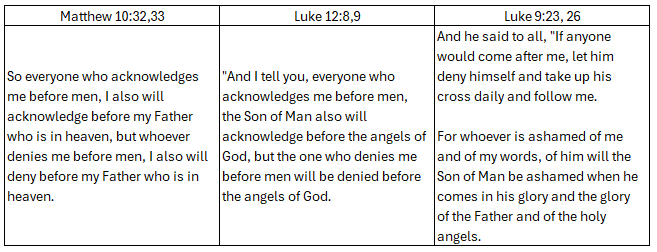
Luke 9:23, 26 And he said to all, “If anyone would come after me, let him deny himself and take up his cross daily and follow me. For whoever is ashamed of me and of my words, of him will the Son of Man be ashamed when he comes in his glory and the glory of the Father and of the holy angels.
Months back, we journeyed into a passage regarding Jesus’ denial of the believer before the Father in heaven. For a review for those interested, I am supplying a link for your convenience. Conditional Security – Matthew 10:32-33.
At first glance, our Luke 9 appears to be the parallel passage to Matthew 10 message from the Lord. Such is not the case, for the parallel is in Luke 12:8,9.
It is not exactly the same topic, for in the Matthew verses, Jesus is speaking of how He will respond before the Father based on our relation with Him. Verse 23 is a simple statement of qualification that precedes a passage that is somewhat similar to Matthew 10:32-33 and Luke 12:8,9
A quick table will provide a comparison.
Now before we proceed, it may be wise to consider some differences. In Matthew 10 and Luke 12, the warning is of denial before the Father. Might this occur even daily in our lives, that as we walk with Him and fall into a denial of some type, Jesus may also reflect this denial before the Father in heaven.
Before we go any further, I need to ask – Is all denial of eternal consequence? Of course not, for we simply need to consider Peter. Some denial is not permanent.
For the passage this morning, it appears to be specifically describing an experience of shame Jesus will go through when He appears in glory.
The first two passages resulted in a denial of our person before the Father. This morning’s passage centers on the shame Jesus will experience at His great revealing.
Shame we experience regarding the Word of God, either the written declaration we possess in our hands or of the Living Son of God, which resides with us in our bodies, may trigger a shame based emotion in Jesus at His coming.
In a believers life, periods of weakness, doubt and shame may occur. Is this a desirable situation? Of course not. Can God work in these periods of dryness, periods of pain and doubt, periods where we are confused, possibly questioning His Word, and pursuing wrong solutions? Of course He can, and thankfully He does.
Yet if we continue to lay the cross down, continue to seek our ways and not His, there is a danger of bringing shame on the Lord at His coming.
For those who may be experiencing difficult times, please be encouraged in that God is still there for you, that He is working in and around you for His glory and your benefit. The charge for us as we struggle in down times is that we do not abandon in the struggle the very strength of God found in His Word and in His Son. None of us wants Jesus to experience any shame on His day, but in our struggles we need to continue in depending on His Word and His Way. It is upside down from what the world teaches, and we desperately need to be reminded of His will and way we are to pursue daily.
Don’t lay down the cross! It is a daily choice that produces life in each of us, as we die to our old desires.
Thanks again for coming to visit. I hope you found something of interest in this post and would appreciate a comment, to begin a discussion. If you would like to receive daily posts from Considering the Bible, click on the “Follow” link below
Romans 8:6 For to set the mind on the flesh is death, but to set the mind on the Spirit is life and peace. Romans 8:7 For the mind that is set on the flesh is hostile to God, for it does not submit to God’s law; indeed, it cannot. Romans 8:8 Those who are in the flesh cannot please God.
Passages within the Word that speak of this topic may be abused by those who promote an understanding of conditional security. I would like to be as honest with the text as I can be, and want to inform those reading that there are arguments that justify thinking Paul is applying these verses to the unregenerate.
Even verse 9, where Paul informs those who are his audience that they are not in the flesh.
Romans 8:9 You, however, are not in the flesh but in the Spirit, if in fact the Spirit of God dwells in you. Anyone who does not have the Spirit of Christ does not belong to him.
Note however, he did not specifically define them as not having the mind of the flesh, but only that they are not in the flesh. Could Paul be speaking of two different conditions – that of being in the flesh, and of having a mind set on the flesh? Is this his intent? I will leave that to my reader to consider!
Paul summarizes some spiritual facts for believers.
Verse 5 – those who live according to the flesh set their mind on the flesh.
Verse 6 – to set their mind on the flesh is death
Verse 7 – a mind set on the flesh is hostile to God
Verse 7 – a mind set on the flesh does not (cannot) submit to God’s law
Verse 8 – Those in the flesh cannot please God
Verse 9 -Believers are not in the flesh
Ok, so this summary seems to direct us to the conclusion that verses 5 – 9 do not apply to believers, and would negate this chapter as being applicable to the topic at hand. That is, if Paul had finished his teaching at this point! But Paul digs in and keeps challenging believers. To minimize repeating myself, I have written on verses 12-14 previously – See Conditional Security – Romans 8:12-14
To summarize though, Paul makes a point of our obligations to the flesh in the following verses, specifically in verse 12, and with the inclusion of the conditional word “if” of verse 13, it seems to be a decision that is incumbent on the believer.
In our passage this morning, Paul provides us some introductory spiritual facts and guidance for our everyday life.
Paul provides, in my humble opinion, characteristics of those whose mind dwells upon or is “set” on the flesh, as having a certain outcome resulting in death. He also provides characteristics of those whose mind dwells upon and is “set” on the things of the Spirit.
What does that mean in our day to day life? What helps me is to compare the characteristics of the Spirit with my own life, with my thinking, with the focus of my mind and consider the resultant fruit/work that is produced.
Those whose mind is set on the flesh will experience the following works of the flesh in their lives.
Galatians 5:19 – 21 Now the works of the flesh are evident: sexual immorality, impurity, sensuality, idolatry, sorcery, enmity, strife, jealousy, fits of anger, rivalries, dissensions, divisions, envy, drunkenness, orgies, and things like these. I warn you, as I warned you before, that those who do such things will not inherit the kingdom of God.
Those whose mind is set on the Spirit will experience the following fruit of the Spirit in their lives.
Galatians 5:22 – 23 But the fruit of the Spirit is love, joy, peace, patience, kindness, goodness, faithfulness, gentleness, self-control; against such things there is no law.
Where is your mind set?
Our lives are the result of our decisions, and those decisions are based on the information that is available. Paul is blunt. If we constantly focus on the things of the flesh death will be the result.
Let us set our minds on the things of the Spirit, for as we do, He will develop the abundant life in us and continue to bring His fruit through us and to others.
And a key for us in this struggle? Where is our mind set?
You got to admit – it’s a no brainer!
Thanks again for coming to visit. I hope you found something of interest in this post and would appreciate a comment, to begin a discussion. If you would like to receive daily posts from Considering the Bible, click on the “Follow” link below
1 Timothy 6:3 If anyone teaches a different doctrine and does not agree with the sound words of our Lord Jesus Christ and the teaching that accords with godliness, 1 Timothy 6:4 he is puffed up with conceit and understands nothing. He has an unhealthy craving for controversy and for quarrels about words, which produce envy, dissension, slander, evil suspicions, 1 Timothy 6:5 and constant friction among people who are depraved in mind and deprived of the truth, imagining that godliness is a means of gain. 1 Timothy 6:6 But godliness with contentment is great gain,
It has been over a year since I have visited this chapter in relation to conditional security, and as we looked at that passage, we considered the influence the love of money may have on a believers faith. If of interest to review, I offer a link. Refer to Conditional Security – 1 Timothy 6:9-11
Regarding our passage today, Paul is discussing the importance of correct doctrine, or right teaching and it’s effects on both the teacher and the one taught.
This passage seems very appropriate due to my recent interactions with a close friend. As many of you may know, my daughter was baptized recently and this dear friend informed me that the ordinances of baptism (and the Lord’s supper) were never intended for the church we are a part of. Those commands, says he, were instructions for a Jewish church, a church that no longer exists. We are of a church that has instructions from Paul, and more specifically, the prison epistles. Nothing needed from John, Peter James, Luke or Mark, is needed for the church. Only Paul has authority in the church, since he received the last revelation, as my friend says, from the Lord in the Arabian desert.
Paul experienced this type of destructive teaching in his day, for he warned Timothy that there were those who would not agree with the sound words of the Lord Jesus Christ.
1 Timothy 6:3 If anyone teaches a different doctrine and does not agree with the sound words of our Lord Jesus Christ and the teaching that accords with godliness,
It is simply amazing that a so called follower of Christ would reject Jesus teaching. Not only does Paul speak of the importance of the words of Christ, he adds additional teaching that is equal with the Lord’s instructions. He speaks of teaching “that accords with godliness”.
One short passage will suffice to provide a teaching that accords with godliness.
Titus 2:11-12 For the grace of God has appeared, bringing salvation for all people, training us to renounce ungodliness and worldly passions, and to live self-controlled, upright, and godly lives in the present age,
One doctrine is to be taught from two sources, the words of Jesus and teaching that accords with godliness. It is self evident this “teaching that accords with godliness” is the accepted books of apostolic authority, based on the foundational Old Testament volumes. There was to be no separating, no dividing, no cutting up the Bible due to some desire to be better than those other “unwashed” ignorant average Christians. Conceit on the part of an erring teacher is the source of this error, at least humanely speaking.
Instead of seeking peace amongst the brethren, working towards a unity in the Body of Christ, a teaching that separates the words of the Lord Jesus from the teaching according to godliness has certain characteristics according to Paul
Characteristics of this teaching
Controversy
This is the Greek word ζήτησις zḗtēsis, and is commonly translated as controvery. Paul has much to say about the place of controversies in the church, especially for his men who were elders, overseeing the people of faith.
1 Timothy 1:4 nor to devote themselves to myths and endless genealogies, which promote speculations rather than the stewardship from God that is by faith.
2 Timothy 2:23 Have nothing to do with foolish, ignorant controversies; you know that they breed quarrels.
Titus 3:9 But avoid foolish controversies, genealogies, dissensions, and quarrels about the law, for they are unprofitable and worthless.
It is interesting that in one additional verse we find this term “controverises” (translated as debate). It is the debate Peter and the men in Acts 15 were involved in.
Acts 15:7 And after there had been much debate, Peter stood up and said to them, “Brothers, you know that in the early days God made a choice among you, that by my mouth the Gentiles should hear the word of the gospel and believe.
Peter, a take charge type of guy, brought the debate to a close, instructing those present of God’s direction, and not their thoughts! I like that. A man seeking to find unity by appealing to the words and works of God!
Regarding my recent discussions with my friend, every topic is controversial. He has the spirit of this teaching deeply embedded in this thinking about many, many topics
Quarrels about words
Logomachía λογομαχία. We can see the Greek for “word” in logos, with machia providing the root meaning of arguing, or trifling over empty or trifling matters. It makes me think of the “straining out of a gnat” image again, as we discussed in a recent post, only this time, related to teaching. These guys make a mountain out of a molehill, as my momma used to say. Major on the major items Carl!
What are the fruits of this teaching?
Envy
Teaching that accords with godliness does not produce envy, but informs the church to put it away, to reject envy as a way of thinking, as a way of life!
1 Peter 2:1 So put away all malice and all deceit and hypocrisy and envy and all slander.
Dissension
Again we see that the fruit of these conceited teachers are opposing the actual teaching of the apostles. Dissension is the same Greek word as quarreling in the following passage.
Romans 13:13 Let us walk properly as in the daytime, not in orgies and drunkenness, not in sexual immorality and sensuality, not in quarreling and jealousy.
Slander
This word surprised me, for the Greek word translated as “slander” is βλασφημία blasphēmía. I imagine Paul is referring to slandering others within the church, defaming their character, tearing down others in an effort to raise themselves up. This should not be surprising, since the fuel that keeps these teachers moving forward is conceit!
Of course, this teaching provides fuel for more and more fruit that the apostles directed the faithful from.
Ephesians 4:31 Let all bitterness and wrath and anger and clamor and slander be put away from you, along with all malice.
Evil Suspicions
Are we not to love the brethren and care for those whom the Lord has died for? To have evil suspicions speaks of a mind that is puffed up, thinking the worst of others, prideful and suspicious.
Is this not antithetical to the command to love one another in a humble and giving nature? Relationships exist amongst trust and care, and cannot exist being fed a diet of suspicious thinking
Constant Frictions
Another result of this teaching is constant friction among the people who are depraved in mind and deprived of the truth! What a sad state of affairs, for due to this false teacher, this hair splitter who rejects the words of the Lord Jesus and those words that foster godly living, boasts he has greater truth, with the result bearing friction amongst his hearers.
In the end this teacher, out of the conceit in his heart and mind, seeks to stir up controversies, thrives on friction amongst his audience, and judges his success by the financial gain he acquires by destroying lives.
Now it seems obvious this type of teacher is not producing the fruits of the Spirit, and per the common teaching of the Word, may be identified by the works he does produce. As we have seen, each is not of the Spirit.
My question for my dear reader isn’t necessarily the salvation status of this teacher, for it may be safe to say he never knew the Lord, but what of the man who has known the Lord, followed after the Lord, and is now bedeviled by a fractious, divider of the word and of the church?
Thanks again for coming to visit. I hope you found something of interest in this post and would appreciate a comment, to begin a discussion. If you would like to receive daily posts from Considering the Bible, click on the “Follow” link below
Deuteronomy 29:18 Beware lest there be among you a man or woman or clan or tribe whose heart is turning away today from the LORD our God to go and serve the gods of those nations. Beware lest there be among you a root bearing poisonous and bitter fruit, Deuteronomy 29:19 one who, when he hears the words of this sworn covenant, blesses himself in his heart, saying, ‘I shall be safe, though I walk in the stubbornness of my heart.’ This will lead to the sweeping away of moist and dry alike. Deuteronomy 29:20 The LORD will not be willing to forgive him, but rather the anger of the LORD and his jealousy will smoke against that man, and the curses written in this book will settle upon him, and the LORD will blot out his name from under heaven.
Before I go off on this verse, it is critical to set the stage for such a harsh set of verses.
This particular passage is found in a chapter of Deuteronomy that describes the judgements upon the man who breaks the covenant the nation entered into at Sinai. As believers in the Messiah, we know that the Messiah rescued us from the curse of the law, and that obedience, absolute perfect obedience was required under the Old Covenant.
Galatians 3:12 But the law is not of faith, rather “The one who does them shall live by them.” Galatians 3:13 Christ redeemed us from the curse of the law by becoming a curse for us–for it is written, “Cursed is everyone who is hanged on a tree”–
This truth came home to me in a Sunday School discussion recently, when it seemed that the lesson was blurring the distinction between promise and law. Some in the class seemed to imply the curses may still be applied to the New Testament saint, effectively removing the salvation Jesus provided to each of us.
It is critical for each of us as believers in the Messiah to understand that we who are of Jesus are of the promise and not of the law.
So then what of the law? Very much, for the law can and does speak to us in this age of promise. As a quick review, Paul speaks of the benefits of understanding the Old Testament in many New Testament passages, teaching on multiple topics using the Law as a basis of his teaching.
For example…
A woman’s restriction in church meetings
1 Corinthians 14:34 the women should keep silent in the churches. For they are not permitted to speak, but should be in submission, as the Law also says.
An apostles right to support
1 Corinthians 9:8 Do I say these things on human authority? Does not the Law say the same? 1 Corinthians 9:9 For it is written in the Law of Moses, “You shall not muzzle an ox when it treads out the grain.” Is it for oxen that God is concerned?
The reason for the gift of tongues
1 Corinthians 14:21 In the Law it is written, “By people of strange tongues and by the lips of foreigners will I speak to this people, and even then they will not listen to me, says the Lord.”
A standard of judgment
Romans 2:12 For all who have sinned without the law will also perish without the law, and all who have sinned under the law will be judged by the law.
The relationship of the law in Christian faith
Rom 3:31 Do we then overthrow the law by this faith? By no means! On the contrary, we uphold the law.
I could continue, but just realized I am writing an introduction to the topic verses and not an independent study on the law’s relationship to the one under promise.
I do get distracted don’t I?
Back to Deuteronomy.
The passage that I would like to draw your attention to is the reference to the man’s heart in this passage. We often think of the law as a means to produce works of compliance, a set of standards that are to be met by good works, proper conduct and righteous behavior. All outwardly seen.
Yet the Lord addresses the root of the matter, even in the covenant of works. It is the heart that initially turns away, and in the turning, lies to itself. Notice the deceitfulness of our hearts, even under the covenant of works, that the man that begins to turn away, (in his heart) argues with the truth, and convinces his heart that his actions, his works that do not comply with the covenant, will not cause a danger.
His heart will bless him in his disobedience.
How fearful of a text, not only for the one under a covenant of works, but more so for us who reside under a covenant of promise, a covenant that has been written with the blood of the Messiah.
My friends, this passage reminds me of a warning passage in Hebrews, comparing the covenant of works with the covenant of promise.
Hebrews 2
1 Therefore we must pay much closer attention to what we have heard, lest we drift away from it. 2 For since the message declared by angels proved to be reliable, and every transgression or disobedience received a just retribution, 3 how shall we escape if we neglect such a great salvation? It was declared at first by the Lord, and it was attested to us by those who heard, 4 while God also bore witness by signs and wonders and various miracles and by gifts of the Holy Spirit distributed according to his will.
Note that the apostle spoke of neglect, not rejection of the salvation provided. As the man in Deuteronomy neglected and turned away, even convincing himself of his safety, a corollary may be seen in our lives, even today, as the apostle warns.
Let us “pay much closer attention”, continually seeking to listen to the One who saves, to hear from the One who guides and gives comfort and to thank and praise the One who has provided such a great salvation!
Let our hearts always lean into Him, and as we may find a coldness creep into our heart, ask Him for His heart.
Look to Him. He is good. Let us be thankful!
Thanks again for coming to visit. I hope you found something of interest in this post and would appreciate a comment, to begin a discussion. If you would like to receive daily posts from Considering the Bible, click on the “Follow” link below
“For the man who does not love his wife but divorces her, says the LORD, the God of Israel, covers his garment with violence, says the LORD of hosts. So guard yourselves in your spirit, and do not be faithless.”
Covenants. Agreements. Contracts. Treaties.
All of these terms describe a state of being of two or more parties having one opinion about something. As two (or more) enter into a covenant or agreement, it is accompanied with some sort of written or public announcement. Such is the special covenant of marriage.
Malachi, throughout his second chapter is discussing the marriage covenant, and has some very interesting points he wants to communicate to the priest of his day, and to the priests of our day – folks who take the name of Christ as their identity.
1 Peter 2:5 you yourselves like living stones are being built up as a spiritual house, to be a holy priesthood, to offer spiritual sacrifices acceptable to God through Jesus Christ.
In Malachi’s day, the priests seemed to think it was an allowable action to ditch the wife of their youth, and to pick up some young foreign woman as a wife. Where did this allowance come from in their thinking?
Malachi provides and answer and is blunt.
Malachi 2:8 But you have turned aside from the way. You have caused many to stumble by your instruction. You have corrupted the covenant of Levi, says the LORD of hosts,
Malachi goes on and describes Judah as “faithless”, and with an abomination having been committed in Israel.
Malachi 2:11a Judah has been faithless, and abomination has been committed in Israel and in Jerusalem.
Tell us Malachi – What is it that Judah has done to exhibit faithlessness, or what is it that is considered an abomination in Israel?
Malachi 2:11b For Judah has profaned the sanctuary of the LORD, which he loves, and has married the daughter of a foreign god.
Now as I mentioned above, the priests had abandoned the wives of their marriage covenant, and found themselves a young “mail order” bride of sorts, a woman of foreign descent.
And the Lord is talking of cutting off from the tribe any descendant of the man who does this. This is the equivalent of excommunication!
Let’s take a moment to review the Lord’s attitude towards marriage.
#1 God loves Marriage
Malachi 2:11 Judah has been faithless, and abomination has been committed in Israel and in Jerusalem. For Judah has profaned the sanctuary of the LORD, which he loves, and has married the daughter of a foreign god.
We have briefly considered the verse above, but it may be good to remember that it teaches of the LORD’s love for the sanctuary, and that the marriage of a foreign woman, which would require the divorce of the priest first wife, profanes this sanctuary. For you see, God’s love for the sanctuary carries over into the actions of those who serve in it.
This is a typical Bible teaching, that the one who serves God is to serve according the the Word and will of God. A life of no restrictions brings about a restriction from the service of God. These priests decided they wanted young wives and in so doing, departed from God.
#2 God seeks holy offspring
Malachi 2:15 Did he not make them one, with a portion of the Spirit in their union? And what was the one God seeking? Godly offspring. So guard yourselves in your spirit, and let none of you be faithless to the wife of your youth.
Why is marriage so important before God? An initial thought is that it provides a man a chance to die, to give up his desires for the sake of another. Another facet of marriage for the man is that he can display, in real time and through continual actions, a fidelity to his promise to his wife.
Malachi provides another reason. Holy offspring. In this context, Malachi is referring to pure Jewish offspring, not combined with those of the nations. To think of a priest of the Lord’s sanctuary producing offspring that are not – cannot be – of the holy lineage is an affront to the plan of God.
For us today, nationality, race and ethnicity mean nothing. The requirement to satisfy God’s seeking godly offspring is faith in the Christ for both partners. Parents that are not in agreement concerning the identity of the Christ, or that have not committed to His will, can not intentionally produce godly offspring.
#3 God hates divorce
Malachi 2:16 “For the man who does not love his wife but divorces her, says the LORD, the God of Israel, covers his garment with violence, says the LORD of hosts. So guard yourselves in your spirit, and do not be faithless.”
If any of this post get’s me in trouble, this will be the portion that does!
This verse was a favorite of mine in my early Christian faith, and I used it “willy nilly” around a lot of hurting people. Now I will not deny that God hates divorce – it is clearly a teaching that is provided here. But He hates all sin, and we have to live amongst and minister to a lot of sinful, hurting people. Judging someone’s past is not in my wheelhouse (anymore!). I have also come to understand there is a nuance to the marriage covenant that I had not considered until I needed to.
Someone very close to me suffered abandonment by her husband. He simply got up and left her with all the bills, all the trouble and no answers. In this case, is she to remain unmarried, tied to a treacherous man that is faithless? Consider Paul’s teaching in 1 Corinthians.
1 Corinthians 7:15 But if the unbelieving partner separates, let it be so. In such cases the brother or sister is not enslaved. God has called you to peace.
Paul has much to say about marriage, and how the believer is to respond to a faithless, or unsaved partner. In the above case, I understand the brother or sister is not bound to the original covenant. It has been broken by the faithless partner.
Although this has been more of a short study on God’s attitude towards marriage than a discussion on conditional security, it does relate to the original topic.
Malachi, throughout this passage, warns the priest of his day that they are faithless five times in this six verse passage, from verse 10 through 16
Twice, at the end of this passage, Malachi advises the priests to
….guard themselves in their spirit…
Now of course, some may see that this description of being faithless as referring to the priest’s commitment to his first wife, and that may very well be the emphasis of Malachi’s teaching. Yet, for a man of God to abandon his covenant promise to his first wife, to walk away from one who he promised to protect, love and provide for, speaks of a character that may abandon other covenants that are also holy, precious and life long.
No matter, it is wise counsel that in our commitments to agreements, covenants and contracts, we are to be men and women of our word.
Matthew 5:37 Let what you say be simply ‘Yes’ or ‘No’; anything more than this comes from evil.
Let’s be men and women of our word, faithful to the covenants we have freely entered into.
Thanks again for coming to visit. I hope you found something of interest in this post and would appreciate a comment, to begin a discussion. If you would like to receive daily posts from Considering the Bible, click on the “Follow” link below
“Come, let us return to the Lord; for he has torn us, that he may heal us; he has struck us down, and he will bind us up.
Let’s take a moment to remember who Hosea is.
Hosea is a prophet of the northern kingdom, who was called to marry a prostitute, suffer the indignities of her unfaithfulness, and in the end rescue her from her own sinful life. His life was a picture for the sinful northern nation to recognize what they were doing to the God who had married them in the Sinai covenant.
Throughout the book, Hosea pleads for the northern nation to return to God, even as he is seeking to keep his own marriage together.
What a terrible inner conflict this man must have suffered! And what a high calling for this man to be called to. To love a bride who is treacherous, who is unfaithful, who proves her indifference and disloyalty to their covenant of marriage.
This very condition is found in many homes today, and though it may be expected in those who have not bowed the knee to the Lord, to find it amongst the saints is a sign of a treacherous partner, a sign that the commitment (to the spouse and to the Lord) has been abandoned.
Nevertheless, to return to the main point. Hosea is preaching to a nation that has walked away from God. As always there were individuals who were of the remnant, that still sought the Lord and looked to Him, but the vast majority of the northern tribes had fallen away.
The nation as an entity had walked away! As Gomer had betrayed Hosea and shunned his commitment to her, Israel mirrored this very same stance in relation to Jehovah.
The amazing thing that Hosea states in this verse is that the Lord has torn, and that He will heal.
To us the term “torn” in this verse cannot be sugar coated, for it speaks of tearing, even of tearing to pieces, being ripped apart. This same word was used when Isaac heard of Joseph’s apparent death.
Genesis 37:33 …”It is my son’s robe. A fierce animal has devoured him. Joseph is without doubt torn to pieces.”
Might this be referring to the tearing away of the northern tribes from the southern kingdom? They tore away from the God ordained lineage of King David, setting up an opposing king, government, and accepting a completely different God requiring a different worship system.
No wonder the passage speaks of the Lord tearing it, for as the people, and the leadership pulled away, the Lord also tore them from the true theocracy. This may be a situation where the cause and effect may be the same action, as it so often appears in the works of God.
Nevertheless, the people of the northern tribes had walked away, they were torn, and Hosea, instead of speaking of condemnation, brings a message of hope, of healing, and a few verses later, or reviving and resurrection.
This is a fantastic passage, given the horrible situation Hosea found himself in. To offer the northern tribes the hope of life after this persistent betrayal is way beyond a response that may be expected. A response I would expect is to let the betrayer suffer for her sins. The Lord offers healing.
In the middle of this passage, I can’t help but to see that the Lord performed this ultimate healing by Himself being torn, by Himself being struck. His suffering and acceptance of the cross provided the healing required, not only for us as we have been the betraying wife at times, but for the nations also.
There is tremendous mercy to be found in the Lord. May we be faithful to such a great God, and as needed, exercise a humility to admit our own betrayal of Him.
Thanks again for coming to visit. I hope you found something of interest in this post and would appreciate a comment, to begin a discussion. If you would like to receive daily posts from Considering the Bible, click on the “Follow” link below
Psalm 85:4-5 Restore us again, O God of our salvation, and put away your indignation toward us! Will you be angry with us forever? Will you prolong your anger to all generations?
Restoration.
It is a consistent refrain in the Word, where the people of God, having slipped (or run headlong) into sin, have fallen victim to bondage and captivity. When Israel finally came to it’s senses, the plea to God was always for restoration, for the Lord to rescue the people who knew Him, back to a place of favor before Him.
I am not sure of when this Psalm was written, whether after the captivity of Babylon, or possibly during one of many spiritually low spots previous to the captivity. Either way, it is a telling psalm of the nations knowledge of their standing before their God.
The people of God needed restoration. They called out to the God of their salvation, seeking restoration to their salvation experience. They were a people of covenant, who had broken ties with their God and reaped the result of having no hope! The people of God understood they were experiencing the anger of a holy and righteous God – which if truth be told, is an enviable position to be in.
Now hold on Carl. To be under the judgment of God is an enviable position to be in? Are you smoking crack? Let me repeat my thought. It is an enviable position to rightly understand their position before God. It is that we are in an enviable position if we know the truth of our position before God.
Many in our day think they are in a great standing before God, and yet live a life of utter disregard to the will of God, the Word of God and the Son of God. The folk in this psalm, of whom we read this morning, understood their position before God and reached out the the only One who could restore them.
A short phrase in verse 4 catches my eye, when the psalmist admits that even their best efforts are of no use before the Mighty God. Do you see what I speak of?
put away your indignation toward us
The psalmist is not claiming that they will do better, that the people of God could earn their position back with the Eternal Father, that some action on their part could assuage the anger of God.
He begs God to put away His own anger, the anger that is towards His own people. God only can put away His own anger. Amazing!
Does that not scream of the crucifixion, of the Father smiting the Son, striking Him, crushing Him and placing all the iniquity on the Servant of God. God did put away His own anger. Jesus carried the iniquity of us all.
Isaiah 53:4,5,6
4 Surely he has borne our griefs and carried our sorrows; yet we esteemed him stricken, smitten by God, and afflicted. 5 But he was pierced for our transgressions; he was crushed for our iniquities; upon him was the chastisement that brought us peace, and with his wounds we are healed. 6 All we like sheep have gone astray; we have turned–every one–to his own way; and the LORD has laid on him the iniquity of us all.
Is Jesus the restoration provided by God? Is the crucifixion the very solution God has provided for those needing salvation, revival and restoration?
To ignore Him and to turn to religion, or good morals or to be socially acceptable is simply to spit in the face of God. We are stating by our actions of religion, morals or social graces that His solution is not good enough for us! How repugnant it must be in the nostrils of our God for us to abandon His solution for beggarly efforts such as those!
Think about it, for if those in the Old Testament, having the light they had and yet rebelled, knew of the anger of God and the need for His mercy, how much more do we who have come after the resurrection need to turn to Him for our restoration and salvation.
My friend. Jesus truly is the answer to this Psalmist’s request for God putting His anger away. That anger was consumed in the cross, in the death of the Messiah.
It is truly an enviable position to understand your position before God. Can you admit of your weakness, your poverty, your inability before Him? Do you understand the separation between Him and you, the gulf that can’t be crossed by your own efforts?
If you are of this condition, knowing you will have to answer to Him someday, are you seeking to put away God’s anger on your own? Are you trying to be good enough? Are you rejecting the very solution God has provided?
My friend, without a living faith in the One who has consumed the anger of God, having come out of the grave to prove His victory, there is no safety. Without God’s provision, there can be no true restoration, no true salvation, no true life.
Realize your need, understand your position before God. Consider the tremendous gulf between the Holy One and yourself. Understand your true condition before God. Agree with that ol’ hymn ” Amazing Grace”.
‘Twas grace that taught my heart to fear, and grace my fears relieved; how precious did that grace appear the hour I first believed!
God reveals not only our dire situation, but also of the complete and full rescue He has provided in His Son Jesus, the Resurrected One.
Run to the One who has put away His own anger!
Thanks again for coming to visit. I hope you found something of interest in this post and would appreciate a comment, to begin a discussion. If you would like to receive daily posts from Considering the Bible, click on the “Follow” link below
Matthew 24:24 For false christs and false prophets will arise and perform great signs and wonders, so as to lead astray, if possible, even the elect.
For this verse, I am not going to enter into any discussion on who the elect are. This topic is not the intent of the post, but the fact that those who have been chosen, who ever they may be, may be led astray.
Two things to consider.
First thing, is the “if” part of our argument? That is, is Jesus saying that the deception will be able to deceive everyone, and that it will be amazing none of the elect fall? The elect couldn’t be lead astray?
I suppose this approach is interpreting Jesus as saying
– so as to lead astray, if possible (but it’s not possible), even the elect.
Or is He saying that some of the elect may be lead astray, if the deception is strong enough and the elect are not prepared? Is the possibility of being led astray resident in the elects ability to resist the deception?
I suppose this approach is interpreting Jesus as saying –
-so as to lead astray, if possible (depending on the elect), even the elect.
In this passage, I do not have a clear understanding. I tend to think of the first option, and it provides great comfort. We find the very same phrase used when Jesus prayed to the Father in the garden.
Matthew 26:39 And going a little farther he fell on his face and prayed, saying, “My Father, if it be possible, let this cup pass from me; nevertheless, not as I will, but as you will.” (italics mine)
We know it was not possible for the cup to pass, yet in the humanity of the Son, He expressed a possibility before the Father. Is this the same intent in our passage. The unknown expressed but not to be realized?
I would appreciate your thoughts on this topic.
Secondly, is it right to consider being “lead astray” to be equal with falling away from the faith?
Did Jesus use the term σκανδαλίζωskandalízō, to trip and fall in this verse? Or was it ἀφίστημιaphístēmi, meaning to make stand off, cause to withdraw, or to remove? Maybe the word He used was what I initially suspected – ἀποστασίαapostasía, meaning a falling away, defection, apostasy.
None of those words were used in this verse.
To be led astray in the Greek is πλανάωplanáō, and it means to cause to stray, to lead astray, lead aside from the right way.
It seems this term speaks of the one leading someone astray as opposed to the one being lead away. It focuses on the deceiver and not the deceived. I suppose this also brings into the discussion that to be deceived may not specifically indicate a loss of life.
The text is not as clear as I had hoped, and that is alright. It is a text that demands a bit of humility, a bit of willingness to consider, a bit of thought.
For those who have spent a few minutes with me in this text and have additional thoughts, I would appreciate your comments.
Thanks again for coming to visit. I hope you found something of interest in this post and would appreciate a comment, to begin a discussion. If you would like to receive daily posts from Considering the Bible, click on the “Follow” link below
Joel 2:12 “Yet even now,” declares the LORD, “return to me with all your heart, with fasting, with weeping, and with mourning;
Another plea to return. Another reaching out to His people in the voice of a prophet. Another petition to a people that were walking away, or should I say had walked away.
For chapter 2 of Joel, this prophet describes the Day of the Lord. The first 11 verses of this chapter provides some of the most fearful imagery of destruction being poured out. Not on Egypt. Not on Assyria, though that would come eventually. Not on Philistia. Not even on Amon or Moab.
This judgement was to fall on the people of God, the nation of Israel. for Joel begins this chapter with
Joel 2:1 Blow a trumpet in Zion; sound an alarm on my holy mountain! Let all the inhabitants of the land tremble, for the day of the LORD is coming; it is near, (bold italics mine)
Joel clearly refers the the land of Israel, giving ample identification of who he is addressing, warning those with the following passage as to what was to befall them. Horrible images of fire devouring ahead of an army, ready to pounce on them, of darkness and gloom, of the victims being in anguish and the earth quaking as the armies approach.
The final verse prior to our plea to return clearly indicates it is the Lord Himself that is leading this army. It is the Lord who guides and directs this Assyrian killing force, known as one of the most merciless fighting forces in the ancient world.
Joel 2:11 The LORD utters his voice before his army, for his camp is exceedingly great; he who executes his word is powerful. For the day of the LORD is great and very awesome; who can endure it?(bold italics mine)
Joel ends this sobering passage, asking who can endure it? Truly who could endure this frightening death? On the brink of total destruction, it seems there is no hope, no rescue and no escape.
This is a loosing situation for the people of God, with no option but to face an enemy that will destroy them. Having departed from God, they have nothing to depend on. They are empty, without strength and without hope.
At this hopeless point, the Lord opens His hands, providing a glimmer of hope, a plea to return, an offer of His relenting over the coming disaster.
Joel 2:12 “Yet even now,” declares the LORD, “return to me with all your heart, with fasting, with weeping, and with mourning; Joel 2:13 and rend your hearts and not your garments.” Return to the LORD your God, for he is gracious and merciful, slow to anger, and abounding in steadfast love; and he relents over disaster.
The offer is conditional, for the people must tear themselves down before the King, show a deep repentance the the One they rejected, on the hope of God possibly turning from this judgement.
Joel 2:14 Who knows whether he will not turn and relent, and leave a blessing behind him, a grain offering and a drink offering for the LORD your God?
Upon true repentance, God is offering the opportunity for Him to offer forgiveness. When Joel asks his audience “Who knows whether He will not turn and relent”, this turn of phrase speaks of either one of two things in my mind.
Ignorance
The absolute ignorance of the people of God as to who their God is. Is it not true that our God is a God who is gracious and merciful slow to anger and abounding in steadfast love? Joel teaches his people this truth, but they are without understanding. They don’t have the assurance that the God of Mercy will exercise mercy, for it is His heartbeat to rescue.
Limits of Patience
The other option is that continual rebellion and rejection of God by the nation God rescued, guided and protected has brought about their own abandonment. Continual rebellion against our God puts the rebel outside of the reach of God, a God known for His gracious and merciful acts. The rebel who walks away from such a kind and loving God, walks directly (if not immediately) towards destruction.
God does not change, for as we listen and strive to know Him, we are covered with the blood, and have the freedom to know His grace and mercy. Do we not know of the continual mercy shown us as we confess our weakness and sin, and look to the Savior?
For those who walk away from God, they begin to loose security, the peace and joy so precious for the saint. Eventually, as these poor souls in Israel experienced, the judgement was ready to fall on them. They had set their hearts to face away from the only Hope they had.
And yet He reached out, seeking them in their sin and rebellion. Our God is just like that, then and now. He is reaching out, with His own blood on His hands.
Thanks again for coming to visit. I hope you found something of interest in this post and would appreciate a comment, to begin a discussion. If you would like to receive daily posts from Considering the Bible, click on the “Follow” link below
Judges 16:20 And she said, “The Philistines are upon you, Samson!” And he awoke from his sleep and said, “I will go out as at other times and shake myself free.” But he did not know that the LORD had left him.
Samson had it going on. Was he not the man about town, without equal, armed with a super human strength. He may have had the appearance of Arnold Schwarzenegger, but I tend to think he looked like me, kinda scrawny, and fairly generic. Now of course the Bible doesn’t directly say this, so it is simply a suggestion. Yet there is one verse that tends to make this a possibility.
You see, his strength befuddled the Philistines. They just couldn’t figure it out. After all their conference room head scratching, they employed that woman, Delilah, demanding that she find out about his strength.
Judges 16:5 And the lords of the Philistines came up to her and said to her, “Seduce him, and see where his great strength lies, and by what means we may overpower him, that we may bind him to humble him…
You got to admit, this man was super human in his exploits. His feats were incredible. Consider the gates of Gaza. That alone is mind numbing when you consider what he did.
Judges 16:3 But Samson lay till midnight, and at midnight he arose and took hold of the doors of the gate of the city and the two posts, and pulled them up, bar and all, and put them on his shoulders and carried them to the top of the hill that is in front of Hebron.
Estimates of the mass of those two gates come in around 8,000 pounds, based on my research. That is 4 tons! That is like Samson carrying an adult hippo on his back! (The male hippo, that is, for the female hippo is a bit chunkier!) But simply carrying the gates is not the only feat of accomplishment he performed that night.
Consider the brute strength of pulling the frame out of the ground, removing it from it’s foundational support. The verse speaks of him pulling up two posts, posts large enough that massive gates, securing the city, would be supported. That is crazy!
But there is more.
He carried those gates to the top of the hill that is in front of Hebron. Remember – He was held in the city of Gaza, in the Philistine country. That distance, by way of the crow, is 36 miles. (60 kilometers for those who live outside of the US.)
I don’t think physical muscle mass was the source of power. How could it be? No this feat found it’s strength from outside of his body. Call me crazy, but Samson may have been a fairly ordinary looking man! Can you imagine?
And that is the rub!
He had this power, and assumed it was his power and assumed, due to the faithfulness of God’s presence, that what life was like yesterday was a guarantee of what tomorrows life would be like!
Assumptions are dangerous things, and we all fall into them at times. This assumption though, did not take into consideration the very real impact of disobeying a solemn vow that was given to God. As a matter of fact, this assumption went against all logic!
Judges 16:17 And he told her all his heart, and said to her, “A razor has never come upon my head, for I have been a Nazirite to God from my mother’s womb. If my head is shaved, then my strength will leave me, and I shall become weak and be like any other man.”
This is an incredible admission, knowing she was trying to trap him, knowing that the Philistines had come to take him three times earlier. He admits to his strength, to the very worst person, and the passage we read at the beginning speaks of Samson that he did not “know that the LORD had left him”.
He knowingly provided his secret to the worst of traitors, thumbing his nose to the very covenant graciously provided to him from birth. He threw God away, for the sake of a hooker!
My friends, this story is not so sad. After this time of considering just one of Samson’s mighty exploits, we see that a tremendous privilege granted to a man may be removed by God. The Nazarite vow that Samson was involved in was a two way street, and he seemed content to keep that covenant for many decades.
Until that woman showed up!
Think of that! Decades of being faithful to the God of the Nazarite vow he was under, until a temptation came that reduced God to a non issue, and focused only on the desire for that woman!
What a shame!
What a lesson.
What a warning.
Be faithful my friend for the Lord is good, patient and loving. But as Samson’s story teaches, God may take a privilege away if we snub Him, reject Him and hate Him.
Thanks again for coming to visit. I hope you found something of interest in this post and would appreciate a comment, to begin a discussion. If you would like to receive daily posts from Considering the Bible, click on the “Follow” link below
But they rebelled and grieved his Holy Spirit; therefore he turned to be their enemy, and himself fought against them.
Isaiah is describing a prayer of an exile, looking forward to the time when a faithful one has been delivered to Babylon, and his recounting of the the history of Israel. For the sake of understanding the passage we are considering, let’s take a few moments and read some of the context.
Isaiah 63:7-10
I will recount the steadfast love of the LORD, the praises of the LORD, according to all that the LORD has granted us, and the great goodness to the house of Israel that he has granted them according to his compassion, according to the abundance of his steadfast love. For he said, “Surely they are my people, children who will not deal falsely.” And he became their Savior. In all their affliction he was afflicted, and the angel of his presence saved them; in his love and in his pity he redeemed them; he lifted them up and carried them all the days of old. But they rebelled and grieved his Holy Spirit; therefore he turned to be their enemy, and himself fought against them.
This prayer begins with describing the saving power of God, of His great goodness, His compassion and steadfast love. This man of prayer started out admitting, declaring God’s work in the nation, of His continual and constant caring for the nation.
It wasn’t that God had only taken care of the nation without expense to His own honor and name. When the nation was afflicted, He was afflicted. The Angel of His Presense performed a saving work in their lives. The speaker remembers God’s love, His pity, His redeeming acts, how God had lifted them up nd carried them through the trials they experienced.
But then we come to verse 10. For those not accustomed to the story of the Bible, this verse must surely be jarring. How could this response to a loving powerful God be justified? How is it that a nation experiencing the constant and continual care of God in showing acts of kindness and care towards the nation could rebellion be an expected response?
It is surely a mystery, a statement of the depth of sin in the human experience.
The nation rebelled, and rebelled, and then rebelled some more. After constant warning and pleading with His people, they received a response they deserved. For so long, the grace of God poured out on the nation, but there came a time when, in the wisdom and knowledge of God, the relationship was evidently beyond repair.
God was turned from Loving Savior to Israel’s enemy. How terrible and unnecessary this turn of events! The nation lost it’s only hope, and in so doing, gained an unassailable foe, One who would gain His will despite the rebellion of the people He cared for.
This condition of becoming the enemy of the Lord is not an isolated teaching found in the Word. Other examples may be found throughout the Old and New Testament. It has been half a decade since I published The Lord’s Enemy, and I hope it makes clear what it takes to loose the blessing of the Lord on your life.
The nation was taken into captivity, with many of the nations being put to death and the loss of the land, and the temple. A complete and utter defeat.
Consider the loving kindness of God in your life. Recognize it, be thankful, and obey His bidding, for His yoke is light.
Matthew 11:29 Take my yoke upon you, and learn from me, for I am gentle and lowly in heart, and you will find rest for your souls. Matthew 11:30 For my yoke is easy, and my burden is light.”
Thanks again for coming to visit. I hope you found something of interest in this post and would appreciate a comment, to begin a discussion. If you would like to receive daily posts from Considering the Bible, click on the “Follow” link below
Their deeds do not permit them to return to their God. For the spirit of whoredom is within them, and they know not the Lord.
Hosea is preaching to a nation fully committed to spiritual adultery. Note that Hosea speaks of their choice of worshipping a thing (an idol) as being the very thing that restricts them from worshipping the Living God. The decision of Israel’s leaders to kneel at the altar of idols results in the inability to worship God, and the Lord warns Israel of her rebellion and that they are in the midst of judgement.
A nation once in relation with the Living God is now in rebellion, and out of that rebellion, judgement will fall on the people. Hosea speaks of this judgement as a creeping, slowly consuming judgement, such as a moth eating a robe, or a rottenness spreading through a nation. This slow creeping judgement may be seen as a mercy of the Lord in the midst of judgement, providing opportunity for the nation to return. Yet their commitment to idolatry has trapped in their spirit of whoredom, committed to gods they know not.
Hosea 5:12 But I am like a moth to Ephraim, and like dry rot to the house of Judah.
Hosea speaks of the nation as not knowing the Lord due to this commitment to idols This duality of the nation’s “allegiance” is a smokescreen to the very ones thinking they can worship the Lord and idols simultaneously.
Hosea 5:6 With their flocks and herds they shall go to seek the LORD, but they will not find him; he has withdrawn from them.
Hosea is blunt. Take sacrifices to the Lord, even as you think of the idol worship you also take part in. This commitment to spiritual adultery results in an empty Temple, for the Lord has withdrawn.
He is not to be found. He is gone!
The nation is without her Savior, for she has dealt faithlessly with the Lord. Now to make things worse, Israel approaches her enemy Assyria, even as she sees her desperate condition, and turns to a foreign nation.
Hosea 5:13 When Ephraim saw his sickness, and Judah his wound, then Ephraim went to Assyria, and sent to the great king. But he is not able to cure you or heal your wound.
There is no hope to be found for Israel in a foreign nation. There is no hope available as they seek assistance from anyone other than the Lord, and He has left their company. A terrible situation to be in, abandoned and alone!
But to be abandoned is not the end. The Lord Himself reveals just a few verses later that He has not simply abandoned the nation, but He will act as a lion, a beast that will tear the nation apart, carrying the victims away.
No one shall rescue God’s people from God.
Hosea 5:14 For I will be like a lion to Ephraim, and like a young lion to the house of Judah. I, even I, will tear and go away; I will carry off, and no one shall rescue.
Israel has went from being a people of God to being God’s enemy. The life they chose has caused this tragic state of affairs. The very idol worship the nation takes part in, that Israel learned from the nations surrounding them, from the very leaders of Israel who were to direct them to God, restricts them from returning to the Lord. Actions have consequences and this decision on the part of Israel, specifically her leaders, has brought about the departure of the Lord. His stance toward the nation has not simply went from a loving kindness and care to abandonment, but to actively taking part in the very destruction of the nation.
Hosea 5:15 I will return again to my place, until they acknowledge their guilt and seek my face, and in their distress earnestly seek me.
He will leave the nation, returning to His place, His throne in heaven, until the very affliction heading their way brings them to their knees.
Why is it that we cannot simply humble ourselves before Him without the trials and suffering? I understand trials are not always a form of getting our attention, as I see Hosea describing the situation here. But it is so sad to hear of this unnecessary pain due to stubbornness of heart! The state of affairs for the nation is dire, and the Lord has been patient with a people who have rejected Him for centuries.
Centuries?
Yes, Solomon was the last king of the unified nation, and upon his death (aprox 975 BC) Israel followed after the idol. The northern kingdom’s first king, kiing Rehoboam made it convenient, and the nation loved the convenience!
All during the two centuries between Rehoboam and the capture of the northern kingdom, the Lord reached out to them with prophets, seeking their repentance from idolatry. Thankfully, there was a remnant that escaped from the Assyrian capture, heading to the southern kingdom during Hezekiah’s reign. (refer to Conditional Security – 2 Chronicles 30:9 for some additional information)
Although the northern kingdom disappeared, fully disciplined by the Lord, there were a faithful remnant that escaped the doom of the Assyrian destruction and captivity. They sought the light of the Lord, even though they were torn down and their land was stripped from their possession .
Hosea prophesied in chapter 6 of those who would turn to the Lord Jesus when he arrived, but chapter 6 may also speak of those who saw the Assyrians heading their way, realized the threat on their doorstep and fled to the south, returning to the Lord.
Hosea 6:1 “Come, let us return to the LORD; for he has torn us, that he may heal us; he has struck us down, and he will bind us up. Hosea 6:2 After two days he will revive us; on the third day he will raise us up, that we may live before him. Hosea 6:3 Let us know; let us press on to know the LORD; his going out is sure as the dawn; he will come to us as the showers, as the spring rains that water the earth.”
The Lord is patient and full of loving kindness and mercy, even for those who have rebelled to the very brink of destruction.
Let us not continue to ignore the call of God on our lives until it is near too late. He is calling us to return, even to press on to know Him.
Thanks again for coming to visit. I hope you found something of interest in this post and would appreciate a comment, to begin a discussion. If you would like to receive daily posts from Considering the Bible, click on the “Follow” link below
For if you return to the Lord, your brothers and your children will find compassion with their captors and return to this land. For the Lord your God is gracious and merciful and will not turn away his face from you, if you return to him.”
Hezekiah is the king, and Israel is in disarray. Hezekiah is ruling over the southern kingdom, with the northern kingdom on the brink of destruction. The Assyrians campaign to take the northern kingdom extended from 734 – 732 BCE, with Samaria falling to the Assyrians in 722 BCE.
Many Bible scholars note that Hezekiah’s first passover was in the year 727. So as Hezekiah was initiating his first passover, the northern kingdom was on the edge of collapse. The Assyrians were in the land, and were actively dominating the weakened and abandoned northern kingdom.
Hence the context of this verse we are considering. Hezekiah is speaking to those in the northern kingdom, those who lived in a kingdom that had continually rejected the Living God, ruled over by kings who consistently practiced evil.
Hezekiah was no innocent in this regard. He understood the judgement that was falling on the northern kingdom, and the only hope they had. In his efforts to bring piety back to the southern kingdom, through the observance of the Passover, Hezekiah went all evangelical, reaching out to those who had rejected God.
He sent emissaries from Beersheba to Dan, throughout all of Israel, providing a plea to turn back to God. As expected, he received two responses.
Rejection
2 Chronicles 30:10 So the couriers went from city to city through the country of Ephraim and Manasseh, and as far as Zebulun, but they laughed them to scorn and mocked them.
A portion of the northern kingdom, even under the threat of the Assyrian armies decimating the countryside, simply mocked Hezekiah’s invitation. The peoples heart had grown stone cold, and the people were in full rejection mode, no matter the consequences.
REception
2 Chronicles 30:11 However, some men of Asher, of Manasseh, and of Zebulun humbled themselves and came to Jerusalem.
What is heartening is that though the northern kingdom was in captivity mode (a condition which God had provided the enemy freedom to destroy the northern kingdom forever) there were some in that kingdom that repented, humbling themselves of their sin, and travelled to Jerusalem for the Passover.
Hezekiah made it clear that to yield themselves to the Lord, to come to the sanctuary, and to serve the Lord, they had the chance of experiencing the fierce anger of the Lord being turned away from them.
These were the Lord’s chosen people turning back to God, a people that had rejected the nations God and was now returning through repentance and humility.
Hezekiah’s Passover was full of gladness, and great joy. As a matter of fact, the remaining chapter of 2 Chronicles speaks of gladness and great joy multiple times, even though some had not prepared themselves properly for the feast.
2 Chronicles 30:18b-20 …many of them … had not cleansed themselves, yet they ate the Passover otherwise than as prescribed. For Hezekiah had prayed for them, saying, “May the good LORD pardon everyone who sets his heart to seek God, the LORD, the God of his fathers, even though not according to the sanctuary’s rules of cleanness.” And the LORD heard Hezekiah and healed the people.
Those who had rejected now received, and there was great joy, and healing of the remnant.
A fantastic story in the midst of a terrible situation, providing for believers throughout the ages a picture of our merciful God receiving back his people.
Thanks again for coming to visit. I hope you found something of interest in this post and would appreciate a comment, to begin a discussion. If you would like to receive daily posts from Considering the Bible, click on the “Follow” link below
Mark 9:39 But Jesus said, “Do not stop him, for no one who does a mighty work in my name will be able soon afterward to speak evil of me
John was a zealous follower of Jesus, and as one of His inner circle, may have acquired a bit of the “I’m special” disease, thinking if your not with his group, following Jesus physically with the group, you were not following Jesus.
This disease is common among believers, for we often reject those who are in the family of God because they may understand Jesus differently than us, go to a different denomination, observe rituals we may not, yet they are manifesting the Spirit of Christ.
The “I’m special” disease is alive and well, but for this post I want to consider the impact of a small phrase Jesus mentioned when John came to Him, trying to control the movement of the Spirit amongst others.
Jesus stated that “no one who does a mighty work in my name will be able soon afterward to speak evil of me”
Soon afterward?
First off, let’s establish that if the man is expelling demons, He is doing that by the Spirit of God. Consider Jesus arguement when the Pharisees argued of His source of authority /power as He expelled demons.
Mark 3:22-27
22 And the scribes who came down from Jerusalem were saying, “He is possessed by Beelzebul,” and “by the prince of demons he casts out the demons.” 23And he called them to him and said to them in parables, “How can Satan cast out Satan? 24 If a kingdom is divided against itself, that kingdom cannot stand. 25 And if a house is divided against itself, that house will not be able to stand. 26 And if Satan has risen up against himself and is divided, he cannot stand, but is coming to an end. 27 But no one can enter a strong man’s house and plunder his goods, unless he first binds the strong man. Then indeed he may plunder his house.
Although Jesus is arguing that the Pharisee’s complaint is fallacious, it may also be applied to this situation in order to establish this follower as being in the faith.
Yet Jesus says that “soon after” phrase and it got me thinking. Yes He speaks of reward in the passage, and as a believer who was once a committed OSAS adherent, I would have claimed this demon casting man would have lost a reward but not his salvation.
But consider
1 Corinthians 12:3 Therefore I want you to understand that no one speaking in the Spirit of God ever says “Jesus is accursed!” and no one can say “Jesus is Lord” except in the Holy Spirit.
Speak evil of Jesus. Jesus is accursed. Personally, I don’t see a difference, and it appears Paul is setting a standard that argues against my previous “loss of reward” understanding.
In summary, I might suggest that as Jesus speaks of “not soon after” in our topic verse, He is referring to the repudiation of Life in the Son, and not just rewards.
But on second thought, let us consider who Jesus is referring to in this verse. Let’s review the context for a moment.
Mark 9:39 But Jesus said, “Do not stop him, for no one who does a mighty work in my name will be able soon afterward to speak evil of me. Mark 9:40 For the one who is not against us is for us. Mark 9:41 For truly, I say to you, whoever gives you a cup of water to drink because you belong to Christ will by no means lose his reward.
The term “reward” speaks of payment or of wages. μισθός misthós
Is Jesus speaking of rewards in relation to the one who was casting out demons (verse 39), and then speaking evil, showing that he has walked away from Life in the Son. Or might He be speaking of those who are in the Body, faithfully serving, even a glass of water. Note that there is a verse in between where Jesus speaks of the unity of the family of God.
Jesus mentions a glass of water being given to those who belong to Christ. This glass of water represents any good that is offered to those in the Body of Christ, and that the one who does good in serving will receive a reward. Note that there is no mention of loosing the reward. The one speaking evil has walked away. Casting out demons is definitely a sign of a good work being performed. But this follower seems to have departed, speaking evil of Jesus as he departs.
I might suggest that the one who provides blessing will not loose his reward. Does this apply to the one who speaks evil of the Savior?
Consider how this small phrase actually speaks of the importance of faithfulness in the believers life, of seeking to maintain a love for the Savior, and not slipping into the Spirit of the age, where it is common to speak evil of the One who rescued us from the evil one.
Let us be thankful for the opportunity to be believers, that we may , in the name of Jesus, do good and speak blessing on those we meet.
As the Master has said, the reward is for servants serving the Body of Christ, even in the smallest of ways.
Thanks again for coming to visit. I hope you found something of interest in this post and would appreciate a comment, to begin a discussion. If you would like to receive daily posts from Considering the Bible, click on the “Follow” link below
Therefore thus says the Lord: “If you return, I will restore you, and you shall stand before me. If you utter what is precious, and not what is worthless, you shall be as my mouth. They shall turn to you, but you shall not turn to them.
In our last few posts on this topic, we have considered the message of Zechariah (a post exilic prophet, a man that prophesied after the Jew returned from captivity in Babylon), the message of Moses as he provided a warning in Deuteronomy 29 to the newly formed nation and Ezra (who many think wrote 1 Chronicles) as he documented King David’s warning to his son.
There is a certain theme that may be observed in many of these Old Testament texts. Although King David’s message to his son doesn’t apply, the theme I speak of is that these Old Testament passages may be aimed at sending out a plea for a national response, addressing the national backsliding of Israel, and calling for a national repentance.
Some may think the application of a conditional security may not be found in these calls to the nation of Israel to repent. Yet, nations are made up of individuals, and the application of this truth of a conditional security seems to be readily transferred to the individuals who hear this message.
Our passage today is not addressed to the nation, but to the very prophet of God, the weeping prophet who had been calling the nation to repentance for many years. He had stood firm as God’s spokesman in front of the people, but at this point in his ministry, he was in deep sorrow, confused with the bitter response he had been receiving, and the seemingly obvious failure he was becoming in bringing the nation to it’s knees.
A bit of context may help.
Jeremiah is in prayer to God, speaking of his experience of the Word of God being a joy and delight, and of Jeremiah’s willingness to separate himself from the “revellers”, much like the Psalmist spoke of in Psalm 1:1.
Jeremiah 15:16 Your words were found, and I ate them, and your words became to me a joy and the delight of my heart, for I am called by your name, O LORD, God of hosts. Jeremiah 15:17 I did not sit in the company of revelers, nor did I rejoice; I sat alone, because your hand was upon me, for you had filled me with indignation. Jeremiah 15:18 Why is my pain unceasing, my wound incurable, refusing to be healed? Will you be to me like a deceitful brook, like waters that fail?
But Jeremiah reveals his condition in verse 18. He has stood with God, but has unceasing pain, as if a wound unhealable. He has stood with God, but has received trials.
What is worse, is that Jeremiah speaks of God as a deceitful brook. The quiet part came out and Jeremiah is on the edge of loosing his trust in God, speaking of Him as waters that fail.
Did not Jeremiah speak of waters earlier on in his ministry, as he sought to describe the people he had been sent to minister to?
Jeremiah 2:13 for my people have committed two evils: they have forsaken me, the fountain of living waters, and hewed out cisterns for themselves, broken cisterns that can hold no water.
It seems obvious that Jeremiah is tasting of his own rebellious heart, and may I ask, how many of my readers can relate to this pain as Jeremiah describes it? Such a low point, so low that he is actually mimicking those who he declared judgement on rather than being the prophet he has been called to be.
In a word, Jeremiah is in deep trouble in his soul, for as he is coming clean to God, he speaks of how he struggles with the situation he finds himself in, and confesses his doubts to the God who called him into this life of hardness.
Does this not speak of Jeremiah’s honesty before the Lord, and how the communication between God and his prophet was open and available. Jeremiah must have known that God was willing to hear of the truth in his soul. Jeremiah was not looking to simply cover it up with regulatory actions, with religious observance. Jeremiah was utterly raw with the Lord, and as we may have expected, God judged him, condemned him and removed him from the office of prophet.
My friend, this is not the God we know of, for though Jeremiah was on the precipice of loosing his faith, God sought his prophet to return , (meaning Jeremiah had left God in some manner), and He promised to restore his prophet.
Jeremiah would stand before the Lord again, if he returned.
One evidence of this return would be that which Jeremiah would utter. If Jeremiah returned, he would stand before the Lord, and if He uttered what was precious, Jeremiah would be His prophet.
Jeremiah’s open and frank admission before the Lord must have been very difficult for this prophet, for he knew of the judgement of God on those who walked away, yet he spoke truthfully to God, and God replied with a hopeful, yet specific message for Jeremiah.
It is a blessing to see that the God we serve, or at times the God we struggle with, is the God who listens to our complaints, our concerns, our lack of understanding and understands our lack of strength. After all, He is the Almighty, the All Knowing and the Ever Living God who is never surprised with the pain, struggles and doubts we experience.
He is the God who seeks us even as we are in the midst of falling from Him. He is good, and He is good all the time!
Thanks again for coming to visit. I hope you found something of interest in this post and would appreciate a comment, to begin a discussion. If you would like to receive daily posts from Considering the Bible, click on the “Follow” link below
Therefore say to them, Thus declares the Lord of hosts: Return to me, says the Lord of hosts, and I will return to you, says the Lord of hosts.
Zechariah is a difficult book, one that I haven’t visited for years and years, to my detriment, for the book is rich with encouraging visions, complex prophecies and providing messages that still haunt us to this day.
But for our time in this book today, I would like to consider the initial plea Zechariah started the book with, his desire to see the nation return to God.
But Zechariah, the nation has returned to God, by leaving behind Babylon and venturing back to the promised land. The portion of Israelites that did not stay in Babylon would be considered the faithful, the remnant, the ones who sought the Temple and the promises!
So what gives Zechariah? Why can’t you be happy with what is going on?
Yes this remnant was in the land, as were their fathers before them. But that is a very low bar to judge themselves by. For their fathers were in the land, but had refused to return to God, and were vomited our of the land. It seems this remnant were their fathers children, in that they too had walked away from the covenant. The covenant each Jew entered into under God, in the keeping of the law and following God’s ways.
It seems that though they were in the land, and that they had returned from Babylon, God expected more. He seemed to want this remnant to return from their evil ways and evil deeds!
Zechariah 1:4 Do not be like your fathers, to whom the former prophets cried out, ‘Thus says the LORD of hosts, Return from your evil ways and from your evil deeds.’ But they did not hear or pay attention to me, declares the LORD.
Some may see this passage as an initial call to salvation, and not necessarily a call back from a backsliden condition. Well and enough it may be, yet the passage speaks of “returning to God”, not coming to God in the first place. To return is to come back to the source or place one originally existing in.
Some may say that the returning was directed to the nation and not individuals. Well and enough it may also be, but this call to return, speaks of the condition of back sliddenness, whether it be for a nation, or as I suspect for an individual.
My friends, it was decades ago when I searched out the Scriptures concerning the teaching of repentance, and found that a majority of time repentance is called for in the New Testament, it is for the saved, the covenant people of God. There are a number of times that it is clearly intended for those who have never known the Lord, but that is in the minority. A little study that may be of interest to the wondering soul may be found in an old blog post I wrote in 2020 – Repent of Your Sins – Introduction
Nevertheless, however you understand Zechariah’s call to return, there is within that call to return, a plea for God’s people to stop their evil ways and doings. We are to be a people that want to do righteous acts (per God’s righteousness) think properly (according to God’s will), and live a life of deep love for those who know and don’t know the Living God!
Thanks again for coming to visit. I hope you found something of interest in this post and would appreciate a comment, to begin a discussion. If you would like to receive daily posts from Considering the Bible, click on the “Follow” link below
A Song of Ascents. Those who trust in the Lord are like Mount Zion, which cannot be moved, but abides forever.
As I consider passages throughout the Word, and stumble (or am guided) to particular passages, I find various degrees of clarity in the passages on out topic.
Some clearly define the truth of a conditional relationship with the Living God, and the danger of letting that relationship sour, becoming such that eventually the soul determines to walk away, and thereby enters into the realm of death.
This is a difficult truth, and though it is a difficult truth, it seems I am consistently looking at the negative aspacts of the cold heart, of the soul that may die. I suppose that is the nature of the topic, and may be unavoidable.
But there is the positive aspect for the heart that endures, for the soul that clings, for the mind that seeks to remain faithful.
Psalm 125:1 caught my sight this evening, and the description of “those who trust”, stuck in my craw. The psalmist does not refer to those who trusted, or those who may trust, but of the present trusting soul seeking God. It is a simple truth, speaking of the trusting one’s stability in life, how the saint who is currently (and by implication, constantly) trusting in the Lord cannot be moved.
Of course, the passage lends itself to imply that those who do not trust do not have this stability, this immovableness, but for our time together today, let’s think of the positive truth provided by this psalmist. Let’s dwell on the blessing of stability God provides to the one who in trusting in the saving work of the Savior, the love of God the Father, and the faithful ministry of the Spirit of God.
He is good, and worthy of our trust.
Hebrews 12:28 Therefore let us be grateful for receiving a kingdom that cannot be shaken, and thus let us offer to God acceptable worship, with reverence and awe,
Thanks again for coming to visit. I hope you found something of interest in this post and would appreciate a comment, to begin a discussion. If you would like to receive daily posts from Considering the Bible, click on the “Follow” link below