The prophecy of the Lord Jesus for our consideration and edification, written centuries prior to His earthly existence is
Prophecy #245
Description
Rejected
Old Testament Prophecy
Isaiah 53:3b
He was despised and rejected by men,
New Testament Fullfillment
Matt 27:21-23
The governor again said to them, “Which of the two do you want me to release for you?” And they said, “Barabbas.”
Pilate said to them, “Then what shall I do with Jesus who is called Christ?” They all said, “Let him be crucified!”
And he said, “Why? What evil has he done?” But they shouted all the more, “Let him be crucified!”
If you are just joining this blog, or are a first time visitor, welcome to Considering the Bible. We would like to offer a document that provides over 350 prophecies of the Messiah found in the Old Testament for your consideration.
I make no claim to be able to comment on every one of these amazing prophecies in the future, but will occasionally bring one to the readers attention for their edification.
Hopefully you will follow “Considering the Bible” and begin an interaction with us
The prophecy of the Lord Jesus for our consideration and edification, written centuries prior to His earthly existence is
Prophecy #244
Description
Despised
Old Testament Prophecy
Isaiah 53:3a
He was despised and rejected by men,
New Testament Fullfillment
Luke 4:28-29
When they heard these things, all in the synagogue were filled with wrath.
And they rose up and drove him out of the town and brought him to the brow of the hill on which their town was built, so that they could throw him down the cliff.
If you are just joining this blog, or are a first time visitor, welcome to Considering the Bible. We would like to offer a document that provides over 350 prophecies of the Messiah found in the Old Testament for your consideration.
I make no claim to be able to comment on every one of these amazing prophecies in the future, but will occasionally bring one to the readers attention for their edification.
Hopefully you will follow “Considering the Bible” and begin an interaction with us
In the mid nineties, I had a little red Buick and a big ol’ bass box in the trunk, and would listen to “Christian Rock”, cranked to 11.
(What did you say? Huh? Can you say that again, I didn’t hear you….)
I have gotten away from that genre for many reasons, the least of which may be a loss of hearing, but some songs have stuck with me over the decades.
The artist’s I listened to sought to reflect Scriptural teaching for the most part. They ranged from “preaching” pop culture religion to significant theological teaching. As I listened to the lyrics, I found some to be quite challenging.
To be honest, I listened because I could justify the rock beat with “sanctified lyrics”.
Occassionaly I will post a song, supply the lyrics and make a comment or two. If you decide to listen to the tune, turn the speaker down unless you are already deaf. Some of the songs tend to have a certain “volume” about them!
This post will consider the song
A Humble Man Rises
I am including the majority of the lyrics for this song (there is an extended bridge) and hope you will enjoy this offering. It has a great message. Humility
[Chorus 1] The humble man rises to a new low A humble man rises to a new low The humble man rises Full of surprises And cuts a dashing figure on the rocks below
[Verse 1] I’m gonna love you in spite of yourself I’m gonna love you in spite of myself Can you love me too Just like I love you All in spite of ourselves?
[Verse 2] A tough guy, immune to the elements Mad jackals running with the elephants Hating God and man just for the hell of it I’m a pervert with the dreams of a celibate
[Verse 3] Time just mutilates me more, yeah Time just mutilates me more, yeah Helps me shed my skin But the shape I’m in is Better than it’s ever been before
[Chorus 2] The humble man rises to a new low The humble man rises to a new low Nothing is ending It’s all beginning When he cuts a dashing figure on the rocks below
[Verse 4] Score another crushing defeat It’s just another crushing defeat Sweeping you off your feet You’re stronger and you’re strongest when your knees are weak
These guys had a great sound and a great sense of humor about them. Always an interesting listen!
Let me know what you think of the lyrics, and of the tunes!
Thanks again for coming to visit. I hope you found something of interest in this post and would appreciate a comment, to begin a discussion. If you know someone this blog may bless (or challenge), send them a link, so they may join us in our discussion
The prophecy of the Lord Jesus for our consideration and edification, written centuries prior to His earthly existence is
Prophecy #243
Description
Appearance of an ordinary man
Old Testament Prophecy
Isaiah 53:2
For he grew up before him like a young plant, and like a root out of dry ground; he had no form or majesty that we should look at him, and no beauty that we should desire him.
New Testament Fullfillment
Phil 2:6-8
who, though he was in the form of God, did not count equality with God a thing to be grasped,
but emptied himself, by taking the form of a servant, being born in the likeness of men.
And being found in human form, he humbled himself by becoming obedient to the point of death, even death on a cross.
If you are just joining this blog, or are a first time visitor, welcome to Considering the Bible. We would like to offer a document that provides over 350 prophecies of the Messiah found in the Old Testament for your consideration.
I make no claim to be able to comment on every one of these amazing prophecies in the future, but will occasionally bring one to the readers attention for their edification.
Hopefully you will follow “Considering the Bible” and begin an interaction with us
16 If anyone sees his brother committing a sin not leading to death, he shall ask, and God will give him life–to those who commit sins that do not lead to death. There is sin that leads to death; I do not say that one should pray for that.
All wrongdoing is sin, but there is sin that does not lead to death.
My friends, this is a tough passage!
So many questions that seem to conflict with general Bible teaching, or at least my understanding of what the Bible teaches. Which is good, for we need to be challenged by the Word, and to have our minds renewed by it’s teaching. We should never be content with our current understanding, which so often veers from our original understanding.
Let’s try to answer these question in two posts. Our first post on this tough passage will dwell on the following two questions. (Taking the relatively easy questions first cause I’m a bit of a chicken on the last three!)
Does this verse refer only to believers throughout its teaching?
What is meant when the apostle speaks of death?
Our second post will consider the final three questions.
What is sin not leading to death?
What is the specific sin that leads to death?
Why are we told not to pray?
So, let us begin with our first two questions.
Does this verse refer only to believers throughout its teaching?
Of the following questions, this one seems the easiest to answer, yet has had the greatest impact on my own Bible understanding when I let the verse speak for itself. It seems obvious that the apostle is instructing the believer to pray (or not to pray) for a brother, in both the act of sinning not unto death and of sinning unto death. No other person (i.e. a non-believer) is brought into the verse to suggest otherwise.
This is alarming, at least from a position of a “once saved always saved” adherent, since the passage states that a believer could enter into sin that leads to death. But I am getting ahead of myself, for we need to understand term “death” before we can try to understand what the apostle is trying to communicate to us.
What is meant when the apostle speaks of death?
When you hear the term death, what comes to mind? A grave? Sorrow? Non-existence?
A quick look into the Greek definition of θάνατοςthánatos, reveals that the word typically means separation. The term generally refers to separation in two ways.
Thánatos may refer to the separation of the soul of a man from his physical body, with the body returning to dust.
Thánatos may be used in speaking of the spiritual separation of man from God, as a result of the original sin, or our own sinful thoughts and actions.
Generally, I understand this term in relation to either the physical or the spiritual realm. The Word speaks of both, as the following verses illustrate.
Physical death of believers in Corinth
1 Corinthians 11:27-30
Whoever, therefore, eats the bread or drinks the cup of the Lord in an unworthy manner will be guilty concerning the body and blood of the Lord. Let a person examine himself, then, and so eat of the bread and drink of the cup. For anyone who eats and drinks without discerning the body eats and drinks judgment on himself. That is why many of you are weak and ill, and some have died.
Physical death of Ananias
Acts 5:3-5 But Peter said, “Ananias, why has Satan filled your heart to lie to the Holy Spirit and to keep back for yourself part of the proceeds of the land? While it remained unsold, did it not remain your own? And after it was sold, was it not at your disposal? Why is it that you have contrived this deed in your heart? You have not lied to man but to God.” When Ananias heard these words, he fell down and breathed his last. And great fear came upon all who heard of it.
Physical death of Sapphira
Acts 5:9 – 10
But Peter said to her, “How is it that you have agreed together to test the Spirit of the Lord? Behold, the feet of those who have buried your husband are at the door, and they will carry you out.” Immediately she fell down at his feet and breathed her last. When the young men came in they found her dead, and they carried her out and buried her beside her husband.
Spiritual death.
Romans 6:23 For the wages of sin is death…
Ezekiel 18:20 The soul who sins shall die…
James 5: 20 …whoever brings back a sinner from his wandering will save his soul from death and will cover a multitude of sins.
How is spiritual death to be understood in relation to believers?
The previous verses imply that believers may experience spiritual death, since both verses were addressed to covenant people in a relationship with God. See Conditional Security – Romans 6:11-23 for further information on this particular topic.
I hope to look at Ezekiel 18:20 in an upcoming post.
Regarding James 5, I have written on this passage in an earlier post. (See Conditional Security – James 5:19-20). I do not understand the death this erring brother was close to experiencing to be simply physical death, and if of interest, check out the associated posting provided above.
Currently, I am of the opinion that during the Lord’s time on earth, the unforgivable sin could, and was committed, but was directly associated with the generation the Lord was addressing at the time of His sojourn on earth.
Of course, the heart of the unforgivable sin (assigning an unclean spirit to the Spirit of God in Jesus) may be a very real possibility today. I would call it apostacy, but that word may be interpreted in various manners and may communicate different things to different people. Definitely worthy of a study on it’s own, but this particular post is getting a bit long in the tooth!
Ok, so with that review of who the apostle was addressing (believers) and a concept of what the concept of death communicates to us (separation) from the pages of the Word, I suggest we consider the impact of this conclusion. For myself, it raises conflicts in my mind that I truly need to resolve, but that I surely cannot do within this current post.
In our next post we will make an effort to address the difficult questions for this verse. Of course, as we venture through this passage, I look to my readers for thier understanding also.
Please take advantage of the comment box below to provide your thoughts.
No matter your position, the Lord has proven to us that He seeks to give us life and that life is in His Son. Look to Him for your hope and faith, knowing that His love is ever-present and never failing.
Look to Him.
In all your doubts and confusion, disappointments and concerns, look to Him.
Thanks again for coming to visit. I hope you found something of interest in this post and would appreciate a comment, to begin a discussion. If you would like to receive daily posts from Considering the Bible, click on the “Follow” link below
The prophecy of the Lord Jesus for our consideration and edification, written centuries prior to His earthly existence is
Prophecy #242
Description
His people would not believe Him
Old Testament Prophecy
Isaiah 53:1
Who has believed what he has heard from us? And to whom has the arm of the Lord been revealed?
New Testament Fullfillment
John 12:37-38
Though he had done so many signs before them, they still did not believe in him,
so that the word spoken by the prophet Isaiah might be fulfilled: “Lord, who has believed what he heard from us, and to whom has the arm of the Lord been revealed?”
If you are just joining this blog, or are a first time visitor, welcome to Considering the Bible. We would like to offer a document that provides over 350 prophecies of the Messiah found in the Old Testament for your consideration.
I make no claim to be able to comment on every one of these amazing prophecies in the future, but will occasionally bring one to the readers attention for their edification.
Hopefully you will follow “Considering the Bible” and begin an interaction with us
The prophecy of the Lord Jesus for our consideration and edification, written centuries prior to His earthly existence is
Prophecy #241
Description
His blood shed sprinkles nations
Old Testament Prophecy
Isaiah 52:15
so shall he sprinkle many nations. Kings shall shut their mouths because of him, for that which has not been told them they see, and that which they have not heard they understand.
New Testament Fullfillment
Heb 9:13-14
For if the blood of goats and bulls, and the sprinkling of defiled persons with the ashes of a heifer, sanctify for the purification of the flesh,
how much more will the blood of Christ, who through the eternal Spirit offered himself without blemish to God, purify our conscience from dead works to serve the living God.
Rev 1:5
and from Jesus Christ the faithful witness, the firstborn of the dead, and the ruler of kings on earth. To him who loves us and has freed us from our sins by his blood
If you are just joining this blog, or are a first time visitor, welcome to Considering the Bible. We would like to offer a document that provides over 350 prophecies of the Messiah found in the Old Testament for your consideration.
I make no claim to be able to comment on every one of these amazing prophecies in the future, but will occasionally bring one to the readers attention for their edification.
Hopefully you will follow “Considering the Bible” and begin an interaction with us
The prophecy of the Lord Jesus for our consideration and edification, written centuries prior to His earthly existence is
Prophecy #240
Description
Nations startled by message of the Servant
Old Testament Prophecy
Isaiah 52:15
so shall he sprinkle many nations. Kings shall shut their mouths because of him, for that which has not been told them they see, and that which they have not heard they understand.
New Testament Fullfillment
Luke 18:31-34
And taking the twelve, he said to them, “See, we are going up to Jerusalem, and everything that is written about the Son of Man by the prophets will be accomplished.
For he will be delivered over to the Gentiles and will be mocked and shamefully treated and spit upon.
And after flogging him, they will kill him, and on the third day he will rise.”
But they understood none of these things. This saying was hidden from them, and they did not grasp what was said.
Matt 26:67-68
Then they spit in his face and struck him. And some slapped him,
saying, “Prophesy to us, you Christ! Who is it that struck you?”
If you are just joining this blog, or are a first time visitor, welcome to Considering the Bible. We would like to offer a document that provides over 350 prophecies of the Messiah found in the Old Testament for your consideration.
I make no claim to be able to comment on every one of these amazing prophecies in the future, but will occasionally bring one to the readers attention for their edification.
Hopefully you will follow “Considering the Bible” and begin an interaction with us
The prophecy of the Lord Jesus for our consideration and edification, written centuries prior to His earthly existence is
Prophecy #239
Description
The Servant shockingly abused
Old Testament Prophecy
Isaiah 52:14
As many were astonished at you— his appearance was so marred, beyond human semblance, and his form beyond that of the children of mankind—
New Testament Fullfillment
Luke 18:31-34
And taking the twelve, he said to them, “See, we are going up to Jerusalem, and everything that is written about the Son of Man by the prophets will be accomplished.
For he will be delivered over to the Gentiles and will be mocked and shamefully treated and spit upon.
And after flogging him, they will kill him, and on the third day he will rise.”
But they understood none of these things. This saying was hidden from them, and they did not grasp what was said.
Matt 26:67-68
Then they spit in his face and struck him. And some slapped him,
saying, “Prophesy to us, you Christ! Who is it that struck you?”
If you are just joining this blog, or are a first time visitor, welcome to Considering the Bible. We would like to offer a document that provides over 350 prophecies of the Messiah found in the Old Testament for your consideration.
I make no claim to be able to comment on every one of these amazing prophecies in the future, but will occasionally bring one to the readers attention for their edification.
Hopefully you will follow “Considering the Bible” and begin an interaction with us
The prophecy of the Lord Jesus for our consideration and edification, written centuries prior to His earthly existence is
Prophecy #238
Description
The Servant exalted
Old Testament Prophecy
Isaiah 52:13
Behold, my servant shall act wisely;[a] he shall be high and lifted up, and shall be exalted.
New Testament Fullfillment
Acts 1:8-11
But you will receive power when the Holy Spirit has come upon you, and you will be my witnesses in Jerusalem and in all Judea and Samaria, and to the end of the earth.”
And when he had said these things, as they were looking on, he was lifted up, and a cloud took him out of their sight.
And while they were gazing into heaven as he went, behold, two men stood by them in white robes,
and said, “Men of Galilee, why do you stand looking into heaven? This Jesus, who was taken up from you into heaven, will come in the same way as you saw him go into heaven.”
Eph 1:19-22
and what is the immeasurable greatness of his power toward us who believe, according to the working of his great might
that he worked in Christ when he raised him from the dead and seated him at his right hand in the heavenly places,
far above all rule and authority and power and dominion, and above every name that is named, not only in this age but also in the one to come.
And he put all things under his feet and gave him as head over all things to the church,
Phil 2:5-9
Have this mind among yourselves, which is yours in Christ Jesus,
who, though he was in the form of God, did not count equality with God a thing to be grasped,
but emptied himself, by taking the form of a servant, being born in the likeness of men.
And being found in human form, he humbled himself by becoming obedient to the point of death, even death on a cross.
Therefore God has highly exalted him and bestowed on him the name that is above every name,
If you are just joining this blog, or are a first time visitor, welcome to Considering the Bible. We would like to offer a document that provides over 350 prophecies of the Messiah found in the Old Testament for your consideration.
I make no claim to be able to comment on every one of these amazing prophecies in the future, but will occasionally bring one to the readers attention for their edification.
Hopefully you will follow “Considering the Bible” and begin an interaction with us
The prophecy of the Lord Jesus for our consideration and edification, written centuries prior to His earthly existence is
Prophecy #237
Description
Published good tidings upon mountains
Old Testament Prophecy
Isaiah 52:7
How beautiful upon the mountains are the feet of him who brings good news, who publishes peace, who brings good news of happiness, who publishes salvation, who says to Zion, “Your God reigns.”
New Testament Fullfillment
Matt 5:12
Rejoice and be glad, for your reward is great in heaven, for so they persecuted the prophets who were before you.
Matt 15:29
Jesus went on from there and walked beside the Sea of Galilee. And he went up on the mountain and sat down there.
Matt 28:16
Now the eleven disciples went to Galilee, to the mountain to which Jesus had directed them.
If you are just joining this blog, or are a first time visitor, welcome to Considering the Bible. We would like to offer a document that provides over 350 prophecies of the Messiah found in the Old Testament for your consideration.
I make no claim to be able to comment on every one of these amazing prophecies in the future, but will occasionally bring one to the readers attention for their edification.
Hopefully you will follow “Considering the Bible” and begin an interaction with us
21 Therefore put away all filthiness and rampant wickedness and receive with meekness the implanted word, which is able to save your souls.
22 But be doers of the word, and not hearers only, deceiving yourselves.
With the book of James (as in all of the Scripture) it is imperative to understand who the apostle is writing to. For our passage today, is this passage directed to those outside the church, or to believers? If we look at the passage independently of the context, it may appear to be addressed to non believers, especially when James speaks of receiving…
with meekness the implanted word, which is able to save your souls.
But let us not be single verse believers and consider the context. James makes sure we are to understand this passage as applying to believers in verse 19.
Jas 1:19 Know this, my beloved brothers: let every person be quick to hear, slow to speak, slow to anger;
Ok – So we know that James intends for his brothers in the faith to be hearing this message, but what does the passage have to say in regards to conditional security?
Receive with Meekness
Believers are to receive with meekness the implanted word. If the Word is implanted (another nod to James speaking to believers), we have received it already, correct? What more do we need?
Let’s consider the term “recieve”. As I have mentioned in this blog previously, I am no Greek geek, but depend on desktop studies of others to try to understand the implications of the original language for our studies.
For the word “receive” I refer to BLB (Blue Letter Bible) as a resource for our study. Under the tools button for each verse, a tab shows up allowing for an interlinear data base to come up. Using the reverse tab, the following data comes up for our word “receive”
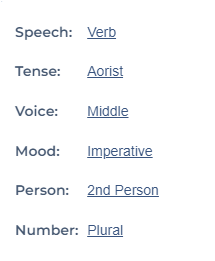
At this point, since receive is a verb, I click on the right hand button (V-XXX-XX) to find the “parsing” of the verb.
One more step to understand what all this means. Each of the underlined terms are hot links to help us understand the verb we are looking at.
An easy one for myself is the mood of the verb in this instance. Our verb has the imperative mood. This is a command. Believers are to actively take part in receiving the Word.
Voice speaks of who is performing the action. A middle voice notes that the subject (the beloved brethren in this case) is the agent of the action. The believer is performing the action of receiving. All of this is simply stating what seems obvious from the English translation.
The aorist tense is what helps me to understand that this action as not limited to a past decision or act of faith. The aorist tense has no regard to the past present or future. It defines a point in time, sometimes referring to the past, and yet this is too limiting.
If I understand the passage correctly, James is telling the believers to receive (at some point in time) the Word of God, which is already implanted in our souls as believers. To receive the Word, we must remove filthiness and wickedness, (another action of the believer).
I have previously seen this passage as a call to sanctification, a passage that speaks of our responsibility to understand and obey God’s will for our lives. Without the next phrase, I would be certain it is a sanctification passage. It’s just that I kinda struggle with what James is telling believers about saving their souls.
Able to Save your Souls
Saving your soul. What in tarnation is that? I thought our souls were saved at the point of conversion, when we first believed.
Maybe other translations translate this term differently? All of the popular English translations use the phrase “save your souls” in this verse, except for the NIV, which translates it as “save your life”. So what is James trying to tell us?
Notice that the implanted word is “able” to save our souls. Ability is an interesting word when it comes to reading the Word. Some that I have interacted with on other blogs interpret the ability to perform an act as synonymous with the completion of the same act.
When I think of the ability to save, I think of the boys in the furnace back in the book of Daniel.
Daniel 3:17-18 If this be so, our God whom we serve is able to deliver us from the burning fiery furnace, and he will deliver us out of your hand, O king. But if not, be it known to you, O king, that we will not serve your gods or worship the golden image that you have set up.”
Notice that the boys confessed God’s ability, but not the outcome (in relation to the furnace). The young Hebrew men spoke of God’s ability to save His children, but allowed for God to choose how to save his children.
To be able to do a task is to have sufficient power to accomplish that task. In relation to our passage today, I understand James is telling believers that the Word has sufficient power to save our souls. I am not convinced James is speaking of the final result, that is the saving of our soul, but of a potential result.
So is this a sanctification verse or a security passage?
But let us not end with simply a question but an affirmation that comes shining through this passage. God is able and has supplied all the needs of the saint. He is the provider of everything the believer requires to save our souls. He is the Savior and we are the ones who need Him so.
Thanks again for coming to visit. I hope you found something of interest in this post and would appreciate a comment, to begin a discussion. If you would like to receive daily posts from Considering the Bible, click on the “Follow” link below
The prophecy of the Lord Jesus for our consideration and edification, written centuries prior to His earthly existence is
Prophecy #236
Description
He was spat upon
Old Testament Prophecy
Isaiah 50:6c
I hid not my face from disgrace and spitting.
New Testament Fullfillment
Matt 27:30
And they spit on him and took the reed and struck him on the head.
If you are just joining this blog, or are a first time visitor, welcome to Considering the Bible. We would like to offer a document that provides over 350 prophecies of the Messiah found in the Old Testament for your consideration.
I make no claim to be able to comment on every one of these amazing prophecies in the future, but will occasionally bring one to the readers attention for their edification.
Hopefully you will follow “Considering the Bible” and begin an interaction with us
The prophecy of the Lord Jesus for our consideration and edification, written centuries prior to His earthly existence is
Prophecy #235
Description
He was smitten on the cheeks
Old Testament Prophecy
Isaiah 50:6b
I hid not my face from disgrace and spitting.
New Testament Fullfillment
Matt 26:67
Then they spit in his face and struck him. And some slapped him,
If you are just joining this blog, or are a first time visitor, welcome to Considering the Bible. We would like to offer a document that provides over 350 prophecies of the Messiah found in the Old Testament for your consideration.
I make no claim to be able to comment on every one of these amazing prophecies in the future, but will occasionally bring one to the readers attention for their edification.
Hopefully you will follow “Considering the Bible” and begin an interaction with us
The prophecy of the Lord Jesus for our consideration and edification, written centuries prior to His earthly existence is
Prophecy #234
Description
“I gave my back to those who struck Me”
Old Testament Prophecy
Isaiah 50:6a
I gave my back to those who strike, and my cheeks to those who pull out the beard;
New Testament Fullfillment
Matt 27:26
Then he released for them Barabbas, and having scourged Jesus, delivered him to be crucified.
If you are just joining this blog, or are a first time visitor, welcome to Considering the Bible. We would like to offer a document that provides over 350 prophecies of the Messiah found in the Old Testament for your consideration.
I make no claim to be able to comment on every one of these amazing prophecies in the future, but will occasionally bring one to the readers attention for their edification.
Hopefully you will follow “Considering the Bible” and begin an interaction with us
The prophecy of the Lord Jesus for our consideration and edification, written centuries prior to His earthly existence is
Prophecy #233
Description
The Servant bound willingly to obedience
Old Testament Prophecy
Isaiah 50:5
The Lord God has opened my ear, and I was not rebellious; I turned not backward.
New Testament Fullfillment
Matt 26:39
And going a little farther he fell on his face and prayed, saying, “My Father, if it be possible, let this cup pass from me; nevertheless, not as I will, but as you will.”
If you are just joining this blog, or are a first time visitor, welcome to Considering the Bible. We would like to offer a document that provides over 350 prophecies of the Messiah found in the Old Testament for your consideration.
I make no claim to be able to comment on every one of these amazing prophecies in the future, but will occasionally bring one to the readers attention for their edification.
Hopefully you will follow “Considering the Bible” and begin an interaction with us
The prophecy of the Lord Jesus for our consideration and edification, written centuries prior to His earthly existence is
Prophecy #232
Description
He is a learned counselor for the weary
Old Testament Prophecy
Isaiah 50:4
The Lord God has given me the tongue of those who are taught, that I may know how to sustain with a word him who is weary. Morning by morning he awakens; he awakens my ear to hear as those who are taught.
New Testament Fullfillment
Matt 7:29
for he was teaching them as one who had authority, and not as their scribes.
Matt 11:28-29
Come to me, all who labor and are heavy laden, and I will give you rest.
Take my yoke upon you, and learn from me, for I am gentle and lowly in heart, and you will find rest for your souls.
If you are just joining this blog, or are a first time visitor, welcome to Considering the Bible. We would like to offer a document that provides over 350 prophecies of the Messiah found in the Old Testament for your consideration.
I make no claim to be able to comment on every one of these amazing prophecies in the future, but will occasionally bring one to the readers attention for their edification.
Hopefully you will follow “Considering the Bible” and begin an interaction with us
The prophecy of the Lord Jesus for our consideration and edification, written centuries prior to His earthly existence is
Prophecy #231
Description
Heaven is clothed in black at His humiliation
Old Testament Prophecy
Isaiah 50:3
I clothe the heavens with blackness and make sackcloth their covering.”
New Testament Fullfillment
Luke 23:44-45
It was now about the sixth hour, and there was darkness over the whole land until the ninth hour,
while the sun’s light failed. And the curtain of the temple was torn in two.
If you are just joining this blog, or are a first time visitor, welcome to Considering the Bible. We would like to offer a document that provides over 350 prophecies of the Messiah found in the Old Testament for your consideration.
I make no claim to be able to comment on every one of these amazing prophecies in the future, but will occasionally bring one to the readers attention for their edification.
Hopefully you will follow “Considering the Bible” and begin an interaction with us
Remember your leaders, those who spoke to you the word of God. Consider the outcome of their way of life, and imitate their faith.
We find our passage today in the midst of the final chapter of the book of Hebrews, where the apostolic author (whomever it may be!) is guiding the Hebrew believers in the exercising of their faith. Granted, in this passage I will not go so far as to state the intent of the author is to communicate a conditional security message, yet I will request your consideration of the passage in light of our topic.
For the readers information, I have provided my understanding of this passage in a series of five posts under the title Christian Accountability A review may help in understanding my general perspective on this passage.
Some of the questions that arise in my mind are as follows.
Why remember our leaders?
Is not our faith a “personal faith in our personal Savior”? What bearing or influence should those who have went before us have on our lives?
Why imitate the leader?
It is often stated amongst the enlightened believers of the 21st century, that we have a “personal” faith with the Messiah, and that He leads us in our own “personal” path. This has an element of truth to it, yet I fear this thinking allows for too much personal interpretation.
As a believer, I may be able to justify many types of behavior, feeling it is a leading of the Spirit of God. As an example, I may feel I need to lie about this one itty bitty thing in order to relieve a temptation. Surely God loves me, and this is His leading. This may reside under the “personal” leading of God justification for some believers, yet when compared with Scripture and the working out of our salvation, allows too much freedom, leading to slavery.
We need to personally witness a faithful example of walking with the Lord. A leader who speaks the Word of God is the choice of the apostle for the believer to come alongside. Time with this type of believer allowing for the witness of the working out of the glory of God in a sinful earthling, is of great benefit.
Now I would caution you, that when I speak of a leader who speaks the Word of God, this does not, in my mind at least, require a paid professional church employee. If you have a close relationship with a pastor, reverend, deacon or such, good on you. But this may be a condition many of us may not have available.
Why does the author remind us of the type of leader to imitate?
He speaks of the leader who spoke the Word of God. As mentioned above, the leader needs to be one who relies on the Word of God for direction in his own life and speaks of the Word of God to others.
A teacher who speaks of his opinion as if from God, but without the foundation of the written Word of God, is to be avoided. Run away from this one.
Why is the believer exhorted to consider the outcome of this leader?
This is where the rubber meets the road, my friends.
The leaders who spoke the Word of God, revealing the Lord Jesus to an apostate nation, came under persecution from their own countrymen. The Hebrew believers were being tempted to fall back into a dead religion, destined for extinction, and to abandon the Lord Jesus for a sacrificial religion that became blasphemous before God.
This departure from the true God has been addressed throughout the book. Even within this passage, although not directly, the author continues to seek every opportunity to guide the believer into experiencing true faith. A faith that is not simply internal, but also an objective experience that may be measured by others witness, and therefore gauge his own growth and maturity.
Fellow believers provide this challenge! Don’t refuse it, but take advantage of this opportunity to learn of real life faith from those who are a bit further down the road than yourself.
As a caution, do not hear me in saying that we are in competition with one another in our experience with the Master, as we do have various callings, yet the moral temperature of our walk requires challenging, especially when pressure bears upon us to “look the other way”.
Look unto Jesus for leading, and as His apostle has exhorted us in this passage, to those who have went before us. He is good, in giving us so many opportunities to experience His life with others.
Thanks again for coming to visit. I hope you found something of interest in this post and would appreciate a comment, to begin a discussion. If you would like to receive daily posts from Considering the Bible, click on the “Follow” link below
The prophecy of the Lord Jesus for our consideration and edification, written centuries prior to His earthly existence is
Prophecy #230
Description
He is despised of the Nation
Old Testament Prophecy
Isaiah 49:7
Thus says the Lord, the Redeemer of Israel and his Holy One, to one deeply despised, abhorred by the nation, the servant of rulers: “Kings shall see and arise; princes, and they shall prostrate themselves; because of the Lord, who is faithful, the Holy One of Israel, who has chosen you.”
New Testament Fullfillment
John 1:11
He came to his own, and his own people did not receive him.
John 8:48-49
The Jews answered him, “Are we not right in saying that you are a Samaritan and have a demon?”
Jesus answered, “I do not have a demon, but I honor my Father, and you dishonor me.
John 19:14-15
Now it was the day of Preparation of the Passover. It was about the sixth hour. He said to the Jews, “Behold your King!”
They cried out, “Away with him, away with him, crucify him!” Pilate said to them, “Shall I crucify your King?” The chief priests answered, “We have no king but Caesar.”
If you are just joining this blog, or are a first time visitor, welcome to Considering the Bible. We would like to offer a document that provides over 350 prophecies of the Messiah found in the Old Testament for your consideration.
I make no claim to be able to comment on every one of these amazing prophecies in the future, but will occasionally bring one to the readers attention for their edification.
Hopefully you will follow “Considering the Bible” and begin an interaction with us
The prophecy of the Lord Jesus for our consideration and edification, written centuries prior to His earthly existence is
Prophecy #229
Description
He is Salvation unto the ends of the earth
Old Testament Prophecy
Isaiah 49:6
he says: “It is too light a thing that you should be my servant to raise up the tribes of Jacob and to bring back the preserved of Israel; I will make you as a light for the nations, that my salvation may reach to the end of the earth.”
New Testament Fullfillment
Acts 15:7-18
And after there had been much debate, Peter stood up and said to them, “Brothers, you know that in the early days God made a choice among you, that by my mouth the Gentiles should hear the word of the gospel and believe.
And God, who knows the heart, bore witness to them, by giving them the Holy Spirit just as he did to us,
and he made no distinction between us and them, having cleansed their hearts by faith.
Now, therefore, why are you putting God to the test by placing a yoke on the neck of the disciples that neither our fathers nor we have been able to bear?
But we believe that we will be saved through the grace of the Lord Jesus, just as they will.”
And all the assembly fell silent, and they listened to Barnabas and Paul as they related what signs and wonders God had done through them among the Gentiles.
After they finished speaking, James replied, “Brothers, listen to me.
Simeon has related how God first visited the Gentiles, to take from them a people for his name.
And with this the words of the prophets agree, just as it is written,
“‘After this I will return, and I will rebuild the tent of David that has fallen; I will rebuild its ruins, and I will restore it,
that the remnant of mankind may seek the Lord, and all the Gentiles who are called by my name, says the Lord, who makes these things
known from of old.’
If you are just joining this blog, or are a first time visitor, welcome to Considering the Bible. We would like to offer a document that provides over 350 prophecies of the Messiah found in the Old Testament for your consideration.
I make no claim to be able to comment on every one of these amazing prophecies in the future, but will occasionally bring one to the readers attention for their edification.
Hopefully you will follow “Considering the Bible” and begin an interaction with us
The prophecy of the Lord Jesus for our consideration and edification, written centuries prior to His earthly existence is
Prophecy #228
Description
He is the Light of the Gentiles
Old Testament Prophecy
Isaiah 49:6
he says: “It is too light a thing that you should be my servant to raise up the tribes of Jacob and to bring back the preserved of Israel; I will make you as a light for the nations, that my salvation may reach to the end of the earth.”
New Testament Fullfillment
John 8:12
Again Jesus spoke to them, saying, “I am the light of the world. Whoever follows me will not walk in darkness, but will have the light of life.”
Acts 13:47
For so the Lord has commanded us, saying, “‘I have made you a light for the Gentiles, that you may bring salvation to the ends of the earth.’”
If you are just joining this blog, or are a first time visitor, welcome to Considering the Bible. We would like to offer a document that provides over 350 prophecies of the Messiah found in the Old Testament for your consideration.
I make no claim to be able to comment on every one of these amazing prophecies in the future, but will occasionally bring one to the readers attention for their edification.
Hopefully you will follow “Considering the Bible” and begin an interaction with us
As a young believer, I spent an unbalanced amount of time in the book of Romans, trying to follow Paul’s logic, and the message he was presenting to the church in Rome. Some passages seemed to be fairly simple to grasp, with others still beyond me. Don’t even ask me about Romans 5 – the more I read that passage, the less I know!
Given the strong message Paul supplies in Romans 3 concerning the requirement of faith and not works for salvation, how can we understand our topic verse today?
First off, lets read it.
to those who by patience in well-doing seek for glory and honor and immortality, he will give eternal life; – Romans 2:7 ESV
First, some background.
I am of the opinion that Paul was crouching his remarks in these early chapters of Romans, providing theological teaching with an intent to address a practical problem within this church.
Now before we go any further, if I were to ask you of the problem resident in the Roman church, what would you say? Was there heresy floating about? Some type of false doctrine infecting this body of believers?
Maybe.
But as we travel through the book of Romans, we find Paul gives his “pièce de résistance”, his crowning jewel setting forth a theological masterpiece, to a church at Rome.
Out of sixteen chapters, three quarters of the book is positional teaching. Chapters 12 through 16 are practical teaching with the following topics
Chapter 12 – rapid fire list of Christian commands,
Chapter 13 – the believers relationship with government (fitting for believers in the capital!)
Chapter 14 – a discussion on strength and weakness in faith
Chapter 15 – a continuation of the discussion on strength and weakness in faith
Chapter 16 – personal greetings to the saints in the church.
Given the amount of space Paul uses for a discussion on strength and weakness in faith, it appears there is an element of disunity fueled by pride within the body. I would suggest that those of the Jewish faith may be holding their religious heritage over their gentile brothers, and causing strife in the body.
As long an introduction to this post is, it is important to consider a possible context we find Romans 2:7. I understand Romans 1 & 2 to be Paul’s mimicking of Nathan’s methods of when he dealt with a sinning King David. (For a fuller discussion on this topic, I recommend Judge Judge Judge – δικαιοκρισία –Study 7)
If my thinking is correct about what Paul has in mind in Romans 2, he is aiming to get a mental agreement of the Jewish believers regarding the wickedness of the subjects of chapter 1, all the while setting the Jewish believers up for self identification as the sinners. (The Nathan method! – See link to earlier post for explanation.)
Given this background, how does Romans 2:7 relate to conditional security? Is Paul simply baiting the Jewish believer, teaching the sinfulness of those described in chapter 1 and then identifying the sinners as Jewish? When Paul speaks of those who “knew no law” being able to attain salvation, how would this have impacted the Jewish believer who has “obeyed the law” their entire life? (And to add a wrinkle to this convoluted thinking, if the Jewish believer had obeyed the law, why did they repent and run to Jesus for salvation! But I digress.)
Context is king here and the previous verse to our text may provide some guidance.
He will render to each one according to his works: – Romans 2:6 to those who by patience in well-doing seek for glory and honor and immortality, he will give eternal life; – Romans 2:7 but for those who are self-seeking and do not obey the truth, but obey unrighteousness, there will be wrath and fury. – Romans 2:8
Paul is speaking of God rendering judgement according to each ones works. The outcome of judgement, based on the well-doing of the subject, is that God will provide eternal life. What? It seems so strange to think of any judgement as resulting in eternal life. When I hear the word “judgement”, I automatically think of fire and brimstone! But that is a different topic for another day.
Granted, the link between works and eternal life is difficult to deal with. I think the reason this linkage between eternal life and works is difficult to deal with is that it impacts our daily decisions to live for Him. Some may say that it is at odds with the salvation by grace through faith teaching that permeates the Word, but I believe there is a solution.
Let me summarize my questions about this passage, with a challenge for my reader.
When we come to judgement for the believer, it is common to have works associated with judgement. As this post is getting a bit long, and if it has peaked my readers interest, I will recommend a study in the Word on the relationship between works and judgement for the believer. I did a search in Blue Letter Bible for “works” and considered the verses that came up. It may be surprising to the reader of their findings!
But kindly note that the suggested topic of study is “works and judgement”, not “works and justification”. Two different studies! (A bit of a hint there, my friends!)
In all of this discussion, it is of primary importance to remember the main thing, that as believers, we are to be patient in well doing, not giving up and to be faithful in what He has called us to.
May God bless you and keep you in serving Him.
Thanks again for coming to visit. I hope you found something of interest in this post and would appreciate a comment, to begin a discussion. If you would like to receive daily posts from Considering the Bible, click on the “Follow” link below
The prophecy of the Lord Jesus for our consideration and edification, written centuries prior to His earthly existence is
Prophecy #227
Description
He is Salvation for Israel
Old Testament Prophecy
Isaiah 49:6
he says: “It is too light a thing that you should be my servant to raise up the tribes of Jacob and to bring back the preserved of Israel; I will make you as a light for the nations, that my salvation may reach to the end of the earth.”
New Testament Fullfillment
Luke 2:29-32
“Lord, now you are letting your servant depart in peace, according to your word;
for my eyes have seen your salvation
that you have prepared in the presence of all peoples,
a light for revelation to the Gentiles, and for glory to your people Israel.”
If you are just joining this blog, or are a first time visitor, welcome to Considering the Bible. We would like to offer a document that provides over 350 prophecies of the Messiah found in the Old Testament for your consideration.
I make no claim to be able to comment on every one of these amazing prophecies in the future, but will occasionally bring one to the readers attention for their edification.
Hopefully you will follow “Considering the Bible” and begin an interaction with us