The prophecy of the Lord Jesus for our consideration and edification, written centuries prior to His earthly existence is
Prophecy #40
Description
“This is of a truth that prophet”
Old Testament Prophecy
Deuteronomy 18:15
The Lord your God will raise up for you a prophet like me from among you, from your brothers—it is to him you shall listen
New Testament Fullfillment
John 6:14
When the people saw the sign that he had done, they said, “This is indeed the Prophet who is to come into the world!”
If you are just joining this blog, or are a first time visitor, welcome to Considering the Bible. We would like to offer a document that provides over 350 prophecies of the Messiah found in the Old Testament for your consideration.
I make no claim to be able to comment on every one of these amazing prophecies in the future, but will occasionally bring one to the readers attention for their edification.
Hopefully you will follow “Considering the Bible” and begin an interaction with us
Occasionally I will be dwelling on a verse or passage, ruminating on the message, (or to be honest, wandering off into some undisciplined daydreaming), and the Lord will bless me with a truth that is so obvious, so fresh and such a blessing that I just want to share it with you.
This passage was not such an occurrence. Jeremiah 29 was being discussed in Sunday School last week and the discussion brought to mind the importance of the context of the verse. First, lets consider the verse and then I will try to explain my thoughts.
Jeremiah 29:11
For I know the plans I have for you, declares the LORD, plans for welfare and not for evil, to give you a future and a hope.
How often have you been surfing the net, checking out facebook or simply listening to a sermon and this verse pops up. The message of the speaker implying, (or out rightly stating) that the Lord has a prosperous and “best life” for you right now! The modern message assures us that the Lord has plans for peace and to give us a future and a hope, implying riches, security and blessing in the present.
Really?
Let’s consider the context of this precious promise, for you see, if we dig a bit we find that the promise is much more than simply satisfying our present wants and relieving our current fears.
This message was to a group of Jews that were no longer residing in the beloved city of David. They had been carried away in the captivity to the city of Babylon, under the obvious displeasure of the Lord, per Deuteronomy 29:28. The nation had been rooted out of the land and the current generation residing in Babylon was being spoken to in Jeremiah 29.
Lets read the immediate context of Jeremiah 29:11
Jeremiah 29:10-14
10 – “For thus says the LORD: When seventy years are completed for Babylon, I will visit you, and I will fulfill to you my promise and bring you back to this place. 11 – For I know the plans I have for you, declares the LORD, plans for welfare and not for evil, to give you a future and a hope.
When 70 years are completed in Babylon? What? No immediate gratification? Verse 10 speaks of the duration this people of Israel will have to reside in Babylon.
The Lord has plans for this nation, and it includes captivity for 70 years! The plans spoken of include a wait of 70 years until the Lord visits them and directs them to return to the city of David and the Promised Land, (which in it self is an act of mercy!). Many of the Jewish population would die in a foreign land, with the second generation returning to a decimated land and city they had never seen.
A bit larger context may be beneficial, so lets consider a few verses previous.
Jeremiah 29:4-9
4 – “Thus says the LORD of hosts, the God of Israel, to all the exiles whom I have sent into exile from Jerusalem to Babylon: 5 – Build houses and live in them; plant gardens and eat their produce. 6 – Take wives and have sons and daughters; take wives for your sons, and give your daughters in marriage, that they may bear sons and daughters; multiply there, and do not decrease. 7 – But seek the welfare of the city where I have sent you into exile, and pray to the LORD on its behalf, for in its welfare you will find your welfare.
The Lord is informing the Jewish remnant, those who trust in His Words, to settle in Babylon, the nation that destroyed them, to raise families and to seek the welfare of the captors city. To pray to the LORD on it’s behalf! (How very New Testamental!)
In the midst of this tremendous passage though, the LORD gives a warning.
8 – For thus says the LORD of hosts, the God of Israel: Do not let your prophets and your diviners who are among you deceive you, and do not listen to the dreams that they dream, 9 – for it is a lie that they are prophesying to you in my name; I did not send them, declares the LORD.
In the city of Babylon, certain men, even Jewish “prophets” had risen up to declare that the captivity would be short lived and the Jew’s would be returning to their homeland soon. The message was intoxicating – “Don’t settle, for you are heading back. This captivity, this suffering will not continue.”
Sound familiar to a message that is popular nowadays?
Those who read this blog must understand that the false gospel of prosperity is a virulent pervasive and deadly message that perverts the loving care of the Lord Almighty, that exchanges the eternal for the here and now, and true riches that should be exchanged for temporal junk.
Sometimes I fear the message is so prevalent, the the culture is fully drunk on the venom.
Let the message of verse 8 ring in your ears.
Do not let your prophets and your diviners who are among you deceive you, and do not listen to the dreams that they dream
The following verses address the desired outcome of the captivity, the joining together of the nation with God in determining their future. (Consider 1 Corinthians 3:9). Note verse 13 & 14, and the conditional finding of God prior to restoration. When you seek Him with all your heart. Then He will be found by you, and then the people will return to the Promised Land.
12 – Then you will call upon me and come and pray to me, and I will hear you. 13 – You will seek me and find me, when you seek me with all your heart. 14 – I will be found by you, declares the LORD, and I will restore your fortunes and gather you from all the nations and all the places where I have driven you, declares the LORD, and I will bring you back to the place from which I sent you into exile.
Amazing cooperation of the Lord Almighty with the will of man, and the invitation by the Holy One to a rebellious people, to again enter into a life of faith with the Living God. We have such a good and loving God, One who is not to be compared with any!
Praise the Father of light, Who has given His own Son for our redemption, salvation and continual blessing, even in the midst of occasional trials.
In conclusion, the Jews in Babylon received a message from Jeremiah, the true prophet of God in Jerusalem, a message of required endurance, and of a future that would be secured for them. A return to the promised land that, though generations away, was secured for the nation by the Word of God.
Individual Jews were also given direction, that is to settle in the land of their enemies, to seek their enemies good and to rest in the promise of God.
This passage from Jeremiah to the Jews in Babylon was to have an intended effect. That effect was to see the Jews seek God (and not conditions of ease) with their whole heart. The Jews were warned NOT to rely on empty promises from false prophets, promising a return to normal peaceful living in security and wealth.
Be at peace with your current situation, even if difficult. If you find yourself in a difficult situation, and the Lord provides an escape, of course take it.
If no escape, endurance is called for. Seek Him with all your heart, and depend on the promises of God.
In the mid nineties, I had a little red Buick and a big ol’ bass box in the trunk, and would listen to “Christian Rock”, cranked to 11.
(What did you say? Huh? Can you say that again, I didn’t hear you….)
I have gotten away from that genre for many reasons, the least of which may be a loss of hearing, but some songs have stuck with me over the decades.
The artist’s I listened to sought to reflect Scriptural teaching for the most part. They ranged from “preaching” pop culture religion to significant theological teaching. As I listened to the lyrics, I found some to be quite challenging.
To be honest, I listened because I could justify the rock beat with “sanctified lyrics”.
Occasionally I will post a song, supply the lyrics and make a comment or two. If you decide to listen to the tune, turn the speaker down unless you are already deaf. Some of the songs tend to have a certain “volume” about them!
This post will consider the song
Mortal Stomp – Ultimatum
How we do groan to be released from the confines of earthly mortality. To live is Christ to die is gain. We will be free from this earthly frame. Lord how we long to meet you in the air. The dead shall rise first, the living, death shall spare. Eternally changed, these cloths shall be shed Mortal Stomp, the resurrection of the dead. Instantly changed to incorruption. Those who reject Him will taste separation. The ground it shall open (and) awaken those who sleep. The Earth in birth pains shall give up her deceased. Spirit and body will be reunited. Death has lost it’s sting, the grave its victory. Eternally changed, these cloths shall be shed, Mortal Stomp, the resurrection of the dead. Death, Separation, Life, Resurrection. (2x) Stomp! Stomp! Stomp! (3x) We shall not sleep, but we shall be changed. In a moment the last trump shall sound. No more sickness and no more tears, no more pain and no more fears. This hope we hold will soon come to pass. Thanks be to God for the victory at last! Eternally changed, these cloths shall be shed, Mortal Stomp, the resurrection of the dead. Death, Separation, Life, Resurrection. (2x) Solo-Steve How we do groan to be released from the confines of earthly mortality. To live is Christ to die is gain. We will be free from this earthly frame. Lord how we long to meet you in the air. The dead shall rise first, the living, death shall spare. Eternally changed, these cloths shall be shed. Mortal Stomp, the resurrection of the dead. Death, Separation, Life, Resurrection. (2x) STOMP!
These guys were hard driving with crazy vocals. I loved this one!
Let me know what you think of the lyrics, and of the tunes!
The prophecy of the Lord Jesus for our consideration and edification, written centuries prior to His earthly existence is
Prophecy #39
Description
Time: “I shall see him, but not now.”
Old Testament Prophecy
Numbers 24:17
I see him, but not now; I behold him, but not near: a star shall come out of Jacob, and a scepter shall rise out of Israel; it shall crush the forehead[a] of Moab and break down all the sons of Sheth.
New Testament Fullfillment
John 1:14
And the Word became flesh and dwelt among us, and we have seen his glory, glory as of the only Son from the Father, full of grace and truth.
Gal 4:4
But when the fullness of time had come, God sent forth his Son, born of woman, born under the law,
If you are just joining this blog, or are a first time visitor, welcome to Considering the Bible. We would like to offer a document that provides over 350 prophecies of the Messiah found in the Old Testament for your consideration.
I make no claim to be able to comment on every one of these amazing prophecies in the future, but will occasionally bring one to the readers attention for their edification.
Hopefully you will follow “Considering the Bible” and begin an interaction with us
As mentioned in the introduction, I have been been discussing the differences between Calvinism and Provisionalism with a fellow blogger. One particular response grabbed my attention and I am trying to understand his position, by referring to his proof texts and logic.
This is the second portion of his response (in red), along with the corresponding verses he referred to. I shall seek to comment on the verses and find his argument within the verses he has provided.
Original Comment
Scripture says God is sovereign in his decision to whom he will have mercy which is in accordance with Romans 9:16 and other scripture Romans 9:15,18 The natural man doesn’t come and can’t come 1 Corinthians 2:14 John 6:44 John 6:65 He doesn’t have the ability because he lacks spiritual discernment because he doesn’t have the spirit.
Romans 9:16 – So then it depends not on human will or exertion, but on God, who has mercy
This is the big one! The verse that seems to answer all questions when it comes to determinism, a lynchpin in the Calvinistic understanding of the sovereignty of God. When the topic of free will comes up in relation to soteriology, Romans 9 seems to be the passage used to defeat all arguments. I am not convinced this is so.
First A Plea
I realize that some may read this and will immediately discount my thoughts. That is expected. When I taught the “doctrines of grace” I too discounted all who challenged me. Romans 9-11 is considered the hotbed of Calvinism. I make absolutely no claim to resolve the debate of it’s interpretation, but only to supply an alternate perspective to the deterministic approach.
For those who refuse to consider any alternate teaching, they themselves have set themselves up to be the arbiters of truth, judging others as opposed to understanding another position and showing grace to others.
They may be completely convinced of their position, and of that, I salute their arrival. For myself, I previously lived a life of “superior” knowledge, looking down on others and their thoughts. (Romans 1:22) Out of that life attitude, I offended, judged, tore down, and condemned many that were walking a better Christian life than myself. (Galations 5:15)
I readily admit that it is difficult to consider a differing opinion, since it opens the reader up to admitting an error. Admitting error is often called repentance in the Body of Christ, and is to be celebrated.
It is important to remember that the Christian life is Christ, that Christianity is not principally a teaching (John 5:39) but a Person, a Person that has been raised from the dead. My second birth occurred due to my repentance of sin and faith in the One who had the right to be my Judge, and yet He sacrificed Himself for a lost sinner. This simple truth has set me free. He is full of grace to the ones who reject Him, revile Him and run from Him.
Back to Verse 16
Who is receiving the mercy? This, in my opinion, is the crux of the matter. Does this passage refer to individuals or nations, that is corporate entities?
This passage is dependent on the context and hinges on a phrase found in Exodus 33:19. Let me try to recount the context.
Exodus 32, Moses is on Mount Sinai, with the children of Israel below, beginning to grumble. During the time on the mount, the Lord informs Moses of the sin of Israel in worshipping the golden calf. The Lord tells Moses to leave Him alone in order that the children of Israel may be consumed.
Moses goes into intermediary mode, (forgoing the potential honor of his own nation from his loins), and reminds the Lord of His promises to the fathers. The Lord relents of His consuming judgement upon His nation, His very own people. Yet judgement came upon certain individuals – 3,000 died at the hand of the Levites.
Exodus 33 Moses receives a command to leave Sinai and head to the promised land. Moses needs assistance in this huge effort of leading the nation of Israel, His people to the promised land. He needs God’s presence with him on this assignment.
Moses was given the promise of God’s presence to go with him and to give him rest. Moses pushes, and makes his demand – If you do not go up with US, do not lead US up from here. He had been given the promise of God’s presence, but Moses sought the presence of God for the nation, the people of God.
God promises His presence for the nation, and then Moses asked to see His glory.
The Lord states
Exodus 33:19
And he said, “I will make all my goodness pass before you and will proclaim before you my name ‘The LORD.’ And I will be gracious to whom I will be gracious, and will show mercy on whom I will show mercy.
Let’s think about the context. Moses had found favor in the sight of the Lord. (Ex 33:17) The nation of Israel had definitely not found favor, but had rebelled and sinned against the One who delivered them.
It seems this phrase
“And I will be gracious to whom I will be gracious, and will show mercy on whom I will show mercy.”
is referring to the nation of Israel, and not an individual, since God’s relationship with Moses had been defined earlier in the passage.
Whoa Carl – that is such a tenuous statement. My Calvinistic teaching demands that the mercy shown in this context is on individuals, and not a corporate mercy. This cannot be the correct interpretation, since it conflicts with my theology!
No comment. Lets continue.
Malachi 1:2-3
“I have loved you,” says the LORD. But you say, “How have you loved us?” “Is not Esau Jacob’s brother?” declares the LORD. “Yet I have loved Jacob
but Esau I have hated. I have laid waste his hill country and left his heritage to jackals of the desert.”
I see the verses above defining the one who is loved as being the corporate entity of the nation of Israel, as opposed to a singular person. Although the passage states that “Esau” was hated, it is the nation of Edom that is referred to in the expression of the hatred. Esau was long gone and his fate had been sealed by this time. But the prophet speaks of a national disaster that befell the nation of Edom, when he defines the “hatred” the Lord has for Esau. Jacob, meanwhile was back in the land and still in existence by the time of Malachi. Surely the nation of Israel was loved by God.
Back to Romans 9:16. With this background and understanding, the mercy spoken of in Exodus 33 was being shown to a nation that had sinned greatly in front of the Lord. His people had rejected Him as He sought to offer His covenant to them.
Is there not a parallel with the condition Paul was in the midst of? The physical nation of Israel was predominantly rejecting the new covenant, just like they rejected the covenant at Sinai.
The very promises of God were being questioned, in the midst of the nation rejecting the opportunity. And Paul was answering these challenges by using verses specifically chosen that define the mercy of God on a corporate entity. The nation of Israel had many blessings as defined in 9:2- 3.
As I mentioned earlier, I am supplying an alternate framework to consider the Romans 9-11 passage, which makes sense to me. Since the name of this blog is “Considering the Bible” and not “I have all truth”, this is offered for your consideration, and not blind obedience!
I do hope you will continue with me as I seek to understand the verses he supplies and if the verses he supplied support his argument of fatalism/determinism which he speaks of.
The prophecy of the Lord Jesus for our consideration and edification, written centuries prior to His earthly existence is
Prophecy #38
Description
The serpent on a pole-Christ lifted up
Old Testament Prophecy
Numbers 21:9
So Moses made a bronze[a] serpent and set it on a pole. And if a serpent bit anyone, he would look at the bronze serpent and live.
New Testament Fullfillment
John 3:14-18
And as Moses lifted up the serpent in the wilderness, so must the Son of Man be lifted up,
that whoever believes in him may have eternal life.
“For God so loved the world, that he gave his only Son, that whoever believes in him should not perish but have eternal life.
For God did not send his Son into the world to condemn the world, but in order that the world might be saved through him.
Whoever believes in him is not condemned, but whoever does not believe is condemned already, because he has not believed in the name of the only Son of God.
If you are just joining this blog, or are a first time visitor, welcome to Considering the Bible. We would like to offer a document that provides over 350 prophecies of the Messiah found in the Old Testament for your consideration.
I make no claim to be able to comment on every one of these amazing prophecies in the future, but will occasionally bring one to the readers attention for their edification.
Hopefully you will follow “Considering the Bible” and begin an interaction with us
Christianity is a socially acceptable religion, if you don’t read the Bible. If you read the Bible, the cultural understanding of Christianity and the prescribed actions of Christianity are sometimes light years apart. I think this passage will agree with me.
Let’s read the parable Jesus spoke to the Pharisee who invited Him into His house.
Luke 14:12-14
12 He said also to the man who had invited him, “When you give a dinner or a banquet, do not invite your friends or your brothers or your relatives or rich neighbors, lest they also invite you in return and you be repaid. 13 But when you give a feast, invite the poor, the crippled, the lame, the blind, 14 and you will be blessed, because they cannot repay you. For you will be repaid at the resurrection of the just.”
Questions to Consider
Who were the audience?
One man was delivered this short story, and yet I think the entire party may have overheard.
When did the Lord give this parable?
This parable was given near the end of a period of withdrawal from Galilee, approx. 6 months prior to entering into Jerusalem for the last time. Jesus was attending a supper, being invited by a ruler of the Pharisees. (Luke 14:1)
Where did the Lord teach the parable?
As mentioned earlier, the Lord was at a supper, in the house of a Pharisee.
Why did the Lord give this message?
The Lord was in the home of a Pharisee, with a bunch of Pharisees attending, watching and judging Him. He had healed a man with the dropsy (See my post on Swelling Opposition for more background)
It doesn’t appear to be clear to me of any known initiator of this parable, other than the situation the Lord found Himself in. Often the parables are told in response to a question, or because of an obvious misunderstanding. This parable seems to be given as a general teaching, yet the Lord is in the midst of Pharisees, known to be considered favored of God due to their wealth and high standing in society.
I understand a generic Pharisee believed that monetary success proved God’s favor. Sinners received poverty, sickness and weakness. To be right with God was to have health, wealth and happiness.
What was the message for the original audience?
For the master of the ceremonies, the host of the party, the message was clear. The home was full of his friends and acquaintances, and if the man with the palsy somehow was included in the party, I fear it may have been reluctantly, in order to entrap the Messiah.
The one with sickness, the one who was a “sinner” was a tool of the Pharisee.
Jesus turned the tables and witnessed against this belief in two points
Don’t invite your equals, peers or those who are close to you
Invite those who are the rejects, the sinners, the ones who seemingly have been rejected by God
Don’t look for temporal repayment.
The doctrine the Pharisees believed was such that God’s love had to constantly renewed with monetary blessings, instead of simply having your life “hid in God”.
In other words, don’t suck up to those who can repay your friendship, but serve those who can’t (or won’t).
What is the message for us today?
Can we invite every poor soul to a party? Can we care for all the crippled and blind? For one soul who is in need, to accept them and give care, even for a short time, fulfills the intent of this story.
As we go about our daily hectic lives, it is difficult to slow down and care for those less fortunate than us.
The first issue that I need to address is my attitude towards my brother, the ones who may have fallen on hard times, struggled with an addiction or sickness, been burdened with a disability. My attitude towards them is to be of acceptance, to see them as loved by God, and not rejected.
The second concern is the practical outworking of this story. Wisdom is needed to understand who to show mercy to, who to bend to and to help. There is a wisdom that my wife often reminds me of in that we are not to cast our pearls to the swine, and this is the rub for me.
Our expression of love is to be with wisdom. Rejection of the downcast is not acceptable towards anyone who is in need, yet the application of our resources needs to be applied with wisdom. Many times the mercy may be provided to those who reject it in the end, but that is not to be our goal. The expression of mercy is an end to itself for it reflects, in a small way, the way of the Master.
May we have grace to express mercy to those less fortunate than ourselves, and find someone even this week to be a blessing to.
The prophecy of the Lord Jesus for our consideration and edification, written centuries prior to His earthly existence is
Prophecy #37
Description
Not a bone of Him broken
Old Testament Prophecy
Numbers 9:12
They shall leave none of it until the morning, nor break any of its bones; according to all the statute for the Passover they shall keep it.
New Testament Fullfillment
John 19:31-36
Since it was the day of Preparation, and so that the bodies would not remain on the cross on the Sabbath (for that Sabbath was a high day), the Jews asked Pilate that their legs might be broken and that they might be taken away.
So the soldiers came and broke the legs of the first, and of the other who had been crucified with him.
But when they came to Jesus and saw that he was already dead, they did not break his legs.
But one of the soldiers pierced his side with a spear, and at once there came out blood and water.
He who saw it has borne witness–his testimony is true, and he knows that he is telling the truth–that you also may believe.
For these things took place that the Scripture might be fulfilled: “Not one of his bones will be broken.”
If you are just joining this blog, or are a first time visitor, welcome to Considering the Bible. We would like to offer a document that provides over 350 prophecies of the Messiah found in the Old Testament for your consideration.
I make no claim to be able to comment on every one of these amazing prophecies in the future, but will occasionally bring one to the readers attention for their edification.
Hopefully you will follow “Considering the Bible” and begin an interaction with us
My wife and I are reading through the Psalms in our evening reading and occasionally a nugget of the Psalms jumps out of the page. Don’t you love it when, after years of reading the “Old Book” passages become alive, reinforcing old teachings or simply warming your heart.
This is the book of Psalms, and it is rich.
I pray I can communicate a portion of the blessing we receive from this wonderful book.
This psalm naturally divides
Let’s read the first few verses before any comment.
Psalm 26:1-3
Of David. Vindicate me, O LORD, for I have walked in my integrity, and I have trusted in the LORD without wavering. Prove me, O LORD, and try me; test my heart and my mind. For your steadfast love is before my eyes, and I walk in your faithfulness.
David was bold.
He knew where he stood, and wanted to be tested. He wanted to be proven, tested to ensure he was where the Lord wanted him in his life.
Prove me! (bāḥan)
To prove something is to examine something, to put to a trial and find results.
What are you saying David? You are telling the Lord to test you out? How rare this request is for our modern christianity!
Consider
Proverbs 17:3
The crucible is for silver, and the furnace is for gold, and the LORD tests (bāḥan) hearts.
Try me! (nāsâ)
To test something is to get proof of the validity of the thing. When the Old Testament saint used the word try (nāsâ), the word literally meant “to test by the smell”.
Consider
Exodus 17:2,7
2 Therefore the people quarreled with Moses and said, “Give us water to drink.” And Moses said to them, “Why do you quarrel with me? Why do you test (nāsâ) the LORD?” 7 And he called the name of the place Massah and Meribah, because of the quarreling of the people of Israel, and because they tested (nāsâ) the LORD by saying, “Is the LORD among us or not?”
Massah nasa. Can you see the similarity between these two words, and the reason Moses called it Massah? It was the place the children of Israel tested (nāsâ) the LORD. (These two words are so homophonic!)
One additional verse needs to be considered in relation to Psalm 26:2
Psalm 95:9
When your fathers put me to the test (nāsâ) and put me to the proof (bāḥan), though they had seen my work.
Amazing contrast, no?
In Psalm 26, the psalmist is requesting the test, to be proven by the Lord. This is the heart of the mature believer, one who seeks to be used by God and will submit to a testing to ensure it!
In Psalm 95, the people are demanding proof of God’s presence. They are not walking in faith, seeking to know God’s will for their lives, but they are seeking their own desires and wants, their own goals and purposes. These folk are continually and without pause, desiring to put God to the test, to demand their rights, to question His goodness and wisdom.
How often have you heard one say that God is not fair, that He must not care for His creation, or His people. If He cared he would stop all disease and hunger, and provide quails for all!
But alas, this is the spirit of a fallen people.
Test me! (ṣārap̄)
The literal meaning of this word is “to melt”, as in to smelt a metal. Heat is implied in this verb, and the Psalmist is demanding this from his Lord.
What audacity! What guts! What confidence in his Master.
My friend, the Lord Himself is a kind and loving Father, One who seeks our best. The monkey wrench in the plan is our lack of desire to be involved in His work.
David sought to be tested, to be melted down and purified. We so often sing of our desire to be purified, and rightly so, but if we are to mimic the saints of old, we need to realize what this means from their standpoint.
This is not to be entered lightly, and is a sobering request of the saint to his Father. Early into my Christian faith, I saw this teaching throughout the Old Testament and sought to follow after their example.
Trials have come, and trials have continued.
Looking back, some of them were simply my immaturity and ignorance of God’s ways, and the results of making poor decisions on my part. He has always brought about good things out of the most painful circumstances.
Some of them were the result of loved ones making bad decisions and my faith was tested. Being out of my control (as if I had much control!), made this testing even more difficult, but He has been so kind and brought about good things out of the bad. But tests such as these are difficult, and can be very painful.
Finally, some trials may have come directly from the hand of the Lord, and not necessarily through an intermediary, or through my own foolishness. These tests, in my opinion have been the most personnel and have caused me to understand my reason for being. These test have also begun to teach my heart and mind of the Lord Himself. He has been so kind to me in my stunted growth, my wanderings and my questionings.
The tests have brought about good things in my life and the lives of those I love. We have great hope based on His constant past care for His loved ones, and we trust that God will bring about a settled faith in future trials.
But let it be clearly stated that the circumstances within and beyond the trials have also been very painful.
Consider when you ask for purification that you are willing to stay under the trial, and have the dross burned off.
In the mid nineties, I had a little red Buick and a big ol’ bass box in the trunk, and would listen to “Christian Rock”, cranked to 11.
(What did you say? Huh? Can you say that again, I didn’t hear you….)
I have gotten away from that genre for many reasons, the least of which may be a loss of hearing, but some songs have stuck with me over the decades.
The artist’s I listened to sought to reflect Scriptural teaching for the most part. They ranged from “preaching” pop culture religion to significant theological teaching. As I listened to the lyrics, I found some to be quite challenging.
To be honest, I listened because I could justify the rock beat with “sanctified lyrics”.
Occasionally I will post a song, supply the lyrics and make a comment or two. If you decide to listen to the tune, turn the speaker down unless you are already deaf. Some of the songs tend to have a certain “volume” about them!
This post will consider the song
Need – Grammatrain
I wear a face that seems to be Confidentiality The only eyes that see in me Know my desperality
And i’m a man thats found his way By having not alot to say I wanna tell You that i need You
I know Your anything they see An image of maturity But if i was what i should be Wouldn’t i be on my knees?
And i’m a man that’s found his way By having not alot to say I wanna tell You that i need You And when i fall into Your hand I see myself for what i am It only shows me that i need You
This is the third and probably not the last, song by Grammatrain that I will post. These guys were amongst my favoritest!!!
Let me know what you think of the lyrics, and of the tunes!
The prophecy of the Lord Jesus for our consideration and edification, written centuries prior to His earthly existence is
Prophecy #36
Description
The Drink-offering: “If any man thirst”
Old Testament Prophecy
Leviticus 23:36-37
For seven days you shall present food offerings to the Lord. qOn the eighth day you shall hold a holy convocation and present a food offering to the Lord. It is a rsolemn assembly; you shall not do any ordinary work.
“These are the appointed feasts of the Lord, which you shall proclaim as times of holy convocation, for presenting to the Lord food offerings, burnt offerings and grain offerings, sacrifices and drink offerings, each on its proper day,
New Testament Fullfillment
John 7:37
On the last day of the feast, the great day, Jesus stood up and cried out, “If anyone thirsts, let him come to me and drink.
If you are just joining this blog, or are a first time visitor, welcome to Considering the Bible. We would like to offer a document that provides over 350 prophecies of the Messiah found in the Old Testament for your consideration.
I make no claim to be able to comment on every one of these amazing prophecies in the future, but will occasionally bring one to the readers attention for their edification.
Hopefully you will follow “Considering the Bible” and begin an interaction with us
As mentioned in the introduction, I have been been discussing the differences between Calvinism and Provisionalism with a fellow blogger. One particular response grabbed my attention and I am trying to understand his position, by referring to his proof texts and logic.
This is the first portion of his response (in red), along with the corresponding verses he referred to. I shall seek to comment on the verses and find his argument within the verses he has provided.
Original Comment
You are always using Human reasoning instead of scripture. God can change and has to change a person’s will to be saved. Ezekiel 36:26 John 3:3-8 Romans 3:10-12 Psalms 14:1-3 even though you think he can’t interfere with natural man’s will and someone will have to tell me how one person believes the Gospel the true gospel that is and another doesn’t. No freewill advocate can give me an answer. They ignore that question.
Psalm 14:1-3
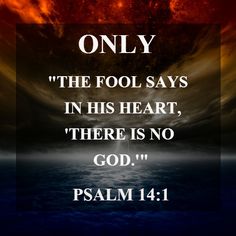
Psalm 14:1 – To the choirmaster. Of David. The fool says in his heart, “There is no God.” They are corrupt, they do abominable deeds; there is none who does good. Psalm 14:2 – The LORD looks down from heaven on the children of man, to see if there are any who understand, who seek after God. Psalm 14:3 – They have all turned aside; together they have become corrupt; there is none who does good, not even one.
This passage is attributed to David, very likely during the persecution of King Saul, or the rebellion of his son Absalom. It is a dark day for David, no matter what, and the psalm expresses his utter despair, and his expectation of the Lord’s deliverance.
It is interesting that David does not say “everyone born says in his heart, “There is no God….” Nope – David has a specific type of person in mind, a fool. This passage my friend has supplied, describes a portion of humanity from David’s perspective. As we considered in our previous post, the Apostle Paul applies this passage to all, (calling us all fools!) yet even the universality of sin does not support my friends contention that a man cannot respond to the grace of God.
Verse 2 speaks of “the children of men”. This moves the reader from considering the category of fools, to that of all humanity.
And yet we have a number of instances in the Word of those who are “devout”.
A good example of the ability of a lost person to respond to God is found in Acts 10, where Peter is told to visit with a dirty Roman centurion. But wait a minute Carl. This fella Cornelius, in verse 2, is called “a devout man who feared God with all his household, gave alms generously to the people and prayed continually to God.” He was obedient to the vision, (whereas Peter had to be shown his vision 3 times!)
What a terrific story, and upon reading it, it seems that Cornelius was seeking to hear and understand, and it was Peter that was a bit reluctant to obey. So backwards to what we should be like.
Nevertheless, Psalms 14 speaks of a person that is corrupt, does bad things, does not do good things, who turns aside, and has become corrupt. (By the way, if this fool has always been against God, what does it mean when he say he turned aside? That he has become corrupt? Could the one described have been seeking God, in some way previously, and has since “turned aside”, has “become corrupt”?)
This passage describes fools, (and the rest of us). It might not be comfortable to hear it, but hear it we must.
I do hope you will continue with me as I seek to understand the verses my friend supplies and if the verses he supplied support his argument of fatalism/determinism which he speaks of.
The prophecy of the Lord Jesus for our consideration and edification, written centuries prior to His earthly existence is
Prophecy #35
Description
It is the blood that makes atonement
Old Testament Prophecy
Leviticus 17:11
For the life of the flesh is in the blood, and I have given it for you on the altar gto make atonement for your souls, hfor it is the blood that makes atonement by the life.
New Testament Fullfillment
Rom. 3:23-24
for all have sinned and fall short of the glory of God,
and are justified by his grace as a gift, through the redemption that is in Christ Jesus,
1 John 1:7
But if we walk in the light, as he is in the light, we have fellowship with one another, and the blood of Jesus his Son cleanses us from all sin.
If you are just joining this blog, or are a first time visitor, welcome to Considering the Bible. We would like to offer a document that provides over 350 prophecies of the Messiah found in the Old Testament for your consideration.
I make no claim to be able to comment on every one of these amazing prophecies in the future, but will occasionally bring one to the readers attention for their edification.
Hopefully you will follow “Considering the Bible” and begin an interaction with us
This parable has provided a guiding principle for me for years and in many areas, but especially when I attend any business, social or religious meeting. Sure I am of the type that holds back, and this teaching tends to reinforce that thinking.
Yet this parable speaks of honor amongst others, and the authority of others when you seek your own honor, that may end up as shame! For you see, there will always be someone more distinguished than you in the room!
Let’s read the parable.
Luke 14:7-11
7 Now he told a parable to those who were invited, when he noticed how they chose the places of honor, saying to them, 8 “When you are invited by someone to a wedding feast, do not sit down in a place of honor, lest someone more distinguished than you be invited by him, 9 and he who invited you both will come and say to you, ‘Give your place to this person,’ and then you will begin with shame to take the lowest place. 10 But when you are invited, go and sit in the lowest place, so that when your host comes he may say to you, ‘Friend, move up higher.’ Then you will be honored in the presence of all who sit at table with you. 11 For everyone who exalts himself will be humbled, and he who humbles himself will be exalted.”
Questions to Consider
Who were the audience?
Jesus spoke this parable to a group of party-goers. These party-goers were jockeying for a place of honor. (Quick question – Who deserved the place of honor?)
With Jesus seeing this behavior in this social environment it seems like a story that would definitely kill a good mood. I don’t think His intentions were such, (who am I to know that!) but the pride and arrogance that Jesus taught against must have been stifling. Imagine a group of successful religious leaders mentally searching out the room to find advantage over others and to attain for self glory. This is so upside down to the gospel we know, yet religion breeds this competition.
When did the Lord give this parable?
This parable was taught within 3 months of entering Jerusalem on His final week.
Where did the Lord teach the parable?
This parable was taught while the Lord and His disciples were in Perea.
Why did the Lord give this message?
As I mentioned above, this parable might have come off as a bit of a kill-joy for certain of the party-goers, but the message was definitely modelled for the situation Jesus and His disciples found themselves in.
What was the message for the original audience?
I suppose the message for the original audience is obvious. Status climbing attitudes, or as I heard it stated in Quebec when we lived there, to be “stepping on heads” was doomed to result in shame.
Self promotion brings shame. Self love and self focus results in glory for someone else. A very uncomfortable position to be in for the one who is so proud of his state of being!
Humility brings honor. Self humbling is the prescribed method to find your worth, and in the midst of it, honor will attach to you, though you will find it an uncomfortable condition! A truly humble one seeks the blessing of another and not himself. When honor comes, the humble tend to be uncomfortable with it.
What is the message for us today?
Note that we are not to wait to be humbled. We are to initiate this attitude. When you feel pride welling up in your heart about all the good things you have done, and can compare favorably with others, give yourself a kick in the head. Sure you may be successful in some area, yet it is the Lord who has provided you the opportunity, skill set, energy, and desire to do the work.
Any many others are exactly the same.
And you nor I can judge properly, because, at least for me, I always emphasize my goodness and all others their badness, therefore skewing the truth. No, the safe attitude is of humility, of considering yourself less that your brother, even less than all your brothers and sisters.
Philippians 2:3 Do nothing from selfish ambition or conceit, but in humility count others more significant than yourselves.
Someone else may exalt you. Give them the opportunity. If I exalt myself, no-one else can!
The prophecy of the Lord Jesus for our consideration and edification, written centuries prior to His earthly existence is
Prophecy #34
Description
The Blood-the life of the flesh
Old Testament Prophecy
Leviticus 17:11
For the life of the flesh is in the blood, and I have given it for you on the altar gto make atonement for your souls, hfor it is the blood that makes atonement by the life.
New Testament Fullfillment
Matt 26:28
for this is my blood of the covenant, which is poured out for many for the forgiveness of sins.
Mark 10:45
For even the Son of Man came not to be served but to serve, and to give his life as a ransom for many.”
If you are just joining this blog, or are a first time visitor, welcome to Considering the Bible. We would like to offer a document that provides over 350 prophecies of the Messiah found in the Old Testament for your consideration.
I make no claim to be able to comment on every one of these amazing prophecies in the future, but will occasionally bring one to the readers attention for their edification.
Hopefully you will follow “Considering the Bible” and begin an interaction with us
My wife and I are reading through the Psalms in our evening reading and occasionally a nugget of the Psalms jumps out of the page. Don’t you love it when, after years of reading the “Old Book” passages become alive, reinforcing old teachings or simply warming your heart.
This is the book of Psalms, and it is rich.
I pray I can communicate a portion of the blessing we receive from this wonderful book.
This psalm naturally divides in two portions, and I would like to consider verses 12 – 23 for this blog post
Let’s read it before any comment.
Psalm 25:12-23
Who is the man who fears the LORD? Him will he instruct in the way that he should choose. His soul shall abide in well-being, and his offspring shall inherit the land. The friendship of the LORD is for those who fear him, and he makes known to them his covenant. My eyes are ever toward the LORD, for he will pluck my feet out of the net. Turn to me and be gracious to me, for I am lonely and afflicted. The troubles of my heart are enlarged; bring me out of my distresses. Consider my affliction and my trouble, and forgive all my sins. Consider how many are my foes, and with what violent hatred they hate me. Oh, guard my soul, and deliver me! Let me not be put to shame, for I take refuge in you. May integrity and uprightness preserve me, for I wait for you. Redeem Israel, O God, out of all his troubles.
The psalmist, in the last half of the psalm is speaking of two topics. The depth of his need and his utter dependency on the LORD.
One verse, amongst the many that speak to me, of relationship with the One who is All, is verse 16
Turn to me and be gracious to me, for I am lonely and afflicted.
The verse before, the psalmist speaks of his eyes always being toward the LORD, that he seeks the favor of God continually. But something is wrong. The LORD is not looking to the psalmist. You see, when the psalmist states “Turn to me”, it implies that the LORD had turned away from him.
Now, I don’t understand too much about the Old Testament saints related to the LORD, and this particular saint, being David, definitely had a relationship with his LORD that compared in many ways with our condition today.
For believers, after the LORD provided His Son for our rescue, to consider Him to be turned away seems to be beyond the pale. (Consider Romans 8:32 as an example of our Father’s attitude to us)
Where is the application for us in this passage?
It may feel like He has turned on us at times in our life, and a couple of thoughts come to mind.
First off, sin breaks fellowship, and unconfessed sin pulls us away from His loving care. Confess the sin, and repent of it, four hundred and ninety times if you have to.
Secondly, the feeling of abandonment may be just that – a feeling. Now don’t get me wrong, feelings are powerful and intended to be a blessing from God, but they can be used to detract us from our goals in life.
There have been times in my life when I have been very low, struggling to maintain a faith, to not give up. Times of loneliness and affliction that were drawn out for months, even years, and were very difficult!
Every believer goes through times such as these. It should drive us to the promises that have been given, that His love is extreme and He seeks the best for us in all our trials. He is seeking to conform us to the image of His Son, and this is a gargantuan effort from my point of view!
Hold on to the promises of God, in the depths of your loneliness and affliction, for He has promised.
And remember, He was truly abandoned in order that we may never be.
In the mid nineties, I had a little red Buick and a big ol’ bass box in the trunk, and would listen to “Christian Rock”, cranked to 11.
(What did you say? Huh? Can you say that again, I didn’t hear you….)
I have gotten away from that genre for many reasons, the least of which may be a loss of hearing, but some songs have stuck with me over the decades.
The artist’s I listened to sought to reflect Scriptural teaching for the most part. They ranged from “preaching” pop culture religion to significant theological teaching. As I listened to the lyrics, I found some to be quite challenging.
To be honest, I listened because I could justify the rock beat with “sanctified lyrics”.
Occasionally I will post a song, supply the lyrics and make a comment or two. If you decide to listen to the tune, turn the speaker down unless you are already deaf. Some of the songs tend to have a certain “volume” about them!
This post will consider the song
Push Me Down – Plankeye
How can I move forward from this place?…of disgrace I’m full of stone…immovable Push me down Push me down now I might break in two Suffer a chip Create, create, create an opaque mess I might break in two, Suffer a chip Now all that echos in the chambers of my heart Thin silhouettes of your truth Push me down Push me down now Remove the veils that once were torn by your blood Lift the scales that I might truly see all of you and you in me
Plankeye surprised me. Not a fan at the start, but they definitely became a band I would go back to. These guys were good
Let me know what you think of the lyrics, and of the tunes!
The prophecy of the Lord Jesus for our consideration and edification, written centuries prior to His earthly existence is
Prophecy #33
Description
Suffering outside the Camp
Old Testament Prophecy
Leviticus 16:27
And the bull for the sin offering and the goat for the sin offering, whose blood was brought in to make atonement in the Holy Place, shall be carried outside the camp. Their skin and their flesh and their dung shall be burned up with fire.
New Testament Fullfillment
Matt 27:33
And when they came to a place called Golgotha (which means Place of a Skull),
Heb. 13:11-12
For the bodies of those animals whose blood is brought into the holy places by the high priest as a sacrifice for sin are burned outside the camp.
So Jesus also suffered outside the gate in order to sanctify the people through his own blood.
If you are just joining this blog, or are a first time visitor, welcome to Considering the Bible. We would like to offer a document that provides over 350 prophecies of the Messiah found in the Old Testament for your consideration.
I make no claim to be able to comment on every one of these amazing prophecies in the future, but will occasionally bring one to the readers attention for their edification.
Hopefully you will follow “Considering the Bible” and begin an interaction with us
As mentioned in the introduction, I have been been discussing the differences between Calvinism and Provisionalism with a fellow blogger. One particular response grabbed my attention and I am trying to understand his position, by referring to his proof texts and logic.
This is the first portion of his response (in red), along with the corresponding verses he referred to. I shall seek to comment on the verses and find his argument within the verses he has provided.
Original Comment
You are always using Human reasoning instead of scripture. God can change and has to change a person’s will to be saved. Ezekiel 36:26 John 3:3-8 Romans 3:10-12 Psalms 14:1-3 even though you think he can’t interfere with natural man’s will and someone will have to tell me how one person believes the Gospel the true gospel that is and another doesn’t. No freewill advocate can give me an answer. They ignore that question.
Romans 3:10-12
The next passage my friend brings to the table to support his theology is Romans 3:10-12. Such a famous set of verses describing the fallen state of man, and the universality of sin in the human race.
Romans 3:10-12
as it is written: “None is righteous, no, not one; no one understands; no one seeks for God. All have turned aside; together they have become worthless; no one does good, not even one.”
In Romans 1 Paul is describing the Gentile world and their wretchedness in front of God, and in chapter 2, he continues with descriptions of sinfulness. By the time he gets to Romans 3:23, he has made his point. All have sinned, both Gentile and Jew.
Remember the problem that Paul was addressing in the letter to the Romans was the division between Jews and Gentiles within the body, how the Jews were acting self righteous and the Gentiles seemingly took too many liberalities. Division was rampant, and we all know how Paul felt about division!
Could the passage be chosen by Paul in order to level the playing field of the different parties reading it? As we say in Texas, all y’all are sinners. All y’all are in the same bucket!
It doesn’t seem to address the sinners abilities to repent, only that they are sinners through and through, and that they have no power to redeem themselves.
Let me try to explain my understanding this way.
If I am drowning and not able to swim, and going down for the third time, I am as good as dead. (Ephesians 2:5) Yet if a boat comes along and rescues me, I only need to stop my struggle and accept the rescue. In words that sound biblical, I need to repent of my own works and receive the grace of God through the Lord Jesus Christ.
Is there any glory in the rescue for the drowning person? I think not. Next time you see a rescue being reported of on the TV, notice who gets the glory.
My friend, we are all sinners, drowning in the cess pool of our own filth, our disobedience only growing with each day of rejection. There is a Savior that is seeking the lost and desiring to commune with the believer. He is the One who desires to live with us, or better put, for us to live with Him, for there is a difference!
I think I may have wandered from the topic, and would like to remind the reader that the emphasis of this passage is the universality of sin on a fallen world, and that it does not describe one who cannot react to the offer of a good gift given to them.
The next passage my friend refers to for consideration is Psalm 14:1. This is the very passage Paul quoted from in the previous portion. David’s context is different and it may be wise to consider the background upon which this passage was written.
I do hope you will continue with me as I seek to understand the verses he supplies and if the verses he supplied support his argument of fatalism/determinism which he speaks of.
The prophecy of the Lord Jesus for our consideration and edification, written centuries prior to His earthly existence is
Prophecy #32
Description
Prefigures Christ’s once-for-all death
Old Testament Prophecy
Leviticus 16:15-17
Then he shall kill the goat of the sin offering that is for the people and bring its blood sinside the veil and do with its blood as he did with the blood of the bull, sprinkling it over the mercy seat and in front of the mercy seat. Thus he shall tmake atonement for the Holy Place, because of the uncleannesses of the people of Israel and because of their transgressions, all their sins. And so he shall do for the tent of meeting, which dwells with them in the midst of their uncleannesses. No one may be in the tent of meeting from the time he enters to make atonement in the Holy Place until he comes out and has made atonement for himself and for his house and for all the assembly of Israel.
New Testament Fullfillment
Heb 9:7-14
but into the second only the high priest goes, and he but once a year, and not without taking blood, which he offers for himself and for the unintentional sins of the people.
By this the Holy Spirit indicates that the way into the holy places is not yet opened as long as the first section is still standing
(which is symbolic for the present age). According to this arrangement, gifts and sacrifices are offered that cannot perfect the conscience of the worshiper,
but deal only with food and drink and various washings, regulations for the body imposed until the time of reformation.
But when Christ appeared as a high priest of the good things that have come, then through the greater and more perfect tent (not made with hands, that is, not of this creation)
he entered once for all into the holy places, not by means of the blood of goats and calves but by means of his own blood, thus securing an eternal redemption.
For if the blood of goats and bulls, and the sprinkling of defiled persons with the ashes of a heifer, sanctify for the purification of the flesh,
how much more will the blood of Christ, who through the eternal Spirit offered himself without blemish to God, purify our conscience from dead works to serve the living God.
If you are just joining this blog, or are a first time visitor, welcome to Considering the Bible. We would like to offer a document that provides over 350 prophecies of the Messiah found in the Old Testament for your consideration.
I make no claim to be able to comment on every one of these amazing prophecies in the future, but will occasionally bring one to the readers attention for their edification.
Hopefully you will follow “Considering the Bible” and begin an interaction with us
Impudence. Jesus told this story with the result that impudence was more powerful than friendship. To be impudent. What in tarnation is that? Following are a number of synonyms
To be offensively bold.
Impertinent.
Insolent.
Disrespectful.
Rudeness.
Ungraciousness
Shamelessness
Let’s read the story Jesus told thousands of years ago, and find truth in it for us today.
Luke 11:5-8
5 And he said to them, “Which of you who has a friend will go to him at midnight and say to him, ‘Friend, lend me three loaves, 6 for a friend of mine has arrived on a journey, and I have nothing to set before him’; 7 and he will answer from within, ‘Do not bother me; the door is now shut, and my children are with me in bed. I cannot get up and give you anything’? 8 I tell you, though he will not get up and give him anything because he is his friend, yet because of his impudence he will rise and give him whatever he needs.
Questions to Consider
Who were the audience?
The disciples had seen the Lord pray, and connected His power to His prayer life, and being the disciples they were, they wanted the power. So they asked Him to teach them to pray. The verses preceding this parable are what is commonly referred to as “The Lord’s prayer”. Immediately after giving the disciples a model prayer to use for their own time with the Father, Jesus taught of the power of impudence.
What? I’ve heard of cleanliness being next to Godliness, but this implies Impudence is next to Godliness. My momma never told me that in all my years of listening to her wisdom, nope never said that!
When did the Lord give this parable?
This parable was given near the end of a period of withdrawal from Galilee, approx. 6 months prior to entering into Jerusalem for the last time.
Where did the Lord teach the parable?
Jesus and His disciples were in Galilee
Why did the Lord give this message?
As mentioned above, this parable was spoken to the disciples to augment the model prayer. To emphasize an aspect of prayer that is not emphasized enough nowadays. At least in my life!
What was the message for the original audience?
The man in need prevailed (by nagging) in his request to his friend’s apathy, even though they had relationship, knew each other and would see each other in the marketplace in the near future.
Please noticve that the response was curt, short and to the point. The man in bed did not respond out of love, by addressing the one in need by calling him “Friend” or “Brother”. Essentially he told the one at the door to get lost – it is too late. Go away.
When the audience heard this mans response, what might their reaction have been? I don’t know about y’all, but once my feet get under the covers, I turn a deaf ear to many requests. (My wifey and children are the exceptions, and maybe a close friend, but not much more than that!)
But the fellow outside wouldn’t give up. Like go home and come back the next day buddy, give your “friend” a night’s sleep. But noooo. This guy was shameless. He needed some food for another of his friends that showed up on his doorstep, and this was very important in the ancient near east. Hospitality was a cultural requirement in those days, and gave honor to the house which gave the hospitality. This man seeking food was fighting for his visitor, and for his own honor. (Kinda sad that he wasn’t prepared better, but that topic will come up in a later parable).
He nagged the fella in bed until he couldn’t stand it anymore. The mans shamelessness caused the one in bed to get up and supply his need. But let me ask you – was the man who was roused out of bed, do you think he had some anger issues going on? Is that a fair assumption? I think so.
The point is the method of attaining answers in prayer has to do with tenacity, never giving up. The “man in bed” is likened to God in this parable, but remember the differences
God never sleeps
God doesn’t give excuses about providing our requests
God doesn’t get angry by our properly asking for our needs and desires. (He may be disappointed about our lack of consistency in prayer, but that isn’t directly in this parable either!)
God seeks to answer our prayers. Let us not blame our Father for our lack of response from Him
If a reluctant sinner won’t get out of bed for his friend due to love, he will get out of bed due to irritation! How much more our Father in heaven?
What is the message for us today?
Is the message that we need to come to God with impunity, nag Him and shamelessly badger Him with requests? Maybe, but I think we need to remember Who we are dealing with in prayer.
He is a loving God, who has sent His only Son to deliver us from the destructive sin in our lives. He has not only forgiven those who trust His Son, He has invited us into His home, into His Body, and allowed us to have relationship as children. (Even as the children in the parable?)
Our invited access to the Father is intimate, personnel, continual, and established. The attitude of nagging is not necessary, yet the attitude of dire need may be the point of the parable.
The prophecy of the Lord Jesus for our consideration and edification, written centuries prior to His earthly existence is
Prophecy #31
Description
The leper cleansed-Sign to priesthood
Old Testament Prophecy
Leviticus 14:11
And the priest who cleanses him shall set the man who is to be cleansed and these things before the LORD, at the entrance of the tent of meeting.
New Testament Fullfillment
Luke 5:12-14
While he was in one of the cities, there came a man full of leprosy. And when he saw Jesus, he fell on his face and begged him, “Lord, if you will, you can make me clean.”
And Jesus stretched out his hand and touched him, saying, “I will; be clean.” And immediately the leprosy left him.
And he charged him to tell no one, but “go and show yourself to the priest, and make an offering for your cleansing, as Moses commanded, for a proof to them.”
Acts 6:7
And the word of God continued to increase, and the number of the disciples multiplied greatly in Jerusalem, and a great many of the priests became obedient to the faith.
If you are just joining this blog, or are a first time visitor, welcome to Considering the Bible. We would like to offer a document that provides over 350 prophecies of the Messiah found in the Old Testament for your consideration.
I make no claim to be able to comment on every one of these amazing prophecies in the future, but will occasionally bring one to the readers attention for their edification.
Hopefully you will follow “Considering the Bible” and begin an interaction with us
My wife and I are reading through the Psalms in our evening reading and occasionally a nugget of the Psalms jumps out of the page. Don’t you love it when, after years of reading the “Old Book” passages become alive, reinforcing old teachings or simply warming your heart.
This is the book of Psalms, and it is rich.
I pray I can communicate a portion of the blessing we receive from this wonderful book.
This psalm naturally divides in two portions, and I would like to consider verses 1 – 11 for this blog post, since it has caught my attention.
Let’s read it before any comment.
Psalm 25:1-11
Of David. To you, O LORD, I lift up my soul. O my God, in you I trust; let me not be put to shame; let not my enemies exult over me. Indeed, none who wait for you shall be put to shame; they shall be ashamed who are wantonly treacherous. Make me to know your ways, O LORD; teach me your paths. Lead me in your truth and teach me, for you are the God of my salvation; for you I wait all the day long. Remember your mercy, O LORD, and your steadfast love, for they have been from of old. Remember not the sins of my youth or my transgressions; according to your steadfast love remember me, for the sake of your goodness, O LORD! Good and upright is the LORD; therefore he instructs sinners in the way. He leads the humble in what is right, and teaches the humble his way. All the paths of the LORD are steadfast love and faithfulness, for those who keep his covenant and his testimonies. For your name’s sake, O LORD, pardon my guilt, for it is great.
The psalmist speaks of his failings, of the potential shame he may experience, of his transgression of his youth, of his sinfulness. He is a man humbled, and in the humility of his experience, he is seeing that God teaches and leads the sinner. This man is looking to God for His ways, His paths, and His ways. He is tired of his own ways, and the resultant shame that is the result of depending on his own understanding.
The psalmist also recognizes that God is good and upright, full of stedfast love and mercy. He can’t seem to say it enough, that He is mercy, He is good, He is a teacher (of sinners, no less), He is the One who brings salvation, He is faithful.
One is sinful. One is not.
One departs through pride. One invites through love and mercy
One is to be humble. One is a capable teacher.
How are you in the Lord?
Check your walk with Him and consider verse 10, asking yourself if your ways are being led by the Lord, for
All the paths of the LORD are steadfast love and faithfulness, for those who keep his covenant and his testimonies.
Steadfast love and faithfulness – a characteristic of one who is led of the Lord into His paths.
In the mid nineties, I had a little red Buick and a big ol’ bass box in the trunk, and would listen to “Christian Rock”, cranked to 11.
(What did you say? Huh? Can you say that again, I didn’t hear you….)
I have gotten away from that genre for many reasons, the least of which may be a loss of hearing, but some songs have stuck with me over the decades.
The artist’s I listened to sought to reflect Scriptural teaching for the most part. They ranged from “preaching” pop culture religion to significant theological teaching. As I listened to the lyrics, I found some to be quite challenging.
To be honest, I listened because I could justify the rock beat with “sanctified lyrics”.
Occasionally I will post a song, supply the lyrics and make a comment or two. If you decide to listen to the tune, turn the speaker down unless you are already deaf. Some of the songs tend to have a certain “volume” about them!
This post will consider the song
With the Tired Eyes of Faith – Swirling Eddies
There’s your hope Nailed to the wood There’s your dream Buried in the ground Here’s your body Battered, bloodied and broken Here’s your peace Teetering on the edge of the world
You’re kneeling somewhere in the middle Of the passion play But with the tired eyes of faith You’ll see your resurrection day
Feel the dust Clogging up your veins There’s your secret Burning in the fire Here’s your heart Cold, lonely and desperate Here’s all creation Groaning for the day of deliverance
Your name is carved here in the headstone The sky is thick with birds of prey But with the tired eyes of faith You’ll see your resurrection day
Resurrection day will come As surely as the rising sun Death will fight a holy war But it will live no more Love will even the score Resurrection day
Here’s your trust Betrayed with a kiss There’s your courage Thrown to the lions Here’s your soul Soiled, tattered and thread bare Here’s you love Cast out and shunned like a leper
You’re kneeling somewhere in the middle Of the passion play But with the tired eyes of faith You’ll see your resurrection day
You’re kneeling somewhere in the middle Of the passion play But with the tired eyes of faith You’ll see your resurrection day
These guys had a knack for turning a phrase and getting a message out, at times a bit uncomfortable, but very relatable.
Let me know what you think of the lyrics, and of the tunes!







 Considering the Bible