After my series on the parables, I found I was drawn back to the gospels to look into the miracles of Jesus. As our introductory post into this topic, I would like to offer some definitions, two downloadable files, and a quick review of why the miracles of Jesus were provided.
Definitions
I found two words that refer to the “miracles” recorded in the New Testament by the Lord Jesus. If you would like to check out the lexicons, get verse lists etc., please use the links provided below.
Our first Greek term is sēmeion, usually translated as miracle or sign. John really likes this term!
A second Greek word dynamis is commonly translated as works, or mighty works and is the default term used to describe what we call a miracle.
Why Miracles were provided?
Why did Jesus perform such signs and mighty works? Well, there are a number of answers to this question, some familiar and some not so much. Consider the following.
To Fulfill Prophecy
This was to fulfill what was spoken by the prophet Isaiah: “He took our illnesses and bore our diseases.” Matthew 8:17
To Give Authority to His Words
And when Jesus finished these sayings, the crowds were astonished at his teaching, for he was teaching them as one who had authority, and not as their scribes. Matthew 7:28-29
But that you may know that the Son of Man has authority on earth to forgive sins”–he then said to the paralytic–“Rise, pick up your bed and go home.” Matthew 9:6
To Exhibit His Compassion
When he went ashore he saw a great crowd, and he had compassion on them and healed their sick. Matthew 14:14
When he came down from the mountain, great crowds followed him. And behold, a leper came to him and knelt before him, saying, “Lord, if you will, you can make me clean.” And Jesus stretched out his hand and touched him, saying, “I will; be clean.” And immediately his leprosy was cleansed. And Jesus said to him, “See that you say nothing to anyone, but go, show yourself to the priest and offer the gift that Moses commanded, for a proof to them.” Matthew 8:1-4,
To Believe His Words
If I am not doing the works of my Father, then do not believe me; but if I do them, even though you do not believe me, believe the works, that you may know and understand that the Father is in me and I am in the Father.” John 10:37-38
Why Miracles were not Provided
To satisfy a fleshly desire
But he answered them, “An evil and adulterous generation seeks for a sign, but no sign will be given to it except the sign of the prophet Jonah. Matthew 12:39
So Jesus said to him, “Unless you see signs and wonders you will not believe.” John 4:48
File Download
In the following downloadable files, you will find gospel narratives of all the miracles for your records and reference. Also, for your convenience, a pdf is available that supplies the miracles in a table format, following the order of our study.
Thanks again for coming to visit. I hope you found something of interest in this post and would appreciate a comment, to begin a discussion. If you would like to receive daily posts from Considering the Bible, click on the “Follow” link below
The prophecy of the Lord Jesus for our consideration and edification, written centuries prior to His earthly existence is
Prophecy #184
Description
His Character-Just
Old Testament Prophecy
Isaiah 9:7
Of the increase of his government and of peace there will be no end, on the throne of David and over his kingdom, to establish it and to uphold it with justice and with righteousness from this time forth and forevermore. The zeal of the Lord of hosts will do this.
New Testament Fullfillment
John 5:30
“I can do nothing on my own. As I hear, I judge, and my judgment is just, because I seek not my own will but the will of him who sent me.
If you are just joining this blog, or are a first time visitor, welcome to Considering the Bible. We would like to offer a document that provides over 350 prophecies of the Messiah found in the Old Testament for your consideration.
I make no claim to be able to comment on every one of these amazing prophecies in the future, but will occasionally bring one to the readers attention for their edification.
Hopefully you will follow “Considering the Bible” and begin an interaction with us
In our last two passages in Matthew and Mark, we looked at the corruption of a tradition by the elders. A tradition based on the fifth commandment, relating to honoring your parents. Jesus brought us back to the original authority, and put the religious leaders in their place.
Prior to Jesus rebuke, many may have considered the ongoing tradition of the elders as being an acceptable method of worshipping God. Jesus laid that idea to rest. This leads my suspicious mind to consider whether some of our current practices are actually creating traditions that may be avoiding teaching of the Apostles for the church.
Hopefully we will gain some understanding from the remaining passages that speak of traditions provided to the church.
Now I commend you because you remember me in everything and maintain the traditions even as I delivered them to you. – 1 Corinthians 11:2
Ok, so this passage from Paul, the apostle to the Gentiles, is commending the Corinthian church that they are maintaining the traditions he had delivered unto the church. A promising start in this study. Interesting that Paul provided a tradition (or multiple traditions) that he expected them to follow. But our question has to be – What were these traditions?
Immediately after this verse, Paul delves into the controversial head covering teaching, which speaks of authority, headship and honor. Fifteen verses later, he speaks of instructions (traditions?) that he does not commend the church for, that is, in their keeping of the Lord’s Supper. At the turn of the page, in the beginning of the next chapter, Paul makes a topical shift to spiritual gifts. Therefore, I would suggest Paul refers to two traditions in chapter 11.
Head Covering
If you have been following this blog, you may remember a post supplied on May 21st, where I provided a link for some teaching on 1 Corinthians 11:13-15. (See Let Me Tell You a Story – Head Coverings). In that post I spoke of my own struggle with this topic of head covering and found some answers in the link provided. Nevertheless, the intent of this post is to consider the tradition Paul handed down to the Corinthian church, what it was, was it cultural and are we to follow this tradition even today.
After the last two posts, where Jesus corrected the religious teachers and brought them back to the original authority, I am fearful of finding some excuse or reason to avoid this teaching. I suppose my concern is that I don’t quite understand this teaching.
Is it a tradition that emphasizes headship and honor, using a culturally accepted practice (long hair on a woman) to indicate submission and honor to her head? Or is it a tradition that is non-cultural, that is every lady in all of the churches worldwide, needs to have a covering in order to honor her head, her husband.
In two verses prior to 1 Corinthians 11:5, where a covering of the wife’s head is referred to, note that the submission of Christ to God is not described “visually”, i.e. with or without a covering on His head.
But I want you to understand that the head of every man is Christ, the head of a wife is her husband, and the head of Christ is God. – 1 Corinthians 11:3
but every wife who prays or prophesies with her head uncovered dishonors her head, since it is the same as if her head were shaven. – 1 Corinthians 11:5
As I mentioned in the linked post above, my family and I attended a brethren chapel for years where this passage was referred to in order to justify coverings on ladies heads while in worship. As a baptist entering into this environment, I had many questions, and struggled with it for quite a while. One fine believer told me that the entire passage made sense when he read the last phrase in the tenth verse.
That is why a wife ought to have a symbol of authority on her head, because of the angels. – 1 Corinthians 11:10
His logic seemed irrefutable. The angels would have no concern for cultural practices, so this practice, that of covering a wife’s head in honor of her husband must be universal and not simply cultural.
This argument was convincing and nearly tipped me into accepting this as God’s intent, until I did a bit of digging and found that “angels” could be translated as messengers and may be simply referring to a company of men attending the church service.
In this passage, headship and authority is the principal theme, and my understanding is that the covering/veil used by the Corinthians was their culturally acceptable manner of displaying who was head and who wasn’t head. A definite order of responsibility (not of worth) is addressed in this passage.
This tradition, of headship, and of displaying the headship within the church has become derelict with our modern Christian lives. The modern church rebels against any hint of a man being the head, and of the woman honoring the husband. A full front attack on manhood has been active for decades, and the church, except for a small minority, has faithfully followed this tempting teaching.
It is a rare family that exercises this tradition, and that has a family order of a male head, with a submissive wife and obedient children. This, I believe is the intent of this tradition Paul speaks of within the church, and it’s natural outflow into all of the believers life.
Now before you claim I am some misogynistic woman hater, please slow down. I love women. I personally have hung out with a lovely person who is a woman for over forty years. She is truly my help meet and my best friend. I would be lost without her. Beyond my biased feelings toward this lady I know, I have also found that that some of the most spiritual people I have met happen to be women.
You see, sometimes folk get confused when dealing with this topic. They think the spirituality of a person is dependent on outward position or visibility. But this is not so! A quiet woman may have more influence with God than some flamboyant “in your face” preacher. Remember we are dealing with the Kingdom of God, a Kingdom that, in the world’s eyes, is completely upside down.
I seem to remember a passage in the word which speaks of the beauty of a gentle and quiet spirit.
but let your adorning be the hidden person of the heart with the imperishable beauty of a gentle and quiet spirit, which in God’s sight is very precious. – 1 Peter 3:4
Consider your family order. If you are a man in the family, love your wife, cherish her, team with her, talk with her (not at her!) and give yourself for her. Lead her into godly decisions and encourage her.
If you are a lady who seeks to honor God, honor your husband. Give him the freedom to make mistakes, support him when you “know” he is wrong. Discuss the issues with him, and trust God in your husbands discussions. (Yelling “I told you so” is not a godly action!) Don’t emasculate him! He desperately needs your support! And, by the way, the Lord is looking for a gentle and quiet (not a forceful and argumentative) spirit in supporting your mate.
As an aside, and for your reference, I am supplying a few verses of Paul’s teaching regarding headship. It may be of some use in helping you understand the apostles teaching, and in defending the order of headship (authority and accountability) within a church, and a family.
Head of every woman is man
But I want you to understand that the head of every man is Christ, the head of a wife is her husband, and the head of Christ is God. – 1 Corinthians 11:3
Woman is the glory of man
For a man ought not to cover his head, since he is the image and glory of God, but woman is the glory of man. – 1 Corinthians 11:7
Woman was created from the man
For man was not made from woman, but woman from man. – 1 Corinthians 11:8
Woman was created for the man
Neither was man created for woman, but woman for man. – 1 Corinthians 11:9
As mentioned in the beginning of this post, I believe the apostle addresses two traditions for the church in this chapter, and since I am a bit long in the tooth with this post, will defer to the next one to discuss the Lord’s Supper as a tradition
Thanks again for coming to visit. I hope you found something of interest in this post and would appreciate a comment, to begin a discussion. If you would like to receive daily posts from Considering the Bible, click on the “Follow” link below
Psalm 39 is a psalm of confession, including an appeal to God’s eternality in considering our existence, our time on this earth as being nothing.
In our last post on Psalm 39, I sought to understand David’s poetical language describing his existence in relation to God’s existence.
When comparing any time unit, whether 10 seconds or 50,000,000 millennium, the result is the same. Time is insignificant since the comparison is somewhat ridiculous. Be that as it may, David compared and walked away beat up.
As I thought on it, trying to understand David’s thoughts, I also came away feeling a bit hopeless, somewhat out of sync. As you many remember, I brought a New Testament passage into the study to try to find some balance, and thankfully it was helpful.
But as I consider these portions of the Psalms, I need to read the psalm as a whole, for David’s reaction to his previous writing had produced in him the same hopelessness I expressed above, and yet he continues with the following.
7 “And now, O Lord, for what do I wait? My hope is in you. 8 Deliver me from all my transgressions. Do not make me the scorn of the fool! 9 I am mute; I do not open my mouth, for it is you who have done it. 10 Remove your stroke from me; I am spent by the hostility of your hand. 11 When you discipline a man with rebukes for sin, you consume like a moth what is dear to him; surely all mankind is a mere breath! Selah
For what do I wait? Waiting speaks of a time element, and David does not condemn this action of waiting. It is not wasted effort as we may assume from the previous passage, where he talks of the futility of our efforts and the fruit of our work passing to those we know not.
This waiting is for a specific action, and the waiting is required due to David’s hope being in God. His hope is not in his own efforts, that is in restraining his heart from expressing his thoughts, his tongue from wagging and flopping in front of his enemies!
Our first few verses in this psalm spoke of David’s effort to “shut up” in front of his enemies. God has accomplished this fruit in David’s life. It seems this “muteness” God accomplished in David’s life may be associated with a stroke from God, a hostility of God’s hand.
This stroke, or blow from God is sometimes associated in the Old Testament with leprosy, although in this instance, I believe David is using the term metaphorically. David is expressing God’s solution to his “yapping” problem as an affliction or a wound, what we may consider as a trial or testing.
This stroke is also described as a “hostility” of God’s hand. This term hostility is used only once in the Word and it also describes a “blow”, and includes a thought of contention or conflict.
David begs for this stroke to be removed, he is under a trial that is teaching, no accomplishing its intended effects, yet David is begging for it’s removal.
How often have we been under a trial and sought to be out of it? Of course as we request prayers for release from God’s stroke, we are often counselled to rejoice in the trial, and James does exhort us in this manner.
Count it all joy, my brothers, when you meet trials of various kinds, for you know that the testing of your faith produces steadfastness. – James 1:2-3
But note that the passage is training us to rejoice when we meet trials of various kinds, for the sake of the resulting patience that will be produced. To joy for the end result. Is this not similar to the outlook the One who took the ultimate stroke for us? He despised the shame, but since He considered the end result, He took joy.
looking to Jesus, the founder and perfecter of our faith, who for the joy that was set before him endured the cross, despising the shame, and is seated at the right hand of the throne of God. – Hebrews 12:2
David summarizes the stroke of God on his life by speaking of how God disciplines a man with rebukes. It is good to know that we have a God who cares for us to the point of rebuking us, of disciplining us, of providing a “stroke” upon us to direct us, and to train us.
David again goes poetic, describing the sin that was so dear to him, as a moth consumed. A moth consumed? Some verses translate this phrase as the moth consuming, others as the moth being consumed. I have no idea which is the correct grammatical translation, but the picture of a moth consuming something is clear in my mind.
You see, growing up in our country home, my mother had a cedar closet. Dad built it so she could store her very best blankets and comforters. Remember, that as a Canadian, blankets and comforters were critical possessions in the depth of the January cold!
I remember only once that she opened it while I was with her, and the smell was awesome. All the walls of the closet had unstained, unvarnished cedar lining, and when it opened, the fragrance was almost overpowering.
I occasionally would return to the closet and take a secret woof of the cedar, but my mom wouldn’t have approved. You see, the cedar was installed to keep moths from attacking those precious blankets. If the cedar smell was exhausted, moths would inevitably eat the blankets, slowly destroying it, and given enough time, the blanket would be consumed.
In this passage, David equates God to the moth. God consumes (like a moth) that which is dear to the saint, that which is sin. Slowly, imperceptibly, God is at work, destroying the sin in your life, sometimes through a stroke or blow, as in this passage for David, and sometimes through other means.
Consider this poetic picture the next time you are under a disciplinary action from the Father, for He is seeking to direct our hearts to the only One we should hope in!
The prophecy of the Lord Jesus for our consideration and edification, written centuries prior to His earthly existence is
Prophecy #183
Description
To establish an everlasting kingdom
Old Testament Prophecy
Isaiah 9:7
Of the increase of his government and of peace there will be no end, on the throne of David and over his kingdom, to establish it and to uphold it with justice and with righteousness from this time forth and forevermore. The zeal of the Lord of hosts will do this.
New Testament Fullfillment
Luke 1:32-33
He will be great and will be called the Son of the Most High. And the Lord God will give to him the throne of his father David,
and he will reign over the house of Jacob forever, and of his kingdom there will be no end.”
If you are just joining this blog, or are a first time visitor, welcome to Considering the Bible. We would like to offer a document that provides over 350 prophecies of the Messiah found in the Old Testament for your consideration.
I make no claim to be able to comment on every one of these amazing prophecies in the future, but will occasionally bring one to the readers attention for their edification.
Hopefully you will follow “Considering the Bible” and begin an interaction with us
25 Consequently, he is able to save to the uttermost those who draw near to God through him, since he always lives to make intercession for them.
I would like to look at what seems to be an unassailable eternal security stronghold verse today. My intent is to look at the verse for what it says, in relation to the believers security .
So often I have found that in my zeal to understand the Word that I find “my truth”. What I mean is that I may have an agenda or teaching, and find support for it in the Word. This is a difficult issue to handle, since I am not a blank slate, but I come to the Scriptures with a history, a bias and a weak mind.
With my limitations clearly stated, I still intend to consider how the passage relates to the security of the believer, with an honest mind and open heart.
Conditional or Eternal Security
Is it the authors intent to discuss the eternal security question? Lets consider the phrases in this verse and try to understand what the apostle (or apostolic representative) is trying to say.
He is Able
Roget thesaurus gives me my first clue as to what is being communicated to us as believers. The thesaurus has a definition for “able” as “capable of performing”, “having an innate capacity”, and uses words like capable, competent and strong as synonyms.
Strong’s dictionary is also helpful.
“Able” is the translation of the greek word dunamai, a very familiar greek term for many believers. G1410, dunamai, Of uncertain affinity; to be able or possible: – be able, can (do, + -not), could, may, might, be possible, be of power.
Hopefully, it is obvious to you, as it is to me, that to be able to perform an action does not inform us that the action is being (or even will be) performed! It is simply a description of the capacity of the Messiah, in His office of High Priest. And yet we know He is a loving and merciful God.
Shall we presume that since He has the ability to save to the uttermost, that He will do so independently of all other considerations? Is the eternal security doctrine falling into this trap?
Is there a condition upon which the ability to save to the uttermost becomes reality in a persons life? And is this reality in a persons life that which is the security believers seek?
Coming to God
The condition in this passage is that those that will be saved, must come unto God by Him.
It is important at this point in the study to realize that all verbs in this passage are “present tense” which in the Greek signifies continuous or habitual action, and often reflects a lifestyle.
This speaks volumes when you consider the verb “come” in this text. Those that are being saved, even to the uttermost, are those who come (continuously) to God via the Great High Priest.
This is the condition upon which His abilities to save are released.
But lets consider one more aspect that I found intriguing.
To the Uttermost
When the author is describing the abilities of our Great High Priest, he states that Jesus is able to save “to the uttermost” I have always come away from this verse, wondering what exactly this means and I am glad this study is forcing me to consider it. You see, what I have found is that “to the uttermost” refers to the result of the sanctifying work of God in a believers life.
Uttermost is the English translation of the Greek παντελής (pantelēs). This word speaks of completely, or perfectly, that the action being performed is finished. It is a rare word in the New Testament, used only in Hebrews 7:25 (our verse today) and in Luke 13:11 in a negative sense.
Luke 13:11
And, behold, there was a woman which had a spirit of infirmity eighteen years, and was bowed together, and could in no wise lift up herself.
She could in no wise lift herself up. She could not “completely” lift herself up. She couldn’t “finish” standing straight!
If the eternal security teaching is true, then I would have hoped that the previous term would have a time element associated with it. What I mean is that the saving action of our Great High Priest would be perpetual based on my initial coming to Him. Sadly, I am not sure this verse supports such a teaching.
So lets recap
To be able to do something does not necessarily imply action.
The Great High Priest has conditions to be met prior to a saving work being performed.
Those coming to God are described as continuously coming. A lifestyle of coming to God! With each coming, the High Priest is able to save, that is completely save. (I take this to mean in a sanctifying process.)
Praise God.
But I still have a problem!
He Ever Liveth
Lets consider the next phrase – He ever liveth to make intercession. Again the present tense, He is always alive in order to always make intercession.
I suppose at this point I have a question that I am not sure if the verse answers.
Does He make intercession for us since we are His children, or does He make intercession for us as we come to God by Him?
I am not going to loose any sleep over it, since we both know that as believers, we are to constantly seek His favor and help.
It is just so great that He is there when we seek Him. He is Good, and He is able! Let us seek Him.
Thanks again for coming to visit. I hope you found something of interest in this post and would appreciate a comment, to begin a discussion. If you would like to receive daily posts from Considering the Bible, click on the “Follow” link below
The prophecy of the Lord Jesus for our consideration and edification, written centuries prior to His earthly existence is
Prophecy #182
Description
The Prince of Peace, Sar Shalom
Old Testament Prophecy
Isaiah 9:6
For to us a child is born, to us a son is given; and the government shall be upon[a] his shoulder, and his name shall be called[b] Wonderful Counselor, Mighty God, Everlasting Father, Prince of Peace
New Testament Fullfillment
John 16:33
I have said these things to you, that in me you may have peace. In the world you will have tribulation. But take heart; I have overcome the world.”
If you are just joining this blog, or are a first time visitor, welcome to Considering the Bible. We would like to offer a document that provides over 350 prophecies of the Messiah found in the Old Testament for your consideration.
I make no claim to be able to comment on every one of these amazing prophecies in the future, but will occasionally bring one to the readers attention for their edification.
Hopefully you will follow “Considering the Bible” and begin an interaction with us
Occasionally I will be dwelling on a verse or passage, ruminating on the message, (or to be honest, wandering off into some undisciplined daydreaming), and the Lord will bless me with a truth that is so obvious, so fresh and such a blessing that I just want to share it with you.
Such is the following passage, for as I was on my way to work this morning, this passage below opened up a bit to me. The truth is a well known doctrine, one that is so well known that is seems to be, I don’t know how to express it without being a complete loser, but that seems so much as “ho hum”, that is so “whatever”.
Let’s read the passage and then I hope I can explain myself.
Many Samaritans from that town believed in him because of the woman’s testimony, “He told me all that I ever did.” So when the Samaritans came to him, they asked him to stay with them, and he stayed there two days. And many more believed because of his word. They said to the woman, “It is no longer because of what you said that we believe, for we have heard for ourselves, and we know that this is indeed the Savior of the world.”
John 4:39-42 ESV
Many who have known of the Lord’s mercies mentally would give assent to this teaching, that is that Jesus is the Savior of the world, but with various exceptions that I have no intention of entering into. What I would like to consider is the context this statement was made in.
Jesus is in Samaria, where the religious elite, dag nab it, even the average Jew would not consider venturing into. No self respecting Jew would cross Samaria to get to the other side of the area, nor would they help a looser Samaritan, or even visit the depicable people for any reason. The Samaritan dirt was exceptionally dirty! The Samaritans were considered spiritual apostates of the worst kind, those who mixed idolatry with Moses. Horrible people in the eyes of the spiritually superior. Just horrible
But Jesus…
Jesus ventured into this dark territory risking the shame of it all, associating with those who were not worthy.
Jesus ventured into this area and had the audacity to speak to a Samaritan, and not only to speak to a Samaritan, but a Samaritan woman, and adulterous Samaritan woman. The passage tells the story of Jesus confronting the woman with His identity, and with her sin (which is a result of understanding who He is!) And although He is the only One who has authority to judge and condemn, He freely speaks with her, is inviting to her and challenges her in her decisions. Some of the statements He provides to this dirty rotten sinner are absolutely mind blowing.
He tells her He is the Christ (John 4:26). The disciples were not given this direct of truth yet. This is the first time Jesus reveals His deity in the Gospels so clearly.
Eventually, the woman succumbs to the truth, believes who she is talking to, and runs off to the villagers she has lived with. Or should I say she has existed with, since I understand she was not a pillar of the community, but likely considered a bit of an outcast, a used up woman of little worth.
And she told the men. A woman speaking the gospel to men. (Remind you of any other time women carried good news to men?)
Such is the story I was listening to prior to the passage above. The Samaritan men believe this woman (small miracle!), and venture out to the well to see this spectacle.
Upon hearing the Messiah for themselves, many believed, and begged Him to remain in dirty ol’ Samaria. He stayed. He actually stayed with these dirty folk. And these dirty Samaritans spoke to the woman, saying…
we know that this is indeed the Savior of the world
Note that these unlearned, unschooled, spiritually dumb, deaf and dead sinners broke forth with a statement that many of the apostles would not catch for years to come. Those dirty Samaritans didn’t claim He was the Savior of the Jews, or King of the Jews.
No no no.
He is the Savior of the World.
The WORLD, my friends. In the Greek, it is the term kosmos, and includes the following meanings in the New Testament.
an apt and harmonious arrangement or constitution, order, government
ornament, decoration, adornment, i.e. the arrangement of the stars, ‘the heavenly hosts’, as the ornament of the heavens. 1 Pet. 3:3
the world, the universe
the circle of the earth, the earth
the inhabitants of the earth, men, the human family
the ungodly multitude; the whole mass of men alienated from God, and therefore hostile to the cause of Christ
world affairs, the aggregate of things earthly
the whole circle of earthly goods, endowments riches, advantages, pleasures, etc, which although hollow and frail and fleeting, stir desire, seduce from God and are obstacles to the cause of Christ
any aggregate or general collection of particulars of any sort
the Gentiles as contrasted to the Jews (Rom. 11:12 etc)
Now I don’t want to make this into a word study, other than for the sake of making my point. Notice that this term is spoken of in reference to the inhabitants of the earth (5), the ungodly multitude (6), even to the gentiles as contrasted with the Jews(8).
As I wander through the Word, I trip over areas that reveal the lifting up of the humble, and the tearing down of the proud. I think this is a prime example of this principal.
Those of the pure religion rubbed shoulders with the Holy One, listened to Him as a young man in the temple, watched His life blossom and exhibit wisdom they could not refute. Blinded by their religious superiority, they eventually condemned the Righteous One to death.
No so with those who had nothing to loose. Those who were outcasts, servants, the poor, sinners of the worst kind. These were drawn to Him, many sought Him out, and many were given revelations many of us in the modern church just accept without any wonder or amazement.
This is a sad commentary of where I am in my walk with Him.
Humble yourselves before the Lord. Do not let theology blind you to the God of all creation. Do not let religious faithfulness create a pride that plugs the ears.
God opposes the proud but gives grace to the humble
I wanna be a bit more like these dirty Samaritans, for they understood Him to be the Savior of the World!
Thanks again for coming to visit. I hope you found something of interest in this post and would appreciate a comment, to begin a discussion. If you would like to receive daily posts from Considering the Bible, click on the “Follow” link below
The prophecy of the Lord Jesus for our consideration and edification, written centuries prior to His earthly existence is
Prophecy #181
Description
The Everlasting Father, Avi Adth
Old Testament Prophecy
Isaiah 9:6
For to us a child is born, to us a son is given; and the government shall be upon[a] his shoulder, and his name shall be called[b] Wonderful Counselor, Mighty God, Everlasting Father, Prince of Peace
New Testament Fullfillment
John 8:58
Jesus said to them, “Truly, truly, I say to you, before Abraham was, I am.”
John 10:30
I and the Father are one.”
If you are just joining this blog, or are a first time visitor, welcome to Considering the Bible. We would like to offer a document that provides over 350 prophecies of the Messiah found in the Old Testament for your consideration.
I make no claim to be able to comment on every one of these amazing prophecies in the future, but will occasionally bring one to the readers attention for their edification.
Hopefully you will follow “Considering the Bible” and begin an interaction with us
In our last post we looked at Matthew 15:1-9 and shared a personal story that brought the concept of conflicting authority to the fore front. As we mentioned, traditions have two core components, that of an authority establishing the practice, and followers faithfully following the practice, of handing the practice down to the next generation.
Now when the Pharisees gathered to him, with some of the scribes who had come from Jerusalem, they saw that some of his disciples ate with hands that were defiled, that is, unwashed. (For the Pharisees and all the Jews do not eat unless they wash their hands properly, holding to the tradition of the elders, and when they come from the marketplace, they do not eat unless they wash. And there are many other traditions that they observe, such as the washing of cups and pots and copper vessels and dining couches.) And the Pharisees and the scribes asked him, “Why do your disciples not walk according to the tradition of the elders, but eat with defiled hands?” And he said to them, “Well did Isaiah prophesy of you hypocrites, as it is written, “‘This people honors me with their lips, but their heart is far from me; in vain do they worship me, teaching as doctrines the commandments of men.’ You leave the commandment of God and hold to the tradition of men.” And he said to them, “You have a fine way of rejecting the commandment of God in order to establish your tradition! For Moses said, ‘Honor your father and your mother’; and, ‘Whoever reviles father or mother must surely die.’ 11 But you say, ‘If a man tells his father or his mother, “Whatever you would have gained from me is Corban”’ (that is, given to God) — 12 then you no longer permit him to do anything for his father or mother, 13 thus making void the word of God by your tradition that you have handed down. And many such things you do.”- Mark 7:1-13 ESV
Mark spends a bit of time explaining the traditions of the elders, since his audience is Greek, and not Jewish as Matthew’s. The two quotes of Exodus Jesus uses are identical, and Mark also directs our attention to Jesus recitation of Isaiah 29:13
And the Lord said: “Because this people draw near with their mouth and honor me with their lips, while their hearts are far from me, and their fear of me is a commandment taught by men, – Isaiah 29:13 ESV
Traditions are based on two foundations, that of an authority and of consistency. Authority was addressed under Matthew 15, where as this passage, this passage actually speaks of both, especially the last phrase.
Their fear of me is a commandment taught by men
Whatever fear the masses had of God was based on the elders teaching, of the elders slight twist on the command, that muddied the water and nullified God’s intent. The elders claimed the authority, rejecting the command of God, and the tradition was replaced with vain worship. Empty worship. No one was practicing the original tradition, and it had effectively been replaced by the error of well-meaning(?) elders.
The last phrase of this passage has intrigued me, not necessarily as a summary statement, but that I hear a bit of sarcasm in Jesus voice.
You have a fine way….
Is Jesus speaking with a bit of sarcasm in His voice? He is the Master Teacher, and effectively uses multiple manners of teaching. Is He commending them in their sin? As if saying … You have expertly performed the duties of nullifying the commandment of God in order to gain for yourselves. You are practiced and skilled teachers, you are very good at rejecting the commandment of God!
Can you imagine an itinerant preacher silencing the religious professionals in such a way? He is so awesome.
Mark continues with his recitation of the discourse and it seems to be harsher, as if he is not pulling any punches. Notice that while Matthew speaks of “not needing to honor his father”, Mark has it as “you no longer permit him to do anything for his father or mother”
Both Matthew and Mark give us Jesus teaching on traditions, at least a teaching on the corruption of a tradition that was established by God, but had been hi-jacked by others.
It is instructive that this passage, along the the Matthew recounting, speaks of the dangers of simply following religious traditions without going to the foundation, the original authority and intent of that authority. Religious professionals provide revisions and refinements to the original command in order to assist us, and in turn, actually assist us in turning away from God. (As if we need any help in turning away!)
Take some time during your busy day today, to ask the Lord to expose an area of your religious life, just one area or teaching that may be distracting you from following God’s commands. As mentioned in the previous post, one area of authority conflict opened my eyes to many other areas, and has revolutionized my understanding of faith, love and walking properly before God.
Please join me in our next post where we begin to look at traditions that have been established for the church. I am looking forward to learning with you.
May God bless you and keep you in the love of Jesus and the fellowship of His Spirit.
Thanks again for coming to visit. I hope you found something of interest in this post and would appreciate a comment, to begin a discussion. If you would like to receive daily posts from Considering the Bible, click on the “Follow” link below
“O LORD, make me know my end and what is the measure of my days; let me know how fleeting I am! Behold, you have made my days a few handbreadths, and my lifetime is as nothing before you. Surely all mankind stands as a mere breath! Selah Surely a man goes about as a shadow! Surely for nothing they are in turmoil; man heaps up wealth and does not know who will gather!
David confessed to his failing effort to control his tongue in our last passage, and like David, I too am guilty of a “speaking” when I shouldn’t. Or better yet, of not trusting God for control of my heart, of my thoughts and therefore of my tongue, especially when in the presence of the wicked.
David immediately follows up his confession with a description of the futility of life, the sheer brevity of our existence.
David speaks of his days as a mere “handbreadth”. This is an uncommon word in my world, and I had to look it up, for my initial understanding was that of a measurement of physical distance, most commonly used in defining the height of a horse.
Low and behold, the modern definition justifies my thinking, in that a handbreadth is a linear measurement approximating the width of a hand, somewhere between 2.5 and 4 inches.
But that is so technical, so soulless. David is speaking of his existence, of my existence and your existence. Is he using handbreadth because he could think of nothing smaller, nothing less significant? His next definition of our lives is that of “nothing before Him, that is in relation to the everlasting nature of God, and our temporal existence actually as nothing, for it is measured in units of time, and time does not impact the Triune God, who inhabits eternity.
Although the Son did enter into His creation (of time!) at one point, in order to partake of flesh and blood. It is good to remember that the time units we swim in, the seconds, minutes, hours days, weeks, months, years, decades, centuries and millennium are, in relation to God’s existence “as nothing”.
But as fallen men and women, we dwell in this creation called time, just as we exist in the created atmosphere or on the surface of the created earth. Time, as a created “thing”, is of God, and one of the conditions upon which we exist.
David has established time as being immaterial to God and then speaks of three “surely’s”.
Surely #1 – All mankind stands as a mere breath.
David speaks of all mankind, the entirety of mankind, from the creation to the completion of all, as being a mere breath, a vapor that is transitory, empty and a vanity.
Mankind is a contradiction of terms, in that as David provides his description of it’s nothingness, each man in the sight of God has been sought, loved, served, guided and died for. What contradiction is this. How can we resolve this tension?
I do not have an answer to this – it is above me, and the only suggestion I may have is that David speaks of the duration of mankind’s existence, whereas the death of the Son speaks of the inherent worth of the creation. David is speaking of all of mankind’s existence, whereas Jesus, although having sought all men, is personal, and relates to each of those within mankind.
of his lifetime, let’s say his 70 years during a specific culture and time, with all the limitations and conditions of the time he exists in, is as nothing before God. Nothing, in relation to the conditions the man
Surely #2 – A man goes about as a shadow
At this point, I think David is leaving the group description, that is of all mankind, and focusing, or describing a single man, and in the relation to the previous description, this single man is only a shadow, a negation of light as a result of some body in the path of light.
Previously, all of mankind is described as nothing, or in my engineers mind, a zero, a non value. A single man as described in this verse, is a negation of light due to some blockage of light, the result of some barrier restricting light. This single man doesn’t even warrant being described as that which causes the shadow! A negative effect. Again, for those who understand my thinking as defaulting to numbers much of the time, this single man may be considered less than nothing. A negative value, in relation to comparing time with eternity.
Now, please don’t get me wrong and think of David giving some arithmetical formulation of men and all mankind. It is my non-balanced literal, numerical thinking that produces this discussion.
David is a poet and is expressing poetically the utter emptiness of his duration of existence without God. His heart is beating correctly, for he realizes his strength can only come from the One who is eternal, outside of the realms of time.
Surely #3 – A man experiences turmoil for nothing
This single man, this one who’s timely existence is equated with a negation, a less than zero value, suffers for nothing. Can you sense the futility David is seeking to express?
This single individual, like all others before and after, keeps themselves busy, works to produce the desires of their heart, spends this duration of time, which has been described as less than nothing in relation to eternity, this single individual spends this time pursuing wealth, wealth that will be taken by some other.
Consider – an individual using an insignificant allotment of time, struggling to acquire wealth that will end up as someone else’s possession, someone who is unknown.
David is speaking hard things to my heart now. Effort expended for nothing, a life spent chasing vapors, years of sweat and toil all to end up in a strangers wallet. How to understand this truth from the Psalmist? What is to be my understanding in order to respond properly? For I hear myself say that I need to be a good steward, to care and seek to provide for the ones I love, and for those God directs me too. And many passages come to mind that speak to caring for our loved ones, of seeking the protection and provision of others.
How can I reconcile this seeming problem in my thinking? Am I to consider all my efforts to be futile? All the time I have spent on this earth as “wasted” and that will be provided to me as a vapor?
Can we take a moment to consider a passage that I think gives some additional light on this psalm? Jesus spoke a hard parable in Luke 12. Let’s visit it for a moment.
Luke 12:13-21
Someone in the crowd said to him, “Teacher, tell my brother to divide the inheritance with me.” But he said to him, “Man, who made me a judge or arbitrator over you?” And he said to them, “Take care, and be on your guard against all covetousness, for one’s life does not consist in the abundance of his possessions.” And he told them a parable, saying, “The land of a rich man produced plentifully, and he thought to himself, ‘What shall I do, for I have nowhere to store my crops?’ And he said, ‘I will do this: I will tear down my barns and build larger ones, and there I will store all my grain and my goods. And I will say to my soul, “Soul, you have ample goods laid up for many years; relax, eat, drink, be merry.”‘ But God said to him, ‘Fool! This night your soul is required of you, and the things you have prepared, whose will they be?’ So is the one who lays up treasure for himself and is not rich toward God.”
At the risk of oversimplifying the passages we are considering, I understand the Lukan passage, the parable of the rich fool, to be a response to a question from a covetous man, one who wanted more of an inheritance. Old Testament law provided the first born double the amount of inheritance than any other sibling. As an example, if two sons in a family were to receive and inheritance, the first born would receive 66% of the inheritance while the younger son would receive 33%. I understand this one asking the question was looking to find a way around this law, and to get an equal share of the inheritance.
Jesus told a parable of a covetous rich fool to address this mans desire, and to expose him as the fool. Jesus was awesome at nailing a problem with a simple story!
Notice the reason I picked this parable when considering Psalm 39:6. In the 20th verse Jesus places these words in God’s mouth.
…the things you have prepared, whose will they be?
This is very similar to David’s message in the 6th verse of Psalm 39.
So, what of it Carl? Jesus is speaking of covetousness. David is speaking of the brevity of our time in relation to eternity. Both men are directing our attention to the importance of God’s perspective in everything we do and think.
Jesus’ parable seems to drive home the point for me. Covetousness. Accumulating things for the wrong purpose is the issue. A covetous man seeks to provide for himself (only?), to acquire and own things for the sake of his own comfort or ease, even his own pride.
And I will say to my soul, “Soul, you have ample goods laid up for many years; relax, eat, drink, be merry.”‘
David speaks of the turmoil of our acquiring, and the futility of losing it to others, even strangers.
In a perfect world, ownership would not provide the option of covetousness, but as fallen creatures, it is the condition we find ourselves in. It is a battle we must fight in order to maintain a purity of heart towards God. A battle to find a life of stewarding God’s good gifts and realizing we own nothing.
My friends, we are to steward things and love people in the wisp of time we have, for soon enough our opportunities will be gone.
The prophecy of the Lord Jesus for our consideration and edification, written centuries prior to His earthly existence is
Prophecy #180
Description
The Mighty God, El Gibor
Old Testament Prophecy
Isaiah 9:6
For to us a child is born, to us a son is given; and the government shall be upon[a] his shoulder, and his name shall be called[b] Wonderful Counselor, Mighty God, Everlasting Father, Prince of Peace
New Testament Fullfillment
1 Cor 1:24
but to those who are called, both Jews and Greeks, Christ the power of God and the wisdom of God.
Titus 2:3
Older women likewise are to be reverent in behavior, not slanderers or slaves to much wine. They are to teach what is good,
If you are just joining this blog, or are a first time visitor, welcome to Considering the Bible. We would like to offer a document that provides over 350 prophecies of the Messiah found in the Old Testament for your consideration.
I make no claim to be able to comment on every one of these amazing prophecies in the future, but will occasionally bring one to the readers attention for their edification.
Hopefully you will follow “Considering the Bible” and begin an interaction with us
It has been quite a while since I began this series and circumstances have reminded me to pick it up again. If you are interested in previous posts on this topic, a simple search of “Conditional Security” within this blog will supply all published posts.
Security
The issue of a saints security before and after the cross seems to be highly debatable amongst believers, that is, if there is any clear thinking on the topic in the first place. I only say that since I am not sure what to think of the topic.
During my time when I was a fully committed OSAS / eternal security adherent, I would defend the eternal security teaching when in the Old Testament by stating that it was a different covenant, a different time and different conditions. All this may be true, but I can’t remember anything in the Word that directed me to think that. I mean, where may I find the passage that directly instructs on the differences Old Testament saints experience compared to the security of the New Testament saint?
If there is a passage I would be most happy to consider it.
The passage under consideration today speaks of the activities / actions of David during his entire life. He did that which was right in the eyes of the Lord. Oh sure, there were issues in his life that caused shame, but it is the intentional murder of Uriah that the writer wants to bring to our attention.
because David did what was right in the eyes of the LORD and did not turn aside from anything that he commanded him all the days of his life, except in the matter of Uriah the Hittite. – 1Kings 15:5
David murdered. And by that single act, became a murderer.
Security Question
When David turned aside to intentionally commit murder, he entered into a very unfavorable state. What security did David experience during this time in his life? According to the Book of Numbers, Chapter 35, the law defines who is a murderer and what the murderer should expect.
Definition and Expectation of a Murderer
Accidental Murder
But if he struck him down with an iron object, so that he died, he is a murderer. The murderer shall be put to death. And if he struck him down with a stone tool that could cause death, and he died, he is a murderer. The murderer shall be put to death. Or if he struck him down with a wooden tool that could cause death, and he died, he is a murderer. The murderer shall be put to death. – Numbers 35:16-18 ESV
Intentional (Premeditated) Murder
And if he pushed him out of hatred or hurled something at him, lying in wait, so that he died, or in enmity struck him down with his hand, so that he died, then he who struck the blow shall be put to death. He is a murderer. The avenger of blood shall put the murderer to death when he meets him. – Numbers 35:20-21 ESV
A murderer is one who accidentally or with malice aforethought takes the life of another person. The passage above seems clear. The expectation of the murderer is also clear.
The Law commanded David’s death.
For the Lord to establish the Kingdom through David’s Son (after an intentional act of murder on David’s part) exhibits the mercy and kindness of God. Mercy, by it’s very character is something that is not guaranteed, and though God is full of mercy and great in love, to presume upon His mercy is very unwise.
Let’s read the promise to get some clarity!
When your days are fulfilled and you lie down with your fathers, I will raise up your offspring after you, who shall come from your body, and I will establish his kingdom. He shall build a house for my name, and I will establish the throne of his kingdom forever. I will be to him a father, and he shall be to me a son. When he commits iniquity, I will discipline him with the rod of men, with the stripes of the sons of men, but my steadfast love will not depart from him, as I took it from Saul, whom I put away from before you. And your house and your kingdom shall be made sure forever before me. Your throne shall be established forever.’” – 2 Samuel 7:12-16 ESV
Some may say that since God’s promise was to David’s immediate son (Solomon), and to his physical lineage, God is “hogtied” to keep His promise. One problem with that thinking is that the earthly kingdom has not continued forever. The Babylonian captivity took care of that. Having a kingdom established forever does not allow for thousands of years inactivity. (All will agree that the earthly theocracy of Israel has been completely erased.)
Therefore I think the promise needs to focus on the ultimate David, that is, Jesus Christ of Nazareth, and the Kingdom that was established during His time on earth.
But some may say that reading the Old Testament and applying it to our lives as Christians is not very wise. If the New Testament did not address the topic of security in relation to the act of murder, I might give you the benefit of the doubt on this point. The only problem is that the New Testament does address the topic of security and murder numerous times.
Consider the following passages.
Now the works of the flesh are evident: sexual immorality, impurity, sensuality, idolatry, sorcery, enmity, strife, jealousy, fits of anger, rivalries, dissensions, divisions, envy, drunkenness, orgies, and things like these. I warn you, as I warned you before, that those who do such things will not inherit the kingdom of God. – Galations 5:19-21 ESV
Granted that this list of the works of the flesh is understood to be a description of a continual lifestyle. Might I suggest it also represents a man or woman who is non-repentant.
You see, a murderer who is non-repentant will continue to commit the act of murder. He has become a murderer, and as the saying goes, “Murderer’s gonna murder” (I know the saying is “Hater’s gonna hate” but I think this transfers very easily.)
Speaking of hater’s, consider what John says about the definition of a hater in 1 John.
Everyone who hates his brother is a murderer, and you know that no murderer has eternal life abiding in him. – 1 John 3:15
I understand 1 John to be giving “Tests for Life”. (See my 18 part series 1 John – Testing to Know ) Throughout the epistle, he is constantly defining the Christian, and by this definition, making it clear to his readers of their security before God. (1 John 5:13 makes sense if the epistle is approached with this understanding.) With that said, understand that John is addressing professing Christians in the epistle and teaching them of their security (based on their actions and attitudes).
John brings the topic up again and describes the expectation of the murderer. The following passage makes it clear that the expectation of the murderer is the second death.
But as for the cowardly, the faithless, the detestable, as for murderers, the sexually immoral, sorcerers, idolaters, and all liars, their portion will be in the lake that burns with fire and sulfur, which is the second death.” – Revelation 21:8
My friend – if you have committed murder (or any of the acts of the flesh described above,) understand that the mercy of God is available to those who repent of their ways. Murderers can be forgiven, but to continue in a murderous lifestyle only proves that eternal life does not abide in you.
David was forgiven of his murderous act, and found the Lord to be merciful and full of kindness. David’s “joy of salvation” was a direct outflow of the renewed security He experienced after confession and repentance. His repentance brought him back into favor with the Lord.
True Security is found by –
Knowing and understanding the character of God (by knowing and understanding His commands and condemnations)
Trusting the Master for strength to live under His authority, which is His Kingdom.
Finding the character of Christ being duplicated in your life.
If this post has caused any concern or comfort, please use the comment form below to get in touch. Also, if you want additional posts delivered to your email, click on the “follow” link below.
The prophecy of the Lord Jesus for our consideration and edification, written centuries prior to His earthly existence is
Prophecy #179
Description
The Counselor, Yaatz
Old Testament Prophecy
Isaiah 9:6
For to us a child is born, to us a son is given; and the government shall be upon[a] his shoulder, and his name shall be called[b] Wonderful Counselor, Mighty God, Everlasting Father, Prince of Peace
New Testament Fullfillment
Matt 13:54
and coming to his hometown he taught them in their synagogue, so that they were astonished, and said, “Where did this man get this wisdom and these mighty works?
If you are just joining this blog, or are a first time visitor, welcome to Considering the Bible. We would like to offer a document that provides over 350 prophecies of the Messiah found in the Old Testament for your consideration.
I make no claim to be able to comment on every one of these amazing prophecies in the future, but will occasionally bring one to the readers attention for their edification.
Hopefully you will follow “Considering the Bible” and begin an interaction with us
I was chatting with my daughter concerning her “helpful child”, and that she can never meet her efficiency expectations she likes to maintain in her life since the child wants to help, wants to be involved.
What a problem to have eh? I think I understand her desire for efficiency, since she acquired this “slave driving” attitude from one of her parents. (She got it from her mother I tell you, it was her mother!!!)
Suffice it to say, after chatting with her, I found myself wandering through some old thoughts, and considered my frustration when the little two year old asks to help bring in a small luggage from the car, or to help set the table, or try to clean the counter. The child loves to be involved!
But this brought to mind on how to solve this tension I am experiencing when with the child. My expectations need to be aligned with reality. Once I accept this, and understand the importance of his involvement not only in the present but also in the future, I have learned to slow down internally, encourage his willingness to help and drop the “get it done now” attitude. (I tell you, efficiency can be a monster!!)
And then the concept of expectations was twisted to a different subject, and that is how the Word addresses this concept. Granted this will NOT be an exhaustive review, so don’t expect it, but a couple verses did come to mind that I would like to share with you.
Luke 21:26 men fainting from fear and the expectation of the things which are coming upon the world; for the powers of the heavens will be shaken.
Men fainting from fear and expectations of things coming upon the world. These poor souls are whipped into a frenzy of fear, and are expecting bad things, really bad things. Expectations can produce physical responses in your body, for these men were fainting from it. As a youngster, I actually suffered from a bleeding ulcer due to expecting dire happenings in my young life! What an existence!
As a believer, during my time in an alternate end times theology, I spent years focusing on a possible evil that may happen, reacting to a sniff of potential danger here or a hint of some serious catastrophe about to surely fall upon me and my family. I was unstable, making decisions based on hearsay or a possible interpretation, without considering alternate possibilities.
To be honest, I am a naturally fearful fella, but this theology fed that fear to the point where I didn’t see the Lord on the throne, in control and reigning over all things. By golly, at times I feared He was struggling to maintain control, whereas if I’m reading the Word correctly, He isn’t even breaking a sweat!
Where are your expectations as a believer? Are you expecting a victory or a defeat?
Luke 6:35 But love your enemies, and do good, and lend, expecting nothing in return; and your reward will be great, and you will be sons of the Most High; for He Himself is kind to ungrateful and evil men.
When I do good to my enemy, (not if Carl, but when) it is a common refrain in my thinking that they will completely repent, turn around and give me a big ol’ hug, provide me with accolades of greatness – you get my point.
But the Lord said not to expect anything! Expect nothing in return. Get your head in the game Carl, for the purpose of loving my enemy is to be like Jesus, not to get applause, or a cake on the doorstep from that neighbor I helped a few days back! (Did I tell him I liked pineapple upside down cake?)
Anyways, this verse impacted me years ago in my relation to friends and their request for financial help. Of course the verse speaks of enemies, but very few enemies ask me for financial help.
If a friend asks for help, my wife and I discuss, and if agreed upon, will provide the funds. In our accounting, the funds are gone forever. No payment plan is initiated on our part, referred to or considered when chatting with our friend. He or she is a friend, not a commodity or investment! Often they will initiate the discussion, which we tend to shy away from.
On a completely different topic, we are currently without access to any funds.
A couple thoughts on expectations for your consideration.
By the way, I have an expectation that some may comment on this two year old and his dragging a suitcase in from a car. If so, use the comment box below.
It truly was a sight to behold!
Thanks again for coming to visit. I hope you found something of interest in this post and would appreciate a comment, to begin a discussion. If you would like to receive daily posts from Considering the Bible, click on the “Follow” link below
The prophecy of the Lord Jesus for our consideration and edification, written centuries prior to His earthly existence is
Prophecy #178
Description
The Wonderful One, Peleh
Old Testament Prophecy
Isaiah 9:6
For to us a child is born, to us a son is given; and the government shall be upon[a] his shoulder, and his name shall be called[b] Wonderful Counselor, Mighty God, Everlasting Father, Prince of Peace
New Testament Fullfillment
Luke 4:22
And all spoke well of him and marveled at the gracious words that were coming from his mouth. And they said, “Is not this Joseph’s son?”
If you are just joining this blog, or are a first time visitor, welcome to Considering the Bible. We would like to offer a document that provides over 350 prophecies of the Messiah found in the Old Testament for your consideration.
I make no claim to be able to comment on every one of these amazing prophecies in the future, but will occasionally bring one to the readers attention for their edification.
Hopefully you will follow “Considering the Bible” and begin an interaction with us
In our introductory post, we spoke of our families traditional Christmas celebrations in order to establish an understanding of what a tradition is, and to offer my understanding of a traditions flexibility. Some of my readers may have read of our historical changes during the traditional gift giving in our home as an unwillingness to maintain a tradition, to create a tradition that would be longstanding and annually honored. This may be true.
But we all must agree that traditions start at a point in time, and are handed down to the next generation, and so on until they become “traditional”. Think of the many nations in this world and each nation having distinct traditions. Every tradition is started by an authority, possibly based on a historical happening.
For some practice to become a tradition, it must originate from an authority, who establishes the practice as worthy of repeating, and by a group of followers who consistently exercise that practice through a period of time. Within the Bible, the authority usually is God of course (there are exceptions), and the repeating of the practice is dependent on the faithful.
Traditions, based on the instruction of an authority and if practiced accurately, are worthy of maintaining. Traditions based on the instruction of an authority but not practiced accurately, are worthy or rejecting, and to return to practicing per the original intent of the instruction. Unless of course the authority repeals the practice.
Given this basis of understanding a “tradition”, lets consider Matthew 15:1-9, where Jesus is questioned by the Pharisees and scribes concerning His disciples breaking of a tradition.
Then Pharisees and scribes came to Jesus from Jerusalem and said, “Why do your disciples break the tradition of the elders? For they do not wash their hands when they eat.” He answered them, “And why do you break the commandment of God for the sake of your tradition? For God commanded, ‘Honor your father and your mother,’ and, ‘Whoever reviles father or mother must surely die.’ But you say, ‘If anyone tells his father or his mother, “What you would have gained from me is given to God,” he need not honor his father.’ So for the sake of your tradition you have made void the word of God. You hypocrites! Well did Isaiah prophesy of you, when he said: “‘This people honors me with their lips, but their heart is far from me; in vain do they worship me, teaching as doctrines the commandments of men.’” – Mat 15:1-9 ESV
First off, let’s establish the authority of the tradition. In this passage, the Pharisees tell us the authority over this tradition of washing hands is that of the elders. The religious leaders readily admit the source of authority is mankind and not God.
Jesus cuts to the heart of the matter by returning to the ultimate authority, and also informs us of the conflict that human authority creates when introduced to assist in obeying the commandments of the true Authority. Jesus asks one tough question, centered on the authority giving the command.
Why do you break the commandment of God for the sake of your tradition?
The Pharisees are whining about clean hands. Jesus goes for the jugular, and focuses on the fifth commandment of God, (without the resultant blessing if obeyed.)
Exodus 20:12 “Honor your father and your mother, that your days may be long in the land that the LORD your God is giving you.
No blessing is included in the passage Jesus quotes, yet Exodus provides the promise of long days in the land. No promise, but He does include Exodus 21:17, defining the judgement if the commandment is broken.
Exodus 21:17 Whoever reviles father or mother must surely die.
Jesus then describes the elders efforts to “clarify the commandment” for the masses, but masterfully brings to the Pharisees (and any who may listen) the effect of modifying Gods commandments with a human tradition.
If the believer sought to honor their parents with a gift, the elders allowed that believer an exception, in order to receive the funds themselves. I am of the opinion that Jesus is actually quoting the elders instructions in the 6th verse, where the allowance to disobey is clearly offered.
he need not honor his father.’ So for the sake of your tradition you have made void the word of God. – Mat 15:6 ESV
Are clean hands an issue in your life? Is outward appearance a priority for you? Do you watch for insignificant rule breaking of others? In your rule keeping, do you dishonor God?
A quick story that brought this passage to life for my wife and I.
We were attending a church years ago, when a close friend and his family were seeking to enter into missionary work. I informed the leadership of our desire to divert our giving’s to this family. This was acceptable to the leadership, although they did ask for a period of time to be defined, so that the funds would begin returning to their coffers. This I gladly provided and we rejoiced in giving to this family on their way to Indonesia with the gospel.
Not long after this, my father-in-law passed away, leaving my mother-in-law a widow. Things became desperate for this sweet woman and we needed/wanted to help. This did not go over well with the church leadership, with their counsel being that we should give above and beyond the tithe to the church in order to help mom. But the tithe was to take a priority.
Eventually, after prayer one morning I landed on the passage above, and it became crystal clear as to what we were to do. Honor our parent.
Eventually this decision became a point of tension with the religious leadership. This authority conflict between the Word and the religious leaders counsel led me to study the teaching of tithing in the church, and a believers responsibility in giving. Eventually, the religious leadership asked us to leave.
Friends – religious organizations have many ways of twisting a believers obligation that negate a commandment of God. Traditions are one way these obligations are nullified. Though many traditions are established with good intentions, it seems it is inevitable that the tradition is followed without thinking, and sometimes becomes a stumbling stones for the believer.
Traditions of men, or in other words, religious requirements to “please God”, beyond the Word either become a conflict and needs to be rejected, or a repetition of the commandment in a different context.
It is safe to consider the Word only as our final authority, since the One who saved us lived and died under it’s authority and provided the church the full orbed teaching of grace and truth for us to understand.
Our next post will consider the same incident with the Pharisees, but from Mark’s perspective. Hope you can join me.
Thanks again for coming to visit. I hope you found something of interest in this post and would appreciate a comment, to begin a discussion. If you would like to receive daily posts from Considering the Bible, click on the “Follow” link below
Don’t you love it when, after years of reading the “Old Book” passages become alive, reinforcing old teachings or simply warming your heart. This is the book of Psalms, and it is rich.
I pray I can communicate a portion of the blessing we receive from this wonderful book.
Psalm 39
1 To the choirmaster: to Jeduthun. A Psalm of David. I said, “I will guard my ways, that I may not sin with my tongue; I will guard my mouth with a muzzle, so long as the wicked are in my presence.” 2 I was mute and silent; I held my peace to no avail, and my distress grew worse. 3 My heart became hot within me. As I mused, the fire burned; then I spoke with my tongue:
David, how dare you reveal my sin! My “tendency” to open mouth and insert foot. My desire to have everyone know my thoughts, my concerns, my complaints, my solutions, blah blah blaaaaah.
Wasn’t it simply two psalms back, in Psalm 37, where David counselled his own heart, (and own lives), to “be still and wait on the Lord”? Obviously David sought to guard his mouth, hold his peace, and yet out comes the verbal diarehha. So Carl-like! So human.
Let us put some chronology into this accusation, and give David the benefit of our findings. Psalm 37 came near the end of David’s life, after he had experienced all of his trials, opened his mouth at all the wrong times, found his will to be far too weak to control his heart. Psalm 39 is a psalm that comes out of the times David was anointed King, early in his adult life.
You see, even in my blogging, I jump to conclusions, and did not give David the benefit of the doubt, and consider the context of David’s experience and situation when he blew his top! I suppose I may be in need of reading (and living) Psalm 37 – what a great psalm!
Nevertheless, this psalm is an open confession of David’s weakness, and it is interesting that in the first three verses, David does not refer to God as his strength, but as his own will not being able to contain his heart. I will, I will, I will.
How often have you made resolutions, determining with all your heart to perform some duty or habit for the Lord, or even for your spouse, a child, boss, co-worker, friend. The spirit is willing, but the flesh is weak. The trouble in my mind is that occasionally I do keep a promise on my own strength and therefore maintain the illusion that I am caption of my own destiny. What malarky.
Jesus, when speaking with His disciples, made the audacious claim, that without Him, they could do nothing.
I am the vine; you are the branches. Whoever abides in me and I in him, he it is that bears much fruit, for apart from me you can do nothing. – John 15:5
My assumption, due to previous errors and limitations in my thinking, is that the fruit is souls, and this verse is restricted to evangelism. After reading it for the 272nd time, I think I may have limited the message of the Lord to His disciples. The fruit may just happen to be the character/image of our Lord, which includes evangelism, but certainly does not restrict itself to only evangelism.
Back to the psalm, where David admits to loosing control of his tongue, and of his confession of the inner rolling and toiling in his heart, of the need to speak up. He just has to correct the issue, interject, insert his all knowing wisdom, inform the audience of every thought and consideration he ruminates over.
In Psalm 37, David knows where his strength is.
May I be brutally honest. As I have tried to understand and follow Him, I have found some truths, though they may not be surprising to you, have rocked my world. Consider.
A Good Question is a Good Teacher
Did not Jesus constantly ask questions. Was not one of the first things men heard from God (that is recorded) a question? (Genesis 3:9)
The power of a good question!
Early on in my walk, I spent hours and hours trying to convince some of the truth of my thinking. Not so now. Some of my best friends are frustrated with me due to my reluctance to define my belief to the 100th point. To what end will this accomplish? To discuss, argue and go away divided? I have found that a good question, if received by the hearer, may reveal a person who wants to know the answer.
Jesus did this often, in providing short stories of fishermen, and farmers, widows and judges. Some wanted to figger it out. They became followers, even apostles!
I am reluctant at times to give definitive answers, and prefer to suggest passages, or various perspectives to consider. The Word of God is available for all, and if you are thirsty for answers, I direct you to the Word of God. Will you go to the Word of God?
Water is Appreciated by Thirsty Folks
Drowning people don’t want water. In a nation full of Christian/religious radio stations, television shows of preachers preaching, churches on every corner (although that is changing in many nations), many people are drowning in the “good news” I find that many are numb to it, and many may feel it is overbearing and oppressive.
Am I saying to not share the gospel? Of course not. But before you open your mouth and speak great swelling words, show humility in service to others, sacrifice of self for the one who even hates you. Drowning people need a life jacket thrown to them, not exhorted to swim better, or to be told they shouldn’t have fallen out of the boat!
A Quiet Spirit is Influential
Many decades ago, I was in a church when during a business meeting, a decision was required that caused much debate. Debate is good, as long as love is in the midst of it. (Hint – Maybe not so in this instance!) An older widowed man, lets call him Bob, who was an elder (leader) in the church was completely quiet, listening to the concerns. At one point, the head elder spoke up and requested (demanded) Bob’s thoughts.
Bob took time to answer, he answered slowing and deliberately, and he answered in response to the spirit of the meeting and not the topic at hand. At the time, in my youth, and along with the head elder, I felt frustration over Bob’s seeming obfuscation of the issue. Looking back, his wisdom should have been treasured, for whether the roof shingles were to be dark or light was of no matter. Imagine this – division in a church over the color of roof shingles! Let it not be! Bob message sounded like an apostle I read, who wrote – “Love one another”
Did the church continue in a heated discussion? Yes, sadly so.
Well then Carl, how can you say a quiet spirit is influential? It sure didn’t seem to make a difference for that meeting!
Well, decades later this old man thinks of Bob’s quiet spirit, and seeks to emulate the quiet influence he had on me. By the way, the shingle decision wasn’t made that night, but folks went home feeling rejected and hurt. So wasteful!
Oh, to be more like Jesus, who knew when to speak and when to not speak. He is the One David confessed as the One who could control his heart/mouth/tongue.
The prophecy of the Lord Jesus for our consideration and edification, written centuries prior to His earthly existence is
Prophecy #177
Description
Declared to be the Son of God with power
Old Testament Prophecy
Isaiah 9:6
For to us a child is born, to us a son is given; and the government shall be upon[a] his shoulder, and his name shall be called[b] Wonderful Counselor, Mighty God, Everlasting Father, Prince of Peace
New Testament Fullfillment
Rom 1:3-4
concerning his Son, who was descended from David according to the flesh
and was declared to be the Son of God in power according to the Spirit of holiness by his resurrection from the dead, Jesus Christ our Lord,
If you are just joining this blog, or are a first time visitor, welcome to Considering the Bible. We would like to offer a document that provides over 350 prophecies of the Messiah found in the Old Testament for your consideration.
I make no claim to be able to comment on every one of these amazing prophecies in the future, but will occasionally bring one to the readers attention for their edification.
Hopefully you will follow “Considering the Bible” and begin an interaction with us
13 Let no one say when he is tempted, “I am being tempted by God,” for God cannot be tempted with evil, and he himself tempts no one.
14 But each person is tempted when he is lured and enticed by his own desire.
15 Then desire when it has conceived gives birth to sin, and sin when it is fully grown brings forth death.
16 Do not be deceived, my beloved brothers.
In an earlier blog, we considered James 1:12 in relation to the security question. The very next week in Sunday School, we continued on in the passage and came across the verses below. During the class, the teacher suggested I ask my question to another believer in the church. That was a welcome offer since it gave me a chance to meet another believer.
So after Sunday School we ventured off to discuss the following passage.
My basic question for both teachers was.. • When James mentions death, is he referring to spiritual or physical death? • If James’ warning is referring to physical death, what threat is that? Everyone dies! • But if James’ warning is referring to spiritual death, what does that mean?
The believer that I got to chat with boldly stated that the death being referred to in this passage is spiritual. I was somewhat surprised when he said this, since I assumed he would be defending the eternal security doctrine. I asked him how this spiritual death applies to believers. He said it doesn’t. He gave me an illustration of when he preaches on a Sunday morning. He sometimes preaches to the congregation as believers, and sometimes directs his message to the lost within the group. I told him I understood his analogy, but the text seemed to be directed to believers. (See James 1:2, 9, 16, 19, 2:1, 5, 14, 15, 3:1, 10, 12, 4:11, 5:10, 12, and 5:19)
He held on to the idea that James is warning the lost within the congregation. He also mentioned that sin and death was brought up by Paul in Romans 6, but I didn’t see how that strengthened his position in the security discussion. I am afraid he has fallen into a trap that is very familiar to me, that is the practice of bringing my preconceived ideas into a passage. I didn’t mention that to him since he was kind enough to chat with me, and I have found that a well placed question left alone is very powerful. I often think of the fellow who asked me about sin and death in Romans 6:23. He just asked, but I couldn’t let it go. Nevertheless, I told him I appreciated his time and hopefully will be able to discuss other issues in the future.
One of the side issues that came out of this discussion was the curiosity of other believers that passed by. By the end of the discussion, the youth pastor and another christian was involved in the discussion. Each partook in the discussion. I hope it was an edifying time.
I am thankful for the body that my wife and I have found. I pray we can be useful for the Lord among His people.
Thanks again for coming to visit. I hope you found something of interest in this post and would appreciate a comment, to begin a discussion. If you would like to receive daily posts from Considering the Bible, click on the “Follow” link below
The prophecy of the Lord Jesus for our consideration and edification, written centuries prior to His earthly existence is
Prophecy #176
Description
A Son given-Deity
Old Testament Prophecy
Isaiah 9:6
For to us a child is born, to us a son is given; and the government shall be upon[a] his shoulder, and his name shall be called[b] Wonderful Counselor, Mighty God, Everlasting Father, Prince of Peace
New Testament Fullfillment
Luke 1:32
He will be great and will be called the Son of the Most High. And the Lord God will give to him the throne of his father David,
John 1:14
And the Word became flesh and dwelt among us, and we have seen his glory, glory as of the only Son from the Father, full of grace and truth.
1 Tim 3:16
Great indeed, we confess, is the mystery of godliness: He was manifested in the flesh, vindicated by the Spirit, seen by angels, proclaimed among the nations, believed on in the world, taken up in glory.
If you are just joining this blog, or are a first time visitor, welcome to Considering the Bible. We would like to offer a document that provides over 350 prophecies of the Messiah found in the Old Testament for your consideration.
I make no claim to be able to comment on every one of these amazing prophecies in the future, but will occasionally bring one to the readers attention for their edification.
Hopefully you will follow “Considering the Bible” and begin an interaction with us
Let me tell you a story about a man who told me a story.
Norman and his wife came to our home Bible study for years, and I always looked forward to his company. I still remember him with the long glowing white beard and the jovial smile, and his quiet bearing. Not that he was quiet, but he did have a soft voice.
He wasn’t quiet, at least for me, since he told a story of his family that twisted my head on right and helped me find healing with my children.
We were in the midst of a study, I think in the book of Matthew, and the topic of forgiveness came up. Most in the study were making comments, and I was trying to stir the pot by asking difficult questions, to get people thinking, when Norman cut to the heart.
He spoke of an only daughter, the one child whom he had not seen for years. He spoke of her breaking relationship with him and his desire to repair the connection. Someone asked of the wrong that he had done, and he spoke of a clear conscience towards his daughter. The young lady had imagined Norman had wronged her and dwelled on it until it became a weeping sore in her thoughts. A poisonous pill that killed a relationship.
Many were stumped of this unfixable state of affairs and promised we would pray. Some of us actually confessed we had similar struggles with our children, that we had differences of opinion and attitudes toward the children that barred a close relationship due to some of their decisions.
Norman challenged us to forgive them of their actions as this is the primary duty of the child of God, and many were brought to face about our dereliction of love toward our own loved ones. It bothered me that I had been carrying attitudes and feelings that were sinful towards my children.
But Norman didn’t stop there. He told us of his trying to connect with his daughter and of asking forgiveness from her. But Norman – You said you had a clear conscience towards her. Surely you meant after you asked her for forgiveness, correct? “No”, said Norman, “I had a clear conscience prior to asking for forgiveness.”
Always the anal one, I shot back – “How could you ask for forgiveness if you have not sinned against her? That is not just!”
Love does not keep count of wrongdoings Carl. If my daughter thinks I have done her wrong, I will accept that, and ask her for forgiveness. A relationship with her is more important than my pride or my understanding of justice!
That blew my mind. My children may have something against me (either perceived or in reality) that I need to clear the air of. I needed to ask for forgiveness, not only exercise forgiveness toward them.
As I met with my children, especially my sons, I admitted my failings and asked for forgiveness. This was one of the major turning points in my mind as to a great healing in our family.
If you have a barrier between you and a loved one – Go seek them out, sit them down and confess your wrongdoings against them, ask for forgiveness and wait.
Do not demand anything from them, do not bring up any defense for your previous actions, do not play a blame game in attributing some of the fault on them. Take responsibly for your wrongdoings (real or perceived), humbly ask for forgiveness and wait. God loves to be in the forgiveness business and He will be in the middle of it!
If this seems foreign to you, you may need to go the the Father and do the same.
Do not demand anything from God, do not bring up any defense for your previous actions, do not play a blame game in attributing some of the fault to God. Take responsibly for your wrongdoings, humbly ask for forgiveness from the Father in heaven. Begin to know the Father through His Son, who provided the forgiveness that you will be granted.
This simple honest action will change your life. And follow the One who forgave.
For He is good!
Thanks again for coming to visit. I hope you found something of interest in this post and would appreciate a comment, to begin a discussion. If you would like to receive daily posts from Considering the Bible, click on the “Follow” link below
The prophecy of the Lord Jesus for our consideration and edification, written centuries prior to His earthly existence is
Prophecy #175
Description
A child born-Humanity
Old Testament Prophecy
Isaiah 9:6
For to us a child is born, to us a son is given; and the government shall be upon[a] his shoulder, and his name shall be called[b] Wonderful Counselor, Mighty God, Everlasting Father, Prince of Peace
New Testament Fullfillment
Luke 1:31
And behold, you will conceive in your womb and bear a son, and you shall call his name Jesus.
If you are just joining this blog, or are a first time visitor, welcome to Considering the Bible. We would like to offer a document that provides over 350 prophecies of the Messiah found in the Old Testament for your consideration.
I make no claim to be able to comment on every one of these amazing prophecies in the future, but will occasionally bring one to the readers attention for their edification.
Hopefully you will follow “Considering the Bible” and begin an interaction with us
Traditions give us a sense of community, of belonging and expectations, a certain rhythm in life.
Consider the tradition of opening gifts on Christmas day. This tradition in our home has went through a number of iterations, which to be honest, argues against the “expectations” concept above. But nevertheless, as our children grew, we introduced different methods of celebrating the Christmas gift opening event.
First it was a conventional delegated gift giver at the base of the tree, picking gifts for each child and waiting as we all watched them receive it and express their gratitude. Soon, the tradition became more of a game, with my wife and I staying up Christmas night and hiding all the gifts, writing out a list of riddles for each gift and which child the gift was meant for. This extended the celebration, and we found that the chillun actually worked together for the hunting. In my opinion, it was a hit with the kids. (Mom and dad were a bit tired, but hey – memories were made!)
Lately, we have considered the materialism of Christmas, and as the children matured into adults, considered the intent of the gifts in the celebration. We tended to pull away from material gifting, and moved over to creating memories for us as a family.
Suffice it to say, traditions such our gift giving at Christmas (fluid as it was), birthday parties, wedding customs and even sports events have been woven into our lives.
This short series on traditions will consider what the Word provides as guidance in the believers life. We will follow the primary Greek word “paradosis” the New Testament writers used that we understand as “tradition”. Below, find the proverbial Vines Expository definition of the term we will be looking into during our time together. Sure hope to see you at our next post as we dive into Matthew 15.
Thanks again for coming to visit. I hope you found something of interest in this post and would appreciate a comment, to begin a discussion. If you would like to receive daily posts from Considering the Bible, click on the “Follow” link below
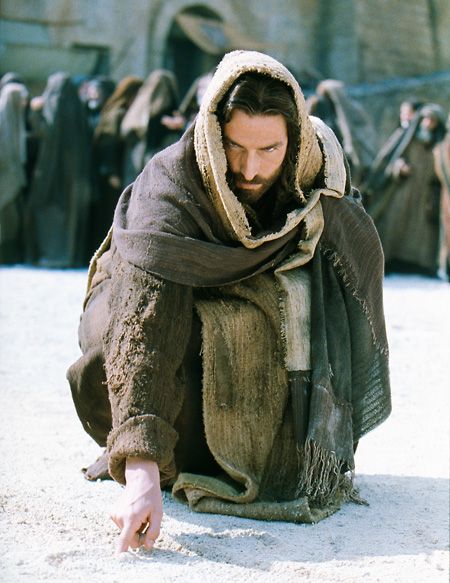





















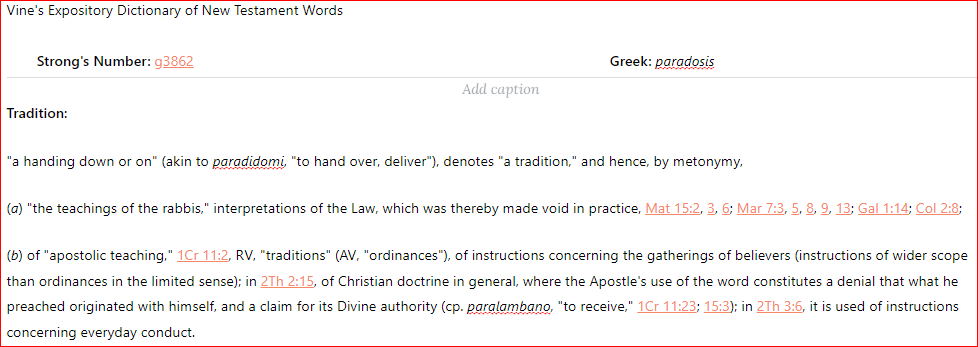
 Considering the Bible