
As believers, we are called by God to follow after Jesus in all our actions and attitudes. How we relate to money in included in our following after Him.
As mentioned in my introduction to this series, my family and I have been impacted a number of times in our church attendance by what appears to be the pull of money on church leadership. During our Christian pilgrimage, a number of churches, through thier leadership, have made decisions that directly impacted our status within the body of believers.
Some of these instances provided us reason to dig into the Word, to find correction in our own personal relationship to money, to try to understand the wisdom of a church leader’s decision, and in the end to apply God’s will for our own finances.
Little did we know the tremendously corrosive power the love of money has over our own hearts, and by extrapolation, the church as a whole. This should not surprise the believer for Paul provided a harsh truth on this topic.
1 Timothy 6:10 For the love of money is a root of all kinds of evils. It is through this craving that some have wandered away from the faith and pierced themselves with many pangs.
Alternately, the writer of Hebrews also provided no better command, (and for some believer’s no harder command) than found in Hebrews 13.
Hebrews 13:5 Keep your life free from love of money, and be content with what you have, for he has said, “I will never leave you nor forsake you.”
Many of our experiences have included the topic of tithing in the church. Personally, our denominational background considers tithing to be Biblically mandated on the New Testament believer. I understand many denominations consider tithing to be an important commmittment of the believers relationship to the church body.
Let’s take a look at this topic, and consider each passage that contains a reference to tithing.
This post will consider Genesis 14:20
and blessed be God Most High, who has delivered your enemies into your hand!” And Abram gave him a tenth of everything.
What a great verse to begin our study. It surely teaches us that tithing is not simply a teaching that is mandated by the Law of Moses, but was practiced by Abram the father of our faith. As such, we are following in the steps of Abram in giving a tenth (a tithe).
Note that Abram, a non-Jew. gave him (Melchizedek) a tithe of everything. This example of Abram surely teaches us a practice that applies to all who have faith.
But let us consider a bit of the context of this verse.
Genesis 14 is the recounting of Abram rescuing Lot from the kings of the region. The region was ruled by nine kings, and as power structures are defined, four of these kings, led by the king of Elam, waged war on the remaining five kings. After the battle, in securing the possessions of the victor, the armies swept though the area of Sodom and Gomorrah, picking up Abram’s nephew Lot.
Abram would have none of this. He gathered his army of 318 men to chase after this victorious army in order to retrieve Lot. Surely Abram was outnumbered, outskilled and unfamiliar with the task of defeating experienced soldiers. Yet he defeated the army, retrieved his nephew and returned home. Abram did not intend to simply steal Lots away from the army under cover of darkness, but he led his men in a defeat of an experienced and recently successful army.
He was motivated to retrieve his nephew and his family. In this endeavor, he brought back “all the possessions”
Genesis 14:16 Then he brought back all the possessions, and also brought back his kinsman Lot with his possessions, and the women and the people.
Genesis 14:21 And the king of Sodom said to Abram, “Give me the persons, but take the goods for yourself.”
It seems that based on the King of Sodoms request, that Abram rescued the vanquished people also, and not merely his nephew.
After the victory and return to camp, Abram was visited by two kings. The king of Sodom and the king of Salem.
King of Sodom
It is good to consider the King of Sodom’s request in light of our topic. Seemingly the king of Sodom was so grateful for Abram’s rescue of his people, he offered Abram all the goods that were retrieved in the battle. He only wanted his people back.
Abram refused, for he spoke of his dedication to God, and that since God is the possessor of heaven and earth, it is to be God that provides Abram’s wealth. Abram would not take any funds or possessions from this king in order to clearly maintain his faith in the God who possesses everything! Quite a stellar faith! When freely offered possessions for a service to others, Abram refused.
King of Salem
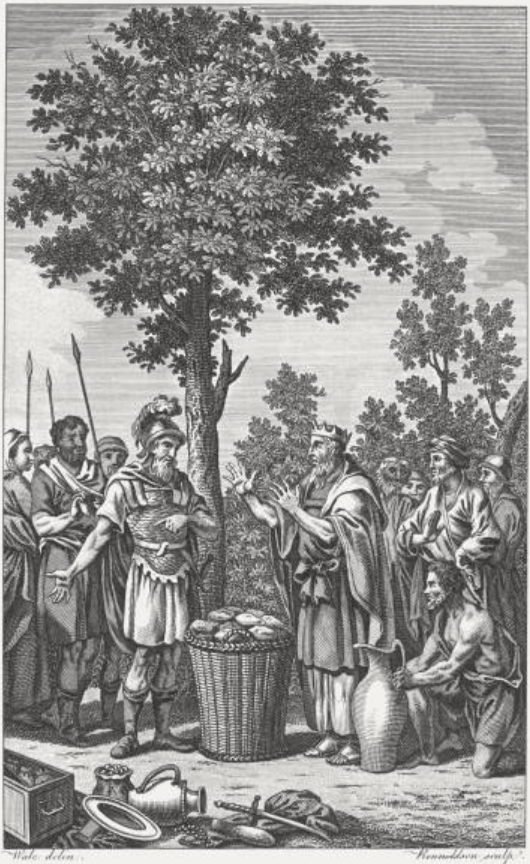
During this meeting, the king of Salem, Melchizedek, brought out bread and wine. Melchizedk blessed Abram in the name of God Most High, the possessor or heaven and earth. Melchizedek claimed that it was this God who delivered Abrams’s enemies into his hand.
Note the difference between these two kings. Sodom offered Abram possessions, possibly as an act of payment for his mercenary efforts. Abram reacts by rejecting this offer, not wanting to be associated with the offering of the king of Sodom.
When it comes to Melchizedek, he provides Abram a truth claim (not possessions) that Abram embraces. In embracing this truth, Abram reacts by giving Melchizedek a tithe, or a tenth of everything.
Now, an issue rises in my mind. What in tarnation is “everything” that Abram tithes of referring to. All of Abrams possessions? Did Abram have an accounting of his net worth performed and then provide a check to the King of Salem? I jest of course, but when the passage refers to Abram giving a tenth, it is good to consider what the tenth is related to. I would suggest the context demands the “everything” refers to the spoils of the battle.
A few more observations I feel are pertinent.
Although Abram gave a tenth, which suggests this was a common percentage to offer to a god in his culture (which speaks loudly to Abrams understanding who Melchizedek is), the text does not indicate this was an ongoing practice.
In summary, in this passage, I find the description of a man who is committed to the Most High God who possesses all heaven and earth. He provided what most likely was a cultural offering back to the King of Salem, whom I understand to be the Lord Jesus. Abram’s gift implies the same identification of the King as the God who provides.
This passage does not provide a prescription for any tithing practice for modern day believers after the cross. It is good to remember that descriptions of the saints lives does not translate into prescriptions of activities for the Christian.
But if there are saints who seek to emulate Abram in this practice, I would suggest they consider the other descriptive activities we find in the passage also occur. Therefore, based on this passage alone, if a believer conquers an army, rescues a blood relative, rescues a people group of another king, acquires the bounty of a battle, and is approached by at least one King, the saint will be able to also mimic Abram in providing a tithe.
Again I jest, for under our covenant, we may meet the King at any time, and our offering is not simply a tithe of some spoils of battle, but of our heart, mind and soul.
By the way, if you are headed out to conquer an army this week, you can call your accountant and tell him you don’t need a full audit of your possessions. Whatever spoil you take in your victory will be easily calculated!
Thanks for joining and Considering The Bible with me. Your thoughts are always welcome, and I look forward to hearing of the faithfulness of God in your lives.


