

As believers, we are called by God to follow after Jesus in all our actions and attitudes. How we relate to money in included in our following after Him.
As mentioned in my introduction to this series, my family and I have been impacted a number of times in our church attendance by what appears to be the pull of money on church leadership. During our Christian pilgrimage, a number of churches, through thier leadership, have made decisions that directly impacted our status within the body of believers.
Some of these instances provided us reason to dig into the Word, to find correction in our own personal relationship to money, to try to understand the wisdom of a church leader’s decision, and in the end to apply God’s will for our own finances.
Little did we know the tremendously corrosive power the love of money has over our own hearts, and by extrapolation, the church as a whole. This should not surprise the believer for Paul provided a harsh truth on this topic.
1 Timothy 6:10 For the love of money is a root of all kinds of evils. It is through this craving that some have wandered away from the faith and pierced themselves with many pangs.
Alternately, the writer of Hebrews also provided no better command, (and for some believer’s no harder command) than found in Hebrews 13.
Hebrews 13:5 Keep your life free from love of money, and be content with what you have, for he has said, “I will never leave you nor forsake you.”
Many of our experiences have included the topic of tithing in the church. Personally, our denominational background considers tithing to be Biblically mandated on the New Testament believer. I understand many denominations consider tithing to be an important commmittment of the believers relationship to the church body.
Let’s take a look at this topic, and consider each passage that contains a reference to tithing.
This post will consider Nehemiah 10:38
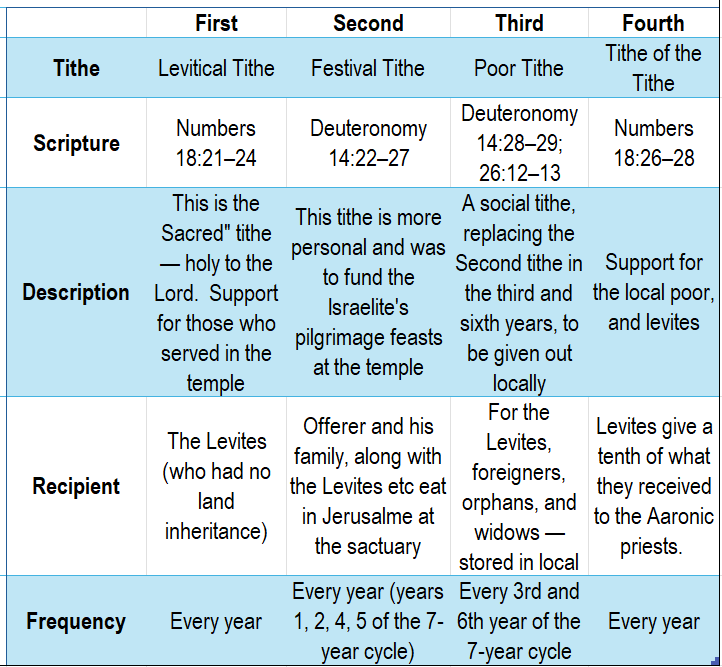
Nehemiah 10:38 – And the priest, the son of Aaron, shall be with the Levites when the Levites receive the tithes. And the Levites shall bring up the tithe of the tithes to the house of our God, to the chambers of the storehouse.

This passage provides wise guidance in the handling of funds the temple received. The potential of corruption was severely limited by having the priest witness the receiving of the tithe. For example , for every ten rutabagas the Levite received, the priest would get his one rutabaga. Truly there was the motivation of the priest to ensure every rutabaga was counted, documented and stored, with his cut to be supplied!
Who doesn’t want their rutabaga? Now I don’t want anyone thinking rutabaga’s were a thing in Israel during this time. They are simply a vehicle to describe the process the priest and Levite were performing in this passage.
Nevertheless, whether it be rutabagas or young sheep, the tithe was to be handled faithfully and without deception. Each party was to receive their allotment, and the presence of both men in the receiving of the tithe from the people provided this transparency.
As I said, the potential for corruption to flourish was hampered by the joint receiving of the tithe. This two party configuration of receiving the tithe, with both parties having a vested interest, provided the Jewish faithful a sense of rightness, of the tithe being handled as per the Word of the Lord.
On top of a specific manner of the receiving of the tithe by both the priest and the Levite, the priest’s tithe was not simply “taken” by the priest at the end of the day, but was delivered by the Levite.
Both the receiving and the subsequent distribution was set up to reveal a sense of order, a sense of rightness and a sense of propriety.
When I first started going to church, especially a small church in London, I recall two ushers “hanging out” at the back of the church as the offering was collected. With the offering collected, two ushers would go to count, and two ushers would remain with the funds until it was counted. Early on, I realized the funds were in safe hands until distribution was performed.
Yet if the news be believed, and I think in this case there is truth, there are some churches that do not provide this type of open and orderly appearance of propriety. With digital giving and direct digital transfers to the church, much of the appearance of giving has disappeared. It appears the bucket passing me is close to empty, and as one who typically sits in the back of the auditorium, I tend to see the bucket contents near the end of the run. Close to empty.
What is the point Carl? Well, two points come to mind.
an appearance of poverty
As that bucket passes, the appearance of sacrifice by the Body seems to be sorely lacking. It is the appearance surely, for the church I attend with my daughter is growing in leaps and bounds. It is a growing church with educational pods being built yearly, and mission giving highlighted every Sunday.
But the offering taken looks like it couldn’t support even one “Levite or priest”. There is an appearance the church body is reluctant in giving, and I think we as a people of God have lost something in this.
But that is not the item that concerns me most.
an appearance of corruption
Without a physical set up with two vested parties receiving an offering, the appearance of corruption grows. With the rise of digital giving, the ledger books of the church have replaced the physical order of two saints receiving the offering.
So for the saint to have the same confidence in giving, it is incumbent on the saint to ask for an accounting, or to attend business meetings. Now let me tell you about business meetings. I attended one years ago, and walked away thinking never again. Not only did it seem to reduce the sacrifice of funds by the saints to a number of business decisions, it also seemed to be a breeding ground for attitudes and arguments.
But even worse than that, is the church leadership that will not provide an accounting of the funds provided. It has become a common news feed of churches, especially mega churches that simply do not disclose the income they receive. Usually, these churches have leaders that are extravagant in their lifestyle, or have personal wealth far exceeding the average congregant.
Some churches refuse to provide any disclosure of the distribution of funds provided by the congregation, even at the request of the government. Now I have no interest in appealing to any government body to try regulate the interests of any church, but the resistance of the church body in providing an accounting is troubling. The appearance of corruption increases exponentially.
Does you church have an open and transparent process of receiving and distributing the funds of the saints? Although the specific responsibility of giving a tithe has passed from the believer’s responsibilities before God, giving certainly has not. Is not the previous process of the receiving and distributing an offering good counsel for any body seeking to honor God in their giving practices? For the Israelite who brought his ten rutabagas to provide for the Levites and the priest, he could walk away from his giving with confidence that his tithe would be received and distributed properly.
Do you have this confidence? In our modern times, some churches do not provide this blessing for the saints, and by doing this, allow the appearance of corruption to exist. For those churches that abuse their “right” to receive the congregants offering, and yet not provide the saint the knowledge of the handling and distribution of the funds, corruption seems to be the default assumption.
I think I heard Paul speak that even the appearance of evil is to be avoided by the believer.
1 Thessalonians 5:22 Abstain from every form of evil.
Some churches may do well to consider his wisdom in this matter.
Thanks for joining and Considering The Bible with me. Your thoughts are always welcome, and I look forward to hearing of the faithfulness of God in your lives.



 Quite awhile ago I sent out an email to a number of prominent pastors (8 or 9) within the area I live in.
 Is not Paul stating that using this “right”, (that is, support from a body of believers) actually hinders (places an obstacle in the way) the gospel? This is an apostle (not an elder or pastor) teaching this truth about an apostles right to support, which Paul is refusing to exercise.
 It is becoming obvious to me, that salaried positions for local elders/pastors seems to be foreign to the New Testament.



 If you give me money, I will train you to fleece your flock better!!!


