
Jesus in the Old Testament is a series of posts that will offer my readers a chance to consider pictures or shadows of Jesus in the Old Testament. As mentioned in the introduction to this series, some may be obvious, some may be not so obvious, and some may simply be a facet of the Lord those reading may not have considered previously.
I hope as we venture through this series, we will see the Lord in many wonderful pictures throughout the Old Testament.
| SEEING JESUS IN |
| Cyrus |
| Liberator by Peace |
| Ezra 1:3,4 Whoever is among you of all his people, may his God be with him, and let him go up to Jerusalem, which is in Judah, and rebuild the house of the LORD, the God of Israel–he is the God who is in Jerusalem. And let each survivor, in whatever place he sojourns, be assisted by the men of his place with silver and gold |
| Ephesians 2:14 For he himself is our peace, who has made us both one and has broken down in his flesh the dividing wall of hostility |
Cyrus may have been the only human regent in history that conquered a capital city without bloodshed.
Now I don’t want to imply that Cyrus did not lead a powerful army, or that he was reluctant to unleash it’s forces for the sake of the advancement of his cause, but as he approached the capital city of Babylon on his march to world domination, he eventually took a different approach.
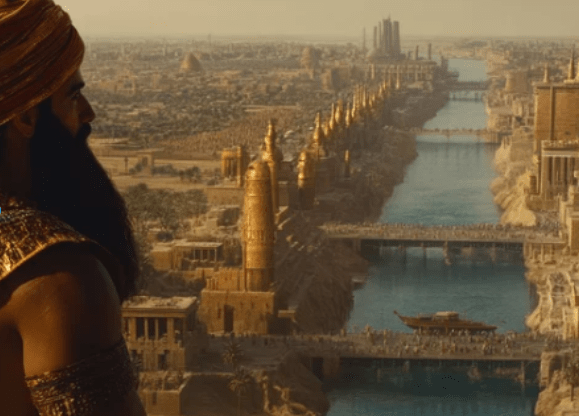
Cyrus conquered the city, and consequently the empire of Babylon, by stealth. History has recorded that as he approached the city of Babylon, it became obvious that the walls of the city were indomitable, and that the city was fully ready for a siege if required. Although a conventional siege commenced, it was to Cyrus’ credit that he sought other means of conquering the city.
The strength of the city of Babylon, amongst many of its wonders, was the river Euphrates that flowed under the walls and through the city. This river provided a source of life for the inhabitants, but it also provided an unconventional access point for the enemy.
My understanding is that Cyrus sent his armies to both the entrance and exit of the river from under the city walls. Upstream, Cyrus reduced the flow of the water by blocking and/or diverting the flow from the main channel. At the exit of the river, his armies dug out a marsh and formed a lake area, large enough to accept much of the flow from the reduced river. Upon opening a canal to the man made lake, the lowered river flow was further reduced and allowed for the Persian army to enter the capital city, conquering the nation of Babylon.
In this monumental conquering of a world empire, Cyrus performed a miraculous feat. By shear genius and stealth, Cyrus added to his empire the extent of the Babylonian kingdom. This kingdom just so happened to contain a small people group known as the Jews.
Though it is not known how Cyrus understood his mission from God – was it Daniel that provided the scroll of Isaiah 45 for him as he began his rule – he liberated the Jew in a famous declaration found in Ezra 1.
Ezra 1:2 “Thus says Cyrus king of Persia: The LORD, the God of heaven, has given me all the kingdoms of the earth, and he has charged me to build him a house at Jerusalem, which is in Judah.
Ezra 1:3 Whoever is among you of all his people, may his God be with him, and let him go up to Jerusalem, which is in Judah, and rebuild the house of the LORD, the God of Israel–he is the God who is in Jerusalem.
Ezra 1:4 And let each survivor, in whatever place he sojourns, be assisted by the men of his place with silver and gold, with goods and with beasts, besides freewill offerings for the house of God that is in Jerusalem.”
Note a few details of this declaration of Cyrus.
Let him go up to Jerusalem
Cyrus provided the Jewish people the freedom to leave or to stay. There was no compulsion on his end towards the Jewish population in returning to Jerusalem. It is so refreshing to see that Cyrus understood the importance of a willing heart in the completion of God’s will.
Do you really want to go back to Jerusalem? If you want to, you have the freedom to. Go ahead….
Is it not also the case in relation to the Messiah.
Mark 4:9 … “He who has ears to hear, let him hear.”
It is as if the Messiah was offering those who heard His message (the parable of the Sower in this case) the chance to “hear His message”!
Do you really want to hear His message? If you want to, you have the freedom to. Go ahead and let the message pierce that ol’ heart!
May his God be with him
Cyrus pronounced a blessing on the people as they went forward to rebuild the temple. It is interesting that the blessing was conferred on those whose desire matched the mission, but this is always the case when we think of the Lord’s work.
Jesus also provided the blessing of God, but not only as a verbal pronouncement, but by the literal giving of His life to become the One in whom we find all blessings.
Ephesians 1:3 Blessed be the God and Father of our Lord Jesus Christ, who has blessed us in Christ with every spiritual blessing in the heavenly places,
Let each survivor .. be assisted
This added effort on the part of Cyrus seems over the top and is further confirmation in my thinking that Cyrus is a clear type of the Messiah. Even as Cyrus provides the opportunity of liberty to those in captivity, and even as he pronounces a blessing on them as they depart, he goes one step further and directs for the nation as a whole to support this monumentous effort of rebuilding the temple.
It is not only those willing to take on the challenge of traversing thousands of miles back to a destroyed land to rebuild the temple to the Living God, but those who stayed behind, for whatever reason, were to support the work of those in Jerusalem.
Does this not speak out the continuing method of accomplishing God’s work, of building God’s kingdom through the varied efforts of those in the kingdom? Who knows the spiritual life condition of those who chose to stay, but they were to be involved in the effort, and Cyrus acknowledges this truth.
It seems obvious that this Gentile king continues to exhibit characteristics (faint though they may be) of the character of the Messiah that we can all admire.
Cyrus may have had alternate motives, or unknown pressures requiring him to provide these advantageous circumstances for the Jewish nation. Not so with the Lord Jesus, for we can confidently say that He had one motive, and was not pressured into any decision other than that which the Father determined for His life.
His mission was simple, direct and massive. His death for our life. Resurrection for our justification. Continual, everlasting life to provide peace for those He conquers, for those whom He liberates to enter a kingdom of peace.
May His name be lifted up!
Thanks again for coming to visit. I hope you found something of interest in this post and would appreciate a comment, to begin a discussion. If you know someone this blog may bless (or challenge), send them a link, so they may join us in our discussion.


Come join us at Considering the Bible
 Considering the Bible