The prophecy of the Lord Jesus for our consideration and edification, written centuries prior to His earthly existence is
Prophecy #213
Description
The nations shall wait on His teachings
Old Testament Prophecy
Isaiah 42:4
He will not grow faint or be discouraged[a] till he has established justice in the earth; and the coastlands wait for his law.
New Testament Fullfillment
John 12:20-26
Now among those who went up to worship at the feast were some Greeks.
So these came to Philip, who was from Bethsaida in Galilee, and asked him, “Sir, we wish to see Jesus.”
Philip went and told Andrew; Andrew and Philip went and told Jesus.
And Jesus answered them, “The hour has come for the Son of Man to be glorified.
Truly, truly, I say to you, unless a grain of wheat falls into the earth and dies, it remains alone; but if it dies, it bears much fruit.
Whoever loves his life loses it, and whoever hates his life in this world will keep it for eternal life.
If anyone serves me, he must follow me; and where I am, there will my servant be also. If anyone serves me, the Father will honor him.
If you are just joining this blog, or are a first time visitor, welcome to Considering the Bible. We would like to offer a document that provides over 350 prophecies of the Messiah found in the Old Testament for your consideration.
I make no claim to be able to comment on every one of these amazing prophecies in the future, but will occasionally bring one to the readers attention for their edification.
Hopefully you will follow “Considering the Bible” and begin an interaction with us
“You are the salt of the earth, but if salt has lost its taste, how shall its saltiness be restored? It is no longer good for anything except to be thrown out and trampled under people’s feet. – Matthew 5:13
The Lord is describing a characteristic of His disciples. The metaphor Jesus uses this time is to describe His disciples as “salt”. During Jesus ministry, He spoke some very difficult and hard sayings. Out of all His hard sayings, I would definitely include the one we are looking at tonight.
One thing that bothered me (very much), prior to my allowing this verse to say what it says, is the idea of salt becoming saltless. To be salt is to be salt, right? And one of salt’s chief characteristic is its savour. Without savour, it is useless, good for nothing, and worthy of being cast out.
How does this relate to the disciple? A disciple who isn’t constantly learning (remember – to be a disciple is to be a learner!) has lost his savour (is not in the process of learning.) A disciple isn’t a disciple without being in the process of learning and following.
Security in Being “Cast Out”?
I don’t understand how salt can become saltless. I seem to think that the principle message is to maintain the status of the disciple. A believer who “settles” is in danger of drifting away.
One thing I am sure of is that terms like “good for nothing”, “cast out” and to be “trodden under foot of men” do not engender a feeling of security.
For a man or woman who is salt, to become one who was salt, is a terrifying concept, according to the verse above.
Continue to follow and learn. He is calling you.
Thanks again for coming to visit. I hope you found something of interest in this post and would appreciate a comment, to begin a discussion. If you would like to receive daily posts from Considering the Bible, click on the “Follow” link below
The prophecy of the Lord Jesus for our consideration and edification, written centuries prior to His earthly existence is
Prophecy #212
Description
He brings hope for the hopeless
Old Testament Prophecy
Isaiah 42:3
a bruised reed he will not break, and a faintly burning wick he will not quench; he will faithfully bring forth justice.
New Testament Fullfillment
John 4
Now when Jesus learned that the Pharisees had heard that Jesus was making and baptizing more disciples than John
(although Jesus himself did not baptize, but only his disciples),
he left Judea and departed again for Galilee.
And he had to pass through Samaria.
So he came to a town of Samaria called Sychar, near the field that Jacob had given to his son Joseph.
Jacob’s well was there; so Jesus, wearied as he was from his journey, was sitting beside the well. It was about the sixth hour.
A woman from Samaria came to draw water. Jesus said to her, “Give me a drink.”
(For his disciples had gone away into the city to buy food.)
The Samaritan woman said to him, “How is it that you, a Jew, ask for a drink from me, a woman of Samaria?” (For Jews have no dealings with Samaritans.)
Jesus answered her, “If you knew the gift of God, and who it is that is saying to you, ‘Give me a drink,’ you would have asked him, and he would have given you living water.”
The woman said to him, “Sir, you have nothing to draw water with, and the well is deep. Where do you get that living water?
Are you greater than our father Jacob? He gave us the well and drank from it himself, as did his sons and his livestock.”
Jesus said to her, “Everyone who drinks of this water will be thirsty again,
but whoever drinks of the water that I will give him will never be thirsty again. The water that I will give him will become in him a spring of water welling up to eternal life.”
The woman said to him, “Sir, give me this water, so that I will not be thirsty or have to come here to draw water.”
Jesus said to her, “Go, call your husband, and come here.”
The woman answered him, “I have no husband.” Jesus said to her, “You are right in saying, ‘I have no husband’;
for you have had five husbands, and the one you now have is not your husband. What you have said is true.”
The woman said to him, “Sir, I perceive that you are a prophet.
Our fathers worshiped on this mountain, but you say that in Jerusalem is the place where people ought to worship.”
Jesus said to her, “Woman, believe me, the hour is coming when neither on this mountain nor in Jerusalem will you worship the Father.
You worship what you do not know; we worship what we know, for salvation is from the Jews.
But the hour is coming, and is now here, when the true worshipers will worship the Father in spirit and truth, for the Father is seeking such people to worship him.
God is spirit, and those who worship him must worship in spirit and truth.”
The woman said to him, “I know that Messiah is coming (he who is called Christ). When he comes, he will tell us all things.”
Jesus said to her, “I who speak to you am he.”
Just then his disciples came back. They marveled that he was talking with a woman, but no one said, “What do you seek?” or, “Why are you talking with her?”
So the woman left her water jar and went away into town and said to the people,
“Come, see a man who told me all that I ever did. Can this be the Christ?”
They went out of the town and were coming to him.
Meanwhile the disciples were urging him, saying, “Rabbi, eat.”
But he said to them, “I have food to eat that you do not know about.”
So the disciples said to one another, “Has anyone brought him something to eat?”
Jesus said to them, “My food is to do the will of him who sent me and to accomplish his work.
Do you not say, ‘There are yet four months, then comes the harvest’? Look, I tell you, lift up your eyes, and see that the fields are white for harvest.
Already the one who reaps is receiving wages and gathering fruit for eternal life, so that sower and reaper may rejoice together.
For here the saying holds true, ‘One sows and another reaps.’
I sent you to reap that for which you did not labor. Others have labored, and you have entered into their labor.”
Many Samaritans from that town believed in him because of the woman’s testimony, “He told me all that I ever did.”
So when the Samaritans came to him, they asked him to stay with them, and he stayed there two days.
And many more believed because of his word.
They said to the woman, “It is no longer because of what you said that we believe, for we have heard for ourselves, and we know that this is indeed the Savior of the world.”
After the two days he departed for Galilee.
(For Jesus himself had testified that a prophet has no honor in his own hometown.)
So when he came to Galilee, the Galileans welcomed him, having seen all that he had done in Jerusalem at the feast. For they too had gone to the feast.
So he came again to Cana in Galilee, where he had made the water wine. And at Capernaum there was an official whose son was ill.
When this man heard that Jesus had come from Judea to Galilee, he went to him and asked him to come down and heal his son, for he was at the point of death.
So Jesus said to him, “Unless you see signs and wonders you will not believe.”
The official said to him, “Sir, come down before my child dies.”
Jesus said to him, “Go; your son will live.” The man believed the word that Jesus spoke to him and went on his way.
As he was going down, his servants met him and told him that his son was recovering.
So he asked them the hour when he began to get better, and they said to him, “Yesterday at the seventh hour the fever left him.”
The father knew that was the hour when Jesus had said to him, “Your son will live.” And he himself believed, and all his household.
This was now the second sign that Jesus did when he had come from Judea to Galilee.
If you are just joining this blog, or are a first time visitor, welcome to Considering the Bible. We would like to offer a document that provides over 350 prophecies of the Messiah found in the Old Testament for your consideration.
I make no claim to be able to comment on every one of these amazing prophecies in the future, but will occasionally bring one to the readers attention for their edification.
Hopefully you will follow “Considering the Bible” and begin an interaction with us
After my series on the parables, I found I was drawn to look into the miracles of Jesus in the Gospels. I have never studies the mighty works of Jesus as a focused effort before and am looking forward to finding nuggets of truth that we can be encouraged by.
I have provided a general introduction, with an opportunity to download two files for your reference in my initial post Signs and Mighty Works of Jesus – Introduction. I found that the format I used for the parable posts were useful to keep me on track, and will continue to use them for this series, with some minor tweaks. With that said, let’s take a look at
Jesus Cleanses a Man With Leprosy
Matthew 8:1-4
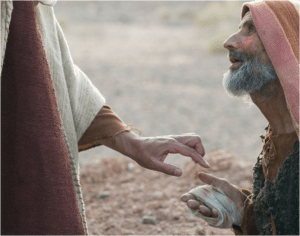
When he came down from the mountain, great crowds followed him. And behold, a leper came to him and knelt before him, saying, “Lord, if you will, you can make me clean.” And Jesus stretched out his hand and touched him, saying, “I will; be clean.” And immediately his leprosy was cleansed. And Jesus said to him, “See that you say nothing to anyone, but go, show yourself to the priest and offer the gift that Moses commanded, for a proof to them.”
Mark 1:40-45
And a leper came to him, imploring him, and kneeling said to him, “If you will, you can make me clean.” Moved with pity, he stretched out his hand and touched him and said to him, “I will; be clean.” And immediately the leprosy left him, and he was made clean. And Jesus sternly charged him and sent him away at once, and said to him, “See that you say nothing to anyone, but go, show yourself to the priest and offer for your cleansing what Moses commanded, for a proof to them.” But he went out and began to talk freely about it, and to spread the news, so that Jesus could no longer openly enter a town, but was out in desolate places, and people were coming to him from every quarter.
Luke 5:12-14
While he was in one of the cities, there came a man full of leprosy. And when he saw Jesus, he fell on his face and begged him, “Lord, if you will, you can make me clean.” And Jesus stretched out his hand and touched him, saying, “I will; be clean.” And immediately the leprosy left him. And he charged him to tell no one, but “go and show yourself to the priest, and make an offering for your cleansing, as Moses commanded, for a proof to them.”
General Observations
This miracle speaks to a medical condition that plagued the nation of Israel for it’s entire existence. Leprosy was an incurable sickness throughout the world until very recently. The curse of leprosy produces nerve damage, resulting in blindness, kidney failure, muscle weakness and disfigurement. Beyond the medical suffering, the leper became a social outcast, condemned to being “outside the camp”.
To this day, to call someone a leper, is to imply a status of an outcast!
Questions to Consider
Who were the audience?
Rockies
Matthew speaks of the miracle occurring as great crowds followed Him down the mountain. If we understand Matthew to be chronological here, this occurred after the Lord gave the nation of Israel the Beatitudes, the laws for Kingdom living. Luke mentions this miracle as happening in one of the cities. As an aside, this does not force a contradiction in the gospels, since it was not uncommon for a city to be at the base of a mountain.
Mount of Beatitudes
Also, it is good to understand that in Israel, a mountain is not the equivalent of the Rocky Mountains on the west coast of Canada. The Mount upon which the Lord gave the Beatitudes is commonly believed to be near Capernaum and is actually 25 meters below sea level. (Yes the top of the mountain is actually 25 meters (~80 feet) below seal level!)
On first review, it seems the miracle was provided to alleviate this lepers suffering. This is the nature of our Lord, in providing deliverance for those who are suffering, looking to Him for salvation.
Alleviating the leper was not the primary reason for the miracle, for this miracle was a challenge to the nation. A challenge to the priests of Israel to research the miracle and make some decisions.
Let me explain.
The Old Testament book of Leviticus addresses leprosy in chapters 13 & 14. Chapter 13 provides detailed instructions on diagnosing the disease. Chapter 14 gives instructions to the priest on what to do if a leper was cleansed.
Throughout the nations history, no leper had been cured. Moses and Miriam were miraculous occurrences of leprosy, both in there acquiring the disease and healing of the disease. No priest’s had ever needed to refer to Leviticus 14 for directions on how to proceed. Leprosy was a death sentence for it’s victims.
Because of this non-occurrence of healing for a leper in Israel, and the Scriptures providing detailed instructions for a priest, the Pharisees reasoned that any healing of leprosy would be a Messianic miracle. This would initiate an investigation phase by the priesthood into the miracle, in order to validate the miracle. If this investigation determined the leprosy was cleansed, and the miracle was a bona fide healing, a second investigation would begin. The Pharisees would then launch an investigation of the One who performed the miracle, asking questions to the miracle worker to determine is the Messiah had truly arrived.
With this miracle, Jesus told the Pharisees to investigate. As my wife mentioned this morning, the Lord was telling the Pharisees to “get to work”! As expected, after this miracle, the gospels record instances of groups of Pharisees attending His ministry, watching His movements, questioning (and condemning) Him.
Jesus did not shy away from challenges to His ministry. He is the truth and provided the proof to those of an open mind and heart. He also understood this investigation would lead to His crucifixion, due to the hardness of the Pharisees position, and dependence on their religion.
He is the truth, and there is no denying it! For Him, to declare the truth will result in His death. For us, to deny the truth is to result in our death.
He is the One who is great! We certainly are not, and need His love and grace.
What was the message for the original audience?
The original audience, that is the great crowd, saw a miracle no other Israelite had ever seen. Multiple witnesses could be called upon for verification. The message they received, if they were literate in the Word, was one of a miracle worker being introduced formally to the nation, of One who claimed to provide proofs of His position as Messiah, and was openly declaring His claims as Messiah.
Oh, and also, they saw a leper get healed before their very eyes! How cool was that? Consider the rarity of this action of touching the leper. The passage in Matthew states that “And Jesus stretched out his hand and touched him“. This is not to be discounted, since the nation had instructed every little boy and girl that to touch a leper was to become unclean, acquire the disease itself, and be rejected socially and religiously.
Jesus touched the leper and Jesus cleansed him. He did not simply declare the leper clean.
He had declared miracles before without touch, and was fully capable of standing far off and healing this leper, yet He made a point of touching the leper, the unclean, the rejected. This is backwards to the logic provided in the Old Testament. Haggai instructs us that uncleanness is transferred to the clean, and that cleanliness is not transferred to the the unclean.
Then Haggai said, “If someone who is unclean by contact with a dead body touches any of these, does it become unclean?” The priests answered and said, “It does become unclean.” – Haggai 2:13
Jesus was no typical rabbi!
What is the message for us today?
Two messages seem obvious to me.
First, Jesus is the Messiah. His claims are verifiable and He wants you to investigate. He has provided multiple evidences of His Messiahship, and our ignoring of the proofs falls back on us if we ignore or reject. His greatest proof of who He is, is the resurrection. He is risen and is by very nature and work, King of Kings and Lord of Lord.
Secondly, He is a God who is not far off. He is a God who touches, who reaches out to us.
This truth came home to me during a class I taught years back. I began to hug my class mates as they entered our home, and although I was not faithful in maintaining this practice, I found that this simple act of touching opened people up to discussing issues and concerns in their lives, providing assistance (if wise) and ultimately directing them to the Lord for solutions.
The act of touching, physically touching one who is hurting, is powerful. Amongst sinners and saints, the act of touching is a catalyst for the formation of trust. How much more, when the God of the universe reaches out and touches one who is in need?
Who have you touched today? Be like Jesus, and reach out to one who is in need.
The prophecy of the Lord Jesus for our consideration and edification, written centuries prior to His earthly existence is
Prophecy #211
Description
Meek and lowly
Old Testament Prophecy
Isaiah 42:2
He will not cry aloud or lift up his voice, or make it heard in the street;
New Testament Fullfillment
Matt 11:28-30
Come to me, all who labor and are heavy laden, and I will give you rest.
Take my yoke upon you, and learn from me, for I am gentle and lowly in heart, and you will find rest for your souls.
For my yoke is easy, and my burden is light.”
If you are just joining this blog, or are a first time visitor, welcome to Considering the Bible. We would like to offer a document that provides over 350 prophecies of the Messiah found in the Old Testament for your consideration.
I make no claim to be able to comment on every one of these amazing prophecies in the future, but will occasionally bring one to the readers attention for their edification.
Hopefully you will follow “Considering the Bible” and begin an interaction with us
A sharing with someone else. I believe this verse hints at Paul’s thankfulness for a very specific partnership the Philippians participated with Paul in. I think he is broaching the topic of dirty mammon, filthy lucre, cold hard cash. (For my reasons for thinking this way, consider the post Conditional Security – Philippians 1:3-11)
If my thinking is correct, Paul is speaking of a very real world need in a beautifully wrapped phrase which the Philippians would understand without him having to blurt it out. Classy. Subdued. Humble and gracious.
This verse speaks of the Apostle using a specific word with intent meant for the audience. Only after getting involved with the book, and Paul’s intimate history with this church, do we understand what the Philippians understood.
Grace in our speech. A message to his loved ones, expressing gratitude for their real world gifts.
My wife and I are reading through the Psalms in our evening reading and occasionally a nugget of the Psalms jumps out of the page. Don’t you love it when, after years of reading the “Old Book” passages become alive, reinforcing old teachings or simply warming your heart.
This is the book of Psalms, and it is rich.
I pray I can communicate a portion of the blessing we receive from this wonderful book.
Psalm 41:1-3
To the choirmaster. A Psalm of David.
Blessed is the one who considers the poor! In the day of trouble the LORD delivers him; the LORD protects him and keeps him alive; he is called blessed in the land; you do not give him up to the will of his enemies. The LORD sustains him on his sickbed; in his illness you restore him to full health.
Consider the poor.
Note that David did not simply state that the one blessed is the one who gives to the poor. No, it is not simply giving, but “considering the poor” that is “considered” here.
What is David trying to say here? To consider is to give attention to, to understand, to be prudent. I think of it as wisdom in supplying needs in order to help the one suffering, instead of simply sacrificing out of guilt or some external obligation. There is a way we help that hurts those we seek to help.
One of the first times I understood this concept was when a brother and I were out door knocking and evangelizing. We came across a young couple that was willing to listen, and we shared the gospel. Eventually, we were told they needed some diapers, which we were happy to retrieve for them. This gave us an opportunity to return and visit! Eventually they needed more formula, some food, a few more diapers, a bit of gas and a bus ticket. We continued to supply, yet there was something wrong. It just seemed wrong.
This family had funds for what some may consider luxury items (large tv, new stereo, a vehicle…), and our assistance was supplementing a lifestyle of desire, not need. Might I suggest that if I “considered the poor” in this instance today, I may have hesitation to express charity to the extent we did so long ago. Something to consider in each situation. Wisdom is needed!
You may wonder where this family is in relation to the gospel. I don’t remember either the husband or wife coming to church with us, making a decision for Christ or showing any real interest other than getting one more diaper.
To be honest, my brother and I got so caught up in supplying the “need”, in order to show Christian charity, we abandoned the original intent of our first visit. We eventually “considered the poor” in this instance, and moved on to others that might receive a message instead of milk us for money.
Charity can also become a crutch for those receiving, creating a dependence on the charity. This is a common concern amongst some charities that simply exist to maintain the status quo of supplying an immediate need, as opposed to solving a root problem. Don’t get me wrong, thinking I know of a solution, but in the personal interactions we have with the poor, David advises us to consider. To ponder the best solution for each particular case. To exercise wisdom in our efforts to assist the poor.
The one who wisely seeks to help the poor properly, without seeking self gratification, will be helped by the Lord in his day of trouble. Consider the day of trouble the saint falls into, and that the Lord will help, for our good and not to our detriment. The Lord Himself considers the poor.
The term poor refers to weakness, a lowliness, even a neediness. We are definitely poor, weak and needy. As we read these verses, it occurs to me that they could apply to the poor, or to the saint who considers the poor. Either way, to consider the poor, and to mimic the Lord’s mercy is enough for the saint.
As we learn of Him and His grace and mercy toward us, we are to follow His example, exercise a heart toward the poor, and consider ways to assist the poor for their good, and not simply ours.








 Considering the Bible