My hope is that this series will offer my readers a chance to consider the names, characteristics and descriptions of our God in the Word.
The remaining Names of God in this series might be considered descriptors, or characteristics of the Lord. We have reviewed the three primary Names of God, along with nineteen compound Names of God in our previous posts. As we venture through these descriptors of our God, I hope we will recognize all the many characteristics of our God that we tend to take for granted.
The Word is truly rich with descriptions of the Living God, and this effort of searching in the Word was quite illuminating. He truly is the ultimate subject of the Word, and His revelation of self-descriptions, or the accolades offered Him by His priests, prophets, kings apostles and faithful truly is a blessing.
May the Name of the Lord be praised, and by thinking on His name, may you have a blessed day.
141
FATHER OF THE FATHERLESS
Psalm 68:5 Father of the fatherless and protector of widows is God in his holy habitation.
When an child is abandoned by a father, he has no leader, no support, no strong voice to listen to, no example to look to. For both the son and the daughter, to be abandoned by a father leaves life long damage, a sense of not belonging, of living without purpose, for a child needs to seek favor, especially of his or her father.
Single parent mothers seek to fill this void, and many make valiant efforts, but a child abandoned by his or her father will never recover fully from this abandonment.
As the verse speaks of widows, the psalmist may be referring to the death of the head of a household. A tragedy in any estimation. Yet the claim of fatherlessness may also imply a chosen abandonment, a decision of the father/husband to leave a family behind. How terrible for the child.
The good news though is that a faithless man in a child’s life may be replaced by a faithful God. As a matter of fact, this weakness, this pain and mental suffering may be used by the Lord to guide them into a relationship with a greater Father, a kinder Father, a loving Father.
As those who read this blog may know, I lost my father to a train accident when I was very young. Bitterness, alienation, a lack of strong guidance and direction resulted in my falling into a deep hole of depression and rebellion. When a young lady directed me to the Father above, I could not resist, for the longing to have someone give guidance, to forgive me of my hatred, anger and sin, to love me despite how broken I was, – it was too much to resist.
He is the Father to the fatherless, and such a good one.
I would love to hear of your favorite name, characteristic or description of the Living God. Please leave me a comment, and I will include it in the list!
Thanks again for coming to visit. I hope you found something of interest in this post and would appreciate a comment, to begin a discussion. If you know someone this blog may bless (or challenge), send them a link, so they may join us in our discussion.
As many who have followed me for a bit, I have fallen into the Psalms, and I can’t get up! (As if I would want to.) The Psalms are a majestic collection of poetry, of heart felt human experiences that constantly challenge me in my own frail attempt to follow the true King. As many of the Psalms are written by David, my study on the Psalms has spurred me on to looking at the life of David, is the main contributor to this book, and to follow the victories and tragedies of the shepherd King of Israel.
Many times in the narrative, we will see the Lord Jesus, imperfectly, yet a reflection of His spirit in a man with weaknesses.
1 Samuel 24:8-15
8 Afterward David also arose and went out of the cave, and called after Saul, “My lord the king!” And when Saul looked behind him, David bowed with his face to the earth and paid homage. 9 And David said to Saul, “Why do you listen to the words of men who say, ‘Behold, David seeks your harm’? 10 Behold, this day your eyes have seen how the LORD gave you today into my hand in the cave. And some told me to kill you, but I spared you. I said, ‘I will not put out my hand against my lord, for he is the LORD’s anointed.’ 11 See, my father, see the corner of your robe in my hand. For by the fact that I cut off the corner of your robe and did not kill you, you may know and see that there is no wrong or treason in my hands. I have not sinned against you, though you hunt my life to take it. 12 May the LORD judge between me and you, may the LORD avenge me against you, but my hand shall not be against you. 13 As the proverb of the ancients says, ‘Out of the wicked comes wickedness.’ But my hand shall not be against you. 14 After whom has the king of Israel come out? After whom do you pursue? After a dead dog! After a flea! 15 May the LORD therefore be judge and give sentence between me and you, and see to it and plead my cause and deliver me from your hand.”
David refused to take advantage of a situation that seemed to be destiny. Was it not God working to provide David an opportunity to ascend to the throne? Was God not inviting David to take matters into his own hands?
It may have seemed that way, and if David did not have the convictions he had, he may have reasoned such. But David had convictions. He knew the Lord and did not succumb to a temptation to fast track God’s will. What a stellar fellow!
And loyal – David, when Saul left the cave, exposed himself to the king (and his army of 3,000 men) to speak of his submission to Saul, and to reason with him.
David had proof, that he was able to get near Saul, and refused to take vengeance on the king. He admitted to the king that God had provided him an opportunity to resolve this battle between the two of them, but refused it. He would not commit treason!
Yet David was all about justice. As he addressed his earthly sovereign, he called on the Greater Sovereign to judge between the two of them. Yet, even in this statement, David again refused to take part in any action against his king.
Truly, as I think on this interaction between the current and the future king, David stands out as other worldy, not practical, without earthly wisdom and not driven to success.
Have you ever sought to obey God and them been defamed by your brother, mocked by your sister, ridiculed by your peers because your actions are actually not benefitting you or your loved ones? Can you hear them even now?
Carl – You are not taking advantage of God’s obvious opportunities for self advancement?
Carl – You should be taking care of your family!
Carl – Think of all the good you could do if you took advantage of the situation.
Yes – to hear God’s direction and to follow will cost you, even if it is doubt about the outcome, and possible loss of advantage – that is earthly advantage!
Nevertheless, David does make a statement that seems obvious at first, but what a great statement for this situation!
Out of the wicked comes wickedness.
Of course out of the wicked comes wickedness. How obvious this statement seems, almost a waste of breath, until I recognized David was calling Saul a wicked man. He called Saul a wicked man, spoke truth to power! This is awesome, a true prophet, a man after the truth. And as a sidebar, David was also claiming that he was not a wicked man.
Years later, Jesus would speak of bad fruit from a bad tree. This truth is so obvious, irrefutable and cutting, that I need to recall this when dealing with those who fight the gospel, hate truth, and display treachery or wickedness. It isn’t a personal attack – Simply a truth statement!
Like my momma used to say, if the shoe fits….
David closes his plea/warning to Saul, bringing his selflessness into focus. I think.
He refers to himself as a dead dog, even a flea. Who is David that Saul would chase after him? Yet Saul knew who David was, and that he was a righteous man, one destined for the throne.
David didn’t have to make claims. His life was on display for all to see, and God was making it obvious that David was the better man, the one destined for good. He could safely state self deprecating claims about himself, only adding honor to his name in the mean time.
Proverbs 27:2 Let another praise you, and not your own mouth; a stranger, and not your own lips.
How often have you met one who cannot speak enough about them selves? David didn’t follow that thought, but diminished himself in front of the king.
There is One who could speak of Himself without any stain of self glory being attributed to Him, for He truly is worthy, more worthy of each and every statement He made of Himself. And yet, when He described Himself to His disciples, He sought to be know as One who was gentle and lowly of heart!
Proverbs 27:2 Let another praise you, and not your own mouth; a stranger, and not your own lips.
How amazing is He, that in the very person of God Almighty, Jesus revealed Himself to those closest to Him as gentle and lowly of heart.
Jesus, though His name alone is worthy of all praise, wanted to be thought of as gentle and lowly of heart, thereby only bringing greater honor upon Himself. He is the only One, and we are only right to praise His name only.
Jesus in the Old Testament is a series of posts that will offer my readers a chance to consider pictures or shadows of Jesus in the Old Testament. As mentioned in the introduction to this series, some may be obvious, some may be not so obvious, and some may simply be a facet of the Lord those reading may not have considered previously.
I hope as we venture through this series, we will see the Lord in many wonderful pictures throughout the Old Testament.
SEEING JESUS IN
AHASUERUS
SAVIOR OF THE JEWS
Esther 8:1 On that day King Ahasuerus gave to Queen Esther the house of Haman, the enemy of the Jews. And Mordecai came before the king, for Esther had told what he was to her.
Acts 13:23 ESV – Of this man’s offspring God has brought to Israel a Savior, Jesus, as he promised.
It is an amazing fact, that though God is in the background in the book of Esther, His fingerprints are all over it. To think that a Persian king, with a rebellious wife would save a tiny nation from a powerful and favored statesman by a stiff necked man and his orphaned cousin is a bit ludicrous, but such is the wisdom of God.
At no time in the narrative is it obvious that Ahasuerus was called to provide protection for the Jews, or that the king was destined to become a protector of God’s people. The danger the Jewish nation faced was far greater, more powerful and for most of the book, hidden from those who would be impacted by Haman’s plans.
Though Ahasuerus became a savior for the Jewish nation, the similarity with Jesus somewhat ends there. Yes, the king of Persia saved the nation, but it appears it was due to manipulation by Queen Esther, and her cousin Mordecai, and not a focused intent by the king to do justice!
Nowhere can we find any place in the gospels that Jesus was manipulated, nor did He become a Savior for the Jewish people out of ignorance. He understood of the dangers of the situation the Jewish people were under, and He had a solution that only He could provide.
Ahasuerus eventually hung Haman, the enemy of the Jews, on a stake, a precursor the the cross. Haman, the enemy of the Jews, died for his own sins. Amazingly, the King provided rights to the Jewish people to fend off any resistance from the Persian populace.
Esther 8:11 …the king allowed the Jews who were in every city to gather and defend their lives, to destroy, to kill, and to annihilate any armed force ….
The king allowed the Jews to defend themselves against his own people, his own Persian populace!
Jesus eventually hung on a cross as the greatest friend the Jewish people could have hoped for. Though they saw Jesus as an enemy, He died for their sins, and out of this unjust suffering, provided the right to become the sons of God, able to stand against any resistance of the true enemy of their souls.
Ephesians 6:13 Therefore take up the whole armor of God, that you may be able to withstand in the evil day, and having done all, to stand firm.
Yes, Jesus is the Savior of the Jews but of course His salvific effects spread far and wide, even to our lives beyond the border of Israel. He is the Savior of the Jews, but He is also the Savior of the world.
John 4:42 They said to the woman, “It is no longer because of what you said that we believe, for we have heard for ourselves, and we know that this is indeed the Savior of the world.”
Trust Him.
He is the King of Kings, over and above any Persian monarch that may have been manipulated to be a deliverer. He is so much more!
Thanks again for coming to visit. I hope you found something of interest in this post and would appreciate a comment, to begin a discussion. If you know someone this blog may bless (or challenge), send them a link, so they may join us in our discussion.
My hope is that this series will offer my readers a chance to consider the names, characteristics and descriptions of our God in the Word.
The remaining Names of God in this series might be considered descriptors, or characteristics of the Lord. We have reviewed the three primary Names of God, along with nineteen compound Names of God in our previous posts. As we venture through these descriptors of our God, I hope we will recognize all the many characteristics of our God that we tend to take for granted.
The Word is truly rich with descriptions of the Living God, and this effort of searching in the Word was quite illuminating. He truly is the ultimate subject of the Word, and His revelation of self-descriptions, or the accolades offered Him by His priests, prophets, kings apostles and faithful truly is a blessing.
May the Name of the Lord be praised, and by thinking on His name, may you have a blessed day.
140
FATHER OF OUR LORD JESUS CHRIST
Romans 15:6 that together you may with one voice glorify the God and Father of our Lord Jesus Christ.
I have five children. I speak specifically to the fathers out there that may read this post.
As you have watched your children grow, become independent, take on challenges and mimic your character (to a point) I ask you to recall your heart experience as your child grew. I have seen my children take on challenges that quite literally scare me, that challenge my trust, that bring fear to my heart, fear that they may not succeed, that they may be hurt, or that I might loose them.
As fathers we have connections with each child that is unique, that no one can enter into other that the two of us. Shared experiences, memories, decisions and outcomes all are specific to my self and my child. No one else can understand the connection, nor should they try.
Some experiences are full of joy, full of triumph, full of surprise. Some are full of pain, and suffering and loss. Each experience is solely mine and my child to own. Each experience, as I remember them, even the difficult times, brings a smile to my face, for I know my children, and their hearts through these experiences.
Translate that to the Father of the Lord Jesus Christ.
I often think of our Father in heaven as somewhat passive, somewhat out of the picture as we read of the Lord Jesus’ experience on this earth, of His frustrations with the disciples, of His patience with the Jewish religious leadership, of His willing submission to those He created, of His prayers in the garden, of His humiliation and suffering, of His being nailed to the cross and His eventual death.
We must remember two things in my mind. The Father was with Him in all these trials. In every decision, the Father was where the buck stopped, He was responsible for the trials Jesus went through to complete our salvation. He and His Son experienced times we are not able to comprehend, we will never understand, and that are solely the Father’s and the Son’s.
I understand I am translating a human experience into the Divine, and with that I admit many of the parallels may be weak, inconsistent or somewhat incorrect. Yet as the Lord Jesus taught us from the simplest of our own experiences in His parables, applying our earthly familiarity to heavenly truths, I offer this thought for my reader to consider.
The Father of our Lord Jesus Christ was with Jesus in each of His trials and victories, and finally as the Son rose from the grave, the Father alone understood the full impact and repercussions of this mighty act.
His smile must have been massive!
I would love to hear of your favorite name, characteristic or description of the Living God. Please leave me a comment, and I will include it in the list!
Thanks again for coming to visit. I hope you found something of interest in this post and would appreciate a comment, to begin a discussion. If you know someone this blog may bless (or challenge), send them a link, so they may join us in our discussion.
My hope is that this series will offer my readers a chance to consider the names, characteristics and descriptions of our God in the Word.
The remaining Names of God in this series might be considered descriptors, or characteristics of the Lord. We have reviewed the three primary Names of God, along with nineteen compound Names of God in our previous posts. As we venture through these descriptors of our God, I hope we will recognize all the many characteristics of our God that we tend to take for granted.
The Word is truly rich with descriptions of the Living God, and this effort of searching in the Word was quite illuminating. He truly is the ultimate subject of the Word, and His revelation of self-descriptions, or the accolades offered Him by His priests, prophets, kings apostles and faithful truly is a blessing.
May the Name of the Lord be praised, and by thinking on His name, may you have a blessed day.
139
FATHER OF SPIRITS
Hebrews 12:9 Besides this, we have had earthly fathers who disciplined us and we respected them. Shall we not much more be subject to the Father of spirits and live?
Our next five names of God will include the term “Father”. It seems appropriate that our first verse refers to earthly fathers as a comparison, and brings to mind my own earthly father.
He was a man I remember faintly, for he was taken from us when I was very young. I do have a few faint memories of him, and of my interactions with him. He was the authority in my home, the father figure that was larger than life, that would work long days to provide for the family. In my mind, he was perfect.
One summer day, when I was home from school, my momma found I had done something wrong and told me to “wait till your father get’s home”.
I spent the rest of that day, holed up in my bedroom, worrying about what my father was going to do to me, how he would deal with me. Hours and hours of waiting, until later that night, when he got home, and as he sat in his lazy boy chair with his feet in the air, he called me to his presence.
I told him of my error, and understood I had done bad. He looked at me and said, “Don’t do it again”.
That was it. I spent what seemed like forever in my mind waiting for the hammer to fall, but when I was in front of him, he showed mercy.
This was a microcosm of what I would later start to understand of the mercy of God.
Did he understand the trial, the self cleansing, the regret I had been through. Highly doubtful – he was probably just tired and dealt with me quickly so he could have a few minutes of rest.
Did he require justice to be enacted to provide forgiveness to me? No – his decision was based most likely on the long day he had and the insignificance of the error in his mind.
My story has many inaccuracies of forgiveness that the Father of Spirits provides, but I tell it to speak of the respect I had for my father. The very mention of his name when it came to correction in the home was enough to make a 6 year old boy quiver in his boots!
He was taken from me shortly after this experience, but my thoughts of my earthly father circle around the idea of respect and of mercy.
The apostle is writing with the very same concern, but to be translated to the Greater Father, the Father of Spirits, the One who is over all of creation. He does not tire, nor consider our actions insignificant. He is ever watching over us as a loving Father.
Should we not be subject to Him? He is worthy, and the benefit of life will be granted to us in our subjection to Him!
He is good, and He is good all the time!
I would love to hear of your favorite name, characteristic or description of the Living God. Please leave me a comment, and I will include it in the list!
Thanks again for coming to visit. I hope you found something of interest in this post and would appreciate a comment, to begin a discussion. If you know someone this blog may bless (or challenge), send them a link, so they may join us in our discussion.
As many who have followed me for a bit, I have fallen into the Psalms, and I can’t get up! (As if I would want to.) The Psalms are a majestic collection of poetry, of heart felt human experiences that constantly challenge me in my own frail attempt to follow the true King. As many of the Psalms are written by David, my study on the Psalms has spurred me on to looking at the life of David, is the main contributor to this book, and to follow the victories and tragedies of the shepherd King of Israel.
Many times in the narrative, we will see the Lord Jesus, imperfectly, yet a reflection of His spirit in a man with weaknesses.
1 Samuel 24:1-7 1 When Saul returned from following the Philistines, he was told, “Behold, David is in the wilderness of Engedi.” 2 Then Saul took three thousand chosen men out of all Israel and went to seek David and his men in front of the Wildgoats’ Rocks. 3 And he came to the sheepfolds by the way, where there was a cave, and Saul went in to relieve himself. Now David and his men were sitting in the innermost parts of the cave. 4 And the men of David said to him, “Here is the day of which the LORD said to you, ‘Behold, I will give your enemy into your hand, and you shall do to him as it shall seem good to you.’” Then David arose and stealthily cut off a corner of Saul’s robe. 5 And afterward David’s heart struck him, because he had cut off a corner of Saul’s robe. 6 He said to his men, “The LORD forbid that I should do this thing to my lord, the LORD’s anointed, to put out my hand against him, seeing he is the LORD’s anointed.” 7 So David persuaded his men with these words and did not permit them to attack Saul. And Saul rose up and left the cave and went on his way.
In our last post we saw that David was rescued by outside influences. Saul was hot on the trail of David until he found out that the Philistines were attacking Israel, probably his own estate. (See previous post for reasoning on this statement)
Saul had to fight off the Philistines, for the sake of his nation, (or maybe his estate!) Nevertheless, Saul took care of his required business and got back to his focus – killing David!
After a spy informed him of David’s whereabouts, he gathered 3,000 of Israel’s finest warriors and headed out to kill the next king of Israel.
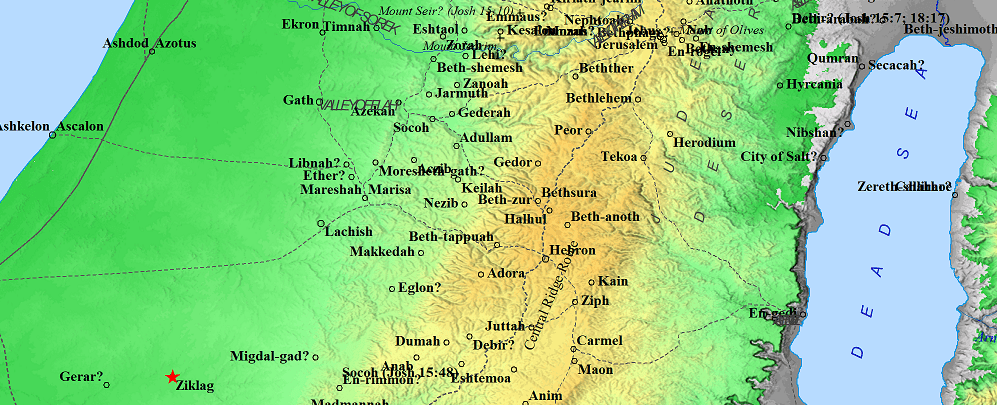
Now a word about Wildgoats’ Rocks. It is another name for Engedi, and this location, per our map to the right, is on the western shore of the Dead Sea, but the map doesn’t rightly describe the topography of the area. Enter Google Maps, to give us an idea of the rock formation of the area.
No wonder they called this area Wildgoats’ Rocks, for the only animals in this area were goats, who could climb the escarpment. This location is also an oasis, fervently green amongst some of the dryest areas on earth. Truly a contradiction of expectations.
It is in this location, Saul sought out David. Traveling up and down the coast, looking for traces of David, having no success. Eventually taking advantage of the many caves found in the escarpment, Saul took advantage of the caves to find some privacy to poop. (everybody gotta poop!) Even the king! All this hunting takes a lot out of a guy, and this happened to be the time Saul had to set aside to sit down and think!
Where would David be? How can I find him? What resistance will he put up? All these thoughts must have been twirling in his head as he was distracted for a few moments. And while Saul was fuming about finding David, he unwittingly had stepped into the very cave David and his men were gathered.
To all appearances, God had delivered Saul to David. Even his men reminded David of God’s plans to deliver Saul to him. But I do not recall any promise from God to David of delivering Saul to him.
Where did David’s men get this information? Was it a popular rumor, based on the men’s desire to see justice for David? Had the men heard from God? I can’t find any record of it! Might this simply be the zeal of the men to justify killing the king? I think so.
But not with David.
David did not listen to his men, for he was to lead them, and listen to God. Listening to men as opposed to God is a great challenge for a Christian leader, but I digress.
David was of such a sensitive heart towards God, that he could not hurt the King even though Saul was hunting him down. Stealthily, he crawled up to the kings robe, possibly taken off during Saul’s “distraction”, (for who wants to poop with a robe on – that just gets nasty!)
The deed was done – David got a snippet of the kings robe, without harming the king. Without the king noticing. Without the king realizing he wasn’t alone! Amazing stealth.
David cut a piece of Saul’s robe, and notice his reaction when he got back to his men.
And afterward David’s heart struck him, because he had cut off a corner of Saul’s robe
David was convicted of cutting a piece off the Kings robe! How could he allow Saul’s death?
The LORD forbid that I should do this thing to my lord, the LORD’s anointed, to put out my hand against him, seeing he is the LORD’s anointed.
David would not allow his men to kill his enemy! How crazy is that? How utterly extreme is that!
It is as if David is a picture of a future King who would tell his men (and women) to not kill their enemies, but HE went just a bit further. He actually stated we are to love our enemies!
Matthew 5:44 But I say to you, Love your enemies …
Thanks again for coming to visit. I hope you found something of interest in this post and would appreciate a comment, to begin a discussion. If you know someone this blog may bless (or challenge), send them a link, so they may join us in our discussion.
Jesus in the Old Testament is a series of posts that will offer my readers a chance to consider pictures or shadows of Jesus in the Old Testament. As mentioned in the introduction to this series, some may be obvious, some may be not so obvious, and some may simply be a facet of the Lord those reading may not have considered previously.
I hope as we venture through this series, we will see the Lord in many wonderful pictures throughout the Old Testament.
SEEING JESUS IN
AHASUERUS
OBEDIENT WIFE
Esther 2:17 the king loved Esther more than all the women, and she won grace and favor in his sight more than all the virgins, so that he set the royal crown on her head and made her queen instead of Vashti.
Matthew 21:43 Therefore I tell you, the kingdom of God will be taken away from you and given to a people producing its fruits.
As we learned in our previous post, Ahasuerus put away his rebellious wife Vashti. Her rebellion was dealt with swiftly and in front of all the kingdom. Vashti was provided no opportunities to humble herself, ask forgiveness or submit. It was over for her!
The wife of Jehovah was dealt with differently. In the gentle and caring fashion of the Father, Israel was provided many offers to return to their marriage with God.
Hosea 14:1 Return, O Israel, to the LORD your God, for you have stumbled because of your iniquity.
Yet she was not to be convinced. Though provided opportunities to repent, she did not.
Ahasuerus would spend months looking for his new wife, a wife that would exhibit humility and honor his name. When he found Esther, she won grace and favor from the King. His love was showered on her and the king found the bride of his hopes.
For Israel, the time came for the Messiah. As he appeared, the last offer of return was given to the nation. Jesus the Son was sent, and though the nation rejected the servants (prophets), surely they would listen to the Son.
Sad to say the nation rejected their Savior, but in the wisdom of God, He provided a way for all those who were of the physical nation to join the spiritual nation of Israel, otherwise known as the church. A church that is powered by the Spirit of God to enable those who follow after the King to be an obedient people, an obedient wife the the King.
1 Peter 2:9 ESV – But you are a chosen race, a royal priesthood, a holy nation, a people for his own possession, that you may proclaim the excellencies of him who called you out of darkness into his marvelous light.
Even in the darkest of times, when it appears all is lost and that any privilege granted by being in the nation was to be ripped away, the Lord Himself provides the opportunity and the power to be the obedient wife.
Oh, the depth of the riches and wisdom and knowledge of God! How unsearchable are his judgments and how inscrutable his ways!
Ahasuerus found his obedient wife. Jesus has found His obedient wife.
Let us follow after our blessed Master, submit to His will and seek to obey in every request and command He issues to us.
May His name be lifted up in our lives!
Thanks again for coming to visit. I hope you found something of interest in this post and would appreciate a comment, to begin a discussion. If you know someone this blog may bless (or challenge), send them a link, so they may join us in our discussion.
My hope is that this series will offer my readers a chance to consider the names, characteristics and descriptions of our God in the Word.
The remaining Names of God in this series might be considered descriptors, or characteristics of the Lord. We have reviewed the three primary Names of God, along with nineteen compound Names of God in our previous posts. As we venture through these descriptors of our God, I hope we will recognize all the many characteristics of our God that we tend to take for granted.
The Word is truly rich with descriptions of the Living God, and this effort of searching in the Word was quite illuminating. He truly is the ultimate subject of the Word, and His revelation of self-descriptions, or the accolades offered Him by His priests, prophets, kings apostles and faithful truly is a blessing.
May the Name of the Lord be praised, and by thinking on His name, may you have a blessed day.
138
FAITHFULNESS
Isaiah 11:5 Righteousness shall be the belt of his waist, and faithfulness the belt of his loins.
In this passage the emphasis is on consistency. Of the proven acts of God that indicate the outworking of the nature of God, of His faithful nature.
It is one thing to know someone who is completely faithful in his core being, in his nature, it is another thing to experience the on going and consistent outworking of that nature upon your own experience.
This continual trustworthiness of God in day to day promise keeping is what is being addressed in this passage.
For His faithfulness to be described as the belt of His loins speaks of the items that protects His honor, that upholds the respect due to Him. Both righteousness and faithfulness are compared to as a belt, and therefore there is a strong link with these two characteristics of God’s nature.
He works out His will faithfully, in righteousness. All of His nature is in harmony within His being as He works out His will. He is not in inner turmoil over His decisions, nor does He reconsider His will, outside of His own nature.
As I try to explain my thoughts, I ask my reader to consider how I understand the righteousness of God. I would be remiss to imply that God is merely a robot complying with His nature, for though He is in harmony regarding His will, He is suffering from the fallout. A broken heart, a crucified Son, a rejecting creation, and all the unnecessary self inflicted pain His people experience.
No, but His belt is faithfulness. God is Faithfulness.
God is faithful to the New Covenant and to His Son, His faithfulness overflowing to those who have willingly joined into the covenant.
For He is Faithfulness.
I would love to hear of your favorite name, characteristic or description of the Living God. Please leave me a comment, and I will include it in the list!
Thanks again for coming to visit. I hope you found something of interest in this post and would appreciate a comment, to begin a discussion. If you know someone this blog may bless (or challenge), send them a link, so they may join us in our discussion.
My hope is that this series will offer my readers a chance to consider the names, characteristics and descriptions of our God in the Word.
The remaining Names of God in this series might be considered descriptors, or characteristics of the Lord. We have reviewed the three primary Names of God, along with nineteen compound Names of God in our previous posts. As we venture through these descriptors of our God, I hope we will recognize all the many characteristics of our God that we tend to take for granted.
The Word is truly rich with descriptions of the Living God, and this effort of searching in the Word was quite illuminating. He truly is the ultimate subject of the Word, and His revelation of self-descriptions, or the accolades offered Him by His priests, prophets, kings apostles and faithful truly is a blessing.
May the Name of the Lord be praised, and by thinking on His name, may you have a blessed day.
137
FAITHFUL GOD
Deuteronomy 7:9 Know therefore that the LORD your God is God, the faithful God who keeps covenant and steadfast love with those who love him and keep his commandments, to a thousand generations,
It is appropriate that our last name of God would end with this name. He is our Faithful God.
Moses is speaking to the Israelites, just prior to entering the promised land, and he describes our Faithful God in two way, depending on our actions.
Verse 9 speaks of our Faithful God keeping “covenant and steadfast love with those who love him and keep his commandments”
First off, note the duration of His faithfulness. To a thousand generations! Is Moses speaking of the faithfulness of God extending past the life of the one who loved Him and kept his commandments”? What does that mean? Could I claim this as a promise for my own life? Have I loved God properly and kept His commandments? Sadly no, and if you will be honest with yourself, you may be saying the same. Yet this verse, this promise remains for us to understand. Is there one out there, somewhere, who has loved God and kept His commandments?
Funny you should ask, for there is One who has perfectly loved God, and singlehandedly, in the midst of much resistance, temptation, contradiction and suffering, obeyed God’s commandments perfectly, fully and without hesitation. He chased after the will of God to His own death!
Our Faithful God has kept this promise, for the promise of keeping covenant and steadfast love with the One who loves God, has been realized in the Suffering Messiah. Because of His faithfulness to God’s commandments, He is in the midst of seeing a thousand generations, or in other words all of creation, being brought into a steadfast love and covenant based on the Messiah’s love of God and His faithful keeping of God’s will.
He is our Faithful God, but as mentioned previously, Moses also describes our God’s faithfulness in relation to those who hate Him.
Verse 10 speaks of our Faithful God repaying “to their face those who hate him, by destroying them. He will not be slack with one who hates him. He will repay him to his face”
God’s faithfulness is expressed in retribution, punishment and destruction, in strict faithfulness to each who hates Him. They will be destroyed. They will be repaid to His face! What a horrible truth Moses was teaching the Israelites, but truth cannot be varnished over simply because it is difficult or unpalatable.
Whatever this destruction encompasses, it is not to be sought after. Love the Lord, and enter into the “thousand generations” that are of the Lord’s family. Enjoy the goodness of God and His faithfulness to those who follow after Jesus.
I would love to hear of your favorite name, characteristic or description of the Living God. Please leave me a comment, and I will include it in the list!
Thanks again for coming to visit. I hope you found something of interest in this post and would appreciate a comment, to begin a discussion. If you know someone this blog may bless (or challenge), send them a link, so they may join us in our discussion.
As many who have followed me for a bit, I have fallen into the Psalms, and I can’t get up! (As if I would want to.) The Psalms are a majestic collection of poetry, of heart felt human experiences that constantly challenge me in my own frail attempt to follow the true King. As many of the Psalms are written by David, my study on the Psalms has spurred me on to looking at the life of David, is the main contributor to this book, and to follow the victories and tragedies of the shepherd King of Israel.
Many times in the narrative, we will see the Lord Jesus, imperfectly, yet a reflection of His spirit in a man with weaknesses.
1 Samuel 23
24 And they arose and went to Ziph ahead of Saul. Now David and his men were in the wilderness of Maon, in the Arabah to the south of Jeshimon. 25 And Saul and his men went to seek him. And David was told, so he went down to the rock and lived in the wilderness of Maon. And when Saul heard that, he pursued after David in the wilderness of Maon. 26 Saul went on one side of the mountain, and David and his men on the other side of the mountain. And David was hurrying to get away from Saul. As Saul and his men were closing in on David and his men to capture them, 27 a messenger came to Saul, saying, “Hurry and come, for the Philistines have made a raid against the land.” 28 So Saul returned from pursuing after David and went against the Philistines. Therefore that place was called the Rock of Escape. 29 And David went up from there and lived in the strongholds of Engedi.
In our last passage we saw the Ziphites travel to see their king, in order to rat out David. Saul seemed hesitant to trust them, but simply couldn’t miss out on a chance to catch the young rebel, and this opportunity of Saul’s turns out to be one of the very near catches that we will see for David and his men.
But as we spoke of Saul’s spies in our last post, we find David has spies also that are feeding him information. It turns out that spies are influencing both sides of the war, and the information is changing as fast as possible.
Saul hears info from the Ziphites. David hears of Saul coming to the south, and ventures into the wilderness of Moan. Saul hears of David’s shift to the wilderness. It is here that Saul comes closest to actually capturing David, for he is only a hill away from David.
So close.
Until we have another “spy” or informant come to Saul informing him of trouble at home, of the Philistines raiding the home land. But why would this become a concern for Saul, as we know that Keilah, which was part of Saul’s kingdom was merely ignored when the Philistines invaded there. Saul was no where to be found. So why would this instance of the Philistines invading the land catch Saul’s attention, unless of course that it was his own personnel property that needed protection. If so, this fits with the character profile we have seen regarding this king. A selfish man, self centered and constantly grasping for more. A life that is always being pulled apart by his focus on self.
So off he goes from being so close to capturing David, causing further frustration on his part, with more frustration only to fall on this pitiable man.
On David’s part, we shall see this near escape come up often, where he uses all the skill of a master general, and yet is close to capture. He is rescued “at the last minute” by outside circumstances.
How often do we see this last minute escape for David provided by outside circumstances? How often the Lord orchestrates a situation where it appears we will be taken down, only to be rescued by outside influences.
Let’s cut to the chase here, for we know that outside circumstances and influences are orchestrated by God, the timing is of the Lord, and our security, as we follow after Him is in His hands. Close calls, from our standpoint, can be sometimes harrowing experiences, but from God’s point of view, close calls are a part of the orchestra He is leading to bring us closer to Him, to listen for His guidance, and to bring about a thankful spirit in our lives.
Let us thank Him for circumstances and influences that redirect danger from our lives.
Thanks again for coming to visit. I hope you found something of interest in this post and would appreciate a comment, to begin a discussion. If you know someone this blog may bless (or challenge), send them a link, so they may join us in our discussion.
Jesus in the Old Testament is a series of posts that will offer my readers a chance to consider pictures or shadows of Jesus in the Old Testament. As mentioned in the introduction to this series, some may be obvious, some may be not so obvious, and some may simply be a facet of the Lord those reading may not have considered previously.
I hope as we venture through this series, we will see the Lord in many wonderful pictures throughout the Old Testament.
SEEING JESUS IN
AHASUERUS
REBELLIOUS WIFE
Esther 1:12 But Queen Vashti refused to come at the king’s command delivered by the eunuchs. At this the king became enraged, and his anger burned within him. Esther 1:15 “According to the law, what is to be done to Queen Vashti, because she has not performed the command of King Ahasuerus delivered by the eunuchs?” Esther 1:19 If it please the king, let a royal order go out … that Vashti is never again to come before King Ahasuerus. And let the king give her royal position to another who is better than she.
Matthew 21:43 Therefore I tell you, the kingdom of God will be taken away from you and given to a people producing its fruits.
Ahasuerus, as king of Persia, demanded a wife that would respect him, honor him and obey him. A powerful king with a disrespectful wife was only going to damage the kingdom, and not lift up the name of Ahasuerus.
Though it appears this act of rebellion on the part of Vashti may have been the first rejection of the king’s authority, it was to be dealt with swiftly and without mercy. Ahasuerus was going to deal with her properly and quickly.
God also had a wife that disobeyed, and that was eventually put away after many warnings. Jeremiah 3:8 and Hosea 2:4-5 depicts the divorce of the nation of Israel from Jehovah God. Though restored after the captivity, Jesus warned the nation of the loss of the kingdom in our passage in Matthew.
Both Ahasuerus and God dealt with a rebellious wife, one instantly, and One with great patience and mercy.
Though both God and Ahasuerus were married to rebellious wives, and both put their rebellious wives away, the character of God shines so brighter than this mere Persian King. According to Ahasuerus, Vashti would never see the King again! (See Esther 1:19) No forgiveness, nor any hope of restoration would be offered to Vashti.
In our passage in Matthew, Jesus speaks of the loss of the kingdom. But notice that this loss of kingdom was not a done deal for those who sought out the true King. Even in this tense moment of truth being delivered to the Jewish leadership, Jesus made it clear that there is a solution.
Matthew 21:44 And the one who falls on this stone will be broken to pieces; and when it falls on anyone, it will crush him.”
Per Jesus, as He addressed those who would eventually hang Him from a cross, He spoke of restoration, for a rebellious wife can be restored through humility and brokenness.
Consider the goodness of God in His patience, His mercy and His longing for His people, that after centuries of disobedience, He provided a Savior, a Stone to fall before, to be brought back to the Father.
He is such a different King! So good to know our King!
May the name of Jesus be lifted up today in our lives, by listening humbly and doing as we are led!
Thanks again for coming to visit. I hope you found something of interest in this post and would appreciate a comment, to begin a discussion. If you know someone this blog may bless (or challenge), send them a link, so they may join us in our discussion.
My hope is that this series will offer my readers a chance to consider the names, characteristics and descriptions of our God in the Word.
The remaining Names of God in this series might be considered descriptors, or characteristics of the Lord. We have reviewed the three primary Names of God, along with nineteen compound Names of God in our previous posts. As we venture through these descriptors of our God, I hope we will recognize all the many characteristics of our God that we tend to take for granted.
The Word is truly rich with descriptions of the Living God, and this effort of searching in the Word was quite illuminating. He truly is the ultimate subject of the Word, and His revelation of self-descriptions, or the accolades offered Him by His priests, prophets, kings apostles and faithful truly is a blessing.
May the Name of the Lord be praised, and by thinking on His name, may you have a blessed day.
136
FAITHFUL WITNESS
Revelation 1:5 and from Jesus Christ the faithful witness, the firstborn of the dead, and the ruler of kings on earth. To him who loves us and has freed us from our sins by his blood
Jesus Christ the Faithful Witness.
We are in the middle of a series of names that speaks to the faithfulness of God. The predominant form of descriptor is Faithful, as we see here, and as spoken of in a past post (Names of God – FAITHFUL – 129).
To be faithful speaks of God’s nature, not what He does, but who He is. His faithfulness, in our description of God is in regard to the Witness He provides. To be a witness is to be a spectator of some occurrence that needs to be remembered, or recounted for others. A recounting of something that has happened, is actual and reflects reality. A true historical occurrence.
Let’s consider a short passage in the Old Testament that gives us contrast to the Faithful Witness. There are bountiful examples of false witnesses, but the following passage seems fitting for our time together today.
First, a bit of context – Ahab wanted Naboth’s vineyard. Worthless men were found to bring a charge against an innocent man. Death ensues. Let’s read the short passage and consider what we read.
1 Kings 21:13 And the two worthless men came in and sat opposite him. And the worthless men brought a charge against Naboth in the presence of the people, saying, “Naboth cursed God and the king.” So they took him outside the city and stoned him to death with stones.
Two men were found, in order to comply with the sham of “religion keeping” the king wanted to portray. The story was brought that Naboth did bad. Nothing specific, for that would open up the story to questions, or contradictions. Just a blanket statement that Naboth did bad.
Ahab got what he wanted. A useful story to justify killing Naboth, without carrying the guilt of committing murder. Two worthless men were used to cover the King’s sin. And his vineyard was added to his real estate holdings!
These two men, these false witnesses, became a fulcrum for a treacherous King used to kill an innocent man. A man who loved God and resisted a corrupt political power to honor God. Naboth is a great picture of the Lord Jesus Christ, and we will address him in our series on Jesus in the Old Testament, but for now, consider the differences between these two worthless men and our Faithful Witness
The faithless witnesses received some payment for the false witness. Being a Faithful Witness cost the Lord His life
The faithless witnesses were used to bring death on a innocent man Being a Faithful witness brought life to dead men.
The faithless witnesses were used by a selfish, greedy man Being a Faithful Witness delivers men from selfishness and greed.
The faithless witnesses are never heard of again. They are not even referred to by name. Being a Faithfull Witness has elevated the name of the Lord to it’s highest status. No name is higher than the name of the Lord.
The faithless witnesses thought they had gained in their deception some status or recognition with the king or queen. Being a Faithfull Witness has elevated Jesus to the highest recognition, with Him being crowned King of Kings and Lord of Lords.
He is our Faithful Witness, the One whose words we can trust, who experienced the crime first hand, (as He was the victim) and has been raised again to tell of (give witness) the victory.
May we tell the story to those we come in contact with, the truth of His resurrection, of the Faithful Witness who delivers us.
He is our Faithful Witness.
I would love to hear of your favorite name, characteristic or description of the Living God. Please leave me a comment, and I will include it in the list!
Thanks again for coming to visit. I hope you found something of interest in this post and would appreciate a comment, to begin a discussion. If you know someone this blog may bless (or challenge), send them a link, so they may join us in our discussion.
My hope is that this series will offer my readers a chance to consider the names, characteristics and descriptions of our God in the Word.
The remaining Names of God in this series might be considered descriptors, or characteristics of the Lord. We have reviewed the three primary Names of God, along with nineteen compound Names of God in our previous posts. As we venture through these descriptors of our God, I hope we will recognize all the many characteristics of our God that we tend to take for granted.
The Word is truly rich with descriptions of the Living God, and this effort of searching in the Word was quite illuminating. He truly is the ultimate subject of the Word, and His revelation of self-descriptions, or the accolades offered Him by His priests, prophets, kings apostles and faithful truly is a blessing.
May the Name of the Lord be praised, and by thinking on His name, may you have a blessed day.
135
FAITHFUL PRIEST
1 Samuel 2:35 And I will raise up for myself a faithful priest, who shall do according to what is in my heart and in my mind. And I will build him a sure house, and he shall go in and out before my anointed forever.
In our last post, looking at Hebrews 2:17, we saw that God is called our Faithful High Priest. He is described as One who became like us in every way.
In this passage, we see the book of Samuel teaching us of God as a faithful priest.
The writer is speaking of how this priest, this faithful priest, will do according to all that is in the heart of God. In our last post, the emphasis was on our Faithful High Priest becoming like us in every respect.
In this passage, the immediate fulfillment seems to be seen in Samuel, the prophet that brings in the kingdom of Saul. The verse emphasizes the heart of the priest to be that of God’s heart, of faithfulness to the character, nature and person of God.
There is no denying that Samuel was a stellar prophet, yet the passage speaks of a faithful priest, and there is little evidence that Samuel was considered to be a priest. His stated office was that of prophet.
No – this passage speaks of our Faithful Priest in the Lord Jesus, in that He followed after God’s way not only in His actions, but by His heart and mind! He is the eternally anointed Faithful Priest of God.
With both these verses we see the Faithful Priest both parties need, for the Priest is essentially a mediator between two parties that have differences.
He is God’s Faithful Priest!
I would love to hear of your favorite name, characteristic or description of the Living God. Please leave me a comment, and I will include it in the list!
Thanks again for coming to visit. I hope you found something of interest in this post and would appreciate a comment, to begin a discussion. If you know someone this blog may bless (or challenge), send them a link, so they may join us in our discussion.
As many who have followed me for a bit, I have fallen into the Psalms, and I can’t get up! (As if I would want to.) The Psalms are a majestic collection of poetry, of heart felt human experiences that constantly challenge me in my own frail attempt to follow the true King. As many of the Psalms are written by David, my study on the Psalms has spurred me on to looking at the life of David, is the main contributor to this book, and to follow the victories and tragedies of the shepherd King of Israel.
Many times in the narrative, we will see the Lord Jesus, imperfectly, yet a reflection of His spirit in a man with weaknesses.
1 Samuel 23
19 Then the Ziphites went up to Saul at Gibeah, saying, “Is not David hiding among us in the strongholds at Horesh, on the hill of Hachilah, which is south of Jeshimon? 20 Now come down, O king, according to all your heart’s desire to come down, and our part shall be to surrender him into the king’s hand.” 21 And Saul said, “May you be blessed by the LORD, for you have had compassion on me. 22 Go, make yet more sure. Know and see the place where his foot is, and who has seen him there, for it is told me that he is very cunning. 23 See therefore and take note of all the lurking places where he hides, and come back to me with sure information. Then I will go with you. And if he is in the land, I will search him out among all the thousands of Judah.”
David was not everyone’s favorite rebel.
Recently he vanquished the Philistines as they were battling the city of Keilah. Finding victory, David and his men were then subjected to a faithless city, having to run before the Keilahites offered him up to Saul.
To be fair, this account of the Keilahites may have a slightly different interpretation than I have offered, since it seems that once the Lord revealed to David the Keilahites intentions to save themselves from Saul’s fighting machine, David willingly ran. Possibly to save the Keilahites of the suffering their king would being on them.
The Ziphites are not so guiltless. They seem to have a desire to assist King Saul, unlike the Keilahites, who may have only given up David in self preservation, if David hadn’t left.
No, the Ziphites sought out Saul at Gibeah, a town approximately 25 miles to the north of Jerusalem. They left their homes, and travelled to see the king with information of David’s whereabouts. Not simply a general location, but a very specific camp David was residing at, in the strongholds at Horesh, on the hill of Hachilah, which is south of Jeshimon.
David was on a specific hill. At first I imagined this “hill” to be mountainous, but it seems the Hebrew word for hill in this instance means hill, somewhat lower than a mountain. This information Saul was provided was very specific!
What good spy’s Saul has here! And they were willingly offering to Saul their full cooperation! What good citizens!
Saul provides the blessing of God on these good and faithful Ziphites. What? He doesn’t understand the blessing of God, nor is he in a position spiritually to pass a blessing on. And for the Ziphites – being blessed for being a traitor to God’s appointed King? Something is terribly wrong with this picture!
And though Saul “blesses” the Ziphites, he will not venture out until the information is verified. It is like he was saying – I don’t quite trust you Ziphites – Go make sure and then come back. Get more specific data.
Is Saul moving from a reactionary attack, based on shear hatred of David, to a more strategic, fact based plan to kill David at this time? Or is it that the Ziphites were known to be untrustworthy?
It seems the Ziphites were not necessarily untrustworthy, but merely seeking to gain the king’s favor. Seeking an earthly king’s pleasure against the Word of God leads to terrible betrayals, and huge treachery.
No- the Ziphites used their political faithfulness to a madman, to work against a movement of God. And we shall see in future passages that this behavior is confirmed in the Ziphites, for this is not the only time they offer up David to the king. We find that they show up on Saul’s doorstep again in chapter 26.
It also turns out that Saul was not as “strategic” as I may have suggested, for, in our next passage, it turns out that Saul couldn’t resist heading south to the region the Ziphites described, before gaining confirmation of David’s whereabouts.
It seemed Saul was about to capture David. Saul’s network of spies was about to deliver David into his hands, and Saul would finally have the peace he sought!
This passage reminds me of times when I seek to accomplish something, in order to find some sense of worth, or to justify a decision I had made, or to have a sense of completion. I may, in a sense be seeking a type of peace in these decisions. I tend to drive people, (as a hangover from work) and need to adjust my focus to people and not tasks.
An alternate view of this passage is that Saul sought to hurt someone. The Ziphites sought to hurt someone. They found a type of fellowship in this desire. They may have felt a bond of some type. Hard as it may be to believe, this may also become a trap for a believer, letting a group dynamic influence a just decision.
Consider your associations and test to see if the goals of the organization are just and right. If there is some uncertainty, or if those you associate with are working against God, it may be time to consider if you should remain? Is it simply a bond that started out right, in pursuit of God, but is now actively working against God?
This takes wisdom from God and clear spiritual discernment, but the Lord is able to teach each of us as we seek Him.
Thanks again for coming to visit. I hope you found something of interest in this post and would appreciate a comment, to begin a discussion. If you know someone this blog may bless (or challenge), send them a link, so they may join us in our discussion.
Jesus in the Old Testament is a series of posts that will offer my readers a chance to consider pictures or shadows of Jesus in the Old Testament. As mentioned in the introduction to this series, some may be obvious, some may be not so obvious, and some may simply be a facet of the Lord those reading may not have considered previously.
I hope as we venture through this series, we will see the Lord in many wonderful pictures throughout the Old Testament.
SEEING JESUS IN
ABIATHAR
SURVIVOR
1 Samuel 22:20 But one of the sons of Ahimelech the son of Ahitub, named Abiathar, escaped and fled after David.
Matthew 2:16 Then Herod, when he saw that he had been tricked by the wise men, became furious, and he sent and killed all the male children in Bethlehem and in all that region who were two years old or under, according to the time that he had ascertained from the wise men.
A bit of context for this man named Abiathar.
In the days of David, very early in David’s wilderness years, Saul had one of his spies inform him of David’s whereabouts in the city of Nob. Now, Nob was a city of priests, and though David did stop by to get supplies and a weapon, he moved on to the Philistine nation to continue getting away from what was becoming a very dangerous situation.
By now, Saul had not fully exposed himself as one who would pursue David to the end, but his manic behavior was becoming more evident and David realized the threat. As he escaped from Saul’s court, he stopped off at Nob, requesting assistance from Ahimelech the priest.
As mentioned, a spy informed Saul, and Saul ventured down to Nob to find David. Without David’s presence available, Saul determined Ahimelech was actively working against him, by providing David assistance. Off with his head, and kill the whole city of Nob. All the rest of the priests, the wives, families, all the livestock.
Even though David was not in the city, the city suffered terribly. Saul knew he had lost David, but his frustration and fear of loosing the kingdom drove him to this incredible massacre.
Yet he missed one person. One sole solitary priest escaped the wrath of a crazy, power hungry, fearful man that wielded his power against innocent people.
This massacre foreshadowed another massacre by a crazy, power hungry fearful man named of Herod. Jesus, as with Abiathar, escaped the clutches of a madman intent on killing to protect his kingdom.
Abiathar escaped to the future King David, and though Abiathar was a faithful man to David, his last days are marked with a wrong choice in following Adonijah. Eventually Abiathar was deposed from his priestly duties and narrowly escaped death at the hands of Solomon. (1 Kings 2:26-27)
Thankfully, we are not to follow Abiathar, but the One who will never make a wrong choice, who, though He escaped the threat of Herod, submitted Himself to the power of the Roman government and Jewish hierarchy, in order to provide us a not only a faithful High Priest, but the wisest of Kings to follow after.
He is good and He is good all the time!
Thanks again for coming to visit. I hope you found something of interest in this post and would appreciate a comment, to begin a discussion. If you know someone this blog may bless (or challenge), send them a link, so they may join us in our discussion.
My hope is that this series will offer my readers a chance to consider the names, characteristics and descriptions of our God in the Word.
The remaining Names of God in this series might be considered descriptors, or characteristics of the Lord. We have reviewed the three primary Names of God, along with nineteen compound Names of God in our previous posts. As we venture through these descriptors of our God, I hope we will recognize all the many characteristics of our God that we tend to take for granted.
The Word is truly rich with descriptions of the Living God, and this effort of searching in the Word was quite illuminating. He truly is the ultimate subject of the Word, and His revelation of self-descriptions, or the accolades offered Him by His priests, prophets, kings apostles and faithful truly is a blessing.
May the Name of the Lord be praised, and by thinking on His name, may you have a blessed day.
134
FAITHFUL HIGH PRIEST
Hebrews 2:17 Therefore he had to be made like his brothers in every respect, so that he might become a merciful and faithful high priest in the service of God, to make propitiation for the sins of the people.
This post, along with our next post, refers to God as a Priest. Given the familiarity of this particular verse seems to have dulled my shock that should arise in my thinking, for priests were mediators between man and deity. For the author of Hebrews to speak of God as a priest is most peculiar.
How can the One who is to be appeased be the One who is appeasing the Deity? This is simply confusing to me, that God, who is spoken of as representing man before God, has taken on this ministry. Though He created us, how can He represent us before the Almighty?
Most of this mystery – not all grant you – is removed in the first phrase the author provides us. This priest was made like His brothers in every respect. He is not representing us before the Great I Am as a theoretical priest, having heard of our situation and is doing the best He can. He has become one of us, experiencing the trials and joys of life, the friction and disappointment of relationships, the frustration of relying on those who may not meet expectations.
He has experienced all of our temptations and trials, and in joining with us in our pilgrimage through this life, can provide a priestly service on our behalf, morally perfect and yet understanding of our situation.
It is through His walk on this earth that He became our Faithfull High Priest, One that could represent us before the Father, pleading our case with the power of a resurrected life and a proven righteousness that the Father has recognized through the resurrection.
He became our Faithfull High Priest in His death and resurrection, having become like us.
I would love to hear of your favorite name, characteristic or description of the Living God. Please leave me a comment, and I will include it in the list!
Thanks again for coming to visit. I hope you found something of interest in this post and would appreciate a comment, to begin a discussion. If you know someone this blog may bless (or challenge), send them a link, so they may join us in our discussion.
My hope is that this series will offer my readers a chance to consider the names, characteristics and descriptions of our God in the Word.
The remaining Names of God in this series might be considered descriptors, or characteristics of the Lord. We have reviewed the three primary Names of God, along with nineteen compound Names of God in our previous posts. As we venture through these descriptors of our God, I hope we will recognize all the many characteristics of our God that we tend to take for granted.
The Word is truly rich with descriptions of the Living God, and this effort of searching in the Word was quite illuminating. He truly is the ultimate subject of the Word, and His revelation of self-descriptions, or the accolades offered Him by His priests, prophets, kings apostles and faithful truly is a blessing.
May the Name of the Lord be praised, and by thinking on His name, may you have a blessed day.
133
FAITHFUL CREATOR
1 Peter 4:19 Therefore let those who suffer according to God’s will entrust their souls to a faithful Creator while doing good.
Peter is speaking in verses previous of how judgement must fall on all of us, and he refers to the church experiencing judgement first. As the nature of judgement is to be of trials, difficulties and pain, many in the church may recoil at this idea, that a loving God would allow His people to suffer. And for Peter to teach that His people to suffer first is over the top.
Many may cry out in that suffering naturally, and faith will be tested. Questions of God’s nature and character may become the rhythm of the saint’s prayers and complaints.
Why me O Lord? Why bring me into this world only for suffering? Why why why?
Job questioned his very existence in the midst of suffering.
Job 3:11-13 “Why did I not die at birth, come out from the womb and expire? Why did the knees receive me? Or why the breasts, that I should nurse? For then I would have lain down and been quiet; I would have slept; then I would have been at rest,
Jeremiah called out, questioning the reason for his continual trials through his life.
Jeremiah 20:18 Why did I come out from the womb to see toil and sorrow, and spend my days in shame?
All saint’s, to varying degrees, come to question God’s intent, or reason for their existence as Jeremiah and Job. Peter, knowing this, ministers to the Body of Christ in his teaching on pain and suffering by referring to our God as the Faithful Creator. God is not a “one time” Creator, as the deist’s believed, that created everything and then walked away to let it run on it’s own.
God is a Faithful Creator, in that He was there at the beginning, has been faithful throughout all of creation and has created each one of us out of a nature of being faithful. We are not stranded without a Savior in our sufferings, and though He may be quiet at times, Peter assures us of His continual faithfulness.
We are a people that need that message to reside deep in our soul, for as hard times may come, to know the Lord as a faithful Creator will be a rock for our lives.
He is a faithful Creator!
I would love to hear of your favorite name, characteristic or description of the Living God. Please leave me a comment, and I will include it in the list!
Thanks again for coming to visit. I hope you found something of interest in this post and would appreciate a comment, to begin a discussion. If you know someone this blog may bless (or challenge), send them a link, so they may join us in our discussion.
As many who have followed me for a bit, I have fallen into the Psalms, and I can’t get up! (As if I would want to.) The Psalms are a majestic collection of poetry, of heart felt human experiences that constantly challenge me in my own frail attempt to follow the true King. As many of the Psalms are written by David, my study on the Psalms has spurred me on to looking at the life of David, is the main contributor to this book, and to follow the victories and tragedies of the shepherd King of Israel.
Many times in the narrative, we will see the Lord Jesus, imperfectly, yet a reflection of His spirit in a man with weaknesses.
1 Samuel 23:15-29 15 David saw that Saul had come out to seek his life. David was in the wilderness of Ziph at Horesh. 16 And Jonathan, Saul’s son, rose and went to David at Horesh, and strengthened his hand in God. 17 And he said to him, “Do not fear, for the hand of Saul my father shall not find you. You shall be king over Israel, and I shall be next to you. Saul my father also knows this.” 18 And the two of them made a covenant before the LORD. David remained at Horesh, and Jonathan went home.
In the verse previous to 15, the author tells us that David was in the strongholds and mountains of the wilderness, due to Saul seeking him everyday. David was the subject of constant harassment, constant stress, constant pressure, from a king he had served faithfully. Yet the die had been set and Saul was determined in his actions. Saulnwas settled in his mind that David had to die, and in the past passages we have seen Saul abuse his wife, his daughters and his son in the pursuit of killing David. No one was safe until David was dead
Now the circumstances of how Jonathon, the son of David’s mortal enemy came to visit him is a mystery. David may have made the appointment with Jonathon, providing Jonathon his exact whereabouts. Yet this was an opportunity for this information to be leaked to Saul, for the transmission of this data to somehow find it’s way to the King.
And the danger was not only on David’s part, for if Saul, in his murderous tirade, knew Jonathon visited with David, it might be the end of Jonathon.
But the meeting was set and the two men were able to discuss David’s circumstances. For some unknown reason, only Jonathon’s message has been preserved for us. Three messages come to David from the lips of Jonathon.
Do not fear
Jonathon spoke words of peace on David, ensuring David that Saul shall not find him. Was this simply words of hope, words that were meant to encourage. Surely. But were these words of surety, or an absolute promise, as if a Word from God?
I don’t understand that Jonathon was a prophet, but at the very least, he may have uttered these words as a repetition of the promise of God to David years earlier. Jonathon made this conclusion of escaping Saul’s hand due to the promise of David ascending to the throne of Israel, which Jonathon rightly reminds David of his future.
You shall be king
David shall be king, and to be king over all Israel. This was the promise of God that ensured both men that David would escape the hand of Saul. And then Jonathon says “I shall be next to you”.
I don’t recall any portion of the promise of God stating this, nor of David providing this promise. So what was Jonathon talking about? Was he thinking of a co-regency, where he would be equal to David in the kingdom?
When Jonathon speaks of being “next” to David, Jonathon may be implying a rank of second in the kingdom, for the Hebrew word מִשְׁנֶה mishneh, sometimes speaks of being second in rank. Might Jonathon be suggesting his desire of a position of power to David? Possibly, yet I want to think that Jonathon was of a purer heart, and simply be referring to his informal, personal support for, and friendship to David in his future reign.
Saul knows this
This is such a sad statement! Saul knew David would ascend to the throne, and yet he toiled against the will of God, against his own benefit, against the good of his own nation, and against his own families existence!
Consider Saul waking up to the realization of David’s supremacy, and humbly coming to him in front of the nation of Israel, bowing the knee and giving up his position of power to David. What would be Saul’s legacy? How many benefits would shower down on Saul for this act of humility?
Knowing the truth and fighting against it is foolish. Yet to agree with the truth takes humility, a washing away of pride and arrogance, the giving up of advantage and power, of losing reputation and starting over.
Truly there are many forms of loss when we are agreeing with the truth. Confession of sin and repentance may cost us much, even our very way of life.
And what do we get out of it?
The foundation of agreeing with the truth is that we are conforming to reality. We are no longer living in a fantasy world, a would of smoke and mirrors, of deceit, cheating, backstabbing and conspiracy. We are no longer looking over our shoulder, but have joy, purpose and a life to live, not a death to fear.
Saul may have been too far gone by this time in his life. I have no idea, nor do I suppose any but God knew of Saul’s opportunity to repent at that time. Sadly we know he did not repent, that his last years were spent fighting against the truth.
If you have been fighting against a truth the Lord has spoke to you about, quit fighting.
Don’t be a Saul.
Thanks again for coming to visit. I hope you found something of interest in this post and would appreciate a comment, to begin a discussion. If you know someone this blog may bless (or challenge), send them a link, so they may join us in our discussion.
My hope is that this series will offer my readers a chance to consider the names, characteristics and descriptions of our God in the Word.
The remaining Names of God in this series might be considered descriptors, or characteristics of the Lord. We have reviewed the three primary Names of God, along with nineteen compound Names of God in our previous posts. As we venture through these descriptors of our God, I hope we will recognize all the many characteristics of our God that we tend to take for granted.
The Word is truly rich with descriptions of the Living God, and this effort of searching in the Word was quite illuminating. He truly is the ultimate subject of the Word, and His revelation of self-descriptions, or the accolades offered Him by His priests, prophets, kings apostles and faithful truly is a blessing.
May the Name of the Lord be praised, and by thinking on His name, may you have a blessed day.
132
FAITHFUL AND TRUE WITNESS
Revelation 3:14 “And to the angel of the church in Laodicea write: ‘The words of the Amen, the faithful and true witness, the beginning of God’s creation.
In our last post we spoke – hopefully clearly – of the name “Faithful and True”. After a poor effort at explaining the state and standard of God in the previous name of God, I would like to consider this name of God, and how the witness of God should be described as the perfectly trustworthy “Faithful and True” God.
This particular name speaks of God as a witness. An action that He partakes in, and the action of Him as a witness is described by the nature our God has.
He is faithful and He is true. There is not much wiggle room in finding fault with this Witness.
But a witness is one who is a spectator of a crime, or a contest or of a happening that needs to be recounted. To be a witness is to communicate what One has seen.
What had Jesus seen? Consider – to be a faithful and true witness does not require the witness to provide every detail, or every fact, or every incident in a case. It is to provide the record that is required in the court room, and pertaining to the case at hand.
Jesus provided the information we needed. He spoke of what He saw, and He communicated what He saw with the help of the Holy Spirit.
His witness, if you would have it, was the glory of God, and brought the faithfulness and truth of God, the grace and mercy of God into a resounding focal point that will never be outshone.
A short story to help connect with my thoughts.
I was in church this Sunday morning, crying over some song that spoke of the glory of God. The church sang of the sacrifice of Jesus, and I realized once again that the crucifixion was the glory of God!
No bright lights. No shining beams, or radiant glow. No attention seeking blast of energy!
No – the greatest exhibit of the glory of God was that in the darkness of the crucifixion, one lone body hung bleeding, that of a man misunderstood, of a tortured soul that gave all, only to be rejected, ridiculed, and mocked. Even as he hung in that excruciating pain, He forgave his tormentors.
As He became a martyr, He forgave His enemies. He forgave. He actually forgave his enemies in the midst of their celebration of defeating Him.
How can we grasp this? What type of God is this, that takes our punishment and forgives those who, with extreme prejudice, executes Him? How can we understand Him.
He is the faithful and True Martyr, for to be a witness, in the New Testament was to be a martyr.
I would love to hear of your favorite name, characteristic or description of the Living God. Please leave me a comment, and I will include it in the list!
Thanks again for coming to visit. I hope you found something of interest in this post and would appreciate a comment, to begin a discussion. If you know someone this blog may bless (or challenge), send them a link, so they may join us in our discussion.
My hope is that this series will offer my readers a chance to consider the names, characteristics and descriptions of our God in the Word.
The remaining Names of God in this series might be considered descriptors, or characteristics of the Lord. We have reviewed the three primary Names of God, along with nineteen compound Names of God in our previous posts. As we venture through these descriptors of our God, I hope we will recognize all the many characteristics of our God that we tend to take for granted.
The Word is truly rich with descriptions of the Living God, and this effort of searching in the Word was quite illuminating. He truly is the ultimate subject of the Word, and His revelation of self-descriptions, or the accolades offered Him by His priests, prophets, kings apostles and faithful truly is a blessing.
May the Name of the Lord be praised, and by thinking on His name, may you have a blessed day.
131
FAITHFUL AND TRUE
Revelation 19:11 Then I saw heaven opened, and behold, a white horse! The one sitting on it is called Faithful and True, and in righteousness he judges and makes war.
For the next two names, we will have a similar situation as we did with #129 Faithful, and #130 Faithful and Just Forgiver
As mentioned in those earlier posts, though these names appear to use the very same words, there is a difference I believe. One speaks of His actions, as the other speaks of His nature.
Let’s consider His name of Faithful and True.
I am going to go out on a limb somewhat and suggest that these two words describe a state and a standard.
First off, to be true is to conform to reality, to be consistent with facts, genuine or real. Although this description is speaking of Jesus as being true, or conforming to reality, how could He not conform to reality?
Yet I think I may be considering this definition of “true” incorrectly. It is not that He conforms to reality, in that He is the the result of forming to a mold or shape. No no no. He is the One who is the maker, and of course, all things made by the Great Creator will smack of conformance to the Maker. All things have the signature of Jesus.
Yet from our perspective, we are looking, not from the creation onward, but from the present back. He is true, for He is the only reality, and all things are merely conforming to His nature of His being. We see the “things”, and associate them with Him. Should we not think “backwards” and consider Him to be the source of all truth, to be “true”, and all things after that are judged in relation to Him?
Yes – that is the correct understanding I would say. The state of Jesus is that He is true. He is the only Truth, given that my reader understands I include the Godhead in my description of Jesus.
With that, I would like to suggest that to be described as “faithful” in the name we are considering, brings to the reader the concept of kept promises, of a promise being made, and at a later time, the fulfillment of that promise. To be shown as faithful requires the passage of time. This is the standard Jesus keeps providing to His people.
His standard of faithfulness is related to His state of being true. Both are related to each other, and when combined in the name we have today, creates a perfect picture of a perfectly trustworthy God.
Jesus is True, and because of this, His word can be trusted. Jesus is Faithful, may be seen by His promises being realized.
He is truly Faithful and True
Praise His Name.
I would love to hear of your favorite name, characteristic or description of the Living God. Please leave me a comment, and I will include it in the list!
Thanks again for coming to visit. I hope you found something of interest in this post and would appreciate a comment, to begin a discussion. If you know someone this blog may bless (or challenge), send them a link, so they may join us in our discussion.
As many who have followed me for a bit, I have fallen into the Psalms, and I can’t get up! (As if I would want to.) The Psalms are a majestic collection of poetry, of heart felt human experiences that constantly challenge me in my own frail attempt to follow the true King. As many of the Psalms are written by David, my study on the Psalms has spurred me on to looking at the life of David, is the main contributor to this book, and to follow the victories and tragedies of the shepherd King of Israel.
Many times in the narrative, we will see the Lord Jesus, imperfectly, yet a reflection of His spirit in a man with weaknesses.
1 Samuel 23:6-14
6 When Abiathar the son of Ahimelech had fled to David to Keilah, he had come down with an ephod in his hand. 7 Now it was told Saul that David had come to Keilah. And Saul said, “God has given him into my hand, for he has shut himself in by entering a town that has gates and bars.” 8 And Saul summoned all the people to war, to go down to Keilah, to besiege David and his men. 9 David knew that Saul was plotting harm against him. And he said to Abiathar the priest, “Bring the ephod here.” 10 Then David said, “O LORD, the God of Israel, your servant has surely heard that Saul seeks to come to Keilah, to destroy the city on my account. 11 Will the men of Keilah surrender me into his hand? Will Saul come down, as your servant has heard? O LORD, the God of Israel, please tell your servant.” And the LORD said, “He will come down.” 12 Then David said, “Will the men of Keilah surrender me and my men into the hand of Saul?” And the LORD said, “They will surrender you.” 13 Then David and his men, who were about six hundred, arose and departed from Keilah, and they went wherever they could go. When Saul was told that David had escaped from Keilah, he gave up the expedition. 14 And David remained in the strongholds in the wilderness, in the hill country of the wilderness of Ziph. And Saul sought him every day, but God did not give him into his hand.
Let’s remember the immediate context of this story. David had just travelled to Keilah and delivered the people of the city of Keilah from the Philistines. David, the rebel, the enemy of the state, the one whom Saul wants to kill, entered deeper into Saul’s territory in order to save some of Saul’s people.
Where was Saul in all of this internal strife?
He was amassing the people of Israel to go to war, to go down to Keilah and capture David. Nothing in this passage speaks of Saul’s desire to rescue the city from the Philistine threat. No – Saul was obsessed with David and the apparent threat David was to the throne of Israel.
Who cares about the people of Israel? Surely not Saul, for he had to protect his own position within the country, to protect his own power over the people. I could imagine Saul justifying his actions by stating it was for the greater good, or some such malarky that we hear by our leaders even today. Simply a selfish act by a selfish man, thinking only of himself.
Yet, Saul, when word got out that David was in Keilah, assumed that the Lord had delivered David into his hands. There was some truth, at least in appearance, for the Lord had told David to go fight the Philistines in Keilah.
Saul was interpreting the actions of God to favor his own circumstances. This is a very common trap that we all do.
We see God doing something with someone, and we tend to interpret it in relation to our situation, to favor our circumstance, to supply a justification for some action we want to take, or to simply align the action with something we are doing at the time.
We all do it.
It is so easy to interpret an action of God and come to some conclusion that is incorrect. God called David to Keilah, into the territory of Saul. Saul interpreted this action as revealing God’s will to Saul to support his sinful actions. In reality, God calling David to Keilah was a judgement on Saul, showing the current king as being ineffective, and unconcerned for his own people God had called him to protect.
Saul thought God was smiling on him. Not so.
So often as I read through these passages, I get a sense that Saul is completely blind to the work of God, rejecting the big picture and only having one focus. Himself.
But that is not the only selfish actor in this passage.
David and his 400 men travelled to Keilah, fought the Philistines, won a mighty victory and rescued the city from devastation. But news gets around, and Saul hears that David is in Keilah. Hot diggity dog – Saul starts rounding up an army to come get him.
What a perfect opportunity to allow this newly minted army of David to continue fighting against Saul! David’s band of men are probably high on the victory and full of adrenaline, peaking on the team work that has begun to develop under David’s leadership. Surely God is calling Saul into this trap!
Well – not surely, for David did not jump to a selfish conclusion, one that might conceivable stop this constant hunt of Saul for his head. David decided to pray and get the bigger picture.
Consider the situation. Keilah was about to be destroyed by the Philistines. David came to the rescue. Keilah was again about to be destroyed, this time by their own king, unless they gave up David.
It was a common tactic to force the surrender of a person in the city to avoid a battle. David knew this was a tactic that might be used, but he again didn’t jump to conclusions, only asking the Lord if the people he just saved would abandon him.
Amazing picture of the gospel here, in that the savior of the people would be turned against by the people he came to save. David’s life is full of situations where the Savior can be clearly seen.
Nevertheless, the Lord informed David of the intent of the people, and prior to the eruption of a conflict at the gates of Keilah, David again saved the city and its population.
He ran.
He swallowed his pride and ran into the wilderness of Zin. Consider the mighty warrior David, turning tail after a victory provided by the hand of the Lord. How utterly confusing (in appearance) is the man of God who listens to God!
Yet if you read the passage carefully, you will notice that his army had not only experienced some real time fighting on the battle field, but that the army actually increased in size! A 50% increase, from 400 men to 600 men.
David is accruing men, a movement of God is happening and David goes deeper into the wilderness, deeper south to Ziph, a rugged place that afforded no comforts or ease of life. But the training of a young shepherd boy was continuing in developing a man of God, a man who would be king, yet through much suffering. Did I mention that Jesus can be seen in the shepherd boy if we take the time to look?
Surely David looked to Jesus for guidance and leadership, and from this looking, became more like Him every day.
2 Corinthians 3:18 And we all, with unveiled face, beholding the glory of the Lord, are being transformed into the same image from one degree of glory to another. For this comes from the Lord who is the Spirit.
Look to the Savior. Take your time and look!
Thanks again for coming to visit. I hope you found something of interest in this post and would appreciate a comment, to begin a discussion. If you know someone this blog may bless (or challenge), send them a link, so they may join us in our discussion.
Jesus in the Old Testament is a series of posts that will offer my readers a chance to consider pictures or shadows of Jesus in the Old Testament. As mentioned in the introduction to this series, some may be obvious, some may be not so obvious, and some may simply be a facet of the Lord those reading may not have considered previously.
I hope as we venture through this series, we will see the Lord in many wonderful pictures throughout the Old Testament.
SEEING JESUS IN
ABRAHAM
CAVE AS A POSSESSION
Genesis 23:17-18 So the field of Ephron in Machpelah, which was to the east of Mamre, the field with the cave that was in it and all the trees that were in the field, throughout its whole area, was made over to Abraham as a possession in the presence of the Hittites, before all who went in at the gate of his city.
Genesis 23:19 After this, Abraham buried Sarah his wife in the cave of the field of Machpelah east of Mamre (that is, Hebron) in the land of Canaan.
Genesis 25:8-9 Abraham breathed his last and died in a good old age, an old man and full of years, and was gathered to his people. Isaac and Ishmael his sons buried him in the cave of Machpelah, in the field of Ephron the son of Zohar the Hittite, east of Mamre,
Luke 23:53 Then he took it down and wrapped it in a linen shroud and laid him in a tomb cut in stone, where no one had ever yet been laid.
Luke 24:2 And they found the stone rolled away from the tomb,
Abraham needed to address the affairs of his home, specifically the death and entombment of his wife Sarah. Being a stranger amongst those he resided, Abraham was literally passing through a land that had been promised to him by God, but had not realized the fulfillment. He needed to secure a place of burial for for his dear wife Sarah. So started the dealing, the negotiation with an Hittite for a patch of land that would eventually become a small area of land his family would be given.
Abraham sought out the cave of Machpelah, a possession of a man named Ephron. Initially Ephron offered it to Abraham as a gift, but wisely Abraham insisted on terms of payment, so all things may be orderly and above board, without any hint of possible impropriety or advantage. This plot of land that received death was the first plot of land in Canaan that was to be the legal possession of the Jewish people. A field with a cave.
Eventually, all of Abraham’s immediate family found their resting place in this cave. Sarah, Abraham, Isaac, Rebekah, Jacob and Leah laid their heads down in this cave. All entered the cave, and their body stayed in the tomb.
For millennia, the Jewish nation generally followed this practice for the dead, eventually using ossuaries for a space saving option.
Abraham owned the cave. It was the only piece of real estate he owned, other than by the faith he lived in. That faith made no difference to the Hittites though.
Jesus did not own any cave, in the sense of a legal transaction with Joseph of Arimathea. It would have been unnecessary, for He was only occupying it for a short term. But at the risk of being flippant with the story of the resurrection, Jesus owned that cave. He controlled it, He dominated what it stood for. He entered, dominated death, and left it empty, hollow and without force.
Abraham and his family – their bodies experienced the effect of death, and one day, we shall all, by the power of Jesus, own the grave. We shall walk out as He did, only on His power and by His promise.
Yes He owned that grave. May we always have before our eyes that resurrection of the One who left a grave behind!
Thanks again for coming to visit. I hope you found something of interest in this post and would appreciate a comment, to begin a discussion. If you know someone this blog may bless (or challenge), send them a link, so they may join us in our discussion.
My hope is that this series will offer my readers a chance to consider the names, characteristics and descriptions of our God in the Word.
The remaining Names of God in this series might be considered descriptors, or characteristics of the Lord. We have reviewed the three primary Names of God, along with nineteen compound Names of God in our previous posts. As we venture through these descriptors of our God, I hope we will recognize all the many characteristics of our God that we tend to take for granted.
The Word is truly rich with descriptions of the Living God, and this effort of searching in the Word was quite illuminating. He truly is the ultimate subject of the Word, and His revelation of self-descriptions, or the accolades offered Him by His priests, prophets, kings apostles and faithful truly is a blessing.
May the Name of the Lord be praised, and by thinking on His name, may you have a blessed day.
130
FAITHFUL AND JUST FORGIVER
1 John 1:9 If we confess our sins, he is faithful and just to forgive us our sins and to cleanse us from all unrighteousness.
This instantly recognizable verse found in 1 John carries with the compound description terms that I didn’t “get” for decades as I read it, over and over again in the midst of my day to day walk with Him.
Now, I see this multiple name of God to be reinforcing each term and emphasizing God’s trustworthiness to depend on Him for His work in our lives.
Let me try to explain. We understand that for God to be described as faithful speaks of His nature, of His core being. Our last blog tried to explain that idea, and I wont’ repeat the thought here.
But when it is combined with the justness of God, God’s willingness to forgive addresses His “just”ness, or righteousness. Righteousness is God’s conformity to His own will, a perfect balancing of the attributes of God. Now this description of conformity to His will is speaking of God Himself. He, in the forgiveness of our sins in response to our confession, is conforming to His own will.
But let us not forget that His will is not only forgiving, but His will is also to judge sin, to rid creation from all that does not conform to His will. So when I come to God confessing my sin, God has two seeming contradictory desires. Forgiveness or judgement.
Except for one fact, one truth, one action that the Savior performed that allowed God to be just, and the justifier of all those who have faith in Jesus
Romans 3:26 … to show his righteousness at the present time, so that he might be just and the justifier of the one who has faith in Jesus. (emphasis mine)
Now, when I come to God with my sins, it is not only an emotional response from God that provides my ongoing forgiveness. Though true, for us to understand that forgiveness would rest in a subjective knowledge of the love of God. It may even degrade in our thinking to a “feeling”, of how God looks at us, how He is generally good and that due to that we have forgiveness.
If I understand our salvation, this is not how God communicates to us. He is committed to our forgiveness, not only in His nature – He is love – but also due to the covenant, the agreement we can read about and believe, that God has acted in real time, provided historical data for us to consider and believe, provided His Son and suffered, dying on a cross and raising again to prove His nature.
This is an objective truth that we can return to daily not having to depend on our feelings, but on the justifying and forgiving truth of our Savior and Father in heaven.
He is faithful and just. And He wants us to rest in his covenant of grace.
I would love to hear of your favorite name, characteristic or description of the Living God. Please leave me a comment, and I will include it in the list!
Thanks again for coming to visit. I hope you found something of interest in this post and would appreciate a comment, to begin a discussion. If you know someone this blog may bless (or challenge), send them a link, so they may join us in our discussion.
My hope is that this series will offer my readers a chance to consider the names, characteristics and descriptions of our God in the Word.
The remaining Names of God in this series might be considered descriptors, or characteristics of the Lord. We have reviewed the three primary Names of God, along with nineteen compound Names of God in our previous posts. As we venture through these descriptors of our God, I hope we will recognize all the many characteristics of our God that we tend to take for granted.
The Word is truly rich with descriptions of the Living God, and this effort of searching in the Word was quite illuminating. He truly is the ultimate subject of the Word, and His revelation of self-descriptions, or the accolades offered Him by His priests, prophets, kings apostles and faithful truly is a blessing.
May the Name of the Lord be praised, and by thinking on His name, may you have a blessed day.
129
FAITHFUL
1 Thessalonians 5:24 He who calls you is faithful; he will surely do it.
Our next ten names of God will include the core thought of faith, faithful and faithfulness.
Ten names that emphasize not our faithfulness, weak and inconsistent as it may be, but of how faithful our eternal and all powerful God is.
Now within the next ten passages, one of the names of God is Faithfulness. I will be addressing the difference in these names in that post, but for this post I would like to consider what it means to be faithful in relation to the person of God.
To be faithful speaks of the Lord’s nature. He is faithful. It is His nature to be trustworthy, to be reliable, to be One we can count on. He is not One who speaks glowing promises and then forgets them, or decides something else later. We may think He means something, and when provides, we are surprised, but I fear that is simply a matter of our not paying attention to His words, His message.
Or better yet. The realization of His promise was provided to us and in the provision, looking back at the promise, was much much more than we considered when we originally “thought” we understood the promise.
Such is the case in the provision of the promise of a Savior. The promises of the Savior in the Old Testament did not fully describe the incredible realization of Jesus.
When Paul speaks of God being faithful in our verse of choice for this topic, he speaks of God “doing it”. He will keep His promise. Paul can claim this because it is the nature of God to fulfill His word.
1 Thessalonians 5:23 Now may the God of peace himself sanctify you completely, and may your whole spirit and soul and body be kept blameless at the coming of our Lord Jesus Christ.
He can surely sanctify and keep us blameless at the coming of the Lord Jesus Christ.
I would love to hear of your favorite name, characteristic or description of the Living God. Please leave me a comment, and I will include it in the list!
Thanks again for coming to visit. I hope you found something of interest in this post and would appreciate a comment, to begin a discussion. If you know someone this blog may bless (or challenge), send them a link, so they may join us in our discussion.