My wife and I are reading through the Psalms in our evening reading and occasionally a nugget of the Psalms jumps out of the page. Don’t you love it when, after years of reading the “Old Book” passages become alive, reinforcing old teachings or simply warming your heart.
This is the book of Psalms, and it is rich.
I pray I can communicate a portion of the blessing we receive from this wonderful book.
Before we begin this psalm that refers of the true king, pictures the Messiah, and describes the ultimate kingdom, it may be good to mention there is some discussion on the author. Per the ESV, verse 1 seems to speak of this psalm as originating (humanly) from Solomon, David’s son. There is an argument that the psalm was written by David himself (see the last verse) and he wrote it “of Solomon” in his reign, as David looked into the future potential of his son.
Although I am of the opinion David wrote this psalm, no matter how you see this topic, let us delve into this psalm that speaks over and over again of the greater Son of David, the true King of all.
Psalm 72:18 Blessed be the LORD, the God of Israel, who alone does wondrous things. Psalm 72:19 Blessed be his glorious name forever; may the whole earth be filled with his glory! Amen and Amen! Psalm 72:20 The prayers of David, the son of Jesse, are ended.
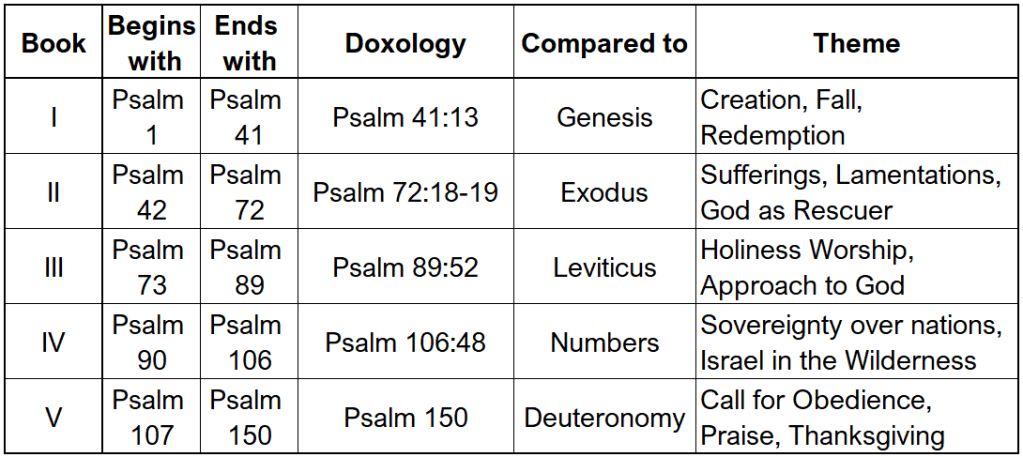
This last few verses contain the doxology of the second book of the Psalms. This idea of the psalms being comprised of “books” was not mentioned before in our studies, but it is an interesting concept to consider.
For my readers interest, I have provided a simple table to describe the concept and for your consideration.
Prior to digging into the doxology, it is good to remember that when David ends this psalm, he refers to it being the end of the prayers of David. So an obvious question I can hear my reader offer is – How can that be, if we find David’s writings in later psalms, such as 86, 101, 103, 108-110, 122, 124, 121, 133, and 138-145. There are a number of possible explanations.
The author may simply be speaking of the end of his prayers in Psalm 72. He may also be referring to the end of a collection of David’s psalms. Psalms added to the book of Psalms may not be in the authors mind at the time of writing.
Nevertheless, David has provided us a Psalm that includes his hopes and prayers for the Solomonic kingdom, and in so doing has given us a Psalm that shows us Jesus Christ as King.
In the final doxology, the author expresses his desire and hope for not only his son, but that the name of the Lord God of Israel be blessed forever, and that the whole earth be filled with His glory.
David knew the end game, for he expressed God’s will perfectly in this last passage, even as Moses and Habakkuk spoke of their desire.
Numbers 14:21 But truly, as I live, and as all the earth shall be filled with the glory of the LORD,
Habakkuk 2:14 For the earth will be filled with the knowledge of the glory of the LORD as the waters cover the sea.
My question for my reader to consider this morning is this.
While David, and the other prophets were expressing this great desire of the saints, would they have understood it included the death of the Son of God to accomplish the will of God?
My friends, we know how serious God is in completing Hios plan for all of creation, for it took the death of His Son to seal the deal. We have this truth, and we have this confidence, that as the Father brought the Son out of the grave, He also will accomplish His will in spreading the glory of God throughout the whole earth.
My wife and I are reading through the Psalms in our evening reading and occasionally a nugget of the Psalms jumps out of the page. Don’t you love it when, after years of reading the “Old Book” passages become alive, reinforcing old teachings or simply warming your heart.
This is the book of Psalms, and it is rich.
I pray I can communicate a portion of the blessing we receive from this wonderful book.
Before we begin this psalm that refers of the true king, pictures the Messiah, and describes the ultimate kingdom, it may be good to mention there is some discussion on the author. Per the ESV, verse 1 seems to speak of this psalm as originating (humanly) from Solomon, David’s son. There is an argument that the psalm was written by David himself (see the last verse) and he wrote it “of Solomon” in his reign, as David looked into the future potential of his son.
Although I am of the opinion David wrote this psalm, no matter how you see this topic, let us delve into this psalm that speaks over and over again of the greater Son of David, the true King of all.
Psalm 72:15 Long may he live; may gold of Sheba be given to him! May prayer be made for him continually, and blessings invoked for him all the day! Psalm 72:16 May there be abundance of grain in the land; on the tops of the mountains may it wave; may its fruit be like Lebanon; and may people blossom in the cities like the grass of the field! Psalm 72:17 May his name endure forever, his fame continue as long as the sun! May people be blessed in him, all nations call him blessed!
This portion of the psalm speaks of the abundance of the Kingdom, prosperity flowing throughout the Kingdom with the focus rightly so on the King Himself. The poor and needy that was previously spoken of in the previous post is under King Jesus, offering up gifts of gold to the King.
I take the subject of these verses to be the King, and specifically King Jesus prophetically. As throughout this psalm, so much is provided to correspond with the Son in His reign that it over shadows the possible immediate intent of David’s desire for His own son Solomon’s earthy reign.
Gold is given to the King, not silver or some inferior metal, but only the finest of materials.
The fields are so heavy with grain, when the wind blows, the grain acts as the cedars of Lebanon, the cedars of Lebanon that were so famous. The agricultural prosperity spoken of here describes the waving action of the grains to not be unlike the wind whipping through the massive cedars of Lebanon. A picture in my mind of oversized grain stalks so large that as they move in the wind, a cracking occurs as with the cedars in their movements.
This picture of prosperity is incredible, but the psalmist goes further. He speak of the waving action of this grain to be on the tops of the mountains. Not the valleys, where all the lush rich earth is, but on the top on mountain tops, where the rain and wind typically erode the good soil and create a barren area. No successful farmer sought out the top of mountains or hills for farming, yet under the King, even the top of hills or mountains brought forth abundance.
And yet when I sat down this morning, my focus was not on the prosperity of the land, great as it is under the King, but on the King Himself, as David describes Him, for he speaks of the King living, or as he starts this portion out as – Long may he live. Let’s take a moment to consider.
Live
Live is the translation of the Hebrew word חָיָהchâyâh, to live or preserve, even quicken recover or retore to life. This term may simply refer to life, to the standard meaning we all accept, but it also was used of the restoration of life. Consider the following passages where we find it being used.
2 Kings 13:21 And as a man was being buried, behold, a marauding band was seen and the man was thrown into the grave of Elisha, and as soon as the man touched the bones of Elisha, he revived and stood on his feet.
Job 14:14 If a man dies, shall he live again? All the days of my service I would wait, till my renewal should come.
Isa 26:14 They are dead, they will not live; they are shades, they will not arise; to that end you have visited them with destruction and wiped out all remembrance of them.
1Kings 17:22 And the LORD listened to the voice of Elijah. And the life of the child came into him again, and he revived.
Ezekiel, as he is questioning the Lord in the famous chapter on dead bones, uses this term multiple times to describe life coming back onto the carcasses he sees.
Even the apostate king of Israel, most likely Jehoram, knew of God’s ability to raise up from the dead.
2 Kings 5:7 And when the king of Israel read the letter, he tore his clothes and said, “Am I God, to kill and to make alive, that this man sends word to me to cure a man of his leprosy? Only consider, and see how he is seeking a quarrel with me.”
Again and again in the Old Testament, this term is used revivification, of quickening, of restoration.
Is David speaking of the resurrection of the King, of the eternal life that He accomplished for mankind at His resurrection? How could a believer not see David’s claim here describing the greatest feat of Jesus, and of his continual “long living of the King”, describing the Kingdom ruled by Him who lives forever!
But there is more. (Man this passage is great!) He not only speaks of the length of the Kings life, but of the Kings continuance. To describe the Kings continuance is not specifically speaking of the length of His reign but more so the manner of the Kingdom’s increase!
Increase
Increase is the translation of the Hebrew word נוּןnûwn, to propagate, or increase. The term is only used once in the Old Testament, and it has the meaning of to propagate by shoots, to multiply, as many plants do by shoots!
The increase of the King’s fame, and of His Kingdom is described as the propagation of His life in the same manner that a plant does through shoots.
Can anyone hear the Lord speaking of this increase in John 15, where we are the branches and He is the Vine. Without Him, we can do nothing. Consider the message the Lord is sharing with His disciples in this. In Him, we propagate out the Kingdom.
John 15:5 I am the vine; you are the branches. Whoever abides in me and I in him, he it is that bears much fruit, for apart from me you can do nothing.
David may be describing in one word a concept the Lord expanded on with His disciples! Though a grain of wheat was buried, the life that exploded out of that burial produced the greatest fruit imaginable. All increase through each believers connection with the King, the natural propagation of life through the shoots finding their life in the root!
John 12:24 Truly, truly, I say to you, unless a grain of wheat falls into the earth and dies, it remains alone; but if it dies, it bears much fruit.
All of the previous actions, the life from the dead and the propagation, or increase of His fame has the fallout of blessing on the people, and that all nations are blessed.
Again, as I have been studying in the Old Testament, I have come to see the many times the nations are included into the plan of God, that from the very beginning, all of creation was to experience the blessing of God.
Here again, the promise of God to Abraham echoes, speaking of the nations being blessed through Abraham.
Genesis 12:3 I will bless those who bless you, and him who dishonors you I will curse, and in you all the families of the earth shall be blessed.”
In Abraham, all the families of the earth will be blessed, and we know that the complete fulfillment of this blessing is found in and only through Abrahams Greatest Son, King Jesus who truly lives forever, escaping the grave and reigning as His Kingdom continually expands, increasing His fame throughout the world.
What a great piece of Scripture! May the Lord increase His fame in each of our lives, so that we reflect it to those we rub shoulders with each and every day.
My wife and I are reading through the Psalms in our evening reading and occasionally a nugget of the Psalms jumps out of the page. Don’t you love it when, after years of reading the “Old Book” passages become alive, reinforcing old teachings or simply warming your heart.
This is the book of Psalms, and it is rich.
I pray I can communicate a portion of the blessing we receive from this wonderful book.
Before we begin this psalm that refers of the true king, pictures the Messiah, and describes the ultimate kingdom, it may be good to mention there is some discussion on the author. Per the ESV, verse 1 seems to speak of this psalm as originating (humanly) from Solomon, David’s son. There is an argument that the psalm was written by David himself (see the last verse) and he wrote it “of Solomon” in his reign, as David looked into the future potential of his son.
Although I am of the opinion David wrote this psalm, no matter how you see this topic, let us delve into this psalm that speaks over and over again of the greater Son of David, the true King of all.
Psalm 72:12 For he delivers the needy when he calls, the poor and him who has no helper. Psalm 72:13 He has pity on the weak and the needy, and saves the lives of the needy. Psalm 72:14 From oppression and violence he redeems their life, and precious is their blood in his sight.
How different the True King is from those who lead nations in this age.
Of course the True King is all powerful, always present, ever faithful and continually offering deliverance and salvation, both in the absolute sense, and in the daily general sense. He is the Savior of our souls, the provider of life and the One who delivers us from ourselves, the world and the accuser!
Yet in this passage, is David speaking of the day to day needs those in the kingdom have, that the King Himself will be the One who is available when they need help? Notice David goes so far as describing the King as responding when the needy calls.
You know, I have sons, and I think they are awesome and powerful, and capable and greater than any other “average” man, but for David to say this about Solomon is more than simple fatherly bias, more than mere hyperbole about the capabilities of Solomon.
As I have postulated throughout this psalm, David is speaking of the True King, the One who has unlimited resources, that has His ear bent to those who call on Him. This King that David describes is not like those who lead in this world, taking our resources only to distribute a pittance back, consuming the resources taken by law and then incapable (or unwilling) to properly respond to the truly needy. The leaders of this world are severely limited in their abilities (and desires) to actually perform the tasks David speak of in this passage.
I speak only of the physical in this regard, and surely David speaks of the needy in a much broader and deeper way. His focus, as believers will agree, is most assuredly not simply the feeding of our bellies, or the defense of a nation.
This King is described as One who takes care of the needy. David uses this term multiple times in this short passage. As a a matter of fact, this term has come up before in verse 4. It seems to be a common refrain, that this King looks to the needy, the poor, the weak, and to them that have no helper.
This begs a question.
Is my relation to the king directly linked to my understanding of my need? If I am constantly telling myself that I can handle a problem, that I have the strength to get through a problem, that I am self sufficient, is that the same as saying the King is not needed, that I am rejecting His authority over my life?
Ok – so that is not just a question, but the topic got away on me! I would humbly suggest that if we seek to know the King better, we would reject any assumption that we are capable on our own to solve our problems.
For heavens sake, we are the problem!
Needy
Let’s spend a moment considering the term “needy”.
To be needy is to be destitute. The Hebrew word is אֶבְיוֹןʼebyôwn, and it describes a beggar, a poor man, one who is destitute. Now where have I heard teaching about being destitute before?
Matthew 5:3 “Blessed are the poor in spirit, for theirs is the kingdom of heaven.
Jesus used the Greek word πτωχόςptōchós, translated as poor, in this verse. It also means destitute, helpless, powerless, to be a pauper, even acting as a cringing beggar. He did not mince words here and sought to make a point of those who would be blessed in His Kingdom.
Thoroughly beggarly, poor, needy souls, who know their condition before the Lord, willing to accept the condition of their souls will be ministered to by the King Himself!
How diametrically opposed to the kingdoms of this world!
Admit your poverty before the True King, and look to the Him, for He is the One who has His ear bent to hear the needy!
My wife and I are reading through the Psalms in our evening reading and occasionally a nugget of the Psalms jumps out of the page. Don’t you love it when, after years of reading the “Old Book” passages become alive, reinforcing old teachings or simply warming your heart.
This is the book of Psalms, and it is rich.
I pray I can communicate a portion of the blessing we receive from this wonderful book.
Before we begin this psalm that refers of the true king, pictures the Messiah, and describes the ultimate kingdom, it may be good to mention there is some discussion on the author. Per the ESV, verse 1 seems to speak of this psalm as originating (humanly) from Solomon, David’s son. There is an argument that the psalm was written by David himself (see the last verse) and he wrote it “of Solomon” in his reign, as David looked into the future potential of his son.
Although I am of the opinion David wrote this psalm, no matter how you see this topic, let us delve into this psalm that speaks over and over again of the greater Son of David, the true King of all.
Psalm 72:8 May he have dominion from sea to sea, and from the River to the ends of the earth! Psalm 72:9 May desert tribes bow down before him, and his enemies lick the dust! Psalm 72:10 May the kings of Tarshish and of the coastlands render him tribute; may the kings of Sheba and Seba bring gifts! Psalm 72:11 May all kings fall down before him, all nations serve him!
As mentioned previously, this psalm may have been intended to describe Solomon’s kingdom as David was in the Spirit, but for goodness sake, even David knew the seeds of destruction were resident in the kingdom he had built under God.
Speaking of sea to sea, David may have meant from the Dead Sea to the Mediterranean Sea. But David had already bequeathed that region to his son Solomon. What pray tell may he have truly anticipated? What else may be implied by this phrase?
I assume this is the very implication we discussed in the previous post on Mark 12. David meant all the seas throughout creation, and that seems obvious with the next phrase he interjects into his plea to God. From the River to the ends of the earth.
It is no coincidence (is it?) that the True King of Israel, the Greater David, used this same terminology when He commissioned His subjects to spread His Kingdom to the ends of the earth.
Acts 1:8 But you will receive power when the Holy Spirit has come upon you, and you will be my witnesses in Jerusalem and in all Judea and Samaria, and to the end of the earth.”
His enemies would lick dust, reminiscent of the words of the curse, and the beginning of the end for the accuser of the brethren. As an enemy would approach a victorious king, they would typically kiss the earth in a show of humility before thier conqueror. Those who approached the True King would not only kiss the earth, they would lick the dust. A true sign of complete domination.
David speaks of His Son as the One whom all would fall before, even those distant from the promised land, no matter their standing, even kings of other nations. To mention Sheba and Seba, Tarshish and the isles, represented some of the farthest countries from Israel, and this implied total dominion over the known world.
All nations shall serve Him. This is the truth, for the Resurrected One is reigning even now, and though not all have bowed the knee, it is only the patience and loving kindness of God that is providing time for repentance to erupt, for each one to realize the truth of the Person of Jesus.
He is the King. It is best we acknowledge this truth, love the King and serve Him with our heart mind and soul.
May He be praised in all our lives, and throughout His everlasting reign!
My wife and I are reading through the Psalms in our evening reading and occasionally a nugget of the Psalms jumps out of the page. Don’t you love it when, after years of reading the “Old Book” passages become alive, reinforcing old teachings or simply warming your heart.
This is the book of Psalms, and it is rich.
I pray I can communicate a portion of the blessing we receive from this wonderful book.
Before we begin this psalm that refers of the true king, pictures the Messiah, and describes the ultimate kingdom, it may be good to mention there is some discussion on the author. Per the ESV, verse 1 seems to speak of this psalm as originating (humanly) from Solomon, David’s son. There is an argument that the psalm was written by David himself (see the last verse) and he wrote it “of Solomon” in his reign, as David looked into the future potential of his son.
Although I am of the opinion David wrote this psalm, no matter how you see this topic, let us delve into this psalm that speaks over and over again of the greater Son of David, the true King of all.
Psalm 72:5 May they fear you while the sun endures, and as long as the moon, throughout all generations! Psalm 72:6 May he be like rain that falls on the mown grass, like showers that water the earth! Psalm 72:7 In his days may the righteous flourish, and peace abound, till the moon be no more!
In our last post on Psalm 72, we found that David was speaking of righteousness as the basis of the Kingdom.
Even as I remind my reader that, I can hear a “little voice” arguing with me. But Carl, is not the Kingdom to be based on love. Does Paul not mention love as the overarching guiding principle of the kingdom?
1 Corinthians 13:13 So now faith, hope, and love abide, these three; but the greatest of these is love.
Yes he does, and the question is valid, little voice. So how does righteousness and love relate in the believers life.
As mentioned previously, righteousness is the acting out of all of God’s characteristics without the diminishing of any. It is unlike that of the worlds righteousness, such that it favors no person. Righteousness in my little world often favors my interests, my desires, my wants and delegates the needs, or even rights of others to a lower standard of consideration in the outcome of righteous judgements. This is the worlds righteousness.
To practice righteousness is to know all the facts of a situation, understand the actions taken by all, discern motivations, and execute judgement, all without departing or diminishing the character of God. To practice righteousness is to not favor one characteristic over another, like favoring mercy over holiness in the decisions made.
For our verses this morning, we shall consider the eternal fear of God’s righteousness, the universality of God’s righteousness, and the peace and prosperity of God’s righteousness.
Eternal Fear
Note in verse 5, as David hopes for the fear of the king to endure while the sun endures and as long as the moon is in the sky, he is looking for a kingdom to provide a continuous “fear of the King” for it’s people.
In God’s Kingdom, there is rightly to be described the element of fear, whether you are experiencing deep respect for the King due to His greatness, or a dreaded fearful expectation due to foolish actions. Fear is a valid and correct response to God’s righteousness being exercised in the Kingdom.
Consider though that David’s description of this Kingdom is ultimately referring to the reign of the Son. His reign is forever and ever through the resurrection from the dead, and the Father’s setting of Him on His holy hill.
Note the direct link between the raising of Jesus in Acts with the passage in Psalm 2. To be begotten refers to the resurrection in verse 2 per the apostles teaching!
Acts 13:32 And we bring you the good news that what God promised to the fathers, Acts 13:33 this he has fulfilled to us their children by raising Jesus, as also it is written in the second Psalm, “‘You are my Son, today I have begotten you.’
Psalm 2:6 “As for me, I have set my King on Zion, my holy hill.” Psalm 2:7 I will tell of the decree: The LORD said to me, “You are my Son; today I have begotten you.
From that day forward the Kingdom exhibited the righteousness of God to all, and the King was set on His throne for all eternity. May all fear the True King of all creation, for godly fear is a natural outgrowth of knowing the King, and following after Him.
Universality
Since the King has be enthroned, the truth of God’s universality in the Kingdom has been exhibited. Now be careful for I have not said the universality of the kingdom began with the appearance of the Son, for we see evidence of God’s working outside of His people often prior to the gospels. But it seemed rare, indicating glimpses of favor to those “outside” for those who were in the chosen people.
Not so as the Messiah appeared. God’s universality, His desire for all to know Him, was one of the most offensive aspects of the Son’s ministry, for He often spoke of those outside as being accepted!
David expresses the universality of God’s righteous kingdom through the picture of rain falling on the earth. Consider the inescapable nature of a rain shower. Every inch of the fields are impacted by the falling rain, and for the one who is caught in the rain, shelter is the only escape. Rain is often considered a universal blessing to those who receive it, and the withholding to be the sign of God’s displeasure.
Yet it is more than simply indicating the pleasure/displeasure of the Lord, for did not the Lord speak of rain as being sent to the just and the unjust?
Matthew 5:45 so that you may be sons of your Father who is in heaven. For he makes his sun rise on the evil and on the good, and sends rain on the just and on the unjust.
For the kingdom to be described as rain falling speaks of the blessing of God on the Kingdom, and of the universality of the gospel invite. Those outside of the Kingdom may and do experience the blessing of God, providing a motivation to enter the Kingdom, and to know the King the One who blesses!
To think of the King favoring those outside of the Kingdom in order to expand His Kingdom is just the type of King we worship. He sees no distinction between any people groups, for we are all needy, broken, blind and crippled up.
Romans 3:22 the righteousness of God through faith in Jesus Christ for all who believe. For there is no distinction:
Romans 10:12 For there is no distinction between Jew and Greek; for the same Lord is Lord of all, bestowing his riches on all who call on him.
His love is universal for a lost people!
peace and prosperity
In David’s Kingdom being described, he is speaking of a kingdom that does not principally consider the ones in power, those who by association with the powerful may have gained power or authority to be experiencing peace and prosperity. It is the righteous, those determined by their actions and not associations are those who experience the benefits of the Kingdom, namely peace and prosperity in this passage.
Notice that David speaks of flourishing as being associated with righteousness, and not necessarily as we often see is this worlds kingdom. This worlds kingdom provides flourishing depending on personal association with those in power. This is absent in God’s Kingdom, at least in relation to varying degrees of flourishing.
It is obvious that to be in the Kingdom requires the righteous ones to be related to the Ultimate authority, that is King Jesus. This is the assumption within this discussion! Beyond that, earthly associations pay no dividends, and may hurt the righteous in that our dedication to the King may be weakened.
Nevertheless, it is instructive to note that this world’s authority structure is rejected in the Kingdom of God.
Luke 22:25 And he said to them, “The kings of the Gentiles exercise lordship over them, and those in authority over them are called benefactors. Luke 22:26 But not so with you. Rather, let the greatest among you become as the youngest, and the leader as one who serves.
Let’s remember Jesus spoke this truth to the disciples due to the turmoil their ego’s were creating within themselves and the group! No prosperity, no peace! Simply self promotion was being exercised in the group, and for peace and prosperity to be realized, self promotion was to be rejected in the Kingdom .
One caveat in relation to the the peace and prosperity I am seeking to describe. Let us not think the teaching of prosperity in the Word refers strictly to worldly wealth, to riches and dollars, bricks of silver or vaults of possessions. This is a beggarly way of understanding prosperity as found in the Word.
Prosperity speaks of abundance, of greatness, of a life blessed. There is much more to life than the acquisition of possessions. Paul provides corrective teaching to the modern outbreak of greed being glorified in the church, by speaking of the uncertainty of seeking riches, and directs us to seeking God, who provides us “with everything to enjoy”.
1 Timothy 6:17 As for the rich in this present age, charge them not to be haughty, nor to set their hopes on the uncertainty of riches, but on God, who richly provides us with everything to enjoy.
David links this prosperity, this abundance with peace in this verse. Might he be speaking of a prosperity that is linked, or that is associated with inner and outer peace that can be found in the Messiah’s Kingdom?
Return to my question
In all of this discussion it is important to understand that there has to be another element brought into any circumstance, that will allow God’s righteousness to be exercised. I referred to love at the beginning of this post as the guiding overarching principle of the Kingdom, and then proceeded to describe righteousness as the foundational character of the Kingdom.
It is the expression of love, of a self sacrificing love that is the act that provides for the experience of righteousness, God’s righteousness in the believers life.
His self sacrifice opened the doors to the Kingdom for each of us. Without His sacrifice, the holiness of God could not allow His mercy and grace to be provided to such a group of sinners as we.
Even on a daily basis, to be of the self sacrificial mindset, to think of others more highly than ourselves, is to be of the correct mindset.
Philippians 2:3 Do nothing from selfish ambition or conceit, but in humility count others more significant than yourselves.
David’s kingdom described in these three verses provided me an opportunity to translate my thoughts to the reader in a very open way. I look forward to comments, and would appreciate your input.
In all of our studies, and in day to day our lives, may we see Jesus just a bit clearer, and understand that which we are granted to comprehend.
Ephesians 3:18 – 19 may have strength to comprehend with all the saints what is the breadth and length and height and depth, and to know the love of Christ that surpasses knowledge, that you may be filled with all the fullness of God.
My wife and I are reading through the Psalms in our evening reading and occasionally a nugget of the Psalms jumps out of the page. Don’t you love it when, after years of reading the “Old Book” passages become alive, reinforcing old teachings or simply warming your heart.
This is the book of Psalms, and it is rich.
I pray I can communicate a portion of the blessing we receive from this wonderful book.
Before we begin this psalm that refers of the true king, pictures the Messiah, and describes the ultimate kingdom, it may be good to mention there is some discussion on the author. Per the ESV, verse 1 seems to speak of this psalm as originating (humanly) from Solomon, David’s son. There is an argument that the psalm was written by David himself (see the last verse) and he wrote it “of Solomon” in his reign, as David looked into the future potential of his son.
Although I am of the opinion David wrote this psalm, no matter how you see this topic, let us delve into this psalm that speaks over and over again of the greater Son of David, the true King of all.
Psalm 72:1 Of Solomon. Give the king your justice, O God, and your righteousness to the royal son! Psalm 72:2 May he judge your people with righteousness, and your poor with justice! Psalm 72:3 Let the mountains bear prosperity for the people, and the hills, in righteousness! Psalm 72:4 May he defend the cause of the poor of the people, give deliverance to the children of the needy, and crush the oppressor!
David opens this psalm with one overarching topic, a topic that is of top priority in any government. This topic, if found in the government will provide the foundation for a lasting kingdom, providing security and prosperity to the people.
The topic is righteousness, and David uses multiple terms to describe this characteristic of the kingdom he foresees
72:1 – 0 Give the king your justice
justice (מִשְׁפָּט mishpâṭ, H4941) This term speaks of the act of judging, an action that rightly belongs to God Himself, who can judge properly and correctly at all times, for He alone is able to know all things affecting the decision, and to weigh the intangible aspects of the act (motivations and intent) being judged. David knows of the challenge this is for the King, and understands the critical need for God to provide!
72:1 – righteousness to the royal son
righteousness (צְדָקָה tsᵉdâqâh, H6666) Can you see the root of one of God’s name in this Hebrew word? JEHOVAH TSIDKENU In that earlier post we spoke of how there may be two righteousness’s in a culture or kingdom, one based on lies and violence and one based on peace and love. Of course, we live in a world where the claim of righteousness is based on lies and violence, but for David, he sought that righteousness that was not logical, not common, not familiar, but of God.
David is asking that the royal son be different than those kingdoms that surround him, that the son would listen to God for instruction in righteousness and not the neighbor kingdoms. And that God would grant him this righteousness!
72:2 – May he judge your people
judge (דִּין dîyn, H1777). This Hebrew word speaks of contending, or of pleading a cause. Might David be hinting to the act of directing the people, or a singular person, prior a decision to be made? Of course as a human king, David must be considering this for Solomon in relation to his inner court, for how could he anticipate all the judgements of his people.
And yet, this may be observed in Solomons judgement to cut the baby in half to bring to the truth the identity of the living child. In his “harsh” judgement, he plead the emotions of the true mother, and found the truth!
72:2 – he judge your people with righteousness,
righteousness (צֶדֶק tsedeq, H6664) This term is of the same root word as in verse 1, and as is obvious, connected with the description of God as righteousness.
72:2 – poor with justice!
righteousness (מִשְׁפָּט mishpâṭ). David speaks the same term here as in verse 1. He reiterates the need of the King to have God provide the correct understanding of each act needing a decision from the king, and produce the desired effect on the kingdom.
Note that he associates the poor (or afflicted) with the kings declaration of justice. It is too often the poor’s only defense against the powerful that the judgement of the government can be called upon. Thus the emphasis on the poor, for the powerful take whatever they want!
72:3 mountains bear prosperity … in righteousness!
Any government worth it’s salt is to provide a condition within the kingdom that provides the ability of it’s subjects to prosper. The environment needed for any within the kingdom to prosper is
72:4 May he defend the cause of the poor
Defend (שָׁפַט shâphaṭ, H8199). David continues his cry for the king to exercise righteousness, in the act of defending the afflicted. He has referred to the connection between righteousness and the poor in verse 2, and speaks again of the responsibility to judge rightly, or to govern in righteousness for the sake of the powerless, the poor and afflicted.
Some passages translate this term as “vindicate”. Is David speaking of not only a defensive position, but a proactive attitude, of not merely rescuing the afflicted, but fighting for them in righteousness? That seems obvious in theory, but David seeks it to be in practice for his royal son.
Consider
In all of this discussion on righteousness, David is setting the stage for the establishment of a kingdom that will endure.
Although we are directed to think of this psalm as being “of Solomon”, or describing the hopes David has for his direct son, in reality, this psalm speaks to the Son of David, the Messiah. Throughout this psalm David speaks of this king’s reign “to the ends of the earth”, that his name “enduring forever”, that “all kings fall down before him”, that his fame “continue as long as the sun” and that “all nations serve him”.
As we venture through this psalm, we will continually bump into statements that bring the Lord Jesus to mind, of the kingdom Jesus will (has) established.
For our passage this morning, note the basis upon Jesus’ governance will be established. He is the Righteous King, and has been granted this right not only through the fact He is God, but that He has suffered and bled for us, leading His kingdom through love, peace and self sacrifice.
My wife and I are reading through the Psalms in our evening reading and occasionally a nugget of the Psalms jumps out of the page. Don’t you love it when, after years of reading the “Old Book” passages become alive, reinforcing old teachings or simply warming your heart.
This is the book of Psalms, and it is rich.
I pray I can communicate a portion of the blessing we receive from this wonderful book.
Before we begin this psalm that refers of the true king, pictures the Messiah, and describes the ultimate kingdom, it may be good to mention there is some discussion on the author. Per the ESV, verse 1 seems to speak of this psalm as originating (humanly) from Solomon, David’s son. There is an argument that the psalm was written by David himself (see the last verse) and he wrote it “of Solomon” in his reign, as David looked into the future potential of his son.
Although I am of the opinion David wrote this psalm, no matter how you see this topic, let us delve into this psalm that speaks over and over again of the greater Son of David, the true King of all.
Psalm 72:1 Of Solomon. Give the king your justice, O God, and your righteousness to the royal son! Psalm 72:2 May he judge your people with righteousness, and your poor with justice! Psalm 72:3 Let the mountains bear prosperity for the people, and the hills, in righteousness! Psalm 72:4 May he defend the cause of the poor of the people, give deliverance to the children of the needy, and crush the oppressor!
David opens this psalm with one overarching topic, a topic that is of top priority in any government. This topic, if found in the government will provide the foundation for a lasting kingdom, providing security and prosperity to the people.
That topic is righteousness, and David uses multiple terms to describe this characteristic of the kingdom he foresees.
72:1 – 0 Give the king your justice
justice (מִשְׁפָּט mishpâṭ, H4941) This term speaks of the act of judging, an action that rightly belongs to God Himself, who can judge properly and correctly at all times, for He alone is able to know all things affecting the decision, and to weigh the intangible aspects of the act (motivations and intent) being judged. David knows of the challenge this is for the King, and understands the critical need for God to provide!
72:1 – righteousness to the royal son
righteousness (צְדָקָה tsᵉdâqâh, H6666) Can you see the root of one of God’s name in this Hebrew word? JEHOVAH TSIDKENU In that earlier post we spoke of how there may be two righteousness’s in a culture or kingdom, one based on lies and violence and one based on peace and love. Of course, we live in a world where the claim of righteousness is based on lies and violence, but for David, he sought that righteousness that was not logical, not common, not familiar, but of God.
David is asking that the royal son be different than those kingdoms that surround him, that the son would listen to God for instruction in righteousness and not the neighbor kingdoms. And that God would grant him this righteousness!
72:2 – May he judge your people
judge (דִּין dîyn, H1777). This Hebrew word speaks of contending, or of pleading a cause. Might David be hinting to the act of directing the people, or a singular person, prior a decision to be made? Of course as a human king, David must be considering this for Solomon in relation to his inner court, for how could he anticipate all the judgements of his people.
And yet, this may be observed in Solomons judgement to cut the baby in half to bring to the truth the identity of the living child. In his “harsh” judgement, he plead the emotions of the true mother, and found the truth!
72:2 – he judge your people with righteousness,
righteousness (צֶדֶק tsedeq, H6664) This term is of the same root word as in verse 1, and as is obvious, connected with the description of God as righteousness.
72:2 – poor with justice!
righteousness (מִשְׁפָּט mishpâṭ). David speaks the same term here as in verse 1. He reiterates the need of the King to have God provide the correct understanding of each act needing a decision from the king, and produce the desired effect on the kingdom.
Note that he associates the poor (or afflicted) with the kings declaration of justice. It is too often the poor’s only defense against the powerful that the judgement of the government can be called upon. Thus the emphasis on the poor, for the powerful take whatever they want!
72:3 mountains bear prosperity … in righteousness!
Any government worth it’s salt is to provide a condition within the kingdom that provides the ability of it’s subjects to prosper. The environment needed for any within the kingdom to prosper is
72:4 May he defend the cause of the poor
Defend (שָׁפַט shâphaṭ, H8199). David continues his cry for the king to exercise righteousness, in the act of defending the afflicted. He has referred to the connection between righteousness and the poor in verse 2, and speaks again of the responsibility to judge rightly, or to govern in righteousness for the sake of the powerless, the poor and afflicted.
Some passages translate this term as “vindicate”. Is David speaking of not only a defensive position, but a proactive attitude, of not merely rescuing the afflicted, but fighting for them in righteousness? That seems obvious in theory, but David seeks it to be in practice for his royal son.
Consider
In all of this discussion on righteousness, David is setting the stage for the establishment of a kingdom that will endure.
Although we are directed to think of this psalm as being “of Solomon”, or describing the hopes David has for his direct son, in reality, this psalm speaks to the Son of David, the Messiah. Throughout this psalm David speaks of this king’s reign “to the ends of the earth”, that his name “enduring forever”, that “all kings fall down before him”, that his fame “continue as long as the sun” and that “all nations serve him”.
As we venture through this psalm, we will continually bump into statements that bring the Lord Jesus to mind, of the kingdom Jesus will (has) established.
For our passage this morning, note the basis upon Jesus governance will be established. He is the Righteous King, and has been granted this right not only through the fact He is God, but that He has suffered and bled for us, leading His kingdom through love, peace and self sacrifice.
My wife and I are reading through the Psalms in our evening reading and occasionally a nugget of the Psalms jumps out of the page. Don’t you love it when, after years of reading the “Old Book” passages become alive, reinforcing old teachings or simply warming your heart.
This is the book of Psalms, and it is rich.
I pray I can communicate a portion of the blessing we receive from this wonderful book.
Psalm 71 is a psalm written by an aged saint, a man who had walked with the Lord through many trials and triumphs. Some think this psalm represents David’s thoughts as he approaches the grave, as he ages and finds his life coming to a close.
One thing that is obvious in this psalm, that whoever wrote this psalm had an intimate experience with the Word of God. I have heard the claim that in the 24 verses of this psalm, there are up to 25 references, allusions and hints of other psalms within this reflection of an old saint. He has saturated his life with the Word, to the point that even phrasing of the old book comes through this old man’s message.
It is truly a witness of the wise to engage in an early and consistent immersion into the Word of God for every saint.
Let’s take a moment to consider
Psalm 71:22 I will also praise you with the harp for your faithfulness, O my God; I will sing praises to you with the lyre, O Holy One of Israel. Psalm 71:23 My lips will shout for joy, when I sing praises to you; my soul also, which you have redeemed. Psalm 71:24 And my tongue will talk of your righteous help all the day long, for they have been put to shame and disappointed who sought to do me hurt.
In our last post, we reviewed the hope of this ol’ saint, the hope of resurrection, of being raised from the depths of the earth. In verse 23, he continues describing the works of God in his soul’s redemption.
God is elevated in His many works by this ol’ saint and not in the simple ways, but in resurrection and redemption. He speaks of God’s “righteous help all the day long”, and in that, it show’s the ol’ saint is watching for the work of God, that he expects and looks for the work of God in his life. He seeks the help, anticipates the help, observes the help and is thankful for the help.
As a matter of fact, the emphasis in this verse is on the righteousness of the help, specifically in this case of the shame and disappointment falling on his adversaries, who wanted to hurt the ol’ saint.
It is good to recognize the help of God as He works righteous acts in and through our lives.
But there is a concern I sometimes trip over as I seek to thank Him for all things. There have been too many times I have praised the Lord for something that favors my lot, yet may not exactly be righteous. Yes we are to give thanks in all circumstances, as 1 Thessalonians directs us.
1 Thessalonians 5:18 give thanks in all circumstances; for this is the will of God in Christ Jesus for you.
You see there is a difference between thanking Him for all things, and thanking Him in all circumstances.
Some things that occur in the believers life may be terrible, and may cause much heartache, disappointment and even despair. These things may even be the righteous acts of our loving Father, and in the pain, the believer may have to submit, but to be thankful for the pain is a difficult concept for me to understand. Yet as 1 Thessalonians speaks, it doesn’t address the believer to be thankful for the pain, but that in the circumstances, God is in the middle of it, and that is the focus of the thanks. It is looking to the source of the circumstance, the hand of God, and not the result of the righteous act, which may be causing great pain.
It is to look to the Savior, to be thankful He is with us, that though we may find pain and trial, to know that the hand of God is with us, that He has led the way and been faithful, that is what we can give thanks for.
This ol’ saint was thankful for the righteous acts of God in his life, and the way God rescued him from his very enemies. He is a saving God, a God who may bring struggles, but as we come to know Him as the loving God He has proven Himself to be, we can go through the trial with a thankful heart.
My wife and I are reading through the Psalms in our evening reading and occasionally a nugget of the Psalms jumps out of the page. Don’t you love it when, after years of reading the “Old Book” passages become alive, reinforcing old teachings or simply warming your heart.
This is the book of Psalms, and it is rich.
I pray I can communicate a portion of the blessing we receive from this wonderful book.
Psalm 71 is a psalm written by an aged saint, a man who had walked with the Lord through many trials and triumphs. Some think this psalm represents David’s thoughts as he approaches the grave, as he ages and finds his life coming to a close.
One thing that is obvious in this psalm, that whoever wrote this psalm had an intimate experience with the Word of God. I have heard the claim that in the 24 verses of this psalm, there are up to 25 references, allusions and hints of other psalms within this reflection of an old saint. He has saturated his life with the Word, to the point that even phrasing of the old book comes through this old man’s message.
It is truly a witness of the wisdom to engage in an early and consistent immersion into the Word of God for every saint.
Let’s take a moment to consider
Psalm 71:17 O God, from my youth you have taught me, and I still proclaim your wondrous deeds. Psalm 71:18 So even to old age and gray hairs, O God, do not forsake me, until I proclaim your might to another generation, your power to all those to come. Psalm 71:19 Your righteousness, O God, reaches the high heavens. You who have done great things, O God, who is like you? Psalm 71:20 You who have made me see many troubles and calamities will revive me again; from the depths of the earth you will bring me up again. Psalm 71:21 You will increase my greatness and comfort me again.
This old man, this old saint who has known God, even from the womb somehow, who leaned on the Lord from before birth, speaks of the teaching work of God in his life. Out of this teaching ministry, the result for this ol’ saint was that he proclaimed the wondrous deeds of God.
He did not proclaim the wondrous works of God out of a vacuum, but had been taught, trained, led by God through many experiences, many trials, many troubles and calamities (vs 20). Given this experience of the leading of God, this ol’ saint does not presume upon his history, but is reaching out to God, seeking that God would continue teaching, that God would not forsake him in his old age.
What a tremendous spirit this ol’ saint had, that he still had a deep resolve to follow, tinged with the fear of God, not assuming but continuing to seek God in his last days.
One additional impression I have of this ol’ saint is that he doesn’t whitewash his pilgrimage with God, but admits that God made him experience trials and troubles.
Did I say one additional impression? Get a load of vs 20. Is that saying what I think it is saying?
Psalm 71:20 You who have made me see many troubles and calamities will revive me again; from the depths of the earth you will bring me up again.
Yes, the ol’ saint has seem his many troubles and calamities, directly from the hand of God, but in this statement, he speaks of reviving, even bringing him up from the depths of the earth.
Now I have been told by some very respectful Bible teachers that the Old Testament does not speak directly of a resurrection for the faithful very often. One passage that stands out is Daniel 12:2.
And many of those who sleep in the dust of the earth shall awake, some to everlasting life, and some to shame and everlasting contempt.
Granted, there are a number of passages that refer to, point to, imply of, and hint at the bodily resurrection of the faithful, but many are pictures of this truth, as in the Shunammite’s child, being resuscitated from death, only to eventually face death later on! 2 Kings 4:18–20, 32–37
Some are super clear, as in Job 19:25–27, and consider verse 26
And after my skin has been thus destroyed, yet in my flesh I shall see God
Additional passages in the Old Testament that provide the hope of resurrection in various ways may be found at the end of this posting for those interested.
For our passage today, in verse 20, this ol’ saint provided a declaration of resurrection that is as clear as any in the Old Testament. As the Lord was dwelling on the Word, how this short passage must have impacted Him, speaking of the faithfulness of God to this ol’ saint, and the hope of resurrection for him in his last days. Jesus would soon enough face his last days, though as a much younger man, but the hope of resurrection was on His mind and in His heart, fanned by the promise of God to His saints!
Might Paul have had in mind this passage as he wrote to the Ephesians of the resurrection “process” of the Lord Himself?
Ephesians 4:9 ….He ascended,” what does it mean but that he had also descended into the lower regions, the earth?
He may have, especially in speaking of the lower regions, the earth, and that the psalmist spoke of the depths of the earth.
As believers age, and have followed after the Lord during our pilgrimage, we can take the place of this ol’ saint, finding confidence in the faithfulness of God, even of the resurrection, for our God is the only God that has proven Himself to crush death under His heal!
My wife and I are reading through the Psalms in our evening reading and occasionally a nugget of the Psalms jumps out of the page. Don’t you love it when, after years of reading the “Old Book” passages become alive, reinforcing old teachings or simply warming your heart.
This is the book of Psalms, and it is rich.
I pray I can communicate a portion of the blessing we receive from this wonderful book.
Psalm 71 is a psalm written by an aged saint, a man who had walked with the Lord through many trials and triumphs. Some think this psalm represents David’s thoughts as he approaches the grave, as he ages and finds his life coming to a close.
One thing that is obvious in this psalm, that whoever wrote this psalm had an intimate experience with the Word of God. I have heard the claim that in the 24 verses of this psalm, there are up to 25 references, allusions and hints of other psalms within this reflection of an old saint. He has saturated his life with the Word, to the point that even phrasing of the old book comes through this old man’s message.
It is truly a witness of the wisdom to engage in an early and consistent immersion into the Word of God for every saint.
Let’s take a moment to consider
Psalm 71:14 But I will hope continually and will praise you yet more and more. Psalm 71:15 My mouth will tell of your righteous acts, of your deeds of salvation all the day, for their number is past my knowledge. Psalm 71:16 With the mighty deeds of the Lord GOD I will come; I will remind them of your righteousness, yours alone.
Remember our psalmist is in the midst of a battle that is possibly going to consume him, take his life and snuff him out! Was it not just a few verses previously, that he spoke of his enemies consulting to take his life?
Psalm 71:10-11 For my enemies speak concerning me; those who watch for my life consult together and say, “God has forsaken him; pursue and seize him, for there is none to deliver him.”
I bring this to our memory, for he begins this portion with hope and praise. He has not won some lottery, or received a promotion at work, but is experiencing a life changing, life altering, possibly life ending event in this passage, yet has the eye of faith that will hope and praise God.
He has a history with God, and is entering his last days, but though weakened, he has a history with God, knowing that God is a faithful and loving God. With this history and the knowledge of the faithfulness of God in his life, he has the strength of spirit to raise up praise in the midst to trial, to hope in a seemingly hopeless situation!
And he isn’t shallow in his experience with God, for he speaks of “talking up” God all day long! He has a deep well of experiences to draw from, of a life where God showed up on a consistent basis, providing a deliverance for the saint, whether small or great, exhibiting His faithfulness.
But let me settle on verse 16, for that is a verse that speaks of the Lord Jesus.
16 With the mighty deeds of the Lord GOD I will come; I will remind them of your righteousness, yours alone.
Did He not come to rescue us?
Did He not come with the mighty deeds of the Lord GOD? So many miracles! So many chances for the soul to admit He is the One!
Did not the Lord Jesus declare the righteousness of the God of Israel, the God of the fathers, the eternal God?
Did not the Lord Jesus remind us of the “onlyness” of God’s righteousness? Granted, I don’t think “onlyness” is a proper word, but hopefully you get my intent. Jesus spoke of God’s righteousness alone, and not of any others, but God’s alone! He minced no words in declaring that God alone is truly righteous, and that all others are not!
He spoke the truth for us, and though it is difficult to hear, His words are a balm for the weary soul, even as we submit to the truth that only God is righteous, and that we are not.
Jesus came with mighty miracles, reminding us of such a righteous God and our need for Him.
And He provided us the way, the truth and the life!
My wife and I are reading through the Psalms in our evening reading and occasionally a nugget of the Psalms jumps out of the page. Don’t you love it when, after years of reading the “Old Book” passages become alive, reinforcing old teachings or simply warming your heart.
This is the book of Psalms, and it is rich.
I pray I can communicate a portion of the blessing we receive from this wonderful book.
Psalm 71 is a psalm written by an aged saint, a man who had walked with the Lord through many trials and triumphs. Some think this psalm represents David’s thoughts as he approaches the grave, as he ages and finds his life coming to a close.
One thing that is obvious in this psalm, that whoever wrote this psalm had an intimate experience with the Word of God. I have heard the claim that in the 24 verses of this psalm, there are up to 25 references, allusions and hints of other psalms within this reflection of an old saint. He has saturated his life with the Word, to the point that even phrasing of the old book comes through this old man’s message.
It is truly a witness of the wisdom to engage in an early and consistent immersion into the Word of God for every saint.
Let’s take a moment to consider
Psalm 71:12 O God, be not far from me; O my God, make haste to help me! Psalm 71:13 May my accusers be put to shame and consumed; with scorn and disgrace may they be covered who seek my hurt.
The psalmist has revealed his enemies thoughts in the previous verses, speaking of how God had forsaken him, and that this was the perfect opportunity to strike.
Psalm 71:11 and say, “God has forsaken him; pursue and seize him, for there is none to deliver him.”
Remember, this psalmist is a man who is aged, with grey hair and strength that was fading, as with all men who age. If this was David, he was a mighty warrior, and in his old age, had lost capabilities to defend as before. His mental and physical energy, stamina and strength has decreased, and for a warrior, this strikes at the heart of who he was.
With his weakening, and the constant trials he had went through, remaining faithful to God, it appears to be a perfect opportunity for his enemies to strike. After all, those outside of faith do not understand that the trial we as believers go through is a proof of God’s commitment to us, no a denial of His loving concern.
Hebrews 12:6 – 7
For the Lord disciplines the one he loves, and chastises every son whom he receives.” It is for discipline that you have to endure. God is treating you as sons. For what son is there whom his father does not discipline?
Truly, those of the world do not understand the life of a believer.
1 Corinthians 2:14 The natural person does not accept the things of the Spirit of God, for they are folly to him, and he is not able to understand them because they are spiritually discerned.
Nevertheless, as the psalmist ages, and his enemies are emboldened, he cries out to God. He cries out to God, and you can almost hear his voice cracking as he begs for God to be near, and then again, but with even greater passion, owning the God he has followed all his life. O my God, make haste to help me!
The psalmist has less strength, the enemies have greater confidence, and who does this aged man of faith turn to? The One he has followed since his birth, the God who has led him through many trials.
I imagine this man to be without resource, without strength, without defense and without support. At the very least he has judged his situation to be dire and immediate. He cries out to his God for immediate help, that God would make haste!
It is true that the more immediate the need, the greater passion I have expressed to the God who is timeless. When I have plenty of time, and things are not crushing down on me, I tend to be somewhat lassiez-faire, somewhat indifferent, but let the pressure build, and then the passion erupts. Often times, in those times of crushing, God has provided his answer and provision, his wisdom and thankfully His peace. Rarely though, when my self imposed deadline for deliverance comes and goes, the Lord is in the midst of it, allowing for a period of instruction, or a realignment of my priorities.
But back to our couple verses!
Our aged man is looking for some answers to his prayers, that his śāṭan (for that is the transliteration of accusers in our verse) would experience shame.
This is a tantamount harm to inflict on an enemy, for our psalmist lived in a shame based society, a culture that defined success and failure though the estimation of a mans honor. Wealth and family were important, but nothing came close to the need for honor in a man’s life. It was the paramount goal of a man to gain honor, in the midst of all other goals.
Note also that this aged saint is praying against the śāṭan of his soul. A few of the more literal word for word translations include this idea.
Psalm 71:13 (NASB) May those who are enemies of my soul be putto shame and consumed;
Psalm 71:13 (ASV) They are ashamed, they are consumed, Who are opposing my soul, They are covered with reproach and blushing, Who are seeking my evil,
He is concerned about the only thing in this world that will last beyond the grave, for he sees this trial coming and understands the situation as an attack on his soul, not as the theft or loss of his wealth, or possibly even the harming of his family, but an attack on his very person. This is, in his cry to God, a critical fight, a fight that will cost him his own soul if he looses it.
Understanding what is at stake, he looks to God, crying out that his adversaries (śāṭan) would be covered with reproach and dishonor. Note that the honor of his enemies is the psalmist’s focus, for this is what is at stake, the highest estimation of a man’s social standing, and this is our psalmist’s desire, that the adversaries fall into disgrace.
And what is worse, (or better, depending on your point of view) is that when he seeks them to be covered, he is speaking of their very plans to backfire on them. To be covered in this verse, is to wrap oneself up, to enwrap. A self inflicted harm. Some act or plan that not only avoids harming the psalmist but falls on the protagonist, the adversary essentially falling into his own trap.
How often we see this in the Word, where the saint stands back, and the very trap the antagonist lays for the saint is the very trap the antagonist suffers. Without a doubt, I think of Esther and Haman as an example of this principle. How utterly satisfying, to not take revenge, and yet see justice!
How critical it is for us as believers that we find our strong refuge in God Himself and not our own strength, our own cunning, our own abilities. In a very real and personal way, as I am entering my sunset years, I need to view this weakening, this loss of ability as one of God’s intended gifts to a receptive believer. May it be so!
I had also hoped, as I aged, that my adversaries may also weaken with me. If this psalm has wakened me to a specific truth, it may be that according to the wisdom of God, my adversaries may not lessen. They may increase in confidence over me, increase in ability compared to my strengths. They may see weakness, well and true, yet I have a strong tower to resort to.
May we all, as we travel through our last years, though we be 18 or 80, have the clarity of mind and desire of heart to cling to the One who gave it all for us.
My wife and I are reading through the Psalms in our evening reading and occasionally a nugget of the Psalms jumps out of the page. Don’t you love it when, after years of reading the “Old Book” passages become alive, reinforcing old teachings or simply warming your heart.
This is the book of Psalms, and it is rich.
I pray I can communicate a portion of the blessing we receive from this wonderful book.
Psalm 71 is a psalm written by an aged saint, a man who had walked with the Lord through many trials and triumphs. Some think this psalm represents David’s thoughts as he approaches the grave, as he ages and finds his life coming to a close.
One thing that is obvious in this psalm, that whoever wrote this psalm had an intimate experience with the Word of God. I have heard the claim that in the 24 verses of this psalm, there are up to 25 references, allusions and hints of other psalms within this reflection of an old saint. He has saturated his life with the Word, to the point that even phrasing of the old book comes through this old man’s message.
It is truly a witness of the wisdom to engage in an early and consistent immersion into the Word of God for every saint.
Let’s take a moment to consider
Psalm 71:7 I have been as a portent to many, but you are my strong refuge. Psalm 71:8 My mouth is filled with your praise, and with your glory all the day. Psalm 71:9 Do not cast me off in the time of old age; forsake me not when my strength is spent. Psalm 71:10 For my enemies speak concerning me; those who watch for my life consult together Psalm 71:11 and say, “God has forsaken him; pursue and seize him, for there is none to deliver him.”
Our aged psalmist continues, describing himself as a portent. That is a word not much used in our modern parlance, and I had to look it up, for which I am grateful.
This particular word speaks of the psalmist as a wonder, a sign or miracle, even a token of a future event. Even as his enemies brought trouble and trial into our psalmist’s life, his commitment to God, and the allowance of suffering he experienced in the midst of his trust in God, surely amazed his tormentors.
How so even today, that as the believer may be experiencing trials or troubles, his attitude of trust and his demeanor of praise to God must surely stump the wicked.
Yet even more so, consider Jesus, the Son of God, suffering under the hand of God, coming to die for sins, not of His own, for He was the sinless One, but for those who hated Him and His Father. What a sign, or a mystery for not only the lost to grapple with, but also the saints, for this act of grace truly is beyond reason, beyond logic, beyond the earthly thinking we are saturated with daily. Sacrifice for the enemy? Love those those who hate?
But let us not miss that for the psalmist, and by extension for the Lord Jesus, that they found their strong refuge in God, the One who is over all and in all. The psalmist did not look to his inner strength, his strong personality, or his cunning abilities, but outside of himself, to the Father above.
In his past, he had exhibited his faith in the trials of his life, and his detractors have been mystified. Though he has a past record of faithfulness, he does not sit on his laurels and coast though the last days of his existence. He continues to seek God, asking not to be cast off, not to be forsaken. He is not a saint that assumes all is well, but he has a passion to continue with God, to seek mercy from God, to continue to seek the will of God and to hang on, even as those around him claim God has forsaken him.
Even as Jesus was providing a full and final salvation for the worst of His enemies, they claimed God had forsaken Him. For the Sinless One to be considered forsaken by those who hated Him must have been hurtful beyond my thoughts.
Mark 15:34 And at the ninth hour Jesus cried with a loud voice, “Eloi, Eloi, lema sabachthani?” which means, “My God, my God, why have you forsaken me?”
But note the passage above, that this claim of those who hated Him actually became a truth Jesus suffered though, for the Lord turned away from the Lamb of God, forsaking His only Son. How brutal, how extreme, how utterly painful without comparison.
This claim of being forsaken by God is a common attack on those who trust God. How powerful for the enemy to make this claim to the faithful follower for it is of the deepest cut to the believers heart. Such a claim may cause the believer self doubt, which in itself may be beneficial, for we, as we age, tend to trust ourselves too much, due to our past walk with Him.
This claim may be allowed by God Himself to provide us a check, a test for our own faith, to give us opportunity to consider who we are trusting as we grow older. Some of us may have wealth we trust, or skills we trust, or relationships we trust.
A short period of self assessment may be of benefit if, and only if, we end up before the throne of Heaven again, confessing our need and admitting our weakness.
We have a promise that God will never forsake the believer, and for that we can be so thankful. We need to check our hearts to see that we have not forsaken Him, the One who was forsaken for our sakes.
May His name be praised and lifted up, and may we follow in His steps more faithfully.
My wife and I are reading through the Psalms in our evening reading and occasionally a nugget of the Psalms jumps out of the page. Don’t you love it when, after years of reading the “Old Book” passages become alive, reinforcing old teachings or simply warming your heart.
This is the book of Psalms, and it is rich.
I pray I can communicate a portion of the blessing we receive from this wonderful book.
Psalm 71 is a psalm written by an aged saint, a man who had walked with the Lord through many trials and triumphs. Some think this psalm represents David’s thoughts as he approaches the grave, as he ages and finds his life coming to a close.
One thing that is obvious in this psalm, that whoever wrote this psalm had an intimate experience with the Word of God. I have heard the claim that in the 24 verses of this psalm, there are up to 25 references, allusions and hints of other psalms within this reflection of an old saint. He has saturated his life with the Word, to the point that even phrasing of the old book comes through this old man’s message.
It is truly a witness of the wisdom to engage in an early and consistent immersion into the Word of God for every saint.
Let’s take a moment to consider.
Psalm 71:4 Rescue me, O my God, from the hand of the wicked, from the grasp of the unjust and cruel man. Psalm 71:5 For you, O Lord, are my hope, my trust, O LORD, from my youth. Psalm 71:6 Upon you I have leaned from before my birth; you are he who took me from my mother’s womb. My praise is continually of you.
Our psalmist continues with his pleas in the next few verses of our psalm, specifically referring to the history he has with God. He opens this short portion of the psalm with a plea to rescue him from the wicked man, and then reminds the Lord of the trust he has had even from the womb.
As mentioned in an earlier post on this Psalm, the author is saturated in the Word, specifically the Psalms, and as we read Psalm 71, we find echoes of other Psalms in his writings. Verse 5 & 6 of Psalm 71 may be one of these echoes, for the same general thoughts are expressed in Psalm 22:9-11.
Psalm 22:9 Yet you are he who took me from the womb; you made me trust you at my mother’s breasts. Psalm 22:10 On you was I cast from my birth, and from my mother’s womb you have been my God. Psalm 22:11 Be not far from me, for trouble is near, and there is none to help.
Note that in chapter 71 the Psalmist speaks of God as the One he leaned from from before his birth.
verse 6 …I have leaned from before my birth
Even in the womb, (before his birth!) the Psalmist confesses to his utter dependence on God.
Which raises a question.
Was there a sense of consciousness in the womb? By that I mean, was the Psalmist self aware, was his personality developing even in the womb? Was he exercising a faith before he could breathe fresh air?
Though I have never met anyone who has a memory of this time in their lives, this does not remove the possibility. Personally, as my wife and I entered into our parenting life with the birth of our five children, we notice a definite difference with each little life as my wife carried them.
One little child was very passive, moved very little and when found a position of comfort, stayed there. One little child was not. That particular child moved and shoved and kicked and squirmed and poked and never gave up! That little child wanted to exercise his will! One little one impacted my wife in her diet, in ways that were different than the others.
Each acted somewhat differently in the womb, and in a way, their activity in the womb somewhat mimics their general personality. That one child that moved and shoved and kicked and squirmed and poked is a very very strong willed child. The one who seemed passive in the womb is the peacemaker, the passive one who seeks to find solutions to differences.
All of that to say, if personality of some type is present in the womb, does that imply a self consciousness, even a God consciousness?
I know of no Scripture that might prove this, other than a passage such as we are looking at that may hint at it. Nevertheless, to think that from the very inception of life that God has been present and known to be with us is a great comfort, for though we don’t recall the time of utter dependence, out Father was there, and possibly in a conscience relationship with us.
It is truly humbling to realize that the little that I do know of God and His creation is becoming increasingly less and less by the day. Realizing the many things we do not know has one effect (of many) on my thinking. My increasing ignorance of this glorious creation only elevates the One who knows all, who is full of wisdom and has provided such a great salvation for us to grow into.
My wife and I are reading through the Psalms in our evening reading and occasionally a nugget of the Psalms jumps out of the page. Don’t you love it when, after years of reading the “Old Book” passages become alive, reinforcing old teachings or simply warming your heart.
This is the book of Psalms, and it is rich.
I pray I can communicate a portion of the blessing we receive from this wonderful book.
Psalm 71 is a psalm written by an aged saint, a man who had walked with the Lord through many trials and triumphs. Some think this psalm represents David’s thoughts as he approaches the grave, as he ages and finds his life coming to a close.
One thing that is obvious in this psalm, that whoever wrote this psalm had an intimate experience with the Word of God. I have heard the claim that in the 24 verses of this psalm, there are up to 25 references, allusions and hints of other psalms within this reflection of an old saint. He has saturated his life with the Word, to the point that even phrasing of the old book comes through this old man’s message.
It is truly a witness of the wisdom to engage in an early and consistent immersion into the Word of God for every saint.
Let’s take a moment to consider.
Psalm 71:1 In you, O LORD, do I take refuge; let me never be put to shame! Psalm 71:2 In your righteousness deliver me and rescue me; incline your ear to me, and save me! Psalm 71:3 Be to me a rock of refuge, to which I may continually come; you have given the command to save me, for you are my rock and my fortress.
Our saint must have been considering Psalm 31 recently in his times with God, or there has been circumstances in his life that brought the psalm to mind, for these verses are built on the first three verses of the 31st psalm.
Consider the likeness!
Psalm 31:1 To the choirmaster. A Psalm of David. In you, O LORD, do I take refuge; let me never be put to shame; in your righteousness deliver me! Psalm 31:2 Incline your ear to me; rescue me speedily! Be a rock of refuge for me, a strong fortress to save me! Psalm 31:3 For you are my rock and my fortress; and for your name’s sake you lead me and guide me;
The cry for rescue was heartfelt in Psalm 31, as it is in this psalm. The timing is different, and the problem may be different – heck the person crying out to God may be different, but it is the same God we look to, the same Savior who is always waiting for our admission of weakness and need. Even if this elderly saint had copied the passage verbatim, it takes nothing away from the desire of the saint for God’s rescue.
I may have mentioned this in earlier posts, but to refer to shame in this passage reminds me that the Israeli man speaking this lived in a shame based culture, where the goal of a man or woman was not primarily appearance of wealth, or intelligence, or influence, as it may be in our society. No, the highest goal for a faithful Israeli was to be honored amongst his or her peers, and even more so, how the man’s honor or shame reflects on the Lord whom he follows.
In our first verse, this elderly man, this faithful saint is not looking for rescue from poverty, as we modern believers may seek, but from shame. The word originally referred to being “pale”, and did not relate to being embarrassed, or to blushing, but was associated with a terror. It spoke of a troubled mind, one who was characterized as disturbed or confused, not of a right mind, a soul that experienced a failure of hope. This shame referred to an expectation not realized. A loss of esteem from associates. To be disgraced amongst others.
For you see, in a shame based society, to be honored amongst family, peers and even strangers was the highest goal for a man in this culture. (Our modern society, I fear, lacks in this goal, even amongst some believers!)
This saint sought to be “in the Lord” and found “in Him” refuge from shame. At the very least, this is his plea. Is this not our plea. Shame may be directed to us from those we rub shoulders with, that those we know may consider us a disappointment, even a disgrace – even rightly so – yet we can turn to Jesus and seek His comfort, To learn from Him that even in the shame He experienced, He looked beyond, He obeyed the Father, and was eventually delivered from it.
This old saint sought to never be put to shame. Oh how we should seek that also, to honor God with an honorable life, yet we are weak, mere dust and dirt.
My reader may be experiencing a period of shame even as he/she reads this. Do not loose faith in Him, for as the world poured shame on the only truly honorable Man that has walked this earth, we should not expect different treatment. Shame poured on the believer by the world due to being “in the Lord” may be a believer’s lot for a period of time.
As James once said
Count it all joy, my brothers, when you meet trials of various kinds,
Our old saint sought to be rescued from shame. We know that the One who suffered the greatest shame was rescued and now has the name that is above every name. As we follow Him, we can be assured of our rescue from any shame we experience in this life.
As I close for this morning, may I mention that shame associated with a sinful decision or action before the Lord is to be responded to in repentance! Forgiveness from the Lord is abundant, quick and assured upon a true repentance before Him.
Remember – It is to be “in the Lord”, and not against the Lord that we find our refuge.
My wife and I are reading through the Psalms in our evening reading and occasionally a nugget of the Psalms jumps out of the page. Don’t you love it when, after years of reading the “Old Book” passages become alive, reinforcing old teachings or simply warming your heart.
This is the book of Psalms, and it is rich.
I pray I can communicate a portion of the blessing we receive from this wonderful book.
Psalm 70 is essentially a repetition of a portion of Psalm 40. There are some differences that may prove to be instructive, and provide opportunity for comment. The following tables will provide my reader an opportunity to quickly compare each verse between the two psalms and consider the differences for themselves.
As before, variations between the two Psalms will be noted by italicized font. Earlier comments for this first portion may be found at Psalms for Psome – Ps 40.07
Let’s consider the last two verses.
Psalm 70
Psalm 40
4 – May all who seek you rejoice and be glad in you! May those who love your salvation say evermore, “God is great!”
16 – But may all who seek you rejoice and be glad in you; may those who love your salvation say continually,“Great is the LORD!”
The difference in this verse when compared with the parallel in Psalm 40 is the psalmist’s reference to God. In Psalm 70, he uses the common name for the creator God. Our psalmist speaks of God in the more general terms, where in Psalm 40, the psalmist refers to God by using the more personal name of Jehovah. Two short posts are available for my reader if they are interested in following up on these names.
5 – But I am poor and needy; hasten to me, O God! You are my help and my deliverer; O LORD, do not delay!
17 – As for me, I am poor and needy, but the Lord takes thought for me. You are my help and my deliverer; do not delay, O my God!
In our final verse, we see the psalmist repeating his immediate need, and removes the description of “the Lord takes thought for me”. This seems to reflect an intentional “depersonalizing” of the Psalm, yet the psalmist refers to God with the more personalized name of God in the end.
No matter how we interpret this adjustment to the message of this man in need, it is refreshing to hear in both the 40th and 70th psalm that these men knew their place. They were poor and needy.
They knew their position before the God they prayed to. May we remember also, that we are but poor and needy people, looking to the Lord God for our assistance.
My wife and I are reading through the Psalms in our evening reading and occasionally a nugget of the Psalms jumps out of the page. Don’t you love it when, after years of reading the “Old Book” passages become alive, reinforcing old teachings or simply warming your heart.
This is the book of Psalms, and it is rich.
I pray I can communicate a portion of the blessing we receive from this wonderful book.
Psalm 70 is essentially a repetition of a portion of Psalm 40. There are some differences that may prove to be instructive, and provide opportunity for comment. The following tables will provide my reader an opportunity to quickly compare each verse between the two psalms and consider the differences for themselves.
Variations between the two Psalms will be noted by italicized font. Earlier comments for this first portion may be found at Psalms for Psome – Ps 40.06.
Prior to getting into the Psalm, it may be good to consider that this Psalm begins with “To the choirmaster. Of David, for the memorial offering.”
This Psalm is stated as related to an offering associated to a past occurrence, a memory, and may refer to Psalm 40, basing this psalms cry to God on the previous Psalm.
This may give the modern believer justification for the repetition of prayers and petitions that are not original from the saint. This thinking is somewhat foreign in my circles, but I have met good and honest believers, those who “merely repeat”, prayers. My judging of this practice is wholly unfair, for what man can judge another man’s motives in his prayers?
Let’s consider the first three verses.
Psalm 70
Psalm 40
1 – Make haste, O God, to deliver me! O LORD, make haste to help me!
13 – Be pleased, O LORD, to deliver me! O LORD, make haste to help me!
It seems this prayer is motivated by an immediate need, more so than the original request. Hurry up O God.
Psalm 70
Psalm 40
2 – Let them be put to shame and confusion who seek my life! Let them be turned back and brought to dishonor who delight in my hurt!
14 – Let those be put to shame and disappointed altogether who seek to snatch away my life; let those be turned back and brought to dishonor who delight in my hurt!
The apparent difference between “confusion “and “disappointed” is translational, for the Hebrew word is the same, but the concept of the disappointment not being complete or “altogether” in psalm 70 may imply the Psalmist is looking for an individual, instead of a group of enemies.
Psalm 70
Psalm 40
3 – Let them turn back because of their shame who say, “Aha, Aha!”
15 – Let thosebe appalled because of their shame who say to me, “Aha, Aha!”
The difference in this verse may be seen in Psalm 70, and that the psalmist is praying for them to be “turned back” or to retreat from any advancement on his life. To be appalled is a much more forceful word in that it describes a desolation, or a ravaging.
Psalm 70, for the minor differences, seems to present to God a prayer of an immediate need, or at least a greater concern with a response from God without delay. The psalmist has modified the prayer to God in Psalm 40, presenting his need as more urgent, and somewhat less concerned with the treatment of his enemies. He is more focused on his salvation than the retribution of his enemies.
A question for my readers. How should a believer, one who has trusted in the Messiah and understood His message, consider the retribution of those who seek his harm?
My wife and I are reading through the Psalms in our evening reading and occasionally a nugget of the Psalms jumps out of the page. Don’t you love it when, after years of reading the “Old Book” passages become alive, reinforcing old teachings or simply warming your heart.
This is the book of Psalms, and it is rich.
I pray I can communicate a portion of the blessing we receive from this wonderful book.
Psalm 69 is a psalm of sorrow, of apparent defeat and deep emotional stress, of a distress in the heart and of being overwhelmed, of a weariness of soul, and of a waiting for an answer from God. It is a psalm that speaks of loneliness, of disappointment and of extended trials.
As we venture through the psalmist’s deep confession, his pain and his sorrow, we will encounter passages that will be referred to in the New Testament, providing a recounting of the sorrow of Jesus.
Let’s read the last three verses of this revealing psalm.
Psalm 69:34 Let heaven and earth praise him, the seas and everything that moves in them. Psalm 69:35 For God will save Zion and build up the cities of Judah, and people shall dwell there and possess it; Psalm 69:36 the offspring of his servants shall inherit it, and those who love his name shall dwell in it.
It’s been over three months since we started this psalm of distress, weariness, fear and anger. It contained some of the harshest judgments wished upon the enemies of David in the Psalms. Not the harshest in my opinion, but we will wait until Psalm 137 to consider that passage.
Throughout the passage the psalmist begged for deliverance, referring to the steadfast love of God, of His faithfulness, and of his enemies pursuing him, poisoning him, and providing him sour wine to drink (vs 21). Does this not hint at not only an exterior enemy, but an enemy within the camp?
He had suffered every angle of treachery, was on the edge of destruction, spoke of the flood sweeping over him, of the pit closing up on him. He was a death’s door, and with no one in sight to assist, no one that he could trust.
All alone.
Of course he wasn’t all alone, for he had the God of Israel, and he sought His help.
There was One was was completely, utterly all alone, and whom was saved after death took Him.
For David, he was rescued from death, and due to his rescue, Israel would become a world power. As we think of Jesus, we know that through His death, all heaven and earth shall praise Him, literally all of creation. This praise will be the direct result of the Lord having erupted out of the grave, for all of creation has been groaning in agony.
Romans 8:22 For we know that the whole creation has been groaning together in the pains of childbirth until now.
He goes on the declare that God will save Zion, and build up the cities of Judah. Of course this has been accomplished in the reign of David, as he took control of Judah, at least the first 7 years of his reign.
For the completion of the saving of Zion, we need to look to the Son of David, as…
He is the One who comes to Zion for salvation
Matthew 21:5 “Say to the daughter of Zion, ‘Behold, your king is coming to you, humble, and mounted on a donkey, on a colt, the foal of a beast of burden.’”
He is the One who is salvation.
1 Peter 2:6 For it stands in Scripture: Behold, I am laying in Zion a stone, a cornerstone chosen and precious, and whoever believes in him will not be put to shame.”
He is the One who builds the True Zion, the church
Heb 12:22 But you have come to Mount Zion and to the city of the living God, the heavenly Jerusalem, and to innumerable angels in festal gathering,
And He is the One who delivers Zion
Romans 11:26 And in this way all Israel will be saved, as it is written, “The Deliverer will come from Zion, he will banish ungodliness from Jacob”;
Yes Jesus is the complete fulfillment of the salvation of Zion, the building of the cities of Judah (praise), and of the character of those resident in Zion. Note that those that inherit this salvation are the offspring of His servants, those who are of service.
Did not Jesus echo this truth in the beatitudes?
Matthew 5:5 Blessed are the meek, for they shall inherit the earth.
Even as He echoed this truth, He expanded it to include the earth, and not just the single hill of Zion near Jerusalem. No – the entire earth will be the inheritance of the meek, lowly Man named Jesus, and with Him His servants.
His salvation was hinted at in the Old Testament, but the realization of what is now, and what is about to be, is far more than we can think or imagine!
My wife and I are reading through the Psalms in our evening reading and occasionally a nugget of the Psalms jumps out of the page. Don’t you love it when, after years of reading the “Old Book” passages become alive, reinforcing old teachings or simply warming your heart.
This is the book of Psalms, and it is rich.
I pray I can communicate a portion of the blessing we receive from this wonderful book.
Psalm 69 is a psalm of sorrow, of apparent defeat and deep emotional stress, of a distress in the heart and of being overwhelmed, of a weariness of soul, and of a waiting for an answer from God. It is a psalm that speaks of loneliness, of disappointment and of extended trials.
As we venture through the psalmist’s deep confession, his pain and his sorrow, we will encounter passages that will be referred to in the New Testament, providing a recounting of the sorrow of Jesus.
Psalm 69:30 I will praise the name of God with a song; I will magnify him with thanksgiving. Psalm 69:31 This will please the LORD more than an ox or a bull with horns and hoofs. Psalm 69:32 When the humble see it they will be glad; you who seek God, let your hearts revive. Psalm 69:33 For the LORD hears the needy and does not despise his own people who are prisoners.
Let’s return to the passage I started to discuss last week, but as you may remember, got a bit distracted from the text by realizing I am more like Michal than David. To say the least, my discovery of a certain aspect of praise certainly took me aside last week, but for this time together, let’s consider more than just one of the words David used for this portion of Psalm 69.
As I read this four verse portion of Psalm 69, I am struck with how New Testamental David sounds in expressing his faith. He speaks of how praise and thanksgiving is greater than the prescribed sacrifices of bulls and oxes. This attitude, in an age dominated and ordained with a sacrificial system that was required by the faithful in order to approach God formally – this is a massive spiritual understanding of the priority of God’s desires.
Note that David refers to the humble seeing “it”. What is it that the humble see?
Is he reaching back to verse 29, speaking of God’s salvation in setting the distraught saint on high? Or might he be thinking of the universal opportunity to approach God based on humility, brokenness, poverty and desire?
Of course, the end result is that the salvation of God set’s the undeserved on high, but I think the humble rejoice in “how” this occurs, from the standpoint of the saint.
First, note that verse 30 speaks of praise, songs, magnification and thanksgiving. These attitudes or characteristics are not restricted from the believer due to their financial class, at least no due to their lack of finances. There is something to be said about how abundance can dull the saints proper stance before God, but we speak of the humble here.
Vere 33 gives more justification to think the humble rejoice in the “how” of approaching God and not specifically the end result of being lifted up. The verse speaks of the needy, and of prisoners, those who have no resources other than their hearts and souls before God.
Yes, the humble rejoice in that they are provided no restrictions in approaching God, that they are not “buying” time with God, but simply expressing a deep need for the Lord, and this is what pleases God, even more than sacrifice!
This is such a freeing concept, a freeing understanding of the type of God we have, that he sets no restrictions to our approaching him in humility and brokenness, and yet I fear we sometimes approach Him in our pride and a wholeness that must nauseate the Master.
As you may know, I got me some grandkids and I love those little rugrats, but when they come to me thinking they are equal, or that they want to manipulate me, or that they can boss ol’ gramps around, that turns my nose up. Don’t get me wrong, I still love them, and I wanna hug em all the time, but a period of repositioning the child in the family has to occur for rightness to occur in the relationship.
But I do have a short story if you don’t mind me sharing, for we had a bunch of my favorite people together for a long weekend. My youngin’s and I were a drivin and singing together, playing old Macdonald, going 75 mph on the highway, when all of a sudden, the group got real quiet. That is a rare situation with four grandkids and grampa, but it happened – no joke! During that interlude, I looked back at one of those youngins, and he simply looked me in the eye, and completely out of the blue, said clear as a bell…
“I love you grandpa”
I can’t communicate the inflection in his voice or the softness of his eyes, the gentle smile on his face or the innocence of the moment, but trust me – at that moment in my life, all was well in my world!
Now, imagine God in a similar circumstance. Since He created us in His image, and though we be a broken and weak reflection of Him, if a simple expression like that melts an ol fella like me, might our simple, humble confession, especially out of the blue, capture God’s attention?
That is the type of God we serve. An active God that is alive and relatable. He is a loving God.
My wife and I are reading through the Psalms in our evening reading and occasionally a nugget of the Psalms jumps out of the page. Don’t you love it when, after years of reading the “Old Book” passages become alive, reinforcing old teachings or simply warming your heart.
This is the book of Psalms, and it is rich.
I pray I can communicate a portion of the blessing we receive from this wonderful book.
Psalm 69 is a psalm of sorrow, of apparent defeat and deep emotional stress, of a distress in the heart and of being overwhelmed, of a weariness of soul, and of a waiting for an answer from God. It is a psalm that speaks of loneliness, of disappointment and of extended trials.
As we venture through the psalmist’s deep confession, his pain and his sorrow, we will encounter passages that will be referred to in the New Testament, providing a recounting of the sorrow of Jesus.
Psalm 69:30 I will praise the name of God with a song; I will magnify him with thanksgiving. Psalm 69:31 This will please the LORD more than an ox or a bull with horns and hoofs. Psalm 69:32 When the humble see it they will be glad; you who seek God, let your hearts revive. Psalm 69:33 For the LORD hears the needy and does not despise his own people who are prisoners.
As you know, I love to try to understand the words we read in our English Bible with the original meanings that men and women have researched. They have provided for us a treasure of knowledge in the work of lexicons and dictionaries of the New and Old Testament.
This morning, as I was just beginning to dig into this passage, I reviewed the word “praise” in the first verse, reading through the Strong’s definition.
Let me share with you what I found.
Did you notice what I noticed? See the reference to “foolish”? Strong’s dictionary defines this word to include the meaning of to be clamorously foolish, even to rave! “Clamorously” refers to that which attracts attention. Something is wrong here. To praise is not to make a fool of myself, is it?
I had to check another source. Let’s consider Gesenius Hebrew-Chaldee Lexicon. The fourth paragraph speaks the same.
The idea of praise in the Old Testament has an element of boasting (which I get) but, which surprised me, a boasting to the extent of appearing foolish.
Why is this such a concern Carl?
A short confession may help my reader understand.
I am an introvert. Give me 8 – 12 hours of study, and I will walk away content and happy. Occasional bursts of emotion, though they may erupt in my heart and soul are “handled” until I can explain myself logically, or at least methodically. Does not the Scripture teach me that the Spirit Himself guides us into a life of self control? Am I not justified in “controlling” my praise to God, in bringing honor to Him while retaining my own?
How is a believer to reconcile this apparent tension. A self controlled believer or a boasting, clamorous fool. Is this a necessary conflict in my thinking? Am I making a mountain out of a molehill?
My friends – I think I have described a man above who seeks to protect his reputation to the detriment of the glory of God. I am the embodiment of a crusty old believer (I think of it as “mature”) that appears to have little or no joy. If God shows forth His greatness to a ol’ fool such as I, should I control that? Should I damp down that joy?
I can’t help thinking of a passage that has always somewhat bothered me.
2 Samuel 6:16 ESV – As the ark of the LORD came into the city of David, Michal the daughter of Saul looked out of the window and saw King David leaping and dancing before the LORD, and she despised him in her heart. 2 Samuel 6:20 …Michal the daughter of Saul came out to meet David and said, “How the king of Israel honored himself today, uncovering himself today before the eyes of his servants’ female servants, as one of the vulgar fellows shamelessly uncovers himself!” 2 Samuel 6:21 …David said to Michal, “It was before the LORD, who chose me above your father and above all his house, to appoint me as prince over Israel, the people of the LORD–and I will celebrate before the LORD.
Am I to act as Michal, or as David? Now that is disheartening! I know which of these characters I reflect. I am the controlled, contained, concerned Michal.
2 Samuel 6:22 will make myself yet more contemptible than this, and I will be abased in your eyes. But by the female servants of whom you have spoken, by them I shall be held in honor.”
David expressed his concern over Michal’s complaint by throwing his own honor (in her sight) under the bus for the sake of the Lord’s honor. Remember David was King of Israel, and he had risked it all for this position. Yet his concern over any honor he may loose was nonexistent.
David was led of the Spirit to worship God and openly show his love for God.
Regarding the self control I resort to when this topic of praise comes up, I am seeing that I have controlled the One who is to control me. Yes, He will, as I depend on Him, provide the strength to resist sinful behavior, providing a self control that honors Him. But any of this self control I exercise, that is any controlling of my heart expression when it comes to God’s glory and His goodness is simply a dampening, an extinguishing of Spirit led praise to God.
Paul saw me coming when he repeatedly wrote of this possibility in the believer
Ephesians 4:30 And do not grieve the Holy Spirit of God, by whom you were sealed for the day of redemption.
1 Thessalonians 5:19 Do not quench the Spirit.
For a brief moment this morning, join me is a prayer that as believers, we (I) would allow the goodness, the greatness, and the glory of the Lord to be expressed in our lives, even in a foolish way, a clamorous way, but only in a way that honors Him. That we (I) would show our love and amazement of the One on the throne, who hung on a cruel cross for us, clearly boasting as the Spirit leads, of His goodness and love for us, willing to sacrifice our own ego, self esteem, pride and reputation to the gutter for the sake of His honor being seen, even for a moment.
How this works out in our lives is up to the One who is over us. May we trust Him enough to follow even in this!
May His name be honored, and mine forgotten.
I fear I have departed from the text this morning, but this has been an unexpected illumination on my part. I will come back to Psalm 69:30-33 in our next posting.
My wife and I are reading through the Psalms in our evening reading and occasionally a nugget of the Psalms jumps out of the page. Don’t you love it when, after years of reading the “Old Book” passages become alive, reinforcing old teachings or simply warming your heart.
This is the book of Psalms, and it is rich.
I pray I can communicate a portion of the blessing we receive from this wonderful book.
Psalm 69 is a psalm of sorrow, of apparent defeat and deep emotional stress, of a distress in the heart and of being overwhelmed, of a weariness of soul, and of a waiting for an answer from God. It is a psalm that speaks of loneliness, of disappointment and of extended trials.
As we venture through the psalmist’s deep confession, his pain and his sorrow, we will encounter passages that will be referred to in the New Testament, providing a recounting of the sorrow of Jesus.
Let’s read a single solitary verse of this revealing psalm.
Psalm 69:29 But I am afflicted and in pain; let your salvation, O God, set me on high!
In our previous passage, we attempted to understand some very difficult portions of this psalm. Condemnation of the enemy, blotting out those men from the book of life, adding punishment upon punishment upon his enemies.
Tough stuff to read, and even tougher to understand. In the midst of those prayers, I still am not convinced of the motivation of the saint writing such difficult verses. Was it that the psalmist wished such harsh judgement to fall on the enemy, or that he expected such harsh judgement to fall on the enemy.
There is a difference! But I will leave that to my reader friend.
Let us consider the psalmist as he turns a corner in his mind, as he speaks clearly of his condition, and of his response to God in the midst of his own condition.
Afflicted
For us modern believers, to be afflicted usually has the meaning of a persecution, of a trial to be endured, or of a persistent suffering. For the Hebrew saint, to be afflicted focuses on poverty, a depression of mind or circumstances, humility and weakness. A state of being that exemplified a lowly state, a state of being needy.
David was at his lowest in this psalm, and yet the surrounding of his enemies may not be the reason he is lamenting this affliction he speaks of. At this point in the psalm, he may have caught sight of his own spiritual poverty. More on this in our next definition.
Personally, I will admit that whenever I venture off into judgy-judge land, where my opinion is the law, and I freely condemn anyone who thinks or does otherwise, I eventually wake up from my stupor to realize how impotent and weak I am, how I have only reflected my own weakness onto others and then judged them to feel better about myself.
It was years ago, I was reading a small book on judgement, and a phrase out of that book has worked itself into my mind. The saint can do two things. Judge others (by that I mean condemn others) or Love others. What the Psalmist went through in the previous verses may have exposed his poverty, weakness and need to himself, and because of this, brought about this realization of his own heart.
As I said above, the previous passage is tough, and my understanding of the psalmist surely needs guidance.
In Pain
Previously, I mentioned that after all the judging the psalmist may have entered into – that is, if the Psalm reflects his wishes as opposed to his expectations – he may have “woke up” and realized he is, at his core, one and the same as those he judged. In this very verse, he may be in the middle of catching sight of his own spiritual poverty (affliction) and pain.
For the Hebrew reader, this word “pain” brought to mind physical and/or mental pain, and is associated with sorrow and grieving. Again, this may be a stretch for some, but I think he may be speaking of his own condition before God, a confession of his own heart.
How deep is the darkness, that when we lash out, we find that after, if we are honest, we must recognize that which we condemned, is that which we take part in, that which we might even love. It is these times when the honest saint will break, when tears are welcomed, when the pain is experienced, and we freely admit to a Holy and Righteous God that we are not worthy to be His subjects, nor could be. It is those times when the darkness of our own desires and experience is revealed, it is at those times that the light of the gospel is utterly, painfully blinding!
He is the Lord who provides light in darkness.
2 Corinthians 4:6 For God, who said, “Let light shine out of darkness,” has shone in our hearts to give the light of the knowledge of the glory of God in the face of Jesus Christ.
For that, we should be ever so thankful. When light shines out of darkness, it is inevitable that hidden things will be revealed. When hidden things are revealed, this will cause, for the honest saint, a self realization of utter poverty, combined with a deep sorrow towards the Lord.
If you are experiencing some self reflection that is difficult to handle, look to the source of light, not your own heart. He is the light. He is our salvation. He will lift us up, though we are lowly, poor and destitute. And when light shines in darkness, affliction and pain can be experienced. It is this repentance we need to agree to in order to maintain and grow in our life in Christ.
My wife and I are reading through the Psalms in our evening reading and occasionally a nugget of the Psalms jumps out of the page. Don’t you love it when, after years of reading the “Old Book” passages become alive, reinforcing old teachings or simply warming your heart.
This is the book of Psalms, and it is rich.
I pray I can communicate a portion of the blessing we receive from this wonderful book.
Psalm 69 is a psalm of sorrow, of apparent defeat and deep emotional stress, of a distress in the heart and of being overwhelmed, of a weariness of soul, and of a waiting for an answer from God. It is a psalm that speaks of loneliness, of disappointment and of extended trials.
As we venture through the psalmist’s deep confession, his pain and his sorrow, we will encounter passages that will be referred to in the New Testament, providing a recounting of the sorrow of Jesus.
Psalm 69:22 Let their own table before them become a snare; and when they are at peace, let it become a trap. Psalm 69:23 Let their eyes be darkened, so that they cannot see, and make their loins tremble continually. Psalm 69:24 Pour out your indignation upon them, and let your burning anger overtake them. Psalm 69:25 May their camp be a desolation; let no one dwell in their tents. Psalm 69:26 For they persecute him whom you have struck down, and they recount the pain of those you have wounded. Psalm 69:27 Add to them punishment upon punishment; may they have no acquittal from you. Psalm 69:28 Let them be blotted out of the book of the living; let them not be enrolled among the righteous.
Difficult. This passage is simply very difficult to understand. How can we understand this passage that appears to be praying for vengeance, pain, judgement and suffering on those who are the psalmist’s foes. This passage just seems to be so human, so judgmental, so full of seeking God to punish others.
Let’s consider verse 26 first, try to understand the reason for this prayer, and then return to this general understanding of the passage as a whole
Psalm 69:26 For they persecute him whom you have struck down, and they recount the pain of those you have wounded.
A long time ago, a Bible teacher I listened to would always remind me to ask the question, “What is the “therefore” there for in a passage? A similar question can be applied for verse 26. What is the “for” there for?
When a sentence starts with “for”, it indicates purpose or reason for the statement to follow. We could replace “for” with “because’, or “since” or “seeing”. The psalmist is giving us the reason for his complaint, for the seeming vicious judgement he wishes would pour down on his adversaries.
Ok, grammar lesson over, and let’s consider why the psalmist is praying for judgement to be unleashed on others.
Two reasons
1. They persecute him whom you have struck down
The first reason for this judgement to be sought after was that the enemies persecuted the author who was already at a low point, one who was under difficult times.
Per Strong’s concordance, this term of persecution may principally communicate a chasing after the victim, hunting the victim down, pursuing him and causing him no rest. The enemy is chasing the psalmist, even while he is at his weakest point, with God having struck him down.
Let’s be clear here. Two actions are being described here.
God has “struck” this saint down. The term speaks of being smitten, beaten, scourged, destroyed punished, even killed. This is no slight inconvenience on the psalmist!
On top of this, the enemy, seeing advantage in the psalmist’s weakened condition, continues chasing him, persecuting, harassing him.
No relief! Constant pressure!
2. They recount the pain of those you have wounded
Beyond this physical suffering of the saint, the second reason for our psalmist to seek judgement on his foes is that they speak of his pain, of the action of God on his life, on those who are under the hand of God.
After understanding our first reason, the persecution of man and smiting of God, this recounting of suffering seems to be somewhat insignificant. It is simply the telling of a condition the saint is under.
But consider. Being under the hand of God, and having everyone know about it due to someone speaking of it, only doubles the pain. There have been times where I have been the topic of gossip, the recounting of a “truth” that was not very positive about my life. The sting, the embarrassment, the hanging of my head, only helps me to identify with this reason for vengeance. In my heart and head, I have to admit I sought damage on those spreading “truth” about me, about God’s displeasure of me.
Consider this condition in a shame based culture like the Old Testament saint lived in. Multiply the sense of dread and embarrassment many fold, and then the effect may approach the truth of this saint’s condition.
Ok, so we have considered why the psalmist is praying this prayer regarding his enemies, and throughout this short study, I have implied that the psalmist wishes (or prays for) judgement to fall on those who persecute him and speak of his troubles. This may very well be true.
Yet a possible approach to this difficult portion of Scripture may be that the psalmist is recounting what he expects to happen as the just recompence of the outworking of the law on his enemies.
Let me explain.
Yes it appears the psalmist has evil intent, that his heart is full of hatred on his enemies, and this may be the correct interpretation. There are many times in the Word where we see the sinful side of man being exposed, recorded for our learning (and warning).
But I do pause on this way of approaching this passage, only due to the way the apostles considered verse 25.
Psalm 69:25 May their camp be a desolation; let no one dwell in their tents.
Luke writes of Peter reaching back into this psalm in referring to Judas end condition.
Acts 1:20 “For it is written in the Book of Psalms, “‘May his camp become desolate, and let there be no one to dwell in it’; and “‘Let another take his office.’
Therefore, let’s recount the end of Judas.
Judas, by all accounts, took his own life, shortened his life, and caused his “camp” to be desolate. He left this world with no descendants, and the prayer of the psalmist found fulfillment in a disciple of Jesus.
This action of Judas was self inflicted, for the last thing Jesus did towards Judas was call him “friend”.
Matthew 26:50 Jesus said to him, “Friend, do what you came to do.” Then they came up and laid hands on Jesus and seized him.
Might the psalmist be speaking of the decisions and lifestyle of the enemy causing the judgement of God to be passively worked out in their lives?
Maybe. Maybe not. Simply a thought experiment for my reader to consider.
Yet this passage does speak of the judgement rightly deserved on those who persecute the Righteous One, the One who was smitten and struck down, wounded for our sakes. Verse 26 speaks of One who suffered, of One who was weakened and gossiped about, Who was taken advantage of, persecuted, smitten and scourged. He suffered, accepting this suffering, taking the pain, the shame and the judgement. He was placed in a tomb, by Himself, under the social stain of the “truth” of his legal conviction by the state.
Judgement should rightly fall on those whose heart and mind would have joined those who condemned Him. Judgement should rightly fall on me.
But He is a Savior like no other, and His substitution on my behalf is a fact I cannot get over, nor wish to. May His name and not mine, be honored today.
His name is Jesus, and He is beyond all explanation and understanding.
My wife and I are reading through the Psalms in our evening reading and occasionally a nugget of the Psalms jumps out of the page. Don’t you love it when, after years of reading the “Old Book” passages become alive, reinforcing old teachings or simply warming your heart.
This is the book of Psalms, and it is rich.
I pray I can communicate a portion of the blessing we receive from this wonderful book.
Psalm 69 is a psalm of sorrow, of apparent defeat and deep emotional stress, of a distress in the heart and of being overwhelmed, of a weariness of soul, and of a waiting for an answer from God. It is a psalm that speaks of loneliness, of disappointment and of extended trials.
As we venture through the psalmist’s deep confession, his pain and his sorrow, we will encounter passages that will be referred to in the New Testament, providing a recounting of the sorrow of Jesus.
Psalm 69:19 You know my reproach, and my shame and my dishonor; my foes are all known to you. Psalm 69:20 Reproaches have broken my heart, so that I am in despair. I looked for pity, but there was none, and for comforters, but I found none. Psalm 69:21 They gave me poison for food, and for my thirst they gave me sour wine to drink.
It has been said that this passage is amongst the deepest pleas for mercy in the Old Testament. David is hitting rock bottom, and expressing a complete helplessness and hopelessness, a condition that repeats the first few verses but has the sense of a deeper exposing of the grief and despair of the subject.
Reproach
Reproach is a common refrain in this psalm.
Psalm 69:7 For it is for your sake that I have borne reproach, that dishonor has covered my face. Psalm 69:9 For zeal for your house has consumed me, and the reproaches of those who reproach you have fallen on me. Psalm 69:10 When I wept and humbled my soul with fasting, it became my reproach. Psalm 69:19 You know my reproach, and my shame and my dishonor; my foes are all known to you. Psalm 69:20 Reproaches have broken my heart, so that I am in despair. I looked for pity, but there was none, and for comforters, but I found none.
The Hebrew term is חֶרְפָּה cherpâh and includes the concepts of disgrace, rebuke and shame.
Shame
This is the only occurrence of shame in this psalm, and the Hebrew term is בֹּשֶׁת bôsheth. This term includes the concepts of confusion and shame, and is associated sometimes with idols, the object of shame for an Israelite. Shame, for the modern world is such that it is ignored, an emotion that is considered to be rejected as opposed to accepted and trained from. How often has our modern society taken a topic that is shameful, even just decades ago, and turned the topic into a discussion of those brave to enter into a shameful life decision. This rejection of the painful emotion of shame is not to anyone’s benefit. We, as a modern society have lost much honor by rejecting shame in our society.
The Hebrew culture was a shame based culture, and to be inflicted with shame was to enter into a condition that may effectively remove you from the social order, from business associations, from family and loved ones, who sought to uphold the social fabric of their community.
Shame, when accepted due to sinful activities performed by the subject, should produce repentance and possibly allow for reentrance in to the social order. At the very least, right living after repentance would be the fruit of accepting and responding to shame in a godly way.
On the other hand, shame laid on a person due to libel, gossip, slander defamation and lies is not something that can be responded to by the victim. Repentance is not necessary, or even available as a tool to repair the damage. The lies and vilification of the enemy stick to the victims character, and even in the best situations, some of the slander will never be removed from the social conscience.
Dishonor
Our third term is the Hebrew word כְּלִמָּה kᵉlimmâh, and it is mentioned twice within our Psalm.
Psalm 69:7 For it is for your sake that I have borne reproach, that dishonor has covered my face. Psalm 69:19 You know my reproach, and my shame and my dishonor; my foes are all known to you.
This term includes the concepts of insult, reproach, shame, confusion and ignominy.
As you have read through this short study, I am sure you have recognized the three terms we have looked at all describe the basic concept of shame.
David was experiencing a depth of shame in his condition that bared repeating in three different shades of meaning. For a king of Israel, the man after God’s own heart, to experience shame within the culture should speak volumes to the modern believer. It is not always the way of the Christ to walk in apparent honor within the social order, though we are not to bring the shame upon ourselves or family, or the church by willful sin and rebellion. Yet our enemy may fling accusations and slander to create the illusion of dishonor on our lives. Let us remember the counsel of Peter in regards to suffering, even of undeserved shame.
1 Peter 3:14 But even if you should suffer for righteousness’ sake, you will be blessed. Have no fear of them, nor be troubled,
1 Peter 3:17 For it is better to suffer for doing good, if that should be God’s will, than for doing evil.
Of course, we are to look to the Master in all areas of our life, and as David poured out his heart, helpless in his circumstance, we too may also cry out to the One who hears, and can restore in His time. For of all those who have walked this earth, He alone has suffered the greatest undeserved shame.
1 Peter 3:18 For Christ also suffered once for sins, the righteous for the unrighteous, that he might bring us to God, being put to death in the flesh but made alive in the spirit,
My wife and I are reading through the Psalms in our evening reading and occasionally a nugget of the Psalms jumps out of the page. Don’t you love it when, after years of reading the “Old Book” passages become alive, reinforcing old teachings or simply warming your heart.
This is the book of Psalms, and it is rich.
I pray I can communicate a portion of the blessing we receive from this wonderful book.
Psalm 69 is a psalm of sorrow, of apparent defeat and deep emotional stress, of a distress in the heart and of being overwhelmed, of a weariness of soul, and of a waiting for an answer from God. It is a psalm that speaks of loneliness, of disappointment and of extended trials.
As we venture through the psalmist’s deep confession, his pain and his sorrow, we will encounter passages that will be referred to in the New Testament, providing a recounting of the sorrow of Jesus.
Psalm 69:16 Answer me, O LORD, for your steadfast love is good; according to your abundant mercy, turn to me. Psalm 69:17 Hide not your face from your servant, for I am in distress; make haste to answer me. Psalm 69:18 Draw near to my soul, redeem me; ransom me because of my enemies!
David has bared his soul, revealed his troubles, the threat on his life and kingdom and admitted to his inability to find strength in himself. He has spoken of his humbling in front of his enemies, and the apparent success they bore over him. How it looked for all watching that he had trusted in error. His faith had been directed towards a God who was not able to answer.
How terrible for a saint to go through the appearance of One you have boasted of, and yet experience the appearance of His failing to save. The sting of disappointment cuts to the core, along with the raising of questions in the mind, the self doubt in the heart and the “lostness” the saint may experience.
David has but one thing to say to His Master.
Answer me. The boldness of this saint to demand an answer is beyond my experience. Yes, I have been through difficult times, but I fall into the “Why”, category of prayers. In reflection, this response to difficulty be asking “Why, why why” is the sign of a self indulgent prayer, concerned with my life as opposed to the honor of God!
David needs answers, and he is speaking to God from the most inner core of his being, demanding a response, knowing even in this apparent failure, that God is steadfast in His love, and that He is good. This is foundational for David, an unshakeable truth that he depends on and reminds God of, as he struggles through this prayer.
He hinted in his appeal to God’s nature in a previous verse.
Psalm 69:13 But as for me, my prayer is to you, O LORD. At an acceptable time, O God, in the abundance of your steadfast love answer me in your saving faithfulness.
By the time we are three verses later, David has dropped the acceptable time option and is simply appealing to the Lord’s steadfast love and mercy.
He repeats similar demands throughout this small portion of the Psalm
Answer me
We have spent a moment on this demand, yet a moment more. To speak “answer me” is to demand an accounting from One of their inactivity, to direct One to pay attention to the state of the situation, and is to imply that the One spoken to has lost focus, is distracted, and possibly has lost interest.
David is so bold before God, yet his appeal is to the Lord of all creation, and not some vengeful, arrogant, sensitive, insecure cultural deity. He knows to whom he is speaking!
Hide not your face
For God to hide His face is a study that needs to be addressed at a later time, in a separate post or series of posts, for my readings have provided amazing implications.
For the purposes of this posting, and as a generality, God would hide His face due to His people forgetting Him. It was a way of expressing the discipline of God on His people, especially in times of prosperity for the people of God.
But let us consider the modern day believer. For the saint in the New Testament, God has provided the promise of never hiding His face.
Ezekiel 39:29 And I will not hide my face anymore from them, when I pour out my Spirit upon the house of Israel, declares the Lord GOD.”
Yet we know that the believer is sometimes disciplined by God.
Hebrews 12:5-6 And have you forgotten the exhortation that addresses you as sons? “My son, do not regard lightly the discipline of the Lord, nor be weary when reproved by him. For the Lord disciplines the one he loves, and chastises every son whom he receives.”
He has promised to not hide His face, and yet we turn from Him.
We turn from Him. His face is towards us in the Savior Jesus, and yet we turn from Him.
Draw near to my soul (Redeem me)
David, after all his confessions, his admission of weakness, his declaration of the trials he is going through, the injustice that he recognizes, in all of this whirlwind of distractions and tribulations, he calls on God to draw near to him.
What?
Are we not to draw near to God? Are we not the ones who are to initiate the process of closeness to God, of repentance and confession? Yes James makes that abundantly clear.
James 4:8 Draw near to God, and he will draw near to you. Cleanse your hands, you sinners, and purify your hearts, you double-minded.
David has spent the previous verses drawing near to God through confession of his sin and inability to solve his trials. He has admitted he is not in control, and that he has no other hope than in God.
Now, he is only expecting that which a millennium later James so succinctly put together for us.
But get this – David speaks in the imperative. For those like myself that aren’t grammar nerds, that speaks of a command, even an order. David may be telling God …
I am broken before you. I am helpless. But You are of a constant and steadfast love. It is who You are O Lord! Now your faithful response O God, is to draw near to me, to my very soul.
David knew his Master. He knew his God and His nature in that He is abundant in mercy, steadfast in love, that his God is a saving God, and that His love is good.
Yes – He is good!
May those who know the Lord confess always and only that He is good!
My wife and I are reading through the Psalms in our evening reading and occasionally a nugget of the Psalms jumps out of the page. Don’t you love it when, after years of reading the “Old Book” passages become alive, reinforcing old teachings or simply warming your heart.
This is the book of Psalms, and it is rich.
I pray I can communicate a portion of the blessing we receive from this wonderful book.
Psalm 69 is a psalm of sorrow, of apparent defeat and deep emotional stress, of a distress in the heart and of being overwhelmed, of a weariness of soul, and of a waiting for an answer from God. It is a psalm that speaks of loneliness, of disappointment and of extended trials.
As we venture through the psalmist’s deep confession, his pain and his sorrow, we will encounter passages that will be referred to in the New Testament, providing a recounting of the sorrow of Jesus.
Psalm 69:13 But as for me, my prayer is to you, O LORD. At an acceptable time, O God, in the abundance of your steadfast love answer me in your saving faithfulness. Psalm 69:14 Deliver me from sinking in the mire; let me be delivered from my enemies and from the deep waters. Psalm 69:15 Let not the flood sweep over me, or the deep swallow me up, or the pit close its mouth over me.
The psalmist turns to prayer for deliverance. After describing the pit of trials he is experiencing, he draws his attention to the only One who can provide deliverance.
After describing men in the earlier passage as those who disapprove of him, as those who throw reproach and shame upon him, David now looks to the One who rightly may show disapproval. Yet David knows the God he serves. He emphasizes the impossible when he writes of God and His
..abundance of His steadfast love
Recall that for God to have steadfast love is to describe His faithfulness in the midst of rebellion. Steadfast love was often translated in older versions as mercy or even pity. The term used is חֶסֶד cheçed and is closely equivalent to our term grace in the New Testament. Also embedded in this term is the concept of commitment, of covenant keeping. I am sure when I mention that God is the ultimate keeper of covenant, my reader will heartily agree!
And yet David goes beyond simply speaking of the cheçed of God, but adds the superlative of abundance. He appeals to the abundance of mercy, faithfulness, love and commitment of God in this prayer. He is looking to the One who is NOT like the men he has just described, throwing reproach and shame on his life. No – God is different, and to that difference, David appeals!
David prays for deliverance. He has described those who are against him previously, and now uses pictures of mire, of the deep, of a flood and of the pit (grave) to emphasize his hopelessness.
Each of the pictures he uses are overwhelming situations that provide no hope of self rescue. Only an outsider could provide the deliverance required, and thankfully David knew His God as One who was fully committed to His cause, including his own life and kingdom.
How much more for the greater Son of David, and how this prayer may have contained the same spirit of desperation for Him as He prayed in the garden. God exercised an abundance of steadfast love to the Savior in delivering Him up from the grave, and shedding the salvation to the world.
Are you in a place where there is no self preservation, no way to find strength or rescue within yourself. Be it known that in this condition, you need to reach out to the One who is abundant in steadfast love.
His name is Jesus, and to follow Him is to know the love of God.