My wife and I are reading through the Psalms in our evening reading and occasionally a nugget of the Psalms jumps out of the page. Don’t you love it when, after years of reading the “Old Book” passages become alive, reinforcing old teachings or simply warming your heart.
This is the book of Psalms, and it is rich.
I pray I can communicate a portion of the blessing we receive from this wonderful book.
Before we begin this psalm that refers of the true king, pictures the Messiah, and describes the ultimate kingdom, it may be good to mention there is some discussion on the author. Per the ESV, verse 1 seems to speak of this psalm as originating (humanly) from Solomon, David’s son. There is an argument that the psalm was written by David himself (see the last verse) and he wrote it “of Solomon” in his reign, as David looked into the future potential of his son.
Although I am of the opinion David wrote this psalm, no matter how you see this topic, let us delve into this psalm that speaks over and over again of the greater Son of David, the true King of all.
Psalm 72:8 May he have dominion from sea to sea, and from the River to the ends of the earth! Psalm 72:9 May desert tribes bow down before him, and his enemies lick the dust! Psalm 72:10 May the kings of Tarshish and of the coastlands render him tribute; may the kings of Sheba and Seba bring gifts! Psalm 72:11 May all kings fall down before him, all nations serve him!
As mentioned previously, this psalm may have been intended to describe Solomon’s kingdom as David was in the Spirit, but for goodness sake, even David knew the seeds of destruction were resident in the kingdom he had built under God.
Speaking of sea to sea, David may have meant from the Dead Sea to the Mediterranean Sea. But David had already bequeathed that region to his son Solomon. What pray tell may he have truly anticipated? What else may be implied by this phrase?
I assume this is the very implication we discussed in the previous post on Mark 12. David meant all the seas throughout creation, and that seems obvious with the next phrase he interjects into his plea to God. From the River to the ends of the earth.
It is no coincidence (is it?) that the True King of Israel, the Greater David, used this same terminology when He commissioned His subjects to spread His Kingdom to the ends of the earth.
Acts 1:8 But you will receive power when the Holy Spirit has come upon you, and you will be my witnesses in Jerusalem and in all Judea and Samaria, and to the end of the earth.”
His enemies would lick dust, reminiscent of the words of the curse, and the beginning of the end for the accuser of the brethren. As an enemy would approach a victorious king, they would typically kiss the earth in a show of humility before thier conqueror. Those who approached the True King would not only kiss the earth, they would lick the dust. A true sign of complete domination.
David speaks of His Son as the One whom all would fall before, even those distant from the promised land, no matter their standing, even kings of other nations. To mention Sheba and Seba, Tarshish and the isles, represented some of the farthest countries from Israel, and this implied total dominion over the known world.
All nations shall serve Him. This is the truth, for the Resurrected One is reigning even now, and though not all have bowed the knee, it is only the patience and loving kindness of God that is providing time for repentance to erupt, for each one to realize the truth of the Person of Jesus.
He is the King. It is best we acknowledge this truth, love the King and serve Him with our heart mind and soul.
May He be praised in all our lives, and throughout His everlasting reign!
As many who have followed me for a bit, I have fallen into the Psalms, and I can’t get up! (As if I would want to.) The Psalms are a majestic collection of poetry, of heart felt human experiences that constantly challenge me in my own frail attempt to follow the true King. As many of the Psalms are written by David, my study on the Psalms has spurred me on to looking at the life of David, is the main contributor to this book, and to follow the victories and tragedies of the shepherd King of Israel.
Many times in the narrative, we will see the Lord Jesus, imperfectly, yet a reflection of His spirit in a man with weaknesses.
2 Samuel 2:29 – 32
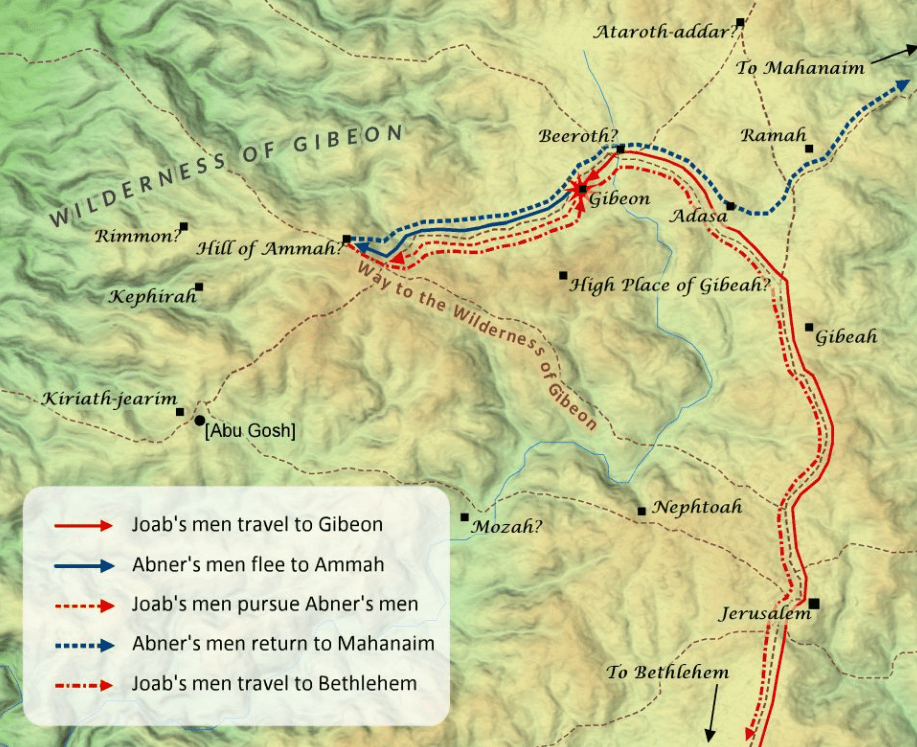
29 And Abner and his men went all that night through the Arabah. They crossed the Jordan, and marching the whole morning, they came to Mahanaim. 30 Joab returned from the pursuit of Abner. And when he had gathered all the people together, there were missing from David’s servants nineteen men besides Asahel. 31 But the servants of David had struck down of Benjamin 360 of Abner’s men. 32 And they took up Asahel and buried him in the tomb of his father, which was at Bethlehem. And Joab and his men marched all night, and the day broke upon them at Hebron.
Two generals having fought and come to a truce, trudge back to their respective bases. One of the generals, Abner, was “limping home” due to a massive relative loss of soldiers. Compared to Joab’s forces, the loss was an 18:1 casualty rate.
For every man Joab lost, Abner lost 18.
No wonder Abner took to flight. He couldn’t stay in the fight with this type of attrition, so off he retreats, only to be defeated by Joab’s brother Asahel. Yes I know, the defeat was not immediate, but the seeds had been sown for Abner’s death as he plunged the spear into Asahel. It was just a matter of time.
For Joab, his turning from the fight is somewhat difficult for me to understand, since he had such a dominant situation. I understand the motivation for David’s army was high, especially after the killing of Asahel, but his men had been in the fight too long. Pulling back would provide a chance for his army to recover. It would also provide an opportunity to mourn his brothers death, provide him a time of burial, and a time for him to plan out the revenge brewing in his heart. Abner had to die!
This battle spoke of the eventuality of the nation becoming the united kingdom under King David, of a time when all 12 tribes would experience a golden age of ascendency for this nation.
The unifying of the nation would take years, for Ish boseth (read Abner) would not give up without a fight. Eventually it came down to a power hungry general, wanting more than the king would allow before this conflict would be resolved.
But I am getting ahead of myself. Abner went back to Manahaim, with Joab returning to Hebron. Both kings would soon enough hear of the results of this battle!
Thanks again for coming to visit. I hope you found something of interest in this post and would appreciate a comment, to begin a discussion. If you know someone this blog may bless (or challenge), send them a link, so they may join us in our discussion.
My wife and I are reading through the Psalms in our evening reading and occasionally a nugget of the Psalms jumps out of the page. Don’t you love it when, after years of reading the “Old Book” passages become alive, reinforcing old teachings or simply warming your heart.
This is the book of Psalms, and it is rich.
I pray I can communicate a portion of the blessing we receive from this wonderful book.
Before we begin this psalm that refers of the true king, pictures the Messiah, and describes the ultimate kingdom, it may be good to mention there is some discussion on the author. Per the ESV, verse 1 seems to speak of this psalm as originating (humanly) from Solomon, David’s son. There is an argument that the psalm was written by David himself (see the last verse) and he wrote it “of Solomon” in his reign, as David looked into the future potential of his son.
Although I am of the opinion David wrote this psalm, no matter how you see this topic, let us delve into this psalm that speaks over and over again of the greater Son of David, the true King of all.
Psalm 72:5 May they fear you while the sun endures, and as long as the moon, throughout all generations! Psalm 72:6 May he be like rain that falls on the mown grass, like showers that water the earth! Psalm 72:7 In his days may the righteous flourish, and peace abound, till the moon be no more!
In our last post on Psalm 72, we found that David was speaking of righteousness as the basis of the Kingdom.
Even as I remind my reader that, I can hear a “little voice” arguing with me. But Carl, is not the Kingdom to be based on love. Does Paul not mention love as the overarching guiding principle of the kingdom?
1 Corinthians 13:13 So now faith, hope, and love abide, these three; but the greatest of these is love.
Yes he does, and the question is valid, little voice. So how does righteousness and love relate in the believers life.
As mentioned previously, righteousness is the acting out of all of God’s characteristics without the diminishing of any. It is unlike that of the worlds righteousness, such that it favors no person. Righteousness in my little world often favors my interests, my desires, my wants and delegates the needs, or even rights of others to a lower standard of consideration in the outcome of righteous judgements. This is the worlds righteousness.
To practice righteousness is to know all the facts of a situation, understand the actions taken by all, discern motivations, and execute judgement, all without departing or diminishing the character of God. To practice righteousness is to not favor one characteristic over another, like favoring mercy over holiness in the decisions made.
For our verses this morning, we shall consider the eternal fear of God’s righteousness, the universality of God’s righteousness, and the peace and prosperity of God’s righteousness.
Eternal Fear
Note in verse 5, as David hopes for the fear of the king to endure while the sun endures and as long as the moon is in the sky, he is looking for a kingdom to provide a continuous “fear of the King” for it’s people.
In God’s Kingdom, there is rightly to be described the element of fear, whether you are experiencing deep respect for the King due to His greatness, or a dreaded fearful expectation due to foolish actions. Fear is a valid and correct response to God’s righteousness being exercised in the Kingdom.
Consider though that David’s description of this Kingdom is ultimately referring to the reign of the Son. His reign is forever and ever through the resurrection from the dead, and the Father’s setting of Him on His holy hill.
Note the direct link between the raising of Jesus in Acts with the passage in Psalm 2. To be begotten refers to the resurrection in verse 2 per the apostles teaching!
Acts 13:32 And we bring you the good news that what God promised to the fathers, Acts 13:33 this he has fulfilled to us their children by raising Jesus, as also it is written in the second Psalm, “‘You are my Son, today I have begotten you.’
Psalm 2:6 “As for me, I have set my King on Zion, my holy hill.” Psalm 2:7 I will tell of the decree: The LORD said to me, “You are my Son; today I have begotten you.
From that day forward the Kingdom exhibited the righteousness of God to all, and the King was set on His throne for all eternity. May all fear the True King of all creation, for godly fear is a natural outgrowth of knowing the King, and following after Him.
Universality
Since the King has be enthroned, the truth of God’s universality in the Kingdom has been exhibited. Now be careful for I have not said the universality of the kingdom began with the appearance of the Son, for we see evidence of God’s working outside of His people often prior to the gospels. But it seemed rare, indicating glimpses of favor to those “outside” for those who were in the chosen people.
Not so as the Messiah appeared. God’s universality, His desire for all to know Him, was one of the most offensive aspects of the Son’s ministry, for He often spoke of those outside as being accepted!
David expresses the universality of God’s righteous kingdom through the picture of rain falling on the earth. Consider the inescapable nature of a rain shower. Every inch of the fields are impacted by the falling rain, and for the one who is caught in the rain, shelter is the only escape. Rain is often considered a universal blessing to those who receive it, and the withholding to be the sign of God’s displeasure.
Yet it is more than simply indicating the pleasure/displeasure of the Lord, for did not the Lord speak of rain as being sent to the just and the unjust?
Matthew 5:45 so that you may be sons of your Father who is in heaven. For he makes his sun rise on the evil and on the good, and sends rain on the just and on the unjust.
For the kingdom to be described as rain falling speaks of the blessing of God on the Kingdom, and of the universality of the gospel invite. Those outside of the Kingdom may and do experience the blessing of God, providing a motivation to enter the Kingdom, and to know the King the One who blesses!
To think of the King favoring those outside of the Kingdom in order to expand His Kingdom is just the type of King we worship. He sees no distinction between any people groups, for we are all needy, broken, blind and crippled up.
Romans 3:22 the righteousness of God through faith in Jesus Christ for all who believe. For there is no distinction:
Romans 10:12 For there is no distinction between Jew and Greek; for the same Lord is Lord of all, bestowing his riches on all who call on him.
His love is universal for a lost people!
peace and prosperity
In David’s Kingdom being described, he is speaking of a kingdom that does not principally consider the ones in power, those who by association with the powerful may have gained power or authority to be experiencing peace and prosperity. It is the righteous, those determined by their actions and not associations are those who experience the benefits of the Kingdom, namely peace and prosperity in this passage.
Notice that David speaks of flourishing as being associated with righteousness, and not necessarily as we often see is this worlds kingdom. This worlds kingdom provides flourishing depending on personal association with those in power. This is absent in God’s Kingdom, at least in relation to varying degrees of flourishing.
It is obvious that to be in the Kingdom requires the righteous ones to be related to the Ultimate authority, that is King Jesus. This is the assumption within this discussion! Beyond that, earthly associations pay no dividends, and may hurt the righteous in that our dedication to the King may be weakened.
Nevertheless, it is instructive to note that this world’s authority structure is rejected in the Kingdom of God.
Luke 22:25 And he said to them, “The kings of the Gentiles exercise lordship over them, and those in authority over them are called benefactors. Luke 22:26 But not so with you. Rather, let the greatest among you become as the youngest, and the leader as one who serves.
Let’s remember Jesus spoke this truth to the disciples due to the turmoil their ego’s were creating within themselves and the group! No prosperity, no peace! Simply self promotion was being exercised in the group, and for peace and prosperity to be realized, self promotion was to be rejected in the Kingdom .
One caveat in relation to the the peace and prosperity I am seeking to describe. Let us not think the teaching of prosperity in the Word refers strictly to worldly wealth, to riches and dollars, bricks of silver or vaults of possessions. This is a beggarly way of understanding prosperity as found in the Word.
Prosperity speaks of abundance, of greatness, of a life blessed. There is much more to life than the acquisition of possessions. Paul provides corrective teaching to the modern outbreak of greed being glorified in the church, by speaking of the uncertainty of seeking riches, and directs us to seeking God, who provides us “with everything to enjoy”.
1 Timothy 6:17 As for the rich in this present age, charge them not to be haughty, nor to set their hopes on the uncertainty of riches, but on God, who richly provides us with everything to enjoy.
David links this prosperity, this abundance with peace in this verse. Might he be speaking of a prosperity that is linked, or that is associated with inner and outer peace that can be found in the Messiah’s Kingdom?
Return to my question
In all of this discussion it is important to understand that there has to be another element brought into any circumstance, that will allow God’s righteousness to be exercised. I referred to love at the beginning of this post as the guiding overarching principle of the Kingdom, and then proceeded to describe righteousness as the foundational character of the Kingdom.
It is the expression of love, of a self sacrificing love that is the act that provides for the experience of righteousness, God’s righteousness in the believers life.
His self sacrifice opened the doors to the Kingdom for each of us. Without His sacrifice, the holiness of God could not allow His mercy and grace to be provided to such a group of sinners as we.
Even on a daily basis, to be of the self sacrificial mindset, to think of others more highly than ourselves, is to be of the correct mindset.
Philippians 2:3 Do nothing from selfish ambition or conceit, but in humility count others more significant than yourselves.
David’s kingdom described in these three verses provided me an opportunity to translate my thoughts to the reader in a very open way. I look forward to comments, and would appreciate your input.
In all of our studies, and in day to day our lives, may we see Jesus just a bit clearer, and understand that which we are granted to comprehend.
Ephesians 3:18 – 19 may have strength to comprehend with all the saints what is the breadth and length and height and depth, and to know the love of Christ that surpasses knowledge, that you may be filled with all the fullness of God.
As many who have followed me for a bit, I have fallen into the Psalms, and I can’t get up! (As if I would want to.) The Psalms are a majestic collection of poetry, of heart felt human experiences that constantly challenge me in my own frail attempt to follow the true King. As many of the Psalms are written by David, my study on the Psalms has spurred me on to looking at the life of David, is the main contributor to this book, and to follow the victories and tragedies of the shepherd King of Israel.
Many times in the narrative, we will see the Lord Jesus, imperfectly, yet a reflection of His spirit in a man with weaknesses.
2 Samuel 2:24-32
24 But Joab and Abishai pursued Abner. And as the sun was going down they came to the hill of Ammah, which lies before Giah on the way to the wilderness of Gibeon. 25 And the people of Benjamin gathered themselves together behind Abner and became one group and took their stand on the top of a hill. 26 Then Abner called to Joab, “Shall the sword devour forever? Do you not know that the end will be bitter? How long will it be before you tell your people to turn from the pursuit of their brothers?” 27 And Joab said, “As God lives, if you had not spoken, surely the men would not have given up the pursuit of their brothers until the morning.” 28 So Joab blew the trumpet, and all the men stopped and pursued Israel no more, nor did they fight anymore.
Three brothers became two brothers. Asahel was dead, and Abner was the man who killed him. Yes he sought to deter Asahel from the conflict. Yes he knew the outcome of any attack on Asahel. Abner was an experienced warrior, whereas Asahel’s “claim to fame” was that he was “swift of foot as a wild gazelle” He could run!
Experienced warrior against a sprinter, or even a long distance runner. Seemed like the result of any conflict would be obvious. And it was. Asahel lay on the ground, bloodied and defeated.
And two brothers found focus! Abner was the man to be dealt with, and Joab with his brother Abishai were in the chase. Vengeance became the motivating force in these two men’s lives, and this death of Asahel became a unifying event for the men of Benjamin following Joab. This had all the earmarks of getting very bloody, with much death and destruction on the battlefield.
There isn’t many motivators that are more powerful than vengeance. To get even, to take vengeance, especially in such an unjust and cruel act such as Abner’s killing of Asahel, blinds the most common man to any logic, and reason against completing this bloodthirst.
Joab and Abishai appear to be the exception, at least for the time being!
Abner was on the run, and as he had mentioned to Asahel, he knew the outcome of his killing Joab’s brother.
2 Samuel 2:22 …Why should I strike you to the ground? How then could I lift up my face to your brother Joab?
To “lift up my face” is an interesting phrase, and worth considering for a moment. What was Abner trying to say to Asahel as he was being chased?
This phrase speaks of a confidence before another. This phrase speaks of the honor / shame culture these people were immersed in, and the importance of the clear conscience in relationships. Consider two verses in Job, as some of his counsellors try to help the suffering saint.
Job 11:15 Surely then you will lift up your face without blemish; you will be secure and will not fear.
Job 22:26 For then you will delight yourself in the Almighty and lift up your face to God.
Yes, Abner and Joab were competing generals, but prior to this killing, their seemed to be a mutual respect.
A confidence and assurance in relationships between two successful warriors. A clarity between men that resulted in a respect, and a showing of honor, even though of different opinions! (What are we missing out on in our current society as this mutual respect for others of a different opinion is sorely lacking!)
Abner knew this mutual respect would evaporate if the conflict with Asahel resulted in his death, and sure enough, it did.
What was Abner’s next ploy. Somewhat genius, for he played the nation card, speaking of senseless death of Israeli brothers. We must remember that Israel is in the midst of a civil war at this time, an internal fighting has the potential to consume the nation.
Abner, to rescue his own skin, showed concern for the nation. Convenient. Of a pure motive? You decide, but it certainly was a convenient argument to provide relief from the pursuit of the motivated men chasing him and his crew!
Why Joab gave up the chase, when he had a united army and motivated leadership to take Abner, and his men down? Let’s remember that Joab has been running his men hard during this battle, and he may admit to the truth of the nation consuming itself. What would be left for him to have power over if decimated?
No, Joab and Abishai, relented the chase, at least in appearance for the sake of the nation. Other opportunities may arise for Joab to take care of “concerns” his brother and he harbored. But for now, hostilities ceased.
Thanks again for coming to visit. I hope you found something of interest in this post and would appreciate a comment, to begin a discussion. If you know someone this blog may bless (or challenge), send them a link, so they may join us in our discussion.
As many who have followed me for a bit, I have fallen into the Psalms, and I can’t get up! (As if I would want to.) The Psalms are a majestic collection of poetry, of heart felt human experiences that constantly challenge me in my own frail attempt to follow the true King. As many of the Psalms are written by David, my study on the Psalms has spurred me on to looking at the life of David, is the main contributor to this book, and to follow the victories and tragedies of the shepherd King of Israel.
Many times in the narrative, we will see the Lord Jesus, imperfectly, yet a reflection of His spirit in a man with weaknesses.
2 Samuel 2:18-23
18 And the three sons of Zeruiah were there, Joab, Abishai, and Asahel. Now Asahel was as swift of foot as a wild gazelle. 19 And Asahel pursued Abner, and as he went, he turned neither to the right hand nor to the left from following Abner. 20 Then Abner looked behind him and said, “Is it you, Asahel?” And he answered, “It is I.” 21 Abner said to him, “Turn aside to your right hand or to your left, and seize one of the young men and take his spoil.” But Asahel would not turn aside from following him. 22 And Abner said again to Asahel, “Turn aside from following me. Why should I strike you to the ground? How then could I lift up my face to your brother Joab?” 23 But he refused to turn aside. Therefore Abner struck him in the stomach with the butt of his spear, so that the spear came out at his back. And he fell there and died where he was. And all who came to the place where Asahel had fallen and died, stood still.
Do you see the Lord in Asahel. A man determined to face the leader of the enemy camp, a man seeking to honor his sovereign and in the pursuit, experiencing death!
But I get ahead of myself, for this passage also speaks of Abner and as such continues to describe the type of man we will bump into occasionally as we follow David’s life through these studies.
Let’s remember Abner in this story, a man who led Saul’s army against David and was essentially running the northern kingdom. He was Saul’s cousin, and had power for many years. He was not about to give that up.
At the pool of Gibeon, he sought to find victory over Joab and David’s forces, but death took all 24 soldiers. Now the full battle broke out, with the nation of Israel in full civil war. Joab’s forces were dominating and Abner was on the run. Although he was on the run, he was not an easy adversary, for Abner had been a warrior his entire life and had shed much blood. To kill a man meant nothing for Abner and yet in this altercation, he sought to pause, to distract Asahel from the chase. All with good intentions? You be the judge.
Nevertheless, he warned off Asahel, sought to redirect, all without success. Eventually, after expressing the fallout that would result in his killing Asahel, it became apparent the death was necessary in Abner’s mind. And Abner continued in his flight.
But let’s also return to Asahel. I realize I began this blog with a short bit on how Asahel may picture the Messiah in his actions, but let me reconsider.
At some convenient point, Asahel determined within himself that it was his calling to take on a challenge for David. The actual circumstances may have simply provided an opportunity for a young man who sought to prove himself. His brother Joab was the Kings general, and his other brother Abishai, had proved his muster back when David entered the camp of Saul and took his spear and water jug. For a quick review, my reader may want to check out the story of Abishai in Life of David – 20.02. To say the least Abishai was honored in his mighty acts for David.
And then there is Asahel. A man who sought to attain to the glories of his brothers, and by all accounts of Abner not worthy of any glory yet.
But Asahel was “I” centered, and I fear his ego delivered him to an early death.
I suppose I see a bit more of me in Asahel, for the only thing he says in this passage is “I”, and it seems that he may have been out of his depth in the confrontation. For though he died for a noble cause, for his king and country, it was a method that seemed destined to failure, and that seemed fueled by his own desire for glory.
Asahel was a brave, but rash young man, seeking his own glory. This is a severe parting of the ways in his representing a picture of the Christ as a willing servant and sacrifice, a Son who sought His Father’s will above his own life. Asahel’s impacted the lives of the army of David, and especially Joab, for we shall return to this killing in future posts, but for now, two lessons may be gleaned from this passage.
Rash decisions
Asahel made a rash decision to make a name for himself in the heat of battle. This most assuredly was not a planned effort with, making a decision based on possible outcomes, times of prayer and considered dangers. Of course it was in the heat of battle, but it was not a requirement for Asahel to chase Abner, an order Joab had directed to Asahel to be obeyed. No it seemed to be nothing but a decision Asahel made on the spot, and locked Asahel into the chase with no the freedom to pull away. And that brings us to the second lesson.
Self glory
In Asahel’s decision to follow after Abner, a greater adversary, Asahel locked himself into a inescapable condition of either killing Abner or dyeing, No other option was available for Asahel, for that would require a humility, a realization that he was out of his depth, and a certain self abnegation.
Self glory has often placed me in similar circumstances. Thankfully none that required my death, as I am obviously still punching keyboard keys! But the desire for self glory, and the forgetfulness of the glory of God in any circumstance often leads me in to a false dichotomy. Either one result or the other will be required as I seek my own glory.
It isn’t so if we allow God to be in the mix, for though I sometimes invite Him into my mess, He has remained faithful in working through my self glory mess for His eventual sake.
It is the “eventual” aspect that bothers me. I have wasted much time in my walk with Him.
As I close, consider decisions that are made in your life, and let’s seek to ask for God’s guidance in those decisions. Let us not be driven by self glory, but to raise up the glory of God in all our actions!
Thanks again for coming to visit. I hope you found something of interest in this post and would appreciate a comment, to begin a discussion. If you know someone this blog may bless (or challenge), send them a link, so they may join us in our discussion.
As many who have followed me for a bit, I have fallen into the Psalms, and I can’t get up! (As if I would want to.) The Psalms are a majestic collection of poetry, of heart felt human experiences that constantly challenge me in my own frail attempt to follow the true King. As many of the Psalms are written by David, my study on the Psalms has spurred me on to looking at the life of David, is the main contributor to this book, and to follow the victories and tragedies of the shepherd King of Israel.
Many times in the narrative, we will see the Lord Jesus, imperfectly, yet a reflection of His spirit in a man with weaknesses.
2 Samuel 2:12-17 12 Abner the son of Ner, and the servants of Ish-bosheth the son of Saul, went out from Mahanaim to Gibeon. 13 And Joab the son of Zeruiah and the servants of David went out and met them at the pool of Gibeon. And they sat down, the one on the one side of the pool, and the other on the other side of the pool. 14 And Abner said to Joab, “Let the young men arise and compete before us.” And Joab said, “Let them arise.” 15 Then they arose and passed over by number, twelve for Benjamin and Ish-bosheth the son of Saul, and twelve of the servants of David. 16 And each caught his opponent by the head and thrust his sword in his opponent’s side, so they fell down together. Therefore that place was called Helkath-hazzurim, which is at Gibeon. 17 And the battle was very fierce that day. And Abner and the men of Israel were beaten before the servants of David.
Pool of Gibeon
Abner is on the march. He made Ish-boseth the king of what remained of Saul’s kingdom and the first order of business was to confront David.
Now let’s remember that Abner and David had history, that Abner “discovered” David for Saul, he knew of David’s prowess on the battle field, he had been loyal to Saul during the hunting of David, and he had been publicly shamed by David, in front of all his troops. You remember when David crept into the camp and took Saul’s spear? Abner took a serious shaming then.
Abner may still be licking his wounds!
It seems that Abner and Joab had communicated and coordinated a place and time for confrontation. Initially it seemed the two men decided to be “civil” about the terms of battle. The setting appeared to be a polite meeting of national leaders, a diplomatic conference amongst warriors. But these men were warriors, battle hardened soldiers that knew the fate of the kingdom was to be decided on the battlefield.
Why then suggest the battle of the 24 soldiers?
Was it suggested in order to save the lives of fellow countrymen? The nation had just split with the anointing of David and the crowning of Ish-boseth. Up till then, the men were all united as the nation of Israel.
Or was it that both generals understood the weakness the nation would suffer if both armies fought to the death? After all, it may have been only a few weeks previously that the Philistines rampaged through the nation, showing their dominance and striking a serious blow on the nations army.
I want to think the generals were thinking of the nation as a whole at this time, but the end result was simply a bloodbath with no desired outcome. Even if some of one group of 12 survived this fight, would not the armies take up arms again, if not that day, soon enough.
No, twenty-four soldiers fell that day, with much blood spilling out. As an act of honor for these men, the field was named the Field of Sharp Swords. Instead of risking all the soldiers, 12 of each side would battle, and die. A futile act that accomplished nothing. 12 men sacrificed to no end. And a bloody civil war broke out. Israel was at war with itself, consuming itself and becoming weaker and weaker militarily with every man falling.
How foolish for a nation to war against itself. For the sake of the pride of two generals, a nation was on fire.
At this point, what could David do? He was being guided by God onto the throne of Israel, and because of loyalty to Saul and a desire to maintain position, Abner forced his hand. Did not Abner know of the promise of God, the anointing of David to rule over all Israel? I suggest he knew, but was not concerned about the peace of the people of Israel, just the power of his position.
My friends, may I remind you we have Abner’s in the church. We must recognize that strong, self willed men often fight to get into leadership positions within the church body, thinking they are great gifts to the kingdom of God. But as Abner was destroying the kingdom he publicly pledged allegiance to, so these men and women who seek power also, with a feigned humility, seek control over the flock, no matter the cost.
When I think of this condition within the church, I ponder on what it means to lead. How is it to best impact those we love without shoving our opinions sometimes violently down their throat.
May I suggest the written/spoken word, fitly spoken, with a quiet humble spirit is powerful for the one who has ears to hear.
Also, any attempt to force our will on another believer seems to be beyond the scope of our calling. Now of course if I see a brother walking into a busy street, I will not quietly mention John 3:16 and hope for the best. I will force my will on him, knocking him back to the sidewalk, away from the traffic.
That should be obvious, but in relation to counselling our brothers, I often think of Paul in his relationship with Apollos. Paul, the great apostle of the Gentiles, requested (strongly urged) Apollos to travel to Corinth. Apollos decided not to.
1 Corinthians 16:12 Now concerning our brother Apollos, I strongly urged him to visit you with the other brothers, but it was not at all his will to come now. He will come when he has opportunity.
Paul didn’t seem threatened by the decision Apollos made, though it was against his wishes! How could Apollos reject the counsel the great apostle provided?
For myself, I reconcile this conflict understanding that both men answered to Jesus. Apollos related to Paul as a man who was his brother, and not his Lord.
May we sit under leaders in the church who understand the importance of believers following Jesus directly as opposed to interjecting their opinion into the relationship between the believer and his Lord.
With that said, I would like to emphasize to all who read this that this is a call to obedience to Jesus, not a call to disobedience to a Christian leader. There is a difference! May we have the wisdom, grace and humility to understand the ways of God for our lives!
And watchout for those Abners! They seem to be multiplying, tearing the church apart and letting many die on the field of battle for the sake of their wants!
Thanks again for coming to visit. I hope you found something of interest in this post and would appreciate a comment, to begin a discussion. If you know someone this blog may bless (or challenge), send them a link, so they may join us in our discussion.
As many who have followed me for a bit, I have fallen into the Psalms, and I can’t get up! (As if I would want to.) The Psalms are a majestic collection of poetry, of heart felt human experiences that constantly challenge me in my own frail attempt to follow the true King. As many of the Psalms are written by David, my study on the Psalms has spurred me on to looking at the life of David, is the main contributor to this book, and to follow the victories and tragedies of the shepherd King of Israel.
Many times in the narrative, we will see the Lord Jesus, imperfectly, yet a reflection of His spirit in a man with weaknesses.
2 Samuel 2:8-11 8 But Abner the son of Ner, commander of Saul’s army, took Ish-bosheth the son of Saul and brought him over to Mahanaim, 9 and he made him king over Gilead and the Ashurites and Jezreel and Ephraim and Benjamin and all Israel. 10 Ish-bosheth, Saul’s son, was forty years old when he began to reign over Israel, and he reigned two years. But the house of Judah followed David. 11 And the time that David was king in Hebron over the house of Judah was seven years and six months.
One new character is introduced in this passage, along with Abner. Now before we ventured into a short discussion on Ish-boseth, it might be good to consider Abner for a moment.
Abner is the son of Ner, who was Kings Saul’s uncle, making Abner and Saul cousins. Abner rose to power as Saul’s general through his time on the throne, and was the man responsible for bringing David to King Saul during the time of Goliath.
Abner was no shrinking violet, for he proved himself in many ways a man of action. Upon the death of his cousin and sovereign, he travelled back to the family of Saul, took Ish-boseth to Mahanaim, and made him king.
Notice all the action verbs are related to Abner. Abner took Ish-boseth. Abner brought Ish-boseth to Mahanaim. Abner made Ish-boseth king.
In many ways, Abner stemmed the tide of David’s rule over the remaining portion of Israel by taking charge and setting up a competitive kingdom. From Abner’s point of view, David was setting up a competitive kingdom, a threat to the monarchy of Saul. David was a direct challenge to the authority granted to Saul through God. At least that is how it appeared to Abner, and it certainly made sense to Abner. After all, monarchies continued through bloodlines – all the nations knew this! This must be the same for Israel, for they truly wanted to be like the nations.
This is an assumption that the Israelites often fell into. The assumption I refer to is that blood lines trump the promise of God. Let me explain.
By now, it was common knowledge throughout Israel that David had been anointed by Samuel as a young boy to be the next king. David was worthy, and prior to his anointing, Saul suffered the rejection by God of his reign over God’s people. This loss of kingdom was not done in a secret meeting, but before all the elders of Israel. Samuel clearly informed Saul and the nation through it’s leadership that Saul was now dethroned by God.
1 Samuel 15:28, 30
28 And Samuel said to him, “The LORD has torn the kingdom of Israel from you this day and has given it to a neighbor of yours, who is better than you. 30 Then he said, “I have sinned; yet honor me now before the elders of my people and before Israel, and return with me, that I may bow before the LORD your God.”
For the remining time of Saul’s life, he would be ruling against God, and not with God. For up to 15 years, the nation continued with Saul over them, though dethroned, persecuting the anointed king of Israel.
This era of a false king over Israel speaks of the same condition we find ourselves in currently. Is not the ruler of this world dethroned? Is not Jesus the anointed King over all? And yet a usurper, an adversary who has (limited) control over the lives of so many, continues to persecute the rightful King. Though the adversary has been publicly dethroned, he still reigns in rebellion for a period.
Even as Jesus was on earth, the majority of the nation preferred the ruling class as opposed to the anointed Son of God. The rejection and persecution of the Son of God, along with the persecution of His followers became evidence of this very condition. They assumed bloodlines from Abraham trumped the promise of God.
Abner made this assumption also. He knew of the promise given to David by God, and yet forced the continuation of a monarchy over Israel that had been rejected by God. He was a man of action, basing his actions on false assumptions, seeking to maintain his own position within the now threatened government of Saul’s rejected monarchy!
We will see Abner often in the next few passages and was certainly a force to be reckoned with! But as mentioned in the introduction, let us now consider Saul’s son Ish-boseth.
Ish-boseth was a puppet of Abner, a weak man that held little promise as a leader, and that was used by Abner to extend a kingdom doomed from the start.
He is known commonly among believers as Ish-boseth, and the name means “man of shame”, or per Gesenius’ Hebrew-Chaldee Lexicon, a man who shames himself.
This is an amazing name for anyone born into a culture where the ruling principal of the culture is elevation of honor as the highest goal. To be shamed is the ultimate insult. What was Saul thinking when this child was born?
Later in the Old Testament records provides an alternate name for this son of Saul. Eshbaal.
1 Chronicles 8:33 Ner was the father of Kish, Kish of Saul, Saul of Jonathan, Malchi-shua, Abinadab and Eshbaal;
This name may provide us the mindset of Saul at his birth. He was named Eshbaal, or “a man of Baal”. Saul was in full rebellion against the God of Israel, and his son bore the name showing of his allegiance to Baal, as opposed to the God who made him!
Ish-boseth became a ruler over Israel, God’s people. He would rule for a short time, but the anointed king was on a path of victory. The anointed king would become dominant over the people of God. The anointed king would be preeminent. The anointed king would unite the kingdom under His leadership.
God’s kingdom is not like the nations. We are not to depend on bloodlines to determine the rightful ruler, but on the blood of One! It was His blood shed on Calvary that opened the kingdom of God for all! Let us look to the promise of God instead of any bloodline that may appeal to our senses, for the anointed One has proven to be the True King of kings through the resurrection from the dead, and ascension to the throne of God.
Thanks again for coming to visit. I hope you found something of interest in this post and would appreciate a comment, to begin a discussion. If you know someone this blog may bless (or challenge), send them a link, so they may join us in our discussion.
As many who have followed me for a bit, I have fallen into the Psalms, and I can’t get up! (As if I would want to.) The Psalms are a majestic collection of poetry, of heart felt human experiences that constantly challenge me in my own frail attempt to follow the true King. As many of the Psalms are written by David, my study on the Psalms has spurred me on to looking at the life of David, is the main contributor to this book, and to follow the victories and tragedies of the shepherd King of Israel.
Many times in the narrative, we will see the Lord Jesus, imperfectly, yet a reflection of His spirit in a man with weaknesses.
2 Samuel 2:1-7 1 After this David inquired of the LORD, “Shall I go up into any of the cities of Judah?” And the LORD said to him, “Go up.” David said, “To which shall I go up?” And he said, “To Hebron.” 2 So David went up there, and his two wives also, Ahinoam of Jezreel and Abigail the widow of Nabal of Carmel. 3 And David brought up his men who were with him, everyone with his household, and they lived in the towns of Hebron. 4 And the men of Judah came, and there they anointed David king over the house of Judah. When they told David, “It was the men of Jabesh-gilead who buried Saul,” 5 David sent messengers to the men of Jabesh-gilead and said to them, “May you be blessed by the LORD, because you showed this loyalty to Saul your lord and buried him. 6 Now may the LORD show steadfast love and faithfulness to you. And I will do good to you because you have done this thing. 7 Now therefore let your hands be strong, and be valiant, for Saul your lord is dead, and the house of Judah has anointed me king over them.”
A bit of a recap is in order.
David, as a young man and an increasingly important soldier for the nation of Israel, became in the kings eyes a competition to the throne. The rumor spread through Israel that he had been anointed by the prophet Samuel and tensions rose in the royal family. Eventually David became an outcast, literally running for his life from the man he had just eulogized in the previous passage.
For the young man David, his initial anointing from the Lord by Samuel to become the next king may have occurred as early as age 15. 2 Samuel speaks of David being 30 years old when he began to reign.
2 Samuel 5:4 David was thirty years old when he began to reign, and he reigned forty years.
I understand that David was 30 years old in this passage when he was anointed the second time by the men of Judah in verse 4, creating a split kingdom. David ruled over Judah, while the remaining tribes assumed the royal lineage, under Saul’s son Ish-boseth.
With all of this background, what jumps out to me is the extended period of time David was “on-hold” for the throne. Not only on hold, but under pressure, experiencing disappointment, despair and a threat of death at the hand of his father-in-law.
In all of his waiting, there must have been times when he looked back on the day Samuel anointed him, and longed for the realization of his ascension. Up to 15 years of waiting, and now the door is open. Obviously David was meant to simply take the throne, for he had been promised it, and this is the opportunity to take it.
Yet he asked the Lord. He saw opportunity, and we know David was a man of action, yet he asked of the Lord for guidance on timing and location. Note that he was very specific in his request to the Lord, even to which city would be best to return home to. He brought his family, and his faithful men, and resided in Hebron.
Now what happened between verse 3 and 4? David is in Israel, and suddenly the men of Judah anointed David. Was this a spontaneous action on the part of the men of Judah, or did David run a political campaign to arouse the locals to his availability to lead?
If David was reluctant to enter Israel without the Lord’s direction, it seems obvious to me that he trusted God to bring to fruition the promise he made to David. To begin a political ad campaign seems out of character for David at this point of his life, even having the appearance of him trying to influence the situation for selfish gain.
He arrived in Hebron, and the promise was realized by the actions of the men of Judah. To think David interjected his will on the men of Judah to attain the throne seems to be without justification from the text and out of character for a man who sought God for such specific direction.
In this second anointing of David by the men of Judah, the nation was split in two, with Saul’s son Ish-boseth taking the throne to the north.
And then David acts. It may be considered his first official act as king over Judah. He praises Jabesh Gilead for their mercies to King Saul.
Let’s remember that Jabesh Gilead is not in Judah, but within the land of Gad originally, and as such was under the leadership of Ish-boseth. This doesn’t stop David for he has the temerity to send men to Jabesh Gilead, and to speak a blessing on them, repaying their kindness and encouraging them. No mention is made of Saul’s son reaching out to the only ones who showed his father respect.
David was astute in the healing of the nation, and as he grew in power within the tribe of Judah, he sought good relations with those outside of his authority.
This is instructive, for I sometimes think with an “us / them” attitude. My little kingdom needs my attention and those outside of it can find encouragement elsewhere. This is not David’s stance, for he sought to bring all of Israel into a united kingdom.
So is the Greater David, as He is constantly looking beyond the borders of His kingdom, inviting those into the kingdom of God, seeking to enlarge His tents.
As Isaiah once prophesied of the expansion of the Kingdom of God.
Isaiah 54:2 “Enlarge the place of your tent, and let the curtains of your habitations be stretched out; do not hold back; lengthen your cords and strengthen your stakes.
The place of His tent has been enlarged, even to include the entire earth. Let us look to those who may be on the outside as those we need to encourage to enter the Kingdom, to meet the Savior and to enjoy eternal life in the Son, the Greater David.
Thanks again for coming to visit. I hope you found something of interest in this post and would appreciate a comment, to begin a discussion. If you know someone this blog may bless (or challenge), send them a link, so they may join us in our discussion.
As many who have followed me for a bit, I have fallen into the Psalms, and I can’t get up! (As if I would want to.) The Psalms are a majestic collection of poetry, of heart felt human experiences that constantly challenge me in my own frail attempt to follow the true King. As many of the Psalms are written by David, my study on the Psalms has spurred me on to looking at the life of David, is the main contributor to this book, and to follow the victories and tragedies of the shepherd King of Israel.
Many times in the narrative, we will see the Lord Jesus, imperfectly, yet a reflection of His spirit in a man with weaknesses.
David has executed the Amalekite who he understands killed his king and best friend. Now, after completing judgement on the Amalekite. David now turns to mourning, to writing a lament regarding Saul his king, and Jonathon his friend. For this passage I would like to consider the two subjects in separate posts.
This post will consider David and his expression of mourning for Saul, his father in law, his friend, his adversary, and his king. A much more complicated relationship, yet the expression of sorrow from David is an honest and deep expression of David’s respect for Saul, and the throne he occupied. He saw Saul as representing God’s man for the nation of Israel.
Let’s read the lamentation once more, considering David’s relation to Saul.
2 Samuel 1:17-27 17 And David lamented with this lamentation over Saul and Jonathan his son, 18 and he said it should be taught to the people of Judah; behold, it is written in the Book of Jashar. He said: 19 “Your glory, O Israel, is slain on your high places! How the mighty have fallen! 20 Tell it not in Gath, publish it not in the streets of Ashkelon, lest the daughters of the Philistines rejoice, lest the daughters of the uncircumcised exult. 21 “You mountains of Gilboa, let there be no dew or rain upon you, nor fields of offerings! For there the shield of the mighty was defiled, the shield of Saul, not anointed with oil. 22 “From the blood of the slain, from the fat of the mighty, the bow of Jonathan turned not back, and the sword of Saul returned not empty. 23 “Saul and Jonathan, beloved and lovely! In life and in death they were not divided; they were swifter than eagles; they were stronger than lions. 24 “You daughters of Israel, weep over Saul, who clothed you luxuriously in scarlet, who put ornaments of gold on your apparel. 25 “How the mighty have fallen in the midst of the battle! “Jonathan lies slain on your high places. 26 I am distressed for you, my brother Jonathan; very pleasant have you been to me; your love to me was extraordinary, surpassing the love of women. 27 “How the mighty have fallen, and the weapons of war perished!”
David’s relationship with Saul, to say the least, was fraught with conflict, tension, confusion, madness and abandonment. No telling of the naked truth would suffice in this funeral dirge for Saul, and as we see David speak of the departure of his king, we see into the heart of David a deep commitment to honor the one man who caused him such terror and trial!
David’s relationship with Saul is expressed in this passage from the point of view of a honorable man, as David sought to honor the king with his accomplishments, and not with the kings efforts as they impacted David. This time of mourning was not about David, but about the first king of Israel, and as a man of character, David would focus on that.
sword of Saul returned not empty
Saul was first and foremost an effective warrior. His sword accomplished that which it set out to perform. This statement, true as it was, honored Saul, and was intended to dull the memory of his body taken from the battle field and shamed by the Philistines.
It is an extension of David’s desire not to have the news of the fall of the mighty ones (Saul and Jonathon) spread through out the Gath and Ashkelon, the land of the Philistines.
Right from the start, Saul knew how to muster his army, how to execute effective combat, and won many battles to the benefit of his kingdom. David remined the nation of this characteristic of their first king.
beloved and lovely
David is being, at least in my opinion, incredibly gracious in this description of Saul, for as we discussed in the previous post, these terms refer to love and agreeableness.
David, in his experience, must have felt betrayed in any love Saul had for him, as he was rejected many times by the king, even in his efforts to bring the king success.
As for agreeableness, this also seems to be difficult to associate with David, for Saul seemed to be against many requests David brought before the king. Many times Saul would not consider any benefit David requested.
As David recounts these characteristics, he may be thinking of Saul in the beginning of his relation with Saul, as he ascended in his kingdom as an effective soldier for Saul, and as a family member eventually. As an example, David won the hand of two of Saul’s daughters. Two of Saul’s daughters? Saul’s eldest daughter Merab was a reward for taking out Goliath. David eventually rescinded the offer due to his humble origins. Yes, Saul finally agreed to the provision of his second daughter to David, but if I recall, it was grudgingly, and with ulterior motives.
After David married Michal, and was forced to begin running from Saul, Saul took Michal from David and married her off to another man, named Paltiel.
Agreeable? David is so gracious! As mentioned in the first post, this funeral dirge, as it related to Saul, is a difficult discussion, yet it shows the heart of David as he relates to the dead, his forgiving spirit, and of his desire to speak well of his departed king.
swifter than eagles, stronger than lions
Again, David refers the the effectiveness Saul exhibited in battle. He was swifter that eagles. David had first hand experience of Saul’s swiftness, as he was often barely ahead of Saul and his army as they pursued him.
Yet we cannot claim this phrase is only for Saul, for David declares this characteristic was of both Saul and Jonathon, that they were swifter than eagles and stronger than lions as a team, in unity on the battlefield.
Both Saul and Jonathon were effective in battle, exercising a swiftness and courage that often overwhelmed the enemy. As a military tactician and strategist, David honored both men in this statement, emphasizing their strength together.
daughters of Israel, weep over Saul
Finally, as a fruit of the military wins over their national enemies, the populace experienced prosperity. During Saul’s reign, in our study on David, we have focused on how Saul impacted David. This obviously was only a part of Saul’s efforts in the throne, and it is apparent that Saul brought much good to the nation. He provided an environment that elevated the living conditions of this upstart monarchy.
All of that is gone now. The nation has been overwhelmed, with the victorious Philistines marauding through the country without a leader to defend it. For some, it may appear the nation was over before it ever had a chance. A one king nation and now it has been vanquished. A flash in the pan, an utter failure of a nation, soon to be absorbed into the surrounding cultures.
Yes it was a very dark day for Israel. Prosperity was gone, along with a potential loss of identity, becoming at best a puppet state for Philistine, or simply to fade away as a people. No other country has experienced the lows that Israel has, and as an early national defeat, the people would mourn, the survivors would mourn, the rebels would mourn.
And God would provide a man who had been through the wringer, who had been under God’s preparatory hand for years.
David would ascend to the throne.
Thanks again for coming to visit. I hope you found something of interest in this post and would appreciate a comment, to begin a discussion. If you know someone this blog may bless (or challenge), send them a link, so they may join us in our discussion.
As many who have followed me for a bit, I have fallen into the Psalms, and I can’t get up! (As if I would want to.) The Psalms are a majestic collection of poetry, of heart felt human experiences that constantly challenge me in my own frail attempt to follow the true King. As many of the Psalms are written by David, my study on the Psalms has spurred me on to looking at the life of David, is the main contributor to this book, and to follow the victories and tragedies of the shepherd King of Israel.
Many times in the narrative, we will see the Lord Jesus, imperfectly, yet a reflection of His spirit in a man with weaknesses.
David has executed the Amalekite who he understands killed his king and best friend. Now, after completing judgement on the Amalekite. David now turns to mourning, to writing a lament regarding Saul his king, and Jonathon his friend. For this passage I would like to consider the two subjects in separate posts.
For this post, lets consider David and his expression of mourning for his best friend Jonathon. I wanted to discuss Jonathon, for his feeling toward Jonathon definitely seem less complicated.
2 Samuel 1:17-18 17 And David lamented with this lamentation over Saul and Jonathan his son, 18 and he said it should be taught to the people of Judah; behold, it is written in the Book of Jashar. He said:
David wrote out his heart, and intended the entire nation to be taught of his feelings of the downfall of the ruling family of Israel. He was not seeking to sling mud, create division or push some agenda on the nation. He spoke of them as mighty ones, Israel’s glory, beloved and lovely, united in death. But I am getting ahead of myself. Let’s read the passage.
2 Samuel 1:19-27 19 “Your glory, O Israel, is slain on your high places! How the mighty have fallen! 20 Tell it not in Gath, publish it not in the streets of Ashkelon, lest the daughters of the Philistines rejoice, lest the daughters of the uncircumcised exult. 21 “You mountains of Gilboa, let there be no dew or rain upon you, nor fields of offerings! For there the shield of the mighty was defiled, the shield of Saul, not anointed with oil. 22 “From the blood of the slain, from the fat of the mighty, the bow of Jonathan turned not back, and the sword of Saul returned not empty. 23 “Saul and Jonathan, beloved and lovely! In life and in death they were not divided; they were swifter than eagles; they were stronger than lions. 24 “You daughters of Israel, weep over Saul, who clothed you luxuriously in scarlet, who put ornaments of gold on your apparel. 25 “How the mighty have fallen in the midst of the battle! “Jonathan lies slain on your high places. 26 I am distressed for you, my brother Jonathan; very pleasant have you been to me; your love to me was extraordinary, surpassing the love of women. 27 “How the mighty have fallen, and the weapons of war perished!”
David refers to Jonathon specifically in verse 22, 23 and 26. Now of course, as David speaks of the mighty ones having fallen, he is including Jonathon, but for the sake of this post, let us consider David’s specific references to Jonathon
bow turned not back
David starts out with the bravery of Jonathon. Any reader of the Old Testament, and of the exploits of Jonathon can readily recall when he took on a battalion of Philistines with his sheild bearer. And he attacked based on outside circumstances, believing God could direct. Amazing courage.
Also, to be in the kings house and yet to be faithful to David, the rightful king, must have strained at Jonathon’s senses of right and wrong, but we must consider the courage it took to be faithful to one in the house of his very enemy.
This condition should be easily recognized by the believer in Jesus, for as we believers walk this earth, we are essentially in the house of the enemy of our King. As Jonathon, we also are to realize our allegiance is with the King not in the land, and that a rebel king is seeking our obedience.
May we be faithful in walking with the only True King!
beloved and lovely
Beloved – simply expressing love for family, a neighbor or for God. David knew his friend and that he was of the right spirit, not vengeful, but with the right spirit.
This word is used of Saul in the same passage, and it will be mush harder to understand when we discuss David speaking thus of him!
Lovely – to be pleasant, agreeable. Sometimes this term refers to singing. This is the spirit of seeking unity, to be at peace. This should not be confused with the spirit of giving up, or of appeasement, for they are two different spirits. To be agreeable is to seek a way for finding similar ground to stand on with those you differ.
Truly, to be agreeable is as much an attitude as an action, and in the attitude of being agreeable, much can be accomplished. To be flexible in finding righteousness is a skill that comes from the Lord, and exhibits a gracious character, a character that draws people to us.
lies slain on your high places
David did not shy away from hard truths. Jonathon had been massacred on the hills, even on the high places.
High places sometimes refers to areas of cultic worship. For our passage this morning, it is likely David is referring to the battlefield of Mount Gilboa. Even as Israel had the advantage in location, for the word speaks of the Philistines chasing the Israelites on Mount Gilboa, Jonathon was slain.
love was extraordinary, surpassing the love of women
This is a magnet verse for a certain group within the church that carry an agenda. It is as if the term “love” (אַהֲבָה ʼahăbâh) describes love in a restricted physical sense only.
When coupled with the following verse, this group within the established church claim David and Jonathon were lovers sexually.
1 Samuel 20:17 And Jonathan made David swear again by his love for him, for he loved him as he loved his own soul.
Regarding the term “love”, it is true that the term is used once in reference to sexual desire.
2 Samuel 13:15 Then Amnon hated her with very great hatred, so that the hatred with which he hated her was greater than the love with which he had loved her. And Amnon said to her, “Get up! Go!”
And it may be understood to speak of the sexual act between a man and woman, but many times, even in the most sexually active book of the Bible (the book of Songs), the term may also speak of the emotional spiritual desire and not only that which is of the physical act. I have added a few verses to consider for my reader.
Song 2:4 He brought me to the banqueting house, and his banner over me was love.
Song 2:5 Sustain me with raisins; refresh me with apples, for I am sick with love.
Song 5:8 I adjure you, O daughters of Jerusalem, if you find my beloved, that you tell him I am sick with love.
Song 8:6 Set me as a seal upon your heart, as a seal upon your arm, for love is strong as death, jealousy is fierce as the grave. Its flashes are flashes of fire, the very flame of the LORD. refresh me with apples, for I am sick with love.
Song 8:7 Many waters cannot quench love, neither can floods drown it. If a man offered for love all the wealth of his house,
Proverbs has a reference that leans towards the sexual act between a man and a woman
Proverbs 5:19 a lovely deer, a graceful doe. Let her breasts fill you at all times with delight; be intoxicated always in her love. he would be utterly despised.
The point is that the term does not have to identify sexual activity, and may refer to love generically, that is in the sense of care, bonding and commitment.
My goodness, this term is also used in God’s care towards His people.
Hosea 11:4 I led them with cords of kindness,with the bands of love, and I became to them as one who eases the yoke on their jaws, and I bent down to them and fed them.
Jeremiah 31:3 the LORD appeared to him from far away. I have loved you with an everlasting love; therefore I have continued my faithfulness to you
So what is David speaking of in this verse then?
I would suggest we remember David’s experience with women, even at the time these passages were written.
David entered into multiple marriages, and at times, his wives tried to shame him, or were used to provide advantage for king Saul.
As he was not faithful to one woman, it can be understood that this reflected into his own opinion of women and their importance in a man’s life.
David had found a soul he could trust, that his soul had bonded with and that he related to deep in his heart. His attachment to Jonathon was soulish, of the inner man and related to the higher ideals of friendship, trust and honor between men.
For those men in my audience, think back to your closest male friend, and honestly consider your feelings toward him. A close friend, a trusting relationship, a bonding of experiences between men, does not require the introduction of any sexual act between them. But there are some in the established church with an agenda.
For the believer, the man or woman who has a living experience with the Risen Savior, it is wise to consider those introducing this heinous picture of David and Jonathon as worthy of rejection. David had enough sin on his plate. We need not consider his relation with Jonathon to also be sinful!
Leave a comment to discuss!
Thanks again for coming to visit. I hope you found something of interest in this post and would appreciate a comment, to begin a discussion. If you know someone this blog may bless (or challenge), send them a link, so they may join us in our discussion.
As many who have followed me for a bit, I have fallen into the Psalms, and I can’t get up! (As if I would want to.) The Psalms are a majestic collection of poetry, of heart felt human experiences that constantly challenge me in my own frail attempt to follow the true King. As many of the Psalms are written by David, my study on the Psalms has spurred me on to looking at the life of David, is the main contributor to this book, and to follow the victories and tragedies of the shepherd King of Israel.
Many times in the narrative, we will see the Lord Jesus, imperfectly, yet a reflection of His spirit in a man with weaknesses.
2 Samuel 1:11-16
11 Then David took hold of his clothes and tore them, and so did all the men who were with him. 12 And they mourned and wept and fasted until evening for Saul and for Jonathan his son and for the people of the LORD and for the house of Israel, because they had fallen by the sword. 13 And David said to the young man who told him, “Where do you come from?” And he answered, “I am the son of a sojourner, an Amalekite.” 14 David said to him, “How is it you were not afraid to put out your hand to destroy the LORD’s anointed?” 15 Then David called one of the young men and said, “Go, execute him.” And he struck him down so that he died. 16 And David said to him, “Your blood be on your head, for your own mouth has testified against you, saying, ‘I have killed the LORD’s anointed.’”
First off, let’s consider the extent of impact the news this Amalekite provided had on David. But not only did it affect David, but all that were with him. At first I assumed it would be all his soldiers, but that is not stated, simply that all who were with him took hold of their clothes and ripped them.
When I read “all who were with him”, I thought of the army, then considered those men who were within earshot of the Amalekite as he spoke the news that brought him his death. After a second read though, I am inclined to think the text may not only be speaking of geographical nearness to David, but of the spirit of the men that heard the news. They had the same spirit of allegiance to King Saul, and to the nation that rejected them that David had.
The power of influence on our friends and acquaintances is inferred in this passage, for the spirit of David, his heart for God and his desire for the best for Saul lasted to the end, and when all hope was extinguished, sorrow came. Such was the spirit of David and of those who were with him.
No celebration, no rejoicing, no seeking an opportunity for the future king, no planning meetings or strategy sessions. Mourning and sorrow was the natural (spiritual?) reaction to the death of Israel’s first monarch.
As for the Amelakite, that was a different story. Thinking he would acquire rewards in removing David’s (assumed) enemy, he stepped into an environment that brought his own demise. How often have we sought to gain advantage, only to recieve defeat, to not only be disappointed, but to take a serious hit in life, a correction.
Thankfully, as believers, even as we slip into the attitude of gaining advantage over another, (and let’s be honest – we to often do), we have a loving Father that will teach us and instruct us (if we are open to Him) even during the discipline that needs to be experienced.
For the Amalekite, he fell by the sword. He killed by the sword (per David’s perception) and he died by the sword.
A fatal judgement, quickly executed fell on this Amalekite due to his act of lying. He killed no man, yet suffered the death penalty.
In this instance, the passage in James speaks loudly to me.
James 2:10-11
10 For whoever keeps the whole law but fails in one point has become guilty of all of it. 11 For he who said, “Do not commit adultery,” also said, “Do not murder.” If you do not commit adultery but do murder, you have become a transgressor of the law.
Don’t get me wrong in thinking this Amalekite was a believer, and that as James spoke to believers in this passage, I am assuming this man as a believer. No no no. The passage is offered to remind us that sin is sin, and the category of sin we fall into does not provide us any safety.
That is, I may be a liar, and think I don’t deserve death, much like this Amalekite, but the Word says I am mistaken. It is in our rebellion against the person of God, against the character of God found in the law of God, whether by “white” lie or murderous actions that we fall. The law perfectly reflects the character of God, and any deviation from the law proves us the rebel.
There is One who perfectly represented God, fulfilled the righteousness of God and suffered a rebels death for those He loved.
Even for that Amalekite, He died.
And for me.
Thanks again for coming to visit. I hope you found something of interest in this post and would appreciate a comment, to begin a discussion. If you know someone this blog may bless (or challenge), send them a link, so they may join us in our discussion.
My wife and I are reading through the Psalms in our evening reading and occasionally a nugget of the Psalms jumps out of the page. Don’t you love it when, after years of reading the “Old Book” passages become alive, reinforcing old teachings or simply warming your heart.
This is the book of Psalms, and it is rich.
I pray I can communicate a portion of the blessing we receive from this wonderful book.
Before we begin this psalm that refers of the true king, pictures the Messiah, and describes the ultimate kingdom, it may be good to mention there is some discussion on the author. Per the ESV, verse 1 seems to speak of this psalm as originating (humanly) from Solomon, David’s son. There is an argument that the psalm was written by David himself (see the last verse) and he wrote it “of Solomon” in his reign, as David looked into the future potential of his son.
Although I am of the opinion David wrote this psalm, no matter how you see this topic, let us delve into this psalm that speaks over and over again of the greater Son of David, the true King of all.
Psalm 72:1 Of Solomon. Give the king your justice, O God, and your righteousness to the royal son! Psalm 72:2 May he judge your people with righteousness, and your poor with justice! Psalm 72:3 Let the mountains bear prosperity for the people, and the hills, in righteousness! Psalm 72:4 May he defend the cause of the poor of the people, give deliverance to the children of the needy, and crush the oppressor!
David opens this psalm with one overarching topic, a topic that is of top priority in any government. This topic, if found in the government will provide the foundation for a lasting kingdom, providing security and prosperity to the people.
The topic is righteousness, and David uses multiple terms to describe this characteristic of the kingdom he foresees
72:1 – 0 Give the king your justice
justice (מִשְׁפָּט mishpâṭ, H4941) This term speaks of the act of judging, an action that rightly belongs to God Himself, who can judge properly and correctly at all times, for He alone is able to know all things affecting the decision, and to weigh the intangible aspects of the act (motivations and intent) being judged. David knows of the challenge this is for the King, and understands the critical need for God to provide!
72:1 – righteousness to the royal son
righteousness (צְדָקָה tsᵉdâqâh, H6666) Can you see the root of one of God’s name in this Hebrew word? JEHOVAH TSIDKENU In that earlier post we spoke of how there may be two righteousness’s in a culture or kingdom, one based on lies and violence and one based on peace and love. Of course, we live in a world where the claim of righteousness is based on lies and violence, but for David, he sought that righteousness that was not logical, not common, not familiar, but of God.
David is asking that the royal son be different than those kingdoms that surround him, that the son would listen to God for instruction in righteousness and not the neighbor kingdoms. And that God would grant him this righteousness!
72:2 – May he judge your people
judge (דִּין dîyn, H1777). This Hebrew word speaks of contending, or of pleading a cause. Might David be hinting to the act of directing the people, or a singular person, prior a decision to be made? Of course as a human king, David must be considering this for Solomon in relation to his inner court, for how could he anticipate all the judgements of his people.
And yet, this may be observed in Solomons judgement to cut the baby in half to bring to the truth the identity of the living child. In his “harsh” judgement, he plead the emotions of the true mother, and found the truth!
72:2 – he judge your people with righteousness,
righteousness (צֶדֶק tsedeq, H6664) This term is of the same root word as in verse 1, and as is obvious, connected with the description of God as righteousness.
72:2 – poor with justice!
righteousness (מִשְׁפָּט mishpâṭ). David speaks the same term here as in verse 1. He reiterates the need of the King to have God provide the correct understanding of each act needing a decision from the king, and produce the desired effect on the kingdom.
Note that he associates the poor (or afflicted) with the kings declaration of justice. It is too often the poor’s only defense against the powerful that the judgement of the government can be called upon. Thus the emphasis on the poor, for the powerful take whatever they want!
72:3 mountains bear prosperity … in righteousness!
Any government worth it’s salt is to provide a condition within the kingdom that provides the ability of it’s subjects to prosper. The environment needed for any within the kingdom to prosper is
72:4 May he defend the cause of the poor
Defend (שָׁפַט shâphaṭ, H8199). David continues his cry for the king to exercise righteousness, in the act of defending the afflicted. He has referred to the connection between righteousness and the poor in verse 2, and speaks again of the responsibility to judge rightly, or to govern in righteousness for the sake of the powerless, the poor and afflicted.
Some passages translate this term as “vindicate”. Is David speaking of not only a defensive position, but a proactive attitude, of not merely rescuing the afflicted, but fighting for them in righteousness? That seems obvious in theory, but David seeks it to be in practice for his royal son.
Consider
In all of this discussion on righteousness, David is setting the stage for the establishment of a kingdom that will endure.
Although we are directed to think of this psalm as being “of Solomon”, or describing the hopes David has for his direct son, in reality, this psalm speaks to the Son of David, the Messiah. Throughout this psalm David speaks of this king’s reign “to the ends of the earth”, that his name “enduring forever”, that “all kings fall down before him”, that his fame “continue as long as the sun” and that “all nations serve him”.
As we venture through this psalm, we will continually bump into statements that bring the Lord Jesus to mind, of the kingdom Jesus will (has) established.
For our passage this morning, note the basis upon Jesus’ governance will be established. He is the Righteous King, and has been granted this right not only through the fact He is God, but that He has suffered and bled for us, leading His kingdom through love, peace and self sacrifice.
As many who have followed me for a bit, I have fallen into the Psalms, and I can’t get up! (As if I would want to.) The Psalms are a majestic collection of poetry, of heart felt human experiences that constantly challenge me in my own frail attempt to follow the true King. As many of the Psalms are written by David, my study on the Psalms has spurred me on to looking at the life of David, is the main contributor to this book, and to follow the victories and tragedies of the shepherd King of Israel.
Many times in the narrative, we will see the Lord Jesus, imperfectly, yet a reflection of His spirit in a man with weaknesses.
2 Samuel 1:1-10 1 After the death of Saul, when David had returned from striking down the Amalekites, David remained two days in Ziklag. 2 And on the third day, behold, a man came from Saul’s camp, with his clothes torn and dirt on his head. And when he came to David, he fell to the ground and paid homage. 3 David said to him, “Where do you come from?” And he said to him, “I have escaped from the camp of Israel.” 4 And David said to him, “How did it go? Tell me.” And he answered, “The people fled from the battle, and also many of the people have fallen and are dead, and Saul and his son Jonathan are also dead.” 5 Then David said to the young man who told him, “How do you know that Saul and his son Jonathan are dead?” 6 And the young man who told him said, “By chance I happened to be on Mount Gilboa, and there was Saul leaning on his spear, and behold, the chariots and the horsemen were close upon him. 7 And when he looked behind him, he saw me, and called to me. And I answered, ‘Here I am.’ 8 And he said to me, ‘Who are you?’ I answered him, ‘I am an Amalekite.’ 9 And he said to me, ‘Stand beside me and kill me, for anguish has seized me, and yet my life still lingers.’ 10 So I stood beside him and killed him, because I was sure that he could not live after he had fallen. And I took the crown that was on his head and the armlet that was on his arm, and I have brought them here to my lord.”
In this passage, we have a story of an Amalekite telling a story. A fabrication to ingratiate himself to the future king of Israel.
So many questions.
Was this one of the Amalekites that escaped from David’s attack, when David came to rescue those taken from Ziklag?
If so, this poor Amalekite escaped from David to simply fall into the hands of Saul, just as he was being defeated. What luck!
Much more likely, this Amalekite was not of the armies that David decimated, but simply a prisoner of war that was being held by the camp of Israel.
Earlier on in 1 Samuel, the text tells us that Saul died before the armor bearer committed suicide.
How did this Amalekite kill Saul without mentioning the killing of the armor bearer, who was sworn to defend the king against all threats?
It is interesting that this Amalekite mentions Saul and his son Jonathon, but not the other sons.
Might he have known of the bond David had with Jonathon?
Why would Saul call to his arch enemy, an Amalekite, to kill him? He had plenty of Philistines surrounding him if Saul sought death.
I could go on, but suffice to say, this Amalekite, in the aftermath of the battle, may have tripped over the body of king Saul, and simply took the crown and armlet of the king. Simply taking advantage of the death of soldiers in the battle field. Kind of a sad picture in my mind, that a foreigner was just waiting to pick from the dead, but somehow it may fit with this fellow. Not of the highest moral fiber, as he is obviously a liar. A liar and a story-teller!
As for David, let’s remember he just got back from a battle, rescuing his family from the Amalekites, and on the third day, was told information that would propel him into the position of king! Saul was the only man who stood in his way, and God had promised him this position. It was David’s time to rise to the throne!
But unlike this Amalekite, he refrained from looking first to his advantage, but sought news of his nation’s state of affairs, and of King Saul.
Here was a man who had nearly entered into battle against his own people, allying himself with the Philistines. David had a busy time this last few days, seeing God consistently working in his life. He had seen the hand of God rescue him from a very sticky situation with the Philistines. He had seen the hand of God deliver him from his own army moving to mutiny him as they entered the plundered Ziklag. He had seen the hand of God provide guidance to the Amalekites camp. He had seen the hand of God provide victory over the Amalekites. He had seen the hand of God in protecting his loved ones, recovering every kidnapped victim of Ziklag.
Now the hand of God was providing news of David’s opportunity to claim the kingdom as promised, and he asked about Saul and Jonathon. The kingdom could wait, for David was of a different spirit than this Amalekite.
Whereas the Amalekite would weave a story to get something, David would put off advantage for the sake of information. He knew the importance of data over dollars!
Much can be gleaned from this passage, but for this writer, these two men reveal a difference that is stark, that is important and for the believer, should be heeded. We, as believers should prioritize facts, data, information, knowledge and the wisdom of God as He works amongst us.
And He is working! Even when a liar comes to tell you a story! God is at work, if you have eyes to see!
Thanks again for coming to visit. I hope you found something of interest in this post and would appreciate a comment, to begin a discussion. If you know someone this blog may bless (or challenge), send them a link, so they may join us in our discussion.
My wife and I are reading through the Psalms in our evening reading and occasionally a nugget of the Psalms jumps out of the page. Don’t you love it when, after years of reading the “Old Book” passages become alive, reinforcing old teachings or simply warming your heart.
This is the book of Psalms, and it is rich.
I pray I can communicate a portion of the blessing we receive from this wonderful book.
Before we begin this psalm that refers of the true king, pictures the Messiah, and describes the ultimate kingdom, it may be good to mention there is some discussion on the author. Per the ESV, verse 1 seems to speak of this psalm as originating (humanly) from Solomon, David’s son. There is an argument that the psalm was written by David himself (see the last verse) and he wrote it “of Solomon” in his reign, as David looked into the future potential of his son.
Although I am of the opinion David wrote this psalm, no matter how you see this topic, let us delve into this psalm that speaks over and over again of the greater Son of David, the true King of all.
Psalm 72:1 Of Solomon. Give the king your justice, O God, and your righteousness to the royal son! Psalm 72:2 May he judge your people with righteousness, and your poor with justice! Psalm 72:3 Let the mountains bear prosperity for the people, and the hills, in righteousness! Psalm 72:4 May he defend the cause of the poor of the people, give deliverance to the children of the needy, and crush the oppressor!
David opens this psalm with one overarching topic, a topic that is of top priority in any government. This topic, if found in the government will provide the foundation for a lasting kingdom, providing security and prosperity to the people.
That topic is righteousness, and David uses multiple terms to describe this characteristic of the kingdom he foresees.
72:1 – 0 Give the king your justice
justice (מִשְׁפָּט mishpâṭ, H4941) This term speaks of the act of judging, an action that rightly belongs to God Himself, who can judge properly and correctly at all times, for He alone is able to know all things affecting the decision, and to weigh the intangible aspects of the act (motivations and intent) being judged. David knows of the challenge this is for the King, and understands the critical need for God to provide!
72:1 – righteousness to the royal son
righteousness (צְדָקָה tsᵉdâqâh, H6666) Can you see the root of one of God’s name in this Hebrew word? JEHOVAH TSIDKENU In that earlier post we spoke of how there may be two righteousness’s in a culture or kingdom, one based on lies and violence and one based on peace and love. Of course, we live in a world where the claim of righteousness is based on lies and violence, but for David, he sought that righteousness that was not logical, not common, not familiar, but of God.
David is asking that the royal son be different than those kingdoms that surround him, that the son would listen to God for instruction in righteousness and not the neighbor kingdoms. And that God would grant him this righteousness!
72:2 – May he judge your people
judge (דִּין dîyn, H1777). This Hebrew word speaks of contending, or of pleading a cause. Might David be hinting to the act of directing the people, or a singular person, prior a decision to be made? Of course as a human king, David must be considering this for Solomon in relation to his inner court, for how could he anticipate all the judgements of his people.
And yet, this may be observed in Solomons judgement to cut the baby in half to bring to the truth the identity of the living child. In his “harsh” judgement, he plead the emotions of the true mother, and found the truth!
72:2 – he judge your people with righteousness,
righteousness (צֶדֶק tsedeq, H6664) This term is of the same root word as in verse 1, and as is obvious, connected with the description of God as righteousness.
72:2 – poor with justice!
righteousness (מִשְׁפָּט mishpâṭ). David speaks the same term here as in verse 1. He reiterates the need of the King to have God provide the correct understanding of each act needing a decision from the king, and produce the desired effect on the kingdom.
Note that he associates the poor (or afflicted) with the kings declaration of justice. It is too often the poor’s only defense against the powerful that the judgement of the government can be called upon. Thus the emphasis on the poor, for the powerful take whatever they want!
72:3 mountains bear prosperity … in righteousness!
Any government worth it’s salt is to provide a condition within the kingdom that provides the ability of it’s subjects to prosper. The environment needed for any within the kingdom to prosper is
72:4 May he defend the cause of the poor
Defend (שָׁפַט shâphaṭ, H8199). David continues his cry for the king to exercise righteousness, in the act of defending the afflicted. He has referred to the connection between righteousness and the poor in verse 2, and speaks again of the responsibility to judge rightly, or to govern in righteousness for the sake of the powerless, the poor and afflicted.
Some passages translate this term as “vindicate”. Is David speaking of not only a defensive position, but a proactive attitude, of not merely rescuing the afflicted, but fighting for them in righteousness? That seems obvious in theory, but David seeks it to be in practice for his royal son.
Consider
In all of this discussion on righteousness, David is setting the stage for the establishment of a kingdom that will endure.
Although we are directed to think of this psalm as being “of Solomon”, or describing the hopes David has for his direct son, in reality, this psalm speaks to the Son of David, the Messiah. Throughout this psalm David speaks of this king’s reign “to the ends of the earth”, that his name “enduring forever”, that “all kings fall down before him”, that his fame “continue as long as the sun” and that “all nations serve him”.
As we venture through this psalm, we will continually bump into statements that bring the Lord Jesus to mind, of the kingdom Jesus will (has) established.
For our passage this morning, note the basis upon Jesus governance will be established. He is the Righteous King, and has been granted this right not only through the fact He is God, but that He has suffered and bled for us, leading His kingdom through love, peace and self sacrifice.
My wife and I are reading through the Psalms in our evening reading and occasionally a nugget of the Psalms jumps out of the page. Don’t you love it when, after years of reading the “Old Book” passages become alive, reinforcing old teachings or simply warming your heart.
This is the book of Psalms, and it is rich.
I pray I can communicate a portion of the blessing we receive from this wonderful book.
Psalm 71 is a psalm written by an aged saint, a man who had walked with the Lord through many trials and triumphs. Some think this psalm represents David’s thoughts as he approaches the grave, as he ages and finds his life coming to a close.
One thing that is obvious in this psalm, that whoever wrote this psalm had an intimate experience with the Word of God. I have heard the claim that in the 24 verses of this psalm, there are up to 25 references, allusions and hints of other psalms within this reflection of an old saint. He has saturated his life with the Word, to the point that even phrasing of the old book comes through this old man’s message.
It is truly a witness of the wise to engage in an early and consistent immersion into the Word of God for every saint.
Let’s take a moment to consider
Psalm 71:22 I will also praise you with the harp for your faithfulness, O my God; I will sing praises to you with the lyre, O Holy One of Israel. Psalm 71:23 My lips will shout for joy, when I sing praises to you; my soul also, which you have redeemed. Psalm 71:24 And my tongue will talk of your righteous help all the day long, for they have been put to shame and disappointed who sought to do me hurt.
In our last post, we reviewed the hope of this ol’ saint, the hope of resurrection, of being raised from the depths of the earth. In verse 23, he continues describing the works of God in his soul’s redemption.
God is elevated in His many works by this ol’ saint and not in the simple ways, but in resurrection and redemption. He speaks of God’s “righteous help all the day long”, and in that, it show’s the ol’ saint is watching for the work of God, that he expects and looks for the work of God in his life. He seeks the help, anticipates the help, observes the help and is thankful for the help.
As a matter of fact, the emphasis in this verse is on the righteousness of the help, specifically in this case of the shame and disappointment falling on his adversaries, who wanted to hurt the ol’ saint.
It is good to recognize the help of God as He works righteous acts in and through our lives.
But there is a concern I sometimes trip over as I seek to thank Him for all things. There have been too many times I have praised the Lord for something that favors my lot, yet may not exactly be righteous. Yes we are to give thanks in all circumstances, as 1 Thessalonians directs us.
1 Thessalonians 5:18 give thanks in all circumstances; for this is the will of God in Christ Jesus for you.
You see there is a difference between thanking Him for all things, and thanking Him in all circumstances.
Some things that occur in the believers life may be terrible, and may cause much heartache, disappointment and even despair. These things may even be the righteous acts of our loving Father, and in the pain, the believer may have to submit, but to be thankful for the pain is a difficult concept for me to understand. Yet as 1 Thessalonians speaks, it doesn’t address the believer to be thankful for the pain, but that in the circumstances, God is in the middle of it, and that is the focus of the thanks. It is looking to the source of the circumstance, the hand of God, and not the result of the righteous act, which may be causing great pain.
It is to look to the Savior, to be thankful He is with us, that though we may find pain and trial, to know that the hand of God is with us, that He has led the way and been faithful, that is what we can give thanks for.
This ol’ saint was thankful for the righteous acts of God in his life, and the way God rescued him from his very enemies. He is a saving God, a God who may bring struggles, but as we come to know Him as the loving God He has proven Himself to be, we can go through the trial with a thankful heart.
As many who have followed me for a bit, I have fallen into the Psalms, and I can’t get up! (As if I would want to.) The Psalms are a majestic collection of poetry, of heart felt human experiences that constantly challenge me in my own frail attempt to follow the true King. As many of the Psalms are written by David, my study on the Psalms has spurred me on to looking at the life of David, is the main contributor to this book, and to follow the victories and tragedies of the shepherd King of Israel.
Many times in the narrative, we will see the Lord Jesus, imperfectly, yet a reflection of His spirit in a man with weaknesses.
For this post, we will not see David, but it will focus of his father-in-law, his king, and his arch enemy describes a turning point in David’s life, and his future as the king.
Lets consider the outfall of Saul’s death.
1 Samuel 31:8 The next day, when the Philistines came to strip the slain, they found Saul and his three sons fallen on Mount Gilboa. 1 Samuel 31:9 So they cut off his head and stripped off his armor and sent messengers throughout the land of the Philistines, to carry the good news to the house of their idols and to the people. 1 Samuel 31:10 They put his armor in the temple of Ashtaroth, and they fastened his body to the wall of Beth-shan. 1 Samuel 31:11 But when the inhabitants of Jabesh-gilead heard what the Philistines had done to Saul, 1 Samuel 31:12 all the valiant men arose and went all night and took the body of Saul and the bodies of his sons from the wall of Beth-shan, and they came to Jabesh and burned them there. 1 Samuel 31:13 And they took their bones and buried them under the tamarisk tree in Jabesh and fasted seven days.
The Philistines won the battle, and on the very next day, they came back to the battle ground, after all the Israelites had run away, to strip off the fallen. Spoils of war!
This is a common act of the victorious, for the winning soldiers would often come back to pick the dead clean. Now of course, this act of recovering goods from dead soldiers sometimes brought our the worst in the soldiers. There were some who could not resist humiliating King Saul, along with the entire nation of Israel, in the decapitation of the defeated king, and the exhibition of his headless corpse on the wall at Beth-shan. Why at Beth Shan? It was deep in the defeated regions of Israel, where the Philistines could shame the king and his people. Perfect psychological warfare, even after the killing was over!
For a body to be hung on the city walls was a great shame, an insult to those of his family. This act of defilement was more than a show of victory over the nation, it was an exhibition of gloating by the Philistines, and heaped disgrace on the royal family, and nation of Israel.
Early on in King Saul’s reign, the town of Jabesh Gilead was the sighting of Saul’s first challenge in defending his people. An Ammonite army descended on Jabesh, placed the town under siege, and then forced the citizen’s of Jabesh into an agreement prior to attacking. The Ammonites would kill them by sword, or have their right eyes gouged out. What a choice!
But for some reason, the Ammonites allowed them to reach out for help, giving them seven days to bring reinforcements. Were they hoping to find more success by defeating greater numbers of Israelites? Or simply heaping additional shame on this town when no-one came?
But the newly crowned King Saul did come, and he was large and in charge. He rallied an army, though through threatening, and marched onto Jabesh. With his army, he defeated the Ammonites fully, and it became a fantastic victory for this newly ascended king.
The people of Jabesh did not forget, and they made efforts to retrieve the kings body. For reasons unknown, the people of Jabesh burned the body of King Saul. This was not common practice in the days of Israel. Possibly they burned the bodies due to the extent of dismemberment, or the deterioration from the daily heat. Personally, I think the Jabesh people sought to give Saul peace from being dug up again and put on display, continuing the shameful treatment of their first king.
Either way, the people of Jabesh, those valiant men, provided King Saul relief from the shame of defeat, the shame of exposure and the shame of defilement. They honored their king, their rescuing hero in a way only they could.
This was a very sad day for the nation, for their first king had been conquered. Depending on your point of view, he had been conquered much earlier than his physical death, but nevertheless, he had been conquered, and the valiant men of Jabesh Gilead went into enemy territory to retrieve what was left of their king.
Thanks again for coming to visit. I hope you found something of interest in this post and would appreciate a comment, to begin a discussion. If you know someone this blog may bless (or challenge), send them a link, so they may join us in our discussion.
My wife and I are reading through the Psalms in our evening reading and occasionally a nugget of the Psalms jumps out of the page. Don’t you love it when, after years of reading the “Old Book” passages become alive, reinforcing old teachings or simply warming your heart.
This is the book of Psalms, and it is rich.
I pray I can communicate a portion of the blessing we receive from this wonderful book.
Psalm 71 is a psalm written by an aged saint, a man who had walked with the Lord through many trials and triumphs. Some think this psalm represents David’s thoughts as he approaches the grave, as he ages and finds his life coming to a close.
One thing that is obvious in this psalm, that whoever wrote this psalm had an intimate experience with the Word of God. I have heard the claim that in the 24 verses of this psalm, there are up to 25 references, allusions and hints of other psalms within this reflection of an old saint. He has saturated his life with the Word, to the point that even phrasing of the old book comes through this old man’s message.
It is truly a witness of the wisdom to engage in an early and consistent immersion into the Word of God for every saint.
Let’s take a moment to consider
Psalm 71:17 O God, from my youth you have taught me, and I still proclaim your wondrous deeds. Psalm 71:18 So even to old age and gray hairs, O God, do not forsake me, until I proclaim your might to another generation, your power to all those to come. Psalm 71:19 Your righteousness, O God, reaches the high heavens. You who have done great things, O God, who is like you? Psalm 71:20 You who have made me see many troubles and calamities will revive me again; from the depths of the earth you will bring me up again. Psalm 71:21 You will increase my greatness and comfort me again.
This old man, this old saint who has known God, even from the womb somehow, who leaned on the Lord from before birth, speaks of the teaching work of God in his life. Out of this teaching ministry, the result for this ol’ saint was that he proclaimed the wondrous deeds of God.
He did not proclaim the wondrous works of God out of a vacuum, but had been taught, trained, led by God through many experiences, many trials, many troubles and calamities (vs 20). Given this experience of the leading of God, this ol’ saint does not presume upon his history, but is reaching out to God, seeking that God would continue teaching, that God would not forsake him in his old age.
What a tremendous spirit this ol’ saint had, that he still had a deep resolve to follow, tinged with the fear of God, not assuming but continuing to seek God in his last days.
One additional impression I have of this ol’ saint is that he doesn’t whitewash his pilgrimage with God, but admits that God made him experience trials and troubles.
Did I say one additional impression? Get a load of vs 20. Is that saying what I think it is saying?
Psalm 71:20 You who have made me see many troubles and calamities will revive me again; from the depths of the earth you will bring me up again.
Yes, the ol’ saint has seem his many troubles and calamities, directly from the hand of God, but in this statement, he speaks of reviving, even bringing him up from the depths of the earth.
Now I have been told by some very respectful Bible teachers that the Old Testament does not speak directly of a resurrection for the faithful very often. One passage that stands out is Daniel 12:2.
And many of those who sleep in the dust of the earth shall awake, some to everlasting life, and some to shame and everlasting contempt.
Granted, there are a number of passages that refer to, point to, imply of, and hint at the bodily resurrection of the faithful, but many are pictures of this truth, as in the Shunammite’s child, being resuscitated from death, only to eventually face death later on! 2 Kings 4:18–20, 32–37
Some are super clear, as in Job 19:25–27, and consider verse 26
And after my skin has been thus destroyed, yet in my flesh I shall see God
Additional passages in the Old Testament that provide the hope of resurrection in various ways may be found at the end of this posting for those interested.
For our passage today, in verse 20, this ol’ saint provided a declaration of resurrection that is as clear as any in the Old Testament. As the Lord was dwelling on the Word, how this short passage must have impacted Him, speaking of the faithfulness of God to this ol’ saint, and the hope of resurrection for him in his last days. Jesus would soon enough face his last days, though as a much younger man, but the hope of resurrection was on His mind and in His heart, fanned by the promise of God to His saints!
Might Paul have had in mind this passage as he wrote to the Ephesians of the resurrection “process” of the Lord Himself?
Ephesians 4:9 ….He ascended,” what does it mean but that he had also descended into the lower regions, the earth?
He may have, especially in speaking of the lower regions, the earth, and that the psalmist spoke of the depths of the earth.
As believers age, and have followed after the Lord during our pilgrimage, we can take the place of this ol’ saint, finding confidence in the faithfulness of God, even of the resurrection, for our God is the only God that has proven Himself to crush death under His heal!
As many who have followed me for a bit, I have fallen into the Psalms, and I can’t get up! (As if I would want to.) The Psalms are a majestic collection of poetry, of heart felt human experiences that constantly challenge me in my own frail attempt to follow the true King. As many of the Psalms are written by David, my study on the Psalms has spurred me on to looking at the life of David, is the main contributor to this book, and to follow the victories and tragedies of the shepherd King of Israel.
Many times in the narrative, we will see the Lord Jesus, imperfectly, yet a reflection of His spirit in a man with weaknesses.
For our next couple of posts, we will not see David directly, but will consider his father-in-law, his king, and his arch enemy. The following recounting of Saul’s last days describes a turning point in David’s life, and his future as the king.
Lets consider Saul’s last day.
1 Samuel 31:1 Now the Philistines were fighting against Israel, and the men of Israel fled before the Philistines and fell slain on Mount Gilboa. 1 Samuel 31:2 And the Philistines overtook Saul and his sons, and the Philistines struck down Jonathan and Abinadab and Malchi-shua, the sons of Saul. 1 Samuel 31:3 The battle pressed hard against Saul, and the archers found him, and he was badly wounded by the archers. 1 Samuel 31:4 Then Saul said to his armor-bearer, “Draw your sword, and thrust me through with it, lest these uncircumcised come and thrust me through, and mistreat me.” But his armor-bearer would not, for he feared greatly. Therefore Saul took his own sword and fell upon it. 1 Samuel 31:5 And when his armor-bearer saw that Saul was dead, he also fell upon his sword and died with him. 1 Samuel 31:6 Thus Saul died, and his three sons, and his armor-bearer, and all his men, on the same day together. 1 Samuel 31:7 And when the men of Israel who were on the other side of the valley and those beyond the Jordan saw that the men of Israel had fled and that Saul and his sons were dead, they abandoned their cities and fled. And the Philistines came and lived in them.
We have the death of Saul in this passage, along with the complete collapse of the Israeli army.
First, let’s consider the general situation prior to thinking about Saul. His army, as noted previously was far outnumbered and his reaction when he realized the size of the Philistine encampment was that of utter fear.
1 Samuel 28:4 The Philistines assembled and came and encamped at Shunem. And Saul gathered all Israel, and they encamped at Gilboa.
In this fear, Saul ventured off to a medium, who only reinforced every fear he had and informed Saul of his death the next day. That day came quickly, and the Philistines were brutal, in that the Philistines entered into the base camp of Israeli army at Gilboa, decimating their forces and killing Saul’s three sons. Although Abinadab and Malchi-shua were possible hires to the throne, it would have been Jonathon that would most likely have reigned in Saul’s place in the event of Saul’s passing.
This possibility would have caused a testing of the friendship between David and Jonathon, for who should reign if Jonathon would ascend to the throne. Not only a testing their freindship, but a testing of the very covenant Jonathon made with David.
1 Samuel 20:16 And Jonathan made a covenant with the house of David, saying, “May the LORD take vengeance on David’s enemies.”
Would he abide by his word of being faithful to David? Could Jonathon justify his ascension in light of this curse? Might he seek the throne as David’s “friend”, and thus avert the very curse he uttered?
My friends, I want to think the best of Jonathon, yet we all know that power can corrupt. Even if there was such a situation that Jonathon could reign without incurring this curse, the nation would not be blessed, for God had determined David to reign.
In a very harsh way, Jonathon’s death was necessary, and in his death, he found honor in staying beside his king, defending his nation and fighting for God till the very end.
This potential competitor for the throne fell to one of Saul’s other son’s, but we will consider the wisdom of God’s plan in allowing that in future installments. For now, a complicated situation has been removed from David’s future.
Let us not forget that this solution brought great pain to David. Some of the Lord’s best plans allow for great pain in our lives. Jonathon and David were the closest of allies and the best of friends, exhibiting a loyalty that continued beyond Jonathon’s life. Yet Jonathon passed on the battlefield.
Saul also passed on the battlefield. But let me ask my reader – Did he die due to the battle? He was certainly wounded by the archers of the Philistines, but the fatal blow did not come from the Philistines. Saul sought his own armor bearer to kill him, in order to avoid the humiliation of capture and mistreatment by the Philistines.
Now consider the armor bearer’s conundrum. He was to protect the king, as this honor was not passed to one lightly, for it was a great responsibility, and carried with it great status. Not only was Saul asking this armor bearer to sacrifice the very person he lived to protect, but also to bring shame upon his own name and family, in killing the very anointed king of Israel.
Saul was fully consumed with his own needs at this time, and I get it, that he is on the very precipice of his grave, looking down into the pit. What else was the king to do? He had lost all honor and status, his kingdom was being run over and he knew he was to die that day. His only choice was how he would fall in battle, and he would not wait for God’s will in even that!
As we know, the armor bearer refused, and Saul fell on his own sword, capping off the self destructive behavior of a man seeking his own will throughout his life.
How sad. A day of tremendous loss for the nation. They lost much of the western territory to the enemy. They lost their army on the hills of Mount Gilboa. They lost their king. They lost the best hope of a successor king in Jonathon’s death. They lost cities to the Philistines due to abandonment. They lost national reputation in the sight of their neighboring countries.
What a terrible defeat. Israel was in tatters. But the shame of the defeat was to be worse as we will find in the next portion of the Word.
For now, let us be thankful for the opportunity to give up our own self will for the Lord’s will, to accept pain and sorrow as it comes from the hand of the Lord, and know that in everything that occurs in our lives, the Lord is in control, the Lord is a merciful God, and that God is good.
Yes, cling to the fact that God is good, even when things might seem very bad. He is on the throne, and He will never be removed from it, for His reign is is forever and ever.
Hebrews 1:8 But of the Son he says, “Your throne, O God, is forever and ever, the scepter of uprightness is the scepter of your kingdom.
Thanks again for coming to visit. I hope you found something of interest in this post and would appreciate a comment, to begin a discussion. If you know someone this blog may bless (or challenge), send them a link, so they may join us in our discussion.
My wife and I are reading through the Psalms in our evening reading and occasionally a nugget of the Psalms jumps out of the page. Don’t you love it when, after years of reading the “Old Book” passages become alive, reinforcing old teachings or simply warming your heart.
This is the book of Psalms, and it is rich.
I pray I can communicate a portion of the blessing we receive from this wonderful book.
Psalm 71 is a psalm written by an aged saint, a man who had walked with the Lord through many trials and triumphs. Some think this psalm represents David’s thoughts as he approaches the grave, as he ages and finds his life coming to a close.
One thing that is obvious in this psalm, that whoever wrote this psalm had an intimate experience with the Word of God. I have heard the claim that in the 24 verses of this psalm, there are up to 25 references, allusions and hints of other psalms within this reflection of an old saint. He has saturated his life with the Word, to the point that even phrasing of the old book comes through this old man’s message.
It is truly a witness of the wisdom to engage in an early and consistent immersion into the Word of God for every saint.
Let’s take a moment to consider
Psalm 71:14 But I will hope continually and will praise you yet more and more. Psalm 71:15 My mouth will tell of your righteous acts, of your deeds of salvation all the day, for their number is past my knowledge. Psalm 71:16 With the mighty deeds of the Lord GOD I will come; I will remind them of your righteousness, yours alone.
Remember our psalmist is in the midst of a battle that is possibly going to consume him, take his life and snuff him out! Was it not just a few verses previously, that he spoke of his enemies consulting to take his life?
Psalm 71:10-11 For my enemies speak concerning me; those who watch for my life consult together and say, “God has forsaken him; pursue and seize him, for there is none to deliver him.”
I bring this to our memory, for he begins this portion with hope and praise. He has not won some lottery, or received a promotion at work, but is experiencing a life changing, life altering, possibly life ending event in this passage, yet has the eye of faith that will hope and praise God.
He has a history with God, and is entering his last days, but though weakened, he has a history with God, knowing that God is a faithful and loving God. With this history and the knowledge of the faithfulness of God in his life, he has the strength of spirit to raise up praise in the midst to trial, to hope in a seemingly hopeless situation!
And he isn’t shallow in his experience with God, for he speaks of “talking up” God all day long! He has a deep well of experiences to draw from, of a life where God showed up on a consistent basis, providing a deliverance for the saint, whether small or great, exhibiting His faithfulness.
But let me settle on verse 16, for that is a verse that speaks of the Lord Jesus.
16 With the mighty deeds of the Lord GOD I will come; I will remind them of your righteousness, yours alone.
Did He not come to rescue us?
Did He not come with the mighty deeds of the Lord GOD? So many miracles! So many chances for the soul to admit He is the One!
Did not the Lord Jesus declare the righteousness of the God of Israel, the God of the fathers, the eternal God?
Did not the Lord Jesus remind us of the “onlyness” of God’s righteousness? Granted, I don’t think “onlyness” is a proper word, but hopefully you get my intent. Jesus spoke of God’s righteousness alone, and not of any others, but God’s alone! He minced no words in declaring that God alone is truly righteous, and that all others are not!
He spoke the truth for us, and though it is difficult to hear, His words are a balm for the weary soul, even as we submit to the truth that only God is righteous, and that we are not.
Jesus came with mighty miracles, reminding us of such a righteous God and our need for Him.
And He provided us the way, the truth and the life!
As many who have followed me for a bit, I have fallen into the Psalms, and I can’t get up! (As if I would want to.) The Psalms are a majestic collection of poetry, of heart felt human experiences that constantly challenge me in my own frail attempt to follow the true King. As many of the Psalms are written by David, my study on the Psalms has spurred me on to looking at the life of David, is the main contributor to this book, and to follow the victories and tragedies of the shepherd King of Israel.
Many times in the narrative, we will see the Lord Jesus, imperfectly, yet a reflection of His spirit in a man with weaknesses.
1 Samuel 30:26-31
26 When David came to Ziklag, he sent part of the spoil to his friends, the elders of Judah, saying, “Here is a present for you from the spoil of the enemies of the LORD.” 27 It was for those in Bethel, in Ramoth of the Negeb, in Jattir, 28 in Aroer, in Siphmoth, in Eshtemoa, 29 in Racal, in the cities of the Jerahmeelites, in the cities of the Kenites, 30 in Hormah, in Bor-ashan, in Athach, 31 in Hebron, for all the places where David and his men had roamed.
In our last post, we see David healing a very real split amongst his men. Those vocal “wicked and worthless” men of David were on the edge of dividing David’s men, diminishing greatly the unity and camaraderie developed through all the strain and struggle they had experienced together.
David wisely reacted to the threat within his army!
In our post here, we find David doing the exact same thing, that of healing relations, but in this passage he is seeking to heal relations with his nation. Surely they thought of him as a traitor, for had he not “abandoned” them as he lived and pillaged in Philistia? Surely this sentiment is at least part of David’s motivation for distributing spoils to the elders of Judah.
Now before I go on, there is an assumption that I think we need to make in this short passage.
This assumption is that the spoil sent to his friends, those of the elders of Judah was of the Amalekites and not of the recovered spoils of his men.
If the cities of Judah were to receive of the spoils of his men, this would have only aggravated relations between David and his men. I can hear the rumors flying throughout the ranks that he was seeking to buy others favor at the expense of his own army! We know this is a common action of some in power, even in todays political world, but I believe David is in the healing business in this passage.
This decision to send to the elders of Judah also effectively addresses the greed of those wicked and worthless men among his soldiers.
Can you imagine those wicked and worthless men returning from their victory, just “licking their chops”, thinking they could gain from not only their brothers at the Brook Besor, but all the spoils of the Amalekites. This was to be a great bounty for those wicked and worthless men. Wow, so much stuff!
David is in this action, providing the soldiers an opportunity to consider their future. This action laid the groundwork for the long term goals of the future king of Israel. They who had been faithful throughout all of David’s trials, temptations and threats, are on the cusp of becoming the future king of Israel’s core fighting men, as the ascension of David to the throne is on the horizon!
As David ascends, the soldiers will benefit in their association with the king. The spoils are a distraction, a short term gain with a long term loss for these soldiers!
David was the rightful king from the day of his anointing. Though estranged from his people, David had a small group of Israeli men who had developed into a rag tag fighting force that stuck with him. Through trial and trouble, these men had developed into David’s men, saw God work miracles and followed David’s leadership into numerous battles they humanly shouldn’t have won, little lone survived.
Jesus also is the rightful King, and though His fighting force is but a fraction of the population of his potential Kingdom, those of us who have followed Him while He has been defamed and ridiculed by the world, need to look long term also.
David was about to become king, at least of Judah, but he is on his way to find the recognition he richly deserved by the people he was intended to reign over. The soldiers needed to see this future and not be driven by the immediate acquistion of booty and spoils.
Jesus will be recognized by all as the King soon. As those who have followed Jesus before His revelation to the world, we also need to look long term.
My friend, if you are beginning to fall into the wicked and worthless mindset, seeking good for yourself, even at the expense of your brothers things, repent and think long term!
More importantly, think of Him who lived His life as an example for us, to think of others and not ourselves only. He is coming, and our hearts are to be for Him and not of others possessions.
Thanks again for coming to visit. I hope you found something of interest in this post and would appreciate a comment, to begin a discussion. If you know someone this blog may bless (or challenge), send them a link, so they may join us in our discussion.
As many who have followed me for a bit, I have fallen into the Psalms, and I can’t get up! (As if I would want to.) The Psalms are a majestic collection of poetry, of heart felt human experiences that constantly challenge me in my own frail attempt to follow the true King. As many of the Psalms are written by David, my study on the Psalms has spurred me on to looking at the life of David, is the main contributor to this book, and to follow the victories and tragedies of the shepherd King of Israel.
Many times in the narrative, we will see the Lord Jesus, imperfectly, yet a reflection of His spirit in a man with weaknesses.
1 Samuel 30:21-25
30:21 Then David came to the two hundred men who had been too exhausted to follow David, and who had been left at the brook Besor. And they went out to meet David and to meet the people who were with him. And when David came near to the people he greeted them. 30:22 Then all the wicked and worthless fellows among the men who had gone with David said, “Because they did not go with us, we will not give them any of the spoil that we have recovered, except that each man may lead away his wife and children, and depart.” 30:23 But David said, “You shall not do so, my brothers, with what the LORD has given us. He has preserved us and given into our hand the band that came against us. 30:25 And he made it a statute and a rule for Israel from that day forward to this day.
This passage delves into a popular passage that many missionaries use to speak of believers not moving on into foreign fields, staying behind on the home front and not continuing on in global evangelism. I have heard a few messages on this topic, but I don’t recall being taught of the extent of exhaustion these soldiers may have experienced.
Let’s try to understand the setting.
We have two groups being referred to in this passage. Our topic group are those “lazy good for nothings” that stayed behind at the brook, with the second group, those “wicked and worthless fellows” claiming they should not receive any of the spoils from the victory.
Those Lazy Good for Nothings
The text states that those soldiers of David that were exhausted stayed at the Brook Besor. After the battle to retrieve the wives, children and livestock, the army reunited with these exhausted remaining at the Brook Besor. Given that this battle took a full day per 1 Samuel 30:17, and that some additional travel to the battlefield was required, we can assume those at the Brook Besor may have had two days of recuperation available.
1 Samuel 30:17 And David struck them down from twilight until the evening of the next day,
In my mind, I imagined these soldiers laying by the beach, with umbrella’s shading them from the harsh sun, being attended to by beach waiters bringing them drinks and snacks. Now this is surely ludicrous, for I am implying that they claimed exhaustion to avoid responsibility. I think I may be thinking like that other group, those wicked and worthless fellows.
Now before we come down hard on these “lazy good for nothings” as the wicked and worthless fellows in verse 22 seem to do, let us consider these soldier’s claim.
The army had been in Philistia, prepping for war with Israel, when they were told to stand down. David led them back to their base, back to Ziklag where they found it burnt and smoldering. Could some of these “lazy good for nothings” have been impacted by the raid on Ziklag? Might they have lost family and possessions? Even the wicked and worthless admit these “lazy good for nothings” had lost wives and children.
Let me ask of these “lazy good for nothings”, regarding their past fighting with David. Had this “excuse” been used before? Was there a portion of David’s men that typically tired earlier than the rest? If so, why were they still with David and his men?
But the biggest indicator that something non-typical was occurring in this story is the strangeness of soldiers not seeking revenge for this kidnapping and destruction of their homes. When was the last time a man, a soldier at that, would not seek to rescue his family. These “lazy good for nothings” had lost family and possessions, and because they wanted a nap, they stayed behind? That does not ring right.
Those wicked and worthless fellows
I also came away from many messages, thinking those who rescued the wives were the heroes, spotless in their allegiance to God and David. They gave what was required to take down the Amalekites, and proved victorious.
And for many in that group, they fought bravely, successfully and experienced the salvation of God. But those few vocal soldiers coming back from the battle, they tried to take advantage of a situation. They spoke out against those exhausted soldiers – I refuse to call them “lazy good for nothings” after considering the situation – those wicked and worthless fellows tried to split the group and get more of the spoils.
Wicked and worthless? These are winning soldiers, who have suffered the long march, fought for David, and returned with the victory. Is it fair to call them wicked and worthless? For those few that were vocal, I think it is very fair to consider them wicked and worthless.
Consider
First off, they sought to create an “us vs them”. How many armies can be successful divided against itself? This effort was divisive and against the will of God.
Secondly, they sought their brothers livestock. This would definitely leave a lasting social and economic impact between this fledgling group of Israeli’s who were to become the greatest army in the region under God. There would be a group within the army that would be left destitute of all livestock. Thankfully the wicked and worthless were going to provide the women and children back to their husbands/fathers. Mighty kind of them!
Thirdly, this request/demand exposes a dark side in some of David’s men, a dark side that seems to be ruled by greed, and not God. Now I am not so naive to think these men were praying three times a day as David may have, but the greed of these vocal soldiers comes into clear view in this passage.
Those vocal soldiers are aptly described as wicked and worthless, and David sees through this logic, for it did have a sense of logic upon it, and instructed his army in a manner that would continue to solidify their team/group dynamic.
In all of this story, When I heard the preaching based on this story as an appeal to go forth into the very ends of the earth, it rocked my world. It appealed to my wicked and worthless side, for the implication was that to be a missionary, a foreign missionary at that, was to be able to acquire others possessions since they didn’t work the harvest fields. I realize somewhat better now that the only reason to enter into service for the Master is strictly and only out of a love for Him.
Self interest and a desire to acquire booty, though it be “spiritual”, is not a holy motivation, could not maintain a faithful service and would only cause heartache and pain in the end. My wife and I sought to enter the mission field at one point, and was refused the honor to serve. When I read this passage, I think the roadblocks we faced may have been placed in front of us due to my impure motivation to serve Him.
In this vein of thought, I often hear Jeremiah’s advise to Baruch in the 45th chapter of Jeremiah, where he admonishes
Jeremiah 45:5 ….do you seek great things for yourself? Seek them not….
Jeremiah and Baruch were undergoing massive upheaval in their lives and this admonition to Baruch involved many issues not directly related to my life, but the admonition is sound.
Seeking the spoils, whether those spoils be possessions that rightly belong to your brother in arms, as these wicked and worthless fellows were seeking, or the desire for self elevation as Baruch may have been desiring, is never the proper way to behave in the Body of Christ.
May we find peace in our desires to serve the Risen Lord, whether in prosperity or poverty, whether in fame or obscurity.
Thanks again for coming to visit. I hope you found something of interest in this post and would appreciate a comment, to begin a discussion. If you know someone this blog may bless (or challenge), send them a link, so they may join us in our discussion.
As many who have followed me for a bit, I have fallen into the Psalms, and I can’t get up! (As if I would want to.) The Psalms are a majestic collection of poetry, of heart felt human experiences that constantly challenge me in my own frail attempt to follow the true King. As many of the Psalms are written by David, my study on the Psalms has spurred me on to looking at the life of David, is the main contributor to this book, and to follow the victories and tragedies of the shepherd King of Israel.
Many times in the narrative, we will see the Lord Jesus, imperfectly, yet a reflection of His spirit in a man with weaknesses.
1 Samuel 30:16-20
1 Samuel 30:16 And when he had taken him down, behold, they were spread abroad over all the land, eating and drinking and dancing, because of all the great spoil they had taken from the land of the Philistines and from the land of Judah. 1 Samuel 30:17 And David struck them down from twilight until the evening of the next day, and not a man of them escaped, except four hundred young men, who mounted camels and fled. 1 Samuel 30:18 David recovered all that the Amalekites had taken, and David rescued his two wives. 1 Samuel 30:19 Nothing was missing, whether small or great, sons or daughters, spoil or anything that had been taken. David brought back all. 1 Samuel 30:20 David also captured all the flocks and herds, and the people drove the livestock before him, and said, “This is David’s spoil.”
In our last post on David, we found him taking the time to show mercy to a rejected Egyptian. Turns out this Egyptian, this stranger was a slave of the very army that had ravaged Ziklag and taken all of David’s men’s wives, children and livestock. David also lost his two wives!
David showed mercy to this unknown person, exemplifying the character of God residing in him, and of his return to the God of Israel.
In this passage, this Egyptian slave turned out to be the real deal, the one who led David and his men right to the camp of the Amalekites. How coincidental!
Now as a quick reminder, the Amalekites were a real thorn in the side of Israel, for they were the nation group that God had instructed Saul to completely annihilate, and yet Saul hadn’t. Saul eventually succumbed to great suffering due to his treatment of the Amalekites, for he did not obey God in the destruction of this nation when he was commanded to.
Now, David was on the edge of the Amalekite camp, knowing God’s desire for this nation, and of his own motivation to rescue his people. The passage speaks of David striking those in the camp down.
He literally slaughtered them!
David knew what he was doing, for he had practice in the wholesale slaughter of a people in an area. Prior to David’s return to the Lord, he had a practice of decimating small populations. Under King Achish, David would enter a land area, and kill all he encountered to get the spoil of the area and to keep his actions secret!
1 Samuel 27:9 ESV – And David would strike the land and would leave neither man nor woman alive, but would take away the sheep, the oxen, the donkeys, the camels, and the garments, and come back to Achish.
Imagine the fervor David had in striking the Amalekites, for they were sworn enemies of Israel, and had kidnapped his loved ones. What he learned in the south of Philistia, he practiced with passion in this instance! He took them on for a full day, fighting through the night, and the following day, after having marched from Philistia to Ziklag and then chasing the Amalekites. Where did this endurance come from?
Four hundred Amalekites fled, but the mission was successful, for the wives and children were rescued with all the livestock. An amazing feat for a man who just a chapter previous was on the edge of mutiny by his men!
It is truly an amazing story and a great tale to reflect on. David took a skill set he developed as he was away from God, the ability to effectively slaughter a people group, and when he returned to God, was able to use this skill set under the hand of God.
For years, David had been trained under the harsh mercy of God, even in his rebellion, and became an tried and true leader, one who was able to do the bidding of the Master. He was now on the precipice of leading the nation of Israel into world domination under the Headship of God!
As we follow God, we may consider some of the skill sets we have acquired to be of no use to the God we serve. Let this thought be banished from our thinking, for our God is not One who only has His servants in sanctuaries, but also in service throughout the nations, as doctors, wives, accountants, bakers and factory workers. He is able to take what we may consider worldly skills and use those skills for those both inside and outside the church.
He is so much bigger than we let on!
Thanks again for coming to visit. I hope you found something of interest in this post and would appreciate a comment, to begin a discussion. If you know someone this blog may bless (or challenge), send them a link, so they may join us in our discussion.
My wife and I are reading through the Psalms in our evening reading and occasionally a nugget of the Psalms jumps out of the page. Don’t you love it when, after years of reading the “Old Book” passages become alive, reinforcing old teachings or simply warming your heart.
This is the book of Psalms, and it is rich.
I pray I can communicate a portion of the blessing we receive from this wonderful book.
Psalm 71 is a psalm written by an aged saint, a man who had walked with the Lord through many trials and triumphs. Some think this psalm represents David’s thoughts as he approaches the grave, as he ages and finds his life coming to a close.
One thing that is obvious in this psalm, that whoever wrote this psalm had an intimate experience with the Word of God. I have heard the claim that in the 24 verses of this psalm, there are up to 25 references, allusions and hints of other psalms within this reflection of an old saint. He has saturated his life with the Word, to the point that even phrasing of the old book comes through this old man’s message.
It is truly a witness of the wisdom to engage in an early and consistent immersion into the Word of God for every saint.
Let’s take a moment to consider
Psalm 71:12 O God, be not far from me; O my God, make haste to help me! Psalm 71:13 May my accusers be put to shame and consumed; with scorn and disgrace may they be covered who seek my hurt.
The psalmist has revealed his enemies thoughts in the previous verses, speaking of how God had forsaken him, and that this was the perfect opportunity to strike.
Psalm 71:11 and say, “God has forsaken him; pursue and seize him, for there is none to deliver him.”
Remember, this psalmist is a man who is aged, with grey hair and strength that was fading, as with all men who age. If this was David, he was a mighty warrior, and in his old age, had lost capabilities to defend as before. His mental and physical energy, stamina and strength has decreased, and for a warrior, this strikes at the heart of who he was.
With his weakening, and the constant trials he had went through, remaining faithful to God, it appears to be a perfect opportunity for his enemies to strike. After all, those outside of faith do not understand that the trial we as believers go through is a proof of God’s commitment to us, no a denial of His loving concern.
Hebrews 12:6 – 7
For the Lord disciplines the one he loves, and chastises every son whom he receives.” It is for discipline that you have to endure. God is treating you as sons. For what son is there whom his father does not discipline?
Truly, those of the world do not understand the life of a believer.
1 Corinthians 2:14 The natural person does not accept the things of the Spirit of God, for they are folly to him, and he is not able to understand them because they are spiritually discerned.
Nevertheless, as the psalmist ages, and his enemies are emboldened, he cries out to God. He cries out to God, and you can almost hear his voice cracking as he begs for God to be near, and then again, but with even greater passion, owning the God he has followed all his life. O my God, make haste to help me!
The psalmist has less strength, the enemies have greater confidence, and who does this aged man of faith turn to? The One he has followed since his birth, the God who has led him through many trials.
I imagine this man to be without resource, without strength, without defense and without support. At the very least he has judged his situation to be dire and immediate. He cries out to his God for immediate help, that God would make haste!
It is true that the more immediate the need, the greater passion I have expressed to the God who is timeless. When I have plenty of time, and things are not crushing down on me, I tend to be somewhat lassiez-faire, somewhat indifferent, but let the pressure build, and then the passion erupts. Often times, in those times of crushing, God has provided his answer and provision, his wisdom and thankfully His peace. Rarely though, when my self imposed deadline for deliverance comes and goes, the Lord is in the midst of it, allowing for a period of instruction, or a realignment of my priorities.
But back to our couple verses!
Our aged man is looking for some answers to his prayers, that his śāṭan (for that is the transliteration of accusers in our verse) would experience shame.
This is a tantamount harm to inflict on an enemy, for our psalmist lived in a shame based society, a culture that defined success and failure though the estimation of a mans honor. Wealth and family were important, but nothing came close to the need for honor in a man’s life. It was the paramount goal of a man to gain honor, in the midst of all other goals.
Note also that this aged saint is praying against the śāṭan of his soul. A few of the more literal word for word translations include this idea.
Psalm 71:13 (NASB) May those who are enemies of my soul be putto shame and consumed;
Psalm 71:13 (ASV) They are ashamed, they are consumed, Who are opposing my soul, They are covered with reproach and blushing, Who are seeking my evil,
He is concerned about the only thing in this world that will last beyond the grave, for he sees this trial coming and understands the situation as an attack on his soul, not as the theft or loss of his wealth, or possibly even the harming of his family, but an attack on his very person. This is, in his cry to God, a critical fight, a fight that will cost him his own soul if he looses it.
Understanding what is at stake, he looks to God, crying out that his adversaries (śāṭan) would be covered with reproach and dishonor. Note that the honor of his enemies is the psalmist’s focus, for this is what is at stake, the highest estimation of a man’s social standing, and this is our psalmist’s desire, that the adversaries fall into disgrace.
And what is worse, (or better, depending on your point of view) is that when he seeks them to be covered, he is speaking of their very plans to backfire on them. To be covered in this verse, is to wrap oneself up, to enwrap. A self inflicted harm. Some act or plan that not only avoids harming the psalmist but falls on the protagonist, the adversary essentially falling into his own trap.
How often we see this in the Word, where the saint stands back, and the very trap the antagonist lays for the saint is the very trap the antagonist suffers. Without a doubt, I think of Esther and Haman as an example of this principle. How utterly satisfying, to not take revenge, and yet see justice!
How critical it is for us as believers that we find our strong refuge in God Himself and not our own strength, our own cunning, our own abilities. In a very real and personal way, as I am entering my sunset years, I need to view this weakening, this loss of ability as one of God’s intended gifts to a receptive believer. May it be so!
I had also hoped, as I aged, that my adversaries may also weaken with me. If this psalm has wakened me to a specific truth, it may be that according to the wisdom of God, my adversaries may not lessen. They may increase in confidence over me, increase in ability compared to my strengths. They may see weakness, well and true, yet I have a strong tower to resort to.
May we all, as we travel through our last years, though we be 18 or 80, have the clarity of mind and desire of heart to cling to the One who gave it all for us.
As many who have followed me for a bit, I have fallen into the Psalms, and I can’t get up! (As if I would want to.) The Psalms are a majestic collection of poetry, of heart felt human experiences that constantly challenge me in my own frail attempt to follow the true King. As many of the Psalms are written by David, my study on the Psalms has spurred me on to looking at the life of David, is the main contributor to this book, and to follow the victories and tragedies of the shepherd King of Israel.
Many times in the narrative, we will see the Lord Jesus, imperfectly, yet a reflection of His spirit in a man with weaknesses.
1 Samuel 30:11-15
11 They found an Egyptian in the open country and brought him to David. And they gave him bread and he ate. They gave him water to drink, 12 and they gave him a piece of a cake of figs and two clusters of raisins. And when he had eaten, his spirit revived, for he had not eaten bread or drunk water for three days and three nights. 13 And David said to him, “To whom do you belong? And where are you from?” He said, “I am a young man of Egypt, servant to an Amalekite, and my master left me behind because I fell sick three days ago. 14 We had made a raid against the Negeb of the Cherethites and against that which belongs to Judah and against the Negeb of Caleb, and we burned Ziklag with fire.” 15 And David said to him, “Will you take me down to this band?” And he said, “Swear to me by God that you will not kill me or deliver me into the hands of my master, and I will take you down to this band.”
David, on a rescue mission to retrieve (hopefully) the wives and children of his soldiers, and his own loved ones, stops to feed a stranger.
Now get the picture in your head of David and his four hundred men marching on a mission of reclaiming their loved ones. Focused, broken hearted and yet hopeful, David and his army were on mission from God. A mission on which God specifically promised they would overtake those who took their loved ones.
8 And David inquired of the LORD, “Shall I pursue after this band? Shall I overtake them?” He answered him, “Pursue, for you shall surely overtake and shall surely rescue.”
So what is the effect of this promise? Were they full of anxious activity, moving about without concern of others, finding every advantage in gaining on the enemy? Were they considering the promise of God as being contingent on marching “double time”, getting to the enemies camp without delay?
It seems not.
Of course I imagine if there were no “distractions”, I am sure David and his men would continue on the hunt for those they were after, but at one point, they found a stranger, an Egyptian. They stopped their pursuit for the sake of a single poor man, dying in the way.
They could have dropped off a portion of sustenance to the man and continued on their march, but David and his men stopped and showed kindness to this stranger.
They gave him bread.
They gave him water
They gave him figs
They gave him raisins
It seems that this act of kindness and generosity was not dependent on retrieving information from the starved man, since he had not informed the group of his identity, or of his past until after the food had been provided.
Yes, it seems David had come back to the Lord and was walking in the steps of kindness and generosity, simply out of obedience to his God.
And out of this obedience, God provided information that strengthened David and his army. God provided to David a treasure trove of information that would eventually enable him to find the Amalekites straightway, even to their very camp, having been given information from this stranger.
Two great lessons can be found in this passage.
a Loss of Anxiety
God’s promise, if received and accepted by the believer, does not produce anxiety but a confidence in seeing it come about. Yes, we are involved in cooperating with the Lord in working out the plan He has, but He is the One who provides, guides and gives us the freedom to show mercy to others in the midst of a mission.
the time for mercy
Let us not forget that in the midst of the big picture, in the midst of large projects or missions, we as believers are never to consider showing mercy as an act of rebellion to God.
Galatians 5:22-23 But the fruit of the Spirit is love, joy, peace, patience, kindness, goodness, faithfulness, gentleness, self-control; against such things there is no law.
To take time to show mercy in the midst of an important project, possibly a time sensitive project, or even a mission provided by God Himself, will not find God’s displeasure.
He seems to find joy in the midst of us providing mercy to others.
Thanks again for coming to visit. I hope you found something of interest in this post and would appreciate a comment, to begin a discussion. If you know someone this blog may bless (or challenge), send them a link, so they may join us in our discussion.