Jesus in the Old Testament is a series of posts that will offer my readers a chance to consider pictures or shadows of Jesus in the Old Testament. As mentioned in the introduction to this series, some may be obvious, some may be not so obvious, and some may simply be a facet of the Lord those reading may not have considered previously.
I hope as we venture through this series, we will see the Lord in many wonderful pictures throughout the Old Testament.
SEEING JESUS IN
ADAM
CREATED
Genesis 2 7 then the LORD God formed the man of dust from the ground and breathed into his nostrils the breath of life, and the man became a living creature.”
1 Corinthians 15 45 Thus it is written, “The first man Adam became a living being”; the last Adam became a life-giving spirit.
In our last post, we considered the fact that both Adam and Jesus were created, or that they “became”. At a point in time in history, both men, Adam and Jesus came into existence.
Adam became. Jesus became.
In this post, I would like to consider that the similarities for these men ends at that point. Adam became a living being. He was a recipient of life. To be alive was not of any meritorious effort on his part. He simply became a living being.
Jesus, in his humanity, became a life giving spirit. Consider the difference for a moment. The one who received life lost it all. The One who provides life, voluntarily gave His life up to provide for the betrayer! How unequal! How unfair! How gracious is He! So much to meditate on, and a fantastic thought to carry through the day!
Thanks again for coming to visit. I hope you found something of interest in this post and would appreciate a comment, to begin a discussion. If you know someone this blog may bless (or challenge), send them a link, so they may join us in our discussion.
My hope is that this series will offer my readers a chance to consider the names, characteristics and descriptions of our God in the Word.
Our next set of names (#4 through #22) are considered His compound names, which typically uses His primary name and attaches a specific descriptor to it. These are the names that originally got me chasing this topic, and now it has developed into a much bigger study than the original intent, but I digress, for I have already mentioned this!
The Word is truly rich with descriptions of the Living God, and this effort of searching in the Word was quite illuminating. He truly is the ultimate subject of the Word, and His revelation of self-descriptions, or the accolades offered Him by His priests, prophets, kings apostles and faithful truly was a blessing.
May the Name of the Lord be praised, and by thinking on His name, may you have a blessed day.
12
JEHOVAH JIREH (THE LORD WILL PROVIDE)
Genesis 22:14 So Abraham called the name of that place, “The LORD will provide”; as it is said to this day, “On the mount of the LORD it shall be provided.”
What a God we have!
Most of my readers will recognize the background to this famous verse, where Abraham is provided a sacrifice to replace Isaac, his son of promise. Such a wonderful picture of a replacement for our sakes, and a picture of the Father, not only providing a sacrifice for our sakes, but actually becoming that sacrifice, in the person of Jesus Christ.
This self sacrifice that God rescued Abraham from He took upon Himself. He provided the Lamb of God for the sacrifice that was required!
And in the midst of this self sacrifice, He has provided a life line to His creation, being able to provide for us in very specific ways that we can now realize come the the very hand of God. These reminders of His care for us come at just the opportune time, and if in prayer for these specific needs, provide great encouragement to the saint.
As a personal story, my wife and I were living in the USA many years ago, without the ability to work, being in a school for training. We had one child, less than a year old and our food supplies were dwindling at the time. Due to that, our little boy was not receiving the sustenance he needed from his mother and she prayed that night, without my knowledge, that God would provide food for little Josh.
The next day as I was picking up my mail, I noticed an envelope with some coin in it. A very unusual occurrence! As I was pondering what was going on, the finance manager for the school walked by and noticed my puzzlement. He was a super friendly guy and let me know that there had been a currency exchange error with the last gift from our friends in Canada. It was a bit of change in our favor.
If I recall it was $0.87. Ever the complainer, I grumbled that there wasn’t more to help us in our need, but nevertheless I headed home to see my little family. Upon arriving I told wifey of the “cash fall” we just fell into, and she asked me to go to the school snack stand to pick up some milk for little Josh.
Can you guess how much that milk cost for our little boy? I think you know!
Our God is the God who provides in more ways than we recognize, but in those times when He gets specific, it creates an encouragement to trust in His loving care.
I would love to hear of your favorite name, characteristic or description of the Living God. Please leave me a comment, and I will include it in the list!
Thanks again for coming to visit. I hope you found something of interest in this post and would appreciate a comment, to begin a discussion. If you know someone this blog may bless (or challenge), send them a link, so they may join us in our discussion.
My wife and I are reading through the Psalms in our evening reading and occasionally a nugget of the Psalms jumps out of the page. Don’t you love it when, after years of reading the “Old Book” passages become alive, reinforcing old teachings or simply warming your heart.
This is the book of Psalms, and it is rich.
I pray I can communicate a portion of the blessing we receive from this wonderful book.
Psalm 54
1 To the choirmaster: with stringed instruments. A Maskil of David, when the Ziphites went and told Saul, “Is not David hiding among us?” O God, save me by your name, and vindicate me by your might. 2 O God, hear my prayer; give ear to the words of my mouth. 3 For strangers have risen against me; ruthless men seek my life; they do not set God before themselves. Selah
As we begin in Psalm 54, some background information is critical to consider. Even David, at the time of his writing this psalm, provided the reason for this psalm of thanksgiving, and it will do us well to understand his situation.
David was on the run from king Saul. He had been anointed king of Israel, and Saul was having none of it. As the king of Israel, Saul had the resources of the government, and of those who seek his allegiance as the authority in the nation.
As an aside, this is one of the fallouts when we replace God in our lives with a human leader. The transferred allegiance to a mortal leader can divert from God’s will, even becoming a tool to persecute those who seek to follow God. So treacherous and yet such an appearance of godliness!
Let’s take a moment to review the passage in 1 Samuel 23, where the treacherous Ziphites approach king Saul to inform him of David’s whereabouts.
1 Samuel 23
19 Then the Ziphites went up to Saul at Gibeah, saying, “Is not David hiding among us in the strongholds at Horesh, on the hill of Hachilah, which is south of Jeshimon? 20 Now come down, O king, according to all your heart’s desire to come down, and our part shall be to surrender him into the king’s hand.” 21 And Saul said, “May you be blessed by the LORD, for you have had compassion on me. 22 Go, make yet more sure. Know and see the place where his foot is, and who has seen him there, for it is told me that he is very cunning. 23 See therefore and take note of all the lurking places where he hides, and come back to me with sure information. Then I will go with you. And if he is in the land, I will search him out among all the thousands of Judah.”
I am curious if the king required his subjects to “rat” on David. Had an edict, or law been passed that required citizens of the nation of Israel to report on David’s whereabouts? I haven’t found anywhere in the text where Saul formally distributed an edict amongst the citizens of Israel, requiring the citizens to inform on David’s whereabouts. Yet it must have been common knowledge that Saul was after the future King. Hearing of the King’s desires can be as powerful as a formal law for those who seek the Kings favor. And of course, as we read in this background passage, the Ziphites were definitely seeking the king’s favor.
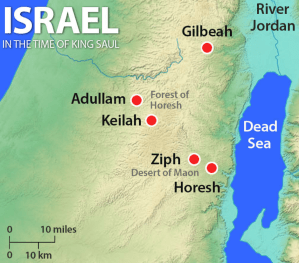
The Ziphites were from the area defined in the map to the right, which also provides the location of Horesh, where David was in hiding, and where the Ziphites were able to locate him. Yet notice the distance to Gibeah, where the Ziphites had to travel to inform Saul of this development. It is close to 25 miles as the crow flies, approximately a days journey for the Ziphites to get to Saul. A days journey there and a days journey back! These folk were determined to get on Saul’s good side!
They bring him good news, and then he, as king of Israel, sends them back for verification. Never enough eh? Give me more information says Saul. This is the spirit of a bossman, a man who is never satisfied, a proud man that uses people.
Notice also that king Saul blessed these folk, but as we well know, these men were treacherous men, seeking to find favor with a king that has had the kingdom taken from him. Did the Ziphites know of Saul’s loss of the kingdom? That is uncertain, but Saul’s vengeful character, his selfish manner and his desire for power should have given the Ziphites guidance on the wisdom of sharing this information.
They should have considered who they were telling secrets too, for I was once told that if a man complains about someone to me, he will complain about me to someone. It is a rare man (or woman) who considers the person’s character he reveals info to, instead of simply looking for instant gratification, as the Ziphites seem to be seeking. Certainly, the Ziphites were ignoring Saul’s character, being deceived by his godly platitudes and were not recognizing the type of man they were revealing sensitive information to.
It is our wisdom to understand those we share sensitive data with, as the Lord himself has informed us in the gospel of Matthew.
Matthew 7:6 “Do not give dogs what is holy, and do not throw your pearls before pigs, lest they trample them underfoot and turn to attack you.
Definitely the need for wisdom is paramount for us as believers in today’s treacherous world, and yet we can have confidence in sharing the love of God with those we come in contact with. He is good, and provides direction in our lives as we look to Him. In all our discussions with those we come in contact with, let us not seek the favor of anyone other than the Lord Himself.
I have spent a bit of time reviewing the context of David’s condition as he writes this Psalm. We shall return to our Psalm in our next post, where David pours out his heart concerning the impact these Ziphites were causing in his attempt to stay alive.
May God bless you as you seek his way this wonderful day.
My hope is that this series will offer my readers a chance to consider the names, characteristics and descriptions of our God in the Word.
Our next set of names (#4 through #22) are considered His compound names, which typically uses His primary name and attaches a specific descriptor to it. These are the names that originally got me chasing this topic, and now it has developed into a much bigger study than the original intent, but I digress, for I have already mentioned this!
The Word is truly rich with descriptions of the Living God, and this effort of searching in the Word was quite illuminating. He truly is the ultimate subject of the Word, and His revelation of self-descriptions, or the accolades offered Him by His priests, prophets, kings apostles and faithful truly was a blessing.
May the Name of the Lord be praised, and by thinking on His name, may you have a blessed day.
11
JEHOVAH EL GEMUWAL (LORD GOD OF RECOMPENSE)
Jeremiah 51:56 for a destroyer has come upon her, upon Babylon; her warriors are taken; their bows are broken in pieces, for the LORD is a God of recompense; he will surely repay.
A bit of background will help in considering this verse
Jeremiah had prophesied the destruction of Jerusalem by the nation of Babylon, and at this time in his ministry, the nation had realized the truth of his message. They had been conquered, and much suffering had been experienced by the people of Israel. In their sufferings, doubts and questions kept rising to the surface for those undergoing this terrible time. One of these questions may have been…
How could a righteous God allow the continuance of this marauding nation to so brutally abuse His people?
In this verse Jeremiah delivers an answer to the people of God in His very name. Remember, a name of someone, in the Word, typifies their character, their essence or identity as to who they really are.
God is a God of recompense!
Jeremiah speaks of a destroyer coming upon Babylon, and that she will experience the very capture and defeat she brought upon Israel. She is not invincible, though we often think of world powers this way. Babylon was on her way out and she would be be shamed and defeated because God is a God of recompense.
When I first found this name, I associated recompense with vengeance, and there is some overlap.
Consider
Deuteronomy 32:35 – Vengeance is mine, and recompense, for the time when their foot shall slip; for the day of their calamity is at hand, and their doom comes swiftly.’
And yet, the term for recompense has an additional component of reward that provides another angle I hadn’t considered.
Isaiah 35:4 Say to those who have an anxious heart, “Be strong; fear not! Behold, your God will come with vengeance, with the recompense of God. He will come and save you.”
Notice that Isaiah speaks of vengeance and recompense and associates it with “coming and saving His people”.
My association of recompense with personal judgement against myself may be bad thinking, for the recompense is for those who reject the Living God, who walk away from Him, who refuse to trust Him. For those who cling to the hope of God, as Isaiah promises,
… He will come and save you
Understanding His recompense depends on where you stand in relation to His presence and person.
He is a God of Recompense and because of that believers may rest in the truth that in the end, His purposes will be accomplished and those who love Him will be saved through trusting His heart of love, as seen in the One who hung on the cross for you and I.
Jesus is the God of Recompense and for that I thank Him and praise His name.
I would love to hear of your favorite name, characteristic or description of the Living God. Please leave me a comment, and I will include it in the list!
Thanks again for coming to visit. I hope you found something of interest in this post and would appreciate a comment, to begin a discussion. If you know someone this blog may bless (or challenge), send them a link, so they may join us in our discussion.
Jesus in the Old Testament is a series of posts that will offer my readers a chance to consider pictures or shadows of Jesus in the Old Testament. As mentioned in the introduction to this series, some may be obvious, some may be not so obvious, and some may simply be a facet of the Lord those reading may not have considered previously.
I hope as we venture through this series, we will see the Lord in many wonderful pictures throughout the Old Testament.
SEEING JESUS IN
ADAM
CREATED
Genesis 2 7 then the LORD God formed the man of dust from the ground and breathed into his nostrils the breath of life, and the man became a living creature.”
1 Corinthians 15 45 Thus it is written, “The first man Adam became a living being”; the last Adam became a life-giving spirit.
Adam became. Jesus became.
Though both of these men are alike in one manner, in that they both “became”, (were brought into existence at a point in time), the similarities end at that point. We shall consider the differences in our next post, but for this particular post I would like to settle on the thought that both these men “became”. The man Adam, and the man Jesus, both became flesh at a point in time, and lived in a flesh and bone body on the face of this earth, both experiencing the temptations and trials of life in a damaged creation.
Both were “created”, and though both would walk entirely different paths in relation to God, they are the two men in this creation who have influenced this world the greatest.
Thanks again for coming to visit. I hope you found something of interest in this post and would appreciate a comment, to begin a discussion. If you know someone this blog may bless (or challenge), send them a link, so they may join us in our discussion.
My hope is that this series will offer my readers a chance to consider the names, characteristics and descriptions of our God in the Word.
Our next set of names (#4 through #22) are considered His compound names, which typically uses His primary name and attaches a specific descriptor to it. These are the names that originally got me chasing this topic, and now it has developed into a much bigger study than the original intent, but I digress, for I have already mentioned this!
The Word is truly rich with descriptions of the Living God, and this effort of searching in the Word was quite illuminating. He truly is the ultimate subject of the Word, and His revelation of self-descriptions, or the accolades offered Him by His priests, prophets, kings apostles and faithful truly was a blessing.
May the Name of the Lord be praised, and by thinking on His name, may you have a blessed day.
10
JEHOVAH ELOHIM (LORD GOD)
Genesis 2:4 These are the generations of the heavens and the earth when they were created, in the day that the LORD God made the earth and the heavens.
Two primary names of God combined together.
We have considered both of these primary names earlier in our thoughts. Elohim and Jehovah (Jahweh)
In combining these two primary names, we have a personal God, as revealed to Moses, yet the strong God of the creation of all things.
Remember that El speaks of power, might, even authority, and when Moses combines the personal name of Jehovah with Elohim, he introduces a tension for the believer to live in.
Is He the almighty, supreme Elohim that is unapproachable, intimidating, beyond our understanding and above all of our thoughts and understanding?
Yes He is!
Is He the eternal, self existent Jehovah (Yahweh) that reveals Himself to men, making the move to open relationship with a broken world, eventually becoming the self sacrificing Messiah willing to die a cruel death for our sakes?
Yes He is!
Brothers – How can we reconcile in our understanding this spectrum of our God? It is too wonderful and beyond comprehension! And yet the Lord promises the believer peace in their understanding, (even if there is tension), a peace that surpasses all understanding.
Philippians 4:7 And the peace of God, which surpasses all understanding, will guard your hearts and your minds in Christ Jesus.
I would love to hear of your favorite name, characteristic or description of the Living God. Please leave me a comment, and I will include it in the list!
Thanks again for coming to visit. I hope you found something of interest in this post and would appreciate a comment, to begin a discussion. If you know someone this blog may bless (or challenge), send them a link, so they may join us in our discussion.
My wife and I are reading through the Psalms in our evening reading and occasionally a nugget of the Psalms jumps out of the page. Don’t you love it when, after years of reading the “Old Book” passages become alive, reinforcing old teachings or simply warming your heart.
This is the book of Psalms, and it is rich.
I pray I can communicate a portion of the blessing we receive from this wonderful book.
We are visiting Psalm 53, which upon even a cursory review, sounds very familiar. So it should, for it is almost identical to Psalm 14, and with that similarity, I would like to consider the similarities and differences each Psalm is communicating. This post will consider verse 3 of the two Psalms.
Psalm 14
Psalm 53
3 – They have all turned aside; together they have become corrupt; there is none who does good, not even one.
3 – They have all fallen away; together they have become corrupt; there is none who does good, not even one.
Psalm 14:3and Psalm 53:3 are identical in all aspects but for one. Is there a difference between turning aside and falling away? Let’s consider this difference in today’s post.
Psalm 14
Psalm 53
turned aside
fallen away
Strongs H5493, סוּר çûwr, soor
Strongs H5472, סוּג çûwg, soog
Genesius’ Hebrew Lexicon defines this term as – to turn aside, to go away, to depart.
Genesius’ Hebrew Lexicon defines this term as – to go away from, to draw back. This term is sometimes associated with backsliding, or moving away
TWOT #1480a
TWOT #1469
I gotta admit something. I am trying to find a difference between Psalm 14:3 and Psalm 53:3, but I can’t!
Though the action taken by the fool is defined by two different Hebrew words in the verses, the Hebrew words are very closely associated (synonyms?). The translation given also provides similar, if not identical actions. The fool turns away from God. The fool falls away from God. Granted, as I took my preliminary read of the two verses, I started thinking falling away is less of an intentional act than turning back, but again the Hebrew words do not allow me to follow that seeming difference.
All that to say, the message is the same. The fool departs from God! This is simply a logical outworking of the contemplation of the heart – no God! No restrictions, and no responsibilities to behave properly with our neighbor! I gotta admit that I sometimes pull a magnifying glass out and try to study little differences in words, when I really just need to pull back and look at the big picture.
Note that David is returning to the concept of corruption. Remember in verse 1, David stated that “They are corrupt”. In this verse, David is describing the group of fools as having “become corrupt”. Which is it David?. They are corrupt or they are becoming corrupt?
Individual or Social?
Although I have no authority in backing up this suggestion, I would like to offer a thought for your consideration. In verse one, might David be referring to an individual fool, and that as an individual, the corruption is a fact. The internal heart condition is in a state of corruption, the degree of which may be different for each fool. Is the corruption evident? Possibly, even probably to a degree, but as the fool continues in his heart contemplation of rejecting God, the evidence of corruption becomes clear.
In verse 3, David includes the descriptive term “together” which I think may hint at the corruption of a group, in contrast to the individual. Is it not true that as an individuals inner corruption becomes evident, it emboldens others to reveal, even boast in their their corruption, allowing for the social fabric to show forth its total corruption. Notice that the verse starts out with this group inclusion thought, by stating “They have all fallen away”.
The last phrase may also support this idea of a group of fools being addressed, in that David emphasizes a singular fool in the midst of the group when he states… “there is none who do good, not even one.” Let me know your thoughts in the comment box below.
With all this analysis, let us remember that the departure from God, corruption that follows and eventual evil acts produced, flows from a heart that rejects God. Every day that we ignore God and His will, we slip towards corruption, to falling away, and to evil acts. This ought not to be, for as the people of God, He has called us to life (not death & corruption), to walking uprightly (not falling away), and to being fruitful believers instead of workers of iniquity.
Spend some time with the One who gives life, righteousness and the fruit of love. He is the fountainhead of all blessing!
My hope is that this series will offer my readers a chance to consider the names, characteristics and descriptions of our God in the Word.
Our next set of names (#4 through #22) are considered His compound names, which typically uses His primary name and attaches a specific descriptor to it. These are the names that originally got me chasing this topic, and now it has developed into a much bigger study than the original intent, but I digress, for I have already mentioned this!
The Word is truly rich with descriptions of the Living God, and this effort of searching in the Word was quite illuminating. He truly is the ultimate subject of the Word, and His revelation of self-descriptions, or the accolades offered Him by His priests, prophets, kings apostles and faithful truly was a blessing.
May the Name of the Lord be praised, and by thinking on His name, may you have a blessed day.
9
EL ROI (GOD OF SEEING)
Genesis 16:13 So she called the name of the LORD who spoke to her, “You are a God of seeing,” for she said, “Truly here I have seen him who looks after me.”
Knowing what we know of the LORD (Jehovah / Jahweh), it seems obvious that He is an all-seeing God. But for a proud woman (Hagar), rejected by her mistress (Sarai), and given up by her husband (Abraham), this verse speaks of the revelation of God who she had heard of from Abraham.
Abraham had taught his household the fear of the Lord, and in this teaching, Hagar must have experienced some influence in her life. Hearing of a God that Abraham knew was one thing. Having this God visit you at your deepest point of sorrow and rejection is another.
What we know of Hagar is that the God who revealed Himself was One that had seen her plight. Few women in this time had been delivered a message from God, and this Angel of the Lord provided her guidance that may not have been too enjoyable.
Sarai had dealt harshly with her, so harshly that Hagar sought refuge out of the camp, away from the community she had been associated with for many years. Yes she had found a spring, and it may have been her hope to find a rescuer at the spring, but the Angel came to visit her before she found an option to choose from.
The stranger brought new that was bad and good.
The bad news was that she had to go back to her mistress, the one who death harshly with her, and was required to submit to her. It seems that the status of being Abraham’s wife went to Hagar’s head, and verse 4 speaks of her looking down on Sarai with contempt. This child she conceived was her opportunity to elevate herself in the tribe, being the only wife able to provide for Abraham a seed. Such an important opportunity provided her a status she had never known, and didn’t quite handle properly.
A continual humbling may be ahead for Hagar, a reminder that she was a second class wife, (at least in Sarai’s eyes), and difficult relationships between the two continued for many years.
The good news was that a young child would be born, that he would be called Ishmael, and that he would be the father of many. The nation of the Ishmaelites grew from this seed, and have been a thorn in Israel’s side for much of her history.
Hagar called the God of Abraham the God of seeing, for He not only saw her affliction at the present, but also her past and future, of her child’s future, and of the leader he would become over his kinsmen.
She saw the One who sees! In her deepest affliction, (brought on by her own contempt and pride), her eyes were ready to see the One who Abraham had spoken of. And she returned to the camp, with a humbled spirit and a willing attitude to do as instructed, for she experientially knew of the God who sees, instead of simply hearing the story of Abrahams God
God is a mysterious One, who uses affliction to open our eyes, and suffering to release the wax from our ears. He is a good God that does not seek to waste any pain we experience in this life, but is willing to take our loss and provide greater good than we can imagine.
Although not directly associated with our name of God for this post, when I think of loss in the believers life, and God’s gracious provision, I usually think of Joel 2:25
Joel 2:25 I will restore to you the years that the swarming locust has eaten, the hopper, the destroyer, and the cutter, my great army, which I sent among you.
God is good and He is the God who sees, not only our good intentions (few as they may be) but also our weakness, pain, rejection, abandonment and loneliness. He sees us, and for this we must be thankful, for He watches over us, working His good will in the midst of this messy life!
I would love to hear of your favorite name, characteristic or description of the Living God. Please leave me a comment, and I will include it in the list!
Thanks again for coming to visit. I hope you found something of interest in this post and would appreciate a comment, to begin a discussion. If you know someone this blog may bless (or challenge), send them a link, so they may join us in our discussion.
I’ll admit it. As a young believer, I grew up in the Lord in a Baptist church and when we spoke of fellowship, we all knew what it meant! Pot providence. (Christians don’t dare believe in luck, therefore pot providence.) A typical gathering in the basement of the old church with Miss Betty’s best rhubarb pie, fried chicken and of course casseroles of exceeding abundance and variety. Looking back, I am shocked at the number of varieties of casseroles that would show up.
Yes – Baptist fellowship was, for a large part of my young church going life, centered around food. Of course, we all know that fellowship is to be centered around the Lord Jesus, but sometimes the breaking of bread, that is munching on casseroles, fried chicken, multiple pies and cakes, hamburgers, hotdogs, french fries, green beans, – must I go on?) actually enables a bonding that the Lord desires with His people. The logic, I think, was that having a meal with another believer is a means to an end, and that is of sharing with others what we have, taking time to be with others around the table. Jesus broke bread with His disciples and during these times, He spoke some of His deepest and richest teachings, sharing His heart with His disciples.
Yes, fellowship still is a food thing for me, and I want to let you know that if a brother invites you to a meal, be thankful. I know – that is so obvious, but my story for this post involves a group of believers that attended our home Bible study years ago. We had about 4 or 5 families coming pretty regular, enjoying a couple hours chatting about life and reading the Word.
After a few months, my wifey wanted to host a meal with the group on a Sunday after church, just to let our hair down a bit with everyone. Thought it was a great idea, and since we usually got together around 3 on a Sunday afternoon, we asked all if a couple hours early would be good this one time. All agreed, and my wife started planning.
Barbecue, tater salad, pies, french fries, salads, and a couple casseroles, if I remember correctly. She really done it up good, and I was anticipating a real good feast with folks around the table. Except, that isn’t what happened. Most of the families that came enjoyed the taste of the food, but two of the families refrained from eating. The stood off in the distance, sat on the couch, and waited for the remainder of the group to finish.
I need to let you know that the two families belonged to a denomination that I wasn’t familiar with, yet in their studies, they seemed very earnest, very passionate. One topic seemed to get stuck in their throat as we had been getting together, but that is something that we all understood and realized they had their convictions. No problem.
Yet when they declined to break bread with us, that became an incident that was telling of a general attitude of those committed to this church. We were not worthy to share a meal with.
How hurtful for the young church after the resurrection, to be split in factions due to religion! How that burned in Paul’s heart, and I somewhat understand. It has been decades since this incident, but Sweetie and I came away from it hurt, shocked and somewhat disbelieving it even happened. In the end I think we have come to understand that doctrine is not the be all and end all. For you see the Word states that without love, we are nothing. A judgmental attitude towards those who claim the name of Jesus, though in a different denomination, is a damaging, destroying attitude that simply brings death to a body of believers.
Galatians 5:14, 15 For the whole law is fulfilled in one word: “You shall love your neighbor as yourself.” But if you bite and devour one another, watch out that you are not consumed by one another.
When a brother offers you something, be grateful, share in it, and bring the love of God into it. It is the best way for both giver and receiver to maximize the blessings available!
As an aside, it seems coincidental that Paul brings into the passage above the concept of biting and devouring. Could he be referring to the same problem in the Galatian church? No matter – I just know that I am gonna sign off get myself a burger – this talk of food has got me hunnery!
Remember – God is good, and His children are to mimic Him.
Thanks again for coming to visit. I hope you found something of interest in this post and would appreciate a comment, to begin a discussion. If you know someone this blog may bless (or challenge), send them a link, so they may join us in our discussion
My hope is that this series will offer my readers a chance to consider the names, characteristics and descriptions of our God in the Word.
Our next set of names (#4 through #22) are considered His compound names, which typically uses His primary name and attaches a specific descriptor to it. These are the names that originally got me chasing this topic, and now it has developed into a much bigger study than the original intent, but I digress, for I have already mentioned this!
The Word is truly rich with descriptions of the Living God, and this effort of searching in the Word was quite illuminating. He truly is the ultimate subject of the Word, and His revelation of self-descriptions, or the accolades offered Him by His priests, prophets, kings apostles and faithful truly was a blessing.
May the Name of the Lord be praised, and by thinking on His name, may you have a blessed day.
8
EL GIBBOR (MIGHTY GOD)
Jeremiah 32:18 You show steadfast love to thousands, but you repay the guilt of fathers to their children after them, O great and mighty God, whose name is the LORD of hosts,
Out of the many names I have found in my research for this series, this particular name is one I have not considered in the past. To see the name “El Gibbor” strikes an unfamiliarity to my thinking. Yet I have often read of the mighty God.
In my research this term is often associated with action or reputation. When speaking of men, the term refers to a champion, a warrior, even a tyrant in some instances. Each of these descriptions speak of one who is not only strong, but uses his strength in battle to win wars.
God is a God of war, and as soon as I say that, most may think of blood, death, destruction and horror on a battle field. I would like to suggest that the Lord Jesus has described our warfare in different terms.
Death to self, and life for others. Loving our enemy. Seeking to be peacemakers, (not just peacekeepers!)
He is the Mighty God, who entered into battle for our souls, voluntarily suffering for others. To submit to this suffering in order to obey His Father and win our souls exhibits great strength of will and power of love.
He is El Gibbor, the Mighty God, mighty in His nature and in His doings, showing steadfast love to thousands upon thousands of His enemies, rescuing them through subjection to suffering.
The strength of our God is not to be lightly considered.
Let us thank Him for Him mighty love that broke through our doubts and fears!
I would love to hear of your favorite name, characteristic or description of the Living God. Please leave me a comment, and I will include it in the list!
Thanks again for coming to visit. I hope you found something of interest in this post and would appreciate a comment, to begin a discussion. If you know someone this blog may bless (or challenge), send them a link, so they may join us in our discussion.
My wife and I are reading through the Psalms in our evening reading and occasionally a nugget of the Psalms jumps out of the page. Don’t you love it when, after years of reading the “Old Book” passages become alive, reinforcing old teachings or simply warming your heart.
This is the book of Psalms, and it is rich.
I pray I can communicate a portion of the blessing we receive from this wonderful book.
We are visiting Psalm 53, which upon even a cursory review, sounds very familiar. So it should, for it is almost identical to Psalm 14, and with that similarity, I would like to consider the similarities and differences each Psalm is communicating. This post will consider verse 2 of both Psalms.
Psalm 14
Psalm 53
2 – The LORD looks down from heaven on the children of man, to see if there are any who understand, who seek after God.
2 – God looks down from heaven on the children of man to see if there are any who understand, who seek after God.
Verse 2 provides a striking difference between the two Psalms. Who is looking down from heaven on the children of men? Psalm 14 speaks of the LORD looking down, whereas Psalm 53 speaks of God looking down on the children of men. What shall we make of this difference?
I have coincidentally just begun a series on the names of God and of course these two primary names of God are considered.
At this time, let us consider if the difference in using two names for God in these psalms may indicate different intended audiences. When we see that God is addressed in Psalm 53, we may understand the audience to be of the more general audience, those not only in the Siniatic covenant (Israel) but of all who have consciousness, alive within this created world. In contrast, when Psalm 14 addresses God with the revealed covenantal name of LORD (Jehovah/Yahweh), David may be targeting the covenantal people of God
Given that in Psalm 53:1, David described the works of the fool as abominable iniquity, and not simply abominable deeds in Psalm 14, may also support this difference in who is looking down on the children of men. Psalm 53, in being directed to a general audience, and may reflect the authors desire to make a point with those outside of the community of faith. Their deeds are incredibly offensive to God. Those outside the community of faith need to understand their plight, for they may not have access to the law of God that provides guidance for their lives, (and conviction of sin).
Are you in a covenant with God, and do you know Him? To avoid the stigma and condemnation / judgement of doing abominable deeds, we must find life in the Son and hold fast to His leadership in our lives.
My hope is that this series will offer my readers a chance to consider the names, characteristics and descriptions of our God in the Word.
Our next set of names (#4 through #22) are considered His compound names, which typically uses His primary name and attaches a specific descriptor to it. These are the names that originally got me chasing this topic, and now it has developed into a much bigger study than the original intent, but I digress, for I have already mentioned this!
The Word is truly rich with descriptions of the Living God, and this effort of searching in the Word was quite illuminating. He truly is the ultimate subject of the Word, and His revelation of self-descriptions, or the accolades offered Him by His priests, prophets, kings apostles and faithful truly was a blessing.
May the Name of the Lord be praised, and by thinking on His name, may you have a blessed day.
7
EL OLAM (THE EVERLASTING GOD)
Genesis 21:33 Abraham planted a tamarisk tree in Beersheba and called there on the name of the LORD, the Everlasting God.
Isaiah 40:28 Have you not known? Have you not heard? The LORD is the everlasting God, the Creator of the ends of the earth. He does not faint or grow weary; his understanding is unsearchable.
This name also uses the primary name El in conjunction with Olam, which, as translated speaks of God’s eternality, or His self existence, without beginning and without end.
As Isaiah speaks to the people of God, he asks rhetorical questions to those who have been under the tutelage of the law. Have you not known? Have you not heard?
My goodness, during the days of Isaiah, if any of creation knows of the God of Abraham, and the God of Moses, it must be the nation of Israel, for they have received the written word, describing the God they are in covenant with, the God who has no beginning and has no end.
It is so easy to condemn those in the past as having dropped the ball when it comes to understanding who God truly is, but I will confess that much of my day is sometimes consumed with the here and now and not the inevitable future where God resides.
I understand I can change nothing about the past, other than to seek forgiveness from those whom I may have hurt, but while in the present, after considering the eternality of God, I can change my future.
Let us reflect on the everlasting nature of our Living God, that He will ever be with us, will never “not be” and has provided His Son, separated from Him for a time, so we may continually abide with the everlasting One.
I would love to hear of your favorite name, characteristic or description of the Living God. Please leave me a comment, and I will include it in the list!
Thanks again for coming to visit. I hope you found something of interest in this post and would appreciate a comment, to begin a discussion. If you know someone this blog may bless (or challenge), send them a link, so they may join us in our discussion.
As we have been venturing through the Psalms, getting lost in the volume of the book, and the many nuggets of truth laid out for believers, I have come to realize (again and again) the beauty of the book, the depth of the book, the expanse of the human experience the book describes and allows us to join into.
We started with a quick dip into one of the most amazing chapters in the Word, one that has impacted my life in various stages of my Christian faith. It is a psalm that spoke to my wife and I as we were reading that night, but it began a journey through the psalms that has continued for over a year, and I suspect may continue to hold me.
With that said, I would like to offer those who read my bumbling efforts to understand one of the great books of the greatest book ever delivered to the human race, an ongoing summary of the findings and blessings I have enjoyed discovering.
Jesus in the Old Testament is a series of posts that will offer my readers a chance to consider pictures or shadows of Jesus in the Old Testament. As mentioned in the introduction to this series, some may be obvious, some may be not so obvious, and some may simply be a facet of the Lord those reading may not have considered previously.
I hope as we venture through this series, we will see the Lord in many wonderful pictures throughout the Old Testament.
SEEING JESUS IN
ADAM
LORD OF CREATION
Genesis 1 28 And God blessed them. And God said to them, “Be fruitful and multiply and fill the earth and subdue it, and have dominion over the fish of the sea and over the birds of the heavens and over every living thing that moves on the earth.”
Colossians 1 15 He is the image of the invisible God, the firstborn of all creation. 16 For by him all things were created, in heaven and on earth, visible and invisible, whether thrones or dominions or rulers or authorities–all things were created through him and for him.
Adam was provided the right to have dominion over all of creation. He was the master or lord over the creation provided to him from God.
Jesus is the Lord of lords, and as such is seen in Adam in the early pages of the Old Testament. He is the One who has dominion over all dominions, thrones, rulers and authorities!
Thanks again for coming to visit. I hope you found something of interest in this post and would appreciate a comment, to begin a discussion. If you know someone this blog may bless (or challenge), send them a link, so they may join us in our discussion.
My hope is that this series will offer my readers a chance to consider the names, characteristics and descriptions of our God in the Word.
Our next set of names (#4 through #22) are considered His compound names, which typically uses His primary name and attaches a specific descriptor to it. These are the names that originally got me chasing this topic, and now it has developed into a much bigger study than the original intent, but I digress, for I have already mentioned this!
The Word is truly rich with descriptions of the Living God, and this effort of searching in the Word was quite illuminating. He truly is the ultimate subject of the Word, and His revelation of self-descriptions, or the accolades offered Him by His priests, prophets, kings apostles and faithful truly was a blessing.
May the Name of the Lord be praised, and by thinking on His name, may you have a blessed day.
6
EL ELYON (THE MOST HIGH GOD)
Psalm 78:35 They remembered that God was their rock, the Most High God their redeemer.
This name of God speaks of His loftiness, His elevated status over all of creation. As the creator of all, He is above all of creation by the fact He is outside of the creation, eternal and everlasting. The term also is used in comparison to false idols and gods, in that they can not compete with the Most High.
The term speaks of one elevated, lofty or supreme. There is no other like the Most High God.
It may be that the Canaanites referred to their local gods as el (god), but for the Israeli’s as they understood the truths that had been delivered to them through the revelation of God, would refer to the true God as the most High God, in comparison with the idols in the land.
Our God is King of Kings and Lord of Lords and is the Most High God, reigning over all other gods, high above all other beings. He is the only One worthy of this name, and we are privileged to know Him through His death on the cross.
And this is eternal life, that they know you, the only true God, and Jesus Christ whom you have sent.
I would love to hear of your favorite name, characteristic or description of the Living God. Please leave me a comment, and I will include it in the list!
Thanks again for coming to visit. I hope you found something of interest in this post and would appreciate a comment, to begin a discussion. If you know someone this blog may bless (or challenge), send them a link, so they may join us in our discussion.
My wife and I are reading through the Psalms in our evening reading and occasionally a nugget of the Psalms jumps out of the page. Don’t you love it when, after years of reading the “Old Book” passages become alive, reinforcing old teachings or simply warming your heart.
This is the book of Psalms, and it is rich.
I pray I can communicate a portion of the blessing we receive from this wonderful book.
We are visiting Psalm 53, which upon even a cursory review, sounds very familiar. So it should, for it is almost identical to Psalm 14, and with that similarity, I would like to consider the similarities and differences each Psalm is communicating.
The first item to review is the topic of a fool. Both psalms speak of the “fool” and in our modern way of understanding, to call someone a fool implies one who is deficient in understanding, judgemnt or sense. One who is easily tricked, or made to look foolish/stupid. This is not the primary meaning of when the Hebrew mind read this word.
The term found in both psalms is nāḇāl, and if you think back in David’s life, you will recognize this noun as a proper name of one of David’s enemies.
1 Samuel 25:3 Now the name of the man was Nabal, and the name of his wife Abigail. The woman was discerning and beautiful, but the man was harsh and badly behaved; he was a Calebite.
Note that the Scripture gives us a character description of the man named “fool” as being harsh and badly behaved. Nothing to do with intelligence directly, but a commentary on his lifestyle and behavior. To be a fool (nāḇāl) in the Hebrew mind was to reject God’s authority and influence, being controlled by the baser elements of the earthly life.
David is not making a commentary on the intelligence of the one rejecting God, but on the moral standing of that one. With that short introduction, lets consider our first verse.
Psalm 14
Psalm 53
1 – To the choirmaster. Of David. The fool says in his heart, “There is no God.” They are corrupt, they do abominable deeds; there is none who does good.
1 – To the choirmaster according to Mahalath. A Maskil of David. The fool says in his heart, “There is no God.” They are corrupt, doing abominable iniquity; there is none who does good.
Note that Psalm 53 has the additional instruction of “according to Mahalath. A Maskil of David”. Mahalath, from what I have found, refers to an instrument, possible a harp, along with the description of David the psalm as a maskil. This is another mysterious word, but many scholars lean to the idea that this word describes a contemplation or an instructive message.
For Psalm 53 to include this addition may emphasize the seriousness of the message, since Mahalath also may have a sense of mournfulness, sadness or entreaty.
The fool contemplates the existence of God in his heart. During this contemplation, he concludes that there is either no God, (as the translation records – “There is no God”) or that the fool rejects God’s authority over him, by saying “No God”. For you see, the Old Testament text does not include specific words that may be translated as “There is” – see snippet from the Blue Letter Bible to the right.
Either an athiest or a rebel – Which my friend do you consider to be the worst fate?
This is the beginning of becoming the fool, for without God, there are no lasting standards defining right from wrong, and therefore all things are relativistic, according to multiple authorities, with inevitable conflicts. Truly a foolish way to live!
Corrupt
David continues in the first verse of both Psalm 14 and 53 to describe the outcome of this contemplation. Both Psalms speaks of corruption, of a spoiling or rotting, even of a perverting of their very nature. Their very nature or character is being destroyed by this thinking, falling to baser and baser levels of existence. They are literally rotting on the inside. After David’s description of the fool’s character, he goes on to to describe the works produced by this fool.
Abominable Deeds/Iniquity
This is where we find a difference in the Psalms we are looking at. You see, Psalm 14 speaks of deeds, whereas Psalm 53 brings the darker concept of iniquity into the equation.
Psalm 14
Psalm 53
they do abominable deeds
doing abominable iniquity
Psalm 53 raises the stakes in speaking of abominable iniquity. Both describe the activities as abominable, that which is abhorrent, but with the added concept of iniquity, Psalm 53 becomes an even darker description of the fools works. Iniquity speaks of injustice, including violence, which if considered, will always become the end result of a life with no standards. This is the end result of saying “No God”
Uniform in not Doing Good
A final description within both Psalms speaks of this group of fool as being homogeneous, pure and without any deviation in their work of doing good. That is, no-one that contemplates the non existence of God, or that refuses to bow before Him, performs any good. To say that no one does good, for some, implies that the fool cannot even understand goodness or righteousness. Yet, let’s remember that David is speaking of actions when he speaks on no one doing good, based on the contemplation of the heart.
Yes, the heart, if hardened beyond reach, this condition sets the fools actions into inevitable evil and injustice. Yet, I am not convinced the contemplation of the heart is necessarily complete in any fool, for I too (as you may be) lived a fools life and contemplated a life of the rebel, saying no to God. In His mercy, He invited me into a living relationship with Him, and by His grace, He is pulling me out of a life of injustice and violence.
Are you contemplating saying no to God? My friend, consider you ways, for a life of rejecting God will lead to a life of injustice. A life of walking with Him will produce love and peace, both internally and as an outworking of the heart into the lives of others.
My hope is that this series will offer my readers a chance to consider the names, characteristics and descriptions of our God in the Word.
Our next set of names (#4 through #22) are considered His compound names, which typically uses His primary name and attaches a specific descriptor to it. These are the names that originally got me chasing this topic, and now it has developed into a much bigger study than the original intent, but I digress, for I have already mentioned this!
The Word is truly rich with descriptions of the Living God, and this effort of searching in the Word was quite illuminating. He truly is the ultimate subject of the Word, and His revelation of self-descriptions, or the accolades offered Him by His priests, prophets, kings apostles and faithful truly was a blessing.
May the Name of the Lord be praised, and by thinking on His name, may you have a blessed day.
5
EL SHADDAI (ALMIGHTY GOD)
Genesis 17:1 When Abram was ninety-nine years old the LORD appeared to Abram and said to him, “I am God Almighty; walk before me, and be blameless,
We have considered Elohim in post #1 of this series, and I would like to consider the secondary term in this compound name, for I have discovered an aspect of “Shaddai” that I had never understood before.
The Hebrew transliteration of the term for Shaddai is šaday, and as I was “rootin’ about”, I clicked on the root word etymology of this term. Blue Letter Bible took me to H7703 – šāḏaḏ.
To be a root word means that all derivatives of the root finds some truth in the root word. Shaddai, as we are considering today, is rooted in the šāḏaḏ.
This is where I became somewhat shocked at what I found, for until this finding, I had always assumed Shaddai was simply referring to God (El) as being powerful, most powerful, all powerful or almighty. And I have no doubt of this fantastic truth.
When we explore the root word šāḏaḏ, it refers to one who spoils, wastes, assaults or deals violently. The term describes the apparent outcome of the power. An example of šāḏaḏ found in the Word, in relation to God’s power being exercised is Jeremiah 25:36
A voice–the cry of the shepherds, and the wail of the lords of the flock! For the LORD is laying waste šāḏaḏ their pasture.
Now before anyone starts calling me a heretic, I am not claiming that the blessed God, who is the Almighty, has evil intent or uses His great abilities simply for destruction! There is no way I believe that. Yet His power may bring about violent happenings, as Jeremiah notes in the verse above, and that which when the shepherds witnessed, brought about crying and wailing. For we must remember that the same God who is described as Almighty, is also described as all knowing, and full of wisdom. He exercises His power in perfect righteousness, without staining His character, though we often struggle with that!
We all will admit we want things to always be peachy keen and for every day to be full of sunshine. We know this is a pipe dream. Bad things happen, and yet our God is the Almighty. Though some of His acts may bring about destruction (from our point of view) faith rises above that and recognizes the God of the Bible as the One hanging on the cross, bearing the suffering we deserved, accepting the shame resulting from our sinful decisions.
He is the Almighty, yet He voluntarily hung on that instrument of death, “powerless” to free himself but for one reason. The power of love, greater than all His suffering and shame, shone forth on that ol’ rugged cross, when the Almighty became weak for our sake.
He is the Almighty God (El Shaddai), mighty in power and love to His creation. Praise His name today!
I would love to hear of your favorite name, characteristic or description of the Living God. Please leave me a comment, and I will include it in the list!
Thanks again for coming to visit. I hope you found something of interest in this post and would appreciate a comment, to begin a discussion. If you know someone this blog may bless (or challenge), send them a link, so they may join us in our discussion.
Jesus in the Old Testament is a series of posts that will offer my readers a chance to consider pictures or shadows of Jesus in the Old Testament. As mentioned in the introduction to this series, some may be obvious, some may be not so obvious, and some may simply be a facet of the Lord those reading may not have considered previously.
I hope as we venture through this series, we will see the Lord in many wonderful pictures throughout the Old Testament.
SEEING JESUS IN
ADAM
HIS WIFE
Genesis 2 22 And the rib that the LORD God had taken from the man he made into a woman and brought her to the man. 23 Then the man said, “This at last is bone of my bones and flesh of my flesh; she shall be called Woman, because she was taken out of Man.”
Revelation 19 7 Let us rejoice and exult and give him the glory, for the marriage of the Lamb has come, and his Bride has made herself ready;
Revelation 21 2 And I saw the holy city, new Jerusalem, coming down out of heaven from God, prepared as a bride adorned for her husband.
In placing Adam into a deep sleep, God took from Adam a rib to make his wife. Adam received a wife out of the experience of death, out of His very body.
How so much more did the Lord create a wife for the Son out of the death He experienced?
Thanks again for coming to visit. I hope you found something of interest in this post and would appreciate a comment, to begin a discussion. If you know someone this blog may bless (or challenge), send them a link, so they may join us in our discussion.
My hope is that this series will offer my readers a chance to consider the names, characteristics and descriptions of our God in the Word.
Our next set of names (#4 through #22) are considered Hs compound names, which typically use His primary name and attach a specific descriptor to it. These are the names that originally got me chasing this topic, and now it has developed into a much bigger study than the original intent, but I digress, for I have already mentioned this!
The Word is truly rich with descriptions of the Living God, and this effort of searching in the Word was quite illuminating. He truly is the ultimate subject of the Word, and His revelation of self-descriptions, or the accolades offered Him by His priests, prophets, kings apostles and faithful truly was a blessing.
May the Name of the Lord be praised, and by thinking on His name, may you have a blessed day.
4
ADONAI JEHOVAH (LORD GOD)
Genesis 15:2 ESV – But Abram said, “O Lord GOD, what will you give me, for I continue childless, and the heir of my house is Eliezer of Damascus?”
Our first compound name is the combination of two primary names. As an aside, I am thankful that when Jehovah (or Jahweh) is found in the text, the translators provide a clue and capitalize all letters in the English translation. Such is the case in this instance.
He is the Lord (Adonai), One who has authority and power, in the ultimate sense, and GOD (Jehovah), the self existent One, dependent on no one.
In our text, Abraham has been provided a promise by God, but it hadn’t been realized yet. He had been promised a son but had remained childless, and time was running out! Yet in addressing God, Abraham combined two of His personal primary names to emphasize his trust in the Living One.
Abraham had used both these names in addressing the Father before, but not in the same manner as here. In this passage he combined them into one name, specifically emphasizing the power and independence of the Lord. In God’s independent power, He was able to provide “results” based only on His own good will and the requests of those who had his ear.
Abraham had entered into this understanding, and was speaking to God freely, concerning His promise of an heir. He is listening today.
Do you have a sense of his independence and power, that He is free (beholding to no one) and able (powerful) to perform that which is within His will for those who have His ear?
I would love to hear of your favorite name, characteristic or description of the Living God. Please leave me a comment, and I will include it in the list!
Thanks again for coming to visit. I hope you found something of interest in this post and would appreciate a comment, to begin a discussion. If you know someone this blog may bless (or challenge), send them a link, so they may join us in our discussion.
My wife and I are reading through the Psalms in our evening reading and occasionally a nugget of the Psalms jumps out of the page. Don’t you love it when, after years of reading the “Old Book” passages become alive, reinforcing old teachings or simply warming your heart.
This is the book of Psalms, and it is rich.
I pray I can communicate a portion of the blessing we receive from this wonderful book.
Psalm 52:8 But I am like a green olive tree in the house of God. I trust in the steadfast love of God forever and ever. Psalm 52:9 I will thank you forever, because you have done it. I will wait for your name, for it is good, in the presence of the godly.
David has just described the doom of the mighty man, along with the reaction of the humble man to the “breaking” of the mighty man. We considered what it meant to be broken and what seeking refuge in his own destruction may be describing. (Who in their right mind would seek refuge in their own destruction).
David, in our portion this time, describes his own experience in relation to God. He is like a green olive tree, and when I hear the term olive tree I think of God’s covenant relationship with His people. See Jeremiah 11:16 for an example.
Jeremiah 11:16 – The LORD once called you ‘a green olive tree, beautiful with good fruit.’ But with the roar of a great tempest he will set fire to it, and its branches will be consumed.
Not only does the green olive tree remind me of the relationship God had with His nation Israel, it also reminds me of the new covenant we enjoy under the Lord’s authority today.
But beyond all that, I think of the wonderful oil that is produced from the fruit of this tree. The olive oil that is produced by the crushing of the olive fruit. A crushing of the fruit that hearkens to the crushing of the Savior, the crushing of His body to bring about the spiritual oil that anoints those who seek the Master. But we must not forget that it was a crushing that was required to produce this blessing, and as he hung on the cross, taking the punishment we – I – deserved, He was also undergoing a crushing that would produce the fruit of life to those who sought Him.
How often Jesus may have recounted the second portion of verse 8 while suffering.
I trust in the steadfast love of God forever and ever.
No one in the history of all of creation has experienced the depth of the truth of that verse but for him. At the very time of His suffering, He only had His trust in the steadfast love of God, in the faithfulness of His Father, even as He was abandoned for the first (and only) time of His existence.
Upon His resurrection, may I suggest that Jesus entered the truth of verse 9.
I will thank you forever, because you have done it.
Consider how Jesus is thanking His Father. God the Father rescued Him from death, for He could not behold it. Is it any less incumbent for us who know nothing of His depth of suffering to be any less thankful for His tremendous grace towards us?
Let us have a thankful spirit and give thanks unto the Lord for His mighty acts of rescue!
My hope is that this series will offer my readers a chance to consider the names, characteristics and descriptions of our God in the Word.
Our first three names are considered His primary names!
The Word is truly rich with descriptions of the Living God, and this effort of searching in the Word was quite illuminating. He truly is the ultimate subject of the Word, and His revelation of self-descriptions, or the accolades offered Him by His priests, prophets, kings apostles and faithful truly was a blessing.
May the Name of the Lord be praised, and by thinking on His name, may you have a blessed day.
3
ADONAI (LORD)
Deut. 6:4 Hear, O Israel: The LORD our God, the LORD is one.
In our last post, we spoke of the Tetragrammaton, in other word the 4 letters that we understand represents the name Jehovah, or Jahweh.
In this post we are going to consider the Hebrew word Adonai, as the third and last primary name of our God. Adonai is the Hebrew word for Lord, referring to someone who has power and authority.
As discussed in our first post, Adonai is also used to refer to earthly rulers frequently in the Word, but of course not in the absolute sense as when referring the our God. The Creator and Sustainer of all things is by His very nature the Lord (Adonai) and Master (Adonai) of all things.
We may fight this truth, deny this truth, ignore this truth, but until we submit to this truth, we will never find peace. And the truth of His lordship is not dependent on our opinion of this claim He makes. He is Lord whether we like it or not.
My advice you ask? Submit to the truth, as far as you understand it, that Jesus is Lord (Adonai) and that you want to be a disciple, a learner of what that means in every area of your life.
Peace will find you when you submit. And it is a glorious peace, for you see, He is Lord and He is good, all the time!
I would love to hear of your favorite name, characteristic or description of the Living God. Please leave me a comment, and I will include it in the list!
Thanks again for coming to visit. I hope you found something of interest in this post and would appreciate a comment, to begin a discussion. If you know someone this blog may bless (or challenge), send them a link, so they may join us in our discussion.
As we have been venturing through the Psalms, getting lost in the volume of the book, and the many nuggets of truth laid out for believers, I have come to realize (again and again) the beauty of the book, the depth of the book, the expanse of the human experience the book describes and allows us to join into.
We started with a quick dip into one of the most amazing chapters in the Word, one that has impacted my life in various stages of my Christian faith. It is a psalm that spoke to my wife and I as we were reading that night, but it began a journey through the psalms that has continued for over a year, and I suspect may continue to hold me.
With that said, I would like to offer those who read my bumbling efforts to understand one of the great books of the greatest book ever delivered to the human race, an ongoing summary of the findings and blessings I have enjoyed discovering.
As you can tell from the expanding list of posts, the Psalms have got a hold on me!
Jesus in the Old Testament is a series of posts that will offer my readers a chance to consider pictures or shadows of Jesus in the Old Testament. As mentioned in the introduction to this series, some may be obvious, some may be not so obvious, and some may simply be a facet of the Lord those reading may not have considered previously.
I hope as we venture through this series, we will see the Lord in many wonderful pictures throughout the Old Testament.
SEEING JESUS IN
ADAM
DEEP SLEEP
Genesis 2 21 So the LORD God caused a deep sleep to fall upon the man, and while he slept took one of his ribs and closed up its place with flesh.
Matthew 27 50 And Jesus cried out again with a loud voice and yielded up his spirit.
Adam’s “deep sleep” speaks of the Messiah’s death, of a death that was purposed for the creation of a partner, a new life out of the death.
Thanks again for coming to visit. I hope you found something of interest in this post and would appreciate a comment, to begin a discussion. If you know someone this blog may bless (or challenge), send them a link, so they may join us in our discussion.
My hope is that this series will offer my readers a chance to consider the names, characteristics and descriptions of our God in the Word.
Our first three names are considered His primary names!
The Word is truly rich with descriptions of the Living God, and this effort of searching in the Word was quite illuminating. He truly is the ultimate subject of the Word, and His revelation of self-descriptions, or the accolades offered Him by His priests, prophets, kings apostles and faithful truly was a blessing.
May the Name of the Lord be praised, and by thinking on His name, may you have a blessed day.
2
JEHOVAH (LORD)
Genesis 4:1 Now Adam knew Eve his wife, and she conceived and bore Cain, saying, “I have gotten a man with the help of the LORD.”
Exodus 3:14God said to Moses, “I am who I am.” And he said, “Say this to the people of Israel: r‘I am has sent me to you.’ ”
This name of God, from the Old Testament is of even greater mystery than our first name, Elohim which introduced the concept of multiple persons in the godhead. Jehovah, or as some scholars prefer Yahweh, is our feeble attempt to understand YHWH, the tetragrammatron, (meaning four letters). No vowels. Four consanants.
The problem with knowing the correct pronunciation of YHWH is that out of respect for the God of Israel, the Jews would not pronouce his name for fear of saying it wrong.
The “four letters” were God’s self revelatory illumination to Moses in Exodus 3:14, as to who was speaking to him. He is the self existant One, the only One who depends on no one else for anything. We are created, He is uncreated. We exist in Him, He is self existant. We are empty shells always needing needing needing. He is the self sufficient One.
Up until Genesis 4:1, Moses referred to God as “LORD God”, or the compound name Jehovah Elohim. Until this verse, all activities were describing Gods actions (creation, commanding, taking, causing, banishment, etc) as first person.
Genesis 4 begins referring to the Lord as Jehovah as the primary name, not a compound name. This verse speaks of Eve’s description of God, due to her giving birth to Cain.
For today, it may well be a good reminder that our God is the One who depends on no one out of necessity, He has no one to answer to, and He is the only One who is not created, but the One who is self existant. I expect that to dwell on this truth today will be a stabilizing influence in our lives, and will honor the One to whom honor is due.
I would love to hear of your favorite name, characteristic or description of the Living God. Please leave me a comment, and I will include it in the list!
Thanks again for coming to visit. I hope you found something of interest in this post and would appreciate a comment, to begin a discussion. If you know someone this blog may bless (or challenge), send them a link, so they may join us in our discussion.









 Considering the Bible