Jesus in the Old Testament is a series of posts that will offer my readers a chance to consider pictures or shadows of Jesus in the Old Testament. As mentioned in the introduction to this series, some may be obvious, some may be not so obvious, and some may simply be a facet of the Lord those reading may not have considered previously.
I hope as we venture through this series, we will see the Lord in many wonderful pictures throughout the Old Testament.
SEEING JESUS IN
Abraham
Foreigner
Genesis 23:4 “I am a sojourner and foreigner among you; give me property among you for a burying place, that I may bury my dead out of my sight.”
John 1:11 He came to his own, and his own people did not receive him.
In our last post on Abraham we considered his accepted status as a a sojourner, or a tempory inhabitant of the land.
In this post lest us consider Abraham as a foreigner. One who is not like those he lives amongst. Someone who is different than the general public, than the masses.
This surely was Abrahams condition, being a monotheist in a land of polytheism, a stranger wandering about. It may have seemed to those he rubbed shoulders with that he may be running from something, or trying to hide from something. Being a foreigner, brings a suspicious eye from the populace.
He was so different!
This also is so true of our Savior, for though he arrived amongst those of His own, He was looked upon with suspicious eyes, seeing that He was different, so different that the average Israelite. As he revealed who He was for those who would accept it, His differences, when compared with the common Joe only increased!
Both Abraham and Jesus were foreigners amongst their neighbors, but how much more for Jesus!
Upon arriving on this globe, Jesus also lived a life of a temporary inhabitant, though He possessed all things, and would eclipse all authorities and powers through His ministry and sacrifice.
He has established a new nation. Don’t be a foreigner!
Thanks again for coming to visit. I hope you found something of interest in this post and would appreciate a comment, to begin a discussion. If you know someone this blog may bless (or challenge), send them a link, so they may join us in our discussion.
My hope is that this series will offer my readers a chance to consider the names, characteristics and descriptions of our God in the Word.
The remaining Names of God in this series might be considered descriptors, or characteristics of the Lord. We have reviewed the three primary Names of God, along with nineteen compound Names of God in our previous posts. As we venture through these descriptors of our God, I hope we will recognize all the many characteristics of our God that we tend to take for granted.
The Word is truly rich with descriptions of the Living God, and this effort of searching in the Word was quite illuminating. He truly is the ultimate subject of the Word, and His revelation of self-descriptions, or the accolades offered Him by His priests, prophets, kings apostles and faithful truly is a blessing.
May the Name of the Lord be praised, and by thinking on His name, may you have a blessed day.
86
CONSUMING FIRE
Deuteronomy 4:24 For the LORD your God is a consuming fire, a jealous God.
A consuming fire. Moses wrote this by inspiration in relation to the topic of idolatry in the life of the faithful Israelite. Moses recounts to the faithful, in verse 15, that the nation “saw no form” when God spoke to them at Horeb.
There was no reason to resort to idolatry, for they had no form to duplicate. Of course they had the influence of their national neighbors, and of course a darkened heart that would expose itself as they sought to obey the law. These times of idolatry were inevitable without the faith that God was looking for.
Out of an idolatrous life, God would appear to be the consuming fire Moses warns them of.
The author of Hebrews resorts to this phrase, describing our God in relation to our refusing to hear Him who speaks (Hebrews 12:25).
In both of these verses, for the faithful Israelite and for the faithful believer, God is described as a consuming fire. Once in relation to idolatry, and once in relation to refusing to hear Him. Might I suggest that idolatry, evil as it is in many forms, has one effect on the believer. A decision to elevate one authority over another.
In this context, when a believer falls into idolatry, he is considering that which he worships (the idol) to be more authoritative than God Himself.
This is a logical thought toward idolatry.
The fuller and more powerful thought regarding idolatry comes down to one thing.
Who ya gonna love?
Who will you choose to love? In the culture I live in, 21st century America, there are multitudes of idols seeking my attention. I would hope my reader would agree that this culture is no friend to the sole worship of our God.
It is a battle of the mind to decide to worship Him. This is the warfare we sometimes do not recognize being in the midst of. Let us remember that our allegiance, our loyalty, our attention and our devotion is to be directed to the Lord Himself.
It is also important to recognize this does not demand we generate a warm fuzzy feeling all the time, for even when we are not “feeling it”, to express our love and gratitude to Him, and to act in obedience to Him because we want to no matter the feelings – that my friend is a very real expression of rejecting idolatry.
Therefore let us be grateful for receiving a kingdom that cannot be shaken, and thus let us offer to God acceptable worship, with reverence and awe, for our God is a consuming fire.
I would love to hear of your favorite name, characteristic or description of the Living God. Please leave me a comment, and I will include it in the list!
Thanks again for coming to visit. I hope you found something of interest in this post and would appreciate a comment, to begin a discussion. If you know someone this blog may bless (or challenge), send them a link, so they may join us in our discussion.
Don’t you love it when, after years of reading the “Old Book” passages become alive, reinforcing old teachings or simply warming your heart.
This is the book of Psalms, and it is rich.
I pray I can communicate a portion of the blessing we receive from this wonderful book.
Psalm 62:1 To the choirmaster: according to Jeduthun. A Psalm of David. For God alone my soul waits in silence; from him comes my salvation. Psalm 62:2 He alone is my rock and my salvation, my fortress; I shall not be greatly shaken.
As I take my time through the Psalms, I have an increased realization of the impact family conflict has on the Psalmist.
The Psalm we are entering this morning has no petitions to God, pleadings to God, requests of God, or praising to God. The Psalmist is quiet before God, having expressed his concerns previously.
He is alone with God.
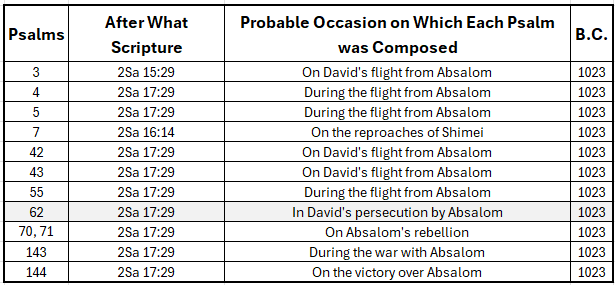
But ever the curious fellow, I sought to understand what prayers and petitions were offered to God in which David was resting upon, in which he could simply express that it was only him and the Lord, and that he was content in this situation. What I found, thanks to Blue Letter Bible, was a timeline of each of the Psalms and their likely cause of writing, along with the time of their writing.
This little table was somewhat shocking, for in it we find that the a greater number of Psalms were written due to Absalom than I would have guessed. He surely was a thorn in David’s side, and his petitions to God were many during this rebellion.
With this understood, let us remember that during the upheaval and treachery of this time, that David had sought refuge and response from his God. In this Psalm David expresses trust only.
Nothing else.
He is alone with God, waiting in silence.
Quite possibly the greatest challenge David faced in life, and he is silent before God. No requests, no wrestling with Him. Simply recounting that God is the decider, the One in charge, the One who is.
My hope is that this series will offer my readers a chance to consider the names, characteristics and descriptions of our God in the Word.
The remaining Names of God in this series might be considered descriptors, or characteristics of the Lord. We have reviewed the three primary Names of God, along with nineteen compound Names of God in our previous posts. As we venture through these descriptors of our God, I hope we will recognize all the many characteristics of our God that we tend to take for granted.
The Word is truly rich with descriptions of the Living God, and this effort of searching in the Word was quite illuminating. He truly is the ultimate subject of the Word, and His revelation of self-descriptions, or the accolades offered Him by His priests, prophets, kings apostles and faithful truly is a blessing.
May the Name of the Lord be praised, and by thinking on His name, may you have a blessed day.
85
CONSOLATION OF ISRAEL
Luke 2:25 Now there was a man in Jerusalem, whose name was Simeon, and this man was righteous and devout, waiting for the consolation of Israel, and the Holy Spirit was upon him.
The Consolation of Israel.
Consider Simeon. He was a righteous and devout man, and my assumption has always been that he was a priest, but when I read the passage above there is no indication he was of the priestly line.
He was, I suppose, a simple man who followed the Lord, and was given an opportunity to see his salvation, to hold his salvation, and to speak of his salvation’s mission to the nation of Israel and the gentiles.
But let us not forget that the Gentiles Simeon spoke of included the very people who were oppressing the people of Israel. Simeon’s waiting for Jesus, the Consolation of Israel, was in the midst of living under oppression. And yet Simeon had the foresight to describe Jesus, the Consolation of Israel, as the One would be a light of revelation to the oppressors, those gentiles that dominated the people of God.
Even before Jesus could speak, His life was described by Simeon as the One who would provide for His enemies a light for the Gentiles.
I can’t help but think that Simeon had recently, by the providence of God, read from the scroll of Isaiah, where the Lord speaks of the Servant of the Lord, our Messiah.
Isaiah 49:6 he says: “It is too light a thing that you should be my servant to raise up the tribes of Jacob and to bring back the preserved of Israel; I will make you as a light for the nations, that my salvation may reach to the end of the earth.”
Simeon saw the writing on the wall, and though the physical nation of Israel was under oppression, a new nation would erupt due to the light extending to the nations, and that salvation would reach the ends of the earth.
For God had much bigger dreams for His creation than many had considered, and for that we should be eternally grateful.
We have a Consolation that provides light to those who oppress, to those who are enemies. Are we mimicking the Great Consolation?
I would love to hear of your favorite name, characteristic or description of the Living God. Please leave me a comment, and I will include it in the list!
Thanks again for coming to visit. I hope you found something of interest in this post and would appreciate a comment, to begin a discussion. If you know someone this blog may bless (or challenge), send them a link, so they may join us in our discussion.
Jesus in the Old Testament is a series of posts that will offer my readers a chance to consider pictures or shadows of Jesus in the Old Testament. As mentioned in the introduction to this series, some may be obvious, some may be not so obvious, and some may simply be a facet of the Lord those reading may not have considered previously.
I hope as we venture through this series, we will see the Lord in many wonderful pictures throughout the Old Testament.
SEEING JESUS IN
Abraham
Sojourner
Genesis 23:4 “I am a sojourner and foreigner among you; give me property among you for a burying place, that I may bury my dead out of my sight.”
Matthew 8:20 And Jesus said to him, “Foxes have holes, and birds of the air have nests, but the Son of Man has nowhere to lay his head.”
When Abraham was called out of his native land, he immediately became a sojourner, a temporary inhabitant. As he ventured through the land that would eventually provide his inhabitants nationhood, Abraham considered himself, even at the end of his travels, to be a “newcomer” in the area, one who did not exercise any rights over the land as yet. The promises were sure, but Abraham lived as having no rights.
Upon arriving on this globe, Jesus also lived a life of a temporary inhabitant, though He possessed all things, and would eclipse all authorities and powers through His ministry and sacrifice.
He was a temporary inhabitant, but now the Eternal King! May His name be praised!
Thanks again for coming to visit. I hope you found something of interest in this post and would appreciate a comment, to begin a discussion. If you know someone this blog may bless (or challenge), send them a link, so they may join us in our discussion.
My hope is that this series will offer my readers a chance to consider the names, characteristics and descriptions of our God in the Word.
The remaining Names of God in this series might be considered descriptors, or characteristics of the Lord. We have reviewed the three primary Names of God, along with nineteen compound Names of God in our previous posts. As we venture through these descriptors of our God, I hope we will recognize all the many characteristics of our God that we tend to take for granted.
The Word is truly rich with descriptions of the Living God, and this effort of searching in the Word was quite illuminating. He truly is the ultimate subject of the Word, and His revelation of self-descriptions, or the accolades offered Him by His priests, prophets, kings apostles and faithful truly is a blessing.
May the Name of the Lord be praised, and by thinking on His name, may you have a blessed day.
84
COMMANDER OF THE ARMY OF THE LORD
Joshua 5:14 And he said, “No; but I am the commander of the army of the LORD. Now I have come.” And Joshua fell on his face to the earth and worshiped and said to him, “What does my lord say to his servant?”
Moses assistant became a great leader, leading the infant nation into many battles, finding victory after victory, until he had secured the extent of the national boundaries for the fledgling country. A truly amazing man, but in our verse here, we find one of Joshua’s greatest character reveals.
He was a mighty general, a terror to those who opposed him, because of his relation to the True Commander of the army of the Lord. Joshua had approached this unknown man, and immediately took to determine his stance before the nation of Israel.
Are you for us, or for our adversaries?
The theophany’s answer was amazing. He did not answer Joshua’s direct question, but described Himself as the Commander of the Lord’s army. He would not align Himself simply with either the nation of Israel or their adversaries.
Yes – Israel was the chosen nation to enter the promised land, and yes, God’s will would be to provide success to the armies of the Israelites as they conquered the land.
But here in this verse, the Lord describes Himself, not as the commander of the armies of the nation of Israel, or of any other nation, be they friend or foe, but of the otherworldly forces He led. He is not some national god that is competing with some other national god, warring and fighting to gain prominence.
He is the True God, over all and will not be relegated to a lower position, simply standing by to support the goals of a portion of His creation, against another portion of His creation. How ludicrous to think that of Him.
This concept, that the Lord is above our national interests, and that it up to us to decide to follow Him, and not for Him to align with our current desires, is repeated over and over again throughout the Old and New Testament.
The first time this idea became very clear to me was in Exodus 23:20-22. See The Lord’s Enemy for some additional thoughts on this topic
No matter, when we come to the Lord, we are to consider His will, and not how He is to conform to our wishes or goals. Joshua immediately took the correction, and we would be wise to follow his example.
After all, centuries later, we can hear the Master telling a woman at the well, that He is not a Messiah of the Jews only but of the entire world. She also sought to claim God as her national god, or at least questioned the truth, and Jesus would have nothing of it. He clearly described salvation as not being only for the nation of Israel, but for all who worship Him in spirit and truth.
He is the Commander of the Lord’s Army!
I would love to hear of your favorite name, characteristic or description of the Living God. Please leave me a comment, and I will include it in the list!
Thanks again for coming to visit. I hope you found something of interest in this post and would appreciate a comment, to begin a discussion. If you know someone this blog may bless (or challenge), send them a link, so they may join us in our discussion.
My wife and I are reading through the Psalms in our evening reading and occasionally a nugget of the Psalms jumps out of the page. Don’t you love it when, after years of reading the “Old Book” passages become alive, reinforcing old teachings or simply warming your heart.
This is the book of Psalms, and it is rich.
I pray I can communicate a portion of the blessing we receive from this wonderful book.
Psalm 61
8 So will I ever sing praises to your name, as I perform my vows day after day.
In our previous post, I skipped over the concept of vows. He had mentioned vows in verse 5, and I find this repetition to be worthy of a short discussion. Let’s read verse 5 once more.
5 For you, O God, have heard my vows;
David had earlier mentioned that God had heard his vows. In our final verse, he speaks to the Lord, reminding Him that he will perform his vows.
It is interesting that the vows are not connected with the results he is requesting. It isn’t a tit for tat type of discussion here. David isn’t entering into a bargaining stance with the Creator of all, hoping to get one over on Him.
We have all heard of the fox hole vow – Get me out of this trouble God and I will serve You the rest of my life. Yet this rarely sticks, and as soon as the trial is over, so is the remembrance of the vow.
But notice that is David’s final statement to the Lord, the cause and effect seems to be turned on it’s head. My common understadning of vows in relation to God goes something like …
I will continually and constantly, out of a previous legal obligation, perform my promise as a payback for a previous rescue! (I know it sounds crass, but that is how my little brain works!)
No, notice that David states that he will sing praise, in order to perform his vows to God.
God does expect us to keep our vows, especially our vow to follow Jesus, but we cannot follow properly simply out of a spirit of obligation. Now don’t get me wrong, we are obligated to Him due to His great sacrifice, yet in the goodness of God, He has provided the power, the energy, the strength to perform our vow, to follow after Him as we sing praise to Him. As we have a spirit of joy in our lives, thankful for His goodness and mercy, may we be faithful “singers’ of His goodness.
Even for those of us whose natural singing voice leaves much to be desired. Yikes!
My hope is that this series will offer my readers a chance to consider the names, characteristics and descriptions of our God in the Word.
The remaining Names of God in this series might be considered descriptors, or characteristics of the Lord. We have reviewed the three primary Names of God, along with nineteen compound Names of God in our previous posts. As we venture through these descriptors of our God, I hope we will recognize all the many characteristics of our God that we tend to take for granted.
The Word is truly rich with descriptions of the Living God, and this effort of searching in the Word was quite illuminating. He truly is the ultimate subject of the Word, and His revelation of self-descriptions, or the accolades offered Him by His priests, prophets, kings apostles and faithful truly is a blessing.
May the Name of the Lord be praised, and by thinking on His name, may you have a blessed day.
83
CLUSTER OF HENNA BLOSSOMS
Song of Songs 1:14 My beloved is to me a cluster of henna blossoms in the vineyards of Engedi.
In the Song of Songs, Solomon writes of the passion between a farm girl and the mighty King of Israel. Often the love between the two is described in words of beauty and grace, speaking of their unrelenting desire for each other.
In this verse, the farm girl is describing her love as a “cluster of henna blossoms”. At first glance, I thought this may describe a beautiful flower, a flower that provided a scent that was irresistible, a flower that was favored above all other flowers.
All of that may be true, but when I did a bit of research I found the Hebrew word translated as henna blossoms is כֹּפֶרkôpher, ko’-fer, and is primarily describing a cover, and by extension describes a redemption price, a ransom, even a sum of money.
Early in the Old Testament, this term was used to describe the pitch that covered the ark.
Genesis 6:14 Make yourself an ark of gopher wood. Make rooms in the ark, and cover it inside and out with pitch.
In our verse today, the farm girl refers to the King as her redemption, the ransom she needs for her life, her protection from danger and as a covering to keep her safe.
So much more than simply a favored flower, but the very protection only the King could provide her, for she speaks of the Kings redemption as for her, that is .. to me He is a cluster of henna blossoms.
This is her estimation of her lover. All the world might think something else of the King, but she knew He was her hope and life.
She represents the ones who have trusted the Messiah for their hope and life. May we constantly be of the same desire as this lowly farm girl.
I would love to hear of your favorite name, characteristic or description of the Living God. Please leave me a comment, and I will include it in the list!
Thanks again for coming to visit. I hope you found something of interest in this post and would appreciate a comment, to begin a discussion. If you know someone this blog may bless (or challenge), send them a link, so they may join us in our discussion.
My hope is that this series will offer my readers a chance to consider the names, characteristics and descriptions of our God in the Word.
The remaining Names of God in this series might be considered descriptors, or characteristics of the Lord. We have reviewed the three primary Names of God, along with nineteen compound Names of God in our previous posts. As we venture through these descriptors of our God, I hope we will recognize all the many characteristics of our God that we tend to take for granted.
The Word is truly rich with descriptions of the Living God, and this effort of searching in the Word was quite illuminating. He truly is the ultimate subject of the Word, and His revelation of self-descriptions, or the accolades offered Him by His priests, prophets, kings apostles and faithful truly is a blessing.
May the Name of the Lord be praised, and by thinking on His name, may you have a blessed day.
82
CLOUD OF THE LORD
Exodus 40:38 For the cloud of the LORD was on the tabernacle by day, and fire was in it by night, in the sight of all the house of Israel throughout all their journeys.
What blessings can we find in our current name we are looking at today? What truths may we take from this verse that will elevate and honor the name of the Lord?
This verse associates a cloud with the Lord, which was very common in the Old Testament, not only during the exodus and wanderings, but also during the days of Solomon’s temple.
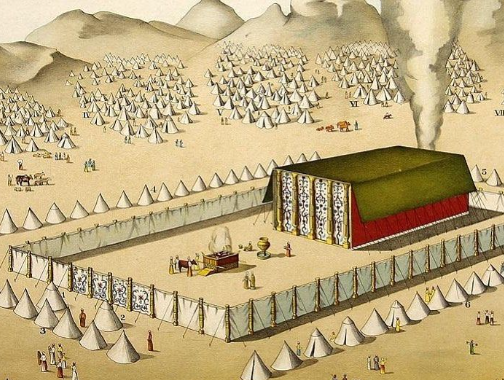
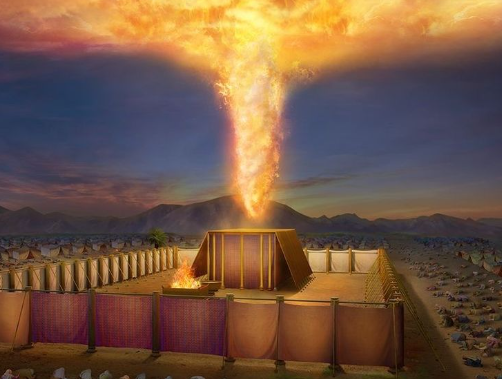
For our verse today, we read that during the day, the cloud of the Lord was on the tabernacle. In many depictions, the cloud appears to be a large, expanding pillar of smoke over the tabernacle, specifically over the holy of holies. Similarly, the fire is depicted as being in the same general configuration.
This may be true but I would like to offer my reader an alternative depiction of the cloud. You see, this particular text says the cloud of the Lord was on the tabernacle, and the fire was in the tabernacle at night.
In my imagination, which sometimes runs amok, I imagine the cloud was actually enveloping the tabernacle, actually covering the tabernacle. One of the effects of this situation may be the hiding of the tabernacle from view.
Why might I suggest that? Often in the Word, clouds are used to veil something. A passage depicting that action may be found in Exodus 24:15-16
Then Moses went up on the mountain, and the cloud covered the mountain.
The glory of the LORD dwelt on Mount Sinai, and the cloud covered it six days. And on the seventh day he called to Moses out of the midst of the cloud.
Later, when the tabernacle had been constructed, we find that a few verses prior to our verse, the cloud covered the tent of meeting, and that Moses was not able to enter the tent of meeting.
Exodus 40:34-35
Then the cloud covered the tent of meeting, and the glory of the LORD filled the tabernacle. And Moses was not able to enter the tent of meeting because the cloud settled on it, and the glory of the LORD filled the tabernacle.
Yes, there are descriptions of the cloud being a pillar when the Israelites are being led to a destination, but when the camp had settled in an area, it seems the cloud took on a different “form”, that the cloud covered the tabernacle.
This understanding brings a different perspective for myself, for instead of the cloud simply designating the location of the presence of God, the cloud may actually be revealing the holiness and righteousness of God.
Let me explain.
In Psalm 97, the psalmist speaks of a cloud and thick darkness in the context of how unapproachable God is.
Psalm 97:2 Clouds and thick darkness are all around him; righteousness and justice are the foundation of his throne.
Later in the Psalms, the psalmist speaks of a cloud covering the tabernacle, and fire providing light in the night.
Psalm 105:39 He spread a cloud for a covering, and fire to give light by night.
This passage recounts our verse above, and provides two subsequent verses where God provided answers to prayer, or should I say demands of the people. The Lord provides for them according to their desires.
Psalm 105:40-41 They asked, and he brought quail, and gave them bread from heaven in abundance. He opened the rock, and water gushed out; it flowed through the desert like a river.
In my understanding, the Cloud of the Lord speaks of His righteousness, His holiness and His justice, even in the midst of His very presence with His people. In the presence of a people who would not conform to His will, and yet He stayed with them, caring and exhibiting His gracious love and mercy to them.
We truly do not deserve our merciful God, and we would do well to remember His “otherness”, how He is not like us, but so much more.
As Paul stated in one of His letters to Timothy, God
…alone has immortality, who dwells in unapproachable light, whom no one has ever seen or can see. To him be honor and eternal dominion. Amen.
I would love to hear of your favorite name, characteristic or description of the Living God. Please leave me a comment, and I will include it in the list!
Thanks again for coming to visit. I hope you found something of interest in this post and would appreciate a comment, to begin a discussion. If you know someone this blog may bless (or challenge), send them a link, so they may join us in our discussion.
My wife and I are reading through the Psalms in our evening reading and occasionally a nugget of the Psalms jumps out of the page. Don’t you love it when, after years of reading the “Old Book” passages become alive, reinforcing old teachings or simply warming your heart.
This is the book of Psalms, and it is rich.
I pray I can communicate a portion of the blessing we receive from this wonderful book.
Psalm 61
6 Prolong the life of the king; may his years endure to all generations! 7 May he be enthroned forever before God; appoint steadfast love and faithfulness to watch over him!
When we last read David’s prayer, he had turned a corner, due to his looking back to the faithfulness of God and the promise he had received of the kingdom.
Our first verse, verse 6, when I initially considered it, made me think of David himself, how he was stating that the Lord would prolong the king’s life in the midst of this emergency. God would prolong the kings life, and then he begins to state the impossible.
The kings life would extend to many generations? He already was an aged man, and he has the audacity to state the Lord would extend his life for “many generations”? Never mind that – consider the next statement, that the king shall abide before God forever!
OK, so we have a shift in the topic from the immediate rescue of David by prolonging his life, to one of two topics
First topic that came to my mind is that he is referring to his eternal state, that he would abide before God forever, no matter his time of death on this old earth.
And yet the subject seems to change in verse 7, where David looks to another king, whom he asks God to prepare mercy and truth to preserve the King.
Can anyone imagine who that King is? When I see mercy and truth, I automatically think of John’s gospel, where he speaks of grace (mercy) and truth in the person of Jesus
John 1:17b … grace and truth came through Jesus Christ.
Does it not make sense that David, in his time with God, at a dark, deeply difficult time, would be caught up with the promised King who would reign forever.
It is only through the reign of Jesus that any of us can expect to have our lives extended through many generations, even forever.
Jesus has been enthroned forever, according to David’s prayer. David was restored to his throne, as the promise of God was maintained for David.
Not only was David restored to the throne for his final days, but in the big picture, his life has been extended through the power of the resurrected King, who was full of mercy and truth.
My hope is that this series will offer my readers a chance to consider the names, characteristics and descriptions of our God in the Word.
The remaining Names of God in this series might be considered descriptors, or characteristics of the Lord. We have reviewed the three primary Names of God, along with nineteen compound Names of God in our previous posts. As we venture through these descriptors of our God, I hope we will recognize all the many characteristics of our God that we tend to take for granted.
The Word is truly rich with descriptions of the Living God, and this effort of searching in the Word was quite illuminating. He truly is the ultimate subject of the Word, and His revelation of self-descriptions, or the accolades offered Him by His priests, prophets, kings apostles and faithful truly is a blessing.
May the Name of the Lord be praised, and by thinking on His name, may you have a blessed day.
81
CHRIST JESUS OUR LORD
Romans 8:39 nor height nor depth, nor anything else in all creation, will be able to separate us from the love of God in Christ Jesus our Lord.
This is our last description of God, referring primarily to the Christ, His Anointed One, in our list of Names of God. Later on, we shall come across the name “Christ” in additional descriptions of our God, but we will wait until they occur for discussion on them.
For our current consideration, we have “Christ Jesus the Lord”.
This name combines the human name of the Christ, along with the reference of the Lord, designating Jesus as the Master.
We spoke of the use of “Lord” combined with Christ in our last post, and with this post we have the added clarification of who the Christ is.
Jesus, the lowly preacher from Bethlehem, associated with Nazareth, and considered a troublemaker and false prophet, even the illegitimate son of Mary – He it is that is the Christ.
He was not the typical teacher. Many would listen and walk away befuddled, or challenged by the message like they had not been challenged before. Even when describing Him amongst His peers, those who were rabbi’s and teachers of the law, He did not fit into any conventional party line.
As a matter of fact, His teaching often offended those steeped in the laws and teachings of the ancients, and caused many times of heated questions being thrown at Him by his fellow rabbis.
But that is just the point. They were not fellow rabbis, for He was (and is) Christ Jesus, the Anointed One, the One chosen of God to provide grace and truth to those most in need. They were not His peers, but His students, yet they knew it not, and would not submit to the Christ, since God’s choice was Jesus.
But Jesus was not their choice!
Yet the truth stands and God’s choice, His Anointed is Jesus. The Master. The teacher and instructor for those who will recognize Him.
Christ Jesus the Lord.
I would love to hear of your favorite name, characteristic or description of the Living God. Please leave me a comment, and I will include it in the list!
Thanks again for coming to visit. I hope you found something of interest in this post and would appreciate a comment, to begin a discussion. If you know someone this blog may bless (or challenge), send them a link, so they may join us in our discussion.
Many on the news and internet are speaking of very difficult times coming for those of us in the western hemisphere. Those in the east have been experiencing difficult times for decades, and we need to remember them in our prayers. Whether it be the Uyghurs in China or believers in North Korea, there have been difficult times for many that we in the west simply can not imagine.
Difficult times are not a recent development for believers, or have not been experienced by believers before. Difficult times are what this post is about. A specific difficult time, in the days of Jeremiah.
With all that said, I want to recount last Sunday during worship service, where the church was led through the great hymn – Great is thy Faithfulness. As we sang this hymn, it occurred to me that this truth was taken from Jeremiah’s pen, when he wrote it in the saddest book of the Bible.
Lamentations 3
22 The steadfast love of the LORD never ceases; his mercies never come to an end; 23 they are new every morning; great is your faithfulness.
Lamentations is a book describing the horrors of a war with the Babylonians, and the eventual conquering of the nation of Israel. The Babylonians defeated the nation of Israel, destroyed the city of David, desecrated the temple, and was deporting all those Israeli’s that had not yet been murdered.
Get a grip on that my friend. Jeremiah saw the temple go down and the people of God decimated, with the land becoming barren, and in the end, he was hated by those few that remained.
And yet he declared
The steadfast love of the LORD never ceases; his mercies never come to an end.
In Jeremiah’s eyes there must have been nothing but discouragement, disappointment, and despair. Yes – he had been promised the nation would rise up again, but that would be seven decades later.
Yet Jeremiah wrote.
his mercies never come to an end; they are new every morning;
The nation had been corrupt, the priesthood had been compromised and was worse than the neighboring heathen. The people sinned and blamed everyone else for the nations condition. No one was following the Lord, but only following their own desires and wants. There was no earthly help for the nation, for the people who made up the nation were sick, nearing death and had refused any spiritual help.
And yet Jeremiah penned the great passage
they (God’s mercies) are new every morning; great is your faithfulness.
In the midst of trials, difficult times and possible future devastation in our lives, let us practice this discipline of Jeremiah, recognizing the mercies of God in our lives, and realizing His faithfulness to us.
He truly is good, and He is good all the time!
Thanks again for coming to visit. I hope you found something of interest in this post and would appreciate a comment, to begin a discussion. If you know someone this blog may bless (or challenge), send them a link, so they may join us in our discussion
Jesus in the Old Testament is a series of posts that will offer my readers a chance to consider pictures or shadows of Jesus in the Old Testament. As mentioned in the introduction to this series, some may be obvious, some may be not so obvious, and some may simply be a facet of the Lord those reading may not have considered previously.
I hope as we venture through this series, we will see the Lord in many wonderful pictures throughout the Old Testament.
SEEING JESUS IN
Absalom
Suspended between heaven and earth
2 Samuel 18:9 And Absalom happened to meet the servants of David. Absalom was riding on his mule, and the mule went under the thick branches of a great oak, and his head caught fast in the oak, and he was suspended between heaven and earth, while the mule that was under him went on.
John 8:28 So Jesus said to them, “When you have lifted up the Son of Man, then you will know that I am he, and that I do nothing on my own authority, but speak just as the Father taught me.
Back in the fourth installment of the Absalom series, we discussed how Absalom was hung on a tree, being a shadow of the Messiah.
This post will focus on the spatial location of the men as they hung on a tree. To be specific, both men hung between heaven and earth. The significance for Absalom hanging between heaven and earth seems to be somewhat strange. Why would the author bring this phrase into the story line? That is an unknown in my mind, other than for the author to show Absalom’s utter helplessness, that he had no where to find support from, or that he belonged neither on earth or in heaven. Pure conjecture on my part regarding Absalom.
Regarding Jesus, the image of Him suspended between heaven and earth is much more obvious to me. The only support He had was the nails through His body, and His determination to complete His mission while on earth. He was (and is) the perfect God man, representing both earth and heaven. He was (and is) the only One who bridged the gap between heaven and earth for us while on He hung on the bloody cross.
He sacrificed Himself for the likes of Absalom and myself. He is so good and He is calling out to you, even today.
Consider Him, hanging between heaven and earth in order for you to know the true God and His Son Jesus Christ.
May His name be praised today.
Thanks again for coming to visit. I hope you found something of interest in this post and would appreciate a comment, to begin a discussion. If you know someone this blog may bless (or challenge), send them a link, so they may join us in our discussion.
My hope is that this series will offer my readers a chance to consider the names, characteristics and descriptions of our God in the Word.
The remaining Names of God in this series might be considered descriptors, or characteristics of the Lord. We have reviewed the three primary Names of God, along with nineteen compound Names of God in our previous posts. As we venture through these descriptors of our God, I hope we will recognize all the many characteristics of our God that we tend to take for granted.
The Word is truly rich with descriptions of the Living God, and this effort of searching in the Word was quite illuminating. He truly is the ultimate subject of the Word, and His revelation of self-descriptions, or the accolades offered Him by His priests, prophets, kings apostles and faithful truly is a blessing.
May the Name of the Lord be praised, and by thinking on His name, may you have a blessed day.
80
CHRIST THE LORD
Luke 2:11 For unto you is born this day in the city of David a Savior, who is Christ the Lord.
Here we have the Christ being defined as the Lord.
At first glance we may assume Luke is combining Christ with the primary name of God as LORD, as in Genesis 2:4, using the Tetragrammatron JHVH.
Not so.
If I had been in Luke’s shoes, I would have emphasized the connection of this young baby with the eternal One, the Creator of heaven and earth, the omniscient One who is all powerful.
But we can be thankful that I was not in Luke’s shoes at the time, writing this passage of truth. I would not have done this passage justice.
No.
Luke brings to our ears the message that Christ is the Master. To say that may seem redundant, for as the Jewish nation was awaiting their Anointed King to arrive, it should have been obvious to all that He would be the Leader, the Master, the One who would be obeyed.
That is the expectation of the masses. The Christ was the One who would be the Master, the One to follow after and to go behind as He conquers those who were oppressing the nation, and that they would eventually become the nation above all other nation. What heady expectations!
Yet Luke provided this description of the lowly baby, for He would turn out to be completely beyond the expectation of the crowd, as He would be the Servant of prostitutes, the Teacher of the tax collector, and the self sacrificial Lamb of God.
To understand the Christ as being a servant, a teacher and a martyr, Luke wisely reiterated the Christ as the Master, for without that description no one would understand, no one would bend the knee to such a “disappointment” of their expectations.
He was a totally different type of Master than expected!
As you have walked with the Anointed One, have you morphed in you understanding of who He is as a Master? Do you understand His way of life, his method of conquering His enemies through service, sacrifice and selfless love?
I would love to hear of your favorite name, characteristic or description of the Living God. Please leave me a comment, and I will include it in the list!
Thanks again for coming to visit. I hope you found something of interest in this post and would appreciate a comment, to begin a discussion. If you know someone this blog may bless (or challenge), send them a link, so they may join us in our discussion.
My wife and I are reading through the Psalms in our evening reading and occasionally a nugget of the Psalms jumps out of the page. Don’t you love it when, after years of reading the “Old Book” passages become alive, reinforcing old teachings or simply warming your heart.
This is the book of Psalms, and it is rich.
I pray I can communicate a portion of the blessing we receive from this wonderful book.
Psalm 61
4 Let me dwell in your tent forever! Let me take refuge under the shelter of your wings! Selah 5 For you, O God, have heard my vows; you have given me the heritage of those who fear your name.
First, lets remember that I am approaching this psalm as from the hand of David, during a most dangerous time in the reign of the King. Rebellion had broken out and his very son had committed the treason. To make matters worse, it looked very promising for Absolam, and that David may be facing his last days on earth.
In David’s cry to God, he speaks of dwelling forever in the tent of the Lord. At this time in the life of the nation, the Temple had not been constructed, and the tabernacle was still a temporary structure, per the wishes and will of God. So when David uses the term “dwell”, he uses a term that sometimes has the connotation of dwelling for a time, to temporarily dwell. This makes sense if the context of the Psalm is as I have suggested. He may only have a few days left in the land. Things were looking very dark.
But notice that he uses the term dwell, sometimes signifying a temporary sojourn, with a qualifier. He wants to stay forever in the tent. Forever in the tabernacle, that would soon be taken down, for the construction of the Temple.
So what gives here?
David is more than a five year planner, figuring out things that need to be accomplished in a set time frame. He is looking long term here, speaking of his eventual demise and permanent state with the Living God.
We also see that he is not only looking to the Lord for his permanent dwelling, but that he is requesting permission to reside under the Lord’s protection, seeking refuge from danger. With this very next phrase, is David requesting protection from the danger that is on his doorstep, and that may bring him to the gates of his grave?
I cannot imagine the strain he is going through, and the multiple conflicting thoughts racing through his head and heart. Yet in the midst of the confusion, he looks to the Lord for his help, whether it is by life or through death.
At this point, starting in verse 5, David turns a corner and begins to remember his God, and the promises he has received from the hand of God.
The very promise David recalls is the promise that seems to be hanging in the balance with this rebellion. David recalls that God had given him “the heritage of those who fear your name”. He is referring to his rule over the people of God, those who fear God’s name.
How could Absalom frustrate the will of God? It seems this very contradiction is a comfort to David in the midst of his present circumstances. Wherever David was during this trial, he resorted to his past experience with the Lord and looked away from his circumstance that seemed so dark. This is the practice of the saint who has walked with the Lord, has seen His faithfulness, and trusts in the midst of a trial that the Father’s heart has not changed.
He is the faithful One, and as we sojourn through our lives down here, it is wise to consider His faithfulness in the midst of trials that come upon us.
My hope is that this series will offer my readers a chance to consider the names, characteristics and descriptions of our God in the Word.
The remaining Names of God in this series might be considered descriptors, or characteristics of the Lord. We have reviewed the three primary Names of God, along with nineteen compound Names of God in our previous posts. As we venture through these descriptors of our God, I hope we will recognize all the many characteristics of our God that we tend to take for granted.
The Word is truly rich with descriptions of the Living God, and this effort of searching in the Word was quite illuminating. He truly is the ultimate subject of the Word, and His revelation of self-descriptions, or the accolades offered Him by His priests, prophets, kings apostles and faithful truly is a blessing.
May the Name of the Lord be praised, and by thinking on His name, may you have a blessed day.
79
CHRIST OUR LIFE
Colossians 3:4 When Christ who is your life appears, then you also will appear with him in glory.
Our life does not consist of hours and minutes, for that is simply a period of time that allows us to serve and self maintain.
Our life does not consist of consuming bread, for that only extends our physical life.
Our life does not consist of labor, for that only enables us to buy the bread we consume.
Our life does not consist of the vanity of pride, which we are caught up in and that distracts us from truth.
Our life does not consist of acquisition of things, such as cars, homes and clothing, for that only provides shelter for us as we live on this globe.
Our life, according to Paul, consists of the Anointed One, the Christ.
Our life is actually invisible to us currently, but there shall come a day when we shall see the centrality of Him, that He is our life.
Until then, we walk by faith, and seek to know Him better, in order that He may consume us, weaning us from those things we so often consider to be our lives.
Let us thank Him for all He is to us, that He is our life, and that we may live in Him, content and finding Him sufficient for all our needs and wants.
He is the Christ, our life.
I would love to hear of your favorite name, characteristic or description of the Living God. Please leave me a comment, and I will include it in the list!
Thanks again for coming to visit. I hope you found something of interest in this post and would appreciate a comment, to begin a discussion. If you know someone this blog may bless (or challenge), send them a link, so they may join us in our discussion.
Jesus in the Old Testament is a series of posts that will offer my readers a chance to consider pictures or shadows of Jesus in the Old Testament. As mentioned in the introduction to this series, some may be obvious, some may be not so obvious, and some may simply be a facet of the Lord those reading may not have considered previously.
I hope as we venture through this series, we will see the Lord in many wonderful pictures throughout the Old Testament.
SEEING JESUS IN
Absalom
Pierced in the side
2 Samuel 18:14 Joab said, “I will not waste time like this with you.” And he took three javelins in his hand and thrust them into the heart of Absalom while he was still alive in the oak.
John 19:34 But one of the soldiers pierced his side with a spear, and at once there came out blood and water. …
Both Absalom and Jesus suffered the piercing of the side to ensure their death.
Both Absalom and Jesus suffered this at the hands of their enemy.
Both men were struck in the heart by a piercing.
It is said that the spear entered Jesus side and pierced the heart, and this can be seen by the blood and water that flowed from His side.
Both men were pierced while helpless to defend themselves. One of them never expected this type of death. One of them fought to undergo this humiliation.
It is truly amazing that we have a Savior that would be so humbled, even to the point of being identified with a man such as Absalom.
Or myself.
Thanks again for coming to visit. I hope you found something of interest in this post and would appreciate a comment, to begin a discussion. If you know someone this blog may bless (or challenge), send them a link, so they may join us in our discussion.
My hope is that this series will offer my readers a chance to consider the names, characteristics and descriptions of our God in the Word.
The remaining Names of God in this series might be considered descriptors, or characteristics of the Lord. We have reviewed the three primary Names of God, along with nineteen compound Names of God in our previous posts. As we venture through these descriptors of our God, I hope we will recognize all the many characteristics of our God that we tend to take for granted.
The Word is truly rich with descriptions of the Living God, and this effort of searching in the Word was quite illuminating. He truly is the ultimate subject of the Word, and His revelation of self-descriptions, or the accolades offered Him by His priests, prophets, kings apostles and faithful truly is a blessing.
May the Name of the Lord be praised, and by thinking on His name, may you have a blessed day.
78
CHRIST OF GOD
Luke 9:20 Then he said to them, “But who do you say that I am?” And Peter answered, “The Christ of God.”
Our name of God this morning is found in the gospel of Luke, and comes as an answer to Jesus direct question to Peter.
Who am I Peter?
This is the question of the ages for everyone to answer. Many confessed willingly, without being challenged, such as the woman at the well in John 4. The woman was clearly taught by the Master that He is the Christ.
John 4:25-26 The woman said to him, “I know that Messiah is coming (he who is called Christ). When he comes, he will tell us all things.” Jesus said to her, “I who speak to you am he.”
With Peter, Jesus had spent a couple years with the Master and had seen or been a participant in all of the Master’s miracles so far. Not only that, he had been the recipient of his wife’s mothers healing and an amazing amazing catch of fish.
Who am I Peter?
The conversation started out as a simple request from the disciples about the rumor mill amongst the crowds on who Jesus was. Of course as we read the verses prior to Peter’s confession, Jesus was praying alone, and the Lord simply stopped in His prayers, asked a general question about the crowds, and then focused in on Peter.
Who am I Peter?
The Christ of God.
The Anointed of God.
Note the definite article “the”. He is not a Christ of God, one of many. He is the Christ of God, the One anointed by God to fulfill all the promised of God throughout the Old Testament, that would be the deliverer, the King of Israel, and the King of Kings.
Immediately after this confession, Jesus forbid them from speaking of it, and began to tell them of his future sacrifice. How utterly unexpected! I tell you we often do not consider the astounding multiple shocks these disciples underwent to follow after Him. Speaking of death when He should be speaking of reigning. Speaking of silence when they should be shouting from the rooftops.
But He was the Christ, the Anointed One, and His directions were to be followed. Thankfully, the apostles, confused as they were, continued to follow.
And Peter was the one who confessed, after the Christ of God had finished prayer.
I wonder who Jesus was praying for?
I would love to hear of your favorite name, characteristic or description of the Living God. Please leave me a comment, and I will include it in the list!
Thanks again for coming to visit. I hope you found something of interest in this post and would appreciate a comment, to begin a discussion. If you know someone this blog may bless (or challenge), send them a link, so they may join us in our discussion.
My wife and I are reading through the Psalms in our evening reading and occasionally a nugget of the Psalms jumps out of the page. Don’t you love it when, after years of reading the “Old Book” passages become alive, reinforcing old teachings or simply warming your heart.
This is the book of Psalms, and it is rich.
I pray I can communicate a portion of the blessing we receive from this wonderful book.
Psalm 61:1 To the choirmaster: with stringed instruments. Of David. Hear my cry, O God, listen to my prayer; Psalm 61:2 from the end of the earth I call to you when my heart is faint. Lead me to the rock that is higher than I, Psalm 61:3 for you have been my refuge, a strong tower against the enemy.
It seems no one is sure of when this Psalm was written or even if it was King David. Some suggest this psalm was written during the Babylonian captivity. I tend to look at the psalm from a traditional approach and consider this Psalm to be of David, and the situation he finds himself in is the rebellion of Absalom.
David was on the run, across the river Jordan, and eventually makes it to the city of Mahanaim, where he gathers reinforcements and prepares for the battle of Ephraim, where his son is defeated.
Prior to the battle, David is in the weakest position he has experienced. If this psalm comes from the hand of David, it is at this point where I feel he may have given us his passage. Having crossed the Jordan, he is away from the temple, from his city, from the throne, and essentially running for his life.
He may have felt like he was at the ends of his kingdom, near the extent of his authority, the limits of his national borders, as he travelled away from his capital. When he refers to the end of the earth, the phrase may be translated the ends of the “land” also, and makes better sense, at least in my mind.
As he is on the run, priorities come to his heart, and as his hopes and dreams are seemingly being dashed by his own blood, he calls out to God as was his habit.
Hear my cry. Pay attention to my prayer O Lord. Not only pay attention, but also understand my prayer. This type of boldness of the Psalmist is what I find so refreshing, so challenging. He had been in enough experiences with Almighty God that he could speak to Him in this manner.
I often come to the Lord with a cowering sense of subjugation, a head bowed and a knee bent attitude, which is due His Person, and yet the one who is on the run is looking up to God, standing in front and requesting (demanding?) an audience with the Most Holy.
Is this stance of David one out of pride of association, out of a familiarity of relationship with the Father? David admits his heart is faint. To be faint originally meant to be covered over, or enveloped. He was completely distracted or consumed in heart with the circumstances and out of this weakness looked to the Lord for three requests
Guidance to
David was looking for His Rock, the God who never changes, is solid in His Person and that gushes forth living water when least expected. David sought a higher position, knowing that both in military battles and spiritual safety, being higher is preferred. He was not looking to stay where he was, to wallow in his experience but to seek higher ground, to the Rock who is always higher.
Guidance Away
David sought God in his deepest and weakest experiences. But let us not miss that he seeks a position or place that is higher than him. He is not looking to himself for any direction, and it may be read that he is looking for guidance away from his own wisdom, abilities or strengths.
He is looking for guidance to God away from a dependence on his own, for he knows he is faint, at his end, distracted from his priorities, and without resources.
A Historic Haven
The Refuge, his Strong Tower against his enemy, who turns out to be his own son. How conflicted David must have been, distracted in his decisions and faint of heart. No matter what David looked to accomplish, he would wrestle with his decisions, having contrary desires pulling at him. Restore his kingdom, but loose his son, or loose the kingdom and die a traitor at the hand of his son.
To put it bluntly, David was in the worst of situations and he had no idea what to do. He desperately needed guidance, and he needed to get out of his own headspace, where he found no solution that was acceptable. He needed a place of refuge, and that place of refuge was His God.
It is good to remind ourselves that David is not crying out to God for a first time in this instance. Notice that he refers to God as having been his refuge in times past. His previous trials, though arguably of lighter concerns than the present trial, trained his heart to reach out to the God of Israel. This experience was critical, for now David was drowning in this trial, and he naturally had experience with his God as his refuge, as a strong tower from which he might be protected.
As we go through trials, no matter the size or complexity, run to the Father for your help. Not only will this please the Father, and deepen your dependency on the ever faithful One, but it will prepare you for trials that may be heading your way.
Not matter the trial or temptation, He is the One we need to resort to. He is the One who is our Strong Tower. Don’t refuse the great blessing of God’s guidance and protection as you go about your day today.
My hope is that this series will offer my readers a chance to consider the names, characteristics and descriptions of our God in the Word.
The remaining Names of God in this series might be considered descriptors, or characteristics of the Lord. We have reviewed the three primary Names of God, along with nineteen compound Names of God in our previous posts. As we venture through these descriptors of our God, I hope we will recognize all the many characteristics of our God that we tend to take for granted.
The Word is truly rich with descriptions of the Living God, and this effort of searching in the Word was quite illuminating. He truly is the ultimate subject of the Word, and His revelation of self-descriptions, or the accolades offered Him by His priests, prophets, kings apostles and faithful truly is a blessing.
May the Name of the Lord be praised, and by thinking on His name, may you have a blessed day.
77
CHRIST JESUS
Romans 3:24 and are justified by his grace as a gift, through the redemption that is in Christ Jesus,
When my list of the names of God revealed todays topic, that is the name “Christ Jesus”, I want to be honest with you – I was intimidated with addressing the Master’s name in a proper, accurate respectful and loving manner.
Not that His majesty would be affected by my failure in properly describing Him, for His being cannot truly be tarnished by a lowly believer trying to do his best for Him.
After all, He is the One who can take a cripple and make him walk, or find a mute deaf man and provide communication skills to him. He is the One who is always showing grace, exhibiting His mercy, providing patience and longsuffering to His disciples, bringing them from glory to glory.
He is the Anointed One (Christ), the Savior (Jesus).
I would love to hear of your favorite name, characteristic or description of the Living God. Please leave me a comment, and I will include it in the list!
Thanks again for coming to visit. I hope you found something of interest in this post and would appreciate a comment, to begin a discussion. If you know someone this blog may bless (or challenge), send them a link, so they may join us in our discussion.
Jesus in the Old Testament is a series of posts that will offer my readers a chance to consider pictures or shadows of Jesus in the Old Testament. As mentioned in the introduction to this series, some may be obvious, some may be not so obvious, and some may simply be a facet of the Lord those reading may not have considered previously.
I hope as we venture through this series, we will see the Lord in many wonderful pictures throughout the Old Testament.
SEEING JESUS IN
Absalom
No Blemish
2 Samuel 14:25 Now in all Israel there was no one so much to be praised for his handsome appearance as Absalom. From the sole of his foot to the crown of his head there was no blemish in him.
1 Peter 1:19 but with the precious blood of Christ, like that of a lamb without blemish or spot.
No blemish.
This likeness is typical of the way Jesus’ character is sometimes reflected in the Old Testament, by describing what a man may physically see. Absalom was without blemish. Stunning in stature, a handsome hulk, a real attractive he-man!
The word “blemish” in the Old Testament can speak of a spot or defect, either in the physical or the moral. This reference to Absalom is surely speaking of him as having no physical blemish in him since the verse speaks of no blemish from the sole of his foot to the crown of his head. The passage speaks of his handsomeness, and to his entire body being without blemish. The author was making a point! He was a looker!
Now, we all know of those amongst us that have that physical quality that draws your eyes to them, that is not only the most handsome man in the room but also has the personality and charisma that draws people to them. Based on appearance and personality. What they look and sound like.
Not so with the Lord. He is described elsewhere in the Word as ordinary, without the appearance of majesty, without beauty and nothing of outward appearance that would draw us to Him.
Isaiah 53:2
For he grew up before him like a young plant, and like a root out of dry ground; he had no form or majesty that we should look at him, and no beauty that we should desire him.
Two men without blemish. Two men without defect or spot. We understand Absalom was described this way in the physical, and yet we know he had a very large and dark blemish in his character. Nothing spiritually stands out about this man, other than he is not godly, not spiritually appealing, not without spiritual blemish.
But consider Jesus, who is without blemish in His character, without blemish in His relationship with God the Father, without blemish before man, though they seek to find fault! This is simply a reflection of their own darkness, for darkened hearts seek to reject the light.
Yet His unspotted character cannot be denied, and though some try to deny, the Father validated His Son through the physical resurrection.
He is the spotless Son of God, a lamb without blemish, that was sacrificed for our souls! May His name be praised!
Thanks again for coming to visit. I hope you found something of interest in this post and would appreciate a comment, to begin a discussion. If you know someone this blog may bless (or challenge), send them a link, so they may join us in our discussion.
My hope is that this series will offer my readers a chance to consider the names, characteristics and descriptions of our God in the Word.
The remaining Names of God in this series might be considered descriptors, or characteristics of the Lord. We have reviewed the three primary Names of God, along with nineteen compound Names of God in our previous posts. As we venture through these descriptors of our God, I hope we will recognize all the many characteristics of our God that we tend to take for granted.
The Word is truly rich with descriptions of the Living God, and this effort of searching in the Word was quite illuminating. He truly is the ultimate subject of the Word, and His revelation of self-descriptions, or the accolades offered Him by His priests, prophets, kings apostles and faithful truly is a blessing.
May the Name of the Lord be praised, and by thinking on His name, may you have a blessed day.
76
CHOSEN PORTION
Psalm 16:5 The LORD is my chosen portion and my cup; you hold my lot.
In our last post, we considered “Chosen One” as a name for God, and spoke of the contrast between the use of the name. Essentially the name “Chosen One” refers to God’s decision to pick the Messiah, that is was an action between God and the Son.
With our name of God in this post, we have a different dynamic being described. As David mentions the LORD as his “Chosen Portion” He is speaking of his choice to prioritize God over all else. The emphasis is on the elevated relationship the believer decides on between him and the Messiah.
In the Old Testament, the portion often referred to an allotment, or part of the family inheritance. That which each son could look forward to due to his being in the family. As I read David, I sense he is prioritizing the LORD over any family inheritance, or even His Kingly estate. All of David’s priorities lies with the LORD, and his future condition depends not on landmass, or status as the king of Israel, but on the LORD alone.
Truly a fantastic declaration from the king of Israel.
How are your priorities today?
I would love to hear of your favorite name, characteristic or description of the Living God. Please leave me a comment, and I will include it in the list!
Thanks again for coming to visit. I hope you found something of interest in this post and would appreciate a comment, to begin a discussion. If you know someone this blog may bless (or challenge), send them a link, so they may join us in our discussion.
My wife and I are reading through the Psalms in our evening reading and occasionally a nugget of the Psalms jumps out of the page. Don’t you love it when, after years of reading the “Old Book” passages become alive, reinforcing old teachings or simply warming your heart.
This is the book of Psalms, and it is rich.
I pray I can communicate a portion of the blessing we receive from this wonderful book.
Psalm 60:9 Who will bring me to the fortified city? Who will lead me to Edom? Psalm 60:10 Have you not rejected us, O God? You do not go forth, O God, with our armies. Psalm 60:11 Oh, grant us help against the foe, for vain is the salvation of man! Psalm 60:12 With God we shall do valiantly; it is he who will tread down our foes.
Our last portion of Psalm 60. I always love the last portion of a psalm, for the body of the typical psalm provides a struggle, a failure, a disappointment, even a question of faith, and the author is struggling with a topic in each psalm, but when we get to the last portion, I do not recall a psalm yet that ends without a time of encouragement and hope in the Lord.
Psalm 60 is no different!
Yes verse 10 reminds us that the nation is feeling the loss of God’s help, that there is something going on that reminds the people of their state of weakness. They have been rejected in some manner and David reminds the people of this fact, yet he doesn’t sit there. He doesn’t remain in a defeated, woe is me state, for he immediately begins his plea with God for help, for his admission of his utter need of help.
No where is there any help in the efforts of men, for where could he go – God is the strength of the nation.
I can hear echoes of Peter in David’s writing here, of when Peter was asked if he would leave after a period of testing. What was Peter’s response in John 6:68?
“Lord, to whom shall we go? You have the words of eternal life.
To whom shall we go? What great reminder for each of us. David spoke of the vanity of the salvation of man. Peter takes the flip side and states the lack of any effective source to rely on other than the Lord.
We have a choice.
With God we shall do valiantly, for in the end, it is He who will tread down our foes!
Seeking help from man will lead us to empty results. No one reading this short post wants empty results!
My hope is that this series will offer my readers a chance to consider the names, characteristics and descriptions of our God in the Word.
The remaining Names of God in this series might be considered descriptors, or characteristics of the Lord. We have reviewed the three primary Names of God, along with nineteen compound Names of God in our previous posts. As we venture through these descriptors of our God, I hope we will recognize all the many characteristics of our God that we tend to take for granted.
The Word is truly rich with descriptions of the Living God, and this effort of searching in the Word was quite illuminating. He truly is the ultimate subject of the Word, and His revelation of self-descriptions, or the accolades offered Him by His priests, prophets, kings apostles and faithful truly is a blessing.
May the Name of the Lord be praised, and by thinking on His name, may you have a blessed day.
75
CHOSEN ONE
Luke 23:35 And the people stood by, watching, but the rulers scoffed at him, saying, “He saved others; let him save himself, if he is the Christ of God, his Chosen One!”
It is amazing the amount of truth that came from the rulers mouths during the time of Jesus being on the earth! Yet the truth that came from the rulers mouths, that Jesus was the Chosen One, was filled with contempt and vitriol. The rulers scoffed at Him at His weakest moments, but as the Chosen One He was delivering them from the very hatred they poured forth. For Jesus to be called the Chosen One at this time was not an isolated event. Back in Luke 9:35, as Jesus was transfigured in front of three of His disciples, Jesus was called out as God’s Chosen One.
And a voice came out of the cloud, saying, “This is my Son, my Chosen One; listen to him!”
What a stark contrast for those three disciples who saw the transfiguration, where they witnessed the Lord in His glory, and were told of God’s choice of Him as His King.
Now the disciples were witnessing His utter rejection and humiliation. And to hear the rulers use the same title while He hung on a cruel cross!
He is the Chosen One. We have the witness of the Word, and though the rulers rejected Him, the truth stands.
I would love to hear of your favorite name, characteristic or description of the Living God. Please leave me a comment, and I will include it in the list!
Thanks again for coming to visit. I hope you found something of interest in this post and would appreciate a comment, to begin a discussion. If you know someone this blog may bless (or challenge), send them a link, so they may join us in our discussion.





 Considering the Bible