Psalm 69:27 Add to them punishment upon punishment; may they have no acquittal from you. Psalm 69:28 Let them be blotted out of the book of the living; let them not be enrolled among the righteous.
Early on in my walk of faith, when I would come across a passage such as this, I would default to the position that those that David referred to were those Philistines, or those Ammonites. Someone who had no relationship, no covenant, no connection with the God of Israel.
I should have read the passage a bit slower.
For David is not saying – Do not allow these enemies to get right with you God – that is do not write their names into the book of the living, but David is asking that the names would be removed, blotted out of the book of the living.
In my research, I have found this likely refers to the records of the nation of Israel, those who formally belonged to the nation of Israel. As children were born to natural Israelites, or as a proselyte joined the faithful people of God, their names would be recorded in the temple. This recordation provided those in the books to enjoy all the privileges of the people of God.
To have a name blotted out of the book of the living, as David prays for, is to remove them from being a part of the nation, removed from the covenant Israel entered into with Almighty God. David was not praying that these enemies simply cease to live, but to lose the privilege of belonging to the covenant people of God.
Remember, as I mistakenly assumed early on, these enemies David is referring are not “those Philistines”, or “those Ammonites”, but Israelites, specifically under the leadership of Saul, the king of Israel.
So, if I hear your right Carl, this blotting out of names from the book of life applies to those who are in covenant with God?
Consider a fellow centuries before David, as he mentions the blotting out of names in relation to the nation. Israel had recently entered into covenant with God, sealed with blood.
Exodus 24:8 And Moses took the blood and threw it on the people and said, “Behold the blood of the covenant that the LORD has made with you in accordance with all these words.”
This fellow offered his own covenant relationship with the God of all Creation to be given up so that the nation could continue with God. (Very Christlike!)
Exodus 32:31 So Moses returned to the LORD and said, “Alas, this people has sinned a great sin. They have made for themselves gods of gold. Exodus 32:32 But now, if you will forgive their sin–but if not, please blot me out of your book that you have written.” Exodus 32:33 But the LORD said to Moses, “Whoever has sinned against me, I will blot out of my book.
Moses, along with all the nation of Israel were in covenant with God, and the blotting out of names in this context was directly connected to those of covenant.
Though there are many passages that discuss the topic of the book of life, with many of those passages found in the New Testament, this post was not intended to be exhaustive on the topic. This post is intended to be but a challenge to each of us to consider the tremendous benefit and privilege of belonging to the people of God. Let us not take it lightly, but walk in a way that is worthy of the King.
Thanks again for coming to visit. I hope you found something of interest in this post and would appreciate a comment, to begin a discussion. If you would like to receive daily posts from Considering the Bible, click on the “Follow” link below
As many who have followed me for a bit, I have fallen into the Psalms, and I can’t get up! (As if I would want to.) The Psalms are a majestic collection of poetry, of heart felt human experiences that constantly challenge me in my own frail attempt to follow the true King. As many of the Psalms are written by David, my study on the Psalms has spurred me on to looking at the life of David, is the main contributor to this book, and to follow the victories and tragedies of the shepherd King of Israel.
Many times in the narrative, we will see the Lord Jesus, imperfectly, yet a reflection of His spirit in a man with weaknesses.
2 Samuel 5:13-16
13 And David took more concubines and wives from Jerusalem, after he came from Hebron, and more sons and daughters were born to David. 14 And these are the names of those who were born to him in Jerusalem: Shammua, Shobab, Nathan, Solomon, 15 Ibhar, Elishua, Nepheg, Japhia, 16 Elishama, Eliada, and Eliphelet.
David was a busy man! He also seems to have a weakness for the feminine wiles. It turns out that he took a minimum of 8 specific wives that the Scriptures speak of.
Michal – 1 Samuel 18:27
Abigail – 1 Samuel 25:42
Ahinoam – 1 Samuel 25:43
Maaca – 2 Samuel 3:3
Haggith – 2 Samuel 3:4
Abital – 2 Samuel 3:4
Eglah – 2 Samuel 3:5
Bathsheba – 2 Samuel 12:24
Beyond those who became his wives, concubines were also collected by the king. As a matter of perspective, this passage may be speaking of wives not mentioned by name, and having become king of the united nation in the capital city, took more wives that are unnamed.
How many wives did David have? Let us be satisfied saying that he had at least 8.
As for concubines, let un not consider them simply as a mistress, a distraction for the man. To be a concubine is to be a wife, albeit of a lower status, a second class wife.
Note a helpful passage in Judges 19 when considering how a concubine was considered in Old Testament times. For brevities sake, I have included only the portions of the verses applicable to our topic. Notice the abundant use of terms that reflect a husband wife relationship
Judges 19:2 And his concubine was unfaithful to him…. Judges 19:3 Then her husband arose and went after her, … And she brought him into her father’s house. … Judges 19:4 And his father-in-law, the girl’s father, made him stay, … Judges 19:5 … the girl’s father said to his son-in-law,
So we may easily say, understanding this wrinkle of what a concubine is, that David surely had plenty more than 8 wives, though some of a lower status. Maybe that early satisfaction in thinking David only had 8 wives was a bit premature!!!
To David’s credit though, it seems he took all his wives from within the nation, and was not of the habit that Solomon developed in marrying foreign women. Yet his multiple wives surely set a standard that justified Solomon’s abuse of his actions.
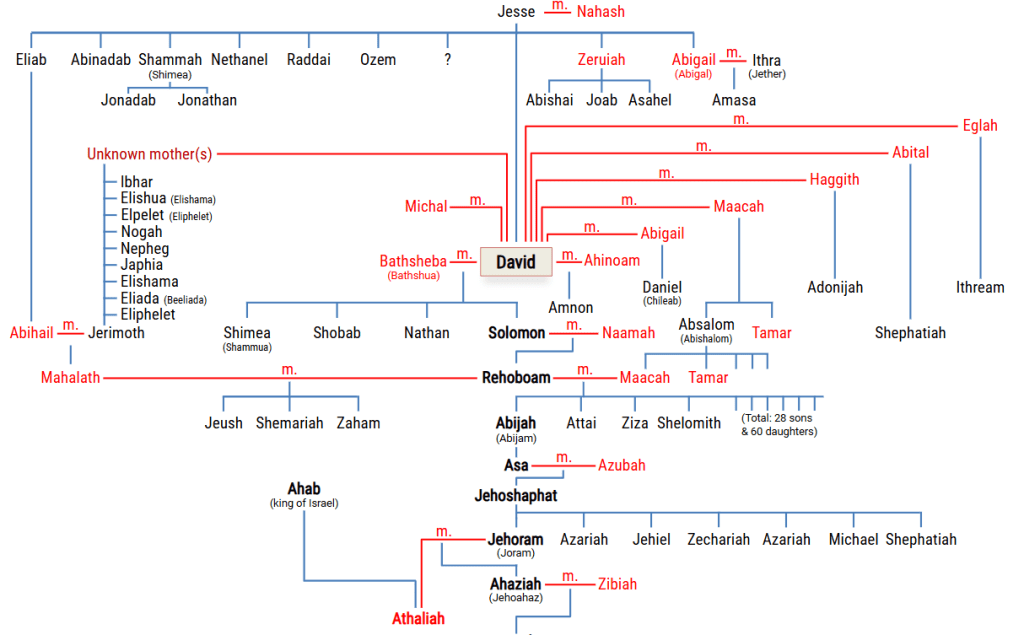
To consider the children of David, that is a task far beyond this writer’s ability, but I have found a great resource for this purpose. (https://www.bibletales.online/king-davids-family-tree/) This website also provides a very useful family tree graphic that has embedded links providing much information for those interested. I am attaching a graphic below for your immediate reference.
In all of this consideration, we find David acquiring, in his ascent to power, all the seeds of distraction, sources of jealousy and continual internal bickering that came to fruition in later years.
What truth can be culled from this short passage? In short, monogamy is wise, yet there are some that consider polygamy an allowance, even a benefit for the Christian society. Those who think so, may appeal to the Old Testament. I would suggest these passages accommodate (not prescribe) polygamy as a form of family structure.
Exodus 21:10 If he takes another wife to himself, he shall not diminish her food, her clothing, or her marital rights.
The Word specifies that a first wife was to be protected from any change in her rights, even as a man may take another. The verse implies that this was a condition the Israelites would continue and the Lord would accommodate for the time being.
Deuteronomy 21:15 “If a man has two wives,… and if the firstborn son belongs to the unloved, Deuteronomy 21:17 … he shall acknowledge the firstborn, the son of the unloved, by giving him a double portion of all that he has.
Again, the Word calls out the rights of the wife, even the second wife, who may be unloved.
Deuteronomy 17:17 And he shall not acquire many wives for himself, lest his heart turn away, nor shall he acquire for himself excessive silver and gold.
Deuteronomy 17:17 is a direct command of Scripture to any future king of Israel. Note that the passage refers to many wives. How many is many? Is three many? I would think so, but I can’t find a specific commandment providing a restriction. Those who want more wives could justify it by stretching the word many in many many many!
In all of this discussion, I want to confess a simple statement.
I am thankful for a simple life, for a loving wife of 44 years, and for the children that the Lord has provided through a monogamous relationship with my best friend.
David was a busy man – way too busy for me!
Thanks again for coming to visit. I hope you found something of interest in this post and would appreciate a comment, to begin a discussion. If you know someone this blog may bless (or challenge), send them a link, so they may join us in our discussion.
My hope is that this series will offer my readers a chance to consider the names, characteristics and descriptions of our God in the Word.
The remaining Names of God in this series might be considered descriptors, or characteristics of the Lord. We have reviewed the three primary Names of God, along with nineteen compound Names of God in our previous posts. As we venture through these descriptors of our God, I hope we will recognize all the many characteristics of our God that we tend to take for granted.
The Word is truly rich with descriptions of the Living God, and this effort of searching in the Word was quite illuminating. He truly is the ultimate subject of the Word, and His revelation of self-descriptions, or the accolades offered Him by His priests, prophets, kings apostles and faithful truly is a blessing.
May the Name of the Lord be praised, and by thinking on His name, may you have a blessed day.
257
GREAT SALVATION
Psalm 18:50 Great salvation he brings to his king, and shows steadfast love to his anointed, to David and his offspring forever.
David, in the 18th Psalm, describes the saving power of God, having found safety and security in the Lord in the midst of being surrounded by enemies.
Psalm 18:1 A Psalm of David, the servant of the LORD, who addressed the words of this song to the LORD on the day when the LORD delivered him from the hand of all his enemies, and from the hand of Saul.
David speaks of the Lord using military terms throughout this Psalm, using terms such as fortress, refuge, shield and horn of salvation.
Psalm 18:2 The LORD is my rock and my fortress and my deliverer, my God, my rock, in whom I take refuge, my shield, and the horn of my salvation, my stronghold.
He gushes over speaking of the might of the Lord in his deliverance, for at the time when there seemed no hope, no salvation available for David, God provided salvation. The enemies were too many, and had all the advantage, but when God was introduced into the situation, the tables where flipped over!
He spends the Psalm describing his love for the Lord, his thankful heart and uses many metaphors in describing the Lord’s saving work in his life.
He describes God’s frontal attack on the enemies, even from heaven, speaking of lightning as being an offensive weapon in the arsenal of God for David’s sake
Psalm 18:14 And he sent out his arrows and scattered them; he flashed forth lightnings and routed them.
He speaks of saving him from drowning
Psalm 18:16 … he drew me out of many waters.
David can’t hold back from describing his God in the victory. He goes so far as to call God his Great Salvation, and though David was speaking of an instant in time, where he was saved physically from enemies, when he calls God his Great Salvation, he is touching a topic that expands exponentially as the plan of God develops in history.
For our verse this morning, let us consider our Great Salvation, and that this Name of God continues in the military imagery David uses through the Psalm. You see, in the repeated passage of Psalm 18 we find in 2 Samuel, we come across our Name of God again, but it has a translation note attached to it.
2 Samuel 22:51 Great salvation he brings to his king, and shows steadfast love to his anointed, to David and his offspring forever.”
The translators of the ESV note that the phrase “Great Salvation he brings” may be rendered as “He is a tower of salvation.”
This imagery is pertinent to our lives, no matter where we are in our walk with the King, for we too are in a battle, even a war. Not only are we waging battle within our souls to submit to our Great Salvation, but also fighting a war for those around us, to represent the Living Savior as the Only Salvation for All.
The Great Salvation truly is for, through and about the Lord, for in our battle for Him, we need to trust in Him, to bring honor through Him to all. Although from a somewhat different context, Paul said it much better when he wrote
Romans 11:36 For from him and through him and to him are all things. To him be glory forever. Amen.
Yes He is our Great Salvation. He is the only One who is our strong tower in our battles, for if we believers do not run to Him for our safety, for our Great Salvation, we will find we have no defense against the ravages of this life!
Hebrews 2 speaks this truth much clearer when the author writes.
Hebrews 2:3a how shall we escape if we neglect such a great salvation?
May we run to our Great Salvation daily!
I would love to hear of your favorite name, characteristic or description of the Living God. Please leave me a comment, and I will include it in the list!
Thanks again for coming to visit. I hope you found something of interest in this post and would appreciate a comment, to begin a discussion. If you know someone this blog may bless (or challenge), send them a link, so they may join us in our discussion.
Psalm 34:6 This poor man cried, and the LORD heard him and saved him out of all his troubles.
Just last week, I was in church with my daughter and her family, when the preacher asked a parishioner to join him on the stage to discuss the faithfulness of God in answering prayers.
Even as they began their discussion, memories of the faithfulness of God, (even as I confess a sporadic, weak prayer life), flooded my mind. Times of comfort and challenge came to mind, sometimes including miraculous answers, and sometimes simply providing the gift of patience in waiting.
As many who follow may know, I have had the privilege of knowing the Lord Jesus for over 4 decades. During those years, He has proved Himself to be a faithful, kind and loving Savior. And as I have learned to lean on Jesus, He has shown Himself to be a merciful Savior, never wavering, even in some very dark times.
This topical series will try to provide a snapshot of an ol’ fools weak and selfish prayers and the ever increasing goodness of God in His responses the those prayers.
I hope my witness to the faithfulness of God will be an encouragement to those reading, and will spur us all on to a deeper, more consistent time of being in the Lord’s presence.
Please visit with me as I tell the story of a faithful God and His care for an ol’ fool. Though David considered himself a poor man in the Psalm, I freely admit, I am just an “ol’ fool” looking to the Lord.
Thanks for joining and Considering The Bible with me. Your thoughts are always welcome, and I look forward to hearing of the faithfulness of God in your lives.
My hope is that this series will offer my readers a chance to consider the names, characteristics and descriptions of our God in the Word.
The remaining Names of God in this series might be considered descriptors, or characteristics of the Lord. We have reviewed the three primary Names of God, along with nineteen compound Names of God in our previous posts. As we venture through these descriptors of our God, I hope we will recognize all the many characteristics of our God that we tend to take for granted.
The Word is truly rich with descriptions of the Living God, and this effort of searching in the Word was quite illuminating. He truly is the ultimate subject of the Word, and His revelation of self-descriptions, or the accolades offered Him by His priests, prophets, kings apostles and faithful truly is a blessing.
May the Name of the Lord be praised, and by thinking on His name, may you have a blessed day.
256
GREAT PRIEST
Hebrews 10:21 and since we have a great priest over the house of God,
For the New Testament believer, we have one Great Priest.
The book of Hebrews is full of descriptions of our Messiah as a priest, usually spoken of as a high priest, but in this one instance, throughout the Word of God, He is called a Great Priest.
Granted, Hebrews 4:14 modifies the Name of God we are considering this morning as our Great “High” Priest.
Hebrews 4:14Since then we have a great high priest who has passed through the heavens, Jesus, the Son of God, let us hold fast our confession.
But for this morning, let us consider our Great Priest, and seek to cull a truth out of the context we find it in.
Our first question to consider. Why did our author use this particular name for this verse in his discussion of the glories of Jesus as our priest.
I would remind my reader that the context of this passage is speaking of the new and living way Jesus has opened up for the believer, to find access through the curtain. It is interesting that the author likens the curtain to His flesh. The typology of the curtain being torn speaks of access to the very holy of Holies. As our Great Priest, Jesus has not only proven His freedom and right to enter the presence of God, but if we are found in Him, we actually enter the presence of God also.
As our Great Priest, He has authority over the house of God, the Temple of God, the Church, the Body of Christ. He is the One who is not only the Head of the Church, but also the Great Priest, the One who has not only become the eternal sacrifice, but willingly gave His own Body on the cross as the sacrifice.
He was the Priest offering His Body on the cross as the sacrifice.
This morning as I was taking my walk in my favorite parking garage, I looked to the morning sky, prior to any sunrise, and was impressed with the knowledge of all that I don’t know.
Yes, it should come as no surprise that we sinners are incredibly ignorant. Sure, I comfort myself in knowing I can add and subtract, communicate (if I take my time), and continue to learn about earthly things, but when I consider the skies, the vastness of space, the depth and quietness of the skies, the immensity of this creation, I confess I am but an ignorant sinner caught by the grace of God.
But more importantly, Jesus is the One who is all knowing, all powerful, all wise and eternal.
Consider that just in the topic of knowledge, He knows all secrets, facts, motivations and hidden thoughts. All those things that I don’t know, and they are many, He is in complete control of each fact and piece of knowledge. He has all knowledge and has all authority, even over the house of God.
And because He is the Great Priest, our author of Hebrews is telling me that Jesus was the One who performed the sacrifice. He had the knowledge of the coming sacrifice, and drove the circumstances of His surroundings and His own Body to the cross. Yes He was the sacrifice, but in this passage, I suggest the action of sacrifice is the emphasis.
And to what end my friend? That we (poor simple sinners, washed in the blood of the Lamb) may draw near with a true heart.
Hebrews 10:22 let us draw near with a true heart in full assurance of faith, with our hearts sprinkled clean from an evil conscience and our bodies washed with pure water.
He is the Living Way, the truth and the Way of Life.
As this verse describes Him as the Great Priest we are reminded He was not an unwilling victim, but the motivating will to make the eternal sacrifice to provide us entrance with Him before the throne.
May His Name, our Great Priest, be honored in our lives.
I would love to hear of your favorite name, characteristic or description of the Living God. Please leave me a comment, and I will include it in the list!
Thanks again for coming to visit. I hope you found something of interest in this post and would appreciate a comment, to begin a discussion. If you know someone this blog may bless (or challenge), send them a link, so they may join us in our discussion.
Matthew 3:8 Bear fruit in keeping with repentance. Matthew 3:9 And do not presume to say to yourselves, ‘We have Abraham as our father,’ for I tell you, God is able from these stones to raise up children for Abraham. Matthew 3:10 Even now the axe is laid to the root of the trees. Every tree therefore that does not bear good fruit is cut down and thrown into the fire.
John the Baptist was on fire. He was lighting up the desert with a message all of Israel was curious about. Some came out to see this rebel out of curiosity, some out of a severe hunger for authenticity, some to confess their sins to get right with God, some even thinking John was the coming Savior.
And there were some in Israel who came out to condemn him, to question his right to preach and baptize, to dissuade those who were listening to him. In this particular passage, John was confronting “many of the Pharisees and Sadducees coming to his baptism”
It is interesting that there is no record of these men speaking against John at this time. Open rejection would come from the leaders of Israel, but the text only speaks of their presence in the crowds. And of John’s judgement on these men.
The relationship these men had with God is the question for the topic of conditional security. We know after multiple teachings of both John and Jesus that these men needed repentance and to trust the Savior instead of their bloodlines and religion.
But at this time, both John and the Pharissees/Sadducees had the assumption of these leaders possessing salvation, an assumption that these men were in covenant with God. The crowds listening in must have taken a collective inhale when John hurled this claim at the religious “cream of the crop” in Israel.
Some may consider John’s message as a message to the nation, and not a message to the individual. I heartily agree, for the nation was on the edge of judgement, with the Savior at the door, ready to provide salvation. Rejection would not be an acceptable outcome for anyone!
Yet, John speaks in the personal.
You brood of vipers! Who warned you to flee from the wrath to come?
The term “you” is the second person singular in this verse. (It is not “y’all” or “all y’all” as we say in Texas to include more than a single person in the group!) John was addressing the individual. And he was speaking of a judgement that was imminent.
A judgement that was imminent due to bad fruit. Or possibly John intended to be understood as claiming they had no fruit. Either way, these men who understood they were right with God were not right with God.
Does this address the security of the New Testament believer? Not directly. There are many conditions that are different between them and us.
But there is one condition that is ever true for the people of God. We are to bear good fruit. A life that mimic s the Saviors, a life of giving, of self sacrifice, or holiness and love towards those who are our enemies.
As I am driving the highways of Texas, I often listen to the “Message” paraphrase Bible. I have settled in the early chapters of Matthew for that last few weeks. A theme becomes evident from the words of Jesus that echoes John’s message of good fruit required from the life of the believer. Jesus is letting us know that He expects good fruit.
5:13 Let me tell you why you are here. You’re here to be salt-seasoning that brings out the God-flavors of this earth. If you lose your saltiness, how will people taste godliness? You’ve lost your usefulness and will end up in the garbage.
5:20 Unless you do far better than the Pharisees in the matters of right living, you won’t know the first thing about entering the kingdom.
5:29 Let’s not pretend this is easier than it really is. If you want to live a morally pure life, here’s what you have to do: You have to blind your right eye the moment you catch it in a lustful leer. You have to choose to live one-eyed or else be dumped on a moral trash pile.
Faith in the Messiah includes repentance from a life of no fruit. John spoke to the religious folks of the day, waking them up to the basis of their trust. Trusting in bloodlines and religiosity offends the True God and His Messiah. He is looking for hearts that are malleable, able to take in truth without an argument, willing to be taught, and willing to obey.
For the Pharisees and Sudducees of John’s day, the axe was at the root of the tree. Nowhere did John describe the tree as dead. The tree was alive. The reason for the axe?
It was not producing good fruit. And judgement was about to fall.
Thanks again for coming to visit. I hope you found something of interest in this post and would appreciate a comment, to begin a discussion. If you would like to receive daily posts from Considering the Bible, click on the “Follow” link below
As many who have followed me for a bit, I have fallen into the Psalms, and I can’t get up! (As if I would want to.) The Psalms are a majestic collection of poetry, of heart felt human experiences that constantly challenge me in my own frail attempt to follow the true King. As many of the Psalms are written by David, my study on the Psalms has spurred me on to looking at the life of David, is the main contributor to this book, and to follow the victories and tragedies of the shepherd King of Israel.
Many times in the narrative, we will see the Lord Jesus, imperfectly, yet a reflection of His spirit in a man with weaknesses.
2 Samuel 5:11-12
11 And Hiram king of Tyre sent messengers to David, and cedar trees, also carpenters and masons who built David a house. 12 And David knew that the LORD had established him king over Israel, and that he had exalted his kingdom for the sake of his people Israel.
This passage begins the description of a long standing relationship between David and a Phoenician King named Hiram. The Word tells us that the relationship between these two men, describing them as leaders of their nations, each seeking the best for their people and working together for the mutual benefit of all.
1 Kings 5:1 Now Hiram king of Tyre sent his servants to Solomon when he heard that they had anointed him king in place of his father, for Hiram always loved David.
Even after David’s passing, Hiram continued to work with Solomon, delivering the required materials for his vast construction projects, including the kings house, and finally the Temple of God.
Our verse this morning though speaks of the first instance this relationship between David and Hiram is mentioned, and it appears Hiram initiated the transaction. Let’s remember that David’s kingdom was in it’s infancy, that the nation had only healed recently, that David was newly placed on the throne of a nation that had been in civil war.
David had established himself as a very capable warrior, and had taken the city of the Jebusites by cunning. A wise man would see this young warrior and find it favorable to align his kingdom with David, and this is apparently what Hiram is doing at this time.
As an aside, after the death of David, there seemed to be a need for a treaty between these two nations.
1 Kings 5:12 And the LORD gave Solomon wisdom, as he promised him. And there was peace between Hiram and Solomon, and the two of them made a treaty.
Now, at first glance this seems innocent, but it also implies no treaty was needed during the time of David. I don’t want to make too much of this other than bringing it to our attention. David and Hiram, as two national leaders, seemed to be content with a relation of coexistence, without a formal treaty being required.
Hiram sent to David not only the materials needed for his kings house, but also the skilled men to construct the house. This is an enormous act of reaching out to this young “upstart” king, and shows the wisdom of Hiram in aligning himself and his people with a nation on track to become a world power.
Hiram saw it coming. And David was realizing it. All the running and living under persecution, all the uncertainty and brushes with death, all the threats and conspiracies against him all behind him, with the future looking as promised.
God had fulfilled His promise to David. The nation was heading into it’s golden age!
For us who are following Jesus today, we are in the state of following a persecuted King, as David was prior to his ascension. Yet we also are in a state, (if we will admit it), of the Great King reigning over all, not only His people in the church, but over all of creation, all the nations, each people group is under the authority of the Messiah.
Our mission is to bring them under a willing compliance to His Lordship, instead of the ignorance and rebellion we all have had towards our Greater David.
Hiram saw the wisdom of seeking favor of Israel’s new Regent. It is the same today. If you are one who has refused to bend the knee to King Jesus, consider who Jesus is.
For Jesus is King, and He rules the nations. Join Him while you have opportunity. Confess your rejection of Him, your sinful attitude and actions against Him. Trust Him, for He is a King like no other.
Thanks again for coming to visit. I hope you found something of interest in this post and would appreciate a comment, to begin a discussion. If you know someone this blog may bless (or challenge), send them a link, so they may join us in our discussion.
My hope is that this series will offer my readers a chance to consider the names, characteristics and descriptions of our God in the Word.
The remaining Names of God in this series might be considered descriptors, or characteristics of the Lord. We have reviewed the three primary Names of God, along with nineteen compound Names of God in our previous posts. As we venture through these descriptors of our God, I hope we will recognize all the many characteristics of our God that we tend to take for granted.
The Word is truly rich with descriptions of the Living God, and this effort of searching in the Word was quite illuminating. He truly is the ultimate subject of the Word, and His revelation of self-descriptions, or the accolades offered Him by His priests, prophets, kings apostles and faithful truly is a blessing.
May the Name of the Lord be praised, and by thinking on His name, may you have a blessed day.
255
GREAT POWER
Deuteronomy 9:29 For they are your people and your heritage, whom you brought out by your great power and by your outstretched arm.’
Israel had sinned. And sinned And sinned again.
Moses is recalling the times of failure for the nation of Israel. This time of remembrance for the nation is summed up as Moses calls the nation to remember in verse 7.
Deuteronomy 9:7 Remember and do not forget how you provoked the LORD your God to wrath in the wilderness. From the day you came out of the land of Egypt until you came to this place, you have been rebellious against the LORD.
Moses is blunt. He openly speaks of their failure, disobedience, rebellion, stubbornness and corruption. He reminds them of the judgement that was imminent from God and how God was willing to blot out their name from under heaven, completely destroying them in verse 14.
Deuteronomy 9:14 Let me alone, that I may destroy them and blot out their name from under heaven. And I will make of you a nation mightier and greater than they.’
They had no claim to the mercy of God in and of themselves. Death was their destiny if it hadn’t been for the exercise of His Great Power in bringing them out of Egypt. Not only were the Israelites drawn out from Egypt by the Great Power of God, their continued relationship with the God of Creation depended on the Great Power.
Moses reminded God of the Great Power He exercised in delivering His people and spoke of His commitment to the people, and of His commitment to the Fathers of the nation, sinners though they be also.
He also spoke of the hit the Lord would take if Israel were to “disappear”. All the nations would murmur and speak of how the Lord only sought to destroy the ones he delivered by His Great Power. Moses was reminding the Lord of His reputation before the nations. and that His treatment of the tiny nation of Israel would be seen far and wide by the nations.
Moses reminded the Lord that a job started was a job that needed completion. The difficulty of the task, the rebellion of the people He was leading, did not negate the need to complete the task. Faithfulness was the challenge Moses brought before the Lord, a faithfulness to the promise He made to the Fathers, and a faithfulness to His own reputation before the nations.
Did Israel deserve judgement? Yes. Would judgement occur in the future? Yes. Would the faithfulness of God to His people be abundantly evident before the nations? Yes.
Now we know as believers, the Great Power of God in delivering the nation of Israel is the Savior, the only One who has provided a physical salvation to a rebellious nation, but also a spiritual salvation to a rebellious sinful people, those who have heard the voice of the Great Power and followed after Him.
Have you heard the voice of the Great Power and decided to follow?
I would love to hear of your favorite name, characteristic or description of the Living God. Please leave me a comment, and I will include it in the list!
Thanks again for coming to visit. I hope you found something of interest in this post and would appreciate a comment, to begin a discussion. If you know someone this blog may bless (or challenge), send them a link, so they may join us in our discussion.
My hope is that this series will offer my readers a chance to consider the names, characteristics and descriptions of our God in the Word.
The remaining Names of God in this series might be considered descriptors, or characteristics of the Lord. We have reviewed the three primary Names of God, along with nineteen compound Names of God in our previous posts. As we venture through these descriptors of our God, I hope we will recognize all the many characteristics of our God that we tend to take for granted.
The Word is truly rich with descriptions of the Living God, and this effort of searching in the Word was quite illuminating. He truly is the ultimate subject of the Word, and His revelation of self-descriptions, or the accolades offered Him by His priests, prophets, kings apostles and faithful truly is a blessing.
May the Name of the Lord be praised, and by thinking on His name, may you have a blessed day.
254
GREAT PEACE
Psalm 119:165 Great peace have those who love your law; nothing can make them stumble.
It may not be obvious in first reviewing the provided verse for this mornings Name of God, but none can argue that this description applied to God is worthy of considering.
Great peace. When I first considered this verse years ago, I glibly passed over it.
I was in a hurry to get to the weightier matters of the Word, teachings found in Romans or Hebrews, meaty teachings that challenge my thinking, make me wonder, let me argue with the text and sometimes allow me to come to a conclusion. At least for a time.
Then I tripped over this verse again, and caught the relationship of Great Peace and loving the Law of God. Of course, as God is the Great Peace, He is obviously the ultimate lover of Gods Law, the absolutes of it, the righteousness found in the Law. He applies the Law in perfection in all His actions, to those who love Him and to those who despise Him. In all ways in in every instance, God loves His Law and the outworking of it in His actions.
But I must get back to the books of greater importance, such as Revelation, where the end time mysteries reside, where it appears secrets are revealed and time schedules are ready to be deciphered.
Suddenly, without aforethought or anticipation, I arrived at this verse one more time. I slowed down for just a moment, and considered the last phrase.
Nothing can make them stumble. What is going with that claim?
Of course, in relation to God, nothing makes Him stumble. He is perfection, and in the midst of His mission to rescue the lost and sinful, He is still without stain. Though He may have many traps and hazards thrown before Him, He is holy, He is complete and He is without stumbling! This is without debate!
But for the believer, there is an opportunity for a life that includes Great Peace, and a life without stumbling.
How does this work itself out?
To stumble is to experience a tripping hazard, a slippage of the foot, a stubbing of the toe in our spiritual experience. A fall into a sin may be considered a stumble. To hear something about myself that upsets me may be a stumble opportunity.
An example may help.
I was on a conference call with a group of my peers and our project manager. Admittedly, I was a few seconds late getting on the call, but when I did, my manager asked how I was.
I am fantabulous boss – Having a great day!
I tend to provide an exaggerated response at times, but I wanted to approach the conversation in a positive way. A few seconds later, I heard her mutter something under her breath. Something that lodged in my mind, and to be honest, it lodged deep in my mind and settled down, making itself quite comfy in there.
What she said is of no importance in this discussion, but the remark was my stumbling opportunity for the morning. My joy evaporated, my peace was torn, and the inner grumbling began. Thankfully I had the foresight to not mention this insignificant issue to my working peers, but it simply galled me.
Until I remembered the Word. How the Word provides the perspective I needed to interpret this remark, for the Word reminds me of the conditions we all live under. The disappointments, the stresses, the conflicts we all experience. The poor choices we all make, and the continual outflow of hurting and sinful hearts that we may be impacted by.
Until I remembered the Living Word, the Savior and how He took insult, injury, attack and hostility without stumbling. How he did not please Himself, but accepted the reproaches aimed at others.
Romans 15:3 For Christ did not please himself, but as it is written, “The reproaches of those who reproached you fell on me.”
Great Peace can be experienced by the believer as he follows the example of the Son of God.
What a great verse! Why did it take me decades to find it?
To follow after God, who is our Great Peace, should produce great peace in our lives. Turmoil, turbulence and tension do not belong in the believers heart and mind.
God, our Great Peace does!
I would love to hear of your favorite name, characteristic or description of the Living God. Please leave me a comment, and I will include it in the list!
Thanks again for coming to visit. I hope you found something of interest in this post and would appreciate a comment, to begin a discussion. If you know someone this blog may bless (or challenge), send them a link, so they may join us in our discussion.
Matthew 5:29 If your right eye causes you to sin, tear it out and throw it away. For it is better that you lose one of your members than that your whole body be thrown into hell. Matthew 5:30 And if your right hand causes you to sin, cut it off and throw it away. For it is better that you lose one of your members than that your whole body go into hell.
Now right off the top, I need to confess that this first verse, regarding my right eye, has a special place in my mind as being really yucky. You all may know my hatred of all things eyeball related, as mentioned in an earlier post. To think of gouging out an eyeball is exceptionally difficult to consider.
Nevertheless, the Lord is making a point about how the believer, one of His followers were to treat anything in our lives that causes us to sin.
It is good to remember that though many believers may live in a debauched and sinful society, a culture that is dripping in unrighteousness and rebellion against the principals and person of God, Jesus is not commanding us to clean up our environment in this passage. Granted, if we believers were to take this command with greater seriousness, some of our society would respond properly and in kind. But that is not the intent of the passage!
I would suggest He is speaking of our own impulses, our own inner desires and rebellion against God and His Savior. James addresses this same tendency, this desire to wander, to leave the One we love, this fallenness within our hearts when he writes in chapter one of his letter
James 1:14-15 But each person is tempted when he is lured and enticed by his own desire. Then desire when it has conceived gives birth to sin, and sin when it is fully grown brings forth death.
Jesus, in Matthew 5 provides two examples of the believers attitude, or better yet, what the believer’s attitude toward this inner desire should be. A ruthlessness, even to the most sensitive organ in the body, (the eye), and the most useful appendage in the body (the hand).
Sometimes the believer may argue it to be innocuous, or of no impact in putting up with a certain rebellion, a certain sin since the removal of this sin in our lives would touch a sensitive area in our lives. Or it may require the removal of a very useful situation, a condition that makes life easier, more “tolerable”.
Jesus is addressing hard things here. Difficult issues that the believer will face as he follows after the Lord. Some decisions to follow after Him will require the loss of sensitive relationships in our lives, such as leaving behind close friends who will only drag you back to sin. Jesus even warns us of the dangers to our faith within our own families.
Sensitive relationships, people that we have loved for many years, may need to be left behind. That portion of our heart, that easily (and willingly) succumbs to the ungodly charms of an old friend or loved one, is to be starved, cut out of our lives, and left behind.
He is brutal in this passage, describing how we are to be committed to His rule, in issues that are difficult to face, to admit weakness in and to find victory in rejecting their influence.
But there is more to this verse than an over the top requirement for discipleship. As He speaks to His followers, He brings up the topic of hell.
What? Followers and hell in the same sentence? What is that all about?
As many of you who may follow this blog, I am not convinced of any specific teaching regarding hell, but if there be one of the three mainstream teachings I find to be least obvious in the Word, it is the teaching of eternal conscious torment. Though there be a few verses that may seem to support it, does Jesus apply this potential destiny to the believer?
Whatever He is referring to, whether it be ECT or some other form of punishment/destiny, when He speaks of my “whole body being thrown into hell”, Jesus is talking to those who are attentive to His message, to His disciples,.
And how can that be?
Might it be a theoretical threat, in that Jesus is using this description of being thrown into hell to emphasize the importance of fleeing temptation, even that which resides within us?
Maybe, but since I wasn’t there to see Him wink or provide a slight grin during the talk, it might not be wise to assume this understanding to quickly.
Ok, so might it be a call to perfection, as He speaks of later in the same chapter of Matthew?
Matthew 5:48 You therefore must be perfect, as your heavenly Father is perfect.
More likely in my opinion, yet this very verse also is a double edged sword. You see, there are two options in my mind.
The call to be perfect is something that can be realized in the believers life, by walking in the Spirit and growing in grace and knowledge of the Lord Jesus. This perfection is sometimes considered maturity and support for this thinking can be found in both Philippians and Hebrews.
The call to perfection is an actual call to moral perfection, and if taken seriously will cause the believer to understand his complete and utter helplessness and hopelessness before the perfect Son of God and the Father of Light.
Now both options drive us to the Savior, which we should expect and be thankful for
Nevertheless, however you read these two topic verses in Matthew, of the call to gouge our eye and cut off our hand, it is a jarring call, with a severe punishment for the believer if he fails.
What think ye? I would love to hear your opinion of this difficult and challenging passage.
Thanks again for coming to visit. I hope you found something of interest in this post and would appreciate a comment, to begin a discussion. If you would like to receive daily posts from Considering the Bible, click on the “Follow” link below
As many who have followed me for a bit, I have fallen into the Psalms, and I can’t get up! (As if I would want to.) The Psalms are a majestic collection of poetry, of heart felt human experiences that constantly challenge me in my own frail attempt to follow the true King. As many of the Psalms are written by David, my study on the Psalms has spurred me on to looking at the life of David, is the main contributor to this book, and to follow the victories and tragedies of the shepherd King of Israel.
Many times in the narrative, we will see the Lord Jesus, imperfectly, yet a reflection of His spirit in a man with weaknesses.
2 Samuel 5:6-10
10 And the king and his men went to Jerusalem against the Jebusites, the inhabitants of the land, who said to David, “You will not come in here, but the blind and the lame will ward you off” – thinking, “David cannot come in here.” 7 Nevertheless, David took the stronghold of Zion, that is, the city of David. 8 And David said on that day, “Whoever would strike the Jebusites, let him get up the water shaft to attack ‘the lame and the blind,’ who are hated by David’s soul.” Therefore it is said, “The blind and the lame shall not come into the house.” 9 And David lived in the stronghold and called it the city of David. And David built the city all around from the Millo inward. 10 And David became greater and greater, for the LORD, the God of hosts, was with him.
What a history for the city of Jerusalem. First spoken of in Genesis 14 when referring to Melchizedek, whom I believe was the Lord Himself, all the way to becoming the city of God, the geographical focal residence of God on earth.
Of course, there were times the city contained somewhat less glorious inhabitants.
As the tribes of Israel entered the land, they were instructed to take the land. All the land, with the strongholds throughout the area. Future Jerusalem was a city that had not been taken.
Judah attempted to take Jebus in the early times of the judges.
Judges 1:8 And the men of Judah fought against Jerusalem and captured it and struck it with the edge of the sword and set the city on fire.
You have to hand it to the tribe of Judah for the attempt, for the city is considered to be a very easily defendable city, but it turns out the nation could not keep the city under their control.
Judges 1:21 But the people of Benjamin did not drive out the Jebusites who lived in Jerusalem, so the Jebusites have lived with the people of Benjamin in Jerusalem to this day.
This is amazing since once taken, the city’s own defense would be in the victor’s favor. Yet the nation could not maintain dominance of the city.
Over 400 years had to pass before a king would take control of Jerusalem, a king who saw the importance of the city, not only as a stronghold, but also as a unifying location for a capital city. Hebron, David’s current capital was far to south now that the northern tribes were joined the kingdom, and Jerusalem became the city David had eyes for.
And David took the city.
But I don’t suppose David’s motivation for taking the city of Jerusalem was only strategic, political and covenantal related. There may have been a bit of motivation supplied by the very Jebusites themselves. Referring to David’s army as men who couldn’t fight disabled soldiers is a fairly significant slap in the face to David. That alone is enough for David to teach the Jebusites a lesson, and while the world watched David gain power, taking Jebus became a necessity!
David took the city unconventionally, for if I understand the passage, the defeat of the Jebusite’s came by stealth, ingenuity and out of the box thinking. A water stack was to be used to gain access for a small band of men to enter and attack the inhabitants. A bit reminiscent of the attack on Babylon by the Persians hundreds of years later, as they took the city of Babylon by entering through a river. But I digress.
David took the city, and David kept the city. Jerusalem, the city on a hill, became the city David would rule from, the city the Temple would be built in, and the city that would be the focus of all things spiritual in the nation of Israel.
But it would also become the city Israel would loose to Babylon 400 years after David’s victory.
In the last days of Jerusalem, Jeremiah echoed the sentiment of the Jebusites, turning the insult onto the city itself. Jerusalem was unable to defend itself, though strategically positioned, against the disabled Chaldean (Babylonian) soldier coming against it.
Jeremiah 37:10 For even if you should defeat the whole army of Chaldeans who are fighting against you, and there remained of them only wounded men, every man in his tent, they would rise up and burn this city with fire.’”
Jerusalem, though a easily defendable city, could be taken by the cripple and disabled. What a insult to the mighty city of David, and yet, as we venture through the Old Testament prophets, we see the continual sliding of Jerusalem from David’s pinnacle to Jeremiah’s day.
Never would the city rise to the heights of glory as in the days of David and his son Solomon. Even after the Babylonian captivity, the city never found strength and power in the region.
Jerusalem became a regional capital for a portion of Israel, primarily Judah and Benjamin, with the 10 northern tribes lost to the Assyrian assault many years previously.
And the temple, though rebuilt, did not contain the Ark of the Covenant, and the nation, what was left of it, could never claim the presence of God residing among them.
Jerusalem was a hollowed out city when compared with the former day’s of glory. It never ascended to it’s former glory, until one opportunity – one Person entered it’s gates.
David’s Son, Jesus the Messiah entered the gates of Jerusalem, and proclaimed the kingdom of God to be present. Not just the kingdom of Israel, but the kingdom of God! Jesus, the Greater Son of David entered the “City of Peace”, declared His Kingship and offered Jerusalem a glory greater than David’s.
We know what happened. Although given the greatest opportunity it had ever been granted, Jerusalem chose poorly, and rejected the King. A generation later, it fell to the Romans, and great was the fall of it. A horrendous and tragic end for what was once the “City on a Hill”.
The kingdom of God though continued, growing exponentially, beyond the geograpic limitations of a small city under the control of Gentile nations.
We also have opportunities provided in our lives. Some opportunities, like David in seeing the stronghold of Jerusalem, need unconventional methods to overcome.
Some opportunities, like hearing the voice of God, simply need open ears and a willing heart to accept.
Thanks again for coming to visit. I hope you found something of interest in this post and would appreciate a comment, to begin a discussion. If you know someone this blog may bless (or challenge), send them a link, so they may join us in our discussion.
My hope is that this series will offer my readers a chance to consider the names, characteristics and descriptions of our God in the Word.
The remaining Names of God in this series might be considered descriptors, or characteristics of the Lord. We have reviewed the three primary Names of God, along with nineteen compound Names of God in our previous posts. As we venture through these descriptors of our God, I hope we will recognize all the many characteristics of our God that we tend to take for granted.
The Word is truly rich with descriptions of the Living God, and this effort of searching in the Word was quite illuminating. He truly is the ultimate subject of the Word, and His revelation of self-descriptions, or the accolades offered Him by His priests, prophets, kings apostles and faithful truly is a blessing.
May the Name of the Lord be praised, and by thinking on His name, may you have a blessed day.
253
GREAT LIGHT
Matthew 4:16 the people dwelling in darkness have seen a great light, and for those dwelling in the region and shadow of death, on them a light has dawned.”
John had just been put in prison. Things were trending to be against this new movement in Jerusalem. Those in the spiritual center of the region were actively seeking to “protect” the people of Israel from heresy.
The time would come when the Messiah would enter the lion’s den in Jerusalem, but for now, upon the imprisonment of John, Jesus headed north, to an area that didn’t have any spiritual light, that was despised by the elite of Jerusalem. Yes He headed to Galilee of the Gentiles, an area that some have estimated inhabited close to three million souls, a fertile farmland region, with a thriving fishing industry. Formerly a part of Israel, with a pure Jewish population found, the region had been “overrun” with Gentiles, to the point that it was defined by their presence.
Galilee of the Gentiles.
This is the region the Lord headed for as John was imprisoned. A region that was in darkness, spiritually speaking, not only in the opinion of those elites in Jerusalem, but also in truth. No prophet had appeared in the region since the area fell to Assyria over 700 years before, and was considered by those who knew best in Jerusalem to be a spiritual write off. Jerusalem was to be the focus for the religious elite, for in it the temple resided, the place where the Light had once been in the Holy of Holies. Granted, the Shekinah glory had not been resident in the Temple for centuries, but the claim to fame was still being held onto by the elite. Those of Jerusalem guarded a tradition, a religion, a past light that had left centuries ago, but the tradition was fiercely guarded, defended against from all competitors.
Even when that Great Light was introduced to the elite, he was imprisoned by the elite.
No – those in the know would protect their truth, defend their light and fight against all who would bring heresy. Definitely a defensive stance!
Jesus, the Great Light was different.
He would go to them, for how could He not? Light is not defensive in it’s nature but outgoing, defeating darkness, proceeding forward. Yes, He saw the rejection of light by those who claimed the light, but then proceeded to take the light to those who had no claim of light, who did not assume a spiritual standing before God.
The region was Gentile! Oh my goodness, how could anyone think there was a spiritual component to the area, when it was overpopulated with Gentiles.
But Jesus, the Great Light was different!
Jesus, as He entered the region performed many miracles, taught many stories, and lived a charmed life amongst them. As the Great Light amongst a darkened people, these folk, even the Gentiles amongst them were exposed to truth, light and love as never before.
Sadly some in the region exercised their stubbornness and remained blind, even though the Great Light was in their presence. This condition is a relevant truth to consider, for if there is darkness, it may be due to a self inflicted, stubborn streak in the one in need of light. After all, when Jesus was closing out His ministry, He condemned some of the cities He had shone in,
Matthew 11:21 “Woe to you, Chorazin! Woe to you, Bethsaida! For if the mighty works done in you had been done in Tyre and Sidon, they would have repented long ago in sackcloth and ashes. Matthew 11:22 But I tell you, it will be more bearable on the day of judgment for Tyre and Sidon than for you. Matthew 11:23 And you, Capernaum, will you be exalted to heaven? You will be brought down to Hades. For if the mighty works done in you had been done in Sodom, it would have remained until this day. Matthew 11:24 But I tell you that it will be more tolerable on the day of judgment for the land of Sodom than for you.”
The Great Light shone in darkness and some who dwelled in darkness judged the darkness to be preferred.
Was it that they were not of the pure Jewish blood, those of Abraham’s lineage that they couldn’t recieve the light? I think not, for as we read of Jesus condemnation, Jesus compared those of Chorazain, Bethsaida and Capernaum with other Gentile cities.
As the Word constantly teaches, bloodlines, nationalities and religions are not the key to seeing light. The key to seeing light is a loss of blindness. And the first step to the loss of blindness is an admission of being blind.
The Great Light is still shining for all of us, and each of us may still retain a certain blindness to His glory. I readily admit my own blindness, my own desire to be in the land of darkness.
Lord help me as I dwell in my own darkness!
It is truly amazing that He not only is the Great Light, but that He came to those in darkness, even a self inflicted darkness, willing and able to provide sight to those who want to escape the darkness.
Each of us, whether we be Jew, Gentile (or even Canadian) have the privilege and responsibility to open our eyes to the Great Light. Once you do, it is a decision that will never be regretted, and that will cause you to keep coming back to that Light, for He is the One and Only Great Light!
I would love to hear of your favorite name, characteristic or description of the Living God. Please leave me a comment, and I will include it in the list!
Thanks again for coming to visit. I hope you found something of interest in this post and would appreciate a comment, to begin a discussion. If you know someone this blog may bless (or challenge), send them a link, so they may join us in our discussion.
My hope is that this series will offer my readers a chance to consider the names, characteristics and descriptions of our God in the Word.
The remaining Names of God in this series might be considered descriptors, or characteristics of the Lord. We have reviewed the three primary Names of God, along with nineteen compound Names of God in our previous posts. As we venture through these descriptors of our God, I hope we will recognize all the many characteristics of our God that we tend to take for granted.
The Word is truly rich with descriptions of the Living God, and this effort of searching in the Word was quite illuminating. He truly is the ultimate subject of the Word, and His revelation of self-descriptions, or the accolades offered Him by His priests, prophets, kings apostles and faithful truly is a blessing.
May the Name of the Lord be praised, and by thinking on His name, may you have a blessed day.
252
GREAT KING OVER ALL THE EARTH
Psalm 47:2 For the LORD, the Most High, is to be feared, a great king over all the earth.
The more I read the Psalms, the more I understand that those in touch with God in the Old Testament understood the global reach of the God they worshipped. They openly boasted of the non tribal nature of God, of His dominance over not only the inferior gods of the Philistines and Amorites, but that these gods of their neighbors had nothing in common with the God of Israel.
He is the Great King over all the earth, and in including all the earth, those old prophets included lands they knew of and beyond.
These men who wrote the Psalms would not be surprised millennia later, when the Lord Jesus claimed to have all authority, that He was King over all in heaven and on earth.
Matthew 28:18 And Jesus came and said to them, “All authority in heaven and on earth has been given to me.
I can’t imagine that Jesus’ claim of authority, extending even into heaven, and not only over all the earth, would cause a stumbling for these prophets of old. These prophets described the God they worshipped as a Great King over all the earth, and didn’t only dwell on Israel’s immense privilege as the chosen nation that would produce the Messiah.
As the Great King over all the earth, He is to be feared, as the Psalmist describes. But it is important to understand that this fear is not the self crippling fear that causes inactivity in the Kingdom, but the very opposite.
Believers, in understanding that our God is the Great King over all the earth, have available the boldness required to take on tasks, or missions, that are unattainable in our own strength, that are of a “foolish” goal in the eyes of the world. The fear of the Lord, best understood, is to drive us from inactivity and into a confident faith that will require a dependance on our King for strength and wisdom.
This Great King may call you to a task that is beyond your capabilities, beyond your strength and beyond your wisdom. Fear the Great King, with a confidence that the Great King will provide that which is necessary for the one who fears Him.
For He is the Great King over all the earth!
I would love to hear of your favorite name, characteristic or description of the Living God. Please leave me a comment, and I will include it in the list!
Thanks again for coming to visit. I hope you found something of interest in this post and would appreciate a comment, to begin a discussion. If you know someone this blog may bless (or challenge), send them a link, so they may join us in our discussion.
Matthew 13:24 He put another parable before them, saying, “The kingdom of heaven may be compared to a man who sowed good seed in his field, Matthew 13:25 but while his men were sleeping, his enemy came and sowed weeds among the wheat and went away. Matthew 13:26 So when the plants came up and bore grain, then the weeds appeared also. Matthew 13:27 And the servants of the master of the house came and said to him, ‘Master, did you not sow good seed in your field? How then does it have weeds?’ Matthew 13:28 He said to them, ‘An enemy has done this.’ So the servants said to him, ‘Then do you want us to go and gather them?’ Matthew 13:29 But he said, ‘No, lest in gathering the weeds you root up the wheat along with them. Matthew 13:30 Let both grow together until the harvest, and at harvest time I will tell the reapers, “Gather the weeds first and bind them in bundles to be burned, but gather the wheat into my barn.”‘”
It must have been a late night when I pulled this passage into the Conditional Security series, for at first glance, I found little that would direct a person (without bias) towards the conclusion of conditional security in this passage.
The passage spoke of the kingdom, specifically of the harvest time and how to bring to judgement those who were enemies within the Kingdom.
But after a slight glance at the parable, and especially the explanation given to the disciples, there may be hints as to the general teaching of conditional security found within.
First off, it is granted that the weeds grew along with the wheat, and that in the parable the weeds have always been weeds. By that I mean, they were sown as weeds, lived as weeds and were gathered as weeds. The parable, in it’s simplicity, seemed to keep these two types of field plants separate throughout the passage.
Yet the parable did speak of the early pulling of weeds and potentially of pulling wheat with the weeds, all of which was destined for the fire. But per the Master’s decision, and his care for the wheat, this was to be avoided by allowing the weeds and wheat to grow together in the field.
29 But he said, ‘No, lest in gathering the weeds you root up the wheat along with them.
No – the harvest was to be immediately preceded by the pulling of the weeds, for at fruition, the weeds showed their true colors. There would be no mistaking of the wheat as weeds.
A little later, the disciples asked for clarity.
Jesus provided clarity in identifying all the parties in the parable, including the sowers and the seed, and how the harvest would act out in the end.
Verse 41 gives me some pause in relation to the way judgement at the end is to be exercised. Let’s read it once more.
41 The Son of Man will send his angels, and they will gather out of his kingdom all causes of sin and all law-breakers,
Notice that in the Lord’s explanation of the parable, the weeds and wheat are not identified in relation to the source seed, (good seed, / weeds) but in the work or actions of those being gathered, (righteousness / sin and law-breakers).
Granted, nothing is specified in the Lord’s explanation that the original good seed, that is the wheat, in included in the that “causes of sin and all law-breakers”, but in the same breath, there is no specific claim that the wheat stayed wheat. Jesus changed the description of the plants from a source seed related identifier to a fruit related identifier. I find that somewhat interesting!
When I first became a follower of Jesus, I was told not to take a parable and make it walk on four legs. I think my brother was telling me that parables typically have a single point of teaching, and that we shouldn’t try to find justification for a teaching in the parables, but to let them speak for themselves in the main point.
I may be doing that very thing with this post. The teaching of conditional security is definitely not the main point of this parable, (dang – it might not be the tenth point of the parable) and if this was the only teaching in the Word that hinted at conditional security, I readily admit it would be heretical to suggest this teaching here.
Yet, throughout the Word, it seems there are subtle hints to the danger of slipping from wheat to weed.
What is your opinion of this parable, and it’s relation to the teaching of conditional security?
Thanks again for coming to visit. I hope you found something of interest in this post and would appreciate a comment, to begin a discussion. If you would like to receive daily posts from Considering the Bible, click on the “Follow” link below
As many who have followed me for a bit, I have fallen into the Psalms, and I can’t get up! (As if I would want to.) The Psalms are a majestic collection of poetry, of heart felt human experiences that constantly challenge me in my own frail attempt to follow the true King. As many of the Psalms are written by David, my study on the Psalms has spurred me on to looking at the life of David, is the main contributor to this book, and to follow the victories and tragedies of the shepherd King of Israel.
Many times in the narrative, we will see the Lord Jesus, imperfectly, yet a reflection of His spirit in a man with weaknesses.
2 Samuel 5:1-5 1 Then all the tribes of Israel came to David at Hebron and said, “Behold, we are your bone and flesh. 2 In times past, when Saul was king over us, it was you who led out and brought in Israel. And the LORD said to you, ‘You shall be shepherd of my people Israel, and you shall be prince over Israel.’” 3 So all the elders of Israel came to the king at Hebron, and King David made a covenant with them at Hebron before the LORD, and they anointed David king over Israel. 4 David was thirty years old when he began to reign, and he reigned forty years. 5 At Hebron he reigned over Judah seven years and six months, and at Jerusalem he reigned over all Israel and Judah thirty-three years.
He is King. He has been accepted by the nation after what seemed like a never ending time of persecution by the very people who now come before him. He who persecuted him has been defeated, and the previous kingdom has been vanquished, even though a puppet king was installed. Those who troubled him have seen the error of their ways, repented and made covenant with the King appointed by God.
I am speaking of David in this instance, but in this short passage, it seems foolish to ignore this picture of Jesus being crowned by God and yet persecuted by the people. Jesus, King of all and owning all authority, yet being chased and persecuted in His church, by the very people He came to serve and save. Though David’s reign is an extended reign, speaking of a test being passed, (for 40 is often associated with testing in the Bible), how much more can we imagine the eternal victory and reign of the Savior, for He passed every test, every temptation, every trial to become the perfect and all righteous King of all.
Back to the text.
The elders came to David and the first thing out of their mouth was this identification of sameness, of being of his bone and flesh.
This seems to be such an obvious point to make that almost seems redundant. Of course David and the Israelites were of the same “bone and flesh”. But let us think about this for a moment.
David was ruling in Hebron, and the tribe of Judah had received him as their king. Eleven other tribes had remained with Saul and his throne, even after his death. Let us remember that David was of the tribe of Judah, and this direct connection could be proven and utilized to justify his reign over Judah. The connection was very direct, personal and in the mind of those in the other tribes, able to be leveraged to prioritize Judah over all of the other tribes.
The northern tribes had to find a connection to being parity before the King and his “favorite” tribe. And hence the claim of same “bone and flesh”. The leaders of the eleven tribes hailed back to Abraham, Isaac and Jacob, claiming – rightly so – that the King of Israel is over all the tribes, that each and every tribe had an equal right to their king.
Though he be but a human, the King was to rule over all the tribes.
I can’t help but to turn back to the image displayed in this passage regarding our King, the eternal King Jesus. Though He initially came for the people of a nation to submit to Him, in their rejection, He has accepted all others also into His Kingdom.
No longer can some claim a “bone and flesh” ownership to the True King. No longer may this be used to include or exclude others from His Kingdom, for He has partook of the “same things” of all creation, not of one or any other group or tribe, nation or people group.
Hebrews 2:14 Since therefore the children share in flesh and blood, he himself likewise partook of the same things, that through death he might destroy the one who has the power of death, that is, the devil,
He became human to rescue lost humans, and though a Jew by nationality, this identification was never His end focus. He rightly sought and gained the throne over all, not just one nation out of many.
True subjects of the Kingdom, those who understand Who the King is and His incredible mission to draw those subjects to Him, will worship Him in spirit and truth, not lean on physical associations, such as “bone and flesh”. How limiting and divisive!
John 4:23 But the hour is coming, and is now here, when the true worshipers will worship the Father in spirit and truth, for the Father is seeking such people to worship him.
David was about to rule over the nation, bring it to the brink of greatness, dominating his enemies and producing a fighting force that was unstoppable.
A great king was on the move! A Greater King is currently on the move! Watch for His hand in your life, and listen to His counsel, for He wants to guide us.
Let us be willing to come before Him.
Thanks again for coming to visit. I hope you found something of interest in this post and would appreciate a comment, to begin a discussion. If you know someone this blog may bless (or challenge), send them a link, so they may join us in our discussion.
My hope is that this series will offer my readers a chance to consider the names, characteristics and descriptions of our God in the Word.
The remaining Names of God in this series might be considered descriptors, or characteristics of the Lord. We have reviewed the three primary Names of God, along with nineteen compound Names of God in our previous posts. As we venture through these descriptors of our God, I hope we will recognize all the many characteristics of our God that we tend to take for granted.
The Word is truly rich with descriptions of the Living God, and this effort of searching in the Word was quite illuminating. He truly is the ultimate subject of the Word, and His revelation of self-descriptions, or the accolades offered Him by His priests, prophets, kings apostles and faithful truly is a blessing.
May the Name of the Lord be praised, and by thinking on His name, may you have a blessed day.
251
GREAT KING ABOVE ALL GODS
Psalm 95:3 For the LORD is a great God, and a great King above all gods.
We have considered the simple adjective “Great” in an earlier post, (Names of God – GREAT IS OUR LORD – 249) with it’s varied meanings that may be applied to the subject, our God.
In our post this morning, we find the psalmist describing our God a a great King above all gods. Now when I read that, I confess, the comparison seems to be that of an apple with an orange.
Let me explain.
The psalmist is declaring God as a King, and then comparing this King against all other gods.
Yes it may seem like I am splitting hairs here, but the message is that God is not simply One who is creator and sustainer, but that He is ruler as a King, One who is a Monarch over the believer.
He is not One who is far away, having brought this creation into being, and One who simply provides for His creation, out of a self imposed responsibility, but One who is actively ruling over the people, One who has authority in the Kingdom, One to whom His subjects bow to willingly and out of deep devotion.
Notice the Psalmist speaks of our God as a King above all gods. This speaks to the competition we find in our lives as to the gods we listen to. There truly are other gods, and the Psalmist openly confesses to this tension, this competition that those in the Kingdom must wrestle with.
For the Psalmist though, it is a cut and dry position, a declaration for him that though there are other gods, there are none as high and lofty, none that exercise such a loving and righteous sovereignty over His subjects as the King we worship.
He is God, and He is Great, and He is a Great King. All of these descriptions describe our Savior, and this truth offers no real confusion when we consider how He has stepped into humanity, taken our weakness, proved His love and given righteous guidance as found in His Word.
He is King, a Great King over all other authorities!
May we worship Him in truth today.
I would love to hear of your favorite name, characteristic or description of the Living God. Please leave me a comment, and I will include it in the list!
Thanks again for coming to visit. I hope you found something of interest in this post and would appreciate a comment, to begin a discussion. If you know someone this blog may bless (or challenge), send them a link, so they may join us in our discussion.
My hope is that this series will offer my readers a chance to consider the names, characteristics and descriptions of our God in the Word.
The remaining Names of God in this series might be considered descriptors, or characteristics of the Lord. We have reviewed the three primary Names of God, along with nineteen compound Names of God in our previous posts. As we venture through these descriptors of our God, I hope we will recognize all the many characteristics of our God that we tend to take for granted.
The Word is truly rich with descriptions of the Living God, and this effort of searching in the Word was quite illuminating. He truly is the ultimate subject of the Word, and His revelation of self-descriptions, or the accolades offered Him by His priests, prophets, kings apostles and faithful truly is a blessing.
May the Name of the Lord be praised, and by thinking on His name, may you have a blessed day.
250
GREAT KING
Malachi 1:14 Cursed be the cheat who has a male in his flock, and vows it, and yet sacrifices to the Lord what is blemished. For I am a great King, says the LORD of hosts, and my name will be feared among the nations.
There are a number of issues going on with this passage. As I read it, certain New Testament passages are erupting in my mind.
That Swindler
Who is this cheat, this swindler that Malachi is pointing his finger to?
Although I rarely am reminded of this fact, Malachi is communicating to a very specific group of Israeli people. He is speaking to the priests, those men called by God to represent the people before Him, to receive the offerings God has prescribed for the nation.
This passage begins in verse 16 with the Lord’s direct charge to the priests.
Malachi 1:6 “A son honors his father, and a servant his master. If then I am a father, where is my honor? And if I am a master, where is my fear? says the LORD of hosts to you, O priests, who despise my name. But you say, ‘How have we despised your name?’
Malachi goes so far as to claim the priest “snort” at the offerings, and claim it is a weariness. Malachi then speaks of this cheat, this swindler, this priest who vows a male sheep of his flock.
That Land Hold up now – Were priests and Levites provided land in the original covenant? I know there is no mention of land in this verse, but where did the priest keep his sheep? Something tells me the Levites were to have no inheritance, no portion of the land of Israel.
Deuteronomy 18:1-2 “The Levitical priests, all the tribe of Levi, shall have no portion or inheritance with Israel. They shall eat the LORD’s food offerings as their inheritance. They shall have no inheritance among their brothers; the LORD is their inheritance, as he promised them.
Granted, by the time of Malachi, the Levites and Priest’s may have established a reason to have land in order to “manage” the sheep for offerings, but is that not similar to the Lord’s message in Mark?
Mark 7:9 And he said to them, “You have a fine way of rejecting the commandment of God in order to establish your tradition! Mark 7:10 For Moses said, ‘Honor your father and your mother’; and, ‘Whoever reviles father or mother must surely die.’ Mark 7:11 But you say, ‘If a man tells his father or his mother, “Whatever you would have gained from me is Corban”‘ (that is, given to God)–
Somehow I think the priest’s conveniently set up a tradition of owning land, but of course, it was a burden they accepted in order to serve God.
That Vow
We have noted that the priest looks down on the offerings, even snorting at them, and then we find he makes a vow. A vow of providing a male of the flock.
An acceptable sacrifice before the Lord is a male of the flock, an unblemished offering before the Lord. Multiple verses in the book of Leviticus, the handbook for the priestly order, speak of offering up an unblemished male.
Is it fair to understand that when the priest vows to offer a male, he is referring to an unblemished male according to the handbook of the priests?
I think this is a safe assumption!
But let us consider the vow for a minute more for making that vow seems to be a problem in my mind. Was it not the priest’s responsibility to offer up the correct sacrifice, so what is going on with this vow? Was it necessary?
As the Lord reminded us in the Beatitudes, those who shout out their acts of righteousness have their reward.
Matthew 6:2 “Thus, when you give to the needy, sound no trumpet before you, as the hypocrites do in the synagogues and in the streets, that they may be praised by others. Truly, I say to you, they have received their reward. Matthew 6:5 “And when you pray, you must not be like the hypocrites. For they love to stand and pray in the synagogues and at the street corners, that they may be seen by others. Truly, I say to you, they have received their reward. Matthew 6:16 “And when you fast, do not look gloomy like the hypocrites, for they disfigure their faces that their fasting may be seen by others. Truly, I say to you, they have received their reward.
By making this vow, the priest may have been looking for his reward. But let’s think about that for a moment. What reward did a priest deserve? He was simply performing his religious duties. Do I want a pat on the back if I go to church? Do I look for a hooray if I give a missionary 50 bucks? Am I to expect accolades if I show mercy to one less fortunate?
Luke 17:9 Does he thank the servant because he did what was commanded? Luke 17:10 So you also, when you have done all that you were commanded, say, ‘We are unworthy servants; we have only done what was our duty.’”
Something is so wrong in this picture!
In Summary
We have a cheating priest, owning contraband land, and offering up left over, unwanted sheep to the Great King. How utterly amazing that the religious leaders of the chosen people had sunk so low.
Malachi was the last prophet to appear before John the Baptist introduces the Great King to Israel. Much of Malachi’s prophetic message decries the state of the priesthood of Israel. Over and over again Malachi represents the Great King as deserving of so much more respect, honor and devotion than He is receiving.
Is it not the same today? It is too easy to relate Malachi’s message to the ruling religious class of our modern church!
Prior to the crucifixion, Jesus spoke to one of the ruling religious class, and summarized Malachi’s message to the ruling religious class of his day.
Matthew 22:37 And he said to him, “You shall love the Lord your God with all your heart and with all your soul and with all your mind.
For the laymen in the Body, let us also fear that we are also of the same ilk, providing to the Great King far less than He deserves!
For He is the Great King, the Ruler over all.
May we recognize our own sin before the Lord, our own disregard of the Great King, and humbly ask Him for forgiveness and power to love Him with all our hearts, soul and mind.
I would love to hear of your favorite name, characteristic or description of the Living God. Please leave me a comment, and I will include it in the list!
Thanks again for coming to visit. I hope you found something of interest in this post and would appreciate a comment, to begin a discussion. If you know someone this blog may bless (or challenge), send them a link, so they may join us in our discussion.
Psalm 26:9 Do not sweep my soul away with sinners, nor my life with bloodthirsty men, Psalm 26:10 in whose hands are evil devices, and whose right hands are full of bribes.
Psalm 26 is a psalm of David, a man who followed after God through struggles, disappointments, persecutions and trials. Even as a young teenager, he knew the Lord and spent many hours communing with the God of Israel while with his sheep.
Considered a nobody by his father, for he was never considered when Samuel requested to see Jesse’s sons, he nevertheless honored his father and trusted the Lord throughout his life. Even during times of persecution, of which produced a psalm as we read this morning, he looked to the Lord and begged for understanding, for the Lord to vindicate him (vs 1), for the Lord to examine him (vs 2), and declared his innocence in comparison to those who sought his life (vs 4-7).
David makes the case for his integrity, and has an open heart for the Lord’s work in his life. The first 7 verses of this psalm are a fantastic example of the Christian life before the Lord. David was so New Testamental!
So it is somewhat shocking that David pleads God not to take away his soul with sinners in verse 9. On top of that plea, he continues with begging that the Lord not gather his life with bloodthirsty men.
What is going on here?
Might it be that he is simply requesting that he not die in the presence of sinners? Maybe.
In the ESV, which is the version I typically use, the term “sweep away” speaks of receiving, removing, collecting and gathering. It isn’t quite clear to me if David is begging to be saved from being gathered with sinners in their judgement/destiny or to be separated from them in the act of death. Or possibly to be separated from them in their sinful actions.
Too many questions, but the verse is admittedly surprising.
Immediately after this plea to God for His protection, David returns to his previous confidence.
Psalm 26:11 But as for me, I shall walk in my integrity; redeem me, and be gracious to me. Psalm 26:12 My foot stands on level ground; in the great assembly I will bless the LORD.
Maybe I shouldn’t have looked at this verse as I seem to be producing more questions than answers. Thankfully, I know there are readers that follow my blog, and I would reach out to them for suggestions on the passage above.
Until then, I will continue to consider the passage. And I may come back to it if the Lord gives me any clarity. Nevertheless, may the Lord bless you as you travel the pilgrim way today.
Thanks again for coming to visit. I hope you found something of interest in this post and would appreciate a comment, to begin a discussion. If you would like to receive daily posts from Considering the Bible, click on the “Follow” link below
My hope is that this series will offer my readers a chance to consider the names, characteristics and descriptions of our God in the Word.
The remaining Names of God in this series might be considered descriptors, or characteristics of the Lord. We have reviewed the three primary Names of God, along with nineteen compound Names of God in our previous posts. As we venture through these descriptors of our God, I hope we will recognize all the many characteristics of our God that we tend to take for granted.
The Word is truly rich with descriptions of the Living God, and this effort of searching in the Word was quite illuminating. He truly is the ultimate subject of the Word, and His revelation of self-descriptions, or the accolades offered Him by His priests, prophets, kings apostles and faithful truly is a blessing.
May the Name of the Lord be praised, and by thinking on His name, may you have a blessed day.
249
GREAT IS OUR LORD
Psalm 147:5 Great is our Lord, and abundant in power; his understanding is beyond measure.
As we consider the names of God, we see the same modifier describing different aspects or characteristics of our God. Such is the case for our current streak of Names.
Since we began in Post 245 – Great and Awesome Name, we have considered the modifier “Great” included in our descriptions. This should not surprise us, for our God is Great, but what does that mean?
Let’s consider some shades of meaning in relation to the term “Great”.
SIZE The first possible meaning might include the concept of size. You know – the fire was great, as in it was a large fire!
SIZE (in comparison) We sometimes call animals of the same genus “great” to differentiate them from others of like nature. An example might include the “Great Blue Heron”, or the “Great Grey Owl”. Great in this case relates to a comparison amongst the same type of animal
SIZE (numerically) How about the way great is used in relation to quantity? There was a great number of students waiting to go into class.
QUALITY Quality may be described when using great, as in – the cheese was great, better than I had ever tasted!
SUPERIORITY Great may be used in relation to character, to the noble and good life lived by a man or woman. She was a great servant of those in need.
SKILLFUL I have a friend that is adept, very skillful at learning languages. She is a great linguist!
CHIEF OR PRINCIPAL Great is sometimes used when describing the principal or main building on a site. I recently visited a ranch in Texas and had meetings in the “great” house.
ENTHUSIASTIC To be considered great in relation to enthusiasm would describe one who loves a certain topic or activity, and then be described as great. Something like – Frank was a great lover of hotdogs. (He wasn’t passive towards those dogs!)
There may be more shades of meaning I have missed, but to call our God Great may include some or all of these shades of meanings.
Which shade of meaning might you consider your favorite? Is there any shade of meaning that you might consider not applicable to God?
Let me know in the comments.
I would love to hear of your favorite name, characteristic or description of the Living God. Please leave me a comment, and I will include it in the list!
Thanks again for coming to visit. I hope you found something of interest in this post and would appreciate a comment, to begin a discussion. If you know someone this blog may bless (or challenge), send them a link, so they may join us in our discussion.
My hope is that this series will offer my readers a chance to consider the names, characteristics and descriptions of our God in the Word.
The remaining Names of God in this series might be considered descriptors, or characteristics of the Lord. We have reviewed the three primary Names of God, along with nineteen compound Names of God in our previous posts. As we venture through these descriptors of our God, I hope we will recognize all the many characteristics of our God that we tend to take for granted.
The Word is truly rich with descriptions of the Living God, and this effort of searching in the Word was quite illuminating. He truly is the ultimate subject of the Word, and His revelation of self-descriptions, or the accolades offered Him by His priests, prophets, kings apostles and faithful truly is a blessing.
May the Name of the Lord be praised, and by thinking on His name, may you have a blessed day.
248
GREAT HIGH PRIEST
Hebrews 4:14 Since then we have a great high priest who has passed through the heavens, Jesus, the Son of God, let us hold fast our confession.
Years ago, my son decided to read through the Old Testament, and as he was going through the Pentateuch, he made a comment I will never forget.
“Those priests were butchers!”
From a young man who had spent most of his life preparing food, as he had read the duties of the Priest, he interpreted it as equal to the task of a butcher. I had read the same passages many times and never came away with that impression.
My concept of the priest was flavored more from the ones who interacted with the Messiah in the New Testament. Businessmen, politicians and religious imposters. A dangerous mix for the people of God to be under!
Was the priest intended to be a butcher? Is that the message we should take away from our reading of the Old Testament? Or maybe, the priest was to be a manager of people, one who controlled and manipulated people and goods.
To be a priest entailed many tasks that I do not intend to venture into with this short post, but two items need to be considered as we think of our God as the Great High Priest.
The High Priest in the Old Testament was a prefigure of the Messiah in many ways. For the purpose of brevity and to relate to this post, consider the High Priest before a holy God and before a sinful people.
Before a Holy God
As the priest entered the presence of God, he “carried” the people on his heart. His approach before a holy God was for the people, as he carried a broken, sinful people on his heart, pleading before the Righteous and Holy God for a people who were not worthy, who had sinned and fallen short of the glory of God.
His “ministry” was of a broken heart for the people he represented.
Exodus 28:30 And in the breastpiece of judgment you shall put the Urim and the Thummim, and they shall be on Aaron’s heart, when he goes in before the LORD. Thus Aaron shall bear the judgment of the people of Israel on his heart before the LORD regularly.
Before Sinful People
His behavior before his people was likewise towards them. It was the prophet that did much of the rebuking, correcting and chastisement in the nation as they rebelled against God, though correction of the people was not out of the priest’s job description. When required, he chastised the people.
But for the faithful Israelite, who came before the priest with an offering, with a lamb, a goat or a pigeon, the priest was of the receiving nature. He was approachable, without rebuke to the one who sacrificed in the right spirit. Proper sacrifice was received gladly, with open arms.
For our time together this morning, consider both of these attributes in the Lord Jesus as our High Priest. Were not sinful broken people on the heart of the Messiah as He faced the judgement of sin in His body on the cross? Though He suffered such horrendous injustice in His service for His people, He has not turned to His people in anger due to this injustice. He is not holding some grudge, or demanding some retribution from His people. He is approachable, with open arms, receiving His people as they come with their own sacrifices of praise and love to Him.
The apostle encourages the people of God to draw near to our High Priest, a High Priest that is able to sympathize with our weakness, having experienced the power of temptation.
Hebrews 4:15 For we do not have a high priest who is unable to sympathize with our weaknesses, but one who in every respect has been tempted as we are, yet without sin. Hebrews 4:16 Let us then with confidence draw near to the throne of grace, that we may receive mercy and find grace to help in time of need.
Jesus is our true Great High Priest, and all other images in my mind of a butcher and a businessman vanish as I see His arms open up!
Let us then with confidence draw near to the throne of grace
I would love to hear of your favorite name, characteristic or description of the Living God. Please leave me a comment, and I will include it in the list!
Thanks again for coming to visit. I hope you found something of interest in this post and would appreciate a comment, to begin a discussion. If you know someone this blog may bless (or challenge), send them a link, so they may join us in our discussion.
2 Corinthians 12:21 I fear that when I come again my God may humble me before you, and I may have to mourn over many of those who sinned earlier and have not repented of the impurity, sexual immorality, and sensuality that they have practiced.
Paul is reaching out to his church in Corinth. As you may remember, Corinth was a church that Paul founded and had spent much time there, discipling the faithful, and exhorting them to continue in the faith. Paul spent 18 months with this church, much longer than most of his plants.
Acts 18:11 And he stayed a year and six months, teaching the word of God among them.
While there, he wasn’t acting in the evangelist mode as much as the Bible teacher, and the Corinthians had the blessing of being under Paul’s teaching for an extended period of time!
If he personally knew a people claiming Christ, it was in Corinth, but as he eventually moved on under the leading of God, he heard rumors, stories of the Corinthians acting like little children, bickering and fighting with one another. Acting unChristian.
The reports of this church’s activities included some sin that even the heathen don’t put up with. And yet he designated them as saints, believers.
1 Corinthians 1:2 To the church of God that is in Corinth, to those sanctified in Christ Jesus, called to be saints together with all those who in every place call upon the name of our Lord Jesus Christ, both their Lord and ours:
Paul goes so far as to speak of the Corinthians surety in the faith.
1 Corinthians 1:6 even as the testimony about Christ was confirmed among you–
But in our verse this morning, we find Paul speaking of mourning. A requirement of mourning over many of those he has declared to be saints.
Mourning is typically associated with death, with grief over the loss of a loved one. While there is hope, mourning is not the word I think of. For Paul to bring this word into the discussion may breach our topic of conditional security, for he has established these as saints, and is now fearing the mourning required at the death of a loved one.
May this mourning be associated with physical death? We know some in the church were judged because of their sin and were taken home early, as we read in 1 Corinthians 11.
1 Corinthians 11:30 That is why many of you are weak and ill, and some have died.
But when Paul speaks of physical death amongst the believers, it is in the context of judgment, without any reference to mourning, sorrow or grief. It is a matter of judgement.
For our verse here, I suggest Paul may be breaching a far greater death, not simply of a saint being judged and taken home early, though still a believer.
Might Paul be introducing the mourning required in the loss of a believer from the faith? Just a few verses later Paul is asking these folks to check themselves out. They need to examine themselves, test themselves, to see if they pass or fail.
2 Corinthians 13:5 Examine yourselves, to see whether you are in the faith. Test yourselves. Or do you not realize this about yourselves, that Jesus Christ is in you?–unless indeed you fail to meet the test!
Now some may be thinking Paul is writing this to a mixed audience, those who are of the faith and those who are simply watching from outside. Some may think that Paul has two audiences in mind, and this testing is for the self-deluded outsider, the professor and not the possessor of the Christian life. This may make sense, except for the fact I don’t recall him addressing any outsiders throughout this letter.
He continues to address believers, bringing to mind the responsibilities and lifestyle requirements of the believer, sometimes rebuking the believer, and speaking to those who have made claims of new life.
How do you understand his reference to mourning in relation to the saints he was about to visit?
Leave me a comment – I am curious of my readers opinions!
Thanks again for coming to visit. I hope you found something of interest in this post and would appreciate a comment, to begin a discussion. If you would like to receive daily posts from Considering the Bible, click on the “Follow” link below
As many who have followed me for a bit, I have fallen into the Psalms, and I can’t get up! (As if I would want to.) The Psalms are a majestic collection of poetry, of heart felt human experiences that constantly challenge me in my own frail attempt to follow the true King. As many of the Psalms are written by David, my study on the Psalms has spurred me on to looking at the life of David, is the main contributor to this book, and to follow the victories and tragedies of the shepherd King of Israel.
Many times in the narrative, we will see the Lord Jesus, imperfectly, yet a reflection of His spirit in a man with weaknesses.
5 Now the sons of Rimmon the Beerothite, Rechab and Baanah, set out, and about the heat of the day they came to the house of Ish-bosheth as he was taking his noonday rest. 6 And they came into the midst of the house as if to get wheat, and they stabbed him in the stomach. Then Rechab and Baanah his brother escaped. 7 When they came into the house, as he lay on his bed in his bedroom, they struck him and put him to death and beheaded him. They took his head and went by the way of the Arabah all night, 8 and brought the head of Ish-bosheth to David at Hebron. And they said to the king, “Here is the head of Ish-bosheth, the son of Saul, your enemy, who sought your life. The LORD has avenged my lord the king this day on Saul and on his offspring.” 9 But David answered Rechab and Baanah his brother, the sons of Rimmon the Beerothite, “As the LORD lives, who has redeemed my life out of every adversity, 10 when one told me, ‘Behold, Saul is dead,’ and thought he was bringing good news, I seized him and killed him at Ziklag, which was the reward I gave him for his news. 11 How much more, when wicked men have killed a righteous man in his own house on his bed, shall I not now require his blood at your hand and destroy you from the earth?” 12 And David commanded his young men, and they killed them and cut off their hands and feet and hanged them beside the pool at Hebron. But they took the head of Ish-bosheth and buried it in the tomb of Abner at Hebron.
Due to the history of the Beerothites, and the likelihood of these men being mere mercenaries, this action of assassination should not surprise us. These men saw an opportunity, but did not consider David’s history with those killing for his sake and took action. A fatal mistake!
I mentioned the history of the Beerothites in an earlier post, of how this tribe had deceived Joshua and entered into a treaty with the nation of Israel under false pretenses. Now, three centuries later, this tribe provides two mercenaries to perform a treasonous act against their king.
For treason, these two men did not disappoint. Walking into the palace, and stabbing the king in broad daylight is gutsy. To leave the palace with the head of the king is beyond audacious – that is simply foolhardy. Yet they were able to do this act of treason, seemingly without any concern of getting caught. Was it that they were part of the royal guard, or was is that since Abner had been taken out of the picture, they entire security around the king was lax. I will leave that with my reader.
These two game changers, having committed a capital offence head off to the upcoming king, a man they seemingly know little of. Surely they didn’t hear the story of that fellow who presented to David the news of Saul’s death. If that man had killed Saul, as David understood, it could be reasoned it was in war, and bad things happen in war. But that reasoning did not wash with David, for that fellow was put to death for raising his hand against the Lord’s anointed!
These fellows had no excuse. No war, the king was at a weak time, and the army that should protect is the killing machine?
Verse 11 is the key verse, where David lays into these fools.
How much more, when wicked men have killed a righteous man in his own house on his bed, shall I not now require his blood at your hand and destroy you from the earth?”
Suffice to say – they died. And David sought to honor Ish-bosheth with entombing him in Abner’s tomb.
Saul had no tomb? What is David doing in laying to rest Ish-bosheth in Abner’s tomb. It is not that Hebron was King Saul’s capital city – that was Gibeah.
If my reader has any possible reasoning for David to provide this specific honor to Ish-bosheth, please let me know in the comments.
Otherwise, this treacherous act of two mercenaries has set the stage for David to rule all of Israel. We will begin to shift in the story of David from watching a man on the run, one who was treated like an enemy by the powers that reigned, to one who ascended to the throne, reigning as God had promised.
Throughout the early years of David, we have seen many instances where David’s life reflected the persecuted life of his Greater Son.
So many similarities to Jesus as He walked among us.
Now as we enter a time where David is enthroned, we will find a man besot with sin, struggling with his own demons, and yet being led by the Father, receiving promises from God and establishing Israel on a path of tremendous world influence, spreading the glory of God throughout the region.
Jesus is also on the throne, ruling over the Kingdom of heaven. His ascension centuries back has become the King of all nations.
Revelation 15:3 And they sing the song of Moses, the servant of God, and the song of the Lamb, saying, “Great and amazing are your deeds, O Lord God the Almighty! Just and true are your ways, O King of the nations!
Jesus’ rule continues throughout eternity, and His righteous reign will lead each of us to greater victories as we follow the One who is our Master.
Thanks again for coming to visit. I hope you found something of interest in this post and would appreciate a comment, to begin a discussion. If you know someone this blog may bless (or challenge), send them a link, so they may join us in our discussion.
My hope is that this series will offer my readers a chance to consider the names, characteristics and descriptions of our God in the Word.
The remaining Names of God in this series might be considered descriptors, or characteristics of the Lord. We have reviewed the three primary Names of God, along with nineteen compound Names of God in our previous posts. As we venture through these descriptors of our God, I hope we will recognize all the many characteristics of our God that we tend to take for granted.
The Word is truly rich with descriptions of the Living God, and this effort of searching in the Word was quite illuminating. He truly is the ultimate subject of the Word, and His revelation of self-descriptions, or the accolades offered Him by His priests, prophets, kings apostles and faithful truly is a blessing.
May the Name of the Lord be praised, and by thinking on His name, may you have a blessed day.
247
GREAT GOD
Daniel 2:45 just as you saw that a stone was cut from a mountain by no human hand, and that it broke in pieces the iron, the bronze, the clay, the silver, and the gold. A great God has made known to the king what shall be after this. The dream is certain, and its interpretation sure.”
Daniel is beckoned before the Babylonian King Nebuchadnezzer, after the king experienced a startling dream. He had watched in his night visions as a massive structure was erected before him, made of various metals.
Now this is the first time Daniel is brought before the king, and the task was daunting. Not only interpret a dream, but determine the dream? Recount the contents of the dream the the king.
Very unexpected!
Daniel and his friends prayed, and in Daniels next appearance, he not only interpreted the dream according to truth, but also was able to provide the contents of the dream to the king.
Daniel spoke of “a great God” in his confession before the king, and as this most likely was the first time before the King, Daniel introduced the King of Kings to the king of Babylon in a somewhat generic way. Daniel would be before the king many times, and would have national/worldwide influence before this king. This initial introduction Daniel was somewhat restrained, for he only revealed the contents of a dream. After all, it was only a message to a king regarding his kingdom’s eventual fall.
An additional passage is found in the Old Testament regarding our Great God.
Nehemiah 8:6 And Ezra blessed the LORD, the great God, and all the people answered, “Amen, Amen,” lifting up their hands. And they bowed their heads and worshiped the LORD with their faces to the ground.
In this passage, we have another man of God describing our God as great. Ezra was addressing a community of faith, who were ready and willing to hear the Word of God.
The reaction of the people of God was amazing. As Ezra opened the book of the law, the people stood. As he read the book of the law, the people wept. Imagine that! Weeping in the congregation of God’s people, due to the reading of the Book of the Law.
Revival in the congregation was breaking out, for the Word reflected their failure, their sin and their disobedience, yet their hearts were open to the Lord.
One man revealed a dream. One man revived a nation. Both actions were attributed the our Great God.
Paul also speaks of our Great God, providing us clear indication of the identity of the One on the cross.
Titus 2:13 waiting for our blessed hope, the appearing of the glory of our great God and Savior Jesus Christ,
Take note that we have went from the indefinite article “a” in describing God with Daniel – (a Great God), through to the definite article “the” in Ezra’s declaration (the Great God) to Paul’s possessive description of God.
He is our Great God.
Lord Jesus – we look to You, our Great God for a time of revival as in Ezra’s day, a period of open hearts in front of the open Book.
Help us have open hearts to Your ways!
I would love to hear of your favorite name, characteristic or description of the Living God. Please leave me a comment, and I will include it in the list!
Thanks again for coming to visit. I hope you found something of interest in this post and would appreciate a comment, to begin a discussion. If you know someone this blog may bless (or challenge), send them a link, so they may join us in our discussion.
My hope is that this series will offer my readers a chance to consider the names, characteristics and descriptions of our God in the Word.
The remaining Names of God in this series might be considered descriptors, or characteristics of the Lord. We have reviewed the three primary Names of God, along with nineteen compound Names of God in our previous posts. As we venture through these descriptors of our God, I hope we will recognize all the many characteristics of our God that we tend to take for granted.
The Word is truly rich with descriptions of the Living God, and this effort of searching in the Word was quite illuminating. He truly is the ultimate subject of the Word, and His revelation of self-descriptions, or the accolades offered Him by His priests, prophets, kings apostles and faithful truly is a blessing.
May the Name of the Lord be praised, and by thinking on His name, may you have a blessed day.
246
GREAT AND AWESOME GOD
Daniel 9:4 I prayed to the LORD my God and made confession, saying, “O Lord, the great and awesome God, who keeps covenant and steadfast love with those who love him and keep his commandments,
Daniel was a righteous man.
Of all the men in the Old Testament, Daniel shines as a glowing example of a man committed to the God of Israel. To show the status of Daniel in the mind of God, Ezekiel lumps him in with Noah and Job as men of faith, men whose righteousness could not hold back the judgement on Israel.
Ezekiel 14:20 even if Noah, Daniel, and Job were in it, as I live, declares the Lord GOD, they would deliver neither son nor daughter. They would deliver but their own lives by their righteousness.
Daniel was a righteous man.
But we find Daniel starting to pray in this verse, and our verse this morning is the beginning of a prayer to God that dwells on confession, describing rebellion, sin, wickedness, transgression, disobedience, unfaithfulness, shame, iniquity, and the departing from the Lord by the nation now in captivity.
Daniel provides for us a prayer of confession unlike any in the Word, for he was in the midst of conditions directly resulting from centuries of sinful choices by the nation. He was righteous, but he also was carried away in the judgement, carried away to Babylon.
In this passage, Daniel is identifying with the rebellious nation, taking his place with the people who rejected the Lord. He is such a great picture of the Lord Jesus, in that though He was completely sinless, He came and identified with us!
And he begins his prayer by speaking of the Lord as the Great and Awesome God. In calling God this, Daniel continues by giving us further explanation as to why the Lord should be called by this name.
Our Great and Awesome God is faithful. Daniel speaks of God’s faithfulness to those who have rejected His covenant. To those who have departed from Him. To those who have rejected God.
Now, if you haven’t reacted to this “slip” in my earlier description of Daniels’s prayer, I want to draw your attention to my heresy. Daniel does not speak of our Great and Awesome God keeping covenant with sinners, but with those who keep the covenant, those who love God and keep (or obey) His commands.
Daniel, after describing the faithfulness of God the covenant keeping people, then goes on and describes the people of Israel, (including himself) as an undeserving, sinful and rebellious people. The covenant is for those who obey (Daniel comes to mind). No covenant is referred to here for those who reject God.
This is no small omission, for without the covenant, there is no “legal” responsibility on God’s part to act. God has a covenant with those who obey.
This is a big problem is God was only and always committed to the Sinai covenant, but even though the covenant is broken, smashed by those who promised to keep it, the Person of God has a heart, a love for the people that goes beyond the covenant.
The heart of God is a heart of mercy, of forgiveness, and exemplifies the GREAT AND AWESOME GOD we recognize in the Father and His Son Jesus Christ.
I would love to hear of your favorite name, characteristic or description of the Living God. Please leave me a comment, and I will include it in the list!
Thanks again for coming to visit. I hope you found something of interest in this post and would appreciate a comment, to begin a discussion. If you know someone this blog may bless (or challenge), send them a link, so they may join us in our discussion.