In the mid nineties, I had a little red Buick and a big ol’ bass box in the trunk, and would listen to “Christian Rock”, cranked to 11.
(What did you say? Huh? Can you say that again, I didn’t hear you….)
I have gotten away from that genre for many reasons, the least of which may be a loss of hearing, but some songs have stuck with me over the decades.
The artist’s I listened to sought to reflect Scriptural teaching for the most part. They ranged from “preaching” pop culture religion to significant theological teaching. As I listened to the lyrics, I found some to be quite challenging.
To be honest, I listened because I could justify the rock beat with “sanctified lyrics”.
Occassionaly I will post a song, supply the lyrics and make a comment or two. If you decide to listen to the tune, turn the speaker down unless you are already deaf. Some of the songs tend to have a certain “volume” about them!
This post will consider the song
Curses – by Steve Talor
Family curses. Are they intended for those who have a family history of rejecting God? Are they the natural result of personal choices? Can a man’s decisions break a pattern?
However you feel about this topic, Mr. Taylor has a tune to consider. As what must seem obvious to many, I have a real admiration for Mr. Taylor and his song writing ability.
Enjoy the tune and consider.
Sworn to love and cherish always Sworn as their provider all your days
You’ve seen that look in each of their eyes So helpless, so demanding You feel the strain of labor in vain The curses rain And few are left standing
CHORUS
Never have I seen the righteous forsaken Never abandoned in the floodlands Never have I seen their children out begging Never have I seen the slip through your hands
And as we watch the family die An orphan choir rehearses Their daddies left without a goodbye Will you, my man, buckle under these curses?
(CHORUS) And the curses fall on another deserter And the curses fall on another deserter And the curses fall on another deserter
Take a listen!
Let me know what you think of the lyrics, and of the tunes!
Thanks again for coming to visit. I hope you found something of interest in this post and would appreciate a comment, to begin a discussion. If you know someone this blog may bless (or challenge), send them a link, so they may join us in our discussion
My hope is that this series will offer my readers a chance to consider the names, characteristics and descriptions of our God in the Word.
The remaining Names of God in this series might be considered descriptors, or characteristics of the Lord. We have reviewed the three primary Names of God, along with nineteen compound Names of God in our previous posts. As we venture through these descriptors of our God, I hope we will recognize all the many characteristics of our God that we tend to take for granted.
The Word is truly rich with descriptions of the Living God, and this effort of searching in the Word was quite illuminating. He truly is the ultimate subject of the Word, and His revelation of self-descriptions, or the accolades offered Him by His priests, prophets, kings apostles and faithful truly is a blessing.
May the Name of the Lord be praised, and by thinking on His name, may you have a blessed day.
262
Great Mighty Awesome God
Nehemiah 9:32 “Now, therefore, our God, the great, the mighty, and the awesome God, who keeps covenant and steadfast love, let not all the hardship seem little to you that has come upon us, upon our kings, our princes, our priests, our prophets, our fathers, and all your people, since the time of the kings of Assyria until this day.
Can you see a progression in our names of God recently?
Two posts ago, we considered our “Great God”, and in our last post, we spent a few moments on the “Great and Mighty God”.
From previous studies, we understand that to be great is not a matter of comparison against something or someone. To be great is not necessarily the opposite of bad, or poor, or weak. Each of those terms have their compliment.
And with “mighty”, we understand this describes God’s abilities, and it goes without saying that in describing His abilities, His abilities are also without comparison. It is not as thought we could say God could perform this action but not that action. (Of course we know He is limited to within His own will, but again – that goes without saying!)
So when we come to the term “awesome”, what are we to understand?
Back in the nineties, awesome was a byword that everyone used for anything that was above average, kinda cool or somewhat likeable. It kind of degraded the English word awesome, at least in my mind.
The term awesome, when we find it in our verse here in Nehemiah, relates to fear. Yes, our modern culture pushes the idea of respect and reverence in relation to God, and of that, this word has some meaning. To be sure, we need a healthy dose of godly reverence towards our God in our modern way of thinking!
But the term also carries with it the element of bone jarring fear, of a fear that overrides all other emotions. This term “awesome” is the same term that describes our ancestor’s first emotion after falling.
Genesis 3:10 And he said, “I heard the sound of you in the garden, and I was afraid, because I was naked, and I hid myself.”
Adam was afraid.
This completely new emotion for God’s creative masterpiece must have been excruciating. The Lord had become One to fear, due to Adam’s actions. Let us remember that the Lord had not changed. We had. And we invited massive fear into our lives. To go from a state of innocent bliss with the eternal God, to the internal knowledge that the Creator God who walked with you in the cool of the garden is now offended – well that must have been such an incredible shift in reality!
Nevertheless, the fear described in the fall of man is of the same fear each of us have lived under if we honestly face our destiny. To be alone before the Great and Mighty God is to be in a fearful place, a place of utter aloneness and nakedness before Him.
Hebrews 10:31 It is a fearful thing to fall into the hands of the living God.
Hebrews 4:13 And no creature is hidden from his sight, but all are naked and exposed to the eyes of him to whom we must give account.
He is God and we are but His creation, a creation that is fallen and in rebellion, with nothing to offer Him, nothing to placate the Holy God we stand before. Let us not dull the sharp edge of truth, even in our desire to give us some sense of comfort, some sense of false security or safety. As we stand, we are not great. We are not mighty. And we are to fear.
As believers, we are compelled, even by the love of Christ, to consider the Lord in the all encompassing manner we are responsible to Him. In that meditation and in realizing we fail Him in so many ways, a dread or fearfulness should rise up in our consciousness. A sense of complete hopelessness in our soul, a fearful looking over our shoulder, realizing we fall so short.
We are a sinful people in such a desperate situation!
If not for our Savior.
If it wasn’t for the massive sacrifice of His unmatched life to provide a ransom for a people who spat on Him, rejecting His counsel, and taking part in the spirit that crucified Him.
If it wasn’t for Him, we would be without hope. Crippling fear with no hope would be our experience.
As believers, Jesus has provided the right to be considered children of God, having removed the crippling fear we deserve. He has opened the door to the throne room of God’s kingdom, and we have the right to enter by the blood of Christ.
At such a cost, should we not continue to carry a fear that is rightly associated with such a Great and Mighty God, even our Great and Mighty, Awesome God!
I would love to hear of your favorite name, characteristic or description of the Living God. Please leave me a comment, and I will include it in the list!
Thanks again for coming to visit. I hope you found something of interest in this post and would appreciate a comment, to begin a discussion. If you know someone this blog may bless (or challenge), send them a link, so they may join us in our discussion.
In the mid nineties, I had a little red Buick and a big ol’ bass box in the trunk, and would listen to “Christian Rock”, cranked to 11.
(What did you say? Huh? Can you say that again, I didn’t hear you….)
I have gotten away from that genre for many reasons, the least of which may be a loss of hearing, but some songs have stuck with me over the decades.
The artist’s I listened to sought to reflect Scriptural teaching for the most part. They ranged from “preaching” pop culture religion to significant theological teaching. As I listened to the lyrics, I found some to be quite challenging.
To be honest, I listened because I could justify the rock beat with “sanctified lyrics”.
Occassionaly I will post a song, supply the lyrics and make a comment or two. If you decide to listen to the tune, turn the speaker down unless you are already deaf. Some of the songs tend to have a certain “volume” about them!
This post will consider the song
Psychedelic Super Jesus – by Bride
It’s all about our perception of who He is. Do we get the information of who Jesus is from the original source, or from nebulous thoughts and unfriendly influencers?
And that’s the way you see him That’s the way you see him That’s the way Psychedelic Super Jesus And that’s the way you see him That’s the way you see him That’s the way Psychedelic Super Jesus
These guys sound alot like Stryper, Bloodgood and Saint.
Take a listen!
Psychedelic Super Jesus – by Bride
Well, you say, “He’s weak, he’s a super freak” Don’t believe that he came You said, “God is dead” You lost your head, you’ve got him swinging from a chain.” You can be saved but you’re digging your own grave I’m begging you to come back, to come back “King of kings”, the angels sing I think the sky has cracked
And that’s the way you see him That’s the way you see him That’s the way Psychedelic Super Jesus That’s the way you see him That’s the way you see him That’s the way Psychedelic Super Jesus
Get high to remember, take a drink to forget; it’s all profanity Still got him on a cross, your heart is lost You nail him to a hippie tree You say, “Light my fire” full desire Don’t you die on me, babe, don’t you die The rope is slipping and you’re voodoo tripping And you’re not a pretty sight to see
And that’s the way you see him That’s the way you see him That’s the way Psychedelic Super Jesus That’s the way you see him That’s the way you see him That’s the way Psychedelic Super Jesus, yeah
(Yeah, this ain’t 1969 in U.S.A., Southern California on a hot day And I don’t look good in bell-bottoms, you know what I mean? No, I sure don’t, and I don’t wear tie-dyed shirts either No, I sure don’t, and I don’t dif those funky head-bands that they used to wear I don’t like none of that stuff You know what? I don’t even know what a eucalyptus tree is.)
God is love Power in the blood Seek and you will find Today is the day, better give it away; There’s no better time Will you learn he will return? It’s no small thing to me, it’s no small thing I tell you now, I show you how The shining glory
And that’s the way you see him That’s the way you see him That’s the way Psychedelic Super Jesus And that’s the way you see him That’s the way you see him That’s the way Psychedelic Super Jesus
(Freak out Go Oh, oh It’s 1960 all over again, we got tie-dyes again, oh no.)
Let me know what you think of the lyrics, and of the tunes!
Thanks again for coming to visit. I hope you found something of interest in this post and would appreciate a comment, to begin a discussion. If you know someone this blog may bless (or challenge), send them a link, so they may join us in our discussion
Psalm 34:6 This poor man cried, and the LORD heard him and saved him out of all his troubles.
As many who follow may know, I have had the privilege to know the Lord for over 40 years. During those decades, He has proved Himself to be a faithful, kind and loving Savior. And as I have learned to lean on Jesus, He has shown Himself to be a merciful Savior, never wavering, even in some very dark times.
This topical series will try to provide a snapshot of an ol’ fools prayers, the weakness and selfishness of his prayers, and the ever increasing goodness of God in His responses the those prayers.
I hope my witness to the goodness and faithfulness of God will be an encouragement to those reading, and will spur us all on to a deeper, more consistent time of being in the Lord’s presence.
Please visit with me as I tell the story of a faithful God and His care for an ol’ fool. Though David considered himself a poor man, I freely admit, I am just an “ol’ fool” looking to the Lord.
Potatoes
My wife and I had just started to establish our home, having been married less than a year when we met a lady by the name of Anne. She was such a sweet lady, and seemed to have such a heart for the Lord. We naturally gravitated to her.
There was a small concern though. She seemed to have been radicalized by a errant thought going around in Christianity about evangelizing the lost.
Yes yes yes, I know. It is common doctrine, an acceptable mental position for the believer to agree to, but she was way out there – way out there in left field.
You see, she was in missions training to reach the untouched, to share the good news with those who had never heard, groups of people who lived a tribal life, hunters and gatherers, even to the extreme of cannibals.
Unheard of. But she was such a servant, and my wife and I listened. Eventually we went to a conference her mission board was putting on. That is where I heard of the importance of good decision making by a man preaching of Daniels choice of food consumption.
I was convinced! My wife – not so much.
So I entered into convincing mode. I made all the arguments, all the pleas, all the demands and every effort to convince her. I realize now my error, but I thought I could “wrestle” her to submission by my efforts, my authority, my desires.
Thankfully her hesitation in joining me in my excitement was to teach me the importance of waiting on God, the power of prayer and the priority of unity in Christian ministry. Her concerns were real, honest and to be considered (if I hadn’t been so preoccupied with my own desires). Eventually it became obvious my efforts to convince her were becoming a point of division between us.
What to do? What ever shall a believer do when an unyielding force meets an immovable rock?
The thought came to me in a flash.
Shut up. Quit trying to convince my wife and leave it with the Lord. My thought was that if God was calling us to this mission, He was able to talk to her about it. I would shut up, – a key element in this effort, for my constant nagging had only worsened the situation – and I would pray each night for 30 days. I would pray that God would open up her mind and heart to leave our family and country, enter a nation where we could not support ourselves, study for two years in a school, and then prepare for the next stage of entering mission work.
Oh – and by the way, we were expecting our first child!
Thirty days of pleading before the Lord. Thirty days of being content before my wife, without mentioning the topic – not even once. Thirty days of uncertainty in my mind as to the outcome, for I had been convinced that the Lord would provide an answer. Therefore I would understand the Lord’s voice in any direction that came out of this effort.
Thirty days passed. I was anxious in my heart – I will not lie. I came home from my day at work to see my wife peeling potatoes for supper. I sat at our little two chair dinner table, looked up at her and asked “Have you thought about missions?”
She looked over to me, peeling a potato, and said “Let’s do it.” She confessed she still had fears and concerns, and they were very valid. We talked. We laughed and we started the application process. We prepared for an adventure that would change our lives forever.
Four weeks after giving birth to our first child, we were on the road to a foreign nation, to a school we had never visited, to a group of people we never knew, and to a situation that promised many many challenges.
There will be other posts of how the Lord provided for this small family, how he taught us difficult lessons – mostly to a hard necked husband that needed the training – and of how He showed Himself as a merciful and kind God, a Savior that knows our weaknesses and yet guides us in His way.
If you are in the midst of a struggle with a friend, a loved one, a son or daughter, even a spouse, where you may be seeking to guide that one into a spiritual decision, take counsel from an old fool.
Human arguments and logic often hardens hearts. Prayer changes hearts. For those who are prayed for, and for those who pray.
May God be looked to for His leading in our lives, even if it isn’t what we think best.
Thanks for joining and Considering The Bible with me. Your thoughts are always welcome, and I look forward to hearing of the faithfulness of God in your lives.
My hope is that this series will offer my readers a chance to consider the names, characteristics and descriptions of our God in the Word.
The remaining Names of God in this series might be considered descriptors, or characteristics of the Lord. We have reviewed the three primary Names of God, along with nineteen compound Names of God in our previous posts. As we venture through these descriptors of our God, I hope we will recognize all the many characteristics of our God that we tend to take for granted.
The Word is truly rich with descriptions of the Living God, and this effort of searching in the Word was quite illuminating. He truly is the ultimate subject of the Word, and His revelation of self-descriptions, or the accolades offered Him by His priests, prophets, kings apostles and faithful truly is a blessing.
May the Name of the Lord be praised, and by thinking on His name, may you have a blessed day.
261
Great and Mighty God
Jeremiah 32:18 You show steadfast love to thousands, but you repay the guilt of fathers to their children after them, O great and mighty God, whose name is the LORD of hosts,
Jeremiah is watching the complete decimation of his beloved nation, falling under the judgement of the hand of God. He is praying for understanding in this passage, even as the Babylonians are at the doorstep of the city of Jerusalem.
Jeremiah 32:24 Behold, the siege mounds have come up to the city to take it, and because of sword and famine and pestilence the city is given into the hands of the Chaldeans who are fighting against it. What you spoke has come to pass, and behold, you see it.
Jeremiah was living in circumstances that would provide abundant fuel for a critical, complaining spirit. Jeremiah was not of that spirit however, having lived a life of the prophet to the nations, and after calling the nation to repentance, experienced the beginning of the captivity of his people.
He is commonly known as the “weeping prophet”, and in many ways lived a life in similar circumstances as the Lord Jesus. Both men were prophets calling Israel back to the Lord, and both prophets saw the rejection of their message.
For all of this disappointment, discouragement and despair, Jeremiah had his eyes beyond the circumstances as he prayed for understanding.
The circumstances he lived in did not change who he worshipped, for as he prayed, he prayed, not to the God who was wringing his hands in desperation, or the god who had lost control, or even the god who was surprised by the situation, but by the Great and Mighty God, the God who is without comparison.
We worship the Great and Mighty God. Remember that He is on the Throne when things are crashing about in your life, when everything seems unstable and on the brink of disaster.
Jeremiah was in the midst of the greatest catastrophe in the life of his nation. And he prayed to the Great and Mighty God, the One who not only delivered the Israelites from Egypt, from Babylon and eventually from Rome, but was the flesh and blood Son of God who took our sin away.
In the grand scheme of all of God’s great and mighty works, we can delegate to a secondary level the building and falling of nations as Jeremiah was seeking answers to. The great and mighty work of our Great and Mighty God is the removal from the sinner of the guilt of sin, the power of sin, and eventually the sinner from the very presence of sin.
That is the great work of our Great and Mighty God, a God who bled and died to accomplish such a feat!
Praise God!
I would love to hear of your favorite name, characteristic or description of the Living God. Please leave me a comment, and I will include it in the list!
Thanks again for coming to visit. I hope you found something of interest in this post and would appreciate a comment, to begin a discussion. If you know someone this blog may bless (or challenge), send them a link, so they may join us in our discussion.
2 Samuel 12:10 Now therefore the sword shall never depart from your house, because you have despised me and have taken the wife of Uriah the Hittite to be your wife.’ 2 Samuel 12:11 Thus says the LORD, ‘Behold, I will raise up evil against you out of your own house. And I will take your wives before your eyes and give them to your neighbor, and he shall lie with your wives in the sight of this sun. 2 Samuel 12:12 For you did it secretly, but I will do this thing before all Israel and before the sun.’” 2 Samuel 12:13 David said to Nathan, “I have sinned against the LORD.” And Nathan said to David, “The LORD also has put away your sin; you shall not die. 2 Samuel 12:14 Nevertheless, because by this deed you have utterly scorned the LORD, the child who is born to you shall die.”
David fell hard.
He was at the pinnacle of success, and the chosen king of Israel. God had given him direction, protection, wisdom and victories over his enemies. He had attained to the throne and united the kingdom!
Over and over again, his life provided to all watching him the sun the witness of a man after God’s own heart. If any man in Israel was a walking talking believer in the God of Israel, David was the man!
Deception, lust, adultery and murder came fast for this king. It was no accidental occurrence of sin. He was the man who gave the orders to bring that woman to him, to send that husband into the battle, to ignore the Lord.
I suppose it is the way of sin isn’t it? To fall into sin, to chase after sin is to ignore the Lord in the daily battles and temptations we face. Some may say David should have been in the battle instead of at the palace, but he has fallen, and by the law, is to be condemned to death!
As we read passages that describe his time from his sin to his restoration, we see a man who had died inside, who was dried up, torn down and without comfort. Even as Nathan came to David in our passage this morning, he came to David with the message of death. Only upon David’s confession of sin was the sentence of death lifted, and that not by legal determination, but by grace, and mercy from the hand of the Lord.
David confessed. He received pardon, for the Lord put away his sin. Yet for the remaining days of David’s life, all under the sun would witness David’s sufferings under the temporal judgement of shaming the Lord in private.
So may I ask my reader – What condition before the Lord was David in prior to his confession? He was surely a man after the heart of God prior to the fall. He was surely a man after the heart of God after this period of rebellion.
But what condition was he in between the sin and the confession?
Thanks again for coming to visit. I hope you found something of interest in this post and would appreciate a comment, to begin a discussion. If you would like to receive daily posts from Considering the Bible, click on the “Follow” link below
As many who have followed me for a bit, I have fallen into the Psalms, and I can’t get up! (As if I would want to.) The Psalms are a majestic collection of poetry, of heart felt human experiences that constantly challenge me in my own frail attempt to follow the true King. As many of the Psalms are written by David, my study on the Psalms has spurred me on to looking at the life of David, is the main contributor to this book, and to follow the victories and tragedies of the shepherd King of Israel.
Many times in the narrative, we will see the Lord Jesus, imperfectly, yet a reflection of His spirit in a man with weaknesses.
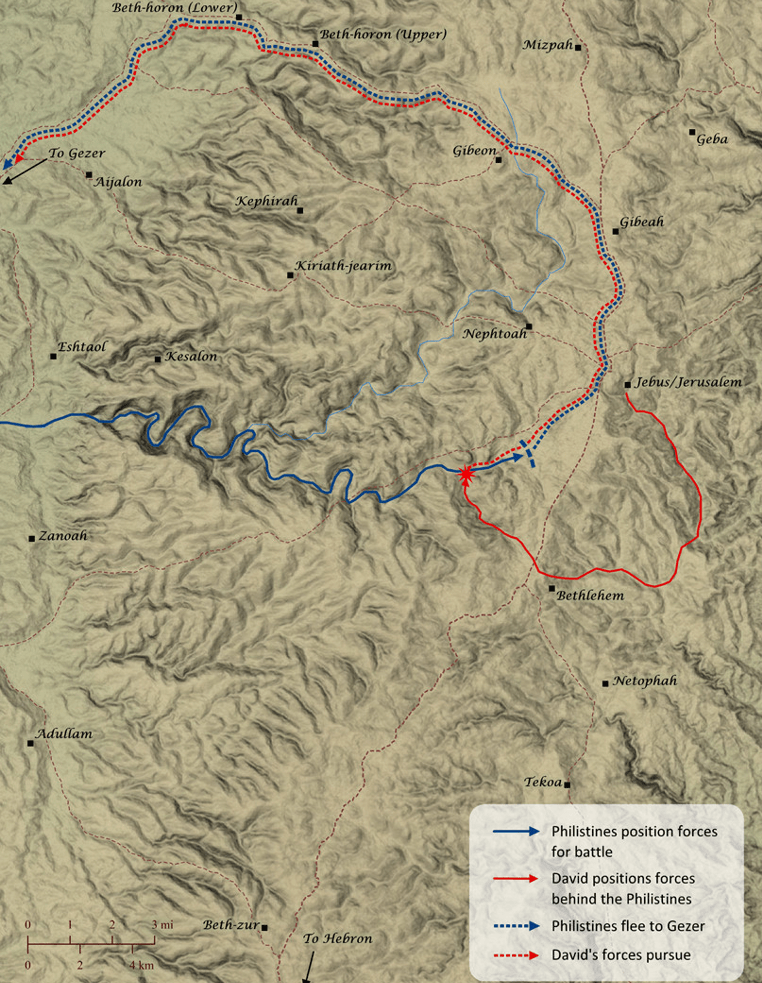
22 And the Philistines came up yet again and spread out in the Valley of Rephaim. 23 And when David inquired of the LORD, he said, “You shall not go up; go around to their rear, and come against them opposite the balsam trees. 24 And when you hear the sound of marching in the tops of the balsam trees, then rouse yourself, for then the LORD has gone out before you to strike down the army of the Philistines.” 25 And David did as the LORD commanded him, and struck down the Philistines from Geba to Gezer.
You gotta hand it to the Philistines. They were suckers for punishment!
Didn’t they just come up on the valley of Rephaim to take on this new king of Israel? Did they not just become defeated, quite decisively buy this new king of Israel?
How did David describe the previous victory of the Philistines?
2 Samuel 5:20…The LORD has broken through my enemies before me like a breaking flood.
A breaking flood is not the description of a non decisive battle, but of a complete domination over another army.
And yet here they are again!
But the amazing thing about this passage, and that which I want to dwell on, is that though David found great success in his previous battle with the Philistines, he wasn’t about to simply repeat the method he was successful at earlier.
He saw the same scenario developing, the same enemy approaching the same battleground geography, and the same potential outcome if he simply attacked as before. Sure the Philistines may be better prepared for them but David could claim the earlier direction from the Lord as still being relevant, still applicable!
But he didn’t! He went to the Lord for fresh orders.
At this time in his kingdom, he didn’t rely on old orders or human assumptions. And because he sought the wisdom of the Lord in fighting the Lord’s battles, he found success.
Success that included an extended victory, all the way from Geba to Gezer.
As we considered the first battle, it was a quick and decisive strike against the Philistines. A show of superiority force against the power of a neighboring nation.
With this battle, strategy came into play, with a rear attack timed perfectly with the help of the Lord, removing any possible conventional escape plans the enemy may have had. Not only no escape, but David did not simply break through and disperse the Philistines this time. No – he chased them from Geba to Gibeon, a distance of over 12 miles!
David and his men accomplished a decisive and prolonged victory over the Philistines in this battle. This battle set the tone for David’s domination over the Philistines, eventually bringing the 5 major cities (Gaza, Gath, Ashkelon, Ashdod, and Ekron) of the Philistines under his control.
David was on the path to becoming a world power, and would bring Israel to her greatest political and military influence over the region. His desire to know and do the commands of the Lord for each situation and challenge he faced brought about this ascendency over the region.
We too are to be listening for the voice of the Lord for His direction, even asking for His leading. And as David was told to go around behind, requiring much additional effort on his part, and to be patient in the waiting for the “the sound of marching in the tops of the balsam trees”, we too may expect some of the guidance of the Lord to be unexpected and require additional effort.
I suppose that is part of the calling of the believer!
Thanks again for coming to visit. I hope you found something of interest in this post and would appreciate a comment, to begin a discussion. If you know someone this blog may bless (or challenge), send them a link, so they may join us in our discussion.
My hope is that this series will offer my readers a chance to consider the names, characteristics and descriptions of our God in the Word.
The remaining Names of God in this series might be considered descriptors, or characteristics of the Lord. We have reviewed the three primary Names of God, along with nineteen compound Names of God in our previous posts. As we venture through these descriptors of our God, I hope we will recognize all the many characteristics of our God that we tend to take for granted.
The Word is truly rich with descriptions of the Living God, and this effort of searching in the Word was quite illuminating. He truly is the ultimate subject of the Word, and His revelation of self-descriptions, or the accolades offered Him by His priests, prophets, kings apostles and faithful truly is a blessing.
May the Name of the Lord be praised, and by thinking on His name, may you have a blessed day.
260
GREAT GOD
Ezra 5:8 Be it known to the king that we went to the province of Judah, to the house of the great God. It is being built with huge stones, and timber is laid in the walls. This work goes on diligently and prospers in their hands.
This passage needs some context.
Ezra was a priest of the Most High during the return of the Israelites to Jerusalem. As we may remember, Cyrus the Persian King gave orders to release the Jews from captivity, returning the vessels of the temple to the people of God, and enabled the return to Jerusalem to build the temple of God.
A tremendous act of salvation, and restoration on the part of our God.
At first the Israelites were diligent in the rebuilding of the temple, but as many projects go, a delay here or there and a distraction over there caused the temple to be put on hold. And where there is a vacuum of religious purpose, self directed activities rise tot he surface.
Such was the case with the Jews. There began to redirect their efforts and materials to the construction of their own homes. Years passed until a prophet started asking some questions. His name was Haggai, and he wanted to know why the building of the temple had ceased.
He stirred up the people, and they got back at the temple building, but in this delay, a new king sat on the throne on Persia by the name of Darius, and a new Persian governor over the region Jerusalem was located.
That governor was a fellow named Tattenai, and from what I can tell, he seemed to be a fair type of Governor. In his research of the situation in Jerusalem, he found that the Jews claimed they had royal Persian authority to reconstruct their temple. Surely Tattenai had heard of the rebellious nature of Israel, and the focal rallying point of the temple for this nation.
He had the option to put the reconstruction on hold until he found out more on the rights these Jews enjoyed, but he seemed to be impressed by his trip to Jerusalem. Not only did he allow the men of Israel to continue in their rebuilding of the temple as he provided his report to Darius, he spoke highly of the God they Jews were dedicated to.
He allowed them to rebuild though he still needed to find out if they were granted authority under the throne of Persia. This is impressive, and not only in his actions, but in his communication back to the throne, he spoke of the temple as the house of the great God.
Was he a convert to Judaism? Did he begin to follow after God? How impressed was he of the object of Israel’s faith? He certainly, for the sake of the report could have simply referred to the temple as the house of a god, but he didn’t. He wrote a letter of record to the king of Persia regarding the temple in a foreign land as the house of the Great God!
Amazing.
For us in our daily lives, let me ask my reader. Do we live such lives that give evidence to those watching us of the Greatness of our God?
Do we have a message of the Greatness of our God that will turn the heads of those who are watching? I dare say we do!
We all have Tattenais in our lives and by the grace of God we can give witness of our God, hopefully impressing on those we interact with of the Great God we love and serve.
I would love to hear of your favorite name, characteristic or description of the Living God. Please leave me a comment, and I will include it in the list!
Thanks again for coming to visit. I hope you found something of interest in this post and would appreciate a comment, to begin a discussion. If you know someone this blog may bless (or challenge), send them a link, so they may join us in our discussion.
In the mid nineties, I had a little red Buick and a big ol’ bass box in the trunk, and would listen to “Christian Rock”, cranked to 11.
(What did you say? Huh? Can you say that again, I didn’t hear you….)
I have gotten away from that genre for many reasons, the least of which may be a loss of hearing, but some songs have stuck with me over the decades.
The artist’s I listened to sought to reflect Scriptural teaching for the most part. They ranged from “preaching” pop culture religion to significant theological teaching. As I listened to the lyrics, I found some to be quite challenging.
To be honest, I listened because I could justify the rock beat with “sanctified lyrics”.
Occassionaly I will post a song, supply the lyrics and make a comment or two. If you decide to listen to the tune, turn the speaker down unless you are already deaf. Some of the songs tend to have a certain “volume” about them!
This post will consider the song
Cash Cow – by Steve Taylor
If you have followed me in this series “Song Squawk” you will undoubtedly recognize my affinity to Steve Taylor. He was a great lyricist, commenting on the condition of the church in the 80’s A great song about the pull of money on the believer. It rings a bell for me every time I listen to it!
I love the reference to Robert Tilton!
Move Move in closer Move in closer to the Move in closer to the middle of the frame
It was a morning just like any other morning In the Sinai desert, 1200 B.C It glistened, it glowed, it rose from the gold of the children of Israel And most of the adults The cash cow! The golden cash cow had a body like the great cows of ancient Egypt And a face like the face of Robert Tilton Without the horns And through the centuries, it has roamed the earth Like a ravenous bovine seeking whom it may lick Cash cow! Cash cow! From the valley of the shadow of the outlet mall To customized petwear boutique From the trailer of the fry chef to the palace of the sheikh The cash cow lurks The cash cow lurks The cash cow lurks, hahahahahaha!
Who loves you, baby? Who’ll give you good credit? Who says you’ll regret it? Aaa-ooooooo Who loves you, baby? Who’ll give you good credit? Who says you’ll regret it? Aaa-aaa-aaa-oooooo
I was young and needed the money I had money and needed more money I was filthy rich and all I wanted was love And a little more money Woe to you, proud mortal Secure in your modest digs You think you’re immune? You, who couldn’t finger said cow in a police line-up with the three little pigs? Cash cow! Master of disguises! Who’s gonna change shape at will? Who’s the eye on the pyramid on the back of the dollar bill? Who loves power lunchin’ from Spago to the Sizzler? Guess who’s coming to dinner! Hahahahahaha!
Who loves you, baby? Who’ll give you good credit? Who says you’ll regret it? Aaa-ooooooo Who loves you, baby? Who’ll give you good credit? Who says you’ll regret it? Aaa-aaa-aaa-ooooooo Who loves you, baby? Who’ll give you good credit? Who says you’ll regret it? Aaa-ooooooo One yank on that udder Will land your butter In a sling First one’s free Cow junkies, take heed
Cash cow, comin’ to get ya! Why? ‘Cause you think this is stupid, don’t you? The cash cow will not be mocked! The cash cow’s planning a coup! The cash cow chews cud bigger than you! Woe, woe, woe to you Who blow off this warning Perhaps you’ve already been licked I, too, was hypnotized by those big cow eyes The last time I uttered those three little words “I deserve better!”
In my opinion Steve Taylor had his finger on the very pulse of corruption in the institutional church and in the Body of Christ,
Take a listen!
Let me know what you think of the lyrics, and of the tunes!
Thanks again for coming to visit. I hope you found something of interest in this post and would appreciate a comment, to begin a discussion. If you know someone this blog may bless (or challenge), send them a link, so they may join us in our discussion
My hope is that this series will offer my readers a chance to consider the names, characteristics and descriptions of our God in the Word.
The remaining Names of God in this series might be considered descriptors, or characteristics of the Lord. We have reviewed the three primary Names of God, along with nineteen compound Names of God in our previous posts. As we venture through these descriptors of our God, I hope we will recognize all the many characteristics of our God that we tend to take for granted.
The Word is truly rich with descriptions of the Living God, and this effort of searching in the Word was quite illuminating. He truly is the ultimate subject of the Word, and His revelation of self-descriptions, or the accolades offered Him by His priests, prophets, kings apostles and faithful truly is a blessing.
May the Name of the Lord be praised, and by thinking on His name, may you have a blessed day.
259
Great Shepherd
Hebrews 13:20 Now may the God of peace who brought again from the dead our Lord Jesus, the great shepherd of the sheep, by the blood of the eternal covenant
We considered Jesus as the Good Shepherd in post number 240. In that particular post, we found it convenient to consider the Good Shepard in relation to the bad shepherds so often described in the Word.
For our post this morning, to consider the Great Shepherd is not to consider Him in comparison to a bad shepherd. That is the task of calling Him the Good Shepherd.
For Him to be called the Great Shepherd is to isolate Him, to consider Him, not in relation to any inferior shepherd, but for who He is in his person and work.
He is the Great Shepherd, having been raised out of the grave. No one can claim the status of being the Great Shepherd other than the One who has accomplished two feats of salvation
1. He passed through death and out from the grave after three days.
No other religious leader, teacher or instructor has ever claimed to be able to perform this feat, yet we know our Messiah not only repeatedly prophesied of His own death and resurrection, He proved His deity by walking out of the tomb. He is a man of His Word!
2. He erupted out of the tomb through the blood of the everlasting covenant.
Now I am not sure if “everlasting covenant” is a synonym for the New Covenant, emphasizing its eternal longevity, continuing on into eternity. The “everlasting covenant” may speak of a covenant entered into prior to the fall of mankind, prior even to creation. Some think this term refers to a council within the Triune Godhead in eternity past, with all three members of the Godhead entering into to accomplish the salvation of rebel sinners, and to provide the greatest glory to the Person of God.
Either thought only lifts up the incredible work of the Lord in offering salvation to a people who were dead, blind and deaf.
He is the Great Shepherd, and as such, He provides us the promise of Life, since He has triumphed over death, and an ongoing covenant that will continue throughout out the ages.
He is the Great Shepherd!
I would love to hear of your favorite name, characteristic or description of the Living God. Please leave me a comment, and I will include it in the list!
Thanks again for coming to visit. I hope you found something of interest in this post and would appreciate a comment, to begin a discussion. If you know someone this blog may bless (or challenge), send them a link, so they may join us in our discussion.
Romans 11:22 Note then the kindness and the severity of God: severity toward those who have fallen, but God’s kindness to you, provided you continue in his kindness. Otherwise you too will be cut off.
Context is everything. And I think I understand the hotbed of Calvinism I enter into by looking at anything in Romans 9-11, but these passages are not to be held captive by a teaching I consider to be misguided.
As I mentioned at the start, context is everything, and we must remember that Paul is writing his magnum opus to a church that is comprised of both Jewish and Gentile converts.
The particular passage we are addressing this morning is discussing the remnant of Israel, a faithful within the nation that God maintained even during periods of complete apostacy within the nation of Israel.
Within the physical nation of Israel, there were a pocket of faithful folk that were right with God. They lived by faith, and did not rely on any bloodline or heritage. The rest of the nation of Israel, those who did not exercise faith in the Living God, but on bloodlines, rules, laws or traditions, were not of the family of God.
Romans 9:6 But it is not as though the word of God has failed. For not all who are descended from Israel belong to Israel,
Paul repeats this teaching over and over again within this portion of Scripture. The nation of Israel was made of a social order that sought righteousness through works, while a portion of the nation of Israel understood the grace, kindness and most importantly the Person of the Savior. Yes they didn’t have a name for the Messiah yet, but when He stepped on earth, those who had listened to the voice of God in years past, recognized it in Jesus, and proved themselves to be of the remnant.
Nevertheless, for our verse this morning, we must address Paul’s warning. It was not a warning to those who were not of the faithful, for they would not hear it. Those of the remnant, even those of the gentiles, would recognize this warning, for it was the voice of the Lord through His apostle.
Paul speaks of kindness and severity.
Severity
This severity, I believe, relates to God’s handling of the (physical) nation of Israel, those who were not of the remnant. God directed severity to those who belonged to the faith of Judaism, a system of teaching that was to direct the adherent to God but seemed to become a deterrent, an actual impediment. This faith produced a people who did not recognize the Messiah. A religion that actually condemned the Son of God to the cross.
What was the Lord to do with a people like this? They were to be cut off, removed from the rolls of the righteous.
It is somewhat coincidental that this concept comes up in this study, for I recently posted on the topic in Conditional Security – Psalm 69:27-28. In that psalm, David is speaking of those who were against his call to Kingship. His prayer spoke of those within the (physical) nation of Israel as being blotted out of the book of the living. I will not repeat what I wrote there, but it may provide some context to this message if interested.
Kindness
The kindness Paul speaks of, based on the context of this passage seems to be related to the grafting of the Gentiles into the faith, a faith that is rooted in the life of God. Yet even in this discussion of kindness, Paul acknowledges that branches were broken off because of unbelief.
Note the connection of kindness from God as a result of continuance in faith. Some of the nation of Israel, who had faith at some earlier time, fell into unbelief. They were broken off! Cut off. Blotted out of the book of the Living. Again refer to the link above for (hopefully) some clarity on this topic.
As Paul closes this discussion on the conditional security of both the Jewish and the Gentile in this passage, he directs the warning of being cut off to believers. Personally, I think it is specifically for the Gentile believer, but I am splitting hairs here, and dulling the point of the message.
God’s kindness is directed to us, provided we continue in his kindness. Otherwise we too will be cut off.
What is the Lord to do with a people that abandon Him?
My friend, look to the Lord for His direction in your life, tell Him of your commitment to His will and ways, and cling to the Savior, for He is our only hope!
Thanks again for coming to visit. I hope you found something of interest in this post and would appreciate a comment, to begin a discussion. If you would like to receive daily posts from Considering the Bible, click on the “Follow” link below
As many who have followed me for a bit, I have fallen into the Psalms, and I can’t get up! (As if I would want to.) The Psalms are a majestic collection of poetry, of heart felt human experiences that constantly challenge me in my own frail attempt to follow the true King. As many of the Psalms are written by David, my study on the Psalms has spurred me on to looking at the life of David, is the main contributor to this book, and to follow the victories and tragedies of the shepherd King of Israel.
Many times in the narrative, we will see the Lord Jesus, imperfectly, yet a reflection of His spirit in a man with weaknesses.
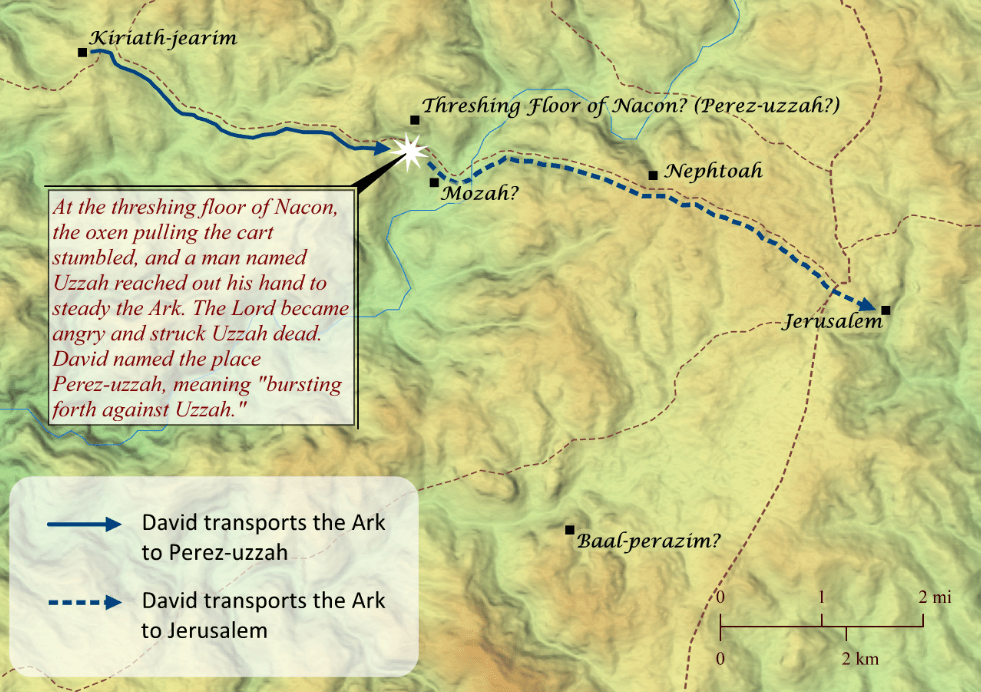
2 Samuel 5:17-25 17 When the Philistines heard that David had been anointed king over Israel, all the Philistines went up to search for David. But David heard of it and went down to the stronghold. 18 Now the Philistines had come and spread out in the Valley of Rephaim. 19 And David inquired of the LORD, “Shall I go up against the Philistines? Will you give them into my hand?” And the LORD said to David, “Go up, for I will certainly give the Philistines into your hand.” 20 And David came to Baal-perazim, and David defeated them there. And he said, “The LORD has broken through my enemies before me like a breaking flood.” Therefore the name of that place is called Baal-perazim. 21 And the Philistines left their idols there, and David and his men carried them away.
For our next few posts, we are going to follow David’s routing of the Philistines. I think it may be beneficial to consider the history this nation has with our new King.
Initially for David, his first encounter with the Philistines were in the defeat of their giant Goliath. A seminal moment in the history of both nations. Something that resides in the collective conscious of both people groups!
Next on our David timeline, the Philistines actually became a haven for this young rebel of Saul, for when his own father in law and current king of Israel sought to kill this young upstart, David fled to the nation of the Philistines. Philistia became a temporary haven for David, having found refuge with King Achish, Saul’s nemesis. Not only did David find refuge under the protection of Achish, David presented himself as a useful soldier for Achish. Of course it was all deception, for David was not cleaning up the southern boundaries of the land of Philistia, ridding the area of the Jewish population, but actually gutting and destroying small Philistia posts.
All of this deception led Achish to position David in his own Philistine army, potentially bringing David and his men against the nation he would rule over! Circumstances, that is God, overruled in this, and David was relieved of having to fight with Achish against his own people.
It was obvious the Philistines knew of the prowess of this new king, for they sought to us him in their own battles. Now that David was on the throne, and the massive victory of Jerusalem was behind him, the Philistines had to make a decision. Attack, or wait to attack.
Obviously waiting was only allowing David to increase in strength. They had to attack now. So the Philistines set us camp in the valley of Rephaim, a valley likely located a few miles northwest of the new capital.
Note also that this location for the Philistines to set up camp was in (or at least near) a valley. That surprises me, for though I am not a military type of guy, I would think any army would naturally look for the high ground. But I am not a military guy.
But let us consider there may have been some advantage for the Philistines in choosing this location. Maybe they could elevate a statue of their idols on a perched area of the slopes, so that they may see the battle, or they may see them during the battle. Or maybe, since there was a stream in the valley, there would be special water to wash their idols of any dust accumulated during the travelling to the battle site. Maybe in their deliberations, their idols somehow informed the Philistine leadership the valley of Rephaim was a strategic location, a location where their idols had some influence.
Somehow, in some way, the valley of Rephaim was chosen and the Philistines brought their idols.
David though inquired of the Lord. His inquiry included two topics. Both of these questions reveal important aspects of David’s trust in the God of the nation.
1 Shall I go up against the Philistines?
Our first question is a simple request for direction. Yes or no. This question has nothing to do with outcome or impact to his kingdom, whether or not this will be a stunning success or a dismal failure. David is just wanting to know the Lord’s will.
2 Will you give them into my hand?
This question addresses the result of the battle if the Lord directs him to fight. Note though, that David makes an assumption of victory based on the Lord’s involvement in the battle. He does not flat out say “Am I going to win?”. He is looking for assurance that the Lord will be with him in the midst of the battle, that the Lord will “get the credit” for the win.
Though the victory is assumed, it seems the import of the question was that God would be with him. Is David repeating the concern Moses had as he led God’s people into the promised land?
Exodus 33:15 And he said to him, “If your presence will not go with me, do not bring us up from here.
Different circumstances but the same heart of the leader. And David received the answer in the affirmative for his concerns. God will place the Philistines in the hand of David.
It seems the victory was quite decisive, for David expressed the win by describing his army, (the arm of the Lord), as breaking through like a breaking flood.
The Israelite army overwhelmed the Philistines, even as a flood of waters destroys every resistance it comes upon.
I suppose the Philistines idols were distracted that day.
Thanks again for coming to visit. I hope you found something of interest in this post and would appreciate a comment, to begin a discussion. If you know someone this blog may bless (or challenge), send them a link, so they may join us in our discussion.
My hope is that this series will offer my readers a chance to consider the names, characteristics and descriptions of our God in the Word.
The remaining Names of God in this series might be considered descriptors, or characteristics of the Lord. We have reviewed the three primary Names of God, along with nineteen compound Names of God in our previous posts. As we venture through these descriptors of our God, I hope we will recognize all the many characteristics of our God that we tend to take for granted.
The Word is truly rich with descriptions of the Living God, and this effort of searching in the Word was quite illuminating. He truly is the ultimate subject of the Word, and His revelation of self-descriptions, or the accolades offered Him by His priests, prophets, kings apostles and faithful truly is a blessing.
May the Name of the Lord be praised, and by thinking on His name, may you have a blessed day.
258
GREAT SAVIOR
Titus 2:13 waiting for our blessed hope, the appearing of the glory of our great God and Savior Jesus Christ,
Ok I admit it – at first glance, the name “Great Savior” is not specifically found in this verse.
There is a rule in the Greek – that when a singular article (the) comes before two nouns (God & Savior), both nouns refer to the same subject, which is Jesus in our verse.
Now I am no Greek geek by any stretch of the imagination, but I can’t imagine any argument from any who know the Savior that He isn’t a Great Savior.
The grammar may make my point, but experience seals the fact to our hearts that Jesus is a Great Savior. In our last post on this topic, we reviewed God’s name as “Great Salvation”, finding that David used it in relation to the imagery of a battle. God is our Great Salvation, or a Great Tower to flee to.
Now, instead of the act of salvation being referred to as Great, let us focus in on the Person of our Great Savior. I am so tempted to describe the work of salvation He has accomplished for our lives, including the abolishing of death.
2 Timothy 1:10 … our Savior Christ Jesus, who abolished death and brought life and immortality to light through the gospel,
The abolishing of death! No that is for another time! But what an amazing accomplishment for those who knew nothin gbut death!
No, let us remember the One who is the Great Savior and in the remembering, consider the Person of the Christ. For He is a Great Savior, but unlike those who are great in this old world, our Great Savior is One who is humble, approachable, meek and gentle. But let us not hear that these characteristics define our Great Savior as weak, for when He speaks, He speaks with authority. He needs not raise His voice, for with authority – not volume – He makes His will known.
He is the Great Savior. Let us spend a moment considering how Great He is this morning!
I would love to hear of your favorite name, characteristic or description of the Living God. Please leave me a comment, and I will include it in the list!
Thanks again for coming to visit. I hope you found something of interest in this post and would appreciate a comment, to begin a discussion. If you know someone this blog may bless (or challenge), send them a link, so they may join us in our discussion.
Psalm 34:6 This poor man cried, and the LORD heard him and saved him out of all his troubles.
As many who follow may know, I have had the privilege to know the Lord for over 40 years. During those decades, He has proved Himself to be a faithful, kind and loving Savior. And as I have learned to lean on Jesus, He has shown Himself to be a merciful Savior, never wavering, even in some very dark times.
This topical series will try to provide a snapshot of an ol’ fools prayers, the weakness and selfishness of his prayers, and the ever increasing goodness of God in His responses the those prayers.
I hope my witness to the goodness and faithfulness of God will be an encouragement to those reading, and will spur us all on to a deeper, more consistent time of being in the Lord’s presence.
Please visit with me as I tell the story of a faithful God and His care for an ol’ fool. Though David considered himself a poor man, I freely admit, I am just an “ol’ fool” looking to the Lord.
That Missing Piece
This prayer was jointly entered into with a young boy who really wanted to go a splashing. Something desperate!
Our family had just moved into a rental home in Kirkland Lake, and the day was a hot one. Little did we know at the time that the future for our family involved Texas. We would learn about hot soon enough!
Nevertheless, my son and I were in the process of setting up a small pool for a bit of splashing fun. Now it is important for the story that you understand the type of pool we are talking about. It wasn’t one of those fancy dancy pools like nowadays, where you simply blow them up. No, I think we got this from a friend who no longer needed it, and it came in three pieces. Very similar to what is considered a doggy pool nowadays, it consisted of an upright ring for a wall for the pool, the bladder, or the skin for the pool, and the crimped edge that would hold the bladder on the wall, so the water could be contained.
We had the bladder. We had the wall. But in the move to Kirkland Lake, we had lost the crimped edging! We looked and looked and you could see my son loosing heart. He had worked so hard to help us move, being such a strong six year old! It just broke my heart to see him so disappointed.
At some point where we crossed paths, I pulled him over and sat down with him on the stoop. I told him I was so sorry we couldn’t find it, and he said he understood, but I knew he was was carrying a load of disappointment. I think he wanted the pool to be ready for when his brother woke up from his nap. They were the best of friends and they would just go crazy in that pool!!!!
You know son, why don’t we ask Jesus to help us find it? Can we pray about that? We bowed our heads, and I asked the Lord to help us find an old crimped edge for an roughed up used pool. I don’t recall hearing my son utter any words, but I am sure the Lord heard that which he did not utter.
After an amen, and a pat on the shoulder, we both got up and ventured off in different directions. Honestly, I had not considered the speed at which a prayer could be answered, but lo and behold, seconds later my son was running towards me down the driveway with a crimped edge held high in his hands, yelling “Jesus answered our prayer. Jesus answered our prayer!”
I can still see him running down the driveway, so excited. He was so loud, yelling a witness out, letting the whole world know that God answered our prayer. But it wasn’t just that he found the crimped edge, so he could have the pool that afternoon. God showed himself to my boy that day. And God showed Himself to a dad in a most insignificant (but significant) way!
God hears the prayers of His children, and in His wisdom, He provides evidence of His attentiveness to His children. Although the Lord has proven Himself in massive answers over the years for my family, this small response over 30 years ago, from the hand of a loving God still lingers in my mind.
He rejoiced. I rejoiced. A whole bunch of rejoicing that day! To top it all off, we got the pool set up in record time, and he got to push his little brother into the pool after his nap!
A great day all around!
Thanks for joining and Considering The Bible with me. Your thoughts are always welcome, and I look forward to hearing of the faithfulness of God in your lives.
In the mid nineties, I had a little red Buick and a big ol’ bass box in the trunk, and would listen to “Christian Rock”, cranked to 11.
(What did you say? Huh? Can you say that again, I didn’t hear you….)
I have gotten away from that genre for many reasons, the least of which may be a loss of hearing, but some songs have stuck with me over the decades.
The artist’s I listened to sought to reflect Scriptural teaching for the most part. They ranged from “preaching” pop culture religion to significant theological teaching. As I listened to the lyrics, I found some to be quite challenging.
To be honest, I listened because I could justify the rock beat with “sanctified lyrics”.
Occassionaly I will post a song, supply the lyrics and make a comment or two. If you decide to listen to the tune, turn the speaker down unless you are already deaf. Some of the songs tend to have a certain “volume” about them!
This post will consider the song
Prophet Priest and King – Smalltown Poets
Not sure what happened to this group, but their first album was very promising. I especially liked this tune, as it provided a good comparison of how we think in relation to “important people” on earth and the greater, much greater privilege we have before the the Savior.
Put down my thoughts in a letter to the President Penciled and packaged with all due respect Elvis commemoratives just for effect Never heard back: you think you know a guy
Wired my congrats to Chuck and Di some time ago All my love to the Queen My invitation was lost in the mail But I know I was missed when they kissed ‘neath the veil I sent a nice gift; never got a note
But my closet’s a shrine to an old friend of mine Here I talk all the time with a prophet, priest… I pull out boxes and brooms and I gush like a groom For it’s here I commune with a prophet, priest and king
If I indeed am misperceived by some heads of state Hey, that’s great ‘Cause I talk to a prophet who tells me the truth And I dine with a king at my home in Duluth Better yet I’m in touch with a much needed friend Who hears my confessions and pardons my sin
Take a listen!
Let me know what you think of the lyrics, and of the tunes!
Thanks again for coming to visit. I hope you found something of interest in this post and would appreciate a comment, to begin a discussion. If you know someone this blog may bless (or challenge), send them a link, so they may join us in our discussion
Psalm 69:27 Add to them punishment upon punishment; may they have no acquittal from you. Psalm 69:28 Let them be blotted out of the book of the living; let them not be enrolled among the righteous.
Early on in my walk of faith, when I would come across a passage such as this, I would default to the position that those that David referred to were those Philistines, or those Ammonites. Someone who had no relationship, no covenant, no connection with the God of Israel.
I should have read the passage a bit slower.
For David is not saying – Do not allow these enemies to get right with you God – that is do not write their names into the book of the living, but David is asking that the names would be removed, blotted out of the book of the living.
In my research, I have found this likely refers to the records of the nation of Israel, those who formally belonged to the nation of Israel. As children were born to natural Israelites, or as a proselyte joined the faithful people of God, their names would be recorded in the temple. This recordation provided those in the books to enjoy all the privileges of the people of God.
To have a name blotted out of the book of the living, as David prays for, is to remove them from being a part of the nation, removed from the covenant Israel entered into with Almighty God. David was not praying that these enemies simply cease to live, but to lose the privilege of belonging to the covenant people of God.
Remember, as I mistakenly assumed early on, these enemies David is referring are not “those Philistines”, or “those Ammonites”, but Israelites, specifically under the leadership of Saul, the king of Israel.
So, if I hear your right Carl, this blotting out of names from the book of life applies to those who are in covenant with God?
Consider a fellow centuries before David, as he mentions the blotting out of names in relation to the nation. Israel had recently entered into covenant with God, sealed with blood.
Exodus 24:8 And Moses took the blood and threw it on the people and said, “Behold the blood of the covenant that the LORD has made with you in accordance with all these words.”
This fellow offered his own covenant relationship with the God of all Creation to be given up so that the nation could continue with God. (Very Christlike!)
Exodus 32:31 So Moses returned to the LORD and said, “Alas, this people has sinned a great sin. They have made for themselves gods of gold. Exodus 32:32 But now, if you will forgive their sin–but if not, please blot me out of your book that you have written.” Exodus 32:33 But the LORD said to Moses, “Whoever has sinned against me, I will blot out of my book.
Moses, along with all the nation of Israel were in covenant with God, and the blotting out of names in this context was directly connected to those of covenant.
Though there are many passages that discuss the topic of the book of life, with many of those passages found in the New Testament, this post was not intended to be exhaustive on the topic. This post is intended to be but a challenge to each of us to consider the tremendous benefit and privilege of belonging to the people of God. Let us not take it lightly, but walk in a way that is worthy of the King.
Thanks again for coming to visit. I hope you found something of interest in this post and would appreciate a comment, to begin a discussion. If you would like to receive daily posts from Considering the Bible, click on the “Follow” link below
As many who have followed me for a bit, I have fallen into the Psalms, and I can’t get up! (As if I would want to.) The Psalms are a majestic collection of poetry, of heart felt human experiences that constantly challenge me in my own frail attempt to follow the true King. As many of the Psalms are written by David, my study on the Psalms has spurred me on to looking at the life of David, is the main contributor to this book, and to follow the victories and tragedies of the shepherd King of Israel.
Many times in the narrative, we will see the Lord Jesus, imperfectly, yet a reflection of His spirit in a man with weaknesses.
2 Samuel 5:13-16
13 And David took more concubines and wives from Jerusalem, after he came from Hebron, and more sons and daughters were born to David. 14 And these are the names of those who were born to him in Jerusalem: Shammua, Shobab, Nathan, Solomon, 15 Ibhar, Elishua, Nepheg, Japhia, 16 Elishama, Eliada, and Eliphelet.
David was a busy man! He also seems to have a weakness for the feminine wiles. It turns out that he took a minimum of 8 specific wives that the Scriptures speak of.
Michal – 1 Samuel 18:27
Abigail – 1 Samuel 25:42
Ahinoam – 1 Samuel 25:43
Maaca – 2 Samuel 3:3
Haggith – 2 Samuel 3:4
Abital – 2 Samuel 3:4
Eglah – 2 Samuel 3:5
Bathsheba – 2 Samuel 12:24
Beyond those who became his wives, concubines were also collected by the king. As a matter of perspective, this passage may be speaking of wives not mentioned by name, and having become king of the united nation in the capital city, took more wives that are unnamed.
How many wives did David have? Let us be satisfied saying that he had at least 8.
As for concubines, let un not consider them simply as a mistress, a distraction for the man. To be a concubine is to be a wife, albeit of a lower status, a second class wife.
Note a helpful passage in Judges 19 when considering how a concubine was considered in Old Testament times. For brevities sake, I have included only the portions of the verses applicable to our topic. Notice the abundant use of terms that reflect a husband wife relationship
Judges 19:2 And his concubine was unfaithful to him…. Judges 19:3 Then her husband arose and went after her, … And she brought him into her father’s house. … Judges 19:4 And his father-in-law, the girl’s father, made him stay, … Judges 19:5 … the girl’s father said to his son-in-law,
So we may easily say, understanding this wrinkle of what a concubine is, that David surely had plenty more than 8 wives, though some of a lower status. Maybe that early satisfaction in thinking David only had 8 wives was a bit premature!!!
To David’s credit though, it seems he took all his wives from within the nation, and was not of the habit that Solomon developed in marrying foreign women. Yet his multiple wives surely set a standard that justified Solomon’s abuse of his actions.
To consider the children of David, that is a task far beyond this writer’s ability, but I have found a great resource for this purpose. (https://www.bibletales.online/king-davids-family-tree/) This website also provides a very useful family tree graphic that has embedded links providing much information for those interested. I am attaching a graphic below for your immediate reference.
In all of this consideration, we find David acquiring, in his ascent to power, all the seeds of distraction, sources of jealousy and continual internal bickering that came to fruition in later years.
What truth can be culled from this short passage? In short, monogamy is wise, yet there are some that consider polygamy an allowance, even a benefit for the Christian society. Those who think so, may appeal to the Old Testament. I would suggest these passages accommodate (not prescribe) polygamy as a form of family structure.
Exodus 21:10 If he takes another wife to himself, he shall not diminish her food, her clothing, or her marital rights.
The Word specifies that a first wife was to be protected from any change in her rights, even as a man may take another. The verse implies that this was a condition the Israelites would continue and the Lord would accommodate for the time being.
Deuteronomy 21:15 “If a man has two wives,… and if the firstborn son belongs to the unloved, Deuteronomy 21:17 … he shall acknowledge the firstborn, the son of the unloved, by giving him a double portion of all that he has.
Again, the Word calls out the rights of the wife, even the second wife, who may be unloved.
Deuteronomy 17:17 And he shall not acquire many wives for himself, lest his heart turn away, nor shall he acquire for himself excessive silver and gold.
Deuteronomy 17:17 is a direct command of Scripture to any future king of Israel. Note that the passage refers to many wives. How many is many? Is three many? I would think so, but I can’t find a specific commandment providing a restriction. Those who want more wives could justify it by stretching the word many in many many many!
In all of this discussion, I want to confess a simple statement.
I am thankful for a simple life, for a loving wife of 44 years, and for the children that the Lord has provided through a monogamous relationship with my best friend.
David was a busy man – way too busy for me!
Thanks again for coming to visit. I hope you found something of interest in this post and would appreciate a comment, to begin a discussion. If you know someone this blog may bless (or challenge), send them a link, so they may join us in our discussion.
My hope is that this series will offer my readers a chance to consider the names, characteristics and descriptions of our God in the Word.
The remaining Names of God in this series might be considered descriptors, or characteristics of the Lord. We have reviewed the three primary Names of God, along with nineteen compound Names of God in our previous posts. As we venture through these descriptors of our God, I hope we will recognize all the many characteristics of our God that we tend to take for granted.
The Word is truly rich with descriptions of the Living God, and this effort of searching in the Word was quite illuminating. He truly is the ultimate subject of the Word, and His revelation of self-descriptions, or the accolades offered Him by His priests, prophets, kings apostles and faithful truly is a blessing.
May the Name of the Lord be praised, and by thinking on His name, may you have a blessed day.
257
GREAT SALVATION
Psalm 18:50 Great salvation he brings to his king, and shows steadfast love to his anointed, to David and his offspring forever.
David, in the 18th Psalm, describes the saving power of God, having found safety and security in the Lord in the midst of being surrounded by enemies.
Psalm 18:1 A Psalm of David, the servant of the LORD, who addressed the words of this song to the LORD on the day when the LORD delivered him from the hand of all his enemies, and from the hand of Saul.
David speaks of the Lord using military terms throughout this Psalm, using terms such as fortress, refuge, shield and horn of salvation.
Psalm 18:2 The LORD is my rock and my fortress and my deliverer, my God, my rock, in whom I take refuge, my shield, and the horn of my salvation, my stronghold.
He gushes over speaking of the might of the Lord in his deliverance, for at the time when there seemed no hope, no salvation available for David, God provided salvation. The enemies were too many, and had all the advantage, but when God was introduced into the situation, the tables where flipped over!
He spends the Psalm describing his love for the Lord, his thankful heart and uses many metaphors in describing the Lord’s saving work in his life.
He describes God’s frontal attack on the enemies, even from heaven, speaking of lightning as being an offensive weapon in the arsenal of God for David’s sake
Psalm 18:14 And he sent out his arrows and scattered them; he flashed forth lightnings and routed them.
He speaks of saving him from drowning
Psalm 18:16 … he drew me out of many waters.
David can’t hold back from describing his God in the victory. He goes so far as to call God his Great Salvation, and though David was speaking of an instant in time, where he was saved physically from enemies, when he calls God his Great Salvation, he is touching a topic that expands exponentially as the plan of God develops in history.
For our verse this morning, let us consider our Great Salvation, and that this Name of God continues in the military imagery David uses through the Psalm. You see, in the repeated passage of Psalm 18 we find in 2 Samuel, we come across our Name of God again, but it has a translation note attached to it.
2 Samuel 22:51 Great salvation he brings to his king, and shows steadfast love to his anointed, to David and his offspring forever.”
The translators of the ESV note that the phrase “Great Salvation he brings” may be rendered as “He is a tower of salvation.”
This imagery is pertinent to our lives, no matter where we are in our walk with the King, for we too are in a battle, even a war. Not only are we waging battle within our souls to submit to our Great Salvation, but also fighting a war for those around us, to represent the Living Savior as the Only Salvation for All.
The Great Salvation truly is for, through and about the Lord, for in our battle for Him, we need to trust in Him, to bring honor through Him to all. Although from a somewhat different context, Paul said it much better when he wrote
Romans 11:36 For from him and through him and to him are all things. To him be glory forever. Amen.
Yes He is our Great Salvation. He is the only One who is our strong tower in our battles, for if we believers do not run to Him for our safety, for our Great Salvation, we will find we have no defense against the ravages of this life!
Hebrews 2 speaks this truth much clearer when the author writes.
Hebrews 2:3a how shall we escape if we neglect such a great salvation?
May we run to our Great Salvation daily!
I would love to hear of your favorite name, characteristic or description of the Living God. Please leave me a comment, and I will include it in the list!
Thanks again for coming to visit. I hope you found something of interest in this post and would appreciate a comment, to begin a discussion. If you know someone this blog may bless (or challenge), send them a link, so they may join us in our discussion.
Psalm 34:6 This poor man cried, and the LORD heard him and saved him out of all his troubles.
Just last week, I was in church with my daughter and her family, when the preacher asked a parishioner to join him on the stage to discuss the faithfulness of God in answering prayers.
Even as they began their discussion, memories of the faithfulness of God, (even as I confess a sporadic, weak prayer life), flooded my mind. Times of comfort and challenge came to mind, sometimes including miraculous answers, and sometimes simply providing the gift of patience in waiting.
As many who follow may know, I have had the privilege of knowing the Lord Jesus for over 4 decades. During those years, He has proved Himself to be a faithful, kind and loving Savior. And as I have learned to lean on Jesus, He has shown Himself to be a merciful Savior, never wavering, even in some very dark times.
This topical series will try to provide a snapshot of an ol’ fools weak and selfish prayers and the ever increasing goodness of God in His responses the those prayers.
I hope my witness to the faithfulness of God will be an encouragement to those reading, and will spur us all on to a deeper, more consistent time of being in the Lord’s presence.
Please visit with me as I tell the story of a faithful God and His care for an ol’ fool. Though David considered himself a poor man in the Psalm, I freely admit, I am just an “ol’ fool” looking to the Lord.
Thanks for joining and Considering The Bible with me. Your thoughts are always welcome, and I look forward to hearing of the faithfulness of God in your lives.
My hope is that this series will offer my readers a chance to consider the names, characteristics and descriptions of our God in the Word.
The remaining Names of God in this series might be considered descriptors, or characteristics of the Lord. We have reviewed the three primary Names of God, along with nineteen compound Names of God in our previous posts. As we venture through these descriptors of our God, I hope we will recognize all the many characteristics of our God that we tend to take for granted.
The Word is truly rich with descriptions of the Living God, and this effort of searching in the Word was quite illuminating. He truly is the ultimate subject of the Word, and His revelation of self-descriptions, or the accolades offered Him by His priests, prophets, kings apostles and faithful truly is a blessing.
May the Name of the Lord be praised, and by thinking on His name, may you have a blessed day.
256
GREAT PRIEST
Hebrews 10:21 and since we have a great priest over the house of God,
For the New Testament believer, we have one Great Priest.
The book of Hebrews is full of descriptions of our Messiah as a priest, usually spoken of as a high priest, but in this one instance, throughout the Word of God, He is called a Great Priest.
Granted, Hebrews 4:14 modifies the Name of God we are considering this morning as our Great “High” Priest.
Hebrews 4:14Since then we have a great high priest who has passed through the heavens, Jesus, the Son of God, let us hold fast our confession.
But for this morning, let us consider our Great Priest, and seek to cull a truth out of the context we find it in.
Our first question to consider. Why did our author use this particular name for this verse in his discussion of the glories of Jesus as our priest.
I would remind my reader that the context of this passage is speaking of the new and living way Jesus has opened up for the believer, to find access through the curtain. It is interesting that the author likens the curtain to His flesh. The typology of the curtain being torn speaks of access to the very holy of Holies. As our Great Priest, Jesus has not only proven His freedom and right to enter the presence of God, but if we are found in Him, we actually enter the presence of God also.
As our Great Priest, He has authority over the house of God, the Temple of God, the Church, the Body of Christ. He is the One who is not only the Head of the Church, but also the Great Priest, the One who has not only become the eternal sacrifice, but willingly gave His own Body on the cross as the sacrifice.
He was the Priest offering His Body on the cross as the sacrifice.
This morning as I was taking my walk in my favorite parking garage, I looked to the morning sky, prior to any sunrise, and was impressed with the knowledge of all that I don’t know.
Yes, it should come as no surprise that we sinners are incredibly ignorant. Sure, I comfort myself in knowing I can add and subtract, communicate (if I take my time), and continue to learn about earthly things, but when I consider the skies, the vastness of space, the depth and quietness of the skies, the immensity of this creation, I confess I am but an ignorant sinner caught by the grace of God.
But more importantly, Jesus is the One who is all knowing, all powerful, all wise and eternal.
Consider that just in the topic of knowledge, He knows all secrets, facts, motivations and hidden thoughts. All those things that I don’t know, and they are many, He is in complete control of each fact and piece of knowledge. He has all knowledge and has all authority, even over the house of God.
And because He is the Great Priest, our author of Hebrews is telling me that Jesus was the One who performed the sacrifice. He had the knowledge of the coming sacrifice, and drove the circumstances of His surroundings and His own Body to the cross. Yes He was the sacrifice, but in this passage, I suggest the action of sacrifice is the emphasis.
And to what end my friend? That we (poor simple sinners, washed in the blood of the Lamb) may draw near with a true heart.
Hebrews 10:22 let us draw near with a true heart in full assurance of faith, with our hearts sprinkled clean from an evil conscience and our bodies washed with pure water.
He is the Living Way, the truth and the Way of Life.
As this verse describes Him as the Great Priest we are reminded He was not an unwilling victim, but the motivating will to make the eternal sacrifice to provide us entrance with Him before the throne.
May His Name, our Great Priest, be honored in our lives.
I would love to hear of your favorite name, characteristic or description of the Living God. Please leave me a comment, and I will include it in the list!
Thanks again for coming to visit. I hope you found something of interest in this post and would appreciate a comment, to begin a discussion. If you know someone this blog may bless (or challenge), send them a link, so they may join us in our discussion.
Matthew 3:8 Bear fruit in keeping with repentance. Matthew 3:9 And do not presume to say to yourselves, ‘We have Abraham as our father,’ for I tell you, God is able from these stones to raise up children for Abraham. Matthew 3:10 Even now the axe is laid to the root of the trees. Every tree therefore that does not bear good fruit is cut down and thrown into the fire.
John the Baptist was on fire. He was lighting up the desert with a message all of Israel was curious about. Some came out to see this rebel out of curiosity, some out of a severe hunger for authenticity, some to confess their sins to get right with God, some even thinking John was the coming Savior.
And there were some in Israel who came out to condemn him, to question his right to preach and baptize, to dissuade those who were listening to him. In this particular passage, John was confronting “many of the Pharisees and Sadducees coming to his baptism”
It is interesting that there is no record of these men speaking against John at this time. Open rejection would come from the leaders of Israel, but the text only speaks of their presence in the crowds. And of John’s judgement on these men.
The relationship these men had with God is the question for the topic of conditional security. We know after multiple teachings of both John and Jesus that these men needed repentance and to trust the Savior instead of their bloodlines and religion.
But at this time, both John and the Pharissees/Sadducees had the assumption of these leaders possessing salvation, an assumption that these men were in covenant with God. The crowds listening in must have taken a collective inhale when John hurled this claim at the religious “cream of the crop” in Israel.
Some may consider John’s message as a message to the nation, and not a message to the individual. I heartily agree, for the nation was on the edge of judgement, with the Savior at the door, ready to provide salvation. Rejection would not be an acceptable outcome for anyone!
Yet, John speaks in the personal.
You brood of vipers! Who warned you to flee from the wrath to come?
The term “you” is the second person singular in this verse. (It is not “y’all” or “all y’all” as we say in Texas to include more than a single person in the group!) John was addressing the individual. And he was speaking of a judgement that was imminent.
A judgement that was imminent due to bad fruit. Or possibly John intended to be understood as claiming they had no fruit. Either way, these men who understood they were right with God were not right with God.
Does this address the security of the New Testament believer? Not directly. There are many conditions that are different between them and us.
But there is one condition that is ever true for the people of God. We are to bear good fruit. A life that mimic s the Saviors, a life of giving, of self sacrifice, or holiness and love towards those who are our enemies.
As I am driving the highways of Texas, I often listen to the “Message” paraphrase Bible. I have settled in the early chapters of Matthew for that last few weeks. A theme becomes evident from the words of Jesus that echoes John’s message of good fruit required from the life of the believer. Jesus is letting us know that He expects good fruit.
5:13 Let me tell you why you are here. You’re here to be salt-seasoning that brings out the God-flavors of this earth. If you lose your saltiness, how will people taste godliness? You’ve lost your usefulness and will end up in the garbage.
5:20 Unless you do far better than the Pharisees in the matters of right living, you won’t know the first thing about entering the kingdom.
5:29 Let’s not pretend this is easier than it really is. If you want to live a morally pure life, here’s what you have to do: You have to blind your right eye the moment you catch it in a lustful leer. You have to choose to live one-eyed or else be dumped on a moral trash pile.
Faith in the Messiah includes repentance from a life of no fruit. John spoke to the religious folks of the day, waking them up to the basis of their trust. Trusting in bloodlines and religiosity offends the True God and His Messiah. He is looking for hearts that are malleable, able to take in truth without an argument, willing to be taught, and willing to obey.
For the Pharisees and Sudducees of John’s day, the axe was at the root of the tree. Nowhere did John describe the tree as dead. The tree was alive. The reason for the axe?
It was not producing good fruit. And judgement was about to fall.
Thanks again for coming to visit. I hope you found something of interest in this post and would appreciate a comment, to begin a discussion. If you would like to receive daily posts from Considering the Bible, click on the “Follow” link below
As many who have followed me for a bit, I have fallen into the Psalms, and I can’t get up! (As if I would want to.) The Psalms are a majestic collection of poetry, of heart felt human experiences that constantly challenge me in my own frail attempt to follow the true King. As many of the Psalms are written by David, my study on the Psalms has spurred me on to looking at the life of David, is the main contributor to this book, and to follow the victories and tragedies of the shepherd King of Israel.
Many times in the narrative, we will see the Lord Jesus, imperfectly, yet a reflection of His spirit in a man with weaknesses.
2 Samuel 5:11-12
11 And Hiram king of Tyre sent messengers to David, and cedar trees, also carpenters and masons who built David a house. 12 And David knew that the LORD had established him king over Israel, and that he had exalted his kingdom for the sake of his people Israel.
This passage begins the description of a long standing relationship between David and a Phoenician King named Hiram. The Word tells us that the relationship between these two men, describing them as leaders of their nations, each seeking the best for their people and working together for the mutual benefit of all.
1 Kings 5:1 Now Hiram king of Tyre sent his servants to Solomon when he heard that they had anointed him king in place of his father, for Hiram always loved David.
Even after David’s passing, Hiram continued to work with Solomon, delivering the required materials for his vast construction projects, including the kings house, and finally the Temple of God.
Our verse this morning though speaks of the first instance this relationship between David and Hiram is mentioned, and it appears Hiram initiated the transaction. Let’s remember that David’s kingdom was in it’s infancy, that the nation had only healed recently, that David was newly placed on the throne of a nation that had been in civil war.
David had established himself as a very capable warrior, and had taken the city of the Jebusites by cunning. A wise man would see this young warrior and find it favorable to align his kingdom with David, and this is apparently what Hiram is doing at this time.
As an aside, after the death of David, there seemed to be a need for a treaty between these two nations.
1 Kings 5:12 And the LORD gave Solomon wisdom, as he promised him. And there was peace between Hiram and Solomon, and the two of them made a treaty.
Now, at first glance this seems innocent, but it also implies no treaty was needed during the time of David. I don’t want to make too much of this other than bringing it to our attention. David and Hiram, as two national leaders, seemed to be content with a relation of coexistence, without a formal treaty being required.
Hiram sent to David not only the materials needed for his kings house, but also the skilled men to construct the house. This is an enormous act of reaching out to this young “upstart” king, and shows the wisdom of Hiram in aligning himself and his people with a nation on track to become a world power.
Hiram saw it coming. And David was realizing it. All the running and living under persecution, all the uncertainty and brushes with death, all the threats and conspiracies against him all behind him, with the future looking as promised.
God had fulfilled His promise to David. The nation was heading into it’s golden age!
For us who are following Jesus today, we are in the state of following a persecuted King, as David was prior to his ascension. Yet we also are in a state, (if we will admit it), of the Great King reigning over all, not only His people in the church, but over all of creation, all the nations, each people group is under the authority of the Messiah.
Our mission is to bring them under a willing compliance to His Lordship, instead of the ignorance and rebellion we all have had towards our Greater David.
Hiram saw the wisdom of seeking favor of Israel’s new Regent. It is the same today. If you are one who has refused to bend the knee to King Jesus, consider who Jesus is.
For Jesus is King, and He rules the nations. Join Him while you have opportunity. Confess your rejection of Him, your sinful attitude and actions against Him. Trust Him, for He is a King like no other.
Thanks again for coming to visit. I hope you found something of interest in this post and would appreciate a comment, to begin a discussion. If you know someone this blog may bless (or challenge), send them a link, so they may join us in our discussion.
My hope is that this series will offer my readers a chance to consider the names, characteristics and descriptions of our God in the Word.
The remaining Names of God in this series might be considered descriptors, or characteristics of the Lord. We have reviewed the three primary Names of God, along with nineteen compound Names of God in our previous posts. As we venture through these descriptors of our God, I hope we will recognize all the many characteristics of our God that we tend to take for granted.
The Word is truly rich with descriptions of the Living God, and this effort of searching in the Word was quite illuminating. He truly is the ultimate subject of the Word, and His revelation of self-descriptions, or the accolades offered Him by His priests, prophets, kings apostles and faithful truly is a blessing.
May the Name of the Lord be praised, and by thinking on His name, may you have a blessed day.
255
GREAT POWER
Deuteronomy 9:29 For they are your people and your heritage, whom you brought out by your great power and by your outstretched arm.’
Israel had sinned. And sinned And sinned again.
Moses is recalling the times of failure for the nation of Israel. This time of remembrance for the nation is summed up as Moses calls the nation to remember in verse 7.
Deuteronomy 9:7 Remember and do not forget how you provoked the LORD your God to wrath in the wilderness. From the day you came out of the land of Egypt until you came to this place, you have been rebellious against the LORD.
Moses is blunt. He openly speaks of their failure, disobedience, rebellion, stubbornness and corruption. He reminds them of the judgement that was imminent from God and how God was willing to blot out their name from under heaven, completely destroying them in verse 14.
Deuteronomy 9:14 Let me alone, that I may destroy them and blot out their name from under heaven. And I will make of you a nation mightier and greater than they.’
They had no claim to the mercy of God in and of themselves. Death was their destiny if it hadn’t been for the exercise of His Great Power in bringing them out of Egypt. Not only were the Israelites drawn out from Egypt by the Great Power of God, their continued relationship with the God of Creation depended on the Great Power.
Moses reminded God of the Great Power He exercised in delivering His people and spoke of His commitment to the people, and of His commitment to the Fathers of the nation, sinners though they be also.
He also spoke of the hit the Lord would take if Israel were to “disappear”. All the nations would murmur and speak of how the Lord only sought to destroy the ones he delivered by His Great Power. Moses was reminding the Lord of His reputation before the nations. and that His treatment of the tiny nation of Israel would be seen far and wide by the nations.
Moses reminded the Lord that a job started was a job that needed completion. The difficulty of the task, the rebellion of the people He was leading, did not negate the need to complete the task. Faithfulness was the challenge Moses brought before the Lord, a faithfulness to the promise He made to the Fathers, and a faithfulness to His own reputation before the nations.
Did Israel deserve judgement? Yes. Would judgement occur in the future? Yes. Would the faithfulness of God to His people be abundantly evident before the nations? Yes.
Now we know as believers, the Great Power of God in delivering the nation of Israel is the Savior, the only One who has provided a physical salvation to a rebellious nation, but also a spiritual salvation to a rebellious sinful people, those who have heard the voice of the Great Power and followed after Him.
Have you heard the voice of the Great Power and decided to follow?
I would love to hear of your favorite name, characteristic or description of the Living God. Please leave me a comment, and I will include it in the list!
Thanks again for coming to visit. I hope you found something of interest in this post and would appreciate a comment, to begin a discussion. If you know someone this blog may bless (or challenge), send them a link, so they may join us in our discussion.
My hope is that this series will offer my readers a chance to consider the names, characteristics and descriptions of our God in the Word.
The remaining Names of God in this series might be considered descriptors, or characteristics of the Lord. We have reviewed the three primary Names of God, along with nineteen compound Names of God in our previous posts. As we venture through these descriptors of our God, I hope we will recognize all the many characteristics of our God that we tend to take for granted.
The Word is truly rich with descriptions of the Living God, and this effort of searching in the Word was quite illuminating. He truly is the ultimate subject of the Word, and His revelation of self-descriptions, or the accolades offered Him by His priests, prophets, kings apostles and faithful truly is a blessing.
May the Name of the Lord be praised, and by thinking on His name, may you have a blessed day.
254
GREAT PEACE
Psalm 119:165 Great peace have those who love your law; nothing can make them stumble.
It may not be obvious in first reviewing the provided verse for this mornings Name of God, but none can argue that this description applied to God is worthy of considering.
Great peace. When I first considered this verse years ago, I glibly passed over it.
I was in a hurry to get to the weightier matters of the Word, teachings found in Romans or Hebrews, meaty teachings that challenge my thinking, make me wonder, let me argue with the text and sometimes allow me to come to a conclusion. At least for a time.
Then I tripped over this verse again, and caught the relationship of Great Peace and loving the Law of God. Of course, as God is the Great Peace, He is obviously the ultimate lover of Gods Law, the absolutes of it, the righteousness found in the Law. He applies the Law in perfection in all His actions, to those who love Him and to those who despise Him. In all ways in in every instance, God loves His Law and the outworking of it in His actions.
But I must get back to the books of greater importance, such as Revelation, where the end time mysteries reside, where it appears secrets are revealed and time schedules are ready to be deciphered.
Suddenly, without aforethought or anticipation, I arrived at this verse one more time. I slowed down for just a moment, and considered the last phrase.
Nothing can make them stumble. What is going with that claim?
Of course, in relation to God, nothing makes Him stumble. He is perfection, and in the midst of His mission to rescue the lost and sinful, He is still without stain. Though He may have many traps and hazards thrown before Him, He is holy, He is complete and He is without stumbling! This is without debate!
But for the believer, there is an opportunity for a life that includes Great Peace, and a life without stumbling.
How does this work itself out?
To stumble is to experience a tripping hazard, a slippage of the foot, a stubbing of the toe in our spiritual experience. A fall into a sin may be considered a stumble. To hear something about myself that upsets me may be a stumble opportunity.
An example may help.
I was on a conference call with a group of my peers and our project manager. Admittedly, I was a few seconds late getting on the call, but when I did, my manager asked how I was.
I am fantabulous boss – Having a great day!
I tend to provide an exaggerated response at times, but I wanted to approach the conversation in a positive way. A few seconds later, I heard her mutter something under her breath. Something that lodged in my mind, and to be honest, it lodged deep in my mind and settled down, making itself quite comfy in there.
What she said is of no importance in this discussion, but the remark was my stumbling opportunity for the morning. My joy evaporated, my peace was torn, and the inner grumbling began. Thankfully I had the foresight to not mention this insignificant issue to my working peers, but it simply galled me.
Until I remembered the Word. How the Word provides the perspective I needed to interpret this remark, for the Word reminds me of the conditions we all live under. The disappointments, the stresses, the conflicts we all experience. The poor choices we all make, and the continual outflow of hurting and sinful hearts that we may be impacted by.
Until I remembered the Living Word, the Savior and how He took insult, injury, attack and hostility without stumbling. How he did not please Himself, but accepted the reproaches aimed at others.
Romans 15:3 For Christ did not please himself, but as it is written, “The reproaches of those who reproached you fell on me.”
Great Peace can be experienced by the believer as he follows the example of the Son of God.
What a great verse! Why did it take me decades to find it?
To follow after God, who is our Great Peace, should produce great peace in our lives. Turmoil, turbulence and tension do not belong in the believers heart and mind.
God, our Great Peace does!
I would love to hear of your favorite name, characteristic or description of the Living God. Please leave me a comment, and I will include it in the list!
Thanks again for coming to visit. I hope you found something of interest in this post and would appreciate a comment, to begin a discussion. If you know someone this blog may bless (or challenge), send them a link, so they may join us in our discussion.