
David Defeats Ammon and Syria
As many who have followed me for a bit, I have fallen into the Psalms, and I can’t get up! (As if I would want to.) The Psalms are a majestic collection of poetry, of heart felt human experiences that constantly challenge me in my own frail attempt to follow the true King. As many of the Psalms are written by David, my study on the Psalms has spurred me on to looking at the life of David, is the main contributor to this book, and to follow the victories and tragedies of the shepherd King of Israel.
Many times in the narrative, we will see the Lord Jesus, imperfectly, yet a reflection of His spirit in a man with weaknesses.
2 Samuel 10:15-19
15 But when the Syrians saw that they had been defeated by Israel, they gathered themselves together.
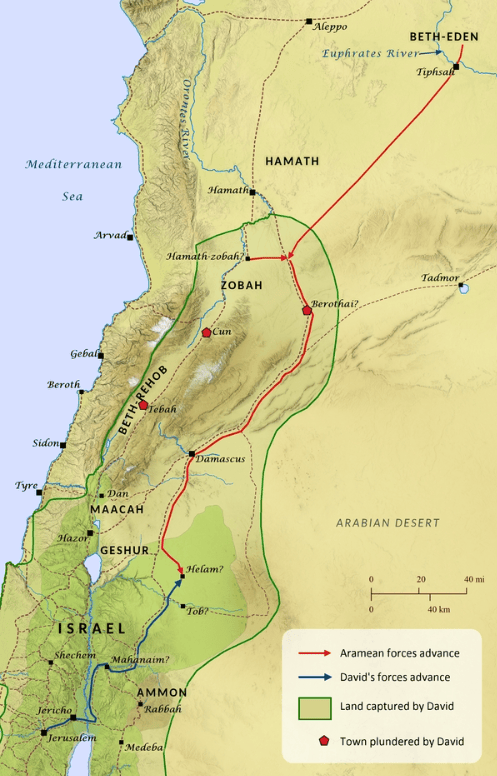
16 And Hadadezer sent and brought out the Syrians who were beyond the Euphrates. They came to Helam, with Shobach the commander of the army of Hadadezer at their head.
17 And when it was told David, he gathered all Israel together and crossed the Jordan and came to Helam. The Syrians arrayed themselves against David and fought with him.
18 And the Syrians fled before Israel, and David killed of the Syrians the men of 700 chariots, and 40,000 horsemen, and wounded Shobach the commander of their army, so that he died there.
19 And when all the kings who were servants of Hadadezer saw that they had been defeated by Israel, they made peace with Israel and became subject to them. So the Syrians were afraid to save the Ammonites anymore.
So Joab defeated the Ammonite threat, but out of this defeat another threat rose against the nation of Israel.
Though the Ammonite mercenaries were pushed back by Joab, those pushed back included the Syrian armies paid by the Ammonite’s.
At this time in the nation of Israel’s history, the Syrians were a serious threat in the region. If we recall, back in chapter 8 of 2 Samuel, we met Hadad-ezer, king of Zob, an Aramean nation within the Syrian coalition of nations.
2 Samuel 8:3 David also defeated Hadadezer the son of Rehob, king of Zobah, as he went to restore his power at the river Euphrates.
Hadad-ezer was a man who wanted to dominate Israel, and after this last fiasco with the Ammonites, was going to try again.
In this chapter, we found him trying to defeat David through a coalition with the Ammonites, but he simply found failure. Pulling back and regrouping with additional Syrian related forces was his only hope, and having been recently defeated by David’s men must have goaded this king. He had to have victory, though he had yet to see any success.
There is much to consider in this passage for the New Testament believer.
First off, our enemy, as Hadad-ezer was, is relentless. Though our enemy has been defeated at the cross, he has not given up. There is much damage he desires to inflict on the believer, and he is relentless, much like this king of Zobah.
We see this very attitude in the days of Jesus, when his enemies sought to enter battle with Him, even though His wisdom defeated them over and over again.
Matthew 22:34 But when the Pharisees heard that he had silenced the Sadducees, they gathered together.
Secondly, there is the danger for the believer to think that one victory provides respite from vigilance. Joab crushed the Ammonite resistance, and drove back the Syrian threat. Surely they had learned the lesson of dealing with Israel but this was not the case. The Syrian forces, though still licking their wounds, rose up to challenge Israel again. And David responded, even as the enemy was preparing. David didn’t wait, but took the battle to them.
Much in the same way we should move forward in our faith, taking the battle to the enemy as opposed to simply waiting to be attacked, even after a great victory is a strategy that continues successful Christian living. Though our battles are not with flesh and blood, we can apply this attitude to the battles we have in the spiritual world, even as it appears the evil is gaining strength.
Let us not fall into compliance and spiritual satisfaction. It may come back to bite us! We may witness this very condition in our next chapter, as we see David letting others lead his army.
Thanks again for coming to visit. I hope you found something of interest in this post and would appreciate a comment, to begin a discussion. If you know someone this blog may bless (or challenge), send them a link, so they may join us in our discussion.
Come join us at Considering the Bible


