
My wife and I are reading through the Psalms in our evening reading and occasionally a nugget of the Psalms jumps out of the page. Don’t you love it when, after years of reading the “Old Book” passages become alive, reinforcing old teachings or simply warming your heart.
This is the book of Psalms, and it is rich.
I pray I can communicate a portion of the blessing we receive from this wonderful book.
We are visiting Psalm 53, which upon even a cursory review, sounds very familiar. So it should, for it is almost identical to Psalm 14, and with that similarity, I would like to consider the similarities and differences each Psalm is communicating.
The first item to review is the topic of a fool. Both psalms speak of the “fool” and in our modern way of understanding, to call someone a fool implies one who is deficient in understanding, judgemnt or sense. One who is easily tricked, or made to look foolish/stupid. This is not the primary meaning of when the Hebrew mind read this word.
The term found in both psalms is nāḇāl, and if you think back in David’s life, you will recognize this noun as a proper name of one of David’s enemies.
1 Samuel 25:3 Now the name of the man was Nabal, and the name of his wife Abigail. The woman was discerning and beautiful, but the man was harsh and badly behaved; he was a Calebite.
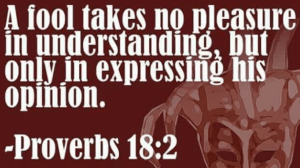
Note that the Scripture gives us a character description of the man named “fool” as being harsh and badly behaved. Nothing to do with intelligence directly, but a commentary on his lifestyle and behavior. To be a fool (nāḇāl) in the Hebrew mind was to reject God’s authority and influence, being controlled by the baser elements of the earthly life.
David is not making a commentary on the intelligence of the one rejecting God, but on the moral standing of that one. With that short introduction, lets consider our first verse.
Psalm 14 Psalm 53 1 – To the choirmaster. Of David. The fool says in his heart, “There is no God.” They are corrupt, they do abominable deeds; there is none who does good. 1 – To the choirmaster according to Mahalath. A Maskil of David. The fool says in his heart, “There is no God.” They are corrupt, doing abominable iniquity; there is none who does good.
Note that Psalm 53 has the additional instruction of “according to Mahalath. A Maskil of David”. Mahalath, from what I have found, refers to an instrument, possible a harp, along with the description of David the psalm as a maskil. This is another mysterious word, but many scholars lean to the idea that this word describes a contemplation or an instructive message.
For Psalm 53 to include this addition may emphasize the seriousness of the message, since Mahalath also may have a sense of mournfulness, sadness or entreaty.

The fool contemplates the existence of God in his heart. During this contemplation, he concludes that there is either no God, (as the translation records – “There is no God”) or that the fool rejects God’s authority over him, by saying “No God”. For you see, the Old Testament text does not include specific words that may be translated as “There is” – see snippet from the Blue Letter Bible to the right.
Either an athiest or a rebel – Which my friend do you consider to be the worst fate?

This is the beginning of becoming the fool, for without God, there are no lasting standards defining right from wrong, and therefore all things are relativistic, according to multiple authorities, with inevitable conflicts. Truly a foolish way to live!
Corrupt
David continues in the first verse of both Psalm 14 and 53 to describe the outcome of this contemplation. Both Psalms speaks of corruption, of a spoiling or rotting, even of a perverting of their very nature. Their very nature or character is being destroyed by this thinking, falling to baser and baser levels of existence. They are literally rotting on the inside. After David’s description of the fool’s character, he goes on to to describe the works produced by this fool.
Abominable Deeds/Iniquity
This is where we find a difference in the Psalms we are looking at. You see, Psalm 14 speaks of deeds, whereas Psalm 53 brings the darker concept of iniquity into the equation.
| Psalm 14 | Psalm 53 |
| they do abominable deeds | doing abominable iniquity |
Psalm 53 raises the stakes in speaking of abominable iniquity. Both describe the activities as abominable, that which is abhorrent, but with the added concept of iniquity, Psalm 53 becomes an even darker description of the fools works. Iniquity speaks of injustice, including violence, which if considered, will always become the end result of a life with no standards. This is the end result of saying “No God”
Uniform in not Doing Good
A final description within both Psalms speaks of this group of fool as being homogeneous, pure and without any deviation in their work of doing good. That is, no-one that contemplates the non existence of God, or that refuses to bow before Him, performs any good. To say that no one does good, for some, implies that the fool cannot even understand goodness or righteousness. Yet, let’s remember that David is speaking of actions when he speaks on no one doing good, based on the contemplation of the heart.
Yes, the heart, if hardened beyond reach, this condition sets the fools actions into inevitable evil and injustice. Yet, I am not convinced the contemplation of the heart is necessarily complete in any fool, for I too (as you may be) lived a fools life and contemplated a life of the rebel, saying no to God. In His mercy, He invited me into a living relationship with Him, and by His grace, He is pulling me out of a life of injustice and violence.
Are you contemplating saying no to God? My friend, consider you ways, for a life of rejecting God will lead to a life of injustice. A life of walking with Him will produce love and peace, both internally and as an outworking of the heart into the lives of others.
Don’t be a Nabal!


Thanks again for coming to visit. I hope you found something of interest in this post and would appreciate a comment, to begin a discussion.
 Considering the Bible
One response to “Psalms for Psome – Ps 53.01”
[…] Psalms for Psome – Ps 53.01 […]
LikeLike