Don’t you love it when, after years of reading the “Old Book” passages become alive, reinforcing old teachings or simply warming your heart.
This is the book of Psalms, and it is rich.
I pray I can communicate a portion of the blessing we receive from this wonderful book.
Psalm 62:5 For God alone, O my soul, wait in silence, for my hope is from him. Psalm 62:6 He only is my rock and my salvation, my fortress; I shall not be shaken. Psalm 62:7 On God rests my salvation and my glory; my mighty rock, my refuge is God.
As we mentioned in an earlier post, this psalm does not ask anything of the Lord, but the psalmist is “in himself”, ruminating on the person of God, reminding himself of God’s active work in his life, of God’s presence and His character.
God
provides hope
is my rock
is my salvation (x2)
is my fortress
is my glory
is my mighty rock
is my refuge
Take a moment and consider each of these descriptors of God. Is there a common denominator, a common theme in these descriptors, something that indicates the condition of David’s heart as he reviews the character of God?
I would suggest that David is in a very difficult place, a place in which there appears to be no escape, no path to safety, no place of security or of strength, and no area that is stable, that is constant.
There are times when we, as believers will also experience this condition. In our lives, there appears to be many enemies, many difficulties, many obstacles and many temptations, that are seemingly insurmountable.
During these times, I have spent too much time looking for solutions, ways out of the problem, solutions to my difficulty. And in these difficult times, I have worried myself into a fit of doubt and despair.
But the rare time, I have turned introspective, remembered the goodness of God, His former guidance, His continued protection, (though not without some scrapes and bruising), and His constant care. During these times of dwelling on God, I have found that my worry machine has run out of gas.
Amazing – we can dwell on His goodness, on His person, on His care for us, or we can worry.
Let’s think on Him. He is good, and He is good all the time.
Don’t you love it when, after years of reading the “Old Book” passages become alive, reinforcing old teachings or simply warming your heart.
This is the book of Psalms, and it is rich.
I pray I can communicate a portion of the blessing we receive from this wonderful book.
Psalm 62:3 How long will all of you attack a man to batter him, like a leaning wall, a tottering fence? Psalm 62:4 They only plan to thrust him down from his high position. They take pleasure in falsehood. They bless with their mouths, but inwardly they curse. Selah
In our previous post, I sought to explain my understanding of this psalm, and that David was silent before God, that he was not making any petitions or requests before God in the psalm. He was silent before God.
Not so much in relation to those who had attacked him. Remember – the attacker is his son, who also had enlisted David’s trusted counselor Ahithophel, one who David considered a friend.
In his silence before God, he questions his attackers.
How long will all of you attack a man to batter him, like a leaning wall, a tottering fence?
As attackers, they naturally sought to find victory when their enemy was weak, like a leaning wall or a tottering fence. David was on the run, with his forces decimated, and unsure who was loyal to him. Who could be trusted, when his very friend Ahithophel had rebelled?
This attack had the smell of death, not only in its eventual outcome, which David could not admit to, but also in the intent of his enemies. Their attack had all the hallmarks of the evil one, saying one thing and doing the other. Hypocrites!
Verse 4 speaks of taking pleasure in falsehood. How foolish and short sighted. Do they not understand the fountain of all truth is the Lord, and that this treachery cannot succeed.
Remember David’s attitude when he was on the run? The rogue king Saul chased him and on multiple occasions, David had opportunity to strike him down, and yet he would not. He would not touch the Lord’s anointed. No success would come of it, and it would frustrate the will of God.
How could David reconcile that his son and friend were doing that which was abhorrent to him.
David could have justified an attack on Saul, since he had been anointed the king of Israel, yet he waited on the Lord. Absalom had no anointing, nor call of God on his life. He was simply a headstrong, deceitful, self willed, spoiled young man.
This rebellion was, from David’s standpoint, utterly spawned in falsehood. Absalom and Ahithophel surely had heard of the previous exploits of David in his ascension to the throne, yet they decided to pursue a completely different method of attaining power. Through falsehood. Through lies to the people of Israel and by deception to the king.
How utterly shortsighted.
And yet, if we consider our own lives, how often do we seek to short circuit God’s will with the same motivation, the same “pleasure in falsehood”, looking to find advantage through another’s weakness and by deception taking advantage of a weakness.
Ephesians 4:20, 25
But that is not the way you learned Christ!– Therefore, having put away falsehood, let each one of you speak the truth with his neighbor, for we are members one of another.
Don’t you love it when, after years of reading the “Old Book” passages become alive, reinforcing old teachings or simply warming your heart.
This is the book of Psalms, and it is rich.
I pray I can communicate a portion of the blessing we receive from this wonderful book.
Psalm 62:1 To the choirmaster: according to Jeduthun. A Psalm of David. For God alone my soul waits in silence; from him comes my salvation. Psalm 62:2 He alone is my rock and my salvation, my fortress; I shall not be greatly shaken.
As I take my time through the Psalms, I have an increased realization of the impact family conflict has on the Psalmist.
The Psalm we are entering this morning has no petitions to God, pleadings to God, requests of God, or praising to God. The Psalmist is quiet before God, having expressed his concerns previously.
He is alone with God.
But ever the curious fellow, I sought to understand what prayers and petitions were offered to God in which David was resting upon, in which he could simply express that it was only him and the Lord, and that he was content in this situation. What I found, thanks to Blue Letter Bible, was a timeline of each of the Psalms and their likely cause of writing, along with the time of their writing.
This little table was somewhat shocking, for in it we find that the a greater number of Psalms were written due to Absalom than I would have guessed. He surely was a thorn in David’s side, and his petitions to God were many during this rebellion.
With this understood, let us remember that during the upheaval and treachery of this time, that David had sought refuge and response from his God. In this Psalm David expresses trust only.
Nothing else.
He is alone with God, waiting in silence.
Quite possibly the greatest challenge David faced in life, and he is silent before God. No requests, no wrestling with Him. Simply recounting that God is the decider, the One in charge, the One who is.
My wife and I are reading through the Psalms in our evening reading and occasionally a nugget of the Psalms jumps out of the page. Don’t you love it when, after years of reading the “Old Book” passages become alive, reinforcing old teachings or simply warming your heart.
This is the book of Psalms, and it is rich.
I pray I can communicate a portion of the blessing we receive from this wonderful book.
Psalm 61
8 So will I ever sing praises to your name, as I perform my vows day after day.
In our previous post, I skipped over the concept of vows. He had mentioned vows in verse 5, and I find this repetition to be worthy of a short discussion. Let’s read verse 5 once more.
5 For you, O God, have heard my vows;
David had earlier mentioned that God had heard his vows. In our final verse, he speaks to the Lord, reminding Him that he will perform his vows.
It is interesting that the vows are not connected with the results he is requesting. It isn’t a tit for tat type of discussion here. David isn’t entering into a bargaining stance with the Creator of all, hoping to get one over on Him.
We have all heard of the fox hole vow – Get me out of this trouble God and I will serve You the rest of my life. Yet this rarely sticks, and as soon as the trial is over, so is the remembrance of the vow.
But notice that is David’s final statement to the Lord, the cause and effect seems to be turned on it’s head. My common understadning of vows in relation to God goes something like …
I will continually and constantly, out of a previous legal obligation, perform my promise as a payback for a previous rescue! (I know it sounds crass, but that is how my little brain works!)
No, notice that David states that he will sing praise, in order to perform his vows to God.
God does expect us to keep our vows, especially our vow to follow Jesus, but we cannot follow properly simply out of a spirit of obligation. Now don’t get me wrong, we are obligated to Him due to His great sacrifice, yet in the goodness of God, He has provided the power, the energy, the strength to perform our vow, to follow after Him as we sing praise to Him. As we have a spirit of joy in our lives, thankful for His goodness and mercy, may we be faithful “singers’ of His goodness.
Even for those of us whose natural singing voice leaves much to be desired. Yikes!
My wife and I are reading through the Psalms in our evening reading and occasionally a nugget of the Psalms jumps out of the page. Don’t you love it when, after years of reading the “Old Book” passages become alive, reinforcing old teachings or simply warming your heart.
This is the book of Psalms, and it is rich.
I pray I can communicate a portion of the blessing we receive from this wonderful book.
Psalm 61
6 Prolong the life of the king; may his years endure to all generations! 7 May he be enthroned forever before God; appoint steadfast love and faithfulness to watch over him!
When we last read David’s prayer, he had turned a corner, due to his looking back to the faithfulness of God and the promise he had received of the kingdom.
Our first verse, verse 6, when I initially considered it, made me think of David himself, how he was stating that the Lord would prolong the king’s life in the midst of this emergency. God would prolong the kings life, and then he begins to state the impossible.
The kings life would extend to many generations? He already was an aged man, and he has the audacity to state the Lord would extend his life for “many generations”? Never mind that – consider the next statement, that the king shall abide before God forever!
OK, so we have a shift in the topic from the immediate rescue of David by prolonging his life, to one of two topics
First topic that came to my mind is that he is referring to his eternal state, that he would abide before God forever, no matter his time of death on this old earth.
And yet the subject seems to change in verse 7, where David looks to another king, whom he asks God to prepare mercy and truth to preserve the King.
Can anyone imagine who that King is? When I see mercy and truth, I automatically think of John’s gospel, where he speaks of grace (mercy) and truth in the person of Jesus
John 1:17b … grace and truth came through Jesus Christ.
Does it not make sense that David, in his time with God, at a dark, deeply difficult time, would be caught up with the promised King who would reign forever.
It is only through the reign of Jesus that any of us can expect to have our lives extended through many generations, even forever.
Jesus has been enthroned forever, according to David’s prayer. David was restored to his throne, as the promise of God was maintained for David.
Not only was David restored to the throne for his final days, but in the big picture, his life has been extended through the power of the resurrected King, who was full of mercy and truth.
My wife and I are reading through the Psalms in our evening reading and occasionally a nugget of the Psalms jumps out of the page. Don’t you love it when, after years of reading the “Old Book” passages become alive, reinforcing old teachings or simply warming your heart.
This is the book of Psalms, and it is rich.
I pray I can communicate a portion of the blessing we receive from this wonderful book.
Psalm 61
4 Let me dwell in your tent forever! Let me take refuge under the shelter of your wings! Selah 5 For you, O God, have heard my vows; you have given me the heritage of those who fear your name.
First, lets remember that I am approaching this psalm as from the hand of David, during a most dangerous time in the reign of the King. Rebellion had broken out and his very son had committed the treason. To make matters worse, it looked very promising for Absolam, and that David may be facing his last days on earth.
In David’s cry to God, he speaks of dwelling forever in the tent of the Lord. At this time in the life of the nation, the Temple had not been constructed, and the tabernacle was still a temporary structure, per the wishes and will of God. So when David uses the term “dwell”, he uses a term that sometimes has the connotation of dwelling for a time, to temporarily dwell. This makes sense if the context of the Psalm is as I have suggested. He may only have a few days left in the land. Things were looking very dark.
But notice that he uses the term dwell, sometimes signifying a temporary sojourn, with a qualifier. He wants to stay forever in the tent. Forever in the tabernacle, that would soon be taken down, for the construction of the Temple.
So what gives here?
David is more than a five year planner, figuring out things that need to be accomplished in a set time frame. He is looking long term here, speaking of his eventual demise and permanent state with the Living God.
We also see that he is not only looking to the Lord for his permanent dwelling, but that he is requesting permission to reside under the Lord’s protection, seeking refuge from danger. With this very next phrase, is David requesting protection from the danger that is on his doorstep, and that may bring him to the gates of his grave?
I cannot imagine the strain he is going through, and the multiple conflicting thoughts racing through his head and heart. Yet in the midst of the confusion, he looks to the Lord for his help, whether it is by life or through death.
At this point, starting in verse 5, David turns a corner and begins to remember his God, and the promises he has received from the hand of God.
The very promise David recalls is the promise that seems to be hanging in the balance with this rebellion. David recalls that God had given him “the heritage of those who fear your name”. He is referring to his rule over the people of God, those who fear God’s name.
How could Absalom frustrate the will of God? It seems this very contradiction is a comfort to David in the midst of his present circumstances. Wherever David was during this trial, he resorted to his past experience with the Lord and looked away from his circumstance that seemed so dark. This is the practice of the saint who has walked with the Lord, has seen His faithfulness, and trusts in the midst of a trial that the Father’s heart has not changed.
He is the faithful One, and as we sojourn through our lives down here, it is wise to consider His faithfulness in the midst of trials that come upon us.
My wife and I are reading through the Psalms in our evening reading and occasionally a nugget of the Psalms jumps out of the page. Don’t you love it when, after years of reading the “Old Book” passages become alive, reinforcing old teachings or simply warming your heart.
This is the book of Psalms, and it is rich.
I pray I can communicate a portion of the blessing we receive from this wonderful book.
Psalm 61:1 To the choirmaster: with stringed instruments. Of David. Hear my cry, O God, listen to my prayer; Psalm 61:2 from the end of the earth I call to you when my heart is faint. Lead me to the rock that is higher than I, Psalm 61:3 for you have been my refuge, a strong tower against the enemy.
It seems no one is sure of when this Psalm was written or even if it was King David. Some suggest this psalm was written during the Babylonian captivity. I tend to look at the psalm from a traditional approach and consider this Psalm to be of David, and the situation he finds himself in is the rebellion of Absalom.
David was on the run, across the river Jordan, and eventually makes it to the city of Mahanaim, where he gathers reinforcements and prepares for the battle of Ephraim, where his son is defeated.
Prior to the battle, David is in the weakest position he has experienced. If this psalm comes from the hand of David, it is at this point where I feel he may have given us his passage. Having crossed the Jordan, he is away from the temple, from his city, from the throne, and essentially running for his life.
He may have felt like he was at the ends of his kingdom, near the extent of his authority, the limits of his national borders, as he travelled away from his capital. When he refers to the end of the earth, the phrase may be translated the ends of the “land” also, and makes better sense, at least in my mind.
As he is on the run, priorities come to his heart, and as his hopes and dreams are seemingly being dashed by his own blood, he calls out to God as was his habit.
Hear my cry. Pay attention to my prayer O Lord. Not only pay attention, but also understand my prayer. This type of boldness of the Psalmist is what I find so refreshing, so challenging. He had been in enough experiences with Almighty God that he could speak to Him in this manner.
I often come to the Lord with a cowering sense of subjugation, a head bowed and a knee bent attitude, which is due His Person, and yet the one who is on the run is looking up to God, standing in front and requesting (demanding?) an audience with the Most Holy.
Is this stance of David one out of pride of association, out of a familiarity of relationship with the Father? David admits his heart is faint. To be faint originally meant to be covered over, or enveloped. He was completely distracted or consumed in heart with the circumstances and out of this weakness looked to the Lord for three requests
Guidance to
David was looking for His Rock, the God who never changes, is solid in His Person and that gushes forth living water when least expected. David sought a higher position, knowing that both in military battles and spiritual safety, being higher is preferred. He was not looking to stay where he was, to wallow in his experience but to seek higher ground, to the Rock who is always higher.
Guidance Away
David sought God in his deepest and weakest experiences. But let us not miss that he seeks a position or place that is higher than him. He is not looking to himself for any direction, and it may be read that he is looking for guidance away from his own wisdom, abilities or strengths.
He is looking for guidance to God away from a dependence on his own, for he knows he is faint, at his end, distracted from his priorities, and without resources.
A Historic Haven
The Refuge, his Strong Tower against his enemy, who turns out to be his own son. How conflicted David must have been, distracted in his decisions and faint of heart. No matter what David looked to accomplish, he would wrestle with his decisions, having contrary desires pulling at him. Restore his kingdom, but loose his son, or loose the kingdom and die a traitor at the hand of his son.
To put it bluntly, David was in the worst of situations and he had no idea what to do. He desperately needed guidance, and he needed to get out of his own headspace, where he found no solution that was acceptable. He needed a place of refuge, and that place of refuge was His God.
It is good to remind ourselves that David is not crying out to God for a first time in this instance. Notice that he refers to God as having been his refuge in times past. His previous trials, though arguably of lighter concerns than the present trial, trained his heart to reach out to the God of Israel. This experience was critical, for now David was drowning in this trial, and he naturally had experience with his God as his refuge, as a strong tower from which he might be protected.
As we go through trials, no matter the size or complexity, run to the Father for your help. Not only will this please the Father, and deepen your dependency on the ever faithful One, but it will prepare you for trials that may be heading your way.
Not matter the trial or temptation, He is the One we need to resort to. He is the One who is our Strong Tower. Don’t refuse the great blessing of God’s guidance and protection as you go about your day today.
My wife and I are reading through the Psalms in our evening reading and occasionally a nugget of the Psalms jumps out of the page. Don’t you love it when, after years of reading the “Old Book” passages become alive, reinforcing old teachings or simply warming your heart.
This is the book of Psalms, and it is rich.
I pray I can communicate a portion of the blessing we receive from this wonderful book.
Psalm 60:9 Who will bring me to the fortified city? Who will lead me to Edom? Psalm 60:10 Have you not rejected us, O God? You do not go forth, O God, with our armies. Psalm 60:11 Oh, grant us help against the foe, for vain is the salvation of man! Psalm 60:12 With God we shall do valiantly; it is he who will tread down our foes.
Our last portion of Psalm 60. I always love the last portion of a psalm, for the body of the typical psalm provides a struggle, a failure, a disappointment, even a question of faith, and the author is struggling with a topic in each psalm, but when we get to the last portion, I do not recall a psalm yet that ends without a time of encouragement and hope in the Lord.
Psalm 60 is no different!
Yes verse 10 reminds us that the nation is feeling the loss of God’s help, that there is something going on that reminds the people of their state of weakness. They have been rejected in some manner and David reminds the people of this fact, yet he doesn’t sit there. He doesn’t remain in a defeated, woe is me state, for he immediately begins his plea with God for help, for his admission of his utter need of help.
No where is there any help in the efforts of men, for where could he go – God is the strength of the nation.
I can hear echoes of Peter in David’s writing here, of when Peter was asked if he would leave after a period of testing. What was Peter’s response in John 6:68?
“Lord, to whom shall we go? You have the words of eternal life.
To whom shall we go? What great reminder for each of us. David spoke of the vanity of the salvation of man. Peter takes the flip side and states the lack of any effective source to rely on other than the Lord.
We have a choice.
With God we shall do valiantly, for in the end, it is He who will tread down our foes!
Seeking help from man will lead us to empty results. No one reading this short post wants empty results!
My wife and I are reading through the Psalms in our evening reading and occasionally a nugget of the Psalms jumps out of the page. Don’t you love it when, after years of reading the “Old Book” passages become alive, reinforcing old teachings or simply warming your heart.
This is the book of Psalms, and it is rich.
I pray I can communicate a portion of the blessing we receive from this wonderful book.
Psalm 60:6 God has spoken in his holiness: “With exultation I will divide up Shechem and portion out the Vale of Succoth. Psalm 60:7 Gilead is mine; Manasseh is mine; Ephraim is my helmet; Judah is my scepter. Psalm 60:8 Moab is my washbasin; upon Edom I cast my shoe; over Philistia I shout in triumph.”
After assuring his reader in the last portion of Psalm 60 that there is a place of refuge to run to; that God is a banner for those who seek Him, David then goes on to state God’s actions.
David was a big picture guy, having his eye on the future of God’s plan and did not let the current set back hold him back. This is a difficult lesson, for as we are pressing forward, we will always have setbacks, disappointments, discouragements, and delays. In our battles, we should not be surprised by difficult times entering our lives, even understanding that the Lord Himself is allowing these difficulties. During those times of difficulties, we must be big picture people, looking to the end game, the purpose for which He has brought us into the game.
The regions David refers to in our verses start in the northern portion of Israel, with each region zigzagging back and forth over the Jordan as the author moves his finger south down the map of Israel.
Each of these regions are described as God’s possessions. This fact that David reminds us of is instructive for it reminds us that we are not the owners, but only stewards, and that as the Owner, God will have his way of working His plan with those people in the regions He speaks of.
It is God’s land. Military setbacks are inevitable, but by remembering the land is the Lord’s and the big picture of God’s victory, David finds solace and relief to continue another day. Please understand – David’s current struggle is not being minimized, but in relation to the goal of God, David has found the perspective He needs.
Are you going through a valley, a difficult time, where it appears you have lost major gains in the Christian walk? Consider the big picture, and understand that God has an end purpose for our lives.
Love God and His Son, be patient, look to the big picture and hang on!
My wife and I are reading through the Psalms in our evening reading and occasionally a nugget of the Psalms jumps out of the page. Don’t you love it when, after years of reading the “Old Book” passages become alive, reinforcing old teachings or simply warming your heart.
This is the book of Psalms, and it is rich.
I pray I can communicate a portion of the blessing we receive from this wonderful book.
Psalm 60:4 You have set up a banner for those who fear you, that they may flee to it from the bow. Selah Psalm 60:5 That your beloved ones may be delivered, give salvation by your right hand and answer us!
David is recounting the goodness of God and it is instructive to recognize, that he was experiencing setbacks militarily. Not only military setbacks, but he calls out God in the earlier passage, stating God had been very harsh, making the land quake, tearing it open, making the nation stagger with what they had experienced. Let’s read the previous verses once more and consider what David was going through. Remember – he was claiming God was the One who brought about the following difficulties.
Psalm 60:2-3 You have made the land to quake; you have torn it open; repair its breaches, for it totters. You have made your people see hard things; you have given us wine to drink that made us stagger.
David was definitely in a low point, a struggle that was not merely a military issue, but a God issue.
A difficult passage to understand, yet as David ponders the goodness of God, I sense he is speaking of a remnant that will look to God, that a banner has been set up for, for those who fear God and will flee to. Yes the nation (physical) has experienced great trial here, but in the midst of this trial, those who fear God recognize the banner set out in front of them, that they can appeal to, that they can flee to, and hide under the Shadow of the Almighty.
Will all seek out the banner of God? David does not answer this, yet in the midst of difficult time, even times brought about by the Father, He is still our cover, our refuge, our banner to gather about.
Let us remember that in no difficulty or trial, God is not there for us.
My wife and I are reading through the Psalms in our evening reading and occasionally a nugget of the Psalms jumps out of the page. Don’t you love it when, after years of reading the “Old Book” passages become alive, reinforcing old teachings or simply warming your heart.
This is the book of Psalms, and it is rich.
I pray I can communicate a portion of the blessing we receive from this wonderful book.
Psalm 60:1 To the choirmaster: according to Shushan Eduth. A Miktam of David; for instruction; when he strove with Aram-naharaim and with Aram-zobah, and when Joab on his return struck down twelve thousand of Edom in the Valley of Salt.
O God, you have rejected us, broken our defenses; you have been angry; oh, restore us. Psalm 60:2 You have made the land to quake; you have torn it open; repair its breaches, for it totters. Psalm 60:3 You have made your people see hard things; you have given us wine to drink that made us stagger.
Many place this psalm in the early years of King David’s reign. 2 Samuel 8:1-8, 2 Samuel 10:1-19 and 1 Chronicles 18:11-13 describe many of the battles referred to in the first verse, and how David and his army conquered vast areas of geography and multiple kingdoms in the area.
And yet, this psalm speaks of rejection, of God’s anger with His people, of the lands quaking and the people seeing hard things. How can this be? Was not King David’s battles against the neighboring nations successful during his early days? Militarily, he dominated the region, expanding the kingdom to the boundaries never experienced by the nation before.
And yet we have this psalm, where it appears God is angry with the nation, that there are setbacks to the victory march. The first verse speaks of their defenses being broken. Defenses? David was on the march, acting offensively in battles. For his defenses to be broken, speaks of loss in battle, of a set back.
The people of God have been made to see hard things, they are staggering about, as if a drunken stupor. And in all this description, David is assigning blame to none else but God. Over and over again in this first three verses, David assigns the actions his military are experiencing to God.
For God is angry. The reason for His anger is not clear but David is in trouble and is begging for restoration.
We sometimes succumb to the thought that the fight of faith is a walk in the park. That we go from victory to victory, with nary a scratch being suffered.
This Psalm reminds us that though the arc of the believers life is of victory, and we may be assured that the church wins in the end, during our pilgrimage, we must be prepared for setbacks, disappointments and losses. There will be times of intense battles, where we not only do not gain ground, but actually are set back on our heels, losing ground, becoming disillusioned, disappointed, and discouraged.
These are times of vulnerability, where we need to be prepared, steeled against the emotional blast of failure. Fellowship with faithful brothers is a strength that we have been provided and we need to take advantage of, not only for ourselves, but to provide to those we know and love.
Yet, there are times when we are alone with God, when it is a battle with Him, seeking to find His will, His desire and to bend the knee to His direction. This time of isolated struggle with God, even as pictured by Jacob in his wrestling with God, brings us out of it, possibly crippled but stronger.
Are you experiencing a wrestling match with God? A time of apparent defeat in your relation with the Master? Does it seem God is angry and you are confused with the reaction of God to your decisions and life choices?
The only thing I can suggest is that you do not let go. Do not walk away from the One who is challenging you, pruning you, wrestling with you. He is expanding your relationship with Him, extending your impact and preparing you for bigger battles. Ensure your approach to Him is without any known sin in your life (You know if there is sin going on!) and keep chasing in the midst of confusion
He truly is good, and if there is some doubt, hang on, until the clouds disperse!
My wife and I are reading through the Psalms in our evening reading and occasionally a nugget of the Psalms jumps out of the page. Don’t you love it when, after years of reading the “Old Book” passages become alive, reinforcing old teachings or simply warming your heart.
This is the book of Psalms, and it is rich.
I pray I can communicate a portion of the blessing we receive from this wonderful book.
Psalm 59
14 Each evening they come back, howling like dogs and prowling about the city. 15 They wander about for food and growl if they do not get their fill. 16 But I will sing of your strength; I will sing aloud of your steadfast love in the morning. For you have been to me a fortress and a refuge in the day of my distress. 17 O my Strength, I will sing praises to you, for you, O God, are my fortress, the God who shows me steadfast love.
As we come to a close on this amazing psalm of David, of how this shepherd boy turned fugitive turned to the living God for deliverance, protection and redemption in the face of a murderous, bloodthirsty king, one truth rings out in my mind.
David returns to recounting the activities of those who are hunting him down, describing them as dogs, howling and prowling, growling to get their fill of violence. The continual return of these assassins every night proves of their determination. Of their hunger to kill.
They are growling, making the noise of a starving, ravenous dog, controlled by their base appetites.
David sings. The one in persecution sings. The one who is on the brink of torture or to be laid in a grave, he sings. Even as he is in the midst of this persecution, notice that David speaks of the Lord as having been a fortress for him, is a present day refuge for him. He speaks of the Lords steadfast love being shown to him.
Remember the state of affairs he is in. The assassins are still out there howling and growling – David is presently experiencing the steadfast love of God.
Praise God from whom all mercies flow! He is good and He is good all the time!
My wife and I are reading through the Psalms in our evening reading and occasionally a nugget of the Psalms jumps out of the page. Don’t you love it when, after years of reading the “Old Book” passages become alive, reinforcing old teachings or simply warming your heart.
This is the book of Psalms, and it is rich.
I pray I can communicate a portion of the blessing we receive from this wonderful book.
Psalm 59
11 Kill them not, lest my people forget; make them totter by your power and bring them down, O Lord, our shield! 12 For the sin of their mouths, the words of their lips, let them be trapped in their pride. For the cursing and lies that they utter, 13 consume them in wrath; consume them till they are no more, that they may know that God rules over Jacob to the ends of the earth. Selah
David is on the brink of death, with one foot tottering over the grave. He has assassins pursuing him, lurking about, working with spies throughout the nation, hunting him down and seeking his death.
And yet David speaks of his enemies mouth, their lips, and their pride. This fact, at face value confused me, for I would have thought David would bring to God the actions these bloodthirsty men were in the midst of doing against him. Yet reference to their speech is scattered throughout the passage.
Consider
vs 3 fierce men stir up strife against me.
vs 5 those who treacherously plot evil
vs 7 bellowing with their mouths
vs 7 with swords in their lips
vs 7 “Who,” they think,“will hear us?” .. speak out plans of destruction
David is looking for God’s recompence upon those who speak evil towards him. This recompense comes in two forms for David.
The first is that those planning and speaking of his destruction are to be scattered. He is looking to God for their plans to come to nought. The first request is that they not be killed, but to be scattered. The evil plans are to be frustrated and those planning his destruction to wander away from this focus of their existence
The second recompense is for those planning David’s death to be consumed. When I see the word consumed, I automatically think of something used up, to be spent, eaten up. To consume in my culture is to use a finite product to its useful end, with it being of no use (or of no existence) upon consumption.
Is that David’s thought here? Somewhat, but what I understand is that this term in the Hebrew (כָּלָה kâlâh, kaw-law Strongs H3615), speaks also of completion, finishing or accomplishment.
So when David is looking for God to consume them in wrath, what is the message? Is David hinting at the idea that God has placed these men in David’s life on purpose, as training material for the future king, and that God will bring about a completion of the work these bloodthirsty men are allowed to perform, in order to train David?
Is that the message?
If so, this speaks of David’s understanding of God as much more than a singular relationship with himself, but that God is also One who orchestrates the entire creation to perform His good will.
No matter how you understand verse 13, it is difficult. If I have captured in a small way the actual understanding David had, it speaks of David’s faith in a greater way than simply seeking protection and deliverance from God in his present circumstances. David is expressing an understanding of a New Testament believer, with a revelation that few Old Testament saints were privy to.
My wife and I are reading through the Psalms in our evening reading and occasionally a nugget of the Psalms jumps out of the page. Don’t you love it when, after years of reading the “Old Book” passages become alive, reinforcing old teachings or simply warming your heart.
This is the book of Psalms, and it is rich.
I pray I can communicate a portion of the blessing we receive from this wonderful book.
Psalm 59
8 But you, O LORD, laugh at them; you hold all the nations in derision. 9 O my Strength, I will watch for you, for you, O God, are my fortress. 10 My God in his steadfast love will meet me; God will let me look in triumph on my enemies.
David, in our last post, spoke of his enemies, those bloodthirsty dogs prowling and howling, speak great swelling words of destruction on the shepherd boy. Everything was mounted up against David, and all appearance of deliverance evaporating in front of his very eyes.
His physical eyes that is. He saw the state of things, his situation. He didn’t minimize the problem. He described it without hesitation and laid it all out in front of the Lord.
When we are in a stressful situation, even a dangerous situation, we mimic David well most times. We speak to God about all the troubles we have, the danger that may (or may not) be out there. All the negative aspects in our life comes out of our heart and into the airspace.
Yet David did not stop there, and neither should we. He recalled who God is, for David claimed God as his..
Strength
David claimed God as his strength, his power , his might. As a young man with the government after him, he must have surely felt helpless. No hope of escape or of a path to freedom and security. David looked to God for his strength.
As an aside, it is very interesting that at the coronation of David, another Psalm was written, with a phrase that is reminiscent of David’s thoughts in Psalm 59.
Psalm 2:4 He who sits in the heavens laughs; the Lord holds them in derision.
David’s experience in Ps 59 may have led to the fantastic passage describing the kings of the earth and the rulers being against the True King. He speaks of the Lord as laughing in the heavens, as both those of the nations and of Israel fight against the Anointed. He reveals to us that this effort to stop the Anointed from His mission must be mock worthy in God’s eyes. How foolish it must seem for anyone to fight against God!
David looked to His strength and realized God was not wringing His hands with fret and worry. His strength was simply shaking His head and laughing! Amazing
Fortress
David claimed God as his fortress. David returns to the concept of elevation or height here, for the term fortress speaks not only of a refuge, but of a high place, a high fort. We visited this concept earlier when David spoke of his enemies rising up against him in verse 1, and David looked to God to protect him, or to lift him up over the reach of his enemies.
For our God to be our fortress in the way David is thinking, is to be beyond the reach of our enemies. Danger may be present and visible, but if we are looking to God for protection, we are looking for His ability to keep us out of the reach of our enemies influence and capture.
This begs the question regarding how believers experience suffering and persecution. Yet we need to recall that the protection God provided His Son was deliverance out of death, not from it. This refocus of deliverance is what gives the believer the ability to endure, for the protection God provides may include physical, emotional or mental suffering. This does not negate the protection God provides, and if we see this as a lack on God’s part, we need to refocus our faith.
He is the protector and our fortress!
God
David finally claims the God of Israel as his God. He is not one of many, but the only one in front of God now, and has the attention of the King of the universe. This, if it were not so common in David’s life and throughout the New Testament, should shock us. That the eternal God of creation, the One who is over all things, may be considered to be My God.
Beyond this astounding fact, David claims that his God has a steadfast love for him. How audacious! How presumptive! Who do you think you are David?
But this is not the point! It has nothing to do with who David is, but who our God is. This speaks of the nature and character of the Creator / Redeemer.
His nature is to love. To express steadfast love. His love is not the type that considers if the recipient is worthy of His love. Does He count all the good as opposed to the bad of the recipient, and then judges whether He will shed His love on him? This isn’t the God of the Bible. When we were without strength, even as enemies, He died for the ungodly.
David is getting his eyes off himself and back on who his God is.
One last item to consider in this passage.
David speaks of meeting with God in a previous passage, and now recalls this time he needed for a huddle, for a review. He speaks of God, out a steadfast love, meeting with him, to review the conditions he is experiencing and to see the state of affairs he is in. How this worked out with David is unknown, but we can confidently say that He has come down, He has met with us, He has experienced our condition on earth and He has lived through it!
My wife and I are reading through the Psalms in our evening reading and occasionally a nugget of the Psalms jumps out of the page. Don’t you love it when, after years of reading the “Old Book” passages become alive, reinforcing old teachings or simply warming your heart.
This is the book of Psalms, and it is rich.
I pray I can communicate a portion of the blessing we receive from this wonderful book.
Psalm 59
6 Each evening they come back, howling like dogs and prowling about the city. 7 There they are, bellowing with their mouths with swords in their lips– for “Who,” they think, “will hear us?”
David’s enemies, those bloodthirsty men, came back each evening, diligently searching for their victim, howling like dogs! Howling as a frustrated hunter, these men of blood are reduced to the actions of a mere animal, growling and howling to gain some advantage. They are seeking an advantage to find their victim, hunting throughout the city, disturbing others and bellowing with thier mouths.
For these men to “bellow” is descriptive, for it includes the image of belching, of vomiting up a sickness that is internal to each of these hunters.
Is it not true that a man’s speech reveals his heart? That which is in a man comes out in his speech. For these men, to vomit out a message reveals their heart. How true the words of the Master when He taught such a hard truth!
Mark 7:21 -23
For from within, out of the heart of man, come evil thoughts, sexual immorality, theft, murder, adultery, coveting, wickedness, deceit, sensuality, envy, slander, pride, foolishness. All these evil things come from within, and they defile a person.”
And what was the message these hunters spoke?
“Who,” they think, “will hear us?”
Their speech further confirms the state of their heart, for they are claiming that no one will hear them in their efforts to chase down and kill the innocent shepherd boy. Their question (out of their heart) is revealing that in their opinion their is no God, that there is no one that could hear them making their plans of death, that though they speak with daggers in their lips (murderous words!) they are safe from any repercussions.
As we consider this, let us remember that those with murder in their hearts did not only exist in the time of David.
Again I refer my gentle reader to the Lord’s message above, speaking of the source of murder, and that it is a heart issue.
from within, out of the heart of man, come evil thoughts, sexual immorality, theft, murder
In Matthew 5, He provides us the truth of how anger is equivalent to murder, how we all have this tendency resident within us.
Matthew 5:21 “You have heard that it was said to those of old, ‘You shall not murder; and whoever murders will be liable to judgment.’ Matthew 5:22 But I say to you that everyone who is angry with his brother will be liable to judgment; whoever insults his brother will be liable to the council; and whoever says, ‘You fool!’ will be liable to the hell of fire.
My friends, consider this sobering truth, that our hearts, though redeemed, continues to have a darkness that needs to be resisted through the power of the Spirit of God.
And we must remember, those outside of the Body of Christ need rescuing from this horrible existence. May the Lord guide us to meet with those who are in need of the gospel today.
Though they may speak murder, we are to speak peace.
My wife and I are reading through the Psalms in our evening reading and occasionally a nugget of the Psalms jumps out of the page. Don’t you love it when, after years of reading the “Old Book” passages become alive, reinforcing old teachings or simply warming your heart.
This is the book of Psalms, and it is rich.
I pray I can communicate a portion of the blessing we receive from this wonderful book.
Psalm 59
3 For behold, they lie in wait for my life; fierce men stir up strife against me. For no transgression or sin of mine, O LORD, 4 for no fault of mine, they run and make ready. Awake, come to meet me, and see! 5 You, LORD God of hosts, are God of Israel. Rouse yourself to punish all the nations; spare none of those who treacherously plot evil. Selah
David continues in our passage speaking of his enemies as lying in wait for his life. These enemies have been previously described as bloodthirsty, and in following verses as fierce, even as dogs. They are on the hunt for a victim, but not just any victim. They aren’t seeking blood of just any victim. They have their eye on the future King of Israel. They are looking for innocent blood, blood that has no cause of death in it, but that he is the future king.
David is speaking relatively, for he is not claiming sinless perfection in front of God, but that in relation to the current king of Israel, he has brought no reason for this persecution. He has committed no sin against the current king. He has no way to remedy this situation, for the entire cause of this persecution is sourced out of a man of jealousy, an insecure man who has walked away from God. David has no opportunity of resolving this conflict since Saul will not seek peace.
Saul wants David’s blood. And David wants God to come see.
Now of course God sees the situation. He clearly sees the situation, from every conceivable vantage point and in every possible way. But David is asking for a conference, a time to get together for a “huddle”, a time of communication and review. David needs to get his head straightened out, to hear of the situation from God, to know of God’s accompaniment with him in this endurance run.
David even goes so far as implying that God is asleep and that He needs to rouse Himself. What audacity of the man to speak to God in such a way.
And yet when trials come our way, do we not question God’s attention. It is so common for us to claim that God is missing, that He is somewhere else, or that He is not paying attention to our experience. We may offer up formal prayers acknowledging His presence, but sometimes couched within those prayers are hints that we have our doubts, even though the promise of His being with us in scattered throughout the written Word.
David made his concerns crystal clear. You are my God, and I need you. I need Your attention in this matter. Come to deliver me oh my God. Deliverance was provided, for David received God’s protection from death in multiple instances and in various ways. Over an extended period of time. Yet David was entering a time of persecution and of being on the run, all the while under God’s protection.
Sometimes the protection provided does not look as we may have wanted, but God is faithful.
My wife and I are reading through the Psalms in our evening reading and occasionally a nugget of the Psalms jumps out of the page. Don’t you love it when, after years of reading the “Old Book” passages become alive, reinforcing old teachings or simply warming your heart.
This is the book of Psalms, and it is rich.
I pray I can communicate a portion of the blessing we receive from this wonderful book.
Psalm 59
1 To the choirmaster: according to Do Not Destroy. A Miktam of David, when Saul sent men to watch his house in order to kill him.
Deliver me from my enemies, O my God; protect me from those who rise up against me; 2 deliver me from those who work evil, and save me from bloodthirsty men.
The psalms of David’s heart are sometimes not associated with a specific time in his life. Not so with this psalm. This is specifically the time when the assassination plot was initiated against the shepherd boy by the King of Israel. Let us consider the passage that describes the condition David is in when He pens this psalm.
1 Samuel 19:11-12
11 Saul sent messengers to David’s house to watch him, that he might kill him in the morning. But Michal, David’s wife, told him, “If you do not escape with your life tonight, tomorrow you will be killed.” 12 So Michal let David down through the window, and he fled away and escaped.
David is on the run! This is unbelievable in David’s mind, totally unexpected, for as he speaks with Saul’s son Jonathon after this, he reveals his confusion.
1 Samuel 20:1
Then David fled from Naioth in Ramah and came and said before Jonathan, “What have I done? What is my guilt? And what is my sin before your father, that he seeks my life?”
Psalm 59 is David’s heart after this shocking development in his life. From becoming a national hero, and the future king of Israel, David plummets to a fugitive, on the run from his own people, expecting a spear through the heart or a sword falling on his neck. He is a dead man.
Except for one hope! His God.
Twice he looks to God, to his God for deliverance, once for defending and finally for salvation. Each of these verbs are telling!
Deliver
Deliver me from my enemies, O my God… (v1)
deliver me from those who work evil (v2)
David’s request for deliverance from his enemies (those who work evil) may be understood as David requesting God to snatch him away from the situation, or to take him away from the danger. His request has the sense of being without any self assistance, as one who is without any resource to perform the escape. David is helpless in this request, and he looks to God for his deliverance.
Protect
Protect me from those who rise up against me (v1)
To “protect” in this verse is a surprising concept for a 21st century believer, for it speaks of the one being protected as being set on high, to be in accessible, to be too high for capture.
Notice Davis is asking to be lifted up (protected) against those who are rising up against him. They are seeking to find advantage in their position over David, and yet David seeks God to being him to a higher point, a position of being unreachable, beyond their grasp
Save
save me from bloodthirsty men. (v2)
David cuts to the chase in this verse, for he speaks of those men who are against him as bloodthirsty. His enemies are rising up against him and working evil, are doing so from a blood lust, a desire to kill.
David clearly understands the situation. He is looking to God, his God for deliverance, to cheat these bloodthirsty men from any success. And we know that God, his God came to his rescue. David eventually became king. Eventually! You see, David may have been as young as 19 on the night Saul’s men came to get him. Eleven years later, he ascended to the throne. Over a decade of protection through numerous close calls, near misses and terror inducing events.
God’s protection and deliverance in David’s life was in the midst of many trials.
It may be good to remember this as we enter into trials and struggles in our own walk with the Master.
God protects and we trust. And we are called to continue to trust, in the midst of the trials, the close calls and the terror inducing events, for God is good, and He is good all the time!
My wife and I are reading through the Psalms in our evening reading and occasionally a nugget of the Psalms jumps out of the page. Don’t you love it when, after years of reading the “Old Book” passages become alive, reinforcing old teachings or simply warming your heart.
This is the book of Psalms, and it is rich.
I pray I can communicate a portion of the blessing we receive from this wonderful book.
David has described his persecutors in last weeks passage, and by extension has described our heart and potential actions also. Out of this treasonous and evil choice of life, David begs God for true justice, for justice that can be provided from the only true Judge.
Psalm 58
10 The righteous will rejoice when he sees the vengeance; he will bathe his feet in the blood of the wicked. 11 Mankind will say, “Surely there is a reward for the righteous; surely there is a God who judges on earth.”
Throughout this psalm we have seen David battle with his frustration, with injustice, with crying out to God for action. Let’s remember David’s situation. He has been recently declared by God and His prophet Samuel, in the presence of his family, to be the next King of Israel. He has saved the nation from extreme embarrassment by defeating the giant Goliath. He has served both father and King with multiple tasks. And now he is on the run, being chased by the King and ignored by his family.
I get the message of verse 10, and the joy of seeing vengeance on an enemy. I really do! There have been times in my life when we have been treated poorly and unjustly, and eventually the Lord brings about a turnaround in the situation, with the persecutor becoming a victim. I found joy in the rescue of the Lord, and to be blunt enjoyed seeing the one suffer.
For some reason, I am finding that even though justice is deserved, and may be meted out, that in those circumstances when I see a fairness exacted I experience less joy, less happiness, less satisfaction. Don’t get me wrong – to have the Lord rescue me or my loved ones is an exhilarating experience, but if it entails a required discipline on another, even an enemy, my relative joy is diminished.
To see my enemy suffer is not a joy. I am not sure where David’s head was when he wrote this, especially referring to bathing his feet in the blood of the wicked. It may have some oriental implication I don’t understand, or he may be simply expressing the natural response of a man under tremendous pressure.
It is beyond me, and may reveal my immaturity in the Lord.
But lets stand back and consider these last two verses, that the joy may not necessarily be in the bloody foot bath, but in the fact that there is a God who judges the earth. There is a judge who will defend the helpless, and put right those actions that are evil.
And yet there is a higher thought that nags at me.
Is it not the same Judge of all the earth that was judged, condemned, tortured, mocked, ridiculed, and crucified by those who are the wicked, unjust and cruel of the land.
And yet He asked for their forgiveness.
Yes He is the Greater David, the One who pulls all of us to higher ground, who reveals the merciful heart of the Father, who provides forgiveness to us who should identify with Saul more than David.
We are truly a blessed people to have the Greater David as our Guide, Leader, Savior and Teacher.
My wife and I are reading through the Psalms in our evening reading and occasionally a nugget of the Psalms jumps out of the page. Don’t you love it when, after years of reading the “Old Book” passages become alive, reinforcing old teachings or simply warming your heart.
This is the book of Psalms, and it is rich.
I pray I can communicate a portion of the blessing we receive from this wonderful book.
David has described his persecutors in last weeks passage, and by extension has described our heart and potential actions also. Out of this treasonous and evil choice of life, David begs God for true justice, for justice that can be provided from the only true Judge.
Psalm 58
6 O God, break the teeth in their mouths; tear out the fangs of the young lions, O LORD! 7 Let them vanish like water that runs away; when he aims his arrows, let them be blunted. 8 Let them be like the snail that dissolves into slime, like the stillborn child who never sees the sun. 9 Sooner than your pots can feel the heat of thorns, whether green or ablaze, may he sweep them away!
In our last post, David described the wicked one, the one who refuses correction, the one who is fully loaded with venom, ready to attack, the one who seeks their own desires above all else.
David turns a corner with this portion, for he is now seeking justice on those who are persecuting him. He is asking the Lord for retribution on the wicked for the suffering he has experienced due to their wicked plans against him. Can you feel the frustration he is experiencing. He faithfully served the King, saved the nation from the Philistines in slaying Goliath, ministered to Saul in his sickness, and is now on the run for his life.
Persecuted, not due to anything he has done, other than the Lord choosing him for the throne of Israel. David’s heart for God, and God’s response in anointing him for the throne of Israel brought about his life of being on the run, of being but a step from the grave.
Can you feel his frustration? What is going on? Surely being chosen by God will only bring blessing and honor into David’s life. Surely there is something wrong with this picture! Surely God is not acting correctly, not providing the justice needed, and David begins to describe to God the ways these men are to be treated. David is looking for his God to deliver him, to execute justice upon those who are unjustly smearing his name, chasing him down and ruining his life.
In these verses, David writes numerous descriptions of how God should judge the wicked, all of which lead to their destruction. Note that David is pleading with God, but David’s actions reflect his faith in God, his belief that God truly is the Judge of all the earth, and that even the timing of justice is in God’s hands.
I can’t help but think of a time I chatted with my best friend and she spoke of her desire to lash out at her boss over an injustice. There was no doubt about the injustice, and yet she had not said anything, nor taken any hasty actions. This situation, though a microcosm of David’s experience, has some parallels. And thankfully, as she is wont to do, just needed to express her feelings, share how she felt, and then reconsidered how Jesus would respond. (She took donuts to work with her to be a blessing!)
As we face injustice, it is good for us to be honest with the Lord in our prayers. Trying to come to God with a “face on” will help no one, and God is not deceived. David fully expressed his desires for these wicked men, yet would not hurt the Lord’s anointed.
David expressed his anger and frustration with God, yet was under God’s control in his day to day life. He was under persecution for doing right, for being right, and yet no retaliation, no seeking of revenge against Saul.
Consider the Greater David. Consider His actions toward those who unjustly mocked Him, ridiculed Him, defamed Him, beat him, whipped Him and crucified Him. Did He seek justice, or ask the Father to forgive them?
My wife and I are reading through the Psalms in our evening reading and occasionally a nugget of the Psalms jumps out of the page. Don’t you love it when, after years of reading the “Old Book” passages become alive, reinforcing old teachings or simply warming your heart.
This is the book of Psalms, and it is rich.
I pray I can communicate a portion of the blessing we receive from this wonderful book.
David provided the core, foundational problem of mankind in last weeks post, of the heart of the ruler, and the violence that flows from the rulers heart through his hands and to the victims.
In todays post, David will continue to describe wicked man, those men who sought him out, chased him with the intention of death, those who hated him without cause. He is also describing those amongst whom we live, those who have gained breath from birth, those we love and cherish, even ourselves – if we are honest with ourselves.
Although uncomfortable, let us read the following passage.
Psalm 58
3 The wicked are estranged from the womb; they go astray from birth, speaking lies. 4 They have venom like the venom of a serpent, like the deaf adder that stops its ear, 5 so that it does not hear the voice of charmers or of the cunning enchanter.
If we are honest with ourselves.
It is a difficult message, when I see my little grandchildren cooing and gurgling, to believe that within those cute little ones, their lies a heart that is bent to selfishness.
It is hard to admit that each of us, as we gain breath, have a desire to satisfy own own heart and none else. Though David’s description is speaking of those who were in full bloom of their sin, they began with a self centered spirit. These enemies of David had potential to either follow after or fight against their estrangement, their isolation from others, and especially from God the Father. These particular men followed after their estrangement. We all do. It is natural. It is normal. It is inevitable.
If we are honest with ourselves.
The wicked come fully weaponized. The wicked have venom. They do not need to gain a source of venom, but come fully equipped with poisonous intent.
Story time
As I was walking though my office yesterday, a peer had his radio on, volume low, and barely discernible, but I caught a phrase in a song that we repeat to ourselves constantly.
I believe people are good. I believe I am good.
Even as I heard that, I felt good. I enjoyed that message. I thought highly of myself. I have done some good things in life, therefore I am good, right?
My friends, I am not trying to say every human is as evil as Hitler in their actions, but we all are capable of great self deception, and easily able to justify evil acts, all the while thinking we are good.
If we are honest with ourselves.
Note that the wicked do not hear the voice of the charmers, or the enchanter. They refuse any counsel or direction. They stop their ears, intentionally refusing to hear of any alternate message, of any correction or rebuke.
At this point, David’s description of mankind is desperate. A fully weaponized individual that refuses any direction, being directed only by a heart that seeks it’s own desire
Let’s be honest with ourselves my friend. If we have ever veered from the perfection of God, (and we all have), we belong to the group David is describing here. Venomous individuals seeking their own. Individuals with a heart that spews out violence.
Is there no hope? Surely we are without any ability to correct our ways, for our only influence is the heart we were born with, that we are controlled by, that devise our plans and direct our actions. No wonder Paul cried out…
Romans 7:24 Wretched man that I am! Who will deliver me from this body of death?
Let us remember that the main issue in this Psalm is the search for the true Judge of all the earth. David is describing a judge (or ruler) vying for control over our lives. In his description of those against him, he condemns us all, for his description is the description of my own heart.
But am I being to harsh, too judgmental, to negative? Jesus himself sealed this truth when He described the heart of man in Matthew 15:18-19
But what comes out of the mouth proceeds from the heart, and this defiles a person. For out of the heart come evil thoughts, murder, adultery, sexual immorality, theft, false witness, slander.
We have a heart that seeks it’s own. The true Judge is One who has the heart we think we have, that is, a heart that is the very definition of right, that has been pieced for us, that has drawn us to Him.
Seek Him. Listen to Him. Do not stop your ears from His counsel. Seek His heart, for His heart is a heart of mercy, forgiveness, love, patience, kindness wisdom.
My wife and I are reading through the Psalms in our evening reading and occasionally a nugget of the Psalms jumps out of the page. Don’t you love it when, after years of reading the “Old Book” passages become alive, reinforcing old teachings or simply warming your heart.
This is the book of Psalms, and it is rich.
I pray I can communicate a portion of the blessing we receive from this wonderful book.
This psalm is a psalm answering the question “Who is the rightful Judge/Ruler of all the earth?” and the complaint concerning the unjust ruler comes from a prophet named David.
A generally accepted background to this psalm is rooted in the early days of David’s relationship with Saul, when Saul became mad (crazy), and sought out David’s life. It seems Saul gathered those of his inner circle and codified his intentions to seek and destroy David, a young man who had only served Saul in his court.
In the loss of his kingdom, Saul must have heard of David’s anointing, for he had eyes throughout the land. Given notice that he was destined to fall from power, Saul sought to frustrate the plan of God, and persecute the one who was rightfully the king.
During this persecution David wrote this psalm, and some think it may have been in the very cave of Adullum, where David was a hair breadth from being caught and hauled off.
David’s poetry is harsh in this passage, and as we live in a time of unjust rulers, there may be some out there who can relate to David’s frustration, anger and eventual release of joy.
But first, let us read David’s initial complaint.
Psalm 58
1 To the choirmaster: according to Do Not Destroy. A Miktam of David. Do you indeed decree what is right, you gods? Do you judge the children of man uprightly? 2 No, in your hearts you devise wrongs; your hands deal out violence on earth.
Immediately, David describes the heart of the rulers, and their unjust ruling over men. His frustration over the corruption within the ruling class is brimming over. Some may think David is referring to spiritual powers when he mentions “gods”, but this passage is addressing the culpability of the men in leadership, making decisions.
His complaint rests in the fact that though the ruler has been granted power to exercise influence over his people, this power can be abused. This abuse is dependent on the nature of the ruler, his heart condition, his desire for either his own good or the good of the people. This difference can be justified easily if the heart of the ruler is not leaning on God constantly. David, as the one who is the target of a ruler who is not leaning on God, sees the extent to which a man without God can fall.
Does the ruler indeed decree what is right?
Indeed. The sarcasm is heavy, for in David’s very question the answer rests, for the very definition of right is being defined by the ruler.
Yes – the very definition of right is defined by the ruler. David understands the motivation of the ruler (his heart’s desire) will define the actions being classified as “right” by the ruler in power. A ruler with evil intent can justify gross sin as a righteous act.
David cuts to the heart of the problem by exposing the intention of the ruler chasing him. Verse 2 describes the source of this corruption.
In your hearts you devise wrongs.
The king has a goal, something born in his desires, and in his heart, he devises actions to bring to fruit his desires. Never mind that some (if not all) of the actions are selfish, sinful and destructive. It can easily be justified by the dark heart, claiming whatever actions he takes, it is for the greater good!
The ruler’s decisions that impact his people are highly dependent on the condition of his heart. Out of the self centered desires of his heart, evil actions flow while he smiles at his people, telling them of his good intentions, of his saving efforts for the future. Some difficult times may come, but it is for a glorious time ahead.
Difficult times do come from a ruler whose heart devises wrong, for out of this heart, David correctly describes the outcome.
Violence on the earth.
The Hebrew term for violence speaks of injustice, of both ethical and physical wrongdoing, of unrighteous gain, cruelty. The term is châmâç, transliterated as ḥāmās.
Saul wanted David out of the picture and he had the authority to put into action his desires and devices. He was granted authority and abused it. Of course we know the mercy and goodness of God in the outcome, but in the meantime, David is experiencing the blunt force power of an evil heart in a jealous ruler.
Violence is what flows from an evil heart, and we must consider it for our own lives, for we all influence others, and though our authority may be small, the heart is still the issue.
We must be those who seek the heart of God, for out of His heart true righteousness flows. His heart is the very definition of “right” for it cannot be otherwise. Anyone who devices “right” apart from God, is fooling himself and will cause violence in their circle of influence.
As a judge/ruler, we shall see that Saul fails miserably, along with all those who sought to follow his plans. The power granted to him was abused, and God through His mysterious will, allowed it for a period, for training of a man of God, and for our instruction.
We also have rulers with evil intent. Let us not forget David’s actions when faced with unjust persecution. If persecution comes, remember the heart of God, the One whose heart was pierced so that we may be forgiven of our evil desires, actions and violence.
My wife and I are reading through the Psalms in our evening reading and occasionally a nugget of the Psalms jumps out of the page. Don’t you love it when, after years of reading the “Old Book” passages become alive, reinforcing old teachings or simply warming your heart.
This is the book of Psalms, and it is rich.
I pray I can communicate a portion of the blessing we receive from this wonderful book.
Psalm 57:6-10
6 They set a net for my steps; my soul was bowed down. They dug a pit in my way, but they have fallen into it themselves. Selah 7 My heart is steadfast, O God, my heart is steadfast! I will sing and make melody! 8 Awake, my glory! Awake, O harp and lyre! I will awake the dawn! 9 I will give thanks to you, O Lord, among the peoples; I will sing praises to you among the nations. 10 For your steadfast love is great to the heavens, your faithfulness to the clouds. 11 Be exalted, O God, above the heavens! Let your glory be over all the earth!
Verse 6 is speaking of a pit being dug for David. Yet the pit has no knowledge for which it was created. The pit is senseless, with no motivation to acquire a victim. It is all in the heart of the one who created the pit. Any we know that there is One who is over all hearts.
So a pit was made for David. David was delivered from the pit. The pit makers fell into the pit.
This is a common refrain in the Word.
Think of Mordecai, in the book of Esther. Haman set a trap for Mordecai, but at the last moment, the tables turn and he dies a horrible death. A horrible death!
How bout Joseph’s brothers. Though he did fall into a trap, that is he was sold by his own brothers, it began a process to bring him to dizzying heights of power, where his brothers would be humbled.
And of course the Christ. What a trap for Him, and He willingly, knowingly and with full understanding walked into it. Nevertheless, those who set the trap suffered an incredible defeat three days later when He arose, and when the disciples 7 weeks later erupted from out of nowhere, there doom was sealed. Unless of course they wanted out of the pit. Forgiveness was available. Some of them reached out to the One they crucified.
Out of their mouths, their refrain must have mimicked David, when he writes
I will give thanks to you, O Lord, among the peoples; I will sing praises to you among the nations. For your steadfast love is great to the heavens, your faithfulness to the clouds. Be exalted, O God, above the heaven
My wife and I are reading through the Psalms in our evening reading and occasionally a nugget of the Psalms jumps out of the page. Don’t you love it when, after years of reading the “Old Book” passages become alive, reinforcing old teachings or simply warming your heart.
This is the book of Psalms, and it is rich.
I pray I can communicate a portion of the blessing we receive from this wonderful book.
Psalm 57:4-5 4 My soul is in the midst of lions; I lie down amid fiery beasts– the children of man, whose teeth are spears and arrows, whose tongues are sharp swords.
5 Be exalted, O God, above the heavens! Let your glory be over all the earth!
David enters into a description of his enemies, possibly reflective of his condition in a cave, where he is likely in the company of various wild life. The pictures of his present condition are three-fold.
Lions
David’s first description of his pursuers is that of lions, and not that they are simply pursuing, but that he is in the midst of them. His soul is in the midst of them, his very life is surrounded by these “lions”.
I can’t help but think of a preacher by the name of Peter, who described our lives as somewhat similar, in that we have one likened to a lion seeking us out.
1 Peter 5:8 Be sober-minded; be watchful. Your adversary the devil prowls around like a roaring lion, seeking someone to devour.
But as David did centuries ago, let us remember that God is a rescuing God, the Lion of the Tribe of Judah is our Savior.
The lions are real threats to our safety, but the Lion we have come to know is able to rescue. He is able!
Fiery Beasts
David speaks of lying down amongst the fiery beasts. ”Fiery beasts” is a difficult term for me to understand – What was David trying to say to the Lord? The term generally speaks of a burning, or a scorching. Destruction resulted from these beasts. Their intent was to destroy, not to consume. It was enough to simply kill for the sake of killing.
And David speaks of lying down in the midst of this destruction. I can’t believe he was implying the beasts were overwhelming him and that he was simply giving up, lying down to accept the inevitable. No – David had a purpose, and this purpose God had for him enabled him to figuratively lie down in the midst of this danger.
I can’ t help but believe that this is much like Peter’s experience of lying down with the soldiers prior to his death in Acts 12:7?
Acts 12:7
And behold, an angel of the Lord stood next to him, and a light shone in the cell. He struck Peter on the side and woke him, saying, “Get up quickly.” And the chains fell off his hands.
Peter was on his way to the sword, just as James had suffered. And Peter was asleep!
Children of Men
David finishes his description of those chasing him with those who would assassinate his character, spread lies about his actions, defame his life and seek to destroy his future. Their teeth and tongues are weapons, and David’s reputation, especially in a honor based society such as Old Testament Israel, was the most sensitive area of his life. Death may come to David, but for his memory to be destroyed would be the deepest cut.
Not only would his enemies lie to find him, and use threats to get information about his whereabouts, the deepest impact for David may be the loss of any honor his name would suffer in the nation.
Israel was an honor based society, and the greatest damage a man experienced was to be of a damaged character, a vile man, one who was not regarded by his “neighbor”. The loss of reputation, and the implication of shame on his life was a blot that he could not remove if it stuck in the general populace.
As Jesus entered into this same social environment, we find that His reputation as a “good teacher” was stripped from Him, and He hung on a cross, taking the shame and insults flung on Him from those with tongues as sharp swords. They knew they had to defame Him to kill Him, and the enemies of God struck swiftly to accomplish their goal.
His reputation was destroyed as He hung on the cross, shame clinging to Him, hanging with crooks and rebels, taking the place of a murderer.
But we know Jesus didn’t stay on the cross, nor did He stay in the grave. He has risen and His reputation, for those who seek the truth, has not only been restored, but elevated to a point where no man can compare or defame again.
He is not the “good teacher” we thought He was, but God has revealed Him as Lord and King.
My wife and I are reading through the Psalms in our evening reading and occasionally a nugget of the Psalms jumps out of the page. Don’t you love it when, after years of reading the “Old Book” passages become alive, reinforcing old teachings or simply warming your heart.
This is the book of Psalms, and it is rich.
I pray I can communicate a portion of the blessing we receive from this wonderful book.
Psalm 57:1-3
1 To the choirmaster: according to Do Not Destroy. A Miktam of David, when he fled from Saul, in the cave.
Be merciful to me, O God, be merciful to me, for in you my soul takes refuge; in the shadow of your wings I will take refuge, till the storms of destruction pass by.
2 I cry out to God Most High, to God who fulfills his purpose for me.
3 He will send from heaven and save me; he will put to shame him who tramples on me. Selah God will send out his steadfast love and his faithfulness!
This psalm is in the same general history of David’s life as our previous one, though instead describing his appearance before king Achish of Philistia and acting insane to escape being held by the Philistines, he is speaking of his flight from Saul being hot on his trail.
As the psalm begins, we find him in a cave, hiding from Saul. The future king of Israel had nothing to lay his head upon, no comforts or bounty. He was in survival mode, and I imagine the conditions were as rough as they will ever be for this man of God, running from the earthly powers chasing him.
As his first cry out to God, he is seeking mercy from the Lord. He has not abandoned the promise of God, in that he knows this “storm of destruction” will pass. He is actively requesting mercy, and yet he is resting in the promise God has provided.
This is amazing, for as a young believer, I often looked down on those who struggled with life conditions, and yet they claimed to know the Lord of glory. I confess my silliness as a youth, for I have come to realize that this condition, that is of having the peace of God in combination with a heart requesting mercy, is not an uncommon state for the believer.
As a matter of fact, it is the heart of living a life of faith.
When difficulties, even persecutions are upon you, crushing you, it is the heart of the believer to reach out to our Father, asking Him for protection, relief, direction, wisdom, – any type of mercy that He may provide.
For David, he is looking for refuge in the Lord, and as we have considered this topic in an earlier post (Psalms for Psome – Ps 43.01), his desire to take refuge reinforces the reality of this ever present danger in his life.
He finds true refuge in the Lord, and not in the cave, or in his ability (so far) to escape from his enemies. His refuge is in the One he cannot see, but that he knows.
He knows God has a purpose for him and the nation of Israel. He knows that eventually God will send from heaven the salvation he so desperately needs, for this condition cannot remain if his purpose is to be fulfilled.
David again refers to his enemies trampling on him, and as we saw in our last Psalm, this term speaks of his enemies panting in the chase, expending all their energy in the chase. The enemies were real and determined to get David, to put him to rest, to get him out of the equation. David must die!
Two wills are being described in these verses, that of God’s will and man’s will. God’s will is to rescue David, but man has determined to kill him.
Thankfully, David was rescued, delivered to reign as the second king of Israel, becoming one of the greatest men in the Old Testament and expanding the kingdom to it’s largest borders! He had a destiny and God brought him through the storm.
His Son, the greater David, experienced the same conflict, that of rescue or death. He entered into death without the rescue David experienced. To all appearances, man’s will succeeded in getting Him out of the way.
How must Jesus have had such greater faith in going through death to get His and our deliverance?
David finishes this short passage with the phrase
God will send out his steadfast love and his faithfulness!
How can we not see that God has sent out His steadfast love and faithfulness for us?


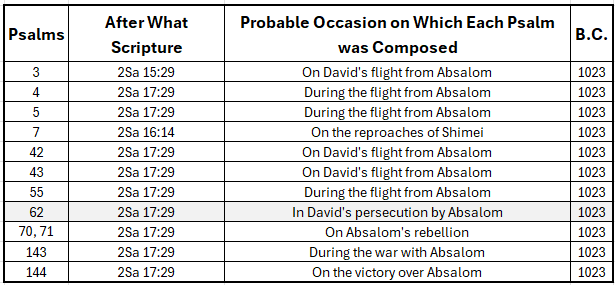


 Considering the Bible