As many who have followed me for a bit, I have fallen into the Psalms, and I can’t get up! (As if I would want to.) The Psalms are a majestic collection of poetry, of heart felt human experiences that constantly challenge me in my own frail attempt to follow the true King. As many of the Psalms are written by David, my study on the Psalms has spurred me on to looking at the life of David, is the main contributor to this book, and to follow the victories and tragedies of the shepherd King of Israel.
Many times in the narrative, we will see the Lord Jesus, imperfectly, yet a reflection of His spirit in a man with weaknesses.
1 Samuel 25:18-22
Then Abigail made haste and took two hundred loaves and two skins of wine and five sheep already prepared and five seahs of parched grain and a hundred clusters of raisins and two hundred cakes of figs, and laid them on donkeys. 19 And she said to her young men, “Go on before me; behold, I come after you.” But she did not tell her husband Nabal. 20 And as she rode on the donkey and came down under cover of the mountain, behold, David and his men came down toward her, and she met them. 21 Now David had said, “Surely in vain have I guarded all that this fellow has in the wilderness, so that nothing was missed of all that belonged to him, and he has returned me evil for good. 22 God do so to the enemies of David and more also, if by morning I leave so much as one male of all who belong to him.”
Abigail exercised wisdom quickly. She had the means and the methods required. Not only did she have access to bunches of food on hand, food that was available at a moments notice, but it seems Nabal’s inventory was such that this removal of these mass quantities of food didn’t set off any alarm for Nabal.
Now of course those who may have been assigned to the accounting of Nabal’s assets may have understood the situation, and covered for Abigail, but this only speaks of the wisdom of the servants in combination with respect towards Abigail.
Either Nabal had so much stockpiled food that this large removal didn’t impact his balance sheet appreciably, or there was a coverup, in order to protect Nabal, and his entire house. After all, the servants understood that harm was coming to get them!
1 Samuel 25:17 Now therefore know this and consider what you should do, for harm is determined against our master and against all his house, and he is such a worthless man that one cannot speak to him.”
Abigail jumped on this situation, short circuiting the obvious request from Nabal, for she knew her husband, that he would not allow any asset to leave his inventory.
Abigail was in rescue mode. David was in retaliation mode. He was looking for blood.
Even before Abigail approached him, David seemed to be reiterating the wrong that Nabal had inflicted on him. I suppose for David,it was an unwritten agreement, or a socially accepted manner of helping those who needed help, that would result in some type of reward, even creating an obligation.
Of course, a man of Nabal’s stature was able to ignore obligations without any serious social impact. So what if people looked at him with a glare. He was filthy rich! And still breathing.
But maybe not for long, for though the socially accepted manner of renumeration was rejected, David seemed a fall back response was to wreak havoc and inflict vengeance on Nabal. He seemed to go dark fast, thinking Nabal’s response warranted extreme blood letting violence. After all, it could be argued, this is simply justice working itself out!
That is a problem!
Revenge is off limits to God’s people, and just yesterday I wrote a short post on it. Kind of providential, but if you are interested, please check out Let Me Tell You a Story – Revenge and Justice. Revenge and justice only relate to one another when the justice is based on our own fickle law system that favors our condition and provides no mercy to any one else.
David was in the wrong in this instance, and he seemed to be revelling in it.
But not to worry – some woman on a donkey was coming to straighten him out in a most unexpected manner.
Thanks again for coming to visit. I hope you found something of interest in this post and would appreciate a comment, to begin a discussion. If you know someone this blog may bless (or challenge), send them a link, so they may join us in our discussion.
As many who have followed me for a bit, I have fallen into the Psalms, and I can’t get up! (As if I would want to.) The Psalms are a majestic collection of poetry, of heart felt human experiences that constantly challenge me in my own frail attempt to follow the true King. As many of the Psalms are written by David, my study on the Psalms has spurred me on to looking at the life of David, is the main contributor to this book, and to follow the victories and tragedies of the shepherd King of Israel.
Many times in the narrative, we will see the Lord Jesus, imperfectly, yet a reflection of His spirit in a man with weaknesses.
1 Samuel 25:14-17
14 But one of the young men told Abigail, Nabal’s wife, “Behold, David sent messengers out of the wilderness to greet our master, and he railed at them. 15 Yet the men were very good to us, and we suffered no harm, and we did not miss anything when we were in the fields, as long as we went with them. 16 They were a wall to us both by night and by day, all the while we were with them keeping the sheep. 17 Now therefore know this and consider what you should do, for harm is determined against our master and against all his house, and he is such a worthless man that one cannot speak to him.”
So what is going on in this short passage? The Word, through this young man, recounts what has occurred to a woman named Abigail. It seems to be a repetition of the previous story.
I think there may be a lesson for us in this repitition of the story. Hopefully I will communicate it properly.
A bit of Background
Remember there are three characters in this chapter, and David, one of those characters is spoken of in glowing terms to this lady named Abigail. David, unbeknownst to him in his current rage, is described as protective, caring, giving and supportive of those who needed protection. Protection that has suddenly soured, becoming Nabal’s greatest enemy. And a single solitary young man took it upon himself to speak to Abigail, for it seems Nabal was not an approachable man. This I believe is a message for us all, in that approachability is somehow couched in this passage and may prove to to be a useful consideration for us today.
Let’s consider each of these characters in their approachability.
David
First let’s consider David. Though it was the last passage that we saw him approached with the soldier regarding Nabal, we see he has not reacted well. He blew up and saddled up with swords a clanging. Although not a common reaction for David, at this time in his life, a wise man does not react out of emotion. Does not the Word challenge us to be guided by peace, the very peace of Christ?
Colossians 3:15 And let the peace of Christ rule in your hearts, to which indeed you were called in one body. And be thankful.
With that said, I am an emotional fellow, and find this to be a challenge in my life, but as with David in this passage, have flown of the handle in a reaction that has not produced the righteousness of God
James 1:20 for the anger of man does not produce the righteousness of God.
Nabal
What can I say about Nabal? I have the sense the only reason anyone approached him was out of duty. It is interesting that when David’s men approached Nabal regarding thier request, the Word states
..they said all this to Nabal in the name of David, and then they waited. – 1 Samuel 25:9
They waited. Of course this may be the common response of a group of men to show respect, yet as I consider Nabal’s general character, it may be that they waited for an emotional explosion, which appears to have happened. Personal defamation of David spewed from Nabal’s mouth, and David’s men received the insults to take back to their chief.
Abigail
And then there is Abigail. Not much is said of her in this passage other than the fact that a young man, of Nabal’s servants (?) approached her and spoke some pretty bad news. The passage doesn’t speak of her interrupting the messenger or of her anger rising, or of her dismissing the information. She, in the silence, seems to be a patient, kind and approachable lady. She was so approachable that the young man felt he had the freedom to speak his mind regarding her husband Nabal, calling him a “worthless man” and one that cannot be spoken to.
Kind of amazing that Abigail had this reputation of openness and approachability. Her non-response regarding her husband in the next passage speaks volumes to her character, for if she had anything against him, this would be the perfect time to enter a whine party!
Approachability. It is all about how we handle our emotions when the worst of news comes to us. Do we think of ourselves only, possibly taking out our disappointment, frustration or anger on the messenger, or do we consider those around us, and especially God, finding ways to express the peace of God to those who need to see Jesus?
Approachability. Would you consider yourself approachable? It seems Jesus was approachable, even to those who would eventually murder Him. He would accept them into His presence no matter.
Thanks again for coming to visit. I hope you found something of interest in this post and would appreciate a comment, to begin a discussion. If you know someone this blog may bless (or challenge), send them a link, so they may join us in our discussion.
As many who have followed me for a bit, I have fallen into the Psalms, and I can’t get up! (As if I would want to.) The Psalms are a majestic collection of poetry, of heart felt human experiences that constantly challenge me in my own frail attempt to follow the true King. As many of the Psalms are written by David, my study on the Psalms has spurred me on to looking at the life of David, is the main contributor to this book, and to follow the victories and tragedies of the shepherd King of Israel.
Many times in the narrative, we will see the Lord Jesus, imperfectly, yet a reflection of His spirit in a man with weaknesses.
1 Samuel 25:10-13
10 And Nabal answered David’s servants, “Who is David? Who is the son of Jesse? There are many servants these days who are breaking away from their masters. 11 Shall I take my bread and my water and my meat that I have killed for my shearers and give it to men who come from I do not know where?” 12 So David’s young men turned away and came back and told him all this. 13 And David said to his men, “Every man strap on his sword!” And every man of them strapped on his sword. David also strapped on his sword. And about four hundred men went up after David, while two hundred remained with the baggage.
A quick reminder of the three characters in chapter 25 that we are considering. Nabal is presented to us as a man who is rich in possessions, harsh in character and of bad behavior. When verse three in the previous passage speaks of bad behavior, the Hebrew word used there is often translated as evil, or wicked. Make no mistake, Nabal is not simply bad, he is a wicked, grevious hurtful man. This surely was very common knowledge for the populace in the region, for a wealthy man’s reputation usually proceeds him. David most likely had some knowledge of this man’s reputation and hoping for the best, approached him via ten of his soldiers, requesting a gift during harvest time. Abigail, Nabal’s wife, is in the wings, not yet knowing the circumstances that would catapult her from riches to royalty.
Last we got together, David’s men were waiting for a response from Nabal, and he doesn’t disappoint, for he comes out swinging. Instead of accepting the easily verifiable gift of protection that David and his men provided, Nabal comes out attacking David himself.
What a brilliant move on Nabal’s part, for he dodged his responsibility of recognizing David’s service to him, and thereby accepting a responsibility of providing a gift. No – immediately he started by attacking David. He attacked David, his family and his allegiance to the King.
Have you known one who is always on the attack? One who is critical of any action you take, no matter the motivation or benefits to others? Do you know someone who might attack you though you have only loved them, provided a service to them, given them some type of gift?
It seems so incredible, that someone would attack the person who is providing them a blessing. It just isn’t fair. I bless you. You are to bless me back. That’s the deal. It is a social norm, at least in the land I live in.
Nabal did not accept that social norm. His norm was “Eat or be eaten”, and he seemed to live it every day. I give to get, but if you give me somethin, I will take it and reject you. It is all about gaining and keeping!
Notice in verse 11, where Nabal admits to providing for his shearers, but he does so only to receive a benefit he is experiencing. He gives to get. But any benefit that he has already received, as in a protection provided in the past, is not to be entertained, for it directly impacts his profit margin.
How short sighted for a business man to be of such character. What is worse, how vile for a man who is associated with the nation of God to act so thankless, to attack instead of defend one who blessed him.
As mentioned above, the social norm is to be return good for good. Nabal rejected this norm for the sake of his selfish wicked life. He returned bad for good. The lowest type of reaction to our fellow man.
There is One who has returned good for bad, has broken the social norm, and rejected the vile mans ways, providing a life for us to mimic, giving us the strength, if we seek it, to provide good for bad.
May I remind my reader of when the Lord spoke of the social norm in Matthew 5:43, stating the norm as…. ‘You shall love your neighbor and hate your enemy.
He went a bit further though. If you know someone who has attacked you verbally, (or even physically), defamed your character, cheated you, damaged your property or reputation, we are directed to return good for bad.
But I say to you, Love your enemies and pray for those who persecute you,
As mentioned a post or two back, this chapter does not reflect well on David, for though he was incredibly “saintful” (is that a word?) in his dealings with Saul, he falls down miserably in relation to Nabal.
Strap on your weapons men – we got some killing to do! Note that he doesn’t simply take the ten men who returned wit the report, he takes 400 men to Nabal’s location, ready to spill blood!
I often think of David and Bathsheba as a low point in David’s walk with the Lord. The Word clearly states the Lord was disappointed in David during that period. For this time of testing, David is to meet with a very unexpected person on the rush to do the killing. A person who through discernment and wisdom, was used of God to restrain David from this evil reaction to Nabal.
Truly good to see that God is active in our lives, even as we ventured off to seek sin. He is a merciful God, and it is for us to always be willing to listen to those we may not expect, to keep our ears open for God’s wishes.
Thanks again for coming to visit. I hope you found something of interest in this post and would appreciate a comment, to begin a discussion. If you know someone this blog may bless (or challenge), send them a link, so they may join us in our discussion.
As many who have followed me for a bit, I have fallen into the Psalms, and I can’t get up! (As if I would want to.) The Psalms are a majestic collection of poetry, of heart felt human experiences that constantly challenge me in my own frail attempt to follow the true King. As many of the Psalms are written by David, my study on the Psalms has spurred me on to looking at the life of David, is the main contributor to this book, and to follow the victories and tragedies of the shepherd King of Israel.
Many times in the narrative, we will see the Lord Jesus, imperfectly, yet a reflection of His spirit in a man with weaknesses.
1 Samuel 25:2-9 2 And there was a man in Maon whose business was in Carmel. The man was very rich; he had three thousand sheep and a thousand goats. He was shearing his sheep in Carmel. 3 Now the name of the man was Nabal, and the name of his wife Abigail. The woman was discerning and beautiful, but the man was harsh and badly behaved; he was a Calebite. 4 David heard in the wilderness that Nabal was shearing his sheep. 5 So David sent ten young men. And David said to the young men, “Go up to Carmel, and go to Nabal and greet him in my name. 6 And thus you shall greet him: ‘Peace be to you, and peace be to your house, and peace be to all that you have. 7 I hear that you have shearers. Now your shepherds have been with us, and we did them no harm, and they missed nothing all the time they were in Carmel. 8 Ask your young men, and they will tell you. Therefore let my young men find favor in your eyes, for we come on a feast day. Please give whatever you have at hand to your servants and to your son David.’” 9 When David’s young men came, they said all this to Nabal in the name of David, and then they waited.
We are introduced to Nabal and his fair wife Abigail in this passage, a couple of the most unlikely pairing. While Nabal comes off as harsh, stiff-necked, and rude, Abigail is described as beautiful, and more importantly discerning. Of course, in the days of arranged marriages, this union may have been more to the benefit of the parents than the bride, but that is shear conjecture.
Let’s take a few minutes and consider Nabel. First off, he was filthy rich, literally owning thousands of sheep and goats. He had it all, and was living the high life. Rich in physical goods. Rich in things. Rich accomplishments. Rich rich rich.
His story reminds me of a story in the New Testament, a parable the Lord spoke, where a rich man tore down his barns to build bigger barns.
Luke 12:16-18 “The land of a rich man produced plentifully, and he thought to himself, ‘What shall I do, for I have nowhere to store my crops?’ And he said, ‘I will do this: I will tear down my barns and build larger ones, and there I will store all my grain and my goods.
Nabal, at this time of the year, was experiencing the same sense of wealth and self sufficiency that the rich man in the parable was enjoying. Eventually, God would speak to Nabal in the same manner as He does the rich man in the parable, but I am getting ahead of myself. Back to the passage for the day.
Nabal was shearing his sheep, a time of harvesting for a rancher like Nabal, a time of potential thanksgiving and rejoicing, of hopefully sharing and giving to others out of an abundance. This time of abundance provided Nabal a huge opportunity to be a blessing to others. To be gracious to those less fortunate.
It seems David was less fortunate, for he approached Nabal in the form of ten servants, requesting a charity, based on his own charity to Nabal in the past. It seems David, in the past had spent time protecting Nabal’s sheep (and shepherds) as a charity, for it does not appear that there had been any formal agreement between the two men. As the future king of Israel, David seems to have taken on the spirit of protection over those of Israel, and during this time, the Philistines were consistently finding opportunity to make raids into the country side.
Just a few chapters earlier, David rescued Keilah from the Philistines in chapter 23, and later in the same chapter, Saul had to break off his pursuit of David to return home due to the Philistines attacking his property.
It seems it was common for the Philistines to cause skirmishes along the southern border at this time, and the region including Maon and Camel, where Nabal and Abigail lived, was a prime location for the Philistines to consider. I cannot find a specific time where the flocks of Nabal were under any direct threat from an enemy, but that might be there very point. David and his men kept them safe.
David sent a formal delegation of his men to Nabal, representing themselves in a humble manner, reminding Nabal of their voluntary service of protection, and requesting a kind response out of Nabal’s abundance. An act of thankfulness to those who provided a shield for Nabal’s servants and sheep.
I am sure most of my readers recall how Nabal reacted, and we shall get to that next post, but for this passage, let’s consider the thankful spirit that Nabal could have provided but didn’t.
Is it not right to live in a thankful spirit to God, for the many blessings He has provided? Relating to this passage, specifically for the protection we may not realize is provided to us. David’s men came to Nabal to inform him of protection. I get the sense this may have been the first time Nabal knew of this added benefit for his shepherds and sheep in the wilderness.
No matter the situation you may find yourself in today, we have an opportunity to be thankful, to be gracious to others, to be a blessing. Nabal was “harsh and badly behaved”, and his life, like the rich man in the parable above, is impacted negatively, not only in our opinion of him, but also in the length of life.
Be a blessing to others today. Take a moment today to reflect on all the blessings God has provided to you. Consider God’s active protection from your enemies, protection that is beyond your experience, or understanding, for there is much going on about us that we do not see. But the Lord is there, encircling your family, your business, your church, your life.
For it is true that God is good all the time.
Thanks again for coming to visit. I hope you found something of interest in this post and would appreciate a comment, to begin a discussion. If you know someone this blog may bless (or challenge), send them a link, so they may join us in our discussion.
As many who have followed me for a bit, I have fallen into the Psalms, and I can’t get up! (As if I would want to.) The Psalms are a majestic collection of poetry, of heart felt human experiences that constantly challenge me in my own frail attempt to follow the true King. As many of the Psalms are written by David, my study on the Psalms has spurred me on to looking at the life of David, is the main contributor to this book, and to follow the victories and tragedies of the shepherd King of Israel.
Many times in the narrative, we will see the Lord Jesus, imperfectly, yet a reflection of His spirit in a man with weaknesses.
1 Samuel 25:1 1 Now Samuel died. And all Israel assembled and mourned for him, and they buried him in his house at Ramah. Then David rose and went down to the wilderness of Paran.
When we last saw David, he was magnanimous towards Saul, the ever loyal, forgiving and grace filled future king of Israel. A great portrait of a great man. After that passage, I felt as if he was larger than life, a true example, a king worthy of following as an Israelite in the day.
By the time we get to the end of chapter 25, we are going to see a man who doesn’t appear to be the same man. He becomes churlish, offended and intends to kill a man simply for not providing for his troops. Nabal and Abigail play a large role in this chapter, but we will come to them soon.
For this single verse, we have the prophet Samuels death recorded.
Samuel was the child prodigy and prophet of Israel that was the direct result of prayers of grief being sent up to God by Hannah. He was trained in the temple and called by God at a very early age during the time of the judges and would eventually become the final judge and the mediator of the transition from judges ruling over Israel, to a monarchy system of leadership.
He anointed Saul, and watched as the kingdom transitioned over the years. Saul was tested on a number of occasions, and failed to meet the test, finding that the kingdom was to be removed from his lineage. Samuel then was called by God to search out a replacement, under the scrutiny of Saul, which must have been somewhat nerve racking. Nevertheless, Samuel surprisingly found a young boy, anointed him, and set his life on fire. Saul would not allow this to succeed and the trials of David’s life began.
Take a minute and consider Samuels situation. He was to be loyal to the king, yet he knew the future king David was the right man. He was to be loyal to a corrupt king (Saul) in the midst of knowing the truth, and serving the future king. If you are a believer, this must ring bells for your own life.
We are to obey worldly governments (Rom 13) yet our allegiance is to the true King. Has it not been this way for all believers? Do we not all have some human authority over us that may at time require obedience that is odds to our love for the Master?
Samuel died, and David arose. God’s work would continue, and David is destined for the throne. But immediate needs of food for his troops had to be satisfied, and he headed south to the wilderness of Paran.
This is the last we see of a David full of grace, humble, and endlessly patient with those around him! Things are going to get nasty, and he doesn’t come out of this chapter looking good. But he is on a mission and God uses those whom he has chosen for his purposes.
And for that, I am truly grateful.
Thanks again for coming to visit. I hope you found something of interest in this post and would appreciate a comment, to begin a discussion. If you know someone this blog may bless (or challenge), send them a link, so they may join us in our discussion.
As many who have followed me for a bit, I have fallen into the Psalms, and I can’t get up! (As if I would want to.) The Psalms are a majestic collection of poetry, of heart felt human experiences that constantly challenge me in my own frail attempt to follow the true King. As many of the Psalms are written by David, my study on the Psalms has spurred me on to looking at the life of David, is the main contributor to this book, and to follow the victories and tragedies of the shepherd King of Israel.
Many times in the narrative, we will see the Lord Jesus, imperfectly, yet a reflection of His spirit in a man with weaknesses.
1 Samuel 24:16-22
16 As soon as David had finished speaking these words to Saul, Saul said, “Is this your voice, my son David?” And Saul lifted up his voice and wept. 17 He said to David, “You are more righteous than I, for you have repaid me good, whereas I have repaid you evil. 18 And you have declared this day how you have dealt well with me, in that you did not kill me when the LORD put me into your hands. 19 For if a man finds his enemy, will he let him go away safe? So may the LORD reward you with good for what you have done to me this day. 20 And now, behold, I know that you shall surely be king, and that the kingdom of Israel shall be established in your hand. 21 Swear to me therefore by the LORD that you will not cut off my offspring after me, and that you will not destroy my name out of my father’s house.” 22 And David swore this to Saul. Then Saul went home, but David and his men went up to the stronghold.
Saul is on stage in this passage. Good wordsmithing. Sounds convincing. Logical. Hopeful. And yet David went back to the stronghold!
Saul put on a performance full of tears, recounting David’s righteous acts and his own wickedness. He took time to speak of David’s righteousness and his own sin.
Saul admits that the Lord’s hand was in his choice of cave to enter, and that the Lord placed him in David’s hands to kill him. Saul even openly admits, to those who were within ear shot, that David will be king, and that Israel shall prosper under David’s rule. This is quite surprising since David must have heard it, David’ men most likely heard it, and Saul’s men may have heard it. After all, this wasn’t a private call on a secure phone line! This was a public discussion.
Ok – so Saul seems to be admitting David to be the better man, a future king of Israel and a good leader. After setting David up, he goes in for the kill. He asks David to swear not to harm his offspring once he takes the kingdom.
From Saul’s perspective this is a huge request, for he is looking to do the very opposite to David. Is not Saul seeking to remove competition for the throne by seeking to kill David, even though he hasn’t attempted to take the throne?
Saul wanted more than he was able to provide David. How could Saul ask for something so beyond normal expectations? It was common that when a king ascended a throne, the prior kings descendants would be killed in order to remove any future claim to the throne. Monarchies work this way. And Saul definitely considered Israel a monarchy, where his family were of the royal blood!
But as an aside, do we see evidence of David considering Israel to be a monarchy? I would suggest that David is acting in ways that conform to a theocracy, a nation ruled over by God. Actions of the human leader were to be directed by the God of the nation, and were not to fall to the level of a simple monarchy, where a man had authority. God provided the laws of the nation at Sinai, and the people entered into covenant with God as their ruler. God was the One who led them from captivity, led them to a covenant at Sinai, and then led them to the land, eventually abdicating to the wishes of the people in their seeking a human leader.
To be the king was to be a replacement for God. Though this was an accepted condition of state by the time David came on the scene, his rule typifies that of a godly king, one who loved the law of God. Sinner that he was in many of his decisions, he listened for God’s voice more than any other at the time.
But lets discuss the request of Saul the monarch. A request for David to not harm his offspring! This request shows Saul to be hedging his bets, to get David, the one more righteous than he, to promise no harm upon his offspring.
This sounds mildly familiar. Let’s go back a few chapters, when David first fled from Saul. Jonathon, Saul’s son provided military intelligence to David concerning his father, initiating David’s flight from Saul. Jonathon, who was loyal to David, sought protection. Let’s read about it below.
1 Samuel 20:14 If I am still alive, show me the steadfast love of the LORD, that I may not die; 1 Samuel 20:15 and do not cut off your steadfast love from my house forever, when the LORD cuts off every one of the enemies of David from the face of the earth.” 1 Samuel 20:16 And Jonathan made a covenant with the house of David, saying, “May the LORD take vengeance on David’s enemies.” 1 Samuel 20:17 And Jonathan made David swear again by his love for him, for he loved him as he loved his own soul.
Jonathon sought David to swear protection for him and his house (vs 15). Saul is seeking the same promise. Coincidence? Likely, for Saul is seeking protection from his enemy, whereas Jonathon was seeking protection by his friend.
Nevertheless, David agreed to the request from Saul. He swore to not cut off Saul’s offspring after him, and not destroy Saul’s name out of his father’s house. This promise becomes a snare for David later. We shall return to this promise in later posts.
A couple of lessons to consider out of this passage.
Tears do not equal truth!
Saul cried out a confession, tearing up, and within two chapters, Saul is on the hunt for David again. His emotional repentance was a show and were without any fruits fit for this repentance.
David correctly did not trust him, as we see him going back to the cave.
Beware the boasting!
The more applicable lesson for myself is that when someone begins to boast about you, beware! Saul spoke in glowing terms of David’s righteousness, of his rising to the throne, and when David was softened up, Saul went in for the kill. Promise me the world David. Promise me you won’t hurt my family, even though this is unheard of for a new king to promise, and leaves him open to challenges constantly.
Be careful what you give your word to when things look so promising!
May we have the wisdom to understand when these traps are presented before us.
Thanks again for coming to visit. I hope you found something of interest in this post and would appreciate a comment, to begin a discussion. If you know someone this blog may bless (or challenge), send them a link, so they may join us in our discussion.
As many who have followed me for a bit, I have fallen into the Psalms, and I can’t get up! (As if I would want to.) The Psalms are a majestic collection of poetry, of heart felt human experiences that constantly challenge me in my own frail attempt to follow the true King. As many of the Psalms are written by David, my study on the Psalms has spurred me on to looking at the life of David, is the main contributor to this book, and to follow the victories and tragedies of the shepherd King of Israel.
Many times in the narrative, we will see the Lord Jesus, imperfectly, yet a reflection of His spirit in a man with weaknesses.
1 Samuel 24:8-15
8 Afterward David also arose and went out of the cave, and called after Saul, “My lord the king!” And when Saul looked behind him, David bowed with his face to the earth and paid homage. 9 And David said to Saul, “Why do you listen to the words of men who say, ‘Behold, David seeks your harm’? 10 Behold, this day your eyes have seen how the LORD gave you today into my hand in the cave. And some told me to kill you, but I spared you. I said, ‘I will not put out my hand against my lord, for he is the LORD’s anointed.’ 11 See, my father, see the corner of your robe in my hand. For by the fact that I cut off the corner of your robe and did not kill you, you may know and see that there is no wrong or treason in my hands. I have not sinned against you, though you hunt my life to take it. 12 May the LORD judge between me and you, may the LORD avenge me against you, but my hand shall not be against you. 13 As the proverb of the ancients says, ‘Out of the wicked comes wickedness.’ But my hand shall not be against you. 14 After whom has the king of Israel come out? After whom do you pursue? After a dead dog! After a flea! 15 May the LORD therefore be judge and give sentence between me and you, and see to it and plead my cause and deliver me from your hand.”
David refused to take advantage of a situation that seemed to be destiny. Was it not God working to provide David an opportunity to ascend to the throne? Was God not inviting David to take matters into his own hands?
It may have seemed that way, and if David did not have the convictions he had, he may have reasoned such. But David had convictions. He knew the Lord and did not succumb to a temptation to fast track God’s will. What a stellar fellow!
And loyal – David, when Saul left the cave, exposed himself to the king (and his army of 3,000 men) to speak of his submission to Saul, and to reason with him.
David had proof, that he was able to get near Saul, and refused to take vengeance on the king. He admitted to the king that God had provided him an opportunity to resolve this battle between the two of them, but refused it. He would not commit treason!
Yet David was all about justice. As he addressed his earthly sovereign, he called on the Greater Sovereign to judge between the two of them. Yet, even in this statement, David again refused to take part in any action against his king.
Truly, as I think on this interaction between the current and the future king, David stands out as other worldy, not practical, without earthly wisdom and not driven to success.
Have you ever sought to obey God and them been defamed by your brother, mocked by your sister, ridiculed by your peers because your actions are actually not benefitting you or your loved ones? Can you hear them even now?
Carl – You are not taking advantage of God’s obvious opportunities for self advancement?
Carl – You should be taking care of your family!
Carl – Think of all the good you could do if you took advantage of the situation.
Yes – to hear God’s direction and to follow will cost you, even if it is doubt about the outcome, and possible loss of advantage – that is earthly advantage!
Nevertheless, David does make a statement that seems obvious at first, but what a great statement for this situation!
Out of the wicked comes wickedness.
Of course out of the wicked comes wickedness. How obvious this statement seems, almost a waste of breath, until I recognized David was calling Saul a wicked man. He called Saul a wicked man, spoke truth to power! This is awesome, a true prophet, a man after the truth. And as a sidebar, David was also claiming that he was not a wicked man.
Years later, Jesus would speak of bad fruit from a bad tree. This truth is so obvious, irrefutable and cutting, that I need to recall this when dealing with those who fight the gospel, hate truth, and display treachery or wickedness. It isn’t a personal attack – Simply a truth statement!
Like my momma used to say, if the shoe fits….
David closes his plea/warning to Saul, bringing his selflessness into focus. I think.
He refers to himself as a dead dog, even a flea. Who is David that Saul would chase after him? Yet Saul knew who David was, and that he was a righteous man, one destined for the throne.
David didn’t have to make claims. His life was on display for all to see, and God was making it obvious that David was the better man, the one destined for good. He could safely state self deprecating claims about himself, only adding honor to his name in the mean time.
Proverbs 27:2 Let another praise you, and not your own mouth; a stranger, and not your own lips.
How often have you met one who cannot speak enough about them selves? David didn’t follow that thought, but diminished himself in front of the king.
There is One who could speak of Himself without any stain of self glory being attributed to Him, for He truly is worthy, more worthy of each and every statement He made of Himself. And yet, when He described Himself to His disciples, He sought to be know as One who was gentle and lowly of heart!
Proverbs 27:2 Let another praise you, and not your own mouth; a stranger, and not your own lips.
How amazing is He, that in the very person of God Almighty, Jesus revealed Himself to those closest to Him as gentle and lowly of heart.
Jesus, though His name alone is worthy of all praise, wanted to be thought of as gentle and lowly of heart, thereby only bringing greater honor upon Himself. He is the only One, and we are only right to praise His name only.
As many who have followed me for a bit, I have fallen into the Psalms, and I can’t get up! (As if I would want to.) The Psalms are a majestic collection of poetry, of heart felt human experiences that constantly challenge me in my own frail attempt to follow the true King. As many of the Psalms are written by David, my study on the Psalms has spurred me on to looking at the life of David, is the main contributor to this book, and to follow the victories and tragedies of the shepherd King of Israel.
Many times in the narrative, we will see the Lord Jesus, imperfectly, yet a reflection of His spirit in a man with weaknesses.
1 Samuel 24:1-7 1 When Saul returned from following the Philistines, he was told, “Behold, David is in the wilderness of Engedi.” 2 Then Saul took three thousand chosen men out of all Israel and went to seek David and his men in front of the Wildgoats’ Rocks. 3 And he came to the sheepfolds by the way, where there was a cave, and Saul went in to relieve himself. Now David and his men were sitting in the innermost parts of the cave. 4 And the men of David said to him, “Here is the day of which the LORD said to you, ‘Behold, I will give your enemy into your hand, and you shall do to him as it shall seem good to you.’” Then David arose and stealthily cut off a corner of Saul’s robe. 5 And afterward David’s heart struck him, because he had cut off a corner of Saul’s robe. 6 He said to his men, “The LORD forbid that I should do this thing to my lord, the LORD’s anointed, to put out my hand against him, seeing he is the LORD’s anointed.” 7 So David persuaded his men with these words and did not permit them to attack Saul. And Saul rose up and left the cave and went on his way.
In our last post we saw that David was rescued by outside influences. Saul was hot on the trail of David until he found out that the Philistines were attacking Israel, probably his own estate. (See previous post for reasoning on this statement)
Saul had to fight off the Philistines, for the sake of his nation, (or maybe his estate!) Nevertheless, Saul took care of his required business and got back to his focus – killing David!
After a spy informed him of David’s whereabouts, he gathered 3,000 of Israel’s finest warriors and headed out to kill the next king of Israel.
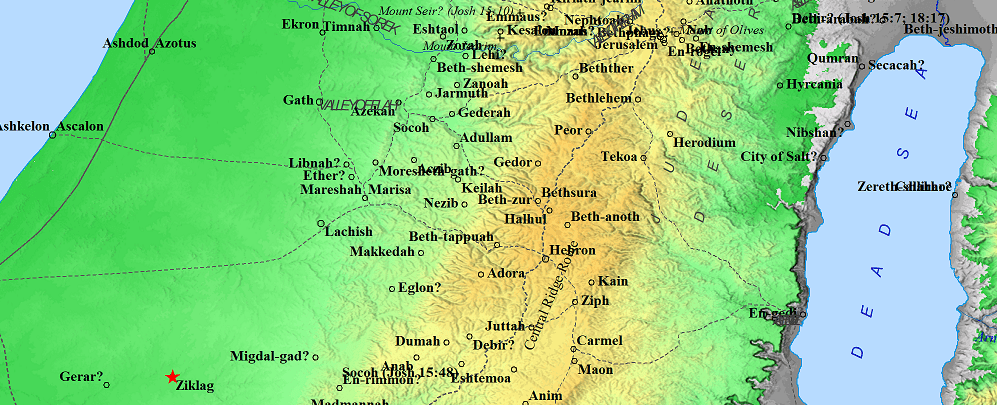
Now a word about Wildgoats’ Rocks. It is another name for Engedi, and this location, per our map to the right, is on the western shore of the Dead Sea, but the map doesn’t rightly describe the topography of the area. Enter Google Maps, to give us an idea of the rock formation of the area.
No wonder they called this area Wildgoats’ Rocks, for the only animals in this area were goats, who could climb the escarpment. This location is also an oasis, fervently green amongst some of the dryest areas on earth. Truly a contradiction of expectations.
It is in this location, Saul sought out David. Traveling up and down the coast, looking for traces of David, having no success. Eventually taking advantage of the many caves found in the escarpment, Saul took advantage of the caves to find some privacy to poop. (everybody gotta poop!) Even the king! All this hunting takes a lot out of a guy, and this happened to be the time Saul had to set aside to sit down and think!
Where would David be? How can I find him? What resistance will he put up? All these thoughts must have been twirling in his head as he was distracted for a few moments. And while Saul was fuming about finding David, he unwittingly had stepped into the very cave David and his men were gathered.
To all appearances, God had delivered Saul to David. Even his men reminded David of God’s plans to deliver Saul to him. But I do not recall any promise from God to David of delivering Saul to him.
Where did David’s men get this information? Was it a popular rumor, based on the men’s desire to see justice for David? Had the men heard from God? I can’t find any record of it! Might this simply be the zeal of the men to justify killing the king? I think so.
But not with David.
David did not listen to his men, for he was to lead them, and listen to God. Listening to men as opposed to God is a great challenge for a Christian leader, but I digress.
David was of such a sensitive heart towards God, that he could not hurt the King even though Saul was hunting him down. Stealthily, he crawled up to the kings robe, possibly taken off during Saul’s “distraction”, (for who wants to poop with a robe on – that just gets nasty!)
The deed was done – David got a snippet of the kings robe, without harming the king. Without the king noticing. Without the king realizing he wasn’t alone! Amazing stealth.
David cut a piece of Saul’s robe, and notice his reaction when he got back to his men.
And afterward David’s heart struck him, because he had cut off a corner of Saul’s robe
David was convicted of cutting a piece off the Kings robe! How could he allow Saul’s death?
The LORD forbid that I should do this thing to my lord, the LORD’s anointed, to put out my hand against him, seeing he is the LORD’s anointed.
David would not allow his men to kill his enemy! How crazy is that? How utterly extreme is that!
It is as if David is a picture of a future King who would tell his men (and women) to not kill their enemies, but HE went just a bit further. He actually stated we are to love our enemies!
Matthew 5:44 But I say to you, Love your enemies …
Thanks again for coming to visit. I hope you found something of interest in this post and would appreciate a comment, to begin a discussion. If you know someone this blog may bless (or challenge), send them a link, so they may join us in our discussion.
As many who have followed me for a bit, I have fallen into the Psalms, and I can’t get up! (As if I would want to.) The Psalms are a majestic collection of poetry, of heart felt human experiences that constantly challenge me in my own frail attempt to follow the true King. As many of the Psalms are written by David, my study on the Psalms has spurred me on to looking at the life of David, is the main contributor to this book, and to follow the victories and tragedies of the shepherd King of Israel.
Many times in the narrative, we will see the Lord Jesus, imperfectly, yet a reflection of His spirit in a man with weaknesses.
1 Samuel 23
24 And they arose and went to Ziph ahead of Saul. Now David and his men were in the wilderness of Maon, in the Arabah to the south of Jeshimon. 25 And Saul and his men went to seek him. And David was told, so he went down to the rock and lived in the wilderness of Maon. And when Saul heard that, he pursued after David in the wilderness of Maon. 26 Saul went on one side of the mountain, and David and his men on the other side of the mountain. And David was hurrying to get away from Saul. As Saul and his men were closing in on David and his men to capture them, 27 a messenger came to Saul, saying, “Hurry and come, for the Philistines have made a raid against the land.” 28 So Saul returned from pursuing after David and went against the Philistines. Therefore that place was called the Rock of Escape. 29 And David went up from there and lived in the strongholds of Engedi.
In our last passage we saw the Ziphites travel to see their king, in order to rat out David. Saul seemed hesitant to trust them, but simply couldn’t miss out on a chance to catch the young rebel, and this opportunity of Saul’s turns out to be one of the very near catches that we will see for David and his men.
But as we spoke of Saul’s spies in our last post, we find David has spies also that are feeding him information. It turns out that spies are influencing both sides of the war, and the information is changing as fast as possible.
Saul hears info from the Ziphites. David hears of Saul coming to the south, and ventures into the wilderness of Moan. Saul hears of David’s shift to the wilderness. It is here that Saul comes closest to actually capturing David, for he is only a hill away from David.
So close.
Until we have another “spy” or informant come to Saul informing him of trouble at home, of the Philistines raiding the home land. But why would this become a concern for Saul, as we know that Keilah, which was part of Saul’s kingdom was merely ignored when the Philistines invaded there. Saul was no where to be found. So why would this instance of the Philistines invading the land catch Saul’s attention, unless of course that it was his own personnel property that needed protection. If so, this fits with the character profile we have seen regarding this king. A selfish man, self centered and constantly grasping for more. A life that is always being pulled apart by his focus on self.
So off he goes from being so close to capturing David, causing further frustration on his part, with more frustration only to fall on this pitiable man.
On David’s part, we shall see this near escape come up often, where he uses all the skill of a master general, and yet is close to capture. He is rescued “at the last minute” by outside circumstances.
How often do we see this last minute escape for David provided by outside circumstances? How often the Lord orchestrates a situation where it appears we will be taken down, only to be rescued by outside influences.
Let’s cut to the chase here, for we know that outside circumstances and influences are orchestrated by God, the timing is of the Lord, and our security, as we follow after Him is in His hands. Close calls, from our standpoint, can be sometimes harrowing experiences, but from God’s point of view, close calls are a part of the orchestra He is leading to bring us closer to Him, to listen for His guidance, and to bring about a thankful spirit in our lives.
Let us thank Him for circumstances and influences that redirect danger from our lives.
Thanks again for coming to visit. I hope you found something of interest in this post and would appreciate a comment, to begin a discussion. If you know someone this blog may bless (or challenge), send them a link, so they may join us in our discussion.
As many who have followed me for a bit, I have fallen into the Psalms, and I can’t get up! (As if I would want to.) The Psalms are a majestic collection of poetry, of heart felt human experiences that constantly challenge me in my own frail attempt to follow the true King. As many of the Psalms are written by David, my study on the Psalms has spurred me on to looking at the life of David, is the main contributor to this book, and to follow the victories and tragedies of the shepherd King of Israel.
Many times in the narrative, we will see the Lord Jesus, imperfectly, yet a reflection of His spirit in a man with weaknesses.
1 Samuel 23
19 Then the Ziphites went up to Saul at Gibeah, saying, “Is not David hiding among us in the strongholds at Horesh, on the hill of Hachilah, which is south of Jeshimon? 20 Now come down, O king, according to all your heart’s desire to come down, and our part shall be to surrender him into the king’s hand.” 21 And Saul said, “May you be blessed by the LORD, for you have had compassion on me. 22 Go, make yet more sure. Know and see the place where his foot is, and who has seen him there, for it is told me that he is very cunning. 23 See therefore and take note of all the lurking places where he hides, and come back to me with sure information. Then I will go with you. And if he is in the land, I will search him out among all the thousands of Judah.”
David was not everyone’s favorite rebel.
Recently he vanquished the Philistines as they were battling the city of Keilah. Finding victory, David and his men were then subjected to a faithless city, having to run before the Keilahites offered him up to Saul.
To be fair, this account of the Keilahites may have a slightly different interpretation than I have offered, since it seems that once the Lord revealed to David the Keilahites intentions to save themselves from Saul’s fighting machine, David willingly ran. Possibly to save the Keilahites of the suffering their king would being on them.
The Ziphites are not so guiltless. They seem to have a desire to assist King Saul, unlike the Keilahites, who may have only given up David in self preservation, if David hadn’t left.
No, the Ziphites sought out Saul at Gibeah, a town approximately 25 miles to the north of Jerusalem. They left their homes, and travelled to see the king with information of David’s whereabouts. Not simply a general location, but a very specific camp David was residing at, in the strongholds at Horesh, on the hill of Hachilah, which is south of Jeshimon.
David was on a specific hill. At first I imagined this “hill” to be mountainous, but it seems the Hebrew word for hill in this instance means hill, somewhat lower than a mountain. This information Saul was provided was very specific!
What good spy’s Saul has here! And they were willingly offering to Saul their full cooperation! What good citizens!
Saul provides the blessing of God on these good and faithful Ziphites. What? He doesn’t understand the blessing of God, nor is he in a position spiritually to pass a blessing on. And for the Ziphites – being blessed for being a traitor to God’s appointed King? Something is terribly wrong with this picture!
And though Saul “blesses” the Ziphites, he will not venture out until the information is verified. It is like he was saying – I don’t quite trust you Ziphites – Go make sure and then come back. Get more specific data.
Is Saul moving from a reactionary attack, based on shear hatred of David, to a more strategic, fact based plan to kill David at this time? Or is it that the Ziphites were known to be untrustworthy?
It seems the Ziphites were not necessarily untrustworthy, but merely seeking to gain the king’s favor. Seeking an earthly king’s pleasure against the Word of God leads to terrible betrayals, and huge treachery.
No- the Ziphites used their political faithfulness to a madman, to work against a movement of God. And we shall see in future passages that this behavior is confirmed in the Ziphites, for this is not the only time they offer up David to the king. We find that they show up on Saul’s doorstep again in chapter 26.
It also turns out that Saul was not as “strategic” as I may have suggested, for, in our next passage, it turns out that Saul couldn’t resist heading south to the region the Ziphites described, before gaining confirmation of David’s whereabouts.
It seemed Saul was about to capture David. Saul’s network of spies was about to deliver David into his hands, and Saul would finally have the peace he sought!
This passage reminds me of times when I seek to accomplish something, in order to find some sense of worth, or to justify a decision I had made, or to have a sense of completion. I may, in a sense be seeking a type of peace in these decisions. I tend to drive people, (as a hangover from work) and need to adjust my focus to people and not tasks.
An alternate view of this passage is that Saul sought to hurt someone. The Ziphites sought to hurt someone. They found a type of fellowship in this desire. They may have felt a bond of some type. Hard as it may be to believe, this may also become a trap for a believer, letting a group dynamic influence a just decision.
Consider your associations and test to see if the goals of the organization are just and right. If there is some uncertainty, or if those you associate with are working against God, it may be time to consider if you should remain? Is it simply a bond that started out right, in pursuit of God, but is now actively working against God?
This takes wisdom from God and clear spiritual discernment, but the Lord is able to teach each of us as we seek Him.
Thanks again for coming to visit. I hope you found something of interest in this post and would appreciate a comment, to begin a discussion. If you know someone this blog may bless (or challenge), send them a link, so they may join us in our discussion.
As many who have followed me for a bit, I have fallen into the Psalms, and I can’t get up! (As if I would want to.) The Psalms are a majestic collection of poetry, of heart felt human experiences that constantly challenge me in my own frail attempt to follow the true King. As many of the Psalms are written by David, my study on the Psalms has spurred me on to looking at the life of David, is the main contributor to this book, and to follow the victories and tragedies of the shepherd King of Israel.
Many times in the narrative, we will see the Lord Jesus, imperfectly, yet a reflection of His spirit in a man with weaknesses.
1 Samuel 23:15-29 15 David saw that Saul had come out to seek his life. David was in the wilderness of Ziph at Horesh. 16 And Jonathan, Saul’s son, rose and went to David at Horesh, and strengthened his hand in God. 17 And he said to him, “Do not fear, for the hand of Saul my father shall not find you. You shall be king over Israel, and I shall be next to you. Saul my father also knows this.” 18 And the two of them made a covenant before the LORD. David remained at Horesh, and Jonathan went home.
In the verse previous to 15, the author tells us that David was in the strongholds and mountains of the wilderness, due to Saul seeking him everyday. David was the subject of constant harassment, constant stress, constant pressure, from a king he had served faithfully. Yet the die had been set and Saul was determined in his actions. Saulnwas settled in his mind that David had to die, and in the past passages we have seen Saul abuse his wife, his daughters and his son in the pursuit of killing David. No one was safe until David was dead
Now the circumstances of how Jonathon, the son of David’s mortal enemy came to visit him is a mystery. David may have made the appointment with Jonathon, providing Jonathon his exact whereabouts. Yet this was an opportunity for this information to be leaked to Saul, for the transmission of this data to somehow find it’s way to the King.
And the danger was not only on David’s part, for if Saul, in his murderous tirade, knew Jonathon visited with David, it might be the end of Jonathon.
But the meeting was set and the two men were able to discuss David’s circumstances. For some unknown reason, only Jonathon’s message has been preserved for us. Three messages come to David from the lips of Jonathon.
Do not fear
Jonathon spoke words of peace on David, ensuring David that Saul shall not find him. Was this simply words of hope, words that were meant to encourage. Surely. But were these words of surety, or an absolute promise, as if a Word from God?
I don’t understand that Jonathon was a prophet, but at the very least, he may have uttered these words as a repetition of the promise of God to David years earlier. Jonathon made this conclusion of escaping Saul’s hand due to the promise of David ascending to the throne of Israel, which Jonathon rightly reminds David of his future.
You shall be king
David shall be king, and to be king over all Israel. This was the promise of God that ensured both men that David would escape the hand of Saul. And then Jonathon says “I shall be next to you”.
I don’t recall any portion of the promise of God stating this, nor of David providing this promise. So what was Jonathon talking about? Was he thinking of a co-regency, where he would be equal to David in the kingdom?
When Jonathon speaks of being “next” to David, Jonathon may be implying a rank of second in the kingdom, for the Hebrew word מִשְׁנֶה mishneh, sometimes speaks of being second in rank. Might Jonathon be suggesting his desire of a position of power to David? Possibly, yet I want to think that Jonathon was of a purer heart, and simply be referring to his informal, personal support for, and friendship to David in his future reign.
Saul knows this
This is such a sad statement! Saul knew David would ascend to the throne, and yet he toiled against the will of God, against his own benefit, against the good of his own nation, and against his own families existence!
Consider Saul waking up to the realization of David’s supremacy, and humbly coming to him in front of the nation of Israel, bowing the knee and giving up his position of power to David. What would be Saul’s legacy? How many benefits would shower down on Saul for this act of humility?
Knowing the truth and fighting against it is foolish. Yet to agree with the truth takes humility, a washing away of pride and arrogance, the giving up of advantage and power, of losing reputation and starting over.
Truly there are many forms of loss when we are agreeing with the truth. Confession of sin and repentance may cost us much, even our very way of life.
And what do we get out of it?
The foundation of agreeing with the truth is that we are conforming to reality. We are no longer living in a fantasy world, a would of smoke and mirrors, of deceit, cheating, backstabbing and conspiracy. We are no longer looking over our shoulder, but have joy, purpose and a life to live, not a death to fear.
Saul may have been too far gone by this time in his life. I have no idea, nor do I suppose any but God knew of Saul’s opportunity to repent at that time. Sadly we know he did not repent, that his last years were spent fighting against the truth.
If you have been fighting against a truth the Lord has spoke to you about, quit fighting.
Don’t be a Saul.
Thanks again for coming to visit. I hope you found something of interest in this post and would appreciate a comment, to begin a discussion. If you know someone this blog may bless (or challenge), send them a link, so they may join us in our discussion.
As many who have followed me for a bit, I have fallen into the Psalms, and I can’t get up! (As if I would want to.) The Psalms are a majestic collection of poetry, of heart felt human experiences that constantly challenge me in my own frail attempt to follow the true King. As many of the Psalms are written by David, my study on the Psalms has spurred me on to looking at the life of David, is the main contributor to this book, and to follow the victories and tragedies of the shepherd King of Israel.
Many times in the narrative, we will see the Lord Jesus, imperfectly, yet a reflection of His spirit in a man with weaknesses.
1 Samuel 23:6-14
6 When Abiathar the son of Ahimelech had fled to David to Keilah, he had come down with an ephod in his hand. 7 Now it was told Saul that David had come to Keilah. And Saul said, “God has given him into my hand, for he has shut himself in by entering a town that has gates and bars.” 8 And Saul summoned all the people to war, to go down to Keilah, to besiege David and his men. 9 David knew that Saul was plotting harm against him. And he said to Abiathar the priest, “Bring the ephod here.” 10 Then David said, “O LORD, the God of Israel, your servant has surely heard that Saul seeks to come to Keilah, to destroy the city on my account. 11 Will the men of Keilah surrender me into his hand? Will Saul come down, as your servant has heard? O LORD, the God of Israel, please tell your servant.” And the LORD said, “He will come down.” 12 Then David said, “Will the men of Keilah surrender me and my men into the hand of Saul?” And the LORD said, “They will surrender you.” 13 Then David and his men, who were about six hundred, arose and departed from Keilah, and they went wherever they could go. When Saul was told that David had escaped from Keilah, he gave up the expedition. 14 And David remained in the strongholds in the wilderness, in the hill country of the wilderness of Ziph. And Saul sought him every day, but God did not give him into his hand.
Let’s remember the immediate context of this story. David had just travelled to Keilah and delivered the people of the city of Keilah from the Philistines. David, the rebel, the enemy of the state, the one whom Saul wants to kill, entered deeper into Saul’s territory in order to save some of Saul’s people.
Where was Saul in all of this internal strife?
He was amassing the people of Israel to go to war, to go down to Keilah and capture David. Nothing in this passage speaks of Saul’s desire to rescue the city from the Philistine threat. No – Saul was obsessed with David and the apparent threat David was to the throne of Israel.
Who cares about the people of Israel? Surely not Saul, for he had to protect his own position within the country, to protect his own power over the people. I could imagine Saul justifying his actions by stating it was for the greater good, or some such malarky that we hear by our leaders even today. Simply a selfish act by a selfish man, thinking only of himself.
Yet, Saul, when word got out that David was in Keilah, assumed that the Lord had delivered David into his hands. There was some truth, at least in appearance, for the Lord had told David to go fight the Philistines in Keilah.
Saul was interpreting the actions of God to favor his own circumstances. This is a very common trap that we all do.
We see God doing something with someone, and we tend to interpret it in relation to our situation, to favor our circumstance, to supply a justification for some action we want to take, or to simply align the action with something we are doing at the time.
We all do it.
It is so easy to interpret an action of God and come to some conclusion that is incorrect. God called David to Keilah, into the territory of Saul. Saul interpreted this action as revealing God’s will to Saul to support his sinful actions. In reality, God calling David to Keilah was a judgement on Saul, showing the current king as being ineffective, and unconcerned for his own people God had called him to protect.
Saul thought God was smiling on him. Not so.
So often as I read through these passages, I get a sense that Saul is completely blind to the work of God, rejecting the big picture and only having one focus. Himself.
But that is not the only selfish actor in this passage.
David and his 400 men travelled to Keilah, fought the Philistines, won a mighty victory and rescued the city from devastation. But news gets around, and Saul hears that David is in Keilah. Hot diggity dog – Saul starts rounding up an army to come get him.
What a perfect opportunity to allow this newly minted army of David to continue fighting against Saul! David’s band of men are probably high on the victory and full of adrenaline, peaking on the team work that has begun to develop under David’s leadership. Surely God is calling Saul into this trap!
Well – not surely, for David did not jump to a selfish conclusion, one that might conceivable stop this constant hunt of Saul for his head. David decided to pray and get the bigger picture.
Consider the situation. Keilah was about to be destroyed by the Philistines. David came to the rescue. Keilah was again about to be destroyed, this time by their own king, unless they gave up David.
It was a common tactic to force the surrender of a person in the city to avoid a battle. David knew this was a tactic that might be used, but he again didn’t jump to conclusions, only asking the Lord if the people he just saved would abandon him.
Amazing picture of the gospel here, in that the savior of the people would be turned against by the people he came to save. David’s life is full of situations where the Savior can be clearly seen.
Nevertheless, the Lord informed David of the intent of the people, and prior to the eruption of a conflict at the gates of Keilah, David again saved the city and its population.
He ran.
He swallowed his pride and ran into the wilderness of Zin. Consider the mighty warrior David, turning tail after a victory provided by the hand of the Lord. How utterly confusing (in appearance) is the man of God who listens to God!
Yet if you read the passage carefully, you will notice that his army had not only experienced some real time fighting on the battle field, but that the army actually increased in size! A 50% increase, from 400 men to 600 men.
David is accruing men, a movement of God is happening and David goes deeper into the wilderness, deeper south to Ziph, a rugged place that afforded no comforts or ease of life. But the training of a young shepherd boy was continuing in developing a man of God, a man who would be king, yet through much suffering. Did I mention that Jesus can be seen in the shepherd boy if we take the time to look?
Surely David looked to Jesus for guidance and leadership, and from this looking, became more like Him every day.
2 Corinthians 3:18 And we all, with unveiled face, beholding the glory of the Lord, are being transformed into the same image from one degree of glory to another. For this comes from the Lord who is the Spirit.
Look to the Savior. Take your time and look!
Thanks again for coming to visit. I hope you found something of interest in this post and would appreciate a comment, to begin a discussion. If you know someone this blog may bless (or challenge), send them a link, so they may join us in our discussion.
As many who have followed me for a bit, I have fallen into the Psalms, and I can’t get up! (As if I would want to.) The Psalms are a majestic collection of poetry, of heart felt human experiences that constantly challenge me in my own frail attempt to follow the true King. As many of the Psalms are written by David, my study on the Psalms has spurred me on to looking at the life of David, is the main contributor to this book, and to follow the victories and tragedies of the shepherd King of Israel.
Many times in the narrative, we will see the Lord Jesus, imperfectly, yet a reflection of His spirit in a man with weaknesses.
Let’s recap David’s history for a moment.
He is on the run from King Saul, having fled to the city of Gath in the country of the Philistines. On his way to Gath, he stops and visits with Ahimelech at Nob, the city of priests. David speaks a story to Ahimelech to get some food and weapons due to being on a “secret” mission from the King. When he gets to Gath, he feigns madness in front of the Philistine King, and is rejected. Without a place to hide from King Saul. he heads back towards Israel, to a cave near Adullam where David seemed to find a sense of security.
It was at this cave that David accrued a ragtag army of men, totaling approx. 400, and where Abiathar, a priest from the city of Nob informed David of the massacre of the priests and the inhabitants of the city of Nob. David commits to protecting the one priest that escaped Nob.
At this point in David’s story, he is starting to look more like a leader and not a runaway. David’s character is challenged again in our passage today. Let’s take a moment to read it.
1 Samuel 23:1-14 1 Now they told David, “Behold, the Philistines are fighting against Keilah and are robbing the threshing floors.” 2 Therefore David inquired of the LORD, “Shall I go and attack these Philistines?” And the LORD said to David, “Go and attack the Philistines and save Keilah.” 3 But David’s men said to him, “Behold, we are afraid here in Judah; how much more then if we go to Keilah against the armies of the Philistines?” 4 Then David inquired of the LORD again. And the LORD answered him, “Arise, go down to Keilah, for I will give the Philistines into your hand.” 5 And David and his men went to Keilah and fought with the Philistines and brought away their livestock and struck them with a great blow. So David saved the inhabitants of Keilah.
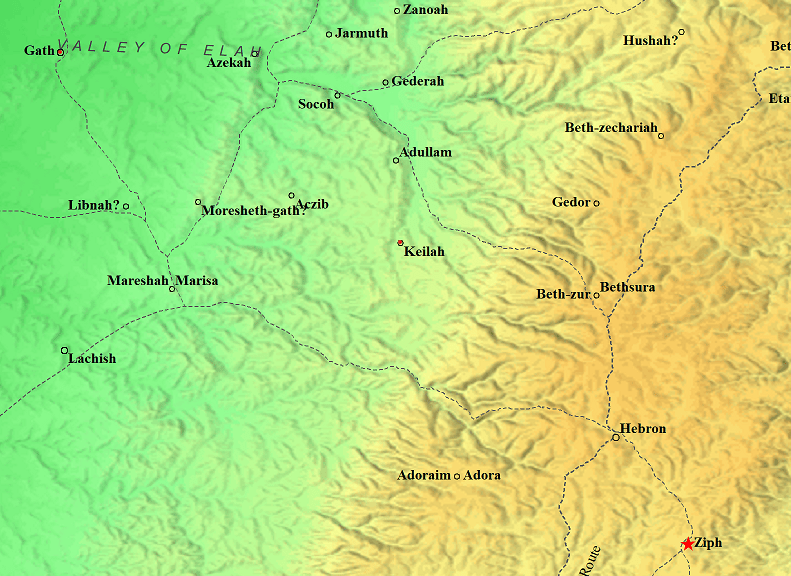
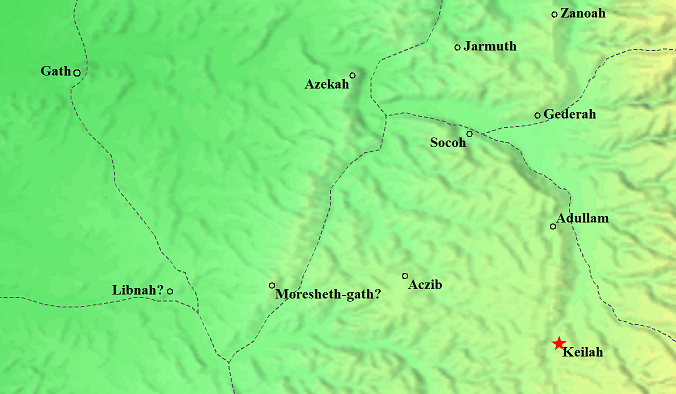
Directly south, approximately 2-3 miles of the cave of Adullum, is a small city named Keilah. I have provided a small map below to give my reader a feel for it’s location in relation to Adullam, and of Gath, in the upper left.
Our passage speaks of Keilah being attacked by the Philistines, and most likely Philistines of the city of Gath, where David had recently showed up, would be the aggressors.
And some unknown group told David of a fight in Keilah, of the Philistines attacking a city of Israel.
Did David sit by and think it was King Saul’s responsibility? Saul was the king. Surely Saul would take care of the city of Keilah. Surely leaving the relative safety of Adullam would be foolish for David. Why leave a safe fortress, only to potentially meet up with King Saul. who wanted to kill him, and King Achish, of Gath, who considers him mad!
What to do? Whatever to do? Hold back. Stay in Adullam to protect those who are with him? Ignore the plight of the city? Assign responsibility to King Saul? Options. Choices. Decisions decision decisions.
Therefore David inquired of the Lord…
David actually approached the Lord twice in this passage, and at first I considered this repetition of request to be an act of disbelief. But after reading the passage a bit more, I am starting to consider the second request to be fueled by the concerns of his men.
David’s first prayer
A simple prayer.
Shall I go down and attach these Philistines?
No mention of Saul in this prayer, no mention of King Saul’s responsibility to the inhabitants of Keilah, and no request for safety from Saul in this prayer. Saul seems to be a non entity in David’s prayer.
David is informed to “Go and attack the Philistines and save Keilah”
Seems to be clear direction from the Lord. Attack and save!
Yet in the preparation for the future battle, his men express their concern, the state of fear they were experiencing, even without entering into any battle. Lets remember these men, who would eventually become some of David’s mighty men, had just come together, had no fighting experience that we know of, and had “fled” to David due to their generally needy circumstances.
1 Samuel 22:2 speaks of David’s men as those who were in distress, in debt, and bitter in soul. Not the valiant men we hear of later in David’s career. These men came to David for escape, for a relief from troubles. Even in Adullam, they knew that being associated with David was not the safest situation. Yet they found solace in being under his leadership.
But it seems their period of relative safety was coming to an end! David realized the circumstance, and I think he approached the Lord a second time for the sake of his men.
David’s second prayer
David’s second prayer is not recorded for us, but the Lord’s answer is.
“Arise, go down to Keilah, for I will give the Philistines into your hand.”
Notice that the Lord’s answer addresses the deliverance of David’s army. God will give the Philistines into your hand. This directly addresses the concerns of David’s men. Nothing about saving Keilah. Nothing about taking any of the spoils of war. Simply that God would deliver them.
These men would become mighty men of valor, and as the last verse of our passage tells us, David and his men struck the Philistines with a great blow. A victory for David with men who were fearful, but had the assurance of God’s presence.
Consider those we are around, those we love and care for, those that we rub shoulders with daily.
Some we know may be fearful to obey God. We need to encourage the fearful with a message tailored to their fear, from the Word of God. Let us not seek to draw believers into walking with God through greed or logic, or lies. Note that God addressed these men’s fear by providing His promise of victory, not of gaining possessions by winning a battle. Collecting booty from war would come later, as these men grew into a faith depending on God.
Some may simply want to rest under the leadership of a godly man. This was a real need for these men as they came under David’s leadership, but it wasn’t to be without action. Rest and action are not diametrically opposed. They needed rest, but true rest came out of an active following of David, of venturing out in spite of fear.
For myself, I have had to swallow much fear this last few years, and found God to be an ever present help. If I were to detail some of these fears, they may seem insignificant to some. That simply speaks to my weakness, and my need of strength.
As I face fears, I have found a simple passage or verse from a current Scripture reading to be invaluable, to lift my spirits, to embolden me in my specific fear of the day. And as I face the fear, He doesn’t seem to remove it as much as provide the strength to overcome it.
These men overcame their fear, vanquished the mighty Philistines, became heroes to the city of Keilah, found reward in gaining some livestock, and started to actively follow after David and His God on an adventure that is remembered by millions three millennium later.
How is fear working out in your life? Is it fueling you to trust or to cower. Remember, true overcoming is based on God’s message to you, and we can receive His message in the Word of God as we read and understand His will for us.
Thanks again for coming to visit. I hope you found something of interest in this post and would appreciate a comment, to begin a discussion. If you know someone this blog may bless (or challenge), send them a link, so they may join us in our discussion.
As many who have followed me for a bit, I have fallen into the Psalms, and I can’t get up! (As if I would want to.) The Psalms are a majestic collection of poetry, of heart felt human experiences that constantly challenge me in my own frail attempt to follow the true King. As many of the Psalms are written by David, my study on the Psalms has spurred me on to looking at the life of David, is the main contributor to this book, and to follow the victories and tragedies of the shepherd King of Israel.
Many times in the narrative, we will see the Lord Jesus, imperfectly, yet a reflection of His spirit in a man with weaknesses.
1 Samuel 22:20-23
20 But one of the sons of Ahimelech the son of Ahitub, named Abiathar, escaped and fled after David. 21 And Abiathar told David that Saul had killed the priests of the LORD. 22 And David said to Abiathar, “I knew on that day, when Doeg the Edomite was there, that he would surely tell Saul. I have occasioned the death of all the persons of your father’s house. 23 Stay with me; do not be afraid, for he who seeks my life seeks your life. With me you shall be in safekeeping.”
One priest escaped the slaughter of our earlier passage. If you will remember, Saul had all the priests, their family, those who lived in the city of Nob, along with all the livestock put to the sword.
One priest escaped that we know of. Abiathar, a priest who followed after David in his fleeing from Saul, saw David rise to power and was faithful to David throughout most of his reign. That is until Adonijah swept Abiathar away from David, but that is for a later time to consider.
In this passage, Abiathar is seen delivering the news to David the news of the slaughter of the priests, and of those in Nob.
David admits to this priest that he knew of the danger of Doeg, and that his actions of deception to Ahimelech caused his death. And the death of those in the city.
As a thought experiment, for just a moment, what if David had told Ahimelech the truth?
Possibility #1 Siding with Saul
Ahimelech could have decided to be faithful to Saul, and either reject David’s plea for assistance, or try to capture David for the sake of the king. Surely David was not in fear of physical capture from the priest. That seems unlikely.
Might Ahimelech have informed Saul after David left, helping the king in his quest for David? Possibly, but David would be in no more danger than he was as he entered Nob. Sure, Saul may know of the time and place David was at a certain time, but David would surely find alternate safehavens to venture to.
Saul would have no reason to kill the priest. The city of Nob would have remained a peaceful place for the priests of God and their families.
The strife between Saul and David had not yet reached Ahimelech. He was limited in his ability to make an informed decision. Out of David’s decision to deceive, Ahimelech and the entire city of Nob was sacrificed on the altar of a madman’s dreams.
So what if David had provided the priest the truth of the situation?
Possibility #2 – Siding with David
If David had trusted the priest, sat him down and explained the situation, Ahimelech may have sided with David, providing him the sword, the prayers and the food. Ahimelech would have had the knowledge to decide what to do, especially in view of Doeg being witness to this interaction.
Might Ahimelech joined David at this time? Hard to say, but it would have been Ahimelech’s choice and not David’s.
Might Ahimelech have had some early warning of the danger of Saul’s request for his appearance? Surely this would provide Ahimelech some warning. Might Ahimelech have had the freedom to attach himself to David at this point, and found a new king, a sane king, though not formally in power, but under the blessing of God?
As I said, this is simply a thought experiment, but it does allow us to see that deception has consequences, that the hiding of information can have dire results.
Hundreds had been slain. One man was with David. A priest, whom David took responsibility for.
It may seem that in this passage, David almost flippantly admits his sin and moves on. The psalms speak a far different matter. Psalms 52, 64, 109 and 140 all have reference to our passage in 1 Samuel 22, and the death of those in the city of Nob. I have currently posted on Psalms 52 and 64 as I work my way through the psalms. For your convenience, the following are links to previous related posts of David’s prayers and heart after the massacre of Nob.
David carried this result of his deception for the rest of his life. Out of this catastrophe, David was surely trained unto righteousness through this memory of this tragedy.
Hebrews 12:11 For the moment all discipline seems painful rather than pleasant, but later it yields the peaceful fruit of righteousness to those who have been trained by it.
The Lord has mysterious ways, and in the midst of horrible circumstances, that may have been assisted by ourselves, we can look to the forgiveness of the One who loves us, the Lord Jesus, and of His continuing love and guidance to us for His will and our good.
May His name be praised.
Thanks again for coming to visit. I hope you found something of interest in this post and would appreciate a comment, to begin a discussion. If you know someone this blog may bless (or challenge), send them a link, so they may join us in our discussion.
As many who have followed me for a bit, I have fallen into the Psalms, and I can’t get up! (As if I would want to.) The Psalms are a majestic collection of poetry, of heart felt human experiences that constantly challenge me in my own frail attempt to follow the true King. As many of the Psalms are written by David, my study on the Psalms has spurred me on to looking at the life of David, is the main contributor to this book, and to follow the victories and tragedies of the shepherd King of Israel.
Many times in the narrative, we will see the Lord Jesus, imperfectly, yet a reflection of His spirit in a man with weaknesses.
1 Samuel 22:11-19
11 Then the king sent to summon Ahimelech the priest, the son of Ahitub, and all his father’s house, the priests who were at Nob, and all of them came to the king. 12 And Saul said, “Hear now, son of Ahitub.” And he answered, “Here I am, my lord.” 13 And Saul said to him, “Why have you conspired against me, you and the son of Jesse, in that you have given him bread and a sword and have inquired of God for him, so that he has risen against me, to lie in wait, as at this day?” 14 Then Ahimelech answered the king, “And who among all your servants is so faithful as David, who is the king’s son-in-law, and captain over your bodyguard, and honored in your house? 15 Is today the first time that I have inquired of God for him? No! Let not the king impute anything to his servant or to all the house of my father, for your servant has known nothing of all this, much or little.” 16 And the king said, “You shall surely die, Ahimelech, you and all your father’s house.” 17 And the king said to the guard who stood about him, “Turn and kill the priests of the LORD, because their hand also is with David, and they knew that he fled and did not disclose it to me.” But the servants of the king would not put out their hand to strike the priests of the LORD. 18 Then the king said to Doeg, “You turn and strike the priests.” And Doeg the Edomite turned and struck down the priests, and he killed on that day eighty-five persons who wore the linen ephod. 19 And Nob, the city of the priests, he put to the sword; both man and woman, child and infant, ox, donkey and sheep, he put to the sword.
Nob was a small, peaceful city of priests, approx. 2 miles northeast of Jerusalem and 3 miles southeast of the capital of Gibeah, where Saul reigned under a tamarisk tree.
In our earlier passage, Doeg had revealed to Saul where David had been, and Saul was like a dog on the hunt. Get Ahimelech! And not just Ahimelech, but all of his house, even all of the priests of the city. Bring them to me!
As Ahimelech, and the priests of Nob arrived in front of Saul, in response to the kings demand, Saul, dwelling in his paranoia, makes ridiculous claims of the priest’s motivations. He exposed his baseless suspicions, claiming the priest of God had intended to subvert the king. Saul claimed that Ahimelech’s assistance was the impetus for David to rise up against the king.
Get a hold of what Saul said to Ahimelech once more.
“Why have you conspired against me, you and the son of Jesse, in that you have given him bread and a sword and have inquired of God for him,so that he has risen against me, to lie in wait, as at this day?”
Ahimelech, in Saul’s twisted thinking was the reason David was in rebellion. Have I mentioned that Saul is full blown nuts yet?
Ahimelech simply answered the king with true words, asking Saul to remember the type of man David was. David was a faithful servant, Saul’s son in law and captain over Saul’s bodyguard. Each of these known facts justified Ahimelech’s assistance to David, in support of King Saul. Ahimelech, based on David’s responses to him, understood that David was on mission for the king.
Saul’s claim that David was the arch enemy of king Saul must have come as a complete shock to Ahimelech. Can you imagine being a man after God’s will, quietly serving the community, seeking to honor the king, and then being confronted with treason?
But there was more.
Ahimelech must die. His crime? Living in Saul’s imagination as an enemy of the state, by giving aid to Saul’s son in law. Incredible!
Even as Saul gave the order to strike down Ahimelech’s household, the servants of Saul refused. This simple act of resistance may have opened the door for later retaliation, making the servants appear to take David’s side. At least in Saul’s mind it may have appeared so. That is what happens to a mind who is consumed with paranoia. Everyone is out to get you. In Saul’s mind, even his servants may have appeared to conspire against him, though in reality, they were only respecting the service of the priests.
Enter Doeg again. In our last post I suggested Doeg may have had a sense of loyalty to his men in providing David’s actions to Saul, that he may have had some positive motive. That may have been a stretch, for Doeg turns out to be a willing accomplice to this crime, a mass murderer, killing 85 priests.
85 priests! This is horrendous. Why 85 priests? Saul commanded Doeg to kill the priests. Not only Ahimelech, as if he had done anything deserving of death, but his family, his peers, all those who wore the linen ephod.
Did I say 85 died that day. Read on, for the blood letting continued on to the city of Nob. This was a blood thirst that was sustained through travelling 3 miles to the south east of Gibeah. To continue the killing only emphasizes the hysterical fever Doeg and his men were experiencing!
I can’t find any record of the number of people in the city of Nob during this time, it must have been in the hundreds. What shock for those left behind, to see wild and crazed men enter the village, bloody and with swords being used on the population. Hundreds were faced with the sword falling on them. Men and women brutally murdered, with the assailants still not satisfied. Children and infants slain, as if they posed a threat, or that they had personally assisted David. Livestock joined in as victims of Doeg and his men. Nob must have been a bloody ghost town when Doeg finished.
In all of this we see what paranoia can lead to, what an insecure and unstable man can cause by suspicious thoughts and wild accusations. Truth had no part in this encounter – Saul was seeing red and would not listen to reason.
It is amazing the unabashed brutality of Saul in this instance. A king, turning on his own people, living in a peaceful city, in service to God. And yet, was it not this same king, earlier in his reign, who was commanded by God to show no mercy to the enemy of his nation? Was he not to strike Amalek and devote to destruction all that they have?
1 Samuel 15:3 Now go and strike Amalek and devote to destruction all that they have. Do not spare them, but kill both man and woman, child and infant, ox and sheep, camel and donkey.’”
Saul showed mercy in this instance with Amalek, in direct disobedience to the Word of God,
1 Samuel 15:9 But Saul and the people spared Agag and the best of the sheep and of the oxen and of the fattened calves and the lambs, and all that was good, and would not utterly destroy them. All that was despised and worthless they devoted to destruction.
How amazing the difference in Saul’s actions here. In our current passage, we see Saul murdering his very own people, men and women who served God. Killing men, women, children and infants, ox and sheep, camel and donkey.
This disobedience in relation to Amalek brought about the loss of Saul’s kingdom and raised up a man after God’s own heart, a man that Saul would commit to hating. David lived “rent free” in Saul’s mind, letting his twisted imagination eat away at any common sense or compassion.
In all of this mass murder, David was on the run, likely with his 400 men. This early decision to visit Nob must have haunted David, for he eventually accepted that his visit to Nob brought Ahimelech, and his family and friends into the target sights of a fanatical king.
A very heavy burden for a man who loved God. A very real message to David. This king Saul was serious as a heart attack. David was being chased by a man fully committed to taking him out. And David trusted God, entering into the very mouth of the lion, looking to God for direction.
David is an incredible example of courage to obey the will of God, and is a wonderful picture of the Lord Jesus, in that even as Jesus knew of His end game, He set his face as a flint to Jerusalem.
Luke 9:51 When the days drew near for him to be taken up, he set his face to go to Jerusalem.
Jesus would not be protected as David was, from the insane leadership that was hunting Him down, but He followed God’s guidance into danger, succumbing to torture and death out of love for His Father.
And love for us.
Thanks again for coming to visit. I hope you found something of interest in this post and would appreciate a comment, to begin a discussion. If you know someone this blog may bless (or challenge), send them a link, so they may join us in our discussion.
As many who have followed me for a bit, I have fallen into the Psalms, and I can’t get up! (As if I would want to.) The Psalms are a majestic collection of poetry, of heart felt human experiences that constantly challenge me in my own frail attempt to follow the true King. As many of the Psalms are written by David, my study on the Psalms has spurred me on to looking at the life of David, is the main contributor to this book, and to follow the victories and tragedies of the shepherd King of Israel.
Many times in the narrative, we will see the Lord Jesus, imperfectly, yet a reflection of His spirit in a man with weaknesses.
1 Samuel 22:6-10 6 Now Saul heard that David was discovered, and the men who were with him. Saul was sitting at Gibeah under the tamarisk tree on the height with his spear in his hand, and all his servants were standing about him. 7 And Saul said to his servants who stood about him, “Hear now, people of Benjamin; will the son of Jesse give every one of you fields and vineyards, will he make you all commanders of thousands and commanders of hundreds, 8 that all of you have conspired against me? No one discloses to me when my son makes a covenant with the son of Jesse. None of you is sorry for me or discloses to me that my son has stirred up my servant against me, to lie in wait, as at this day.” 9 Then answered Doeg the Edomite, who stood by the servants of Saul, “I saw the son of Jesse coming to Nob, to Ahimelech the son of Ahitub, 10 and he inquired of the LORD for him and gave him provisions and gave him the sword of Goliath the Philistine.”
Remember in our previous passage, David had found a certain security at the cave of Adullum, and though many came to follow him at the cave, it was a place of relative safety and security from Saul. That is, until the Lord spoke to David and told him to go into the lions mouth. To go back to Saul’s kingdom, to go to a place of far less safety. With 400 men following David, it was only a matter of time for Saul to hear that David was “back in town”.
This is instructive for me, in that in David’s obedience, the action appears to favor Saul’s goals. Opportunity opens up for Saul to get his man, and to keep his kingdom. David was a sitting duck, almost appearing to ask to be caught.
Yet in the mysteries of God, this act of obedience only gave David the opportunity to see the faithfulness of God in His protection from Saul. In my imagination, if David had settled in a different land. away from Saul and his minions, he may have rid the time of Saul’s kingdom out, waiting patiently for the promise to come true. But that was not to be, for David was to be exercised in his faith, was to see the goodness of God (in the midst of trial and turmoil), was to experience.
Let’s take a moment to consider Saul. A petulant, self centered man committed to the destruction of David, a young man who had served Saul faithfully. Saul was a man that alienated his children in order to protect his own status, and in this scene we have him whining about his circumstances in front of those he was to lead. (By the way, if you are a leader of any ilk, whining is not a good look on you. Lead, don’t whine!)
First he sought to buy votes. It is a poor politicians method of gaining power, by enticing the populace – his servants in this case, with worldly goods. David wouldn’t be so kind as offering fields and vineyards to the servants, implying that Saul had provided these things! Had Saul provided fields and vineyards to his servants yet? Who knows. Yet he appealed to their baser nature.
v8… No one discloses to me when my son makes a covenant with the son of Jesse. None of you is sorry for me or discloses to me that my son has stirred up my servant against me, to lie in wait, as at this day.”
Then he claims his servants were traitorous. They were unwilling to rat out Jonathon, implying Saul thought they knew of Jonathon’s connection with David. Saul was questioning their loyalty, and assuming the worst. In his paranoia, he claims all his servants had conspired against him. He goes so far as to claim his son is the one who instigated David’s rebellion. This man is nuts!
And as self absorbed men reveal, they rely on pity for support. “None of you is sorry for me…”
When was the last time you looked up to a leader who exhibited this type of treatment towards his people? Saul was not in his right mind!
And as the first verse tells us, Saul had a spear in his hand. Many times we have seen that Saul is not reluctant to use a spear he is holding onto, and at this time of instability. the spear may fly if someone doesn’t do something soon!
Enter Doeg. Not a stellar chap in any stretch of the imagination, but he was the chief of Saul’s herdsmen (1 Samuel 21:7). Might the servants in this passage may be the same? The instability of Saul and the danger it may pose for the servants may have been the impetus to reveal David’s recent appearance in Nob.
Maybe, but most likely, Doeg was one that would take advantage of a situation, and not worry about morality, right over wrong, or the outcome of his actions, other than getting something out of it!
So Doeg spilled his guts!
For Doeg also, it must have seemed like God’s will for him to be at the very same place as David, and then days/weeks later, have an opportunity to gain favor from this king. Opportunity!
Consider our own lives. We sometimes have situations that seem to line up for us, that are obviously the correct way to go, that provide apparent blessings and goodness for our own lives.
Yet I would challenge us to consider the revealed will of God when things are coincidentally lining up for us. Will the next step violate the character of God if we follow through? Will our words, decisions or actions cause harm to others, and go against God’s will for our lives.
For Doeg, he saw opportunity and jumped. As believers, we should be wary of circumstances that are lining up, but always consider the way of the Lord, His will in every decision.
We don’t want to look like a Doeg!
Thanks again for coming to visit. I hope you found something of interest in this post and would appreciate a comment, to begin a discussion. If you know someone this blog may bless (or challenge), send them a link, so they may join us in our discussion.
As many who have followed me for a bit, I have fallen into the Psalms, and I can’t get up! (As if I would want to.) The Psalms are a majestic collection of poetry, of heart felt human experiences that constantly challenge me in my own frail attempt to follow the true King. As many of the Psalms are written by David, my study on the Psalms has spurred me on to looking at the life of David, is the main contributor to this book, and to follow the victories and tragedies of the shepherd King of Israel.
Many times in the narrative, we will see the Lord Jesus, imperfectly, yet a reflection of His spirit in a man with weaknesses.
1 Samuel 22:3-5
3 And David went from there to Mizpeh of Moab. And he said to the king of Moab, “Please let my father and my mother stay with you, till I know what God will do for me.” 4 And he left them with the king of Moab, and they stayed with him all the time that David was in the stronghold. 5 Then the prophet Gad said to David, “Do not remain in the stronghold; depart, and go into the land of Judah.” So David departed and went into the forest of Hereth.
David escaped the hands of King Saul, running to the Philistine country, to the King of Gath for a possible hideout, or place of safety. That didn’t turn out, and he shamed himself in finding escape. Now he is taking his parents to the country of Moab.
Why Moab? And why Mizpah? Why not keep his parents with him, to keep an eye on them and to defend them from any danger?
Jesse and David’s mother are descendants of a woman from Moab. Her name is Ruth and there must have been some strong connections to the country of Moab for David to take his parents into a foreign nation for protection. Not only connections in Moab, but at this point, it may not have been beyond Saul’s effort to get David by way of capturing his parents. Moab was a good location, and in taking them there, he exercised his care for his parents in the midst of his own trials!
Ok Moab has a connection with David’s family, but what about Mizpeh? Why there, and where might it be?
Moab was on the eastern side of the dead sea, far from the hand of Saul.
As for Mizpeh, the likely location is in the hills of Moab, east of the dead sea. It is a place that occurs a number of times in the Scripture and is associated with the concepts of witness and a watchtower. As a matter of fact, the name means a watchtower or a lookout, and by implication would seem to be a good defensive position to be in for any future skirmish or attack. This was to be David’s parents home for the foreseeable future!
The king of Moab was to watch for David’s parents, which surely strengthened this relationship for the future as David rose to prominence in the nation of Israel.
Once David’s parents had been taken care of, the prophet Gad shows up in David’s presence. This is the first time Gad appears in the life of David, but it is not the last. Gad became a personal prophet to David and was used at times to direct or rebuke David in his goings in and out.
We will see him again in future posts, but for now his message is to return to Israel, to the tribe of Judah. What? Did not David just flee from this region of danger? Is he not on the run from the king of Israel? Was it not beginning to look like David was just starting to become established with a small army congregating about him?
Why the sudden change?
Humanly speaking, this advise was ridiculous. Leave an established stronghold and enter the very area that represents danger. Strategically, I would imagine this direction from Gad was not expected by David, nor desired.
But David did it. He ventured into danger based on the message of a prophet, a man of God.
Although it is not certain, the forest of Hereth is likely southeast of the cave of Adullum, approximately 15 miles south of Jerusalem. In the land of Judah, and within the grasp of Saul, David’s stay in this desolate area was most likely brief.
David was open to the direction of God, as he stated to the king of Moab.
1 Samuel 22:4 …till I know what God will do for me
God provided direction, and David would know it from the mouth of the prophet. But surely not the direction he anticipated. The Forest of Hereth was closer to danger, had less physical defensive positions available and provided less available resources for sustenance. Other than the Word of God directing David, I do no see any advantage for David in relocating here!
Have you experienced the direction of God in a totally unexpected way? If so, were you open to God’s loving hand, accept His wisdom and hear enough to step out?
It may take you into apparent danger, (or actual danger) but it is much safer in the will of God than in a cave with hundreds of soldiers protecting you.
Thoughts to think on!
Thanks again for coming to visit. I hope you found something of interest in this post and would appreciate a comment, to begin a discussion. If you know someone this blog may bless (or challenge), send them a link, so they may join us in our discussion.
As many who have followed me for a bit, I have fallen into the Psalms, and I can’t get up! (As if I would want to.) The Psalms are a majestic collection of poetry, of heart felt human experiences that constantly challenge me in my own frail attempt to follow the true King. As many of the Psalms are written by David, my study on the Psalms has spurred me on to looking at the life of David, is the main contributor to this book, and to follow the victories and tragedies of the shepherd King of Israel.
Many times in the narrative, we will see the Lord Jesus, imperfectly, yet a reflection of His spirit in a man with weaknesses.
1 Samuel 22:1-2 1 David departed from there and escaped to the cave of Adullam. And when his brothers and all his father’s house heard it, they went down there to him. 2 And everyone who was in distress, and everyone who was in debt, and everyone who was bitter in soul, gathered to him. And he became commander over them. And there were with him about four hundred men.
David departed from there, from Achish, after having acted mad in front of King Achish and his servants. David had sought refuge from a former enemy, and when push came to shove, he resorted to deception, seemingly in reaction mode, having just begun his flight from the King of Israel.
He was a bandit, an enemy of the state, a rebel and a threat to his nation. He was rejected by his own nation and at this time, without a place of safety granted by his neighbor nation. David would return to Achish later, but without acting out in such a way as he did here.
Yes he ran from King Achish, escaping from his influence and ending up in a cave in Adullam. This cave was near a small settlement called Adullam, approximately 16 miles southwest of Jerusalem, between Israel and Philistia, a sort of no-mans land. It was an isolated location providing some anonymity for David. Or at least he may have thought so.
But it was not to be so. David was a natural born leader and news of his location began to spread. Although the cave, according to my research was large enough to fit 40 men, was clearly not enough once the word got out.
Soon, the cave was the central meeting place for the band of men that would become his fighting men, his militia, his comrades.
And of course, only the finest men came, those of high standing, wealthy, highly trained men with good blood lines. No – this is not so, for those who came to David were of three descriptions.
Those in Distress
These men who came to David were in distress, or in other words, anguish. They were undergoing personal trials, and may have looked to David for solutions, or at the very least to provide an escape from the conditions they wanted out of.
This does not bode well for the “value” these men brought to David, for they may have initially been more of a burden to the future king than a benefit.
Yet David took them in, accepting them and became their commander, their leader, their master. I may be overextending the message here, but I have noticed that those who are under the greater pressure in their lives, if given a place to focus their thoughts and lives, actually shake off the distress they may have experienced.
Those in Debt
Our second group on individuals who congregated around David were those who had no personal resources to bring to the fight. They had a baggage of debt, and though it may have been circumstantial, it may also indicate one who is not a responsible man, one who does not have a disciplined life. These who came with debt may have been born into it, without any connection to the circumstance of the debt. In both these cases, David became their commander. Those who were born into debt, and those who allowed / created their own debt. Both were now with David.
Those bitter in soul
Bitterness. It speaks of anger, of a discontented spirit. A certain hostility towards life.
I find it instructive that when David was on the run from his own son years later, Hushai described the king and his men as enraged like a bear.
2 Samuel 17:8 Hushai said, “You know that your father and his men are mighty men, and that they are enraged, like a bear robbed of her cubs in the field. Besides, your father is expert in war; he will not spend the night with the people.
Enraged. This bitterness spoken of in this passage leads me to see some amongst David’s fighting men as men who are on the edge, furious, ready to lash out, even possibly somewhat out of control.
These that came to David were not of the highest quality of men, but how they came to David and what they became are two different stories. David became their commander, and as they followed David, they found themselves becoming a fighting force, a group of men who coalesced about a leader, on the path to the Kingdom.
Of course, this is such a beautiful picture of the greater David, associating with 12 men who may not have been the most illustrious, powerful and influential of men, but by being with Him, they turned the world upside down!
Acts 4:13 Now when they saw the boldness of Peter and John, and perceived that they were uneducated, common men, they were astonished. And they recognized that they had been with Jesus.
Is it not so for the modern man too, for if we seek to be with Him, our life will change. It matters not where we start in life, what hole we may be in, what moral depth we may have fallen into, what personal hell we are experiencing. He is there to accept us and to lead us into His Kingdom.
1 Corinthians 1:26 For consider your calling, brothers: not many of you were wise according to worldly standards, not many were powerful, not many were of noble birth.
Yes – He is there to accept you, change you and lead you into His Kingdom.
Thanks again for coming to visit. I hope you found something of interest in this post and would appreciate a comment, to begin a discussion. If you know someone this blog may bless (or challenge), send them a link, so they may join us in our discussion.
As many who have followed me for a bit, I have fallen into the Psalms, and I can’t get up! (As if I would want to.) The Psalms are a majestic collection of poetry, of heart felt human experiences that constantly challenge me in my own frail attempt to follow the true King. As many of the Psalms are written by David, my study on the Psalms has spurred me on to looking at the life of David, is the main contributor to this book, and to follow the victories and tragedies of the shepherd King of Israel.
Many times in the narrative, we will see the Lord Jesus, imperfectly, yet a reflection of His spirit in a man with weaknesses.
Let’s continue in 1 Samuel 21:12-15, where David faces the King of Gath, in the Philistine territory.
12 And David took these words to heart and was much afraid of Achish the king of Gath. 13 So he changed his behavior before them and pretended to be insane in their hands and made marks on the doors of the gate and let his spittle run down his beard. 14 Then Achish said to his servants, “Behold, you see the man is mad. Why then have you brought him to me? 15 Do I lack madmen, that you have brought this fellow to behave as a madman in my presence? Shall this fellow come into my house?”
David heard the servants of Achish speak the very words that caused him to flee from the murderous king Saul. The military success David experienced, that the Israeli women sang of, was becoming a noose tightening around his throat.
How could something that was done in the service of his king become the very reason he was being persecuted, and on the run for his life? We cannot assume that good deeds will produce favorable results for ourselves, and as we may enter this circumstance in our own lives, we need to remember the Lord Jesus in his offering of blessing, and receiving of death. It is not an uncommon experience for the believer!
But let us take a look at our passage this morning with a bit more detail.
David reacted to the words of the servants to Achish, and made the decision to act mad. Notice that the servants of Achish had David “in their hands”, implying they were restricting him from attacking Achish.
Although hindsight is 20/20, if David had taken a chance with Achish to explain the situation, might the outcome have been different? Did David have an opportunity to discuss with Achish during the servants report to Achish? It does seem that as David feigned madness, Achish was present with the servants.
Again, let us remember that David was in flight mode, and may have been less strategic and more reactive at this early period of his running. I get it, for though I have not had the threat of death chasing me, I have experienced a state of fear that greatly influenced my decision making skills. Reacting to a fear based problem is a knee jerk reaction, and if David’s response was out of a reaction to the situation, I get it!
But David really put in on, for his act of madness was awesome. Spittle down the beard! Wow. Achish accepted the appearance of insanity and simply rejected David from his house. It may have went far worse for the future king of Israel, for David was the reason the Philistines lost the battle years back. David could have been considered a national enemy of the Philistines, but for some reason Achish may have provided some protection in the acceptance of David as being mad!
David may have acted mad, but out of this experience poured forth Psalm 34. Take a moment and consider the truths of the Psalm, understanding the background of David’s experience
I began this post with a question. How could doing good produce problems instead of blessings for the doer? In the midst of trials, God’s blessing may be found in our weakness. He is the ever helpful One, working out His will in the middle of our confusion and poor reactions. As we see this truth in our lives, I pray we move from reacting out of fear to trusting Him in the midst of a problem, listening for direction from Him we need to obey.
May it be so!
Thanks again for coming to visit. I hope you found something of interest in this post and would appreciate a comment, to begin a discussion. If you know someone this blog may bless (or challenge), send them a link, so they may join us in our discussion.
As many who have followed me for a bit, I have fallen into the Psalms, and I can’t get up! (As if I would want to.) The Psalms are a majestic collection of poetry, of heart felt human experiences that constantly challenge me in my own frail attempt to follow the true King. As many of the Psalms are written by David, my study on the Psalms has spurred me on to looking at the life of David, is the main contributor to this book, and to follow the victories and tragedies of the shepherd King of Israel.
Many times in the narrative, we will see the Lord Jesus, imperfectly, yet a reflection of His spirit in a man with weaknesses.
Let’s continue with David’s escape from Israel.
1 Samuel 21:10-11 10 And David rose and fled that day from Saul and went to Achish the king of Gath. 11 And the servants of Achish said to him, “Is not this David the king of the land? Did they not sing to one another of him in dances, ‘Saul has struck down his thousands, and David his ten thousands’?”
Let’s remember where we are in the life of David.
He was pulled from his duties as a shepherd, and sent on a errand to his brothers. The next day he is the champion of Israel. Soon he is stretched between family and the king, being offered two princesses of Israel for a bride. Within a brief span of time, he is commanding his own troop of soldiers, taking on deadly challenges the king throws him into, succeeding in every endeavor. Throw into the mix of this heady experience, a prophet of God anoints him as the next king of Israel!
Yet all this fame caused his popularity to become like a noose around his neck. The women of Israel sung a song of David’s exploits, comparing him with the king. This caused a problem, for the king was an unstable man, finding his self worth in the position of king, and this comparison threatened him and his position. Threatened him to the point of placing a death sentence on David!
Now he is on the run. The first place he heads to is a man of God in Nob, where he spins a yarn to get some food and a weapon from the house of the Lord.
This passage has him running from Nob to Gath, which is a major city of the Philistines, to Achish, the king of Gath and away from the Saul, the king of Israel.
David had no where to go that was safe, and his flight to a Philistine city speaks of his judgement of safety in Saul’s domain. Yet, what was he thinking by going into the very city Goliath was from? Ekron was as close, and to all appearances, did not have the history as with the City of Gath. He had humiliated Achish, the local king of Gath when he took down Goliath, and now he is at the kings doorstep.
Although 100% conjecture, let me suppose a couple of scenarios. Nob was located just northeast of Jerusalem (Jebus at the time) and if the Philistine territory was the next best place to find safety, David had two options that were closest. He could travel to Gath or Ekron. They both seem to be approx. 25 miles from Nob, so why choose Gath?
Did David understand that in the killing of Goliath, he performed without knowing, a service to Achish. Had Goliath become a threat to the power of Achish, as David had become in the mind of Saul? Was David now seeing Achish as a possible ally?
It appears that David’s assumption may have not have been accurate, for his reputation had proceeded him. Not only had the song of Israel’s women proceeded him, showing him to be a greater soldier than Israel’s king, it seems common knowledge amongst the Philistines was that David had become the king of Israel. Was this some misunderstanding, some gossip that had got out of control, or did the heathen of the land understand and believe the prophecy of Samuel, the anointing of David for future kingship?
So many unknowns, yet I notice truths popping out of this short passage.
Popularity is a two edged sword. David’s success in battle, above and beyond his kings abilities, produced a murderous king Saul, causing David to run for his life. That same popularity has met him in in another country, causing leadership in that nation to fear him.
If David’s anointing was known in Philistine, were the Philistines more accepting of the truth than the Israeli population? Also, if the Philistines had common (though erroneous) knowledge of David being king, would it not have spread amongst the Israeli population also. If so, David judged the heathen to be safer than the people of God.
This seems to be a common theme through the Word, where a man (or message) of God is rejected by the people of God, only to be accepted by those outside of the community of faith. Did not the Savior spend time in the Decapolis, on the northern shore, and also amongst the Samaritans. Was He not welcomed by those who had been rejected by the religious?
For David, he had nowhere to go, and his hope of finding refuge amongst the Philistines didn’t look good at this time. It is interesting that Achish appears in David’s life later, and actually provides him a city to reside in, but we will get to that passage a bit later.
For now, let David’s life be an encouragement for each of us, as we may be misunderstood by those who we share the faith with, not accepted by those outside of the faith, and at times have no where to go.
But that is not true, for we always have a faithful and merciful high priest.
Hebrews 4:16 Let us then with confidence draw near to the throne of grace, that we may receive mercy and find grace to help in time of need.
Thanks again for coming to visit. I hope you found something of interest in this post and would appreciate a comment, to begin a discussion. If you know someone this blog may bless (or challenge), send them a link, so they may join us in our discussion.
As many who have followed me for a bit, I have fallen into the Psalms, and I can’t get up! (As if I would want to.) The Psalms are a majestic collection of poetry, of heart felt human experiences that constantly challenge me in my own frail attempt to follow the true King. As many of the Psalms are written by David, my study on the Psalms has spurred me on to looking at the life of David, is the main contributor to this book, and to follow the victories and tragedies of the shepherd King of Israel.
Many times in the narrative, we will see the Lord Jesus, imperfectly, yet a reflection of His spirit in a man with weaknesses.
1 Samuel 21:8-9
8 Then David said to Ahimelech, “Then have you not here a spear or a sword at hand? For I have brought neither my sword nor my weapons with me, because the king’s business required haste.” 9 And the priest said, “The sword of Goliath the Philistine, whom you struck down in the Valley of Elah, behold, it is here wrapped in a cloth behind the ephod. If you will take that, take it, for there is none but that here.” And David said, “There is none like that; give it to me.”
Goliath’s Sword
David has acquired food, and Doeg has acquired information. At this point, David has to dip into his lie once more, of being sent by the king.
Now I don’t know about you, but I don’t suspect the tabernacle was the equivalent of a gun armory, (or a sword armory, if we should think back then). For David to ask about weapons that the priest may have may show a bit of desperation, yet again Ahimelech works with David in his request. It just so happens that the very sword of Goliath was stored at the tabernacle.
This willingness of David to take the sword, this massive sword of Goliath may give us a hint to the growth he experienced as a warrior since his initial encounter with Saul. If you recall, when offered the armor of king Saul, he rejected it, due to it not being tested. I suspect the armor was not to his customary use, being a shepherd boy.
Things are different now. David was an accomplished warrior, strong and able to handle conventional weapons with skill and force.
Psalm 18:34 He trains my hands for war, so that my arms can bend a bow of bronze.
Goliath’s sword was also a symbol of victory, a symbol of David’s ascendency to power, a symbol of a young shepherd boy who took on a giant and with the giant’s own weapon, slew him.
Yes David approved of taking the sword. Did he know all along where the sword had been stored? Whether he knew it was stored there or not is unknown in my understanding, but the fact remains, this was a very opportune situation for a man on the run!
And he was on the run. Tired, hungry, fearful, anxious. The situation was hitting him hard and in his first encounter after realizing he was formally a hunted man, he failed to be honest with a man of God.
Honesty amongst believers
Sometimes a believer is lied to in order to conceal an actual situation, for many reasons. Let us not be offended by a brother’s weakness, doubting them, or judging them in order to avoid the situation, but do what we can with what we have to be a blessing to them. Is this not the attitude of Ahimelech?
The rest of the deal is with God.
Romans 14:11-12
for it is written, “As I live, says the Lord, every knee shall bow to me, and every tongue shall confess to God.” So then each of us will give an account of himself to God.
David was eventually taught by God in this failure, and tragically people died, God fearing men died due to this failure of David.
How can we process this seeming injustice? The innocent died for a guilty man’s lies. How can this be right?
Can you recall when this may have happened for you in your life?
Personally, I have failed much in my Christian life, and I have seen the mercy of God reach out to my family and I, rescue us in my weakness, protecting my family and friends. When I have failed, and sensed no return to blessings for those close to me, I consider a small verse I tripped over by the grace of God.
Joel 2:25
I will restore to you the years that the swarming locust has eaten, the hopper, the destroyer, and the cutter, my great army, which I sent among you.
Joel had seen his nation ravaged due to massive swarms of locusts descending of the fields of Israel, stripping the land of all food. It was a judgement of God on a wayward and rebellious nation, and came after much patience of the Lord, much seeking of the Lord for the nation to repent. But judgement fell. Suffering was experienced. Death was widespread.
For believers, we need to understand we are not beyond the temporal judgement of God, and yet we can trust He restores in His own way.
It is the mercy of God to restore. Out of this restoration, His mercy is to pull us closer, pull us to love Him more, to live for Him.
Be thankful for His mercy and judgements. Speak of His goodness. Let others know of His mercies. He is good and He is good all the time!
Thanks again for coming to visit. I hope you found something of interest in this post and would appreciate a comment, to begin a discussion. If you know someone this blog may bless (or challenge), send them a link, so they may join us in our discussion.
As many who have followed me for a bit, I have fallen into the Psalms, and I can’t get up! (As if I would want to.) The Psalms are a majestic collection of poetry, of heart felt human experiences that constantly challenge me in my own frail attempt to follow the true King. As many of the Psalms are written by David, my study on the Psalms has spurred me on to looking at the life of David, is the main contributor to this book, and to follow the victories and tragedies of the shepherd King of Israel.
Many times in the narrative, we will see the Lord Jesus, imperfectly, yet a reflection of His spirit in a man with weaknesses.
1 Samuel 21:7
7 Now a certain man of the servants of Saul was there that day, detained before the LORD. His name was Doeg the Edomite, the chief of Saul’s herdsmen.
A certain man
In our last post we found David lying to a godly priest named Ahimelech, and receiving sustenance for himself and his supposed company of soldiers he was going to supposedly meet. All lies, and yet Ahimelech provided for David the food that he requested.
In this post, we meet a certain man. He was of the servants of Saul. His name is Doeg, and he was an Edomite. We know that Edom had always been in enmity with Israel, and that Saul had vanquished the Edomites in a battle per 1 Samuel 14:47.
When Saul had taken the kingship over Israel, he fought against all his enemies on every side, against Moab, against the Ammonites, against Edom, against the kings of Zobah, and against the Philistines. Wherever he turned he routed them.
So it is likely Doeg was either a captive of king Saul, or a traitor to his own country, seeing an opportunity to side with Saul. I will let the reader consider which is likely.
In some of the non biblical literature describing Doeg, it appears he may have been more than just a turncoat, more than just a man who took advantage. Some of the ancient writings speak of Doeg as being scholarly, a brilliant debater, yet without any piety towards God. He may have considered himself an equal to David, one that was in competition for status before the king.
His name actually means to be fearful, anxious, concerned. To be considered the chief of the kings herdsman may have simply referred to his character, and not a formal office. To be chief in this instance, referred to Doeg as being stouthearted, mighty, even obstinate. He was a self willed man, determined to acquire favor of a madman who was king.
For Doeg to be detained before the Lord implies he had been proselytized into the Jewish faith, at least in ritual, and that he was taking care of some responsibility before the Lord. Disciplinary or ceremonially it is uncertain.
But he was there at the right time in order to take advantage of David’s pleas to the priest! Doeg must have recognized the hand of God in this coincidence! Of course, as a man who sought the favor of the king, it would not turn out to be beneficial to anyone!
Thanks again for coming to visit. I hope you found something of interest in this post and would appreciate a comment, to begin a discussion. If you know someone this blog may bless (or challenge), send them a link, so they may join us in our discussion.
As many who have followed me for a bit, I have fallen into the Psalms, and I can’t get up! (As if I would want to.) The Psalms are a majestic collection of poetry, of heart felt human experiences that constantly challenge me in my own frail attempt to follow the true King. As many of the Psalms are written by David, my study on the Psalms has spurred me on to looking at the life of David, is the main contributor to this book, and to follow the victories and tragedies of the shepherd King of Israel.
Many times in the narrative, we will see the Lord Jesus, imperfectly, yet a reflection of His spirit in a man with weaknesses.
1 Samuel 21:1-6 1 Then David came to Nob, to Ahimelech the priest. And Ahimelech came to meet David, trembling, and said to him, “Why are you alone, and no one with you?” 2 And David said to Ahimelech the priest, “The king has charged me with a matter and said to me, ‘Let no one know anything of the matter about which I send you, and with which I have charged you.’ I have made an appointment with the young men for such and such a place. 3 Now then, what do you have on hand? Give me five loaves of bread, or whatever is here.” 4 And the priest answered David, “I have no common bread on hand, but there is holy bread – if the young men have kept themselves from women.” 5 And David answered the priest, “Truly women have been kept from us as always when I go on an expedition. The vessels of the young men are holy even when it is an ordinary journey. How much more today will their vessels be holy?” 6 So the priest gave him the holy bread, for there was no bread there but the bread of the Presence, which is removed from before the LORD, to be replaced by hot bread on the day it is taken away.
For the remainder of the book of 1 Samuel, David is a hunted man, on the run, constantly looking over his shoulder. He does gather a small militia in his travels, and becomes a military force in his wandering, but for this passage, David is unfed, unarmed, unprepared, unable to plan and unwilling to speak the truth to a man of God. David begins a life of running, a life of seeking to simply survive!
Deceit
David, by this time in his career with the royal house of Israel, had attained a position that afforded him a company of soldiers with him as he was sent by the king on missions. He was no mere singular soldier. This is the background that Ahimelech understood when he saw David that fateful day. Based on this understanding, for David to be alone, without soldiers accompanying him was suspicious.
When Ahimelech came to David trembling, my first understanding was that Ahimelech was trembling. Of that I am not sure, for Ahimelech had no cause to tremble, but David had just begun a life of running, of hiding from the king, of living with one foot in the grave, not knowing who he could trust. I suggest David was not only alone, but was also trembling, possibly looking rough from three days of hiding in the rocks, waiting for Jonathon.
I have recently posted on Psalm 64, and noticed that David had learned an important lesson on spiritual warfare. In that particulat Psalm, David prayed that he would be preserved from the dread/fear of the enemy. David had not learned that yet, as he was running based on knowledge granted from Jonathon, but also out of fear. He had no knowledge of the extent Saul would go to snuff him out. no knowledge of the web of spies about him. He would soon find out of the extent of Saul’s hatred!
At this time, he was running somewhat blind, and his first stop on his long period of running was at the tabernacle. He has said farewell to his best friend and confidant Jonathon, and now he visits the tabernacle, the house of God, for what most likely will be the last time for the foreseeable future.
And he lies. He uses deceit with the priest to get food and a weapon. He openly lies, not in the corner of the tabernacle so that only the priest understands his predicament, but he openly states he is on a secret mission, with soldiers meeting him in a rendezvous location.
This lie will come back to haunt David, and will expose the commitment of Saul’s hatred towards David. It will also show David that this life of running will impact more than his own existence! No man is an island.
Bread
David’s first request (or demand) of the priest was for sustenance, for any food that he may have. Had David been without food during his time waiting for Jonathon’s return? His need of food speaks of his unprepared condition to enter into a life of being a fugitive. No one, neither David or Jonathon seemed to consider this possible situation.
Ahimelech had one condition of supplying the show bread to David. Sexual abstinence. For this condition to be met, David had no problem, for he was away from family, seeking to find hiding from the powers that be. A woman was the last thing he could afford at this time. As for the soldiers that he claimed to be meeting, the women were as real as the soldiers were. One more lie shouldn’t matter!
But consider the Lord in His reflection of David’s situation at the tabernacle. David had obviously lied to the priest of God, and yet Jesus commended Ahimelech.
Matthew 12:3 He said to them, “Have you not read what David did when he was hungry, and those who were with him: Matthew 12:4 how he entered the house of God and ate the bread of the Presence, which it was not lawful for him to eat nor for those who were with him, but only for the priests? Matthew 12:7 And if you had known what this means, ‘I desire mercy, and not sacrifice,’ you would not have condemned the guiltless.
I don’t see Jesus commending David, but Ahimelech in the actions he took in providing David food of the tabernacle. I understand the guiltless to be Ahimelech in this story, for he had no knowledge of the current situation, trusted a man who was a faithful Israeli, and provided a need instead of simply following a dogma or religious rule. After all, though the Word does state that the priests are to consume the holy bread, it does not say only the priests are to consume it. This may have given Ahimelech the allowance to provide David the food without conflict. Ahimelech was a man driven by love and not strictly law in this act.
Leviticus 24:9 And it shall be for Aaron and his sons, and they shall eat it in a holy place, since it is for him a most holy portion out of the LORD’s food offerings, a perpetual due.”
An important principle is provided in this passage. God desires mercy and not sacrifice. He desires we take care of those who are in need, above and beyond the religious duties laid out in the Word.
How does that work out in your life? Are you committed to a religious process over the needs of others? I know for myself it is much easier to think God wants church attendance over helping someone on a Sunday morning.
In this passage, David lies, and Ahimelech shows mercy. David gets sustenance and Ahimelech has visitors a few days later. It may be surprising to find out who is the protected party, which of the two men are delivered from the hand of the king!
Thanks again for coming to visit. I hope you found something of interest in this post and would appreciate a comment, to begin a discussion. If you know someone this blog may bless (or challenge), send them a link, so they may join us in our discussion.
As many who have followed me for a bit, I have fallen into the Psalms, and I can’t get up! (As if I would want to.) The Psalms are a majestic collection of poetry, of heart felt human experiences that constantly challenge me in my own frail attempt to follow the true King. As many of the Psalms are written by David, my study on the Psalms has spurred me on to looking at the life of David, is the main contributor to this book, and to follow the victories and tragedies of the shepherd King of Israel.
Many times in the narrative, we will see the Lord Jesus, imperfectly, yet a reflection of His spirit in a man with weaknesses.
1 Samuel 20:35-42
35 In the morning Jonathan went out into the field to the appointment with David, and with him a little boy. 36 And he said to his boy, “Run and find the arrows that I shoot.” As the boy ran, he shot an arrow beyond him. 37 And when the boy came to the place of the arrow that Jonathan had shot, Jonathan called after the boy and said, “Is not the arrow beyond you?” 38 And Jonathan called after the boy, “Hurry! Be quick! Do not stay!” So Jonathan’s boy gathered up the arrows and came to his master. 39 But the boy knew nothing. Only Jonathan and David knew the matter. 40 And Jonathan gave his weapons to his boy and said to him, “Go and carry them to the city.” 41 And as soon as the boy had gone, David rose from beside the stone heap and fell on his face to the ground and bowed three times. And they kissed one another and wept with one another, David weeping the most. 42 Then Jonathan said to David, “Go in peace, because we have sworn both of us in the name of the LORD, saying, ‘The LORD shall be between me and you, and between my offspring and your offspring, forever.’” And he rose and departed, and Jonathan went into the city.
Communication.
This communication of a message through the use of a code that Jonathon developed and deployed, with the help of a nameless young boy, appears to be for the benefit of David.
Yet David was convinced that he was on the edge of the grave. Remember early in this chapter, beginning with David expressing his conviction to Jonathon that Saul was going to murder him.
1 Samuel 20:3 But David vowed again, saying, “Your father knows well that I have found favor in your eyes, and he thinks, ‘Do not let Jonathan know this, lest he be grieved.’ But truly, as the LORD lives and as your soul lives, there is but a step between me and death.”.
David didn’t need this message. The young boy didn’t know what the message truly was. The only one this message truly was intended to benefit was Jonathon himself. But Jonathon knew the content of the message before coming to the field, for he came close to dying in order to find out the direction Saul was going with David.
1 Samuel 20:33 But Saul hurled his spear at him to strike him. So Jonathan knew that his father was determined to put David to death.
Ok – David knew, Saul knew, and the little boy didn’t need to know. Jonathon finally knew, for he came to believe the worst of his father and the danger for David. This covert meeting in a field was not necessarily for the sake of David as it turns out, but for Jonathon. He was the one who was convinced of his fathers intent, and realized the danger not only David was in but also himself.
Yes, he conjured up a clandestine meeting with this arrow code, with David hiding for days in the field, and with this hapless boy running after some arrows. The danger was real, and in this realization, it is the more impressive for Jonathon to send the boy home, and pursue a time with David.
This is the last time David and Jonathon see each other. With the young boy returning to the city, David comes out from hiding and the future king of Israel bows before the crown prince of Israel. He bows three times, weeping. At no time does David speak in this story, for he simply weeps and shows his deep care for Jonathon. He is patient with Jonathon in completing this exercise of communication, for the sake of his friend. He could have been travelling away from his enemy for the times he spent waiting on Jonathon, but he remained behind for Jonathon’s sake. He remained out of love for his friend.
Jonathon finally knew the danger. David knew of the danger previously.
39 But the boy knew nothing.
In all this communication, the young lad had no ears to hear! Oh, he had ears to hear the words, but he didn’t have ears to hear the message. He wasn’t able to understand the message Jonathon shouted through the use of words.
Jonathon’s message reached it’s intended target. David had ears to hear, for he knew the one speaking, he had spent time with the one speaking, and he had relationship with the one speaking.
Centuries later, Another came to speak messages using words (and miracles), and yet many did not have ears to hear. The young lad during Jonathon’s time didn’t understand the message, and he held no malice in his heart towards any. Not so with those hearing Jesus words. Much malice was brewing in the hearts of those who heard the words but not the message!
David came out from amongst the rocks to escape the danger of a murderous government. Jesus entered the danger of a murderous mob, accepted the death sentence of a murderous government, and came out from the rocks, His grave, victorious.
Jonathon never saw David again. We will see our David again, for He has not, nor will He abandon us. He came out from the rocks in order to save us from the danger we are in the middle of.
Decades after His earthly time of teaching, He asked His church if they had ears to hear.
What is the message His words communicate to you today?
Thanks again for coming to visit. I hope you found something of interest in this post and would appreciate a comment, to begin a discussion. If you know someone this blog may bless (or challenge), send them a link, so they may join us in our discussion.