English and Russian voices together in a beautiful song of going home.


Thanks again for coming to visit. I hope you found something of interest in this post and would appreciate a comment, to begin a discussion.
English and Russian voices together in a beautiful song of going home.
Thanks again for coming to visit. I hope you found something of interest in this post and would appreciate a comment, to begin a discussion.

The prophecy of the Lord Jesus for our consideration and edification, written centuries prior to His earthly existence is
| Prophecy #64 |
| Description |
| The Crucifixion and Resurrection intimated |
| Old Testament Prophecy |
| Psalm 2:7-8 |
| I will tell of the decree: The Lord said to me, “You are my Son; today I have begotten you. Ask of me, and I will make the nations your heritage, and the ends of the earth your possession. |
| New Testament Fullfillment |
| Acts 13:29-33 |
| And when they had carried out all that was written of him, they took him down from the tree and laid him in a tomb. But God raised him from the dead, and for many days he appeared to those who had come up with him from Galilee to Jerusalem, who are now his witnesses to the people. And we bring you the good news that what God promised to the fathers, this he has fulfilled to us their children by raising Jesus, as also it is written in the second Psalm, “‘You are my Son, today I have begotten you.’ |
If you are just joining this blog, or are a first time visitor, welcome to Considering the Bible. We would like to offer a document that provides over 350 prophecies of the Messiah found in the Old Testament for your consideration.
351 Old Testament Prophecies Fulfilled in Jesus Christ
I make no claim to be able to comment on every one of these amazing prophecies in the future, but will occasionally bring one to the readers attention for their edification.
Hopefully you will follow “Considering the Bible” and begin an interaction with us
Follow Considering the Bible on WordPress.com
Thanks again for coming to visit. I hope you found something of interest in this post and would appreciate a comment, to begin a discussion.
Recently I have been in discussions with some friends that read my blog fairly consistently and they have, in an effort to understand my beliefs, have baited me by calling me a universalist.
That is fair, since I may not have defined every specific teaching as they may want, most likely due to the fact I honestly haven’t come to a settled persuasion on some of the teaching they may ask about me.
After all, I am not quite sure how many angels can sit on the head of a pin!
I want to focus on the bigger picture, the fact that He is the One to look to, to love and listen for, and not necessarily “pure doctrine” that is sometimes advertised as being required to be right with God.
Don’t get me wrong, we need to look to the Word of truth for truth, and yet we need to go beyond simply truth seeking and mature into loving others that may believe the Word from a different perspective!
If you have a different doctrine of where the New Jerusalem will be (Peoria Illinois?) or if you feel that there will be no dogs in heaven (don’t tell my wife!), I believe it is acceptable to love y’all who have a different view. Golly, it is commanded to love all y’all, believers or non-believers, enemies or friends!
You know that whole “love your enemy” thing applies to those who think differently about God also.
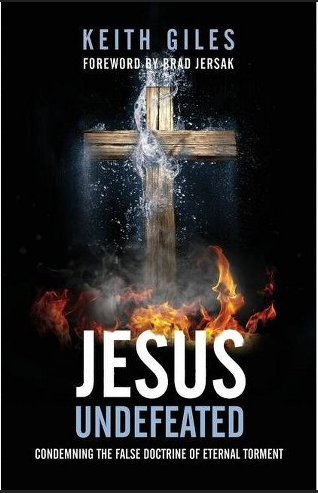
Enough of the general rant, I wanted to introduce the book “Jesus Undefeated”, by Keith Giles in this blog. His topic is Universalism, and the debunking of the Eternal Torment teaching. I picked up this book due to some who claim I am a Universalist. Thought I would find out what I believe, or at least get a bit more familiar with my assumed faith.
I have published two other posts describing this teaching, but they were fairly high level introductory blogs ( God – What is HE Like & Universal Reconciliation & the Church Fathers).
With this series, I would like to begin delving into some of the New Testament passages Mr. Giles brought to my attention, for your consideration, edification and civil discussion.
Initially, as I have stated in previous posts, I was surprised with the number of verses that support an evangelical universal teaching. Please do not think that this teaching I am trying to describe is the same as the “all roads lead to heaven” teaching, which I consider to be blasphemous. There is only one way to the Father, and that is through the Lord Jesus Christ.
In the following blog posts in this series, I would like to provide a number of New Testament passages which teach the universal salvation of all through the redemption that is found in Christ Jesus.
Regarding the book itself, I read it in one sitting, not simply because it was under 200 pages, but that it challenged my though process and I found it enjoyable reading. If this topic interests you, please pick up a copy. It is well worth your time.
Our next blog post will begin with passage 1, First Timothy 4:10.
Talk to you then – Thanks for dropping by!
Follow Considering the Bible on WordPress.com
Thanks again for coming to visit. I hope you found something of interest in this post and would appreciate a comment, to begin a discussion.

As mentioned in the introduction, I have been been discussing the differences between Calvinism and Provisionalism with a fellow blogger. One particular response grabbed my attention and I am trying to understand his position, by referring to his proof texts and logic.
This is the third portion of his response (in red), along with the corresponding verses he referred to. I shall seek to comment on the verses and find his argument within the verses he has provided.

God gave to the man Jesus the spirit without limit. God doesn’t give faith to everyone because He doesn’t want to according to Romans 9:16 John 1:12-13.
My friend is telling me that God doesn’t want to give faith to everyone, according to Romans 9:16 (dealt with last post) and the current set of verses being considered.
So lets take a look to see if this set of verses gives support to the claim that God doesn’t give faith to everyone, because He doesn’t want to.
First, let’s read the passage.
John 1:12-13 – But to all who did receive him, who believed in his name, he gave the right to become children of God, who were born, not of blood nor of the will of the flesh nor of the will of man, but of God.
It seems the ability to believe is not addressed in this passage, but simply stated as a condition. The result of the belief is that the one believing receives the right to become a child of God. I suppose I could state that the order of salvation is addressed in this verse, in that belief comes before the right to become children of God, but this isn’t my friends intent with this verse, so I will move on.
I think he is referring to the last three clauses in the verse, to speak of where the belief comes from, but that doesn’t seem all that clear in my opinion.
It seems the “being born” is the action being defined in this passage, in that the “being born” is an act of God. It seems to be a stretch to consider the “believing in His name” as being the object of the action.
So if one believes in His name, the believing one acquires the right to become a child of God. It is the result of the faith exercised in the name of the Messiah, that God provides the life, or in other words, “the birth” of a child of God.
Does the faith of the believing one perform the action of becoming a child of God, of being born? No. The action of being born is sourced, or found, in the will of God, not in any other agency.
One more time for a bit of clarity – The faith allows the believing one to acquire the right to become a child of God. God provides the birth upon the faith that is directed to the Messiah.
This passage doesn’t seem to address the topic my friend is seeking to prove, that God doesn’t give faith to everyone, because He doesn’t want to. As a matter of fact, it seems to be an open invitation to any who would trust in His name.
I do hope you will continue with me as I seek to understand the verses he supplies and if the verses he supplied support his argument of fatalism/determinism which he speaks of.
Thanks again for coming to visit. I hope you found something of interest in this post and would appreciate a comment, to begin a discussion.
Follow Considering the Bible on WordPress.com
The prophecy of the Lord Jesus for our consideration and edification, written centuries prior to His earthly existence is
| Prophecy #63 |
| Description |
| Declared the Beloved Son |
| Old Testament Prophecy |
| Psalm 2:7 |
| I will tell of the decree: The Lord said to me, “You are my Son; today I have begotten you. |
| New Testament Fullfillment |
| Matt 3:17 |
| and behold, a voice from heaven said, “This is my beloved Son, with whom I am well pleased.” |
| Rom 1:4 |
| and was declared to be the Son of God in power according to the Spirit of holiness by his resurrection from the dead, Jesus Christ our Lord, |
If you are just joining this blog, or are a first time visitor, welcome to Considering the Bible. We would like to offer a document that provides over 350 prophecies of the Messiah found in the Old Testament for your consideration.
351 Old Testament Prophecies Fulfilled in Jesus Christ
I make no claim to be able to comment on every one of these amazing prophecies in the future, but will occasionally bring one to the readers attention for their edification.
Hopefully you will follow “Considering the Bible” and begin an interaction with us
Follow Considering the Bible on WordPress.com
Thanks again for coming to visit. I hope you found something of interest in this post and would appreciate a comment, to begin a discussion.

My wife and I are reading through the Psalms in our evening reading and occasionally a nugget of the Psalms jumps out of the page. Don’t you love it when, after years of reading the “Old Book” passages become alive, reinforcing old teachings or simply warming your heart.
This is the book of Psalms, and it is rich.
I pray I can communicate a portion of the blessing we receive from this wonderful book.
Psalm 32
1 A Maskil of David. Blessed is the one whose transgression is forgiven, whose sin is covered.
2 Blessed is the man against whom the LORD counts no iniquity, and in whose spirit there is no deceit.
3 For when I kept silent, my bones wasted away through my groaning all day long.
4 For day and night your hand was heavy upon me; my strength was dried up as by the heat of summer. Selah
5 I acknowledged my sin to you, and I did not cover my iniquity; I said, “I will confess my transgressions to the LORD,” and you forgave the iniquity of my sin. Selah
6 Therefore let everyone who is godly offer prayer to you at a time when you may be found; surely in the rush of great waters, they shall not reach him.
7 You are a hiding place for me; you preserve me from trouble; you surround me with shouts of deliverance. Selah
8 I will instruct you and teach you in the way you should go; I will counsel you with my eye upon you.
9 Be not like a horse or a mule, without understanding, which must be curbed with bit and bridle, or it will not stay near you.
10 Many are the sorrows of the wicked, but steadfast love surrounds the one who trusts in the LORD.
11 Be glad in the LORD, and rejoice, O righteous, and shout for joy, all you upright in heart!
David was a man after God’s own heart, and yet he struggled with sin issues, sin such as murder, adultery and deception. He was a man who sought the Lord and yet fell violently into sin, into a darkness that enveloped him, that pulled him into conflict with the One he loved. He was under the hand of God, and he kept silent. Confession and repentance for this man of God was refused.
He would not admit his sin! It would cost too much, (from a purely human standpoint).

How often have you experienced the hand of God on your life? In the darkness, in the quiet of your soul, you have a balance sheet, a kind of ledger that you base decisions on. You weigh the pros and cons of each decision you make in your life, some of which are instantaneous, and some of which you spend time deliberating, considering the cost of certain actions.
Deciding to commit adultery with Bathsheba was an instant decision. (2 Samuel 11:2-3) David’s decision to commit adultery with Bathsheba did not consume much of David’s time.
A different story when it comes to cleaning the mess up. David spent nights tossing in his bed, conjuring up plans of action, determining methods of escaping the hand of God on his life, calculating his next move, trying to minimize the damage and maximize the benefits. He was running the numbers, and by his calculations he had to bury the sin!
First off, a little deception! Let’s pull an innocent man, no the victim of David’s sin, into the mix!
Call for Uriah and deceive him, appeal to his desire to serve the King, offer him a privilege of rest and renewal with his wife. David didn’t see the godliness of Uriah – how could he, his vision was clouded with his sin! Uriah, Bathsheba’s husband, the man David cheated against, came to David and humbly served him, seeking David’s welfare above his own. He slept at the door of the King’s house, ever ready to serve!
David was in a bad place! He couldn’t cajole Uriah to be with his wife! David got the poor man drunk, tried to bribe him, sought to puff him up, and what became of it? Uriah served his King.
David had a decision to make. He consulted his ledger of options, and decided after serious calculation through the night, that Uriah had to die!
Note that David’s decisions caused one man’s death, one man becoming an accomplice, and one child’s eventual death. One woman became a byword through Israel, and yet attained the position of queen eventually. And the king was in sin!
Joab obeyed his king and abandoned the godly man Uriah in battle. Uriah died without any knowledge of the treachery going on in his world. The sacrifice had to be made based on David’s cold and calculating schemes.
And David fell deeper into the darkness, struggling against the chains of his own making. His self inflicted burden weighed him down and tore at his sleep. Constant raging in his soul all the day long. A never ending slavery to the decisions he made based on his calculations, his balance sheet of pro and con.
Sometimes the love of God draw’s us to His side. Sometimes the pain and agony of our current situation pushes us to the Fathers side. This concept of realizing our position before our Father is a recurring theme in my thinking lately. (Consider Parable Surprises – Lost Son).
When you are in the dark spot, that period of time that the struggle with choice is so fierce, when your calculations sheet of obedience/disobedience is tottering back and forth, remember the great love of God. Remember the first time you found the great forgiveness of God. Remember the freeing grace that opened up opportunities and confidence for your heart.
Confess you sin. Admit it to God, at least primarily. Agree with God in the existence and offence your action(s) have on the Father. Find forgiveness at the foot of the cross.
If you have sinned against someone, ask them for forgiveness.
Romans 5:20 …where sin increased, grace abounded all the more
He has provided grace that abounds. The calculation sheet during times of darkness does not consider the grace of God. It is uncalculatable!
Psalm 32:5 I acknowledged my sin to you, and I did not cover my iniquity; I said, “I will confess my transgressions to the LORD,” and you forgave the iniquity of my sin.
Follow Considering the Bible on WordPress.com
Thanks again for coming to visit. I hope you found something of interest in this post and would appreciate a comment, to begin a discussion.
The prophecy of the Lord Jesus for our consideration and edification, written centuries prior to His earthly existence is
| Prophecy #62 |
| Description |
| To own the title King |
| Old Testament Prophecy |
| Psalm 2:6 |
| “As for me, I have set my King on Zion, my holy hill.” |
| New Testament Fullfillment |
| Matt 2:2 |
| saying, “Where is he who has been born king of the Jews? For we saw his star when it rose and have come to worship him.” |
If you are just joining this blog, or are a first time visitor, welcome to Considering the Bible. We would like to offer a document that provides over 350 prophecies of the Messiah found in the Old Testament for your consideration.
351 Old Testament Prophecies Fulfilled in Jesus Christ
I make no claim to be able to comment on every one of these amazing prophecies in the future, but will occasionally bring one to the readers attention for their edification.
Hopefully you will follow “Considering the Bible” and begin an interaction with us
Follow Considering the Bible on WordPress.com
Thanks again for coming to visit. I hope you found something of interest in this post and would appreciate a comment, to begin a discussion.
One of my favorites
Thanks again for coming to visit. I hope you found something of interest in this post and would appreciate a comment, to begin a discussion.
The prophecy of the Lord Jesus for our consideration and edification, written centuries prior to His earthly existence is
| Prophecy #61 |
| Description |
| His Character-Holiness |
| Old Testament Prophecy |
| Psalm 2:6 |
| “As for me, I have set my King on Zion, my holy hill.” |
| New Testament Fullfillment |
| John 8:46 |
| Which one of you convicts me of sin? If I tell the truth, why do you not believe me? |
| Rev 3:7 |
| “And to the angel of the church in Philadelphia write: ‘The words of the holy one, the true one, who has the key of David, who opens and no one will shut, who shuts and no one opens. |
If you are just joining this blog, or are a first time visitor, welcome to Considering the Bible. We would like to offer a document that provides over 350 prophecies of the Messiah found in the Old Testament for your consideration.
351 Old Testament Prophecies Fulfilled in Jesus Christ
I make no claim to be able to comment on every one of these amazing prophecies in the future, but will occasionally bring one to the readers attention for their edification.
Hopefully you will follow “Considering the Bible” and begin an interaction with us
Follow Considering the Bible on WordPress.com
Thanks again for coming to visit. I hope you found something of interest in this post and would appreciate a comment, to begin a discussion.

If there is a parable that is famous, this is the one! The prodigal son has much in it to speak on, and if we are lucky, I will be able to get my thoughts out in one post, but that is highly unlikely!
But lets get at it, and read the passage.
Luke 15:11-32
11 And he said, “There was a man who had two sons. 12 And the younger of them said to his father, ‘Father, give me the share of property that is coming to me.’ And he divided his property between them. 13 Not many days later, the younger son gathered all he had and took a journey into a far country, and there he squandered his property in reckless living. 14 And when he had spent everything, a severe famine arose in that country, and he began to be in need. 15 So he went and hired himself out to one of the citizens of that country, who sent him into his fields to feed pigs. 16 And he was longing to be fed with the pods that the pigs ate, and no one gave him anything. 17 “But when he came to himself, he said, ‘How many of my father’s hired servants have more than enough bread, but I perish here with hunger! 18 I will arise and go to my father, and I will say to him, “Father, I have sinned against heaven and before you. 19 I am no longer worthy to be called your son. Treat me as one of your hired servants.”‘ 20 And he arose and came to his father. But while he was still a long way off, his father saw him and felt compassion, and ran and embraced him and kissed him. 21 And the son said to him, ‘Father, I have sinned against heaven and before you. I am no longer worthy to be called your son.’ 22 But the father said to his servants, ‘Bring quickly the best robe, and put it on him, and put a ring on his hand, and shoes on his feet. 23 And bring the fattened calf and kill it, and let us eat and celebrate. 24 For this my son was dead, and is alive again; he was lost, and is found.’ And they began to celebrate. 25 “Now his older son was in the field, and as he came and drew near to the house, he heard music and dancing. 26 And he called one of the servants and asked what these things meant. 27 And he said to him, ‘Your brother has come, and your father has killed the fattened calf, because he has received him back safe and sound.’ 28 But he was angry and refused to go in. His father came out and entreated him, 29 but he answered his father, ‘Look, these many years I have served you, and I never disobeyed your command, yet you never gave me a young goat, that I might celebrate with my friends. 30 But when this son of yours came, who has devoured your property with prostitutes, you killed the fattened calf for him!’ 31 And he said to him, ‘Son, you are always with me, and all that is mine is yours. 32 It was fitting to celebrate and be glad, for this your brother was dead, and is alive; he was lost, and is found.’”
It is important to understand the original audience to understand a bit better the intent of the message. This second parable is no exception. Lets read the first three verses to ensure we know who is hearing this story for the very first time!
Luke 15:1 Now the tax collectors and sinners were all drawing near to hear him.
Luke 15:2 And the Pharisees and the scribes grumbled, saying, “This man receives sinners and eats with them.”
Luke 15:3 So he told them this parable:
As we pointed out in the last post, we have tax collectors and sinners drawing near to Him! But look – them Pharisees and Scribes are lurking about, checking out this preacher, protecting the nation from heresy and false prophets. What heros!
This parable was given within three months of the passion week. For a helpful document, providing a list of all the events in Jesus Life, check out the following download.
During the last three months of the Lord’s time in Israel, much of it was spent in Perea, on the eastern side of the Jordan, and finally in Jerusalem.
This final parable continues with the theme mentioned previously, that is of reckless love for the sought and rejoicing with neighbors when the lost is found.
This message speaks of the reckless love of the Father in seeking out both the prodigal and the elder son. Remember who the audience is in this telling of the story, in that the tax collectors and sinners are coming to see the Messiah, along with the guardians of the nation of Israel, the ones who are “working God’s field”!
It is obvious that sinners and tax collectors were attracted to the Messiah, and that this story speaks of their return to God the Father, of God’s reckless love to reach His lost and rejected people. It is a story of rejection by the younger son, and of an ever patient Father who waits for the son to come to his senses, humble himself and return to the One who loves him.
The Pharisees were working in the field, “faithful” sons, (which is so graceful of the Lord describe them such!) The Father spoke of the elder son as being with Him always, and that all that was His is the elder sons.
But the issue is the green eyed monster – jealousy.
The elder son wanted to live a sinful life, especially when he mentions prostitutes and wanton living. Sure he stayed behind, but reluctantly! It seems he did not work the farm out of love and devotion to the Father, but out of a sense of duty, or obligation. Seems like a bit of a soulless type of fella, one that didn’t experience joy or love, happiness or friendships. Yes – I am stretching the parable and making some assumptions, but I think somewhat justified. Notice that not once did he consider the pain the younger son experienced, the lostness and fears, the isolation and poverty his own brother must have went through. Kind of a soulless man, living in the grip of jealousy!
The Father is definitely not your typical Jewish farmer. Of course, there were some in the nation of Israel, in their faithful following of the God of Israel, that leaned into this self sacrificial love, but to go as far as the Father in this story was beyond belief. To be insulted by the younger son by demanding (note that the son didn’t ask politely – just “give me”), and to comply to the sons command, it is just too much! What utter weakness, and granting of such freedom, even to the point of allowing a destructive behavior to be followed by the son.
What type of father is this?
A Father who is self sacrificial, who loves his son in the long term, not the short term, a father who realizes a young heart needs to be hungry before it is satisfied. This father realized the younger son was determined to go, and forcing him to stay may keep him physically on the farm, but in spirit, the son was gone already.
As a matter of fact, it turns out both sons had left the father, but only one had the nerve to “grab the dough”, leave his father and go to a foreign land!
Do you remember finding out about the reckless love of the Father? I will not duplicate my testimony here, since it is available for my reader to access here. Suffice to say, the abounding love that I began to understand as a condemned man of 21, the intense grace that the Father provided to a sinner such as I, was more than I could have imagined.
If you have not experienced the love of God and the release from the guilt and dominion of sin, reach out to the Savior. Admit your sin to Him, repent of the enemy attitude toward Him, and join the body of believers you will meet as you walk with Him.
The prodigal “came to his senses” and decided to return to his father. Humility and repentance! He was willing to return to the father in a beggars position. He had to experience hunger and deprivation before he “came to his senses”. Is that necessary for you? Will you need to be humbled by your own decisions and the work of death they produce in your life? So unnecessary!
“Come to your senses”, humble yourself, repent of your sin, and trust the Savior for eternal life in the here and now?
Are you a religious man or woman? Keeping all the rules and ensuring each day’s duties are performed for the god you have created in your mind, or through your upbringing? Is it a burden that is continually bearing down on you? Sure you have a reputation of “working on the farm,” of keeping some law and resisting every vice (at least in appearance)?
Give it up, repent of your self sufficiency, and join the family of God. You need to realize that His sacrifice was as much for you as the “sinner” out there. He has given all in order that you can have joy and contentment, peace and an assurance of everlasting love.
This father that Jesus speaks of is the One who patiently waits. He is the One who supplies what many may consider a destructive freedom to His creation. A freedom that many may argue against and find some way to limit, in order to protect God’s wisdom and holiness.
Yet the Father is the One who is represented, nay identified in the Son, the One who is the Master, yet serves, the Savior who freely forgives, yet was condemned, the King who is sovereign, yet provides freedom to His creation, the Source of all life, and yet was crucified as a common thief or insurgent.
The love of God the Father is beyond description.
I am reminded of an old hymn that describes the impossibility of defining the love of God. Years back, a lady who had just lost her husband to cancer (the week before), sang this song in chapel. It moved me then, and thinking of her reminds me of the beautiful God we have in our Father.
“Could we with ink the ocean fill,
And were the skies of parchment made,
Were every stalk on earth a quill,
And every man a scribe by trade;
To write the love of God above
Would drain the ocean dry;
Nor could the scroll contain the whole,
Though stretched from sky to sky.”
Follow Considering the Bible on WordPress.com
Thanks again for coming to visit. I hope you found something of interest in this post and would appreciate a comment, to begin a discussion.
As mentioned in the introduction, I have been been discussing the differences between Calvinism and Provisionalism with a fellow blogger. One particular response grabbed my attention and I am trying to understand his position, by referring to his proof texts and logic.
This is the third portion of his response (in red), along with the corresponding verses he referred to. I shall seek to comment on the verses and find his argument within the verses he has provided.
God gave to the man Jesus the spirit without limit. God doesn’t give faith to everyone because He doesn’t want to according to Romans 9:16 John 1:12-13.
My friend is trying to teach me that God doesn’t give faith to everyone because He doesn’t want to, and he refers to Romans 9:16 to support this claim.
So let’s read the passage and try to understand his point.
Romans 9:16 – So then it depends not on human will or exertion, but on God, who has mercy.

Ok. I may be a bit daft, but I am not sure where faith is referred to in this verse, unless faith is the “it” at the start of the verse.
So what is “it”?
Let’s consider the immediate context.
Romans 9:14 What shall we say then? Is there injustice on God’s part? By no means!
Romans 9:15 For he says to Moses, “I will have mercy on whom I have mercy, and I will have compassion on whom I have compassion.”
Romans 9:16 So then it depends not on human will or exertion, but on God, who has mercy.

So the “it” in Romans 9:16 reaches back to the question posed in verse 14 – that is “Is there injustice on God’s part?” Faith doesn’t seem to be referred to here. As a matter of fact, this chapter does not address faith until verse 30, (14 verses later!) where it appears that the gentiles received a righteousness by faith. Verse 32 speaks of the Jews not attaining righteousness by faith, but by seeking to attain it by works. This is the only two references to faith in the chapter, and it doesn’t appear to address God’s willingness or reluctance to provide faith to anyone.
Oh, and the subject of faith (or belief) was last referred to in Romans 6:8, speaking of the resurrection, but not of God restricting faith or belief from anyone.
I am not sure why he referred to this verse to teach me that God doesn’t give faith to everyone because He doesn’t want to. Let’s see if the next set of verses in John 1 help us understand his thoughts.
I do hope you will continue with me as I seek to understand the verses he supplies and if the verses he supplied support his argument of fatalism/determinism which he speaks of.
Thanks again for coming to visit. I hope you found something of interest in this post and would appreciate a comment, to begin a discussion.
The prophecy of the Lord Jesus for our consideration and edification, written centuries prior to His earthly existence is
| Prophecy #60 |
| Description |
| To own the title, Anointed (Christ) |
| Old Testament Prophecy |
| Psalm 2:2 |
| The kings of the earth set themselves, and the rulers take counsel together, against the Lord and against his Anointed, saying, |
| New Testament Fullfillment |
| John 1:41 |
| He first found his own brother Simon and said to him, “We have found the Messiah” (which means Christ). |
| Acts 2:36 |
| Let all the house of Israel therefore know for certain that God has made him both Lord and Christ, this Jesus whom you crucified.” |
If you are just joining this blog, or are a first time visitor, welcome to Considering the Bible. We would like to offer a document that provides over 350 prophecies of the Messiah found in the Old Testament for your consideration.
351 Old Testament Prophecies Fulfilled in Jesus Christ
I make no claim to be able to comment on every one of these amazing prophecies in the future, but will occasionally bring one to the readers attention for their edification.
Hopefully you will follow “Considering the Bible” and begin an interaction with us
Follow Considering the Bible on WordPress.com
Thanks again for coming to visit. I hope you found something of interest in this post and would appreciate a comment, to begin a discussion.
Calvin’s followers seek to justify their teaching with verses that, with just a little bit of explanation, seem to reinforce their philosophy.
You know – the Romans 9 passage, or maybe 1 Corinthians 2:14.
Some of these passages, without considering alternate views (i.e. listening to only Calvinist teachers!) tend to reinforce the Calvinistic thought pattern.
This series of video podcasts will provide a discussion that many Calvinists may have never heard, or considered.
Take a few minutes, and try to have an open mind.
Follow Considering the Bible on WordPress.com
Thanks again for coming to visit. I hope you found something of interest in this post and would appreciate a comment, to begin a discussion.
The prophecy of the Lord Jesus for our consideration and edification, written centuries prior to His earthly existence is
| Prophecy #59 |
| Description |
| The enmity of kings foreordained |
| Old Testament Prophecy |
| Psalm 2:1-3 |
| Why do the nations rage[a] and the peoples plot in vain? The kings of the earth set themselves, and the rulers take counsel together, against the Lord and against his Anointed, saying, “Let us burst their bonds apart and cast away their cords from us. |
| New Testament Fullfillment |
| Acts 4:25-28 |
| who through the mouth of our father David, your servant, said by the Holy Spirit, “‘Why did the Gentiles rage, and the peoples plot in vain? The kings of the earth set themselves, and the rulers were gathered together, against the Lord and against his Anointed’– for truly in this city there were gathered together against your holy servant Jesus, whom you anointed, both Herod and Pontius Pilate, along with the Gentiles and the peoples of Israel, to do whatever your hand and your plan had predestined to take place. |
If you are just joining this blog, or are a first time visitor, welcome to Considering the Bible. We would like to offer a document that provides over 350 prophecies of the Messiah found in the Old Testament for your consideration.
351 Old Testament Prophecies Fulfilled in Jesus Christ
I make no claim to be able to comment on every one of these amazing prophecies in the future, but will occasionally bring one to the readers attention for their edification.
Hopefully you will follow “Considering the Bible” and begin an interaction with us
Follow Considering the Bible on WordPress.com
Thanks again for coming to visit. I hope you found something of interest in this post and would appreciate a comment, to begin a discussion.
A classic
Thanks again for coming to visit. I hope you found something of interest in this post and would appreciate a comment, to begin a discussion.
The prophecy of the Lord Jesus for our consideration and edification, written centuries prior to His earthly existence is
| Prophecy #58 |
| Description |
| The Resurrection predicted |
| Old Testament Prophecy |
| Job 19:23-27 |
| “Oh that my words were written! Oh that they were inscribed in a book! Oh that with an iron pen and lead they were engraved in the rock forever! For I know that my Redeemer lives, and at the last he will stand upon the earth. And after my skin has been thus destroyed, yet in[b] my flesh I shall see God, whom I shall see for myself, and my eyes shall behold, and not another. My heart faints within me! |
| New Testament Fullfillment |
| John 5:24-29 |
| Truly, truly, I say to you, whoever hears my word and believes him who sent me has eternal life. He does not come into judgment, but has passed from death to life. “Truly, truly, I say to you, an hour is coming, and is now here, when the dead will hear the voice of the Son of God, and those who hear will live. For as the Father has life in himself, so he has granted the Son also to have life in himself. And he has given him authority to execute judgment, because he is the Son of Man. Do not marvel at this, for an hour is coming when all who are in the tombs will hear his voice and come out, those who have done good to the resurrection of life, and those who have done evil to the resurrection of judgment. |
If you are just joining this blog, or are a first time visitor, welcome to Considering the Bible. We would like to offer a document that provides over 350 prophecies of the Messiah found in the Old Testament for your consideration.
351 Old Testament Prophecies Fulfilled in Jesus Christ
I make no claim to be able to comment on every one of these amazing prophecies in the future, but will occasionally bring one to the readers attention for their edification.
Hopefully you will follow “Considering the Bible” and begin an interaction with us
Follow Considering the Bible on WordPress.com
Thanks again for coming to visit. I hope you found something of interest in this post and would appreciate a comment, to begin a discussion.

Today, forty years ago, I found myself in a very small room, off the sanctuary of the church I had begun attending, waiting and watching for the notice.
Eventually, I heard the good news and began to breathe easier. Her brother had finally arrived, and we could get started!

You see, eight months earlier I had met a young lady that would become my wife. This lady, was the most beautiful person I had ever met, had captivated me from the very first moment I met her, and introduced me to the One who died for my life.
Since then, I have come to recognize a lady who is not only the “pertiest girl” at the dance, but has a depth of spirit that has been a rock for me, an encouraging soul that has never given up on an ol’ fool, even when I was a young “ol’ fool”
Happy Anniversary Sweetheart – You truly are my favorite! I just wanna hold your hand as we venture through this life and onto the next!
As mentioned in the introduction, I have been been discussing the differences between Calvinism and Provisionalism with a fellow blogger. One particular response grabbed my attention and I am trying to understand his position, by referring to his proof texts and logic.
This is the second portion of his response (in red), along with the corresponding verses he referred to. I shall seek to comment on the verses and find his argument within the verses he has provided.
Scripture says God is sovereign in his decision to whom he will have mercy which is in accordance with Romans 9:16 and other scripture Romans 9:15,18 The natural man doesn’t come and can’t come 1 Corinthians 2:14 John 6:44 John 6:65 He doesn’t have the ability because he lacks spiritual discernment because he doesn’t have the spirit.
This is another favorite verse of the theologically deterministic thinking folks, Calvin’s disciples that is.
John 6:65 – And he said, “This is why I told you that no one can come to me unless it is granted him by the Father.”
Why? Why did Jesus tell them that no man can come to Him unless it is granted him by the Father? Let’s take a few moments to check the context.
John 6:60 When many of his disciples heard it, they said, “This is a hard saying; who can listen to it?”
John 6:61 But Jesus, knowing in himself that his disciples were grumbling about this, said to them, “Do you take offense at this?
John 6:62 Then what if you were to see the Son of Man ascending to where he was before?
John 6:63 It is the Spirit who gives life; the flesh is no help at all. The words that I have spoken to you are spirit and life.
John 6:64 But there are some of you who do not believe.” (For Jesus knew from the beginning who those were who did not believe, and who it was who would betray him.)
John 6:65 And he said, “This is why I told you that no one can come to me unless it is granted him by the Father.”
Jesus had just finished teaching a hard saying, that is that He was the bread of Life. In verse 51, Jesus equates Himself with the true manna, and instructs those who would live forever to eat of this bread. This is a very very hard saying for a good Jew to understand, since it may imply cannibalism.

Of course the Lord meant it spiritually, and this was a genius move on the Lords method of winnowing out the ones who were simply following for the wrong reasons.
Are you following for the sake of the food (and miracles)? Or are you following because I am the true Deliverer, even if my message seems hard or difficult?
The Jews were in a tizzy, taking the message literally.
There are two audiences in this passage – the literalists – those who question the ability to eat of the Messiah’s actual flesh (WOW) and those who understand the message as a symbolic or spiritual message. Note that verse 60 opens the immediate context, where the disciples speak of the “hard saying” The message is the topic!
Jesus responds, asking if they are going to take offence at the message. After the bread message, Jesus actually warns them of more difficult saying that will be coming, such as in verse 62, speaking of His ascension. Things weren’t going to get easier for those who sought to follow Him!
Verse 63 is a defining verse. My very first preaching in a church was based on this passage, and looking back, I had it all messed up. Nevertheless, my understanding now is as follows.
Now to our supposed proof passage.
.. “This is why I told you that no one can come to me unless it is granted him by the Father.”
Jesus is speaking of the reception of the words He provides to the masses, not of some secret mysterious will that is conjured up in the minds of some theologians.
Lets consider the action of the Father in this verse. The one coming is granted by the Father. It seemed a funny word to use in this translation, but after reviewing some study books, found it is synonymous with “enabled”. The same idea of the Father enabling the one coming is similar in our previous post on John 6:44.

There is a difference.
To be enabled does not equate with to be compelled. I can enable my children to attend a function by inviting them, providing times and addresses and durations for the event. Many may come, but one may not come. Enabling my child to attend does not compel them, or force them to come to the function.
So lets wrap up some of our thoughts. The words of Jesus are the focus, and the words of Jesus include the enabling of those coming. Peter admitted to understanding this when challenged if they will leave the Messiah. He answered – “To whom shall we go? You have the words of eternal life.”

The gospel is the invitation. The words of Jesus is the life giving message. The message was believed, and Peter (along with most of the remaining disciples) knew that Jesus was the Holy One of God. This belief was a result of hearing the message Jesus preached and taught.
As an aside, for my friends who are leaning in the deterministic camp, consider that Jesus chose Judas (vs 6:70), yet was the very one that betrayed the Lord, that fell from grace. That is if he ever walked in grace at all! How is it that the one chosen should be the one who betrays? This is confusing if the choices were made before the foundation of the world!
I do hope you will continue with me as I seek to understand the verses he supplies and if the verses he supplied support his argument of fatalism/determinism which he speaks of.
Thanks again for coming to visit. I hope you found something of interest in this post and would appreciate a comment, to begin a discussion.
The prophecy of the Lord Jesus for our consideration and edification, written centuries prior to His earthly existence is
| Prophecy #57 |
| Description |
| Mediator between man and God |
| Old Testament Prophecy |
| Job 9:32-33 |
| For he is not a man, as I am, that I might answer him, that we should come to trial together. There is no arbiter between us, who might lay his hand on us both. |
| New Testament Fullfillment |
| 1 Tim 2:5 |
| For there is one God, and there is one mediator between God and men, the man Christ Jesus, |
If you are just joining this blog, or are a first time visitor, welcome to Considering the Bible. We would like to offer a document that provides over 350 prophecies of the Messiah found in the Old Testament for your consideration.
351 Old Testament Prophecies Fulfilled in Jesus Christ
I make no claim to be able to comment on every one of these amazing prophecies in the future, but will occasionally bring one to the readers attention for their edification.
Hopefully you will follow “Considering the Bible” and begin an interaction with us
Follow Considering the Bible on WordPress.com
Thanks again for coming to visit. I hope you found something of interest in this post and would appreciate a comment, to begin a discussion.
This parable continues with a theme that the Lord is emphasizing, and will culminate in the lost son, or the prodigal son.
This theme is two fold in my mind, and includes the reckless tenacity of seeking out a lost article (sheep, coin, son) and the joy experienced in heaven when a seeker find the sought, and the sinner repents.
Luke 15:8-10
8 “Or what woman, having ten silver coins, if she loses one coin, does not light a lamp and sweep the house and seek diligently until she finds it? 9 And when she has found it, she calls together her friends and neighbors, saying, ‘Rejoice with me, for I have found the coin that I had lost.’ 10 Just so, I tell you, there is joy before the angels of God over one sinner who repents.”
It is important to understand the original audience to understand a bit better the intent of the message. This second parable is no exception. Lets read the first three verses to ensure we know who is hearing this story for the very first time!
Luke 15:1 Now the tax collectors and sinners were all drawing near to hear him.
Luke 15:2 And the Pharisees and the scribes grumbled, saying, “This man receives sinners and eats with them.”
Luke 15:3 So he told them this parable:
As we pointed out in the last post, we have tax collectors and sinners drawing near to Him! But look – them Pharisees and Scribes are lurking about, checking out this preacher, protecting the nation from heresy and false prophets. What heros!
This parable was given within three months of the passion week. For a helpful document, providing a list of all the events in Jesus Life, check out the following download.
During the last three months of the Lord’s time in Israel, much of it was spent in Perea, on the eastern side of the Jordan, and finally in Jerusalem.
This “middle” parable continues with the theme mentioned above, that is of reckless love for the sought and rejoicing with neighbors when the sought is found.
Of course a coin can’t repent, which introduces a wrinkle in the story, emphasizing the seeker and not the sought. The coin has no “will” in this story, such as the sheep in the previous portion, or which will be discussed in the next parable of the lost son.
The coin was misplaced by the owner, (or some stranger in the home) and has no responsibility for it’s condition. This additional wrinkle is interesting and may be a portion of the reason the Lord used this particular example. Would He be describing a parallel condition found in the one sought, or is He emphasizing the efforts of the seeker?
As it was described in the previous parable of the lost sheep, one of the messages that shouts out to the original audience is the importance of each possession the seeker looks for.

In the parable of the lost sheep, the shepherd risked 99% of his flock in order to find 1%. I will admit this is ludicrous to my thinking, but for a shepherd in old Israel, that shepherd knew the sheep.
In this parable, the woman sought out one coin, 10% of her silver coins. She tears up her home in order to find that one coin! The coins referred to here are likely drachmas, which represented a days wages. Yet for a common woman, a peasant woman, most of her livelihood is taken care of by making her own cloth, growing her own food, bartering and generally being self supporting, from day to day. These coins may represent her savings and not simply “a days wage”.
This woman wanted all of her coins, just like the shepherd wanted all of his sheep, and upon finding the lost, rejoicing was shared with the seekers friends. Rejoicing! No grumbling or complaining allowed.

In the last parable I asked of your attitude towards “sinners”. Do you receive them as the Lord, accept them and seek to love them, show interest in their lives and trials, or do you simply consider them to be lost and it is their decision, their fault and most can not repent if they wanted to, so….
In this portion of the three parable message, the woman seeks out an inanimate object, a silver coin that has a value associated with it. The coin cannot help in the search. It is simply waiting to be found.
The woman is the seeker, and we understand the woman represents God the Father, as the shepherd in the story before. So we can leave this parable, knowing that we have no responsibility in seeking out the coin, knowing that it is God alone that will search for the coin, will find the coin, and will rejoice over the found coin.
Such may be the conclusion of some who would lean toward a deterministic theology. Taken alone, this parable would seem to support this thinking, but we must admit that the previous and next parable fights against that.
Remember that the sheep in the previous parable wandered off from the flock, which was an unnatural action. The sheep did not wander from the fold simply for no reason. I suggested the attitude of the established religious order within Israel may have been a reason.
The established religious order did not seek those “out of the club”. Jesus did. He received and looked for the ones who were not “in the club”.
If you are “in the club”, whatever that may mean to you, consider those who are not included. The reception of “them” (as opposed to “us”) is at the very heartbeat of these last two parables.
If Jesus has three parables back to back with the same message, that of rejoicing over lost items found, let me ask you – When have you truly rejoiced over a lost one being found? Be careful – the implied message many may hear is of rejoicing that a sinner is converted, get’s baptized, joins a church, begins tithing…
That is not the message that I understand. No conditions are being placed on the lost article in these parables. The rejoicing is over the receiving of the lost one, not the lost ones reaction to being found. This may seem like splitting hairs, but as a believer, I sometimes apply many conditions to my unconditional love for those I know.
Can we love/receive one who is constantly against us, who is arguing against our position, who is mocking our life or who is seemingly settled in a lifestyle of rejection?
Where is my faith, my desire for lost relationships to be reestablished. Jesus is teaching us of His reckless love for all of His “sheep” and for all of His “coins”.
Consider relationships that are broken in your life. Ask for forgiveness. Seek out restoration. Ask for forgiveness for actions you may have committed against them, whether real or perceived! Give up your self importance that may be restricting you from humbly approaching one that the Lord Jesus loves, that you may have inadvertently offended, and you may not even know of.
Ask for forgiveness. Admit your weakness and the love you have for the relationship, the desire you have that considers others, that carries a burden for a neighbor, that seeks out the good of others.
Of course, to be following the Lord, we will not be carrying any grudges, malice, ill will, or resentment towards any, that is, we will have forgiven them of any acts we may have experienced at their hand – it is the way of the Master! Hanging on to offenses from others will only cause the separation to continue, the separation of our lives from the Living God, and from the one who supposedly committed the offence.

How are you receiving others? Have you “found” a coin lately, and the rejoicing that comes with it?
Follow Considering the Bible on WordPress.com
Thanks again for coming to visit. I hope you found something of interest in this post and would appreciate a comment, to begin a discussion.
The prophecy of the Lord Jesus for our consideration and edification, written centuries prior to His earthly existence is
| Prophecy #56 |
| Description |
| “I will be His Father, He…my Son.” |
| Old Testament Prophecy |
| 1 Chronicles 17:13 |
| I will be to him a father, and he shall be to me a son. I will not take my steadfast love from him, as I took it from him who was before you, |
| New Testament Fullfillment |
| Heb 1:5 |
| For to which of the angels did God ever say, “You are my Son, today I have begotten you”? Or again, “I will be to him a father, and he shall be to me a son”? |
If you are just joining this blog, or are a first time visitor, welcome to Considering the Bible. We would like to offer a document that provides over 350 prophecies of the Messiah found in the Old Testament for your consideration.
351 Old Testament Prophecies Fulfilled in Jesus Christ
I make no claim to be able to comment on every one of these amazing prophecies in the future, but will occasionally bring one to the readers attention for their edification.
Hopefully you will follow “Considering the Bible” and begin an interaction with us
Follow Considering the Bible on WordPress.com
Thanks again for coming to visit. I hope you found something of interest in this post and would appreciate a comment, to begin a discussion.
Another beautiful song to rest in
Thanks again for coming to visit. I hope you found something of interest in this post and would appreciate a comment, to begin a discussion.
The prophecy of the Lord Jesus for our consideration and edification, written centuries prior to His earthly existence is
| Prophecy #55 |
| Description |
| To reign on David’s throne forever |
| Old Testament Prophecy |
| 1 Chronicles 17:12-13 |
| He shall build a house for me, and I will establish his throne forever. I will be to him a father, and he shall be to me a son. I will not take my steadfast love from him, as I took it from him who was before you, |
| New Testament Fullfillment |
| Luke 1:32-33 |
| He will be great and will be called the Son of the Most High. And the Lord God will give to him the throne of his father David, and he will reign over the house of Jacob forever, and of his kingdom there will be no end.” |
If you are just joining this blog, or are a first time visitor, welcome to Considering the Bible. We would like to offer a document that provides over 350 prophecies of the Messiah found in the Old Testament for your consideration.
351 Old Testament Prophecies Fulfilled in Jesus Christ
I make no claim to be able to comment on every one of these amazing prophecies in the future, but will occasionally bring one to the readers attention for their edification.
Hopefully you will follow “Considering the Bible” and begin an interaction with us
Follow Considering the Bible on WordPress.com
Thanks again for coming to visit. I hope you found something of interest in this post and would appreciate a comment, to begin a discussion.
My wife and I are reading through the Psalms in our evening reading and occasionally a nugget of the Psalms jumps out of the page. Don’t you love it when, after years of reading the “Old Book” passages become alive, reinforcing old teachings or simply warming your heart.
This is the book of Psalms, and it is rich.
I pray I can communicate a portion of the blessing we receive from this wonderful book.
Psalm 31
1 To the choirmaster. A Psalm of David. In you, O LORD, do I take refuge; let me never be put to shame; in your righteousness deliver me!
2 Incline your ear to me; rescue me speedily! Be a rock of refuge for me, a strong fortress to save me!
3 For you are my rock and my fortress; and for your name’s sake you lead me and guide me;
4 you take me out of the net they have hidden for me, for you are my refuge.
5 Into your hand I commit my spirit; you have redeemed me, O LORD, faithful God.
6 I hate those who pay regard to worthless idols, but I trust in the LORD.
7 I will rejoice and be glad in your steadfast love, because you have seen my affliction; you have known the distress of my soul,
8 and you have not delivered me into the hand of the enemy; you have set my feet in a broad place.
9 Be gracious to me, O LORD, for I am in distress; my eye is wasted from grief; my soul and my body also.
10 For my life is spent with sorrow, and my years with sighing; my strength fails because of my iniquity, and my bones waste away.
11 Because of all my adversaries I have become a reproach, especially to my neighbors, and an object of dread to my acquaintances; those who see me in the street flee from me.
12 I have been forgotten like one who is dead; I have become like a broken vessel.
13 For I hear the whispering of many– terror on every side!– as they scheme together against me, as they plot to take my life.
14 But I trust in you, O LORD; I say, “You are my God.”
15 My times are in your hand; rescue me from the hand of my enemies and from my persecutors!
16 Make your face shine on your servant; save me in your steadfast love!
17 O LORD, let me not be put to shame, for I call upon you; let the wicked be put to shame; let them go silently to Sheol.
18 Let the lying lips be mute, which speak insolently against the righteous in pride and contempt.
19 Oh, how abundant is your goodness, which you have stored up for those who fear you and worked for those who take refuge in you, in the sight of the children of mankind!
20 In the cover of your presence you hide them from the plots of men; you store them in your shelter from the strife of tongues.
21 Blessed be the LORD, for he has wondrously shown his steadfast love to me when I was in a besieged city.
22 I had said in my alarm, “I am cut off from your sight.” But you heard the voice of my pleas for mercy when I cried to you for help.
23 Love the LORD, all you his saints! The LORD preserves the faithful but abundantly repays the one who acts in pride.
24 Be strong, and let your heart take courage, all you who wait for the LORD!
I would like to dwell on three verses from this beautiful psalm this evening. The first verse we will consider most will recognize.
5 Into your hand I commit my spirit; you have redeemed me, O LORD, faithful God.

This is the passage that the Lord cried out while on the cross, yet He only declared the first phrase. Knowing that those who were at the feet of the cross, especially those who sought His crucifixion, were Bible scholars, and knew the facts of the Psalms, they must have recognized this phrase from this psalm. But more importantly, they knew the context of the psalm, and even as He hung on that cruel cross, He was declaring the redemption He looked for.
He was quoting from a psalm that spoke of the LORD as being a faithful God, One that had redeemed Him. In the suffering and agony He was experiencing, He declared His victory through God

17 O LORD, let me not be put to shame, for I call upon you; let the wicked be put to shame; let them go silently to Sheol.
How contradictory this must seem. The Lord is considering this Psalm in the very act of dying for our sins, and it speaks of not being put to shame. He was spit on, beaten, mocked and humiliated. He was described as a demon, a false teacher, a heretic and a rebel. He was an outcast of His own people, a reject from the leaders who should have bowed down to Him
Oh, He was experiencing shame, but He is not experiencing this shame now, for He has been exalted to the highest, and one day, all will openly and joyfully confess that Jesus Christ is Lord, to the glory of God the Father
21 Blessed be the LORD, for he has wondrously shown his steadfast love to me when I was in a besieged city.

As He suffered, He may have considered the 21st verse. He knew of the steadfast love of the Father, of being in a besieged city. Jerusalem was a city that killed the prophets and that was besieged with anti-God attitudes. He walked amongst those who despised Him, and yet walked in the steadfast love of God, even to the witness of those whom He walked amongst.
God the Father had shown His love to the Son in many ways during His ministry amongst the besieged city, through miracles and the witness of His teaching, through His sinless life and constant love for those who had been rejected by the religious community.
This religious community acted in pride and arrogance, determining their truth when looking at the truth. Their visitation would be soon and complete!
One last verse – I know I said three earlier, but this verse sums up the Psalm beautifully.
23 Love the LORD, all you his saints! The LORD preserves the faithful but abundantly repays the one who acts in pride.
Follow Considering the Bible on WordPress.com
Thanks again for coming to visit. I hope you found something of interest in this post and would appreciate a comment, to begin a discussion.
 Considering the Bible