My hope is that this series will offer my readers a chance to consider the names, characteristics and descriptions of our God in the Word.
Our next set of names (#4 through #22) are considered His compound names, which typically uses His primary name and attaches a specific descriptor to it. These are the names that originally got me chasing this topic, and now it has developed into a much bigger study than the original intent, but I digress, for I have already mentioned this!
The Word is truly rich with descriptions of the Living God, and this effort of searching in the Word was quite illuminating. He truly is the ultimate subject of the Word, and His revelation of self-descriptions, or the accolades offered Him by His priests, prophets, kings apostles and faithful truly was a blessing.
May the Name of the Lord be praised, and by thinking on His name, may you have a blessed day.
8
EL GIBBOR (MIGHTY GOD)
Jeremiah 32:18 You show steadfast love to thousands, but you repay the guilt of fathers to their children after them, O great and mighty God, whose name is the LORD of hosts,
Out of the many names I have found in my research for this series, this particular name is one I have not considered in the past. To see the name “El Gibbor” strikes an unfamiliarity to my thinking. Yet I have often read of the mighty God.
In my research this term is often associated with action or reputation. When speaking of men, the term refers to a champion, a warrior, even a tyrant in some instances. Each of these descriptions speak of one who is not only strong, but uses his strength in battle to win wars.
God is a God of war, and as soon as I say that, most may think of blood, death, destruction and horror on a battle field. I would like to suggest that the Lord Jesus has described our warfare in different terms.
Death to self, and life for others. Loving our enemy. Seeking to be peacemakers, (not just peacekeepers!)
He is the Mighty God, who entered into battle for our souls, voluntarily suffering for others. To submit to this suffering in order to obey His Father and win our souls exhibits great strength of will and power of love.
He is El Gibbor, the Mighty God, mighty in His nature and in His doings, showing steadfast love to thousands upon thousands of His enemies, rescuing them through subjection to suffering.
The strength of our God is not to be lightly considered.
Let us thank Him for Him mighty love that broke through our doubts and fears!
I would love to hear of your favorite name, characteristic or description of the Living God. Please leave me a comment, and I will include it in the list!
Thanks again for coming to visit. I hope you found something of interest in this post and would appreciate a comment, to begin a discussion. If you know someone this blog may bless (or challenge), send them a link, so they may join us in our discussion.
For this series in Philippians, I am going to limit each post to one verse, and hopefully produce a short, succinct read for my friends who follow.
In the previous posts, I have suggested that Paul is reintroducing Timothy to the Philippians, speaking of Timothy as a mature servant of Christ, genuinely caring for the interests of others. In this post we are going to consider Timothy’s gained worth to Paul!
2:22 But you know Timothy’s proven worth, how as a son with a father he has served with me in the gospel.
Paul speaks of Timothy’s proven worth. The Greek word for proven is the root word for first word I ever did a study on a hundred years ago. It is the Greek word δοκιμή(dokimē) and it speaks of a specimen (Timothy in this case) going through a trial and coming through the affliction with gained experience and faith intact. The term refers to a test that was given and that Timothy overcame. Out of this test, Timothy increased in worth to Paul.
Increased in worth?
Whoa Carl, you need to put the brakes on here! Are we not worth so much greater than we can imagine, based not on our works, but on our being made in the image of God? How can our worth increase if it is based on our being made in the image of God?
The inherent worth of a person, based on his being made in the image of God is a very popular teaching nowadays, and there is much truth in it. We are a marred image, but an image of God none the less!
For our topic today, we also need to consider how we may find increased worth in front of God. And that is where trials and testing comes to the rescue! As believers we are either entering a test, currently in a test or coming out of a test, hopefully overcoming the challenge. God provides testing for believers in order for us to mature, to become in our experience what He seeks for us in our destiny. With every test we face, we are given the opportunity to acquire increased worth in the eyes of man and God.
To be faithful to God in our testing will provide greater opportunities in our future. Later in Paul’s ministry, he wrote to Timothy, exhorting him to do his best, to make every effort to be before God as one approved (tested and accepted), with no need to be ashamed. I have much to say about my understanding of this verse, but for the sake of brevity, will address it in an alternate post!
2 Timothy 2:15 Do your best to present yourself to God as one approved, a worker who has no need to be ashamed, rightly handling the word of truth.
The inherent worth of the believer, based on his being made in the image of God is not the idea in this teaching, precious as it is. It is what the faith of the believer produces through the Spirit of God in their character through trials. There is an old Dutch reformed saying that at one time I considered heresy, yet as I study, am finding there may be valuable truth found in it.
It goes something like this…
What we are is God’s gift to us, what we become is our gift to God.
What think thee? Have you an understanding of the various ways our worth is “calculated” in our lives? Even as I type this, I wish to remind the reader (and myself), that this understanding of gained “worth” is to be held with kid gloves, and that we are to understand this teaching in a spirit of humility. He is the One who provides the strength, endurance and encouragement we require to pass through tests, and out of this testing to increase in our worth to man and God.
He is worth it, for He is good and He is good all the time!
Thanks again for coming to visit. I hope you found something of interest in this post and would appreciate a comment, to begin a discussion. If you know someone this blog may bless (or challenge), send them a link, so they may join us in our discussion
My wife and I are reading through the Psalms in our evening reading and occasionally a nugget of the Psalms jumps out of the page. Don’t you love it when, after years of reading the “Old Book” passages become alive, reinforcing old teachings or simply warming your heart.
This is the book of Psalms, and it is rich.
I pray I can communicate a portion of the blessing we receive from this wonderful book.
We are visiting Psalm 53, which upon even a cursory review, sounds very familiar. So it should, for it is almost identical to Psalm 14, and with that similarity, I would like to consider the similarities and differences each Psalm is communicating. This post will consider verse 2 of both Psalms.
Psalm 14
Psalm 53
2 – The LORD looks down from heaven on the children of man, to see if there are any who understand, who seek after God.
2 – God looks down from heaven on the children of man to see if there are any who understand, who seek after God.
Verse 2 provides a striking difference between the two Psalms. Who is looking down from heaven on the children of men? Psalm 14 speaks of the LORD looking down, whereas Psalm 53 speaks of God looking down on the children of men. What shall we make of this difference?
I have coincidentally just begun a series on the names of God and of course these two primary names of God are considered.
At this time, let us consider if the difference in using two names for God in these psalms may indicate different intended audiences. When we see that God is addressed in Psalm 53, we may understand the audience to be of the more general audience, those not only in the Siniatic covenant (Israel) but of all who have consciousness, alive within this created world. In contrast, when Psalm 14 addresses God with the revealed covenantal name of LORD (Jehovah/Yahweh), David may be targeting the covenantal people of God
Given that in Psalm 53:1, David described the works of the fool as abominable iniquity, and not simply abominable deeds in Psalm 14, may also support this difference in who is looking down on the children of men. Psalm 53, in being directed to a general audience, and may reflect the authors desire to make a point with those outside of the community of faith. Their deeds are incredibly offensive to God. Those outside the community of faith need to understand their plight, for they may not have access to the law of God that provides guidance for their lives, (and conviction of sin).
Are you in a covenant with God, and do you know Him? To avoid the stigma and condemnation / judgement of doing abominable deeds, we must find life in the Son and hold fast to His leadership in our lives.
My hope is that this series will offer my readers a chance to consider the names, characteristics and descriptions of our God in the Word.
Our next set of names (#4 through #22) are considered His compound names, which typically uses His primary name and attaches a specific descriptor to it. These are the names that originally got me chasing this topic, and now it has developed into a much bigger study than the original intent, but I digress, for I have already mentioned this!
The Word is truly rich with descriptions of the Living God, and this effort of searching in the Word was quite illuminating. He truly is the ultimate subject of the Word, and His revelation of self-descriptions, or the accolades offered Him by His priests, prophets, kings apostles and faithful truly was a blessing.
May the Name of the Lord be praised, and by thinking on His name, may you have a blessed day.
7
EL OLAM (THE EVERLASTING GOD)
Genesis 21:33 Abraham planted a tamarisk tree in Beersheba and called there on the name of the LORD, the Everlasting God.
Isaiah 40:28 Have you not known? Have you not heard? The LORD is the everlasting God, the Creator of the ends of the earth. He does not faint or grow weary; his understanding is unsearchable.
This name also uses the primary name El in conjunction with Olam, which, as translated speaks of God’s eternality, or His self existence, without beginning and without end.
As Isaiah speaks to the people of God, he asks rhetorical questions to those who have been under the tutelage of the law. Have you not known? Have you not heard?
My goodness, during the days of Isaiah, if any of creation knows of the God of Abraham, and the God of Moses, it must be the nation of Israel, for they have received the written word, describing the God they are in covenant with, the God who has no beginning and has no end.
It is so easy to condemn those in the past as having dropped the ball when it comes to understanding who God truly is, but I will confess that much of my day is sometimes consumed with the here and now and not the inevitable future where God resides.
I understand I can change nothing about the past, other than to seek forgiveness from those whom I may have hurt, but while in the present, after considering the eternality of God, I can change my future.
Let us reflect on the everlasting nature of our Living God, that He will ever be with us, will never “not be” and has provided His Son, separated from Him for a time, so we may continually abide with the everlasting One.
I would love to hear of your favorite name, characteristic or description of the Living God. Please leave me a comment, and I will include it in the list!
Thanks again for coming to visit. I hope you found something of interest in this post and would appreciate a comment, to begin a discussion. If you know someone this blog may bless (or challenge), send them a link, so they may join us in our discussion.
As we have been venturing through the Psalms, getting lost in the volume of the book, and the many nuggets of truth laid out for believers, I have come to realize (again and again) the beauty of the book, the depth of the book, the expanse of the human experience the book describes and allows us to join into.
We started with a quick dip into one of the most amazing chapters in the Word, one that has impacted my life in various stages of my Christian faith. It is a psalm that spoke to my wife and I as we were reading that night, but it began a journey through the psalms that has continued for over a year, and I suspect may continue to hold me.
With that said, I would like to offer those who read my bumbling efforts to understand one of the great books of the greatest book ever delivered to the human race, an ongoing summary of the findings and blessings I have enjoyed discovering.
As many who have followed me for a bit, I have fallen into the Psalms, and I can’t get up! (As if I would want to.) The Psalms are a majestic collection of poetry, of heart felt human experiences that constantly challenge me in my own frail attempt to follow the true King. As many of the Psalms are written by David, my study on the Psalms has spurred me on to looking at the life of David, is the main contributor to this book, and to follow the victories and tragedies of the shepherd King of Israel.
Many times in the narrative, we will see the Lord Jesus, imperfectly, yet a reflection of His spirit in a man with weaknesses.
Saul is hunting some donkeys. Let’s see what we can glean from this passage.
1 Samuel 9:5-10
5 When they came to the land of Zuph, Saul said to his servant who was with him, “Come, let us go back, lest my father cease to care about the donkeys and become anxious about us.” 6 But he said to him, “Behold, there is a man of God in this city, and he is a man who is held in honor; all that he says comes true. So now let us go there. Perhaps he can tell us the way we should go.” 7 Then Saul said to his servant, “But if we go, what can we bring the man? For the bread in our sacks is gone, and there is no present to bring to the man of God. What do we have?” 8 The servant answered Saul again, “Here, I have with me a quarter of a shekel of silver, and I will give it to the man of God to tell us our way.” 9 (Formerly in Israel, when a man went to inquire of God, he said, “Come, let us go to the seer,” for today’s “prophet” was formerly called a seer.) 10 And Saul said to his servant, “Well said; come, let us go.” So they went to the city where the man of God was.
In our last post, I suggested that Saul and his assistant had been sent on a hunt for his families donkeys, and that it may have been quite an extensive journey. With the start of verse 5, we are introduced to the land of Zuph, where most think it was just to the north of the land of the Benjaminite’s. When Saul and his servant entered this area, Saul had had enough of the search and wanted to turn around. No food and gone so long! Yet so close to the prize, though he knew it not.
Nevertheless, his servant spoke of a prophet that might help in completing the task, and after all of Saul’s reasons not to go, he relented.
Notice that the servant was the motivator to take Saul the last few yards to the finish line. How important to have those around us that provide encouragement to pursue the end game, to be the voice that pushes us to the last few steps we need to take. It seemed Saul had a good reason for turning back, since his father may being worrying that they had been so long. But a nameless servant with a good argument and a quarter won the day, and the nation of Israel was never the same!
Be an encourager for someone today. Someone may be getting ready to turn back, to give up, to throw in the towel, and your kind words and offer of help may make all the difference.
1 Thessalonians 5:11 Therefore encourage one another and build one another up, just as you are doing.
Thanks again for coming to visit. I hope you found something of interest in this post and would appreciate a comment, to begin a discussion. If you know someone this blog may bless (or challenge), send them a link, so they may join us in our discussion.
Jesus in the Old Testament is a series of posts that will offer my readers a chance to consider pictures or shadows of Jesus in the Old Testament. As mentioned in the introduction to this series, some may be obvious, some may be not so obvious, and some may simply be a facet of the Lord those reading may not have considered previously.
I hope as we venture through this series, we will see the Lord in many wonderful pictures throughout the Old Testament.
SEEING JESUS IN
ADAM
LORD OF CREATION
Genesis 1 28 And God blessed them. And God said to them, “Be fruitful and multiply and fill the earth and subdue it, and have dominion over the fish of the sea and over the birds of the heavens and over every living thing that moves on the earth.”
Colossians 1 15 He is the image of the invisible God, the firstborn of all creation. 16 For by him all things were created, in heaven and on earth, visible and invisible, whether thrones or dominions or rulers or authorities–all things were created through him and for him.
Adam was provided the right to have dominion over all of creation. He was the master or lord over the creation provided to him from God.
Jesus is the Lord of lords, and as such is seen in Adam in the early pages of the Old Testament. He is the One who has dominion over all dominions, thrones, rulers and authorities!
Thanks again for coming to visit. I hope you found something of interest in this post and would appreciate a comment, to begin a discussion. If you know someone this blog may bless (or challenge), send them a link, so they may join us in our discussion.
My hope is that this series will offer my readers a chance to consider the names, characteristics and descriptions of our God in the Word.
Our next set of names (#4 through #22) are considered His compound names, which typically uses His primary name and attaches a specific descriptor to it. These are the names that originally got me chasing this topic, and now it has developed into a much bigger study than the original intent, but I digress, for I have already mentioned this!
The Word is truly rich with descriptions of the Living God, and this effort of searching in the Word was quite illuminating. He truly is the ultimate subject of the Word, and His revelation of self-descriptions, or the accolades offered Him by His priests, prophets, kings apostles and faithful truly was a blessing.
May the Name of the Lord be praised, and by thinking on His name, may you have a blessed day.
6
EL ELYON (THE MOST HIGH GOD)
Psalm 78:35 They remembered that God was their rock, the Most High God their redeemer.
This name of God speaks of His loftiness, His elevated status over all of creation. As the creator of all, He is above all of creation by the fact He is outside of the creation, eternal and everlasting. The term also is used in comparison to false idols and gods, in that they can not compete with the Most High.
The term speaks of one elevated, lofty or supreme. There is no other like the Most High God.
It may be that the Canaanites referred to their local gods as el (god), but for the Israeli’s as they understood the truths that had been delivered to them through the revelation of God, would refer to the true God as the most High God, in comparison with the idols in the land.
Our God is King of Kings and Lord of Lords and is the Most High God, reigning over all other gods, high above all other beings. He is the only One worthy of this name, and we are privileged to know Him through His death on the cross.
And this is eternal life, that they know you, the only true God, and Jesus Christ whom you have sent.
I would love to hear of your favorite name, characteristic or description of the Living God. Please leave me a comment, and I will include it in the list!
Thanks again for coming to visit. I hope you found something of interest in this post and would appreciate a comment, to begin a discussion. If you know someone this blog may bless (or challenge), send them a link, so they may join us in our discussion.
For this series in Philippians, I am going to limit each post to one verse, and hopefully produce a short, succinct read for my friends who follow.
Our topic today is the continuation of Paul’s introduction of Timothy to the Philippian church. As mentioned earlier, the Philippians had met Timothy very early in their lives as a body of believers. He was with Paul and Silas at the very birth of the church, albeit not one who was recognized as a leader. The leaders (Paul and Silas) were hauled off to prison, but Timothy was left behind, supposedly of no threat to the municipal government.
Paul is reintroducing Timothy to his church because he had matured greatly and become a trusted confidant to the apostle, not simply a warm body occupying space!
2:21 For they all seek their own interests, not those of Jesus Christ.
Adding others
Let’s get some context to this short statement from Paul. Earlier in the chapter, Paul has admonished the church to show concern for others interests
Philippians 2:4 Let each of you look not only to his own interests, but also to the interests of others.”
Paul is informing the Philippians of the natural tendency of all to seek their own interests, or their own concerns. We all seek our own interests! But in this verse, he is admonishing the believers to add to their concerns, the concerns of others. This is beyond the self care that we all tend to cherish. Admit it – we like taking care of ourselves! But Paul is telling the believers to reach out to others, invest time in their lives, find out what is of concern in their lives and get involved in those interests.
What might some of the interests be of others? Health issues springs to mind, or financial concerns. But it might start out by finding someone in the body of Christ (or outside of the body of Christ) and asking what type of motorcycle they like, or if they are coffee drinkers, or maybe something else that seems insignificant, but informs them that you are interested in them, and not simply using them to speak of yourself and your interests. After all, we do tend to like taking care of our interests!
Seeking Christ
Paul speaks of “all seeking their own interests” not those of Jesus Christ. Ok Paul – now it seems you have changed subject matter. Is it others or Christ that we are to seek the interests of?
Is there a difference? If we genuinely care for others welfare, are we not also seeking the interests of the Lord Jesus? Yet Paul provides focus for the believer, by redirecting our sights to Christ, and not to others. If we focus properly on Him, (and not get lost in some side interest), our nature will change into one that is genuinely concerned for others.
But beware! If I understand my nature correctly, there is a danger that some who are reading this may come away from this discussion, thinking that if they care for others, that is the same as seeking the interests of Christ. Is that correct? Could some think this way, and actually work themselves into a state of pride? Look at how much I care for others! Wow – Carl you care a whole lot!
I am thinking this may be getting the cart before the horse, as my momma used to say. The order is critical and Paul reminds us of this when he redirects us to the source of true humility, of true deference to others. Jesus is the only true source of humility and by focusing on His sacrifice for us, on His character and teachings, we can be transformed into one who genuinely cares for others.
Seek the interests of Jesus and as you do, you will become one who genuinely cares for the interests of others.
Thanks again for coming to visit. I hope you found something of interest in this post and would appreciate a comment, to begin a discussion. If you know someone this blog may bless (or challenge), send them a link, so they may join us in our discussion
My wife and I are reading through the Psalms in our evening reading and occasionally a nugget of the Psalms jumps out of the page. Don’t you love it when, after years of reading the “Old Book” passages become alive, reinforcing old teachings or simply warming your heart.
This is the book of Psalms, and it is rich.
I pray I can communicate a portion of the blessing we receive from this wonderful book.
We are visiting Psalm 53, which upon even a cursory review, sounds very familiar. So it should, for it is almost identical to Psalm 14, and with that similarity, I would like to consider the similarities and differences each Psalm is communicating.
The first item to review is the topic of a fool. Both psalms speak of the “fool” and in our modern way of understanding, to call someone a fool implies one who is deficient in understanding, judgemnt or sense. One who is easily tricked, or made to look foolish/stupid. This is not the primary meaning of when the Hebrew mind read this word.
The term found in both psalms is nāḇāl, and if you think back in David’s life, you will recognize this noun as a proper name of one of David’s enemies.
1 Samuel 25:3 Now the name of the man was Nabal, and the name of his wife Abigail. The woman was discerning and beautiful, but the man was harsh and badly behaved; he was a Calebite.
Note that the Scripture gives us a character description of the man named “fool” as being harsh and badly behaved. Nothing to do with intelligence directly, but a commentary on his lifestyle and behavior. To be a fool (nāḇāl) in the Hebrew mind was to reject God’s authority and influence, being controlled by the baser elements of the earthly life.
David is not making a commentary on the intelligence of the one rejecting God, but on the moral standing of that one. With that short introduction, lets consider our first verse.
Psalm 14
Psalm 53
1 – To the choirmaster. Of David. The fool says in his heart, “There is no God.” They are corrupt, they do abominable deeds; there is none who does good.
1 – To the choirmaster according to Mahalath. A Maskil of David. The fool says in his heart, “There is no God.” They are corrupt, doing abominable iniquity; there is none who does good.
Note that Psalm 53 has the additional instruction of “according to Mahalath. A Maskil of David”. Mahalath, from what I have found, refers to an instrument, possible a harp, along with the description of David the psalm as a maskil. This is another mysterious word, but many scholars lean to the idea that this word describes a contemplation or an instructive message.
For Psalm 53 to include this addition may emphasize the seriousness of the message, since Mahalath also may have a sense of mournfulness, sadness or entreaty.
The fool contemplates the existence of God in his heart. During this contemplation, he concludes that there is either no God, (as the translation records – “There is no God”) or that the fool rejects God’s authority over him, by saying “No God”. For you see, the Old Testament text does not include specific words that may be translated as “There is” – see snippet from the Blue Letter Bible to the right.
Either an athiest or a rebel – Which my friend do you consider to be the worst fate?
This is the beginning of becoming the fool, for without God, there are no lasting standards defining right from wrong, and therefore all things are relativistic, according to multiple authorities, with inevitable conflicts. Truly a foolish way to live!
Corrupt
David continues in the first verse of both Psalm 14 and 53 to describe the outcome of this contemplation. Both Psalms speaks of corruption, of a spoiling or rotting, even of a perverting of their very nature. Their very nature or character is being destroyed by this thinking, falling to baser and baser levels of existence. They are literally rotting on the inside. After David’s description of the fool’s character, he goes on to to describe the works produced by this fool.
Abominable Deeds/Iniquity
This is where we find a difference in the Psalms we are looking at. You see, Psalm 14 speaks of deeds, whereas Psalm 53 brings the darker concept of iniquity into the equation.
Psalm 14
Psalm 53
they do abominable deeds
doing abominable iniquity
Psalm 53 raises the stakes in speaking of abominable iniquity. Both describe the activities as abominable, that which is abhorrent, but with the added concept of iniquity, Psalm 53 becomes an even darker description of the fools works. Iniquity speaks of injustice, including violence, which if considered, will always become the end result of a life with no standards. This is the end result of saying “No God”
Uniform in not Doing Good
A final description within both Psalms speaks of this group of fool as being homogeneous, pure and without any deviation in their work of doing good. That is, no-one that contemplates the non existence of God, or that refuses to bow before Him, performs any good. To say that no one does good, for some, implies that the fool cannot even understand goodness or righteousness. Yet, let’s remember that David is speaking of actions when he speaks on no one doing good, based on the contemplation of the heart.
Yes, the heart, if hardened beyond reach, this condition sets the fools actions into inevitable evil and injustice. Yet, I am not convinced the contemplation of the heart is necessarily complete in any fool, for I too (as you may be) lived a fools life and contemplated a life of the rebel, saying no to God. In His mercy, He invited me into a living relationship with Him, and by His grace, He is pulling me out of a life of injustice and violence.
Are you contemplating saying no to God? My friend, consider you ways, for a life of rejecting God will lead to a life of injustice. A life of walking with Him will produce love and peace, both internally and as an outworking of the heart into the lives of others.
My hope is that this series will offer my readers a chance to consider the names, characteristics and descriptions of our God in the Word.
Our next set of names (#4 through #22) are considered His compound names, which typically uses His primary name and attaches a specific descriptor to it. These are the names that originally got me chasing this topic, and now it has developed into a much bigger study than the original intent, but I digress, for I have already mentioned this!
The Word is truly rich with descriptions of the Living God, and this effort of searching in the Word was quite illuminating. He truly is the ultimate subject of the Word, and His revelation of self-descriptions, or the accolades offered Him by His priests, prophets, kings apostles and faithful truly was a blessing.
May the Name of the Lord be praised, and by thinking on His name, may you have a blessed day.
5
EL SHADDAI (ALMIGHTY GOD)
Genesis 17:1 When Abram was ninety-nine years old the LORD appeared to Abram and said to him, “I am God Almighty; walk before me, and be blameless,
We have considered Elohim in post #1 of this series, and I would like to consider the secondary term in this compound name, for I have discovered an aspect of “Shaddai” that I had never understood before.
The Hebrew transliteration of the term for Shaddai is šaday, and as I was “rootin’ about”, I clicked on the root word etymology of this term. Blue Letter Bible took me to H7703 – šāḏaḏ.
To be a root word means that all derivatives of the root finds some truth in the root word. Shaddai, as we are considering today, is rooted in the šāḏaḏ.
This is where I became somewhat shocked at what I found, for until this finding, I had always assumed Shaddai was simply referring to God (El) as being powerful, most powerful, all powerful or almighty. And I have no doubt of this fantastic truth.
When we explore the root word šāḏaḏ, it refers to one who spoils, wastes, assaults or deals violently. The term describes the apparent outcome of the power. An example of šāḏaḏ found in the Word, in relation to God’s power being exercised is Jeremiah 25:36
A voice–the cry of the shepherds, and the wail of the lords of the flock! For the LORD is laying waste šāḏaḏ their pasture.
Now before anyone starts calling me a heretic, I am not claiming that the blessed God, who is the Almighty, has evil intent or uses His great abilities simply for destruction! There is no way I believe that. Yet His power may bring about violent happenings, as Jeremiah notes in the verse above, and that which when the shepherds witnessed, brought about crying and wailing. For we must remember that the same God who is described as Almighty, is also described as all knowing, and full of wisdom. He exercises His power in perfect righteousness, without staining His character, though we often struggle with that!
We all will admit we want things to always be peachy keen and for every day to be full of sunshine. We know this is a pipe dream. Bad things happen, and yet our God is the Almighty. Though some of His acts may bring about destruction (from our point of view) faith rises above that and recognizes the God of the Bible as the One hanging on the cross, bearing the suffering we deserved, accepting the shame resulting from our sinful decisions.
He is the Almighty, yet He voluntarily hung on that instrument of death, “powerless” to free himself but for one reason. The power of love, greater than all His suffering and shame, shone forth on that ol’ rugged cross, when the Almighty became weak for our sake.
He is the Almighty God (El Shaddai), mighty in power and love to His creation. Praise His name today!
I would love to hear of your favorite name, characteristic or description of the Living God. Please leave me a comment, and I will include it in the list!
Thanks again for coming to visit. I hope you found something of interest in this post and would appreciate a comment, to begin a discussion. If you know someone this blog may bless (or challenge), send them a link, so they may join us in our discussion.
Now I would remind you, brothers, of the gospel I preached to you, which you received, in which you stand, and by which you are being saved, if you hold fast to the word I preached to you–unless you believed in vain. – 1 Corinthians 15:1-2
As a hardcore OSAS, this is one of the first passages that I figgered Paul got wrong.
Since I am eternally secure, and my initial faith equaled a one time contractual negotiation with God, how could the apostle Paul say such a difficult saying that seems to bring question to the remainder of the Word. A number of items arise in this passage that just scrambled my brain as an OSAS adherent.
Brothers
Paul called them brothers. Why would he call them brothers if they had not given evidence of their faith in the Living God? His time with them gave him ample evidence of the Spirit of the Living God residing in them. Remember that Paul was with this church for 18 months, not three weekends like the Thessalonians, or the very short time he had with the Philippians. He witnessed first hand what the gospel produced in these people.
Received
Paul declared that they received the gospel. To receive is to take, acquire or accept. Paul understood that at the preaching of the gospel, these brothers took the gospel, accepted it as truth and received the message into their lives. I may be overreaching to say that they did not merely accept it intellectually due to the time the apostle spent with this congregation. To receive the gospel is to become the brother he referenced them as earlier.
Note that this verb is aorist tense, that is that they received the gospel at a point in time in the past.
Stand
Paul wrote that they stood in the gospel. When I read of standing in the gospel, I am reminded of Paul’s use of the term in Ephesians 6:14, speaking to believers concerning their responsibility in their Christian life, to be firm in their convictions, to be active in their faith, to be established in the faith.
Note that this verb is perfect tense, that is the Corinthians live in the gospel, they are active believers in the Messiah.
Being Saved
Paul said they were being saved by the gospel. Now this was where I started to go off the rails in my thinking with Paul. It is amazing that he could slip from the truth of OSAS so quickly, but I would be forgiving towards him, in that I would simply “ignore” his mistakes, like he is slipping into here!
Yet the passage speaks of being saved. Describing believers (who are saved) as being saved! Why are you muddying the waters of my OSAS mind, Paul? What are you saying? It seems the salvation we received, and as believers, are standing in, is an active living salvation, that the salvation we have is working in our lives, bringing us to a maturity that is not only expected, but that God will perform in our faith.
If
Then comes that dreaded word. IF.
Some may think Paul intended to say since, instead of if here. In my research, I have found no support for this term to be translated as since. The word “if” speaks of a conditional state, dependent on someone to perform an action. “If’” is a primary particle of conditionality. Something Paul’s writes next will be what the brothers will require to perform in order to maintain their current status as brothers.
Hold fast to the word Paul preached. Do not let it slip away, as the author of Hebrews describes the falling brother in chapter 2.
Hebrews 2:1 Therefore we must pay much closer attention to what we have heard, lest we drift away from it.
Of course, if the brothers do let the gospel slip from them, if they do not hold fast to the message Paul preached, – well what does that mean? Paul’s conclusion is that they believed in vain. Did they not really believe at the initial preaching of the gospel? Is that what believing in vain refers to?
Of might it mean that they believed “in a random” sort of manner, to no purpose, to be void of result, empty. To be void of result, to not complete the initial faith they exhibited in the Messiah. Might this be where Paul is taking us. The believers in Corinth had placed their faith in the Messiah, yet it appears this “faith” may not produce the end result intended.
The argument comes down to this.
Never Brothers
Is Paul graciously calling these folks brothers, (though if OSAS is correct, Paul fears some are not) and these “never brothers” are falling away from Christ because they had no (a vain) faith? In other words, is Paul just being kind calling them brothers, but in reality have never believed in the Savior?
Currently Brothers
Is Paul accurately calling his audience brothers, and is expressing his fear of their slipping away, a danger of leaving the faith, of an apostacy within the church? Is Paul expressing a fear of their not holding fast to the word that was preached unto them?
How do you see this passage?
Thanks again for coming to visit. I hope you found something of interest in this post and would appreciate a comment, to begin a discussion. If you would like to receive daily posts from Considering the Bible, click on the “Follow” link below
As many who have followed me for a bit, I have fallen into the Psalms, and I can’t get up! (As if I would want to.) The Psalms are a majestic collection of poetry, of heart felt human experiences that constantly challenge me in my own frail attempt to follow the true King. As many of the Psalms are written by David, my study on the Psalms has spurred me on to looking at the life of David, is the main contributor to this book, and to follow the victories and tragedies of the shepherd King of Israel.
Many times in the narrative, we will see the Lord Jesus, imperfectly, yet a reflection of His spirit in a man with weaknesses.
A short review of Saul’s call to be King!
1 Samuel 9:3-4
3 Now the donkeys of Kish, Saul’s father, were lost. So Kish said to Saul his son, “Take one of the young men with you, and arise, go and look for the donkeys.” 4 And he passed through the hill country of Ephraim and passed through the land of Shalishah, but they did not find them. And they passed through the land of Shaalim, but they were not there. Then they passed through the land of Benjamin, but did not find them.
Saul was on a journey. A journey to destiny! Little did he know of the life changing meeting he would have with a prophet of God while searching for his father’s livestock.
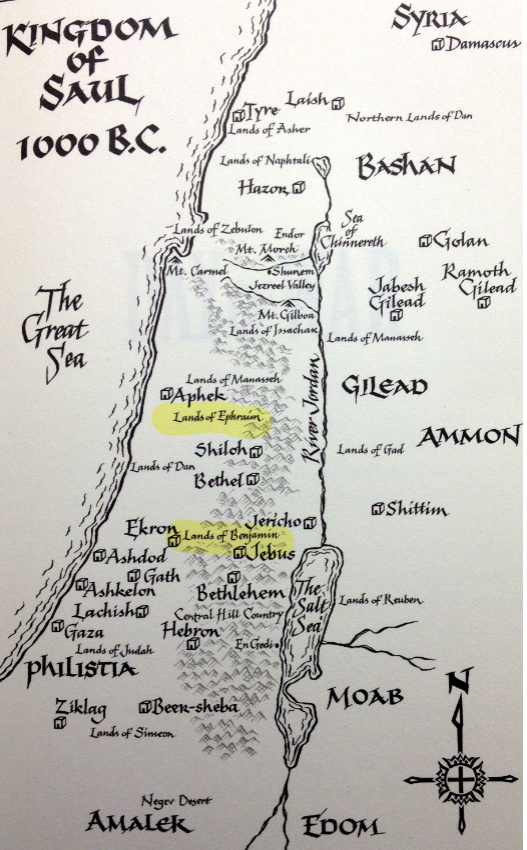
I suppose the first thing I am curious about is the route he took in looking for his animals – through the hill country of Ephraim, through Shalishah, though Shaalim, and through the land of Benjamin.
Best I can tell, the map to the right provides demarcation of the Hill Country, and lands of Benjamin and Ephraim. This journey may have been as much as 100 miles round trip, traveling through hilly country, looking for donkeys.
Donkeys!
When I think of Old Testament Israel, I think sheep, not donkeys, yet these animals were common in the land, even used to transport royalty in the very near future. And Saul, with an assistant was out looking for a heard of donkey’s upon assignment from his father Kish.
Let’s think about this. A prominent, wealthy family looses a herd of donkeys. Does this speak of bad livestock management practices? We need to give Kish and his family the benefit of the doubt as this occurrence was used of God to direct Saul to a fateful meeting with Samuel. To be anointed the first King of Israel, continuing the rejection of God as their King!
What are you talking about Carl – Israel’s rejection of God? You see, Saul was out searching for lost donkeys, spending a considerable amount of time and effort chasing after them. It turns out he never did find them. But he was led to a prophet that had been told of Israel’s rejection of God, of God giving the nation He created, saved and established what they wanted. And what did they want? A replacement leader. Someone instead of God. We will see this as a consistent truth as we venture through the Old Testament, but it is good to understand how this impacts not only Samuel’s life, but more importantly God’s interpretation of Israel’s desires.
1 Samuel 8:7 And the LORD said to Samuel, “Obey the voice of the people in all that they say to you, for they have not rejected you, but they have rejected me from being king over them.
Sobering thoughts on the desires of a nation, when it simply wants to be like the nations around it.
Thanks again for coming to visit. I hope you found something of interest in this post and would appreciate a comment, to begin a discussion. If you know someone this blog may bless (or challenge), send them a link, so they may join us in our discussion.
Jesus in the Old Testament is a series of posts that will offer my readers a chance to consider pictures or shadows of Jesus in the Old Testament. As mentioned in the introduction to this series, some may be obvious, some may be not so obvious, and some may simply be a facet of the Lord those reading may not have considered previously.
I hope as we venture through this series, we will see the Lord in many wonderful pictures throughout the Old Testament.
SEEING JESUS IN
ADAM
HIS WIFE
Genesis 2 22 And the rib that the LORD God had taken from the man he made into a woman and brought her to the man. 23 Then the man said, “This at last is bone of my bones and flesh of my flesh; she shall be called Woman, because she was taken out of Man.”
Revelation 19 7 Let us rejoice and exult and give him the glory, for the marriage of the Lamb has come, and his Bride has made herself ready;
Revelation 21 2 And I saw the holy city, new Jerusalem, coming down out of heaven from God, prepared as a bride adorned for her husband.
In placing Adam into a deep sleep, God took from Adam a rib to make his wife. Adam received a wife out of the experience of death, out of His very body.
How so much more did the Lord create a wife for the Son out of the death He experienced?
Thanks again for coming to visit. I hope you found something of interest in this post and would appreciate a comment, to begin a discussion. If you know someone this blog may bless (or challenge), send them a link, so they may join us in our discussion.
My hope is that this series will offer my readers a chance to consider the names, characteristics and descriptions of our God in the Word.
Our next set of names (#4 through #22) are considered Hs compound names, which typically use His primary name and attach a specific descriptor to it. These are the names that originally got me chasing this topic, and now it has developed into a much bigger study than the original intent, but I digress, for I have already mentioned this!
The Word is truly rich with descriptions of the Living God, and this effort of searching in the Word was quite illuminating. He truly is the ultimate subject of the Word, and His revelation of self-descriptions, or the accolades offered Him by His priests, prophets, kings apostles and faithful truly was a blessing.
May the Name of the Lord be praised, and by thinking on His name, may you have a blessed day.
4
ADONAI JEHOVAH (LORD GOD)
Genesis 15:2 ESV – But Abram said, “O Lord GOD, what will you give me, for I continue childless, and the heir of my house is Eliezer of Damascus?”
Our first compound name is the combination of two primary names. As an aside, I am thankful that when Jehovah (or Jahweh) is found in the text, the translators provide a clue and capitalize all letters in the English translation. Such is the case in this instance.
He is the Lord (Adonai), One who has authority and power, in the ultimate sense, and GOD (Jehovah), the self existent One, dependent on no one.
In our text, Abraham has been provided a promise by God, but it hadn’t been realized yet. He had been promised a son but had remained childless, and time was running out! Yet in addressing God, Abraham combined two of His personal primary names to emphasize his trust in the Living One.
Abraham had used both these names in addressing the Father before, but not in the same manner as here. In this passage he combined them into one name, specifically emphasizing the power and independence of the Lord. In God’s independent power, He was able to provide “results” based only on His own good will and the requests of those who had his ear.
Abraham had entered into this understanding, and was speaking to God freely, concerning His promise of an heir. He is listening today.
Do you have a sense of his independence and power, that He is free (beholding to no one) and able (powerful) to perform that which is within His will for those who have His ear?
I would love to hear of your favorite name, characteristic or description of the Living God. Please leave me a comment, and I will include it in the list!
Thanks again for coming to visit. I hope you found something of interest in this post and would appreciate a comment, to begin a discussion. If you know someone this blog may bless (or challenge), send them a link, so they may join us in our discussion.
For this series in Philippians, I am going to limit each post to one verse, and hopefully produce a short, succinct read for my friends who follow.
2:20 For I have no one like him, who will be genuinely concerned for your welfare.
Our current topic is the young man Timothy, and his character as described by no less than the apostle Paul. The Philippians had encountered Timothy a number of times and yet Paul describes him to them as if they had never met.
Of had they? Timothy had been a young convert when he had joined Paul in Lystra, and one of the first stops on Paul’s journeys with Timothy was the city of Philippi. This Philippian church was a sort of baptism of ministry for Timothy, and his youthfulness in the Lord may have been evident. Note that Timothy was not in the prison with Paul and Silas, possibly implying that Timothy may have been more of an observer than active minister/leader amongst the apostles.
Since that initial contact with the church, Timothy had continued with Paul and Silas through Thessalonica, Berea, Athens, Corinth and back to Antioch. Missionary journeys had come and gone. Years passed and Timothy stuck it out with Paul, being sent to Corinth as Paul languished in prison, visiting the church and reporting back. Even early on, Timothy was gaining gracious reviews from Paul.
1 Corinthians 4:17 That is why I sent you Timothy, my beloved and faithful child in the Lord, to remind you of my ways in Christ, as I teach them everywhere in every church.
By the time Timothy was being sent to the first church plant he had experienced, Timothy had become a very trusted disciple. Some suggest Timothy may have been with Paul for close to twelve years by the time he is sent back to Philippi. Twelve years under the tutelage of the apostle Paul. Obviously Timothy was not the same man. The Philippians may remember a young “wet behind the ears” convert, but the believer Paul was sending had matured and become a cherished helper of Paul, often being sent out in Paul’s absence.
Timothy was not the same man. Paul may have provided this description of Timothy to reintroduce him to the Philippians. Paul was not sending an inexperienced disciple from the fringes of his associates , but a man who had proven himself in the trenches of ministry.
Timothy had proven himself to be a man who naturally cared for the church, for those individuals in the church, and that gave of himself for the church. To care for believers was not in his job description, nor was it a task that had been assigned to him. His activities did not include among many items caring for believers as one of his responsibilities. Timothy cared for them in the same way he breathed. It was natural, involuntary, and consistent. It was natural for him to care. Paul was sending a man to the Philippians that he trusted and had blossomed as a disciple in front of Paul’s eyes.
A rare man!
Time with the apostle, meant time with a man of influence, under the Kingship of Jesus. Change had occurred, and Timothy had entered the life of change into the image of Christ.
Let me ask a question – If you met an old friend you hadn’t seen for a decade, would they meet a different person, a person influenced by the Christ, naturally caring for others?
Thanks again for coming to visit. I hope you found something of interest in this post and would appreciate a comment, to begin a discussion. If you know someone this blog may bless (or challenge), send them a link, so they may join us in our discussion
My wife and I are reading through the Psalms in our evening reading and occasionally a nugget of the Psalms jumps out of the page. Don’t you love it when, after years of reading the “Old Book” passages become alive, reinforcing old teachings or simply warming your heart.
This is the book of Psalms, and it is rich.
I pray I can communicate a portion of the blessing we receive from this wonderful book.
Psalm 52:8 But I am like a green olive tree in the house of God. I trust in the steadfast love of God forever and ever. Psalm 52:9 I will thank you forever, because you have done it. I will wait for your name, for it is good, in the presence of the godly.
David has just described the doom of the mighty man, along with the reaction of the humble man to the “breaking” of the mighty man. We considered what it meant to be broken and what seeking refuge in his own destruction may be describing. (Who in their right mind would seek refuge in their own destruction).
David, in our portion this time, describes his own experience in relation to God. He is like a green olive tree, and when I hear the term olive tree I think of God’s covenant relationship with His people. See Jeremiah 11:16 for an example.
Jeremiah 11:16 – The LORD once called you ‘a green olive tree, beautiful with good fruit.’ But with the roar of a great tempest he will set fire to it, and its branches will be consumed.
Not only does the green olive tree remind me of the relationship God had with His nation Israel, it also reminds me of the new covenant we enjoy under the Lord’s authority today.
But beyond all that, I think of the wonderful oil that is produced from the fruit of this tree. The olive oil that is produced by the crushing of the olive fruit. A crushing of the fruit that hearkens to the crushing of the Savior, the crushing of His body to bring about the spiritual oil that anoints those who seek the Master. But we must not forget that it was a crushing that was required to produce this blessing, and as he hung on the cross, taking the punishment we – I – deserved, He was also undergoing a crushing that would produce the fruit of life to those who sought Him.
How often Jesus may have recounted the second portion of verse 8 while suffering.
I trust in the steadfast love of God forever and ever.
No one in the history of all of creation has experienced the depth of the truth of that verse but for him. At the very time of His suffering, He only had His trust in the steadfast love of God, in the faithfulness of His Father, even as He was abandoned for the first (and only) time of His existence.
Upon His resurrection, may I suggest that Jesus entered the truth of verse 9.
I will thank you forever, because you have done it.
Consider how Jesus is thanking His Father. God the Father rescued Him from death, for He could not behold it. Is it any less incumbent for us who know nothing of His depth of suffering to be any less thankful for His tremendous grace towards us?
Let us have a thankful spirit and give thanks unto the Lord for His mighty acts of rescue!
My hope is that this series will offer my readers a chance to consider the names, characteristics and descriptions of our God in the Word.
Our first three names are considered His primary names!
The Word is truly rich with descriptions of the Living God, and this effort of searching in the Word was quite illuminating. He truly is the ultimate subject of the Word, and His revelation of self-descriptions, or the accolades offered Him by His priests, prophets, kings apostles and faithful truly was a blessing.
May the Name of the Lord be praised, and by thinking on His name, may you have a blessed day.
3
ADONAI (LORD)
Deut. 6:4 Hear, O Israel: The LORD our God, the LORD is one.
In our last post, we spoke of the Tetragrammaton, in other word the 4 letters that we understand represents the name Jehovah, or Jahweh.
In this post we are going to consider the Hebrew word Adonai, as the third and last primary name of our God. Adonai is the Hebrew word for Lord, referring to someone who has power and authority.
As discussed in our first post, Adonai is also used to refer to earthly rulers frequently in the Word, but of course not in the absolute sense as when referring the our God. The Creator and Sustainer of all things is by His very nature the Lord (Adonai) and Master (Adonai) of all things.
We may fight this truth, deny this truth, ignore this truth, but until we submit to this truth, we will never find peace. And the truth of His lordship is not dependent on our opinion of this claim He makes. He is Lord whether we like it or not.
My advice you ask? Submit to the truth, as far as you understand it, that Jesus is Lord (Adonai) and that you want to be a disciple, a learner of what that means in every area of your life.
Peace will find you when you submit. And it is a glorious peace, for you see, He is Lord and He is good, all the time!
I would love to hear of your favorite name, characteristic or description of the Living God. Please leave me a comment, and I will include it in the list!
Thanks again for coming to visit. I hope you found something of interest in this post and would appreciate a comment, to begin a discussion. If you know someone this blog may bless (or challenge), send them a link, so they may join us in our discussion.
As we have been venturing through the Psalms, getting lost in the volume of the book, and the many nuggets of truth laid out for believers, I have come to realize (again and again) the beauty of the book, the depth of the book, the expanse of the human experience the book describes and allows us to join into.
We started with a quick dip into one of the most amazing chapters in the Word, one that has impacted my life in various stages of my Christian faith. It is a psalm that spoke to my wife and I as we were reading that night, but it began a journey through the psalms that has continued for over a year, and I suspect may continue to hold me.
With that said, I would like to offer those who read my bumbling efforts to understand one of the great books of the greatest book ever delivered to the human race, an ongoing summary of the findings and blessings I have enjoyed discovering.
As you can tell from the expanding list of posts, the Psalms have got a hold on me!
As many who have followed me for a bit, I have fallen into the Psalms, and I can’t get up! (As if I would want to.) The Psalms are a majestic collection of poetry, of heart felt human experiences that constantly challenge me in my own frail attempt to follow the true King. As many of the Psalms are written by David, my study on the Psalms has spurred me on to looking at the life of David, is the main contributor to this book, and to follow the victories and tragedies of the shepherd King of Israel.
Many times in the narrative, we will see the Lord Jesus, imperfectly, yet a reflection of His spirit in a man with weaknesses.
Thanks again for coming to visit. I hope you found something of interest in this post and would appreciate a comment, to begin a discussion. If you know someone this blog may bless (or challenge), send them a link, so they may join us in our discussion.
Jesus in the Old Testament is a series of posts that will offer my readers a chance to consider pictures or shadows of Jesus in the Old Testament. As mentioned in the introduction to this series, some may be obvious, some may be not so obvious, and some may simply be a facet of the Lord those reading may not have considered previously.
I hope as we venture through this series, we will see the Lord in many wonderful pictures throughout the Old Testament.
SEEING JESUS IN
ADAM
DEEP SLEEP
Genesis 2 21 So the LORD God caused a deep sleep to fall upon the man, and while he slept took one of his ribs and closed up its place with flesh.
Matthew 27 50 And Jesus cried out again with a loud voice and yielded up his spirit.
Adam’s “deep sleep” speaks of the Messiah’s death, of a death that was purposed for the creation of a partner, a new life out of the death.
Thanks again for coming to visit. I hope you found something of interest in this post and would appreciate a comment, to begin a discussion. If you know someone this blog may bless (or challenge), send them a link, so they may join us in our discussion.
My hope is that this series will offer my readers a chance to consider the names, characteristics and descriptions of our God in the Word.
Our first three names are considered His primary names!
The Word is truly rich with descriptions of the Living God, and this effort of searching in the Word was quite illuminating. He truly is the ultimate subject of the Word, and His revelation of self-descriptions, or the accolades offered Him by His priests, prophets, kings apostles and faithful truly was a blessing.
May the Name of the Lord be praised, and by thinking on His name, may you have a blessed day.
2
JEHOVAH (LORD)
Genesis 4:1 Now Adam knew Eve his wife, and she conceived and bore Cain, saying, “I have gotten a man with the help of the LORD.”
Exodus 3:14God said to Moses, “I am who I am.” And he said, “Say this to the people of Israel: r‘I am has sent me to you.’ ”
This name of God, from the Old Testament is of even greater mystery than our first name, Elohim which introduced the concept of multiple persons in the godhead. Jehovah, or as some scholars prefer Yahweh, is our feeble attempt to understand YHWH, the tetragrammatron, (meaning four letters). No vowels. Four consanants.
The problem with knowing the correct pronunciation of YHWH is that out of respect for the God of Israel, the Jews would not pronouce his name for fear of saying it wrong.
The “four letters” were God’s self revelatory illumination to Moses in Exodus 3:14, as to who was speaking to him. He is the self existant One, the only One who depends on no one else for anything. We are created, He is uncreated. We exist in Him, He is self existant. We are empty shells always needing needing needing. He is the self sufficient One.
Up until Genesis 4:1, Moses referred to God as “LORD God”, or the compound name Jehovah Elohim. Until this verse, all activities were describing Gods actions (creation, commanding, taking, causing, banishment, etc) as first person.
Genesis 4 begins referring to the Lord as Jehovah as the primary name, not a compound name. This verse speaks of Eve’s description of God, due to her giving birth to Cain.
For today, it may well be a good reminder that our God is the One who depends on no one out of necessity, He has no one to answer to, and He is the only One who is not created, but the One who is self existant. I expect that to dwell on this truth today will be a stabilizing influence in our lives, and will honor the One to whom honor is due.
I would love to hear of your favorite name, characteristic or description of the Living God. Please leave me a comment, and I will include it in the list!
Thanks again for coming to visit. I hope you found something of interest in this post and would appreciate a comment, to begin a discussion. If you know someone this blog may bless (or challenge), send them a link, so they may join us in our discussion.
For this series in Philippians, I am going to limit each post to one verse, and hopefully produce a short, succinct read for my friends who follow.
The letter takes a turn for us transitioning from the humility of Christ and his apostle, to describing two additional followers of Christ that impact the lives of the Philippians.
Timothy and Epaphroditus are two men who will minister to the Philippians. Timothy, Paul’s very own disciple would be offered to the Philippians in service to their needs, and Epaphroditus would return to them, after having travelled to the apostle in order to provide a gift to him from his beloved church. But let us not get head of ourselves, for we are set to get a glimpse of how Paul considered his young Timothy in this letter to his friends. Our first verse in this description starts with hope, and of course includes cheer, a close relative to the ever present joy we find in the book.
2:19 I hope in the Lord Jesus to send Timothy to you soon, so that I too may be cheered by news of you.
Since we will be spending a few verses looking at Timothy, a quick reminder of the caliber of man this young believer was may be in order.
How did Paul express his trust in this young man? He often sent Timothy ahead, to churches that he couldn’t get to, or that caused him immediate concerns. Paul placed tremendous faith in Timothy’s ability to represent him, even in the midst of a very troubled and rebellious church as the Corinthians.
Consider that many scholars think of Timothy meeting Paul around 50 AD, during his second missionary trip, and that Timothy was 16 when he first met Paul. Paul wrote 1 Corinthians in 54 AD, which would make Timothy a young man of 20, having been under Pauls influence for roughly 4 years. Imagine sending a relatively young convert into the moral confusion of the Corinthians.
1 Corinthians 4:17
That is why I sent you Timothy, my beloved and faithful child in the Lord, to remind you of my ways in Christ, as I teach them everywhere in every church.
Timothy also was sent to a very young church, experiencing some troubling teaching, in order to establish the Thessalonians, to encourage them in the faith and to relieve the apostle of his concerns over the fledgling church
1 Thessalonians 3:1,2,6
Therefore when we could bear it no longer, we were willing to be left behind at Athens alone, and we sent Timothy, our brother and God’s coworker in the gospel of Christ, to establish and exhort you in your faith, But now that Timothy has come to us from you, and has brought us the good news of your faith and love and reported that you always remember us kindly and long to see us, as we long to see you–
Timothy was a man that voluntarily entered into circumcision to be an example of self sacrifice for the sake of others.
Acts 16:3
Paul wanted Timothy to accompany him, and he took him and circumcised him because of the Jews who were in those places, for they all knew that his father was a Greek.
I met a man once who experienced this “pain” later in life, and he informed me that it caused him great discomfort. Very great discomfort!
We have seen that Timothy was a man of character, willing to enter into difficult situations, endure pain for the sake of ministry, and to represent Paul faithfully in his ministry to churches he had planted. Philippians 2:19 speaks of Paul sending Timothy to the Philippians to be encouraged. For his own encouragement.
But notice that Paul assumes that this church is moving forward in thier faith, that they will naturally be an encouragement to Paul, not only in thier support of him, as he has recieved a gift from them by Epaphroditus visit, but that thier general condition will be encouraging to him.
And to send Timothy to the Philippians, at least in part for his own encouragement, speaks of the apostles humanity, of his admission of weakness in his ministry. “Strong” leaders would not admit to the need for encourement, for that may show weakness. This is not Paul’s stance, for he freely admits his weakness through many of his letters.
He admits his weakness, his need of encouragement in front of those he is leading. Such a strange, upside down way of looking at leadership. Maybe I have witnessed too much of another kind of leadership in the church. Yes – maybe that is the problem.
Thanks again for coming to visit. I hope you found something of interest in this post and would appreciate a comment, to begin a discussion. If you know someone this blog may bless (or challenge), send them a link, so they may join us in our discussion
My wife and I are reading through the Psalms in our evening reading and occasionally a nugget of the Psalms jumps out of the page. Don’t you love it when, after years of reading the “Old Book” passages become alive, reinforcing old teachings or simply warming your heart.
This is the book of Psalms, and it is rich.
I pray I can communicate a portion of the blessing we receive from this wonderful book.
Psalm 52:5 But God will break you down forever; he will snatch and tear you from your tent; he will uproot you from the land of the living. Selah Psalm 52:6 The righteous shall see and fear, and shall laugh at him, saying, Psalm 52:7 “See the man who would not make God his refuge, but trusted in the abundance of his riches and sought refuge in his own destruction!”
David just completed the introductory verses of Ps 52, describing the boasting of the mighty man, referring to Doeg the Edomite, as he ratted on David to Saul.
We noticed in our last study that Doeg and David had some similarities, in that they were both men associated with a deceitful tongue. Remember that David was lying to Ahimelech when he spoke of his circumstances. Granted we may readily admit that Doeg was a man who sought to deceive, destroy and devour, whereas David fell into deception at a weak point in his life. All that may be true, but as we spoke last time, David will speak of the outcome of a deceitful, destructive devouring tongue, even though David fell into that very condition for a short time. Yet, David did not shy away from the holiness and righteousness of God, even if it condemned him. That, in my mind, is a wonderful testimony of the truth and inspiration of the Word. Sin isn’t covered up, even by the author who performed a sin.
Nevertheless, our passage today speaks of God’s judgement on the mighty man who devours, destroys and deceives, and the reaction of the righteous when the mighty man is broken.
Verse 5 begins with the statement that God will break the mighty man down forever. Reading it for the first time, I assumed David was speaking of Doeg’s destruction, his death and eternal judgement. Even as I say that, I am not sure that is what David intended me to understand, for as we read the following verse, David speaks of the mighty man torn from his home (tent) and uprooted from the land of the living. Yes, seeing land of the living may refer to the death of the mighty man. That may be the intent of David’s message.
But, consider what it means to be broken. God will break the mighty man down forever. May this expression be synonymous to a humbling of the mighty man? God is able to humble the mighty man, we know that. And I think you may agree with me that being taken into captivity (or at least from his home and land) is a most humbling event.
Still though Carl, when David refers to the land of the living, he must be speaking of Doegs death. Well might that be, but consider that the land of the living may also reference a land full of vibrant life, much vegetation, wildlife, plenty of water and resources for a population. The land of the living may be our present condition, pre-death.
Consider Psalm 27:13
I believe that I shall look upon the goodness of the LORD in the land of the living!
This makes some sense to this feeble mind, even as David continues in verse 6, stating that the righteous will see and fear the outcome of the mighty man. And laugh at him!
If David is describing what we consider to be eternal conscious torment, how would laughing be appropriate for the righteous man? I am not convinced that David, or any OT prophet had the understanding of the afterlife – especially for the unrighteous – that we say we have today!
David finished this three verse middle portion of Psalm 52 with a statement from the righteous man’s lips, speaking of the mighty man’s own destruction, how the life of the mighty man showed that he was in reality seeking refuge in his own destruction!
What a difficult truth to grapple with! To seek refuge in our own destruction. What is it for us to seek our own hurt, our own pain, to avoid life and turn from it? I believe if my reader has walked with the Lord for any period of time, they will admit to the pull of the old man, dragging us away from life, away from real blessing, away from the fountainhead of all goodness.
He rescues us from the guilt of sin in our initial salvation, but our walk with Him is our rescue from a life of sin, a life of rebellion, a life of seeking death. Sanctification during our time on earth is the battle to say no to seeking our own hurt, and to pursue the blessing of knowing the One True God.
Let us admit that our daily lives are not simply a time for us to wait for the end to be delivered to heaven, but that even today, He is actively working in us to do His good will, to conform us to His dear Son, to imitate God, walking in the way of love.
My friends, this condition is somewhat common amongst both the mighty and the humble. The difference is that only the humble understand how treacherous and strong the old man is, for the mighty man never challenges the old man, but simply follows his whims.
Follow after Him and say no to your old man. It is the path He walked.













 Considering the Bible