
Considering the Bible

  • Testimony
  • Purpose
  • Contact Me
  • Home
  • About
  • Conditional Security – 2 Timothy 2:24-26 – B

    2024-10-17

    2 Timothy 2:24-26

    24 And the Lord’s servant must not be quarrelsome but kind to everyone, able to teach, patiently enduring evil,

    25 correcting his opponents with gentleness. God may perhaps grant them repentance leading to a knowledge of the truth,

    26 and they may come to their senses and escape from the snare of the devil, after being captured by him to do his will.

    In our last post we spoke of experiential knowledge, a knowledge of the Lord that goes beyond the head and into the heart. Timothy was charged with a type of teaching – a method of teaching that was characterized by gentleness, kindness, patience and was without quarrelling. The reason for this non-combative style of teaching? To allow God to perform the work of changing hearts, and to allow the opponent to choose based on truth and not intimidation.

    First, Paul is speaking of the opponents being led to the knowledge of truth. Let’s consider Paul’s second intent for this manner of teaching.

    Come to thier senses

    In our last post we spoke of Timothy’s targeted audience in his teaching, and came to the understanding that he was to teach everyone, even his opponents. His mission was to those in the church and out of the church, and for both groups, his approach of gentleness patience and kindness was to be exhibited.

    Paul’s second goal of this passage, that he was laying out for Timothy, was that his teaching was to wake the opponents up, help them “come to their senses”

    Again, we must not limit Timothy’s audience to only those outside of the church, for there have been many times, as a believer, I have had to come to my senses, come to a new understanding, repent of my previous thinking and see things in a different light.

    To “come to your senses” is a translation of a word that speaks of returning to soberness, of recovering your self from a delusion or a mistake.

    At the risk of sounding repetitive, there is nothing from the text that implies or teaches that Paul is only speaking of those outside of the church. Believers can fall into error. Believers can wander off the path. Believers can trip and stumble. As a matter of fact, believers not only can but do tend to walk away. We are very good at walking the wrong path!

    How often have you known someone who has walked away from the Lord, and after a period of wandering, returned? Of a person who struggled with a certain truth, and then, for some unknown reason and at a unexpected time, come to realize a different perspective, a different focus or goal for life, a different emphasis or direction for his/her life?

    Paul is seeking Timothy to reach out to those who are of a different opinion, of a different thinking and to offer a cogent and practical message reflecting truth, which the opponent will recognize in both the message and the teacher himself.

    escape from the snare of the devil

    Ok, this is the portion of 2 Timothy that has brought this passage into the topic of Conditional Security. What is the snare of the devil, and what exactly does it mean if it is being applied to the believer?

    Paul uses this exact phrase in 1 Timothy 3:6-7, where he is speaking of the qualification of overseers.

    1 Timothy 3:6-7

    He must not be a recent convert, or he may become puffed up with conceit and fall into the condemnation of the devil.

    Moreover, he must be well thought of by outsiders, so that he may not fall into disgrace, into a snare of the devil.

    We see that the snare of the devil is applied directly to a believer, a leader-servant within the body in this verse. Also, by the previous verse, we see that condemnation is associated with this believer. Horrible things to consider!

    So let us consider what a snare is. Of course, in my mind, when speaking of a snare, I think of a trap, especially a rope noose that slings the victim into the air once it is sprung. The element of surprise is necessary, for no victim would knowingly set the trap to be caught. The trap must offer something tantalizing, something worth seeking and yet only provides disappointment, suffering, loss, and possibly death.

    The snare, in this instance, is referred to by Paul to speak of that which the believer may escape from. It is not a done deal, a fait accompli!

    This is good news, and our only escape is through the truth of the gospel, whether we be saints or sinners! We are offered release from the snare of the devil, from condemnation and loss. After being led to acknowledging (head knowledge) and knowing (heart knowledge) the truth, we may come to our senses, wake up in the very same way as the prodigal son, and return to the Father to do His will.

    May we seek this in our lives and honor His name!


    Thanks again for coming to visit. I hope you found something of interest in this post and would appreciate a comment, to begin a discussion. If you would like to receive daily posts from Considering the Bible, click on the “Follow” link below

    ← Back

    Thank you for your response. ✨

    Warning
    Warning
    Warning
    Warning
    Warning.

    Follow Considering the Bible on WordPress.com

    Share this:

    • Email a link to a friend (Opens in new window) Email
    • Print (Opens in new window) Print
    • Share on Telegram (Opens in new window) Telegram
    Like Loading…
  • Life of David – 13.01

    2024-10-16

    David at the Cave of Adullam

    As many who have followed me for a bit, I have fallen into the Psalms, and I can’t get up! (As if I would want to.) The Psalms are a majestic collection of poetry, of heart felt human experiences that constantly challenge me in my own frail attempt to follow the true King. As many of the Psalms are written by David, my study on the Psalms has spurred me on to looking at the life of David, is the main contributor to this book, and to follow the victories and tragedies of the shepherd King of Israel.

    Many times in the narrative, we will see the Lord Jesus, imperfectly, yet a reflection of His spirit in a man with weaknesses.

    1 Samuel 22:1-2
    1 David departed from there and escaped to the cave of Adullam. And when his brothers and all his father’s house heard it, they went down there to him.
    2 And everyone who was in distress, and everyone who was in debt, and everyone who was bitter in soul, gathered to him. And he became commander over them. And there were with him about four hundred men.

    David departed from there, from Achish, after having acted mad in front of King Achish and his servants. David had sought refuge from a former enemy, and when push came to shove, he resorted to deception, seemingly in reaction mode, having just begun his flight from the King of Israel.

    He was a bandit, an enemy of the state, a rebel and a threat to his nation. He was rejected by his own nation and at this time, without a place of safety granted by his neighbor nation. David would return to Achish later, but without acting out in such a way as he did here.

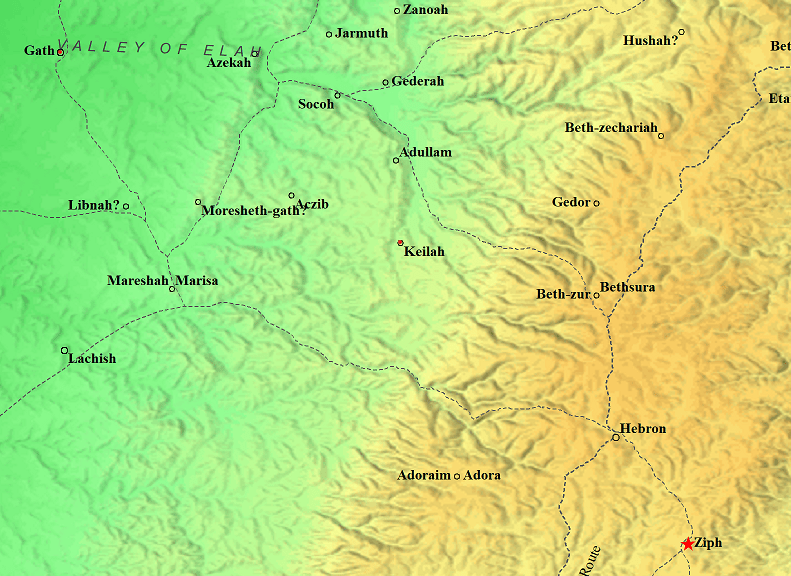
    Yes he ran from King Achish, escaping from his influence and ending up in a cave in Adullam. This cave was near a small settlement called Adullam, approximately 16 miles southwest of Jerusalem, between Israel and Philistia, a sort of no-mans land. It was an isolated location providing some anonymity for David. Or at least he may have thought so.

    But it was not to be so. David was a natural born leader and news of his location began to spread. Although the cave, according to my research was large enough to fit 40 men, was clearly not enough once the word got out.

    Soon, the cave was the central meeting place for the band of men that would become his fighting men, his militia, his comrades.

    And of course, only the finest men came, those of high standing, wealthy, highly trained men with good blood lines. No – this is not so, for those who came to David were of three descriptions.

    Those in Distress

    These men who came to David were in distress, or in other words, anguish. They were undergoing personal trials, and may have looked to David for solutions, or at the very least to provide an escape from the conditions they wanted out of.

    This does not bode well for the “value” these men brought to David, for they may have initially been more of a burden to the future king than a benefit.

    Yet David took them in, accepting them and became their commander, their leader, their master. I may be overextending the message here, but I have noticed that those who are under the greater pressure in their lives, if given a place to focus their thoughts and lives, actually shake off the distress they may have experienced.

    Those in Debt

    Our second group on individuals who congregated around David were those who had no personal resources to bring to the fight. They had a baggage of debt, and though it may have been circumstantial, it may also indicate one who is not a responsible man, one who does not have a disciplined life. These who came with debt may have been born into it, without any connection to the circumstance of the debt. In both these cases, David became their commander. Those who were born into debt, and those who allowed / created their own debt. Both were now with David.

    Those bitter in soul

    Bitterness. It speaks of anger, of a discontented spirit. A certain hostility towards life.

    I find it instructive that when David was on the run from his own son years later, Hushai described the king and his men as enraged like a bear.

    2 Samuel 17:8 Hushai said, “You know that your father and his men are mighty men, and that they are enraged, like a bear robbed of her cubs in the field. Besides, your father is expert in war; he will not spend the night with the people.

    Enraged. This bitterness spoken of in this passage leads me to see some amongst David’s fighting men as men who are on the edge, furious, ready to lash out, even possibly somewhat out of control.

    These that came to David were not of the highest quality of men, but how they came to David and what they became are two different stories. David became their commander, and as they followed David, they found themselves becoming a fighting force, a group of men who coalesced about a leader, on the path to the Kingdom.

    Of course, this is such a beautiful picture of the greater David, associating with 12 men who may not have been the most illustrious, powerful and influential of men, but by being with Him, they turned the world upside down!

    Acts 4:13 Now when they saw the boldness of Peter and John, and perceived that they were uneducated, common men, they were astonished. And they recognized that they had been with Jesus.

    Is it not so for the modern man too, for if we seek to be with Him, our life will change. It matters not where we start in life, what hole we may be in, what moral depth we may have fallen into, what personal hell we are experiencing. He is there to accept us and to lead us into His Kingdom.

    1 Corinthians 1:26 For consider your calling, brothers: not many of you were wise according to worldly standards, not many were powerful, not many were of noble birth.

    Yes – He is there to accept you, change you and lead you into His Kingdom.


    Thanks again for coming to visit. I hope you found something of interest in this post and would appreciate a comment, to begin a discussion. If you know someone this blog may bless (or challenge), send them a link, so they may join us in our discussion.

    Come join us at Considering the Bible

    ← Back

    Thank you for your response. ✨

    Warning
    Warning
    Warning
    Warning.

    Share this:

    • Email a link to a friend (Opens in new window) Email
    • Print (Opens in new window) Print
    • Share on Telegram (Opens in new window) Telegram
    Like Loading…
  • Jesus in the Old Testament – Abraham – 13

    2024-10-15

    Jesus in the Old Testament is a series of posts that will offer my readers a chance to consider pictures or shadows of Jesus in the Old Testament. As mentioned in the introduction to this series, some may be obvious, some may be not so obvious, and some may simply be a facet of the Lord those reading may not have considered previously.

    I hope as we venture through this series, we will see the Lord in many wonderful pictures throughout the Old Testament.

    SEEING JESUS IN
     
    ABRAHAM
     
    MANY OFFSPRING
     
    Genesis 15:5 And he brought him outside and said, “Look toward heaven, and number the stars, if you are able to number them.” Then he said to him, “So shall your offspring be.”
     
    Galatians 3:29 And if you are Christ’s, then you are Abraham’s offspring, heirs according to promise.

    How many children did Abram have at this time? Take a quick guess.

    If you said zero, you would be right! He only had a servant who would act as his heir in the event of his death. No children. Not one. And we must remember that Abram was an old man by this time. And yet in this passage, the Lord promised him offspring as numerous as the stars in heaven. It may have started slowly, and required a miraculous birth, but Abram’s offspring through Sarah was found in one son.

    Isaac is a great image of Jesus in the Old Testament, and we shall consider him in the future, but for this post, consider the many offspring through the promise offered in this passage, during an extended time of disappointment and apparent delay.

    Looking back, it is abundantly clear that the promise offered to Abram has been realized, for no-one could count the number of physical children that are from the loins of Abram. To go beyond the physical, to the greater intent of the promise, we must realize that we all as believers are the result of this promise to Abraham being exercised through the Lord Jesus Christ. He is the One who is the source of life, and of whom we are properly related to in relation to our faith.

    His offspring are greater than the stars of the sky!

    Thanks again for coming to visit. I hope you found something of interest in this post and would appreciate a comment, to begin a discussion. If you know someone this blog may bless (or challenge), send them a link, so they may join us in our discussion.


    ← Back

    Thank you for your response. ✨

    Warning
    Warning
    Warning
    Warning.

    Come join us at Considering the Bible

    Share this:

    • Email a link to a friend (Opens in new window) Email
    • Print (Opens in new window) Print
    • Share on Telegram (Opens in new window) Telegram
    Like Loading…
  • Names of God – EVERLASTING ARMS – 118

    2024-10-14

    My hope is that this series will offer my readers a chance to consider the names, characteristics and descriptions of our God in the Word.

    The remaining Names of God in this series might be considered descriptors, or characteristics of the Lord. We have reviewed the three primary Names of God, along with nineteen compound Names of God in our previous posts. As we venture through these descriptors of our God, I hope we will recognize all the many characteristics of our God that we tend to take for granted.

    The Word is truly rich with descriptions of the Living God, and this effort of searching in the Word was quite illuminating. He truly is the ultimate subject of the Word, and His revelation of self-descriptions, or the accolades offered Him by His priests, prophets, kings apostles and faithful truly is a blessing.

    May the Name of the Lord be praised, and by thinking on His name, may you have a blessed day.

    118
     
    EVERLASTING ARMS
     
    Deuteronomy 33:27 The eternal God is your dwelling place, and underneath are the everlasting arms. And he thrust out the enemy before you and said, ‘Destroy.’
    In our last post we referred to the very same verse, and noted that Moses described Israel’s dwelling place, not as a patch of land, but as the Eternal God. We also noted that Moses did not use the typical word commonly used to describe eternal (“Olam”) in the Old Testament, but “qedem”, emphasizing Gods past existence, that God is from the beginning.

    Moses strengthens his message with our next description of God, describing God as Israel’s Everlasting Arms. Here is where Moses uses the commonly used Hebrew word translated as eternal, or everlasting, not specifically defining Gods past existence, but His existence not in relation to our time based understanding.

    For God to be called the Everlasting Arms brings many thoughts to mind.

    First off, He arm is under the believer, supporting us, carrying us. In this word picture, we don’t have a God who is looking down on us, pointing fingers, demanding results. We have a picture of a loving Father, ready to protect us as we learn to walk, ready to scoop us up if we fail.

    His arm provides redemption
     Exodus 6:6 ..and I will redeem you with an outstretched arm 

    His arm provides protection
     Isaiah 52:10 The LORD has bared his holy arm

    His arm provides strength
    Psalm 136:12 with a strong hand and an outstretched arm,

    His arm provides salvation
    Isaiah 53:1 ..And to whom has the arm of the LORD been revealed?

    The Arm of the Lord has been revealed in the person of Christ, most gloriously on the cross, suffering for my sin, for your sin.

    He is the Everlasting Arm, never to die again, always on the throne with might and power, protecting His people.

    I would love to hear of your favorite name, characteristic or description of the Living God. Please leave me a comment, and I will include it in the list!

    Thanks again for coming to visit. I hope you found something of interest in this post and would appreciate a comment, to begin a discussion. If you know someone this blog may bless (or challenge), send them a link, so they may join us in our discussion.


    ← Back

    Thank you for your response. ✨

    Warning
    Warning
    Warning
    Warning.

    Come join us at Considering the Bible

    Share this:

    • Email a link to a friend (Opens in new window) Email
    • Print (Opens in new window) Print
    • Share on Telegram (Opens in new window) Telegram
    Like Loading…
  • Song Squawk – The Lament Of Desmond R G Underwood Frederick IV

    2024-10-13

    In the mid nineties, I had a little red Buick and a big ol’ bass box in the trunk, and would listen to “Christian Rock”, cranked to 11.

    (What did you say?  Huh?  Can  you say that again, I didn’t hear you….)

    I have gotten away from that genre for many reasons, the least of which may be a loss of hearing, but some songs have stuck with me over the decades.

    The artist’s I listened to sought to reflect Scriptural teaching for the most part. They ranged from “preaching” pop culture religion to significant theological teaching. As I listened to the lyrics, I found some to be quite challenging.

    To be honest, I listened because I could justify the rock beat with “sanctified lyrics”.

    Occasionally I will post a song, supply the lyrics and make a comment or two. If you decide to listen to the tune, turn the speaker down unless you are already deaf. Some of the songs tend to have a certain “volume” about them!


    This post will consider the song

    The Lament Of Desmond R G Underwood Frederick IV – by Steve Taylor

    I have referred to Mr. Taylor in previous posts. His stuff has always been fresh no matter how many times I come back to him. The lyrics are worth a read, especially as you listen

    Ah, the news of my impending death
    Came at a really bad time for me
    Yeah, the news of my impending death
    Any other day might have been ok

    I was starting to track with my inner guide
    I was getting in touch with my feminine side
    But when the doctor starts whistling “Happy Trails”
    Tends to take a bit of wind out of the old sails

    Desi Ray, if I may be so blunt
    Galahad, bag your agnostic front
    Underwood, hire a good undertaker
    Freddie, get ready to meet your maker

    Ah, the news of my impending death
    Came at a really bad time for me
    I was far too young to depreciate
    When they read me my expiration date

    I’d built Iron Man stalls in the northern wild
    I’d played Cabbage Patch dolls with my inner child
    Now I’m getting sealed bids for a granite vault
    And I’m pretty sure this is my parents’ fault

    Ah, the news of my impending death
    Came at a really bad time for me
    When they cancel your breathing policy
    Tends to steal a bit of the old joie de vivre

    I’d just found the lost key to my mythic life
    So I bravely shook free of my kids and wife
    I had seminars booked as a second career
    Until a still, small voice screamed loud and clear

    Death is on it’s path to us and we need to keep the first things first! Don’t let it become a surprise!

    This fella can cut an issue fairly deep, and by that I mean he can “step on toes” fairly consistently. Don’t worry bout the volume on this tune! Take your time and get this guy’s message!

    Take a listen!

    Let me know what you think of the lyrics, and of the tunes!


    ← Back

    Thank you for your response. ✨

    Warning
    Warning
    Warning
    Warning.

    Follow Considering the Bible on WordPress.com

    Thanks again for coming to visit. I hope you found something of interest in this post and would appreciate a comment, to begin a discussion.

    Share this:

    • Email a link to a friend (Opens in new window) Email
    • Print (Opens in new window) Print
    • Share on Telegram (Opens in new window) Telegram
    Like Loading…
  • Psalms for Psome – Ps 65.03

    2024-10-12

    My wife and I are reading through the Psalms in our evening reading and occasionally a nugget of the Psalms jumps out of the page. Don’t you love it when, after years of reading the “Old Book” passages become alive, reinforcing old teachings or simply warming your heart.

    This is the book of Psalms, and it is rich.

    I pray I can communicate a portion of the blessing we receive from this wonderful book.

    Psalm 65

    9 You visit the earth and water it; you greatly enrich it; the river of God is full of water; you provide their grain, for so you have prepared it.
    10 You water its furrows abundantly, settling its ridges, softening it with showers, and blessing its growth.
    11 You crown the year with your bounty; your wagon tracks overflow with abundance.
    12 The pastures of the wilderness overflow, the hills gird themselves with joy,
    13 the meadows clothe themselves with flocks, the valleys deck themselves with grain, they shout and sing together for joy.

    In our last post we considered the previous 4 verses and arrived at the conclusion Paul provided in Romans 1, where those outside of the covenant with Israel has information in creation regarding the nature of God and of His might. Yet David does not stop with the general revelation, that God is mighty, but ventures into the care and abundance of God in relation to the created world. He did not simply create the world we live in and then abandon it, but visits the earth.

    He is the creator and sustainer of the created world, as He is with each of us.

    Verse 9 – 11 speak of God’s provision to all, through His overabundant care of the earth. His provision of life giving water throughout the world is not with a grudging attitude, or sparingly, but He makes it overflow, He greatly enriches it, the river is full. David repeatedly describes the abundance provided by the Lord of the life giving supply of water. Out of this supply of water, grain is provided, and the seasons produce much produce, more than enough.

    Beyond the picture of the domesticated picture of a harvest, David then proceeds to describe four additional areas that receive the abundance of God, as sheer grace to those occupying the area.

    Pastures of Wilderness

    The term for pastures speaks of a dwelling place, an abode, a home for the animals who are not domesticated, who are of the wilderness. God cares for them, providing them a place to belong to, an environment to dwell in.

    Hills

    David speaks of the hills as one that would put on a belt, ready for the day, but not a standard belt but a belt of joy. With the blessing of God provided, the hills are personified and exhibit joy. What a great concept to consider.

    Meadows

    David returns to the domesticated environment, when he refers to the meadow here, also personifying the area, being clothed with flocks. Given the modest environment David wrote from (and not our 20th century bent to skimpy clothing), to be clothed speaks of being covered, of an abundance of flocks.

    Valleys

    Of course, as the water is provided, the valleys recieve and with the water, the soils are ready to produce food stuffs, such as grain. But David isn’t through with his descriptions bearing human characteristics. The combination of the valleys and the grain, rejoice and shout, and sing!

    The whole “system” of this abundant blessing from God only results in a positive, good and fruitful response from His creation.

    As my wife and I are entering a slowing down of our lives, we have recently purchased a little hideaway, a place where we go to get away from the stress and strain of modern life, away from the bustle and hurry of cosmopolitan life.

    From the outside, it is a little shack, and has nothing about it that may appeal to some, but when the quiet is available and nature cant be avoided, and you listen real hard to the silence, there is a symphony playing, an orchestrated existence that many, if not most, ignore or are bothered by. The city life is required for many – I understand – yet we look so forward to experiencing the blessing of God’s nature when we can. This morning, with the sun just breaking, I look forward to hearing the symphony of nature once more.

    Be blessed my friends, and consider the gift God has provided in the world we inhabit. It is a gift for all, even to those at the ends of the earth, and as I have mentioned in previous posts, (Montana, The Quiet) the quiet of our created world simply screams the glory of God.


    ← Back

    Thank you for your response. ✨

    Warning
    Warning
    Warning
    Warning
    Warning.

    Thanks again for coming to visit. I hope you found something of interest in this post and would appreciate a comment, to begin a discussion.

    Follow Considering the Bible on WordPress.com

    Share this:

    • Email a link to a friend (Opens in new window) Email
    • Print (Opens in new window) Print
    • Share on Telegram (Opens in new window) Telegram
    Like Loading…
  • Names of God – ETERNAL GOD – 117

    2024-10-11

    My hope is that this series will offer my readers a chance to consider the names, characteristics and descriptions of our God in the Word.

    The remaining Names of God in this series might be considered descriptors, or characteristics of the Lord. We have reviewed the three primary Names of God, along with nineteen compound Names of God in our previous posts. As we venture through these descriptors of our God, I hope we will recognize all the many characteristics of our God that we tend to take for granted.

    The Word is truly rich with descriptions of the Living God, and this effort of searching in the Word was quite illuminating. He truly is the ultimate subject of the Word, and His revelation of self-descriptions, or the accolades offered Him by His priests, prophets, kings apostles and faithful truly is a blessing.

    May the Name of the Lord be praised, and by thinking on His name, may you have a blessed day.

    117
     
    ETERNAL GOD
     
    Deuteronomy 33:27 The eternal God is your dwelling place, and underneath are the everlasting arms. And he thrust out the enemy before you and said, ‘Destroy.’
    Moses spends all of Deuteronomy 33 defining the blessing of God for each tribe of Israel, much like Israel did in Genesis 49 prior to his passing.

    His conclusion to this list of blessings is a summary statement of Moses as he closes this section of the Word. He is addressing all of Israel, and not any individual tribe, stating the eternal God is their dwelling place.

    Hold up now – God has just delivered this rag tag family of slaves out from Egypt, creating a nation at Sinai, with divine laws and ordinances, defining a religious order, and finally delivering them east of the Jordan, on the cusp on receiving the promised land. He has delivered them to a place they can call their own, a place to dwell, and then Moses speaks of the Eternal God as their dwelling place.

    Note that Moses was directing the attention of the tribes to the Eternal God instead of the land, drawing their minds and hearts to the person of God, and not for just a fleeting glance, but directing them to consider God as the Eternal God.

    Sure God provided the tiny nation a land to settle in, but Moses wanted to direct them to the true “place” to live. Moses, in describing God as Eternal, does not refer to a place that can be defined by borders, or by size of fields and cities, but by the Eternal God, the God who is defined in relation to time.

    As a matter of fact, this term “Eternal” is not the common Hebrew word which I assumed Moses would use. This word is “qedem”, not “olam”, and it speaks of antiquity, of being of an ancient time, from the beginning. Moses, if I understand his message, is directing those entering the land to consider God as the One who has always been, Who has always existed, emphasizing the past existence of God, He who is the uncaused cause, the source of all life, independent from Creation and ruling over all. He speaks of God as the One who has existed from the beginning.

    Moses knew God’s people get distracted easily with the gifts of God, and he wanted to direct their attention to the source of all life, not the resources to survive, or to even to prosper.

    Do we not also get distracted, confused with shiny trinkets and dreams of grandeur? We need to find out place of dwelling in the Eternal God, and not simply be satisfied with earthly gifts from the Eternal God.

    For He alone is the Eternal God.

    I would love to hear of your favorite name, characteristic or description of the Living God. Please leave me a comment, and I will include it in the list!

    Thanks again for coming to visit. I hope you found something of interest in this post and would appreciate a comment, to begin a discussion. If you know someone this blog may bless (or challenge), send them a link, so they may join us in our discussion.


    ← Back

    Thank you for your response. ✨

    Warning
    Warning
    Warning
    Warning.

    Come join us at Considering the Bible

    Share this:

    • Email a link to a friend (Opens in new window) Email
    • Print (Opens in new window) Print
    • Share on Telegram (Opens in new window) Telegram
    Like Loading…
  • Conditional Security – 2 Timothy 2:24-26 – A

    2024-10-10

    2 Timothy 2:24-26

    24 And the Lord’s servant must not be quarrelsome but kind to everyone, able to teach, patiently enduring evil,

    25 correcting his opponents with gentleness. God may perhaps grant them repentance leading to a knowledge of the truth,

    26 and they may come to their senses and escape from the snare of the devil, after being captured by him to do his will.

    Second Timothy 2:24 is one of my favorite verses when it comes to godly instruction, how I am to respond to those around me, the exhortation to patience, and the exercise of gentleness. Massive challenges for myself, but for the intent of this post, let us focus on Paul’s reason for giving Timothy this direction.

    Three intended results of teaching with kindness, patience and gentleness are provided as follows.

    A knowledge of the Truth

    Paul is teaching Timothy on his approach to everyone in verse 24 and focuses somewhat on Timothy’s opponents in verse 25. If we are to accept the common understanding of pastoral life, we may think this manner of teaching is intended only for those in the church. After all, the pastor is the main teacher in the church and it may be assumed Paul is speaking to those primarily in the body Timothy is shepherding.

    I am of the opinion that the practice of the pastor in the first century was more akin to the tentmaker ministry we sometimes come across. A man who is ministering amongst a body, but is working to support himself and his family without any obligations placed on the believers. If so, then we have a man who has opportunity to teach everyone (as verse 24 states) and not only those within the church body.

    With all that said, Paul is addressing Timothy regarding those who need correction. Surely this means for all those who come in contact with the pastor, inside and outside of the body.

    Is Paul including those within the body of Christ, those who claim Christ as their Lord, as opponents? Did Paul have the concept in his mind that a church body never has any friction, and faction, any disputes within it? Surely not.

    So, when Paul speaks to Timothy of correcting his opponents with gentleness, I do not understand this as strictly intended for those outside of the body of Christ. How often do we see in the New Testament believers exhorted to repent, to change their mind on certain attitudes, ideas or issues in their lives. If you are willing to consider it, the Word is full of the message of repentance directed to believers. Over and over again the believer is challenged to change, to admit error, to be humble enough to listen and not argue.

    And what is Paul asking Timothy to guide those in and out of the church towards? Might it be to accept a knowledge of the truth. Paul does not get super specific, and require Timothy to convince all in the body of dispensationalism, or Calvinism, or infant baptism. That may be an overextension of this command.

    The term “knowledge” is interesting. Paul uses epígnōsis, the knowledge that speaks of full discernment or acknowledgement. I wrote once of a time in my past where I understood two different types of knowledge one can acquire. Factual and experiential. (Refer to Inherit the Kingdom? Who knew?)

    Paul uses the term that is associated with experience, (not simply the acquisition of factual knowledge) and he places a prefix on it to expand it to full experiential knowledge. When I come to this message, I understand it to imply orthopraxy, or the right belief with the right practice. Timothy was not being told to simply argue his opponent into agreement, but to pull them into a lifestyle associated with the truth.

    So Paul is directing Timothy to correct with gentleness those opponents within and without the church, into correct thinking and living.

    Let us remember that Paul was not one who wore rose colored glasses, thinking the church was all kumbaya. He knew of opponents within the church, and he was preparing Timothy on how to best deal with them.

    In our next post we will dig a little further into this set of verses and try to understand Paul’s thoughts, especially regarding that “snare of the devil” statement

    Until then, remember we are to know the Lord, not only in a factual (head knowledge) way, but also in an experiential (heart knowledge) way, to trust Him and see His working in our lives on a daily basis.

    May His Name be honored in our lives, and may we walk with Him in truthfulness.


    Thanks again for coming to visit. I hope you found something of interest in this post and would appreciate a comment, to begin a discussion. If you would like to receive daily posts from Considering the Bible, click on the “Follow” link below

    ← Back

    Thank you for your response. ✨

    Warning
    Warning
    Warning
    Warning
    Warning.

    Follow Considering the Bible on WordPress.com

    Share this:

    • Email a link to a friend (Opens in new window) Email
    • Print (Opens in new window) Print
    • Share on Telegram (Opens in new window) Telegram
    Like Loading…
  • Life of David – 12.02

    2024-10-09

    David Flees to Gath

    As many who have followed me for a bit, I have fallen into the Psalms, and I can’t get up! (As if I would want to.) The Psalms are a majestic collection of poetry, of heart felt human experiences that constantly challenge me in my own frail attempt to follow the true King. As many of the Psalms are written by David, my study on the Psalms has spurred me on to looking at the life of David, is the main contributor to this book, and to follow the victories and tragedies of the shepherd King of Israel.

    Many times in the narrative, we will see the Lord Jesus, imperfectly, yet a reflection of His spirit in a man with weaknesses.

    Let’s continue in 1 Samuel 21:12-15, where David faces the King of Gath, in the Philistine territory.

    12 And David took these words to heart and was much afraid of Achish the king of Gath.
    13 So he changed his behavior before them and pretended to be insane in their hands and made marks on the doors of the gate and let his spittle run down his beard.
    14 Then Achish said to his servants, “Behold, you see the man is mad. Why then have you brought him to me?
    15 Do I lack madmen, that you have brought this fellow to behave as a madman in my presence? Shall this fellow come into my house?”

    David heard the servants of Achish speak the very words that caused him to flee from the murderous king Saul. The military success David experienced, that the Israeli women sang of, was becoming a noose tightening around his throat.

    How could something that was done in the service of his king become the very reason he was being persecuted, and on the run for his life? We cannot assume that good deeds will produce favorable results for ourselves, and as we may enter this circumstance in our own lives, we need to remember the Lord Jesus in his offering of blessing, and receiving of death. It is not an uncommon experience for the believer!

    But let us take a look at our passage this morning with a bit more detail.

    David reacted to the words of the servants to Achish, and made the decision to act mad. Notice that the servants of Achish had David “in their hands”, implying they were restricting him from attacking Achish.

    Although hindsight is 20/20, if David had taken a chance with Achish to explain the situation, might the outcome have been different? Did David have an opportunity to discuss with Achish during the servants report to Achish? It does seem that as David feigned madness, Achish was present with the servants.

    Again, let us remember that David was in flight mode, and may have been less strategic and more reactive at this early period of his running. I get it, for though I have not had the threat of death chasing me, I have experienced a state of fear that greatly influenced my decision making skills. Reacting to a fear based problem is a knee jerk reaction, and if David’s response was out of a reaction to the situation, I get it!

    But David really put in on, for his act of madness was awesome. Spittle down the beard! Wow. Achish accepted the appearance of insanity and simply rejected David from his house. It may have went far worse for the future king of Israel, for David was the reason the Philistines lost the battle years back. David could have been considered a national enemy of the Philistines, but for some reason Achish may have provided some protection in the acceptance of David as being mad!

    David may have acted mad, but out of this experience poured forth Psalm 34. Take a moment and consider the truths of the Psalm, understanding the background of David’s experience

    I began this post with a question. How could doing good produce problems instead of blessings for the doer? In the midst of trials, God’s blessing may be found in our weakness. He is the ever helpful One, working out His will in the middle of our confusion and poor reactions. As we see this truth in our lives, I pray we move from reacting out of fear to trusting Him in the midst of a problem, listening for direction from Him we need to obey.

    May it be so!


    Thanks again for coming to visit. I hope you found something of interest in this post and would appreciate a comment, to begin a discussion. If you know someone this blog may bless (or challenge), send them a link, so they may join us in our discussion.

    Come join us at Considering the Bible

    ← Back

    Thank you for your response. ✨

    Warning
    Warning
    Warning
    Warning.

    Share this:

    • Email a link to a friend (Opens in new window) Email
    • Print (Opens in new window) Print
    • Share on Telegram (Opens in new window) Telegram
    Like Loading…
  • Jesus in the Old Testament – Abraham – 12

    2024-10-08

    Jesus in the Old Testament is a series of posts that will offer my readers a chance to consider pictures or shadows of Jesus in the Old Testament. As mentioned in the introduction to this series, some may be obvious, some may be not so obvious, and some may simply be a facet of the Lord those reading may not have considered previously.

    I hope as we venture through this series, we will see the Lord in many wonderful pictures throughout the Old Testament.

    SEEING JESUS IN
     
    ABRAHAM
     
    WARRIOR / REDEEMER
     
    Genesis 14:14-16
    When Abram heard that his kinsman had been taken captive, he led forth his trained men, born in his house, 318 of them, and went in pursuit as far as Dan.
    And he divided his forces against them by night, he and his servants, and defeated them and pursued them to Hobah, north of Damascus.
    Then he brought back all the possessions, and also brought back his kinsman Lot with his possessions, and the women and the people.
     
    Titus 2:14 who gave himself for us to redeem us from all lawlessness and to purify for himself a people for his own possession who are zealous for good works.

    Abram, when he began his pilgrimage to a land God promised him, a nephew tagged along, a nephew by the name of Lot. He tended to be the lesser man, with Abram being the leader, and Lot having an eye for the lesser things in life.

    Nevertheless, when four kings met in the valley of Siddim to have it out with five other kings, the battle engulfed Lot and his family. They were taken away along with the spoils of war from their homes and fields.

    Abram and his immediate family were beyond the scope of the battle field, and nothing was of any concern until he heard of Lot’s predicament. This would not stand, for Abram was a man who was committed to those who went on pilgrimage with him, and he convinced his allies in the area to a pursuit of his families captors.

    In the end, he brought back all the possessions, family kinsmen, the women and the remaining people. A stunning victory.

    Jesus, as our redeemer, also entered into a battle with our captor, and in His battle, gave his own life that we might be freed.

    Abram was a warrior redeemer for those who loved him.

    Jesus was a warrior redeemer for those who hated Him.

    He is a much more stellar warrior redeemer, who should be worshipped and loved more every day.


    Thanks again for coming to visit. I hope you found something of interest in this post and would appreciate a comment, to begin a discussion. If you know someone this blog may bless (or challenge), send them a link, so they may join us in our discussion.


    ← Back

    Thank you for your response. ✨

    Warning
    Warning
    Warning
    Warning.

    Come join us at Considering the Bible

    Share this:

    • Email a link to a friend (Opens in new window) Email
    • Print (Opens in new window) Print
    • Share on Telegram (Opens in new window) Telegram
    Like Loading…
  • Names of God – ETERNAL SPIRIT – 116

    2024-10-07

    My hope is that this series will offer my readers a chance to consider the names, characteristics and descriptions of our God in the Word.

    The remaining Names of God in this series might be considered descriptors, or characteristics of the Lord. We have reviewed the three primary Names of God, along with nineteen compound Names of God in our previous posts. As we venture through these descriptors of our God, I hope we will recognize all the many characteristics of our God that we tend to take for granted.

    The Word is truly rich with descriptions of the Living God, and this effort of searching in the Word was quite illuminating. He truly is the ultimate subject of the Word, and His revelation of self-descriptions, or the accolades offered Him by His priests, prophets, kings apostles and faithful truly is a blessing.

    May the Name of the Lord be praised, and by thinking on His name, may you have a blessed day.

    116
     
    ETERNAL SPIRIT
     
    Hebrews 9:14 how much more will the blood of Christ, who through the eternal Spirit offered himself without blemish to God, purify our conscience from dead works to serve the living God.
    In our last post on the Names of God, we considered “Eternal Life”. This post will address another name of God involving the term eternal. With that, it may be good to consider what eternal actually means.

    It generally has the meaning of everlasting, or of forever. I did a bit of a deep dive (for me) and posted my findings previously on this blog. If you are interested and are willing to consider some of my thinking, check out A Study of Eternal / Everlasting.

    Nevertheless, it is the Spirit that is eternal in this verse and our previous passage spoke of the Son as Eternal Life. I am sure you will not be surprised by our next post, and who is described as eternal in that passage.

    But I speak without thinking. For the passage before us speaks of the reliance of the Lord upon His equal, the Spirit of God, to be enabled to offer Himself to God.

    Jesus had spent entire His life depending on the Father through the Spirit, and when His greatest challenge came, He continued to trust, He continued to rely on the Spirit of God in His death.

    What trust! What strength the Spirit supplied, in the midst of such injustice, hatred, suffering, confusion and shame.

    He is the Eternal Spirit!

    I would love to hear of your favorite name, characteristic or description of the Living God. Please leave me a comment, and I will include it in the list!

    Thanks again for coming to visit. I hope you found something of interest in this post and would appreciate a comment, to begin a discussion. If you know someone this blog may bless (or challenge), send them a link, so they may join us in our discussion.


    ← Back

    Thank you for your response. ✨

    Warning
    Warning
    Warning
    Warning.

    Come join us at Considering the Bible

    Share this:

    • Email a link to a friend (Opens in new window) Email
    • Print (Opens in new window) Print
    • Share on Telegram (Opens in new window) Telegram
    Like Loading…
  • Calvin’s Concerns – Predestination Short

    2024-10-06

    I hope all is well in your world.

    As I was researching out a passage for a series I had been working on, I stumbled over what is commonly called a “short”, a video that is relegated to approx. 60 seconds on youtube.

    I took a minute to watch and found it to be a very good alternate explanation of predestination for the believer.

    As I may have spoken of earlier in my posts, I spent many years consumed with the Calvinistic teaching, only to break free because of men like Dr. Flowers, who offer alternative views that make more sense and glorify God, making Him purer, and more loving.

    I do hope you will consider the teaching with an open mind.


    ← Back

    Thank you for your response. ✨

    Warning
    Warning
    Warning
    Warning.

    Follow Considering the Bible on WordPress.com

    Thanks again for coming to visit. I hope you found something of interest in this post and would appreciate a comment, to begin a discussion.

    Share this:

    • Email a link to a friend (Opens in new window) Email
    • Print (Opens in new window) Print
    • Share on Telegram (Opens in new window) Telegram
    Like Loading…
  • Psalms for Psome – Ps 65.02

    2024-10-05

    My wife and I are reading through the Psalms in our evening reading and occasionally a nugget of the Psalms jumps out of the page. Don’t you love it when, after years of reading the “Old Book” passages become alive, reinforcing old teachings or simply warming your heart.

    This is the book of Psalms, and it is rich.

    I pray I can communicate a portion of the blessing we receive from this wonderful book.

    Psalm 65

    5 By awesome deeds you answer us with righteousness, O God of our salvation, the hope of all the ends of the earth and of the farthest seas;
    6 the one who by his strength established the mountains, being girded with might;
    7 who stills the roaring of the seas, the roaring of their waves, the tumult of the peoples,
    8 so that those who dwell at the ends of the earth are in awe at your signs. You make the going out of the morning and the evening to shout for joy.

    In our last post, we spoke of the One who was chosen and brought near to dwell in the Father’s courts, and suggested this makes most sense, (from our perspective – knowing what we know) that Jesus Christ is the fulfillment of this verse. We also suggested that this psalm is not restricted to Israel only, but with the development of the first four verses discussing “all flesh”, we suggested it may be to a greater audience.

    With this set of verses this morning, this suggestion gains additional traction in my opinion, since David refers to “hope of all the ends of the earth and of the farthest seas” David is making a point, looking beyond Israel’s boundaries, beyond the kingdoms he knows of, and declaring God is speaking – answering us with righteousness.

    With the entire creation being referenced, and David bringing in the concept of answering us, my natural response is – What was the question? What question was on all of creations lips, that God is answering in righteousness?

    This entire portion speaks of the power of God being exhibited in creation and of God’s ability to manage creations “natural” processes. I say “natural” for I believe God is involved in all the processes of nature, as I understand David speaks also

    In David’s writing, he speaks not only of the physical creation and it’s seeming upheaval, but also of the restlessness of the people, of those who are unsettled like the seas. They will be answered with the signs provided.

    But again, what was the question?

    David speaks of the way (or method) God provides an answer in verse 5-7 (by awesome deeds), and speaks of the anticipated response of awe by those who dwell at the ends of the earth in verse 8. This anticipated response speaks of astonishment, reverence or godly fear.

    This entire psalm, referring to the ends of the earth often within its verses, is speaking of the nations who at the time of writing, did not have the special revelation of the Law and the privilege of the prophets. The only communication provided to the creation is of the created world. For those without Israel’s elevated status of special revelation, God provided the display of nature to talk to all. The message is that the power and might of the Lord is clearly revealed. Paul speaks of the message and helps to define the question, in Romans 1

    Romans 1:20 – For his invisible attributes, namely, his eternal power and divine nature, have been clearly perceived, ever since the creation of the world, in the things that have been made. So they are without excuse.

    Creation shows His power and divine nature, so any questions that those outside of Israel had regarding God in relation to our responsibility to Him is addressed by the very existence of our surroundings. God has provided enough evidence, nay more than enough evidence for all to understand the power and nature of God. He is mighty, yet the psalm continues with additional characteristics beyond shear power and might of God.

    Please join me as we venture into the next portion of Psalm 65, seeing further evidence of the God we serve.

    ← Back

    Thank you for your response. ✨

    Warning
    Warning
    Warning
    Warning
    Warning.

    Thanks again for coming to visit. I hope you found something of interest in this post and would appreciate a comment, to begin a discussion.

    Follow Considering the Bible on WordPress.com

    Share this:

    • Email a link to a friend (Opens in new window) Email
    • Print (Opens in new window) Print
    • Share on Telegram (Opens in new window) Telegram
    Like Loading…
  • Names of God – ETERNAL LIFE – 115

    2024-10-04

    My hope is that this series will offer my readers a chance to consider the names, characteristics and descriptions of our God in the Word.

    The remaining Names of God in this series might be considered descriptors, or characteristics of the Lord. We have reviewed the three primary Names of God, along with nineteen compound Names of God in our previous posts. As we venture through these descriptors of our God, I hope we will recognize all the many characteristics of our God that we tend to take for granted.

    The Word is truly rich with descriptions of the Living God, and this effort of searching in the Word was quite illuminating. He truly is the ultimate subject of the Word, and His revelation of self-descriptions, or the accolades offered Him by His priests, prophets, kings apostles and faithful truly is a blessing.

    May the Name of the Lord be praised, and by thinking on His name, may you have a blessed day.

    115
     
    ETERNAL LIFE
     
    1 John 1:2 the life was made manifest, and we have seen it, and testify to it and proclaim to you the eternal life, which was with the Father and was made manifest to us–
    Eternal life is not principally a possession we gain or a condition we enter as we initially trust Christ, but eternal life is the very essence of the Christ.

    He is eternal life, and to be found in Him is to be a partaker of eternal life. John tells us that Jesus is eternal life and that eternal life was shown to us while Jesus walked this earth.

    I have thought for may years that eternal life speaks of duration of life, and this surely has merit, yet as I walk with Him as feebly as I do, I find that eternal life is a quality of life.

    If the concept of our spirit existing forever is true, then eternal life is of no added benefit if the quality of life is not a major consideration. Of course, eternal life speaks of no beginning and no end, and there are some who may claim that humans also had a pre existence, and will exist forever, but I find little evidence of this teaching in the Word.

    What I do find evidence of in the Word is the quality of our Savior, the stellar character of His person, the gracious acceptance of those who are against Him, the willingness to bow down to us, bow down ever so far, to meet us in our sorry condition.

    As believers, let us consider Who the true eternal life is, that the person of the Christ is eternal life embodied in flesh, the One who gave His life up to manifest eternal life to those who had nothing to give.

    He is Eternal Life!

    I would love to hear of your favorite name, characteristic or description of the Living God. Please leave me a comment, and I will include it in the list!

    Thanks again for coming to visit. I hope you found something of interest in this post and would appreciate a comment, to begin a discussion. If you know someone this blog may bless (or challenge), send them a link, so they may join us in our discussion.


    ← Back

    Thank you for your response. ✨

    Warning
    Warning
    Warning
    Warning.

    Come join us at Considering the Bible

    Share this:

    • Email a link to a friend (Opens in new window) Email
    • Print (Opens in new window) Print
    • Share on Telegram (Opens in new window) Telegram
    Like Loading…
  • Conditional Security – 1 Timothy 4:1-3 – B

    2024-10-03

    Let’s remind ourselves of the verses we have been exploring before we dive into our second look at it.

    1 Timothy 4:1-3

    Now the Spirit expressly says that in later times some will depart from the faith by devoting themselves to deceitful spirits and teachings of demons,
    2 through the insincerity of liars whose consciences are seared,
    3 who forbid marriage and require abstinence from foods that God created to be received with thanksgiving by those who believe and know the truth.

    In our last post on this passage, we discussed the concept of departing, and that it was not simply describing the one act of apostacy, or better yet, the verse didn’t simply use the term “apostacy” in the passage. In this post, we will look at the message of devotion, of believers devoting themselves to something other than the gospel and the Savior Lord.

    Devoting themselves

    Devoting. προσέχω proséchō

    Paul continues in this verse describing those who are departing as devoting themselves to deceitful spirits and teachings of demons. By using the word proséchō, Paul uses a word that is typically translated as that which holds the mind, to pay attention to, to adhere to. It is often translated as beware, pay attention to, and devote. A few examples may be helpful.

    The Lord spoke this word many times in His ministry, warning His followers of false prophets (Matthew 7:15), the teaching of the Sadducees and Pharisees (Matthew 16:6), our own religious pride (Matthew 6:1), and of men (Matthew 10:17).

    Luke used it also in the book of Acts, where it interestingly describes paying attention to magicians claiming God’s power.

    Acts 8:10-11

    They all paid attention to him, from the least to the greatest, saying, “This man is the power of God that is called Great.” And they paid attention to him because for a long time he had amazed them with his magic.

    When we get to Paul’s writing, especially the pastoral epistles, he speaks of devotion to myths and genealogies (1 Timothy 1:4), deceitful spirits and teachings of demons, commands of people who turn away from the truth (Titus 1:14), and wine (1Timothy 3:8).

    With this summary of the word proséchō provided, might it be understood that this word is used in relation to outside influences? From being a warning of dangerous lifestyles or teaching, to defining what we are attracted to that is dangerous, this term in many contexts is associated with that which “pulls us away”.

    To be pulled away means you have a starting point from which you are pulled away from, further helping us understand this verse as a warning to true believers.

    To depart and devote is Paul’s concern in this verse. For believers to depart from the faith and to devote (pay attention) to deceitful spirits and teachings of demons must have been heartbreaking for Paul to describe.

    This same term proséchō is not used exclusively in describing a pulling away from the faith, but is also used to direct believers to pay attention to truth.

    Hebrews 2:1 Therefore we must pay much closer attention to what we have heard, lest we drift away from it.

    Drifting away is a very real consequence for us who do not pay attention to what we have heard and know. Do not let it slip!

    Finally, Peter provides us a fitting verse to end this scary passage describing the path of believers who are departing and devoting themselves to wrong teachings.

    2 Peter 1:19 And we have the prophetic word more fully confirmed, to which you will do well to pay attention as to a lamp shining in a dark place, until the day dawns and the morning star rises in your hearts,


    Thanks again for coming to visit. I hope you found something of interest in this post and would appreciate a comment, to begin a discussion. If you would like to receive daily posts from Considering the Bible, click on the “Follow” link below

    ← Back

    Thank you for your response. ✨

    Warning
    Warning
    Warning
    Warning
    Warning.

    Follow Considering the Bible on WordPress.com

    Share this:

    • Email a link to a friend (Opens in new window) Email
    • Print (Opens in new window) Print
    • Share on Telegram (Opens in new window) Telegram
    Like Loading…
  • Life of David – 12.01

    2024-10-02

    David Flees to Gath

    As many who have followed me for a bit, I have fallen into the Psalms, and I can’t get up! (As if I would want to.) The Psalms are a majestic collection of poetry, of heart felt human experiences that constantly challenge me in my own frail attempt to follow the true King. As many of the Psalms are written by David, my study on the Psalms has spurred me on to looking at the life of David, is the main contributor to this book, and to follow the victories and tragedies of the shepherd King of Israel.

    Many times in the narrative, we will see the Lord Jesus, imperfectly, yet a reflection of His spirit in a man with weaknesses.

    Let’s continue with David’s escape from Israel.

    1 Samuel 21:10-11
    10 And David rose and fled that day from Saul and went to Achish the king of Gath.
    11 And the servants of Achish said to him, “Is not this David the king of the land? Did they not sing to one another of him in dances, ‘Saul has struck down his thousands, and David his ten thousands’?”

    Let’s remember where we are in the life of David.

    He was pulled from his duties as a shepherd, and sent on a errand to his brothers. The next day he is the champion of Israel. Soon he is stretched between family and the king, being offered two princesses of Israel for a bride. Within a brief span of time, he is commanding his own troop of soldiers, taking on deadly challenges the king throws him into, succeeding in every endeavor. Throw into the mix of this heady experience, a prophet of God anoints him as the next king of Israel!

    Yet all this fame caused his popularity to become like a noose around his neck. The women of Israel sung a song of David’s exploits, comparing him with the king. This caused a problem, for the king was an unstable man, finding his self worth in the position of king, and this comparison threatened him and his position. Threatened him to the point of placing a death sentence on David!

    Now he is on the run. The first place he heads to is a man of God in Nob, where he spins a yarn to get some food and a weapon from the house of the Lord.

    This passage has him running from Nob to Gath, which is a major city of the Philistines, to Achish, the king of Gath and away from the Saul, the king of Israel.

    David had no where to go that was safe, and his flight to a Philistine city speaks of his judgement of safety in Saul’s domain. Yet, what was he thinking by going into the very city Goliath was from? Ekron was as close, and to all appearances, did not have the history as with the City of Gath. He had humiliated Achish, the local king of Gath when he took down Goliath, and now he is at the kings doorstep.

    Although 100% conjecture, let me suppose a couple of scenarios. Nob was located just northeast of Jerusalem (Jebus at the time) and if the Philistine territory was the next best place to find safety, David had two options that were closest. He could travel to Gath or Ekron. They both seem to be approx. 25 miles from Nob, so why choose Gath?

    Did David understand that in the killing of Goliath, he performed without knowing, a service to Achish. Had Goliath become a threat to the power of Achish, as David had become in the mind of Saul? Was David now seeing Achish as a possible ally?

    It appears that David’s assumption may have not have been accurate, for his reputation had proceeded him. Not only had the song of Israel’s women proceeded him, showing him to be a greater soldier than Israel’s king, it seems common knowledge amongst the Philistines was that David had become the king of Israel. Was this some misunderstanding, some gossip that had got out of control, or did the heathen of the land understand and believe the prophecy of Samuel, the anointing of David for future kingship?

    So many unknowns, yet I notice truths popping out of this short passage.

    Popularity is a two edged sword. David’s success in battle, above and beyond his kings abilities, produced a murderous king Saul, causing David to run for his life. That same popularity has met him in in another country, causing leadership in that nation to fear him.

    If David’s anointing was known in Philistine, were the Philistines more accepting of the truth than the Israeli population? Also, if the Philistines had common (though erroneous) knowledge of David being king, would it not have spread amongst the Israeli population also. If so, David judged the heathen to be safer than the people of God.

    This seems to be a common theme through the Word, where a man (or message) of God is rejected by the people of God, only to be accepted by those outside of the community of faith. Did not the Savior spend time in the Decapolis, on the northern shore, and also amongst the Samaritans. Was He not welcomed by those who had been rejected by the religious?

    For David, he had nowhere to go, and his hope of finding refuge amongst the Philistines didn’t look good at this time. It is interesting that Achish appears in David’s life later, and actually provides him a city to reside in, but we will get to that passage a bit later.

    For now, let David’s life be an encouragement for each of us, as we may be misunderstood by those who we share the faith with, not accepted by those outside of the faith, and at times have no where to go.

    But that is not true, for we always have a faithful and merciful high priest.

    Hebrews 4:16 Let us then with confidence draw near to the throne of grace, that we may receive mercy and find grace to help in time of need.


    Thanks again for coming to visit. I hope you found something of interest in this post and would appreciate a comment, to begin a discussion. If you know someone this blog may bless (or challenge), send them a link, so they may join us in our discussion.

    Come join us at Considering the Bible

    ← Back

    Thank you for your response. ✨

    Warning
    Warning
    Warning
    Warning.

    Share this:

    • Email a link to a friend (Opens in new window) Email
    • Print (Opens in new window) Print
    • Share on Telegram (Opens in new window) Telegram
    Like Loading…
  • Let Me Tell You a Story -Souls Under the Altar

    2024-10-01
    let-me-tell-you-a-story.jpg

    Revelation 6:9-10

    9-When he opened the fifth seal, I saw under the altar the souls of those who had been slain for the word of God and for the witness they had borne.
    10- They cried out with a loud voice, “O Sovereign Lord, holy and true, how long before you will judge and avenge our blood on those who dwell on the earth?”

    I am not in the book of Revelation very much but recently found myself in the 6th chapter, considering the above verses. What a horrible situation we find described here.

    Those who stood up for the Word of God had been slain. Take that in for a moment. The injustice, the hatred, the total rejection of God in the killing of His messengers. Yet it is curious, if that is the correct way of speaking, that the souls were under the altar.

    Would not the souls, being those of the righteous, be with the Lord? This was an assumption that I usually make, backed up with a verse such as

    2 Corinthians 5:8 Yes, we are of good courage, and we would rather be away from the body and at home with the Lord.

    Yet we find the souls of the righteous under the altar, crying out for justice on those who dwell on the earth, on those who poured out their blood. But wait – we have a picture of a sacrifice in the souls of the righteous, with the blood, and an altar being spoken of. And we have those who are to be judged, presumably for the death of the saints.

    Could this picture imply who the saints were persecuted by, and that should receive justice from God? John speaks of those who “dwell on the earth”, yet the picture presented seems to allow the persecutors, those who committed the murders of the saints, to be of a religious persuasion, spilling blood at an altar.

    How is it that to be understood? We are constantly associating religion with God, yet there are numerous instances within the Word where we find the saint is persecuted primarily by those who are the most religious!

    Surely, as an example we do not have to go far, for the most religious people on earth spent years finding a way to kill Him, and eventually they succeeded. His blood was shed on an altar of His own choice, and His experience with the religious has much to teach us.

    That is why it is so important for us to recognize the spirit of God being expressed in the character of the believer, having been described by the apostles of the Lord.

    May I offer a few verses that describe the saint, as opposed to the religious amongst us.

    Galatians 5:22-23 But the fruit of the Spirit is love, joy, peace, patience, kindness, goodness, faithfulness, gentleness, self-control; against such things there is no law.

    Matthew 11:29 Take my yoke upon you, and learn from me, for I am gentle and lowly in heart, and you will find rest for your souls.

    2 Timothy 2:24 And the Lord’s servant must not be quarrelsome but kind to everyone, able to teach, patiently enduring evil,

    I could bury this post in verses that speak of humility, patience, endurance, love, joy, sacrifice, and gentleness but I think my point is clear.

    The religious amongst us may not be our ally, but actually, without knowing, distract, delude, deceive, disappoint and destroy the believer. This truth should spark us to realize we need the Lord in relating with those who are both openly against us, and those who may seem to be with us. The Word has given us guidance in finding discernment of those surrounding us, and direction in how to related to them.

    Both brother and enemy is to experience love from the believer, yet the believer is to discern and understand those we are amongst.

    A bit of a ramble, but this short passage stirred something in me, and reminded me that to be religious is not necessarily the path God wants me to be on.

    He wants us to follow Jesus, and He was one of the most irreligious, and yet most righteous, Man who ever walked the earth!

    May we be a bit more like Him today, and a bit less religious!


    Thanks again for coming to visit. I hope you found something of interest in this post and would appreciate a comment, to begin a discussion. If you know someone this blog may bless (or challenge), send them a link, so they may join us in our discussion

    Come join us at Considering the Bible

    ← Back

    Thank you for your response. ✨

    Warning
    Warning
    Warning
    Warning
    Warning.

    Share this:

    • Email a link to a friend (Opens in new window) Email
    • Print (Opens in new window) Print
    • Share on Telegram (Opens in new window) Telegram
    Like Loading…
  • Names of God – EQUAL WITH GOD – 114

    2024-09-30

    My hope is that this series will offer my readers a chance to consider the names, characteristics and descriptions of our God in the Word.

    The remaining Names of God in this series might be considered descriptors, or characteristics of the Lord. We have reviewed the three primary Names of God, along with nineteen compound Names of God in our previous posts. As we venture through these descriptors of our God, I hope we will recognize all the many characteristics of our God that we tend to take for granted.

    The Word is truly rich with descriptions of the Living God, and this effort of searching in the Word was quite illuminating. He truly is the ultimate subject of the Word, and His revelation of self-descriptions, or the accolades offered Him by His priests, prophets, kings apostles and faithful truly is a blessing.

    May the Name of the Lord be praised, and by thinking on His name, may you have a blessed day.

    114
     
    EQUAL WITH GOD
     
    John 5:18 This was why the Jews were seeking all the more to kill him, because not only was he breaking the Sabbath, but he was even calling God his own Father, making himself equal with God.
    In John 5:17, Jesus claims for the first time, that God is His own Father. He simply states “My Father is working…

    No self respecting Israeli would be audacious enough to claim the eternal and all powerful Creator of all to be His own Father. This was clearly blasphemy in the minds of the learned religious class of Israel, for they had come to a conclusion very early on that Jesus could not be the Messiah.

    Of course, if they had no bias against this Rabbi, they may have considered all the prophecies He had fulfilled without His being able to control the circumstances. Prophecies of his birth, of His youth, of His family circumstances and lineage, His miracle working, His unassailable logic in teaching.

    God provided ample evidence of His person, and when Jesus simply stated what should have been obvious to unbiased ears, those who had closed their ears and eyes to facts, opened their hearts and mouths to the option of death.

    When the Jews stated that He made Himself equal to God, the term equal can be considered in both the quantitative or qualitative sense.

    Quantitative as in a math equation, or that two objects have the same number of components, or are equal in weight or number.

    Qualitative, as in the quality of two items. This meaning may be closer to the intent, for to be qualitatively equal to God the Father is to claim for Himself all the characteristics of the Most Blessed.

    This claim was completely beyond the Jews comprehension, for they were poisoned with a bias, and made assumptions that were completely unfounded. This dangerous attitude was based in a darkened heart that would not recognize the true God, for they imagined Him as a warrior, and not the servant, as One who would kill, and not save, as One who would separate and not join together.

    How far off they were from the Living One!

    Bias and assumptions about Jesus can kill you. Please – for your own sake – do not make uniformed decisions about who Jesus is, or listen to gossip about Him, or watch His followers make mistakes, or ignore the One who provided proofs.

    Read the record that provides the witness of His person. Read it with an open mind, and ask for insight. Might I suggest taking the gospel of John and as you read, ask hard questions about what the gospel is trying to communicate. Take your time reading it, looking for the message you need to hear.

    But don’t simply reject Him because of a bias, or an assumption. For He is equal with God.

    Read the Scriptures and believe!

    I would love to hear of your favorite name, characteristic or description of the Living God. Please leave me a comment, and I will include it in the list!

    Thanks again for coming to visit. I hope you found something of interest in this post and would appreciate a comment, to begin a discussion. If you know someone this blog may bless (or challenge), send them a link, so they may join us in our discussion.


    ← Back

    Thank you for your response. ✨

    Warning
    Warning
    Warning
    Warning.

    Come join us at Considering the Bible

    Share this:

    • Email a link to a friend (Opens in new window) Email
    • Print (Opens in new window) Print
    • Share on Telegram (Opens in new window) Telegram
    Like Loading…
  • Philippian Bits – Now What?

    2024-09-29

    Our travels through the book of Philippians is complete, though not done. I have studied this book many times and been the richer for it each time. This frail effort at a verse by verse study has been a blessing to me, sometimes a challenge to me, but always edifying for this old man.

    But we have come to the last verse in Philippians and I would like to offer my readers a chance to provide suggestions to replace the Philippian post on Sunday.

    I have a number of topical and character studies I am pursuing and enjoying currently on this blog, and appreciate your interaction with me on them.

    • Monday – Names of God
    • Tuesday – Jesus in the Old Testament
    • Wednesday – Life of David
    • Thursday – Paradoxical Passages, Conditional Security
    • Friday – Names of God
    • Saturday – Psalms for Psome
    • Sunday – Now What?

    Let me know your thoughts.

    Thanks again for reading!


    Thanks again for coming to visit. I hope you found something of interest in this post and would appreciate a comment, to begin a discussion. If you know someone this blog may bless (or challenge), send them a link, so they may join us in our discussion

    ← Back

    Thank you for your response. ✨

    Warning
    Warning
    Warning
    Warning
    Warning.

    Follow Considering the Bible on WordPress.com

    Share this:

    • Email a link to a friend (Opens in new window) Email
    • Print (Opens in new window) Print
    • Share on Telegram (Opens in new window) Telegram
    Like Loading…
  • Psalms for Psome – Ps 65.01

    2024-09-28

    My wife and I are reading through the Psalms in our evening reading and occasionally a nugget of the Psalms jumps out of the page. Don’t you love it when, after years of reading the “Old Book” passages become alive, reinforcing old teachings or simply warming your heart.

    This is the book of Psalms, and it is rich.

    I pray I can communicate a portion of the blessing we receive from this wonderful book.

    Psalm 65

    1 To the choirmaster. A Psalm of David. A Song. Praise is due to you, O God, in Zion, and to you shall vows be performed.
    2 O you who hear prayer, to you shall all flesh come.
    3 When iniquities prevail against me, you atone for our transgressions.
    4 Blessed is the one you choose and bring near, to dwell in your courts! We shall be satisfied with the goodness of your house, the holiness of your temple!

    Our first verse is hanging me out to dry. I am not sure what the message is, and I hope it isn’t because I am daft!

    The passage states that “Praise is due to you”, with a footnote, in the ESV, that suggests it may be understood as “Praise waits for you in silence”. When I first read out passage, I was thinking it was a matter of debt to God, that is praise is due to God, as in a natural reaction to all the blessings He provides. This is certainly true, for we shall never express all the praise owed to Him for His many mercies! Yet this passage seems to communicate the idea of silence, and waiting. Consider a few other translations.

    • NKJV ..Praise is awaiting You
    • NIV … Praise awaits you
    • NASB20 There will be silence before You, and praise in Zion, God
    • LSB …. To You, there will be silence and praise in Zion, O God,
    • NET …Praise awaits you, O God, in Zion.
    • ASV…Praise waiteth for thee, O God, in Zion;
    • DBY …Praise waiteth for thee in silence, O God, in Zion
    • WEB …Praise waiteth for thee, O God

    Now I don’t want you to think that all translations use the term “wait” instead of due, but a number do, and with the thought of waiting, an occasional translation will also include the thought of “waiting in silence”.

    What to make of this? Is this a none issue, a point that makes no difference in our final understanding? Maybe, but I tend to see these minor tweaks or differences to be of interest, to consider what an alternate thought may be communicated.

    Hold the thought of praise waiting in Zion, and lets consider verse 2.

    Psalm 65:2 O you who hear prayer,
    to you shall all flesh come.

    To God shall all flesh come. That phrase is huge! How do you understand that phrase? Is it that every man will meet his Maker, and then judgement? Maybe, and we know this general truth is found throughout the Scripture.

    Is it that all flesh will come, and that the praise spoken of in verse 1, is waiting for all flesh to come? Is verse 1 speaking of the delay of praise due to the fact that not all flesh has not yet come to God? It is a possible thought that David may be communicating.

    Verse 3 continues with David expressing his weight of sin, and that God atones for our transgressions. Is David speaking of our in the singular, that is his transgressions, or is he referring to Israel’s transgressions? Might he be referring to the transgression of all flesh?

    Come on Carl, David clears up all ambiguity of who the subject of this psalm is concerning in verse four, where He states that only a few are chosen and brought near to dwell in His courts.

    4 Blessed is the one you choose and bring near,
    to dwell in your courts!
    We shall be satisfied with the goodness of your house,
    the holiness of your temple!

    Oh – I think I may be reading into the passage the idea of a limited number being chosen. David is expressing the blessedness of one who is chosen and brought near, not the quantity of persons brought near, to dwell in His courts.

    As a matter of fact, as I read this passage, it seems to lend itself to understanding the one who is brought near as being the Savior Himself. After all, we can only approach the Father by being in the Son, and the Son certainly is One who was chosen and brought near.

    Those in Christ shall certainly be satisfied with His goodness, and He will become, out of shear grace and mercy, the entrance, as it were a narrow gate, a door even, into the holiness of His temple.

    In closing I have two questions for my dear reader.

    Do you see many or few giving praise unto the Father, the Son and the Holy Spirit?

    Is Zion, the City of the Great King waiting in silence (as verse 1 speaks of) for the praise of all flesh?

    May it be so!


    ← Back

    Thank you for your response. ✨

    Warning
    Warning
    Warning
    Warning
    Warning.

    Thanks again for coming to visit. I hope you found something of interest in this post and would appreciate a comment, to begin a discussion.

    Follow Considering the Bible on WordPress.com

    Share this:

    • Email a link to a friend (Opens in new window) Email
    • Print (Opens in new window) Print
    • Share on Telegram (Opens in new window) Telegram
    Like Loading…
  • Names of God – ENTHRONED ON THE PRAISES OF ISRAEL – 113

    2024-09-27

    My hope is that this series will offer my readers a chance to consider the names, characteristics and descriptions of our God in the Word.

    The remaining Names of God in this series might be considered descriptors, or characteristics of the Lord. We have reviewed the three primary Names of God, along with nineteen compound Names of God in our previous posts. As we venture through these descriptors of our God, I hope we will recognize all the many characteristics of our God that we tend to take for granted.

    The Word is truly rich with descriptions of the Living God, and this effort of searching in the Word was quite illuminating. He truly is the ultimate subject of the Word, and His revelation of self-descriptions, or the accolades offered Him by His priests, prophets, kings apostles and faithful truly is a blessing.

    May the Name of the Lord be praised, and by thinking on His name, may you have a blessed day.

    113
     
    ENTHRONED ON THE PRAISES OF ISRAEL
     
    Psalm 22:3 Yet you are holy, enthroned on the praises of Israel.
    Psalm 22 is the psalm of the Most Righteous One suffering the greatest injustice possible, and the thoughts and prayers of this One as He endured the path to death.

    In all of the pain and suffering, pleas were made to be heard. Prayers were lifted up but unanswered. No one was paying attention, and no one was out there. It seemed that the only response was abandonment, and for the Messiah, this was a fact.

    David, when writing this psalm did not, in truth, experience the loneliness the Messiah went through on the cross. God was quiet for David, but for the Messiah, God had turned His back. He was truly alone, more alone than any who had walked the earth.

    Yet, no slander was flung onto God, no attack on God’s ways, no character assassination, no hatefulness or scorn thrown on God’s person. None of the common, base reactions to suffering were exercised in the Messiah’s thoughts. In all the raging thoughts racing through His heart and mind while His body is screaming out in pain and agony, not one thought of anger or hatred to the Father was expressed.

    In all the quiet, the Messiah knew two things that centered Him, that was foundational for Him.

    God is holy.
    God is Enthroned on the Praises of Israel.

    He is King – enthroned of all, yet as the nation praised Him, He became evident for all to see, He became “visible” to all around in the praises of His people.

    How can a man suffering think this way? How can a man that is unjustly treated refer to praise to God in the middle of persecution?

    It comes down to a truth. God is holy, and He is King. Whether circumstances appear to support this or not, the fact remains, and the One who experienced everything that screamed “God has abandoned Me”, could not be moved from this fact.

    God is holy and God is King.

    He is Enthroned on the Praises of Israel, bar the circumstances!

    I would love to hear of your favorite name, characteristic or description of the Living God. Please leave me a comment, and I will include it in the list!

    Thanks again for coming to visit. I hope you found something of interest in this post and would appreciate a comment, to begin a discussion. If you know someone this blog may bless (or challenge), send them a link, so they may join us in our discussion.


    ← Back

    Thank you for your response. ✨

    Warning
    Warning
    Warning
    Warning.

    Come join us at Considering the Bible

    Share this:

    • Email a link to a friend (Opens in new window) Email
    • Print (Opens in new window) Print
    • Share on Telegram (Opens in new window) Telegram
    Like Loading…
  • Conditional Security – 1 Timothy 4:1-3 – A

    2024-09-26

    1 Timothy 4:1-3

    Now the Spirit expressly says that in later times some will depart from the faith by devoting themselves to deceitful spirits and teachings of demons,
    2 through the insincerity of liars whose consciences are seared,
    3 who forbid marriage and require abstinence from foods that God created to be received with thanksgiving by those who believe and know the truth.

    In my travels through the Word, as I come across passages that I have provided my reader to consider in relation to conditional security of the believer, there have been some passages that seemed to support the Once Saved Only Saved (OSAS) teaching. Decades ago, these were the passages I would refer to when I met a “heretic” (such as I have become), positing the position of possible apostacy of true believers. One of my standby’s when defeating the heretic was John 10:28-29. I have sought to explain my thinking in this verse in an earlier post. See Conditional Security – John 10:28-29. There were a number of passages I used to refer to in order to support the OSAS position.

    One of the passages I would invariably be faced with in the discussion is the passage we will consider today. I can tell you right now, I remember this passage causing me trouble when it was brought up, and I would typically avoid or deflect the seeming obvious message it carried. (I am quite adept at avoiding that which I did not want to face!)

    Two actions are described in the first verse. Departing and Devoting. And of course the subject of the sentence is critical for our correct understanding. Who will depart? Who will devote?

    The first item of concern is the subject of departing. It seems obvious that Paul is describing true believers doing the departing since he claims it is an express statement from the Spirit. The Spirit is making a specific statement about this departing and devoting. Paul is instructing Timothy, a man who was a leader in the church, a man who was responsible for oversight of a church body, who needed direction for difficult, unforeseen occurrences in the church. Might apostacy be one of these circumstances that Timothy needed express instruction on? Would there be any reason for instruction to be provided to Timothy for those outside of the church? For those outside of the church, what would they be departing from?

    Too many questions erupt if we do not understand that this passage is describing true believers. With that established, let us continue considering departing and devoting

    Depart from the faith

    To depart. ἀφίστημι aphístēmi.

    The Greek word Paul used is not as I first expected. I assumed he would have used ποστασία apostasía for this verse, if he is truly describing a falling away from the faith, a defection of faith. You see, I expected this verse to be describing apostacy, a falling away. Maybe not exactly. Paul, in this verse is describing something a bit different, yet I fear the end result is the same.

    Paul, by the express message of the Spirit, used aphístēmi in this verse, describing some departure. Our word in this verse speaks of removal, withdrawal, or a drawing away, and this makes sense as we remember that those drawn away are devoting themselves to something. In my initial understanding of this concept, I think Paul may have used this word because he is highlighting outside influences having the desired effect on believers. May it be more than simply be falling away, or rejecting/ignoring the gospel as in apostacy? Might those under consideration in this verse be lured away, drawn away from the gospel, in order to chase something other than the gospel?

    Paul says that “some will depart from the faith”. To depart implies leaving a location or position and to seek an alternate goal or end. It also implies the possession of the initial position, that of being in the faith. How can this be? How can those who know the Lord ever walk away, depart, leave Him?

    How is it that I have this dangerous heart in me?

    In our next post, let’s explore that topic. I hope we can meet again and consider the Bible for the message it has for us.


    Thanks again for coming to visit. I hope you found something of interest in this post and would appreciate a comment, to begin a discussion. If you would like to receive daily posts from Considering the Bible, click on the “Follow” link below

    ← Back

    Thank you for your response. ✨

    Warning
    Warning
    Warning
    Warning
    Warning.

    Follow Considering the Bible on WordPress.com

    Share this:

    • Email a link to a friend (Opens in new window) Email
    • Print (Opens in new window) Print
    • Share on Telegram (Opens in new window) Telegram
    Like Loading…
  • Life of David – 11.03

    2024-09-25

    David and the Holy Bread

    As many who have followed me for a bit, I have fallen into the Psalms, and I can’t get up! (As if I would want to.) The Psalms are a majestic collection of poetry, of heart felt human experiences that constantly challenge me in my own frail attempt to follow the true King. As many of the Psalms are written by David, my study on the Psalms has spurred me on to looking at the life of David, is the main contributor to this book, and to follow the victories and tragedies of the shepherd King of Israel.

    Many times in the narrative, we will see the Lord Jesus, imperfectly, yet a reflection of His spirit in a man with weaknesses.

    1 Samuel 21:8-9

    8 Then David said to Ahimelech, “Then have you not here a spear or a sword at hand? For I have brought neither my sword nor my weapons with me, because the king’s business required haste.”
    9 And the priest said, “The sword of Goliath the Philistine, whom you struck down in the Valley of Elah, behold, it is here wrapped in a cloth behind the ephod. If you will take that, take it, for there is none but that here.” And David said, “There is none like that; give it to me.”

    Goliath’s Sword

    David has acquired food, and Doeg has acquired information. At this point, David has to dip into his lie once more, of being sent by the king.

    Now I don’t know about you, but I don’t suspect the tabernacle was the equivalent of a gun armory, (or a sword armory, if we should think back then). For David to ask about weapons that the priest may have may show a bit of desperation, yet again Ahimelech works with David in his request. It just so happens that the very sword of Goliath was stored at the tabernacle.

    This willingness of David to take the sword, this massive sword of Goliath may give us a hint to the growth he experienced as a warrior since his initial encounter with Saul. If you recall, when offered the armor of king Saul, he rejected it, due to it not being tested. I suspect the armor was not to his customary use, being a shepherd boy.

    Things are different now. David was an accomplished warrior, strong and able to handle conventional weapons with skill and force.

    Psalm 18:34 He trains my hands for war, so that my arms can bend a bow of bronze.

    Goliath’s sword was also a symbol of victory, a symbol of David’s ascendency to power, a symbol of a young shepherd boy who took on a giant and with the giant’s own weapon, slew him.

    Yes David approved of taking the sword. Did he know all along where the sword had been stored? Whether he knew it was stored there or not is unknown in my understanding, but the fact remains, this was a very opportune situation for a man on the run!

    And he was on the run. Tired, hungry, fearful, anxious. The situation was hitting him hard and in his first encounter after realizing he was formally a hunted man, he failed to be honest with a man of God.

    Honesty amongst believers

    Sometimes a believer is lied to in order to conceal an actual situation, for many reasons. Let us not be offended by a brother’s weakness, doubting them, or judging them in order to avoid the situation, but do what we can with what we have to be a blessing to them. Is this not the attitude of Ahimelech?

    The rest of the deal is with God.

    Romans 14:11-12

    for it is written, “As I live, says the Lord, every knee shall bow to me, and every tongue shall confess to God.” So then each of us will give an account of himself to God.

    David was eventually taught by God in this failure, and tragically people died, God fearing men died due to this failure of David.

    How can we process this seeming injustice? The innocent died for a guilty man’s lies. How can this be right?

    Can you recall when this may have happened for you in your life?

    Personally, I have failed much in my Christian life, and I have seen the mercy of God reach out to my family and I, rescue us in my weakness, protecting my family and friends. When I have failed, and sensed no return to blessings for those close to me, I consider a small verse I tripped over by the grace of God.

    Joel 2:25

    I will restore to you the years that the swarming locust has eaten, the hopper, the destroyer, and the cutter, my great army, which I sent among you.

    Joel had seen his nation ravaged due to massive swarms of locusts descending of the fields of Israel, stripping the land of all food. It was a judgement of God on a wayward and rebellious nation, and came after much patience of the Lord, much seeking of the Lord for the nation to repent. But judgement fell. Suffering was experienced. Death was widespread.

    For believers, we need to understand we are not beyond the temporal judgement of God, and yet we can trust He restores in His own way.

    It is the mercy of God to restore. Out of this restoration, His mercy is to pull us closer, pull us to love Him more, to live for Him.

    Be thankful for His mercy and judgements. Speak of His goodness. Let others know of His mercies. He is good and He is good all the time!


    Thanks again for coming to visit. I hope you found something of interest in this post and would appreciate a comment, to begin a discussion. If you know someone this blog may bless (or challenge), send them a link, so they may join us in our discussion.

    Come join us at Considering the Bible

    ← Back

    Thank you for your response. ✨

    Warning
    Warning
    Warning
    Warning.

    Share this:

    • Email a link to a friend (Opens in new window) Email
    • Print (Opens in new window) Print
    • Share on Telegram (Opens in new window) Telegram
    Like Loading…
  • Jesus in the Old Testament – Abraham – 11

    2024-09-24

    Jesus in the Old Testament is a series of posts that will offer my readers a chance to consider pictures or shadows of Jesus in the Old Testament. As mentioned in the introduction to this series, some may be obvious, some may be not so obvious, and some may simply be a facet of the Lord those reading may not have considered previously.

    I hope as we venture through this series, we will see the Lord in many wonderful pictures throughout the Old Testament.

    SEEING JESUS IN
     
    ABRAHAM
     
    TESTING
     
    Genesis 22:2 He said, “Take your son, your only son Isaac, whom you love, and go to the land of Moriah, and offer him there as a burnt offering on one of the mountains of which I shall tell you.”
     
    Hebrews 5:8 Although he was a son, he learned obedience through what he suffered.

    Abraham’s greatest test is recorded for us in Genesis 22, in the offering up of his son on an altar in obedience to God’s command. This is truly an amazing passage, exhibiting a faith in God that was being stretched to a breaking point.

    It was Abraham’s greatest test, but not his only test, for God had been working in Abraham constantly, challenging him in multiple ways. As a matter of fact, the number of tests Abraham lived through is quite illuminating, and more numerous than I assumed.

    • Abraham left Ur and Haran for an unknown destination at God’s direction
    • Abraham directed a peaceful separation from Lot and settled at the oaks of Mamre.
    • Abraham rescued Lot from the five kings. Abraham tithed after the battle for Lot to a mysterious king/priest Melchizedek. He also rejected any provision the king of Sodom offered.
    • Abraham trusted God’s promise that he would have a son.
    • Abraham received the promised land by faith, though the fulfillment would not come for many generations.
    • Abraham circumcised every male in his family.
    • Abraham welcomed strangers, (angels).
    • Abraham prayed for Sodom
    • Abraham admitted to wrongdoing (in front of the king of Egypt) and took the actions needed to set things right.
    • Abraham negotiated a treaty with Abimelech concerning a well.
    • Abraham prepared to sacrifice his son Isaac.

    Abraham was tested through out his walk with God, and we know this is true of the many tests the Lord Jesus faced, (though many of the tests Jesus experienced came from evil men). Nevertheless this life trait of being tested speaks of the similarity between these two individuals in the Word.

    Hebrews 5:8 Although he was a son, he learned obedience through what he suffered.

    Jesus was tested and passed each test, though the passing of the tests often caused loneliness, misunderstanding and finally great pain, to the point of death!

    Abraham’s hopes (Isaac) was set to die in Genesis 22. Jesus life was snuffed out, through an excruciating death. Similar, but not exactly the same, for the Lord took the testing to it’s ultimate conclusion, and came out if it victorious.


    Thanks again for coming to visit. I hope you found something of interest in this post and would appreciate a comment, to begin a discussion. If you know someone this blog may bless (or challenge), send them a link, so they may join us in our discussion.


    ← Back

    Thank you for your response. ✨

    Warning
    Warning
    Warning
    Warning.

    Come join us at Considering the Bible

    Share this:

    • Email a link to a friend (Opens in new window) Email
    • Print (Opens in new window) Print
    • Share on Telegram (Opens in new window) Telegram
    Like Loading…
←Previous Page
1 … 18 19 20 21 22 … 91
Next Page→

Create a website or blog at WordPress.com


Loading Comments...
 

    • Subscribe Subscribed
      • Considering the Bible
      • Join 692 other subscribers
      • Already have a WordPress.com account? Log in now.
      • Considering the Bible
      • Subscribe Subscribed
      • Sign up
      • Log in
      • Report this content
      • View site in Reader
      • Manage subscriptions
      • Collapse this bar
    %d