
Considering the Bible

  • Testimony
  • Purpose
  • Contact Me
  • Home
  • About
  • 1 Thessalonian Bits – 1:10

    2025-06-15

    A little while ago, I produced a verse by verse series in Philippians. I really enjoyed that exercise and have been wondering if I should take on another book. Well it turns out that 1 Thessalonians is the victim of my machinations, and hopefully, the thoughts produced by this fantastic book will edify and encourage the reader.

    As with Philippians I am going to limit each post to one verse, and hopefully produce a short, succinct read for my friends who follow.

    1 Thessalonians 1:10 and to wait for his Son from heaven, whom he raised from the dead, Jesus who delivers us from the wrath to come.

    This letter from Paul made the chapter breakout relatively easy for that priest or scribe back in the 13th century that determined the chapters in the Word, For this book, each chapter break ends with a reference to the coming of Christ.

    Our first chapter closes with the Thessalonians waiting for the Son of God to come from heaven. Paul can not resist the opportunity to speak of the resurrection of Jesus from the dead, and that one of the ministries of Jesus is the deliverance from wrath that was to come.

    Jesus is the Great deliverer and it matter’s not the specifics of the trial the believer is in, for the Lord is able to deliver those not deserving His care – which is all of us!

    So as we spend a few minutes considering the wrath to come for these believers, let us not get too distracted from our own coming wrath. He is a delivering Savior, yet for those Thessalonians, as well as for us, wrath was coming.

    Now how to understand that is the question in my mind. Is the wrath to come, for both them and us, the terrors of eternal damnation? Is that how the Thessalonians would have understood this?

    Maybe, for Paul speaks of eternal destruction in his next letter to this church.

    2 Thessalonians 1:7-9

    and to grant relief to you who are afflicted as well as to us, when the Lord Jesus is revealed from heaven with his mighty angels in flaming fire, inflicting vengeance on those who do not know God and on those who do not obey the gospel of our Lord Jesus. They will suffer the punishment of eternal destruction, away from the presence of the Lord and from the glory of his might,

    Maybe.

    Maybe not.

    Let us leave a discussion on these verses in 2 Thessalonians for another day, and allow for our current understanding to stand. Paul may be speaking of eternal damnation in the fires of hell for ever and ever.

    Jesus can deliver us from this destiny, and has delivered believers by His blood, by His death and by His suffering. He is the Great Deliverer.

    But let us also consider that the “wrath to come” may present itself in a more immediate context for these Thessalonians.

    Let’s remember – Paul found these saints in a synagogue. They were not heathen Canadians who were Biblically illiterate (as I was at my conversion!) Consider that for the Jewish faithful that followed after Paul, the background these believers had was of Moses, Isaiah and Jeremiah, steeped in the Old Testament imagery of the prophets.

    Granted, to understand the wrath to come is more complicated than I first considered.

    Sometimes it looks like it was in the future for those who first heard the declaration. Consider Jeremiah’s audience. He directed his pronouncement of God’s wrath on the very people of His nation, for they were about to experience the armies of Babylon coming into their nation, their city and their Temple, completely decimating the people of God.

    Jeremiah 7:16, 17, 20

    As for you, do not pray for this people, or lift up a cry or prayer for them, and do not intercede with me, for I will not hear you.
    Do you not see what they are doing in the cities of Judah and in the streets of Jerusalem?
    Therefore thus says the Lord GOD: Behold, my anger and my wrath will be poured out on this place, upon man and beast, upon the trees of the field and the fruit of the ground; it will burn and not be quenched.”

    In hind sight, it is obvious that Jeremiah was speaking of Babylon invading Israel, but he described as the wrath of God on His people.

    Jesus used the same phrase when He spoke to the Pharisees and Sadducees in the gospels. Might He have been referring to the Romans coming to the nation of Israel, as the Babylonians had previously. After all, it was less than a generation later that these men who heard Jesus may have witnessed the very wrath coming on them in the form of the Roman legions!

    Matthew 3:7 But when he saw many of the Pharisees and Sadducees coming to his baptism, he said to them, “You brood of vipers! Who warned you to flee from the wrath to come?
    Luke 3:7 He said therefore to the crowds that came out to be baptized by him, “You brood of vipers! Who warned you to flee from the wrath to come?

    Yet I spoke earlier of the wrath as being somewhat complicated, at least for an ol’ fool like me. What do you do when Jesus speaks the following?

    John 3:36 Whoever believes in the Son has eternal life; whoever does not obey the Son shall not see life, but the wrath of God remains on him.

    Every person on earth has the wrath of God remaining on him or her, until they believe in Jesus and follow! How might the Thessalonians have understood this wrath? An experience of warring nations on a people, causing death, destruction, famine and desolation? Might they consider it as modern believers may understand it, as a pit of fire, with demons and darkness, suffering excruciating pain for ever and ever?

    All of this is debatable, but for me, it is weariness and worry, a seemingly endless debate that in the end does not motivate the believer effectively to the glory of God. Debates and discussions on the eternal state have their place, but not to the exclusion on the most important matter!

    It is Jesus who delivers us. He is the Deliverer. He delivers from death, from destruction, from the grave and from our own foolishness.

    For this ol’ fool, I am thankful that whatever the wrath might be that is coming, that had come, that is on us, or that may touch us, it is Jesus who is faithful to His own nature, to being a Delivering God, to being a Saving Messiah.

    May His Name be praised and lifted up.


    ← Back

    Thank you for your response. ✨

    Warning
    Warning
    Warning
    Warning
    Warning.

    Follow Considering the Bible on WordPress.com

    Thanks again for coming to visit. I hope you found something of interest in this post and would appreciate a comment, to begin a discussion.

    Share this:

    • Email a link to a friend (Opens in new window) Email
    • Print (Opens in new window) Print
    • Share on Telegram (Opens in new window) Telegram
    Like Loading…
  • Psalms for Psome – Ps 70.01

    2025-06-14

    My wife and I are reading through the Psalms in our evening reading and occasionally a nugget of the Psalms jumps out of the page. Don’t you love it when, after years of reading the “Old Book” passages become alive, reinforcing old teachings or simply warming your heart.

    This is the book of Psalms, and it is rich.

    I pray I can communicate a portion of the blessing we receive from this wonderful book.

    Psalm 70 is essentially a repetition of a portion of Psalm 40. There are some differences that may prove to be instructive, and provide opportunity for comment. The following tables will provide my reader an opportunity to quickly compare each verse between the two psalms and consider the differences for themselves.

    Variations between the two Psalms will be noted by italicized font. Earlier comments for this first portion may be found at Psalms for Psome – Ps 40.06.

    Prior to getting into the Psalm, it may be good to consider that this Psalm begins with “To the choirmaster. Of David, for the memorial offering.”

    This Psalm is stated as related to an offering associated to a past occurrence, a memory, and may refer to Psalm 40, basing this psalms cry to God on the previous Psalm.

    This may give the modern believer justification for the repetition of prayers and petitions that are not original from the saint. This thinking is somewhat foreign in my circles, but I have met good and honest believers, those who “merely repeat”, prayers. My judging of this practice is wholly unfair, for what man can judge another man’s motives in his prayers?

    Let’s consider the first three verses.

    Psalm 70Psalm 40
    1 – Make haste, O God, to deliver me! O LORD, make haste to help me!13 – Be pleased, O LORD, to deliver me! O LORD, make haste to help me!

    It seems this prayer is motivated by an immediate need, more so than the original request. Hurry up O God.

    Psalm 70Psalm 40
    2 – Let them be put to shame and confusion who seek my life! Let them be turned back and brought to dishonor who delight in my hurt!
    14 – Let those be put to shame and disappointed altogether who seek to snatch away my life; let those be turned back and brought to dishonor who delight in my hurt!

    The apparent difference between “confusion “and “disappointed” is translational, for the Hebrew word is the same, but the concept of the disappointment not being complete or “altogether” in psalm 70 may imply the Psalmist is looking for an individual, instead of a group of enemies.

    Psalm 70Psalm 40
    3 – Let them turn back because of their shame who say, “Aha, Aha!”15 – Let those be appalled because of their shame who say to me, “Aha, Aha!”

    The difference in this verse may be seen in Psalm 70, and that the psalmist is praying for them to be “turned back” or to retreat from any advancement on his life. To be appalled is a much more forceful word in that it describes a desolation, or a ravaging.

    Psalm 70, for the minor differences, seems to present to God a prayer of an immediate need, or at least a greater concern with a response from God without delay. The psalmist has modified the prayer to God in Psalm 40, presenting his need as more urgent, and somewhat less concerned with the treatment of his enemies. He is more focused on his salvation than the retribution of his enemies.

    A question for my readers. How should a believer, one who has trusted in the Messiah and understood His message, consider the retribution of those who seek his harm?

    Leave me a message in the comments below.


    ← Back

    Thank you for your response. ✨

    Warning
    Warning
    Warning
    Warning
    Warning.

    Thanks again for coming to visit. I hope you found something of interest in this post and would appreciate a comment, to begin a discussion.

    Follow Considering the Bible on WordPress.com

    Share this:

    • Email a link to a friend (Opens in new window) Email
    • Print (Opens in new window) Print
    • Share on Telegram (Opens in new window) Telegram
    Like Loading…
  • Names of God – GOD OF SHEM – 186

    2025-06-13

    My hope is that this series will offer my readers a chance to consider the names, characteristics and descriptions of our God in the Word.

    The remaining Names of God in this series might be considered descriptors, or characteristics of the Lord. We have reviewed the three primary Names of God, along with nineteen compound Names of God in our previous posts. As we venture through these descriptors of our God, I hope we will recognize all the many characteristics of our God that we tend to take for granted.

    The Word is truly rich with descriptions of the Living God, and this effort of searching in the Word was quite illuminating. He truly is the ultimate subject of the Word, and His revelation of self-descriptions, or the accolades offered Him by His priests, prophets, kings apostles and faithful truly is a blessing.

    May the Name of the Lord be praised, and by thinking on His name, may you have a blessed day.

    186
     
    God of Shem
     
    Genesis 9:26 He also said, “Blessed be the LORD, the God of Shem; and let Canaan be his servant.
    I will be honest with you. When I first saw this verse, the three stooges popped in my head, and I had a picture in my mind of Shep.

    Let me tell you first off, that that this mental picture is not helpful, and it is absolutely not true. Well, let me take that back, for it may be true that God is the God of Shep if he had trusted in Christ during his life, and generally, that God is the God of all, (and therefore the God of Shep). but I am going down a rabbit trail.

    Let me get back on topic. Who is Shem?

    Shem is the first son of Noah, brother to Japheth and Ham, and the father of the line of the Shemites, or as we say it today, the Semites. Yes, he is the father to Abraham, who produced the people of Israel, along with the the Arab nations.

    Shem was the eldest of the brothers, and showed respect to his father, (along with his brother Japheth), when Noah fell drunk and lay naked in his tent.

    Shem, along with his brothers were associated with Noah in the building of the ark, a massive endeavor to complete. Nowhere does the Word speak of these sons receiving direction or any message from God directly, and this speaks of the honor these men showed to their prophet father Noah.

    When we consider Noah’s drunken incident, it occurs to me that Shem is revealing his true colors, his actual faith in God by honoring God’s prophet. He had been faithful prior to the flood in construction efforts and the shame associated with that He had been faithful during the flood, since he was carried through the flood in the ark!

    This final act of reverence to the prophet Noah, who has “exposed his nakedness” in some manner, describes the ongoing character of Shem as a righteous man, a protector of his father’s reputation.

    Shem is mentioned only a few times in the Old Testament, but from those few times we can deduce that he was a man who worked for his father, who accepted shame for his father, who endured hardness for his father and protected the name of his father.

    As Noah spoke these words over his son Shem, the actions of Shem in his past provided Noah a basis of character for this prophecy. Was it clear to Noah that Shem would carry the lineage of Jesus? Maybe. It surely is clear for us, for the chronicler listed a lineage of Shem to include Abraham.

    1 Chronicles 1:24 -27
    Shem, Arpachshad, Shelah, Eber, Peleg, Reu Serug, Nahor, Terah Abram, that is, Abraham.

    Shem’s character showed who he trusted, and Noah declared that God was the God of Shem.

    May we hear the Father speak the same of us!

    I would love to hear of your favorite name, characteristic or description of the Living God. Please leave me a comment, and I will include it in the list!

    Thanks again for coming to visit. I hope you found something of interest in this post and would appreciate a comment, to begin a discussion. If you know someone this blog may bless (or challenge), send them a link, so they may join us in our discussion.


    ← Back

    Thank you for your response. ✨

    Warning
    Warning
    Warning
    Warning.

    Come join us at Considering the Bible

    Share this:

    • Email a link to a friend (Opens in new window) Email
    • Print (Opens in new window) Print
    • Share on Telegram (Opens in new window) Telegram
    Like Loading…
  • Conditional Security – John 5:28-29

    2025-06-12

    John 5:28 Do not marvel at this, for an hour is coming when all who are in the tombs will hear his voice
    John 5:29 and come out, those who have done good to the resurrection of life, and those who have done evil to the resurrection of judgment.

    It has been a while, but years back I sought to study the term judgement in the New Testament. The series was called Judge Judge Judge, and for the most part I remember finding that judging was a necessary part of the believers life, that to judge was imperative for the believer.

    Now before you blow a gasket and start condemning me for propagating a lifestyle of hating on people, the Greek words I found that were occasionally translated as judge had the intent of discernment, not condemnation, and it turns out that when we see “judge” in the New Testament, we need to be careful as to our understanding of it.

    I need to pick up that thread of study, for I got diverted in completing it.

    Nevertheless, one of the Greek words I was slated to study is found in this passage. The term is κρίσις krísis, translated as judgement in verse 29.

    When we see this word, we can default to the base meaning of condemnation, of a judgement to punishment, not merely an act of making a decision, but that consequences of punishment are the result of this judgement.

    Harsh. Yes. There will be some that are resurrected to this judgement. A judgement of condemnation, of punishment, of damnation.

    Thankfully we can rest on the fact that salvation is by faith alone, and that if we believe, we will escape this judgement. One act of belief, one night of decision, one point in time when a person invites Jesus into their heart, and all is well.

    Woah. Hold on a minute! Let’s read this passage again.

    John 5:29 and come out, those who have done good to the resurrection of life, and those who have done evil to the resurrection of judgment.

    I do not explicitly see any reference to faith or belief in this verse! Let’s look a few verses earlier for Jesus does bring up the concept of faith, of believing, of hearing.

    John 5:24 Truly, truly, I say to you, whoever hears my word and believes him who sent me has eternal life. He does not come into judgment, but has passed from death to life.

    Jesus speaks of the one who hears and believes. The one who currently hears Jesus word, and currently believes God that sent the Messiah. Both of these verbs in verse 24 are in the present tense, indicating a current condition of the one who is being granted eternal life.

    Yet Jesus does not speak of faith in the verse we are considering, but speaks of “doing”, of those who have done good, and of those who have done evil.

    Why has he changed up the criteria? What is it that we are to understand? Does faith save us? Yes, of course, but we sometimes think of faith as “mental assent” or “inner agreement”, where Jesus is teaching us that faith is equal to, or results in “doing good”.

    Let me be frank. Good works are necessary for the believer, for to believe in such a great God will produce good works in our lives. As we constantly listen for and believe the words of Jesus, we will reproduce the life of service that Jesus exhibited, not perfectly by a long shot, but “doing good” will be evident.

    So how should we consider the term “doing evil”? Is this synonymous with disobeying, not listening, not believing Jesus and His message? Might Jesus be defining the nature of “doing evil” by being equal to rejecting God’s message of Jesus as the Messiah, and that not believing will result in a life dominated with doing evil?

    The twist in my mind is that there are some, from a worldly point of view, that “do good” all the time, and yet have nothing to do with Jesus. Is Jesus implying that by merely doing good there is the hope of resurrection to life?

    I would suggest that as we read this passage, the definition of doing good is to be understood in the context of belief in Jesus, that our understanding of doing good needs to be refined.

    To truly do good not only is an action seen by men, but that the motivation also is critical. Did not Paul speak of this in 1 Timothy 1:5?

    The aim of our charge is love that issues from a pure heart and a good conscience and a sincere faith.

    Consider that the resurrection of life is dependent on our belief in Jesus, a continuing, current belief, and that out of this continuous, current faith in the Messiah and His message, our hearts will lead us to perform good works. We will do good, according to Jesus definition, and not merely for show


    Thanks again for coming to visit. I hope you found something of interest in this post and would appreciate a comment, to begin a discussion. If you would like to receive daily posts from Considering the Bible, click on the “Follow” link below

    ← Back

    Thank you for your response. ✨

    Warning
    Warning
    Warning
    Warning
    Warning.

    Follow Considering the Bible on WordPress.com

    Share this:

    • Email a link to a friend (Opens in new window) Email
    • Print (Opens in new window) Print
    • Share on Telegram (Opens in new window) Telegram
    Like Loading…
  • Life of David – 22.03

    2025-06-11

    Saul and the Medium of En-dor

    As many who have followed me for a bit, I have fallen into the Psalms, and I can’t get up! (As if I would want to.) The Psalms are a majestic collection of poetry, of heart felt human experiences that constantly challenge me in my own frail attempt to follow the true King. As many of the Psalms are written by David, my study on the Psalms has spurred me on to looking at the life of David, is the main contributor to this book, and to follow the victories and tragedies of the shepherd King of Israel.

    Many times in the narrative, we will see the Lord Jesus, imperfectly, yet a reflection of His spirit in a man with weaknesses.

    8 So Saul disguised himself and put on other garments and went, he and two men with him. And they came to the woman by night. And he said, “Divine for me by a spirit and bring up for me whomever I shall name to you.”
    9 The woman said to him, “Surely you know what Saul has done, how he has cut off the mediums and the necromancers from the land. Why then are you laying a trap for my life to bring about my death?”
    10 But Saul swore to her by the LORD, “As the LORD lives, no punishment shall come upon you for this thing.”
    11 Then the woman said, “Whom shall I bring up for you?” He said, “Bring up Samuel for me.”
    12 When the woman saw Samuel, she cried out with a loud voice. And the woman said to Saul, “Why have you deceived me? You are Saul.”
    13 The king said to her, “Do not be afraid. What do you see?” And the woman said to Saul, “I see a god coming up out of the earth.”
    14 He said to her, “What is his appearance?” And she said, “An old man is coming up, and he is wrapped in a robe.” And Saul knew that it was Samuel, and he bowed with his face to the ground and paid homage.

    Let’s remember the situation.

    Saul is scared, really frightened by the massive force of Philistines coming to make war with Israel. He has no resources to rely upon beyond his army. Given his reaction to the battlefield, his army must have been significantly less than the army he is facing. He may also have heard rumors of a certain Israelite in the camp of the Philistines by the name of David. That, I imagine, was very troubling.

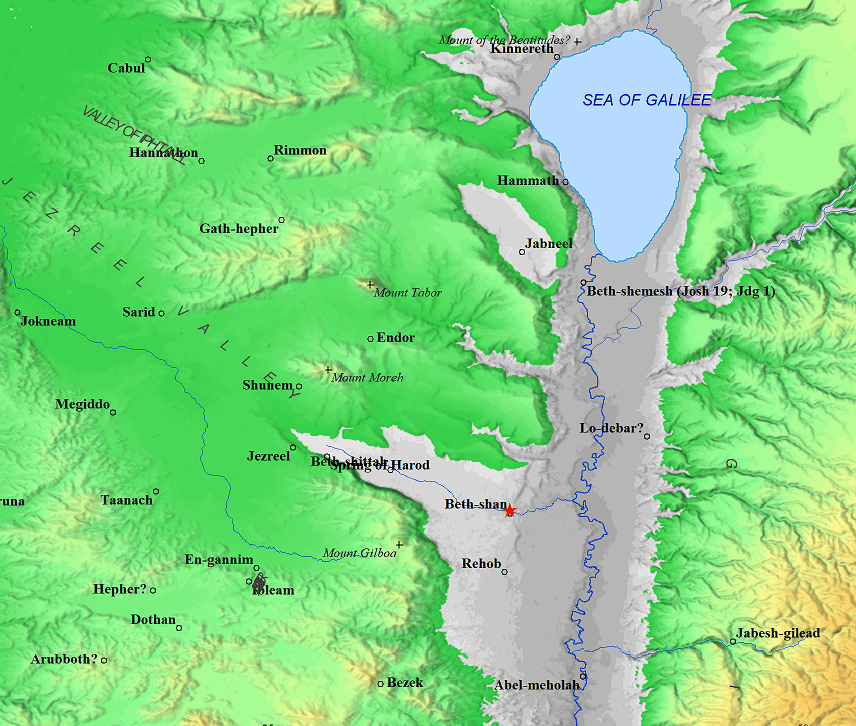
    On top of this, the location had a history. Shunem, where the Philistines had encamped, belonged to the tribe of Issachar and was south of the valley of Jezreel. This indicates that the Philistines had entered Israeli territory and were itching to take more land.

    A previous battle with the Philistines in this same locale, under the leadership of Eli the judge, did not go well, with Eli’s sons dying, the Israeli army being defeated and the Ark of the Covenant being taken from the people of God.

    Things were not stacking up good for Saul.

    As mentioned in the passage, he started looking for a witch, a medium, one who could channel dead spirits. As luck would have it, Sauls servants found a medium at En-dor, a location that was just beyond the Philistine encampment at Shunem. His encampment was south, the witch was north, and the Philistines were just to the west.

    So off with the royal garb and crown, and on with other garments, Saul and two of his men headed north, past the Philistines and under cover of darkness, knocked on the mediums door.

    After reassuring the medium of the safety of the situation, she brought up Samuel, or at least a spirit that mimicked Samuel. (When you are dealing with a medium, what can you trust?) Also note that she was willing to trust this “stranger” regarding the safety of the action. She just seems real sketchy at this point, but then again, when you deal with the dead, verification of truth claims probably are low on the priority scale. She just trusted this stranger, not knowing this stranger was Saul until after “Samuel” came out of the earth.

    The witch spoke of an old man wrapped in a mantle. Saul made the claim it was Samuel.

    A question to my reader. Was it Samuel or a deceiving spirit? Let me know your thoughts.

    No matter what, this passage literally yells at me that when the Lord is not in the middle of the situation, you just don’t know who you can trust.

    Trust is such a fragile commodity for if you provide it to everyone, you will be burned and not able to exercise it due to the disappointments of previous trusting.

    A wife that can be trusted is a beautiful thing. I have been blessed with a wonderful lady who I trust wholeheartedly.

    My children – I don’t deserve them, for they are trustworthy, loving young men and women who have proven themselves over and over again.

    A Christian brother or sister that can be trusted is a precious find, and though believers are a family, conflicts and priorities may produce times when trust is broken. Communication to restore relationship, and then to eventually able to exercise trust is critical.

    The passage above brings two people together that have never met, that in the past were on opposite sides of an issue, and due to special circumstance are forced together by a man’s desperate and trembling heart. It is a bad situation ripe for defeat, disappointment and deception.

    And they both trusted each other! How desperate of a situation, and how unnecessary for them to be in such a situation. But that is not true! It was necessary for Saul to trust the medium, and for the medium to trust Saul, for they had both rejected the only One who can be trusted fully.

    Only due to rejecting the living God is such a situation forced on a person. Trust God, or you will be forced to trust someone or something else at a time that is forced upon you.

    May God give us wisdom and strength for a daily decisions.


    Thanks again for coming to visit. I hope you found something of interest in this post and would appreciate a comment, to begin a discussion. If you know someone this blog may bless (or challenge), send them a link, so they may join us in our discussion.

    Come join us at Considering the Bible

    ← Back

    Thank you for your response. ✨

    Warning
    Warning
    Warning
    Warning.

    Share this:

    • Email a link to a friend (Opens in new window) Email
    • Print (Opens in new window) Print
    • Share on Telegram (Opens in new window) Telegram
    Like Loading…
  • Jesus in the Old Testament – Bathsheba – 02

    2025-06-10

    Jesus in the Old Testament is a series of posts that will offer my readers a chance to consider pictures or shadows of Jesus in the Old Testament. As mentioned in the introduction to this series, some may be obvious, some may be not so obvious, and some may simply be a facet of the Lord those reading may not have considered previously.

    I hope as we venture through this series, we will see the Lord in many wonderful pictures throughout the Old Testament.

    SEEING JESUS IN
     
    BATHSHEBA
     
    Covenant Owner
     
    1 Kings 1:28-30 Then King David answered, “Call Bathsheba to me.” So she came into the king’s presence and stood before the king.
    And the king swore, saying, “As the LORD lives, who has redeemed my soul out of every adversity,
    as I swore to you by the LORD, the God of Israel, saying, ‘Solomon your son shall reign after me, and he shall sit on my throne in my place,’ even so will I do this day.”
     
    Hebrews 6:17 So when God desired to show more convincingly to the heirs of the promise the unchangeable character of his purpose, he guaranteed it with an oath,

    In our last post we spoke of the shame both Bathsheba and the Lord experienced at the hands of the politically powerful.

    In this post, we see Bathsheba receiving the fruit of the promise King David gave to her regarding her son Solomon. Solomon would sit on the throne of David upon his passing.

    The promise provided to Bathsheba was certain. Bathsheba went to the King, in the midst of another coup attempt happening in the nation of Israel, and was assured of the promise given her, that her son Solomon would be king. The promise granted to Bathsheba was fulfilled at a time when all seemed dark and threatening for her and her son.

    A little background may help, for you see, Adonijah had legal right to the throne of David. He was the oldest living son of David, and by the standard of primogeniture, his claim to the throne was valid. Although He assumed the throne prior to the death of king David, which is highly irregular and speaks of his nature, he did have the ancient custom and common law behind him in his effort to ascend to the throne.

    It is interesting that David initiated the completion of the promise, that Bathsheba (in this passage) was passive in the transaction. The only action Bathsheba performed was paying homage to the King.

    Jesus also was passive in the grave, as the Father worked His power, and kept His promise in raising Him physically from the dead. The Father kept the promise of an everlasting seed on the throne of David by way of having the True King rise from the dead.


    Thanks again for coming to visit. I hope you found something of interest in this post and would appreciate a comment, to begin a discussion. If you know someone this blog may bless (or challenge), send them a link, so they may join us in our discussion.


    ← Back

    Thank you for your response. ✨

    Warning
    Warning
    Warning
    Warning.

    Come join us at Considering the Bible

    Share this:

    • Email a link to a friend (Opens in new window) Email
    • Print (Opens in new window) Print
    • Share on Telegram (Opens in new window) Telegram
    Like Loading…
  • Names of God – GOD OF MY SALVATION – 185

    2025-06-09

    My hope is that this series will offer my readers a chance to consider the names, characteristics and descriptions of our God in the Word.

    The remaining Names of God in this series might be considered descriptors, or characteristics of the Lord. We have reviewed the three primary Names of God, along with nineteen compound Names of God in our previous posts. As we venture through these descriptors of our God, I hope we will recognize all the many characteristics of our God that we tend to take for granted.

    The Word is truly rich with descriptions of the Living God, and this effort of searching in the Word was quite illuminating. He truly is the ultimate subject of the Word, and His revelation of self-descriptions, or the accolades offered Him by His priests, prophets, kings apostles and faithful truly is a blessing.

    May the Name of the Lord be praised, and by thinking on His name, may you have a blessed day.

    185
     
    GOD OF MY SALVATION
     
    Psalm 18:46 The LORD lives, and blessed be my rock, and exalted be the God of my salvation
    We spoke of the God of Salvation in an earlier post, recounting the nature of the God we worship. This passage speaks of the personal ownership of such a God.

    I understand David wrote this psalm in his old age. He wrote this passage after having been rejected by king Saul, hunted by king Saul, ran out of his country by king Saul, rejected by the nation and having only a small portion of Israelites trust him. He had to hide in caves, run at night, have cities that he rescued turn on him. Those he protected rejected him, and those of his family he lost. Wives were taken from him, his best friend was torn from him, and all the comforts and recognition he once enjoyed, was ripped from him, replaced with suspicion, deception and slander.

    By the time Saul passed, David had been through the wringer. His testing had proven to be severe, and by the grace and mercy of God, he came out alive, rising to the throne of Judah. Yet his struggles were far from over.
    Seven and a half years of war with his own people to establish one nation, having to struggle against Saul’s son Is-bosheth and Abner.

    Once on the throne of Israel, he experienced a period of personal quietness, while the nation took to warring against their enemies, and eventually becoming the dominant power in the region. If David led the battle, the nation won. God was doing amazing work through a man that had been crushed, chased, hunted, ridiculed, slandered and threatened.

    Once he found comfort, he stumbled. This stumble brought great pain and severe consequences to his life, family, and the nation. He lost multiple children to the sin with Bathsheba in the immediate and long term, his daughter was raped by a son who found license by example, and the kingdom of Israel was torn apart, leaving David in his old age, teetering between the grave and the throne. Rejection by the nation he led though the treachery of his own son, and betrayal by his best friend pained David. Even on his death bed, forces were acting in the kingdom, in his very own family, to take his legacy away.

    A short history of David is offered here to remind us that the God of Salvation can be the God of My Salvation, and that to experience the God of Salvation requires difficulties, struggles, pain and disappointment. It is in the battles and wars we fight through with the God of Salvation, that allows us to experience the God of My Salvation.

    As we walk with Him and taught by Him, we need to keep our eyes on Him as He leads us. He can be the God of My Salvation as we wait on Him each day.

    Psalm 25:5 Lead me in your truth and teach me, for you are the God of my salvation; for you I wait all the day long.

    I would love to hear of your favorite name, characteristic or description of the Living God. Please leave me a comment, and I will include it in the list!

    Thanks again for coming to visit. I hope you found something of interest in this post and would appreciate a comment, to begin a discussion. If you know someone this blog may bless (or challenge), send them a link, so they may join us in our discussion.


    ← Back

    Thank you for your response. ✨

    Warning
    Warning
    Warning
    Warning.

    Come join us at Considering the Bible

    Share this:

    • Email a link to a friend (Opens in new window) Email
    • Print (Opens in new window) Print
    • Share on Telegram (Opens in new window) Telegram
    Like Loading…
  • 1 Thessalonian Bits – 1:9

    2025-06-08

    A little while ago, I produced a verse by verse series in Philippians. I really enjoyed that exercise and have been wondering if I should take on another book. Well it turns out that 1 Thessalonians is the victim of my machinations, and hopefully, the thoughts produced by this fantastic book will edify and encourage the reader.

    As with Philippians I am going to limit each post to one verse, and hopefully produce a short, succinct read for my friends who follow.

    1 Thessalonians 1:9 For they themselves report concerning us the kind of reception we had among you, and how you turned to God from idols to serve the living and true God,

    Who are “they”?

    As I mentioned in my last rambling, I think Paul may have spoke of both believers (regarding the Word of the Lord) and unbelievers (regarding the Faith of the Saints). If my thinking is correct, who might Paul be referring to when he speaks of “they themselves”? Am I getting lost in my pronouns!

    Whoever is doing the reporting, “they” understood the impact Paul and his cohorts had on the Thessalonians, or more accurately, the reception the Thessalonians gave Paul and his gang.

    What type of reception did you ask?

    Well, the city did not show it’s best face to these visitors, but for a few of the citizens, they openly accepted these strangers with good news, exhibited a willingness to hear and listen, and an openness to be influenced by men that laid it on the line for others. They saw men speaking of a risen Savior, being in the middle of a riot erupting with some jealous Jews, eventually having their synagogue ruler dragged before the court, with these apostles run out of town.

    The reception of those few Thessalonians resulted in conversion to a whole new life. They were willing to hear a message, they watched the messengers and they made a choice. People were hearing about it, and some of “them” were reporting about it!

    And what were “they” reporting?

    Two pieces of news!

    turned to God from idols

    Turning.

    I want to speak of this word as defining repentance, and it might very well speak of that, but the Greek word usually used for repentance, μετάνοια metánoia, is not used here. This word is ἐπιστρέφω epistréphō. Interestingly it is used often of Gentiles becoming believers.

    • Acts 9:35
    • Acts 9:40 
    • Acts 11:21
    • Acts 14:15
    • Acts 15:19
    • Acts 26:18.
    • Acts 26:20
    • 2 Corinthians 3:16 
    • 1 Peter 2:25

    Nothing too earth shattering about it’s meaning, for it simply means to turn, or to turn oneself. These folk saw the gospel, heard the gospel and turned to God. This turning included one action with two results. These folks turned to God and these folks turned from idols. This is conversion, and this also informs us of the idol worship involved in those who did not turn.

    Is this true for todays citizen of the world? If one you know hasn’t turned to God, is it safe to conclude they are still following after idols? Leave a comment, let me know your thoughts

    to serve the living and true God

    Many may hear the gospel, and say they believe in God. They say they believe and well enough they may. But the second piece of news being reported on was the commitment the Thessalonians exhibited. They turned to serve the Living and True God.

    Let me be blunt. The Christian life is not a warm fuzzy feeling received every 7 days for 15 minutes while the music blares in the auditorium. The Christian life is a life of service, of following and caring for others in His name. At times there are very difficult decisions to be made in following the Master, decisions and actions that cause pain, loneliness, separation from friends and family, in order to follow after the One who walked a path to Golgotha.

    To serve the Living and True God is a marker of the man or woman of faith, of one who has truly turned to God from idols.

    The Thessalonians had turned even though no promise of an easy life. Pretty impressive. I guess it makes sense that “they” were telling everyone.

    Still not sure who “they” are though!


    ← Back

    Thank you for your response. ✨

    Warning
    Warning
    Warning
    Warning
    Warning.

    Follow Considering the Bible on WordPress.com

    Thanks again for coming to visit. I hope you found something of interest in this post and would appreciate a comment, to begin a discussion.

    Share this:

    • Email a link to a friend (Opens in new window) Email
    • Print (Opens in new window) Print
    • Share on Telegram (Opens in new window) Telegram
    Like Loading…
  • Life of David – 22.02

    2025-06-07

    Saul and the Medium of En-dor

    As many who have followed me for a bit, I have fallen into the Psalms, and I can’t get up! (As if I would want to.) The Psalms are a majestic collection of poetry, of heart felt human experiences that constantly challenge me in my own frail attempt to follow the true King. As many of the Psalms are written by David, my study on the Psalms has spurred me on to looking at the life of David, and to follow the victories and tragedies of the shepherd King of Israel.

    Many times in the narrative, we will see the Lord Jesus, imperfectly, yet a reflection of His spirit in a man with weaknesses.

    3 Now Samuel had died, and all Israel had mourned for him and buried him in Ramah, his own city. And Saul had put the mediums and the necromancers out of the land.
    4 The Philistines assembled and came and encamped at Shunem. And Saul gathered all Israel, and they encamped at Gilboa.
    5 When Saul saw the army of the Philistines, he was afraid, and his heart trembled greatly.
    6 And when Saul inquired of the LORD, the LORD did not answer him, either by dreams, or by Urim, or by prophets.
    7 Then Saul said to his servants, “Seek out for me a woman who is a medium, that I may go to her and inquire of her.” And his servants said to him, “Behold, there is a medium at En-dor.”

    Did we not witness the death of Samuel three chapters back? His passing was recorded in 1 Samuel 25:1

    Now Samuel died. And all Israel assembled and mourned for him, and they buried him in his house at Ramah. Then David rose and went down to the wilderness of Paran.

    The repetition of this fact may be reminding us of the loss of spiritual leadership God’s people were suffering under. The nation had a king who was in rebellion against God, a king who had chased off the hope of the nation, a king that would hold on to the throne at all costs! Things were not looking good!

    As an aside, and to set up the story of Saul’s final grasp on his kingdom, we are reminded that king Saul had outlawed mediums and necromancers in the land. It is safe to assume that Saul set the lay down in response to the prophet Samuel, who knew the Word in rejected the practice of contacting the dead.

    Samuel sure was a pesky influence on king Saul!

    As Saul ventured farther and farther away from the God of Israel, he found the distance he suffered was insurmountable, that the God of Israel had become “deaf” to his cries of help. And Saul needed help!

    The Philistines were on his doorstep, and they were looking pretty fearful. Saul, the natural leader of the nation, the man who has led the armies of Israel into battle, was not exhibiting bravery once he saw the Philistines

    He was afraid

    This fear mentioned of Saul spoke of astonishment, awe, even reverence. The Philistines were bringing their best and it was intimidating Saul to his core.

    His heart trembled greatly

    Our author describes Saul’s heart as trembling greatly, of being struck with terror, shuddering at the sight of this army in front of him. Saul had brought the entire army of Israel to the battlefield and yet the enemy caused him terror. Saul had no reserves in his army, or in his personal life to deal with such a challenge! Saul was in no shape to face this enemy.

    And God was nowhere to be found.

    It is to Saul’s credit (minimally) that he sought out the Lord in this time of terror, but no matter his many pleas or much begging, through various methods, he was not heard by the God of Israel.

    He had been abandoned by God.

    1 Samuel 28:6 And when Saul inquired of the LORD, the LORD did not answer him, either by dreams, or by Urim, or by prophets.

    At Saul’s greatest time of need, God was gone. Abandoned by the God who chose him as king. No response to his pleas, in the face of his greatest fears, the heavens were still, the Lord quiet and still.

    This surely is a black mark on the faithfulness of God, as many may claim. Yet let us consider the past, for Saul surely had fought against the Lord in his seeking to retain the throne.

    He disobeyed in the matter of the Amalekites. He sacrificed that which was against the command of Samuel. He had been informed by the prophet that the kingdom would be taken from him. He actively persecuted the anointed son of Jesse, whom he knew was his successor.

    Saul knew it was over years back, when Samuel had clearly informed him of the loss of his kingdom after the fiasco with the Amalekites.

    1 Samuel 15:28 And Samuel said to him, “The Lord has torn the kingdom of Israel from you this day and has given it to a neighbor of yours, who is better than you.

    Now we are witnessing the grasping of a man who knows he has been in rebellion, a man looking for help from the very One who has declared his end.

    How desperate! How utterly depressing for the former king of Israel, to face such a challenge and have no resource to lean on. He had no spiritual assistance at all.

    Maybe.

    Well, if one god doesn’t answer, maybe another god will come to his rescue. After all, he is a desperate man, not a discriminating king at this point. He had made his choice years back, and at this point in his life, the early choices he made are simply being acted out in real time before our eyes.

    A witch. Get me a witch he says! I’m desperate, and I am driven by fear. I need help and I don’t care where I get it.

    My friends, this is the lesson of Saul.

    Isaiah 55:6 Seek the LORD while he may be found; call upon him while he is near

    Do not wait. Make your choice today for God and not your self, Do not wait for tomorrow, for the days passed for Saul, and the door was shut. Listen to and obey the One who may be sought, while He is near. Do not reject His leadership today, thinking tomorrow you will still have opportunity.

    Now is the day of salvation.

    2 Corinthians 6:2 For he says, “In a favorable time I listened to you, and in a day of salvation I have helped you.” Behold, now is the favorable time; behold, now is the day of salvation.

    My friends, Saul is an example to us all, that early choices for self make later choices for God impossible. The earlier you make good choices for God and His Son, the greater you will know of His peace and presence, and the confidence gained from walking with the Savior will be invaluable.

    Choose you this day whom you will serve. If you do not actively and openly choose God, eventually you may be resorting to the door of a witch! As we will see in our next few posts, this goes from bad to worse for the king of Israel.


    Thanks again for coming to visit. I hope you found something of interest in this post and would appreciate a comment, to begin a discussion. If you know someone this blog may bless (or challenge), send them a link, so they may join us in our discussion.

    Come join us at Considering the Bible

    ← Back

    Thank you for your response. ✨

    Warning
    Warning
    Warning
    Warning.

    Share this:

    • Email a link to a friend (Opens in new window) Email
    • Print (Opens in new window) Print
    • Share on Telegram (Opens in new window) Telegram
    Like Loading…
  • Names of God – GOD OF SALVATION – 184

    2025-06-06

    My hope is that this series will offer my readers a chance to consider the names, characteristics and descriptions of our God in the Word.

    The remaining Names of God in this series might be considered descriptors, or characteristics of the Lord. We have reviewed the three primary Names of God, along with nineteen compound Names of God in our previous posts. As we venture through these descriptors of our God, I hope we will recognize all the many characteristics of our God that we tend to take for granted.

    The Word is truly rich with descriptions of the Living God, and this effort of searching in the Word was quite illuminating. He truly is the ultimate subject of the Word, and His revelation of self-descriptions, or the accolades offered Him by His priests, prophets, kings apostles and faithful truly is a blessing.

    May the Name of the Lord be praised, and by thinking on His name, may you have a blessed day.

    184
     
    GOD OF SALVATION
     
    Psalm 68:20 Our God is a God of salvation, and to GOD, the Lord, belong deliverances from death.
    I once heard a preacher challenge the saints to a thought experiment.

    Consider God differently than the Bible teaches.

    Hold on a moment. Consider if God was not as the Word teaches. We know He is not for the Scriptures are abundant in the claims of the love, patience, mercy, humility and saving nature of God. We can be thankful for such a God who is for us and not against us!

    Yet consider the thought experiment.

    What if God’s nature, His personality were grounded and based in hatred, of despising all that were not perfect, providing no hope to those who sought Him.

    What if His character allowed, or even championed the trait of deception. No trust could be developed, suspicion would constantly fester and grow within all of creation.

    This is painful to consider!

    What if God’s character demanded not only perfect obedience to all His demands, but also allowed no delay in that perfect obedience. Instant compliance.

    What if God was proud, arrogant and haughty? No encouragement of approaching Him for assistance! No possibility that He might bend down to us, but our only expectation was that He exhibit scorn and contempt towards those below Him.

    Can you imagine?

    But alas, some want to think of Him in this way. Those who know not the Suffering Savior want to consider Him as the worst possible God.

    In fact, as believers, we also tend to sometimes imagine Him this way in our lives, forgetting the message of the Word, the beauty of the God we serve, the mercy He shows, the patience of His love, His willingness to bend down to us in our condition of weakness.

    God is a God of love, not hate, a God of truth, not lies, a God of patience, not of agitation, a God of meekness and lowliness, not of scorn and contempt.

    We have a God, who by His very nature is a God of Salvation, who can not help but by His very own nature seek to save. Deliverance from death is His game plan, His goal and we are simply the recipients of such a God’s desire.

    It is out of this nature of love, truth, patience and lowliness that we find He is the God of Salvation.

    He is the God of Salvation, bringing salvation to us through the death of His own Son, proving Him to be the loving, truthful, patient and lowly God we don’t really understand or can fully comprehend.

    He is the God of Salvation, and His very name speaks of salvation, for His name is Jesus!

    I would love to hear of your favorite name, characteristic or description of the Living God. Please leave me a comment, and I will include it in the list!

    Thanks again for coming to visit. I hope you found something of interest in this post and would appreciate a comment, to begin a discussion. If you know someone this blog may bless (or challenge), send them a link, so they may join us in our discussion.


    ← Back

    Thank you for your response. ✨

    Warning
    Warning
    Warning
    Warning.

    Come join us at Considering the Bible

    Share this:

    • Email a link to a friend (Opens in new window) Email
    • Print (Opens in new window) Print
    • Share on Telegram (Opens in new window) Telegram
    Like Loading…
  • Conditional Security – Matthew 13:5-6, 20-21

    2025-06-05

    The Parable

    Matthew 13:5 Other seeds fell on rocky ground, where they did not have much soil, and immediately they sprang up, since they had no depth of soil,
    Matthew 13:6 but when the sun rose they were scorched. And since they had no root, they withered away.

    The Explanation

    Matthew 13:20 ESV – As for what was sown on rocky ground, this is the one who hears the word and immediately receives it with joy,
    Matthew 13:21 ESV – yet he has no root in himself, but endures for a while, and when tribulation or persecution arises on account of the word, immediately he falls away.

    If this passage supports the conditional security teaching, it is in seeing that, though the seed had no root, “they” (vs 6) sprang up. The debate in my mind is that “they” who sprung up, may have sprung up merely emotionally, and not due to conviction of sin and the birth of the new heart.

    Yet as the Lord explains the passage to His disciples, He speaks of …

    the one who hears the word and immediately receives it with joy,

    “Hearing and receiving” certainly falls into the description of life, and at least for a short time, to be evidence of life in this one. To “receive” is used of true conversion, or at least the process of conversion taking place.

    Acts 19:2 And he said to them, “Did you receive the Holy Spirit when you believed?” And they said, “No, we have not even heard that there is a Holy Spirit.”

    Acts 26:18 to open their eyes, so that they may turn from darkness to light and from the power of Satan to God, that they may receive forgiveness of sins and a place among those who are sanctified by faith in me.’

    One additional phrase that may argue for this one to have been truly saved, and yet to have fallen away or apostatized, is that

    …he endures for a while

    This one walks the walk for a period of time, providing evidence of life, even in the midst of trials. This is typically the very thing I watch for in any that claim they follow, that is if hard times come, do they turn their back on the Master. This one did not for a while….

    One last phrase that this passage provides may help us understand the teaching of conditional security. The Lord declares..

    …he falls away

    This is not the Greek word that is transliterated as apostacy, which prior to looking, I assumed I would find. The term found in the gospel is σκανδαλίζω skandalízō, and typically is translated as offend, to be offended, or to trip up. So the first thing I need to understand is what might be the stumbling rock upon which this one trips up over. He has endured for a while, it is looking promising, so what is it that trips him up?

    It is…

    when tribulation or persecution arises on account of the Word.

    This is enlightening, but not for my purposes in relation to conditional security. It may support the teaching, it may not, I will let my reader consider.

    For this one who we are considering, he endured for a while, assuming the endurance was due to troubles he suffered, but when persecution was due to the Word, this caused the one to stumble.

    • Could the Word become a stumbling block for a believer?
    • Might a truly born again person get to the point that the Word offends them, causes them confusion or inner conflict?
    • Might a truly repentant, blood bought believer apostatize, due to the Word?

    As we are on our pilgrimage, it is critical to have a humble and sensitive spirit towards the Word, to approach it with respect and to acknowledge it is the truth, the witness of the Son of God, the Savior. Some things in the Word are very difficult to understand, and some seem to be in conflict with what we think is true. It is at this point we need to confess our ignorance of all things, of our near complete ignorance of the universe, of history, of our own current affairs in this world and even our own lives.

    We are simply too limited in our understanding! How then could we take the position of judge over the Word of God? It is the message God has provided to His people, that has survived for millennium the attacks of the faithless, and given us the witness of His Son, the Sacrificial Lamb who died for our sins. As we become a judge over the Word, finding problems or supposed conflicts, statements that are uncomfortable, or things we just don’t want to accept, we should realize this may be dangerous territory to enter into.

    No matter what the specific message you may be struggling with this very day, a willing heart, an inquisitive mind, and a humble spirit is needed to provide opportunity for solutions to be found, or the patience to endure until the Lord provides direction for our souls.

    He is good, but sometimes He lets us struggle for our own good. Do not give up the fight of living a life of humility before the One who died for us.


    Thanks again for coming to visit. I hope you found something of interest in this post and would appreciate a comment, to begin a discussion. If you would like to receive daily posts from Considering the Bible, click on the “Follow” link below

    ← Back

    Thank you for your response. ✨

    Warning
    Warning
    Warning
    Warning
    Warning.

    Follow Considering the Bible on WordPress.com

    Share this:

    • Email a link to a friend (Opens in new window) Email
    • Print (Opens in new window) Print
    • Share on Telegram (Opens in new window) Telegram
    Like Loading…
  • Life of David – 22.01

    2025-06-04

    Saul and the Medium of En-dor

    As many who have followed me for a bit, I have fallen into the Psalms, and I can’t get up! (As if I would want to.) The Psalms are a majestic collection of poetry, of heart felt human experiences that constantly challenge me in my own frail attempt to follow the true King. As many of the Psalms are written by David, my study on the Psalms has spurred me on to looking at the life of David, is the main contributor to this book, and to follow the victories and tragedies of the shepherd King of Israel.

    Many times in the narrative, we will see the Lord Jesus, imperfectly, yet a reflection of His spirit in a man with weaknesses.

    1 Samuel 28:1-2
    1 In those days the Philistines gathered their forces for war, to fight against Israel. And Achish said to David, “Understand that you and your men are to go out with me in the army.”
    2 David said to Achish, “Very well, you shall know what your servant can do.” And Achish said to David, “Very well, I will make you my bodyguard for life.”

    Let’s remember what David has just accomplished with Achish. He has used Achish to provide the city of Ziklag as a base for excursions into the south, allowing David to attack and kill every soul in the town attacked, and then, when informing Achish of his whereabouts and accomplishments, speaks of the raids as upon the very people of Israel, Achish’s arch enemies and David national home.

    No wonder Achish was convinced that David would be his servant for ever, for he understood (falsely) that David had turned on his own people and that he had committed multiple atrocities against his own nation.

    Well, it appears the chickens are coming home to roost. As my wife often states – Be sure your sin will find you out! Achish is finding in David a tremendous resource, a resource that can “obviously” be trusted, for all he knows.

    At this time in David’s life, David was a story teller, a salesman, a conman that worked his enemy. And he was now in between a rock and a hard place. And David made the statement, almost the only thing he could say at this time. Somewhat non-committal, somewhat generic!

    Very well, you shall know what your servant can do.

    What else could he say? He was up to his neck in deception, and was facing the man he deceived, the man who would kill him if he found out the truth. He couldn’t appeal to Saul for “extradition”, trying some diplomacy thing. That is ludicrous. He couldn’t call on his own army, for 600 men were no match against the Philistine army, and he surely felt he couldn’t count on God for assistance in battle. What else could David do at this point but to be non-committal, generic and without any promise of success

    Very well, you shall know what your servant can do.

    Yes, Achish would know what his servant can do. What ever that means!

    Have you met any who might provide a generic promise, some vague statement that sounds good, but when analyzed and considered after the fact, you realize the message was empty.

    Kinda like saying “It is what it is”, or “Time, being what it is”, or “Wherever you are, that’s where you’ll be”. Statements like this may sound profound, but when you sit back and think of them, they convey nothing worthwhile.

    I think David resorted to this type of message because he realized he was in trouble! He couldn’t commit, and he couldn’t confess! He had to confuse, or at least confound!

    It must have seemed like this situation he was in was fast becoming a trap, and he himself was to blame for much of it. He needed time, and he really needed to have some time in front of God.

    That is the solution, is it not? Do you find yourself in a sticky wicket? Whether self inflicted or not, we have a God who is approachable in times of difficulty. If we are becoming non-committal, generic or confusing with others in an effort to avoid a problem or situation, rest assured that we will need to face God eventually and be committed, specific and clear as to our situation.

    Its just a matter of time! But He is there for us, for He is not a God of confusion, but of peace.


    Thanks again for coming to visit. I hope you found something of interest in this post and would appreciate a comment, to begin a discussion. If you know someone this blog may bless (or challenge), send them a link, so they may join us in our discussion.

    Come join us at Considering the Bible

    ← Back

    Thank you for your response. ✨

    Warning
    Warning
    Warning
    Warning.

    Share this:

    • Email a link to a friend (Opens in new window) Email
    • Print (Opens in new window) Print
    • Share on Telegram (Opens in new window) Telegram
    Like Loading…
  • Jesus in the Old Testament – Bathsheba – 01

    2025-06-03

    Jesus in the Old Testament is a series of posts that will offer my readers a chance to consider pictures or shadows of Jesus in the Old Testament. As mentioned in the introduction to this series, some may be obvious, some may be not so obvious, and some may simply be a facet of the Lord those reading may not have considered previously.

    I hope as we venture through this series, we will see the Lord in many wonderful pictures throughout the Old Testament.

    SEEING JESUS IN
     
    Bathsheba
     
    Subservient to Power
     
    2 Samuel 11:2 It happened, late one afternoon, when David arose from his couch and was walking on the roof of the king’s house, that he saw from the roof a woman bathing; and the woman was very beautiful.
    2 Samuel 11:4 So David sent messengers and took her, and she came to him, and he lay with her. (Now she had been purifying herself from her uncleanness.) Then she returned to her house.
     
    Mark 15:3-5 And the chief priests accused him of many things.
    And Pilate again asked him, “Have you no answer to make? See how many charges they bring against you.” But Jesus made no further answer, so that Pilate was amazed.

    This particular typology, or picture of Christ is related to the exercise of power and not an intimate act, though in this case violent. It seems beyond my understanding to think of this as a consensual act of intercourse, but rather an act of political power over a servant of the kingdom.

    Simply stated, David took Bathsheba.

    As I read the portion of Scripture that describes David’s initial meeting with Bathsheba, it appears that David is the instigator, the manipulator, the power broker, and the dominating force on that fateful day. You see, I have generally thought that Bathsheba may have known that David was in eyesight, and that she may have been laying a trap for him, enticing him, drawing him to her.

    I am not convinced, for what woman would in her uncleanness perform such a task. Nowhere do I see her other than one that was abused, even raped by a powerful king, and then sent away. David took her and David lay with her. Verse 4 speaks of David acting, not Bathsheba. The only action Bathsheba took was returning to her house. I imagine her walk back was in shame, that she had been treated so violently.

    This understanding of the life of Bathsheba establishes for myself a picture of one who has been violently acted upon by one of power. David was the ultimate authority in the nation at the time, and he did what his selfish desires wanted. He raped a woman without regard to the consequences.

    One thousand years later, a Man appeared that came in peace, providing healing and encouragement for the poor and broken hearted. His life was of gentleness and humility, yet those in power decided to violently exercise their power, having him shamed and tortured.

    They, like David, let their will and base emotions take control of the situation, not considering the outcome. They wanted what they wanted, and they had the power to get it.

    Jesus, like Bathsheba, bowed to the force of power, taking the shame and humiliation without response, without restraint. The record states that Jesus despised the shame, and yet He eventually sat at the right hand of the throne of God. We may visit this topic next time, but for now, consider the likeness of the True King to Bathsheba.

    Both suffered unjustly.

    Both experienced shame.

    Both endured violence.


    Thanks again for coming to visit. I hope you found something of interest in this post and would appreciate a comment, to begin a discussion. If you know someone this blog may bless (or challenge), send them a link, so they may join us in our discussion.


    ← Back

    Thank you for your response. ✨

    Warning
    Warning
    Warning
    Warning.

    Come join us at Considering the Bible
    Share this:

    • Email a link to a friend (Opens in new window) Email
    • Print (Opens in new window) Print
    • Share on Telegram (Opens in new window) Telegram
    Like Loading…
  • Names of God – GOD OF PEACE – 183

    2025-06-02

    My hope is that this series will offer my readers a chance to consider the names, characteristics and descriptions of our God in the Word.

    The remaining Names of God in this series might be considered descriptors, or characteristics of the Lord. We have reviewed the three primary Names of God, along with nineteen compound Names of God in our previous posts. As we venture through these descriptors of our God, I hope we will recognize all the many characteristics of our God that we tend to take for granted.

    The Word is truly rich with descriptions of the Living God, and this effort of searching in the Word was quite illuminating. He truly is the ultimate subject of the Word, and His revelation of self-descriptions, or the accolades offered Him by His priests, prophets, kings apostles and faithful truly is a blessing.

    May the Name of the Lord be praised, and by thinking on His name, may you have a blessed day.

    183
     
    God of Peace
     
    1 Thessalonians 5:23 Now may the God of peace himself sanctify you completely, and may your whole spirit and soul and body be kept blameless at the coming of our Lord Jesus Christ.
    We have just considered the name “God of Love” in 2 Corinthians 13:11, in which Paul added this very description near the end of the verse.

    2 Corinthians 13:11 …and the God of love and peace will be with you.

    Paul brought this name to bear in the Corinthian passage speaking of the potential of the God of love and peace being with the Corinthians, if they mend their ways.

    For the Thessalonians, this name of God is focused solely on peace, and Paul is praying that the God of Peace sanctify these believers completely. There were some issues that the apostle brings before the saints that needed some work.

    There appears to be ethical standards, specifically sexual norms, and work ethics that needed addressing. This is common for religious groups that think the end of the world in upon them. Some in the church were definitely preaching His coming, even that he had come. The Second Coming will be addressed in chapter 4, along with Paul’s admonitions to sexual purity and personal responsibility.

    One additional item of concern was the attitude of the Thessalonians towards their spiritual leadership. There may have been confusion as to who the leadership was that the believers were to listen to. There were others speaking alternate viewpoints that caused some confusion.

    Paul calls on the God of Peace to sanctify these folks. To sanctify means to set apart.

    Whenever I hear that term, I recall a message I heard over 40 yrs ago by a dear brother who became a missionary in Bangladesh. He told the story of his brother with an ice cream cone, and that he wanted a bite. The brother decided the best way to avoid any loss of ice cream to his bothersome brother was to lick the entire cone, ice cream and all. He sanctified that cone, and was not bothered again for a bite.

    He did not lick a portion of it, allowing a portion still available for my preacher friend. He licked it all. He effectively owned that ice cream cone, and no one else. That cone was set apart for the brother, and no one else.

    Although crass, in a very weird way, this analogy strikes a chord in me. Obviously that is true since it has been over 40 years, but it also makes a great point.

    God wants us all, and Paul is asking God to accomplish this! Are you not thankful that Paul did not describe God as an all-consuming God? (Especially when thinking of this analogy!)

    The God who wants to sanctify us, who wants to set us apart from the world, our sin and our pain is a God of Peace.

    Jesus is the God of Peace and He brings peace into our lives, taking the confusion and stress away as we seek His ways.

    I would love to hear of your favorite name, characteristic or description of the Living God. Please leave me a comment, and I will include it in the list!

    Thanks again for coming to visit. I hope you found something of interest in this post and would appreciate a comment, to begin a discussion. If you know someone this blog may bless (or challenge), send them a link, so they may join us in our discussion.


    ← Back

    Thank you for your response. ✨

    Warning
    Warning
    Warning
    Warning.

    Come join us at Considering the Bible

    Share this:

    • Email a link to a friend (Opens in new window) Email
    • Print (Opens in new window) Print
    • Share on Telegram (Opens in new window) Telegram
    Like Loading…
  • 1 Thessalonian Bits – 1:8

    2025-06-01

    A little while ago, I produced a verse by verse series in Philippians. I really enjoyed that exercise and have been wondering if I should take on another book. Well it turns out that 1 Thessalonians is the victim of my machinations, and hopefully, the thoughts produced by this fantastic book will edify and encourage the reader.

    As with Philippians I am going to limit each post to one verse, and hopefully produce a short, succinct read for my friends who follow.

    1 Thessalonians 1:8 For not only has the word of the Lord sounded forth from you in Macedonia and Achaia, but your faith in God has gone forth everywhere, so that we need not say anything.

    Two messages are being discussed in this verse, as far as I can tell.

    The word of the Lord.

    This message is dispersed from the Thessalonians to those in Macedonia and Achaia, as Paul mentions. I am tempted to think Paul is referring to the Philippian and Berean churches in Macedonia, and the Corinthian churches in Achaia.

    This is wholly my assumption, and I may be placing a limitation not intended – let my reader consider – but is this word of the Lord intended for those who already are in the Body of Christ, those who may have heard of the life these believers were experiencing? How after such a short visit, these believers became imitators and followers of the apostles, and his team?

    These Thessalonians were living examples for these nearby congregations, flesh and blood imitators that could be easily witnessed, being placed “on stage” for other churches to see. This is the wonder of the gospel, for though we may have an understanding of walking out our faith, to see others exercise their faith only encourages us, helps us to realize we are not alone, and expands the possibilities in our own life of faith by seeing others work it out in their specific way.

    This is not a light subject, for I call to witness my reader, that they along with myself, have been enriched in our lives by being with others who exalt the name of Jesus though in different situations, cultures, societies, and manners.

    In our past we have predominantly been in the baptist persuasion of church, but occasionally my wife and I will visit other denominations, even joining one for a period of time. We found aspects of their faith to be challenging, forcing decisions to be made and belief’s to be accepted. More so though, we witnessed those in other denominations honor God and exalt Jesus in ways we never considered.

    The Thessalonians were examples for the nearby churches. Whether examples to provide encouragement, or witnesses of a lifestyle that rebukes the viewing church, these men and women were examples for the regional body beyond their own local group.

    your faith in God

    The Word of the Lord may have been directed to the churches in the region, as an example of true imitators of the apostles, and as a good reflection of the Spirit of God working in a group of believers. The Word of the Lord, I think was a ministry to the faithful.

    The Thessalonians also had a message for those outside of the faith. For those outside of the faith, these men and women had a faith that was going forth everywhere.

    Consider there was no internet, telephone, telegraph, television, radio, or any other method of mass communication. The Thessalonians had one ace in the hole though. They were on a trade route.

    Imagine these men and women, in their day to day jobs, speaking of a Risen Savior, of the Rabbi who had been crucified unjustly, of a Prophet who spoke words of radical upheaval for the people of God. Those travelers and business associates these believers came into contact with, experienced these believers faith in God, not only in their message, but I dare say in their changed lives, giving force to their message.

    These visitors, travelers, business associates and foreigners were in contact with gospel people. Though these Thessalonians may have never left the city in their lives, the faith they lived travelled with those they came into contact with.

    By way of application, let us not be discouraged if we spend our days faithful in a church, never travelling to the far flung mission field. If you live your faith, not just in the church environment, but in the Monday through Saturday world, your example of faith will travel.

    True faith travels.

    Consider the number of people in one week that you know and deal with that is outside of your local area. After a short time of reflection, it becomes apparent that our reach may be far greater than we first thought.

    Be encouraged my friend, and live your faith in front of those you rub shoulders with, whether they be on the internet, though the telephone, even by way of telegraph…..

    You get my point? Live your faith. Faith will travel.


    ← Back

    Thank you for your response. ✨

    Warning
    Warning
    Warning
    Warning
    Warning.

    Follow Considering the Bible on WordPress.com

    Thanks again for coming to visit. I hope you found something of interest in this post and would appreciate a comment, to begin a discussion.

    Share this:

    • Email a link to a friend (Opens in new window) Email
    • Print (Opens in new window) Print
    • Share on Telegram (Opens in new window) Telegram
    Like Loading…
  • Psalms for Psome – Ps 69.14

    2025-05-31

    My wife and I are reading through the Psalms in our evening reading and occasionally a nugget of the Psalms jumps out of the page. Don’t you love it when, after years of reading the “Old Book” passages become alive, reinforcing old teachings or simply warming your heart.

    This is the book of Psalms, and it is rich.

    I pray I can communicate a portion of the blessing we receive from this wonderful book.

    Psalm 69 is a psalm of sorrow, of apparent defeat and deep emotional stress, of a distress in the heart and of being overwhelmed, of a weariness of soul, and of a waiting for an answer from God. It is a psalm that speaks of loneliness, of disappointment and of extended trials.

    As we venture through the psalmist’s deep confession, his pain and his sorrow, we will encounter passages that will be referred to in the New Testament, providing a recounting of the sorrow of Jesus.

    Let’s read the last three verses of this revealing psalm.

    Psalm 69:34 Let heaven and earth praise him, the seas and everything that moves in them.
    Psalm 69:35 For God will save Zion and build up the cities of Judah, and people shall dwell there and possess it;
    Psalm 69:36 the offspring of his servants shall inherit it, and those who love his name shall dwell in it.

    It’s been over three months since we started this psalm of distress, weariness, fear and anger. It contained some of the harshest judgments wished upon the enemies of David in the Psalms. Not the harshest in my opinion, but we will wait until Psalm 137 to consider that passage.

    Throughout the passage the psalmist begged for deliverance, referring to the steadfast love of God, of His faithfulness, and of his enemies pursuing him, poisoning him, and providing him sour wine to drink (vs 21). Does this not hint at not only an exterior enemy, but an enemy within the camp?

    He had suffered every angle of treachery, was on the edge of destruction, spoke of the flood sweeping over him, of the pit closing up on him. He was a death’s door, and with no one in sight to assist, no one that he could trust.

    All alone.

    Of course he wasn’t all alone, for he had the God of Israel, and he sought His help.

    There was One was was completely, utterly all alone, and whom was saved after death took Him.

    For David, he was rescued from death, and due to his rescue, Israel would become a world power. As we think of Jesus, we know that through His death, all heaven and earth shall praise Him, literally all of creation. This praise will be the direct result of the Lord having erupted out of the grave, for all of creation has been groaning in agony.

    Romans 8:22 For we know that the whole creation has been groaning together in the pains of childbirth until now.

    He goes on the declare that God will save Zion, and build up the cities of Judah. Of course this has been accomplished in the reign of David, as he took control of Judah, at least the first 7 years of his reign.

    For the completion of the saving of Zion, we need to look to the Son of David, as…

    He is the One who comes to Zion for salvation

    Matthew 21:5  “Say to the daughter of Zion, ‘Behold, your king is coming to you, humble, and mounted on a donkey, on a colt, the foal of a beast of burden.’”

    He is the One who is salvation.

    1 Peter 2:6 For it stands in Scripture: Behold, I am laying in Zion a stone, a cornerstone chosen and precious, and whoever believes in him will not be put to shame.”

    He is the One who builds the True Zion, the church

    Heb 12:22 But you have come to Mount Zion and to the city of the living God, the heavenly Jerusalem, and to innumerable angels in festal gathering,

    And He is the One who delivers Zion

    Romans 11:26 And in this way all Israel will be saved, as it is written, “The Deliverer will come from Zion, he will banish ungodliness from Jacob”;

    Yes Jesus is the complete fulfillment of the salvation of Zion, the building of the cities of Judah (praise), and of the character of those resident in Zion. Note that those that inherit this salvation are the offspring of His servants, those who are of service.

    Did not Jesus echo this truth in the beatitudes?

    Matthew 5:5 Blessed are the meek, for they shall inherit the earth.

    Even as He echoed this truth, He expanded it to include the earth, and not just the single hill of Zion near Jerusalem. No – the entire earth will be the inheritance of the meek, lowly Man named Jesus, and with Him His servants.

    His salvation was hinted at in the Old Testament, but the realization of what is now, and what is about to be, is far more than we can think or imagine!


    ← Back

    Thank you for your response. ✨

    Warning
    Warning
    Warning
    Warning
    Warning.

    Thanks again for coming to visit. I hope you found something of interest in this post and would appreciate a comment, to begin a discussion.

    Follow Considering the Bible on WordPress.com

    Share this:

    • Email a link to a friend (Opens in new window) Email
    • Print (Opens in new window) Print
    • Share on Telegram (Opens in new window) Telegram
    Like Loading…
  • Names of God – GOD OF LOVE – 182

    2025-05-30

    My hope is that this series will offer my readers a chance to consider the names, characteristics and descriptions of our God in the Word.

    The remaining Names of God in this series might be considered descriptors, or characteristics of the Lord. We have reviewed the three primary Names of God, along with nineteen compound Names of God in our previous posts. As we venture through these descriptors of our God, I hope we will recognize all the many characteristics of our God that we tend to take for granted.

    The Word is truly rich with descriptions of the Living God, and this effort of searching in the Word was quite illuminating. He truly is the ultimate subject of the Word, and His revelation of self-descriptions, or the accolades offered Him by His priests, prophets, kings apostles and faithful truly is a blessing.

    May the Name of the Lord be praised, and by thinking on His name, may you have a blessed day.

    182
     
    God of Love
     
    2 Corinthians 13:11 Finally, brothers, rejoice. Aim for restoration, comfort one another, agree with one another, live in peace; and the God of love and peace will be with you.
    He is the God of Love. No matter how you cut it, He is the God of Love. Not only is He the source of all that is considered love, but He is the very definition of what true love is.

    But in the interest of this verse, lets take a few moments and consider what Paul may be saying here.

    Paul admonishes these believers to rejoice. In all of the council Paul has had to offer these believers, all the rebukes and reproaches, he ends with an admonition to rejoice, for in all of the interpersonal issues that have erupted between him and the Corinthian church, all the disciplinary stances he has had to take with this church, he is encouraging them to rejoice. No matter the situation, in the end, there is always reason to rejoice, for we have a God that is over all the storms in our lives, and settles those hearts that look to Him. He is good, and for that simple fact, we should rejoice.

    The next thing Paul speaks of is the goal of restoration. There have been relationships strained to the point of breaking in this church, and this is not God’s ideal. Paul directs his saints to aim for restoration, to find ways to make relationships whole, to seek others for the sake of peace. Might he even be suggesting the giving up of rights in order to be peace makers? To die to their own desires for the sake of others? You may have a hard time convincing me otherwise!

    The NASB and the RSV actually translates “aim for restoration” as “mend your ways”, for the ways of the saint needed mending. The comfort/encouragement may not be self directed, but intended for saint to provide to others. Two verses earlier in the chapter, Paul is praying for restoration to occur in this church.

    They need it!

    2 Corinthians 13:9 For we are glad when we are weak and you are strong. Your restoration is what we pray for.

    Comfort one another. This is another phrase that may be translated other than it appears. It seems a few of the common translations suggest that Paul is asking the saints to “listen to his appeal”. He has provided God’s will for the people, but if it is ignored, all the counsel in the world will count for nothing for these dear saints!

    As if he simply cannot get off the unity theme, his next phrase to admonish and encourage this church of strife is that they are to agree with one another. As an out growth of this call to agreeableness with one another, or as a final admonition for these saints, is to live in peace.

    After all of these admonitions, encouragements, directions and counsels, he adds that if they obey, if they seek to follow, then the God of Love and Peace will be with them. (Why would the God of Love and Peace be with a fractious warlike congregation?)

    After the effort is expended to find restoration, peace, agreeableness and peace amongst themselves, this church will experience the God of Love.

    It is not that God is not the God of Love until they get straight. No no no. Let us not suggest such silliness. No – God is the God of Love, but due to the sin in the group and amongst the brothers, they have cut themselves off from the experience of God’s peace and love in their personal and group life. They sacrificed the knowledge of the God of Love to exercise their selfish desires.

    He is the God of Love, and in His person perfect love is found. For the God of Love is found most clearly in Jesus, who is the sum total expression of the Love of God!

    I would love to hear of your favorite name, characteristic or description of the Living God. Please leave me a comment, and I will include it in the list!

    Thanks again for coming to visit. I hope you found something of interest in this post and would appreciate a comment, to begin a discussion. If you know someone this blog may bless (or challenge), send them a link, so they may join us in our discussion.


    ← Back

    Thank you for your response. ✨

    Warning
    Warning
    Warning
    Warning.

    Come join us at Considering the Bible

    Share this:

    • Email a link to a friend (Opens in new window) Email
    • Print (Opens in new window) Print
    • Share on Telegram (Opens in new window) Telegram
    Like Loading…
  • Conditional Security – Psalm 51:11

    2025-05-29

    Psalm 51:11 Cast me not away from your presence, and take not your Holy Spirit from me.

    Talk about a verse to discuss for this topic! How have I went for over 5 years of blogs considering this topic, and yet not addressed this seemingly obvious verse.

    Some general background may be beneficial. David is the author, and he has fallen hard. Fallen into sin that includes, adultery and murder. Confession didn’t come immediately, but when it did, amazingly forgiveness was granted.

    2 Samuel 12:13 David said to Nathan, “I have sinned against the LORD.” And Nathan said to David, “The LORD also has put away your sin; you shall not die.

    Capital offences according the the covenant of God! When Nathan speaks of David and death, he is speaking of the Law of God demanding the offender to die.

    Adultery demands death.

    Leviticus 20:10 If a man commits adultery with the wife of his neighbor, both the adulterer and the adulteress shall surely be put to death.

    Murder demands death.

    Exodus 21:14 But if a man willfully attacks another to kill him by cunning, you shall take him from my altar, that he may die.

    David should die. He should die for either one of these offenses! The Law demanded death! Nathan delivered to David God’s reprieve of physical death, of the Lord putting away his sin. David would experience trouble in his family, but he would not be put to death. David would live.

    David realized this physical judgement mirrored his spiritual life. Though the judgement of physical death had been taken from him, he understood the spiritual death he was wallowing in presented a much greater danger.

    Over and over again, in different ways and with different phrases, David looked to God for forgiveness beyond the physical in this psalm.

    Blot out my transgressions, wash me thoroughly from my iniquity, cleanse me from my sin, purge me with hyssop, wash me, hide Your face from my sins, blot out all my iniquities.

    He openly confessed his sin and sought from God the forgiveness he needed to experience and posses his spiritual life. He had been released from physical death. He would live, but he was desperate to live!

    Eventually he begged God to not take away the Holy Spirit from him. He needed a new heart! A clean heart.

    What a man of God!

    He realized his complete poverty before God and openly confessed his total lack of ability to make things right, to be right with God. He knew the Spirit of God had been taken from Saul, and now it looked like he was heading down the same path of self destruction, being abandoned by God due to sin.

    Of course, as an OSAS (Once Saved Always Saved) adherent, I would reject any connection to David or Saul, or any Old Testament saint who spoke of the Holy Spirit being taken from them, as being applicable for the New Testament saint.

    We have many verses in the New Testament speaking of the faithfulness of God to the believer, of His never leaving us, of His constant ministry in our lives. The New Testament is replete with describing God’s commitment to the believer.

    Hebrews 13:5 … he has said, “I will never leave you nor forsake you.”

    Matthew 28:20 …I am with you always, to the end of the age.”

    John 10:28 …no one will snatch them out of my hand.

    Ephesians 4:30 ….you were sealed for the day of redemption

    Romans 11:29 …the gifts and the calling of God are irrevocable.

    The faithfulness of God is described in the New Testament to the believer, and for that we are to be ever so thankful.

    But consider.

    Does the faithfulness of God somehow guarantee our faithfulness to Him? Are they one and the same? For God to be faithful, as He is, describes God’s faithfulness. Should we be of such boldness to assume we are as faithful as He? We are a weak, crippled people, and though we have been given a new heart, and the Spirit of God has come to abide with us, we are but jars of clay. He is the light and we are but dust. Though He is able to provide strength, we must not assume we are without responsibility in our relationship with the Almighty God. Our lives are to exhibit a humility and godly fear before Him, not assuming on the promises of God, and ignoring our part in the relationship with the Master!

    David and us

    • Does the New Testament believer and David have the same God?
      • Of course! He is faithful!
    • Does the New Testament believer and David possess the same covenant?
      • Of course not. We have such a deeper and greater covenant with Him, by the blood of the Lamb.
    • Does the New Testament believer and David share in the sinfulness of a darkened, deceitful heart?
      • Of course! We are not faithful to God by our very nature!
    • Does the New Testament believer and David struggle with sin, causing pain and grief to the Lord?
      • Of course! Let us not deceive ourselves, thinking we are of any better stock than the man after God’s own heart! We have a much greater understanding and covenant with God, but we are on our own, weak, poor and blind.

    Let us learn from this passage, not some implied connection between David’s experience and a possible experience of the New Testament believer. That will be debated by believers until He comes back.

    No, the lesson is that as David reacted to his sin before God in this psalm, we should also react to our sin before Him, from a heart of sorrow, out of a need for His grace, sensing a desperation for God, desperate to be created anew!


    Thanks again for coming to visit. I hope you found something of interest in this post and would appreciate a comment, to begin a discussion. If you would like to receive daily posts from Considering the Bible, click on the “Follow” link below

    ← Back

    Thank you for your response. ✨

    Warning
    Warning
    Warning
    Warning
    Warning.

    Follow Considering the Bible on WordPress.com

    Share this:

    • Email a link to a friend (Opens in new window) Email
    • Print (Opens in new window) Print
    • Share on Telegram (Opens in new window) Telegram
    Like Loading…
  • Let Me Tell You a Story – Group Think

    2025-05-28
    let-me-tell-you-a-story.jpg

    Proverbs 27:17 Iron sharpens iron, and one man sharpens another.

    It has been a while since I read of the importance of disagreement in the church. One book I read a few years back, “The Gospel according to Moses“, offered a discussion on the value of alternate opinions on topics of faith. The author’s argument in the book was that bringing up alternate ways of considering portions of Scripture is a healthy way of learning. Interaction with alternate points of view provides challenges to misconceptions and misunderstandings we may have of Bible truths, and allows for each disciple to think, ponder, and possibly self correct.

    I say this is the best way to understanding a truth, instead of simply accepting a statement. Be exposed to teaching that does not allow you to be comfortable. Open yourself to what the Word is teaching, even in those portions of Scripture that are difficult, scary or suggest an alternate view of that which you have accepted. After all, if we have the truth, we should be willing to accept all challengers!

    Prior to this though, a foundational truth needs to be established. As believers, we must humbly confess that the Word is the source of all truth, that it contains the message we are to follow, that the Word is a message we are to dedicate our lives to learning and obeying, and that the Word is deep, eternal, mysterious, puzzling and most of all, honors the Lord Jesus (and not us) in all it’s message.

    The Word as the authority for our faith is foundational. Let the Word be the fire we need, the hammer it is!

    In practice though, as modern believers, we tend to gather with believers that are carbon copies of ourselves. When we gather with those who think like we do, and allow one man to monologue the group into his understanding of the Word, I fear we may tend to go numb. We interpret group think as synonymous with peace in the church. It may simply be numbness.

    Sadly, this condition of “group think” can also foster a culture of superiority, of thinking we have arrived, that other believers are wrong in some (or many) areas of faith. Alternate opinions are considered sources of confusion (or worse “of the devil”), and this surely is not God’s intent, is it?

    Does not the Word speak of confusion as not from God?

    1 Corinthians 14:33 For God is not a God of confusion but of peace. As in all the churches of the saints,

    We may claim alternate teaching as confusing, not because it is, but due to our own laziness, our mental unwillingness to be set off balance, to be challenged.

    My point may be further defined in this. Is there any profit (spiritually) to be challenged in your understanding of the Word, of God, of Jesus and His mission?

    Is there a possible downside to the modern concept of being “fed” the truth? Is the main source of truth for your life the same general understanding, the same viewpoint on the Scripture that is rediscovered every Sunday morning? Might there be benefit in finding a friend or teacher to challenge our understanding? Should we as believers consider the first truths we were taught to be the only truth?

    1 Corinthians 14:36 Or was it from you that the word of God came? Or are you the only ones it has reached?

    Test your own body of believers next time you get together. Do you find yourself sitting together, simply reinforcing already accepted truths? The same old truths spoken as all our eyes gloss over, slowly becoming detached to the challenge of understanding such a fantastic book, a message from God!

    There is a difference between being told what to think, and being taught how to think.

    We may justify our reluctance to be challenged by claiming we have the truth already (sounds boastful in my mind) and desire to maintain a “purity” of doctrine. When a sensitive topic or “difficult” verse enters a conversation, does the group chase it, consider it, dig into it, or does someone simply throw a verse reference at it and move on? I cannot count the number of times I have offered questions and was told to look up a verse later, only to find the verse had nothing to do with my question.

    This test may also be misunderstood by my reader, for you may be thinking I am suggesting we reconsider the deity of Christ, or the eternality of God, or any other central doctrine the faithful have clung to through the ages. This is not what I am suggesting. It is more of the secondary doctrines, or those that are on the fringe that need to be considered, examined, and understood, (even if not accepted) as we grow into Christ. It is good to understand our brothers and sisters position in Christ, to have an attitude of teachableness, of humility, and of a willingness to consider their knowledge in the Word.

    Personally, the first topic that I tripped over, and that was a test for the body I belonged to at the time, was the topic of tithing. Surely this is not a cardinal doctrine, (though for the church I belonged to at the time, it seemed to be equal in importance to the Atonement.) I have wrote on this topic before so I shall not bore you with the conclusion of the “discussion” on tithing with the leadership, but it did set a mind in me to not simply accept what one man teaches without searching out the Word, looking for answers, and allowing myself to be wrong in my faith.

    Since then, I have adjusted my understanding of the Word in a number of it’s teachings, and am thankful the Lord has directed me as I learned. I am also very cognizant of the fact that I still have much to learn and could be wrong in areas I am “sure of”.

    I needed to accept the possibility I was wrong in my faith in order to grow in my faith.

    No matter, for if we are willing to listen to our brothers, without putting up a wall, without formulating a defense as they explain their position, and express a humility and desire to understand their point of view, much could be accomplished in the fractured church we exist in.

    One of the most difficult exercises I have had to practice in this regard is to shut up and to listen! It’s really quite a challenge!


    Thanks again for coming to visit. I hope you found something of interest in this post and would appreciate a comment, to begin a discussion. If you know someone this blog may bless (or challenge), send them a link, so they may join us in our discussion

    Come join us at Considering the Bible

    ← Back

    Thank you for your response. ✨

    Warning
    Warning
    Warning
    Warning
    Warning.

    Share this:

    • Email a link to a friend (Opens in new window) Email
    • Print (Opens in new window) Print
    • Share on Telegram (Opens in new window) Telegram
    Like Loading…
  • Jesus in the Old Testament – Balaam – 04

    2025-05-27

    Jesus in the Old Testament is a series of posts that will offer my readers a chance to consider pictures or shadows of Jesus in the Old Testament. As mentioned in the introduction to this series, some may be obvious, some may be not so obvious, and some may simply be a facet of the Lord those reading may not have considered previously.

    I hope as we venture through this series, we will see the Lord in many wonderful pictures throughout the Old Testament.

    SEEING JESUS IN
     
    Balaam
     
    A Saving Donkey
     
    Numbers 22:23 And the donkey saw the angel of the LORD standing in the road, with a drawn sword in his hand. And the donkey turned aside out of the road and went into the field. And Balaam struck the donkey, to turn her into the road.
     
    Psalm 68:19 Blessed be the Lord, who daily bears us up

    As we consider Balaam as a picture of the Christ, we cannot think of Balaam without thinking of the donkey he rode. This donkey, in its efforts to keep it’s master Balaam safe, did all it could to avoid certain danger from the Angel of the Lord. It may seem odd to refer to the donkey as an appropriate topic in relation to the Christ, but did not the Master do all He could to keep us from danger, from the Angel of the Lord.

    Also, the donkey is quite appropriate to associate with the Master. Though white stallions are often associated with Kings, a careful reading of the Old Testament reveals that when a King rode a donkey, it was due to him coming in peace.

    Consider 1 Kings 1:33

    And the king said to them, “Take with you the servants of your lord and have Solomon my son ride on my own mule, and bring him down to Gihon.

    or Judges 5:10, when Deborah and Barak spoke of royalty

    Tell of it, you who ride on white donkeys, you who sit on rich carpets and you who walk by the way.

    or Judges 10:4, describing the aspirations of Jair the Gieladite

    And he had thirty sons who rode on thirty donkeys, and they had thirty cities, called Havvoth-jair to this day, which are in the land of Gilead.

    or Judges 12:14, speaking of Abdon the son of Hillel’s lineage.

    He had forty sons and thirty grandsons, who rode on seventy donkeys, and he judged Israel eight years.

    Though it may seem obvious to associate a donkey as a beast of burden, and find the likeness of the Christ as the Great burden bearer, it may be also appropriate to see the nature and character of peacefulness as a point of similarity in the Messiah.

    After all, He came into Jerusalem, as the prophet predicted.

    Zechariah 9:9 Rejoice greatly, O daughter of Zion! Shout aloud, O daughter of Jerusalem! Behold, your king is coming to you; righteous and having salvation is he, humble and mounted on a donkey, on a colt, the foal of a donkey.
    Zechariah 9:10 I will cut off the chariot from Ephraim and the war horse from Jerusalem; and the battle bow shall be cut off, and he shall speak peace to the nations; his rule shall be from sea to sea, and from the River to the ends of the earth.

    For the Prince of Peace entered Jerusalem on a donkey, humble and on a mission of peace

    Matthew 21:5 “Say to the daughter of Zion, ‘Behold, your king is coming to you, humble, and mounted on a donkey, on a colt, the foal of a beast of burden.’”

    The sad thing is that though the donkey sought to protect Balaam, as the Christ sought to protect and save His people, both the donkey and the Savior received a punishment from the very ones they were caring for.

    Yet, as with all pictures of the Christ, the punishment was not equal, for the Messiah suffered, bled and died a horrible death, completely unlike the relatively minor punishment received by the donkey.

    The likeness is found in the unjustness of the punishment, and not necessarily the extent, or depth of punishment experienced!

    How unjust for the Savior to suffer for me!


    Thanks again for coming to visit. I hope you found something of interest in this post and would appreciate a comment, to begin a discussion. If you know someone this blog may bless (or challenge), send them a link, so they may join us in our discussion.


    ← Back

    Thank you for your response. ✨

    Warning
    Warning
    Warning
    Warning.

    Come join us at Considering the Bible

    Share this:

    • Email a link to a friend (Opens in new window) Email
    • Print (Opens in new window) Print
    • Share on Telegram (Opens in new window) Telegram
    Like Loading…
  • Names of God – GOD OF JESHURUN – 181

    2025-05-26

    My hope is that this series will offer my readers a chance to consider the names, characteristics and descriptions of our God in the Word.

    The remaining Names of God in this series might be considered descriptors, or characteristics of the Lord. We have reviewed the three primary Names of God, along with nineteen compound Names of God in our previous posts. As we venture through these descriptors of our God, I hope we will recognize all the many characteristics of our God that we tend to take for granted.

    The Word is truly rich with descriptions of the Living God, and this effort of searching in the Word was quite illuminating. He truly is the ultimate subject of the Word, and His revelation of self-descriptions, or the accolades offered Him by His priests, prophets, kings apostles and faithful truly is a blessing.

    May the Name of the Lord be praised, and by thinking on His name, may you have a blessed day.

    181
     
    GOD OF JESHURUN
     
    Deuteronomy 33:26
    There is none like the God of Jeshurun,
    Who rides the heavens to your help,
    And through the skies in His majesty.
    Jeshurun. The name means upright one, and it is used exclusively of Israel. As you may know, Israel mean God prevails.

    Jeshurun is a name provided by God, speaking of her ideal character, the goal she as a nation was to strain for. It is a poetic name, especially as we see Israel fail and fail.

    To be called Jeshurun was a reminder of the loving attitude of God Almighty towards His called people.

    It is interesting that even when God referred to His people by this term of endearment, reflecting an ideal image of the nation, of a nation that was “upright”, that God would ride the heaven to her help.

    This truth is sometimes forgotten when things are good in our lives, when we are seeking to please God, when we are not under conviction of sin or undergoing a learning lesson, but simply walking with Him to the best of our ability and knowledge. Even then, He rides the heavens to our help.

    He is not a God that only rescues those in trouble, though for that I am eternally thankful, but He is a God who helps those who are walking properly. He is a God who is always at our side, riding the heavens to provide aid to the upright.

    He is a God who is with us always.

    Matthew 28:20 … behold, I am with you always, to the end of the age.

    He is the God of Jeshurun.

    I would love to hear of your favorite name, characteristic or description of the Living God. Please leave me a comment, and I will include it in the list!

    Thanks again for coming to visit. I hope you found something of interest in this post and would appreciate a comment, to begin a discussion. If you know someone this blog may bless (or challenge), send them a link, so they may join us in our discussion.


    ← Back

    Thank you for your response. ✨

    Warning
    Warning
    Warning
    Warning.

    Come join us at Considering the Bible

    Share this:

    • Email a link to a friend (Opens in new window) Email
    • Print (Opens in new window) Print
    • Share on Telegram (Opens in new window) Telegram
    Like Loading…
  • 1 Thessalonian Bits – 1:7

    2025-05-25

    A little while ago, I produced a verse by verse series in Philippians. I really enjoyed that exercise and have been wondering if I should take on another book. Well it turns out that 1 Thessalonians is the victim of my machinations, and hopefully, the thoughts produced by this fantastic book will edify and encourage the reader.

    As with Philippians I am going to limit each post to one verse, and hopefully produce a short, succinct read for my friends who follow.

    1 Thessalonians 1:7 so that you became an example to all the believers in Macedonia and in Achaia.

    Verse 7 speaks of the consequence of the actions described in verse 5 and 6, that the Thessalonians were presented the gospel and became imitators of the men who presented this gospel to them. We addressed the term “imitator” in an earlier posting, but Paul uses another term, somewhat related to imitator.

    To be an imitator is to follow one as a model, a reference to finding and following a guide, having a goal to copy in order to become like that person. To imitate is to follow someone in their mannerisms, character, desires, ethics, sufferings and thoughts.

    To be an example is to be that which others may imitate. Paul is beginning to teach on the very same principle he instructed Timothy of years later.

    2 Timothy 2:2 and what you have heard from me in the presence of many witnesses entrust to faithful men, who will be able to teach others also.

    Although Paul is speaking to the church as a whole, in that their body life was a fantastic example for other churches to imitate, the process of multiplication in the same in body life as well in personal discipleship. Our lives either impact the church in a positive way, as the Thessalonian church did according to Paul, or our lives impact the church negatively.

    One church that did not have the full endorsement of the apostle was the Corinthian church. His non-commendation is expressed throughout the first epistle, but man be clearly noted in chapter 11.

    1 Corinthians 11:17 But in the following instructions I do not commend you, because when you come together it is not for the better but for the worse.
    1 Corinthians 11:22 What! Do you not have houses to eat and drink in? Or do you despise the church of God and humiliate those who have nothing? What shall I say to you? Shall I commend you in this? No, I will not.

    Even though the apostle Paul stayed with the Corinthians for much longer than he did with the Thessalonians, his presence and manner of life did not seem to “stick” with the metropolitan Corinthians.

    Note that in the epistle/letter to the Corinthians, the internal difficulties were addressed directly with the church. As my momma used to say, “don’t be showing everyone your dirty laundry!” Paul addressed the issues of the Corinthian church, with the Corinthian church. We have the privilege of reading this letter of holy writ, but it seems the intent of Paul was to be direct with the church and not enter into a public discourse “showing everyone the Corinthians dirty laundry”.

    Not so with the Thessalonians. Paul spoke of them as examples to the churches in Macedonia and Achaia, (which coincidentally contained a church named Corinth.) These believers molded themselves to be such imitators that they became examples for others to follow. And Paul told everybody!

    This is a very high compliment from the apostle to a small church he had not been able to return to. The word was getting out that the Thessalonian’s caught the life Paul exhibited, and the gospel he proclaimed.

    The church was alive and was providing proof of that life, in the midst of much affliction!

    Might the affliction the Thessalonians accepted be the missing element in the church of Corinth? I will let my reader consider the difference and make up their own mind.

    No matter, the Thessalonians were examples, believers who could be watched by other churches as they lived their lives, providing an example to be imitated, as others sought to follow the Lord.

    A very worthy model to imitate!


    ← Back

    Thank you for your response. ✨

    Warning
    Warning
    Warning
    Warning
    Warning.

    Follow Considering the Bible on WordPress.com

    Thanks again for coming to visit. I hope you found something of interest in this post and would appreciate a comment, to begin a discussion.

    Share this:

    • Email a link to a friend (Opens in new window) Email
    • Print (Opens in new window) Print
    • Share on Telegram (Opens in new window) Telegram
    Like Loading…
  • Psalms for Psome – Ps 69.13

    2025-05-24

    My wife and I are reading through the Psalms in our evening reading and occasionally a nugget of the Psalms jumps out of the page. Don’t you love it when, after years of reading the “Old Book” passages become alive, reinforcing old teachings or simply warming your heart.

    This is the book of Psalms, and it is rich.

    I pray I can communicate a portion of the blessing we receive from this wonderful book.

    Psalm 69 is a psalm of sorrow, of apparent defeat and deep emotional stress, of a distress in the heart and of being overwhelmed, of a weariness of soul, and of a waiting for an answer from God. It is a psalm that speaks of loneliness, of disappointment and of extended trials.

    As we venture through the psalmist’s deep confession, his pain and his sorrow, we will encounter passages that will be referred to in the New Testament, providing a recounting of the sorrow of Jesus.

    Psalm 69:30 I will praise the name of God with a song; I will magnify him with thanksgiving.
    Psalm 69:31 This will please the LORD more than an ox or a bull with horns and hoofs.
    Psalm 69:32 When the humble see it they will be glad; you who seek God, let your hearts revive.
    Psalm 69:33 For the LORD hears the needy and does not despise his own people who are prisoners.

    Let’s return to the passage I started to discuss last week, but as you may remember, got a bit distracted from the text by realizing I am more like Michal than David. To say the least, my discovery of a certain aspect of praise certainly took me aside last week, but for this time together, let’s consider more than just one of the words David used for this portion of Psalm 69.

    As I read this four verse portion of Psalm 69, I am struck with how New Testamental David sounds in expressing his faith. He speaks of how praise and thanksgiving is greater than the prescribed sacrifices of bulls and oxes. This attitude, in an age dominated and ordained with a sacrificial system that was required by the faithful in order to approach God formally – this is a massive spiritual understanding of the priority of God’s desires.

    Note that David refers to the humble seeing “it”. What is it that the humble see?

    Is he reaching back to verse 29, speaking of God’s salvation in setting the distraught saint on high? Or might he be thinking of the universal opportunity to approach God based on humility, brokenness, poverty and desire?

    Of course, the end result is that the salvation of God set’s the undeserved on high, but I think the humble rejoice in “how” this occurs, from the standpoint of the saint.

    First, note that verse 30 speaks of praise, songs, magnification and thanksgiving. These attitudes or characteristics are not restricted from the believer due to their financial class, at least no due to their lack of finances. There is something to be said about how abundance can dull the saints proper stance before God, but we speak of the humble here.

    Vere 33 gives more justification to think the humble rejoice in the “how” of approaching God and not specifically the end result of being lifted up. The verse speaks of the needy, and of prisoners, those who have no resources other than their hearts and souls before God.

    Yes, the humble rejoice in that they are provided no restrictions in approaching God, that they are not “buying” time with God, but simply expressing a deep need for the Lord, and this is what pleases God, even more than sacrifice!

    This is such a freeing concept, a freeing understanding of the type of God we have, that he sets no restrictions to our approaching him in humility and brokenness, and yet I fear we sometimes approach Him in our pride and a wholeness that must nauseate the Master.

    As you may know, I got me some grandkids and I love those little rugrats, but when they come to me thinking they are equal, or that they want to manipulate me, or that they can boss ol’ gramps around, that turns my nose up. Don’t get me wrong, I still love them, and I wanna hug em all the time, but a period of repositioning the child in the family has to occur for rightness to occur in the relationship.

    But I do have a short story if you don’t mind me sharing, for we had a bunch of my favorite people together for a long weekend. My youngin’s and I were a drivin and singing together, playing old Macdonald, going 75 mph on the highway, when all of a sudden, the group got real quiet. That is a rare situation with four grandkids and grampa, but it happened – no joke! During that interlude, I looked back at one of those youngins, and he simply looked me in the eye, and completely out of the blue, said clear as a bell…

    “I love you grandpa”

    I can’t communicate the inflection in his voice or the softness of his eyes, the gentle smile on his face or the innocence of the moment, but trust me – at that moment in my life, all was well in my world!

    Now, imagine God in a similar circumstance. Since He created us in His image, and though we be a broken and weak reflection of Him, if a simple expression like that melts an ol fella like me, might our simple, humble confession, especially out of the blue, capture God’s attention?

    That is the type of God we serve. An active God that is alive and relatable. He is a loving God.

    Thank you Jesus. I love you!


    ← Back

    Thank you for your response. ✨

    Warning
    Warning
    Warning
    Warning
    Warning.

    Thanks again for coming to visit. I hope you found something of interest in this post and would appreciate a comment, to begin a discussion.

    Follow Considering the Bible on WordPress.com

    Share this:

    • Email a link to a friend (Opens in new window) Email
    • Print (Opens in new window) Print
    • Share on Telegram (Opens in new window) Telegram
    Like Loading…
  • Names of God – GOD OF HEAVEN AND EARTH – 180

    2025-05-23

    My hope is that this series will offer my readers a chance to consider the names, characteristics and descriptions of our God in the Word.

    The remaining Names of God in this series might be considered descriptors, or characteristics of the Lord. We have reviewed the three primary Names of God, along with nineteen compound Names of God in our previous posts. As we venture through these descriptors of our God, I hope we will recognize all the many characteristics of our God that we tend to take for granted.

    The Word is truly rich with descriptions of the Living God, and this effort of searching in the Word was quite illuminating. He truly is the ultimate subject of the Word, and His revelation of self-descriptions, or the accolades offered Him by His priests, prophets, kings apostles and faithful truly is a blessing.

    May the Name of the Lord be praised, and by thinking on His name, may you have a blessed day.

    180
     
    GOD OF HEAVEN AND EARTH
     
    Ezra 5:11 And this was their reply to us: ‘We are the servants of the God of heaven and earth, and we are rebuilding the house that was built many years ago, which a great king of Israel built and finished.
    Ezra is a teaching scribe, provided by God to the nation after being in Babylon for 70 years. Those brave enough to leave the nation that took them captive, experienced challenges beyond our imagination, but with leaders like Ezra and Nehemiah, were able to surmount those challenges.

    The challenge the nation was confronting in this portion of Scripture is the neighboring governors of nearby provinces, impacting the Jews desire to rebuild the temple. These neighboring powers, (Tattenai and Shethar-bozenai) sent a letter to Darius, the king of Persian, the ultimate power of the region, questioning the legality of the Jews efforts.

    The situation smacks of sucking up to the powers that be, in order to find some advantage. (A bit like my little grandkids when they go tattle on their brother to mommy).

    Nevertheless, this was another challenge to the Jews that may cause a work stoppage. A letter was crafted by the Jews, describing their efforts and their authority to perform the work. In this letter, that Tattenai and Shethar-bozenai sent off to Darius, the Jews declare they are the servants of the God of heaven and earth.

    Interestingly, Darius, as king of Persia, and ruling over the largest empire the world had ever known at the time, was very tolerant of other religions. He, himself seemed to be monotheistic, that is, he only spoke of one God, speaking only of the religion of Zoroaster. 

    For the Jews to refer to the God of heaven and earth, as apposed the the God of Israel, had two intents, if I understand the motivation for speaking to Darius in such a way.

    To refer to God as the God of Israel, may introduce an element of superiority of the Jews over the Persian king. This communication may have been chosen in order to maintain good relations with the Persian king while they have his favor.

    The second reason the Jews may have referred to God as the God of heaven and earth is that Darius spoke of one god, Ahura Mazda, the supreme god of the Persians. Though the identification of the supreme God differed between the Persians and the Jewish nation, both agreed there was a power over them that was supreme.

    The Jews reminded Darius, (along with Tattenai and Shethar-bozenai), of this truth. Even the king of Persia had to answer to someone, and the Jews communicated this truth to find common ground between them. Very diplomatic!

    He is the God of Heaven and Earth. He reigns over all inhabitants of this creation, making all responsible to Him, whether you were a recently released people or the reigning King of Persia.

    We are all under Him, the God of Heaven and Earth. Thankfully, we can know Him, as He has entered our existence, bled and died, was raised for our salvation and rules over us.

    There is no longer any need to speak in general terms to identify the God of Heaven and Earth. The God of Heaven and Earth is Jesus.

    I would love to hear of your favorite name, characteristic or description of the Living God. Please leave me a comment, and I will include it in the list!

    Thanks again for coming to visit. I hope you found something of interest in this post and would appreciate a comment, to begin a discussion. If you know someone this blog may bless (or challenge), send them a link, so they may join us in our discussion.


    ← Back

    Thank you for your response. ✨

    Warning
    Warning
    Warning
    Warning.

    Come join us at Considering the Bible

    Share this:

    • Email a link to a friend (Opens in new window) Email
    • Print (Opens in new window) Print
    • Share on Telegram (Opens in new window) Telegram
    Like Loading…
←Previous Page
1 … 8 9 10 11 12 … 91
Next Page→

Create a website or blog at WordPress.com


Loading Comments...
 

    • Subscribe Subscribed
      • Considering the Bible
      • Join 692 other subscribers
      • Already have a WordPress.com account? Log in now.
      • Considering the Bible
      • Subscribe Subscribed
      • Sign up
      • Log in
      • Report this content
      • View site in Reader
      • Manage subscriptions
      • Collapse this bar
    %d