For this series in Philippians, I am going to limit each post to one verse, and hopefully produce a short, succinct read for my friends who follow.
4:17 Not that I seek the gift, but I seek the fruit that increases to your credit.
There are motivations that are holy and their are motivations that are not! Is Paul defining the two in this verse?
Let us remember the example of Jesus, where he said it is more blessed to give than to receive, and that he stated the beautiful phrase of “freely ye have received, freely give”.
There is this principle within the Word that describes the mature believer as one who does not consider his own needs as important as another’s needs. It is a self sacrificial life, looking for the gain of others, even at the cost of his own.
This is based on the constant realization that the God of all has supplied the needs of the believer directly to the believer, that he is settled into this security, that he has faith in God to provide his needs and therefore looks to be a blessing to others.
Is this not what Paul is expressing? Paul is content with the situation God has placed him in, for the context of this passage began with his expression of contentment in both high and low times. He doesn’t have to seek a gift, for he knows the One who ultimately provides.
And based on this faith, this experience, this internal knowledge, he is able to consider the needs or benefits of others instead of his own.
Paul has expressed this heart of the gospel in this verse, being his own heart.
Thanks again for coming to visit. I hope you found something of interest in this post and would appreciate a comment, to begin a discussion. If you know someone this blog may bless (or challenge), send them a link, so they may join us in our discussion
For this series in Philippians, I am going to limit each post to one verse, and hopefully produce a short, succinct read for my friends who follow.
4:16 Even in Thessalonica you sent me help for my needs once and again.
Twice while he was in Thessalonica?
Let’s think about this statement.
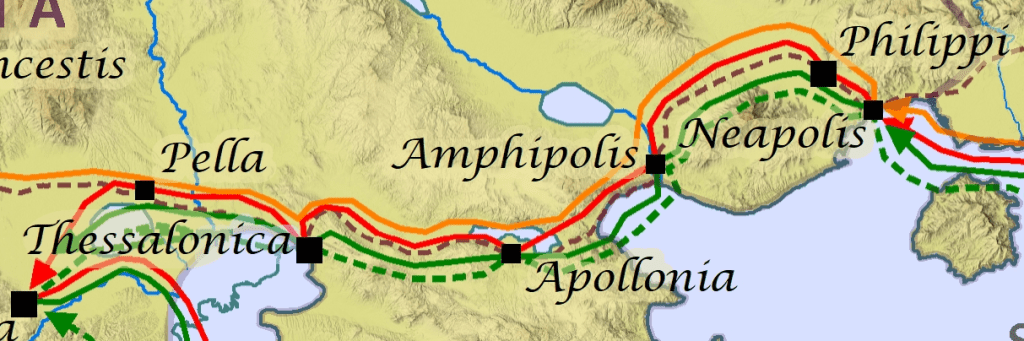
The church didn’t have UPS in the day, nor the technological wizardry of sending funds instantly through a phone app. To get funds to Paul would require travelling through Neapolis, Amphipolis, and Apollonia. (See graphic below).
The distance from Philippi to Thessalonica was about 100 miles! The average walking velocity is about 3 mph. This trip, if walked would take over 30 hours, if there was no rest stop for the evening.
Let’s say two days to travel!
Ok – Lets consider the time Paul was in Thessalonica. Can anyone remember? Acts 17:2 speaks of three sabbath days of teaching before the Jews starting causing some trouble. Once the uproar started, it seems that Paul was sent away immediately (Acts 17:10)
Given the earlier info, we can suggest Paul may have been in Thessalonica for four weeks, roughly a month. In that time, the Philippians sent his gifts TWICE.
This screams of a church that could not stop reaching out to Paul, that they were anxious to help, looking for ways to help their apostle.
Can you imagine being part of a body that is so connected with a missionary that the gifts are sent out almost machinegun like!
Paul definitely found fertile soil in the city of Philippi for the gospel to root in!
Thanks again for coming to visit. I hope you found something of interest in this post and would appreciate a comment, to begin a discussion. If you know someone this blog may bless (or challenge), send them a link, so they may join us in our discussion
For this series in Philippians, I am going to limit each post to one verse, and hopefully produce a short, succinct read for my friends who follow.
4:15 And you yourselves know that in the beginning of the gospel, when I left Macedonia, no church entered into partnership with me in giving and receiving, except you only.
Paul began this book with a thankful attitude, beginning in verse 5, speaking of the Philippians partnership with him in the gospel from the very start!
1:5 because of your partnership in the gospel from the first day until now.
As I mentioned in an earlier post in discussing a different matter, a cursory review of the times the Philippians assisted Paul in his journeys, or in his trials, could be detailed as follows
When he left the Philippian church the first time
Twice while he was in Thessalonica (see next verse)
At least once in Corinth
At least once in prison (the core reason for writing the Philippians)
But note the strength of Paul’s resolve in his mission work.
From a purely theoretical perspective, when Paul entered a new area and started a church, providing the life giving message to the lost, it would seem obvious that gifts would flow to Paul to encourage him on in spreading the gospel. Yet the only church that entered into this was a small church that began near a river with some womenfolk!
Paul had no real support! Paul sought it not – I am getting ahead of myself here – , but as is evident in this letter, the gifts were more than a simple transaction of assets, a transfer of funding, a contractual obligation that was being kept! These gifts were evidence of a love for Paul that was active, and of fruit being produced within the church.
One other note that I find most interesting. Paul speaks of the church “entering into partnership” with him in giving and receiving. Does it make sense that the church initiated this act of love? Do you see the apostle Paul preach, (as many in the church nowadays preach,) of the obligation to support the full time worker, of the need to cough up the cash?
I am of the opinion that Paul allowed this gifting, even being surprised that the church initiated this act of partnership. I have no evidence to suggest that any other church prior to this letter entered into this type of care for the apostle.
Truly, Paul had found fertile soil for the gospel to flourish in.
Thanks again for coming to visit. I hope you found something of interest in this post and would appreciate a comment, to begin a discussion. If you know someone this blog may bless (or challenge), send them a link, so they may join us in our discussion
For this series in Philippians, I am going to limit each post to one verse, and hopefully produce a short, succinct read for my friends who follow.
4:14 Yet it was kind of you to share my trouble.
Paul continues in this heartfelt letter to his church in Philippi, speaking of this gift they had provided. And yet Paul settled on the thought of sharing in his trouble.
He emphasized their sharing of his trouble, of their taking upon themselves a burden to be borne with Paul. He did not phrase this as simply a financial transaction, much like some of the gifts I may have given in the past, or of an obligation that was fulfilled due to some promise made, or commitment to be fulfilled.
This phrase screams of two things in my mind.
Proactive
I hope I am not reading into the passage, but the love this church had for Paul was expressed in a willingness to help, that when a “trouble” became known, the church did not wait for a plea from the apostle, for a request for assistance. They were proactive, looking for ways to be of assistance.
It seems they were on the lookout for the apostle, keeping their eyes and ears open for an opportunity to join with him in his mission.
Team Culture
A team culture. What might be a better description of what I am trying to communicate? Yes – a better description might be that the church was a family, and that Paul was a brother who was away.
When one in a healthy family is hurting, the rest of the family comes around them to protect, to provide, to encourage, to support and to forgive.
As my own family has went through trials, I have seen my children huddle together to protect the hurting, “conspire” to find ways of helping their brother or sister, and generally be sensitive to the needs of those who are on the edge. I am truly thankful for the family the Lord has given my wife and I.
A family is a picture of a healthy church, and I have been privileged to be a part of a church like this at different times in my life. If you are currently in a church that is a proactive family, give thanks to God. Give thanks to God and keep a look out for those who may be in trouble.
Thanks again for coming to visit. I hope you found something of interest in this post and would appreciate a comment, to begin a discussion. If you know someone this blog may bless (or challenge), send them a link, so they may join us in our discussion
For this series in Philippians, I am going to limit each post to one verse, and hopefully produce a short, succinct read for my friends who follow.
4:13 I can do all things through him who strengthens me.
A few years ago, a sports figure began to display this verse on his clothing, and the implication was that nothing could stop him on the field/court. He could do all things because God was continually providing him the strength to perform on the field/court.
Does that make sense? Does that offend you? Is that a correct understanding of God’s working in our lives, that He provides not only skills, but the energy, ambition and drive to succeed. He is the One who provides our very breath, so in a sense, He does provide much of what I have described.
Yet is this what Paul is speaking of? Did Paul see a sports figure claiming God was in the middle of his experience in playing a sport, when he wrote this famous verse?
Since this is a blog that works through this book in a verse by verse method, let’s remember what we found out last time in verse 12. What was the topic? Sport related abilities to win championships?
Or might it be something much more important, much more valuable in the eyes of God.
Contentment. The context is contentment, and Paul is speaking how he can find this contentment in all things, in all situations, in all areas of life. Not that the believer is to find contentment passively, but to learn from experiences and situations in order to attain this contentment.
Two ways of interpreting this verse.
One way may be described that God is our servant, providing the needs to succeed in a vocation, to gain more and more victories, higher salaries, bigger houses, larger egos(?). More and more and more.
Or possibly, just possibly, that God would like us to be satisfied in Him, living a life in communion with Him, finding time for Him.
One practical suggestion in gaining this life of contentment is to minimize our exposure to the deadly advertising industry prevalent in our lives. Remember, to advertise is to make us desire what we don’t have, to make us uncontented.
And what are you going to do if you reduce your time spent under the influence of advertising?
I can think of a couple things that might please God, through Him who strengthens me.
Thanks again for coming to visit. I hope you found something of interest in this post and would appreciate a comment, to begin a discussion. If you know someone this blog may bless (or challenge), send them a link, so they may join us in our discussion
For this series in Philippians, I am going to limit each post to one verse, and hopefully produce a short, succinct read for my friends who follow.
4:12 I know how to be brought low, and I know how to abound. In any and every circumstance, I have learned the secret of facing plenty and hunger, abundance and need.
In our last blog, we spoke of contentment
In the Christian life, I am convinced that contentment falls back onto our relation with the Lord and our understanding that His will is above our will. If we are constantly seeking our will, and struggling to attain our wishes, our wants, our desires, we cannot experience contentment.
Contentment has the meaning of being independent of external circumstances. As circumstances come into our lives, our very continuing dependence on the Lord is tested.
A tragedy coming into our lives may reveal a lack of correct dependence, and as such, should be considered a welcomed notification from our Father.
A more difficult circumstance is success. As we seek to be faithful to our God, others should see our desire to do things properly and correctly, and out of this recognition of character, may be provided greater responsibility and greater rewards for our service. The rewards are the problem, for we sometimes get distracted with the rewards and move away from a contented, well placed dependence on God.
One additional meaning of contentment is the realization that you are strong enough to need no aid or support from others.
This I fear is where the modern believer may suffer want. Not that we do not have all we need in our work or in our ministries, but that the tempting messages bombarding our senses every day teaches us we are not complete until we have the latest iPhone, or the fastest internet, or the tastiest hamburger.
To be content. It is a goal that we are constantly required to learn in this culture.
If you have a sense of contentment, you are a thankful person. If you do not live in a thankful spirit, check out your contentment meter.
You may be running on fumes!
Thanks again for coming to visit. I hope you found something of interest in this post and would appreciate a comment, to begin a discussion. If you know someone this blog may bless (or challenge), send them a link, so they may join us in our discussion
For this series in Philippians, I am going to limit each post to one verse, and hopefully produce a short, succinct read for my friends who follow.
4:11 Not that I am speaking of being in need, for I have learned in whatever situation I am to be content.
Contentment.
In the advertising industry a contented customer is anathema. For a customer to be content means the wallet stays shut. They deal in providing us a constant diet of discontentment.
Contentment.
In the Christian life, contentment is not a natural state of being. It is not a fruit of the Spirit, or a gift that is provided to the believer. Paul says he has learned to be content.
He may have been without contentment at a time, like the Israeli’s who sought after the onions and leeks of the Egyption salvery they lived under.
But after years of ministry, and miles of travel, Paul says he has learned to be content.
But what is it to be content? Is contentment a feeling, a sense of well being, a feeling of peace? Might it be a state of being in which you are satisfied with your current life situation?
Contentment is more than a simple feeling that may come over us at times of peace. It is a learned behavior that, I fear in our culture especially, is constantly being challenged.
In our next verse, Paul speaks of different circumstances he faced that were opportunities to learn contentment. I am tempted to write on those things in this post, but am content to close with a simple challenge.
Are you content in the Lord?
Thanks again for coming to visit. I hope you found something of interest in this post and would appreciate a comment, to begin a discussion. If you know someone this blog may bless (or challenge), send them a link, so they may join us in our discussion
For this series in Philippians, I am going to limit each post to one verse, and hopefully produce a short, succinct read for my friends who follow.
4:10 I rejoiced in the Lord greatly that now at length you have revived your concern for me. You were indeed concerned for me, but you had no opportunity.
A revived concern? What are you speaking of Paul?
Cold hard cash, or at least the equivalent of funds. But you see, Paul was a “classy fellow” when it came to this topic. He wasn’t in it for the money. Far from it. At times he would refuse any assistance from a church in order to keep his conscience clear.
The Philippian church was a different matter. The Philippian church was a major supporter of Paul in his journeys, and in an earlier posting, I offered some background to the following summary of gifts the church had provided to the apostle.
The Philippians had supported the Apostle in the following ways (that we know of).
When he left the Philippian church the first time
Twice in Thessalonica
At least once in Corinth
At least once in prison (the reason for the writing of this epistle)
The phrase that warms my heart this morning is that opportunity only provided the expression of their continual care they had for the apostle. He freely states that the church had an active and continuous care for him, and this care was expressed when then could, when they had opportunity.
Are we looking for opportunities to provide for those we say we are concerned for?
Proverbs 3:28 Do not say to your neighbor, “Go, and come again, tomorrow I will give it”–when you have it with you.
Thanks again for coming to visit. I hope you found something of interest in this post and would appreciate a comment, to begin a discussion. If you know someone this blog may bless (or challenge), send them a link, so they may join us in our discussion
For this series in Philippians, I am going to limit each post to one verse, and hopefully produce a short, succinct read for my friends who follow.
4:9 What you have learned and received and heard and seen in me–practice these things, and the God of peace will be with you.
Paul is recapping his previous teaching here and laying responsibility on the believer for his level of joy in the Lord.
Since verse 4 – Rejoice in the Lord always; again I will say, rejoice, Paul has been laying out certain Christian practices that he has written down for the believers, and here testifies that these practices are not merely theoretical. He has lived these practices in front of the believers; the church themselves witnessing the outworking of the practice of prayer, and the filtering of Paul’s thought life.
Prayer and the inner life. Paul speaks of how his witness was fully evident to the Philippians. They had learned of his lifestyle and dedication. They had received of his ministry. They had heard of his sacrifice. And finally, they had seen how God had worked in his person. He was a believer that practiced what he preached, and out of that practice, no one could deny the evidence!
One final item on this short passage from Philippians 4:8-9. Prior to his expression of gratitude for the Philippians gift, he provides the promise of the presence of God with them as they practice these disciplines.
In the midst of this promise, Paul defines our God as the God of peace. The God of peace will be with those who practice these things.
Are you struggling with peace in your life? Do you have a sense of upheaval and stress? Back in verse 7, after an admonition to prayer, speaks of the peace of God guarding our hearts and minds. In this verse, we are offered the God of peace to be with us.
The peace of God and the God of peace! In the midst of an admonition for the believer to pray and think properly, Paul gives us great encouragement to practice the disciplines of prayer and Christian thinking.
May the Lord help us in our lives to honor Him and to follow after the commands Paul provides us for our good!
Thanks again for coming to visit. I hope you found something of interest in this post and would appreciate a comment, to begin a discussion. If you know someone this blog may bless (or challenge), send them a link, so they may join us in our discussion
For this series in Philippians, I am going to limit each post to one verse, and hopefully produce a short, succinct read for my friends who follow.
4:8 Finally, brothers, whatever is true, whatever is honorable, whatever is just, whatever is pure, whatever is lovely, whatever is commendable, if there is any excellence, if there is anything worthy of praise, think about these things.
As I was considering the approach to this verse, my automatic first thought was to provide a definition and example for each word within this list of thought contents Paul is describing here for the Christian. That may have been a good approach, but then I started to think about the layers of meanings within the list. You know, the foundational thought contents, such as truth and honor that Paul was providing for the believer, and that as the list progressed, each of the couplets of thought contents only became rarer, possibly harder to find in this old world.
Let me explain. We, as believers, should have a grasp of the truth, for we are to be students of the Word and the Word is truth. Out of that truth, we surely can find honorable things to think on. From the precepts and principles of the Word, our task is to understand the truth to determine what justice and purity is, and from that determination, judge that which is lovely and commendable. Further refinement of our thoughts include a test of excellence and praise, the highest form of Christian thought.
You may notice that as the topics a believer is to think on are described, the range of correct thought content narrows. This should be of no surprises to the believer, as we are not to have an “open mind”, accepting all messages about all topics, but to have a discerning mind, not only filtering out unacceptable thoughts, but also refraining from accepting those thoughts we have been exercised to reject.
A simple example may help.
As I have come to know a friend, I have found that he has many qualities about him that define him. Each of these qualities, by my determination are true. He is a giving man, a man of compassion, a man of service. And yet if I am honest, the truth also bears witness that he is a man who exaggerates the truth, who tells stories and “amplifies” his message unnecessarily. Each of these qualities are true, and if Paul stopped the list with only “Think on whatever is true” I would be justified in dwelling on not only his good but bad character traits.
Paul does not allow us to do that, for he filters out those things that are not honorable, not just, not pure, not lovely, and not commendable.
In providing this list, Paul has two things in mind per my understanding. Filter out that which is non-Christlike in our thinking, and Focus on Christlike thoughts.
When I dwell on this verse, an Old Testament verse comes to mind in providing the result of this type of thinking.
Proverbs 23:7 for he is like one who is inwardly calculating. “Eat and drink!” he says to you, but his heart is not with you….
The true quality of the man is found in his inwardly calculating, not in his outward message. If we change the way we think, we actually come into harmony with the will of God and become the people of God that He can use.
And yet, this is a restricted, might I say self guarded way of thinking, that is our responsibility to perform and maintain. The exercise of thinking this way is surely reflected in what we consume and dwell on during the day. Our consumption of true but negative things surely misses the mark, as the consumption of true but ugly things misses the mark.
Yes this is a restricted, some may even say a closed mind approach to our thoughts, yet we all know that there are evil, sinful and destructive ideas floating in our world that are only intending to pull us down.
Consider what you feed your heart and mind my friend. It will be either a blessing or a burden to you, in your efforts to dwell on those things described in our passage today.
One more thought. This list is truly an amazing list of filters for the believer, but consider this list in the description of the thoughts of our Lord. His thoughts are continually dwelling on those things that are true, honorable, just, pure, lovely, commendable, excellent and worthy of praise.
Are we in tune with Him, and is He finding your life one of truth, honor, justice, purity, loveliness… It would be to our benefit, not only to practice this for our life on this old globe, but also to provide our Master with content from our lives to dwell on.
Thanks again for coming to visit. I hope you found something of interest in this post and would appreciate a comment, to begin a discussion. If you know someone this blog may bless (or challenge), send them a link, so they may join us in our discussion
For this series in Philippians, I am going to limit each post to one verse, and hopefully produce a short, succinct read for my friends who follow.
4:7 And the peace of God, which surpasses all understanding, will guard your hearts and your minds in Christ Jesus.
If my readers remember our last post, I had mentioned that Philippians 4:6 was a favorite memory verse, I often resorted to when I was anxious and troubled. I suppose the command was last post and the benefit is this post.
Have you noticed that under the grace of God, when He gives a command, He also provides a blessing associated with it. Case in point with this pair of verses.
Command – Don’t be anxious but pray about everything
Result – Peace of God guarding our heart.
What a great God we have when He provides a command to honor Him and to help us and it turns out the result is a blessing. Amazing, yet let us look at this passage for a moment to “understand” our blessing.
When I think of peace, I often think of a cessation of hostilities between two warring factions, whether it be two neighbors or two nations. Peace that is established for the most part out of fear that the alternate is not desirable.
Is this what is communicated with us in this passage? Simply a cessation of hostilities? Let us remember that within the Godhead there is and never has been any type of “war” within the fellowship of the persons of the Trinity.
This peace of God is much more than simply a truce amongst parties. When Paul speaks of the peace of God, I sense he is speaking of the tranquility and harmony found within the Godhead. What else might the peace of God represent? He is not describing some type of peace found by the the cessation of any warlike activity within my own heart and mind. This peace is otherworldly, found only in the Godhead and is amazingly offered to the saint.
I would have been content to simply have the lack of anxiousness that is replaced by the activity of prayer. This would have been sufficient in my mind, but the Lord does not skimp on His blessings to the believer. We often – too often – run past the blessings in our hurried lives, only to become anxious and worried. What a rat race!
Yet let us continue considering the blessing of the peace of God entering our lives. No – that is not what Paul is speaking of now, is it? He says the peace of God will guard our hearts and minds in Christ Jesus.
To Guard
The specific word Paul uses is not found very often in the New Testament. As a matter of fact it is only found in three other verses.
2 Corinthians 11:32
At Damascus, the governor under King Aretas was guarding the city of Damascus in order to seize me,
This passage speaks of closing up all exit points in a city to restrict Paul from escaping. We get a general idea here that this guarding is not primarily against an outside attacker, but to restrict the release of one who is already within the city. There is a difference, and it may come up again in our little study.
Galatians 3:23 Now before faith came, we were held captive under the law, imprisoned until the coming faith would be revealed.
Here we see Paul teaching of the purpose of the law, and that we were “held captive” under the law. Again this concept of a prisoner occurs in our brief study on the word “guarded” Paul uses. Interesting. Lets quickly review our last verse.
1 Peter 1:4-5 to an inheritance that is imperishable, undefiled, and unfading, kept in heaven for you,
who by God’s power are being guarded through faith for a salvation ready to be revealed in the last time.
This passage is somewhat more interesting and I included verse 4 to get a sense of where Peter is headed with this passage. Notice that Peter refers to believers being guarded through faith, and that our inheritance is being kept (or guarded) in heaven for us. Although the two actions of guarding use different Greek words, this passage speaks of the Lord watching over not only our lives but our inheritance. He is truly a perfect Father.
But let us refocus on Philippians 4:7. Paul tells us that this otherworldly peace of God will guard our hearts and minds in Christ Jesus. Might Paul continue to use the image of restriction in the guarding, as in 2 Corinthians and Galatians? Is it that the peace of God actually restricts us from falling into anxiousness and worry?
In all of this, we may have missed the most important part of the verse. Notice that the peace of God guards our heart and minds in Christ Jesus.
As we pray, offering up our requests to God, we are actually conforming to the image of Christ in a small way. Of course, as believers, our standing is in Christ Jesus, but Paul is describing an experience we may enter into as we practice the Christian life.
What thinkest thou? Does the peace of God guard us from outside enemies, or in the midst of trials, simply keep us secure in Christ Jesus?
Thanks again for coming to visit. I hope you found something of interest in this post and would appreciate a comment, to begin a discussion. If you know someone this blog may bless (or challenge), send them a link, so they may join us in our discussion
For this series in Philippians, I am going to limit each post to one verse, and hopefully produce a short, succinct read for my friends who follow.
4:6 do not be anxious about anything, but in everything by prayer and supplication with thanksgiving let your requests be made known to God.
As a believer, I assume those of like minded faith have found the value of memorizing portions of Scripture. To have passages of Scripture available for the Spirit to bring to mind at instantaneous moments of decision making is an invaluable blessing and resource. I mention Bible memorization as this particular verse is one of the very first I committed to memory, and have found it to be a verse that I come back to so often, for I am an anxious fella.
To be anxious is to be troubled with cares, and often associates itself with those things that are directly connected with one’s own interests. That may seem obvious, but saying it out loud seems to make the action of being anxious just a little bit more foolish.
Yet I worry, fret, care about and am troubled by many things that will, in the end either not come to pass, or if they do, will not be of the concern that I feared.
My anxiousness belies a core problem in my heart. Can anyone suggest what that problem may be from our text? I can suggest two problems in a persons life that is riddled with anxiousness.
Lack of Prayer
Paul provides the first problem, or should I say the first solution to an anxious life. Prayer and supplication. The addition of the term “supplication” implies a need that has to be requested for, a time of asking, of requesting. Prayer itself is the more general term of our communicating (and communing ) with God. Supplication adds to this passage an aspect of need, of a humbleness of knowing that we are not “all that”.
Our realization of our need in our prayers may be our greatest need! That our needs are not simply a grocery list of wants that we speak out repeatedly, but a heart issue that makes the spirit waken, that reaches out with a passion at times, begging for an answer. I think of David’s prayers in the book of Psalms, and of his emotional phrases he approaches God with.
One of my favorite passages, when I think of David’s prayers, is found in psalm 5. I especially like the way the Message delivers David’s cry out to God.
Psalm 5:1-3
Listen, God! Please, pay attention! Can you make sense of these ramblings, my groans and cries? King-God, I need your help. Every morning you’ll hear me at it again. Every morning I lay out the pieces of my life on your altar and watch for fire to descend.
He was going to “wake up” God if he had to, and he wouldn’t give up.
How passionate have you been with the Lord lately? Does He know what you care about, or that you just have cares?
Complaining Spirit
One of the most crippling spiritual diseases I have been a victim to is being a victim, living a life of complaint and comparison with others. What a slavish, horrible existence, for just when you think you have a leg up on someone, another person seems to have a better life than yours.
Of course, with a complaining spirit, there is no need to address God in prayer, for it is a foregone conclusion that He will not do anything for you. You are trapped in a life of lack, an existence that sees scarcity and shortcomings. What a life!
Yet with an attitude adjustment, in the very same conditions, that life can become one of joy and fruitfulness, if a thankful spirit is exercised. This is a choice for the most part and with the Spirit of God residing in us, pleading with us to rise up out of a victim mentality and able to provide the strength to be a thankful believer, life can instantly be one worth living.
Thankfulness is a fantastic attitude to exercise, for it spreads good feelings and creates feeds the good attitude as it grows in my heart. A thankful spirit is a victorious spirit, and makes trials and troubles so much easier to bear. Trials and troubles will come, but why take them on without a thankful spirit?
Earlier, I mentioned that anxiousness is a choice and one of the two verses I think of when it comes to anxiousness, besides our verse this morning, is in Matthew 6
25 “Therefore I tell you, do not be anxious about your life, what you will eat or what you will drink, nor about your body, what you will put on. Is not life more than food, and the body more than clothing? 27 And which of you by being anxious can add a single hour to his span of life? 28 And why are you anxious about clothing? Consider the lilies of the field, how they grow: they neither toil nor spin,
Jesus questions why we are anxious. The very questions create the space where we should realize how foolish these concerns and cares are. Do not be anxious.
Instead of being anxious,
seek first the kingdom of God and his righteousness, and all these things will be added to you.
Prayer and thankfulness can and will replace an anxious life, but it is a choice that we need to exercise on a daily basis.
May the Lord bless you as you seek Him and His righteousness.
Thanks again for coming to visit. I hope you found something of interest in this post and would appreciate a comment, to begin a discussion. If you know someone this blog may bless (or challenge), send them a link, so they may join us in our discussion
For this series in Philippians, I am going to limit each post to one verse, and hopefully produce a short, succinct read for my friends who follow.
4:5 Let your reasonableness be known to everyone. The Lord is at hand;
Reasonableness. Yes, this is a clear command from the apostle to be nice, agreeable, non-confrontational, and malleable in the hands of those in and out of the church. To be compliant even with those who are against the gospel?
Is this Paul’s instruction? Are we to go along with everyone in order to be considered reasonable?
The Greek word is ἐπιεικής epieikḗs and describes one who is equitable, fair, patient, mild. The ESV typically translates this term as gentle. Given the many passages where we as believers are commanded to stand strong in the Lord and to fight for the faith, how does this “reasonableness” work itself into the equation?
It seems to make sense to me in that when we are fighting for the faith, or standing strong in the Lord, holding onto our convictions of how good and loving our God is and of the sacrifice of our Savior for our sake – in the midst of all of what He means to us, we are to have a gentle spirit.
A gentle spirit in front of everyone. Not just in Sunday School when it may be easy to put this front on, but in the workplace, where we are to be peacemakers, gracious and gentle when it comes to our relations with our co-workers, peers and those who are responsible to us in their duties.
Reasonable (gentle) when we have been attacked verbally by a neighbor, when we have been a victim of a crime, or have suffered a loss.
How can Paul expect this of believers? He provides the reason for the reasonableness.
The Lord is at hand. He is near. Paul may be referring to the Lord’s location or of the Lord’s imminent return from heaven. The term “near” can have either intent, yet for Philippians 4:5, Paul seems to be referring to the immanency of His return.
But hold up. If that is correct, how could Paul say that to the Philippians in the first century? He was writing to believers around 62 AD, and over 1,960 years have passed since, with no return. Was Paul wrong? Was he simply mistaken?
Or do we as modern believers sometimes think it is all about ourselves, that the Word was written 2000 years ago just for our generation? That is surely how I read the Word for many decades as a believer, yet Paul was writing to a local church, trying to encourage them in the Christian life.
What could “the Lord is at hand” mean for those believers?
One teaching that has made sense to me is that during this time after the resurrection, that first few decades, much upheaval was going on in the nations. The Roman government was going through civil wars, the land was experiencing many climate phenomenon’s, (the occurrence of earthquakes in the region had increased) and many false prophets had been opposing the gospel message. Our very next verse speaks of the church’s anxiousness. Things were in upheaval, and yet the Lord is at hand, He would be returning.
Yet the church is still on earth! So does that mean He did not return?
His specific return for the church may not be referred to here. There are times when the Word speaks of His return, of His coming in response to a churches relationship to Him. Consider the book of Revelation.
2:5 Remember therefore from where you have fallen; repent, and do the works you did at first. If not, I will come to you and remove your lampstand from its place, unless you repent.
2:16 Therefore repent. If not, I will come to you soon and war against them with the sword of my mouth.
2:25 Only hold fast what you have until I come.
3:3 Remember, then, what you received and heard. Keep it, and repent. If you will not wake up, I will come like a thief, and you will not know at what hour I will come against you.
With all this content speaking of the Lord’s coming to His church, many of these verses speak of a judgement, or a return to clean house, to put the church in order or even to “close it down”
This coming in Philippians 4:5 is most likely not the nature of Paul’s reference in our passage today, I am of the opinion Paul is speaking of the Lord’s coming to the nation of Israel in the form of the Roman army’s annihilation of the nation of Israel. This act of the most powerful nation doing the bidding of the Lord in taking the nation of Israel out of commission, would confirm the church’s status as the voice of God in the world.
This short study has definitely become a bit longer than anticipated, so I will close for now. If there are some out there who may have questions on this understanding, I would love to discuss further.
For now though, let us have a reasonable spirit as we live amongst everyone we come in contact with, while we stand for the Lord, and declare His goodness to all.
Thanks again for coming to visit. I hope you found something of interest in this post and would appreciate a comment, to begin a discussion. If you know someone this blog may bless (or challenge), send them a link, so they may join us in our discussion
For this series in Philippians, I am going to limit each post to one verse, and hopefully produce a short, succinct read for my friends who follow.
4:4 Rejoice in the Lord always; again I will say, rejoice.
A key verse of the letter. While Paul is in prison, addressing what may be considered a silly argument amongst those in his favorite church, he breaks forth with this reiteration of joy.
He says we are to rejoice always!
Come on Paul. I have a hangnail, and it is super irritating, my car had a flat last night and I have no diet coke in the fridge. How can you expect me to experience joy in the midst of these trials?
Oh the trials of the modern believer. Oh the heavy weight of the modern believer. In the midst of a life where we get distracted from our greater purpose by insignificant and inconsequential troubles, we are robbed of a joy that is offered to us.
Yet let us look at Paul’s statement once more.
He does not say “Experience joy” or “You shall enjoy life without condition”. His statement is a command. This is life changing, for as soon as I realized this was not simply a statement of my current condition, but a command to obey, much of the uncertainty of my faith fell away.
We are to rejoice! It is within our scope of obedience, and we are to enter into rejoicing by a decision we make in our lives. Paul gives us the focus of the joy, and that is in the Lord, He is our joy, and when our eyes focus on diet coke or flat tires, we have walked away from this command.
Yes diet coke and flat tires are distractions, some more powerful than others, but as we walk this pilgrimage, we are to focus on the Lord and rejoice.
As Paul said, I also will remind us and again say – Rejoice!
What a privilege to follow after Him, and to follow after Him in the midst of joy, not in a drudgery or complaining mood, which will suffocate your faith.
Rejoice. Decide to look to the Lord, realize who our Great Savior is, and rejoice!
Thanks again for coming to visit. I hope you found something of interest in this post and would appreciate a comment, to begin a discussion. If you know someone this blog may bless (or challenge), send them a link, so they may join us in our discussion
For this series in Philippians, I am going to limit each post to one verse, and hopefully produce a short, succinct read for my friends who follow.
4:3 Yes, I ask you also, true companion, help these women, who have labored side by side with me in the gospel together with Clement and the rest of my fellow workers, whose names are in the book of life.
What to do with arguing women? A question for the ages!
As we noticed in the previous verse Paul called out two women who were struggling with unity between themselves. And as we all have come to realize, when there are two who struggle with unity in a church, this typically causes two camps to form behind each opinion.
This is naughty! Not beneficial in any way! Divisive!
Yet what is Paul’s exhortation? Kick ’em out of the church! At least get rid of the one who brings less tithes into the coffers!
Duh – read the passage once more. Paul is requesting a third party to intervene in this strife. To help these women. Not to eject them. To bring about a spirit of cooperation between them, to unite them under one purpose.
Is this third party a known brother to us? Is Paul describing this one as a true yoke fellow, or might he be calling on one in the church named Syzygos. It is interesting to say the least that if there was a worker in the church whose name was Syzygos, Paul calls on him to act as his name describes him, as one who unites under a yoke. Might it be that it is his strength or gift to bring people together under one yoke? Under one Savior?
As we ended the last post, we see that Paul continues with the theme of unity, of peacemaking. He is seeking to bring together those who have the same Master, to have believers be peacemakers. Again we see relationship within the body as being a paramount concern in the apostles heart.
Book of Life
Having said that, let us consider the topic of the book of life. Paul brings up this term seemingly out of nowhere. There are a number of possible links in the Old Testament that Paul may be referencing, and bringing into the New Covenant thought.
Our first passage in Isaiah designates a characteristic of those whose name is recorded for life. Holiness. A chief characteristic of the saint, of the follower of God is the desire of holiness, of being set apart for God. Isaiah speaks of a time when Zion will be cleansed of filth, with those left behind being the very same as those who are in the book of life, recorded for life.
Isaiah 4:3 ESV – And he who is left in Zion and remains in Jerusalem will be called holy, everyone who has been recorded for life in Jerusalem,
Our next verse is in Daniel. Notice that Daniel links citizenship in the nation of Israel with the names written in the book. When referring to “your people” Daniel is speaking of those who would be delivered from a time of trouble. Those whose name was found in the book would be protected.
Daniel 12:1 ESV – “At that time shall arise Michael, the great prince who has charge of your people. And there shall be a time of trouble, such as never has been since there was a nation till that time. But at that time your people shall be delivered, everyone whose name shall be found written in the book.
Ezekiel brings to our attention the idea on non inclusion, that is that the names should not be in the register of the nation. Those false prophets were not to be enrolled in the national register, the record of citizenship for the nation. Ezekiel speaks of keeping the register clean by not allowing any false prophets to be considered of the nation of Israel.
Ezekiel 13:9 ESV – My hand will be against the prophets who see false visions and who give lying divinations. They shall not be in the council of my people, nor be enrolled in the register of the house of Israel, nor shall they enter the land of Israel. And you shall know that I am the Lord GOD.
One time in the Old Covenant, the idea of being blotted out of the book of the living is considered. David speaks of his foes, and by referring to them as being blotted out, links them with the nation of Israel. These foes were to be stricken from the rolls of citizenship!
Psalm 69:28 ESV – Let them be blotted out of the book of the living; let them not be enrolled among the righteous.
You know, when Paul brings up the topic of the book of life, right after his reference to our citizenship in heaven, it may not be as out of the blue as I first thought. May Paul be bringing this common thread of Old Testament record keeping of citizenship into Christian thinking? What thinkest thou?
Of course Paul is not the only apostle who speaks of the book of life. But the phrase is not used in the New Testament again until the apostle John refers to it in the book of Revelation six more times.
And that is for another time!
Thanks again for coming to visit. I hope you found something of interest in this post and would appreciate a comment, to begin a discussion. If you know someone this blog may bless (or challenge), send them a link, so they may join us in our discussion
For this series in Philippians, I am going to limit each post to one verse, and hopefully produce a short, succinct read for my friends who follow.
With this passage we begin a portion of exhortation, encouragement and prayer.
4:2 I entreat Euodia and I entreat Syntyche to agree in the Lord.
Dang if Paul wasn’t breaching the topic of unity in the previous passage, and lo and behold, we have an example of division within the Philippian church.
It seems Euodia and Syntyche, two women in the church were having a disagreement. Do we know the extent of the disagreement, the theological division these women were struggling with, or was it simply the color of the pew cushions for the new worship center?
We don’t know what the topic was, but if it had been a theological topic, I am fairly certain Paul would have provided the corrective teaching, as he does in all the other epistles he wrote. No, I think the disagreement may have been of personal preferences, possibly not unlike that of a minor decision, such as the color of pew cushions or the order of service. I speak as a fool, for I do not see either of those topics as being applicable in the first century. But I think you may get my point, right?
Story time
A few years back, I was in a church where two women were in disagreement over a similar level of concern, and I suggested the leadership call them out in order to resolve the friction. To get it out in the open. To seek to open discussion instead of simply bear the damage being caused.
In requesting this action, you would have thought I was the divisive person. How can we call them out. This would be a humbling exercise for these women, and the fall out might be damaging to the church. Yet Paul called them out, by name, in a book that has survived for two thousand years! I think Paul esteemed peace and unity in the church far greater than we do. I also think Paul had greater faith in his converts than we sometimes do, since he called these ladies out as he did, initiating a resolution process.
These women are introduced to us a portion of this book that holds such great truths, and these truths come from a possible personality conflict. There is potential growth in conflict. Potential, but it sometimes has to go through a humbling, painful process, and I think this is by design! Remember that Jesus chose a tax collector to walk with a zealot. Two opposites if there ever was!
My friends, if you have conflict with one in the body of Christ, remember the words of the Lord, when He taught us.
Matthew 5:23-25
So if you are offering your gift at the altar and there remember that your brother has something against you, leave your gift there before the altar and go. First be reconciled to your brother, and then come and offer your gift. Come to terms quickly with your accuser while you are going with him to court, lest your accuser hand you over to the judge, and the judge to the guard, and you be put in prison.
We are to be peacemakers, and not simply peacekeepers. There will be strife in the church, but it is up to each of us what we do with that strife!
Thanks again for coming to visit. I hope you found something of interest in this post and would appreciate a comment, to begin a discussion. If you know someone this blog may bless (or challenge), send them a link, so they may join us in our discussion
For this series in Philippians, I am going to limit each post to one verse, and hopefully produce a short, succinct read for my friends who follow.
4:1 Therefore, my brothers, whom I love and long for, my joy and crown, stand firm thus in the Lord, my beloved.
This is an unfortunate chapter break in the book, as it begins with a “therefore”, which signals the question – What is the “therefore” there for?. The term therefore is a concluding statement to an argument established previously, that is in chapter 3. So a little refresher may be in order.
What was Paul teaching in chapter 3? Paul spoke of his straining to a goal, to the goal of Christlikeness, to the upward call of God. He spoke of his not attaining this goal, but that wasn’t stopping him. He also had a theme of unity thread through the passage, and had the nerve to challenge the brethren (and the sistren) to imitate him is his chasing after God. He provided a warning, speaking of those whose minds are set on earthly things, and ended the exhortation with the final transformation of our bodies by the One who is on the throne.
He mentions our citizenship being in heaven. This, in my mind is the core issue he is referring back to in 4:1.
Citizenship implies much. Citizenship implies a specific country, a specific King (or ruler) a specific set of laws (or principles), specific responsibilities and specific rights.
Therefore, since you have established your citizenship in heaven, act as the citizen you claim to be. Stand firm in the truth of your new citizenship, with all the implications.
One other item that needs to be considered. To be a citizen of heaven implies the renunciation of any previous obligations of citizenship of a previous country. As many of my readers may know, I was born Canadian, but have gained citizenship of the United States of America. As an example, I no longer have to comply to the speed limits of the Canadian transportation system, but am enjoying the benefits of the American / Texas traffic laws, (which by the way, provides greater opportunities to traverse greater distances in less time!!!). This may be a silly item to bring up, but for a fella that loves to drive, it seemed appropriate to consider.
For the believer, we are under a set of principles that allows us to love our enemy, allows us to engender unity amongst those who may disagree, and allows us to spread joy to those who are under difficult circumstances.
We have principles we are responsible to, in standing firm in the Lord. And in our straining to stand firm, we are to look to the One who provided us the example, provides us the strength and is providing us the motivation.
He is all of it, and we surely do not deserve the salvation He has granted us!
Thanks again for coming to visit. I hope you found something of interest in this post and would appreciate a comment, to begin a discussion. If you know someone this blog may bless (or challenge), send them a link, so they may join us in our discussion
For this series in Philippians, I am going to limit each post to one verse, and hopefully produce a short, succinct read for my friends who follow.
3:20 But our citizenship is in heaven, and from it we await a Savior, the Lord Jesus Christ,
Paul has been comparing true believers with those who have become enemies of the gospel, those who have taken the teachings of the grace of God and turned them into license to chase after the base desires we all are susceptible to.
Each person on this earth is dragging about the desires of the old man, those desires of self satisfaction, earthly confidences, material abundance and high reputations in this world. It is the natural way of a darkened heart.
The blessing those of us that have decided to follow Jesus is that we have choice in this battle with the old man. The reason we have choice is because we belong to a different world, and we have our citizenship in heaven.
Citizenship has rights and responsibilities, and as a Canadian who has taken on the privilege of American citizenship, I readily admit that where you decide to claim as home has a bearing on your relationships, attitudes and obligations.
As Paul reminds us of our heavenly citizenship, he does not tell the Philippians to renounce their earthly citizenship of being in a Roman colony, which definitely had its perks! No, but he does prioritize the heavenly citizenship.
And based on our citizenship, we have the obligation of obeying “the law of the land”, or in other words, to walk after the principles the Lord laid out for His followers while on this enemy planet.
One of the principles that has been challenging myself is the forgiveness we are to exercise to those who have hurt me or my loved ones. This is not in my base nature and I need to ask Him for help with this very obedience.
Do you have a struggle you are experiencing? Hopefully, for only dead people do not struggle!
Reach out to Him and seek His strength, His grace and His kingdom.
Thanks again for coming to visit. I hope you found something of interest in this post and would appreciate a comment, to begin a discussion. If you know someone this blog may bless (or challenge), send them a link, so they may join us in our discussion
For this series in Philippians, I am going to limit each post to one verse, and hopefully produce a short, succinct read for my friends who follow.
3:19 Their end is destruction, their god is their belly, and they glory in their shame, with minds set on earthly things.
I admit it. I’m a bit overweight. I could use loosing about 15 lbs. I have struggled a bit with my weight to be honest with you. Oh I can drop it as I have occasionally, but currently I have been enjoying the snacks a bit much!
So is my belly my god? Is that where Paul is headed with this verse? Let’s consider where this verse takes us.
Paul starts with destruction. This is the inevitable completion (or end) of the enemies of the gospel. I wrote on the term Paul uses in this passage (apōleia, destruction) in a post a while back here, and on the general topic (apollymi, perishing) here. With this said, the general idea of this word is not “eternal conscious suffering”, as I had assumed my entire Christian life. It carries the meaning of loss, uselessness, misery, nonexistence, and ruination.
So, these enemies do not have a future! That may be fair to state. Is that because they eat a few too many chips and salsa? Yes and no.
I read Paul here as saying that their belly is their god in the sense that they comply with their sensual natures, with no regard to the commands of God for their lives. It is as if they have taken the grace of God and turned it into license, allowing any and all their desires to rule in their lives. The idea of sacrifice for the sake of the Master is not in their thoughts.
The succeeding result of allowing their desires to rule is that they have to convince themselves that the actions that should bring shame, they glory in this.
How accurate for the society we live in today! But those outside of the church are only following what they know, as opposed to those in the church who have learned of a better way, a way of sacrifice, of rejecting their base desires for the sake of others.
Paul finishes this verse, referring to the mind of the enemies. Now where did the mind come up in Paul’s thoughts before. Oh yes – back in Chapter 2, where he tells believers to “mind among yourselves, which is yours in Christ Jesus”, in the context of exercising a mind of humility and unity. Note that the enemies have their mind set on earthly things. Nothing mysterious about this. The term speaks of things on the earth. Like physical, material, actual items resident on the earth.
So, are you eating too much? Are you loving this life a bit too much, taking every pleasure that is available, seeking satisfaction in the here and now?
Are you focused on things of this earth? Are you worried about your accumulations, your financial securities?
How about your status in front of your peers, your reputation in your career or amongst your friends?
As Paul has challenged other believers, this may be a good time to reconsider his challenge to the Corinthians when he wrote…
2 Corinthians 13:5 Examine yourselves, to see whether you are in the faith. Test yourselves. Or do you not realize this about yourselves, that Jesus Christ is in you?–unless indeed you fail to meet the test!
Thanks again for coming to visit. I hope you found something of interest in this post and would appreciate a comment, to begin a discussion. If you know someone this blog may bless (or challenge), send them a link, so they may join us in our discussion
For this series in Philippians, I am going to limit each post to one verse, and hopefully produce a short, succinct read for my friends who follow.
3:18 For many, of whom I have often told you and now tell you even with tears, walk as enemies of the cross of Christ.
Have you ever pictured Paul preaching, getting all fired up, preaching hell and condemnation, yelling about the fires of destruction falling on those lousy sinners! How if they don’t turn, they were going to burn, that every sin deserves eternal everlasting judgement. How he relished the destruction of those who didn’t toe the line. Or that he emphasized the punishment of hell, the suffering that we deserve, the constant reminder of our rebellion?
Whoa – slow down Carl – Let’s think about this. There are two audiences we should consider when we try to understand the attitudes of the apostles, and how they relate to those outside and inside the church.
When Paul was preaching to the lost, count how many times he brought up eternal judgement. Now be careful – I am asking you to search the New Testament where he was preaching to those who had not heard the gospel yet, so you are restricted to the book of Acts for this research. While you are at it, check out the other apostles message, of how often they used a turn or burn message.
Secondly, check out the Apostles attitude when teaching the church, as he is here in this passage. Those who have turned from the cross, walking as enemies must surely deserve hateful condemnation of their actions, and yet Paul by his own admission, speaks of tears flowing. What gives here?
He should be condemning them, tearing those enemies up in order to build up those who are still faithful to the message. A little bit of condemnation might actually keep the faithful faithful! By the way – If you think that, you many need to read the New Testament again.
Paul’s heart was broken for those who had walked away from the cross of Christ. He wasn’t better than them, throwing a hate filled monologue on them, pushing them further into destruction. He described the plight of those who walked away, and shared his brokenness with those who rubbed shoulders with them.
How often do we find it easier to judge than to love?
Thanks again for coming to visit. I hope you found something of interest in this post and would appreciate a comment, to begin a discussion. If you know someone this blog may bless (or challenge), send them a link, so they may join us in our discussion
For this series in Philippians, I am going to limit each post to one verse, and hopefully produce a short, succinct read for my friends who follow.
3:17 Brothers, join in imitating me, and keep your eyes on those who walk according to the example you have in us.
Can you imagine the challenge this passage was for the Philippians, for though we read of Paul’s exploits, habits, sacrifices, sufferings, preaching, teaching, disappointments, and dedication, the Philippians actually saw this man in action.
They saw a man who had been whipped and jailed but had shown forgiveness to the jailor, who spoke to women at the river, who supported himself for their sakes while sharing of a crucified One. They watched Paul in his daily life, the way he related to the believers, encouraging and exhorting them. They observed him when he left his friends for the sake of others, and the emotional turmoil he exhibited.
Do you have a Paul that you can observe? Can you be a Paul, that others might observe and see Christ in? Is someone watching you and coming away thinking the right thoughts?
Thanks again for coming to visit. I hope you found something of interest in this post and would appreciate a comment, to begin a discussion. If you know someone this blog may bless (or challenge), send them a link, so they may join us in our discussion
For this series in Philippians, I am going to limit each post to one verse, and hopefully produce a short, succinct read for my friends who follow.
3:16 Only let us hold true to what we have attained.
Paul has just described his advancement in the gospel, careful to inform the Philippians that he had not that I have “already obtained” or was “already perfect” back in verse 12.
He has then went on to describe his state of being in the Christian life, careful to inform his brothers that he hasn’t “made it” yet. That he has growth to go through.
As mentioned in verse 13, he is focused on forgetting and straining. Forgetting what lies behind (accomplishments and failures) and straining forward to Christ likeness. He is in the process.
In verse 16, he is reminding the rest of us that we are in process. This process of moving forward includes holding onto the progress already achieved.
This is a practice that is not to be ignored. How often have I been diligent in my studies, and then got lazy? How often have I sought to pray more and then followed some other goal? How often have I sought to be a peacemaker, and then gossip about a brother? How often have I sought to serve, and then in the midst of service, been distracted.
My friends, Paul is asking us to hold true to those characteristics of Christ that we have already assimilated into our lives. To practice the heart of God in day to day interactions with those we rub shoulders with.
As I consider this short verse, I find it holds a great challenge. A good question to consider might be…
Have you maintained what you attained?
Thanks again for coming to visit. I hope you found something of interest in this post and would appreciate a comment, to begin a discussion. If you know someone this blog may bless (or challenge), send them a link, so they may join us in our discussion
For this series in Philippians, I am going to limit each post to one verse, and hopefully produce a short, succinct read for my friends who follow.
3:15 Let those of us who are mature think this way, and if in anything you think otherwise, God will reveal that also to you.
Paul again refers to perfection when he speaks of mature, (for it contains the same root Greek word as “perfect” in verse 12). I stumbled over this concept a few verses ago, when my mind went to a “sinless perfection” idea, when really he was speaking of the completion of a goal or task.
In those verses he claimed he was not perfect or mature, but in this verse he is grouping himself with those who are mature. What gives?
As we age in this present life, we have stages of life that are obvious to all. A baby, a toddler, a little boy or girl, a tweenager, and then a teenager. A young adult, a middle aged person, an old man and finally a fully mature being. In each of these stages, a certain maturity is reached before passing onto the next stage. My grandson, as a baby, left that stage of life when he took his first steps, thereby becoming a toddler.
I think Paul may be considering this idea as he speaks here. There is a certain maturity (an intermediate maturity) a believer should grow into within the Christin faith that becomes obvious for all to see. It was obvious in the Philippian church, for Paul was reaching out to those younger in this verse.
So much practical wisdom may be gleaned from the Word. Paul, in this verse recognizes that some within the church of Philippi may think different than Paul. Does Paul demand conformity to his thoughts? Does he rant and rave, assuming others have to think as he does in all things? Is that Paul’s concept of maturity, of a unity within the Body of Christ?
I think not. An example may suffice in describing my thought. Remember in 1 Corinthians, when Paul was requiring Apollos to perform what he wanted?
1 Corinthians 16:12 Now concerning our brother Apollos, I strongly urged him to visit you with the other brothers, but it was not at all his will to come now. He will come when he has opportunity.
Paul strongly urged Apollos, yet Apollos would not bend his will to Paul’s. Can you imagine saying no to Paul? Where is the unity? There is no unity if we consider our leaders to be the one we are to circle about, for they are not the Lord.
Similarily here in Philippians, where Paul appeals to the Lord as the One who is the revealer, the One we are to be united under.
As I mentioned above, there is so much practical advise provided in the Word, and this is one place I woould do well to practice more.
When in a discussion with a peer, does their opinion offend you, cause you to want to defend your position, upset you or irritate you. It didn’t seem to bother Paul in this instance, for he simply referred back to His (and our) Master.
Of course this can’t be said about the preaching of the gospel to the lost, for as we share, we are obligated to state the truth and let the chips fall where they may. Pleading for their soul may be warranted, but sowing and reaping entails many different types of effort. But allowing them to wander off thinking they can safely have another opinion about God other than the truth of Jesus is not where Paul is coming from.
But we all know that, right?
Thanks again for coming to visit. I hope you found something of interest in this post and would appreciate a comment, to begin a discussion. If you know someone this blog may bless (or challenge), send them a link, so they may join us in our discussion
For this series in Philippians, I am going to limit each post to one verse, and hopefully produce a short, succinct read for my friends who follow.
3:14 I press on toward the goal for the prize of the upward call of God in Christ Jesus.
If Paul is carrying the topic of resurrection from amongst the dead through the last few verses, that is his completion of his service and life upon the earth, then he gives us additional descriptions of the goal of his life.
It is a Goal
Again Paul refers to this idea of perfection, or as I now understand it as a completion of a task. It is something he has not “attained” yet but he is pushing to it
It is a Prize
The “prize” also has the connotation of being an award to a victor in the games. It is an accomplishment, something that is tangible and may be remembered to prove talent or energy expending, of the ability to excel and complete a task or race.
It is an Upward Call
It is upward, not downward. This seems obvious but consider your actions in the past day. Have your actions and attitudes been on a higher scale than last year? Last month? We are to be changing, growing and straining to a better witness of our Savior. I am becoming convinced that much of this witness is never seen by man, that our witness if true, is a continual lifestyle of service, and even as we are alone with our thoughts and Savior, we are to seek higher thoughts, higher motivations, higher attitudes, that reflect the nature He has given us.
Also, note that is is a call, an invite. You don’t have to serve, sacrifice or suffer if you don’t love Him. Walk away.
It is of God
The call came from God. Incredible. An invitation from God to a sinner, a man of weakness and frailty, a man that has been distracted, disillusioned and depressed, and yet the call goes out to this man that has no claim to deserving this call. Other than the radical love of the Savior, always seeking and saving!
It is in Christ Jesus.
How fitting for Paul to finish this description of the prize as Christ Jesus. How appropriate! How good to be reminded that He is the prize, and the resurrection from amongst the dead is not a final goal of the believer but a channel through which we will enter into His presence for all of eternity.
Consider your call my friend.
Thanks again for coming to visit. I hope you found something of interest in this post and would appreciate a comment, to begin a discussion. If you know someone this blog may bless (or challenge), send them a link, so they may join us in our discussion



 Considering the Bible