As many who have followed me for a bit, I have fallen into the Psalms, and I can’t get up! (As if I would want to.) The Psalms are a majestic collection of poetry, of heart felt human experiences that constantly challenge me in my own frail attempt to follow the true King. As many of the Psalms are written by David, my study on the Psalms has spurred me on to looking at the life of David, is the main contributor to this book, and to follow the victories and tragedies of the shepherd King of Israel.
Many times in the narrative, we will see the Lord Jesus, imperfectly, yet a reflection of His spirit in a man with weaknesses.
Today’s post we will review Saul’s Justification.
1 Samuel
14 And Samuel said, “What then is this bleating of the sheep in my ears and the lowing of the oxen that I hear?” 15 Saul said, “They have brought them from the Amalekites, for the people spared the best of the sheep and of the oxen to sacrifice to the LORD your God, and the rest we have devoted to destruction.” 16 Then Samuel said to Saul, “Stop! I will tell you what the LORD said to me this night.” And he said to him, “Speak.”
Notice Adam in this verse anywhere? Blameshifting on steroids! THEY brought the sheep.. THE PEOPLE spared the best…. Regarding that which was in obedience to the command, Saul joined in on that activity – WE have devoted the rest to destruction.
Stop! Samuel had had it.
He knew Saul was going to loose the kingdom, and this was the trigger that set off the announcement. Samuel had just spent the night hearing from the LORD, and it wasn’t good news. The man that was to be the replacement for God in the nation of Israel has lost his position, is being kicked “out of the garden”. There are some minor similarities of Saul with Adam, but then again, there are some similarities of Saul with me!
Saul was brought short by Samuel, in the midst of his blameshifting and justification of his actions. So religious, wanting to sacrifice the best of someone else’s sheep and oxen! Quite a sacrifice! No matter, for this is the beginning of the end for Saul, and he falls hard!
Our next post will review the judgement that was to fall on this man named Saul.
Thanks again for coming to visit. I hope you found something of interest in this post and would appreciate a comment, to begin a discussion. If you know someone this blog may bless (or challenge), send them a link, so they may join us in our discussion.
As many who have followed me for a bit, I have fallen into the Psalms, and I can’t get up! (As if I would want to.) The Psalms are a majestic collection of poetry, of heart felt human experiences that constantly challenge me in my own frail attempt to follow the true King. As many of the Psalms are written by David, my study on the Psalms has spurred me on to looking at the life of David, is the main contributor to this book, and to follow the victories and tragedies of the shepherd King of Israel.
Many times in the narrative, we will see the Lord Jesus, imperfectly, yet a reflection of His spirit in a man with weaknesses.
Let’s consider Saul’s Monument
1 Samuel 15
12 And Samuel rose early to meet Saul in the morning. And it was told Samuel, “Saul came to Carmel, and behold, he set up a monument for himself and turned and passed on and went down to Gilgal.” 13 And Samuel came to Saul, and Saul said to him, “Blessed be you to the LORD. I have performed the commandment of the LORD.”
Saul was in great spirits! He had set up a monument for himself, and had performed the commandment of the LORD. What? Wait! What did that say? He set up a monument? For himself? Saul was riding high here, and this was a precursor to a great fall. Notice that King Saul blessed Samuel, as if he was some great spiritual giant, that could bless poor ol’ Samuel.
Hebrews 7:7 It is beyond dispute that the inferior is blessed by the superior.
Notice also the story told to Samuel about Saul’s actions. “Turned and passed on and went down to Gilgal” That seems unnecessarily wordy, unless of course the narrator is speaking of Saul’s victory parade, and how he made the most of it. Who knows, but it does seem a bit odd.
Nevertheless, this short passage describes a man who is in rebellion, about to loose his kingdom, boasting of how great he is, full of self confidence and strutting about.
I suspect he was feeling like we sometimes do when we are oblivious to the truth of the situation. There is tremendous wisdom in a continual attitude of humility, willing to hear others as opposed to our own voices.
James 4:10 Humble yourselves before the Lord, and he will exalt you.
We don’t have to wait to be humble. As a matter of fact, if we wait, it might not be our choice and the humbling may be far worse! Notice that it is a choice, or James wouldn’t have told us to “humble ourselves”. It is just not our nature to bend, and we have to understand that if we are going to have any victory.
Thanks again for coming to visit. I hope you found something of interest in this post and would appreciate a comment, to begin a discussion. If you know someone this blog may bless (or challenge), send them a link, so they may join us in our discussion.
As many who have followed me for a bit, I have fallen into the Psalms, and I can’t get up! (As if I would want to.) The Psalms are a majestic collection of poetry, of heart felt human experiences that constantly challenge me in my own frail attempt to follow the true King. As many of the Psalms are written by David, my study on the Psalms has spurred me on to looking at the life of David, is the main contributor to this book, and to follow the victories and tragedies of the shepherd King of Israel.
Many times in the narrative, we will see the Lord Jesus, imperfectly, yet a reflection of His spirit in a man with weaknesses.
Let’s consider God’s Regret.
1 Samuel 15 10 The word of the LORD came to Samuel: 11 “I regret that I have made Saul king, for he has turned back from following me and has not performed my commandments.” And Samuel was angry, and he cried to the LORD all night.
This is the beginning of the end for King Saul, yet he seemingly doesn’t get it. Before we get to Saul’s great downfall, his rejection of God from being king of Israel, we have to consider what is going on in the mind of the Lord.
The passage speaks of the Lord regretting having made Saul the king of Israel. How can the ever present, all know God come to a point in realizing a mistake, for the term regret often brings with it the sense of a bad decision, a wrong act that has come back to bite you. I regret having made some decisions in the past, and although I believe God is making even those decisions tools to shape me into what He wants, there is no denying that I still have some regret.
I have made some decisions within my family that has ripped my heart out, but was necessary at the time. The particulars are not important here, other than the decision was the right one, given the information I had. But it still ripped my heart out!
The problem is that God is perfect, all knowing, and all wise! How could He make a decision that He would regret? God’s command to Saul, through the prophet Samuel was complete and utter destruction of Amalek, and all the livestock of Amalek.
1 Samuel 15:3 Now go and strike Amalek and devote to destruction all that they have. Do not spare them, but kill both man and woman, child and infant, ox and sheep, camel and donkey.’”
As we find out a bit later in the text, Saul spared a few animals (for a good reason though).
Consider God, in providing Saul to the nation of Israel as her first human king, and then seeing this failure come to fruition. God knew it was coming (depending on how you see foreknowledge), but the experience of seeing Saul fail ripped God’s heart out.
The term regret in this verse, and in verses 15:29 and 15:35 is the Hebrew word נָחַם nâcham, and it has many nuances. Some understand this term to denote pity, or compassion, even to suffer grief. Granted some of the meanings of the term include the idea of being sorry, and even repenting, but within this verse I am of the opinion that God is expressing His emotional reaction to the failure Saul committed. His heart was ripped out even though He knew it was coming.
We all fail, but as the leader of the nation, in relation to this specific command, Saul failed. And God regretted, or expressed His sorrow over the situation, and the future judgement that would have to fall on Saul.
What specifically broke God’s heart, brought this regret into the emotional life of God?
Saul Turned Back
The term “turned back” may be thought of as to apostatize, or to turn away, or even to turn against. Saul’s turning back seemed to be a decision he made at some time in his past, and was the root of the regret that God was experiencing. When this apostacy came to full bloom may be conjected for years, but Saul had begun stepping into rebellion when he got ahead of himself and performed a sacrifice without the prophet being present.
1 Samuel 13:13 ESV – And Samuel said to Saul, “You have done foolishly. You have not kept the command of the LORD your God, with which he commanded you. For then the LORD would have established your kingdom over Israel forever.
Saul’s intentions may have been good, but as a friend once told me, “The road to hell is paved with good intentions”. Saul’s battles with the Philistines definitely started off on the wrong foot!
This rebellion, that of sparing some animals of the Amalekites, may have a been a show of mercy, or dedication to the sacrificial system, or even an exhibition of religious devotion, but God called for obedience.
Saul has not Performed
Saul did not perform. He didn’t rise to the occasion. He came up short.
Where the previous phrase may be describing the premature sacrificial offerings before the battles with the Philistines, it appears this phrase may be describing the very act of sparing the King of Amalek, along with the “finest” of his animals. Saul was provided pretty clear instructions, but for some reason, went above and beyond the call of duty and spared the King of Amalek. The very man he was told to destroy, his arch enemy! What is going on in your head Saul? I get the justification of keeping the animals alive in order to sacrifice. Hear me out now – I am not justifying Saul’s actions in rebelling against God’s command, just speaking as one who also tries to do good without God!
But allowing the enemy to survive? I don’t understand.
Until I realize I can justify anything if I want it bad enough. That is where the will needs to be impacted by the love of God. Christianity is not a religion of emotion, or a system of logic, but a relationship with the Living God that impacts our will, to the point we are to say “not my will”.
Not my will, but Thine
Thanks again for coming to visit. I hope you found something of interest in this post and would appreciate a comment, to begin a discussion. If you know someone this blog may bless (or challenge), send them a link, so they may join us in our discussion.
As many who have followed me for a bit, I have fallen into the Psalms, and I can’t get up! (As if I would want to.) The Psalms are a majestic collection of poetry, of heart felt human experiences that constantly challenge me in my own frail attempt to follow the true King. As many of the Psalms are written by David, my study on the Psalms has spurred me on to looking at the life of David, is the main contributor to this book, and to follow the victories and tragedies of the shepherd King of Israel.
Many times in the narrative, we will see the Lord Jesus, imperfectly, yet a reflection of His spirit in a man with weaknesses.
1 Samuel 10:20-24
20 Then Samuel brought all the tribes of Israel near, and the tribe of Benjamin was taken by lot. 21 He brought the tribe of Benjamin near by its clans, and the clan of the Matrites was taken by lot; and Saul the son of Kish was taken by lot. But when they sought him, he could not be found. 22 So they inquired again of the LORD, “Is there a man still to come?” and the LORD said, “Behold, he has hidden himself among the baggage.” 23 Then they ran and took him from there. And when he stood among the people, he was taller than any of the people from his shoulders upward. 24 And Samuel said to all the people, “Do you see him whom the LORD has chosen? There is none like him among all the people.” And all the people shouted, “Long live the king!”
In our last post, verses immediately prior to our text for the day, Samuel dressed down the nation of Israel for rejecting God as their king. Describing Israel’s attitude towards God in this rejection, Samuel described Israel’s attitude as disdain, or that the nation considered God loathsome. Samuel did not hold anything back during this time of national crisis!
After this dressing down of the nation, Samuel brought all the tribes together. Remember the nation has never had a king provided for them before, so the nation may not be sure why they were called together. Could judgement be falling on them due to their rejection of God? Could a punishment be forthcoming, ready to fall on a nation in rebellion against God?
No – Their king was to be revealed. Another instance of the grace of God in meeting the people of God where they were! Yet the Lord in His wisdom saw this coming in Deuteronomy 17.
Deuteronomy 17:14-15
“When you come to the land that the LORD your God is giving you, and you possess it and dwell in it and then say, ‘I will set a king over me, like all the nations that are around me, you may indeed set a king over you whom the LORD your God will choose. One from among your brothers you shall set as king over you. You may not put a foreigner over you, who is not your brother.
Judgement was not falling on the nation yet, though some of the future earthly kings caused much destruction to the nation, eventually bringing them into bondage and captivity. But that is for a later discussion. At this time, Samuel brought the people together to reveal to them their king.
After the process of determining the tribe and family the future king would come from, his name is announced to the nation. But the man was no where to be found! Not only absent, but hidden so effectively that the nation can not find their king. Can you imagine the internal conflict of those who sought prayer before God for direction in finding the king they chose instead of God. Consider the grace of God in providing a king to a rebellious people, and then having to direct the nation to this replacement king, a man who is hiding in the supplies. A man who is running from his calling.
But all of that doesn’t matter, for Saul looked good. He was not like any of those around him, handsome and tall! Saul was tall, and that may have been a redeeming characteristic of the new king, once the nation eventually found their leader. After all, many of the nations had tall kings, and many of the peoples surrounding Israel had tall leaders. I’m thinking of Goliath at this time, for he surely was tall and a leader. But how much does that count when we are speaking of leading a nation for God?
But the nation has finally received a king like all the nations!
Yet to have to search for their king must have hurt the national pride, the national image. Saul was not a man who was self assured, confident, even boisterous in his capabilities, willing and able to lead a nation as a king, full of courage! Golly, this fella didn’t have the courage to face his own people.
Consider the roller coaster ride of emotions for the nation during this time. The nation went from a fear of discipline, to anticipation of who the king would be, to disappointment of no king showing up, to embarrassment of having to ask the King they rejected to find the king who would be God’s replacement, and then finally attaining some type of acceptance based on the standards of the world.
What an day! And what a future to anticipate, not only in the near term, with a king like Saul, but for the national destiny! To put the future of the nation in the hands of a fallen man just seems so tenuous, so temporary!
Yes, I would like to remind my gentle reader that we are so like the nation of Israel, for we also seek to find approval of our wordly neighbors, to want to be like them, to live the lives they are living. We also need to recognize when we are reading the Word, it is most helpful to see ourselves in the villains place, and not the hero’s place. To identify with the hero may simply become a way of deceiving ourselves.
Humility demands we understand our weakness, our propensity of acting like the nation of Israel, of our leaning towards destruction and death. The nation of Israel is a history we should be familiar with in order to learn from.
Romans 15:4 For whatever was written in former days was written for our instruction, that through endurance and through the encouragement of the Scriptures we might have hope.
Our God is a merciful and gracious God, who though warning us of our rejection, will also bend down to reach us, to pick us up, and provide direction to us in finding our true King, Jesus the Christ, who is no longer hidden, no longer a mystery, but graciously revealed to His saints.
Colossians 1:26 the mystery hidden for ages and generations but now revealed to his saints.
Our King is not like the nations kings, and for that we should be eternally grateful!
Thanks again for coming to visit. I hope you found something of interest in this post and would appreciate a comment, to begin a discussion. If you know someone this blog may bless (or challenge), send them a link, so they may join us in our discussion.
As many who have followed me for a bit, I have fallen into the Psalms, and I can’t get up! (As if I would want to.) The Psalms are a majestic collection of poetry, of heart felt human experiences that constantly challenge me in my own frail attempt to follow the true King. As many of the Psalms are written by David, my study on the Psalms has spurred me on to looking at the life of David, is the main contributor to this book, and to follow the victories and tragedies of the shepherd King of Israel.
Many times in the narrative, we will see the Lord Jesus, imperfectly, yet a reflection of His spirit in a man with weaknesses.
In our last study, Samuel provided Saul the message that he was going to be king over the people of God, and that he was to reign over them and protect them from enemies. In this portion of Scripture, Samuel addresses the nation, informing them of how God see’s their decision, demanding a king to be like the rest of the nations.
1 Samuel 10:18,19
18 And he said to the people of Israel, “Thus says the LORD, the God of Israel, ‘I brought up Israel out of Egypt, and I delivered you from the hand of the Egyptians and from the hand of all the kingdoms that were oppressing you.’ 19 But today you have rejected your God, who saves you from all your calamities and your distresses, and you have said to him, ‘Set a king over us.’ Now therefore present yourselves before the LORD by your tribes and by your thousands.”
How does God understand the Israelis decision to demand a king? We have mentioned His understanding of this decision a number of times, but this passage makes it abundantly clear. The nation of Israel, the people of God, have rejected God from being their king.
Rejected! Wow. That is so harsh Samuel. Surely the people of God did not intend to hurt God’s feelings, or make it seem like He wasn’t good enough to be King. Surely this option of installing a human king was allowable, for the people of God had multiple judges before and currently a prophet had been leading them for decades by now. Installing a king – What difference does that make?
Well, when Samuel used the term “rejected”, he wasn’t candy coating the message. The Hebrew word is מָאַס mâʼaç, and is translated in numerous ways. Abhor, cast away, despise, disdain, become loathsome… I think you get my point.
By demanding a king, a human king that is, the people of God showed their disdain for God, considered God loathsome, and were casting God to the side. They knew of a better way, and rejected the very One who created them, redeemed them, rescued them and protected them.
Earlier I had asked why installing a king was such a big deal. Can anyone provide a guess? I have my opinion, (I always have my opinion!) but I would like to see if any of my readers have a better idea. Let me know in the comments.
The last phrase of this passage is where I would like to end for this post. Notice that Samuel tells the nation to present themselves before the LORD. The twelve tribes of Israel were to “take a stand” before the LORD, and in our next portion of this Scripture, we will discover how the king was chosen. Samuel knows who is going to be king, and Saul knows who is going to be king, but to have their king, the nation needs to present themselves before God, understanding they have rejected God.
We will look at the choosing next time, but consider how you would feel, if you were told that a decision you made amounted to rejecting God. Then told to present yourself before Him.
Uncomfortable much?
Thanks again for coming to visit. I hope you found something of interest in this post and would appreciate a comment, to begin a discussion. If you know someone this blog may bless (or challenge), send them a link, so they may join us in our discussion.
As many who have followed me for a bit, I have fallen into the Psalms, and I can’t get up! (As if I would want to.) The Psalms are a majestic collection of poetry, of heart felt human experiences that constantly challenge me in my own frail attempt to follow the true King. As many of the Psalms are written by David, my study on the Psalms has spurred me on to looking at the life of David, is the main contributor to this book, and to follow the victories and tragedies of the shepherd King of Israel.
Many times in the narrative, we will see the Lord Jesus, imperfectly, yet a reflection of His spirit in a man with weaknesses. Let’s continue with our look into the man who would become Israel’s first king, if only to consider the historical condition David enters into as he soon appears in our study.
1 Samuel 10:1
1 Then Samuel took a flask of oil and poured it on his head and kissed him and said, “Has not the LORD anointed you to be prince over his people Israel? And you shall reign over the people of the LORD and you will save them from the hand of their surrounding enemies. And this shall be the sign to you that the LORD has anointed you to be prince over his heritage.
In this passage we find Saul receiving his office as king and two mandates for the remainder of his life.
Saul was to be Prince over God’s people Israel
Saul went from being a donkey hunter to replacing God as the king of Israel. Heady stuff! To be a prince over God’s people.
Not only is Saul to be king over a nation, but it is a nation that has been miraculously created and rescued from dangers and threats since it was established, without the need of a king. Talk about filling a position that is not required, other than to satisfy the whim of a population that seeks to walk away from God. I don’t know about you, but I do not envy Saul being given this honor!
Three times Samuel refers to the LORD in this passage, using the tetragrammaton, the four letters that represent God’s self existent revelation of His person. Is Samuel possibly reminding Saul that God, who placed him on the throne, is not some territorial god that is “one among many”, but that He is the eternal self existent God that depends on no one and provides for all?
No matter what, Saul has his work cut out for him and Samuel provides two mandates from the Lord as to his mission in life as king of Israel.
Saul is to reign over the people of the LORD
As I said, Saul has his work cut out for him, replacing the Lord in reigning over the LORD’s people. Yes, it is true that theoretically he was not to be independent of God, but to find direction, strength, wisdom, understanding, patience, and all the other components required to reign over God’s people per God’s direction, from God and God only.
But what is it to “reign”?
Some of my brothers in the faith would say that to reign is to control, to influence each citizen of the kingdom in all their decisions and actions, requiring all to be compliant to the whims and wishes of the monarch. I suppose this may be the intent of leader who is insecure, or that is power hungry. Would you agree that both of these types of leaders do not represent God’s wishes in a leader?
Consider that if God chooses a man for a position, the security comes from God, and if for some reason God decides to move the man onto some other responsibility, that is simply a matter of obedience to the will of God.
If the leader is power hungry, and has exorbitant demands, continually increasing in his authority over the people he reigns, he becomes a dictator. Under a dictator, the people always suffer, for he is not there to serve the people, but to abuse his position and take what is not rightly his.
As King, Saul was to reign over the LORD’s people. Although not comparable in every way, there are some similarities to the leaders in the New Testament church. All of God’s leaders have some commonalities in their work for God. For those who may be interested, I considered what it meant for a New Testament leader to rule in the church in a blog years back. (Christian Accountability – Rule).
Let me know if a king over Israel could rule his people using the same method as described in Hebrews 13. I would suggest that the king of Israel was to primarily be a servant of the people, to direct the people into a society that honors God and promotes both internal and external peace for it’s citizens.
Saul is to save the people of the LORD from their enemies
As mentioned above, the second mandate given to Saul from the LORD was to save them from their enemies. This has been the LORD’s desire throughout Israel’s history and should not surprise us as a specific task. He is not tasked with developing a new social order, creating a different type of economy or producing a new style of worship to their God.
He is to protect them, save them from threats. Given the history of God’s method of protection prior to Saul’s arrival on the scene, we should not understand that this requires a multiplicity of horses and chariots, of increasing the size of the army, or of building defensive battlements, unless directed by God of course. But this hasn’t been the typical direction God has taken this nation!
Consider the unorthodox methods God has used to deliver the nation prior to Saul being installed as king.
Use a famine to direct a small family into a strange nation (Egypt).
Allowance of the people to become slaves for a great delivery to be performed.
Use a stutterer to confront the most powerful man on earth, demanding the slave be let go.
Ten plagues, with protection for the people of God for each plague.
Split the Red Sea to save the people and defeat the Egyptians.
Rain manna down from heaven to supply for the nation.
Parade around a town for a week until the walls fall down.
Send out a coward out to fight and defeat the Midianites, with only 300 farmers.
Need I go on?
To be the king of Israel, from a historic perspective, meant that conventional methods of protecting the nation were not typical. The nation of Israel was to be completely different, not only in their worship, but also in who they looked to for their safety. Saul is now under the microscope of every citizen of Israel, and he has only One hope.
That hope turns out to be the One he is replacing as the leader of the nation.
Yes I surely do not envy Saul’s position. It is a good thing that the LORD is not a power hungry dictator or an insecure monarch, but is the perfect and rightful King. He was ever ready to provide guidance to Saul for his success. God is also ever ready to provide for us as we seek His guidance and do as He directs. He has never stepped down from His throne, and we can be thankful it is a throne of grace, ever ready to provide help in time of need.
Hebrews 4:16
Let us then with confidence draw near to the throne of grace, that we may receive mercy and find grace to help in time of need.
Thanks again for coming to visit. I hope you found something of interest in this post and would appreciate a comment, to begin a discussion. If you know someone this blog may bless (or challenge), send them a link, so they may join us in our discussion.
As many who have followed me for a bit, I have fallen into the Psalms, and I can’t get up! (As if I would want to.) The Psalms are a majestic collection of poetry, of heart felt human experiences that constantly challenge me in my own frail attempt to follow the true King. As many of the Psalms are written by David, my study on the Psalms has spurred me on to looking at the life of David, is the main contributor to this book, and to follow the victories and tragedies of the shepherd King of Israel.
Many times in the narrative, we will see the Lord Jesus, imperfectly, yet a reflection of His spirit in a man with weaknesses.
1 Samuel 9:15-16
15 Now the day before Saul came, the LORD had revealed to Samuel: 16 “Tomorrow about this time I will send to you a man from the land of Benjamin, and you shall anoint him to be prince over my people Israel. He shall save my people from the hand of the Philistines. For I have seen my people, because their cry has come to me.”
We last left Saul and his assistant having met with some women coming out of the city, and receiving instructions as to how to find the seer Samuel.
This short passage provides instructions to the other participant in that meeting, as the Lord prepares Samuel for a fateful time with the future king of Israel. Remember, this is the man that will take over the leadership of the nation of Israel, and not only that, but a new office is being created here, that is the office of a king, effectively overshadowing, at least in Samuels thinking, that of his office of prophet.
You have to wonder what is going on in the prophets mind prior to this meeting. Earlier we have considered that the demand for a king by the nation of Israel amounted to the rejection of God as their king, (1 Samuel 8:7) and this surely affected Samuel, as God’s representative! Yet God, in the midst of His rejection by the nation, sought to protect His prophet from thinking it was the nation rejecting him.
What may be of greater interest in my thinking is – What is going on in the Lord’s mind at this time?
Let’s consider what is happening. The Lord provides Samuel direction on when he will meet the future king, where the king is from, and the method of placing Saul in the office of king. All of this is for Samuels benefit.
If I were to guess God’s next message to Samuel, is that judgement will fall on the nation of Israel due to their rejection of God. Fire and brimstone, plagues, poverty, death, destruction, pestilence, starvation. But that is only my guess. After all, this is a rejection of the One who not only created Israel, but rescued the fledgling nation from the grip of Egypt, provided a land of milk and honey to them, and protected them as they fought their battles.
But take note of the Lord’s (not my) thoughts.
For I have seen my people, because their cry has come to me.
What? What type of God do we worship? In the midst of the nation’s rebellion, God sees their suffering and responds out of mercy to a traitorous people. He actually will use the people’s sinful choice of a king for their own benefit, and rescue them from the Philistines!
Don’t get me wrong – judgement will come, for even back during Moses time, this rejection was foretold.
Deuteronomy 28:36-37 “The LORD will bring you and your king whom you set over you to a nation that neither you nor your fathers have known. And there you shall serve other gods of wood and stone. And you shall become a horror, a proverb, and a byword among all the peoples where the LORD will lead you away.
This future judgement based on their rejection of God’s ways, including the demand for a king, would also exhibit the patience and longsuffering of the Lord, for it would be centuries of God’s pleading with the nation before they were led away, experiencing the prophecy of Moses.
God’s reaction in this passage speaks volumes of the God I know so little of. He is gracious in the most extreme way, in the midst of a betrayal by the nation, He provides a salvation for them.
Is it any surprise, when we consider the grace of the Father with Israel over 3,000 years ago, that His ultimate saving action would only magnify this exhibition of His mercy and grace? On the cross, He provided a far greater salvation to those who hated Him and sought to destroy Him?
Let’s face the facts. He is good and He is good all the time! Take time today to thank Him for His many mercies!
Thanks again for coming to visit. I hope you found something of interest in this post and would appreciate a comment, to begin a discussion. If you know someone this blog may bless (or challenge), send them a link, so they may join us in our discussion.
As many who have followed me for a bit, I have fallen into the Psalms, and I can’t get up! (As if I would want to.) The Psalms are a majestic collection of poetry, of heart felt human experiences that constantly challenge me in my own frail attempt to follow the true King. As many of the Psalms are written by David, my study on the Psalms has spurred me on to looking at the life of David, is the main contributor to this book, and to follow the victories and tragedies of the shepherd King of Israel.
Many times in the narrative, we will see the Lord Jesus, imperfectly, yet a reflection of His spirit in a man with weaknesses.
Today Saul meets Samuel, and things start to change for this man.
1 Samuel 9:11-14
11 As they went up the hill to the city, they met young women coming out to draw water and said to them, “Is the seer here?” 12 They answered, “He is; behold, he is just ahead of you. Hurry. He has come just now to the city, because the people have a sacrifice today on the high place. 13 As soon as you enter the city you will find him, before he goes up to the high place to eat. For the people will not eat till he comes, since he must bless the sacrifice; afterward those who are invited will eat. Now go up, for you will meet him immediately.” 14 So they went up to the city. As they were entering the city, they saw Samuel coming out toward them on his way up to the high place.
Saul and his servant are so close now. By chance, as they were climbing up the hill to the city, they met some young women, and asked about the prophet. Sure – he is here, because the people have a sacrifice today on the high place
Sacrifice on the high place? What is going on there? We must remember that Jerusalem and the temple were not the center of worship at this time, but the tabernacle. By the time of Samuel’s call into the ministry as a young child, the tabernacle may have been replaced with a permanent structure in Shiloh, since it was referred to as the temple of the Lord
1 Samuel 1:9 After they had eaten and drunk in Shiloh, Hannah rose. Now Eli the priest was sitting on the seat beside the doorpost of the temple of the Lord.
1 Samuel 3:3 The lamp of God had not yet gone out, and Samuel was lying down in the temple of the Lord, where the ark of God was.
Ok, so the temple was available for worship, yet we find the prophet going to a small city for a sacrifice. On a high place no less. The prophets condemned this behavior multiple times in later years, as we see in 1 & 2 Kings.
1 Kings 3:3 Now Solomon loved the Lord, walking in the statutes of his father David, except he sacrificed and burned incense on the high places.
2 Kings 17:11 and there they burned incense on all the high places as the nations did which the Lord had carried away to exile before them; and they did evil things provoking the Lord.
So, some may think of this as an inconsistency in the message of the Bible, that one prophet sacrifices on a high place and other prophets condemn that action. But consider the expanding knowledge God provides, revealing greater and deeper truth as His people grow. What yesterday was not revealed and “allowed” at a later time is revealed and restricted. It is a common theme through the Word, and best described in a passage by another man called Saul at one time.
Romans 3:25 whom God put forward as a propitiation by his blood, to be received by faith. This was to show God’s righteousness, because in his divine forbearance he had passed over former sins. 26It was to show his righteousness at the present time, so that he might be just and the justifier of the one who has faith in Jesus.
So, let’s get back to our original passage in 1 Samuel. We see Saul and his servant climbing the hill, and as soon as they enter the city, Samuel appears, heading toward them, on his way to the sacrifice. Saul’s meeting the prophet was that quick. No hunting through the city, no delay or avoidance by the prophet, even though it is a mission that is based on the nations rejection of God.
Samuel comes out to them, obedient to God’s command, as we will see in our next passage. He obeys what I would consider to be a very discouraging task, that is to meet the man who will replace God, and by association his prophet, by the nation of Israel. To do that which is displeasing in order to please the One sending him is part of the believer’s life.
Is there something that is ahead for you that is displeasing to you, yet you know it needs to be dealt with? Unless it is time dependent, that is, it is something that cannot be done until a specific time, take care of it today.
One of my favorite verses on this topic is Proverbs 22:13
The sluggard says, “There is a lion outside; I will be killed in the streets!”
Today is a good day to do what you need to do.
Thanks again for coming to visit. I hope you found something of interest in this post and would appreciate a comment, to begin a discussion. If you know someone this blog may bless (or challenge), send them a link, so they may join us in our discussion.
As many who have followed me for a bit, I have fallen into the Psalms, and I can’t get up! (As if I would want to.) The Psalms are a majestic collection of poetry, of heart felt human experiences that constantly challenge me in my own frail attempt to follow the true King. As many of the Psalms are written by David, my study on the Psalms has spurred me on to looking at the life of David, is the main contributor to this book, and to follow the victories and tragedies of the shepherd King of Israel.
Many times in the narrative, we will see the Lord Jesus, imperfectly, yet a reflection of His spirit in a man with weaknesses.
Saul is hunting some donkeys. Let’s see what we can glean from this passage.
1 Samuel 9:5-10
5 When they came to the land of Zuph, Saul said to his servant who was with him, “Come, let us go back, lest my father cease to care about the donkeys and become anxious about us.” 6 But he said to him, “Behold, there is a man of God in this city, and he is a man who is held in honor; all that he says comes true. So now let us go there. Perhaps he can tell us the way we should go.” 7 Then Saul said to his servant, “But if we go, what can we bring the man? For the bread in our sacks is gone, and there is no present to bring to the man of God. What do we have?” 8 The servant answered Saul again, “Here, I have with me a quarter of a shekel of silver, and I will give it to the man of God to tell us our way.” 9 (Formerly in Israel, when a man went to inquire of God, he said, “Come, let us go to the seer,” for today’s “prophet” was formerly called a seer.) 10 And Saul said to his servant, “Well said; come, let us go.” So they went to the city where the man of God was.
In our last post, I suggested that Saul and his assistant had been sent on a hunt for his families donkeys, and that it may have been quite an extensive journey. With the start of verse 5, we are introduced to the land of Zuph, where most think it was just to the north of the land of the Benjaminite’s. When Saul and his servant entered this area, Saul had had enough of the search and wanted to turn around. No food and gone so long! Yet so close to the prize, though he knew it not.
Nevertheless, his servant spoke of a prophet that might help in completing the task, and after all of Saul’s reasons not to go, he relented.
Notice that the servant was the motivator to take Saul the last few yards to the finish line. How important to have those around us that provide encouragement to pursue the end game, to be the voice that pushes us to the last few steps we need to take. It seemed Saul had a good reason for turning back, since his father may being worrying that they had been so long. But a nameless servant with a good argument and a quarter won the day, and the nation of Israel was never the same!
Be an encourager for someone today. Someone may be getting ready to turn back, to give up, to throw in the towel, and your kind words and offer of help may make all the difference.
1 Thessalonians 5:11 Therefore encourage one another and build one another up, just as you are doing.
Thanks again for coming to visit. I hope you found something of interest in this post and would appreciate a comment, to begin a discussion. If you know someone this blog may bless (or challenge), send them a link, so they may join us in our discussion.
As many who have followed me for a bit, I have fallen into the Psalms, and I can’t get up! (As if I would want to.) The Psalms are a majestic collection of poetry, of heart felt human experiences that constantly challenge me in my own frail attempt to follow the true King. As many of the Psalms are written by David, my study on the Psalms has spurred me on to looking at the life of David, is the main contributor to this book, and to follow the victories and tragedies of the shepherd King of Israel.
Many times in the narrative, we will see the Lord Jesus, imperfectly, yet a reflection of His spirit in a man with weaknesses.
A short review of Saul’s call to be King!
1 Samuel 9:3-4
3 Now the donkeys of Kish, Saul’s father, were lost. So Kish said to Saul his son, “Take one of the young men with you, and arise, go and look for the donkeys.” 4 And he passed through the hill country of Ephraim and passed through the land of Shalishah, but they did not find them. And they passed through the land of Shaalim, but they were not there. Then they passed through the land of Benjamin, but did not find them.
Saul was on a journey. A journey to destiny! Little did he know of the life changing meeting he would have with a prophet of God while searching for his father’s livestock.
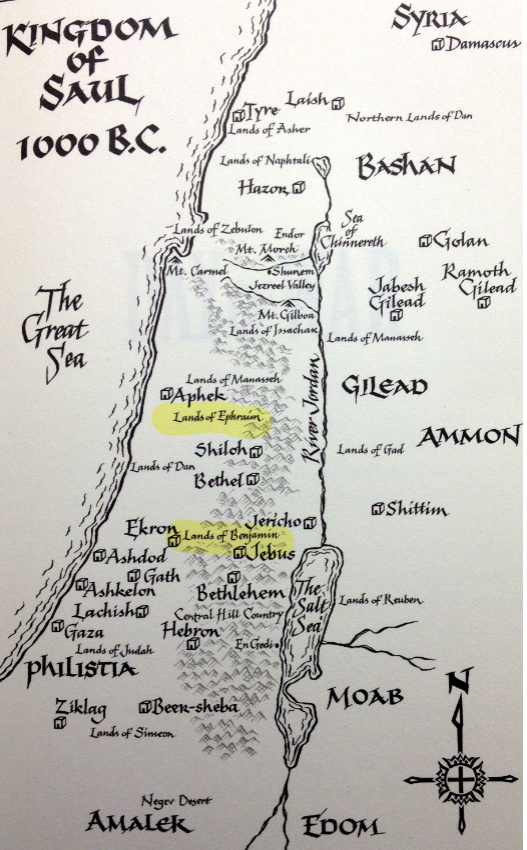
I suppose the first thing I am curious about is the route he took in looking for his animals – through the hill country of Ephraim, through Shalishah, though Shaalim, and through the land of Benjamin.
Best I can tell, the map to the right provides demarcation of the Hill Country, and lands of Benjamin and Ephraim. This journey may have been as much as 100 miles round trip, traveling through hilly country, looking for donkeys.
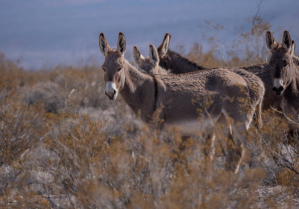
Donkeys!
When I think of Old Testament Israel, I think sheep, not donkeys, yet these animals were common in the land, even used to transport royalty in the very near future. And Saul, with an assistant was out looking for a heard of donkey’s upon assignment from his father Kish.
Let’s think about this. A prominent, wealthy family looses a herd of donkeys. Does this speak of bad livestock management practices? We need to give Kish and his family the benefit of the doubt as this occurrence was used of God to direct Saul to a fateful meeting with Samuel. To be anointed the first King of Israel, continuing the rejection of God as their King!
What are you talking about Carl – Israel’s rejection of God? You see, Saul was out searching for lost donkeys, spending a considerable amount of time and effort chasing after them. It turns out he never did find them. But he was led to a prophet that had been told of Israel’s rejection of God, of God giving the nation He created, saved and established what they wanted. And what did they want? A replacement leader. Someone instead of God. We will see this as a consistent truth as we venture through the Old Testament, but it is good to understand how this impacts not only Samuel’s life, but more importantly God’s interpretation of Israel’s desires.
1 Samuel 8:7 And the LORD said to Samuel, “Obey the voice of the people in all that they say to you, for they have not rejected you, but they have rejected me from being king over them.
Sobering thoughts on the desires of a nation, when it simply wants to be like the nations around it.
Thanks again for coming to visit. I hope you found something of interest in this post and would appreciate a comment, to begin a discussion. If you know someone this blog may bless (or challenge), send them a link, so they may join us in our discussion.
As many who have followed me for a bit, I have fallen into the Psalms, and I can’t get up! (As if I would want to.) The Psalms are a majestic collection of poetry, of heart felt human experiences that constantly challenge me in my own frail attempt to follow the true King. As many of the Psalms are written by David, my study on the Psalms has spurred me on to looking at the life of David, is the main contributor to this book, and to follow the victories and tragedies of the shepherd King of Israel.
Many times in the narrative, we will see the Lord Jesus, imperfectly, yet a reflection of His spirit in a man with weaknesses.
Thanks again for coming to visit. I hope you found something of interest in this post and would appreciate a comment, to begin a discussion. If you know someone this blog may bless (or challenge), send them a link, so they may join us in our discussion.
As many who have followed me for a bit, I have fallen into the Psalms, and I can’t get up! (As if I would want to.) The Psalms are a majestic collection of poetry, of heart felt human experiences that constantly challenge me in my own frail attempt to follow the true King. As many of the Psalms were written by David, my Psalms for Psome study has spurred me on to looking at the life of David, and to following the victories and tragedies of the shepherd King of Israel.
Many times in the narrative, we will see the Lord Jesus, imperfectly, yet a reflection of His spirit may be found in David, a man exposed for us to wonder at, to identify with and to gain warnings from.
In my initial research, I discovered an introductory snippet, that encapsulates David’s life as a central character in the Old Testament narrative.
Of all the lives in Scripture, David’s is the only one that is exhaustively examined from the time of his childhood to his death. It is an open book like no other. Even his state of mind is revealed in the Psalms, like a diary open to our review. How would our own lives look if subjected to this type of scrutiny? I am humbled to consider that the day is coming when all the hidden things of my life will be revealed. For that reason alone, we should be kind to the memory of David, recognizing in him many of our own failings and weaknesses, but also admiring his strengths.
William H Gross, 2005
David is an amazing soul, that we will do well to learn from. Although his life covers both books of Samuel, and the beginning of 1Kings (with supplemental information provided in the books of the Chronicles), I propose to venture through his life using the topics found in the table below. Of course as I get into the details of this man’s life, I anticipate I will need to create multiple posts for singular topics.
A listing of future posts I hope to share with my readers follows and may be downloaded for personal study at your leisure.
Subject
Scripture Passage
Aprox Date
1
Saul Chosen, Anointed and Proclaimed to Be King
1 Samuel 9:1-15,16, 10:1,18-19-24
1040 BC
2
The Lord Rejects Saul
1 Sam. 15:10-28
1030 BC
3
David Anointed King
1 Samuel 16:1-13
1025 BC
4
David in Saul’s Service
1 Samuel 16:14-23, 17:15
1023 – 1015 BC
5
David and Goliath
1 Samuel 17:1-58
1020 BC
6
David and Jonathan’s Friendship
1 Samuel 18:1-5
1020 BC
7
Saul’s Jealousy of David
1 Samuel 18:6-16
1010 BC
8
David Marries Michal
1 Samuel 18:17-30
1008 BC
9
Saul Tries to Kill David
1 Samuel 19:1-24
1007 BC
10
Jonathan Warns David
1 Samuel 20:1-42
1006 BC
11
David and the Holy Bread
1 Samuel 21:1-9
1006 BC
12
David Flees to Gath
1 Samuel 21:10-15
1006 BC
13
David at the Cave of Adullam
1 Samuel 22:1-5
1005 BC
14
Saul Kills the Priests at Nob
1 Samuel 22:6-23
1005 BC
15
David Saves the City of Keilah
1 Samuel 23:1-14
1005 BC
16
Saul Pursues David
1 Samuel 23:15-29
1005 BC
17
David Spares Saul’s Life
1 Samuel 24:1-22
1005 BC
18
The Death of Samuel
1 Samuel 25:1
1005 BC
19
David and Abigail
1 Samuel 25:2-44
1005 BC
20
David Spares Saul Again
1 Samuel 26:1-25
1004 BC
21
David Flees to the Philistines
1 Samuel 27:1-12
1004 BC
22
Saul and the Medium of En-dor
1 Samuel 28:1-25
1000 BC
23
The Philistines Reject David
1 Samuel 29:1-11
1000 BC
24
David’s Wives Are Captured
1 Samuel 30:1-15
1000 BC
25
David Defeats the Amalekites
1 Samuel 30:16-31
1000 BC
26
The Death of Saul
1 Samuel 31:1-13
1000 BC
27
David Hears of Saul’s Death
2 Samuel 1:1-16
1000 BC
28
David’s Lament for Saul and Jonathan
2 Samuel 1:17-27
1000 BC
29
David Anointed King of Judah
2 Samuel 2:1-7
1000 BC
30
Ish-bosheth Made King of Israel
2 Samuel 2:8-11
998 BC
31
The Battle of Gibeon
2 Samuel 2:12-32
998 BC
32
Abner Joins David
2 Samuel 3:1-25
998 BC
33
Joab Murders Abner
2 Samuel 3:26-30
998 BC
34
David Mourns Abner
2 Samuel 3:31-39
998 BC
35
Ish-bosheth Murdered
2 Samuel 4:1-12
998 BC
36
David Anointed King of Israel
2 Samuel 5:1-16
997 BC
37
David Defeats the Philistines
2 Samuel 5:17-25
993 BC
38
The Ark Brought to Jerusalem
2 Samuel 6:1-4
992 BC
39
Uzzah and the Ark
2 Samuel 6:5-15
992 BC
40
David and Michal
2 Samuel 6:16-23
992 BC
41
The Lord’s Covenant with David
2 Samuel 7:1-17
992 BC
42
David’s Prayer of Gratitude
2 Samuel 7:18-29
992 BC
43
David’s Victories
2 Samuel 8:1-14
982 BC
44
David’s Officials
2 Samuel 8:15-18
982 BC
45
David’s Kindness to Mephibosheth
2 Samuel 9:1-13
982 BC
46
David Defeats Ammon and Syria
2 Samuel 10:1-19
981 BC
47
David and Bathsheba
2 Samuel 11:1-27
980 BC
48
Nathan Rebukes David
2 Samuel 12:1-15
980 BC
49
David’s Child Dies
2 Samuel 12:16-23
980 BC
50
Solomon’s Birth
2 Samuel 12:24-25
979 BC
51
Rabbah Is Captured
2 Samuel 12:26-31
979 BC
52
Amnon and Tamar
2 Samuel 13:1-22
978 BC
53
Absalom Murders Amnon
2 Samuel 13:23-33
976 BC
54
Absalom Flees to Geshur
2 Samuel 13:34-39
976 BC
55
Absalom Returns to Jerusalem
2 Samuel 14:1-33
974 BC
56
Absalom’s Conspiracy
2 Samuel 15:1-12
972 BC
57
David Flees Jerusalem
2 Samuel 15:13-37
969 BC
58
David and Ziba
2 Samuel 16:1-4
969 BC
59
Shimei Curses David
2 Samuel 16:5-14
969 BC
60
Absalom Enters Jerusalem
2 Samuel 16:15-23
969 BC
61
Hushai Saves David
2 Samuel 17:1-29
969 BC
62
Absalom Killed
2 Samuel 18:1-18
969 BC
63
David Hears of Absalom’s Death
2 Samuel 18:19-30
969 BC
64
David’s Grief
2 Samuel 18:31-33
969 BC
65
Joab Rebukes David
2 Samuel 19:1-8
969 BC
66
David Returns to Jerusalem
2 Samuel 19:9-15
969 BC
67
David Pardons His Enemies
2 Samuel 19:16-43
969 BC
68
The Rebellion of Sheba
2 Samuel 20:1-26
969 BC
69
David Avenges the Gibeonites
2 Samuel 21:1-14
968 – 966 BC
70
War with the Philistines
2 Samuel 21:15-22
965 BC
71
David’s Song of Deliverance
2 Samuel 22:1-51
965 BC
72
The Last Words of David
2 Samuel 23:1-7
965 BC
73
David’s Mighty Men
2 Samuel 23:8-39
74
David’s Census
2 Samuel 24:1-9
964 BC
75
The Lord’s Judgment of David’s Sin
2 Samuel 24:10-17
964 BC
76
David Builds an Altar
2 Samuel 24:18-25
963 BC
77
David in His Old Age
1 Kings 1:1-4
962 BC
78
Adonijah Sets Himself Up as King
1 Kings 1:5-10
962 BC
79
Nathan and Bathsheba Before David
1 Kings 1:11-27
962 BC
80
Solomon Anointed King
1 Kings 1:28-53
961 BC
81
David’s Instructions to Solomon
1 Kings 2:1-9
961 BC
82
The Death of David
1 Kings 2:10-12
961 BC
Thanks again for coming to visit. I hope you found something of interest in this post and would appreciate a comment, to begin a discussion. If you know someone this blog may bless (or challenge), send them a link, so they may join us in our discussion.