
Jesus in the Old Testament is a series of posts that will offer my readers a chance to consider pictures or shadows of Jesus in the Old Testament. As mentioned in the introduction to this series, some may be obvious, some may be not so obvious, and some may simply be a facet of the Lord those reading may not have considered previously.
I hope as we venture through this series, we will see the Lord in many wonderful pictures throughout the Old Testament.
SEEING JESUS IN
ABRAHAM
WARRIOR / REDEEMER
Genesis 14:14-16 When Abram heard that his kinsman had been taken captive, he led forth his trained men, born in his house, 318 of them, and went in pursuit as far as Dan. And he divided his forces against them by night, he and his servants, and defeated them and pursued them to Hobah, north of Damascus. Then he brought back all the possessions, and also brought back his kinsman Lot with his possessions, and the women and the people.
Titus 2:14 who gave himself for us to redeem us from all lawlessness and to purify for himself a people for his own possession who are zealous for good works.
Abram, when he began his pilgrimage to a land God promised him, a nephew tagged along, a nephew by the name of Lot. He tended to be the lesser man, with Abram being the leader, and Lot having an eye for the lesser things in life.
Nevertheless, when four kings met in the valley of Siddim to have it out with five other kings, the battle engulfed Lot and his family. They were taken away along with the spoils of war from their homes and fields.
Abram and his immediate family were beyond the scope of the battle field, and nothing was of any concern until he heard of Lot’s predicament. This would not stand, for Abram was a man who was committed to those who went on pilgrimage with him, and he convinced his allies in the area to a pursuit of his families captors.
In the end, he brought back all the possessions, family kinsmen, the women and the remaining people. A stunning victory.
Jesus, as our redeemer, also entered into a battle with our captor, and in His battle, gave his own life that we might be freed.
Abram was a warrior redeemer for those who loved him.
Jesus was a warrior redeemer for those who hated Him.
He is a much more stellar warrior redeemer, who should be worshipped and loved more every day.
Thanks again for coming to visit. I hope you found something of interest in this post and would appreciate a comment, to begin a discussion. If you know someone this blog may bless (or challenge), send them a link, so they may join us in our discussion.
My hope is that this series will offer my readers a chance to consider the names, characteristics and descriptions of our God in the Word.
The remaining Names of God in this series might be considered descriptors, or characteristics of the Lord. We have reviewed the three primary Names of God, along with nineteen compound Names of God in our previous posts. As we venture through these descriptors of our God, I hope we will recognize all the many characteristics of our God that we tend to take for granted.
The Word is truly rich with descriptions of the Living God, and this effort of searching in the Word was quite illuminating. He truly is the ultimate subject of the Word, and His revelation of self-descriptions, or the accolades offered Him by His priests, prophets, kings apostles and faithful truly is a blessing.
May the Name of the Lord be praised, and by thinking on His name, may you have a blessed day.
116
ETERNAL SPIRIT
Hebrews 9:14 how much more will the blood of Christ, who through the eternal Spirit offered himself without blemish to God, purify our conscience from dead works to serve the living God.
In our last post on the Names of God, we considered “Eternal Life”. This post will address another name of God involving the term eternal. With that, it may be good to consider what eternal actually means.
It generally has the meaning of everlasting, or of forever. I did a bit of a deep dive (for me) and posted my findings previously on this blog. If you are interested and are willing to consider some of my thinking, check out A Study of Eternal / Everlasting.
Nevertheless, it is the Spirit that is eternal in this verse and our previous passage spoke of the Son as Eternal Life. I am sure you will not be surprised by our next post, and who is described as eternal in that passage.
But I speak without thinking. For the passage before us speaks of the reliance of the Lord upon His equal, the Spirit of God, to be enabled to offer Himself to God.
Jesus had spent entire His life depending on the Father through the Spirit, and when His greatest challenge came, He continued to trust, He continued to rely on the Spirit of God in His death.
What trust! What strength the Spirit supplied, in the midst of such injustice, hatred, suffering, confusion and shame.
He is the Eternal Spirit!
I would love to hear of your favorite name, characteristic or description of the Living God. Please leave me a comment, and I will include it in the list!
Thanks again for coming to visit. I hope you found something of interest in this post and would appreciate a comment, to begin a discussion. If you know someone this blog may bless (or challenge), send them a link, so they may join us in our discussion.
My hope is that this series will offer my readers a chance to consider the names, characteristics and descriptions of our God in the Word.
The remaining Names of God in this series might be considered descriptors, or characteristics of the Lord. We have reviewed the three primary Names of God, along with nineteen compound Names of God in our previous posts. As we venture through these descriptors of our God, I hope we will recognize all the many characteristics of our God that we tend to take for granted.
The Word is truly rich with descriptions of the Living God, and this effort of searching in the Word was quite illuminating. He truly is the ultimate subject of the Word, and His revelation of self-descriptions, or the accolades offered Him by His priests, prophets, kings apostles and faithful truly is a blessing.
May the Name of the Lord be praised, and by thinking on His name, may you have a blessed day.
115
ETERNAL LIFE
1 John 1:2 the life was made manifest, and we have seen it, and testify to it and proclaim to you the eternal life, which was with the Father and was made manifest to us–
Eternal life is not principally a possession we gain or a condition we enter as we initially trust Christ, but eternal life is the very essence of the Christ.
He is eternal life, and to be found in Him is to be a partaker of eternal life. John tells us that Jesus is eternal life and that eternal life was shown to us while Jesus walked this earth.
I have thought for may years that eternal life speaks of duration of life, and this surely has merit, yet as I walk with Him as feebly as I do, I find that eternal life is a quality of life.
If the concept of our spirit existing forever is true, then eternal life is of no added benefit if the quality of life is not a major consideration. Of course, eternal life speaks of no beginning and no end, and there are some who may claim that humans also had a pre existence, and will exist forever, but I find little evidence of this teaching in the Word.
What I do find evidence of in the Word is the quality of our Savior, the stellar character of His person, the gracious acceptance of those who are against Him, the willingness to bow down to us, bow down ever so far, to meet us in our sorry condition.
As believers, let us consider Who the true eternal life is, that the person of the Christ is eternal life embodied in flesh, the One who gave His life up to manifest eternal life to those who had nothing to give.
He is Eternal Life!
I would love to hear of your favorite name, characteristic or description of the Living God. Please leave me a comment, and I will include it in the list!
Thanks again for coming to visit. I hope you found something of interest in this post and would appreciate a comment, to begin a discussion. If you know someone this blog may bless (or challenge), send them a link, so they may join us in our discussion.
Let’s remind ourselves of the verses we have been exploring before we dive into our second look at it.
1 Timothy 4:1-3
Now the Spirit expressly says that in later times some will depart from the faith by devoting themselves to deceitful spirits and teachings of demons, 2 through the insincerity of liars whose consciences are seared, 3 who forbid marriage and require abstinence from foods that God created to be received with thanksgiving by those who believe and know the truth.
In our last post on this passage, we discussed the concept of departing, and that it was not simply describing the one act of apostacy, or better yet, the verse didn’t simply use the term “apostacy” in the passage. In this post, we will look at the message of devotion, of believers devoting themselves to something other than the gospel and the Savior Lord.
Devoting themselves
Devoting. προσέχω proséchō
Paul continues in this verse describing those who are departing as devoting themselves to deceitful spirits and teachings of demons. By using the word proséchō, Paul uses a word that is typically translated as that which holds the mind, to pay attention to, to adhere to. It is often translated as beware, pay attention to, and devote. A few examples may be helpful.
The Lord spoke this word many times in His ministry, warning His followers of false prophets (Matthew 7:15), the teaching of the Sadducees and Pharisees (Matthew 16:6), our own religious pride (Matthew 6:1), and of men (Matthew 10:17).
Luke used it also in the book of Acts, where it interestingly describes paying attention to magicians claiming God’s power.
Acts 8:10-11
They all paid attention to him, from the least to the greatest, saying, “This man is the power of God that is called Great.” And they paid attention to him because for a long time he had amazed them with his magic.
When we get to Paul’s writing, especially the pastoral epistles, he speaks of devotion to myths and genealogies (1 Timothy 1:4), deceitful spirits and teachings of demons, commands of people who turn away from the truth (Titus 1:14), and wine (1Timothy 3:8).
With this summary of the word proséchō provided, might it be understood that this word is used in relation to outside influences? From being a warning of dangerous lifestyles or teaching, to defining what we are attracted to that is dangerous, this term in many contexts is associated with that which “pulls us away”.
To be pulled away means you have a starting point from which you are pulled away from, further helping us understand this verse as a warning to true believers.
To depart and devote is Paul’s concern in this verse. For believers to depart from the faith and to devote (pay attention) to deceitful spirits and teachings of demons must have been heartbreaking for Paul to describe.
This same term proséchō is not used exclusively in describing a pulling away from the faith, but is also used to direct believers to pay attention to truth.
Hebrews 2:1 Therefore we must pay much closer attention to what we have heard, lest we drift away from it.
Drifting away is a very real consequence for us who do not pay attention to what we have heard and know. Do not let it slip!
Finally, Peter provides us a fitting verse to end this scary passage describing the path of believers who are departing and devoting themselves to wrong teachings.
2 Peter 1:19 And we have the prophetic word more fully confirmed, to which you will do well to pay attention as to a lamp shining in a dark place, until the day dawns and the morning star rises in your hearts,
Thanks again for coming to visit. I hope you found something of interest in this post and would appreciate a comment, to begin a discussion. If you would like to receive daily posts from Considering the Bible, click on the “Follow” link below
As many who have followed me for a bit, I have fallen into the Psalms, and I can’t get up! (As if I would want to.) The Psalms are a majestic collection of poetry, of heart felt human experiences that constantly challenge me in my own frail attempt to follow the true King. As many of the Psalms are written by David, my study on the Psalms has spurred me on to looking at the life of David, is the main contributor to this book, and to follow the victories and tragedies of the shepherd King of Israel.
Many times in the narrative, we will see the Lord Jesus, imperfectly, yet a reflection of His spirit in a man with weaknesses.
Let’s continue with David’s escape from Israel.
1 Samuel 21:10-11 10 And David rose and fled that day from Saul and went to Achish the king of Gath. 11 And the servants of Achish said to him, “Is not this David the king of the land? Did they not sing to one another of him in dances, ‘Saul has struck down his thousands, and David his ten thousands’?”
Let’s remember where we are in the life of David.
He was pulled from his duties as a shepherd, and sent on a errand to his brothers. The next day he is the champion of Israel. Soon he is stretched between family and the king, being offered two princesses of Israel for a bride. Within a brief span of time, he is commanding his own troop of soldiers, taking on deadly challenges the king throws him into, succeeding in every endeavor. Throw into the mix of this heady experience, a prophet of God anoints him as the next king of Israel!
Yet all this fame caused his popularity to become like a noose around his neck. The women of Israel sung a song of David’s exploits, comparing him with the king. This caused a problem, for the king was an unstable man, finding his self worth in the position of king, and this comparison threatened him and his position. Threatened him to the point of placing a death sentence on David!
Now he is on the run. The first place he heads to is a man of God in Nob, where he spins a yarn to get some food and a weapon from the house of the Lord.
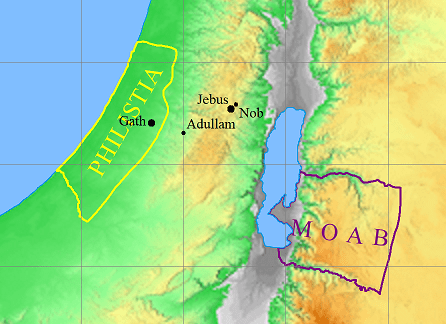
This passage has him running from Nob to Gath, which is a major city of the Philistines, to Achish, the king of Gath and away from the Saul, the king of Israel.
David had no where to go that was safe, and his flight to a Philistine city speaks of his judgement of safety in Saul’s domain. Yet, what was he thinking by going into the very city Goliath was from? Ekron was as close, and to all appearances, did not have the history as with the City of Gath. He had humiliated Achish, the local king of Gath when he took down Goliath, and now he is at the kings doorstep.
Although 100% conjecture, let me suppose a couple of scenarios. Nob was located just northeast of Jerusalem (Jebus at the time) and if the Philistine territory was the next best place to find safety, David had two options that were closest. He could travel to Gath or Ekron. They both seem to be approx. 25 miles from Nob, so why choose Gath?
Did David understand that in the killing of Goliath, he performed without knowing, a service to Achish. Had Goliath become a threat to the power of Achish, as David had become in the mind of Saul? Was David now seeing Achish as a possible ally?
It appears that David’s assumption may have not have been accurate, for his reputation had proceeded him. Not only had the song of Israel’s women proceeded him, showing him to be a greater soldier than Israel’s king, it seems common knowledge amongst the Philistines was that David had become the king of Israel. Was this some misunderstanding, some gossip that had got out of control, or did the heathen of the land understand and believe the prophecy of Samuel, the anointing of David for future kingship?
So many unknowns, yet I notice truths popping out of this short passage.
Popularity is a two edged sword. David’s success in battle, above and beyond his kings abilities, produced a murderous king Saul, causing David to run for his life. That same popularity has met him in in another country, causing leadership in that nation to fear him.
If David’s anointing was known in Philistine, were the Philistines more accepting of the truth than the Israeli population? Also, if the Philistines had common (though erroneous) knowledge of David being king, would it not have spread amongst the Israeli population also. If so, David judged the heathen to be safer than the people of God.
This seems to be a common theme through the Word, where a man (or message) of God is rejected by the people of God, only to be accepted by those outside of the community of faith. Did not the Savior spend time in the Decapolis, on the northern shore, and also amongst the Samaritans. Was He not welcomed by those who had been rejected by the religious?
For David, he had nowhere to go, and his hope of finding refuge amongst the Philistines didn’t look good at this time. It is interesting that Achish appears in David’s life later, and actually provides him a city to reside in, but we will get to that passage a bit later.
For now, let David’s life be an encouragement for each of us, as we may be misunderstood by those who we share the faith with, not accepted by those outside of the faith, and at times have no where to go.
But that is not true, for we always have a faithful and merciful high priest.
Hebrews 4:16 Let us then with confidence draw near to the throne of grace, that we may receive mercy and find grace to help in time of need.
Thanks again for coming to visit. I hope you found something of interest in this post and would appreciate a comment, to begin a discussion. If you know someone this blog may bless (or challenge), send them a link, so they may join us in our discussion.
My hope is that this series will offer my readers a chance to consider the names, characteristics and descriptions of our God in the Word.
The remaining Names of God in this series might be considered descriptors, or characteristics of the Lord. We have reviewed the three primary Names of God, along with nineteen compound Names of God in our previous posts. As we venture through these descriptors of our God, I hope we will recognize all the many characteristics of our God that we tend to take for granted.
The Word is truly rich with descriptions of the Living God, and this effort of searching in the Word was quite illuminating. He truly is the ultimate subject of the Word, and His revelation of self-descriptions, or the accolades offered Him by His priests, prophets, kings apostles and faithful truly is a blessing.
May the Name of the Lord be praised, and by thinking on His name, may you have a blessed day.
114
EQUAL WITH GOD
John 5:18 This was why the Jews were seeking all the more to kill him, because not only was he breaking the Sabbath, but he was even calling God his own Father, making himself equal with God.
In John 5:17, Jesus claims for the first time, that God is His own Father. He simply states “My Father is working…
No self respecting Israeli would be audacious enough to claim the eternal and all powerful Creator of all to be His own Father. This was clearly blasphemy in the minds of the learned religious class of Israel, for they had come to a conclusion very early on that Jesus could not be the Messiah.
Of course, if they had no bias against this Rabbi, they may have considered all the prophecies He had fulfilled without His being able to control the circumstances. Prophecies of his birth, of His youth, of His family circumstances and lineage, His miracle working, His unassailable logic in teaching.
God provided ample evidence of His person, and when Jesus simply stated what should have been obvious to unbiased ears, those who had closed their ears and eyes to facts, opened their hearts and mouths to the option of death.
When the Jews stated that He made Himself equal to God, the term equal can be considered in both the quantitative or qualitative sense.
Quantitative as in a math equation, or that two objects have the same number of components, or are equal in weight or number.
Qualitative, as in the quality of two items. This meaning may be closer to the intent, for to be qualitatively equal to God the Father is to claim for Himself all the characteristics of the Most Blessed.
This claim was completely beyond the Jews comprehension, for they were poisoned with a bias, and made assumptions that were completely unfounded. This dangerous attitude was based in a darkened heart that would not recognize the true God, for they imagined Him as a warrior, and not the servant, as One who would kill, and not save, as One who would separate and not join together.
How far off they were from the Living One!
Bias and assumptions about Jesus can kill you. Please – for your own sake – do not make uniformed decisions about who Jesus is, or listen to gossip about Him, or watch His followers make mistakes, or ignore the One who provided proofs.
Read the record that provides the witness of His person. Read it with an open mind, and ask for insight. Might I suggest taking the gospel of John and as you read, ask hard questions about what the gospel is trying to communicate. Take your time reading it, looking for the message you need to hear.
But don’t simply reject Him because of a bias, or an assumption. For He is equal with God.
Read the Scriptures and believe!
I would love to hear of your favorite name, characteristic or description of the Living God. Please leave me a comment, and I will include it in the list!
Thanks again for coming to visit. I hope you found something of interest in this post and would appreciate a comment, to begin a discussion. If you know someone this blog may bless (or challenge), send them a link, so they may join us in our discussion.
My hope is that this series will offer my readers a chance to consider the names, characteristics and descriptions of our God in the Word.
The remaining Names of God in this series might be considered descriptors, or characteristics of the Lord. We have reviewed the three primary Names of God, along with nineteen compound Names of God in our previous posts. As we venture through these descriptors of our God, I hope we will recognize all the many characteristics of our God that we tend to take for granted.
The Word is truly rich with descriptions of the Living God, and this effort of searching in the Word was quite illuminating. He truly is the ultimate subject of the Word, and His revelation of self-descriptions, or the accolades offered Him by His priests, prophets, kings apostles and faithful truly is a blessing.
May the Name of the Lord be praised, and by thinking on His name, may you have a blessed day.
113
ENTHRONED ON THE PRAISES OF ISRAEL
Psalm 22:3 Yet you are holy, enthroned on the praises of Israel.
Psalm 22 is the psalm of the Most Righteous One suffering the greatest injustice possible, and the thoughts and prayers of this One as He endured the path to death.
In all of the pain and suffering, pleas were made to be heard. Prayers were lifted up but unanswered. No one was paying attention, and no one was out there. It seemed that the only response was abandonment, and for the Messiah, this was a fact.
David, when writing this psalm did not, in truth, experience the loneliness the Messiah went through on the cross. God was quiet for David, but for the Messiah, God had turned His back. He was truly alone, more alone than any who had walked the earth.
Yet, no slander was flung onto God, no attack on God’s ways, no character assassination, no hatefulness or scorn thrown on God’s person. None of the common, base reactions to suffering were exercised in the Messiah’s thoughts. In all the raging thoughts racing through His heart and mind while His body is screaming out in pain and agony, not one thought of anger or hatred to the Father was expressed.
In all the quiet, the Messiah knew two things that centered Him, that was foundational for Him.
God is holy. God is Enthroned on the Praises of Israel.
He is King – enthroned of all, yet as the nation praised Him, He became evident for all to see, He became “visible” to all around in the praises of His people.
How can a man suffering think this way? How can a man that is unjustly treated refer to praise to God in the middle of persecution?
It comes down to a truth. God is holy, and He is King. Whether circumstances appear to support this or not, the fact remains, and the One who experienced everything that screamed “God has abandoned Me”, could not be moved from this fact.
God is holy and God is King.
He is Enthroned on the Praises of Israel, bar the circumstances!
I would love to hear of your favorite name, characteristic or description of the Living God. Please leave me a comment, and I will include it in the list!
Thanks again for coming to visit. I hope you found something of interest in this post and would appreciate a comment, to begin a discussion. If you know someone this blog may bless (or challenge), send them a link, so they may join us in our discussion.
Now the Spirit expressly says that in later times some will depart from the faith by devoting themselves to deceitful spirits and teachings of demons, 2 through the insincerity of liars whose consciences are seared, 3 who forbid marriage and require abstinence from foods that God created to be received with thanksgiving by those who believe and know the truth.
In my travels through the Word, as I come across passages that I have provided my reader to consider in relation to conditional security of the believer, there have been some passages that seemed to support the Once Saved Only Saved (OSAS) teaching. Decades ago, these were the passages I would refer to when I met a “heretic” (such as I have become), positing the position of possible apostacy of true believers. One of my standby’s when defeating the heretic was John 10:28-29. I have sought to explain my thinking in this verse in an earlier post. See Conditional Security – John 10:28-29. There were a number of passages I used to refer to in order to support the OSAS position.
One of the passages I would invariably be faced with in the discussion is the passage we will consider today. I can tell you right now, I remember this passage causing me trouble when it was brought up, and I would typically avoid or deflect the seeming obvious message it carried. (I am quite adept at avoiding that which I did not want to face!)
Two actions are described in the first verse. Departing and Devoting. And of course the subject of the sentence is critical for our correct understanding. Who will depart? Who will devote?
The first item of concern is the subject of departing. It seems obvious that Paul is describing true believers doing the departing since he claims it is an express statement from the Spirit. The Spirit is making a specific statement about this departing and devoting. Paul is instructing Timothy, a man who was a leader in the church, a man who was responsible for oversight of a church body, who needed direction for difficult, unforeseen occurrences in the church. Might apostacy be one of these circumstances that Timothy needed express instruction on? Would there be any reason for instruction to be provided to Timothy for those outside of the church? For those outside of the church, what would they be departing from?
Too many questions erupt if we do not understand that this passage is describing true believers. With that established, let us continue considering departing and devoting
Depart from the faith
To depart. ἀφίστημι aphístēmi.
The Greek word Paul used is not as I first expected. I assumed he would have used ποστασία apostasía for this verse, if he is truly describing a falling away from the faith, a defection of faith. You see, I expected this verse to be describing apostacy, a falling away. Maybe not exactly. Paul, in this verse is describing something a bit different, yet I fear the end result is the same.
Paul, by the express message of the Spirit, used aphístēmi in this verse, describing some departure. Our word in this verse speaks of removal, withdrawal, or a drawing away, and this makes sense as we remember that those drawn away are devoting themselves to something. In my initial understanding of this concept, I think Paul may have used this word because he is highlighting outside influences having the desired effect on believers. May it be more than simply be falling away, or rejecting/ignoring the gospel as in apostacy? Might those under consideration in this verse be lured away, drawn away from the gospel, in order to chase something other than the gospel?
Paul says that “some will depart from the faith”. To depart implies leaving a location or position and to seek an alternate goal or end. It also implies the possession of the initial position, that of being in the faith. How can this be? How can those who know the Lord ever walk away, depart, leave Him?
How is it that I have this dangerous heart in me?
In our next post, let’s explore that topic. I hope we can meet again and consider the Bible for the message it has for us.
Thanks again for coming to visit. I hope you found something of interest in this post and would appreciate a comment, to begin a discussion. If you would like to receive daily posts from Considering the Bible, click on the “Follow” link below
As many who have followed me for a bit, I have fallen into the Psalms, and I can’t get up! (As if I would want to.) The Psalms are a majestic collection of poetry, of heart felt human experiences that constantly challenge me in my own frail attempt to follow the true King. As many of the Psalms are written by David, my study on the Psalms has spurred me on to looking at the life of David, is the main contributor to this book, and to follow the victories and tragedies of the shepherd King of Israel.
Many times in the narrative, we will see the Lord Jesus, imperfectly, yet a reflection of His spirit in a man with weaknesses.
1 Samuel 21:8-9
8 Then David said to Ahimelech, “Then have you not here a spear or a sword at hand? For I have brought neither my sword nor my weapons with me, because the king’s business required haste.” 9 And the priest said, “The sword of Goliath the Philistine, whom you struck down in the Valley of Elah, behold, it is here wrapped in a cloth behind the ephod. If you will take that, take it, for there is none but that here.” And David said, “There is none like that; give it to me.”
Goliath’s Sword
David has acquired food, and Doeg has acquired information. At this point, David has to dip into his lie once more, of being sent by the king.
Now I don’t know about you, but I don’t suspect the tabernacle was the equivalent of a gun armory, (or a sword armory, if we should think back then). For David to ask about weapons that the priest may have may show a bit of desperation, yet again Ahimelech works with David in his request. It just so happens that the very sword of Goliath was stored at the tabernacle.
This willingness of David to take the sword, this massive sword of Goliath may give us a hint to the growth he experienced as a warrior since his initial encounter with Saul. If you recall, when offered the armor of king Saul, he rejected it, due to it not being tested. I suspect the armor was not to his customary use, being a shepherd boy.
Things are different now. David was an accomplished warrior, strong and able to handle conventional weapons with skill and force.
Psalm 18:34 He trains my hands for war, so that my arms can bend a bow of bronze.
Goliath’s sword was also a symbol of victory, a symbol of David’s ascendency to power, a symbol of a young shepherd boy who took on a giant and with the giant’s own weapon, slew him.
Yes David approved of taking the sword. Did he know all along where the sword had been stored? Whether he knew it was stored there or not is unknown in my understanding, but the fact remains, this was a very opportune situation for a man on the run!
And he was on the run. Tired, hungry, fearful, anxious. The situation was hitting him hard and in his first encounter after realizing he was formally a hunted man, he failed to be honest with a man of God.
Honesty amongst believers
Sometimes a believer is lied to in order to conceal an actual situation, for many reasons. Let us not be offended by a brother’s weakness, doubting them, or judging them in order to avoid the situation, but do what we can with what we have to be a blessing to them. Is this not the attitude of Ahimelech?
The rest of the deal is with God.
Romans 14:11-12
for it is written, “As I live, says the Lord, every knee shall bow to me, and every tongue shall confess to God.” So then each of us will give an account of himself to God.
David was eventually taught by God in this failure, and tragically people died, God fearing men died due to this failure of David.
How can we process this seeming injustice? The innocent died for a guilty man’s lies. How can this be right?
Can you recall when this may have happened for you in your life?
Personally, I have failed much in my Christian life, and I have seen the mercy of God reach out to my family and I, rescue us in my weakness, protecting my family and friends. When I have failed, and sensed no return to blessings for those close to me, I consider a small verse I tripped over by the grace of God.
Joel 2:25
I will restore to you the years that the swarming locust has eaten, the hopper, the destroyer, and the cutter, my great army, which I sent among you.
Joel had seen his nation ravaged due to massive swarms of locusts descending of the fields of Israel, stripping the land of all food. It was a judgement of God on a wayward and rebellious nation, and came after much patience of the Lord, much seeking of the Lord for the nation to repent. But judgement fell. Suffering was experienced. Death was widespread.
For believers, we need to understand we are not beyond the temporal judgement of God, and yet we can trust He restores in His own way.
It is the mercy of God to restore. Out of this restoration, His mercy is to pull us closer, pull us to love Him more, to live for Him.
Be thankful for His mercy and judgements. Speak of His goodness. Let others know of His mercies. He is good and He is good all the time!
Thanks again for coming to visit. I hope you found something of interest in this post and would appreciate a comment, to begin a discussion. If you know someone this blog may bless (or challenge), send them a link, so they may join us in our discussion.
Jesus in the Old Testament is a series of posts that will offer my readers a chance to consider pictures or shadows of Jesus in the Old Testament. As mentioned in the introduction to this series, some may be obvious, some may be not so obvious, and some may simply be a facet of the Lord those reading may not have considered previously.
I hope as we venture through this series, we will see the Lord in many wonderful pictures throughout the Old Testament.
SEEING JESUS IN
ABRAHAM
TESTING
Genesis 22:2 He said, “Take your son, your only son Isaac, whom you love, and go to the land of Moriah, and offer him there as a burnt offering on one of the mountains of which I shall tell you.”
Hebrews 5:8 Although he was a son, he learned obedience through what he suffered.
Abraham’s greatest test is recorded for us in Genesis 22, in the offering up of his son on an altar in obedience to God’s command. This is truly an amazing passage, exhibiting a faith in God that was being stretched to a breaking point.
It was Abraham’s greatest test, but not his only test, for God had been working in Abraham constantly, challenging him in multiple ways. As a matter of fact, the number of tests Abraham lived through is quite illuminating, and more numerous than I assumed.
Abraham left Ur and Haran for an unknown destination at God’s direction
Abraham directed a peaceful separation from Lot and settled at the oaks of Mamre.
Abraham rescued Lot from the five kings. Abraham tithed after the battle for Lot to a mysterious king/priest Melchizedek. He also rejected any provision the king of Sodom offered.
Abraham trusted God’s promise that he would have a son.
Abraham received the promised land by faith, though the fulfillment would not come for many generations.
Abraham circumcised every male in his family.
Abraham welcomed strangers, (angels).
Abraham prayed for Sodom
Abraham admitted to wrongdoing (in front of the king of Egypt) and took the actions needed to set things right.
Abraham negotiated a treaty with Abimelech concerning a well.
Abraham prepared to sacrifice his son Isaac.
Abraham was tested through out his walk with God, and we know this is true of the many tests the Lord Jesus faced, (though many of the tests Jesus experienced came from evil men). Nevertheless this life trait of being tested speaks of the similarity between these two individuals in the Word.
Hebrews 5:8 Although he was a son, he learned obedience through what he suffered.
Jesus was tested and passed each test, though the passing of the tests often caused loneliness, misunderstanding and finally great pain, to the point of death!
Abraham’s hopes (Isaac) was set to die in Genesis 22. Jesus life was snuffed out, through an excruciating death. Similar, but not exactly the same, for the Lord took the testing to it’s ultimate conclusion, and came out if it victorious.
Thanks again for coming to visit. I hope you found something of interest in this post and would appreciate a comment, to begin a discussion. If you know someone this blog may bless (or challenge), send them a link, so they may join us in our discussion.
My hope is that this series will offer my readers a chance to consider the names, characteristics and descriptions of our God in the Word.
The remaining Names of God in this series might be considered descriptors, or characteristics of the Lord. We have reviewed the three primary Names of God, along with nineteen compound Names of God in our previous posts. As we venture through these descriptors of our God, I hope we will recognize all the many characteristics of our God that we tend to take for granted.
The Word is truly rich with descriptions of the Living God, and this effort of searching in the Word was quite illuminating. He truly is the ultimate subject of the Word, and His revelation of self-descriptions, or the accolades offered Him by His priests, prophets, kings apostles and faithful truly is a blessing.
May the Name of the Lord be praised, and by thinking on His name, may you have a blessed day.
112
ENLARGER OF MY HEART
Psalm 119:32 I will run in the way of your commandments when you enlarge my heart!
In our last post we considered the description of God as the enlarger of Gad, specifically in the geographical opportunities provided that tribe centuries ago.
In this post, we see a personal plea to God for enlarging of the psalmist’s heart. To enlarge is to widen, to expand, and the psalmist speaks of his need to be more than he is.
Consider that the heart is the seat of our emotional life, and as such, for our heart to be enlarged would speak of a expanded commitment in God, a larger swath of our lives to be under God, willing to let Him have His way.
This enlarging of heart is a great thought, a high ideal, a noble goal, but what does it look like when a saint’s heart is enlarged? I would suggest that one possible evidence is the possession of wisdom and knowledge, and I would refer my reader to the following passage.
1 Kings 4:29.
And God gave Solomon wisdom and understanding beyond measure, and breadth of mind like the sand on the seashore,
God gave Solomon wisdom and understanding beyond measure, or in other words, God enlarged Solomon’s capacity and possession of wisdom and understanding. This wisdom and understanding would be evident in a believers life daily, for this is the hallmark of a wise one, continually exercising truth and grace in his life in practical ways.
For God to enlarge our heart will include (but not be restricted to) a growing outworking of practical wisdom in our lives for ourselves and for others. This wisdom will be borne from our widening commitment to God, our trust in His will and our desire to do His pleasure.
And in all that we plead – God – be the One who enlarges our heart!
I would love to hear of your favorite name, characteristic or description of the Living God. Please leave me a comment, and I will include it in the list!
Thanks again for coming to visit. I hope you found something of interest in this post and would appreciate a comment, to begin a discussion. If you know someone this blog may bless (or challenge), send them a link, so they may join us in our discussion.
My hope is that this series will offer my readers a chance to consider the names, characteristics and descriptions of our God in the Word.
The remaining Names of God in this series might be considered descriptors, or characteristics of the Lord. We have reviewed the three primary Names of God, along with nineteen compound Names of God in our previous posts. As we venture through these descriptors of our God, I hope we will recognize all the many characteristics of our God that we tend to take for granted.
The Word is truly rich with descriptions of the Living God, and this effort of searching in the Word was quite illuminating. He truly is the ultimate subject of the Word, and His revelation of self-descriptions, or the accolades offered Him by His priests, prophets, kings apostles and faithful truly is a blessing.
May the Name of the Lord be praised, and by thinking on His name, may you have a blessed day.
111
ENLARGER OF GAD
Deuteronomy 33:20 And of Gad he said, “Blessed be he who enlarges Gad! Gad crouches like a lion; he tears off arm and scalp.
Gad was the seventh son of Jacob and Leah, and as the tribe of Gad was led to the promised land by Moses, they became one of the tribes that settled on the east side of the Jordan, the other being Rueben and half the tribe of Manasseh.
This choice by the tribe of Gad was commended by Moses, for there was no restriction for expansion on the east side of the Jordan. Each of the other tribes of Israel would end up with land allocations between a sea and the Jordan river, providing little if any opportunity for geographical expansion.
This choice of land allocation by Gad is a result of God’s blessing on Gad, on God providing opportunity to Gad in their location to settle. This tribe would also provide valiant soldiers for the later King David in his battles, and their expertise in fighting may be the result of having an open border to the east, always needing to be defended.
God provided Gad the blessing of opportunity, but with opportunities came along responsibilities to guard the land, possibly expand it, and provide skills for the greater good of the entire nation.
It is like that for us today also. Consider the opportunities God has provided you, the associated responsibilities and the skill sets developed for the greater good.
God enlarges Gad, and He seeks to enlarge us in our opportunities, responsibilities, privileges, and blessings to others.
Blessed is the One who enlarges!
I would love to hear of your favorite name, characteristic or description of the Living God. Please leave me a comment, and I will include it in the list!
Thanks again for coming to visit. I hope you found something of interest in this post and would appreciate a comment, to begin a discussion. If you know someone this blog may bless (or challenge), send them a link, so they may join us in our discussion.
In the mid nineties, I had a little red Buick and a big ol’ bass box in the trunk, and would listen to “Christian Rock”, cranked to 11.
(What did you say? Huh? Can you say that again, I didn’t hear you….)
I have gotten away from that genre for many reasons, the least of which may be a loss of hearing, but some songs have stuck with me over the decades.
The artist’s I listened to sought to reflect Scriptural teaching for the most part. They ranged from “preaching” pop culture religion to significant theological teaching. As I listened to the lyrics, I found some to be quite challenging.
To be honest, I listened because I could justify the rock beat with “sanctified lyrics”.
Occasionally I will post a song, supply the lyrics and make a comment or two. If you decide to listen to the tune, turn the speaker down unless you are already deaf. Some of the songs tend to have a certain “volume” about them!
This post will consider the song.
Lean on me – Bill Withers
Lean on me when you’re not strong And I’ll be your friend I’ll help you carry on For it won’t be long ‘Til I’m gonna need Somebody to lean on
[Verse 2] Please swallow your pride If I have things you need to borrow For no one can fill Those of your needs That you won’t let show
[Bridge] You just call on me, brother, when you need a hand We all need somebody to lean on I just might have a problem that you’ll understand We all need somebody to lean on
I don’t know if Bill Withers intended to write this song about the Christian life, but some songs come along that lend themselves to the Christian life no matter the intent when writing.
This song is such a recognizable song from the 60’s that I found myself singing it without any prompt a few days ago, and realized it describes a family unit, friends that rely on one another, folks that will let their guard down with a friend or brother. Does that not describe a healthy Christian environment?
Take a listen!
Does this describe a healthy Christian environment? Let me know your thoughts.
Thanks again for coming to visit. I hope you found something of interest in this post and would appreciate a comment, to begin a discussion. If you know someone this blog may bless (or challenge), send them a link, so they may join us in our discussion
As many who have followed me for a bit, I have fallen into the Psalms, and I can’t get up! (As if I would want to.) The Psalms are a majestic collection of poetry, of heart felt human experiences that constantly challenge me in my own frail attempt to follow the true King. As many of the Psalms are written by David, my study on the Psalms has spurred me on to looking at the life of David, is the main contributor to this book, and to follow the victories and tragedies of the shepherd King of Israel.
Many times in the narrative, we will see the Lord Jesus, imperfectly, yet a reflection of His spirit in a man with weaknesses.
1 Samuel 21:7
7 Now a certain man of the servants of Saul was there that day, detained before the LORD. His name was Doeg the Edomite, the chief of Saul’s herdsmen.
A certain man
In our last post we found David lying to a godly priest named Ahimelech, and receiving sustenance for himself and his supposed company of soldiers he was going to supposedly meet. All lies, and yet Ahimelech provided for David the food that he requested.
In this post, we meet a certain man. He was of the servants of Saul. His name is Doeg, and he was an Edomite. We know that Edom had always been in enmity with Israel, and that Saul had vanquished the Edomites in a battle per 1 Samuel 14:47.
When Saul had taken the kingship over Israel, he fought against all his enemies on every side, against Moab, against the Ammonites, against Edom, against the kings of Zobah, and against the Philistines. Wherever he turned he routed them.
So it is likely Doeg was either a captive of king Saul, or a traitor to his own country, seeing an opportunity to side with Saul. I will let the reader consider which is likely.
In some of the non biblical literature describing Doeg, it appears he may have been more than just a turncoat, more than just a man who took advantage. Some of the ancient writings speak of Doeg as being scholarly, a brilliant debater, yet without any piety towards God. He may have considered himself an equal to David, one that was in competition for status before the king.
His name actually means to be fearful, anxious, concerned. To be considered the chief of the kings herdsman may have simply referred to his character, and not a formal office. To be chief in this instance, referred to Doeg as being stouthearted, mighty, even obstinate. He was a self willed man, determined to acquire favor of a madman who was king.
For Doeg to be detained before the Lord implies he had been proselytized into the Jewish faith, at least in ritual, and that he was taking care of some responsibility before the Lord. Disciplinary or ceremonially it is uncertain.
But he was there at the right time in order to take advantage of David’s pleas to the priest! Doeg must have recognized the hand of God in this coincidence! Of course, as a man who sought the favor of the king, it would not turn out to be beneficial to anyone!
Thanks again for coming to visit. I hope you found something of interest in this post and would appreciate a comment, to begin a discussion. If you know someone this blog may bless (or challenge), send them a link, so they may join us in our discussion.
Jesus in the Old Testament is a series of posts that will offer my readers a chance to consider pictures or shadows of Jesus in the Old Testament. As mentioned in the introduction to this series, some may be obvious, some may be not so obvious, and some may simply be a facet of the Lord those reading may not have considered previously.
I hope as we venture through this series, we will see the Lord in many wonderful pictures throughout the Old Testament.
SEEING JESUS IN
ABRAHAM
NEW NAME
Genesis 17:5 No longer shall your name be called Abram, but your name shall be Abraham, for I have made you the father of a multitude of nations.
Revelation 3:12 The one who conquers, I will make him a pillar in the temple of my God. Never shall he go out of it, and I will write on him the name of my God, and the name of the city of my God, the new Jerusalem, which comes down from my God out of heaven, and my own new name.
Abram wasn’t looking for a new name, and when the Lord changed it on him, the name change signified something incredible, unbelievable. The name God gave him represented the promise he had just been given by God.
Of course, at the time of the name change, Abram had no children by Sarai, and his only offspring was a young man named Ishmael. Sarai was barren and as a last resort, Sarai struck a bargain with (nagged?) Abraham to lay with Hagar her maid. She must have really wanted a child in the worst way!
Thirteen years after the birth of Ishmael to Abram, God appeared to Abram to cut a covenant with him. A covenant with the promise of a multitude of nations to come from his loins. He had one child at this time, a child of a servant not of his wife. And his wife, who would provide a child without dispute, was barren. Old and barren. Quite the promise!
God had the audacity to promise that nations would come from Sarai. Why not Ishmael? In Genesis 17:15-16, God made it clear that Sarai (not Hagar) would produce the nations, that kings would come from her. And Abraham, before any children from Sarai would appear on the scene, would go by the name of Abraham – Father of multitudes, Father of nations!
Talk about wearing your faith! Abraham was now to be known as a father of many, but in experience the father of none, at least by Sarai! (Might Abram hear some mockery when the neighbors are told of the name change?)
Jesus also has a new name, one that we do not know yet. He promises that as we overcome, He will make us a pillar in the temple of God. As a pillar, He will write on us His own new name! Too many mysteries are beyond me in this description of the Lord’s doings, but we do see that a new name is provided to those who have greater things promised in the future, as in Abrams case. How that applies to the Lord Jesus is beyond me.
Yet He will have a new name, and we may find out some day, for the name is written on the pillars (overcomers) of the church for all to see!
He does everything for us, even giving us His new name.
Praise Him for His loving mercy!
Thanks again for coming to visit. I hope you found something of interest in this post and would appreciate a comment, to begin a discussion. If you know someone this blog may bless (or challenge), send them a link, so they may join us in our discussion.
My hope is that this series will offer my readers a chance to consider the names, characteristics and descriptions of our God in the Word.
The remaining Names of God in this series might be considered descriptors, or characteristics of the Lord. We have reviewed the three primary Names of God, along with nineteen compound Names of God in our previous posts. As we venture through these descriptors of our God, I hope we will recognize all the many characteristics of our God that we tend to take for granted.
The Word is truly rich with descriptions of the Living God, and this effort of searching in the Word was quite illuminating. He truly is the ultimate subject of the Word, and His revelation of self-descriptions, or the accolades offered Him by His priests, prophets, kings apostles and faithful truly is a blessing.
May the Name of the Lord be praised, and by thinking on His name, may you have a blessed day.
110
DWELLING PLACE
Deuteronomy 33:27 The eternal God is your dwelling place, and underneath are the everlasting arms. And he thrust out the enemy before you and said, ‘Destroy.’
God is described as a place for us to dwell in. To dwell – what may I ask does my reader consider when the term “dwell” occurs in a passage? To find permanence in? To live in, and to be familiar with?
To be described as a dwelling place is to be likened to a habitation or even a refuge, implying a place of safety from danger. The term is sometimes used of an animals den or lair, a place that provides protection from an enemy, a place of permanence for the animal to resort to. Many times, this description implies a place of refuge from danger, and in this passage also, it is in the context of finding protection. It is not simply a place of familiarity and comfort, though a secondary message for the believing one to find encouragement in. The primary message is that of God providing safety for the saint from an enemy.
The fact that He is described as a possession of the saint – He didn’t say “a” dwelling place, but “your” dwelling place – should be a constant encouragement and comfort for the saint.
Remember, the Eternal God is your dwelling place. The eternal God!
I would love to hear of your favorite name, characteristic or description of the Living God. Please leave me a comment, and I will include it in the list!
Thanks again for coming to visit. I hope you found something of interest in this post and would appreciate a comment, to begin a discussion. If you know someone this blog may bless (or challenge), send them a link, so they may join us in our discussion.
My hope is that this series will offer my readers a chance to consider the names, characteristics and descriptions of our God in the Word.
The remaining Names of God in this series might be considered descriptors, or characteristics of the Lord. We have reviewed the three primary Names of God, along with nineteen compound Names of God in our previous posts. As we venture through these descriptors of our God, I hope we will recognize all the many characteristics of our God that we tend to take for granted.
The Word is truly rich with descriptions of the Living God, and this effort of searching in the Word was quite illuminating. He truly is the ultimate subject of the Word, and His revelation of self-descriptions, or the accolades offered Him by His priests, prophets, kings apostles and faithful truly is a blessing.
May the Name of the Lord be praised, and by thinking on His name, may you have a blessed day.
109
DREAD WARRIOR
Jeremiah 20:11 But the LORD is with me as a dread warrior; therefore my persecutors will stumble; they will not overcome me. They will be greatly shamed, for they will not succeed. Their eternal dishonor will never be forgotten.
Out of all the names of God I have considered, this one name has caused me a bit of reluctance to consider.
Why you ask?
To be honest I really don’t know. I look forward to considering the character of our God in these short posts, but to consider God as a dread warrior initially shook me.
I say that as an encouragement to my readers that even if the Word seems to say hard things, things we may not want to look at, it is to our benefit to understand to the best of our ability the truth of His message to us for His sake. We are not to simply try to protect ourselves from a predisposed assumption of what the verse may be saying.
With that said, let us consider this passage and try to understand it’s message for us.
A bit of background for this verse will give us some context.
Jeremiah was called a prophet by God in the midst of a nation that was in the final throws of a death sentence. Judgement was coming onto Israel, and Jeremiah had been preaching this message. Pashur, a leading priest of the nation had struck Jeremiah and thrown him in stocks for this message. Upon his release, Jeremiah declared judgement on Pashur, very specific judgements that would have definitely set a bullseye on his back. Pashur would not allow this to stand and Jeremiah knew what was coming.
In this condition, Jeremiah resolves to quit his prophetic work, stating that he will not make mention of God, nor speak anymore in His name. (Jeremiah 20:9). His inner struggle was great, and he admits that the Word of God was more powerful than his own self interests. God was at war with His prophet!
In this context, we have this statement
But the Lord is with me as a dread warrior.
My initial thoughts were that God was a dread warrior against Jeremiah’s persecutors, and the immediate portion of the verse after this phrase lends itself to this understanding.
But as I consider this passage, I wonder. The previous portion describes God’s effective battle in Jeremiah’s heart, and verse 12 speaks of the Lord’s testing of the righteous.
May Jeremiah be realizing that because God won the victory over his will, that he now understands the God of Israel as a fierce, mighty and awesome God that will accomplish His will, in the righteous first and then the unrighteous? God will win in the righteous one’s heart as with Jeremiah. God will also win (in some manner) with those who fight against God. If those who are against God will not willingly accept the will of God, they to will come to understand that God is a fierce warrior, a dread fear inducing warrior. He is not a negotiating God.
It is to the benefit of all to understand that God is a dread warrior, that He is a warrior for our benefit, though it is often a painful process. May we see Him as the Dread Warrior for our souls, for our lives, for our good, and for His glory.
I am glad I faced this verse, this name of God, and this fear I had. He is a Dread Warrior, fighting for us, and not against us.
May His name be honored in our lives.
I would love to hear of your favorite name, characteristic or description of the Living God. Please leave me a comment, and I will include it in the list!
Thanks again for coming to visit. I hope you found something of interest in this post and would appreciate a comment, to begin a discussion. If you know someone this blog may bless (or challenge), send them a link, so they may join us in our discussion.
As many who have followed me for a bit, I have fallen into the Psalms, and I can’t get up! (As if I would want to.) The Psalms are a majestic collection of poetry, of heart felt human experiences that constantly challenge me in my own frail attempt to follow the true King. As many of the Psalms are written by David, my study on the Psalms has spurred me on to looking at the life of David, is the main contributor to this book, and to follow the victories and tragedies of the shepherd King of Israel.
Many times in the narrative, we will see the Lord Jesus, imperfectly, yet a reflection of His spirit in a man with weaknesses.
1 Samuel 21:1-6 1 Then David came to Nob, to Ahimelech the priest. And Ahimelech came to meet David, trembling, and said to him, “Why are you alone, and no one with you?” 2 And David said to Ahimelech the priest, “The king has charged me with a matter and said to me, ‘Let no one know anything of the matter about which I send you, and with which I have charged you.’ I have made an appointment with the young men for such and such a place. 3 Now then, what do you have on hand? Give me five loaves of bread, or whatever is here.” 4 And the priest answered David, “I have no common bread on hand, but there is holy bread – if the young men have kept themselves from women.” 5 And David answered the priest, “Truly women have been kept from us as always when I go on an expedition. The vessels of the young men are holy even when it is an ordinary journey. How much more today will their vessels be holy?” 6 So the priest gave him the holy bread, for there was no bread there but the bread of the Presence, which is removed from before the LORD, to be replaced by hot bread on the day it is taken away.
For the remainder of the book of 1 Samuel, David is a hunted man, on the run, constantly looking over his shoulder. He does gather a small militia in his travels, and becomes a military force in his wandering, but for this passage, David is unfed, unarmed, unprepared, unable to plan and unwilling to speak the truth to a man of God. David begins a life of running, a life of seeking to simply survive!
Deceit
David, by this time in his career with the royal house of Israel, had attained a position that afforded him a company of soldiers with him as he was sent by the king on missions. He was no mere singular soldier. This is the background that Ahimelech understood when he saw David that fateful day. Based on this understanding, for David to be alone, without soldiers accompanying him was suspicious.
When Ahimelech came to David trembling, my first understanding was that Ahimelech was trembling. Of that I am not sure, for Ahimelech had no cause to tremble, but David had just begun a life of running, of hiding from the king, of living with one foot in the grave, not knowing who he could trust. I suggest David was not only alone, but was also trembling, possibly looking rough from three days of hiding in the rocks, waiting for Jonathon.
I have recently posted on Psalm 64, and noticed that David had learned an important lesson on spiritual warfare. In that particulat Psalm, David prayed that he would be preserved from the dread/fear of the enemy. David had not learned that yet, as he was running based on knowledge granted from Jonathon, but also out of fear. He had no knowledge of the extent Saul would go to snuff him out. no knowledge of the web of spies about him. He would soon find out of the extent of Saul’s hatred!
At this time, he was running somewhat blind, and his first stop on his long period of running was at the tabernacle. He has said farewell to his best friend and confidant Jonathon, and now he visits the tabernacle, the house of God, for what most likely will be the last time for the foreseeable future.
And he lies. He uses deceit with the priest to get food and a weapon. He openly lies, not in the corner of the tabernacle so that only the priest understands his predicament, but he openly states he is on a secret mission, with soldiers meeting him in a rendezvous location.
This lie will come back to haunt David, and will expose the commitment of Saul’s hatred towards David. It will also show David that this life of running will impact more than his own existence! No man is an island.
Bread
David’s first request (or demand) of the priest was for sustenance, for any food that he may have. Had David been without food during his time waiting for Jonathon’s return? His need of food speaks of his unprepared condition to enter into a life of being a fugitive. No one, neither David or Jonathon seemed to consider this possible situation.
Ahimelech had one condition of supplying the show bread to David. Sexual abstinence. For this condition to be met, David had no problem, for he was away from family, seeking to find hiding from the powers that be. A woman was the last thing he could afford at this time. As for the soldiers that he claimed to be meeting, the women were as real as the soldiers were. One more lie shouldn’t matter!
But consider the Lord in His reflection of David’s situation at the tabernacle. David had obviously lied to the priest of God, and yet Jesus commended Ahimelech.
Matthew 12:3 He said to them, “Have you not read what David did when he was hungry, and those who were with him: Matthew 12:4 how he entered the house of God and ate the bread of the Presence, which it was not lawful for him to eat nor for those who were with him, but only for the priests? Matthew 12:7 And if you had known what this means, ‘I desire mercy, and not sacrifice,’ you would not have condemned the guiltless.
I don’t see Jesus commending David, but Ahimelech in the actions he took in providing David food of the tabernacle. I understand the guiltless to be Ahimelech in this story, for he had no knowledge of the current situation, trusted a man who was a faithful Israeli, and provided a need instead of simply following a dogma or religious rule. After all, though the Word does state that the priests are to consume the holy bread, it does not say only the priests are to consume it. This may have given Ahimelech the allowance to provide David the food without conflict. Ahimelech was a man driven by love and not strictly law in this act.
Leviticus 24:9 And it shall be for Aaron and his sons, and they shall eat it in a holy place, since it is for him a most holy portion out of the LORD’s food offerings, a perpetual due.”
An important principle is provided in this passage. God desires mercy and not sacrifice. He desires we take care of those who are in need, above and beyond the religious duties laid out in the Word.
How does that work out in your life? Are you committed to a religious process over the needs of others? I know for myself it is much easier to think God wants church attendance over helping someone on a Sunday morning.
In this passage, David lies, and Ahimelech shows mercy. David gets sustenance and Ahimelech has visitors a few days later. It may be surprising to find out who is the protected party, which of the two men are delivered from the hand of the king!
Thanks again for coming to visit. I hope you found something of interest in this post and would appreciate a comment, to begin a discussion. If you know someone this blog may bless (or challenge), send them a link, so they may join us in our discussion.
Jesus in the Old Testament is a series of posts that will offer my readers a chance to consider pictures or shadows of Jesus in the Old Testament. As mentioned in the introduction to this series, some may be obvious, some may be not so obvious, and some may simply be a facet of the Lord those reading may not have considered previously.
I hope as we venture through this series, we will see the Lord in many wonderful pictures throughout the Old Testament.
SEEING JESUS IN
ABRAHAM
SACRIFICER
Genesis 22:10 Then Abraham reached out his hand and took the knife to slaughter his son.
Hebrews 10:12 But when Christ had offered for all time a single sacrifice for sins, he sat down at the right hand of God,
We are looking at the character of Abraham is relation the sacrificing for God. There are multiple passages where Abraham made sacrifice but I have chosen the greatest sacrifice he sought to provide His God for our text to review this time.
Abraham was willing to sacrifice his Son, and we often, rightly so, consider Abraham to be a type for God the Father. There is some room to consider Abraham to be a type of Jesus in this passage also, for as we consider Hebrews 10:12, notice that Jesus Himself offered a single sacrifice. He was acting as the One making the sacrifice, very similar to Abraham.
Upon this offering on the altar, He not only made the sacrifice, He was the sacrifice. This is too much for me to comprehend, and yet the Word speaks of this dual activity by the Master.
So not only was He the sacrifice, He was the Sacrificer, and proved to be the Greater than Abraham even in Abraham’s greatest sacrifice!
He is beyond comprehension, when considered in light of the Word’s testimony of His life and death, His love and grace to us, and His commitment to the Will of God!
Thanks again for coming to visit. I hope you found something of interest in this post and would appreciate a comment, to begin a discussion. If you know someone this blog may bless (or challenge), send them a link, so they may join us in our discussion.
My hope is that this series will offer my readers a chance to consider the names, characteristics and descriptions of our God in the Word.
The remaining Names of God in this series might be considered descriptors, or characteristics of the Lord. We have reviewed the three primary Names of God, along with nineteen compound Names of God in our previous posts. As we venture through these descriptors of our God, I hope we will recognize all the many characteristics of our God that we tend to take for granted.
The Word is truly rich with descriptions of the Living God, and this effort of searching in the Word was quite illuminating. He truly is the ultimate subject of the Word, and His revelation of self-descriptions, or the accolades offered Him by His priests, prophets, kings apostles and faithful truly is a blessing.
May the Name of the Lord be praised, and by thinking on His name, may you have a blessed day.
108
DOOR OF THE SHEEP
John 10:7 So Jesus again said to them, “Truly, truly, I say to you, I am the door of the sheep.
In our last post, we spoke of a general message presented when the term “door” is mentioned. We looked at the fact that a door represents an opening to an area or place that would otherwise be restricted.
The same is true with this descriptor of God, and without repeating myself, I would like to consider the aspect of the sheep in this description of our God.
But before that, note that Jesus is very restrictive here in His self Description. No other way into the sheepfold other than Him. He is the Door. But He is the Door for the sheep.
He had just finished explaining His identity of being the Good Shepherd, and repeats the general teaching, modifying it to represent himself as the door of the sheep. His earlier teaching spoke of the sheep having entered and leaving the sheepfold (vs 3) so this passage isn’t necessarily speaking of a salvation experience, but of maintaining a relationship with God through Jesus. The Sheep follow Jesus, they know His name, and they enter their safe environment through His person.
He is the Good Shepherd leading the sheep and the Access/Door through which the sheep enter into the sheepfold, a safe environment for the sheep.
The Lord peppers throughout His message the dangers of strangers, thieves and robbers attacking the sheep. His Self description typifies His saving nature for His people.
I would love to hear of your favorite name, characteristic or description of the Living God. Please leave me a comment, and I will include it in the list!
Thanks again for coming to visit. I hope you found something of interest in this post and would appreciate a comment, to begin a discussion. If you know someone this blog may bless (or challenge), send them a link, so they may join us in our discussion.
My hope is that this series will offer my readers a chance to consider the names, characteristics and descriptions of our God in the Word.
Our next set of names (#4 through #22) are considered His compound names, which typically uses His primary name and attaches a specific descriptor to it. These are the names that originally got me chasing this topic, and now it has developed into a much bigger study than the original intent, but I digress, for I have already mentioned this!
The Word is truly rich with descriptions of the Living God, and this effort of searching in the Word was quite illuminating. He truly is the ultimate subject of the Word, and His revelation of self-descriptions, or the accolades offered Him by His priests, prophets, kings apostles and faithful truly was a blessing.
May the Name of the Lord be praised, and by thinking on His name, may you have a blessed day.
107
DOOR OF FAITH
Acts 14:27 And when they arrived and gathered the church together, they declared all that God had done with them, and how he had opened a door of faith to the Gentiles.
Our next two names or descriptions of God speak of a door. Although obvious, it may be good to consider what a door is.
A door is an opening. An opening to a specific area or place that cannot be entered without use of this door. A door implies walls (or restrictions of some type) everywhere else, walls that restrict one from entering an area or place. A door can also be temporarily closed to restrict from entry into an area or place.
The Jewish church was gathering, and hearing reports of the missionaries journeys and adventures, and the news was huge! God has provided a door to the Gentiles.
Gentiles were becoming believers! No mention of the Gentiles becoming Jews though, for the message was that they were not being circumcised, or that they were building synagogues, or that there was a need for teachers of the Torah.
No – the message was as simple as it was radical. They were entering into the family of disciples, the family of God through a door of faith!
God was not providing them any other way into the family other than through the Door of Faith. No other way than through faith in the Risen Son of God. No other door is mentioned of. The only door was the door of faith, and this door of faith, is the crucified and risen Savior.
He is the Only Way, the Only Door!
I would love to hear of your favorite name, characteristic or description of the Living God. Please leave me a comment, and I will include it in the list!
Thanks again for coming to visit. I hope you found something of interest in this post and would appreciate a comment, to begin a discussion. If you know someone this blog may bless (or challenge), send them a link, so they may join us in our discussion.
As many who have followed me for a bit, I have fallen into the Psalms, and I can’t get up! (As if I would want to.) The Psalms are a majestic collection of poetry, of heart felt human experiences that constantly challenge me in my own frail attempt to follow the true King. As many of the Psalms are written by David, my study on the Psalms has spurred me on to looking at the life of David, is the main contributor to this book, and to follow the victories and tragedies of the shepherd King of Israel.
Many times in the narrative, we will see the Lord Jesus, imperfectly, yet a reflection of His spirit in a man with weaknesses.
1 Samuel 20:35-42
35 In the morning Jonathan went out into the field to the appointment with David, and with him a little boy. 36 And he said to his boy, “Run and find the arrows that I shoot.” As the boy ran, he shot an arrow beyond him. 37 And when the boy came to the place of the arrow that Jonathan had shot, Jonathan called after the boy and said, “Is not the arrow beyond you?” 38 And Jonathan called after the boy, “Hurry! Be quick! Do not stay!” So Jonathan’s boy gathered up the arrows and came to his master. 39 But the boy knew nothing. Only Jonathan and David knew the matter. 40 And Jonathan gave his weapons to his boy and said to him, “Go and carry them to the city.” 41 And as soon as the boy had gone, David rose from beside the stone heap and fell on his face to the ground and bowed three times. And they kissed one another and wept with one another, David weeping the most. 42 Then Jonathan said to David, “Go in peace, because we have sworn both of us in the name of the LORD, saying, ‘The LORD shall be between me and you, and between my offspring and your offspring, forever.’” And he rose and departed, and Jonathan went into the city.
Communication.
This communication of a message through the use of a code that Jonathon developed and deployed, with the help of a nameless young boy, appears to be for the benefit of David.
Yet David was convinced that he was on the edge of the grave. Remember early in this chapter, beginning with David expressing his conviction to Jonathon that Saul was going to murder him.
1 Samuel 20:3 But David vowed again, saying, “Your father knows well that I have found favor in your eyes, and he thinks, ‘Do not let Jonathan know this, lest he be grieved.’ But truly, as the LORD lives and as your soul lives, there is but a step between me and death.”.
David didn’t need this message. The young boy didn’t know what the message truly was. The only one this message truly was intended to benefit was Jonathon himself. But Jonathon knew the content of the message before coming to the field, for he came close to dying in order to find out the direction Saul was going with David.
1 Samuel 20:33 But Saul hurled his spear at him to strike him. So Jonathan knew that his father was determined to put David to death.
Ok – David knew, Saul knew, and the little boy didn’t need to know. Jonathon finally knew, for he came to believe the worst of his father and the danger for David. This covert meeting in a field was not necessarily for the sake of David as it turns out, but for Jonathon. He was the one who was convinced of his fathers intent, and realized the danger not only David was in but also himself.
Yes, he conjured up a clandestine meeting with this arrow code, with David hiding for days in the field, and with this hapless boy running after some arrows. The danger was real, and in this realization, it is the more impressive for Jonathon to send the boy home, and pursue a time with David.
This is the last time David and Jonathon see each other. With the young boy returning to the city, David comes out from hiding and the future king of Israel bows before the crown prince of Israel. He bows three times, weeping. At no time does David speak in this story, for he simply weeps and shows his deep care for Jonathon. He is patient with Jonathon in completing this exercise of communication, for the sake of his friend. He could have been travelling away from his enemy for the times he spent waiting on Jonathon, but he remained behind for Jonathon’s sake. He remained out of love for his friend.
Jonathon finally knew the danger. David knew of the danger previously.
39 But the boy knew nothing.
In all this communication, the young lad had no ears to hear! Oh, he had ears to hear the words, but he didn’t have ears to hear the message. He wasn’t able to understand the message Jonathon shouted through the use of words.
Jonathon’s message reached it’s intended target. David had ears to hear, for he knew the one speaking, he had spent time with the one speaking, and he had relationship with the one speaking.
Centuries later, Another came to speak messages using words (and miracles), and yet many did not have ears to hear. The young lad during Jonathon’s time didn’t understand the message, and he held no malice in his heart towards any. Not so with those hearing Jesus words. Much malice was brewing in the hearts of those who heard the words but not the message!
David came out from amongst the rocks to escape the danger of a murderous government. Jesus entered the danger of a murderous mob, accepted the death sentence of a murderous government, and came out from the rocks, His grave, victorious.
Jonathon never saw David again. We will see our David again, for He has not, nor will He abandon us. He came out from the rocks in order to save us from the danger we are in the middle of.
Decades after His earthly time of teaching, He asked His church if they had ears to hear.
What is the message His words communicate to you today?
Thanks again for coming to visit. I hope you found something of interest in this post and would appreciate a comment, to begin a discussion. If you know someone this blog may bless (or challenge), send them a link, so they may join us in our discussion.
Jesus in the Old Testament is a series of posts that will offer my readers a chance to consider pictures or shadows of Jesus in the Old Testament. As mentioned in the introduction to this series, some may be obvious, some may be not so obvious, and some may simply be a facet of the Lord those reading may not have considered previously.
I hope as we venture through this series, we will see the Lord in many wonderful pictures throughout the Old Testament.
SEEING JESUS IN
ABRAHAM
UNIVERSAL BLESSINGS
Genesis 12:2-3 And I will make of you a great nation, and I will bless you and make your name great, so that you will be a blessing. I will bless those who bless you, and him who dishonors you I will curse, and in you all the families of the earth shall be blessed.”
Galatians 3:14 so that in Christ Jesus the blessing of Abraham might come to the Gentiles, so that we might receive the promised Spirit through faith.
Abraham was a channel of blessing to the nation of Israel, in that he was the father of the nation, and was the friend of God, establishing a relationship that the nation of Israel has depended on most of their existence.
He became a divider of the nations, in that any who blessed Abraham would be blessed, and any who cursed Abraham would be cursed. Two groups of nations, based on the reception they had to Abraham.
Yet as we read this passage, it is important to notice that the blessing is personal, not necessarily national. Some may think, as I used to, that if a nation acted favorably to the nation of Israel, those of the physical family of Abraham, it would have the blessing of God. This may be true, but I am not sure this verse specifically states that.
It is a personal promise of a person blessing Abraham, or cursing Abraham. Sure, Abraham will become a great nation, but it is the singular person that this promise refers to. This positive attitude towards Abraham opens up a “blank check” type of promise from God of an undefined general blessing. Reread the verses and consider!
Is it not even truer for the Lord Jesus. One person’s attitude toward the Lord Jesus opens up untold blessings, greater than we can imagine, and as Galatians states, this blessing that was through Abraham can be found in Christ Jesus.
Abraham was a conduit for blessing from God, but once Jesus Christ the Lord lived and died for us, even resurrecting three days later, the conduit of Abraham for blessing from God was no longer needed, for all blessings may only be found in the Messiah.
Consider the difference.
Thanks again for coming to visit. I hope you found something of interest in this post and would appreciate a comment, to begin a discussion. If you know someone this blog may bless (or challenge), send them a link, so they may join us in our discussion.
My hope is that this series will offer my readers a chance to consider the names, characteristics and descriptions of our God in the Word.
The remaining Names of God in this series might be considered descriptors, or characteristics of the Lord. We have reviewed the three primary Names of God, along with nineteen compound Names of God in our previous posts. As we venture through these descriptors of our God, I hope we will recognize all the many characteristics of our God that we tend to take for granted.
The Word is truly rich with descriptions of the Living God, and this effort of searching in the Word was quite illuminating. He truly is the ultimate subject of the Word, and His revelation of self-descriptions, or the accolades offered Him by His priests, prophets, kings apostles and faithful truly is a blessing.
May the Name of the Lord be praised, and by thinking on His name, may you have a blessed day.
106
DIVINE BEING
Acts 17:29 Being then God’s offspring, we ought not to think that the divine being is like gold or silver or stone, an image formed by the art and imagination of man.
Paul is addressing the men of Athens, having arrived there directly from Berea, an area where Paul was challenged with every teaching he provided by his audience checking the Word, to see if his teaching aligned with their authorities.
Arriving in Athens, his audience is not of the Jewish flavor, but of the Athenian philosophy bent, an audience that was not steeped in Jewish law but in human reasoning and philosophy. He doesn’t have a foundation of Old Testament understanding in the audience to teach from, so he uses what connection he can find with these men, and builds his message from there. There is wisdom in this approach for our use!
He speaks of his travels within the city, and refers to idols that have been constructed, especially an idol to the unknown god, and he latches onto this to begin his teaching. Note that he does not condemn these people for idolatry. Something to remember as we share the gospel with those in our world!
Foundational logic, the language of the philosopher, was being used for the sake of communicating to the audience, speaking of the creator God as necessary for their worldview, and then their own philosophy to leverage the audiences thoughts to a personal God.
“In him we live and move and have our being” is likely a portion of a poem by the Cretan poet Epimenides, and “For we are indeed his offspring.” is taken from a poet by the name of Aratus. Both of these authorities would have been well known to the audience and made a connection for them with Paul’s thoughts.
Logically speaking, if these poets message, generally accepted by the audience, the outcome would be there is a God out there that is not created as an idol is, but is a being. There would be similarities to human beings, but this God would of course be divine. as an extension of this argument, based on their very own accepted teaching, a greater being than us has to be present, has to exist.
Paul uses “divine” to introduce this God to the audience, for he is trying to build a logical connection for the audience of a personal God that exists. For the Greek philosopher, to refer to a divine being is similar to our cultural understanding of the same. Generally a very nebulous descriptor other than being greater than us.
Paul does not let the audience think “generally” about this god for long, for immediately, after laying a foundation of connection for the Greek audience of a living God, he introduces judgement on their ignorance (not idolatry) and a call to repent. And the basis of this judgment and call to repentance is a Man who has risen from the dead.
Paul presents a lot of specific doctrine to the audience after establishing the existence of the Divine Being!
The Divine Being is a patient God, overlooking ignorance, a God who expects repentance upon information provided, a God who is righteous, a God who will judge the world properly, a God that supplies facts, for He has not only appointed a specific Man to perform the judgement, but has provided a series of eye witness historical occurrences backing up the claim of the resurrection of this Judge. He has given assurance of the Judge’s identity by the resurrection!
Upon the resurrection news, the audience split. A Divine Being who raises a man from the dead was unheard of, and this teaching cannot be the result of simple logic or reasoning. To go from a Divine Being to a Judge (Jesus Christ) raised from the dead requires repentance and FAITH, not simply logical reasoning only. Some in the audience were not ready to explore this line of reasoning!
But the true Divine Being has raised Jesus from the dead. The audiences response is like that of today. Open to hearing more, or mockery.
Are you open to hearing more?
I would love to hear of your favorite name, characteristic or description of the Living God. Please leave me a comment, and I will include it in the list!
Thanks again for coming to visit. I hope you found something of interest in this post and would appreciate a comment, to begin a discussion. If you know someone this blog may bless (or challenge), send them a link, so they may join us in our discussion.