David Defeats the Philistines
As many who have followed me for a bit, I have fallen into the Psalms, and I can’t get up! (As if I would want to.) The Psalms are a majestic collection of poetry, of heart felt human experiences that constantly challenge me in my own frail attempt to follow the true King. As many of the Psalms are written by David, my study on the Psalms has spurred me on to looking at the life of David, is the main contributor to this book, and to follow the victories and tragedies of the shepherd King of Israel.
Many times in the narrative, we will see the Lord Jesus, imperfectly, yet a reflection of His spirit in a man with weaknesses.
2 Samuel 5:17-25
17 When the Philistines heard that David had been anointed king over Israel, all the Philistines went up to search for David. But David heard of it and went down to the stronghold.
18 Now the Philistines had come and spread out in the Valley of Rephaim.
19 And David inquired of the LORD, “Shall I go up against the Philistines? Will you give them into my hand?” And the LORD said to David, “Go up, for I will certainly give the Philistines into your hand.”
20 And David came to Baal-perazim, and David defeated them there. And he said, “The LORD has broken through my enemies before me like a breaking flood.” Therefore the name of that place is called Baal-perazim.
21 And the Philistines left their idols there, and David and his men carried them away.
For our next few posts, we are going to follow David’s routing of the Philistines. I think it may be beneficial to consider the history this nation has with our new King.
Initially for David, his first encounter with the Philistines were in the defeat of their giant Goliath. A seminal moment in the history of both nations. Something that resides in the collective conscious of both people groups!
Next on our David timeline, the Philistines actually became a haven for this young rebel of Saul, for when his own father in law and current king of Israel sought to kill this young upstart, David fled to the nation of the Philistines. Philistia became a temporary haven for David, having found refuge with King Achish, Saul’s nemesis. Not only did David find refuge under the protection of Achish, David presented himself as a useful soldier for Achish. Of course it was all deception, for David was not cleaning up the southern boundaries of the land of Philistia, ridding the area of the Jewish population, but actually gutting and destroying small Philistia posts.
All of this deception led Achish to position David in his own Philistine army, potentially bringing David and his men against the nation he would rule over! Circumstances, that is God, overruled in this, and David was relieved of having to fight with Achish against his own people.
It was obvious the Philistines knew of the prowess of this new king, for they sought to us him in their own battles. Now that David was on the throne, and the massive victory of Jerusalem was behind him, the Philistines had to make a decision. Attack, or wait to attack.
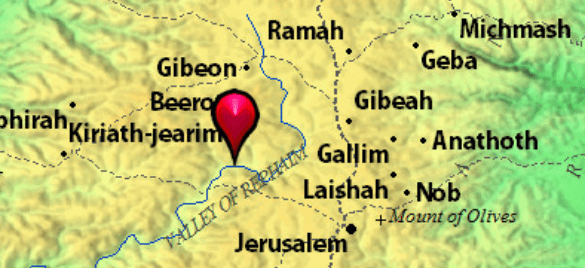
Obviously waiting was only allowing David to increase in strength. They had to attack now. So the Philistines set us camp in the valley of Rephaim, a valley likely located a few miles northwest of the new capital.
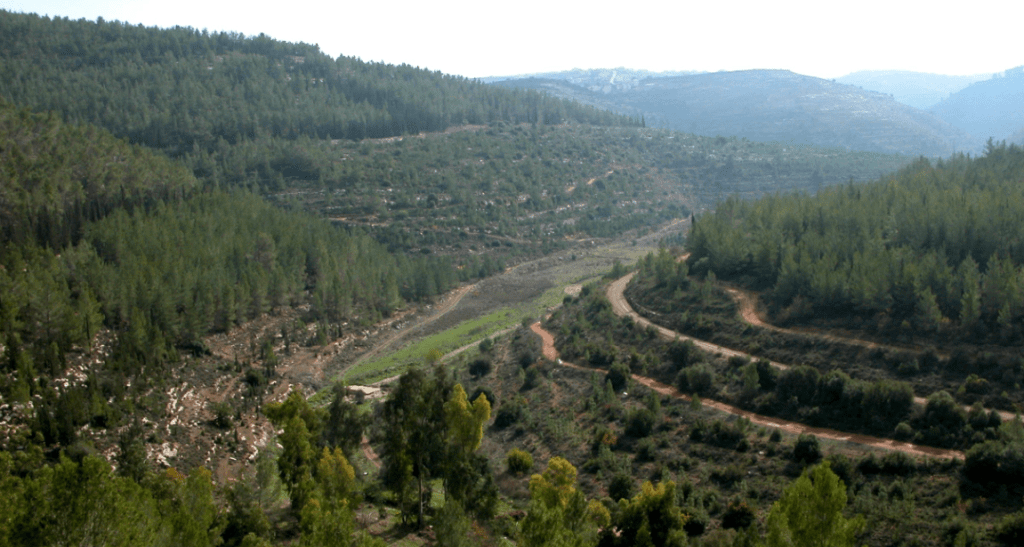
Note also that this location for the Philistines to set up camp was in (or at least near) a valley. That surprises me, for though I am not a military type of guy, I would think any army would naturally look for the high ground. But I am not a military guy.
But let us consider there may have been some advantage for the Philistines in choosing this location. Maybe they could elevate a statue of their idols on a perched area of the slopes, so that they may see the battle, or they may see them during the battle. Or maybe, since there was a stream in the valley, there would be special water to wash their idols of any dust accumulated during the travelling to the battle site. Maybe in their deliberations, their idols somehow informed the Philistine leadership the valley of Rephaim was a strategic location, a location where their idols had some influence.
Somehow, in some way, the valley of Rephaim was chosen and the Philistines brought their idols.
David though inquired of the Lord. His inquiry included two topics. Both of these questions reveal important aspects of David’s trust in the God of the nation.
1 Shall I go up against the Philistines?
Our first question is a simple request for direction. Yes or no. This question has nothing to do with outcome or impact to his kingdom, whether or not this will be a stunning success or a dismal failure. David is just wanting to know the Lord’s will.
2 Will you give them into my hand?
This question addresses the result of the battle if the Lord directs him to fight. Note though, that David makes an assumption of victory based on the Lord’s involvement in the battle. He does not flat out say “Am I going to win?”. He is looking for assurance that the Lord will be with him in the midst of the battle, that the Lord will “get the credit” for the win.
Though the victory is assumed, it seems the import of the question was that God would be with him. Is David repeating the concern Moses had as he led God’s people into the promised land?
Exodus 33:15 And he said to him, “If your presence will not go with me, do not bring us up from here.
Different circumstances but the same heart of the leader. And David received the answer in the affirmative for his concerns. God will place the Philistines in the hand of David.
It seems the victory was quite decisive, for David expressed the win by describing his army, (the arm of the Lord), as breaking through like a breaking flood.
The Israelite army overwhelmed the Philistines, even as a flood of waters destroys every resistance it comes upon.
I suppose the Philistines idols were distracted that day.
Thanks again for coming to visit. I hope you found something of interest in this post and would appreciate a comment, to begin a discussion. If you know someone this blog may bless (or challenge), send them a link, so they may join us in our discussion.
Come join us at Considering the Bible


 Considering the Bible