The Death of Saul
As many who have followed me for a bit, I have fallen into the Psalms, and I can’t get up! (As if I would want to.) The Psalms are a majestic collection of poetry, of heart felt human experiences that constantly challenge me in my own frail attempt to follow the true King. As many of the Psalms are written by David, my study on the Psalms has spurred me on to looking at the life of David, is the main contributor to this book, and to follow the victories and tragedies of the shepherd King of Israel.
Many times in the narrative, we will see the Lord Jesus, imperfectly, yet a reflection of His spirit in a man with weaknesses.
For this post, we will not see David, but it will focus of his father-in-law, his king, and his arch enemy describes a turning point in David’s life, and his future as the king.
Lets consider the outfall of Saul’s death.
1 Samuel 31:8 The next day, when the Philistines came to strip the slain, they found Saul and his three sons fallen on Mount Gilboa.
1 Samuel 31:9 So they cut off his head and stripped off his armor and sent messengers throughout the land of the Philistines, to carry the good news to the house of their idols and to the people.
1 Samuel 31:10 They put his armor in the temple of Ashtaroth, and they fastened his body to the wall of Beth-shan.
1 Samuel 31:11 But when the inhabitants of Jabesh-gilead heard what the Philistines had done to Saul,
1 Samuel 31:12 all the valiant men arose and went all night and took the body of Saul and the bodies of his sons from the wall of Beth-shan, and they came to Jabesh and burned them there.
1 Samuel 31:13 And they took their bones and buried them under the tamarisk tree in Jabesh and fasted seven days.
The Philistines won the battle, and on the very next day, they came back to the battle ground, after all the Israelites had run away, to strip off the fallen. Spoils of war!
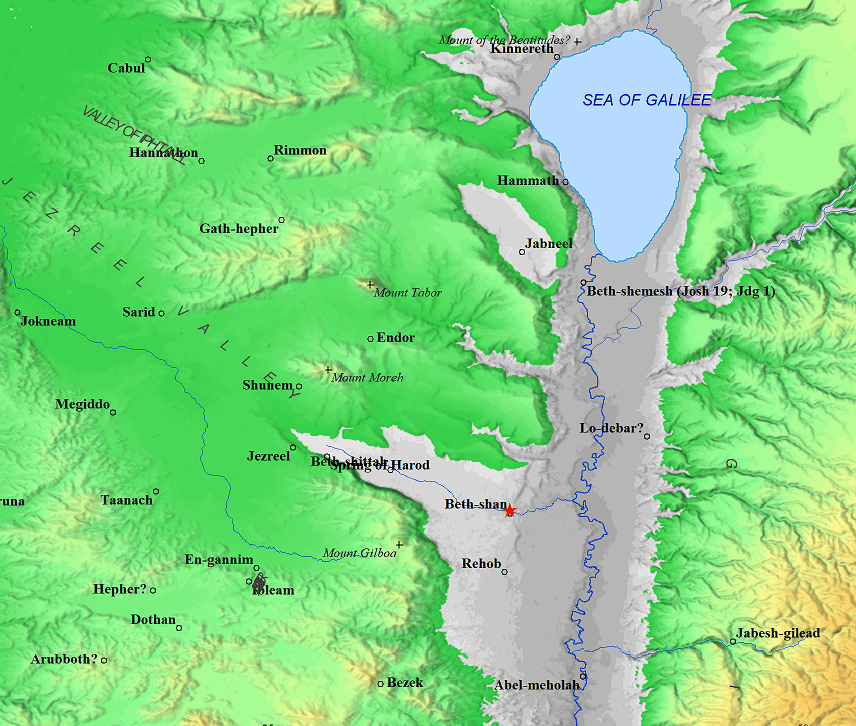
This is a common act of the victorious, for the winning soldiers would often come back to pick the dead clean. Now of course, this act of recovering goods from dead soldiers sometimes brought our the worst in the soldiers. There were some who could not resist humiliating King Saul, along with the entire nation of Israel, in the decapitation of the defeated king, and the exhibition of his headless corpse on the wall at Beth-shan. Why at Beth Shan? It was deep in the defeated regions of Israel, where the Philistines could shame the king and his people. Perfect psychological warfare, even after the killing was over!
For a body to be hung on the city walls was a great shame, an insult to those of his family. This act of defilement was more than a show of victory over the nation, it was an exhibition of gloating by the Philistines, and heaped disgrace on the royal family, and nation of Israel.
Early on in King Saul’s reign, the town of Jabesh Gilead was the sighting of Saul’s first challenge in defending his people. An Ammonite army descended on Jabesh, placed the town under siege, and then forced the citizen’s of Jabesh into an agreement prior to attacking. The Ammonites would kill them by sword, or have their right eyes gouged out. What a choice!
But for some reason, the Ammonites allowed them to reach out for help, giving them seven days to bring reinforcements. Were they hoping to find more success by defeating greater numbers of Israelites? Or simply heaping additional shame on this town when no-one came?
But the newly crowned King Saul did come, and he was large and in charge. He rallied an army, though through threatening, and marched onto Jabesh. With his army, he defeated the Ammonites fully, and it became a fantastic victory for this newly ascended king.

The people of Jabesh did not forget, and they made efforts to retrieve the kings body. For reasons unknown, the people of Jabesh burned the body of King Saul. This was not common practice in the days of Israel. Possibly they burned the bodies due to the extent of dismemberment, or the deterioration from the daily heat. Personally, I think the Jabesh people sought to give Saul peace from being dug up again and put on display, continuing the shameful treatment of their first king.
Either way, the people of Jabesh, those valiant men, provided King Saul relief from the shame of defeat, the shame of exposure and the shame of defilement. They honored their king, their rescuing hero in a way only they could.
This was a very sad day for the nation, for their first king had been conquered. Depending on your point of view, he had been conquered much earlier than his physical death, but nevertheless, he had been conquered, and the valiant men of Jabesh Gilead went into enemy territory to retrieve what was left of their king.
Thanks again for coming to visit. I hope you found something of interest in this post and would appreciate a comment, to begin a discussion. If you know someone this blog may bless (or challenge), send them a link, so they may join us in our discussion.
Come join us at Considering the Bible


 Considering the Bible