

David Flees to the Philistines
As many who have followed me for a bit, I have fallen into the Psalms, and I can’t get up! (As if I would want to.) The Psalms are a majestic collection of poetry, of heart felt human experiences that constantly challenge me in my own frail attempt to follow the true King. As many of the Psalms are written by David, my study on the Psalms has spurred me on to looking at the life of David, is the main contributor to this book, and to follow the victories and tragedies of the shepherd King of Israel.
Many times in the narrative, we will see the Lord Jesus, imperfectly, yet a reflection of His spirit in a man with weaknesses.
1 Samuel 27:
8 Now David and his men went up and made raids against the Geshurites, the Girzites, and the Amalekites, for these were the inhabitants of the land from of old, as far as Shur, to the land of Egypt.
9 And David would strike the land and would leave neither man nor woman alive, but would take away the sheep, the oxen, the donkeys, the camels, and the garments, and come back to Achish.
First thing to consider is who in tarnation are the Geshurites, the Girzites, and the Amalekites. Let’s consider their regions first.
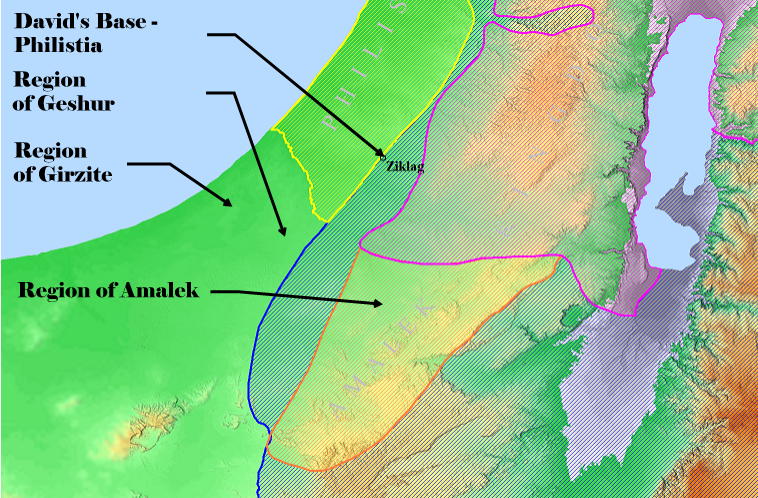
As you can see, these three areas seem to be easy pickings for David, since he can make a day trip into one of these areas, do some slaughtering, indiscriminate killing of men, women and children, and then head back to the comfort of his home in Ziklag. No that is incorrect. It wasn’t indiscriminate killing. It was the entire population of any town that fell under David’s eye.
Forget about the location – that seems so unimportant when we read of the slaughter David took part in. What is going on with this man after God’s own heart?
Is there something I am missing in this scenario?
As David was being pursued by Saul, he wrote of his thirst for God in Psalm 63.
Psalm 63:1 A Psalm of David, when he was in the wilderness of Judah. O God, you are my God; earnestly I seek you; my soul thirsts for you; my flesh faints for you, as in a dry and weary land where there is no water.
Next thing we read, he has escaped Saul’s clutches, moves to Philistine, and appears to become a senseless cut throat murderer, thieving things and killing everyone?
As my wife says – Make that make sense!
Could there be some justification in David’s actions? Let’s head back into the Pentateuch, the book of Deuteronomy, and consider the first couple of verses of chapter 7.
Deuteronomy 7:1 “When the LORD your God brings you into the land that you are entering to take possession of it, and clears away many nations before you, the Hittites, the Girgashites, the Amorites, the Canaanites, the Perizzites, the Hivites, and the Jebusites, seven nations more numerous and mightier than you,
Deuteronomy 7:2 and when the LORD your God gives them over to you, and you defeat them, then you must devote them to complete destruction. You shall make no covenant with them and show no mercy to them.
To “devote them to complete destruction” is synonymous to eradicate, eliminate, devote, destroy utterly, completely destroy, dedicate for destruction, exterminate. There is no easy, or palatable way of saying this. God was telling the Israelites to completely remove from the land those who were living there by death!
The Lord did not shy away from this command, but once more directed the Israelites to a mission of complete annihilation of those in the land.
Deuteronomy 20:16 ESV – But in the cities of these peoples that the LORD your God is giving you for an inheritance, you shall save alive nothing that breathes,
Deuteronomy 20:17 ESV – but you shall devote them to complete destruction, the Hittites and the Amorites, the Canaanites and the Perizzites, the Hivites and the Jebusites, as the LORD your God has commanded,
The author of 1 Samuel speaks of these people as inhabitants of the land from of old.
8 Now David and his men went up and made raids against the Geshurites, the Girzites, and the Amalekites, for these were the inhabitants of the land from of old, as far as Shur, to the land of Egypt.
Might this phrase be added by the author as a nod to the old mission, where Israel was to take out these inhabitants?
Now we all know that the mission had not been completed, that though Joshua completed taking all the promised land, (Check out Joshua 11:23), this did not mean that the command of God in Deuteronomy 7 and 20 had been accomplished. Joshua conquered the people of the land. They were not to remain alive. Some survived.
So along comes David, and he is in a hard place. He is a warrior, not a farmer or a business man, and warriors go to war, fight in battles, lead men to victory. Sitting in Ziklag may not have been a favorable situation for David. But what if he though he could work a favorable outcome for his future kingdom right under the nose of his enemy. Was he not destined to take Israel that next step in obedience to God, completing God’s command? Maybe his motivation was zealousness for the Lord, that he sought to honor God by devoting some of the people in the regions south of him. After all, what is a warrior to do?
What thinkest the reader? Is this a potential motivation for David? Could we see this as simply the working out of an opportunity David saw to work out the command of God in Deuternomony?
Or had David simply become a cut throat rebel, killing and stealing to satisfy his need of action? Had he simply turned into a mercenary, a vicious one at that, killing every living soul in whatever town he entered?
What ever my reader may suppose, when we get to our next passage, where King Achish starts asking about the spoils he is bringing back, David slips from being a man of truth to a man who slips into deception. This slipping for David eventually leads to a situation that requires the salvation of the Lord, for no other than God can help this poor man.
I don’t know about you, but this passage is difficult to comprehend, no matter how you look at it.
However we see this portion of the Word, it is best to remember that every saint – even David – has periods where they are placed in hard spots, difficult circumstances that require very difficult decisions to be made. For David, I can not tell in this passage if his motivations were for the glory of God, or for his own self gratification and escape.
I am very glad that we have One Judge, One Master, who knows our weakness, who knows our struggles, who ministers to us in the midst of seeming failure.
He is God, and He takes care of saints, though they may act like a sinner occasionally.
Thanks again for coming to visit. I hope you found something of interest in this post and would appreciate a comment, to begin a discussion. If you know someone this blog may bless (or challenge), send them a link, so they may join us in our discussion.
Come join us at Considering the Bible


 Considering the Bible
3 responses to “Life of David – 21.03”
[…] and stealing, turning into a vicious mercenary, killing every living soul in towns he raided. (See Life of David – 21.03 for more information).Yes David could relate to Jacob. David was a fallen man, that actually […]
LikeLike
[…] Now we may ask ourselves how David was able to ingratiate himself into the favor of King Achish. It seems it was only a matter of deception, for when Achish would ask what David had been up to, he merely lied, telling Achish that he had been raiding the nation of Israel. Of course the deception was just the tip of the iceberg, for David had become a bit of a cut throat rebel, killing every soul he entered for the sake of bounty and secrecy. (Life of David – 21.03) […]
LikeLike
[…] There may have been a justified reason David unleashed such seemingly harsh, murderous treatment on those of the Geshurites, the Girzites, and the Amalekites. There may have been motivation that could be found in the Word of God. David may have been basing his actions on God’s written commands. (Come on Carl – that is too much!) For those not following this series, consider Life of David – 21.03. […]
LikeLike