David Saves the City of Keilah
As many who have followed me for a bit, I have fallen into the Psalms, and I can’t get up! (As if I would want to.) The Psalms are a majestic collection of poetry, of heart felt human experiences that constantly challenge me in my own frail attempt to follow the true King. As many of the Psalms are written by David, my study on the Psalms has spurred me on to looking at the life of David, is the main contributor to this book, and to follow the victories and tragedies of the shepherd King of Israel.
Many times in the narrative, we will see the Lord Jesus, imperfectly, yet a reflection of His spirit in a man with weaknesses.
1 Samuel 23:6-14
6 When Abiathar the son of Ahimelech had fled to David to Keilah, he had come down with an ephod in his hand.
7 Now it was told Saul that David had come to Keilah. And Saul said, “God has given him into my hand, for he has shut himself in by entering a town that has gates and bars.”
8 And Saul summoned all the people to war, to go down to Keilah, to besiege David and his men.
9 David knew that Saul was plotting harm against him. And he said to Abiathar the priest, “Bring the ephod here.”
10 Then David said, “O LORD, the God of Israel, your servant has surely heard that Saul seeks to come to Keilah, to destroy the city on my account.
11 Will the men of Keilah surrender me into his hand? Will Saul come down, as your servant has heard? O LORD, the God of Israel, please tell your servant.” And the LORD said, “He will come down.”
12 Then David said, “Will the men of Keilah surrender me and my men into the hand of Saul?” And the LORD said, “They will surrender you.”
13 Then David and his men, who were about six hundred, arose and departed from Keilah, and they went wherever they could go. When Saul was told that David had escaped from Keilah, he gave up the expedition.
14 And David remained in the strongholds in the wilderness, in the hill country of the wilderness of Ziph. And Saul sought him every day, but God did not give him into his hand.
Let’s remember the immediate context of this story. David had just travelled to Keilah and delivered the people of the city of Keilah from the Philistines. David, the rebel, the enemy of the state, the one whom Saul wants to kill, entered deeper into Saul’s territory in order to save some of Saul’s people.
Where was Saul in all of this internal strife?
He was amassing the people of Israel to go to war, to go down to Keilah and capture David. Nothing in this passage speaks of Saul’s desire to rescue the city from the Philistine threat. No – Saul was obsessed with David and the apparent threat David was to the throne of Israel.
Who cares about the people of Israel? Surely not Saul, for he had to protect his own position within the country, to protect his own power over the people. I could imagine Saul justifying his actions by stating it was for the greater good, or some such malarky that we hear by our leaders even today. Simply a selfish act by a selfish man, thinking only of himself.
Yet, Saul, when word got out that David was in Keilah, assumed that the Lord had delivered David into his hands. There was some truth, at least in appearance, for the Lord had told David to go fight the Philistines in Keilah.
Saul was interpreting the actions of God to favor his own circumstances. This is a very common trap that we all do.
We see God doing something with someone, and we tend to interpret it in relation to our situation, to favor our circumstance, to supply a justification for some action we want to take, or to simply align the action with something we are doing at the time.
We all do it.
It is so easy to interpret an action of God and come to some conclusion that is incorrect. God called David to Keilah, into the territory of Saul. Saul interpreted this action as revealing God’s will to Saul to support his sinful actions. In reality, God calling David to Keilah was a judgement on Saul, showing the current king as being ineffective, and unconcerned for his own people God had called him to protect.
Saul thought God was smiling on him. Not so.
So often as I read through these passages, I get a sense that Saul is completely blind to the work of God, rejecting the big picture and only having one focus. Himself.
But that is not the only selfish actor in this passage.
David and his 400 men travelled to Keilah, fought the Philistines, won a mighty victory and rescued the city from devastation. But news gets around, and Saul hears that David is in Keilah. Hot diggity dog – Saul starts rounding up an army to come get him.
What a perfect opportunity to allow this newly minted army of David to continue fighting against Saul! David’s band of men are probably high on the victory and full of adrenaline, peaking on the team work that has begun to develop under David’s leadership. Surely God is calling Saul into this trap!
Well – not surely, for David did not jump to a selfish conclusion, one that might conceivable stop this constant hunt of Saul for his head. David decided to pray and get the bigger picture.
Consider the situation. Keilah was about to be destroyed by the Philistines. David came to the rescue. Keilah was again about to be destroyed, this time by their own king, unless they gave up David.
It was a common tactic to force the surrender of a person in the city to avoid a battle. David knew this was a tactic that might be used, but he again didn’t jump to conclusions, only asking the Lord if the people he just saved would abandon him.
Amazing picture of the gospel here, in that the savior of the people would be turned against by the people he came to save. David’s life is full of situations where the Savior can be clearly seen.
Nevertheless, the Lord informed David of the intent of the people, and prior to the eruption of a conflict at the gates of Keilah, David again saved the city and its population.
He ran.
He swallowed his pride and ran into the wilderness of Zin. Consider the mighty warrior David, turning tail after a victory provided by the hand of the Lord. How utterly confusing (in appearance) is the man of God who listens to God!
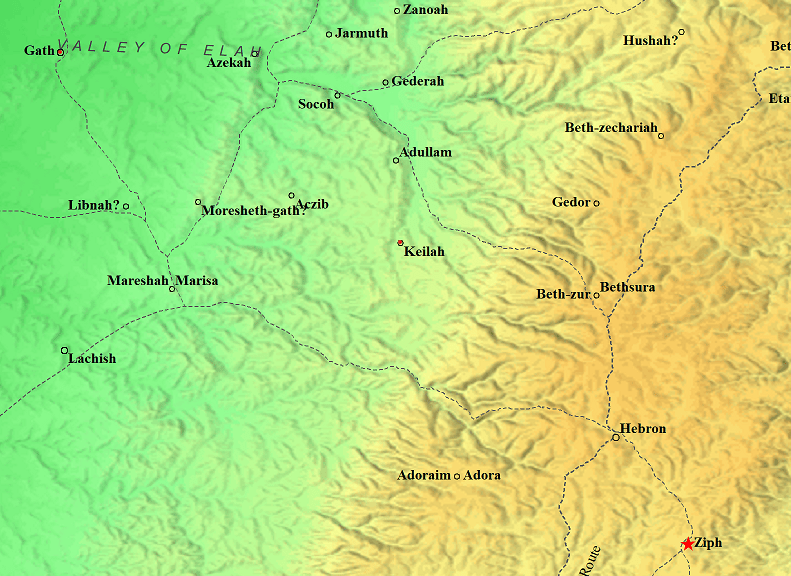
Yet if you read the passage carefully, you will notice that his army had not only experienced some real time fighting on the battle field, but that the army actually increased in size! A 50% increase, from 400 men to 600 men.
David is accruing men, a movement of God is happening and David goes deeper into the wilderness, deeper south to Ziph, a rugged place that afforded no comforts or ease of life. But the training of a young shepherd boy was continuing in developing a man of God, a man who would be king, yet through much suffering. Did I mention that Jesus can be seen in the shepherd boy if we take the time to look?
Surely David looked to Jesus for guidance and leadership, and from this looking, became more like Him every day.
2 Corinthians 3:18 And we all, with unveiled face, beholding the glory of the Lord, are being transformed into the same image from one degree of glory to another. For this comes from the Lord who is the Spirit.
Look to the Savior. Take your time and look!
Thanks again for coming to visit. I hope you found something of interest in this post and would appreciate a comment, to begin a discussion. If you know someone this blog may bless (or challenge), send them a link, so they may join us in our discussion.
Come join us at Considering the Bible


 Considering the Bible