David Saves the City of Keilah
As many who have followed me for a bit, I have fallen into the Psalms, and I can’t get up! (As if I would want to.) The Psalms are a majestic collection of poetry, of heart felt human experiences that constantly challenge me in my own frail attempt to follow the true King. As many of the Psalms are written by David, my study on the Psalms has spurred me on to looking at the life of David, is the main contributor to this book, and to follow the victories and tragedies of the shepherd King of Israel.
Many times in the narrative, we will see the Lord Jesus, imperfectly, yet a reflection of His spirit in a man with weaknesses.
Let’s recap David’s history for a moment.
He is on the run from King Saul, having fled to the city of Gath in the country of the Philistines. On his way to Gath, he stops and visits with Ahimelech at Nob, the city of priests. David speaks a story to Ahimelech to get some food and weapons due to being on a “secret” mission from the King. When he gets to Gath, he feigns madness in front of the Philistine King, and is rejected. Without a place to hide from King Saul. he heads back towards Israel, to a cave near Adullam where David seemed to find a sense of security.
It was at this cave that David accrued a ragtag army of men, totaling approx. 400, and where Abiathar, a priest from the city of Nob informed David of the massacre of the priests and the inhabitants of the city of Nob. David commits to protecting the one priest that escaped Nob.
At this point in David’s story, he is starting to look more like a leader and not a runaway. David’s character is challenged again in our passage today. Let’s take a moment to read it.
1 Samuel 23:1-14
1 Now they told David, “Behold, the Philistines are fighting against Keilah and are robbing the threshing floors.”
2 Therefore David inquired of the LORD, “Shall I go and attack these Philistines?” And the LORD said to David, “Go and attack the Philistines and save Keilah.”
3 But David’s men said to him, “Behold, we are afraid here in Judah; how much more then if we go to Keilah against the armies of the Philistines?”
4 Then David inquired of the LORD again. And the LORD answered him, “Arise, go down to Keilah, for I will give the Philistines into your hand.”
5 And David and his men went to Keilah and fought with the Philistines and brought away their livestock and struck them with a great blow. So David saved the inhabitants of Keilah.
Directly south, approximately 2-3 miles of the cave of Adullum, is a small city named Keilah. I have provided a small map below to give my reader a feel for it’s location in relation to Adullam, and of Gath, in the upper left.
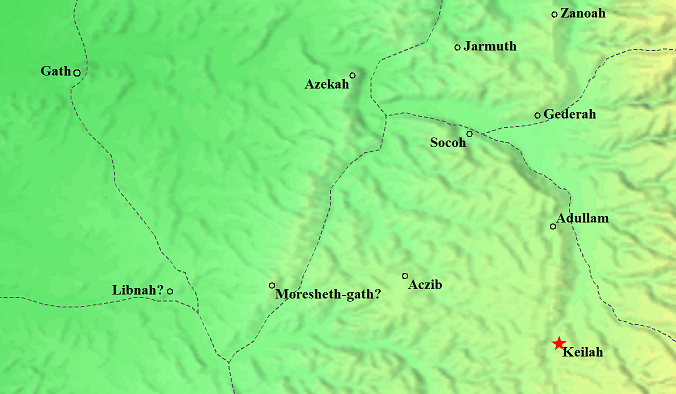
Our passage speaks of Keilah being attacked by the Philistines, and most likely Philistines of the city of Gath, where David had recently showed up, would be the aggressors.
And some unknown group told David of a fight in Keilah, of the Philistines attacking a city of Israel.
Did David sit by and think it was King Saul’s responsibility? Saul was the king. Surely Saul would take care of the city of Keilah. Surely leaving the relative safety of Adullam would be foolish for David. Why leave a safe fortress, only to potentially meet up with King Saul. who wanted to kill him, and King Achish, of Gath, who considers him mad!
What to do? Whatever to do? Hold back. Stay in Adullam to protect those who are with him? Ignore the plight of the city? Assign responsibility to King Saul? Options. Choices. Decisions decision decisions.
Therefore David inquired of the Lord…
David actually approached the Lord twice in this passage, and at first I considered this repetition of request to be an act of disbelief. But after reading the passage a bit more, I am starting to consider the second request to be fueled by the concerns of his men.
David’s first prayer
A simple prayer.
Shall I go down and attach these Philistines?
No mention of Saul in this prayer, no mention of King Saul’s responsibility to the inhabitants of Keilah, and no request for safety from Saul in this prayer. Saul seems to be a non entity in David’s prayer.
David is informed to “Go and attack the Philistines and save Keilah”
Seems to be clear direction from the Lord. Attack and save!
Yet in the preparation for the future battle, his men express their concern, the state of fear they were experiencing, even without entering into any battle. Lets remember these men, who would eventually become some of David’s mighty men, had just come together, had no fighting experience that we know of, and had “fled” to David due to their generally needy circumstances.
1 Samuel 22:2 speaks of David’s men as those who were in distress, in debt, and bitter in soul. Not the valiant men we hear of later in David’s career. These men came to David for escape, for a relief from troubles. Even in Adullam, they knew that being associated with David was not the safest situation. Yet they found solace in being under his leadership.
But it seems their period of relative safety was coming to an end! David realized the circumstance, and I think he approached the Lord a second time for the sake of his men.
David’s second prayer
David’s second prayer is not recorded for us, but the Lord’s answer is.
“Arise, go down to Keilah, for I will give the Philistines into your hand.”
Notice that the Lord’s answer addresses the deliverance of David’s army. God will give the Philistines into your hand. This directly addresses the concerns of David’s men. Nothing about saving Keilah. Nothing about taking any of the spoils of war. Simply that God would deliver them.
These men would become mighty men of valor, and as the last verse of our passage tells us, David and his men struck the Philistines with a great blow. A victory for David with men who were fearful, but had the assurance of God’s presence.
Consider those we are around, those we love and care for, those that we rub shoulders with daily.
Some we know may be fearful to obey God. We need to encourage the fearful with a message tailored to their fear, from the Word of God. Let us not seek to draw believers into walking with God through greed or logic, or lies. Note that God addressed these men’s fear by providing His promise of victory, not of gaining possessions by winning a battle. Collecting booty from war would come later, as these men grew into a faith depending on God.
Some may simply want to rest under the leadership of a godly man. This was a real need for these men as they came under David’s leadership, but it wasn’t to be without action. Rest and action are not diametrically opposed. They needed rest, but true rest came out of an active following of David, of venturing out in spite of fear.
For myself, I have had to swallow much fear this last few years, and found God to be an ever present help. If I were to detail some of these fears, they may seem insignificant to some. That simply speaks to my weakness, and my need of strength.
As I face fears, I have found a simple passage or verse from a current Scripture reading to be invaluable, to lift my spirits, to embolden me in my specific fear of the day. And as I face the fear, He doesn’t seem to remove it as much as provide the strength to overcome it.
These men overcame their fear, vanquished the mighty Philistines, became heroes to the city of Keilah, found reward in gaining some livestock, and started to actively follow after David and His God on an adventure that is remembered by millions three millennium later.
How is fear working out in your life? Is it fueling you to trust or to cower. Remember, true overcoming is based on God’s message to you, and we can receive His message in the Word of God as we read and understand His will for us.
Thanks again for coming to visit. I hope you found something of interest in this post and would appreciate a comment, to begin a discussion. If you know someone this blog may bless (or challenge), send them a link, so they may join us in our discussion.
Come join us at Considering the Bible


 Considering the Bible