The prophecy of the Lord Jesus for our consideration and edification, written centuries prior to His earthly existence is
Prophecy #239
Description
The Servant shockingly abused
Old Testament Prophecy
Isaiah 52:14
As many were astonished at you— his appearance was so marred, beyond human semblance, and his form beyond that of the children of mankind—
New Testament Fullfillment
Luke 18:31-34
And taking the twelve, he said to them, “See, we are going up to Jerusalem, and everything that is written about the Son of Man by the prophets will be accomplished.
For he will be delivered over to the Gentiles and will be mocked and shamefully treated and spit upon.
And after flogging him, they will kill him, and on the third day he will rise.”
But they understood none of these things. This saying was hidden from them, and they did not grasp what was said.
Matt 26:67-68
Then they spit in his face and struck him. And some slapped him,
saying, “Prophesy to us, you Christ! Who is it that struck you?”
If you are just joining this blog, or are a first time visitor, welcome to Considering the Bible. We would like to offer a document that provides over 350 prophecies of the Messiah found in the Old Testament for your consideration.
I make no claim to be able to comment on every one of these amazing prophecies in the future, but will occasionally bring one to the readers attention for their edification.
Hopefully you will follow “Considering the Bible” and begin an interaction with us
After my series on the parables, I found I was drawn to look into the miracles of Jesus in the Gospels. I have never studies the mighty works of Jesus as a focused effort before and am looking forward to finding nuggets of truth that we can be encouraged by.
I have provided a general introduction, with an opportunity to download two files for your reference in my initial post Signs and Mighty Works of Jesus – Introduction. I found that the format I used for the parable posts were useful to keep me on track, and will continue to use them for this series, with some minor tweaks. With that said, let’s take a look at
Jesus Calms a Storm
Matthew 8:23-27
And when he got into the boat, his disciples followed him. And behold, there arose a great storm on the sea, so that the boat was being swamped by the waves; but he was asleep. And they went and woke him, saying, “Save us, Lord; we are perishing.” And he said to them, “Why are you afraid, O you of little faith?” Then he rose and rebuked the winds and the sea, and there was a great calm. And the men marveled, saying, “What sort of man is this, that even winds and sea obey him?”
Mark 4:35-41
On that day, when evening had come, he said to them, “Let us go across to the other side.” And leaving the crowd, they took him with them in the boat, just as he was. And other boats were with him. And a great windstorm arose, and the waves were breaking into the boat, so that the boat was already filling. But he was in the stern, asleep on the cushion. And they woke him and said to him, “Teacher, do you not care that we are perishing?” And he awoke and rebuked the wind and said to the sea, “Peace! Be still!” And the wind ceased, and there was a great calm. He said to them, “Why are you so afraid? Have you still no faith?” And they were filled with great fear and said to one another, “Who then is this, that even the wind and the sea obey him?”
Luke 8:22-25
One day he got into a boat with his disciples, and he said to them, “Let us go across to the other side of the lake.” So they set out, and as they sailed he fell asleep. And a windstorm came down on the lake, and they were filling with water and were in danger. And they went and woke him, saying, “Master, Master, we are perishing!” And he awoke and rebuked the wind and the raging waves, and they ceased, and there was a calm. He said to them, “Where is your faith?” And they were afraid, and they marveled, saying to one another, “Who then is this, that he commands even winds and water, and they obey him?”
General Observations
For some reason, one of the first questions that rose in my thinking was the size of the boat. How large of a boat did the 13 men use to cross the Sea of Galilee?
That ignorance is unnecessary since a boat was unearthed near the region of Capernaum. This boat, sometimes called the “Jesus Boat” has been dated to approx. 50 BCE, and is typical of the boat Jesus and His disciples may have taken across the Sea of Galilee on that fateful night.
What is surprising is the size of the boat. Per the graphic to the right, the boat may have been 27 foot long. That is the approx. length of a UPS van.
Not an ocean liner to say the least!
Questions to Consider
Who were the audience?
The audience were the twelve disciples.
And other boats were with Him. Mark simply adds this snippet, without adding any additional information. Did the other boats venture out into the sea with Jesus and His disciples? Nothing else is spoken of concerning the other boats in the three gospel accounts of this miracle, yet it intrigues me that Mark added that info.
Jesus performed this miracle at the request of His disciples, who were afraid for their lives. Turns out fear is a major theme in this miracle. Both before and after the miracle! But let us consider the circumstances for a moment.
The fishermen among the disciples knew the Sea of Galilee. They had spent their lives fishing on this body of water and knew of these dangerous gales that could strike at a moments notice. They were experienced sailors, yet with this storm they were beyond their own abilities in controlling the circumstance, in maintaining their safe passage. Prior to waking Jesus, I imagine Simon, Andrew, John and James, the experienced fishermen, had enlisted all of “them thar landlubbers” of the group into any help they could provide. Although I am somewhat reluctant to say it, this storm provided a great team building exercise, but I think this was not the intent! This storm had greater messages than that.
Wind
The wind is described as a great windstorm, and Luke provides us the added information of this storm coming down on the lake. This added information helps greatly, since it speaks of the winds from the surrounding mountains sweeping down into the hot tropical air of the lake basin. The ferocity of the wind and the contours of the land surrounding the lake merged together to create a very perilous trip across the sea. This storm may have caused the other boats that were with Him initially to turn back, but that is pure conjecture.
Waves
With the wind sweeping down on the sea, the waves became an additional threat to the lives of those in the boat. The text speaks of the boat being flooded with water. The Greek word symplēroō Luke uses in 8:23 describes the boat as being “swamped” or filled with water. This was a terrible position to be in, and for these experienced sailors to be found helpless must have been very humbling.
Golly, they can’t even take care of their Master in the very element they are experts!
What was the message for the original audience?
Where is your faith? Although the telling of the miracle often highlights a lack of faith the disciples, they knew who to go to in the middle of the storm. Admittedly they had few options beyond exhausting their own resources, and yet they went to Him, asking Him about His care for them.
“Teacher, do you not care that we are perishing?”
The storm is whipping us to the point of sinking and You are asleep. Can’t you man the rigging, or take an oar to help us ride the storm out? Everyone is taking part in getting us through the storm. We need your help. Don’t you care?
It is interesting that the text speaks of the disciples waking Him, to ask of His care, and the very next verse speaking of Him waking up. Did they have to wake Him twice? That is not clear, but when He awoke, He definitely did not help the disciples in the way they had hoped.
He simply spoke to the wind and the sea. Peace! Be still!
Take a moment to consider how unexpected this assistance is. All of the disciples are in terror, doing all they know how to do, and their Teacher addresses both the obvious and not so obvious problems. The obvious problem He addressed by simply speaking two words to the elements. Calmness returns to the sea and the boat, with it’s inhabitants, are safe once more from the elements.
Yet the fear in the disciples hearts about their survival in the storm becomes great fear, not in the storm anymore, but in the identity of the One in their midst.
Who in the world are we hanging out with here? The sensory overload of the storm, the adrenaline pumping through their veins, the survival instinct that took them to their limits is to be contrasted with the One who simply spoke two words to the elements, and then challenged the disciples about their natural survival instincts as being out of place.
He said to them, “Why are you so afraid? Have you still no faith?”
The disciples had left all they had to follow after this Rabbi. They had seen miracles as bystanders, witnessing of His power and might, of His abilities, but this miracle included the disciples. They simply hadn’t translated what they had witnessed as they saw Him heal a leper, or raise a widows son into their own experience.
The One they were following brought great fear into their lives. What manner of man is this One? These disciples had been taught of the Lord God being over the sea, for the Old Testament speaks often of the sea reacting to the rule of God. Stories of the Lord God opening the Red Sea for Moses, of the Lord God bringing the flood in Noah’s day, and of the Lord God stilling the sea during Jonah’s rebellion.
Specific passages may have rung in the disciples ears as they considered what manner of man was in their midst.
Psalm 89:9 You rule the raging of the sea; when its waves rise, you still them.
Psalm 77:16 When the waters saw you, O God, when the waters saw you, they were afraid; indeed, the deep trembled.
Psalm 93:4 Mightier than the thunders of many waters, mightier than the waves of the sea, the LORD on high is mighty!
Were the disciples beginning to grasp that the One asleep in the back of the boat moments ago is the Lord God in their midst?
What is the message for us today?
Two applications for my own life occur to me, and may apply to my reader.
Faith
A personal experience with the Lord God, in the person of Jesus Christ is the faith being questioned by the Lord to the disciples. Hearing of others experience with the Lord does not make me a disciple. Watching God do miraculous things in others lives does not make me a believer. Mental assent to truth, to agreeing that something is true or has happened in the past may provide support for my faith, but it is not faith.
Faith, if I am reading this passage correctly, is personal. It is not my Pastor’s faith, or my wife’s faith, or anyone else’s faith.
I have heard of faith as being defined as follows a few years back, and it has greatly helped me to better exercise faith in the Lord. Faith is hearing the Word of God, understanding the message of the Word, and agreeing to comply with the message. This definition helps me with the inclusion of understanding.
The disciples were beginning to understand, through their personal experience and their questioning amongst their selves of who this Man was, that they were in deep waters, (theologically speaking.) The implications began to pile up, and the emotional impact what they had just went through drove home what their eyes had only seen previously into their very hearts and lives.
Care
This tends to be a hobby horse for this blog, in that many posts seem to return to the theme of the Master’s love and goodness to His people, His creation.
How often have you questioned the loving concern of the Master when you are in the midst of a storm? The psalmist often requests the Lord to wake and defend his cause. Many times, in the Old Testament, God’s saints have asked this question, and I know I have asked this question far to often. Yet in the midst of the storm, the very request is answered, and He rises to the cry of His people.
And if we have ears to hear, we may understand that our faith may not be as it should be.
Thanks again for coming to visit. I hope you found something of interest in this post and would appreciate a comment, to begin a discussion. If you know someone this blog may bless (or challenge), send them a link, so they may join us in our discussion
The prophecy of the Lord Jesus for our consideration and edification, written centuries prior to His earthly existence is
Prophecy #238
Description
The Servant exalted
Old Testament Prophecy
Isaiah 52:13
Behold, my servant shall act wisely;[a] he shall be high and lifted up, and shall be exalted.
New Testament Fullfillment
Acts 1:8-11
But you will receive power when the Holy Spirit has come upon you, and you will be my witnesses in Jerusalem and in all Judea and Samaria, and to the end of the earth.”
And when he had said these things, as they were looking on, he was lifted up, and a cloud took him out of their sight.
And while they were gazing into heaven as he went, behold, two men stood by them in white robes,
and said, “Men of Galilee, why do you stand looking into heaven? This Jesus, who was taken up from you into heaven, will come in the same way as you saw him go into heaven.”
Eph 1:19-22
and what is the immeasurable greatness of his power toward us who believe, according to the working of his great might
that he worked in Christ when he raised him from the dead and seated him at his right hand in the heavenly places,
far above all rule and authority and power and dominion, and above every name that is named, not only in this age but also in the one to come.
And he put all things under his feet and gave him as head over all things to the church,
Phil 2:5-9
Have this mind among yourselves, which is yours in Christ Jesus,
who, though he was in the form of God, did not count equality with God a thing to be grasped,
but emptied himself, by taking the form of a servant, being born in the likeness of men.
And being found in human form, he humbled himself by becoming obedient to the point of death, even death on a cross.
Therefore God has highly exalted him and bestowed on him the name that is above every name,
If you are just joining this blog, or are a first time visitor, welcome to Considering the Bible. We would like to offer a document that provides over 350 prophecies of the Messiah found in the Old Testament for your consideration.
I make no claim to be able to comment on every one of these amazing prophecies in the future, but will occasionally bring one to the readers attention for their edification.
Hopefully you will follow “Considering the Bible” and begin an interaction with us
For this series in Philippians, I am going to limit each post to one verse, and hopefully produce a short, succinct read for my friends who follow.
1:13 so that it has become known throughout the whole imperial guard and to all the rest that my imprisonment is for Christ.
Paul’s imprisonment was common knowledge. Nothing was hidden from those who were in his vicinity. Of course, some of the imperial guard would know of Paul’s imprisonment through their direct orders to guard him. The remaining imperial guard depended on gossip through the ranks.
Yet, it is hard to imagine (and this is my imagination!) the soldiers in the imperial guard, hardened disciplined men of the highest caliber of soldier, would be susceptible to common gossip. Paul’s imprisonment caused a major stir that rippled through the ranks, primarily due to the conversions of those guarding him. Those who had no contact with Paul, were in contact with guards that had become believers.
This, if understood by the leadership of the Romans, would give reason for concern, for the Caesar was to be considered god, and the guards were changing their allegiance.
My wife and I are reading through the Psalms in our evening reading and occasionally a nugget of the Psalms jumps out of the page. Don’t you love it when, after years of reading the “Old Book” passages become alive, reinforcing old teachings or simply warming your heart.
This is the book of Psalms, and it is rich.
I pray I can communicate a portion of the blessing we receive from this wonderful book.
Psalm 43:1-2
1 Vindicate me, O God, and defend my cause against an ungodly people, from the deceitful and unjust man deliver me! 2 For you are the God in whom I take refuge; why have you rejected me? Why do I go about mourning because of the oppression of the enemy?
Vindicate me. Judge me. Of course David is praying with an assumption of innocence, and that his aggressors to be guilty. Yet this is somewhat of a strange plea if I am honest with myself.
Let me try to explain.
How often have you sought the Lord, and asked Him to judge you? To vindicate includes the concept of judgement, and being used in this passage, must mean that David see’s himself as the offended party, the one who is “guiltless” in the conflict that he is in the middle of.
If anything can be said about King David, he was an honest soul with the Lord. He is looking for a judgement by God, declaring himself to be in the right, and pleading for a defense against the ungodly, deceitful and unjust man.
And yet, I may have spoken somewhat to early, for as I read the first verse, David does not clearly state he is innocent, but as he enters into the second verse, states the reason for his expectation of a good judgement.
Note that verse two starts with “For”. For you are the God in whom I take refuge. Notice that he doesn’t state that the reason he expects a positive judgement is based on his actions directly, but on who he takes refuge in. It is his faith in the covenant keeping God that he is claiming as his defense.
And as I type that, it occurs to me that as modern believers, we tend to use this defense without considering some of the back story to what it means to take refuge in the Lord. Some may have a mental acceptance of the truth of the gospel, and yet in their lives, they take no refuge in Him.
To Take Refuge
As David is writing this psalm, he is obviously in trouble. His enemies are seeking him out, and he is looking for deliverance. Remember my friend, he is a man of war, yet he seeks the Lord for his protection, his refuge from danger.
And that is the point.
To take refuge implies danger, stress, conflict, a storm in your life. David is a man of war, yet he is not depending on his wits, or strategic abilities, his past victories or his command of any army. No, he is taking refuge in the Lord, as opposed to his own strengths, wisdom or abilities.
Let me try to explain this as I understand it.
I was at work the other day, and had a meeting to go into, which may have become somewhat of a storm for myself, a “difficult” meeting. Admittedly, I was tempted to be quiet on a matter of importance for the group. I asked for grace to refrain from “little white lies” which in my opinion, would be taking refuge in my methods. I asked God for strength to tell the truth, though it may cause myself harm. In this minor, tiny, little itty bitty decision, looking back, I think I was taking refuge in the God of my salvation. I trusted Him to provide strength to be factual, and to bring about His will in the midst of the meeting. (By the way, the Lord gave me strength, and provided a wonderful resolution for all!)
To take refuge in Him is to seek to honor the character He displayed while on this ball of dirt and muck. To trust His word, and to practice the outworking of His word in our lives is the message I am getting from this wonderful psalm.
As a believer, if we constantly fall back to our reasonings, our methods, our defenses, and not on His revealed character as displayed in the life of our Messiah, we may have to ask ourselves if we are really following. Of course none of us follow perfectly, (as least speaking for myself), and yet there comes a confidence in trusting in His will, and in asking for the strength to perform his wishes.
So, when I read that David takes refuge in the God of Israel, I read that he is following the Lord, hearing the voice of God, and responding positively in times of danger, in the storms of his life. Did he know all doctrine, pure teaching and all truths? Not at all, and again we are in good standing with the King of Israel. But to the truth he had revealed to him, he sought to follow the will of God as opposed to his own will, though the danger was staring him flat in the face.
The prophecy of the Lord Jesus for our consideration and edification, written centuries prior to His earthly existence is
Prophecy #237
Description
Published good tidings upon mountains
Old Testament Prophecy
Isaiah 52:7
How beautiful upon the mountains are the feet of him who brings good news, who publishes peace, who brings good news of happiness, who publishes salvation, who says to Zion, “Your God reigns.”
New Testament Fullfillment
Matt 5:12
Rejoice and be glad, for your reward is great in heaven, for so they persecuted the prophets who were before you.
Matt 15:29
Jesus went on from there and walked beside the Sea of Galilee. And he went up on the mountain and sat down there.
Matt 28:16
Now the eleven disciples went to Galilee, to the mountain to which Jesus had directed them.
If you are just joining this blog, or are a first time visitor, welcome to Considering the Bible. We would like to offer a document that provides over 350 prophecies of the Messiah found in the Old Testament for your consideration.
I make no claim to be able to comment on every one of these amazing prophecies in the future, but will occasionally bring one to the readers attention for their edification.
Hopefully you will follow “Considering the Bible” and begin an interaction with us
21 Therefore put away all filthiness and rampant wickedness and receive with meekness the implanted word, which is able to save your souls.
22 But be doers of the word, and not hearers only, deceiving yourselves.
With the book of James (as in all of the Scripture) it is imperative to understand who the apostle is writing to. For our passage today, is this passage directed to those outside the church, or to believers? If we look at the passage independently of the context, it may appear to be addressed to non believers, especially when James speaks of receiving…
with meekness the implanted word, which is able to save your souls.
But let us not be single verse believers and consider the context. James makes sure we are to understand this passage as applying to believers in verse 19.
Jas 1:19 Know this, my beloved brothers: let every person be quick to hear, slow to speak, slow to anger;
Ok – So we know that James intends for his brothers in the faith to be hearing this message, but what does the passage have to say in regards to conditional security?
Receive with Meekness
Believers are to receive with meekness the implanted word. If the Word is implanted (another nod to James speaking to believers), we have received it already, correct? What more do we need?
Let’s consider the term “recieve”. As I have mentioned in this blog previously, I am no Greek geek, but depend on desktop studies of others to try to understand the implications of the original language for our studies.
For the word “receive” I refer to BLB (Blue Letter Bible) as a resource for our study. Under the tools button for each verse, a tab shows up allowing for an interlinear data base to come up. Using the reverse tab, the following data comes up for our word “receive”
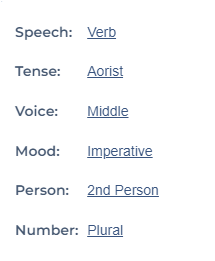
At this point, since receive is a verb, I click on the right hand button (V-XXX-XX) to find the “parsing” of the verb.
One more step to understand what all this means. Each of the underlined terms are hot links to help us understand the verb we are looking at.
An easy one for myself is the mood of the verb in this instance. Our verb has the imperative mood. This is a command. Believers are to actively take part in receiving the Word.
Voice speaks of who is performing the action. A middle voice notes that the subject (the beloved brethren in this case) is the agent of the action. The believer is performing the action of receiving. All of this is simply stating what seems obvious from the English translation.
The aorist tense is what helps me to understand that this action as not limited to a past decision or act of faith. The aorist tense has no regard to the past present or future. It defines a point in time, sometimes referring to the past, and yet this is too limiting.
If I understand the passage correctly, James is telling the believers to receive (at some point in time) the Word of God, which is already implanted in our souls as believers. To receive the Word, we must remove filthiness and wickedness, (another action of the believer).
I have previously seen this passage as a call to sanctification, a passage that speaks of our responsibility to understand and obey God’s will for our lives. Without the next phrase, I would be certain it is a sanctification passage. It’s just that I kinda struggle with what James is telling believers about saving their souls.
Able to Save your Souls
Saving your soul. What in tarnation is that? I thought our souls were saved at the point of conversion, when we first believed.
Maybe other translations translate this term differently? All of the popular English translations use the phrase “save your souls” in this verse, except for the NIV, which translates it as “save your life”. So what is James trying to tell us?
Notice that the implanted word is “able” to save our souls. Ability is an interesting word when it comes to reading the Word. Some that I have interacted with on other blogs interpret the ability to perform an act as synonymous with the completion of the same act.
When I think of the ability to save, I think of the boys in the furnace back in the book of Daniel.
Daniel 3:17-18 If this be so, our God whom we serve is able to deliver us from the burning fiery furnace, and he will deliver us out of your hand, O king. But if not, be it known to you, O king, that we will not serve your gods or worship the golden image that you have set up.”
Notice that the boys confessed God’s ability, but not the outcome (in relation to the furnace). The young Hebrew men spoke of God’s ability to save His children, but allowed for God to choose how to save his children.
To be able to do a task is to have sufficient power to accomplish that task. In relation to our passage today, I understand James is telling believers that the Word has sufficient power to save our souls. I am not convinced James is speaking of the final result, that is the saving of our soul, but of a potential result.
So is this a sanctification verse or a security passage?
But let us not end with simply a question but an affirmation that comes shining through this passage. God is able and has supplied all the needs of the saint. He is the provider of everything the believer requires to save our souls. He is the Savior and we are the ones who need Him so.
Thanks again for coming to visit. I hope you found something of interest in this post and would appreciate a comment, to begin a discussion. If you would like to receive daily posts from Considering the Bible, click on the “Follow” link below









 Considering the Bible