At the beginning of this series, I made mention of the purpose John had in giving these tests for believers. Was it to confirm fellowship or to confirm identity (i.e. whether you are a believer or not).
Let’s read the following passage afresh and consider the message John is giving us.
1 John 5:10
Whoever believes in the Son of God has the testimony in himself. Whoever does not believe God has made him a liar, because he has not believed in the testimony that God has borne concerning his Son.
1 John 5:11
And this is the testimony, that God gave us eternal life, and this life is in his Son.
1 John 5:12
Whoever has the Son has life; whoever does not have the Son of God does not have life.
1 John 5:13
I write these things to you who believe in the name of the Son of God, that you may know that you have eternal life.
1 John 5:14
And this is the confidence that we have toward him, that if we ask anything according to his will he hears us.
John, in his summary statement, seems to make it clear.
Lets follow his logic…
God has supplied a message – a testimony.
This message is that He gave believers eternal life.
This life is in His Son.
Have life as defined in the epistle? You have the Son.
Don’t have the Son, as evidenced by the tests supplied? John says you do not have life.
It all hinges on the relationship, if any, with the Son.
His is the only One who has the life of God resident in Him. We do not have the life resident in us, other than through Him.
Then John supplies the summary statement
1 John 5:13
I write these things to you who believe in the name of the Son of God, that you may know that you have eternal life.
But John, you just taught of who had life and who didn’t and now you are addressing believers?
Is this simply a reminder of where believers come from, i.e. that at one time we did not have the Son and therefore had no life?
Is John providing tests in order that some believers may experientially know of their relationship before God? Does this imply that some believers do not have that experience?
Or is John’s purpose a call to faithfulness in passing the tests?
Does the message of John challenge you to greater love and faithfulness, or does it simply define the life you are living currently?
Let me know of how you understand this book, reasons for thinking the way you do and how this entices you to follow Him. Let me know if our journey together in the book of 1 John has challenged you in a specific area.
Although this series of posts is complete, I intend to chase down a word study in the book of 1 John, looking at the term “know”. If this is of interest to you, please come join me in looking at 1 John – Knowledge to Know
I hope you found a truth that was helpful in your life within this post. Drop me a line, or send this post to a friend that you thought of recently.
One sunny day, as Jesus was in the middle of teaching by way of parables, (in the 13th chapter of Matthew) Matthew makes a brief comment that may help us in understanding why Jesus taught in parables.
Matthews first comment is on the regularity of Jesus teaching in parables. His second comment is on the the fulfillment of prophecy in doing so.
I’m sorry – What was that? Teaching in parables was a fullfillment of prophecy?
Hang on – we will get to it, but first lets look at the passage from the gospel of Matthew.
Matthew 13:34-35
34 All these things Jesus said to the crowds in parables; indeed, he said nothing to them without a parable.
35 This was to fulfill what was spoken by the prophet: “I will open my mouth in parables; I will utter what has been hidden since the foundation of the world.”
Verse 34 seems to be telling us that Jesus limited Himself to teaching only in parables, yet we know that He taught in many ways, sometimes with object lessons, or with a simple direct narrative. He is the Great Teacher, and exercised many methods of teaching.
So what is Matthew saying? At this time in Jesus ministry, and with the current audience, He taught them with parables. That, in my opinion was a simple observation. Verse 35 is where I am struggling.
A Difficulty – Apostolic Interpretation
My first difficulty is the fact that this method of teaching is a fulfillment of prophecy. Let’s consider the Old Testament verse we find the prophecy in.
Psalm 78:2
I will open my mouth in a parable; I will utter dark sayings from of old
It appears that the psalmist is stating the current condition for his writing, that is, he will open his mouth in a parable. It is his chosen method of teaching in his current historical context. As a young believer, reading through the Old Testament, there were prophecies that were obvious, such as Isaiah 53 or Psalm 22, concerning the Messiah. Psalm 78, without the apostles direction, would not have occured to me as prophetic.
This is critical, for the apostles are the teachers of truth, based on the Lords method of reading the Old Testament.
Which makes this next passage so amazing.
A Difficulty – Parabolic Reasons
The Lord supplied the reason for speaking in parables in the following verses.
Matthew 13:13-15
13 This is why I speak to them in parables, because seeing they do not see, and hearing they do not hear, nor do they understand.
14 Indeed, in their case the prophecy of Isaiah is fulfilled that says: “‘”You will indeed hear but never understand, and you will indeed see but never perceive.”
15 For this people’s heart has grown dull, and with their ears they can barely hear, and their eyes they have closed, lest they should see with their eyes and hear with their ears and understand with their heart and turn, and I would heal them.’
Again, let’s consider the passage Jesus is referring to in verse 14.
Isaiah 6:9
And he said, “Go, and say to this people: “‘Keep on hearing, but do not understand; keep on seeing, but do not perceive.’
God is speaking to Isaiah, telling him that the people of his day will hear the words, but not understand the message. When I read this passage, it seems to be directed to the people Isaiah was ministering to over 700 yrs before the Messiah. I wouldn’t have seen this as prophetic, and that is why the apostolic interpretation of the Old Testament is such an important concept to grasp as we read through the New Testament.
As amazing as the apostolic interpretation of the Old Testament is (which is such a gift!), the reason why the parables are Jesus’ preferred teaching method is even more amazing.
Jesus tells His apostles that the reason He teaches in parables is to teach only to the teachable. (And yet some of his disciples didn’t understand the parables!) He tells stories that only those who are willing and able to hear can understand. The people He is teaching at this time, that do not “hear” Him, only become deafer and blinder.
Another Feature of Grace
Truly amazing when you think of the loneliness of the Master as He taught. No-one was getting it! How frustrating. The Master Teacher came to earth, spent His days speaking out truth, and yet His best students/disciples were struggling with understanding the message.
What hope do we have? The Spirit of God and prayer are critical for this effort. As I have quickly reviewed the parables in accumulating them for the study, I am concerned I may be biting off more than I can chew.
No – that is wrong. I am definetly biting off more than I can chew. I need guidance and strength to understand, see and hear His message.
I do hope you will venture along with me on this trek. It promises to be a whopper!
In the mid nineties, I had a little red Buick and a big ol’ bass box in the trunk, and would listen to “Christian Rock”, cranked to 11.
(What did you say? Huh? Can you say that again, I didn’t hear you….)
I have gotten away from that genre for many reasons, the least of which may be a loss of hearing, but some songs have stuck with me over the decades.
The artist’s I listened to sought to reflect Scriptural teaching for the most part. They ranged from “preaching” pop culture religion to significant theological teaching. As I listened to the lyrics, I found some to be quite challenging.
To be honest, I listened because I could justify the rock beat with “sanctified lyrics”.
Occassionaly I will post a song, supply the lyrics and make a comment or two. If you decide to listen to the tune, turn the speaker down unless you are already deaf. Some of the songs tend to have a certain “volume” about them!
This post will consider the song
All over Me – by The Benjamin Gate
This group was from South Africa and had a lady front woman (Adrienne “Adie” Camp), with a great voice. It was a fun group, but like I mentioned with X-Sinner, these guys were having fun with thier music. There seemed to be a generality about this song, but nevertheless, it was catchy and I tended to find I came back to it occasionally.
Wave come, wave fall Cast me on your broken shore Sun come, sun fall Cast me on your love so warm
Take a listen!
All over Me – by The Benjamin Gate
All over Me – by The Benjamin Gate
Wave come, wave fall Cast me on your broken shore Sun come, sun fall Cast me on your love so warm
Jesus’ love is Jesus’ love is
All over me, all over me Your love is all over me All over me, all over me Your love is . . .Christ come, Christ crawl Nailed to a cross so tall All come, all fall All walk with hearts so torn
Jesus’ love is Jesus’ love is
All over me, all over me Your love is all over me All over me, all over me Your love is . . .
Let me know what you think of the lyrics, and of the tunes!
Lately, I have been exclusively in the Apostle John’s writings, in my personal readings, my blog writing, and my time with my wife.
John reiterates one theme, over and over again in my opinion, and that is that we are to love one another, to love like Jesus, to love.
It is refreshing to be reminded of the core mission of believers.
Love like Jesus.
Kindness
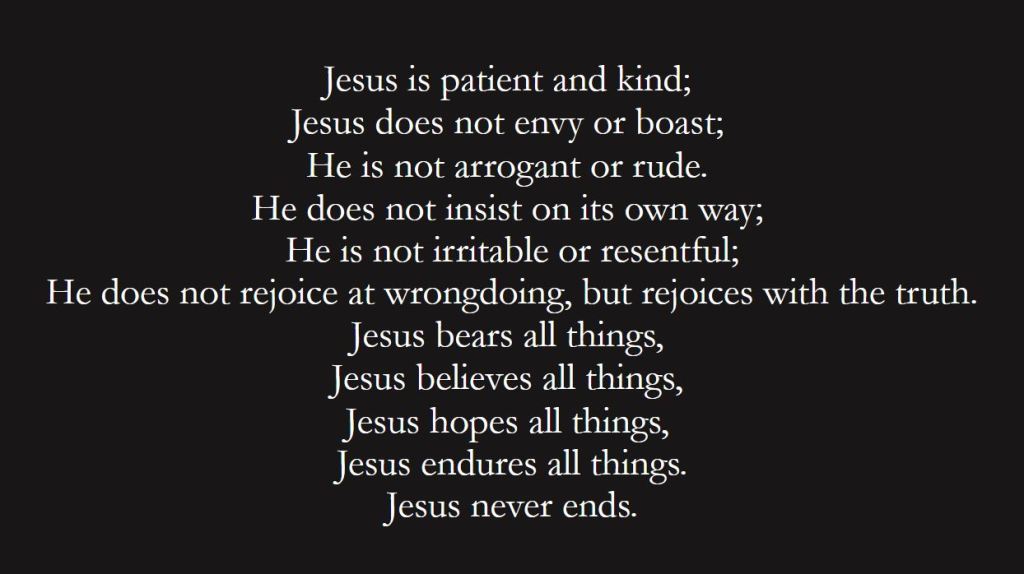
Love is the goal of all of Christian life. Love that is displayed in the life of Jesus. The life and death of Jesus. This love is described in 1 Corinthians 13. Let’s consider
Love is kind
It has been years since a brother once instructed me to replace the term “love” with “Jesus” to get a better understanding of who He is.
Jesus is kind
Kindness, in my mind, is the same as being “nice”.
But does the Bible teach believers to be nice?
Let’s consider a comparison of these two concepts. I owe this information to Crumps Corner.
Kind
Nice
Speaks up
Stays quiet
Healing
Toxic
Tells the truth
Lies to keep the peace
Moves forward with care
Holds back
Takes courage
Lacks courage
Is more concerned for others than self
Is more concerned for self than for others
Desires to be helpful
Desires to be liked
Leads to success
Prevents success
Nice
I read a book a few years ago, simply because the title was so outrageous. “Don’t Be a Nice Christian”, or something like that. I had always assumed that Christianity was typified by niceness. You are so nice Carl, what a nice Christian. You do nice things Carl… The book started to bug me. Alot.
Let’s consider the concept of niceness per Bible teaching.
Okay I found three words in the Bible that refer to “nice”
Bernice, Eunice, Phenice – Definitely not the results I was hoping for! Nothing of any command for believers to “be nice”
Nothing to see here folks. Let’s move along…
Kind
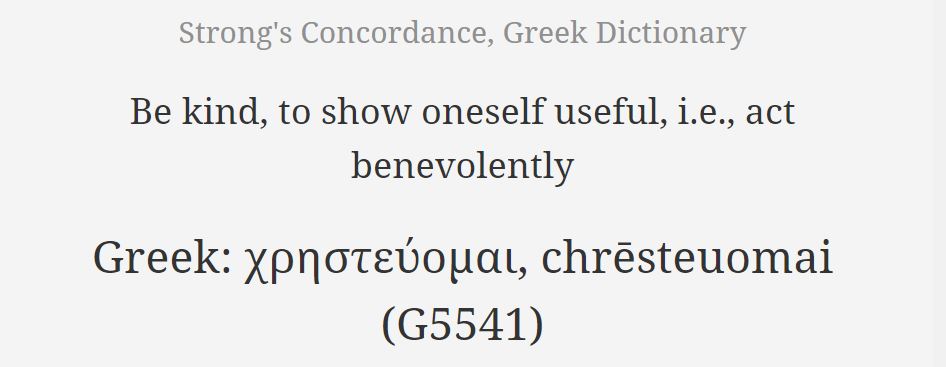
Not so with the kindness Paul uses to describe Christian love. The passage we are reading today defines love as kind (chresteoumai). This word is used ten times in the New Testament, mostly describing the kindness (or sometimes translated as goodness, gentleness) of God. Nevertheless, love as expressed as kind is a goal for the believer to strive to.
What does that look like? This table above, I suggest gives us much to consider. If you are “nice” like I am “nice”, you will want to consider the differences.
2 Corinthians 6:6
by purity, knowledge, patience, kindness, the Holy Spirit, genuine love;
Paul is describing the methods of service to God by which they commend themselves to others. It is interesting that two verses earlier, patience rears its head again in the description of the Christian life! I wonder which patience he refers to? The “makro” or the “hupo”? I gave you a hint in the last post if you remember!
Back to kindness. Paul’s method of serving God included kindness. Vines Expository Dictionary of the New Testament states
It signifies “not merely goodness as a quality, rather it is goodness in action, goodness expressing itself in deeds,
Kindness is not simply a feeling within your heart, or only a good attitude toward others, which of course is required, but it is expressed in acts of usefulness to others. By implication, to those who do not deserve it – those who may be neutral to us, or – dare I say it – our enemies!
Galatians 5:22
But the fruit of the Spirit is love, joy, peace, patience, kindness, goodness, faithfulness,
Kindness is a fruit of the Spirit, not a work of the flesh. Focus on the source and not the fruit and the fruit will fruit out. (does that make sense to you?)
Colossians 3:12
Put on then, as God’s chosen ones, holy and beloved, compassionate hearts, kindness, humility, meekness, and patience,
A simple command for believers to obey. Be kind, by putting on the new man, the Christ.
In conclusion I have a question for my gentle reader.
Was the Christ kind when he cleaned the temple? I certainly do not think He was nice, but again, let us refuse that connection with Christianity.
Jesus replacing Love
So is my brother’s suggestion of replacing the term love with Jesus accurate and helpful?
The gospels do not describe Jesus with the exact Greek term Paul uses in this passage, the root word chrēstos, is definitely used in relation to the Master. Many of you are zeroing in on one of the more famous descriptions of our Lord when He described Himself thusly.
Matthew 11:28-30
Come to me, all who labor and are heavy laden, and I will give you rest.
Take my yoke upon you, and learn from me, for I am gentle and lowly in heart, and you will find rest for your souls.
For my yoke is easy, and my burden is light.”
He is gentle and lowly in heart, and yet the term we are looking at is describing the yoke He is providing to those who will follow. The yoke is “kind”. He is gentle and His yoke in easy, or kind. I have heard it described as a yoke that doesn’t chafe the neck of the one wearing it.
As we look to the Master, as we recognize His character, and the tremendous love He has for us, the yoke, no matter what it may entail in our lives at the time, is tailored to our need and condition. To realize this, we must understand His character, His meekness and lowliness of heart.
He directs us to learn of Him, and yet describes Himself as meek. If He were not the Son of God, this claim to learn of Him would be an act of extreme arrogance. If the Son of God, this direction to learn of Him is wisdom personified.
Learn of Him. He is the truth.
Please join me as we continue our travels through 1 Cor 13, looking at the first description of love as a negative. (Say it isn’t so Carl)
I look forward to comments and discussion. May the Lord give you an understanding heart and a willing spirit to consider the Bible and all it’s wealth.
It’s funny how things go round in life. Over twenty years ago I providentially tripped over the teaching’s of “grace”, and found that my head had additional capacity for puffing up (see 1 Corinthians 8:1).
At the time, I was teaching a Sunday School Class for adults, studying a minimum of 10 hours for every hour in front of the class. (Can you hear the me me monster coming out?)
Nevertheless, did I mention that I was in a church that was NOT Calvinistic, that did not adhere to the teachings of grace.
It wasn’t easy!
Since moving away and not attending that church, I have had the opportunity to consider the teachings of Calvinism. I have found that I just couldn’t retain the obvious conclusions this teaching provided. I initially ignored this particular theory, and then serendipitously found Bible passages that refuted it. Eventually, I came to the conclusion that Calvinism had too many concerns and not enough foundation in the truth.
Years pass, and I venture into other areas of Bible research. Ecclesiology, a bit or Eschatology. Maybe even some hamartiology –
Say it isn’t so Carl! Yes but not for long.
Covid 19 struck America and we spent some time not attending a fellowship. Eventually I had had enough and sought out a church that was welcoming people in their buildings for face to face worship.
What a wonderful idea!
The preaching was good and the folks seemed real friendly. Eventually, it became apparent that this body of believers were of the Calvinistic stripe.
Golly, I become a Calvinist in a non Calvinist church, leave that church and abandon Calvinism, and now begin attending a fine church, with teaching that focuses on the Calvinistic thought process a bit much.
No matter. Fellowship depends on our relationship with the Son, not on our perspective regarding “mysterious” decress in eternity past.
With that said, I would like to offer an alternative consideration of soteriology (Doctrine of Salvation, or the study of Biblical Salvation).
I have found a teacher on You Tube that presents an irenic message, well thought out and, in my humble opinion, a perspective that has far greater support based on the Word of God.
Watch for the first installment in our next “Calvin’s Concerns” post.
I found a book called “12 Steps for the Recovering Pharisee” by John Fischer, and found the following chapters somewhat convicting. Since reading it, I have come to recognize a glaring problem in my life, and you guessed it – I love to “do the Pharisee!”
To do the pharisee is to live a dry, empty and lonely existence. This book will supply specific attitudes that need to be addressed in each of our lives as we seek to live grace-filled lives.
The following heading for the “12 Steps” supply a general outline of the book.
We admit that our single most unmitigated pleasure is to judge other people.
We have come to believe that our means of obtaining greatness is to make everyone lower than ourselves in our own mind.
We realize that we detest mercy being given to those who, unlike us, haven’t worked for it and don’t deserve it.
We have decided that we don’t want to get what we deserve after all, and we don’t want anyone else to either.
We will cease all attempts to apply teaching and rebuke to anyone but ourselves.
We are ready to have God remove all these defects of attitude and character.
We embrace the belief that we are, and will always be, experts at sinning.
We are looking closely at the lives of famous men and women of the Bible who turned out to be ordinary sinners like us.
We are seeking through prayer and meditation to make a conscious effort to consider others better than ourselves.
We embrace the state of astonishment as a permanent and glorious reality.
We choose to rid ourselves of any attitude that is not bathed in gratitude.
Having had a spiritual awakening as the result of these steps, we will try to carry this message to others who think that Christians are better than everyone else.
One passage that rung so true for me is as follows…
“The only way to save a Pharisee is to break a Pharisees back with the burden of the law. There was, and is, hope for the Pharisee, and that hope comes in the form of failure. Failure is the doorway to freedom, but of course this presents a huge dilema, since failure is the one thing a good Pharisee can never accept.
Pick it up if you have ever judged (condemned) anyone in your Christian life.
If any who are reading this and have found what I am describing, please let me know. Comment as you see fit. I always love hearing from you.
In the past few months I have noticed that there are rumblings – at least in my world – of some internet folks trying to make out the message of Paul to be different that that of Jesus.
Never mind the fact that Jesus was dealing with a nation in the last gasps of it’s life and His pleading for their repentance, and Paul’s focus on “making that tent bigger for them dirty Gentiles” (See Isaiah 54:2-3)
Why? I don’t know, and at this point I am not concerned with their motivation, since I will assume the worst, which may not be fair.
Nevertheless, as I was browsing my computer bible study files, I providentially tripped over the following information. I must have found this info years back, and will not take credit for the compiling of the verses, but for the life of me, I am not sure where I found this.
This is the twentieth post addressing different topics from the New Testament that both Jesus and Paul taught on showing similarity in their teachings. My comments will be sparse, (unless they are not)
20. Both had the same attitude toward women’s roles – Did not choose them as church leaders
Jesus
Mark 3:13-19 — And He went up on the mountain and called to Him those He Himself wanted. And they came to Him. Then He appointed twelve, that they might be with Him and that He might send them out to preach, and to have power to heal sicknesses and to cast out demons: Simon, to whom He gave the name Peter; James the son of Zebedee and John the brother of James, to whom He gave the name Boanerges, that is, “Sons of Thunder”; Andrew, Philip, Bartholomew, Matthew, Thomas, James the son of Alphaeus, Thaddaeus, Simon the Cananite; and Judas Iscariot…
Luke 6:12-14 — Now it came to pass in those days that He went out to the mountain to pray, and continued all night in prayer to God. And when it was day, He called His disciples to Himself; and from them He chose twelve whom He also named apostles: Simon, whom He also named Peter… [etc.]
Paul
1 Timothy 2:12 — And I do not permit a woman to teach or to have authority over a man…
1 Timothy 3:2-5 — A bishop [Gr. “overseer”]then must be blameless, the husband of one wife, temperate, soberminded, of good behavior, hospitable, able to teach; not given to wine, not violent, not greedy for money, but gentle, not quarrelsome, not covetous; one who rules his own house well, having his children in submission with all reverence (for if a man does not know how to rule his own house, how will he take care of the church of God?).
Titus 1:5-6 — For this reason I left you in Crete, that you should set in order the things that are lacking, and appoint elders in every city as I commanded you—if a man is blameless, the husband of one wife, having faithful children…
A short post to encourage you with the consistency of the Word. May the Lord strengthen you and bless you as you seek His Kingdom.



 But John, you just taught of who had life and who didn’t and now you are addressing believers?




 I found a book called “12 Steps for the Recovering Pharisee” by John Fischer, and found the following chapters somewhat convicting. Since reading it, I have come to recognize a glaring problem in my life, and you guessed it – I love to “do the Pharisee!”
 In the past few months I have noticed that there are rumblings – at least in my world – of some internet folks trying to make out the message of Paul to be different that that of Jesus.
 Considering the Bible